Assessing elemental ratios as a paleotemperature proxy in the calcite
shells of patelloid limpets
L.E. Graniero
a,⁎, D. Surge
a, D.P. Gillikin
b, I. Briz i Godino
c,d,e, M. Álvarez
c,e aDepartment of Geological Sciences, University of North Carolina Chapel Hill, 104 South Road, Chapel Hill, NC 27571-0035, USA b
Department of Geology, Union College, 807 Union Street, Schenectady, NY 12308, USA c
CONICET-Centro Austral de Investigaciones Científicas, Av./B. Houssay, 200, Ushuaia 9410, Argentina dDepartment of Archaeology, University of York, The King's Manor, York Y01 7EP, UK
e
ICSE-UNTDF, Av./Alem, 1036, Ushuaia 9410. Argentina
a b s t r a c t
a r t i c l e i n f o
Article history: Received 7 January 2016
Received in revised form 17 October 2016 Accepted 19 October 2016
Available online 24 October 2016
Archaeological shell andfish middens are rich sources of paleoenvironmental proxy data. Patelloid limpet shells are common constituents in archaeological middens found along European, African, and South American coast-lines. Paleotemperature reconstructions using oxygen isotope ratios of limpet shells depend on the ability to con-strain the oxygen isotope ratio of seawater; therefore, alternative proxies are necessary for coastal localities where this is not possible. The study evaluates whether Mg/Ca, Sr/Ca, Li/Ca, Li/Mg, and Sr/Li ratios are reliable proxies of sea surface temperature (SST) in the calcite layer of shells of the patelloid limpets,Patella vulgata andNacella deaurata. We compare Mg/Ca, Sr/Ca, Li/Ca, Li/Mg, and Sr/Li ratios to the seasonal variations in con-temporaneousδ18O
shellvalues, which primarily record seasonal changes in SST. Elemental ratios (Mg/Ca, Sr/Ca,
Li/Ca, Li/Mg, and Sr/Li) show no significant correlations with reconstructed SST inP. vulgataandN. deaurata shells, nor do they show sinusoidal cycles expected from a SST proxy. In addition, shellδ13C values show no
sig-nificant ontogenetic trends, suggesting that these limpets exhibit little change in metabolic carbon incorporation into the shell with increasing ontogenetic age. Although shell growth rate exhibits a logarithmic decrease with age based on calculated linear extension rates, growth rate does not correlate with elemental profiles in these limpets. Overall, elemental ratios are not reliable recorders of paleotemperature in patelloid limpets.
© 2016 Elsevier B.V. All rights reserved. Keywords:
Elemental ratios Paleotemperature Patelloid limpets Oxygen isotopes Carbon isotopes Paleoceanography
1. Introduction
Archaeological shell middens potentially contain archives of high-res-olution seasonal variations in coastal sea surface temperature (SST). Lim-pet shells are common constituents in archaeological middens along European, African, and South American coastlines (Álvarez et al., 2011; Balbo et al., 2011). Oxygen isotope ratios (18O/16O) of modern and
ar-chaeological limpet shells from the generaPatella, have been used to re-construct seasonal-scale SST and ocean circulation patterns during the Late Quaternary (Shackleton, 1973; Cohen and Tyson, 1995; Fenger et al., 2007; Ferguson et al., 2011; Colonese et al., 2012; Surge and Barrett, 2012; Wang et al., 2012). Oxygen isotope paleothermometry is based on the temperature dependence of the fractionation of biogenic carbon-ate and ambient wcarbon-aters (reviewed inGrossman, 2012). There is an in-verse relationship between carbonateδ18O values and temperature,
where increases in temperature result in a decrease in carbonateδ18O
values. Such studies depend on the ability to constrain theδ18
O value of seawater (δ18O
water) for accurate paleotemperature calculations.
Fresh-water inputs to coastal environments influenceδ18O
watervalues making
it difficult to constrainδ18O
waterwhen freshwater inputs cannot be
quan-tified. This is especially important in estuarine environments which are subject to seasonal variations in freshwater inputs. Alternative proxies, such as elemental ratios, are potentially useful for such coastal localities where traditional paleotemperature reconstruction methods, such as δ18O values, are unreliable.
Elemental ratios have been used as paleotemperature proxies in corals (Smith et al., 1979; de Villers et al., 1995; Quinn et al., 2006) and foraminifera (reviewed inBaker et al., 2005) with varying degrees of success, and appear problematic in bivalves (e.g.,Klein et al., 1996; Vander Putten et al., 2000; Gillikin et al., 2005; Freitas et al., 2006; Surge and Walker, 2006; Surge and Lohmann, 2008; Wisshak et al., 2008; Poulain et al., 2015). In general, factors that control elemental ra-tios in molluscs appear to vary among studies (e.g.,Carré et al., 2006; Klein et al., 1996; Takesue and van Geen, 2004; Freitas et al., 2006; Sosidan et al., 2006; Poulain et al., 2015). For instance, some studies sug-gest elemental ratios such as Sr/Ca and Mg/Ca ratios reflect changes in ⁎ Corresponding author.
E-mail addresses:[email protected](L.E. Graniero),[email protected](D. Surge),
[email protected](D.P. Gillikin),[email protected](I. Briz i Godino),
[email protected](M. Álvarez).
http://dx.doi.org/10.1016/j.palaeo.2016.10.021
0031-0182/© 2016 Elsevier B.V. All rights reserved.
Contents lists available atScienceDirect
Palaeogeography, Palaeoclimatology, Palaeoecology
growth rate (e.g.,Gillikin et al., 2005; Sosidan et al., 2006; Surge and Walker, 2006; Surge and Lohmann, 2008), while others suggest a bio-logical control (e.g.,Wanamaker et al., 2008). These kinetic and meta-bolic controls appear to be unpredictable among different genera or even within the same species from the same locale (e.g.,Lorrain et al., 2005). Therefore, further investigations on the incorporation of minor and trace element ratios in mollusk shells are warranted.
Few studies have investigated elemental ratios as an independent paleothermometer in limpet shells (Schifano and Censi, 1986; Foster and Chacko, 1995; Ferguson et al., 2011) and none to our knowledge have consideredNacellain their investigations. In addition, this is the first study to examine a suite of elemental ratios as paleotemperature proxies in patelloid limpets. Previous studies that investigate the δ18O-Mg/Ca relationship inPatellashells produce conflicting results.
Schifano and Censi (1986)found thatPatellafrom the Gulf of Bonagia, Sicily, exhibited different Mg and Sr relationships to temperature de-pending on the season. In this case, winter growth showed no correla-tion to temperature, in contrast with high correlacorrela-tion during summer (R2= 0.99;Schifano and Censi, 1986). On the other hand,Ferguson et
al. (2011)concluded that Mg/Ca ratios andδ18O values record the full
range of SST in the Mediterranean, although shells without a clear δ18
O-Mg/Ca relationship were omitted from the paleotemperature re-construction. These seasonal breakdowns in the Mg/Ca-SST relationship have also been noted in bivalves (Vander Putten et al., 2000; Mouchi et al., 2013). Such enigmatic breakdowns in theδ18
O-Mg/Ca relationship are not well understood, but may be species specific.
Although previous studies have investigated elemental ratios such as Sr/Ca, Li/Ca, Li/Mg, and Sr/Li in calcifying organisms, there appears to be considerable variation as to how these ratios are related, if at all, to environmental conditions. For instance, Sr/Ca profiles recorded in aragonitic shells of modern marine gastropods were found to covary with shellδ18O pro
files (Sosidan et al., 2006; Gentry et al., 2006). Sosidan et al. (2006)established that this seasonal variation in Sr/Ca ra-tios ofConusshells is due to seasonal changes in growth rate based on the covariance of Sr/Ca ratios withδ18
O values and linear extension rate. In inorganic calcium carbonate, we expect Sr/Ca ratios to show a temperature dependence in aragonite due to the co-precipitation of Sr with aragonite, but not in calcite (Kinsman and Holland, 1969; Tesoriero and Pankow, 1996). However, in bivalves the relationship be-tween Sr/Ca ratios and temperature appears to be primarily related to growth rate irrespective of shell mineralogy (e.g.,Purton et al., 1999; Takesue and van Geen, 2004; Gillikin et al., 2005; Lorrain et al., 2005; Poulain et al., 2015).
Li/Ca ratios in calcite foraminifera have been investigated as a proxy for temperature, calcification rate, and carbonate ion concentration (Delaney et al., 1985; Hall and Chan, 2004; Marriott et al., 2004; Hathorne and James, 2006). Although Li/Ca ratios increase in planktonic and benthic foraminiferal tests as temperature decreases, other factors appear to be the dominant drivers of Li/Ca ratios including microhabitat, growth rate, mineralogy, and genetic variation among species (Hall and Chan, 2004). Similarly, Li/Mg ratios have been used to reconstruct SST in aragoniticPoritescorals from the Indo-Pacific, however there is likely a biological component to the relationship as well (Hathorne et al., 2013). In bivalves the Li/Ca-SST relationship is less clear; although Li/Ca ratios showed seasonal cycles inArctica islandica, they only exhibit a weak cor-relation between Li/Ca ratios and temperature (Thébault et al., 2009). Correlations between growth increment width and river discharge sug-gest thatfluctuations in bivalve Li/Ca ratios may be related to calcifi ca-tion rate and/or riverine inputs of Li (Thébault et al., 2009; Thébault and Chauvaud, 2013). Finally,Füllenbach et al. (2015)proposed Sr/Li ra-tios serve as a paleotemperature proxy in aragonitic bivalve shells from brackish environments; however, environments in their study are con-sidered marine. Even so, this proxy will be investigated alongside the previously discussed elemental ratios to test whether Sr/Li ratios can be applied to coastal marine environments, which may be susceptible to freshwater influence.
In summary, the present study evaluates whether Mg/Ca, Sr/Ca, Li/ Ca, Li/Mg, and Sr/Li ratios are reliable proxies of SST in calcite shells of the patelloid limpets,Patella vulgataandNacella deaurata. To test this hypothesis, we compare these elemental ratios to seasonal variations in contemporaneousδ18O
shellvalues, which primarily record seasonal
changes in SST.
2. Materials and methods
2.1. Shell and water samples
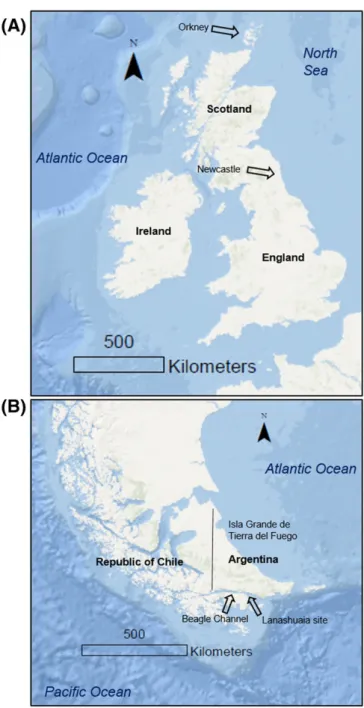
Patella vulgatawere collected alive from the rocky intertidal zone in Whitley Bay, Northumberland, England in June 2001 (Fig. 1A; speci-men NL-0601-3 fromFenger et al., 2007) and in Rack Wick Bay, Westray, Orkney, Scotland in August 2009 (specimen ORK-LT5)
(Table 1;Fig. 1A). Periodic measurements made in previous studies in-dicate that these locations have normal marine salinity, ranging from 34.0 to 34.8 in Whitley Bay (Fenger et al., 2007; Surge and Barrett, 2012).
ModernN. deauratawere collected from the lower intertidal zone of the Beagle Channel (the Outer Cambaceres Bay identified as CE in Fig. 1 ofColonese et al., 2012), Tierra del Fuego, Argentina in August 2009 (specimens ND-MOD-1 and ND-MOD-6;Table 1,Fig. 1B). The Beagle Channel is semi-enclosed and has restricted exchange with Pacific wa-ters (Antezana, 1999). It is influenced by river discharge and summer meltwater (Gordillo et al., 2008; Colonese et al., 2012). The monthly av-erage temperature and salinity from 2009 to 2010 are 7.0 ± 1.6 °C and 34.4 ± 1.8 psu, respectively, in Outer Cambares Bay (Colonese et al., 2012), similar to ongoing monthly monitoring in the Beagle Channel (beginning in October 2015) that indicates that the range in tempera-ture is 10.1 ± 2.4 °C and the range in salinity is 30.6 ± 0.8 psu. Two ar-chaeologicalN. deauratashells (between 1155 ± 40BP (CNA 1056) and 1385 ± 25BP (CNA 590)Evans et al., 2016) were selected from the pre-viously excavated Lanashuaia II site (Colonese et al., 2012) (specimens ND-ARCH-1 and ND-ARCH-3). We refer the reader toFenger et al. (2007)andColonese et al. (2012)for more information about the ecol-ogy of these two species.
Waters samples from the shore of Outer Cambacares Bay (Beagle Channel, 54°52′49.62″S 67°16′26.49″W) were collected once a month to characterize the seasonal variation in oxygen isotope ratios. Monthly sample collection began in October 2015 and will continue for an entire year. We report our water analyses to date (October 2015 to March 2016) together with previously published δ18O
water values from
Colonese et al. (2012). Water was collected and tightly sealed in 30 ml glass vials. Waterδ18
O were measured on a gas-source isotope ratio mass spectrometer (Finnigan Delta S) at the University of Arizona. Sam-ples were equilibrated with CO2gas at approximately 15 °C in an
auto-mated equilibration device coupled to the mass spectrometer. Standardization is based on international reference materials VSMOW and SLAP. Precision is 0.08‰or better forδ18O based on replicates of
in-ternal standards.
2.2. Preparation of shell cross sections
Shells were sectioned from anterior to posterior using a Gryphon di-amond band saw (Fig. 2A). Each half of the sectioned shells were mounted on separate microscope slides and cut into thick sections using a Buehler Isomet low-speed saw. Both thick sections were ground and polished with 1μm diamond suspension grit (Buehler). One polished thick section was used for isotopic and elemental analyses (3 mm thick) and the other was used to make acetate peels (0.5 mm thick). Acetate peels were prepared by etching the shell surface with 5% HCl solution for 30 s. After etching the surface, shells were drenched in acetone, then carefully covered with a 76.2μm (0.003 in.) thick ace-tate sheet for 45 min. Aceace-tate peels were used to enhance the visibility Table 1
Sample list with shell name, age, growth rate, and isotope values.
ShellName
Age (years)
Length sampled (mm)
Mean extension rate (mm/year)
Min δls
O Max δls
O Δ18O (Max-Min)
Average δ18
0 SD δ18 O
Min δ13
C Max δ13
C Δ13C (Max-Min)
Average δ13
C SD δ13 C
Newcastle, UK
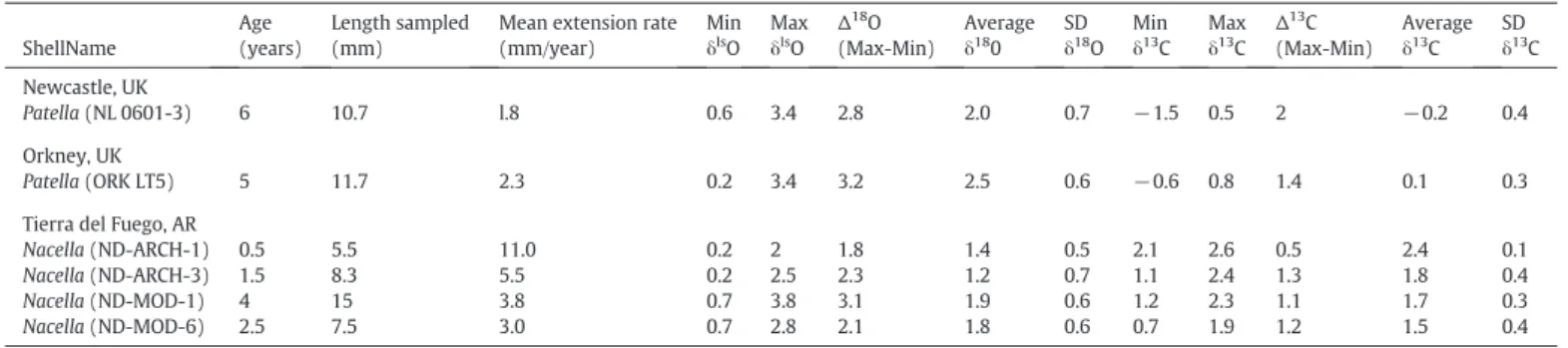
Patella(NL 0601-3) 6 10.7 l.8 0.6 3.4 2.8 2.0 0.7 −1.5 0.5 2 −0.2 0.4
Orkney, UK
Patella(ORK LT5) 5 11.7 2.3 0.2 3.4 3.2 2.5 0.6 −0.6 0.8 1.4 0.1 0.3
Tierra del Fuego, AR
Nacella(ND-ARCH-1) 0.5 5.5 11.0 0.2 2 1.8 1.4 0.5 2.1 2.6 0.5 2.4 0.1
Nacella(ND-ARCH-3) 1.5 8.3 5.5 0.2 2.5 2.3 1.2 0.7 1.1 2.4 1.3 1.8 0.4
Nacella(ND-MOD-1) 4 15 3.8 0.7 3.8 3.1 1.9 0.6 1.2 2.3 1.1 1.7 0.3
Nacella(ND-MOD-6) 2.5 7.5 3.0 0.7 2.8 2.1 1.8 0.6 0.7 1.9 1.2 1.5 0.4
of growth lines (Fig. 2B). Growth increments were used to guide isoto-pic sampling.
2.3. Stable isotopic analysis (δ18O andδ13C)
Samples for isotopic analysis were micromilled at submonthly reso-lution guided by prominent growth increments using a computerized Merchantek micromill.P. vulgatashells are comprised of seven shell layers of both calcitic and aragonitic mineralogy (seeFenger et al., 2007for details). Carbonate microsamples were collected from the inner calcitic layer ofPatellaandNacellaspecimens (i.e., layer m + 2; Fenger et al., 2007; Ferguson et al., 2011; Colonese et al., 2012). Shell NL 0601-3 was previously analyzed byFenger et al. (2007). All other isotope samples were analyzed using a Kiel III coupled to a Finnigan MAT 252 gas-ratio mass spectrometer at the University of Arizona. An-alytical precision is 0.08‰forδ13C and 0.10
‰forδ18O. Isotopic ratios
are reported relative to the Vienna-Pee Dee Belemnite (VPDB) standard. Sea surface temperature reconstructions were calculated using the following paleotemperature equation for calcite (Friedman and O'Neil, 1977modified fromTarutani et al., 1969):
1000 lnα¼2:78106=T2−2:89 ð1Þ
αshell−water¼ δ18Oshellþ1000
= δ18
Owaterþ1000
ð2Þ
whereαis the fractionation factor between shell carbonate and water, T is temperature (°C),
δ18O
water is the oxygen isotope ratio of ambient water versus
Vienna-Standard Mean Ocean Water (VSMOW). The annual average δ18O
watervalues for Newcastle and Orkney, UK are 0.10 ± 0.04‰
for the North Sea (Hickson et al., 1999) and 0.31 ± 0.17‰for Rack Wick Bay (Surge and Barrett, 2012), respectively. Both loca-tions are fully marine and are not significantly influenced by fresh-water runoff (Fenger et al., 2007; Surge and Barrett, 2012and references therein). Theδ18O
watervalue for the Beagle Channel
(Outer Cambaceres Bay identified as CE inFig. 1ofColonese et al., 2012), Tierra del Fuego, Argentina is−1.3 ± 0.2‰based on an av-erage of monthly measurements taken from December 2009 to October 2010 by Colonese et al. (2012) and October 2015 to March 2016 from this study (Table 2).Gordillo et al. (2015)also suggestδ18O
watervalues at this site are relatively constant and
that is appropriate to assume a constant δ18O
water value for
paleotemperature reconstruction. It is unlikely that the archaeo-logicalNacellashells came from Inner Cambaceres Bay, given that modern day Nacella of this size are not present in the Inner
Cambaceres Bay and are harvested primarily from the Outer Bay for human consumption (Briz i Godino, pers. comm.).Nacella pre-fer to inhabit environments with a high level of wave movement, which does not describe conditions in the Inner Cambaceres Bay (Briz i Godino, pers. comm.). Patella shell δ18O values were
corrected for the + 1.01‰predictable offset observed byFenger et al. (2007).Colonese et al. (2012)found thatNacellaprecipitate their shells in isotopic equilibrium requiring no correction factor to be applied.
2.4. Analysis of elemental ratios by LA-ICP-MS
High-resolution elemental analyses were conducted using a laser-ablation inductively-coupled mass spectrometer (LA-ICP-MS; CETAC LSX-213 frequency quintupled Nd:YAG laser (λ= 213 nm) coupled to a Perkin Elmer Elan 6100 DRC ICP- MS) in the Geology Department at Union College, NY (Table 3). Instrumental parameters and data reduc-tion are discussed in Gillikin and Dehairs (2013) andO'Neil and Gillikin (2014). Spot analyses were completed (50μm diameter) at con-stant spacing (150 or 300μm). ThO/Th ratios were monitored daily to check for oxide formation and were alwaysb0.6% (monitored using the NIST 612 glass standard).43Ca was used as an internal standard and7Li,26Mg, and86Sr were monitored. Data were calibrated using
the silicate standard NIST612 with values fromPearce et al. (1992). Analysis of the U.S. Geological Survey pressed carbonate pellet MACS3 suggested a robust calibration and small error (percent relative stan-dard deviations on 26 analyses over three analytical days are: Li = 5.6%, Mg = 4.6%, and Sr = 3.2%). The laser was shot in the inner calcitic layer ofPatellaspecimens (i.e., m + 2;Fenger et al., 2007) and in the inner calcitic layer ofNacellaspecimens.
3. Results
3.1. Shellδ18O andδ13C values
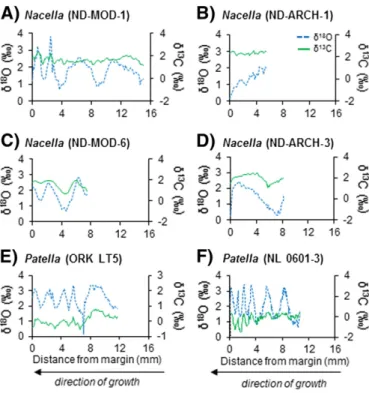
Live-collectedPatellaandNacellashells exhibit a quasi-sinusoidal trend in the temporal variation ofδ18O values (Fig. 3A, C, E and F).
Their number of cycles (peak to peak or trough to trough) range from about 2.5 (ND-MOD-6, between 0 and 7.5 mm) to 6.5 (NL-0601-3, be-tween 0 and 10.7 mm). In contrast, the oxygen isotope time series re-corded in archaeological shell ND-ARCH-1 shows an incomplete cycle (between 0 and 5.5 mm), and specimen ND-ARCH-3 contains only one complete cycle (between 0 and 8.25 mm). Since temperaturefl uc-tuates seasonally, these shellδ18O minima and maxima are used as
measures of annual cycles. Assuming one cycle is equivalent to one year of growth as found in other limpet shells (Fenger et al., 2007; Surge et al., 2013), the ontogenetic age for modern specimens range from ~ 2.5–6.5 years, whereas the two archaeological shells are half a year to a year old.Table 1summarizes the estimated age and descriptive statistics of theδ18O andδ13C time series for each individual. Values of
δ18O andδ13C do not covary except in the last ~3 years of life of
speci-men NL-0601-3. There is no consistent ontogenetic trend inδ13C values
among specimens analyzed in this study (Fig. 4).
3.2. Linear extension rates
Mean annual linear extension rates (LER) were calculated based on δ18
Oshellminima and maxima, which represent summer and winter
temperatures, respectively. Mean annual LER were calculated by esti-mating the number of years represented by theδ18O
shellprofile and
measuring the distance along the shell. Mean LER over the lifetime of the limpets were lower in the UK (1.8 and 2.6 mm/year), than in Argentina (3.0 to 11.0 mm/year;Table 1). Furthermore, archaeological specimens have growth LER that are roughly 2–4 times higher than live-collected specimens of the same species at the same location. In shells where several years were sampled, mean annual LER show a Table 2
Compilation ofδ18
Owatervalues for Tierra del Fuego, AR fromColonese et al. (2012)and this study relative to VSMOW.
Date δ18Owater (‰) Reference
Dec-09 −1.3 Colonese et al. (2012)
Jan-10 −1.6 Colonese et al. (2012)
Feb-10 −1.4 Colonese et al. (2012)
Apr-10 −1.2 Colonese et al. (2012)
Jim-10 −1.3 Colonese et al. (2012)
Aug-10 −0.8 Colonese et al. (2012)
Oct-10 −1.2 Colonese et al. (2012)
Oct-15 −1.3 This study
Nov-15 −1.5 This study
Dec-15 −1.4 This study
Jan-16 −1.2 This study
Feb-16 −1.4 This study
Mar-16 −1.2 This study
logarithmic trend that decreases with ontogenetic age, although only one Patella (NL 0601-3) shows a statistically significant trend (P≤0.05) (Fig. 5).
3.3. Elemental ratios
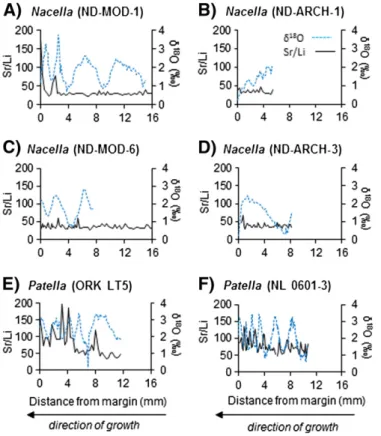
Unlike oxygen isotope ratios, there does not appear to be regular an-nual cycles in any studied profiles of elemental ratios (Figs. 6–10). Similar to carbon isotope ratios, no ontogenetic trends are evident in any of the profiles of elemental ratios. In general, observe some cyclicity inPatella Mg/Ca profiles (Fig. 6E, F) and moreflat lying trends inNacellaMg/Ca pro-files (Fig. 6A, B, D). Mg/Ca ratios inP. vulgataexhibit an apparent cyclicity, although these cycles do not correspond to a coevalδ18O cycle and vary
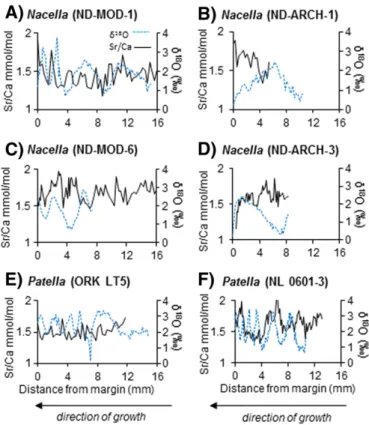
more than two-fold in the Northumberland shell (Fig. 6E). The Sr/Ca ra-tios exhibit cyclicity in some shells (Fig. 7C, F) and not others (Fig. 7A, E). When cyclicity is evident in Sr/Ca there is no associated relationship with co-occurring shellδ18O values. The Li/Ca ratios were similar for all
specimens ranging from ~ 0.02 to 0.06 mmol/mol, with the values fluctuating more rapidly than theδ18O values (Fig. 8). Sr/Li ratios do not
correspond withδ18O curves and tend to be moreflat laying thanδ18O
profiles (Fig. 9). Li/Mg ratios appear to exhibit distinct cycles in ND MOD-6, ND MOD-1, and ND-ARCH-3, although these cycles do not corre-spond to a coevalδ18O cycle (Fig. 10A, C, D).
3.4. Elemental ratio-SST relationship
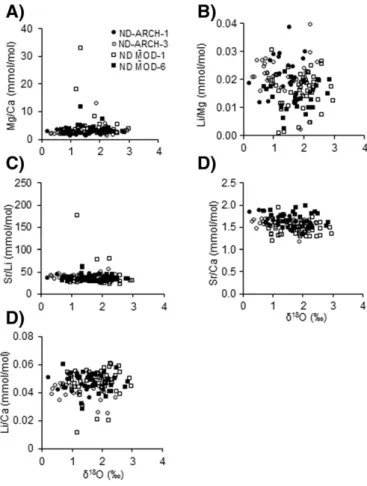
To evaluate elemental ratio-SST correlations, reconstructed SST values were calculated using an established paleotemperature equation (Eqs.(1) and (2)above). Elemental ratios (Mg/Ca, Sr/Ca, Li/Ca, Sr/Li, Li/Mg) show no apparent relationship with reconstructed SST inP. vulgata(Fig. 11) andN. deaurata(Fig. 12) shells. Rather, the cross plots exhibit either a shotgun pattern or relativelyflat trend.Nacella deauratashells have lower Mg/Ca ratios (b10 mmol/mol) thanP. vulgata(N10 mmol/mol). Sr/Ca ratios are relativelyflat lying, and the range for all specimens is approximately 1 to 2 mmol/mol (Figs. 11, 12). Li/Ca and Li/Mg ratios have large scatter in the data for both species (Figs. 11B, E,12B, E). Table 3
Compilation of elemental ratio means, minima, and maxima for all shells in units of mmol/mol for Mg/Ca, Sr/Ca, and Li/Ca. Li/Mg and Sr/Li are unitless.
ShellName
Mean Mg/Ca
Min Mg/Ca
Max Mg/Ca
Mean Sr/Ca
Min Sr/Ca
Max
Sr/Ca Mean Li/Ca Min Li/Ca
Max Li/Ca
Mean Li/Mg
Min Li/Mg
Max Li/Mg
Mean Sr/Li
Min Sr/Li
Max Sr/Li
Newcastle, UK
Patella(NL 0601-3) 19.4 ± 4.1 12.4 35.1 1.6 ± 02 1.3 2.2 0.023 ± 0.007 0.000 0.037 0.001 ± 0.000 0.000 0.003 73 ± 20 43 136 Orkney, UK
Patella(ORKLT5) 18.4 ± 3.0 12.0 25.4 1.5 ± 0.1 1.4 1.7 0.024 ± 0.010 0.008 0.046 0.001 ± 0.001 0.000 0.002 78 ± 40 33 199 Tierra del Fuego, AR
Nacella(ND-ARCH-1) 2.1 ± 0.7 1.3 4.0 l.6 ± 0.l 1.3 1.9 0.048 ± 0.005 0.037 0.055 0.024 ± 0.007 0.012 0.039 34 ± 5 27 46 Nacella(ND-ARCH-3) 2.5 ± 1.7 1.3 12.7 l.6 ± 0.l 1.2 1.9 0.042 ± 0.006 0.020 0.055 0.020 ± 0.007 0.002 0.040 39 ± 6 30 69 Nacella(ND-MOD-1) 4.5 ± 4.0 1.7 32.6 1.5 ± 0.2 1.2 2.2 0.042 ± 0.011 0.022 0.060 0.013 ± 0.007 0.001 0.030 41 ± 24 22 175 Nacella(ND-MOD-6) 3.6 ± 1.5 2.2 8.6 1.7 ± 0.1 1.5 2.0 0.047 ± 0.007 0.029 0.059 0.015 ± 0.005 0.003 0.024 37 ± 7 30 60
Fig. 3.NacellaandPatellashellδ18O andδ13C profiles (‰VPDB). A-D,Nacella deaurata shells collected from Tierra del Fuego, Argentina. MOD = shells collected alive. ARCH = archaeological shells.E-F,Patella vulgatashells collected alive from Orkney (ORK) and Newcastle (NL), UK. The blue dashed lines representδ18
O values and the green solid lines representδ13
C values. Note that time and growth is from right to left.
Nacella deauratashells have Li/Mg ratios an order of magnitude higher thanP. vulgatashells (Fig. 10).
4. Discussion
There are no apparent elemental ratio-SST trends in shells ofP. vulgataandN. deaurata, therefore Mg/Ca, Sr/Ca, Li/Ca, Sr/Li, and Li/Mg are not reliable recorders of SST in paleoenvironmental studies (Figs. 11 and 12, respectively). At Blythe, UK, approximately 20 km from Newcastle, average annual SST trends exhibit a clear sinusoidal trend ranging from about 5 °C in February to 14 °C in August (Fig. 13A). In the Beagle Channel, compiled SST from 1963 through 2011 show a distinct, consistent sinusoidal trend ranging from about 5 °C in July/August to 10 °C in January (Fig. 13B). At both sites, shell δ18O values reflect this distinct sinusoidal trend (e.g.,Fig. 3), especially
in specimens older than 1.5 years. Based on the paleotemperature
equation (Eqs.(1), (2)), these temperature ranges account for a roughly 2‰range in shellδ18O values at Newcastle and a 1‰range in the Beagle
Channel. A compilation of monthlyδ18
Owaterdata from Tierra del Fuego
Fig. 5.Mean annual extension rate with ontogenetic year. Growth rates forPatellaand Nacellaspecimens older than 2 years exhibit a negative logarithmic trend in mean annual extension rate over time. Only NL 0601-3 exhibits a statistically significant trend.
Fig. 6.Shell Mg/Ca ratios andδ18
O values forN. deaurata(A–D) andP. vulgata(E, F). The blue dashed line indicatesδ18
O values and the black solid line indicates Mg/Ca values. Note that time and growth is from right to left.
Fig. 7.Shell Sr/Ca ratios andδ18
O values forN. deaurata(A–D) andP. vulgata(E, F). The blue dashed line indicatesδ18
O values and the black solid line indicates Sr/Ca values. Note that time and growth is from right to left.
Fig. 8.Shell Li/Ca ratios andδ18
O values forN. deaurata(A–D) andP. vulgata(E, F). The blue dashed line indicatesδ18
indicates that variability inδ18O
watervalues is minimal (0.2‰;Table 2).
Therefore, shellδ18
O values are most strongly driven by variations in SST. The annual cyclicity in shellδ18O values is mainly driven by
temperature, therefore, it is reasonable to compare elemental ratios to shellδ18
O values to evaluate whether elemental ratios record variations in temperature (Figs. 11, 12). Thus, it is clear that the elemental ratios do not follow the expected sinusoidal variation in SST. Furthermore, salin-ity variations are not likely to influence Mg, Sr, and Ca concentrations in the water because Mg/Ca and Sr/Ca are conservative at salinities above 10 psu (Dodd and Crisp, 1982; Lazareth et al., 2003). Since study sites are fully marine, salinity variations are not expected to significantly af-fect the Mg/Ca and/or Sr/Ca at either site.
Patella vulgatafrom this study do not show the significant Mg/Ca-SST correlation observed inP. caerulea(Schifano and Censi, 1986; Ferguson et al., 2011) and P. rustica(Ferguson et al., 2011) from previous studies. For instance,Ferguson et al. (2011)were able to recon-struct SST within ~4 °C using Mg/Ca ratios inP. caeruleaandP. rustica from the Mediterranean Sea, although they did report some inconsis-tencies in the Mg/Ca-SST relationship. Shells with no clear correlation betweenδ18O and Mg/Ca values were excluded from their SST
recon-struction, suggesting that Mg/Ca ratios are unpredictable as a paleotemperature proxy. While the absolute Mg/Ca ratios measured in this study are comparable to those fromFerguson et al. (2011)(about 11 to 30 mmol/mol), our samples exhibit the enigmatic breakdown of this Mg/Ca-SST relationship that was observed in one shell from the aforementioned study.
While the cause of this breakdown in Mg/Ca-SST in limpet shells is unknown, we consider habitat heterogeneity and changes in life habit as potential causes. Differences in growth patterns between studies may explain this disparity betweenP. vulgata from the UK, which grow slowly during winter and rapidly during early summer (Blackmore, 1969; Baxter, 1982; Fenger et al., 2007), and otherPatella Fig. 9.Shell Sr/Li ratios andδ18
O values forN. deaurata(A-D) andP. vulgata(E, F). The blue dashed line indicatesδ18
O values and the black solid line indicates Sr/Li values. Note that time and growth is from right to left.
Fig. 10.Shell Li/Mg ratios andδ18
O values forN. deaurata(A-D) andP. vulgata(E, F). The blue dashed line indicatesδ18
O values and the black solid line indicates Li/Mg values. Note that time and growth is from right to left.
Fig. 11.A–E. Elemental ratio-δ18
from the Mediterranean, which grow slowly during the summer (Schifano and Censi, 1986). Variations in microhabitat may potentially impact elemental ratios in limpets as well. A previous study found thatP. vulgataliving in sheltered versus exposed shores are exposed to differing food supply, grazing activity, dessication stress, and preda-tion (Jenkins and Hartnoll, 2001). For instance, grazing at sheltered shores isb50% of that at exposed shores, although the cause of this dis-similarity is debated (seeJenkins and Hartnoll, 2001). Nevertheless, Jenkins and Hartnoll (2001)showed that limpets at comparable densi-ties from sheltered and exposed shores exhibit no significant difference in growth rate despite occupying disparate habitats. More broadly, the difference between limpets inhabiting subtidal and intertidal environ-ments may influence the incorporation of trace elements into shells. Limpets living in subtidal environments experience constant submer-sion and higher food availability than those from intertidal environ-ments (Willmer et al., 2005). The Mg/Ca-SST relationship appears to differ between subtidalP. caerulea(Schifano and Censi, 1986), intertidal P. rustica, P. caerulea(Ferguson et al., 2011), andP. vulgatafrom this study. Furthermore,Schifano and Censi (1986)found that the Mg/Ca-SST inPatella changes seasonally, showing a stronger correlation (R2= 0.99) during warm temperatures, although the annual
correla-tion is significant as well (R2= 0.82).
Strontium to calcium ratios are variable among individuals that grew at the same location, therefore, we suggest that Sr/Ca ratios in our spec-imens are do not appear to be governed by environmental controls. Pre-vious studies reasoned that shell Sr/Ca ratios may be related to calcification temperature (Dodd, 1965), kinetic effects (e.g.,Carpenter and Lohmann, 1992; Lorens, 1981), biological processes, and/or salinity (seeLorrain et al., 2005for a review). However, due to the lack of Sr/Ca-SST correlation (Figs. 11, 12) and no apparent ontogenetic trends (Fig. 7), temperature and metabolism do not appear to be controlling the Sr/Ca ratios inN. deaurataandP. vulgata. Unfortunately, the mecha-nism of Sr2+incorporation into the shell is still not well understood and
is likely controlled by multiple mechanisms. It is likely that Sr/Ca ratios are primarily under biological control, although further research is needed to assess how biology affects the process of Sr2+incorporation
from the water column, through the body, and ultimately into the shell (Gillikin et al., 2005). When the Sr/Ca partition coefficient deviates significantly from 1,Gillikin et al. (2005)suggest controls on Sr/Ca ratios within the shell are controlled by biological processes. The analysis of water Sr/Ca ratios may shed light on the degree of biological controls on shell Sr/Ca ratios.
Recently, Li+has gained attention as an element that may be a
useful paleotemperature proxy in biological carbonates (Delaney et al., 1985; Hall and Chan, 2004; Marriott et al., 2004; Hathorne and James, 2006; Thébault et al., 2009; Thébault and Chauvaud, 2013). The Li/Ca ratios from this study are comparable to values reported for Pecten maximus ranging from ~ 0.01 to 0.100 mmol/mol (Thébault and Chauvaud, 2013). Modern and archaeological Li/Ca ra-tios inN. deauratafrom Tierra del Fuego are comparable, generally ranging from 0.03 to 0.06 mmol/mol (Fig. 8A-D). Likewise, inter-in-dividual variation was low inP. vulgatafrom the UK. Thisfinding sug-gests that shell Li/Ca ratios are under environmental control; however, seasonalfluctuations in shell Li/Ca ratios are difficult to distinguish (Fig. 8). While previous studies suggest that higher SST increases the amount of Li+incorporated intoCerastoderma edule
(Füllenbach et al., 2015), there is no evidence of this effect inN. deaurataorP. vulgata.ForP. vulgata, there is a decrease in Li/Ca with ontogeny in ORK LT5 (R2= 0.68) and NL 0601-3 (R2= 0.31).
Therefore, changes in metabolism and/or growth rate with ontogeny may be influencing Li+incorporation into the shell.
Archaeological and modernN. deauratashells show similar elemen-tal ratio-SST relationships (Fig. 12). This may suggest that while the con-trols on limpet shell elemental ratios (Mg/Ca, Sr/Ca, Li/Ca, Sr/Li, Li/Mg) are not temperature-dependent, they likely have not changed signifi -cantly over time.
Fig. 12.A–E. Elemental ratio-δ18
O relationship for modernNacella deauratalimpet shells. Shells ND 1 and ND 3 are archaeological, and ND MOD-1 and ND MOD-6 are modern.
5. Conclusion
Elemental ratios (e.g., Mg/Ca, Sr/Ca, Li/Ca, Sr/Li, Li/Mg) are not reli-able recorders of paleotemperature in patelloid limpets. Although our results exhibit the breakdown in the Mg/Ca-SST relationship presented byFerguson et al. (2011), they are consistent with the assessment made byFoster and Chacko (1995)that the incorporation of Mg inPatella vulgataare insensitive to changes in environmental conditions. While the cause of enigmatic breakdowns in Mg/Ca-SST in limpet shells is un-known, it may be the result of localized differences in habitat between limpets.
Sr/Ca ratios varied among individuals growing at the same location, which suggests that Sr/Ca ratios are not likely dominated by environ-mental controls. The lack of Sr/Ca-SST correlation and no apparent onto-genetic trends suggest that temperature and metabolism do not appear to be controlling the Sr/Ca ratios inN. deaurataandP. vulgata. Converse-ly, inter-individual variations in Li/Ca were low inP. vulgatafrom the UK suggesting that shell Li/Ca ratios may be under environmental control, although they lack clear seasonalfluctuations in shell Li/Ca ratios as would be expected for a SST proxy (Fig. 8). ForP. vulgata, there is a decrease in Li/Ca with ontogeny in both ORK LT5 (R2= 0.68) and NL
0601-3 (R2= 0.31). Therefore, changes in metabolism and/or growth rate may influence Li+incorporation into the shell. Further research is
necessary to establish the controls on elemental ratios in limpet shells. Considering the variability in elemental profiles between individuals growing in the same location and the lack of any ontogenic trends or any other discernable trends, we suggest that elemental incorporation into limpet shells are governed by a plethora of factors resulting in large inter-individual differences. However, we were able to rule out growth-rate and other ontogenic effects as have been observed in bi-valves (e.g.,Purton et al., 1999; Gillikin et al., 2005; Lorrain et al., 2005). Similar to bivalves (Poulain et al., 2015), limpet shell elemental ratios seem to be under strong physiological control.
Acknowledgements
We thank the United States National Science Foundation (NSF) for funding this project (AGS-1103371; awarded to DS), as well as Union College's LA-ICP-MS (NSF-CCLI #9952410 and NSF-MRI #1039832). We also thank Matthew Manon for general maintenance of the LA-ICP-MS instrumentation. Thanks to David Dettman at the Environmen-tal Isotope Laboratory, University of Arizona, for performing stable isotope analyses. Thanks to Dr. G. Lovrich and his team (CONICE-CADIC) for their help in the measurement of marine water values in Tierra del Fuego. Funding for the project about Fuegian shell middens was provided by the Ministerio de Ciencia e Innovación-Spain (project: HAR2009-06996), Consejo Nacional de Investigaciones Científicas y Técnicas-Argentina (project: PIP-0706) and the Wenner-Gren Founda-tion for Anthropological Research-United States (project: GR7846). The comments and suggestions of the anonymous reviewers signifi -cantly improved the quality of the manuscript.
References
Álvarez, M., Briz i Godino, I., Balbo, A., Madella, M., 2011.Shell middens as archives of past environments, human dispersal and specialized resource management. Quat. Int. 239, 1–7.
Antezana, T., 1999.Hydrographic features of Magellan and Fuegian inland passages and adjacent Subantarctic waters. Sci. Mar. 63 (S1), 23–34.
Baker, S., Cacho, I., Benway, H., Tachikawa, K., 2005.Planktonic foraminiferal Mg/Ca as a proxy for past oceanic temperatures: a methodological overview and data compila-tion for the last glacial maximum. Quat. Sci. Rev. 24, 821–834.
Balbo, A., Madella, M., Briz i Godino, I., Álvarez, M., 2011.Shell midden research: an inter-disciplinary agenda for the quaternary and social sciences. Quat. Int. 239 (1–2), 147–152.
Baxter, J.M., 1982.Population dynamics ofPatella vulgatain Orkney. Neth. J. Sea Res. 16, 96–104.
Blackmore, D.T., 1969.Studies ofPatella vulgataL.I. Growth, reproduction and zonal distri-bution. J. Exp. Mar. Biol. Ecol. 3 (2), 200–213.
Carpenter, S.J., Lohmann, K.C., 1992.Sr/Mg ratios of modern calcite: empirical indicators of ocean chemistry and precipitation rate. Geochim. Cosmochim. Acta 56, 1837–1849.
Carré, M., Bentaleb, I., Bruguier, O., Ordinola, E., Barrett, N.T., Fontugne, M., 2006.Calcifi ca-tion rate influence on trace element concentrations in aragonitic bivalve shells: evi-dences and mechanisms. Geochim. Cosmochim. Acta 70 (19), 4906–4920.
Cohen, A.L., Tyson, P.D., 1995.Sea-surface temperaturefluctuations off southern Africa. The Holocene 5 (3), 304–312.
Colonese, A.C., Verdún-Castelló, E., Álvarez, M., Briz i Godino, I., Zurro, D., Salvatelli, L., 2012.
Oxygen isotopic composition of limpet shells from the Beagle Channel: implications for seasonal studies in shell middens of Tierra del Fuego. J. Archaeol. Sci. 39, 1738–1748.
de Villers, S., Nelson, B.K., Chivas, A.R., 1995.Biological controls on coral Sr/Ca and d18O reconstruction of sea surface temperatures. Science 269 (5228), 1247–1249.
Delaney, M.L., Bé, A.W.H., Boyle, E.A., 1985.Li, Sr, Mg, and Na in foraminiferal calcite shells from laboratory culture, sediment traps, and sediment cores. Geochim. Cosmochim. Acta 49 (6), 1327–1341.
Dodd, J.R., 1965.Environmental control of strontium and magnesium in Mytilus. Geochim. Cosmochim. Acta 29, 385–398.
Dodd, J.R., Crisp, E.L., 1982.Non-linear variation with salinity of Sr/Ca and Mg/Ca ratios in water and aragonitic bivalve shells and implications for paleosalinity studies. Palaeogeogr. Palaeoclimatol. Palaeoecol. 38, 45–56.
Evans, S., Briz, I., Álvarez, M., Roswell, K., Collier, P., Prosser, R.N., Mulville, J., Lacrouts, A., Collins, M., Speller, C., 2016.Using combined biomolecular methods to explore whale exploitation and social aggregation in hunter–gatherer–fisher society in Tierra del Fuego. J. Archaeol. Sci. Rep. 6, 757–767.
Fenger, T., Surge, D., Schöne, B., Milner, N., 2007.Sclerochronology and geochemical var-iation in limpet shells (Patella vulgata): a new archive to reconstruct coastal sea sur-face temperature. Geochem. Geophys. Geosyst. 8 (7), 1–17.
Ferguson, J.E., Henderson, G.H., Fa, D.A., Finlayson, J.C., Charnley, N.R., 2011.Increased sea-sonality in the Western Mediterranean during the last glacial from limpet shell geo-chemistry. Earth Planet. Sc. Lett. 308, 325–333.
Foster, P., Chacko, J., 1995.Minor and trace elements in the shell ofPatella vulgata(L.). Mar. Environ. Res. 40 (1), 55–76.
Freitas, P.S., Clarke, L.J., Kennedy, H., Richardon, C.A., Abrantes, F., 2006.Environmental and biological controls on elemental (Mg/Ca, Sr/Ca, and Mn/Ca) ratios in shells of the king scallopPecten maximus. Geochim. Cosmochim. Acta 70, 5119–5133.
Friedman, I., O'Neil, J.R., 1977.Compilation of stable isotope fractionation factors of geo-chemical interest. In: Fleischer, M. (Ed.), Data of Geochemistry. U. S. Gov. Print. Off, Washington, D.C., pp. 1–12.
Füllenbach, C.S., Schöne, B.R., Mertz-Kraus, R., 2015.Strontium/lithium ratios in shells of
Cerastoderma edule–a potential temperature proxy for brackish environments. Geophys. Res. Abstr. EGU Gen. Assem. 17.
Gentry, D.K., Sosidan, S., Grossman, E.L., Rosenthal, Y., Hicks, D., Lear, C.H., 2006.Stable iso-tope and Sr/Ca profiles from the marine gastropodConus ermineous: testing a multiproxy approach for inferring paleotemperature and paleosalinity. PALAIOS 23 (4), 195–209.
Gillikin, D.P., Dehairs, F., 2013.Uranium in aragonitic marine bivalve shells. Palaeogeogr. Palaeoclimatol. Palaeoecol. 373, 60–65.
Gillikin, D.P., Lorrain, A., Navez, J., Taylor, J.W., André, L., Keppens, E., Baeyens, W., Dehairs, F., 2005.Strong biological controls on Sr/Ca ratios in aragonitic marine bivalve shells. Geochem. Geophys. Geosyst. 6, Q05009.
Gordillo, S., Rabassa, J., Coronato, A., 2008.Paleoecology and paleobiogeographic patterns of mid-Holocene molluscs from the Beagle Channel (southern Tierra del Fuego, Argentina). Rev. Geol. Chile 35 (2), 321–333.
Gordillo, S., Brey, T., Beyer, K., Lomovasky, B.J., 2015.Climatic and environmental changes during the middle to lateHolocene in southern South America: a sclerochronological approach using the bivalveRetrotapes exalbidus(Dillwyn) from the Beagle Channel. Quat. Int. 337, 83–90.
Grossman, E.L., 2012.Applying oxygen isotope paleothermometry in deep time. In: Ivany, L.C., Huber, B.T. (Eds.), Reconstructing Earth's Deep-Time Climate—The State of the Art in 2012, Paleontological Society Short Course, November 3, 2012. The Paleonto-logical Society Papers vol. 18, pp. 39–67.
Hall, J.M., Chan, L.-H., 2004.Li/Ca in multiple species of benthic and planktonic foraminif-era: thermocline, latitudinal and glacial-interglacial variation. Geochim. Cosmochim. Acta 68 (3), 529–545.
Hathorne, E.C., James, R.H., 2006.Temporal record of lithium in seawater: a tracer for sil-icate weathering? Earth Planet. Sci. Lett. 246 (3–4), 393–406.
Hathorne, E.C., Felis, T., Suzuki, A., Kawahata, H., Cabioch, G., 2013.Lithium in the arago-nite skeletons of massivePoritescorals: a new tool to reconstruct tropical sea surface temperatures. Paleoceanography 28, 143–152.
Hickson, J.A., Johnson, A.L.A., Heaton, T.H.E., Balson, P.S., 1999.The shell of the queen scal-lopAequipecten opercularis(L.) as a promising tool for palaeoenvironmental recon-struction: evidence and reasons for equilibrium stable-isotope incorporation. Palaeogeogr. Palaeoclimatol. Palaeoecol. 154 (4), 325–337.
Jenkins, S.R., Hartnoll, R.G., 2001.Food supply, grazing activity and growth rate in the lim-petPatella vulgataL.: a comparison between exposed and sheltered shores. J. Exp. Mar. Biol. Ecol. 258 (1), 123–139.
Kinsman, D.J.J., Holland, H.D., 1969.The co-precipitation of cations with CaCO3- IV. The
co-precipitation of Sr2+ with aragonite between 16 °C and 96 °C. Geochim. Cosmochim. Acta 33, 1–17.
Klein, R.T., Lohmann, K.C., Thayer, C.W., 1996.Bivalve skeletons record sea-surface tem-perature andδ18
O via Mg/Ca and18
O/16
O ratios. Geology 24 (5), 415–418.
Lazareth, C.E., Vander Putten, E., André, L., Dehairs, F., 2003.High-resolution trace element profiles in shells of the mangrove bivalveIsognomon ephippium: a record of environ-mental spatio-temporal variations? Estuar. Coast. Shelf Sci. 57, 1103–1114.
Lorrain, A., Gillikin, D.P., Paulet, Y.-M., Chauvaud, L., Mercier, A.L., et al., 2005.Strong kinet-ic effects on Sr/Ca ratios in the calcitkinet-ic bivalve. Geol. Geol. Soc. Am. 33 (12), 965–968.
Marriott, C.S., Henderson, G.M., Belshaw, N.S., Tudhope, A.W., 2004.Temperature depen-dence ofδ7
Li,δ44
Ca and Li/Ca during growth of calcium carbonate. Earth Planet. Sci. Lett. 222, 615–624.
Mouchi, V., de Rafélis, M., Lartaud, F., Fialin, M., Verrecchia, E., 2013.Chemical labelling of oyster shells used for time-calibrated high-resolution Mg/Ca ratios: a tool for estima-tion of past seasonal temperature variaestima-tions. Palaeogeogr. Palaeoclimatol. Palaeoecol. 373, 66–74.
O'Neil, D.D., Gillikin, D.P., 2014.Do freshwater mussel shells record road salt pollution? Sci. Rep. Nat. 4, 7168.
Pearce, N.J.G., Perkins, W.T., Abell, I., Duller, G.A.T., Fuge, R., 1992.Mineral microanalysis by laser ablation inductively coupled plasma mass spectrometry. J. Anal. Atom. Spectrom. 7, 53–57.
Poulain, C., Gillikin, D.P., Thébault, J., Munaron, J.M., Bohn, M., Robert, R., Paulet, Y.-M., Lorrain, A., 2015.An evaluation of Mg/Ca, Sr/Ca, and Ba/Ca ratios as environmental proxies in aragonite bivalve shells. Chem. Geol. 396, 42–50.
Purton, L., Shields, G.A., Brasier, M.D., Grime, G.W., 1999.Metabolism controls Sr/Ca ratios in fossil aragonitic mollusks. Geology 27 (12), 1083–1086.
Quinn, T.M., Taylor, F.W., Crowley, T.J., 2006.Coral-based climate variability in the West-ern Pacific Warm Pool since 1867. J. Geophys. Res. 111, 1–11.
Schifano, G., Censi, P., 1986.Oxygen and carbon isotope composition, magnesium and strontium contents of calcite from a subtidalPatella caeruleashell. Chem. Geol. Isot. Geosci. Sect. 58 (4), 325–331.
Shackleton, N.J., 1973.Oxygen isotope analysis as a means of determining season of occu-pation of prehistoric midden sites. Archaeometry 15 (1), 133–141.
Smith, S.V., Buddemeier, R.W., Redalje, R.C., Houck, J.E., 1979.Strontium-calcium ther-mometry in coral skeletons. Science 204 (4931), 404–407.
Sosidan, S., Gentry, D.K., Lear, C.H., Grossman, E.L., Hicks, D., Rosenthal, Y., 2006.Strontium to calcium ratios in the marine gastropodConus ermineous: growth rate effects and temperature calibration. Geochem. Geophys. Geosyst. 7 (11), 1–17.
Surge, D., Barrett, J.H., 2012. Marine climatic seasonality during medieval times (10th to 12th centuries) based on isotopic records of Viking age shells from Orkney, Scotland. Palaeogeogr. Palaeoclimatol. Palaeoecol. 350–352 (0):236–246.http://dx.doi.org/10. 1016/j.palaeo.2012.07.003.
Surge, D., Lohmann, K.C., 2008. Evaluating Mg/Ca ratios as a temperature proxy in the es-tuarine oyster,Crassostrea virginica. J. Geophys. Res. Biogeosci. 113, G02001.http:// dx.doi.org/10.1029/2007JG000623.
Surge, D., Walker, K.J., 2006.Geochemical variation in microstructural shell layers of the southern quahog (Mercenaria campechiensis): implications for reconstructing season-ality. Palaeogeogr. Palaeoclimatol. Palaeoecol. 237 (2–4), 182–190.
Surge, D., Wang, T., Gutiérrez-Zugasti, I., Kelley, P.H., 2013. Isotope sclerochronology and season of annual growth line formation in limpet shells (Patella vulgata) from warm-and cold-temperate zones in the eastern North Atlantic. PALAIOS 28:386–393.http:// dx.doi.org/10.2110/palo.2012.p12-038r.
Takesue, R.K., van Geen, A., 2004.Mg/Ca, Sr/Ca, and stable isotopes in modern and Holo-ceneProtothaca stamineashells from a northern California coastal upwelling region. Geochim. Cosmochim. Acta 68 (19), 3845–3861.
Tarutani, T., Clayton, R.N., Mayeda, T.K., 1969.The effect of polymorphism and magnesium substitution on oxygen isotope fractionation between calcium carbonate and water. Geochim. Cosmochim. Acta 33, 987–995.
Tesoriero, A.J., Pankow, J.F., 1996.Solid solution partitioning of Sr2+
, Ba2+
, and Cd2+
to calcite. Geochim. Cosmochim. Acta 60, 1053–1063.
Thébault, J., Chauvaud, L., 2013.Li/Ca enrichments in great scallop shells (Pecten maximus) and their relationship with phytoplankton blooms. Palaeogeogr. Palaeoclimatol. Palaeoecol. 373, 108–122.
Thébault, J., Schöne, B.R., Hallmann, N., Barth, M., Nunn, E.V., 2009.Investigation of Li/Ca variations in aragonitic shells of the ocean quahogArctica islandica, Northeast Iceland. Geochem. Geophys. Geosyst. 10, Q12008.
Vander Putten, E., Dehairs, F., Keppens, E., Baeyens, W., 2000.High resolution distribution of trace elements in the calcite shell layer of modernMytilus edulis: environmental and biological controls. Geochim. Cosmochim. Acta 64 (6), 997–1011.
Wanamaker Jr., A.D., Kreutz, K.J., Wilson, T., Borns Jr., H.W., Introne, D.S., Feindel, S., 2008.
Experimentally determined Mg/Ca and Sr/Ca ratios in juvenile bivalve calcite for
Mytilus edulis: implications for paleotemperature reconstructions, advances in mol-lusc sclerochronology and sclerochemistry: tools for understanding climate and envi-ronment. Geo-Mar. Lett. Spec. Issue 28.
Wang, T., Surge, D., Mithen, S., 2012.Seasonal temperature variability of the Neoglacial (3300-2500 BP) and roman warm period (2500-1600 BP) reconstructed from the ox-ygen isotope ratios of limpets shells (Patella vulgata), Northwest Scotland. Palaeogeogr. Palaeoclimatol. Palaeoecol. 317-318, 104–113.
Willmer, P., Stone, G., Johnston, I.A., 2005.Environmental Physiology of Animals. Black-well Pub. Print, Malden, MA.
Wisshak, M., Correa, M.L., Gofas, S., Salas, C., Taviani, M., Jakobsen, J., Freidwald, A., 2008.