A Pooled Time-Series Analysis
By
Thomas Causey
Senior Honors Thesis Political Science
University of North Carolina at Chapel Hill
April 8, 2020
Approved:
Dr. Timothy McKeown, Advisor
Dr. Layna Mosley, Reader
Abstract:
1 Introduction
As China’s economy has continued to grow, pundits and scholars alike have begun paying more attention to the political ramifications of its impressive material wealth.
Indeed, Beijing is playing an ever-more important role in the world of development finance, and this has generated significant interest in what China’s aid means for both its
recipients and for traditional donors of foreign aid. While scholars have firmly established that states use their foreign aid flows in service of their foreign policies, relatively fewer works have studied whether and how China uses its state-backed
financing to pursue its diplomatic goals.
In this paper, I build upon the results of Dreher and colleagues (2018) by
investigating how China’s foreign aid1 affects recipients’ voting patterns within the United Nations General Assembly. Scholars have shown that China takes political considerations into account when disbursing its foreign aid, suggesting that Beijing is, at
the very least, attempting to use foreign aid as a tool for foreign policy. However, as I discuss below, the literature also provides reasons to be doubtful of the success of such
attempts. To investigate the relationship between Chinese aid and support for its policies within the UNGA, I estimate a series of pooled time series models incorporating both country- and year-fixed effects. My results provide no evidence to suggest that aid is a
consistent predictor of future accommodation for Beijing’s stances. Rather, trade flows appear to have a much stronger effect on China’s diplomatic ties, suggesting that Beijing
The remainder of the paper is divided as follows. The next section presents an overview of previous literature studying the relationship between foreign aid and states’
bilateral relations. In the third section, I build on previous work by Bueno de Mesquita and Smith (2007, 2009) to develop a theory of Chinese vote-buying attempts in the UNGA. Section four presents an approach for evaluating my hypotheses, with the results
presented in the fifth section. Faced with evidence contradicting my expectations, I provide potential theoretical explanations for these results. Additionally, I find tentative
evidence that Chinese state-backed financing may work to improve Beijing’s diplomatic relations with recipients through promoting its trade ties. Finally, the last section presents concluding remarks.
2 Literature Review
Foreign Aid and Vote-Buying
The study of how states use foreign aid as a tool of foreign policy lies within a larger literature of economic statecraft. Baldwin defines this phenomenon as “influence
attempts relying primarily on resources that have a reasonable semblance of a market price in terms of money” (1985, 30). Arguing against the idea that economic sanctions are a poor use of the state’s resources, Baldwin demonstrates that major powers have, in
the past, been successful at using economic means to influence other states, even though success is hard to measure in many cases. Drezner (2003) likewise argues that because
While these and other works focus on the use of sanctions, scholars have long studied foreign aid’s efficacy as a tool for influence. Morgenthau (1962) argues that US
foreign aid neither serves its stated objective of advancing economic development in recipient states or its underlying goal of securing political benefits. Other studies have largely corroborated the idea that foreign aid is not always allocated with development
goals alone in mind. Trumbull & Wall (1992) find that flows of official development assistance (ODA) follow a mix of goals, reflecting both recipients’ needs and donors’
political intentions in allocating the aid. Likewise, Alesina & Dollar (2000) find that donors allocate more aid to countries with whom they have colonial ties or that present a certain strategic value. Clearly, foreign aid is one of many tools that states use to pursue
their foreign policy goals.
One such goal is securing support in international organizations, particularly
bodies like the United Nations General Assembly (UNGA). Wang (1999) demonstrates that the United States has had success in linking foreign aid to compliance within the UNGA. By focusing on votes that the US government has deemed crucial to US interests,
he shows that US foreign aid flows lead to greater support for these specific votes within the body. As Wang writes, many votes within the UN “are simply not important enough
for the US to expend its scarce resources in influencing the outcomes.” (Wang 1999, 199). For these key votes, however, the US government is both willing and able to exchange foreign aid for recipients’ support. This emphasis on particular resolutions,
rather than all issues, forms the basis for much subsequent work on vote-buying behavior. Just as donors do not view all votes as equal, so do recipients not view all aid as
compliance within the UNGA, the US’ success depends in part on the content of the aid package itself. Concessional aid such as grants and general budget support is more likely
to win the US support among recipients, as these regimes have the most discretion over how to use such aid. Conversely, tied and project-level aid is much less likely to be employed in pursuit of diplomatic allies. That a relatively small portion of Chinese aid
fits the former definition raises questions about the effectiveness of China’s foreign aid flows in buying political support. If the US project-level aid has done little to buy it
support within the UNGA, why would similar aid from China work where the US’s failed? Investigating such questions is a key goal of this paper.
Other work has shown that vote-buying behavior permeates a number of different
international organizations. Kuziemko and Werker (2006) show that countries serving their two-year term on the United Nations Security Council (UNSC) receive significantly
more aid from the US. Likewise, Dreher, Sturm, and Vreeland (2009) show that the US also uses its influence within the International Monetary Fund (IMF) to buy the votes of temporary UNSC members. These results make sense in light of Wang’s finding that
states value certain votes more highly than others. Compared to the UNGA, votes within the UNSC are of much greater importance to the United States. Particularly during years
where it is seeking support for a major military or diplomatic initiative, the US pays out great sums to temporary members of the council. In addition to these votes affecting major international decisions, vote-buying attempts and donor competition be observed in
institutions that play a much less important role in global affairs, such as the International Whaling Commission (Biddel 2015). These works demonstrate that major powers care a
they are willing to use their foreign aid in pursuit of diplomatic allies. Additionally, it shows then when looking for evidence of vote-buying, focusing on votes of particular
importance to the donor state is critical.
While the above-mentioned studies have focused on the political effects of foreign aid, other scholars have focused on the logic driving such influence attempts.
Bueno de Mesquita and Smith (2007, 2009) propose a theoretical model to explain how and why donor states swap foreign aid for policy concessions. In their thinking,
aid-for-policy swaps are driven primarily by leaders’ desires to stay in office. Donors use foreign aid to buy policy concessions from recipient states, thereby delivering payoffs to their own support base. Likewise, recipients use the funds to consolidate their grip on power
by delivering economic benefits to their own supporters. This theory provides a powerful explanation for why states might be willing to offer their support in exchange for aid.
Poor regimes likely value votes within international organizations less than the ability to pay off their supporters using aid. Key to Bueno de Mesquita and Smith’s theory is the assumption that foreign aid is inherently fungible, or that it is used to fund activities that
recipient regimes would have pursued otherwise. Receipt of fungible aid, then, allows a regime to spend money in other areas, delivering benefits to the regime’s support base.
This touches on a separate debate within the foreign aid literature.
Different assumptions about fungibility can lead to very different estimates of foreign aid’s effect on recipient countries. Taking the view that foreign aid is fungible,
Morrison (2009) finds support for his argument that foreign aid has a stabilizing effect on recipient regimes, mirroring the effect that other sources of nontax revenue (especially, in
this understanding of foreign aid. Arguing that donor nations can provide non-fungible aid that is “used for purposes the recipient government would not have otherwise
pursued” (2). While this debate is separate from the study of vote-buying in international institutions, it nonetheless provides important lessons for the study of vote-buying. If foreign aid and other forms of nontax revenue actually serve similar purposes, then it will
be important to control for such resources in any analysis of foreign aid.
Some scholars have sought to investigate the effect that regime type has on the
aid-for-policy dynamic. For their part, Bueno de Mesquita and Smith (2007, 2009) predict that more open, democratic nations will be more likely to propose aid-for-policy swaps, while recipient regimes who have a particularly narrow base of support will be
more open to exchanging such policy. Likewise, Carter and Stone (2015) find that the United States has had more success in using its foreign aid flows to influence democratic
recipients. More autocratic recipients are less likely to abide by US influence attempts. Because many of these regimes have an unsteady grip on power, they need foreign aid to maintain control over the country, and this fragility undercuts the credibility of any US
threats to revoke aid. As such, the US has had much more success in influencing democracies than non-democracies. The results of Brazys and Panke (2015) provide an
interesting complement to this finding. Focusing on repeated votes within the UNGA, they find that autocratic nations can switch their votes more easily than democracies can, likely because they lack the institutional or bureaucratic constraints that more democratic
regimes do. Each of these works raises important questions for the study of Chinese aid. That China appears to be such a large donor of aid seems to conflict with Bueno de
swaps, especially when other works seem to suggest that China is engaging in vote-buying attempts (Dreher et al. 2018). Likewise, Carter and Stone demonstrate the US’
failure to coerce autocracies. This rests in large part on the fact that the US has a strategic interest in propping up its authoritarian aid partners; that China likely lacks this interest raises important questions about whether this holds true for China’s foreign aid attempts
as well. Along with Brazys and Panke’s finding that authoritarian institutions are more conducive to vote-swapping, these works lead me to consider regime type analysis in my
analysis below.
In short, explaining any aid-for-policy dynamic requires careful attention to each party’s interests. First, one must pay careful attention to the votes that are of particular
importance to donor nations (Dreher, Sturm, and Vreeland 2009; Kuziemko and Werker 2006; Wang 1999). The type of aid in question can also influence foreign aid’s
effectiveness at buying policy concessions (Dreher, Nunnenkamp, and Thiele 2008). As for the recipient, scholars have shown that their regime type and access to similar forms of capital can affect their susceptibility to vote-buying attempts (Brazys and Panke 2017;
Carter and Stone 2015). As most of these works have focused on the United States or other Western donors, I hope to investigate whether China’s foreign aid is similarly
effective at buying policy concessions within international organizations. I also hope to test whether or not Beijing’s influence attempts are subject to the same constraints that the US’ is.
The above-mentioned studies have focused in large part on traditional donors, that is, the United States, Japan, and other members of the G7 club. However, as China has
grown wealthier, its aid programs have ballooned in size, with the country reportedly dispersing over USD$14 billion between 2010 and 2012 alone (State Council 2011, 2014). Below, I discuss not only China’s foreign aid flows but also its overall foreign
policy goals and other attempts at economic statecraft.
To understand China’s foreign policy situation, one must remember that the
foreign policy of the Chinese government is driven primarily by the interests of the Chinese Communist Party (CCP). Scholars have shown how the party’s unique strategic situation drives much of its foreign policy decisions. Scobell and Nathan (2012) argue
that the CCP’s search for security drives Chinese foreign policy, echoing other work that argues a similar instinct drives aid-for-policy swaps (Bueno de Mesquita and Smith 2007;
2009). In the diplomatic sphere, this manifests itself primarily in Beijing’s attempts to build diplomatic coalitions within international organizations. China’s intentions in this are manifold. First, it hopes to isolate Taiwan diplomatically, excluding it from
international organizations and advancing the PRC’s one-China policy. Additionally, it hopes to shield itself from condemnations of its human rights record, especially after the
wave of criticism that followed the 1989 Tiananmen Square crackdown. Chinese
diplomats also seek to advance their own preferred norms on key issues like sovereignty and non-interference. In doing so, Chinese leaders hope to shield themselves from
international criticism and threats to the country’s territorial integrity.
Other works have pointed to specific examples of such diplomacy. Foot and
Human Rights Council, finding that Chinese diplomats attempted to and were partially successful in mobilizing diplomatic allies to shape the institution to their liking.
Interestingly, they find that China did not have to rely on overtly coercive or threatening means to build a coalition. Rather, it was able to lean on other like-minded states and its own image as a champion for the developing world to achieve a favorable outcome.
Likewise, Alden & Large (2015), in their study of China’s Africa policy, show the extent to which China works to reshape international norms to emphasize values like
non-interference and non-intervention, values that, if adopted, would shield China from condemnation of its human rights abuses. Here, too, the authors find that China did not have to rely too much on coercive statecraft. Many African nations and developing
countries view China in a positive light, and as such, follow the country’s attempts to shape international norms to its own liking.
Other work has focused on Beijing’s use of more coercive means to achieve foreign policy goals, and the results suggest that success in such attempts is far from guaranteed. Kastner (2016) finds that trade with China has led many countries to
accommodate Beijing’s stance on economic issues, but finds mixed evidence that such ties have led to support for China’s actions in Tibet or attitude towards Taiwanese
independence. Rather, whether a state is more autocratic or democratic in nature is a stronger predictor of how it views China’s actions. Autocratic states with similarly poor human rights records were more likely to support China’s stance, with trade being a
much weaker predictor of support. Similarly, Drezner (2009) also finds that China has had some success in using financial means to influence Taiwan, but otherwise has been
Some studies have shown evidence of more successful attempts at political coercion. Brazys and Dukalskis (2017) find that China has used both diplomatic and
economic means to influence votes within the UNGA, particularly on votes pertaining to human rights, non-interference, democracy, and state sovereignty. They show that increased trade with China resulted in closer ties within the UNGA. Additionally,
autocratic regimes are more likely to move into alignment with China, with democracies being less likely. Likewise, Flores-Macías and Kreps (2013) also show that trade with
China leads to foreign policy concessions: as states come to rely on China for trade, their foreign policies come to align with Beijing’s as well. While this work demonstrated the real consequences that result from increased trade with China, the authors do not give an
explicit causal explanation for why this occurs. Here, the work of Davis, Fuchs, and Johnson (2017) is crucial. They show that because of China’s unique political economy,
it is able to exert more control over economic actors in pursuit of political ends. Specifically, because the Chinese government controls the state-owned enterprises (SOE’s) that play such a large role in China’s trading relationships, the state is able to put
pressure on these actors, restricting trade to punish countries it hopes to influence. The most comprehensive study on China’s economic statecraft produces
important conclusions about the determinants of any influence attempts. Norris’s (2016) study, while not focusing explicitly on Chinese foreign aid, nonetheless provides very valuable conclusions. He focuses primarily on the principal-agent relationship between
the Chinese state and the economic actors it wishes to control, attempting to identify the factors determining when China is more or less successful in its attempts to control
applicable to Chinese foreign aid. Because the Chinese state, by definition, has direct control over state-backed loans, there is not a similar principal-agent relationship like the
one that Norris studies. Nonetheless, he identifies one factor that is particularly important to this study: state unity. When the government actors formulating policy are divided in their incentives, motivations, or policy goals, they fail to adequately control economic
actors for political ends. This observation is extremely crucial in light of Zhang and Smith’s (2017) study. Interviewing hundreds of officials involved in the Chinese foreign
aid bureaucracy, they find that this process is marked by internal division and fierce competition between multiple government agencies. While the Ministry of Commerce (MOFCOM) plays the most important role and oversees the lion’s share of Chinese
foreign aid projects, Zhang and Smith argue that the role of China’s Ministry of Foreign Affairs (MFA) cannot be ignored. MOFCOM is primarily concerned with the interests of
Chinese businesses, but the MFA is tasked with improving China’s diplomatic relations, and it uses its influence to ensure that foreign aid decisions serve China’s political interests, rather than the interests of Chinese corporations alone. This competition is
interesting in light of Norris’ findings. If the government officials in charge of allocating aid cannot agree on the ultimate goal of such loans, then his framework tells us we should
be skeptical that Chinese aid will do much to buy policy concessions from its recipients. The study of China’s aid flows often presents a more difficult pursuit than the study of its trade ties. Chinese aid flows remain notoriously opaque (Bräutigam 2011),
and although the Chinese government occasionally publishes white papers on its foreign aid flows (State Council PRC 2011; 2014), there is good reason to doubt the accuracy of
interesting findings on Chinese aid. Woods (2008) examines the increasingly important role China plays in providing international aid to developing countries, particularly in
Africa. Because Chinese aid rarely includes stipulations related to a recipient nation’s internal affairs, such funding has become a relatively more attractive option for developing nations. Because the political reforms demanded by Western donors are
politically costly for recipient regimes, they prefer Chinese aid. Watkins (2020) finds that receipt of Chinese aid decreases recipients’ compliance with traditional lenders’
conditionality, while Kilama (2016) finds that Western donors are increasingly using their foreign aid flows to curb Chinese influence on the continent.
One study is of particular importance to this project. To investigate the
determinants of Chinese aid flows, Dreher and colleagues (2018) use a novel dataset that captures information on thousands of Chinese state-backed investments around the world.
Key to their analysis is how they distinguish between different kinds of aid. They classify financing that meets the OECD-DAC’s definition of official development assistance (ODA) as “ODA-like” loans, and they find support for their hypothesis that China
allocates these types of loans for political purposes. Conversely, they term non-concessional financing “other official flows” and hypothesize that these loans are
allocated according to China’s economic interests. Importantly, they show that China allocates its concessional, ODA-like loans to countries that vote alongside it in the UNGA. This demonstrates that China certainly has political motivations in mind when
allocating its concessional financing. However, while their results provide strong
evidence that China engages in vote-buying behavior, they say less about whether Beijing
on the receipt of aid, and while the authors establish the correlation between supporting China in the UNGA and receiving aid, they stress that their analysis does not necessarily
explain year-to-year changes in aid (187), but rather cross-country variation. As such, I aim to build upon these results, testing the effect of aid on subsequent voting patterns in the UNGA.
Taken together, these works provide a strong foundation for my own research and a solid basis for the study of Chinese attempts at vote-buying. First, we know that
Chinese leaders, driven by a desire to maximize regime stability (Nathan and Scobell 2012), care a great deal about building coalitions within international organizations (Alden and Large 2015; Foot and Inboden 2014). It is also clear that Chinese leaders are
willing to expend economic resources in pursuit of these goals (Brazys and Dukalskis 2017; Davis, Fuchs, and Johnson 2019; Dreher and Fuchs 2015; Dreher et al. 2018;
Drezner 2009). China’s success in these attempts is not guaranteed, being dependent on the economic tool in question and especially the degree to which the state is unified (Norris 2016). Finally, Chinese aid is at least in part allocated with political goals in mind
(Dreher and Fuchs 2015; Dreher et al. 2018).
I aim to these results contribute by investigating a number of questions. First, it
appears that the US has had more success buying political support using general budget support and untied aid (Dreher, Nunnenkamp, and Thiele 2008). Because so few of Chinese aid packages meet this definition, with most coming in the form of low-interest,
project-level loans (Dreher et al. 2018), these findings raise questions about the success of Chinese vote-buying attempts. If other donors rarely use project-level aid to buy
Additionally, that China’s foreign aid bureaucracy is filled with so much internal strife and inter-agency competition would seem to predict poor performance for any
aid-for-policy swaps (Norris 2016; Zhang and Smith 2017). While Dreher and colleagues’ (2018) demonstrate a clear link between aid and UNGA voting indicative of influence attempts, they do not directly address the question of whether such attempts are consistently
successful. Answering this question is thus the main focus of this paper. In the section below, I develop a theory of Chinese aid-for-policy swaps.
3 Theory
I largely follow Bueno de Mesquita and Smith (2007, 2009) in their conception of the aid-for-policy dynamic. I assume that each regime’s desire to stay in power drives the
relationship between donor and recipient. This assumption is shared by Nathan and Scobell (2012), who argue that PRC leaders are motivated by a desire to maximize the survival chances of the CCP. Foreign policy goals follow from these motivations.
Chinese leaders aim to protect the regime against threats from abroad, among which is the threat posed by potential condemnations of China’s human rights record, as well as its
stance on Tibet and Taiwan. These condemnations may not present immediate, physical threats to PRC leaders or the CCP regime, but there is evidence to suggest that Chinese leaders view them as threats nonetheless. That China puts great effort into advancing its
own norms on human rights, as well as its search for support regarding Tibetan and Taiwanese independence, demonstrates that China cares deeply about its position within
Faced with this need for diplomatic allies, Chinese leaders should seek to use their foreign aid packages for political purposes. There are many studies showing that Chinese
policymakers take political concerns into account when deciding aid flows (Alden and Large 2015; Foot and Inboden 2014). Crucially, the fact that the Ministry of Foreign Affairs, a department charged explicitly with ensuring foreign aid serves the country’s’
political interests, maintains veto power over the foreign aid decision-making process suggests that foreign aid decisions are at least in part a function of political calculations
(Zhang & Smith, p. 2334-2335). Finally, that Chinese concessional lending tends to flow towards China’s allies within the UNGA provides a solid basis for concluding that Chinese policymakers, at the very least, attempt to use foreign aid to buy diplomatic
support (Dreher and Fuchs 2015; Dreher et al. 2018). As detailed above, however, the MFA is not the only, and likely not even the primary, determinant of China’s foreign aid
policies. As such, whether China will be able to effectively signal conditionality and receive policy concessions in exchange for aid remains to be seen.
In deciding whether or not to allocate foreign aid to a given country, Chinese
decisionmakers must weigh the material costs of providing concessional loans against the expected diplomatic benefits that this provides. When the latter outweigh the former, the
Chinese state will allocate the funds, hoping to buy political support from the recipients. In this way, Chinese aid is conditional. Recipient regimes who “betray” China, voting against it in the UNGA, will be much less likely to receive future aid flows. However,
this is a different kind of conditionality than the kind associated with traditional donors. Whereas these lenders typically include stipulations about governance or economic
nations’ domestic affairs (Bräutigam 2011; State Council PRC 2014). As such, their aid is not conditioned on recipient governments’ policy decisions regarding internal affairs.
Based on the above-mentioned studies, it seems likely that Chinese foreign aid is instead conditional on future support within the UNGA.
Chinese decisionmakers must also determine the amount of aid to provide to a
country. My theory has little to say about how much aid China will provide other than that the amount of aid is proportional to the amount of expected future support. Other
work has shown that donors expect more concessions for more aid (Bueno de Mesquita and Smith 2007; 2009). It is likely that this applies to China as well: the more foreign aid that China provides to a recipient, the more support they will expect in the future.
As for the recipient government, the benefits it derives from receiving Chinese foreign aid lead to improved ties with China in a number of ways. For one, it likely
improves the general relationship and sense of goodwill between the two countries. Many African nations have come to view China in a positive light, for instance, following its lead on certain issues. As a result, it does not appear that great amounts of coercion or
explicit threats need to be leveled for China to gather support from some countries (Foot and Inboden 2014). While this soft power effect likely plays a role, the main factor
driving recipient leaders towards an accommodating stance on China is their desire for future aid. Because Chinese aid is conditioned on their support of its foreign policy positions, these leaders realize that offending China in an international setting would
damage such chances. This motivates them to support Chinese positions.
A regime’s decision of whether or not to accommodate China on a given issue is
Chinese aid. Regime type plays a role in these calculations, in that more autocratic regimes likely face fewer costs and constraints in accommodating China on issues like
human rights and state sovereignty (Brazys and Dukalskis 2017; Brazys and Panke 2017; Kastner 2016). Additionally, countries with large trade ties with China may be wary of offending it, for fear of retaliation (Davis, Fuchs, and Johnson 2019; Norris 2016).
Likewise, how much a regime values Chinese aid in itself depends on primarily economic factors. Wealthier countries should have less need for aid in the first place, while
Morrison’s (2009) argument implies that states with access to alternative forms of non-tax revenue should value Chinese aid less. Additionally, if a country receives aid from other donors, it should feel less pressured to exchange policy concessions to any one side
(Kilama 2016, Watkins 2020). Because these different factors likely affect how much a country values Chinese aid, I control for these in my analysis below.
Hypotheses
Several hypotheses follow from this theory, the most basic of which is that foreign aid
flows from China will lead a recipient nation to grant China the foreign policy support it desires. Formally,
H1: The more foreign aid that a given country receives from China, the more the two countries’ foreign policies should converge in international institutions.
This hypothesis derives from the thinking that China links its foreign aid packages to future support within international institutions and recipient regimes, wanting to
Because China expects more support for more aid, the degree of accommodation should be proportional to the amount of aid received.
As different states face different costs in accommodating China, with autocratic states facing the least resistance, I argue that Chinese aid should have a greater effect on autocratic leaders. That is, a given amount of aid will buy China
more policy concessions from the recipient regime.
H2: Chinese foreign aid flows will have a greater effect on an
autocratic regime’s policy distance than on a democratic regime’s. The argument here rests on the idea that autocratic regimes likely face fewer costs in aligning with China on issues like human rights and state sovereignty. For instance,
regime type has been a strong predictor of a country’s support for China’s positions on Taiwan and Tibet in the past (Kastner 2016), with more autocratic regimes appearing
more willing to voice their support for Beijing’s actions. Additionally, such regimes should be more able to change their foreign policies, because other actors within the system do no constrain the decisions of autocratic leaders like those in democratic
countries do (Brazys and Panke 2017). While Carter and Stone (2015) observe that autocratic regimes are more adept at resisting the US’ attempts at coercion, I do not
suspect this dynamic to apply to China. Much of the authors’ logic rests on the fact that the United States has an interest in propping up certain autocratic recipients of foreign aid, due to their strategic importance in military conflicts or geopolitical rivalries. China
certainly has an interest in the survival of its diplomatic allies. However, I do not expect this interest to be as strong as that of the US. In my thinking, China sees these allies as
strategic ties with these states that make its interest in propping them up much stronger. As such, I do not expect that China will struggle to exact aid-for-policy swaps from these
authoritarian regimes in the way that the US does. Because its interest in supporting such regimes is not as strong, its threats of revoking aid should be more credible, increasing the likelihood of compliance on the recipient state’s part. I therefore expect the estimated
coefficient on the interaction term between receipt of foreign aid and regime type to be positive. That is, as a country becomes more democratic, a given amount of aid will do
less to reduce the policy distance between China and the recipient state.
While different regimes face different costs, they also likely value Chinese aid differently. As argued above, a country’s dependency on Chinese aid is, in part, a
function of its access to other forms of foreign aid and non-tax revenue. This might include sources like OECD-DAC donors. Similarly, countries with access to a large
amount of natural resource rents or capital on the private market should value Chinese foreign aid less highly.
H3: A country with less access to alternative forms of capital will
give up more policy concessions for a given amount of Chinese aid.
This hypothesis touches on the debate over the fungibility of foreign aid packages (Bermeo 2016; Morrison 2009). If, as Morrison argues, aid behaves in similar ways as natural resource rents do, then countries with more access to such resources should value
results.
4 Empirical Strategy
Variables and Data
To test my hypotheses, I focus on the difference between China’s and a given country’s
respective positions in the UNGA. I call this variable Policy Distance. Multiple studies of vote-buying attempts have studied patterns within the body (Wang 1999; Dreher,
Nunnenkamp, and Thiele 2008), and because China and other states care a great deal
about their images within the UNGA, it provides an appropriate setting to search for attempts at economic statecraft. While many studies focus on the coincidence rate
between two countries’ voting patterns, calculated as the percentage of (key) votes the two countries voted in agreement on, I instead rely on the database constructed by Bailey, Strezhnev and Voeten (2017) to estimate my dependent variable. The authors construct
this database using a unique methodology, locating each country’s preferences (termed their “ideal points”) along a spectrum, with more liberal countries like the United States
and EU member states on one end and less liberal nations on another.
This approach has key advantages over other methodologies. First, it does not weigh each vote equally. While all votes within the UNGA are non-binding, there are
many votes within the UNGA that are of little consequence to states (Wang 1999). By accounting for the subject of the resolutions themselves, these data focus on votes that
estimate the difference between their respective foreign policy preferences. This measure has over a 90% correlation with a recipient nation’s S-score with China during this
period. However, it nonetheless better captures the extent to which a recipient nation aligns itself with China. For instance, if states do not vote on controversial issues like human rights in a given year, it might appear that certain states have moved into
alignment when, in actuality, no such shift has taken place. By accounting for these nuances, the ideal points database better captures alignment within the UNGA.
Additionally, this variable captures not only votes on resolutions but also votes on the individual paragraphs or wording of a given resolution. This allows for a very accurate estimation of preferences within the UNGA.
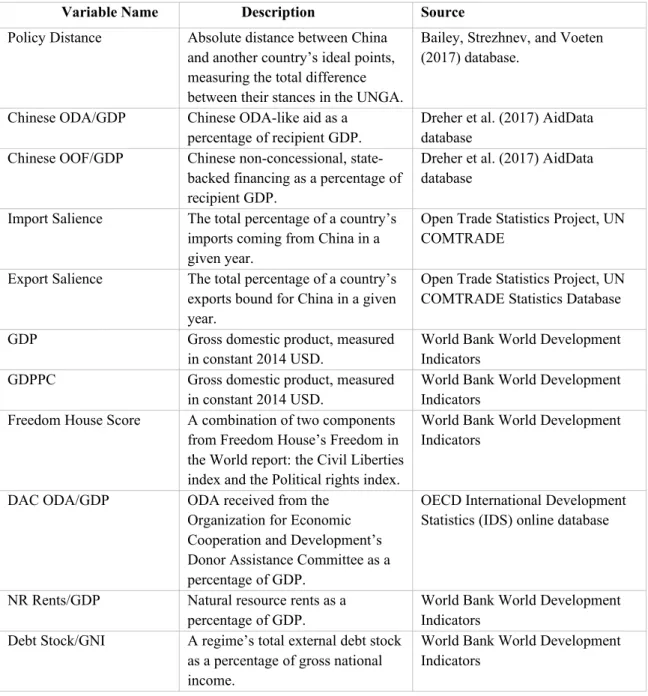
To measure my variable of interest, Chinese foreign aid, I rely on the Global Chinese Official Finance Dataset, constructed by the AidData project (Dreher et al.
2017). Because China does not publish reliable, disaggregated statistics on its aid flows, the creators of this database rely upon a Tracking of Underreported Financial Flows (TUFF) methodology. The TUFF methodology begins with a machine learning algorithm
that processes English- and Chinese-language reports from government and media sources to triangulate project-level data on a Chinese aid investment. After the algorithm
detects a likely project, human researchers then examine the reports, confirm the project’s existence, and enter the available project-level data into their database.
This database provides the most useful and relevant information on Chinese
foreign aid projects. By classifying each project using the OECD-DAC’s definition of official development assistance (ODA), this database allows me to focus on concessional
Nunnenkamp, & Thiele 2008; Dreher et al. 2018). Additionally, the database keeps track of whether projects have been simply committed to, completed, or canceled. This allows
me to exclude funds that were committed to by China but never allocated. By separating and aggregating these loans by year and country, I find the total amount of concessional foreign aid that China granted to a country from the years 2000-2014.
While the AidData database provides the best option for measuring Chinese aid disbursements, there are difficulties inherent in this pursuit. First, the TUFF methodology
likely fails to detect a number of projects around the world2. Additionally, not all projects have an associated financial value. As a result, there are many country-years for which data are likely underestimated or missing altogether. To increase the number of
observations in my dataset, I code the amount of aid that large, wealthy nations receive from China as 0 for all years. This includes the US, Canada, Japan, and wealthy
European countries like France and Germany. It seems safe to assume that these countries were not recipients of Chinese state-backed financing in the given time period.
Additionally, because states that recognize Taiwan are ineligible for receipt of Chinese
state-backed financing (Zhang & Smith 2017; Dreher et al. 2018), I likewise code their aid amounts as zero. This drastically improves the number of observations in my analyses
and does not influence my final results.
I measure Chinese aid (termed ODA in the model and results tables below) as the amount of Chinese ODA-like aid received as a percentage of the recipient country’s GDP
for that year. This decision is based on the logic that smaller and less developed countries should value a given amount of aid more than a larger or wealthier nation would.
Alternative measures of aid, such as a moving average of ODA/GDP and the logged value of ODA, do not affect my results.
I include a range of control variables as well. Because trade with China leads to foreign policy convergence (Brazys and Panke 2017), I include a variable capturing trade salience between a given country and China, measured as the percentage of that country’s
exports going to China and the percentage of its imports originating from China. The estimate on these coefficients is expected to be negative, decreasing policy distance
between China and a given nation. I obtain these dyad-year data from the Open Trade Statistics (OTS) project. The project’s raw data comes from the United Nations Comtrade database. After obtaining the initial records on two countries’ imports and exports to one
another, researchers resolve any discrepancies in the data, which often arise when an exporter and importer use different criteria for the same good. By reconciling these
records, OTS researchers provide an accurate, cleaned source of data on dyadic-level trade flows.
My models also include a control variable for a country’s level of economic
development. For this variable, I include data on logged gross domestic product per-capita (GDPPC). More developed, wealthier countries such as those in the West are
likely more democratic and thus might face more costs in aligning with China. As such, they are less likely to align with China on issues like human rights. Additionally, more developed countries have more well-defined foreign policy stances and are therefore less
I argue that a country will value Chinese aid less if they have more access to alternative forms of foreign aid. As such, I include data on the net amount of aid received
from OECD-DAC countries, calculated as the amount of aid they receive from these sources less the amount paid back on previous loans. Access to such funds should make a country less dependent on Chinese aid overall, and it also might capture third-party
attempts at vote-buying. OECD-DAC countries, especially large democratic nations like the United States or France, typically have agendas opposed to the Chinese within the
UNGA. As such, it is important to control for their aid flows. Fortunately, OECD-DAC lenders are required to publish their aid data. I use the publicly available data published by the OECD-DAC to account for these aid flows.
In a similar vein, I control for a recipient’s regime type. Countries with more autocratic regimes should have a shared interest in promoting those norms on issues that
China cares most about, such as non-interference, sovereignty, and human rights.
Likewise, more autocratic regimes swap their votes more frequently in the UNGA, likely because they have better control over the state’s bureaucracy (Brazys and Panke 2017). I
obtain this data from Freedom House’s Freedom in the World Report, which separately measures political rights and civil liberties in a country. These two scores are combined,
producing a 12-point scale, with 2 being the least liberal regime and 12 being the most liberal.3 I expect the coefficient on this variable to be negative; as a country becomes more democratic, its foreign policy preferences should diverge from China, resulting in a
greater distance between its ideal point score and China’s. Additionally, building off Brazys and Panke’s (2017) finding that autocratic states can more easily swap their votes
within the body, I argue that Chinese foreign lending will have more of an effect on autocratic regimes. I interact my measure of Chinese foreign aid with this measure and
expect the estimated coefficient to be positive. The more liberal a recipient regime, the less that a given amount of aid should do to decrease policy distance between the two countries.
I also control for a country’s access to alternative forms of capital that might serve a similar purpose as Chinese foreign aid. For instance, if a country has high access to
money from natural resource rents, a similar form of nontax revenues for regimes (Morrison 2009), then they may value Chinese aid less highly, decreasing the power of such aid to buy policy concessions. Following this logic, I control for a country’s natural
resource rents as a percentage of GDP for a given year. Likewise, I control for the amount of a country’s total external debt stock as a percentage of GNI. The higher a
regime’s debt stock, the more difficult it should be to secure funding from private capital markets. I interact each of these variables with Chinese foreign aid levels, expecting a negative estimate on the interaction term of ODA-like aid and natural resource rents and
a positive estimate on the interaction term between aid and debt. Data on these two variables come from the World Bank’s World Development Indicators.
I also include variables that control for the influence of third-party states. Multiple scholars have demonstrated that a country beginning its two-year term on the UN
Security Council will become the target of increased vote-buying attempts from
traditional lenders like the United States (Kuziemko and Werker 2006; Dreher, Sturm and Vreeland 2009). In turn, China revokes its own aid during this time (Dreher et al. 2018).
time on the UNSC. As countries typically swing towards the United States and other Western P-5 members during this time, I expect the coefficient on this dummy variable to
be positive, increasing a country’s distance from China in the UNGA. I obtain these data from the United Nations website.
My analysis covers 189 countries from the period 2000-2015. Out of these 189
countries, 124 receive ODA-like Chinese aid at some point in the covered time period. As data is missing for certain country-years, the dataset is unbalanced.
Models
To investigate my research question, I use an ordinary least squares regression to estimate
a pooled, time-series model with country- and year-fixed effects. I estimate the following baseline model:
PolicyDistanceit= β1ODAit−1 +β2importsit−1 + β3exportsit−1 + β4GDPPCit−1
+ β5GDPPC2it−1 + β6UNSCit + β7regimeit + β8DACAidit-1+ β9AltFunds it-1+τi +t + εit
Where PolicyDistance represents the distance between China’s and country i’s stances in the United Nations General Assembly, as measured by the absolute value of the
difference between their respective ideal points. ODA measures the amount of ODA-like Chinese financing a given country i receives in year t – 1. Imports and exports represent the percentage of a country’s total trade coming from or bound for China in a given year,
the amount of aid that country i receives from OECD-DAC sources in year t – 1.
AltFunds measures a country’s access to a variety of other funding sources that might
serve similar purposes as foreign aid, including private capital and natural resource rents.
Regime represents a country’s score on the Freedom House’s Freedom in the World Report. A dummy variable, UNSC,measures whether or not a country is serving its
temporary two-year term on the United Nations Security Council. τi is a country-fixed effect term, measuring the average, time-invariant effect on PolicyDistance for a given
country i, while t controls for yearly effects that might affect voting in the United
Nations, such as major wars or economic crises. Finally, εit is an idiosyncratic error term.
Additionally, to test my second hypothesis that Chinese foreign aid will be more
effective in buying the support of autocratic regimes, I estimate the following model:
PolicyDistanceit= β1ODAit−1 +β2importsit−1 + β3exportsit−1 + β4GDPPCit−1
+ β5GDPPC2it−1 + β6UNSCit + β7regimeit-1 + β8DACAidit-1+ β9AltFunds it-1
+
β10 ODAit−1 x regimeit-1+
τi+t + εit
Where ODAit−1 x regimeit-1 the interaction of a recipient i’s Freedom House score and
the amount of Chinese ODA-like lending that country received in year t – 1, and the other
terms are defined above.
Finally, I test my final hypothesis regarding alternative forms of capital by
PolicyDistanceit= β1ODAit−1 +β2importsit−1 + β3exportsit−1 + β4GDPPCit−1
+ β5GDPPC2it−1 + β6UNSCit + β7regimeit-1 + β8DACAidit-1+ β9AltFunds it-1
+
β10 ODAit−1 x AltFundsit-1 +
τi+t + εit
Where β10 ODAit−1 x AltFunds-1 is the interaction of ODA-like Chinese aid as a
percentage of GDP and a country’s access to natural resource rents as a percentage of
GDP and total external debt stock as a percentage of GNI. The effect on the former is
expected to be positive: the more access to natural resources a country has, the less
leverage a given amount of Chinese aid should provide it over a country. The estimate on
the latter is expected to be negative, as the more money a country owes to foreign
creditors, the more it should value concessional lending that China provides.
Most of the independent variables in this model are lagged, representing their values in year t – 1. Such an approach should mitigate endogeneity concerns, such as the
possibility that voting in the UNGA drives aid rather than aid driving voting patterns.
5 Results
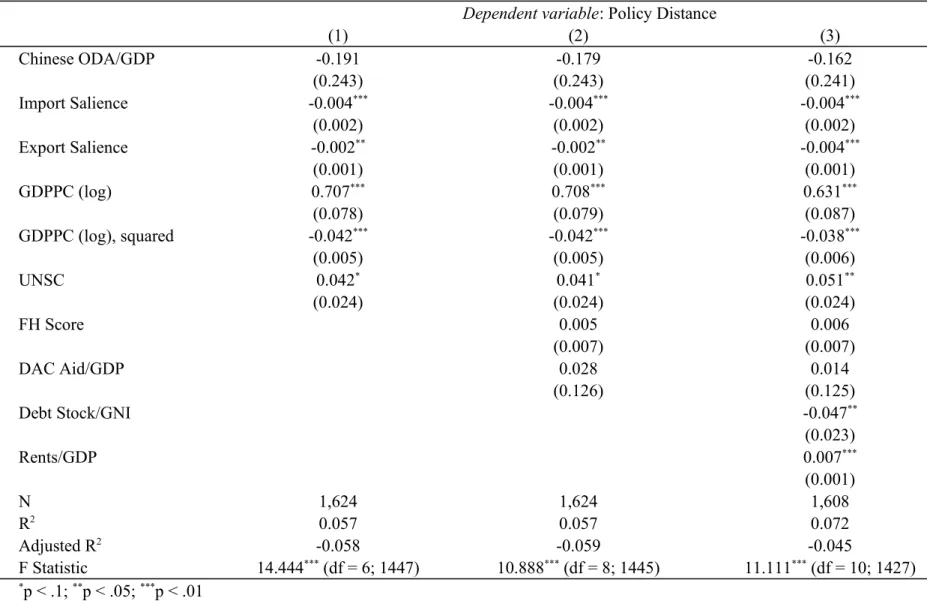
Table 1 presents the results of my baseline regression. The estimate on the aid coefficient
is negative, but not statistically significant at conventional levels. This finding is robust with respect to alternative measures of aid, including the logarithmic transformation of
Fuchs 2015; Dreher et al. 2018) that demonstrate Chinese ODA is allocated to its allies in the UNGA. Below, I offer tentative explanations for the failure of Chinese aid to
consistently predict reductions in policy distance.
While the estimate on aid does not satisfy conventional levels of significance, the results suggest that other variables might be strong predictors of policy distance between
China and other countries. The estimates on import and export salience are both negative, as expected, and statistically significant at the p < 0.01 and p < 0.05 levels, respectively.
This finding complements the large body of work showing that increased trade ties between China and its partners result in foreign policy convergence (Brazys and
Dukalskis 2017; Davis, Fuchs, and Johnson 2019; Flores-Macías and Kreps 2013; Norris
2016). Export salience, in particular, might support Davis, Fuchs, and Johnson’s (2017) finding that China uses its state-owned enterprises to restrict imports and punish trading
partners for political reasons. As I explain below, given that there is a plausible relationship between receipt of Chinese aid and improved trade ties, I investigate the possibility that, while perhaps not influencing policy distance directly, aid nonetheless
works through trade to generate support for China’s foreign policy positions.
As for the other estimates presented in Table 1, GDP per-capita is estimated to
have a positive and statistically significant effect on policy distance. This suggests that wealthier, more developed countries are relatively more likely to have voting patterns contrary to China’s within the UNGA. The negative coefficient on the quadratic term
As expected, the coefficient for the UNSC dummy variable is estimated to be positive and statistically significant at the p < 0.10 level. This indicates that the policy
distance between a country serving its two-year term on the UNSC and China increases. This complements other work studying the political dynamics of the UNSC, wherein major Western P-5 powers increase their foreign aid flows to temporary members in
order to secure their vote (Dreher, Sturm, and Vreeland 2009; Kuziemko and Werker 2006). Additionally, it makes sense in light of Dreher and colleagues' (2018) finding that
China “punishes” its allies, revoking aid from those previous recipients of aid that move closer to Western members of the Security Council.
The results show two other findings that contradict my expectations. The results
provide no evidence that either regime type or the receipt of OECD-DAC aid is associated with a change in a country’s policy distance with China. The estimated
coefficient on regime type is positive, as expected, but fails to meet conventional criteria for statistical significance. This implies that authoritarian countries are not necessarily more likely to support China in the UNGA, while more liberal countries do not always
vote against China in the body. Carter and Stone (2015) observed a similar dynamic, arguing that democratic regimes are no more likely to vote in line with the United States.
It appears that a complementary logic holds true for China. That is, more authoritarian regimes are not necessarily more likely to have voting patterns similar to China’s in the UNGA. Likewise, the estimate on the net OECD-DAC aid coefficient is not statistically
The overall goodness-of-fit for these models is not high, with adjusted R2 values falling below 0 in each of them. A low R-squared is to be expected when dealing with
pooled time-series data, but this is nonetheless lower than models in similar studies. For comparison, in a study of Israeli vote-buying attempts that employs similar techniques, the adjusted R2 on the authors’ models does not exceed 0.15 (Lutmar and Mandler 2019).
Even compared to these results, however, my models are particularly poor predictors of policy distance between China and a given country.
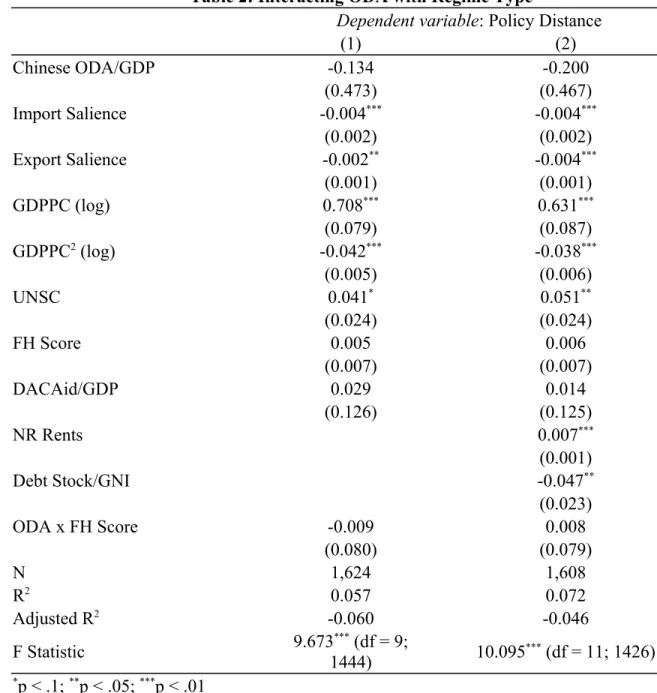
To test my second hypothesis that more authoritarian regimes will be more willing to swap their votes for Chinese foreign aid, I estimate a second series of models, interacting the aid variable with a country’s regime type. Table 2 presents these results.
The coefficient on the interaction term is estimated to be negative in the first model, but upon the inclusion of additional control variables, it becomes positive. Neither of these
Table 1: Policy Distance, country- and year-fixed effects models
Dependent variable: Policy Distance
(1) (2) (3)
Chinese ODA/GDP -0.191 -0.179 -0.162
(0.243) (0.243) (0.241)
Import Salience -0.004*** -0.004*** -0.004***
(0.002) (0.002) (0.002)
Export Salience -0.002** -0.002** -0.004***
(0.001) (0.001) (0.001)
GDPPC (log) 0.707*** 0.708*** 0.631***
(0.078) (0.079) (0.087)
GDPPC (log), squared -0.042*** -0.042*** -0.038***
(0.005) (0.005) (0.006)
UNSC 0.042* 0.041* 0.051**
(0.024) (0.024) (0.024)
FH Score 0.005 0.006
(0.007) (0.007)
DAC Aid/GDP 0.028 0.014
(0.126) (0.125)
Debt Stock/GNI -0.047**
(0.023)
Rents/GDP 0.007***
(0.001)
N 1,624 1,624 1,608
R2 0.057 0.057 0.072
Adjusted R2 -0.058 -0.059 -0.045
reject the null hypothesis. It appears that Chinese aid is no more effective at buying the support of autocratic regimes than it is at buying the support of democratic ones.
There are possible explanations for this finding. Carter and Stone (2015) have found that authoritarian regimes typically resist attempts at vote-buying more
successfully than do democracies, but their explanation is rooted mainly in the fact that
the United States (the donor of focus in their study) has an interest in ensuring the survival of such regimes, and cannot credibly revoke the aid which supports these
governments. A similar dynamic could explain the failure of Chinese aid to engender more support among authoritarian countries, but it seems unlikely that China shares a similar strategic interest in supporting regimes in the way the United States does. Rather,
this finding likely results from an overall failure of Chinese aid to predict later policy distance within the UNGA.
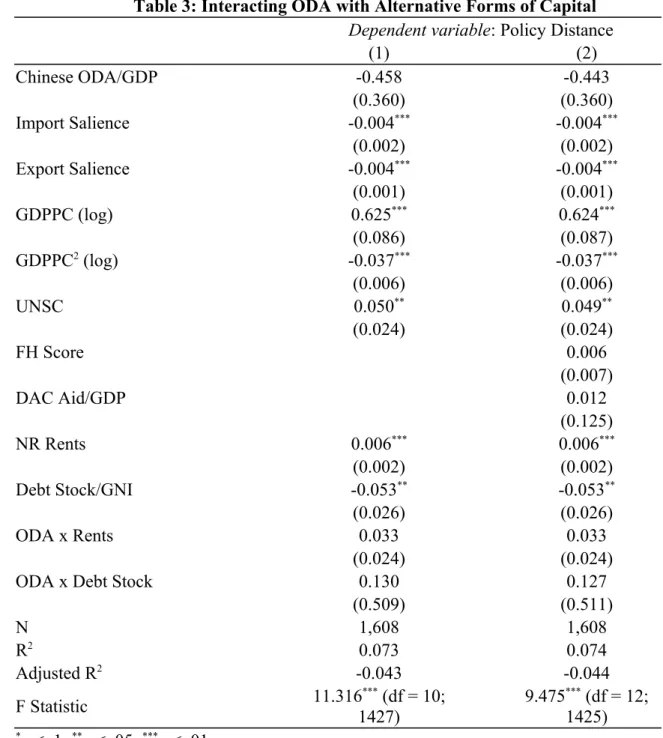
My third hypothesis predicts that countries with less access to alternative forms of capital will value Chinese aid more, and as such a given amount of aid will do more to buy policy concessions from the recipient nation. I estimate models interacting China’s
aid with a country’s natural resource rents as a percentage of GDP and its total external debt stocks as a percentage of GNI. Looking at the results depicted in Table 4, once
again, I find insufficient evidence to reject the null hypotheses. Only the estimate of the debt stock coefficient is negative and statistically significant at the p < 0.05 level, but this says little about Chinese economic statecraft or the effect of Chinese aid on voting
logic as that of GDP per capita; poorer countries, on average, are more supportive of China’s agenda in the UNGA.
Table 2: Interacting ODA with Regime Type
Dependent variable: Policy Distance
(1) (2)
Chinese ODA/GDP -0.134 -0.200
(0.473) (0.467)
Import Salience -0.004*** -0.004***
(0.002) (0.002)
Export Salience -0.002** -0.004***
(0.001) (0.001)
GDPPC (log) 0.708*** 0.631***
(0.079) (0.087)
GDPPC2 (log) -0.042*** -0.038***
(0.005) (0.006)
UNSC 0.041* 0.051**
(0.024) (0.024)
FH Score 0.005 0.006
(0.007) (0.007)
DACAid/GDP 0.029 0.014
(0.126) (0.125)
NR Rents 0.007***
(0.001)
Debt Stock/GNI -0.047**
(0.023)
ODA x FH Score -0.009 0.008
(0.080) (0.079)
N 1,624 1,608
R2 0.057 0.072
Adjusted R2 -0.060 -0.046
F Statistic 9.673*** (df = 9;
1444) 10.095*** (df = 11; 1426)
Table 3: Interacting ODA with Alternative Forms of Capital
Dependent variable: Policy Distance
(1) (2)
Chinese ODA/GDP -0.458 -0.443
(0.360) (0.360)
Import Salience -0.004*** -0.004***
(0.002) (0.002)
Export Salience -0.004*** -0.004***
(0.001) (0.001)
GDPPC (log) 0.625*** 0.624***
(0.086) (0.087)
GDPPC2 (log) -0.037*** -0.037***
(0.006) (0.006)
UNSC 0.050** 0.049**
(0.024) (0.024)
FH Score 0.006
(0.007)
DAC Aid/GDP 0.012
(0.125)
NR Rents 0.006*** 0.006***
(0.002) (0.002)
Debt Stock/GNI -0.053** -0.053**
(0.026) (0.026)
ODA x Rents 0.033 0.033
(0.024) (0.024)
ODA x Debt Stock 0.130 0.127
(0.509) (0.511)
N 1,608 1,608
R2 0.073 0.074
Adjusted R2 -0.043 -0.044
F Statistic 11.3161427)*** (df = 10; 9.475***1425) (df = 12; *p < .1; **p < .05; ***p < .01
My results, while providing insufficient evidence to reject the null hypothesis, leave open the possibility that aid is successful in reducing policy distance, but not via a direct,
explicit link between aid and policy concessions. Rather, if Chinese aid can promote trade ties, it may indirectly improve China’s diplomatic relations as well. Returning to the results listed in Table 1, the coefficients on both import and export salience are negative
and statistically significant at conventional levels. These findings support others’ work showing that increased trade ties between China and another nation work to improve their
alignment on foreign policy issues (Flores-Macías & Kreps 2013) and that China has had success in explicit attempts to manipulate trade flows in pursuit of political goals (Davis, Fuchs, and Johnson 2017; Norris 2016). Following this logic, below, I explore the
possibility that Chinese foreign aid might improve its trade ties, thereby indirectly improving its diplomatic relations with recipient states.
According to Drezner’s (1999) logic of economic coercion, there are theoretical reasons to suggest China should prefer to rely on trade ties as a tool for foreign policy rather than aid. As he writes, the major difference between economic coercion (such as
shutting off trade ties to punish target states) and economic inducement (providing aid in exchange for votes) is that “the stick is expensive when it fails, whereas the carrot is
successful when it succeeds” (200). For China to continuously tie aid to votes in an explicit way would require it to continuously disperse aid, an expensive pursuit.
However, by leaning on its massive trade ties with other countries, it only has to suffer an
addition to the political gains its threats have earned. This work suggests that China’s trade ties are likely a more promising tool for economic statecraft.
Therefore, to the extent that China’s foreign aid and other forms of state-backed financing improve its trade ties with other countries, it can be said that aid might
encourage policy convergence, albeit not in the direct way that I originally predicted. To
investigate this further, I test whether China’s state-backed financing in one year predicts increased trade ties in the following year. Positive results would not suggest evidence of
explicit vote-buying, only that Chinese foreign aid helps indirectly improve China’s foreign relations with recipients. It is likely that China uses its state-backed financing at least in part to promote markets for its exports and secure access to natural resources
(Dreher et al. 2018). However, these motivations do not hold true for all of Beijing’s investments. Rather, China allocates its non-concessional loans, which do not meet
OECD-DAC criteria for ODA, to its trading partners. These loans (termed “Other Official Flows” or OOF) are allocated with more commercial reasons in mind, one of which is improving the market for its exports. Additionally, most Chinese aid is tied, with
a minimum of 50% of the funds provided to be spent on goods sourced from China (Bräutigam 2011). This suggests that such aid will naturally increase the amount of a
country’s imports that come from China. As such, I expect that both ODA-like and less concessional forms of Chinese aid will improve trade relations.
To investigate this possibility further, I estimate the following model:
tradeit= β1aidit-1+ β2tradeit-1 + β3GDPPCit-1+ β4GDPPC2it-1 + τi+ t + εit
Where trade is measured as the import or export salience between a country and China
expect the estimated coefficients on both of these measures to be positive. I control for the level of trade ties between countries in the year before, t – 1. I also include GDP
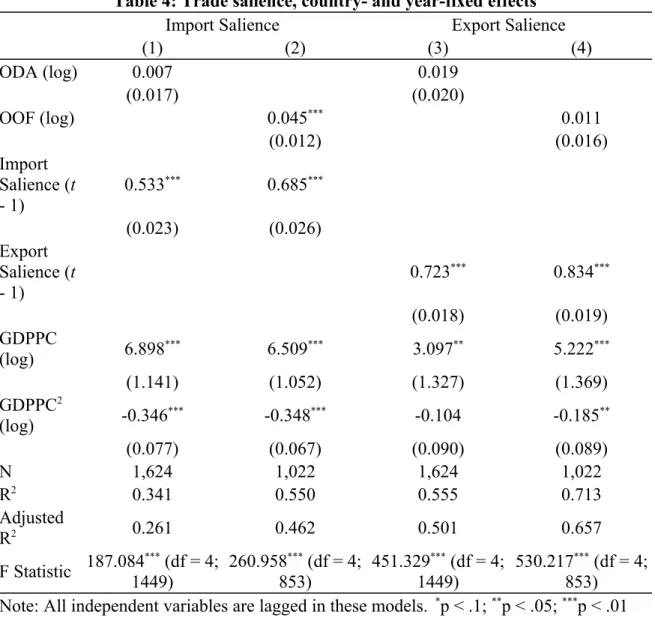
per-capita and a quadratic term to control for a country’s level of development. The results of this regression are depicted in Table 4 below. As the table demonstrates, different kinds of Chinese aid have more predictive power than others when it comes to trade flows.
Specifically, the estimate on non-concessional, state-backed Chinese financing is positive and significant at the p < 0.01 level. An increase in one logged value of Chinese OOF in
year t - 1 is associated with an 0.06% increase in the amount of a country’s imports that originate from China. This is not surprising, given that Dreher and colleagues (2018) demonstrate that less concessional Chinese loans seem to be allocated with more
economic objectives in mind. China’s state-backed investments with less concessional loans are likely associated with attempts to increase the market for China’s exports.
However, the results also show that this relationship between aid and import salience does not hold for Chinese ODA-like loans. Concessional, low-interest rate loans in year t – 1 are not associated with an increase in either import or export salience in a statistically
significant way.
If increased trade ties are associated with decreased policy distance within the
UNGA, and non-concessional financing is associated with increased trade ties (at least imports), then it seems that aid may indeed affect China’s diplomatic relationships with recipients, albeit in two ways that both contradict my earlier predictions. First, the results
of my analysis give no evidence that there exists a direct relationship between an increase in receipt of Chinese state-backed financing and decreased policy distance. Additionally,
lending, these types of loans may do more to engender policy support from recipients in the long run than ODA-like loans. This finding is surprising, considering that other work
has shown China’s ODA-like loans to be more associated with political objectives
(Dreher and Fuchs 2015; Dreher et al. 2018). However, these regressions are not meant to be concrete statements of causality. I only wish to investigate the possibility that Chinese
state-backed financing might improve trade ties, which Beijing can later use to extract policy concessions from other states. Below, I provide possible explanations for why
Table 4: Trade salience, country- and year-fixed effects
Import Salience Export Salience
(1) (2) (3) (4)
ODA (log) 0.007 0.019
(0.017) (0.020)
OOF (log) 0.045*** 0.011
(0.012) (0.016)
Import Salience (t
- 1) 0.533
*** 0.685***
(0.023) (0.026)
Export Salience (t
- 1)
0.723*** 0.834***
(0.018) (0.019)
GDPPC
(log) 6.898*** 6.509*** 3.097** 5.222***
(1.141) (1.052) (1.327) (1.369)
GDPPC2
(log) -0.346*** -0.348*** -0.104 -0.185**
(0.077) (0.067) (0.090) (0.089)
N 1,624 1,022 1,624 1,022
R2 0.341 0.550 0.555 0.713
Adjusted
R2 0.261 0.462 0.501 0.657
Potential Explanations for Ineffective Chinese Vote-Buying
Taken together, the results of these different estimations provide no evidence that China
has been able to successfully and consistently link its foreign aid flows to future support within the UNGA. There are many potential explanations for this finding. The first is that it might result from a lack of clear and available data on Chinese state-backed financing.
The AidData Global Chinese Investment database provides the most comprehensive and up-to-date data on China’s foreign aid, but it is likely that the project’s methodology fails
to detect a number of projects around the world. Additionally, that the dataset only extends to 2014 means that at least five years of information on Chinese foreign aid activity is missing. More detailed information on the funding allocated since 2014,
especially in light of the ambitious Belt and Road Initiative (BRI), might provide a much clearer picture of whether or not China successfully ties its foreign aid to future support
in the UNGA.
In addition to the above-mentioned difficulties, there are theoretical explanations for why China might have difficulty in linking aid to policy concessions. One explanation
lies in the composition of the aid itself. Dreher, Nunnenkamp, and Thiele (2008) show that in the US experience, certain types of aid are more successful at buying votes than
others. Specifically, US budget support for recipient nations, which leaves the allocation of such resources up to the discretion of the recipient government, does more to buy policy support within the UNGA than other types of aid. Given that very little Chinese
ODA-like aid constitutes general budget support, it is possible that Beijing is relying on the wrong kind of aid. Aid that leaves little up to the recipient government’s discretion
votes within the UNGA. It might also signal a lack of Chinese conditionality. Perhaps China does not link its aid to future voting patterns in international organizations, or at
least not to voting within the UNGA.
Another explanation lies in the institutional makeup of the Chinese state. Drezner (1999) argues that countries with more authoritarian and secretive regimes will be less
likely to make attempts at using economic means to induce support among recipient nations. In his thinking, because they provide more information on state preferences,
more open societies enjoy lower transaction costs and higher audience costs when making economic threats or promises, increasing their credibility. It is possible that China, with its highly secretive and authoritarian regime, struggles to clearly and credibly
signal its preferences to aid recipients. China’s foreign aid extremely opaque and is ostensibly not conditional (State Council PRC 2014). When compared to the US
government’s official policy that US foreign aid should go towards countries that support its positions in the UNGA (Wang 1999), it appears that China’s more ambiguous stance may affect the success of its aid-for-policy attempts.
I find a third explanation, one rooted in the institutional makeup of China’s foreign bureaucracy, especially convincing. In this thinking, China may struggle to
convert its aid into policy because the large number of actors involved in coordinating aid inhibits Beijing’s ability to clearly make an aid-for-policy proposition. This explanation is rooted in other work on China’s economic statecraft and qualitative studies of its
foreign aid regime. Norris (2016) finds that the success of the PRC’s attempts at economic coercion rests in large part on the degree to which the Chinese state itself is