RESTRICTED MOVEMENTS: RESEARCHING THE LATIN MUSIC SCENE IN THE POST HB 318 TRIANGLE
Amanda M. Black
A thesis submitted to the faculty at the University of North Carolina at Chapel Hill in partial fulfillment of the requirements for the degree of Master of Arts in Musicology in the Department
of Music.
Chapel Hill 2016
Approved by:
David F. Garcia
Andrea F. Bohlman
ABSTRACT
Amanda M. Black: Restricted Movements: Researching the Latin Music Scene in the Post HB 318 Triangle
(Under the direction of David F. Garcia)
The population of North Carolina residents identifying as Hispanic/Latino grew by 943%
between 1990 and 2010. With this demographic shift, space for musical practice, dancing, and
concerts has become contested within the Raleigh, Durham, and Chapel Hill area. The latest of
several anti-immigration laws passed in the last decade, the controversial Protect North Carolina
Workers Act, HB 318, was signed into law on October 28, 2015. The effects of fear-inducing
legislation and immigration enforcement on the ground have led to restricted movements in the
Latino community, both in their daily and musical lives. Considering the Latin music scene in
the Triangle as a cross-genre, multi-venue, and translocal network, this thesis details the
TABLE OF CONTENTS
LIST OF TABLES.……….v
LIST OF FIGURES………...….vi
INTRODUCTION………...1
The Latinization of North Carolina……….9
Border Police and Bordered Genres………..14
Researching the Latin Music Scene in the Triangle: Methods and Challenges………….17
CHAPTER 1: A WAREHOUSE OF SOUND………..24
Virtual Enactors in Social Media………...32
What’s in a Name?...35
CHAPTER 2: LESS SPACES, MORE RESTRICTIONS………43
¿Qué Pasó Con Qué Pasa Raleigh?...43
Safety Over Selection………..…………..45
Sounding Consolidation Through Selective Marketing………50
Filling a Gap………..55
Wanted: A Place to Play………61
CONCLUSION………..67
The Go-Between………67
APPENDIX………72
LIST OF TABLES
LIST OF FIGURES
Figure 1 - Tego Calderón Promotional Photo………..74
Figure 2 - La Banda El Recodo Concert Photo, The Ritz…………...75
Figure 3 - The Head and the Heart Concert Photo, The Ritz……...76
INTRODUCTION
Desde siempre, las mariposas y las golondrinas y los flamencos vuelan huyendo del frío, año tras año, y nadan las ballenas en busca de otra mar y los salmones y las truchas en busca de su río. Ellos viajan miles de leguas, por los libres caminos del aire y del agua. No son libres, en cambio, los caminos del éxodo humano.
(Always, butterflies and swallows and flamingos have flown to flee from the cold, year after year, and whales swim seeking out other oceans, and salmon and trout, their river. They travel thousands of leagues, through the free paths of the air and water. The paths of human exodus, however, are not free.)
Eduardo Galeano, “Los emigrantes, ahora”1
Aracely’s spot has the cheapest and most long-lasting gel manicures in town. Gel polish:
A manicurist paints your nails with layers of polish and places your hands into a small machine
that zaps the paint with UV light. The polish turns into a hard, shiny, indestructible finish that
can last weeks. Uñas Aracely, the walls painted barn red, with one moss green accent wall, is
also located in the entrance of a record store owned by her sister-in-law Eloisa. Eloisa, originally
from Mexico City, in her mid-forties, hadn’t made it in to work the counter of her own store that
day in early May of 2016. I had ventured to Aracely’s nail shop looking for a manicure instead
of my usual mission to peruse records and talk to Eloisa. Just like the record shop, Aracely’s is a
one-woman operation. 25 years old, born in Colón, Honduras, Aracely has lived slightly over
half her life in Durham and Wake counties. Both women are ineligible for legal status as
undocumented immigrants. Neither have drivers’ licenses. We sat and chatted as she did my
friend’s nails, joking with each other that Eloisa was probably out with a boyfriend.
“Who knows where she might have gone off to!” Aracely winked. The hour passed; it
was reaching three in the afternoon, and her comments took on a shadow of worry, masked as
annoyance. “That Eloisa! Leaving me here all alone!” “She has to get rides here, you know.
They probably had something to do.” The record store phone rang, and there was nobody to pick
it up. A man entered the record store to ask about the new banda2 record arrivals. Aracely, her
hands busy with a nail file, turned to me and smiled wryly—“Do you know?” I showed the
customer where I thought the newer records might have been. When he returned to the nail salon
fifteen minutes later, with a CD in hand, Aracely looked at me and nodded towards the counter
as she painted another layer of polish onto Jen’s nails. I clumsily walked behind the counter,
slowly removed the security device and plastic wrapper from the banda CD he had chosen, and
rang him up using the cash-out button on the register.
“Well now I guess you work here,” both Jen and Aracely joked, in separate languages at
the same time. Aracely understood Jen, although Jen did not understand Aracely. But there was
an added element of worry to Aracely’s joke: we still didn’t know where Eloisa was. Two days
later, Aracely would write to me on Facebook and let me know that Eloisa had told her she had
gone shopping with the person who would normally give her a lift to work. Relieved, we took
back up the joke, this time online:
“Ay, esa Eloisa!!!!!” (Oh, that Eloisa!!!!!)
2Banda is a broad term in Spanish used to describe many different ensembles of brass, woodwind, and percussion
instruments. Here, I use it to describe the 21st century commercial groups from Mexico or of Mexican origin, often
“Ya sabes como es” (You know what she’s like)
----
In 1985, as the manager of the Ritz, a popular night club in Raleigh, North Carolina, Judy
Powers took a step that no other club owner in the Triangle was prepared to take: she booked a
show for Los Tigres del Norte. This would be the beginning of a long legacy for the Ritz as a
club willing to book Latino-friendly shows. As I sat in Powers’ office at the Ritz in 2013, dozens
of tiny plastic Happy Meal toys lining her desk, and an almost equally tiny white dog perched on
a dog bed on the floor, she spoke about how her venue came to be the first space to musically
cater to the Mexican workers who were becoming a fixture in the state: "People told me I was
crazy. They said 'Who is going to go to a show like that?'"3
For Powers’ English-speaking friends and coworkers, there was no audience demand for
norteña music in Raleigh.4 Despite their misgivings, a full house welcomed the San José,
California-based group with roots in Sinaloa, heralding the shift in North Carolina's
demographics. Powers' foresight allowed the 2,400 capacity venue of the Ritz to become a place
where Latinos could go to experience music in their own language, be served in their own
language, and move from the rural regions of North Carolina into the center, even if temporarily,
for a night out in the capital city.
----
These vignettes, albeit short and contrasting, demonstrate two of the many sides of the
Latinization of North Carolina. As Powers, and others, advocate for the carving of a musical
space for Spanish-speakers, these same Spanish-speakers find themselves negotiating with
3Judy Powers, interview by Amanda Black, Raleigh, North Carolina, October 14, 2013.
liminality on a daily basis, an in-between state that may follow them for the majority of their
lives (such as for Aracely). This limits their movements and participation in the very musical
spaces made for them.
I began my study of the Latin music scene in the Triangle (comprised of the cities
Durham, Raleigh, and Chapel Hill) as part of a project for an ethnomusicology seminar focused
on approaches for the study of musical scene. I had honed in on musical venues catering
Spanish-speaking audiences as the focus for my work that semester. My experience living and
working in the Latinized Triangle had begun fourteen years earlier, in Pittsboro, just south of the
(sub)urban space of Chapel Hill. Working as a hostess and expediter for a restaurant in my small
hometown (population 3,743 as of 2010), I was able to put into practice the Spanish I had
learned in high school and was improving upon in college courses at the University of North
Carolina at Greensboro. In the kitchen, Mexican Spanish was the most useful tool, and one I
adapted to using as the boisterous all female team of cooks joked about my accent, book-learned
vocabulary, and timid delivery of awkward sentences. By the third year of university studies, my
interests in Latin American history, literature, and visual art—as well as my experience working
in the kitchen—led me to spend my final year of undergraduate studies in Studio Art and Spanish
at the Universidad de Guanajuato, in Guanajuato City, Mexico.
Initially, I was drawn to studying in Mexico because I knew many Mexicans in North
Carolina. In Carrboro, where I would often spend time going to concerts or hanging out in cafés,
12.9% of the population identified as Latino. Of the Latinos in Carrboro, the largest percentage
of them are Mexican, from the city of Celaya in the state of Guanajuato.5 When I returned from
Guanajuato in 2006, I had a broader understanding of the context from which many
5Hannah Gill. The Latino Migration Experience in North Carolina: New Roots in the Old North State. Chapel Hill:
guanajuatenses (people from Guanajuato) came: villages and towns in the state emptied of men,
who had moved north; entire towns living off remissions from the US; in my experience, a
middle class who would much rather stay put on the southern side of the border. I went on to
work as the Language Services Coordinator for the School of Dentistry at the University of
North Carolina at Chapel Hill for four years. Responsible for all of the interpretation and
translation needs for fourteen clinics, on average I would work with ten patients a day, some of
whom would be repeat patients.
Building bridges between communities, what children of immigrants do every day to help
their parents get through life in the English-speaking US, became what I did professionally and
socially. For people from countries outside of Mexico or Central America, my Mexican-accented
Spanish was instantly recognizable, or even funny. Mexicans or Central Americans, on the other
hand, ventured guesses that perhaps being “blond,” I was Argentine, Spanish, or somehow linked
to the upper classes of Mexican society. “No, but where are you really from?” became a question
I was used to hearing, and one that I answered with an unequivocal “Here!”. Whiteness in
combination with Mexican vocabulary, accent, and cultural references proved to be a powerful
tool when moving between the English- and Spanish-speaking communities closest to me in
Carrboro, Chapel Hill, Durham, or Raleigh. The Spanish language became the thread that linked
together the varied communities to which I belonged, whether at organizational meetings and
trainings for interpreters, or my social network comprised of Mexicans, Colombians, and other
South Americans.
After having researched the Latin music scene in the Triangle as part of the
ethnomusicology seminar, I began writing for Indy Week, the publication I had heavily critiqued
now editor) Grayson Currin took up the call for action that I presented him in the paper about the
Ritz. Recognizing that there was indeed an audience whose musical interests were not covered in
his paper, he offered me numerous opportunities to write about shows in different venues in
Raleigh, Durham, and Chapel Hill. Although Sylvia Pfeiffenberger had been writing about music
in Spanish in the Triangle for the paper since 2001, there was not much overlap in our coverage.
Writing reviews and publicity for alternative Spanish-language concerts, I covered shows
in diverse genres: reggaetón, rock in Spanish, hip-hop, and romantic rock. Sylvia also covered
diverse genres, including flamenco, Latin jazz, and but had focused in the past decade on
musicians playing within the circuit of university presenters.678 As I at times work as an
interpreter for Carolina Performing Arts, I decided it was in my best interest to avoid providing
journalistic coverage for these events; this choice is reflected in this thesis, as well. Moving
through different venues outside of the university circuit, I talked to concertgoers and concert
promoters, musicians and managers, as well as venue management. My role as a
Spanish-speaking journalist writing for an English-language publication allowed me access to individuals
who shared financial and cultural stakes in the success of Spanish-language shows, across the
language divide.
Latino residents of North Carolina may find themselves problematized, rejected, and/or
invisibilized in the English-language public sphere, including in the media. The Indy Week’s
6Sylvia Pfeiffenberger. “Live: Diego El Cigala makes a successful Durham debut.” Indy Week. 26 Nov. 2014.
Accessed 20 May 2016. http://www.indyweek.com/music/archives/2014/11/26/live-diego-el-cigala-makes-a-successful-durham-debut
7Sylvia Pfeiffenberger. “Live: Lila Downs’ Multicultural Mexican Translations.” Indy Week. 13 May 2015.
Accessed 20 May 2016. http://www.indyweek.com/music/archives/2015/05/13/live-lila-downs-multicultural-mexican-translations
8Sylvia Pfeiffenberger. “Live: Branford Marsalis and his MF’s take on Duke’s Baldwin Auditorium.” Indy Week. 10
longstanding commitment to publishing English reviews of Spanish-language shows stands as an
exception to the rule, and creates a bridge from the English to the Spanish-speaking world. This
thesis is the product of conversations and observations carried out both before and after having
written for Indy Week, an attempt to further bridge the gap between Spanish- and
English-speaking residents of North Carolina.
There is already a Spanish-language public sphere that consistently creates the bridge
from the Spanish-speaking world to the English, lifting up immigrants as necessary for the
survival of the state economy. Headlines in Spanish feature stories such as “Immigrants Are
Vital to North Carolina Economy, According to Study,” or “Immigrant Contributions Celebrated
in Henderson, North Carolina.”910 These stories (the former gleaned from Fox News Latino
online; the latter, a clearinghouse website advertised for Hondurans) emphasize the importance
of Latina/o immigrants to economic and cultural life in North Carolina. Media studies scholar
and theorist Hector Amaya underlines how this paradox functions at a national level:
Judging from the underrepresentation of Latinas/os in politics, one may assume that the Latino public sphere is extremely weak, but this is simply not true. Latinas/os struggle to get access to English-language media (ELM) but have significant access to Spanish-language media (SLM). The sheer economic and cultural power of SLM, which includes Univision, the fifth-largest television network in the nation; half a dozen other TV networks; hundreds of radio stations; hundreds of newspapers; and significant presence on the Web, speaks of a vital cultural resource that behaves as a mediated public sphere. If we consider SLM, we are forced to question the very axiom stating that access to media correlates to a healthy public sphere and that access to the public sphere somehow correlates to access to political power. With Latinas/os, more access to a public sphere equals less political power.11
9"Inmigrantes Son Vitales En La Economía De Carolina Del Norte, Según Estudio." Fox News Latino. Agencia
EFE, 1 June 2015. Web. 20 Apr. 2016. http://latino.foxnews.com/latino/espanol/2015/06/01/inmigrantes-son-vitales-en-la-economia-de-carolina-del-norte-segun-estudio/.
10"Destacarán Aportes De Inmigrantes En Henderson, Carolina Del Norte." - Departamento 19. 5 Mar. 2012. Web.
Regionally, this assessment holds true in the experiences of Latino residents of the Triangle.
Facing increasingly repressive controls over Latino residents, Spanish language media sources in
the Triangle decry the laws yet make do not make headway in shifting public opinion at large. In
the months while I was writing this thesis, political discourse surrounding the 2016 presidential
elections has further debased Mexican immigrants and has helped bring into sharp focus the
underlying prejudices towards Latino immigrants on a national level.12
These prejudices, paired with legal controls over people’s movements, constitute a threat
to the ‘cultural citizenship’ of Latino immigrants, defined by Renato Rosaldo as “the right to be
different and to belong in a participatory democratic sense […] The notion of belonging means
full membership in a group and the ability to influence one’s destiny by having a significant
voice in basic decisions.”13 The basic decisions compromised by a lack of cultural citizenship
often have ramifications for leisure time. I interviewed Alicia Hernández (pseudonym), 32, from
Abasolo, Guanajuato Mexico, in her home in Durham in April 2016. “I avoid many things, I
avoid doing many things,” she responded when I asked her about how she decided where to go,
when it was safest to drive. When I asked her about driving at night for musical activities, or to
take her children somewhere, she responded:
I don’t go out. We don’t go to the movies, I used to love to go to the movies with my children, to family parties[…] I drive everywhere for work. I was stopped by
11Hector Amaya. Citizenship Excess: Latino/as, Media, and the Nation (Critical Cultural Communication). New
York: NYU Press, 2013. Kindle Edition. 42.
12Donald Trump, Republican presidential candidate, has gone on the record calling Mexican immigrants “drug
dealers” and “rapists.” See: Benjamin Landy. “‘Totally accurate’: Trump defends calling Mexican immigrants ‘rapists.’” MSNBC, 30 June 2015. Accessed 1 April 2016. http://www.msnbc.com/msnbc/totally-accurate-trump-defends-calling-mexican-immigrants-rapists
13Renato Rosaldo. “Further Inflections: Toward Ethnographies of the Future.” Cultural Anthropology. Vol. 9, No. 3.
the police yesterday. I felt bad, because you can tell it seems to them that you are doing something very bad by driving without a license. But I can’t get a license. I told my children ‘calm down, everything’s fine.’ And I talked to the policeman. I said ‘I don’t have a license,’ and he said ‘Why not? Then why are you driving?’ I said ‘You can just go ahead and give me a ticket, but remember my face, because you’ll be seeing it again. I have to drive. I clean the banks in Chapel Hill every night, and I have to. You’ll see my face again.’
The police officer let Hernández go with only a warning. As we continued the conversation,
Hernández expressed how she did not understand why she was not able to get a license, if all she
did was work. For her, going out at night to see a group play live music was a risk she could not
take, given “how bad things have gotten.” Samuel Byrd points to how Mexican immigrants in
Charlotte avoided leaving their neighborhoods to access other clubs due to police checkpoints for
DUI.14 In an area like the Triangle, comprised of three smaller cities, this may translate to
possible concertgoers not leaving even the more circumscribed areas of Raleigh, Durham,
Chapel Hill, or the outlying towns of Wake, Durham, or Orange Counties. In this project, I use
the intertwining of legislative, venue, and personal narrative to underline the relationship of
immigration legislation with that of musical access. Latino immigrants’ access to daily activities
in NC has been sharply restricted through identification-based legislative measures, and this
restriction moves in parallel with more restricted spaces for musical practice and consumption
for Latinos.
The Latinization of North Carolina
According to Altha J. Cravey and Gabriela Valdivia, the Latinization of North Carolina
“follows a long-established US pattern of invitation and reversal, of toleration and subsequent
14Byrd, Samuel. The Sounds of Latinidad: Immigrants Making Music and Creating Culture in a Southern City. NY:
harassment […].”15 That is, although the influx of Latino immigrants is caused by economic
policies relying on unregulated hiring of cheap labor, the laborers themselves are rejected as
problematic, and are scapegoated for a host of national problems—especially crime rates,
unemployment, and issues of national security. The historical precedent for this discourse dates
back to the mid 19th century, when the derogatory term “Greaser” came into vogue during the
California Gold Rush as a reaction to more experienced Mexican and Chilean miners
immigrating to the area.16
Legal scholar Steven Bender argues that “most of the long-standing demeaning social
constructions of Latinas/os have helped ensure their legal detriment.”17 These social
constructions include the racialization of Latinas/os as an inferior mixed-race group in opposition
to a supposedly pure “Anglo-Saxon” race. Ken Gonzáles-Day points to how in the context of the
California Gold Rush, the term “Mexican” could be utilized as “either a racial, class, or national
marker, or all three.” As Anglo-Americans increasingly aspired to a fictitious race-nation linking
themselves to a Teutonic or Aryan past, racially mixed Mexicans became “thought of as being a
half-breed race, scarcely above the indigenous ‘Indians’ who were regularly portrayed as
primitive or savage peoples.”18
Bender argues that negative stereotypes about Latino Others informs legal statutes, whose
effects then trickle down to the day-to-day lives of immigrants; in the 19th century context, the
15Altha J. Cravey and Gabriela Valdivia. “Carolina del Norte: An Introduction.” Southeastern Geographer, Special
Issue: Carolina del Norte. Geographies of Latinization in the South. Volume 51: Number 2, Summer 2011. 220.
16Ken Gonzáles-Day. Lynching in the West, 1850-1935. Durham: Duke University Press, 2006. 24.
17Steven Bender. Greasers and Gringos: Latinos, law, and the American imagination. New York: New York
University Press, 2003. 1.
Greaser Act of 1854 (changed one year later to the Anti-Vagrancy Act) was created as a way to
tax Latin American miners based on their racial characteristics. Masking the racist nature of the
law, the 1855 law instead uses the euphemistic “vagrancy” to profile “all persons who are
commonly known as ‘Greasers’ or the issue of Spanish and Indian blood […] and who go armed
and are not peaceable and quiet persons.”19 Although Gonzáles-Day correctly sustains that the
practice of using the umbrella term “Mexican” was more prevalent in the 19th century than it is
today, Donald Trump’s use of the national moniker to describe “rapists and drug dealers”
displays a similar tendency to push fears of multiple Latino Others onto the closest nation south
of the border.
The discourse of criminality, and resource drain, persists in North Carolina despite the
massive demographic shift pointing towards a Latinization of the state. Bender’s theory of
stereotypes influencing laws regarding Latinos continues to be valid for North Carolina politics.
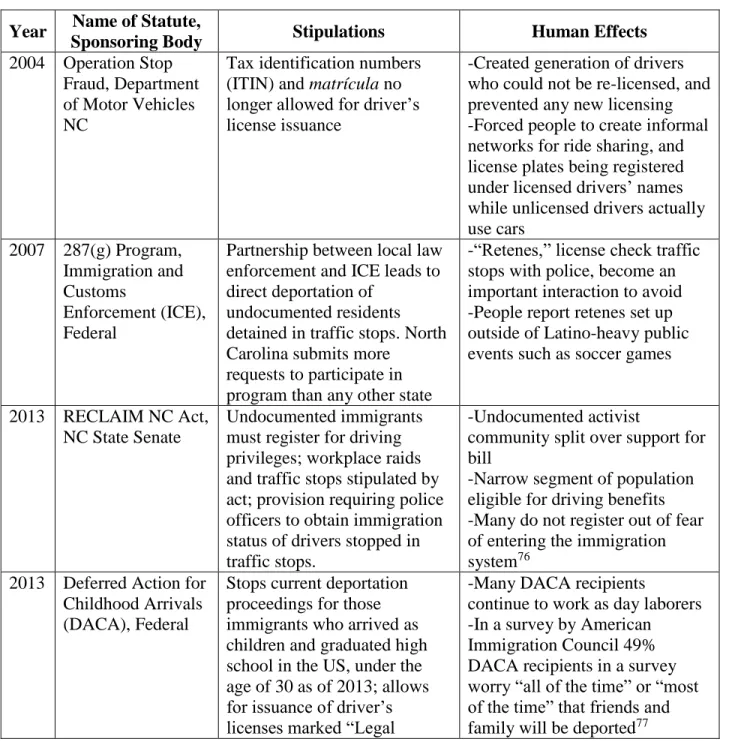
Below, a chart outlines both the federal and state initiatives that have led to a lower quality of
life for undocumented immigrants over the past twelve years. The columns “Human Effects” is
an attempt to explain, in broad strokes, and mostly based on my observations and conversations
with members of the undocumented Latino community, how the laws played out in their
day-to-day lives (see Table 1 in appendix).
Most relevant to the issues encapsulated in this thesis, the most recent NC state law
pertaining to immigrants is HB 318, passed October 28, 2015. The “Protect North Carolina
Workers Act” bans local governments from passing measures which would not allow law
enforcement to ask about someone’s immigration status, bans local law enforcement from
accepting consular identification as valid ID for law enforcement purposes, and requires state
and government agencies to use the E-Verify system to check the legal status of job applicants
and contractors—except for agricultural workers, and limited food stamp assistance for single
adults (a move condemned by the AFL-CIO).20 This law coincided with an increase in ICE raids
in the state, supported by the state’s multiple 287(g) programs, occurring between October 1,
2015, and January 15, 2016.21
Although North Carolina’s undocumented residents undergo hardships in ways specific
to their status, racism and discrimination is often a common experience for both documented and
undocumented residents across the country.22 As Alejandro Madrid writes, “it is an extended
ignorance about the specifics of migration, diaspora, and transculturation at the U.S.-Mexico
border or a precarious and grotesque attempt to control the area’s changing racial and ethnic
dynamics” which causes mainstream US politics to consider these residents, and the porousness
of the border, as a “problem.”23 US Citizenship and Immigration Services, a new federal agency
created as part of the Homeland Security Act of 2002, indicates how this porousness became a
central issue in the post-9/11 discourse on national security:
The events of September 11, 2001, injected new urgency into INS’ mission and initiated another shift in the United States’ immigration policy. The emphasis of American immigration law enforcement became border security and removing criminal aliens to protect the nation from terrorist attacks. At the same time the
20Leyla Santiago and Matthew Burns. “McCrory signs bill outlawing sanctuary cities in NC.” 28 October 2015.
Accessed 23 March 2016. http://www.wral.com/mccrory-signs-bill-outlawing-sanctuary-cities-in-nc/15035244/
21Jorge Cancino. “Alarma por nuevas redadas de inmigrantes en Carolina del Norte.” Univisión Noticias. Web. 19
Feb. 2016. Accessed 20 May 2016. http://www.univision.com/noticias/redadas/alarma-por-nuevas-redadas-de-inmigrantes-en-carolina-del-norte
22Nick Valencia. “Opinión: Mi encuentro con el racismo anti-Latino.” 4 October 2011. Accessed 10 March 2016.
http://cnnespanol.cnn.com/2011/10/04/opinion-mi-encuentro-con-el-racismo-anti-latino/#0
23Alejandro Madrid. Transnational Musical Encounters at the U.S.-Mexico Border. New York: Oxford University
United States retained its commitment to welcoming lawful immigrants and supporting their integration and participation in American civic culture.24
As the chart before demonstrates, legislators have attempted to deal with immigration on both
state and national levels, scrambling to enact laws addressing large contingents of undocumented
residents. In North Carolina, these effects are striking, as the state has undergone a massive
demographic shift over the past three decades.
In a report presented by the Governor's Office of Hispanic/Latino affairs, the Latino
population in North Carolina grew by 943% between 1990 and 2010, with the Pew Research
Center estimating a population of 828,000 Hispanic residents within the state.25 Of the 828,000
Hispanic residents within the state, an estimated 342,000 are undocumented. 80% of the
undocumented population is estimated to be from Mexico and Central America.26 Census data
from 2011 reports that overall, 60.9% of the Latino population is of Mexican origin, Puerto
Ricans, Dominicans and Cubans make up 13.2% of the population, and people of Central
American origin follow at 13.1%. A small but significant 5.8% of people of South American
origin, a quarter of whom are Colombian, complete the demographic picture.27
24“Agency History: Post-9/11.” US Department of Homeland Security, US Citizenship and Immigration Services.
Web. No date. Accessed 20 May 2016. https://www.uscis.gov/history-and-genealogy/our-history/agency-history/post-911
25Pew Research Center: Hispanic Trends. “Demographic Trends of Hispanics in North Carolina, 2011.” 2011. Pew
Internet and American Life Project. Accessed March 2016. http://www.pewhispanic.org/states/state/nc/
26Migration Policy Institute. Profile of the Unauthorized Population: North Carolina. 2013.
http://www.migrationpolicy.org/data/unauthorized-immigrant-population/state/NC
27Zabala, Gabriela. Demographic Trends of Hispanics/ Latinos in North Carolina. Report. October 2011. Accessed
Border Police and Bordered Genres
Michel DeCerteau signals that “A narrative activity, even if it is multiform and no longer
unitary, continues to develop where frontiers and relations with space abroad are concerned.
Fragmented and disseminated, it is continually concerned with marking out boundaries.”28 The
power processes involved in establishing a socially-enacted border between the US and Mexico,
deterritorializing the border as it weaves through North Carolina, exercise a control of movement
enacted over Spanish- and English-speaking bodies; the accompanying justifying narrative is so
efficiently disseminated that the border becomes an unquestioned organic entity within public
discourse, especially in the shadow of 9/11. The border comes to represent not only the boundary
between the US and Mexico, but rather the US and Latin America at large. I suggest that in more
carefully examining the bordered musical relationships that have moved northward, we may
expand the analytical possibilities for what constitutes the border, the socially naturalized
South/North divide. In order to disrupt this border, the narrative activities around discussing
immigration policy also need to be disrupted. The narrative activity of creating and maintaining
the US/Mexico border is an exercise in changing, rearranging, and directing stories into linear or
interlaced structures. Hence, “Every story is a travel story – a spatial process.”29 In this spatial
process, whose travel stories are being told?
Gloria Anzaldúa’s theorizing of the border questions this neat, linear spatial process by
not only pointing to a plurality of selves, but the inherent plurality of the land claimed by border
itself: “This land was Mexican once, / was Indian always / and is. / and will be again.”30 While
28Michel de Certeau. The Practice of Everyday Life. Berkeley: University of California Press, 2011. 125.
29Ibid., 115.
Anzaldúa underlines the ethnic plurality of ownership of the bordered territory, Alejandro
Madrid characterizes the border as transnational since its establishment. Musical genre is bound
up in these spatial processes of border creation, each category a travel story that carries a
fragmented, necessarily partial, narrative with it. Madrid critiques border music scholars for
privileging Tejano, norteña, and corridos at the exclusion of other types of popular music from
the border region.31
Transnationally, the impulse to categorize music based on the Mexico/US border
relationship is strong , both for industry and musicological purposes. For example, in Cathy
Ragland's narrative about the development of Mexican norteña music "versus" Texan conjunto
music, the author polices these genre boundaries by creating diverging histories, and says little
about the crossover audiences or cover songs produced by artists across these musical styles.32
Although there are stylistic and instrumentational differences between the genres, they are both
developed around a permeable geographic border, as Ragland aptly demonstrates while writing
on music and migration. This transnational relationship leads to significant borrowings from
each of the divided sides.
But there is yet also another important bordered relationship to consider within the pages
of this thesis: that of genre within the Spanish language sphere. Simon Frith has explained the
concept of genre as a categorization based partially on the need to organize the sales process, but
one that music fans also continue to reinforce.33 In this study, the policing of genre unfolds
locally in the case of Latin music in the Triangle, especially where rock en español, norteña, and
31Ibid, 9.
32Cathy Ragland, Música Norteña: Mexican Migrants Creating a Nation between Nations. Philadelphia: Temple
University Press, 2009. 13.
música urbana are concerned. While, as Madrid indicates, much has been written about norteña,
little has been written musicologically about rock en español, nor how these genres are often
defined in opposition to each other by fans, practitioners, and the Spanish-language media. A
scholar of literature, Ignacio Corona explains how the slippery rock en español, emerging in
Latin America in the 1980s “relies on regional and global music, on local and non-local content,
on mass and elite culture, etc. to create a musical-cultural framework where diverse references
and identity positions are played out.”34 That is, rock en español can sound like many things,
from the moody vocal stylings of Argentine Fito Páez over synth beats in the 1990s, to roots and
reggae rock from Mexican band Maná (still very popular today), to the cosmopolitan bands
Kinky and Plastilina Mosh from the Avanzada Regia (a wave of groups emerging in the 2000s
from Monterrey, Mexico). For Corona, and for many fans, the promise of rock en español lies in
its abilities to transgress boundaries; within the Triangle, these genre categories create new
boundaries that are enforced while bands and promoters vie for venue space and media coverage.
Música norteña carries a strong working-class association, while the rock en español fans I have
spoken with, both as part of this study and in writing reviews of Latin shows, try to distance
themselves continually from norteña, even if they, too, identify themselves as working class.
Música urbana (reggaetón, rap, and hip hop in Spanish) is often held up as the foil to both of the
other genres. For example, in covering a show by Mexican rock group Elefante, the members of
the band asked that I write in my review that they were in Durham to show that rock-n-roll could
“destroy” reggaetón. Although I did not comply, the emphasis on Latin music not “only” being
reggaetón, nor only norteña, speaks to the adversarial relationship that has cropped up between
34Ignacio Corona. “Rock en español.” In: Song and Social Change in Latin America (Kindle Locations 2461-2467).
the genres. Borders acting within an already very delineated space, these genre categories serve
to further divide and organize music within the margins.
Researching The Latin Music Scene in the Triangle: Methods and Challenges
I carried out fieldwork within Durham and Raleigh between October of 2013 and May of
2016. My methodology combines ethnographic research with online research, taking into
account the perspectives of fans, people involved in the promotion and sale of Latin music,
venue owners, and my own journalistic perspective from the past three years covering the Latin
music scene for the English-language weekly newspaper, Indy Week. The accounts I have
gathered are often presented here in thick description, interwoven with analysis. D. Soyini
Madison suggests that description forms a key part of the ethnographer’s toolbox. As we listen to
people explain, we are obliged to embrace “the emotions and sensuality of what is being
described and how it is being described through highlighting, sometimes redescribing, the
remembered textures, smells, sounds, tastes and sights rendered through story […].”35 My
descriptive style of writing, in English, is intended to create a bridge of communication about the
workings and apprehensions of some of the members of the Spanish-language musical sphere for
those in the English-language sphere.
This quotes in this thesis are the result of interviews, or more informal conversations,
with a total of ten people: eight are Spanish-speaking Latino, or bilingual Spanish-English; one is
an English-speaking White American woman; one English-speaking White American man, and
another bilingual English-Spanish White American man. Two interlocutors, Leonel Vega and
Isidro García, are 29-year-old Mexican men who are recipients of DACA. I met Isidro and
Leonel (both from Mexico City) at the Mexican rock band Elefante’s concert, promoted by
35D. Soyini Madison. Critical Ethnography: Method, Ethics, and Performance. Los Angeles: SAGE Publications,
Leonel, at Motorco Music Hall in Durham, when writing a review of the concert for Indy Week.
Eloy Tupayachi, from Peru, is the editor for Qué Pasa Raleigh, the Spanish-language newspaper
with the most readers in North Carolina. Tania Aburto, 26, from Mexico City, and a PhD student
in Public Health at UNC-Chapel Hill, contributed an important perspective over the course of but
one short conversation. Dayuma Albán, 36, is from Quito, Ecuador, and is a third-year PhD
student in Anthropology at UNC-Chapel Hill; her thoughts about the audiences at
university-presented Latin music shows helped form the research questions of this thesis.
While the five people above have not been anonymized, I carried out this work in a
fear-imbued space. The vulnerability of the people I spoke to led me to pseudonymize three women
who were central to the narratives presented in this thesis. Alicia Hernández is 32 years old and
from Abasolo, Guanajuato. She has been here since she was eighteen, which makes her ineligible
for DACA status. Running her own cleaning service, she cleans houses in Cary, Durham,
Raleigh, and Chapel Hill by day, and banks by night. Aracely Mejía, 25, from Colón, Honduras,
owns a small nail shop located in the entryway of her sister-in-law Eloisa Pérez’s record store.
Eloisa is from Puebla, Mexico, and is married to Aracely’s brother, who was deported in 2015.
She has lived in Durham for fifteen years, after having lived in New York for five years. Aracely
moved to Wake County when she was thirteen, and did not finish high school. This rendered her
ineligible for DACA.
Nasir Syed posits, in his virtual exploration of Hindustani musical communities, that the
internet can be a rich source for both “casual and rigorous research.” In my case, the internet is
an indispensable, and never-ending, source of information about the Spanish-speaking
community’s musical practices. I have linked my personal Facebook account to the Facebook
and had conversations with concertgoers and promoters, creating relationships there that extend
back into the electronic sphere through the international messaging service WhatsApp, Facebook
messenger, email, and text messaging. In this iterative research process, electronic exchange
leads to further in-person exchange. Information conveyed to me over electronic messages helps
me craft better questions to ask in person, and vice versa. I have also shared observations with
the people with whom I have spoken, and asked for feedback and help clarifying details
throughout the process.
Sociologist Dhiraj Murthy’s 2008 take on social media advocates a balance of physical
and digital ethnography, allowing researchers to develop new methods for the demarginalization
of respondents–but that the ability to access these platforms is mediated by race, class, and
gender. In the past seven years, multiple developments for social media have emerged, including
the explosive popularity of Twitter, and newer social media tools like Snapchat and Periscope.
Still, Murthy’s consideration of websites as a type of virtual archive proves useful for
ethnographers.36 Accessing archives online presents specific challenges when dealing with
Spanish language media. Informal archives have been created and maintained by Qué Pasa
graphic designers, but there is no searchable database of the newspaper at this time, nor is the
newspaper incorporated into a larger cross-publication clearinghouse such as Newspapers.com.
In this context, social media sites are relevant not only for their own content, but as a means for
tracing how content is cross-posted or followed by different users. One may see who is using the
“archives.” For example, if I use my personal Facebook page, and on my news feed see that a
Mexican popular music fan reposts a breaking article on immigration reform by Qué Pasa, I
learn that this user accesses the paper for up-to-date news and finds it a trustworthy source.
36Murthy, Dhiraj. “Digital Ethnography: An Examination of the Use of New Technologies for Social Research.” In
Immigration and music has typically been dealt with in musicology and ethnomusicology
outside of the theoretical work around scene, a concept found in the subfield of popular music
studies. Scholars in this subfield have worked towards a broadening of the concept of the
post-subcultural study of scenes, with scholars such as Nicola Smith researching aging popular music
scenes. However, much of the ethnographic work on music in migration has dealt solely with
musicians.37 Adriana Helbig’s 2011 study on Afro-Ukrainian folk fusion details difficulties for
the musicians living in the Ukraine, but does not take into account other infrastructural elements
at play regarding music consumption.38 In Samuel Byrd’s in-depth analysis of the experiences of
Latino musicians working in Charlotte, the Latin music scene of the metropolis is composed of
different networks of musicians working in the genres of música tropical, regional mexicano,
and rock en español.39 For the purposes of the present study, I define the Latin music scene of
the Triangle through a transnational, cross-genre, and infrastructural lens rather than strictly a
genre-based performative lens. In my research on the Latin music scene in the Triangle, I define
“scene” as a multi-venue musical network engaging in contact with the Spanish language sphere.
My study contributes to a burgeoning literature on music of migrants in periods of assimilation,
although it differs from some projects like that of Mina Yang. Rather than focusing on the past, I
37Nicola Smith. “Beyond the Master Narrative of Youth: Researching Ageing Popular Music Scenes.” In The
Ashgate Research Companion to Popular Musicology. Derek B. Scott, ed. Farnham, GB: Routledge, 2016. ProQuest ebrary. Web. 20 May 2016.
38Adriana Helbig. "’On Stage, Everyone Loves a Black’: Afro-Ukrainian Folk Fusion, Migration, and Racial
Identity in Ukraine." Current Musicology.91 (2011): 31,48,218. ProQuest. Web. 30 May 2016.
am attempting to approach the contemporary situation of immigration in the US through a series
of ethnographic snapshots paired with interviews and media analysis.40
I have chosen to circumscribe my analysis to those aspects of the Triangle scene which
are not tied to the university arts presenters in Raleigh, Durham, and Chapel Hill. Although both
Duke University and the University of North Carolina at Chapel Hill have been at the helm of
university-curated events featuring Latin artists, these events often attract the attention of world
music fans. With the notable exception of the ChocQuibTown concert at Memorial Hall in 2013
on the UNC-Chapel Hill campus, held by Carolina Performing Arts, events are not advertised in
Spanish. The events are then limited to those in the Spanish-speaking community who also speak
English, are on university arts presenter listserves, or who have friends or relatives who pass
along information to them about upcoming shows.41 Dayuma Albán, 36 years old, from Quito,
Ecuador, and a third year Anthropology PhD student at UNC-Chapel Hill, commented that time,
money, and finding out about the shows were the main barriers for her to attend upcoming
concerts at Carolina Performing Arts. Even then, she reported choosing to go to shows mostly on
the basis of receiving a student discount on the tickets. These barriers are even more imposing
for those Spanish-speakers not connected in any way to the university. A thorough analysis of
these barriers is certainly in order; however, in this thesis, my descriptions and analyses are
limited to those independent business owners, venues, and fans who are not affiliated with the
universities. Different channels of communication, the Spanish-English divide, and differing
40Mina Yang. “Orientalism and the Music of Asian Immigrant Communities in California, 1924-1945.” American Music, Vol. 19, No.4
41Amanda Black. “Live: Ana Tijoux bridges language gap with beats and attitude.” Indy Week. Web. 9 October
levels of cultural capital within the US mainstream keep these two worlds, more often than not,
divided.42
Tammy Anderson, in her sociological engagement with the decline of the Philadelphia
rave scene, points to two predominant approaches taken on by the few authors who have dealt
with the decline of scene. By and large, the decline of scenes has been attributed to a crisis of
authenticity. In the top-down approach, the music industry produces music in a way that
consumers can easily access it, corrupting the formerly “authentic” musical traits of a genre,
leading to decline. In the bottom-up approach, where as a scene expands from a grassroots level,
commercialization takes hold.43 In the case of the Latin musical “scene” I explore here,
authenticity is not as prominent a value in defining the scene’s networks. Most of the music
performed in the spaces I describe are already very successful commercially; in fact, it is because
of this commercial success that it finds a home (or not) on a Triangle stage or played on a
Triangle sound system.
There is a similarity at play in both the cases of the rave scene of the 90s and the Latin
music scene in the Triangle today: The importance of legislation as it translates into the musical
everyday. In the 1990s, congressional and senate representatives at the national level fretted
about the use of recreational drugs in the rave scene, and moved towards harsh sentencing for
drug offenses in an international war on drugs. Today, immigration has become the major talking
point around national security, and harsh legislation has followed. The repressive legislative and
legal climate of North Carolina has worked towards the fragmentation, and in some cases,
42For a university-produced CD of local Latin music from NC, see “¡Viva Cackalacky! Latin Music of the New
South” (2012) Prod. David Garcia and students of Music 258, Music in Migration.
43Tammy L. Anderson, “Understanding the Alteration and Decline of a Music Scene: Observations from Rave
destruction, of the Latin music scene in the Triangle. Often separately, people work resourcefully
to keep their separate piece of scene moving, growing (and sometimes just surviving) in a
climate of fear.
In the first chapter of this thesis, one venue, the Ritz in Raleigh, has shifted from a
contested space to a decidedly Anglo one—and subsequently has left a hole for a large-sized
venue for the Latin music scene in the Triangle. In the second chapter, a Spanish-language
newspaper deals with a downturn in public investment in entertainment as they respond to a fear
of deportation; a record store owner describes the paralyzing fear of her customers, and goes
outside her own genre preferences for nighttime entertainment so as to feel safe in a
Latino-friendly space; an entrepreneur consolidates the commercial identities of his club and radio
station by marketing to undocumented Central Americans and Mexicans; and a local promoter
who plays in a rock en español cover band deals with booking and promotional difficulties
during the bleak months following the passing of HB 318. Throughout the cases presented, fear
is woven together with frustration.
I argue that musical space is at a critical point of scarcity for Latino immigrants in the
Triangle. The fear reinforced through legal measures negatively intrudes into cultural practices
such as musical consumption and network building. I also aim to illustrate how the Latin music
scene in the Triangle facilitates the consumption of certain genres, and the exclusion of others.
As a musical community, Spanish-speakers in the Triangle are, nevertheless, moving and
creating and resisting within their restricted circuit—and it is my hope that these case studies
CHAPTER 1: A WAREHOUSE OF SOUND
A clean, black-and-white checked floor. Metal beams painted black. Looking up into the dark, one can only differentiate a balcony placed high above the first level. The ceiling is not visible, but the purple, green, and blue lights projected onto the dance floor, delineated by a distinct tile pattern, beam down from high, so high, that one could even imagine a third level. Five bars –three on the first floor, two on the second– proffer neon Tecate, Budweiser, and Red Bull signs. Enormous vinyl banners announcing the club's partnership with the Spanish-language radio station La Ley 101.1 hang from the metal railings of the balcony, the only clue to figuring out just how big the space is. One feels like the penny held up for scale next to the dinosaur that is the Ritz warehouse venue space, a pinpoint in a galaxy. (Field notes, October 3, 2013)
The Ritz operated as a privately-owned night club in Raleigh from the late 1970s until
2014, when it was sold to Live Nation, the merged companies of Ticketmaster and Live Nation.
During this time, manager (and then owner) Judy Powers established a booking schedule
balanced between almost weekly Spanish-language concerts; regular indie rock and alternative
shows booked and promoted by the smaller sized venue Cat’s Cradle in Carrboro; and hard rock
and metal shows that catered to mostly Raleigh-based fans. She achieved this balance despite
considerable pushback from area English-language music journalists who, as I will detail later,
claimed the space as a part of the American indie “underground.” A partnership with
Spanish-language radio station La Ley 101.1 FM, bilingual bartenders, and printed promotional materials
in Spanish ensured that mostly Mexican regional shows were often sold-out, despite poor online
reviews in English on the review site Yelp.
I had attended the Ritz when it was named “Disco Rodeo,” in the early 2000s. In 2001 I
Redhead and Interpol. In the Blonde Redhead show, I had noticed that most of the signage in the
club had been changed to Spanish. Since then, my interest was piqued. I had returned to the Ritz
as part of a project on researching local music scene. I wanted to see how the space had been
adapted over time to meet the shifting demographics of the Triangle. In my interview with
Powers in 2013, she remarked that she was attempting to market a different type of show to
younger second-generation Latino concert attendees: The Ritz would be moving into the
reggaetón business. Reggaetón, a style blurring the lines between hip-hop and Afro-Caribbean
dancehall music, the dembow dancehall rhythmbeing the uniting factor, is popular throughout
Latin America and the US. Puerto Rican artist Tego Calderón, Latin Grammy winner and
cultural icon, was scheduled as the first reggaetón concert on the books for Powers. This would
be a significant change for Powers, whose expertise had thus far been limited to booking
norteña, banda and other Mexican regional styles, as well as some salsa groups. In this section, I
question the genre policing of Latin music, show how this policing eventually played out in the
space of the Ritz, and then trace the decline and eventual disappearance of Latin shows in the
corporatized Ritz Live Nation. This trajectory moves in parallel with the increasingly restrictive
legislative trajectory of North Carolina’s immigration laws.
On the night of Tego Calderón's performance at the Ritz, a group of four, short-statured,
monochromatically-dressed concertgoing men huddled around the bar farthest from the entrance.
Another group, mixed in gender and making a night of it, switched places from one side to
another of their eight-person group, taking photos of themselves in varying angles, arms akimbo.
Two started to dance: nobody ventured to the center of the room. Similar groups formed around
the other two bars. One woman twerked near one of the bars, and others alternated looking at her
Shakira to Don Omar, emceeing to people whom they could definitely not see. As everybody
was hidden under the balcony, the stage lighting must have obscured the DJs' views of the
crowd. It was a bit surreal, seeing a DJ pumping up an invisible crowd for three hours, from
10:00 PM to 1:00 AM.
The boredom set in at midnight, and people were sticking to the edges of the space,
nobody wanting to close the fourth side of the rectangle that runs parallel to the stage. The music
playing was what anyone might hear at any dance club. There was no reason for anybody to
enter the dance floor's lonely square, because nobody else had. The bar manager commented that
there were five too many bartenders on duty for such a small crowd. It was obvious that the
revenue from the bar, no matter how expensive the cocktails, would in no way mitigate the
financial loss that this night represented for the club owner and staff.
At 1:00 AM, an MC with cornrows took the stage and announced that Calderón would be
performing soon. Every person in the space ran toward the stage. The MC's lively medley of
reggaetón hits from the past decade galvanized the crowd, and by a quarter after one, his set was
over and the crowd radiated excitement. As enactors of space, those who find themselves in the
Ritz, or in any venue, are those who temporarily define it—no matter where the VIP section was
originally delineated, these physical boundaries were renegotiated as soon as the live music
began. The expectation of experiencing a live performance from an important artist physically
moved people from the shadows, out of the towering VIP sections denoting privilege, and into
the front of a room. Nothing kept the Ritz from being an empty, clanging warehouse until the
spatial enactors identified it as a venue. In this case, these enactors responded in this way only
Within fifteen minutes, the energy, the spatial action, has transformed from disparate
small groups around the margins of a disjointed quadrilateral into a concentrated block of
enthusiasm in front of the performer. The space closest to the stage opened up, because there
were not enough people to justify a tiered system. The guards dispersed, so all of the people who
had previously been limited in their movements by metal barricades crowded in and danced in
the designated VIP section. The crowd, trying to fill the physical space with the energy of 2,400
fans instead of 120, took precedence over who had paid what amount for their ticket.
At 1:20 AM, Tego took the stage. In olive green cargo pants, and a mustard floral linen
shirt, the trademark sunglasses were the only shiny vestiges of celebrity on the performer. In
2006, in an interview with the Miami New Times, Calderón recounted: "I went to Africa, and
after what I saw, I decided to give up the diamonds. I won't promote their use anymore. Wearing
jewelry is the equivalent of me trying to straighten my Afro. I feel free without having to put on
the diamonds."44 In 2016, Calderón does not use an afro, but rather dreadlocks.
Calderón grew up in Santurce, Puerto Rico, and then moved to Miami in twelfth grade.
As a young child, he would listen to Puerto Rican salsa group Cortijo's Combo with lead singer
Ismael "Maelo" Rivera on the radio, as well as to psychedelic rock with his father. He played
drums in a heavy metal band as he reached adolescence. It was upon moving to Miami in 1987
that he began listening to hip-hop in English—KRS-One, NWA, and Eric B. and Rakim—
although he had listened to Vico C, known as the father of Puerto Rican hip-hop, before leaving
the island. When he and his family returned to the island, the artist began his hip-hop/reggaetón
career in earnest, despite his initial reservations about reggaetón as a "stolen" version of
Jamaican reggae. In his most recent albums, tracks featuring Nigerian drums, speed metal, and
44José Dávila, "Return of the King." Miami New Times. October 12, 2006. Accessed December 09, 2013.
salsa clásica demonstrate a surprising level of cohesion despite these disparate styles: This is
thanks to Calderón's inimitable flow, his vowel-heavy Puerto Rican Spanish (vacilado becomes
vacilao, todas becomes toas) as relaxed-sounding as the lyrics are incisive.
At the Ritz performance, Calderón had made it through three songs when one by one, a
parade of audience members climbed onto the stage to dance with, show appreciation for, or
communicate with the artist. Unfazed, Calderón would not miss a beat as the audience member
would stop for a moment to sing along, dance with him, or whisper something to him, before
being ushered offstage by one of the security guards. One interlocutor, 34, a white man from
Chapel Hill who had lived in La Victoria, Lima, Perú, for seven years, told me that he had told
Calderón that the neighborhood La Victoria, where most people were Afrodescendants, loved
and supported the artist. This was the way the audience member felt was best for him to show his
support for a Latin Grammy-nominated artist playing to such a small crowd.
Tego Calderón represented an important musical star, or even an ally, for many of the
concertgoers. Judy Powers converted the Ritz into an ally for them as well, a venue that would
accept them and bring an important artist to town. The Ritz did not fare nearly as well in this
deal, losing tens of thousands of dollars from the show because of low attendance. Later, when
several weeks had passed, I talked to a journalist who pondered whether Powers had sold the
Ritz to Live Nation partially due to the financial hit of the Tego Calderón show. I heard derisive
remarks regarding the poor promotion of the show from the interlocutor who had lived in Perú
who I had spoken to that night. But was the show doomed to be an economic failure from the
beginning?
Reggaetón, at the time of the 2013 show at the Ritz, may have not been a big enough
Actually, the success of reggaetón can be explained by the connection it makes for the first time between the second and third generations of Hispanics who live in the United States and their origins, those of their parents: the urban style of hip hop represents the country where they live and the Caribbean rhythm, their roots. The young Latino must no longer choose between their family and the US pop culture, between tradition and what’s cool. It’s what Daddy Yankee, a 28-year-old Puerto Rican who became a star of the genre, sums up nicely: ‘Music allows the second generation to feel Latino.’45
According to my associates, the problem for young Latinos in the Triangle is hardly that they do
not feel Latino enough. “Somos outcasts,” says Isidro García, who has spent over half his life in
Wake County, speaks English with a drawl and a slight Mexican accent, and considers himself a
member of the “hardworking class.” Over the fourteen years I have spent speaking with
immigrant Latinos of different ages from mainly Mexico and Central America, the overarching
narrative is one of exclusion from the English-language mainstream, and lack of cultural
citizenship, especially when their documentation situation is irregular—and even if their English
is perfect.
In booking an artist like Tego Calderón, the Ritz was perhaps overestimating the number
of young Latinos in the Triangle who would be willing to venture out for an artist whose style
may have been far from their roots in Mexican regional music, or even may have been unknown
to them, despite Calderón’s critical success and Latin Grammy nominations.46 That there were so
few people at a show that represented a very exciting moment to the people who did attend could
be explained by local demographics, as well as nation-wide radio listening trends amongst Latino
audiences. 2012 Arbitron ratings indicate a slight surge in the popularity of Spanish Tropical
(salsa, merengue, bachata, reggaetón) stations, but far and away, Mexican Regional music still
45Frédéric Martel. Cultura Mainstream. Cómo nacen los fenómenos de masas. Madrid: Taurus, 2011. 13.
accounts for the greatest share of Spanish-language stations in the country.47 Many marketers of
Spanish-language commodities, however, "disparagingly describe the genre as 'foreign,' 'niche,'
and 'old-fashioned' [...] Despite its industry muscle, the genre carries raced and classed
undertones of its migrant, working-class, Spanish-dominant listenership."48 In my interview with
Powers, she recalled how different the people attending her shows look to her now. In her words,
they look more "assimilated," with fewer cowboy hats and baggier jeans. Simon Frith writes that
the Grammys, and their “subsequent air of fantasy,” are a representation of what the music
industry wants the music industry to look like, genre-wise, but has little to do with what is
actually most popular with fans.49 Although Frith was writing about the mainstream
English-sphere American Grammy awards, the same holds true for the Latin Grammys, with some
cultural critics blasting the awards ceremony for paying too much attention to some genres while
ignoring or excluding others.
Gustavo Arellano, OC Weekly cultural critic, in his expletive-laden editorial titled "Why
the Latin Grammys Remain America's Biggest Anti-Mexican Sham," declares:
The Latin Grammys are obviously an awards ceremony meant to celebrate Latin music in the United States, not Latin America, and specifically the Latin music that its organizers--centered mostly in Florida and New York--favor, far from the maddening Mexican crowds that buy the albums that keeps their labels afloat.50
47Arbitron: Hispanic Radio Today 2013 - How Hispanic America Listens to Radio. Report. 2013. Accessed
November 1, 2013. http://www.arbitron.com/downloads/Hispanic_Radio_Today_2013_execsum.pdf
48Casillas, Dolores Inés. "Listening to Race and Migration on Contemporary U.S. Spanish-Language Radio." In
Radio's New Wave: Global Sound in the Digital Era, edited by Jason Loviglio and Michele Hilmes, 96. New York: Routledge, 2013.
49Ibid., 78.
50Arellano, Gustavo. "Why the Latin Grammys Remain America's Biggest Anti-Mexican Sham." Heard Mentality.
Although Arellano posits that the Grammys constitute an anti-Mexican cultural farce, there is an
alternative, but related, explanation for the awards ceremony’s relative silence towards Mexican
Regional music. This alternative explanation centers on the quandary of obtaining cultural
citizenship, which plays out differently across the rural and urban regions of the US, Arellano
hints when he writes about Florida and New York. He is referring to the urban centers of Miami
and New York City, known for their strong contingents of cosmopolitan Latinos (Cubans in
Miami, and Puerto Ricans in New York). In the region of the Triangle, North Carolina, where the
booking of a Latin Grammy-nominated artist does not necessarily guarantee financial success.
Unlike Miami, where generations of Cubans live, and New York, where Puerto Ricans first
immigrated, the hopes for whole Mexican and Central American families enjoying the privileges
of full cultural citizenship within less urban areas are dim. Frith’s "fantasy" plays out in the Latin
Grammys, then, as the idea that most younger people are moving away from regional music and
towards a more solidified urban genre, because of their need to, as Martel suggests, reaffirm their
Latin roots despite their overall assimilation into US culture.
Powers attempted to move outside of the Mexican Regional circuit, and suffered a
financial loss. Despite the marginalized position of Mexican Regional Music in the US media
and the Latin Grammys, the Ritz had uniquely positioned itself in the Triangle as the only venue
in the Spanish-language sphere also existing in the English-language sphere, catering to Mexican
Regional fans in sold-out shows one night, and offering rock concerts in English (or sometimes
Spanish) on other nights. It is possible that Powers did not fully grasp the political reality in
which many young Latinos live in the Triangle—even if the Latin Grammys embrace reggaetón
as the next generation’s way to connect with their Latin roots, the liminal position of young
multi-scene venue survived as a contested space until 2014, when the sale to Live Nation led to
changes in booking practices, converting the space into an English-only venue over a matter of
months. The live performances held at the Ritz were some of the few moments where Latino
attendees were able to move to the center without fear, regaining a temporary power that they
were otherwise unable to exercise in many aspects of their day-to-day lives. After establishing
this history, I will trace how Spanish-language shows were moved to the margins, and then
completely invisibilized, a history erased.
Virtual Enactors in Social Media
For Henri Lefebvre, social space is a social product of practice, incorporating “social
actions, the actions of subjects both individual and collective.”51 In social media, the Ritz as a
social space has found a built-in mechanism for the second point of Lefebvres’s conceptual triad:
the representation of space. For the Ritz, social media has simultaneously acted as a marketing
tool, a representation of a social space, and a social space in its own right, where group identities
are formed and exercised. The choice of English of Spanish language becomes key to how
spaces are created and divided: This is also true for the Ritz's social media presence. As of May
2016, Yelp.com reviews of the Ritz are exclusively in English. The English language reviews
complain of gouging prices for everything from tickets to parking to beer. The Facebook page
reviews of the venue were, until late 2014, 95% in Spanish, as were the comments (which are
almost all positive), and the posts written by the venue.
Until late 2014, the venue's Facebook page posted high-resolution images of posters and
photos promoting Spanish-language shows, with few English shows. Ramón Ayala y Sus Bravos
del Norte, Banda el Recodo and rock groups Haragán, El Tri, and Five Finger Death Punch are