Immunogenicity of rotavirus vaccine
(Rotarix
TM
) in infants with environmental
enteric dysfunction
Innocent Mwape1,2*, Samuel Bosomprah1,3, John Mwaba1, Katayi Mwila-Kazimbaya1, Natasha Makabilo Laban1, Caroline Cleopatra Chisenga1, Gibson Sijumbila2,
Michelo Simuyandi1, Roma Chilengi1,4
1 Center for Infectious Disease Research in Zambia, Lusaka, Zambia, 2 Department of Physiological sciences,University of Zambia, Lusaka, Zambia, 3 Department of Biostatistics, School of Public Health, University of Ghana, Legon, Accra, Ghana, 4 University of North Carolina at Chapel Hill, Chapel Hill, North Carolina, United States of America
Abstract
Introduction
Deployment of rotavirus vaccines has contributed to significant declines in diarrheal morbid-ity and mortalmorbid-ity globally. Unfortunately, vaccine performance in low-middle income coun-tries (LMICs) is generally lower than in developed councoun-tries. The cause for this has been associated with several host and maternal factors including poor water sanitation and hygiene (WASH) status, which are predominant in LMICs. More recently, environmental enteric dysfunction (EED) has specifically been hypothesized to contribute to poor vaccine uptake and response. The aim of this study was to examine the association between sero-logical biomarkers of EED and seroconversion to rotavirus vaccine in Zambian infants.
Methods
This was a retrospective cohort study of 142 infants who had been fully immunized with Rotarix™, and had known seroconversion status. Seroconversion was defined as 4-fold or more increase in rotavirus-specific IgA titres between pre-vaccination and one month post-dose two vaccination. We performed ELISA assays to assess soluble CD14 (sCD14), Endo-toxin Core IgG Antibodies (EndoCAb), intestinal fatty acid binding protein (i-FABP) and Zonulin according to the manufacturers protocols. Generalised linear model with family-poisson, link-log and robust standard error was used to estimate the independent effects of biomarkers on seroconversion adjusting for important cofounders.
Results
The median concentration of Zonulin, Soluble CD14, EndoCaB, and IFABP were 209.3 (IQR = 39.7, 395.1), 21.5 (IQR = 21.5, 21.5), 0.3 (IQR = 0.3, 0.3), and 107.7 (IQR = 6.4, 1141.4) respectively. In multivariable analyses adjusting for the independent effect of other biomarkers and confounders (i.e. age of child at vaccination, breast-milk anti-rotavirus IgA,
a1111111111 a1111111111 a1111111111 a1111111111 a1111111111 OPEN ACCESS
Citation: Mwape I, Bosomprah S, Mwaba J, Mwila-Kazimbaya K, Laban NM, Chisenga CC, et al. (2017) Immunogenicity of rotavirus vaccine (RotarixTM) in infants with environmental enteric
dysfunction. PLoS ONE 12(12): e0187761.https:// doi.org/10.1371/journal.pone.0187761
Editor: Miren Iturriza-Go´mara, University of Liverpool, UNITED KINGDOM
Received: March 30, 2017
Accepted: October 25, 2017
Published: December 27, 2017
Copyright:©2017 Mwape et al. This is an open
access article distributed under the terms of the
Creative Commons Attribution License, which permits unrestricted use, distribution, and reproduction in any medium, provided the original author and source are credited.
infant serum anti-rotavirus IgG, and IgA seropositivity at baseline), there was strong evi-dence of about 24% increase in seroconversion due to doubling Zonulin concentration (Adjusted risk ratio (aRR) = 1.24; 95% CI = 1.12 to1.37; p<0.0001). Similarly, we found about 7% increase in seroconversion due to doubling IFABP concentration (aRR = 1.07; 95% CI = 1.02 to 1.13; p = 0.006).
Conclusion
We found that high levels of zonulin and IFABP played a role in seroconversion. It is plausi-ble that increased gut permeability in EED allows greater uptake of the live virus within the vaccine, but later consequences result in deleterious local structural distortions and malab-sorption syndromes.
Introduction
Diarrhea is the second largest killer of children in the world and rotavirus is the most common cause of severe diarrhea among children<5 years of age globally [1]. Rotavirus caused an esti-mated 233,000 deaths of children in 2013 alone, with the majority of these deaths occurring in low and middle-income countries (LMICs) [2]. Zambia records over 3,600 rotavirus-related deaths per year among children under 5 years [3].
Many LMICs are adding oral rotavirus vaccines (RVs) to their national immunization schedules to reduce the burden of rotavirus diarrhea [4]; however, RVs are proving to have lower immunogenicity, efficacy, effectiveness, and duration of protection in LMIC children [5]. For example, while in US children, RV effectiveness against hospitalization for rotavirus diarrhea was 87% (95% CI, 71%, 94%), in sub-Saharan Africa, clinical trials of the pentavalent (RV5) and monovalent (RV1) RVs showed efficacies were 39% (95% CI, 19%, 55%) and 61% (95% CI, 44%, 73%), respectively [6–13].
Several factors such as micronutrient deficiency, co-administration with oral poliovirus vaccines and maternal breast milk factors have been suggested as reasons for low immunoge-nicity of oral vaccines in developing countries [14,15]. However, there is little known on the effect of intestinal mucosal integrity on seroconversion following administration of rotavirus vaccine [16].
Environmental enteric dysfunction (EED) is a syndrome of mucosal and sub-mucosal inflammation, reduced intestinal absorptive capacity and reduced barrier function, which is widespread in both adults and children residing in low and middle-income countries (LMICs) [17,18]. Chronic inflammation due to EED has been associated with non-specific responses to oral vaccine antigens and result in clearance of the vaccine before sufficient induction of adap-tive immunity [19–21]. Studies that have investigated EED have demonstrated intestinal archi-tectural alterations such as crypt hyperplasia, blunting of the villi, and lymphocytic infiltration of the lamina propria [20,22,23]. Individuals with EED can often be asymptomatic of gastro-intestinal diseases but may demonstrate underlying malabsorption and low grade inflamma-tion that may potentially result in failure of oral vaccines [20,24,25].
Several biomarkers have been shown to be associated with, mucosal dysfunction of the small intestine in children under 5 years of age from developing countries [26]. Zonulin physi-ologically modulates tight junctions of enterocytes of the digestive tract [27]. This protein binds to a specific receptor on the surface of intestinal epithelia cells that induces tight junction
only be used for the purposes related to the original research or study. The CIDRZ Ethics and Compliance Committee will normally review all data requests within 48 – 72 hours (Monday - Friday), and provide notification if access has been granted or additional project information is needed, before access can be granted. If the requester chooses to use post mail, the following address must be used: The CIDRZ Ethics and Compliance Committee, Centre for Infectious Disease Research in Zambia, Plot # 34620, Off Alick Nkhata Road, next to Energy Regulation Board Offices, Opposite Football House, (FAZ), PO Box 34681, Lusaka, Zambia.
Funding: This work was supported with funding from an NIH R01 grant #1R01AI099601 and DfID through the SHARE Consortium through grant # ITDCHA23-5. The funders had no role in study design, data collection and analysis, decision to publish, or preparation of the manuscript.
disassembly and a subsequent increase in permeability of the intestinal epithelia [28]. Intestinal fatty acid binding protein (I-FABP) is a glycoprotein specifically secreted in circulation due to enterocyte damage [29]. Soluble CD14 (sCD14) is the glycoprotein expressed mainly on the surfaces of monocytes or macrophages which acts as a co-receptor along with Toll like receptor type 4 to which later binds lipopolysaccharides [30,31]. Fourth, is Endotoxin Core IgG Anti-bodies (EndoCab); enhanced levels of this marker in serum may reflect a systemic inflamma-tory response [32].
We hypothesised that the levels of these intestinal inflammation biomarkers, measuring EED, may have an influence on seroconversion in infants receiving rotavirus vaccines. The objective of the study was to examine the association of Zonulin, I-FABP, sCD14 and EndoCab serum levels prior to vaccination with seroconversion in infants receiving rotavirus vaccine (Rotarix™-GSK Biologicals, Belgium) in Lusaka, Zambia.
Methods
Study site and participants
In this study, serum samples collected from infants receiving rotavirus vaccination in a previ-ously described study were used [5]. Briefly, the study was conducted at Kamwala clinic, a peri-urban health facility in Lusaka under which a prospective cohort of 420 infants aged between 6 to 12 weeks and receiving Rotarix™vaccine was enrolled between April 2013 and March 2014. Blood was drawn from infants at baseline, before receiving the first dose of Rotarix™and at one month post vaccine dose two at which seroconversion status was deter-mined based on a four-fold or greater increase in rotavirus-specific IgA from baseline. Ethical approval was obtained from the University of Zambia Biomedical Research Ethics Committee as well as the Institutional Review Board of the University of North Carolina, at Chapel Hill USA. The study is registered at Clinical Trials.gov with NCT# 01886833.
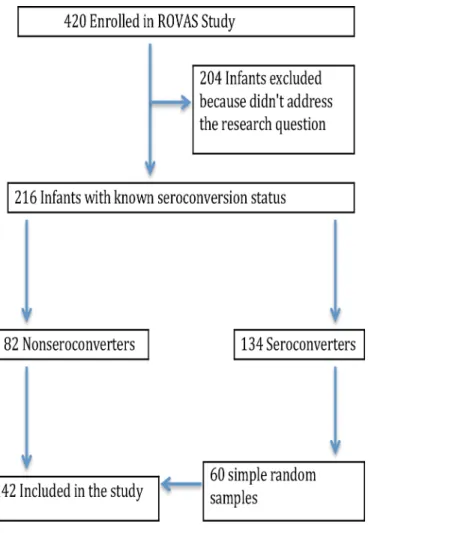
Baseline sera from infants with known seroconversion status were included and tested for presence of EED biomarkers. Of 420 enrolled infants, 216 had known seroconversion status: 82 classified as non-seroconverters, and 134 as seroconverters. Screening for EED biomarkers was done for all of the non-seroconverters and for 60 randomly selected seroconverters as illustrated inFig 1.
Post-hoc power calculation
With a seroconversion rate estimated at 60% in the general population [5], the study sample of 142 infants had 85% power to detect a reduction in seroconversion to 35% using a 2-sided Pearson Chi-Squared Test at 5% level of significance.
Laboratory procedures
Measurement of serum IgA and IgG. Rotavirus-specific serum IgA and IgG were
deter-mined by an antibody capture ELISA assay as previously described [5]. Plates were coated with rabbit hyperimmune serum to rhesus rotavirus (RRV) and incubated with diluted RV1 strain or blotto (5% skim milk in phosphate-buffered saline [PBS]). Following incubaton, plates were washed and serially diluted serum samples in diluent buffer (1% skim milk and 0.5% [v/v] of 10% polyoxyethylene ether W1 in PBS) were added to the wells together with biotin-conju-gated goat antihuman IgA antibodies. This was followed by the second incubation stage and washing afterwards. Extravidin was then added to all wells and incubated. After incubation, reactions were developed with 3,30,5,50-tetramethylbenzidine) and stopped with 1N hydrogen
Calculation of IgA titres in serum were as the reciprocal of the highest dilution that gave a mean OD greater than the cut-off value (3 standard deviations above the mean OD of the neg-ative control serum wells). RV-specific IgG in serum samples was tested and analysed in a sim-ilar way as IgA the only difference was that 0.5% normal rabbit serum was added to the biotin-conjugated goat antihuman IgG antibody solution.
Measurement of serological biomarkers of EED. Commercial enzyme linked
immuno-sorbent assays (ELISA) kits were used to measure levels of sCD14, EndoCAb, I-FABP (Hycult Biotech, Uden, Netherlands) and Zonulin (Immundiagnostik AG, Bensheim Germany) according to the manufacturer’s instructions with modifications on sample dilutions. Undi-luted plasma samples were used for measurement of sCD14 whereas samples were diUndi-luted 1:20 for Zonulin, 1:50 for Endocab and 1:10 for IFABP. Optical density was measured at 450nm (ELX808 BioTek) and concentrations were determined using assay standard curve.
Statistical analysis
The primary outcome of interest was seroconversion defined as 4-fold or more increase in rotavirus-specific IgA titres between pre-vaccination and one month post-dose -2 vaccination. Rotavirus-specific IgA titres below limit of detection were imputed with 1 [5] before assessing the fold-increase. The exposures of interest were serological EED biomarkers of intestinal
Fig 1. Infant recruitment and sample selection flow chart.
damage (IFABP), permeability (Zonulin) and microbial products of translocation (soluble CD14 and Endocab). We summarised the concentration of EED biomarkers using median and interquartile range. We used Fisher’s exact test to examine association of seroconversion with key infant and maternal factors. We used test for trend to assess dose-response relation-ship between the serological biomarkers of EED and seroconversion. The test for trend was performed by modelling the median concentration in each quartile of the biomarker concen-tration on seroconversion using a logit model.
Since this was a cohort study design we elected to estimate risk ratio using poisson with robust standard error. Therefore, Generalised linear model with family-poisson, link-log and robust standard error was used to estimate the independent effects of biomarkers on serocon-version adjusting for important cofounders. The biomarkers were modelled on log base 2 scale so that the effect would be doubling of the level of the biomarker. Values of biomarker concen-trations below the limit of detection were imputed with half the lowest concentration for that biomarker before the log-transformation. The analysis was performed using Stata 15 (Statcorp, College Station, Texas, USA).
Results
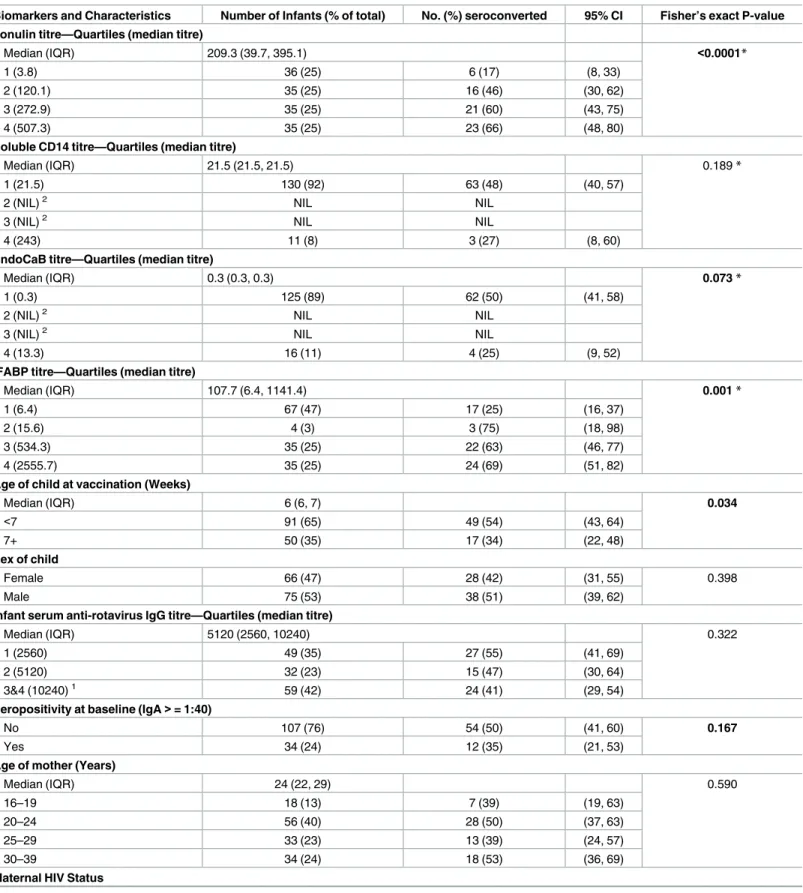
A total of 142 infant plasma samples were assessed for serological EED biomarkers. The median concentration of Zonulin, Soluble CD14, EndoCaB, and IFABP were 209.3 (IQR = 39.7, 395.1), 21.5 (IQR = 21.5, 21.5), 0.3 (IQR = 0.3, 0.3), and 107.7 (IQR = 6.4, 1141.4) respec-tively (Table 1).
In univariable analyses, there was strong evidence that high levels of Zonulin (test for trend p<0.0001) and IFABP (test for trend p = 0.001) were associated with increased probability of seroconversion, while there was no evidence at 5% level of significance that high levels of sCD14 (p = 0.189) and EndoCab (p = 0.073) were associated with seroconversion (Table 1,
Table 2).
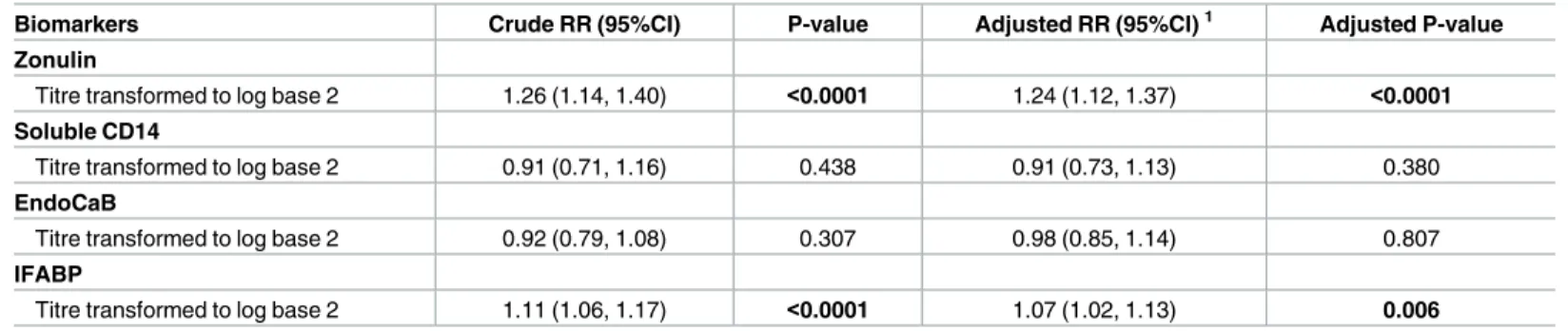
In multivariable analyses adjusting for the independent effect of other biomarkers and con-founders (i.e. age of child at vaccination, breast-milk rotavirus IgA, infant serum anti-rotavirus IgG, and IgA seropositivity at baseline), there was strong evidence of about 24% increased in seroconversion due to doubling Zonulin concentration (Adjusted risk ratio (aRR) = 1.24; 95% CI = 1.12 to1.37; p<0.0001) (Table 2). Similarly, we found about 7% in-crease in seroconversion due to doubling IFABP concentration (aRR = 1.07; 95% CI = 1.02 to 1.13; p = 0.006).
Discussion
We report findings of the influence of intestinal inflammation biomarkers on seroconversion in infants receiving rotavirus vaccines. We found that high levels of Zonulin and IFABP were strongly associated with vaccine seroconversion. We also found very low levels of EndoCAb and sCD14, which were not associated with seroconversion.
Zonulin and IFABP biomarkers are indicators of the integrity of the “Gate” (intestinal bar-rier). Increased serum concentration reflects “Openness of the gate” and thus increased leaking from the intestinal lumen into lamina propria. We think this implied easy vaccine uptake and thus resulted into “better seroconversion”. Zonulin, as a tight junction modulator protein, is secreted due to antigen binding to receptor on intestinal epithelial cell surface, which later binds to EGF receptor (EGFR) via proteinase-activated receptor 2 (PAR2) [33]. Activation of
Table 1. Seroconversion at post dose 2 by environmental enteric dysfunction status and key infant and maternal factors.
Biomarkers and Characteristics Number of Infants (% of total) No. (%) seroconverted 95% CI Fisher’s exact P-value Zonulin titre—Quartiles (median titre)
Median (IQR) 209.3 (39.7, 395.1) <0.0001*
1 (3.8) 36 (25) 6 (17) (8, 33)
2 (120.1) 35 (25) 16 (46) (30, 62)
3 (272.9) 35 (25) 21 (60) (43, 75)
4 (507.3) 35 (25) 23 (66) (48, 80)
Soluble CD14 titre—Quartiles (median titre)
Median (IQR) 21.5 (21.5, 21.5) 0.189*
1 (21.5) 130 (92) 63 (48) (40, 57)
2 (NIL)2 NIL NIL
3 (NIL)2 NIL NIL
4 (243) 11 (8) 3 (27) (8, 60)
EndoCaB titre—Quartiles (median titre)
Median (IQR) 0.3 (0.3, 0.3) 0.073*
1 (0.3) 125 (89) 62 (50) (41, 58)
2 (NIL)2 NIL NIL
3 (NIL)2 NIL NIL
4 (13.3) 16 (11) 4 (25) (9, 52)
IFABP titre—Quartiles (median titre)
Median (IQR) 107.7 (6.4, 1141.4) 0.001*
1 (6.4) 67 (47) 17 (25) (16, 37)
2 (15.6) 4 (3) 3 (75) (18, 98)
3 (534.3) 35 (25) 22 (63) (46, 77)
4 (2555.7) 35 (25) 24 (69) (51, 82)
Age of child at vaccination (Weeks)
Median (IQR) 6 (6, 7) 0.034
<7 91 (65) 49 (54) (43, 64)
7+ 50 (35) 17 (34) (22, 48)
Sex of child
Female 66 (47) 28 (42) (31, 55) 0.398
Male 75 (53) 38 (51) (39, 62)
Infant serum anti-rotavirus IgG titre—Quartiles (median titre)
Median (IQR) 5120 (2560, 10240) 0.322
1 (2560) 49 (35) 27 (55) (41, 69)
2 (5120) 32 (23) 15 (47) (30, 64)
3&4 (10240)1 59 (42) 24 (41) (29, 54)
Seropositivity at baseline (IgA>= 1:40)
No 107 (76) 54 (50) (41, 60) 0.167
Yes 34 (24) 12 (35) (21, 53)
Age of mother (Years)
Median (IQR) 24 (22, 29) 0.590
16–19 18 (13) 7 (39) (19, 63)
20–24 56 (40) 28 (50) (37, 63)
25–29 33 (23) 13 (39) (24, 57)
30–39 34 (24) 18 (53) (36, 69)
Maternal HIV Status
Elevated levels of zonulin in serum has been found to be associated with rotavirus infection in infants in Poland [35]. Further, it has been demonstrated that Dendritic Cells (DC) open the tight junctions between epithelial cells, send dendrites directly in the lumen for antigen sampling [36–38], suggesting that increased permeablility evidenced by high levels of Zonulin facilitates sending DC processes in lumen for antigen upatake. Also, antigen-nonspecific trans-port occurs through transcellular or paracellular pathways when the tight junction becomes more permeable or damaged by environmental factors. This increased uptake of antigens may occur as a result of allergic enteropathy, and other environmental factors that activate inflam-matory cascades [39–41].
On the other hand, intestinal fatty-acid binding protein (I-FABP) is expressed in epithelial cells of the mucosal layer of the small intestine tissue [42]. When intestinal mucosal damage occurs due to presence of microbes or dietary antigens, gut barrier integrity can be disrupted leading to increased intestinal permeability [43]. This breach of intestinal barrier facilitates increased uptake of microbial products as well as live vaccines. These mechasims were sup-ported by our findings that high levels of Zonulin and IFABP was associated with seroconver-sion. We think the high levels of Zonulin and IFABP implied early infant exposure to poor sanitation and hygiene, and therefore exposure to pathogens causing intestinal inflammation.
Table 1. (Continued)
Biomarkers and Characteristics Number of Infants (% of total) No. (%) seroconverted 95% CI Fisher’s exact P-value
Negative 88 (62) 42 (48) (37, 58) 0.862
Positive 53 (38) 24 (45) (32, 59)
Breast-milk anti-rotavirus IgA—Quartiles (median titre)
Median (IQR) 160 (80, 320) 0.053
1 (80) 54 (40) 32 (59) (46, 72)
2 (160) 30 (22) 11 (37) (21, 55)
3 (320) 28 (21) 12 (43) (26, 62)
4 (640+) 24 (18) 7 (29) (14, 50)
Total 141 66 (47) (39, 55)
1
3rdand 4thQuartiles were combined because the frequencies were small
2
Over 90% of titres were below limit of detection and therefore 25th, 50th, 75thpercentiles were the same as shown in the interquartile range (IQR)
*P-values were calculated using logit model where median titres were used to test for trend
https://doi.org/10.1371/journal.pone.0187761.t001
Table 2. Independent effects of markers of environmetal enteric dysfunction on seroconversion post dose 2 among rotavirus vaccinated infants aged 6–11 weeks.
Biomarkers Crude RR (95%CI) P-value Adjusted RR (95%CI)1 Adjusted P-value
Zonulin
Titre transformed to log base 2 1.26 (1.14, 1.40) <0.0001 1.24 (1.12, 1.37) <0.0001 Soluble CD14
Titre transformed to log base 2 0.91 (0.71, 1.16) 0.438 0.91 (0.73, 1.13) 0.380
EndoCaB
Titre transformed to log base 2 0.92 (0.79, 1.08) 0.307 0.98 (0.85, 1.14) 0.807
IFABP
Titre transformed to log base 2 1.11 (1.06, 1.17) <0.0001 1.07 (1.02, 1.13) 0.006
1
Estimates were adjusted for biomarkers (transformed on log base 2); and Age of child at vaccination (binary); Breast-milk anti-rotavirus IgA (transformed on log base 2); Seropositivity at baseline (IgA>= 1:40) (binary); Infant serum anti-rotavirus IgG (transformed on log base 2)
The timing of the samples just before the first vaccine dose was appropriate as it reflects the EED status of the internal milieu. We postulated that if the live oral vaccine is taken around such a time, the increased translocation of luminal microbes and their products actually facili-tated better vaccine uptake. This thinking is consistent with the known mechanism for natural infections [17,20,21]. Our finding is consistent with that of a Bangladeshi study in which IFABP had positive association with oral chorela vaccine [44].
However, soluble CD14 and Endocab are markers of responses to lipopolysaccharides (LPS), a product of gram negative bacterial cell wall, which indicate “Gut leakage”. It has been postulated that high levels of sCD14 in the plasma are reflective of LPS exposure [45]. The low levels of soluble CD14 and Endocab found in our study may suggest that infants were less exposed to intestinal bacterial infection.
We acknowledge some limitations in our study. First, stool biomarkers were not used to asses EED [46]. Second, we did not assess the intestinal microbiota, which has been shown to have an effect on vaccine responses among infants [47]. Third, there may be other unmeasured confounders that could impact immune responses. Despite these limitations, we believe that the findings are relevant to warrant future studies establishing the levels of Zonulin and IFABP at which immune activation due to increased permeability does not lead to negative associa-tion of vaccine seroconversion.
Conclusion
We found that high levels of zonulin and IFABP played a role in seroconversion. It is plausible that increased gut permeability in EED allows greater uptake of the live virus within the vac-cine, but later consequences result in deleterious local structural distortions and malabsorption syndromes.
Supporting information
S1 File.
(ZIP)
S2 File.
(ZIP)
Acknowledgments
We are grateful to the parents of all the infants who have participated in this study.
Author Contributions
Conceptualization: Innocent Mwape, Michelo Simuyandi, Roma Chilengi.
Data curation: Innocent Mwape, John Mwaba, Katayi Mwila-Kazimbaya, Natasha Makabilo
Laban, Caroline Cleopatra Chisenga.
Formal analysis: Samuel Bosomprah.
Funding acquisition: Roma Chilengi.
Investigation: Innocent Mwape, John Mwaba, Katayi Mwila-Kazimbaya, Natasha Makabilo
Laban, Caroline Cleopatra Chisenga, Michelo Simuyandi.
Methodology: Samuel Bosomprah, Gibson Sijumbila.
Supervision: Gibson Sijumbila, Roma Chilengi.
Writing – original draft: Innocent Mwape, Samuel Bosomprah.
Writing – review & editing: Innocent Mwape, Samuel Bosomprah, John Mwaba, Katayi
Mwila-Kazimbaya, Natasha Makabilo Laban, Caroline Cleopatra Chisenga, Gibson Sijum-bila, Michelo Simuyandi, Roma Chilengi.
References
1. United Nations Children’s Fund, World, Health, Organization. Diarrhoea: why children are still dying and what can be done. Geneva, Switzerland: WHO, 2009.
2. Tate JE, Burton AH, Boschi-Pinto C, Parashar UD. Coordinated Global Rotavirus Surveillance Network Global, Regional, and National Estimates of Rotavirus Mortality in Children. CID. 2016; 62(Suppl 2). 3. PATH. Rotavirus disease and vaccines in Zambia.www.path.org/publications/files/VAD_rotavirus_
zambia_fs.pdf. Accessed March 22, 2017.
4. Rudd C, Mwenda J, Chilengi R. Rotavirus landscape in Africa -Towards prevention and control: A report of the 8th African rotavirus symposium, Livingstone, Zambia. Vaccine. 2015; 33(29):3263–7.https://doi. org/10.1016/j.vaccine.2015.04.002PMID:25957665
5. Chilengi R, Simuyandi M, Beach L, Mwila K, Becker-Dreps S, Emperador D, et al. Association of Mater-nal Immunity with Rotavirus Vaccine Immunogenicity in Zambian Infants. PloS one. 2016; 11(3). 6. Armah G, Sow S, Breiman R, Dallas M, Tapia M, Feikin D. Efficacy of pentavalent rotavirus vaccine
against severe rotavirus gastroenteritis in infants in developing countries in sub-Saharan Africa: a ran-domised, double-blind, placebo-controlled trial. Lancet. 2010; 376:606–14.https://doi.org/10.1016/ S0140-6736(10)60889-6PMID:20692030
7. Glass R, Parashar U, Bresee J, Turcios R, Fischer T, Widdowson M. Rotavirus vaccines: current pros-pects and future challenges. Lancet. 2006; 368:323–32.https://doi.org/10.1016/S0140-6736(06) 68815-6PMID:16860702
8. Madhi S, Cunliffe N, Steele D, Witte D, Kirsten M, Louw C. Effect of human rotavirus vaccine on severe diarrhea in African infants. The New England journal of medicine. 2010; 362:289–98.https://doi.org/10. 1056/NEJMoa0904797PMID:20107214
9. Salinas B, Perez S, Linhares A, Ruiz P, Guerrero M, Yarzabal J. Evaluation of safety, immunogenicity and efficacy of an attenuated rotavirus vaccine, RIX4414: A randomized, placebo-controlled trial in Latin American infants. The Pediatric infectious disease journal. 2005; 24:807–16. PMID:16148848
10. Soares-Weiser K, Maclehose H, Bergman H, Ben-Aharon I, Nagpal S, Goldberg E. Vaccines for pre-venting rotavirus diarrhoea: vaccines in use. Cochrane database of systematic reviews (Online). 2012; 11:CD008521.
11. Vesikari T, Karvonen A, Puustinen L, Zeng S-Q, Szakal E, Delem A. Efficacy of RIX4414 Live attenu-ated human rotavirus vaccine in Finnish infants. The Pediatric infectious disease journal. 2004; 23. 12. Vesikari T, Matson D, Dennehy P, Van Damme P, Santosham M, Rodriguez Z. Safety and efficacy of a
pentavalent human-bovine (WC3) reassortant rotavirus vaccine. Rotavirus Efficacy and Safety Trial (REST) Study Group. The New England journal of medicine. 2006; 354:23–33.https://doi.org/10.1056/ NEJMoa052664PMID:16394299
13. Zaman K, Dang D, Victor J, Shin S, Yunus M, Dallas M. Efficacy of pentavalent rotavirus vaccine against severe rotavirus gastroenteritis in infants in developing countries in Asia: a randomised, double-blind, placebo-controlled trial. Lancet. 2010; 376:615–23.https://doi.org/10.1016/S0140-6736(10) 60755-6PMID:20692031
14. Mwila K, Chilengi R, Simuyandi M, Permar S, Becker-Dreps S. Contribution of maternal immunity to decreased rotavirus vaccine performance in low- and middle-income countries. Clin Vaccine Immunol. 2017; 24.
15. Parker E, Kampmann B, Kang G, Grassly N. Influence of enteric infections on response to oral poliovi-rus vaccine: a systematic review and meta- analysis. J Infect Dis. 2014; 210:853–64.https://doi.org/10. 1093/infdis/jiu182PMID:24688069
16. Petri W, Naylor C, Haque R. Environmental enteropathy and malnutrition: do we know enough to inter-vene? BMC Medicine. 2014; 12:187.https://doi.org/10.1186/s12916-014-0187-1PMID:25604120
17. Korpe P, Petri W. Environmental enteropathy: critical implications of a poorly understood condition. Trends Mol Med. 2012; 18:328–36.https://doi.org/10.1016/j.molmed.2012.04.007PMID:22633998
19. Guerrant R, Oria´ R, Moore S, Oria´ M, Lima A. Malnutrition as an enteric infectious disease with long-term effects on child development. Nutrition reviews. 2008; 66(9):487–505.https://doi.org/10.1111/j. 1753-4887.2008.00082.xPMID:18752473
20. Kelly P, Menzies I, Crane R, Zulu I, Nicoles C, Feakins R. Responses of small intestinal architecture and function over time to environmental factors in a tropical population. The American journal of tropical medicine and hygiene. 2004; 70(4):412–9. PMID:15100456
21. Patriarca P, Wright P, John T. Factors affecting the immunogenicity of oral poliovirus vaccine in devel-oping countries: review. Reviews of infectious diseases. 1991; 13(5):926–39. PMID:1660184
22. Sullivan P, Lunn P, Northrop-Clewes C, Crowe P, Marsh M, Neale G. Persistent diarrhea and malnutri-tion-the impact of treatment on small bowel structure and permeability. Journal of pediatric gastroenter-ology and nutrition. 1992; 14(2):208–15. PMID:1593377
23. Sullivan P, Marsh M, Mirakian R, Hill S, Milla P, Neale G. Chronic diarrhea and malnutrition histology of the small intestinal lesion. Journal of pediatric gastroenterology and nutrition. 1991; 12(2):195–203. PMID:1904932
24. Keusch G, Denno D, Black R, Duggan C, Guerrant R, Lavery J. Environmental enteric dys- function: pathogenesis, diagnosis, and clinical consequences. Clinical infectious diseases: an official publication of the Infectious Diseases Society of America. 2014; 59(4):207–12.
25. Mondal D, Minak J, Alam M, Liu Y, Dai J, Korpe P. Contribution of enteric infection, altered intestinal barrier function, and maternal malnutrition to infant malnutrition in Bangladesh. Clinical infectious dis-eases: an official publication of the Infectious Diseases Society of America. 2012; 54:185–92. 26. Denno D, VanBuskirk K, Nelson Z, Musser C, Tarr P. Environmental enteric dysfunction: Advancing
current knowledge. St.Louis, MO.
27. Fasano A. Intestinal permeability and its regulation by zonulin: diagnostic and therapeutic implications. Clin Gastroenterol Hepatol. 2012; 10(10):1096–100.https://doi.org/10.1016/j.cgh.2012.08.012PMID:
22902773
28. Wang W, Uzzau S, Goldblum S, Fasano A. Human zonulin, a potential modulator of intestinal tight junc-tions Journal of cell science. 2000; 113(24):4435–40.
29. Pelsers M, Namiot Z, Kisielewski W, Namiot A, Januszkiewicz M, Hermens W. Intestinal-type and liver-type fatty acid-binding protein in the intestine. Tissue distribution and clinical utility. Clin Biochem. 2003; 36:529–35. PMID:14563446
30. Kitchens R. "Role of CD14 in cellular recognition of bacterial lipopolysaccharides". Chemical immunol-ogy. 2000; 74:61–82. PMID:10608082
31. Tapping R, Tobias P. "Soluble CD14-mediated cellular responses to lipopolysaccharide". Chemical immunology. 2000; 74:108–21. PMID:10608084
32. Barclay G. Endogenous endotoxin-core antibody (EndoCAb) as a marker of endotoxin exposure and a prognostic indicator: a review. Prog Clin Biol Res. 1995; 392:263–72. PMID:8524931
33. Lammers K, Lu R, Brownley J, Lu B, Gerard C, Thomas K. Gliadin induces an increase in intestinal per-meability and zonulin release by binding to the chemokine receptor CXCR3. Gastroenterology. 2008; 135:194–204.https://doi.org/10.1053/j.gastro.2008.03.023PMID:18485912
34. Tripathi A, Lammers K, Goldblum S, Shea-Donohue T, Yang S, Arrietta M. Identification of human zonulin, a physiological modulator of tight junctions, as prehaptoglobin-2. Proc Natl Acad Sci USA. 2009; 106:16799–804.https://doi.org/10.1073/pnas.0906773106PMID:19805376
35. Tarko A, Suchojad A, Michalec M, Majcherczyk M, Brzozowska A, Maruniak-Chudek I. Zonulin: A Potential Marker of Intestine Injury in Newborns. Hindawi Disease Markers 2017;Article ID 2413437:6 pages.
36. Rescigno M, Ubrano M, Valzasina B, Francolini M, Rotta G, Bonasio R, et al. Dendritic cells express tight junction proteins and penetrate gut epithelial monolayers to sample bacteria. Nat Immunol. 2001; 2 (4):361–7.https://doi.org/10.1038/86373PMID:11276208
37. Soderrholm J, Streutker C, Yang P, Perdue M. Increased epithelial uptake of proteins among Crohns disease mediated by tumor necrosis factor alpha. Gut. 2004; 53(12):1817–24.https://doi.org/10.1136/ gut.2004.041426PMID:15542521
38. Tennant S, Muhsen K. Gut Immunology and oral vaccination. Molecular vaccines. 2013; 1:61. 39. Aristo V. The Assessment of Intestinal Permeability, Size Matters. Alternative Therapies. 2013; 19(1). 40. Ford R, Menzies I, Philips A, Walker-Smith J, Turner M. Intestinal sugar permeability: relationship to
diarrhoeal disease and small bowel morphology. Journal of pediatric gastroenterology and nutrition. 1985; 4(4):568–74. PMID:4032170
42. Gajda A, Storch J. Enterocyte fatty acid-binding proteins (FABPs): Different functions of liver and intesti-nal FABPs in the intestine. Prostaglandins Leukot Essent Fatty Acids. 2014; 93:9–16.https://doi.org/10. 1016/j.plefa.2014.10.001PMID:25458898
43. Lau E, Marques C, Pestana D, Santoalha M, Carvalho D, Freitas P. Conceic¸ão Calhau. The role of I-FABP as a biomarker of intestinal barrier dysfunction driven by gut microbiota changes in obesity. Nutri-tion & Metabolism. 2016; 13:31.
44. Uddin M, Islam S, Nishat N, Hossain M, Rafique T, Rashu R. Biomarkers of Environmental Enteropathy are Positively Associated with Immune Responses to an Oral Cholera Vaccine in Bangladeshi Children. PLoS Negl Trop Dis. 2016; 10(11):e0005039.https://doi.org/10.1371/journal.pntd.0005039PMID:
27824883
45. Durieux J, Vita N, Popescu O, Guette F, Calzada-wack J, Munker R. The two soluble forms of the lipo-polysaccharide receptor, CD14: characterization and release by normal human monocytes. European journal of immunology. 1994; 24:2006–12.https://doi.org/10.1002/eji.1830240911PMID:7522157
46. Kosek M, Haque R, Lima A, Babji S, Shrestha S, Quereshi S. Fecal markers of intestinal inflammation and permeability associated with the subsequent acquisition of linear growth deficits in infants. Am J Trop Med Hyg. 2013; 88:390–6.https://doi.org/10.4269/ajtmh.2012.12-0549PMID:23185075