Clindamycin Pharmacokinetics and Safety in Preterm and Term
Infants
Daniel Gonzalez,aPaula Delmore,bBarry T. Bloom,bC. Michael Cotten,cBrenda B. Poindexter,dElisabeth McGowan,eKaren Shattuck,f Kathleen K. Bradford,gP. Brian Smith,c,hMichael Cohen-Wolkowiez,c,hMaurine Morris,hWanrong Yin,iDaniel K. Benjamin, Jr.,c,h Matthew M. Laughon,gon behalf of the Best Pharmaceuticals for Children Act–Pediatric Trials Network Steering Committee
Division of Pharmacotherapy and Experimental Therapeutics, UNC Eshelman School of Pharmacy, The University of North Carolina at Chapel Hill, Chapel Hill, North Carolina, USAa
; Department of Neonatology, Wesley Medical Center, Wichita, Kansas, USAb
; Department of Pediatrics, Duke University School of Medicine, Durham, North Carolina, USAc
; Department of Pediatrics, Riley Hospital for Children, Indiana University, Indianapolis, Indiana, USAd
; Floating Hospital for Children at Tufts Medical Center, Boston, Massachusetts, USAe
; Department of Pediatrics, University of Texas Medical Branch, Galveston, Texas, USAf
; Department of Pediatrics, School of Medicine, The University of North Carolina at Chapel Hill, Chapel Hill, North Carolina, USAg
; Duke Clinical Research Institute, Duke University School of Medicine, Durham, North Carolina, USAh
; Emmes Corporation, Rockville, Maryland, USAi
Clindamycin may be active against methicillin-resistant
Staphylococcus aureus
, a common pathogen causing sepsis in infants,
but optimal dosing in this population is unknown. We performed a multicenter, prospective pharmacokinetic (PK) and safety
study of clindamycin in infants. We analyzed the data using a population PK analysis approach and included samples from two
additional pediatric trials. Intravenous data were collected from 62 infants (135 plasma PK samples) with postnatal ages of
<
121
days (median [range] gestational age of 28 weeks [23 to 42] and postnatal age of 17 days [1 to 115]). In addition to body weight,
postmenstrual age (PMA) and plasma protein concentrations (albumin and alpha-1 acid glycoprotein) were found to be
signifi-cantly associated with clearance and volume of distribution, respectively. Clearance reached 50% of the adult value at PMA of
39.5 weeks. Simulated PMA-based intravenous dosing regimens administered every 8 h (
<
32 weeks PMA, 5 mg/kg; 32 to 40
weeks PMA, 7 mg/kg;
>
40 to 60 weeks PMA, 9 mg/kg) resulted in an unbound, steady-state concentration at half the dosing
in-terval greater than a MIC for
S. aureus
of 0.12
g/ml in
>
90% of infants. There were no adverse events related to clindamycin
use. (This study has been registered at ClinicalTrials.gov under registration no. NCT01728363.)
G
ram-positive organisms account for 70% of late-onset sepsis
in the neonatal intensive care unit (NICU), most commonly
coagulase-negative staphylococci and
Staphylococcus aureus
(
1
).
In the NICU,
S. aureus
infections are associated with severe
pneu-monia, septic shock, and high mortality in infants (
⬃
25%) (
2
,
3
).
In addition, a large fraction of
S. aureus
isolates in this setting are
methicillin resistant (
3
).
Clindamycin is a lincosamide antibiotic approved by the U.S.
Food and Drug Administration (FDA) for use in adults and
chil-dren requiring treatment for staphylococcal, streptococcal, and
anaerobic infections. Doses of 15 to 20 mg/kg/day are
recom-mended for infants
⬍
1 month of age, and doses of 20 to 40 mg/
kg/day are recommended for children 1 month to 16 years old
(both administered in three or four divided doses) (
4
). The
avail-able data suggest that there are important age-dependent
differ-ences in clindamycin disposition, particularly in preterm infants,
where pronounced physiological differences are expected (
5
,
6
).
Clindamycin is largely metabolized by CYP3A4 (
7
), and the
on-togeny of this drug-metabolizing enzyme may contribute to
pro-nounced differences in its clearance (CL). Furthermore,
clinda-mycin is highly protein bound (78 to 94%) (
8–10
), primarily to
alpha-1 acid glycoprotein (AAG), and ontogenic changes in this
plasma protein during childhood and infancy may also alter
clin-damycin’s distribution into tissues.
Despite the public health need for rigorous clinical trials to be
performed in children during the first few months after birth, drug
labeling changes frequently do not include neonatal data (
11
).
Preterm infants, who are a particularly vulnerable subpopulation
due to immaturity in their organ systems, are rarely studied, and
thus optimal dosing and safety information is lacking. Due to
clindamycin’s widespread use in infants (
12
), we performed a
pro-spective, multicenter clinical trial to characterize its
developmen-tal pharmacokinetics (PK) and safety in preterm and term infants.
Relative to our previous investigation (
13
), this trial provided
more intense PK sampling in preterm and term infants, sought to
account for the role of age-dependent AAG concentrations on
clindamycin disposition, and collected detailed safety data in
in-fants, which are currently lacking in the literature.
MATERIALS AND METHODS
Patient population.PK and safety data were collected as part of the Phar-macokinetics of Anti-Staphylococcal Antibiotics in Infants clinical trial (Staph Trio; NICHD-2012-STA01, ClinicalTrials.gov NCT01728363; IND 115,396). This was a multicenter (n⫽8 enrolling under clindamy-cin), prospective, multiple-dose PK and safety study. Infants with a sus-pected systemic infection or receiving one of three antibiotic drugs of
Received23 December 2015Returned for modification31 January 2016
Accepted20 February 2016
Accepted manuscript posted online29 February 2016
CitationGonzalez D, Delmore P, Bloom BT, Cotten CM, Poindexter BB, McGowan E, Shattuck K, Bradford KK, Smith PB, Cohen-Wolkowiez M, Morris M, Yin W, Benjamin DK, Jr, Laughon MM, on behalf of the Best Pharmaceuticals for Children Act–Pediatric Trials Network Steering Committee. 2016. Clindamycin
pharmacokinetics and safety in preterm and term infants. Antimicrob Agents Chemother 60:2888 –2894.doi:10.1128/AAC.03086-15.
Address correspondence to Matthew M. Laughon, [email protected].
Supplemental material for this article may be found athttp://dx.doi.org/10.1128 /AAC.03086-15.
interest per local standard of care (including clindamycin) were eligible for enrollment. For the clindamycin group, infants were⬍30 weeks’ ges-tational age (GA) and⬍121 days’ postnatal age (PNA). Infants who met any of the following criteria were excluded: allergic reactions to a study drug, urine output⬍0.5 ml/kg/h, or serum creatinine⬎1.7 mg/dl. The study was reviewed and approved by the local institutional review board. Informed consent was obtained from the legal guardian of each study participant. The first and last infants were enrolled on 8 February 2013 and 28 February 2014, respectively.
We combined clindamycin data from Staph Trio with PK data col-lected after intravenous clindamycin administration in two additional clinical trials: (i) Pharmacokinetics of Understudied Drugs Administered to Children per Standard of Care (PTN POPS) and (2) Safety and Phar-macokinetics of Multiple-Dose Intravenous and Oral Clindamycin Pedi-atric Subjects With BMIⱖ85th Percentile (CLIN01). Combining the data across all three trials allowed for development of a population PK model that describes clindamycin disposition after intravenous administration across pediatric age groups. The PTN POPS and CLIN01 studies are de-scribed in separate publications (13; M. Smith, D. Gonzalez, J. Goldman, R. Yogev, J. E. Sullivan, M. Reed, R. Anand, K. Martz, K. Berezny, P. B. Smith, M. Cohen-Wolkowiez, and K. Watt, presented at the Pediatric Academic Societies 2015 Annual Meeting, San Diego, CA, 25 to 28 April 2015). Briefly, PTN POPS (NICHD-2011-POP01, ClinicalTrials.gov NCT01431326; IND 113,645) was a multicenter (n⫽27), prospective, PK and safety study. PTN POPS enrolled children (⬍21 years of age) who received a drug of interest (including clindamycin) per standard of care as administered by their treating caregiver. CLIN01 (NICHD-2012-CLN01, ClinicalTrials.gov NCT01744730; IND 115,396) was a prospective, mul-ticenter (n⫽6), open-label, multiple-dose PK and safety study of clinda-mycin in children 2 to⬍18 years of age with a body mass index (BMI)ⱖ 85th percentile. Children with a suspected or confirmed infection or those receiving clindamycin per standard of care were eligible for the study.
Drug dosing and sample collection.In the Staph Trio trial, all infants received clindamycin 10 mg/kg intravenously every 6, 8, or 12 h unless they were prescribed clindamycin per standard of care, in which case dosing was at the discretion of the treating caregiver. The dosing interval used was based on PNA:⬍14 days, 10 mg/kg every 12 h;ⱖ14 to 45 days, 10 mg/kg every 8 h; and⬎45 to 120 days, 10 mg/kg every 6 h. Clindamycin was administered over 30 min. Predefined PK sample time collection win-dows based on dosing interval were noted in the protocol (see Table S1 in the supplemental material); however, samples collected outside these col-lection windows were also included in the analysis.
For the PTN POPS study, dosing information was collected for up to eight doses prior to the sampling dose (last dose before biological sample collection). Since PTN POPS used an opportunistic study design, the timing of blood sample collection was dependent on standard-of-care laboratory assessments, unless a parent/guardian provided consent to ob-tain PK sampling for research purposes only (13). In the CLIN01 trial, clindamycin was prescribed at a dose of 30 to 40 mg/kg/day (based on the total body weight [WT]) every 6 or 8 h. Predefined PK sampling times used were based on route of administration and dosing interval (Smith et al., Pediatric Academic Societies 2015 Annual Meeting).
Analytical methods. Whole blood was collected (200 l) in an EDTA-K2 microtainer and processed immediately prior to freezing at the study sites. Plasma samples were stored at or below⫺70°C within 8 h of collection. PK samples were sent to the Pediatric Trials Network central laboratory (OpAns, LLC, Durham, NC) for storage and analysis. Clinda-mycin concentrations were quantified using a validated liquid chroma-tography-tandem mass spectrometry assay as previously described (13). The lower limit of quantification was 50 ng/ml. Accuracy and precision were within the FDA bioanalytical assay validation criteria (e.g.,⫾15%). An enzyme-linked immunosorbent assay (Assaypro LLC, St. Charles, MO) was used for the measurement of AAG in plasma. The method was qualified over the range 0.125 to 4g/ml for human AAG in MIX Diluent (a buffered protein base supplied with the kit) representing 0.125 to 4
mg/ml corrected for dilution. Both calibration standards and quality con-trol samples met assay validation criteria. Each study sample was diluted 1:1,000 into MIX Diluent and then processed in duplicate.
Population PK model development.Clindamycin plasma PK data collected after intravenous administration were analyzed with a nonlinear mixed effects modeling approach using the software NONMEM (version 7.2; Icon Solutions, Ellicott City, MD). The first-order conditional estimation method with interaction was used for all model runs. Run management was performed using Pirana (version 2.8.1) (14). Visual pre-dictive checks and bootstrap methods were performed with Perl-speaks-NONMEM (PsN, version 3.6.2) (15). Data manipulation and visualiza-tion were performed using R (version 3.0.2; R Foundavisualiza-tion for Statistical Computing, Vienna, Austria) and RStudio (version 0.97.551; RStudio, Boston, MA), with the packages lattice and ggplot2 used for the latter (16,17).
As previously described, a one-compartment structural PK model was used (13). Interindividual variability was assessed for PK model parame-ters using an exponential relationship. The correlation between param-eters for CL and volume of distribution (V) was estimated according to equation 1:
⫽ CL,V
兹
CL2·V2(1)
whereCL,Vdenotes the off-diagonal element between CL andV, and CL2andV2are the variance estimates for the interindividual variability
in CL andV, respectively. A proportional error model was used to esti-mate the residual variability for each study (Staph Trio, PTN POPS, and CLIN01) separately.
WT was assumed to be a significant covariate for CL andVand was included in the base model. The relationship between WT and PK param-eters was characterized using a fixed exponent (0.75 and 1) allometric and linear relationship for CL andVparameters (scaled to a 70-kg standard-ized WT), respectively. Because postmenstrual age (PMA) was previously noted to be an important predictor of interindividual variability in clin-damycin disposition in the pediatric population, this covariate was again tested. The following covariates were then also explored: aspartate ami-notransferase (AST), alanine amiami-notransferase (ALT), serum creatinine, bilirubin (total and direct), serum albumin (ALB), AAG, obese status (BMIⱖ95th percentile), ethnicity, and sex. PMA is defined as the sum of the GA (weeks) plus PNA in weeks (days/7).
The relationship between PMA and CL was characterized using a sig-moidalEMAXmaturation function as shown in equation 2:
FPMA⫽
PMAHILL TM50HILL ⫹ PMAHILL
(2)
whereFPMAdenotes the fraction of the adult CL value, TM50represents the value of PMA (weeks) when 50% adult CL is reached, and “HILL” is a slope parameter for the sigmoidal maturation model.
With the exception of WT and age, all other continuous covariates were normalized to the population median value as described in equation 3, whereas for dichotomous categorical covariates (e.g., obese status and sex) a relationship, as shown in equation 4, was used:
Pij⫽ pop,j·
冉
covi covm
冊
cov
(3)
Pij⫽ pop,j·covCATEGORICAL (4)
where covidenotes the individual covariate value, covmis the population
median covariate value,covis a parameter which represents the covariate
effect, and “CATEGORICAL” is a categorical variable that can take on one of two values: zero or one.
Population PK model evaluation.During the population PK model-building process, the following tools or criteria were used to assess model robustness: successful minimization, standard diagnostic plots, plausibil-ity and precision of parameter estimates, objective function and shrinkage values, and visual predictive checks. Parameter precision for the final pop-ulation PK model was evaluated using nonparametric bootstrapping (1,000 replicates) to generate 95% confidence intervals for parameter es-timates using the percentile method.
Dosing simulations.The final population PK model was used to sim-ulate steady-state exposure in preterm and term infants following previ-ously recommended (13) intravenous dosing regimens:ⱕ32 weeks PMA, 5 mg/kg every 8 h;⬎32 to 40 weeks PMA, 7 mg/kg every 8 h; and⬎40 to 60 weeks PMA, 9 mg/kg every 8 h. The steady-state area under the con-centration versus time curve from 0 to 8 h (AUCss,0 – 8), maximal
steady-state concentration (Css,max), and steady-state concentration at half the
dosing interval (Css,50) were calculated according to equations 5 to 7:
AUCss,0–8⫽
Dose
CL (5)
Css,max⫽
Dose
共
CL · DUR兲
·关
1⫺EXP共
⫺Ke· DUR兲兴
关
1⫺EXP共
⫺Ke·兲兴
(6)Css,50⫽Css,max· EXP
共
⫺Ke· 3.5兲
(7)whereKedenotes the first-order elimination rate constant calculated as CL/V, “DUR” denotes the infusion duration (0.5 h for all dosing simula-tions), andis the dosing interval (8 h for all dosing simulations). Cova-riate values used in the simulations were the same as those in the study population used for model development. A total of 200 concentrations versus time profiles were simulated for each virtual patient. A maximum absolute dose of 900 mg every 8 h and infusion duration of 0.5 h were used in all dosing simulations.
Finally, the simulated unbound, steady-state concentration at half the dosing interval (fCss,50) was calculated for each virtual subject assuming a
fraction unbound of 17% (9). The proportion of virtual participants with anfCss,50greater than an MIC of 0.12g/ml (previously reported MIC90
forS. aureus) after the optimal dosing was calculated (18).
Safety.Safety was assessed from the time of informed consent through 72 h and 7 days after the last dose for adverse events and serious adverse events, respectively. For standard of care clindamycin dosing, the last dose
was defined as the sixth dose after enrollment. The safety data were re-viewed on a quarterly basis by the Best Pharmaceuticals for Children Act data monitoring committee convened by the National Institute of Child Health and Human Development. An adverse event was defined as any untoward medical occurrence that took place during the conduct of the study trial regardless of whether it was drug related. A serious adverse event was an event that resulted in any of the following outcomes: death, life-threatening adverse event, persistent or significant incapacity or dis-ruption in the ability to perform normal life functions, inpatient hospi-talization or prolonging an existing hospihospi-talization, or an important med-ical event that jeopardized the health of a study participant.
RESULTS
Patient characteristics.
We enrolled 21 infants with a median
(range) GA and PNA of 26 weeks (23 to 29) and 23 days (5 to 65),
respectively. We collected 75 PK samples, of which eight
scav-enged (leftover samples from routine patient care) samples, two
samples below the limit of quantification, and one sample with
uncertain timing were not included in the analysis. The median
(range) number of samples per infant was three (2 to 4). The
median (range) clindamycin doses were 9.8 mg/kg/dose (4.3 to
13.0) and 28.9 mg/kg/day (10.0 to 39.5).
We combined the data from this prospective clinical trial with
additional PK samples collected from preterm and term infants in
PTN POPS, a separate opportunistic study (
Table 1
) (
13
). From
this study, there were 41 infants with a
⬍
121-day PNA who
con-tributed 71 PK samples (median [range] per subject of 2 [1 to 5]).
The median (range) GA and PNA values were 33 weeks (22 to 42)
and 16 days (1 to 115), respectively. The median (range)
clinda-mycin dose was 5.1 mg/kg/dose (3.8 to 13.5) and 15.0 mg/kg/day
(7.6 to 40.6).
Population PK model development and evaluation.
The data
across three trials (total
n
⫽
220 subjects; 420 PK samples) were
pooled to develop a population PK model that characterizes
clin-damycin disposition across all pediatric age groups (see Table S2
in the supplemental material). CLIN01 included 89 plasma PK
samples from 21 overweight or obese children. After accounting
TABLE 1Clinical data for preterm and term infants⬍121 days of agea
Characteristic
GA⬍30 wk GAⱖ30 wk
PNA⬍14 days (n⫽16)
PNAⱖ14–45 days (n⫽16)
PNA⬎45–120 days (n⫽6)
PNA⬍14 days (n⫽9)
PNAⱖ14–45 days (n⫽5)
PNA⬎45–120 days (n⫽10) GA (wk) 26.0 (22.9–29.7) 26.5 (23.0–28.9) 27.5 (24.0–29.0) 36.6 (31.1–40.0) 39.0 (37.0–39.7) 38.1 (30.0–42.0) PNA (days) 4.9 (2.1–10.0) 22.5 (14.0–44.0) 58.9 (51.0–64.0) 6.3 (0.8–13.0) 16.1 (16.0–29.9) 78.5 (53.0–115.2) Postmenstrual age (wk) 27.0 (23.6–30.0) 29.1 (25.7–34.3) 36.2 (31.3–37.1) 36.7 (32.0–41.4) 41.6 (39.3–42.0) 49.2 (37.6–56.3) Wt (kg) 0.8 (0.5–1.2) 1.0 (0.6–2.6) 1.8 (1.4–3.0) 2.5 (1.2–3.8) 3.7 (2.4–4.4) 5.8 (1.9–8.8) Serum creatinine (mg/dl) 1.0 (0.5–1.5) 0.5 (0.2–1.5) 0.3 (0.2–0.8) 0.4 (0.3–0.8) 0.3b 0.2 (0.2–0.3)
AST (U/liter) 21.0 (15.0–34.0) 24.5 (16.0–87.0) 109.0 (30.0–116.0) NS 24.5 (21.0–28.0) 29* ALT (U/liter) 6.0 (6.0–11.0) 15.5 (6.0–47.0) 41.0 (20.0–55.0) NS 33.0 (11.0–55.0) 25* Total bilirubin (mg/dl) 5.3 (2.3–7.7) 2.8 (0.5–8.2) 4.9 (3.5–7.9) 8.5* 1.4 (0.5–2.2) 0.5* Albumin (g/dl) 2.3 (1.9–2.8) 2.3 (1.3–2.7) 2.2 (2.1–2.3) NS 3.0 (2.1–3.7) 3.3 (2.6–4.0) AAG (mg/ml) 1.2 (0.4–3.8) 1.0 (0.2–2.9) 1.3 (0.7–2.1) 2.2 (0.9–3.3) 2.1 (1.3–2.5) 2.1 (1.3–6.3)
No. of subjects (%)
Male 10 (63) 6 (38) 5 (83) 5 (56) 2 (40) 9 (90)
Caucasian 13 (81) 15 (94) 3 (50) 6 (67) 5 (100) 10 (100)
Hispanic 4 (25) 2 (13) 1 (17) 1 (11) 2 (40) 3 (30)
a
Values are medians (ranges) for continuous variables and no. (%) for categorical variables calculated based on values at the time of the first recorded dose. For categorical variables, the percentages were calculated as a function of the number of subjects in each study. GA, gestational age; PNA, postnatal age; Wt, total body weight; AST, aspartate aminotransferase; ALT, alanine aminotransferase; AAG, alpha-1 acid glycoprotein; NS, no subjects contributed data; *, one subject contributed data.
for body size using WT, inclusion of PMA on CL and ALB and
AAG on
V
further reduced the objective function value by 115.6,
18.5, and 9.2 points, respectively. Inclusion of serum creatinine on
CL also significantly reduced the objective function value (11.6
points) but was not included in the final model because its
reten-tion in the model was largely a result of one influential individual
(with a value of 3.4 mg/dl). No other covariates reached statistical
significance.
For the final model, the typical values for CL and V can be
expressed according to the following equations: CL (liters/h)
⫽
13.8 · (WT/70)
0.75· [PMA
2.83/(39.5
2.83⫹
PMA
2.83)];
V
(liters)
⫽
63.6 · (WT/70) · (ALB/3.3)
⫺0.83· (AAG/2.4)
⫺0.25(see Table S3 in
the supplemental material). There was an inverse relationship
be-tween AAG levels and weight-normalized
V
(
Fig. 1
). Eta shrinkage
estimates for CL and
V
were 6.2 and 23.6%, respectively; epsilon
shrinkage estimates for PTN POPS, Staph Trio, and CLIN01 were
25.8, 13.7, and 11.9%, respectively. Goodness-of-fit plots and a
visual predictive check for all data included in the analysis are
shown in Fig. S1 to S3 in the supplemental material. Empirical
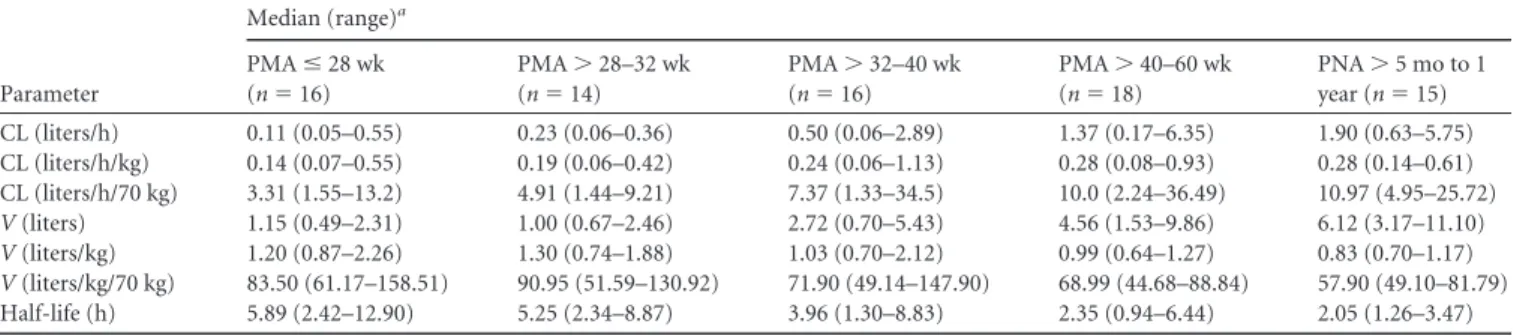
Bayesian estimates stratified by age are shown in
Table 2
.
Clear-ance values increased with age, whereas
V
decreased with age due
in part to increasing plasma protein concentrations.
Dosing simulations.
PMA-based dosing (
ⱕ
32 weeks, 5 mg/kg;
⬎
32 to 40 weeks, 7 mg/kg;
⬎
40 to 60 weeks, 9 mg/kg; each
regi-men administered intravenously every 8 h) resulted in
compara-ble AUC
ss,0 – 8(median [2.5th to 97.5th quantiles] 33.8
g · h/ml
[10.5 to 110]) and
C
ss,max(median [range] 7.9
g/ml [3.4 to 18.3])
across all infant age categories (
Fig. 2
) (
19
). The
fC
ss,50was greater
than the MIC for
S. aureus
of 0.12
g/ml in
⬎
97% of virtual
infants.
For infants
⬎
5 months to 1 year PNA, 12 mg/kg administered
intravenously every 8 h resulted in a median (2.5th to 97.5th
quan-tiles) simulated AUC
ss,0 – 8and
C
ss,maxof 41.2
g · h/ml (13.0 to
137.0) and 14.1
g/ml (9.2 to 26.7), respectively. The
fC
ss,50was
⬎
0.12
g/ml for 94.3% of the virtual infants.
Safety.
Nine (43%) infants experienced a total of 14 adverse
events, none of which were deemed related to study drug. The 14
adverse events were as follows (
n
[%]): seizures (3 [21%]), anemia
(2 [14%]), worsening necrotizing enterocolitis (NEC) (1 [7%]),
worsening spontaneous bowel perforation (1 [7%]), respiratory
acidosis (1 [7%]), hypotension (1 [7%]), abdominal wound
de-hiscence from NEC surgery (1 [7%]), diaper rash (1 [7%]),
chronic lung disease (1 [7%]), neonatal feeding intolerance (1
[7%]), and grade I intraventricular hemorrhage (1 [7%]).
The three infants who experienced a seizure were 25 to 26
weeks’ GA and
⬍
21 days’ PNA and received a median
clindamy-cin dose of
⬃
10 mg/kg intravenously every 12 h. Based on their
empirical Bayesian estimates and dosing, their predicted
steady-state area under the concentration versus time curves from zero to
12 h (AUC
ss,0 –12) were 17.9, 93.9, and 108.6
g · h/ml; the
C
ss,maxFIG 1(A) Alpha-1 acid glycoprotein versus volume of distribution (V); (B) postmenstrual age versus V. The black line and shaded area denote the loess curve and an associated 95% confidence region.
TABLE 2Individual empirical Bayesian post hoc parameter estimates stratified by age
Parameter
Median (range)a
PMAⱕ28 wk (n⫽16)
PMA⬎28–32 wk (n⫽14)
PMA⬎32–40 wk (n⫽16)
PMA⬎40–60 wk (n⫽18)
PNA⬎5 mo to 1 year (n⫽15) CL (liters/h) 0.11 (0.05–0.55) 0.23 (0.06–0.36) 0.50 (0.06–2.89) 1.37 (0.17–6.35) 1.90 (0.63–5.75) CL (liters/h/kg) 0.14 (0.07–0.55) 0.19 (0.06–0.42) 0.24 (0.06–1.13) 0.28 (0.08–0.93) 0.28 (0.14–0.61) CL (liters/h/70 kg) 3.31 (1.55–13.2) 4.91 (1.44–9.21) 7.37 (1.33–34.5) 10.0 (2.24–36.49) 10.97 (4.95–25.72)
V(liters) 1.15 (0.49–2.31) 1.00 (0.67–2.46) 2.72 (0.70–5.43) 4.56 (1.53–9.86) 6.12 (3.17–11.10)
V(liters/kg) 1.20 (0.87–2.26) 1.30 (0.74–1.88) 1.03 (0.70–2.12) 0.99 (0.64–1.27) 0.83 (0.70–1.17)
V(liters/kg/70 kg) 83.50 (61.17–158.51) 90.95 (51.59–130.92) 71.90 (49.14–147.90) 68.99 (44.68–88.84) 57.90 (49.10–81.79) Half-life (h) 5.89 (2.42–12.90) 5.25 (2.34–8.87) 3.96 (1.30–8.83) 2.35 (0.94–6.44) 2.05 (1.26–3.47)
values were 5.2, 10.7, and 14.2
g/ml. In four subjects who
re-ceived clindamycin intravenous dosing every 12 h (5 to 10 mg/kg/
dose) and did not experience a seizure, the median (range)
AUC
ss,0 –12and
C
ss,maxwere 42.2
g · h/ml (28.8 to 57.3) and 6.7
g/ml (4.1 to 9.1), respectively.
DISCUSSION
As previously described (
13
), we used a one-compartment
struc-tural PK model to find that after correcting for body size using
WT, PMA was the most significant covariate that accounts for
maturation in infants. Using a sigmoid
E
MAXmaturation
func-tion, maturation reached 50% adult CL values at 39.5 weeks’
PMA, comparable to other CYP3A4 substrates (e.g., 39.7 weeks
with lopinavir) (
20
,
21
). The population estimates for CL and
V
were 13.8 liters/h and 63.6 liters (scaled to a 70-kg standardized
adult WT), respectively, which were comparable to reported adult
values of 15.2 liters/h and 66.2 liters, respectively (
22
).
In addition to body size and age (PMA), plasma protein
con-centrations (AAG and ALB) significantly explained
interindi-vidual variability in
V
. Clindamycin binds primarily to AAG, and
changes in the concentrations of this protein would be expected to
alter its fraction unbound in infants (
8–10
,
23
) A reduction in
V
with age was observed in part due to increased AAG
concentra-tions, which is consistent with a previous investigation that
pre-dicted 50% adult concentrations at birth (
24
). A trend toward
lower ALB levels in infants was also observed (
⬃
40% lower in
infants
⬍
28 weeks versus
⬎
40 to 60 weeks PMA), but a substantial
fraction of subjects were lacking an available measurement.
We compared our individual clindamycin PK estimates with
two previous studies in infants (
5
,
6
). One study that enrolled 40
preterm and term infants (GA, 28 to 40 weeks; PNA, 2 to 27 days;
WT, 1 to 9.6 kg) and administered intravenous clindamycin (15 to
20 mg/kg/day) noted increases in CL with PNA (0.29 liter/h for
preterm and
⬍
28 days PNA, 0.68 liter/h for term and
⬍
28 days
PNA, and 1.59 liter/h for
⬎
4 weeks of age) (
5
). Although not
statistically significant, the authors noted that
V
was three times
higher in preterm infants (relative to term infants
⬍
28 days and
infants
⬎
4 weeks of age) (
5
). A second study enrolled 12 newborn
infants (GA, 26 to 39 weeks; PNA, 1 to 24 days; WT, 0.8 to 2.6 kg)
and reported a mean (range) weight-normalized
V
and CL of 0.56
liter/kg (0.15 to 1.1) and 0.06 liter/h/kg (0.02 to 0.13), respectively
(
6
). These estimates of CL and
V
are in agreement with the values
observed in our study, whereby preterm infants had the lowest CL
and highest
V
estimates.
The treatment regimens simulated in our study were within the
range of recommended doses in the package insert but were
fur-ther stratified based on the PMA of the infant. The regimens we
simulated resulted in comparable simulated exposure relative to
adult estimates (
19
). The exposures were comparable even when
plotted as a function of weight and varying AAG and ALB
concen-FIG 2Simulated steady-state area under the total clindamycin concentration versus time curve from 0 to 8 h (AUCss,0 – 8) after intravenous dosing to achieve
exposure comparable to observed adult values after 600 mg intravenously every 8 h (mean [standard deviation], 31.8g · h/ml [6.7]) (19). (A and B) AUCss,0 – 8
versus postmenstrual age and total body weight after age-based dosing:ⱕ32 weeks’ postmenstrual age, 5 mg/kg every 8 h;⬎32 to 40 weeks’ postmenstrual age, 7 mg/kg every 8 h; and⬎40 to 60 weeks’ postmenstrual age, 9 mg/kg every 8 h. (C and D) AUCss,0 – 8versus postnatal age and total body weight after 12 mg/kg
trations. Furthermore, a high percentage of infants (
⬎
94%) up to
1 year of age had simulated concentrations above an MIC of 0.12
g/ml across all dosing regimens, which suggests that these doses
will yield a therapeutic benefit.
Clindamycin was generally well tolerated in our study. None
of the adverse events reported were deemed related to study
drug. The most common adverse events (seizures, anemia, and
worsening NEC) may be due to the inherent disease processes
in this vulnerable population. Although seizures are possibly
due to high concentrations of clindamycin, the extent of
cen-tral nervous system penetration of clindamycin in children is
unknown, and in adults the cerebrospinal fluid/plasma ratio is
low, generally 1 to 3% (
25
). Two of the three infants who
ex-perienced seizures had a predicted exposure in the upper range
of all infants enrolled in the infant PK study. For one of the
infants, the seizure occurred
⬃
3 days after the last clindamycin
dose. A follow-up study to evaluate clindamycin safety in
pre-term and pre-term infants is needed.
Combining clindamycin data collected across multiple PK
studies allowed us to characterize the disposition of this drug as a
function of age. We used a flexible study design, which collected
PK and safety data for three antistaphylococcal antibiotics
(in-cluding clindamycin) and then merged these data with two other
data sets. The final population PK model then allowed us to
iden-tify important covariates that explain interindividual variability
and explore clindamycin dosing. A few limitations of our
ap-proach should be noted. First, we combined data across three
clinical trials with different study designs and patient populations,
which may introduce additional variability. As a result, in our
model we estimated separate residual variability parameters for
each study. Second, in the opportunistic study, a substantial
pro-portion of the subjects were missing laboratory data (e.g., ALB),
which limited our ability to evaluate the significance of some
co-variates. However, a measurement of AAG, clindamycin’s
pre-dominant binding protein, was available for 98% of subjects
across all three studies.
Conclusion
In conclusion, a one-compartment population PK
model accounting for size-based differences using WT,
matura-tion in drug CL using PMA, and differences in protein binding
using AAG and ALB concentrations characterized clindamycin
disposition in preterm and term infants. In preterm infants,
clin-damycin should be dosed using WT and PMA to achieve
thera-peutic exposures.
ACKNOWLEDGMENTS
An assay measuring clindamycin concentrations was performed at OpAns Laboratory (Durham, NC) by Randall Armour (Staph Trio, PTN POPS, and CLIN01), Misha Sims (Staph Trio and CLIN01), Lisa St. John-Wil-liams (PTN POPS), Christine Grosse (PTN POPS and CLIN01), and Amy Delinsky (CLIN01).
This study was funded under National Institute of Child Health and Human Development (NICHD) contracts HHSN275201000003I (prin-cipal investigator [PI] D. K. Benjamin) for the Pediatric Trials Network, HHSN27500013 (PI D. K. Benjamin) for the Pharmacokinetics of Anti-staphylococcal Antibiotics in Infants study (Staph Trio; protocol NICHD-2012-STA01), HHSN27500006 (PIs C. Melloni and M. Cohen-Wolkow-iez) for the Pharmacokinetics of Understudied Drugs Administered to Children per Standard of Care Study (PTN POPS; protocol NICHD-2011-POP01), and HHSN27500018 (PI K. Watt) for the Safety and Phar-macokinetics of Multiple-Dose Intravenous and Oral Clindamycin Pedi-atric Subjects with BMI ⱖ85th Percentile Study (CLIN01; protocol
NICHD-2012-CLN01). Research reported in this publication was also supported by the National Center for Advancing Translational Sci-ences of the National Institutes of Health (NIH) under award number UL1TR001117. D.G. received research support through 1K23HD083465-01 from the NICHD, and from the nonprofit organi-zation Thrasher Research Fund (www.thrasherresearch.org). P.B.S. received salary support for research from the NIH and the National Center for Advancing Translational Sciences of the NIH (UL1TR001117), the NICHD (HHSN2752010000031 and 1R01-HD081044-01), and the Food and Drug Administration (1R18-FD005292-0I), as well as research support from Cempra Pharmaceu-ticals (subaward to HHSO100201300009C) and Industry for Neonatal and Pediatric Drug Development (www.dcri.duke.edu/research/coi .jsp). M.C.-W. received support for research from the NIH (1R01-HD076676-01A1), the National Center for Advancing Translational Sciences of the NIH (UL1TR001117), the National Institute of Allergy and Infectious Disease (NIAID; HHSN272201500006I and HHSN272201300017I), the NICHD (HHSN275201000003I), the Food and Drug Administration (1U01FD004858-01), the Biomedical Advanced Research and Development Authority (BARDA; HHSO100201300009C), and the nonprofit organization Thrasher Re-search Fund (www.thrasherresearch.org) and from industry (Car-dioDx and Durata Therapeutics) for drug development in adults and children (www.dcri.duke.edu/research/coi.jsp). D.K.B. received sup-port from the United States government for his work in pediatric and neonatal clinical pharmacology (2K24HD058735-06, UL1TR001117, NICHD contract HHSN275201000003I, and NIAID contract HHSN272201500006I), as well as research support from Cempra Pharmaceuticals (subaward to HHSO100201300009C) for neonatal and pediatric drug development (www.dcri.duke.edu/research/coi .jsp). M.M.L. received support from the U.S. government for work in pediatric and neonatal clinical pharmacology (government contract HHSN267200700051C, PI D. K. Benjamin under the Best Pharmaceu-ticals for Children Act), from the NICHD (K23HD068497), and from Pfizer, Cempra, and Astellas for work on DSMBs. The remaining au-thors have no funding to disclose. The content is solely the responsi-bility of the authors and does not necessarily represent the official views of the NIH.
FUNDING INFORMATION
This work, including the efforts of Michael Cohen-Wolkowiez, was funded by Biomedical Advanced Research and Development Authority (HHSO100201300009C). This work, including the efforts of Michael Co-hen-Wolkowiez, was funded by HHS | National Institutes of Health (NIH) (1R01-HD076676-01A1). This work, including the efforts of Dan-iel K. Benjamin, Jr., was funded by HHS | National Institutes of Health (NIH) (2K24HD058735-06). This work, including the efforts of Matthew M. Laughon, was funded by HHS | National Institutes of Health (NIH) (HHSN267200700051C). This work, including the efforts of Michael Co-hen-Wolkowiez and Daniel K. Benjamin, Jr., was funded by HHS | NIH | National Institute of Allergy and Infectious Diseases (NIAID) (HHSN272201500006I). This work, including the efforts of Michael Co-hen-Wolkowiez, was funded by HHS | NIH | National Institute of Allergy and Infectious Diseases (NIAID) (HHSN272201500006I). This work, in-cluding the efforts of P. Brian Smith, Michael Cohen-Wolkowiez, and Daniel K. Benjamin, Jr., was funded by HHS | NIH | National Center for Advancing Translational Sciences (NCATS) (UL1TR001117). This work, including the efforts of Daniel Gonzalez, P. Brian Smith, Michael Cohen-Wolkowiez, and Daniel K. Benjamin, Jr., was funded by HHS | NIH | National Institute of Child Health and Human Development (NICHD) (HHSN275201000003I). This work, including the efforts of Daniel K. Benjamin, Jr., was funded by HHS | NIH | National Institute of Child Health and Human Development (NICHD) (HHSN27500013). This work, including the efforts of Michael Cohen-Wolkowiez, was funded by HHS | NIH | National Institute of Child Health and Human Development (NICHD) (HHSN27500006). This work, including the efforts of Daniel K. Benjamin, Jr., was funded by HHS | NIH | National Institute of Child Health and Human Development (NICHD) (HHSN27500018). This work, including the efforts of Daniel Gonzalez, was funded by HHS | NIH | National Institute of Child Health and Human Development (NICHD) (1K23HD083465-01). This work, including the efforts of P. Brian Smith, was funded by HHS | NIH | National Institute of Child Health and Human Development (NICHD) (1R01-HD081044-01). This work, including the efforts of Matthew M. Laughon, was funded by HHS | NIH | National Institute of Child Health and Human Development (NICHD) (K23HD068497). This work, including the efforts of P. Brian Smith, was funded by MOHW | Food and Drug Administration (FDA) (1R18-FD005292-01). This work, including the efforts of Michael Cohen-Wolkowiez, was funded by MOHW | Food and Drug Administration (FDA) (1U01FD004858-01).
REFERENCES
1.Stoll BJ, Hansen N, Fanaroff AA, Wright LL, Carlo WA, Ehrenkranz RA, Lemons JA, Donovan EF, Stark AR, Tyson JE, Oh W, Bauer CR, Korones SB, Shankaran S, Laptook AR, Stevenson DK, Papile L-A, Poole WK.2002. Late-onset sepsis in very low birth weight neonates: the experience of the NICHD Neonatal Research Network. Pediatrics110:
285–291.http://dx.doi.org/10.1542/peds.110.2.285.
2.Healy CM, Palazzi DL, Edwards MS, Campbell JR, Baker CJ. 2004. Features of invasive staphylococcal disease in neonates. Pediatrics114:
953–961.http://dx.doi.org/10.1542/peds.2004-0043.
3.Shane AL, Hansen NI, Stoll BJ, Bell EF, Sanchez PJ, Shankaran S, Laptook A, Das RA, Walsh MC, Hale EC, Newman NS, Schrag SJ, Higgins RD.2012. Methicillin-resistant and susceptibleStaphylococcus aureus bacteremia and meningitis in preterm infants. Pediatrics129:
e914 – e922.http://dx.doi.org/10.1542/peds.2011-0966.
4.U.S. National Library of Medicine2007. Bedford Laboratories: clinda-mycin phosphate injection. U.S. National Library of Medicine, Washing-ton, DC. https://dailymed.nlm.nih.gov/dailymed/archives/fdaDrugInfo .cfm?archiveid⫽3499.
5.Bell MJ, Shackelford P, Smith R, Schroeder K.1984. Pharmacokinetics of clindamycin phosphate in the first year of life. J Pediatr105:482– 486. http://dx.doi.org/10.1016/S0022-3476(84)80033-5.
6.Koren G, Zarfin Y, Maresky D.1985. Pharmacokinetics of intravenous clindamycin in newborn infants. Pediatr Pharmacol5:287–292.
7.Wynalda M, Hutzler J, Koets M.2003. In vitro metabolism of clindamy-cin in human liver and intestinal microsomes. Drug Metab Dispos31:
878 – 887.http://dx.doi.org/10.1124/dmd.31.7.878.
8.Son DS, Osabe M, Shimoda M, Kokue E.1998. Contribution of alpha 1-acid glycoprotein to species difference in lincosamides-plasma protein binding kinetics. J Vet Pharmacol Ther21:34 – 40.http://dx.doi.org/10 .1046/j.1365-2885.1998.00111.x.
9.Flaherty JF, Jr, Gatti G, White J, Bubp J, Borin M, Gambertoglio JG.
1996. Protein binding of clindamycin in sera of patients with AIDS. Anti-microb Agents Chemother40:1134 –1138.
10. Zhanel GG, Kirkpatrick ID, Hoban DJ, Kabani A, Karlowsky MJA.
1998. Influence of human serum on pharmacodynamic properties of an investigational glycopeptide, LY333328, and comparator agents against
Staphylococcus aureus. Antimicrob Agents Chemother42:2427–2430. 11. Laughon MM, Avant D, Tripathi N, Hornik CP, Cohen-Wolkowiez M,
Clark RH, Smith PB, Rodriguez W.2014. Drug labeling and exposure in neonates. JAMA Pediatr 168:130 –136.http://dx.doi.org/10.1001 /jamapediatrics.2013.4208.
12. Hsieh EM, Hornik CP, Clark RH, Laughon MM, Benjamin DK, Smith PB.2014. Medication use in the neonatal intensive care unit. Am J Peri-natol31:811– 821.http://dx.doi.org/10.1055/s-0033-1361933.
13. Gonzalez D, Melloni C, Yogev R, Poindexter BB, Mendley SR, Delmore P, Sullivan JE, Autmizguine J, Lewandowski A, Harper B, Watt KM, Lewis KC, Capparelli EV, Benjamin DK, Jr, Cohen-Wolkowiez M.2014. Use of opportunistic clinical data and a population pharmacokinetic model to support dosing of clindamycin for premature infants to adoles-cents. Clin Pharmacol Ther96:429 – 437.http://dx.doi.org/10.1038/clpt .2014.134.
14. Keizer RJ, Karlsson MO, Hooker A.2013. Modeling and simulation workbench for NONMEM: tutorial on Pirana, PsN, and Xpose. CPT Pharmacometrics Syst Pharmacol 2:e50. http://dx.doi.org/10.1038/psp .2013.24.
15. Lindbom L, Ribbing J, Jonsson EN. 2004. Perl-speaks-NONMEM (PsN)—a Perl module for NONMEM related programming. Comput Methods Programs Biomed75:85–94.
16. Wickham H.2009. ggplot2: elegant graphics for data analysis. Springer, New York, NY.
17. Sarkar D.2008. Lattice: multivariate data visualization with R. Springer, New York, NY.
18. Reeves DS, Holt HA, Phillips I, King A, Miles RS, Paton R, Wise R, Andrews JM.1991. Activity of clindamycin againstStaphylococcus aureus
andStaphylococcus epidermidisfrom four UK centres. J Antimicrob Che-mother27:469 – 474.http://dx.doi.org/10.1093/jac/27.4.469.
19. Gatti G, Flaherty J, Bubp J, White J, Borin M, Gambertoglio J.1993. Comparative study of bioavailabilities and pharmacokinetics of clindamy-cin in healthy volunteers and patients with AIDS. Antimicrob Agents Che-mother37:1137–1143.http://dx.doi.org/10.1128/AAC.37.5.1137. 20. Holford N, Heo Y, Anderson B.2013. A pharmacokinetic standard for
babies and adults. J Pharm Sci102:2941–2952.http://dx.doi.org/10.1002 /jps.23574.
21. Urien S, Firtion G, Anderson ST, Hirt D, Solas C, Peytavin G, Faye A, Thuret I, Leprevost M, Giraud C, Lyall H, Khoo S, Blanche S, Tréluyer J-M.2011. Lopinavir/ritonavir population pharmacokinetics in neonates and infants. Br J Clin Pharmacol71:956 –960.http://dx.doi.org/10.1111/j .1365-2125.2011.03926.x.
22. Bouazza N, Pestre V, Jullien V, Curis E, Urien S, Salmon D, Tréluyer J-M.2012. Population pharmacokinetics of clindamycin orally and intra-venously administered in patients with osteomyelitis. Br J Clin Pharmacol
74:971–977.http://dx.doi.org/10.1111/j.1365-2125.2012.04292.x. 23. Lerman J, Strong HA, LeDez KM, Swartz J, Rieder MJ, Burrows FA.
1989. Effect of age on the serum concentration of alpha-1-acid glycopro-tein and the binding of lidocaine in pediatric patients. Clin Pharmacol Ther46:219 –225.http://dx.doi.org/10.1038/clpt.1989.129.
24. McNamara PJ, Alcorn J.2002. Protein binding predictions in infants. AAPS PharmSci4:E4.