DO NEIGHBORHOOD CHARACTERISTICS MATTER FOR OLDER ADULTS LIVING IN PRIMARILY RURAL NEIGHBORHOODS, AND IF SO, HOW AND FOR WHOM?
Sarah Dorothy Kowitt
A dissertation submitted to the faculty of the University of North Carolina at Chapel Hill in partial fulfillment of the requirements for the degree of Doctor of Philosophy in the Department of Health
Behavior in the Gillings School of Global Public Health.
Chapel Hill 2018
ABSTRACT
Sarah Dorothy Kowitt: Do Neighborhood Characteristics Matter for Older Adults Living in Primarily Rural Neighborhoods, and If So, How and for Whom?
(Under the direction of Edwin B. Fisher)
Background. More than half of all adults in the United States—117 million people—have a chronic condition. In addition to accounting for most health care expenditures (86%), chronic disease is often associated with considerable decline in quality of life, increased risk of mortality, and decreased psychosocial and psychological functioning. Individual risk factors have been extensively linked to chronic disease and growing evidence now suggests that aspects of the neighborhood are associated with health and wellbeing.
Methods. Accordingly, this dissertation includes two studies that examine the relationships among neighborhood characteristics and mental and physical functioning in older adults with knee osteoarthritis (Study 1) and the relationships with depression in a broader sample of older adults (Study 2). Specifically, Study 1 examined in multilevel, cross-sectional and longitudinal analyses if four neighborhood
Results. Although few longitudinal associations were found, cross-sectional results from Study 1 suggested that perceived neighborhood social cohesion and perceived neighborhood resources for physical activity and walking were associated with less depression and greater physical functioning among older adults with knee osteoarthritis. Additionally, several interactions were found among neighborhood characteristics and race, disease severity, and presence of comorbidities. Study 2 again found relationships between neighborhood characteristics and depression. Further, mediation analysis indicated that these associations were mediated by physical activity, social support, and perceived individual control.
ACKNOWLEDGEMENTS
I would like to acknowledge everyone who has supported me in this dissertation journey. First and foremost, to my advisor, mentor, and dissertation chair, Dr. Ed Fisher, thank you for your all your patience, support, and guidance over the past five years. You have given me both the flexibility to pursue my research interests and structured opportunities to learn from your projects. I entered this PhD program knowing nothing about research. Today, I leave feeling like a real “researcher.”
To my other committee members, Drs. Allison Aiello, Leigh Callahan, Nisha Gottfredson, and Kate Muessig: Thank you for your thoughtful feedback on my dissertation and for supporting my growth as a scholar.
To Drs. Adam Goldstein and Leah Ranney and everyone else from the Project Credibility team at the UNC Center for Regulatory Research on Tobacco Communication: Thank you for being my home outside of the department. I’ve appreciated the opportunity to learn from all of you and grow as a tobacco control researcher. My PhD program would not have been the same without you.
To my cohort, Nev: I don’t know if I could have done this without you. I am so appreciative of your encouragement, support, and perspective. Thanks for being the best possible cohortmate. I can’t wait for us to grow together as research colleagues.
To Allen: Thank you for your endless love and encouragement throughout this entire journey. You always push me to “do better” and your confidence in my work has carried me through the program.
To my parents, Sam, grandparents, and the rest of my family: You are the reasons I started and finished this program. Thank you for teaching me that investing in education will always be rewarded. I have been so fortunate to be blessed with a family like this.
TABLE OF CONTENTS
LIST OF TABLES ... x
LIST OF FIGURES ... xi
LIST OF ABBREVIATIONS...xii
CHAPTER 1: INTRODUCTION ... 1
Overview ... 1
Study 1 Background ... 2
Study 2 Background ... 3
Significance for Public Health ... 4
Organization of the Dissertation... 6
CHAPTER 2: BACKGROUND AND RESEARCH GAPS ... 8
Neighborhoods and Health ... 8
Synthesis of Research Gaps ... 14
CHAPTER 3: THEORETICAL FRAMEWORKS AND CONCEPUTAL MODELS ... 16
The Social Environment and Health ... 16
The Neighborhood Economic Environment and Health ... 18
The Neighborhood Physical Environment and Health ... 21
Synergistic Effects of Neighborhood Social, Economic, and Physical Environments on Health ... 22
Conceptual Model and Research Questions ... 22
Hypotheses and Aims ... 25
CHAPTER 4: STUDY 1 ... 29
Methods ... 31
Results ... 40
Discussion ... 45
Tables for Study 1 ... 53
Figures for Study 1 ... 61
CHAPTER 5: STUDY 2 ... 64
Introduction ... 64
Methods ... 67
Results ... 73
Discussion ... 77
Tables for Study 2 ... 83
Figures for Study 2 ... 87
CHAPTER 6: SYNTHESIS AND FUTURE DIRECTIONS ... 89
Summary of Findings ... 89
Study Strengths... 91
Study Limitations ... 93
Implications for Research ... 95
Implications for Practice ... 98
APPENDIX A. MEASURES ... 101
APPENDIX B. SUPPLEMENTARY FIGURES FOR STUDY 1 ... 111
APPENDIX C. SUPPLEMENTARY TABLES FOR STUDY 1 ... 113
APPENDIX D. BASELINE PARTICIPANT CHARACTERISTICS ANALYSIS FOR STUDY 1 ... 118
APPENDIX E. SUPPLEMENTARY TABLES FOR STUDY 2 ... 120
LIST OF TABLES
Table 1. Participant characteristics of adults with knee OA from the T2 wave (n=656) and T3 wave (n=434) of the Johnston County Osteoarthritis Project, Johnston County,
North Carolina, 2006-2011 and 2013-2015 ... 53 Table 2. Correlations among neighborhood characteristics, physical activity, and health
outcomes, among adults with knee OA, from the T2 wave (n=656) and T3 wave (n=434) of the Johnston County Osteoarthritis Project, Johnston County, North Carolina,
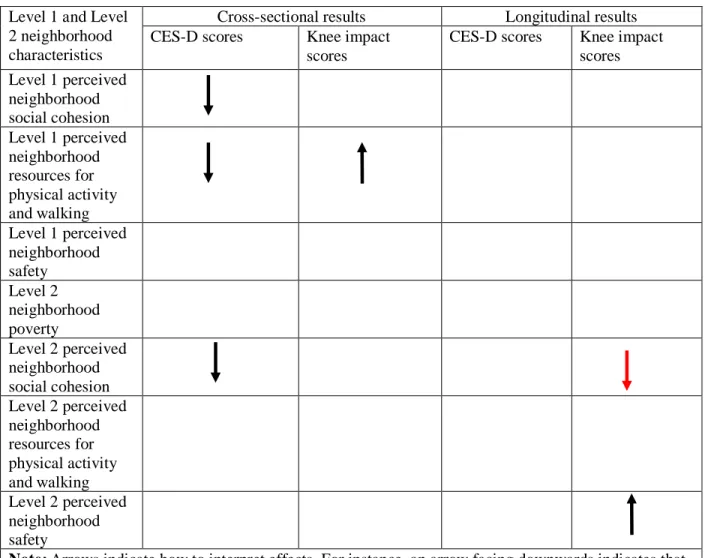
2006-2011 and 2013-2015 ... 54 Table 3. Summary of main effects from Study 1, using data from the T2 and T3 wave of
the Johnston County Osteoarthritis Project, Johnston County, North Carolina, 2006-2011
and 2013-2015 ... 55 Table 4. Individual and neighborhood-level correlates of CES-D scores among
individuals with knee OA, n=656, from the T2 wave of the Johnston County Osteoarthritis
Project, Johnston County, North Carolina, 2006-2011 ... 56 Table 5. Individual and neighborhood-level correlates of reported knee impact scores
among individuals with knee OA, n=656, from the T2 wave of the Johnston County
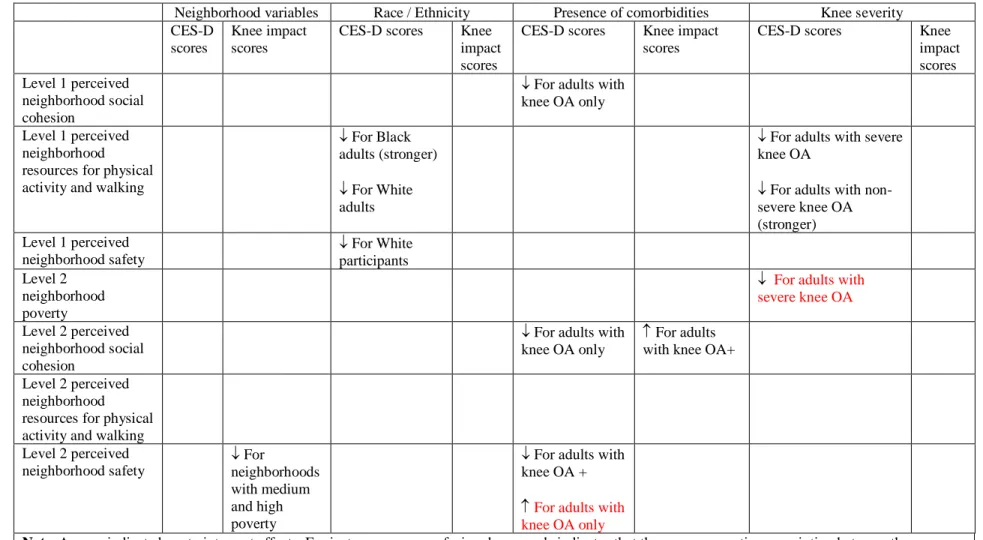
Osteoarthritis Project, Johnston County, North Carolina, 2006-2011 ... 57 Table 6. Summary of interactions from Study 1, using data from the T2 wave of the
Johnston County Osteoarthritis Project, Johnston County, North Carolina, 2006-2011 ... 58 Table 7. Individual and neighborhood-level correlates of PROMIS-D scores at T3
among individuals with knee OA, longitudinal results n=434, using data from the T2 wave and T3 wave of the Johnston County Osteoarthritis Project, Johnston County,
North Carolina, 2006-2011 and 2013-2015 ... 59 Table 8. Individual and neighborhood-level correlates of reported knee impact scores
at T3 among individuals with knee OA, longitudinal results n=434, using data from the T2 wave and T3 wave of the Johnston County Osteoarthritis Project, Johnston County,
North Carolina, 2006-2011 and 2013-2015 ... 60 Table 9. Participant characteristics of adults from the T2 wave of the Johnston County
Osteoarthritis Project, Johnston County, North Carolina, 2006-2011, n=1697 ... 83 Table 10. Model fit from the confirmatory factor analyses for adults from the T2 wave
of the Johnston County Osteoarthritis Project, Johnston County, North Carolina,
2006-2011, n=1697 ... 84 Table 11. Correlation matrix of observed and latent variables for adults from the T2
wave of the Johnston County Osteoarthritis Project, Johnston County, North Carolina,
2006-2011, n=1697 ... 85 Table 12. Results from the structural equation model for adults from the T2 wave
of the Johnston County Osteoarthritis Project, Johnston County, North Carolina,
LIST OF FIGURES
Figure 1. Conceptual models for Studies 1 and 2 ... 24 Figure 2. Interactions among neighborhood context and key individual-level
characteristics among adults with knee OA, n=656, from the T2 wave of the Johnston County Osteoarthritis Project, Johnston County, North Carolina,
2006-2011 ... 61 Figure 3. Conceptual model for proposed structural equation model pathways for
adults from the T2 wave of the Johnston County Osteoarthritis Project, Johnston
County, North Carolina, 2006-2011 ... 87 Figure 4. Final conceptual model with direction and significance of parameter
estimates for adults from the T2 wave of the Johnston County Osteoarthritis
LIST OF ABBREVIATIONS
AIC Akaike information criterion BIC Bayesian information criterion
BRFSS Behavioral Risk Factor Surveillance System BMI Body mass index
CDC Centers for Disease Control and Prevention CES-D Center for Epidemiologic Studies Depression CFI Comparative Fit Index
CFA Confirmatory factor analysis EMA Ecological Momentary Assessment FIML Full information maximum likelihood GIS Geographic Information System GPS Global Positioning System ICC Intraclass correlation
JOCO OA Johnston County osteoarthritis KL Kellgren and Lawrence
KOOS Knee Injury and Osteoarthritis Outcome Score NIH National Institutes of Health
NC North Carolina
OA Osteoarthritis
PHQ-9 Patient Health Questionnaire
PROMIS-D Patient-Reported Outcome Measurement Information System Depression RMSEA Root mean square error of approximation
SES Socioeconomic
SD Standard Deviation
T2 Time 1 Wave
T3 Time 2 Wave
TLI Tucker-Lewis Index
US United States
CHAPTER 1: INTRODUCTION Overview
More than half of all adults in the United States (US)—117 million people—and more than 85% of older adults have a chronic condition.1-3 In addition to accounting for most of the US’ health care expenditures (86%),4 chronic disease is often associated with considerable decline in quality of life, increased risk of mortality, and decreased psychosocial and psychological functioning.5 The burden and patterning of chronic disease are clear—individuals marginalized by social, economic, and geographic structures are disproportionately burdened by chronic disease.6 Indeed, there is growing evidence that aspects of the neighborhood are associated with health behaviors, health outcomes, and quality of life, especially as they relate to chronic disease prevention and management.6 This dissertation research combines theories on neighborhoods and health with advanced statistical methods to identify and examine how neighborhood context is associated with mental and physical functioning among a unique
population: older adults living in primarily rural neighborhoods with a specific chronic disease (knee osteoarthritis, OA, Study 1) and a general sample of older adults living in primarily rural
neighborhoods—91% of whom have at least one chronic condition (Study 2). Extending previous empirical and conceptual research, two studies examine if neighborhoods matter (Study 1), for whom
neighborhoods matter most (Study 1) and how neighborhoods affect health (Study 2). Study Populations
Study 1 focuses on a specific chronic disease (knee OA) for four reasons. First, while research on neighborhoods and health has increased, few studies have focused specifically on OA, as will be
features (e.g., disease severity) influence health outcomes and interact with neighborhood level
characteristics, a focus on a specific disease is needed (in this case, knee OA). Third, research suggests that adults with arthritis and other chronic conditions fare worse on several indicators than adults with multiple chronic conditions, not including arthritis, which makes research on arthritis important.7 Finally, the dataset used in this dissertation was specifically designed to assess OA prevalence and functioning.
Study 2 focuses on older adults more generally, without inclusion or exclusion based on OA status, for two reasons. First, most studies on neighborhoods and health have focused on a single disease, which can be useful for understanding a specific disease pattern or examining disease-specific outcomes, but limits comparisons across studies. Second, more than 85% of older adults have at least one chronic disease, most of which share common underlying risk factors (e.g., unhealthy weight) or factors that complicate disease management (e.g., lack of social support).3 Since this aim focuses on understanding how neighborhoods are associated with health and examines general mediators that public health interventions could target, a broader focus is relevant.
Study 1 Background
Arthritis is one of the most common chronic diseases in the US,4 particularly among older adults, among whom half of those over the age of 65 report having arthritis.8 Of the different types of arthritis, OA is the most common.9 OA is a degenerative joint disease that often causes pain, stiffness, and
limitations in movement.9,10 An extensive body of literature has identified individual-risk factors for OA, including age,11 gender,11 race,12-15 socioeconomic status (SES),12-15 genetics,16 bone density,16 overuse of joints,16,17 joint injury,11,16 and obesity.18 However, research has shown that even after controlling for individual risk factors, variation in arthritis prevalence and management is not fully explained.19 There is now growing evidence that neighborhood aspects are associated with functioning and wellbeing among adults with arthritis.19
affect mental health among individuals with OA,23,26 which is arguably an important dimension of OA functioning. Third, the majority of studies have examined a single neighborhood characteristic—
neighborhood SES—which limits our understanding of how neighborhoods affect health and comparisons across studies.12-14,20-24,26-31 While neighborhood SES is important, few studies have examined other determinants of neighborhood context that may be associated with OA-related outcomes. Fourth, the vast majority of studies examining neighborhood-level characteristics and OA outcomes have been cross-sectional,12-14,20-29,32,33 with few notable exceptions. Finally, few of these previous studies have examined how neighborhood characteristics may interact with key individual-level characteristics to influence OA functioning.24
Addressing these limitations, Study 1 examines if neighborhood context is associated with mental and physical health outcomes among individuals with knee OA cross-sectionally and over time and assesses whether neighborhood characteristics interact with one another and key individual level
characteristics to influence health outcomes. Using multilevel modeling and a cohort of older adults with radiographic knee OA, this study comprehensively examines the contributions of neighborhood context to health outcomes. Findings from this study can help public health policy makers and researchers
understand the influence of differing neighborhood characteristics on important OA outcomes. Study 2 Background
Third, despite a number of theories and conceptual frameworks illustrating how neighborhoods affect health (see work on social determinants of health,42 social disorganization theory43 and conceptual models from Diez Roux & Mair,34 Brown et al.,44 Carpiano,45 and Blair et al46), these conceptual models have rarely been empirically tested. Finally, most of these conceptual models were built for general use, without regard to specific populations. However, some research suggests that neighborhoods are particularly important for older adults due to their more limited mobility,47 shrinking social networks,48 and increased exposure to residential neighborhood effects over time.41,49
Study 2 examines how neighborhood characteristics are associated with depression among a unique population: older adults living in primarily rural neighborhoods—91% of whom have at least one chronic condition. Using prior theories and conceptual frameworks, neighborhood poverty is
hypothesized to affect three neighborhood characteristics: perceived social cohesion, perceived safety, and perceived resources for physical activity and walking. These three neighborhood characteristics are then posited to affect depression through health behaviors (i.e., physical activity) and psychosocial processes (i.e., social support and perceived individual control).
Significance for Public Health
The contribution of the proposed research is to better understand, if, how, and for whom neighborhood and community factors affect health outcomes among older adults. These studies build on and contribute to research on neighborhoods and chronic disease management in important ways. Neighborhoods Matter
Large Scale Guidelines and Initiatives Often Mention Neighborhoods but Are Limited
While researchers and policymakers emphasize the importance of neighborhoods and communities (see Healthy People 2020,61 the Affordable Care Act,62 and new models of health care delivery, such as the Chronic Care Model63), little research has attempted to intervene, change, or leverage neighborhood characteristics to improve health.64 Without fully understanding if, how, and for whom neighborhood characteristics matter, research, guidelines, and interventions to improve chronic disease management and functioning will remain limited.
Neighborhood Research Can Be Directly Applied to Create Interventions
Neighborhoods naturally contain resources, such as social bonds, parks, reliable and safe public transportation, that can be used in interventions to protect against stressors and positively impact communities’ and individuals’ health.65 Relatedly, because neighborhoods are geographically bound, research on how neighborhood context affects health can be directly applied to create public health interventions. In fact, a growing number of interventions have targeted neighborhood-level
characteristics. Beyond the classic “Moving to Opportunities” study, in which individuals were given vouchers to move from high to low-poverty areas,66 interventions have also manipulated other neighborhood features, including aesthetic improvements to strengthen social networks and social capital,67 improvements to indoor and outdoor spaces to allow individuals to foster and maintain
relationships68, and improvements to lighting and sidewalks to increase physical activity.69 Increasingly, researchers are also using tools, such as Geographic Information System (GIS), to comprehensively map out neighborhood features and advocate for population health approaches that address problematic areas.70 For these reasons, research on neighborhoods can be directly applied to create interventions. Contributions of This Dissertation
Studies 1 and 2 can make important contributions to public health research and practice. Findings from Study 1 could provide more specific recommendations to practitioners, interventionists, and
of neighborhoods for OA prevention and management.71 Study 1 can move these recommendations forward by providing more concrete guidance on what neighborhood characteristics should be addressed, individuals who represent priority populations for interventions, and how neighborhood characteristics interact with key individual-level characteristics to influence health. Additionally, not only does the proposed study explore neighborhood effects on physical health outcomes, but it also examines effects on depression. This is important because depression has emerged as an important public health problem in its own right.72 In addition, depression has been independently associated with OA management and
outcomes and co-morbid depression and OA have been correlated with poorer functioning,73,74 increased pain,73,75,76 increased health care use,76 and costs76 than either condition alone. Thus, the proposed research broadens the current reach and impact of OA interventions, especially for those that may focus on
different OA-related outcomes.
Study 2 could provide support to better tailor interventions and policies for older adults (the vast majority of which have at least one chronic disease), specifying where and how to intervene to more efficiently allocate resources. For instance, if the proposed research demonstrates a relationship between neighborhood poverty and depression that is mediated by physical activity, then interventions could target physical activity, while also recognizing the importance of neighborhood context (i.e., poverty) when designing intervention components. Overall, this study can be directly applied to create future public health interventions that seek to mitigate neighborhood-level risk factors or leverage neighborhood-level protective factors to improve chronic disease management and wellbeing among older adults.
Organization of the Dissertation
This dissertation has six chapters. The first chapter contains an introduction to the dissertation, an overview of the two studies proposed, and the significance of research on neighborhoods and health. Chapter 2 synthesizes previous empirical research on neighborhoods and health, chronic disease
CHAPTER 2: BACKGROUND AND RESEARCH GAPS Neighborhoods and Health
Over the past few decades, a growing body of research has established that neighborhoods affect health. Specific neighborhood features have been associated with health behaviors, health outcomes, quality of life, psychological health, and mortality.34,77 Indeed, neighborhoods are such an important predictor of health that many individuals have declared, “longevity may be more influenced by your zip code than by your genetic code.”78 Because neighborhoods encompass economic, physical, and social features, there are plausible links between neighborhoods and health, independent of individual-level risk factors, and increasing evidence demonstrates that neighborhood context is an important social
determinant of health.
In this chapter, I briefly review the evidence linking neighborhoods to health, focusing on seven key dimensions: historical trends, health conditions, methods, mediators, interactions with key individual-level characteristics, populations, and settings. Then, I synthesize research gaps and discuss how these gaps informed Studies 1 and 2.
Historical Trends
remain some of the most studied structural factors relevant to health status.80 Even today, few studies assess neighborhood characteristics using area-level indicators that are independent of residents’ perceptions (such as neighborhood poverty measured through census indicators) and self-reported neighborhood characteristics (such as individuals’ perceptions of neighborhood safety), which is important since many neighborhood characteristics cannot be measured without self-report (e.g., social cohesion81) and area-level measures and self-reported neighborhood measures are associated with health in different, but important ways.82
For research on neighborhoods and arthritis, this focus on neighborhood economic conditions, is especially pronounced. Indeed, most studies have examined neighborhood SES, using census-based measures to capture proportion of people living in poverty12-14,21-24,26,27 or indices of relative
disadvantage.20,28-31 Some studies have looked at community barriers and facilitators,32,33 perceived neighborhood social environment (e.g., cohesion, aesthetics, safety),25 or the types of resources used by adults with OA.83,84 However, only two studies have quantitatively investigated the role of physical or social neighborhood characteristics on OA outcomes and both studies focused on disability.32,33 Health Conditions
In addition to limiting their foci to one or two neighborhood characteristics, most neighborhood studies have only examined one health outcome or condition, namely those related to physical health, as indicated by the substantial number of studies linking neighborhoods to obesity, chronic disease risk and management, morbidity, and mortality.34 While at least six systematic reviews in the past decade35-40 have documented how neighborhood features may be associated with depression and mental health, most of these studies only focused on neighborhood SES. Indeed, one of the six reviews focused exclusively on neighborhood SES,35 three of the reviews included a majority of articles that focused only on
Additionally, research on neighborhoods and certain health conditions (e.g., OA) or multiple health conditions (e.g., comorbidities) is lacking. Initially, most research examining neighborhoods and arthritis focused on self-report arthritis.20-26 While these studies were useful in providing a foundation for how neighborhoods are associated with arthritis outcomes, few studies focused on OA, despite it being the most common type of arthritis. This is important, since OA differs from other types of arthritis, such as rheumatoid arthritis, with regard to risk factors (i.e., body mass index, BMI) and self-management guidelines (i.e., physical activity, weight management). Within the past five to ten years, more research has been devoted to neighborhoods and OA, which is likely a result of increased research from the Johnston County Osteoarthritis (JOCO OA) project. Specifically, researchers have found household poverty to be associated with greater odds of radiographic, bilateral radiographic, and symptomatic knee OA,14 as well as increased pain among individuals with radiographic knee OA.12 While evidence
continues to grow (with at least six studies demonstrating that neighborhood factors are associated with OA prevalence,13,14 pain,12,27 or disability31,33), further research examining neighborhood characteristics and their association with OA-related outcomes, particularly mental health, is needed.
Methods, Measurement, and Study Design
independence of observations within neighborhoods, and c) examination of both within-neighborhood and between-neighborhood variation.85 While most multilevel research still used administrative
boundaries and relied on cross-sectional, observational data, these studies allowed researchers to ask more sophisticated questions regarding how neighborhoods affect health, such as: Do neighborhoods differ in average outcomes after controlling for individuals within them? Are neighborhood-level variables related to outcomes after controlling for individual-level variables? Do individual-level associations vary from neighborhood to neighborhood? Do neighborhood-level variables modify the effects of individual-level variables?85
More recently, researchers examining neighborhoods and health have started to use GIS and spatial analysis techniques. These approaches allow researchers to use “person-centered buffers” or buffers around household or work locations to understand how relevant neighborhood characteristics affect health.86 A major application of GIS has been to characterize features of the built environment (e.g., land use, street connectivity, housing density, physical activity resources), typically by compiling
observational data from different sources.87 While GIS approaches allow for more precise measurement of certain neighborhood characteristics, particularly the built environment, they may not be amenable to all research questions or studies, particularly studies examining social environmental characteristics that are generally assessed using scales and not disaggregated using person-centered buffers.
Mediators
Since the 1980s, researchers have developed a number of theories and conceptual frameworks to illustrate how neighborhoods affect health (see work on social determinants of health,42 social
disorganization theory43 and conceptual models from Diez Roux & Mair,34 Brown et al.,44 Carpiano,45 Blair et al.,46 and Kawachi & Berkman81), yet these models have rarely been empirically tested. In these models, characteristics of the neighborhood economic environment (e.g., that can refer to both
neighborhood disadvantage and compositional features of neighborhoods, such as racial segregation, that have been used as proxies for economic disadvantage) are thought to influence characteristics of the neighborhood physical environment (e.g., environmental exposures, food, physical activity, and recreation resources, services), and neighborhood social environment (e.g., safety, norms, cohesion, capital).34 In turn, characteristics of the neighborhood physical and social environments are then hypothesized to be associated with health outcomes both directly and indirectly through various mediators, including but not limited to:
1) Psychosocial processes (e.g., social support, stress, resiliency, sense of control, sense of fear and anxiety)34,46
2) Health behaviors, including physical activity34,42-45,90,91 3) Access to resources, medical care and quality34,42,44,91 More research empirically testing these hypotheses is needed. Interactions with Key Individual-Level Characteristics
An attractive feature of multilevel models is their ability to examine interactions among neighborhood characteristics and individual-level characteristics (termed “cross-level interactions”). Despite hypotheses that neighborhood context may interact with individual-level characteristics,
contexts interact with individual characteristics.”24 While research since then on cross-level interactions has increased, understanding how neighborhood characteristics interact with individual-level
characteristics to influence OA-related outcomes would help researchers understand how neighborhoods affect health and for which sub-populations neighborhood characteristics are most important.
Populations
Research on neighborhoods and health has generally established that neighborhood context matters. With increasing research, more specificity and nuance for whom neighborhoods matter is important. Some research suggests that neighborhoods are particularly important for older adults for several reasons.49 First, older adults typically have more limited mobility,47 which makes residential neighborhood features important. Second, the frequency and number of social contacts decline with age,48 which makes neighborhood social cohesion and connectedness important. Third, older adults may not leave their neighborhoods as much as younger adults who may be working or have other obligations.41 Fourth, nearly 80% of older adults own their homes93 and have lived in their neighborhoods for a number of years, thereby increasing exposure to residential neighborhood effects. Finally, more than 80% of older adults have chronic conditions,3 which have been shown to be extensively associated with neighborhood characteristics.34 The number and magnitude of these factors suggest that older adults may be more vulnerable to certain neighborhood features and make research on neighborhoods and older adults especially useful.41,94
Settings
Finally, most neighborhood research has been conducted in urban environments, with few studies examining whether associations between neighborhood context in health extend to rural and suburban areas.41,95,96 This finding stands in stark contrast to the disproportionately greater rates of chronic disease, obesity, and physical inactivity experienced by residents in rural areas.97 Only recently have researchers begun to define what constitutes a “rural neighborhood.”95 In one of the first studies of its kind,
area around their home to be a neighborhood and how they would draw this area, most participants agreed that the area around their home could be considered a neighborhood (26 out of 29 individuals) and drew neighborhood boundaries that were less than 0.5 square miles (22 out of 26 individuals).95 When asked “what kinds of things make it a neighborhood?”, participants described personal connections with neighbors, structural factors, and shared resources.95 This study was important for two reasons. First, it confirmed that research on rural neighborhoods is applicable since individuals define the areas around their homes to be neighborhoods. Second, it illustrated that even in rural areas that are typically sparsely populated, neighborhoods are defined by small boundaries.
In the past decade, other researchers have begun creating measures to assess rural environments, however, these measures have focused more on town center characteristics, rather than neighborhood features.98,99 While more research is beginning to focus on rural neighborhoods,95,96 greater attention defining rural neighborhoods, measuring their characteristics, and evaluating their associations with health is needed.
Synthesis of Research Gaps
Despite the contributions of previous research on neighborhoods and health and the evolution of the field, a number of gaps remain, including:
1) Measures: Most studies have focused on neighborhood SES and have not included measures of physical or social environments.
2) Health outcomes: Relatively few studies have focused on mental health outcomes and OA, compared to physical health outcomes and other chronic diseases.
3) Methods: Most studies have been cross-sectional and few studies have used SEM.
and/or longitudinal,32,33,37,83,87 examine perceived neighborhood characteristics from the social and physical environment,25 examine mental health outcomes,34 and explore how neighborhoods affect health in rural settings.95,96 Studies 1 and 2 begin to address these gaps.
CHAPTER 3: THEORETICAL FRAMEWORKS AND CONCEPUTAL MODELS There are different ways in which neighborhoods may affect health, as well as different ways of conceptualizing neighborhood characteristics. Based on definitions from the often-cited article by Diez Roux and Mair on neighborhoods and health,34 neighborhood characteristics may be sorted into the following overarching domains:
• Economic environment, which includes neighborhood deprivation, neighborhood poverty, community disadvantage, social affluence, and other compositional features of
neighborhoods e.g., immigrant population or ethnic heterogeneity, which have been used as proxies for economic disadvantage
• Physical environment, which includes neighborhood resources, community facilities, aesthetic quality, community characteristics, food availability / accessibility, walkability, barriers in the physical environment, rurality, and health services availability / problems • Social environment, which includes social integration, religious support, social networks,
social / civic engagement, social cohesion, social environment, neighborhood problems (e.g., safety, housing, crime), social capital, and belonging.
In this chapter, I focus on theoretical and conceptual research examining how neighborhood social, economic, and physical characteristics are associated with health. I first focus on each of these neighborhood influences separately and then discuss literature linking all three influences.
The Social Environment and Health
dimensions of the neighborhood social environment given their inclusion in the dataset that I will be using and their importance for health behaviors and outcomes. While some researchers hypothesize that neighborhood social cohesion affects neighborhood safety (i.e., cohesive neighborhoods are more able to exert social control and increase safety and/or perceptions of safety),81 other researchers argue that neighborhood safety influences neighborhood social cohesion (i.e., safer neighborhoods facilitate more bonds and connectedness among residents).101 In this dissertation, I define social cohesion and safety as two separate, but interrelated, domains of the neighborhood social environment.
Mechanisms Through Which the Social Environment Influences Health
A growing number of studies have examined neighborhood social cohesion and safety as predictors of individual-level health behaviors and outcomes. Kawachi & Berkman (2014) hypothesized that the levels of social cohesion in neighborhoods impact health outcomes through three pathways: 1) health-related behaviors, 2) access to services and amenities, and 3) psychosocial processes.81
Regarding the first pathway, it is likely that neighborhood social cohesion would affect health behaviors by a) promoting more rapid diffusion of health information and b) exerting social control over deviant health-related behaviors.81 Supporting these pathways, the theory of diffusion of innovations posits that cohesive communities (in which more residents know and trust one another) are more likely to diffuse information.102 Research from social disorganization theory (discussed more in-depth later) also suggests that socially cohesive neighborhoods are more able to exert social control over deviant
behaviors. While social disorganization theory has mostly been applied to substance use (e.g., smoking, drinking, drug use), Kawachi & Berkman hypothesize that through this same pathway, social cohesion would influence social control (also referred to as “collective efficacy”) and thereby health behaviors.81
access to health services.”103 p., 3 Clearly, access to health-related resources and services, would then be associated with health outcomes.
Last, regarding the third pathway, social cohesion likely influences psychosocial processes by directly affecting levels of affective support, empowerment, self-esteem, and mutual respect—all of which have been found to be associated with overall health. For instance, with regard to social support, relationships are fundamental among primates104 and directly influence biological processes undermining health outcomes.105 Indeed, in a meta-analysis of 148 longitudinal studies, Holt-Lundstad et al. found that there was a 50% reduction in mortality for individuals with strong social relationships which was
comparable with reductions in mortality attributable to smoking.106
Given the strong theoretical and empirical body of research connecting social cohesion to health outcomes, I rely on Kawachi & Berkman’s framework and analyze how perceived neighborhood social cohesion influences health through health behaviors (i.e., physical activity) and psychosocial processes (i.e., social support and perceived individual control). Furthermore, given strong links between social cohesion and safety,101 I hypothesize perceived neighborhood safety to influence health through similar pathways.
In the paragraphs that follow, I turn to literature discussing the links between the neighborhood economic environment and health.
The Neighborhood Economic Environment and Health
Early research on neighborhoods and health focused on the neighborhood economic environment, typically defined through poverty, socioeconomic position, or other measures of deprivation or
disadvantage.34 While subsequent neighborhood studies began to focus on additional neighborhood characteristics, e.g., social and physical features, economic conditions remain some of the most studied structural factors relevant to health status.80
present six theoretical / conceptual frameworks that discuss how and why neighborhood economic conditions are important to health. Synthesizing results, I then describe how I will use these frameworks to create the conceptual model that guides this proposal.
Social disorganization theory, which was first introduced by Shaw and McKay (1969), was one the earliest theories linking neighborhood disadvantage to crime and health behaviors.43 Specifically, this theory posits that disadvantaged neighborhoods are characterized by high economic disadvantage, residential instability, and ethnic heterogeneity.107 These risk factors disrupt social control and collective efficacy by diminishing communities’ resources to sustain institutions, like churches, schools, and voluntary organizations and reducing communities’ ability to sustain connections, implement shared goals, and encourage social relationships.90 While this theory focuses less on neighborhood poverty and more on the disorganization that is thought to result from neighborhood poverty and similar processes, it remains one of the earliest theories on neighborhood poverty and health and its findings have influenced later theories.
Over the past 20-25 years, a growing body of research on social determinants of health has emerged.42 Though this theory does not explicitly emphasize the mechanisms through which
neighborhood poverty affects health, it does highlight the importance of neighborhood economic
conditions and resources on health. The mechanisms through which these effects occur include but are not limited to: living and working conditions in homes and communities; medical care; and personal
behaviors.
segregation can result in spatial inequalities in resources, which in turn can reinforce residential
segregation. Also, of importance, these processes may operate over the life course and can be modified by individual-level characteristics.
Mentioning similar pathways as Diez-Roux and Mair, Carpiano (2006) proposed that neighborhood socioeconomic factors (e.g., income, home ownership, poverty, income inequality) influences health outcomes through two main pathways.45 The first pathway includes social processes (namely social cohesion and social capital), which then influence health. The second pathway emphasizes that neighborhood socioeconomic factors affect health directly through risk factors, health behaviors, and health status.
Authors have also proposed how neighborhood economic context influences specific disease outcomes. For instance, focusing specifically on individuals with chronic diseases, Brown et al. (2004) proposed that neighborhood SES influences health outcomes through three mechanisms: 1) health behaviors, 2) access to care, and 3) processes of care (i.e., the quality of care offered to individuals).44 Because their framework was specifically created for individuals with chronic diseases, specifically diabetes, more emphasis was placed on health care processes (e.g., quality of care) than has been proposed in other theoretical frameworks.
Finally, in a review of studies examining neighborhood characteristics and depression outcomes, Blair et al. (2014), identified 14 longitudinal studies published between 2003 and 2011.46 From these studies, they created a conceptual model to explain how neighborhood exposures, including social disadvantage, affect depression. The proposed pathways through which these health effects occurred included: exposure to stress; formation of supportive and/or mobilized social networks; resiliency to negative affectivity; perceptions of aesthetics; sense of control or powerlessness; and sense of fear and anxiety.
of health theory, and conceptual models from Diez Roux & Mair,34 Brown et al,44 Carpiano,45 and Blair et al.46 In total, these frameworks have proposed a number of mediating mechanisms through which the neighborhood economic environment influences health.34,42-46,90,91 These pathways include:
1) The social environment (i.e., social control, collective efficacy, social cohesion, violence, safety)34,42-46,90
2) Access to resources, medical care and quality34,42,44,91 3) Health behaviors34,42-45,90,91
4) Psychosocial processes (e.g., stress, resiliency, sense of control, sense of fear and anxiety)34,46 Pulling from these previous theories and conceptual models, I therefore hypothesize that
neighborhood poverty directly and indirectly affects health outcomes through influences on: 1) perceptions of the social and physical neighborhood environment, 2) health-related behaviors, and 3) psychosocial processes. Though there are likely other mechanisms at play, e.g., stress, gene-environment interactions, medical care (access and quality), etc. I selected these three mechanisms because of their preponderance in theoretical and empirical research and their inclusion in the dataset that I will be using. The Neighborhood Physical Environment and Health
Last, a growing body of research has examined how and why the neighborhood physical environment (or “built environment”) is associated with health. Typically, research on the built
environment has examined homes, buildings, streets, open spaces, parks, resources for physical activity, and infrastructure and their association with physical activity, diet, and obesity.34
Mechanisms Through Which the Physical Environment Influences Health
associations between the built environment and health behaviors and weaker, but still consistent
associations between the built environment and BMI), therefore suggesting strong and stable relationships between the built environment and health, especially through health behaviors.34 I therefore hypothesize that perceptions of the physical envionment influence health outcomes directly and indirectly through health behaviors.
Synergistic Effects of Neighborhood Social, Economic, and Physical Environments on Health Most neighborhood research has examined different types of neighborhood characteristics (e.g., social environment, economic environment, physical environment) separately. However, theory, and specifically those theories presented by Diez Roux and Mair,34 Carpiano,45 and Blair et al.46 posit that neighborhood domains interact to affect health. In these conceptual models, neighborhood SES is considered a structural antecedent to neighborhood social and physical features. More specifically, neighborhood SES influences resources available to residents, affects isolation or integration of residents, influences perceptions of safety, and changes the quality of residents’ engagement with one another and neighborhood cohesion. In other words, neighborhood SES likely influences and interacts with social cohesion, safety, and features of the built environment.34,44
Despite hypotheses that neighborhood characteristics may interact with one another, relatively little research has empirically examined how different neighborhood factors may interact to influence health. In fact, according to Diez-Roux and Mair “a relatively unexplored area is the synergistic effect of neighborhood physical and social environments. Most research has tended to treat both domains as independent although they are clearly closely related and may have synergistic effects on health.”34 p. 136 This makes empirical research on interactions between neighborhood characteristics especially fruitful, which I investigate in my dissertation.
Conceptual Model and Research Questions
neighborhood context is associated with mental and physical functioning among individuals with knee OA and explores for whom neighborhood characteristics matter most by examining interactions among neighborhood characteristics and key individual-level characteristics. Study 2 examines what factors mediate the relationship between neighborhood context and depression among older adults, most of whom have at least one chronic disease. Broadly, this dissertation examines:
1. Do neighborhoods matter? 2. For whom do they matter most? 3. How do they matter?
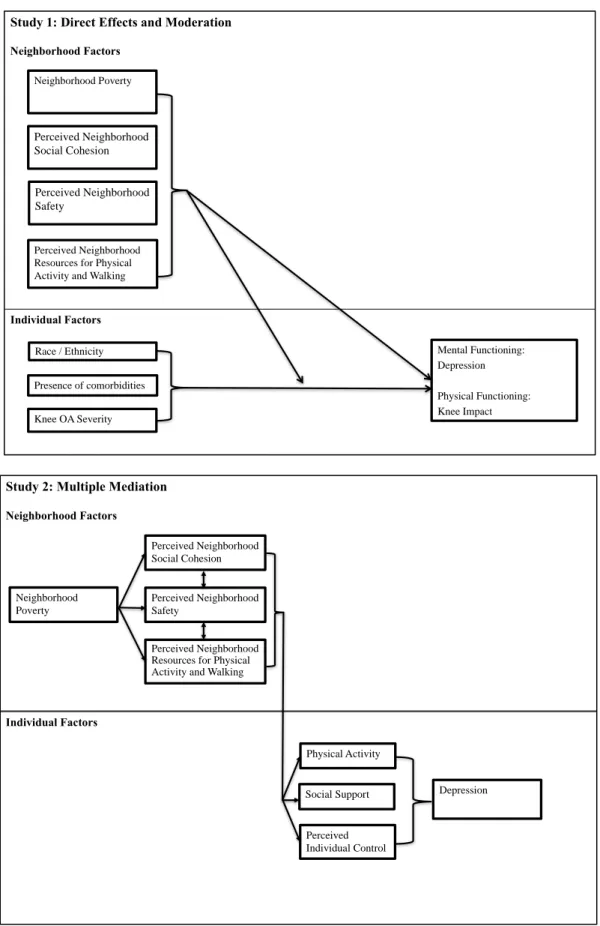
Figure 1 illustrates key relationships proposed for my dissertation. In Study 1, neighborhood poverty, perceived neighborhood social cohesion, perceived neighborhood safety, and perceived neighborhood resources for walking and physical activity are hypothesized to affect health outcomes among individuals with knee OA and interact with one another and with key individual-level
characteristics to influence health. The bidirectional arrows connecting the neighborhood characteristics illustrate the hypothesis that neighborhood characteristics may interact to influence health outcomes.
In Study 2, using prior theory and conceptual frameworks, neighborhood poverty is hypothesized to affect perceptions of three neighborhood characteristics: social cohesion, safety, and resources for physical activity and walking. Perceptions of these three neighborhood characteristics are then posited to affect health outcomes (namely depression) through health behaviors (i.e., physical activity) and
Figure 1. Conceptual models for Studies 1 and 2 Study 1: Direct Effects and Moderation
Neighborhood Factors
Individual Factors
Mental Functioning: Depression Physical Functioning: Knee Impact Neighborhood Poverty
Perceived Neighborhood Social Cohesion
Perceived Neighborhood Resources for Physical Activity and Walking Perceived Neighborhood Safety
Presence of comorbidities Race / Ethnicity
Knee OA Severity
Study 2: Multiple Mediation
Neighborhood Factors
Individual Factors
Neighborhood Poverty
Perceived Individual Control Physical Activity
Social Support Depression Perceived Neighborhood
Social Cohesion
Perceived Neighborhood Safety
Hypotheses and Aims
The following aims and hypotheses are proposed Study 1: Aim
Examine how neighborhood context (i.e., neighborhood poverty, perceived neighborhood social cohesion, perceived neighborhood safety, perceived neighborhood resources for physical activity and walking, interactions among them and with key individual-level characteristics) is associated with mental and physical functioning cross-sectionally and longitudinally among older adults with knee OA.
Study 1 hypothesis 1
In a 2009 review of different neighborhood factors and their influence on older adults’ health, Yen et al. found that neighborhood-level SES was the strongest and most consistent predictor of a variety of health outcomes, compared to other neighborhood-level characteristics.49 I therefore hypothesize that neighborhood poverty will be the strongest and most consistent neighborhood-level predictor of health outcomes among individuals with knee OA. In the absence of data suggesting neighborhood poverty to be more strongly associated with mental or physical health outcomes, I propose that neighborhood poverty will be equally associated with mental and physical functioning.
Study 1 hypothesis 2
Study 1 hypothesis 3
Previous reviews34 and studies (including a study with adults with arthritis)25 have demonstrated a fairly consistent relationship among neighborhood social environment characteristics and mental health outcomes, particularly depression. Few studies have investigated features of neighborhood social environments and physical health outcomes.34 As a result, I hypothesize that perceived neighborhood social cohesion and safety will be most consistently associated with mental health outcomes (compared to physical health outcomes) among older adults with knee OA.
Study 1 hypothesis 4
In a 2009 study by Mair et al. examining cross-sectional and longitudinal associations of neighborhood cohesion and stressors with depressive symptoms, researchers found that neighborhood social cohesion, aesthetics, and violence were associated with depressive
symptoms cross-sectionally but not longitudinally. In my study, I will likely have reduced power (smaller sample size) to observe significant associations longitudinally. As a result,I hypothesize that relationships among neighborhood characteristics and outcomes will emerge more
consistently in cross-sectional analyses than in longitudinal analyses. Study 1 hypothesis 5
Study 1 hypothesis 6
Given previous research suggesting that additional comorbidities (e.g., diabetes, heart disease) affect the health and wellbeing of individuals with OA,117,118 and some research suggesting that specific neighborhood contexts are associated with development of comorbidities,119 I
hypothesize that neighborhood context will interact with presence of comorbidities to influence mental and physical health outcomes among individuals with OA.
Study 1 hypothesis 7
Previous research has found differences in OA function, pain, and treatment options based on level of OA severity.115 In addition, several studies have shown that OA severity is a result of several modifiable risk factors, including BMI120 and physical activity at work.121 As a result, I hypothesize that neighborhood context will interact with knee OA severity to influence both mental and physical health outcomes among individuals with OA.
Study 2: Aim
Determine what factors (i.e., physical activity, social support, perceived individual control), as specified in prior theories and conceptual frameworks mediate the relationships between
neighborhood characteristics and depression among older adults—91% of whom have at least one chronic condition.
Study 2 hypothesis 1
Based on previous theories and conceptual frameworks,34,42,44-46,81,107 I hypothesize that
neighborhood poverty will be associated with depression through perceived neighborhood social cohesion, perceived neighborhood resources for physical activity and walking, and perceived neighborhood safety. I also hypothesize that this mediation will be partial, not complete; in other words, there will still be a direct effect from neighborhood poverty to depression.
Study 2 hypothesis 2
CHAPTER 4: STUDY 1 Introduction
Arthritis is one of the most common chronic diseases in the US,4 particularly among older adults, where half of all adults 65+ report having arthritis.8 An extensive body of literature has identified
individual-risk factors for arthritis, including age,11 gender,11 race,12-15 SES,12-15 genetics,16 bone density,16 overuse of joints,16,17 joint injury,11,16 and obesity.18 However, research has shown that even after
controlling for individual risk factors, variation in arthritis prevalence and management is not fully explained.19 There is now growing evidence that aspects of the neighborhood are associated with arthritis related outcomes.12-14,20,22-24,27,32,33
Indeed, neighborhood SES has been found to be associated with: increased prevalence of self-reported arthritis20,22,24 and radiographic hip and knee OA;13,14 reduced quality of life23 and increased depression26 among individuals with self-report arthritis; and increased pain12 and disability27,32,33 among individuals with or at risk for developing OA. Important among these previous studies is their illustration that neighborhood conditions matter for individuals with arthritis. However, despite the growing body of evidence that neighborhoods influence the health and well-being of individuals with arthritis, several notable gaps in the literature remain. First, the majority of previous studies have not focused on OA, despite it being the most common type of arthritis.20-26 This is important, since OA differs from other types of arthritis, such as rheumatoid arthritis, with regards to risk factors (i.e., BMI) and
self-management guidelines (i.e., physical activity, weight self-management).9
Second, while studies have found associations among neighborhood context and several OA outcomes (i.e., prevalence of self-reported arthritis,20,22,24 prevalence of radiographic hip and knee OA,13,14 joint replacement,28,29 pain,12 and disability27,32,33) relatively few studies have examined how
SES to be associated with reduced quality of life,23 and depression26 among individuals with self-report arthritis. However, there is limited research examining neighborhood context and psychological well-being among individuals with OA, despite the relatively high prevalence of depression and anxiety among individuals with OA73,124,125 and research suggesting co-morbid depression and OA are associated with poorer functioning,73,74 increased pain,73,75,76 increased health care use,76 and costs,76 than either condition alone.76
Third, the majority of studies have examined neighborhood SES either by using census-based measures to capture proportion of people living in disadvantaged areas12-14,21-24,26,27 or creating indices of relative disadvantage.20,28-31 While these types of analyses are important, few studies have examined other determinants of neighborhood context that may be associated with OA-related outcomes. For instance, researchers examining the association between perceived neighborhood social environment and OA functioning found that individuals with self-report arthritis had increased odds of depressive symptoms if they perceived lower neighborhood safety and lower neighborhood social cohesion.25 The authors therefore concluded that, “findings from this research suggest that future researchers consider the importance of the perceived neighborhood environment (aesthetics, safety, and social cohesion) when examining the influence of place on health, particularly mental health, in individuals with arthritis.”25
Fourth, few previous studies have examined how neighborhood characteristics may interact with key individual-level characteristics to influence OA functioning. OA prevalence, pain, and functioning differ by race / ethnicity, knee OA severity, and presence of comorbidities. For instance, research has found that African Americans have more than double the prevalence of severe knee OA than
Caucasians;115 they are more likely to have significantly worse pain, stiffness, and function;113,114 and they are less likely to seek and receive joint replacement therapy or pain medication.126-128 In addition to race, individuals with severe OA (compared to non-severe OA) are more likely to experience pain and
neighborhood characteristics interact with individual-level characteristics among individuals with OA. Summarizing this important gap, Canizares et al. concluded, “few studies using both individual and community characteristics have used arthritis as an outcome; hardly any have examined how community contexts interact with individual characteristics.”24
Finally, as is common with research on neighborhoods and health more generally,34 few studies have examined longitudinal associations among neighborhood-level characteristics and OA outcomes. 12-14,20-29,32,33
The present study examines if neighborhood context is associated with mental and physical functioning and begins to address limitations of previous research by answering the following research questions among individuals with knee OA:
1. Is neighborhood context associated with mental and physical health outcomes? 2. Do neighborhood characteristics interact to influence health outcomes?
3. Do key individual characteristics interact with neighborhood context to influence health outcomes?
4. Is neighborhood context associated with health outcomes over time? Methods
Participants and Procedures
Data for this study come from a population-based prospective cohort of knee and hip OA among African American and Caucasian individuals (the JOCO OA project).129 Recruitment occurred in
Johnston County, North Carolina (NC), which at the time of this study, was classified as a mostly rural county.130 Details on the study design, data collection procedures, and study population are detailed in previous publications.129 In brief, the study was designed to be representative of civilian,
assessment of weight and height and radiographic examination of the knees, and an additional home interview approximately 2 weeks after the clinic visit. At baseline, all participants provided informed written consent at the time of recruitment. The study was approved by the Institutional Review Boards of the University of North Carolina Schools of Medicine and Public Health and the CDC.
Study Analytic Sample
The analytical sample for this study uses two time points: Time 1 (T2 wave), which was collected between 2006-2011 (for cross-sectional analyses) and Time 2 (T3 wave), which was collected between 2013-2015 (for longitudinal analyses). Individuals’ temporal positions within waves were generally held constant. For instance, if someone were interviewed early in the T2 wave (e.g., 2006, 2007), they would likely be interviewed early in the T3 wave (e.g., 2013). As a result, between 4 and 7 years generally elapsed between the T2 and T3 waves. For the purposes of this study, I restricted analyses to individuals with knee OA. Researchers assessed presence or absence of OA using radiography and the Kellgren and Lawrence (KL) grade, which scores OA severity on a scale of 0-4.16 I classified individuals with scores of 2-4 as having knee OA. The reliability and validity of using the KL scale to determine OA has already been established; in previous studies, both inter-rater reliability and intra-rater reliability have been high (weighted inter-rater reliability = 0.86; Kappa for intra-rater reliability = 0.89).12
Among adults with knee OA at T2 (n=729), cases in which individuals were missing on any control variables (n=73) were dropped from the sample, yielding a sample size of 656. Among adults with knee OA at T3 (n=485), cases in which individuals were missing on any control variables (n=51) were dropped from the sample, yielding a sample size of 434.
Measures
A comprehensive list of all measures and how they were coded can be seen in Appendix A. Outcomes. I measured two outcomes, depression and knee impact scores.
depression in the general population, rather than diagnosis at clinical intake.131 While items were chosen from previously validated depression scales and based on symptoms of depression in clinical cases, the CES-D was not designed to reflect diagnostic criteria of depression at the time of its development.131 Indeed, some diagnostic criteria are not reflected (e.g., suicidality) and many “healthy” or “normal” people could experience some of the symptoms reflected in CES-D items. In contrast to other widely used measures, such as the Beck Depression Inventory, the CES-D focuses more on affective aspects of
depression, rather than depression cognitions.132
The CES-D contains 20 items that assess the frequency of depressive symptoms in the week prior to the interview. Response options range from 0 to 3, which refer to frequency of the symptoms (i.e., “rarely of none of the time” to “all of the time”). The CES-D was originally posited to have a four-factor structure model composed of depressed affect, positive affect, somatic activity, and interpersonal
issues.131 For instance, the item “I felt depressed” would belong to the depressed affect factor, “I felt hopeful about the future” would belong to the positive affect factor, “my sleep was restless” would belong to the somatic activity factor, and “people were unfriendly” would belong to the interpersonal issues factor. However, more than 20 alternative factor structures—including a unidimensional factor structure,133—have been reported.134 In practice, many researchers (including Radloff, the original developer of the CES-D) report a total score.133 I therefore summed item responses to create a total score that ranged from 0 (best possible) to 60 (worst) (Cronbach’s alpha in this study = 0.86), where higher scores reflect more symptoms of depression, weighted by frequency of occurrence in the previous week.131 Given this complexity in interpreting scores, I report results using the terminology “CES-D scores.” Although a cut-off point of 16 has been used in previous research to indicate risk for moderate or severe depression,135 I conceptualized and analyzed CES-D scores as a continuum (not merely in
dichotomous terms).
into models as the corresponding measure at T2. PROMIS measures were developed by the National Institutes of Health (NIH) to more precisely and efficiently measure patient-reported symptoms, functioning, and health-related quality of life.136 In contrast to the CES-D, PROMIS-D items excluded somatic symptoms, such as appetite and sleep to prevent confounding when assessing individuals with physical health conditions.137,138 Instead, PROMIS-D items focus on negative affect (e.g., sadness), views of self (e.g., worthlessness), social cognition (e.g., loneliness), and decreased positive affect (e.g., loss of interest).138 Indeed, while some items from the CES-D and PROMIS-D are the same (e.g., “I felt
depressed”) or have conceptual overlap (e.g., in the CES-D “I felt hopeful about the future” vs. in the PROMIS-D “I felt hopeless”), many of the items in the CES-D are distinct from those in the PROMIS-D (e.g., “I could not get going,” “My sleep was restless,” “I felt that people dislike me” all appear in the CES-D but are absent in the PROMIS-D). Also, in contrast to the CES-D, an Item Response Theory approach was used to develop item banks for the PROMIS-D (rather than a Classical Test Theory approach, which was used to develop the CES-D). Regardless of differences, the PROMIS depression scale has shown strong correlations with the CES-D (>0.80) and the Patient Health Questionnaire (PHQ-9) (>0.70) among individuals with major depressive disorder seeking outpatient treatment,139 as well as the general population.137
I used an 8-item short form of the PROMIS-D. These 8 items were rated on a 5-point scale (1=never; 2=rarely; 3=sometimes; 4=often; and 5=always) with higher scores indicating greater severity of depression.138 I summed responses and then converted the raw scores to standardized scores, in line with scoring guidelines138 (Cronbach’s alpha in this study = 0.94).
to your knee?” (Function in Daily Living), and “how much pain do you have in your knee while twisting / pivoting?” (Pain). Response options determine the frequency of problems in the past week and each item is scored 0 to 4. I calculated the mean of the 30 items and transformed scores to a 0-100 scale, with zero representing extreme problems and 100 representing no problems (Cronbach’s alpha in this study = 0.98). The KOOS has been extensively validated among individuals with OA,140 shown to have adequate reliability,141 and used in a number of OA studies.142,143
At T2, items from the KOOS sub-scales were asked without regard to specific knee, whereas at T3, items from the KOOS sub-scales were asked of each knee. For example, at T2, I asked individuals: “How often are you aware of your knee problems?” and at T3, I asked individuals: “How often are you aware of your knee problem? (left)” and “How often are you aware of your knee problem? (right)”. To make scores comparable in longitudinal analyses, I took the highest score for each set of knees at T3, rather than each knee. Using the same example from above, if an individual scored their left knee to be a 4 and their right knee to be a 0, I calculated the score for that set of items to be a 4. I analyzed scores this way on the intuitive assumption that individuals think of their most painful knee when asked to evaluate overall knee functioning. I calculated the mean of the 8 items and transformed scores to a 0-100 scale, with 0 representing extreme problems and 100 representing no problems (Cronbach’s alpha in this study for knee impact scores at T3 = 0.99).
Neighborhood characteristics. I measured four neighborhood characteristics.
Neighborhood poverty. I defined neighborhood poverty as the percentage of households with income below the poverty line within a census block group. These data were compiled from the 2010 U.S. Census. I used census block groups as the unit of analysis, since they are the smallest administrative boundary from the census that includes economic data. Census block groups generally contain between 600 and 3,000 people.144
(1=strongly agree to 5=strongly disagree). I then summed responses, which ranged from 5-25, with higher scores indicating more social cohesion (Cronbach’s alpha in this study = 0.85). Previous studies have found high reliability for this scale (Cronbach’s alpha over 0.80) and consistency over time (test-retest ICC: 0.90; 95% CI: 0.84, 0.94).146 Supporting validity, this scale has also been used in a variety of research studies assessing social cohesion / social capital.25,37,147
Perceived neighborhood resources for physical activity and walking. I measured perceived neighborhood resources for physical activity and walking using 11 items from the Walking and Exercise Environment scale. This scale assesses opportunities for exercise in individuals’ neighborhoods. An example item is: “my neighborhood offers many opportunities to be physically active.” I assessed all items on a 5-point likert response scale (1=strongly agree to 5=strongly disagree) and summed responses, where higher scores indicate more resources (Cronbach’s alpha in this study = 0.71). Previous studies have shown this scale to have high reliability and consistency over time (test-retest ICC: 0.88; 95% CI: 0.79, 0.93).146
Perceived neighborhood safety. I measured perceived neighborhood safety with three items. An example item is: “I feel safe walking in my neighborhood during the evening.” All items were assessed on a 5-point likert response scale (1=strongly agree to 5=strongly disagree) and summed, where higher scores indicate more safety (Cronbach’s alpha in this study = 0.67). Previous studies have demonstrated these items to be reliable and consistent over time (test-retest ICC: 0.80; 95% CI: 0.67, 0.88).146