Journal of Athletic Training 2017;52(5):457–463 doi: 10.4085/1062-6050-52.2.16
Óby the National Athletic Trainers’ Association, Inc
www.natajournals.org original research
Epidemiology of Skin Infections in Men’s Wrestling:
Analysis of 2009–2010 Through 2013–2014 National
Collegiate Athletic Association Surveillance Data
Mackenzie M. Herzog, MPH*; Melissa A. Fraser, PhD, MS
†
;
Johna K. Register-Mihalik, PhD, LAT, ATC
‡
; Zachary Y. Kerr, PhD, MPH
‡
*Department of Epidemiology, †Human Movement Science Curriculum, and ‡Department of Exercise and Sport Science, University of North Carolina at Chapel Hill. Dr Fraser is now at Department of Health and Human Performance, Texas State University, San Marcos.
Context: Our knowledge of the current epidemiology of skin infections among wrestlers is limited.
Objective: To analyze and report the epidemiology of skin infections among National Collegiate Athletic Association (NCAA) men’s wrestling student-athletes during the 2009– 2010 through 2013–2014 academic years.
Design: Descriptive epidemiology study.
Setting: Aggregate skin infection and exposure data col-lected by the NCAA Injury Surveillance Program.
Patients or Other Participants: Collegiate men’s wrestling student-athletes.
Main Outcome Measure(s): All viral, bacterial, or fungal skin infections reported by athletic trainers at 17 NCAA programs were analyzed, providing 35 team-seasons of data. Skin infection rates per 10 000 athlete-exposures (AEs), rate ratios, skin infection proportions, and skin infection proportion ratios were calculated.
Results: The athletic trainers reported 112 skin infections contracted by 87 student-athletes across 78 720 AEs. The
overall skin infection rate was 14.23/10 000 AEs (95% confidence interval [CI]¼11.59, 16.86). Of the skin infections identified, 22.3% (n¼25) were recurrent skin infections. Most skin infections (65.2%) were attributable to 5 team-seasons (range, 11–19 infections). Most skin infections occurred during the regular season (n ¼ 76, 67.9%), were identified during practice (n¼100, 89.3%), and resulted in24 hours’ time loss (n¼ 83, 74.1%). The rate for viral skin infections was 1.72 times the rate for bacterial skin infections (95% CI ¼ 1.09, 2.72) and 2.08 times the rate for fungal skin infections (95% CI ¼ 1.28, 3.39). Fungal skin infections more often resulted in time loss ,24 hours compared with all other skin infections (75.0% versus 12.5%; infection proportion ratio¼6.00; 95% CI ¼3.30, 10.92).
Conclusions: Our findings highlight the contagiousness of skin infections and suggest that skin infection rates may be attributable to high incidences among particular teams.
Key Words: skin conditions, outbreaks, dermatology
Key Points
Most infections were reported during the regular season and practices, yet they resulted in at least 24 hours of time
loss.
The majority of skin infections were attributable to 5 team-seasons.
W
restling is a historic sport that has evolved to include many styles of combat. Across many cultures, the origin of the sport dates back to early civilization.1–3Currently, wrestling remains a popular sport among adolescents and young adults. In the 2013– 2014 academic year, the reported numbers of US high school and collegiate wrestling participants were 279 4184 and 6982,5 respectively.As does any physical activity, wrestling carries an inherent risk for injury. In fact, wrestling has one of the highest rates of injury among high school and collegiate athletes.1,6–8Unlike many other sports, wrestling also poses a serious risk for skin infection.1 Previous investigators have highlighted the contagious nature of skin infections among wrestlers. Outbreaks of ringworm have also been linked to the sport.9–15
from multiple teams. The purpose of our study was to analyze and report the epidemiology of skin infections among National Collegiate Athletic Association (NCAA) men’s wrestling student-athletes during the 2009–2010 through 2013–2014 academic years using data from the NCAA Injury Surveillance Program (ISP).
METHODS
The NCAA-ISP is a prospective surveillance program that is managed by the Datalys Center for Sports Injury Research and Prevention, Inc (hereafter known as the Datalys Center), an independent, nonprofit research orga-nization. The Research Review Board of the NCAA approved the study, which used data from men’s wrestling during the 2009–2010 through 2013–2014 academic years. A convenience sample of 17 NCAA varsity wrestling teams provided 35 team-seasons of data; ateam-seasonis defined as 1 season of 1 team. The included team-seasons for wrestling represented 3.2% of all 1096 wrestling team-seasons that occurred during the 2009–2010 through 2013– 2014 academic years. Five wrestling teams participated in 2009–2010, followed by 9 in 2010–2011, 8 in 2011–2012, 6 in 2012–2013, and 7 in 2013–2014. The median number of seasons in which each team participated was 2 (range, 1–5 seasons). The methods of the ISP during the 2009–2010 through 2013–2014 academic years have been previously described20but are summarized here.
Data Collection
Athletic trainers (ATs) working with participating men’s wrestling programs attended school-sanctioned practices and competitions and reported exposure and injury data (including infections).20 The ATs provided the number of student-athletes participating in each practice, conditioning session, and competition. Only varsity-level practices, competition events, and team conditioning sessions were included in the ISP datasets. Individual weight-lifting and conditioning sessions were excluded.
When injuries, illnesses, or infections occurred, the ATs reported them through the electronic health record application used by the team medical staff. For each injury, illness, or infection event, the AT completed a detailed event report on the injury or condition, including the body site, diagnosis, assessment, activity, injury mechanism, event type (ie, competition or practice), time in season (ie, preseason, regular season, or postseason), and whether the injury was recurrent (ie, from an injury within the same or previous academic year).20For wrestling, ATs also entered the injured student-athlete’s weight class. Previously submitted information could be viewed and updated as needed during the course of a season, including when the student-athlete returned to full sport participation. The difference between the event date and the return date yielded the number of days in which the athlete was restricted from participation.
Exported data passed through an automated verification process that involved a series of consistency checks. Data were reviewed and flagged for invalid values. The AT and data–quality-assurance staff were notified and worked together to resolve the concern. Data that passed the verification process were then placed into the final dataset.
Definitions
A reportableskin infectionin the ISP was a contagious or noncontagious skin infection that occurred as a result of participation in an organized intercollegiate conditioning session, practice, or competition and required attention from an AT, physician, or other medical professional. Multiple skin infections could be included as the result of 1 skin infection event. In detecting and diagnosing skin infections, we relied on the experience and knowledge of the ATs and the team medical staff with whom they worked to accurately monitor the incidence of skin infection; however, the NCAA provides guidance for medical providers regarding diagnosis and management of skin infections.21
Non–time-loss skin infections were those skin infections resulting in less than 24 hours of time loss. Severe skin infections22were those skin infections resulting in time loss of more than 3 weeks or those that resulted in the student-athlete prematurely ending the season (ie,season-ending skin infection).
A reportable athlete-exposure (AE) was defined as 1 student-athlete participating in 1 NCAA-sanctioned practice or competition in which he or she was exposed to the possibility of skin infection, regardless of the time associated with that participation. Only athletes with actual playing time in a competition were included in competition exposures.
Statistical Analysis
Skin infection rates were calculated as the ratio of skin infections per 10 000 AEs. Given the rarity of skin infection cases in the ISP, we used 10 000 AEs as the denominator instead of the typical 1000 AEs. We also explored the distribution of skin infections within a team-season across time. We calculated rate ratios and infection proportion ratios. Arate ratio(RR) is defined as the relative difference between 2 groups and, in this study, compared the incidences of viral, bacterial, and fungal skin infections. The RR provides information on which specific type of skin infection had the highest incidence across the dataset. The following is an example of an RR comparing viral and bacterial skin infection rates:
RR¼
P
viral infections
P
athlete-exposures
P
bacterial infections
P
athlete-exposures
An infection proportion ratio (IPR) is defined as the proportion of skin infections among 1 group compared with another group and, in this study, we compared the proportion of skin infections by time loss. The IPR helps us understand which type of skin infection the athlete presents to a sports medicine professional may be more likely to result in a more severe outcome (or less severe in the case of a non–time-loss infection). The following is an example of an IPR comparing the proportion of fungal skin infections that were non-time loss with that of all other skin infections:
IPR¼
P
fungal infections resulting in non-time loss
P
fungal infections
P
all other infections resulting in non-time loss
P
all other infections
All 95% confidence intervals (CIs) not containing 1.00 were considered statistically significant. Data were ana-lyzed using SAS-Enterprise Guide software (version 4.3; SAS Institute Inc, Cary, NC).
RESULTS
Skin Infection Frequencies and Rates
During the 2009–2010 through 2013–2014 academic years, ATs participating in the ISP reported 112 skin infections contracted by 87 unique student-athletes across 78 720 AEs. The resulting skin infection rate was 14.23/ 10 000 AEs (95% CI ¼ 11.59, 16.86; Table 1). Twenty student-athletes (23.0%) contracted multiple skin infec-tions: 16 sustained 2 skin infections, 3 sustained 3 skin infections, and 1 sustained 4 skin infections. Of the skin infections identified, 22.3% (n¼25) were recurrent. The majority of skin infections occurred during the regular season (n¼76, 67.9%) and were identified during practice (n¼100, 89.3%; Table 1).
Type of Skin Infections
The most common skin infections reported were viral (n ¼50, 44.6%), particularly herpes simplex I (n¼46, 41.1%;
Table 2). Bacterial skin infections and fungal skin infections comprised 25.9% (n¼29) and 21.4% (n¼24), respectively, of the total skin infections. The rate for viral skin infections (6.35/10 000 AEs) was larger than those for bacterial skin infections (3.68/10 000 AEs; RR¼1.72; 95% CI ¼1.09, 2.72) and fungal skin infections (3.05/10 000
AEs; RR ¼ 2.08; 95% CI ¼ 1.28, 3.39). The most
commonly reported bacterial skin infection was impetigo (n¼12, 10.7%), and the most commonly reported fungal skin infection was tinea versicolor (n ¼ 15, 13.4%). Impetigo constituted the largest proportion of recurrent cases (41.7% of all impetigo cases), followed by ringworm (33.3% of all ringworm cases) and herpes simplex I (37.0% of all herpes simplex I cases).
Time Loss
Eighty-three skin infections resulted in24 hours of time loss (74.1%), whereas 29 skin infections were classified as non-time loss (25.9%). Of the skin infections that resulted in24 hours of time loss, 4 (4.8%) were considered severe (time loss .3 weeks). These severe skin infections consisted of 1 case of non–methicillin-resistant Staphylo-coccus aureusinfection, 1 case of cellulitis, and 1 case of boil, abscess, furuncle, or carbuncle. The fourth most frequent severe skin infection was not specified. Fungal Table 1. Skin Infection Rates in National Collegiate Athletic Association Wrestlers by Time in Season, 2009–2010 Through 2013–2014 Academic Years
Time in Season No. of Infections in Sample Athlete-Exposures
Infection Rate per 10 000 Athlete-Exposures (95% Confidence Interval) Preseason 33 22 946 14.38 (9.47, 19.29) Regular season 76 50 873 14.94 (12.10, 18.30) Postseason 3 4900 6.12 (0.00, 13.05) Total 112 78 720 14.23 (11.59, 16.86)
Table 2. Types of Skin Infections Reported in National Collegiate Athletic Association Wrestlers, 2009–2010 Through 2013–2014 Academic Yearsa
Type of Skin Infection
No. of Infections in Sample
Infection Rate per 10 000 AEs
Infections, %
Non-Time Lossb Severec Recurrent
Bacterial 29 3.68 17.2 10.3 17.2 Impetigo 12 1.52 8.3 0.0 41.7 Folliculitis 8 1.02 37.5 0.0 0.0 Non–methicillin-resistantStaphylococcus aureusinfection 6 0.76 0.0 16.7 0.0 Cellulitis 2 0.25 NA NA NA Boil, abscess, furuncle, carbuncle 1 0.13 NA NA NA Fungal 24 3.05 75.0 0.0 12.5 Tinea versicolor 15 1.91 100.0 0.0 0.0 Ringworm 9 1.14 33.3 0.0 33.3 Viral 50 6.35 6.0 0.0 34.0 Herpes simplex Id 46 5.84 6.5 0.0 37.0
Shingles (herpes azoster) 2 0.25 NA NA NA Molluscum contagiosum 1 0.13 NA NA NA Conjunctivitis 1 0.13 NA NA NA Eczema 1 0.13 NA NA NA Other 8 1.02 25.0 12.5 0.0 Total 112 14.23 25.9 3.6 22.3
Abbreviation: NA, not available.
aPercentages of non–time-loss, severe, and recurrent skin infections not calculated for counts under 5. bNon–time-loss skin infections resulted in time loss,1 day.
skin infections more commonly resulted in no time loss compared with all other skin infections (75.0% versus 12.5%; IPR ¼ 6.00; 95% CI ¼ 3.30, 10.92). Bacterial infections were more likely to result in severe time loss compared with all other skin infections, although the difference was not statistically significant (10.3% versus 1.2%; IPR¼8.59; 95% CI¼0.93, 79.31).
Season-Specific Infection Occurrences
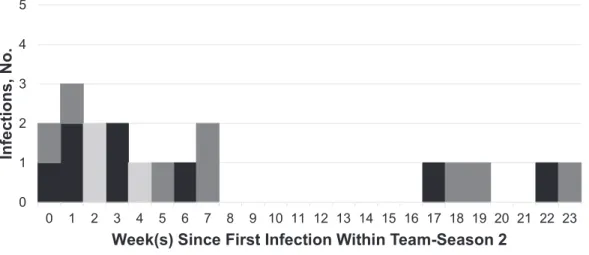
Most skin infections (65.2%) occurred within 5 seasons (range, 11–19 infections). Within these 5 team-seasons, several groups of skin infections were identified. For example, 1 team-season had an occurrence of 8 herpes infections throughout 5 weeks of the season (Figure 1). Another program had occurrences of 14 skin infections, of varying types, throughout 8 weeks of the season (Figure 2). These skin infections included herpes, tinea versicolor, and shingles, among others.
DISCUSSION
To our knowledge, this is the first study to present the epidemiology of skin infections among collegiate men’s wrestling student-athletes. Previous literature on collegiate wrestlers’ skin infections has been limited to case studies9,16–19 or broader descriptive studies in which skin infections represented 1 combined injury category.1,3,7,10,14 Therefore, these data provide the largest in-depth exami-nation of recent skin infection data from multiple collegiate wrestling teams, which can help inform skin infection-prevention protocols. According to the National Athletic Trainers’ Association position statement23on skin diseases, infection-control policies are recommended for all colle-giate institutions, including cleaning and disinfecting of all facilities, encouraging hand hygiene, and ensuring the practice of athlete hygiene. Currently, the National Wrestling Coaches Association24offers a Webinar on skin infections and the National Federation of State High School Associations25 emphasizes proper care for and prevention Figure 1. Example of grouping of infections among 1 team over season 1. Abbreviation: Staph (non-MRSA), non–methicillin-resistant Staphylococcus aureus.
of communicable skin conditions. The National Federation of State High School Associations emphasizes the impor-tance of becoming educated regarding skin conditions, cleaning wrestling mats daily using a solution of 1 part bleach to 100 parts water, maintaining proper ventilation, cleaning all wrestling gear after use, using body wipes or taking a shower using individual soap following each practice or competition, performing daily skin checks, and not sharing personal hygiene supplies.25 In addition, education regarding the importance of controlling skin infections should be a priority for all collegiate wrestling stakeholders.23
A majority of the reported skin infections occurred within 5 of the 35 team-seasons examined, highlighting the contagious nature of skin infections. However, given the limitations of these surveillance data, we were unable to determine whether the skin infections were causally related. When analyzing causal links in a group of skin infections, future researchers should consider the mechanisms of transmission and the incubation periods for each specific type of skin infection. In addition, our data did not include information on hygiene practices within each participating program. We suspect that environmental hygiene may exacerbate student-athletes’ susceptibility to skin infection. Ensuring proper student-athlete hygiene and daily mat cleaning with disinfectant solutions may help to decrease athlete-to-athlete and mat-to-athlete transmission. There-fore, routine cleaning of facilities and equipment is strongly encouraged. Mat cleaning should be undertaken daily using a solution of 1 part bleach to 100 parts water to mitigate the risk for skin infection transmission.25 Additionally, main-taining proper body hygiene; not sharing personal equip-ment, towels, or razors; and taking proper care of skin lesions are important for preventing skin infections.21
We reported an overall rate of 14.23 skin infections per 10 000 AEs among collegiate wrestlers, which is similar to the rate reported in previously published literature. From previous ISP data from collegiate men’s wrestling injuries in the 1988–1999 through 2003–2004 academic years, Agel et al3demonstrated an infection rate range of 0.72 to 0.98/ 1000 AEs (or 7.2 to 9.8/10 000 AEs). Another group1 identified a slightly higher rate (1.9/1000AEs, or 19.1/ 10 000 AEs). The variation in reported skin infection rates may reflect differences in reporting or identifying condi-tions, or it could represent natural variations. In addition, previous investigators1,3 considered only skin infections that resulted in time loss of at least 1 day, whereas 25.9% of infections in our study were non-time loss. Nevertheless, even when considering only the 83 skin infections in our study that resulted in time loss of at least 1 day, the infection rate estimate of 10.54/1000 AEs fell between prior estimates.1,3 Previous authors3 stated that skin infections increased annually by an average of 1.7% during the 1988–1989 through 2003–2004 academic years. Thus, despite infection-prevention initiatives, our findings may suggest persisting skin infections among collegiate wres-tlers. Future researchers should directly assess the efficacy of skin infection-prevention initiatives in wrestling while identifying barriers to compliance with recommendations and standardization of detection and management. Weekly skin checks by ATs who work with collegiate male wrestlers throughout the season may allow for early identification and treatment to reduce outbreaks or clusters
of these conditions. All athletes should be encouraged to immediately report any skin lesion, and appropriate referral for assessment and management should be pursued to prevent transmission. Continued surveillance of infections in wrestling will also help to identify areas of opportunity for infection prevention through recognition of clusters, which can lead to more focused studies of causation.
Among the skin infections we reported, few (n¼4) were considered severe (ie, time loss .3 weeks). This finding parallels the results of a previous 1-year study1 of high school and collegiate wrestling programs in which no skin infections lasted .21 days but 8.8% of high school and 14.7% of collegiate skin infections resulted in 10 to 21 days of time loss. Of the severe cases reported in our study, 2 were identified as communicable (1 non–methicillin-resistant Staphylococcus aureus infection and 1 boil, abscess, furuncle, or carbuncle). However, the treatment time for these 2 skin infections often depends on the duration of the skin infection prior to the initiation of treatment and its severity. Although severe skin infections are relatively rare, ensuring appropriate and timely identification is essential. Skin infections located in crevices of the body, such as the buttocks, armpits, and groin, are difficult to keep dry and covered. Also, a skin infection may be difficult to identify until it accumulates to sufficient size with associated pain. A cursory skin check by a medical provider may not catch either of these skin infections until after they have formed a head and are raised and red or white. Thus, although many skin infections can be treated in less than a week, larger and more severe skin infections may require surgical drainage, wound packing, and longer-duration antibiotic treatments. It is important for each wrestler to perform routine self skin checks to expedite the treatment process for these painful and potentially contagious skin infections. Unfortunately, our data did not account for specific body location; thus, future investigators should examine how specific body locations of skin infections may be associated with transmission.
services and treatments and their association with non– time-loss skin infections; future research is warranted.
As did previous researchers,3 we found that most skin infections were identified during practice. Currently, collegiate student-athletes undergo skin checks before competition. If an infectious skin condition is identified, the student-athlete is often barred from competing until it has resolved.23 For this reason, student-athletes, coaches, and medical professionals may be more likely to identify and attempt to treat skin infections during practice in order to prevent a last-minute withdrawal from competition. Skin checks before both competition and practice and removal from participation after identification of contagious skin conditions are necessary to prevent the spread of these diseases. Athletes and coaches should be trained to recognize potential skin conditions and encouraged to seek immediate care from a medical professional.
Types of skin infections in our study were also similar to those identified previously,1,3,10 with herpes simplex I (41.1%) and impetigo (10.7%) identified as common pathogens. Tinea versicolor was the most frequent fungal infection identified, which contrasts with previous NCAA-related research3 in which ringworm occurred most often among wrestlers. This may be because previous authors included only skin infections resulting in time loss. In our sample, all cases of tinea versicolor were non–time-loss skin infections and, thus, would have been excluded using previous identification criteria. It is also possible that other investigators did not include tinea versicolor in their findings because it is not considered a contagious skin disease. Despite these variations, our findings, coupled with those of previous researchers, highlight the breadth of skin infections that may be reported in wrestling athletes.
Limitations
The ISP does not include information on skin infections that were not reported to ATs or other team medical staff. This should have a minimal effect on the analysis because skin infections often require medical treatment; however, it remains possible that athletes did not report skin infections that could be self-treated. In addition, although the NCAA Sports Medicine Handbook includes recommendations for the diagnosis and management of these conditions, we have no information on actual implementation of and compliance with these recommendations. All data were reported by ATs with medical training in identification of skin infections, which we believe reduces the potential for heterogeneity in reporting. Given the convenience sample of 17 varsity wrestling programs, selection bias may have occurred. It is possible that the results are not generalizable to all collegiate wrestlers, yet the ISP represents the most current, nationally representative data available on colle-giate wrestlers. The ATs were provided with training on integrating the NCAA-ISP into their member institutions’ electronic health record applications. Nevertheless, be-cause identification of skin infections and their character-istics (eg, recurrence) is based on the expertise of the participating ATs, it is possible that variations in reporting and monitoring occurred within our sample. For example, the examination process for skin problems before practices and competitions may have differed; the ISP does not collect such specific data. Also, the definition of a skin
infection asrecurrentwas based on expertise of the AT, as was the determination of how the skin infection was contracted. With recurrent skin infections in particular, there is some ambiguity as to whether a second occurrence of the same skin infection in a single athlete is a recurrent skin infection or an independent second occurrence, and these may have been identified and reported in different ways. Finally, some variables of interest may have been misclassified. For example, time loss due to a skin infection could result for a variety of reasons (ie, during participation breaks) and may not accurately reflect the severity of the condition; however, inclusion of all skin infections, regardless of time loss, improves our ability to understand the occurrence of skin infections among collegiate male wrestlers.
CONCLUSIONS
Our findings highlight the contagious nature of skin infections in NCAA wrestlers, with the most skin infections occurring among 4 teams over 5 team-seasons. Also, most skin infections were reported during practices. Interven-tions that reduce such clusters will help to dramatically reduce the rate of skin infections among collegiate wrestlers. This may include daily mat cleaning with bleach water, skin checks by ATs that exceed competition requirements, promotion of self skin checks, proper student-athlete hygiene, and other educational initiatives.
ACKNOWLEDGMENTS
The NCAA-ISP data were provided by the Datalys Center for Sports Injury Research and Prevention. The ISP was funded by the NCAA. The content of this manuscript is solely the responsibility of the authors and does not necessarily represent the official views of the NCAA. We thank the many ATs who have volunteered their time and efforts to submit data to the NCAA-ISP. Their efforts are greatly appreciated and have had a tremendously positive effect on the safety of collegiate athletes.
REFERENCES
1. Yard EE, Collins CL, Dick RW, Comstock RD. An epidemiologic comparison of high school and college wrestling injuries. Am J Sports Med. 2008;36(1):57–64.
2. Myers RJ, Linakis SW, Mello MJ, Linakis JG. Competitive wrestling-related injuries in school aged athletes in U.S. emergency departments.West J Emerg Med. 2010;11(5):442–449.
3. Agel J, Ransone J, Dick R, Oppliger R, Marshall SW. Descriptive epidemiology of collegiate men’s wrestling injuries: National Collegiate Athletic Association Injury Surveillance System, 1988– 1989 through 2003–2004.J Athl Train. 2007;42(2):303–310. 4. 2013–14 High School Athletics Participation Survey. The National
Federation of State High School Associations Web site. http://www. nfhs.org/ParticipationStatics/PDF/2013-14_Participation_Survey_ PDF.pdf. Accessed January 14, 2014.
5. Student-athlete participation: 1981-82 – 2013-14. National Collegiate Athletic Association Web site. https://www.ncaa.org/sites/default/ files/Participation%20Rates%20Final.pdf. Accessed January 14, 2014.
6. Centers for Disease Control and Prevention (CDC). Sports-related injuries among high school athletes—United States, 2005–06 school year.MMWR Morb Mortal Wkly Rep. 2006;55(38):1037–1040. 7. Jarret GJ, Orwin JF, Dick RW. Injuries in collegiate wrestling.Am J
8. Hootman JM, Dick R, Agel J. Epidemiology of collegiate injuries for 15 sports: summary and recommendations for injury prevention initiatives.J Athl Train. 2007;42(2):311–319.
9. Beller M, Gessner BD. An outbreak of tinea corporis gladiatorum on a high school wrestling team.J Am Acad Dermatol. 1994;31(2, pt 1): 197–201.
10. Collins CJ, O’Connell B. Infectious disease outbreaks in competitive sports, 2005–2010.J Athl Train. 2012;47(5):516–518.
11. Cohen BA, Schmidt C. Tinea gladiatorum. N Engl J Med. 1992; 327(11):820.
12. Kohl TD, Giesen DP, Moyer J Jr, Lisney M. Tinea gladiatorum: Pennsylvania’s experience.Clin J Sport Med. 2002;12(3):165–171. 13. Kohl TD, Lisney M. Tinea gladiatorum: wrestling’s emerging foe.
Sports Med. 2000;29(6):439–447.
14. Turbeville SD, Cowan LD, Greenfield RA. Infectious disease outbreaks in competitive sports: a review of the literature. Am J Sports Med. 2006;34(11):1860–1865.
15. Ergin S, Ergin C, Erdogan BS, Kaleli I, Evliyaoglu D. An experience from an outbreak of tinea capitis gladiatorum due to Trichophyton tonsurans.Clin Exp Dermatol. 2006;31(2):212–214.
16. Anderson BJ. Managing herpes gladiatorum outbreaks in competitive wrestling: the 2007 Minnesota experience. Curr Sports Med Rep. 2008;7(6):323–327.
17. Anderson BJ. The epidemiology and clinical analysis of several outbreaks of herpes gladiatorum.Med Sci Sports Exerc. 2003;35(11): 1809–1814.
18. Anderson BJ. Prophylactic valacyclovir to prevent outbreaks of primary herpes gladiatorum at a 28-day wrestling camp.Jpn J Infect Dis. 2006;59(1):6–9.
19. Belongia EA, Goodman JL, Holland EJ, et al. An outbreak of herpes gladiatorum at a high-school wrestling camp.N Engl J Med. 1991; 325(13):906–910.
20. Kerr ZY, Dompier TP, Snook EM, et al. National Collegiate Athletic Association Injury Surveillance System: review of methods for 2004–2005 through 2013–2014 data collection.J Athl Train. 2014; 49(4):552–560.
21. Parsons JT.2014–15 NCAA Sports Medicine Handbook. Indianapo-lis, IN: National Collegiate Athletic Association; 2014.
22. Darrow CJ, Collins CL, Yard EE, Comstock RD. Epidemiology of severe injuries among United States high school athletes 2005–2007. Am J Sports Med. 2009;37(9):1798–1805.
23. Zinder SM, Basler RS, Foley J, Scarlata C, Vasily DB. National Athletic Trainers’ Association position statement: skin diseases. J Athl Train. 2010;45(4):411–428.
24. Preventing skin infections. National Wrestling Coaches Association Web site. http://www.nwcaskinprevention.com/webinar. Accessed December 27, 2016.
25. Wrestling points of emphasis, 2015–16. National Federation of State High School Associations Web site. https://nfhs-wrestling. arbitersports.com/Groups/105418/Library/files/2015-16%20 NFHS%20WRESTLING%20POINTS%20OF%20EMPHASIS-%20Web.pdf. Accessed December 27, 2016.