www.ijemst.com
Identfying the Needs of Pre-Service
Classroom Teachers About Science
Teaching Methodology Courses in terms
of Parlett’s Illuminative Program
Evaluation Model
İlke Çalışkan Hacettepe University
To cite this article:
Caliskan, I. (2014). Identifying the needs of pre-service classroom teachers about science
teaching methodology courses in terms of Parlett’s Illuminative Program Evaluation Model.
International Journal of Education in Mathematics, Science and Technology, 2
(2), 138-148.
This article may be used for research, teaching, and private study purposes.
Any substantial or systematic reproduction, redistribution, reselling, loan, sub-licensing,
systematic supply, or distribution in any form to anyone is expressly forbidden.
Authors alone are responsible for the contents of their articles. The journal owns the
copyright of the articles.
Volume 2, Number 2, April 2014, Page 138-148
ISSN: 2147-611X
Identfying The Needs Of Pre-Service Classroom Teachers About Science
Teaching Methodology Course In Terms Of Parlett’s Illuminative Program
Evaluation Model
İlke Çalışkan*
Hacettepe University
Abstract
The aim of this study was to identify the needs of third grade classroom teaching students about science teaching course in terms of Parlett’s Illuminative program evaluation model. Phenomographic research design was used in this study. Illuminative program evaluation model was chosen for this study in terms of its eclectic and process-based characteristics. 61 third grade classroom teachers, three instructors of science teaching methodology courses and one curriculum specialist were the participants of this study. Open-ended questionnaire, semi-structured interviews and diaries of pre-service teachers were used as data of the study. Data were analyzed in terms of phenomographic research design principles. Descriptive and content analyses were used as data analysis techniques. Needs assessment results showed that pre-service teachers found science teaching courses dominantly theoretical and they underlined that there was a big gap about the association between theory and practice in science teaching methodology course. Longitudinal needs assessment efforts, preparation of detailed course implementation plans, giving periodical feedback about the assessment process, using multi-media environments and constructivist learning principles, considering classroom management issues in the learning and teaching processes were the suggestions expressed in terms of the results.
Key words: Needs assessment, illuminative program evaluation model, science teaching methodology course.
Introduction
Science Society identifies the standards that underlie using knowledge effectively and transfer attainments into daily life situations rather than memorizing and putting them into brains. Higher order thinking skills of the learners can be developed by effective learner-centered programs which allow students to learn by doing in schools. All steps of the curricula should be flexible to make necessary changes during the individual’s cognitive, affective and psycho-motor development processes and meet the expectancies of world and national standards.
There are so many definitions about program evaluation models, most of which support mainly one philosophy and viewpoint. Ornstein and Hunkins (1998) emphasized that, “The point is that program evaluation studies should not be too rigid or close-ended and try to fill in all the boxes. There are too many gray areas in education.” In terms of different disciplines, dominant trend and philosophy about learning and teaching in the world starts to go beyond accepting the flexibility in curriculum design and evaluation process in terms of learner-centered approaches. Developing and applying skills and affective domains start becoming more important than transferring knowledge in every field.
Evaluation is one of the most important process in the curriculum design. Although there is no exact definitions of evaluation Fitzpatrick, Sanders and Worthen (2004) defined it as “to determine or fix the value of “to examine and judge”. In terms of this definition, evaluation uses inquiry and judgement methods including: (1) determining standards for judging quality and deciding whether those standards should be relative or absolute, (2) collecting relevant information, and (3) applying the standards to determine the value, quality, usability, effectiveness, or importance. It leads to recommendations intended to optimize the evaluation object in relation to its purposes or to help those concerned determine whether the evaluation object is worth adoption,
*
Corresponding Author:
continuation or expansion. This definition underlines the importance of using multiple assessment strategies and models for identfiying and improving learners’ knowledge and skill-oriented domains.
Needs assessment is the most important step in both program development and evaluation processes. This is very comprehensive and plays a critical role in program evaluation models. Needs assessment is a systematic process to determine and address needs, "gaps" between current and desired conditions or "wants". The discrepancy between the current and desired conditions must be measured to identify the need appropriately. The need can be a desire to improve current performance or to correct any shortcomings.A needs assessment is a part of planning processes, often used for improvement in individuals, education/training, organizations or communities. Needs assessment isn’t a single instrument or action, but an overall strategy or plan, that over time utilizes a variety of instruments and methods to identify educational needs. A comprehensive needs assessment strategy includes collection of information from a variety of sources and employs a range of methods. Needs assessment should be used in concert with program evaluation to provide an ongoing determination of whether or not educational activities are satisfactorily addressing the needs identified (Kaufmann & English, 1979). There were studies about program evaluation using mostly just only product or process based models (Brinkerhoff, 1983; Bickman, 1997; Yaşar et. al., 2005) There was a gap in using process-based program evaluation models which use qualitative methodologies. Bronwen (2005) developed a program evaluation model for science courses which cover student and teacher interviews and classroom observations. He found that process–based models give detailed information about instructional design process. More flexible curriculum design needs more qualitative research analysis for the curriculum evaluation process. One of the other studies proposed an online program evaluation model in an inservice science and mathematics education course. The researchers studied with 37 inservice science and mathematics teacher. They divided them into 12 groups and offered an online peer assessment activity related to their masters and PhD theses and relation to their educational activities. Using comprehensive evaluation models offers creative opportunities to develop and reconstruct the educational programs (Wen & Tsai, 2008). Related to this issue, Finkelflügel, Cornielje and Velema (2008) claimed that use of eclectic and flexible program evaluation models help improve new standards for analyzing and developing social program such as community-based rehabilitation. Karamustafaoğlu (2009)
emphasized that using comparative qualitative methodologies in program evaluation and analysis of program evaluation models gave indepth clues to instructional planning in classes.
Theoretical/Conceptual Framework
The information about the needs assessment aspects is not intended to apply that any approach is “best”; rather, it is our contention that each approach can be useful. The challenge is to determine which approach is the most relevant to the task at hand. In terms of identifying process-based detailed issues about instructional planning in science teaching methods courses for pre-service classroom teachers, needs assessment process of illuminative program evaluation model was chosen for this study. Gredler (1996) defined that the illuminative evaluation is a holistic perspective. The purpose of this evaluation perspective is to identify and describe the entire network of interrelationships rather than focusing on a few program features.
Science teaching methodology course was selected as a context for needs assessment process because the alteration processes of science education programs in elementary and pre-service education levels at the end of 90s and during the 2000s in Turkish context to meet the science society standards. Programs in elementary and middle levels were reconstructed under the influence of constructivist learning theory and student-centered philosophy in Turkey at the end of 90s. Elementary science curriculum was constructed under multiple intelligence theory in 2000, then it was reconstructed in 2004 under constructivist learning theory. Considering the results of TIMMS 2003 and PISA 2003 it was reconstructed again under inquiry-based learning principles regarding the results of PISA 2012 (Kaya& Bacanak, 2013). In terms of periodical and continious changes in elementary science curricula, there are also some changes in pre-service teacher education programs. Studies and reports show that needs assessment of elementary science curricula efforts were not done effectively in a longitudinal manner and this brought constant changes. Although there are many printed documents related to science curricula, there is no documented program in science teacher education. Science teaching courses play an important role in improving pre-service classroom teachers’ teaching skills in elementary science education level. Instructors of this course prepare some course outlines, syllabuses to show the general flow of the class during the semester because of the lack of concrete documented program.
secondary education levels and their curricula in Turkey. Higher Education Council is the central unit coordinating the higher education curricula and standards in paralel with Ministry of National Education in Turkish context. In terms of Higher Education Council’s definition, basic science concepts and teaching methods should be given in theoretical part of science teaching methodology course and then classroom teachers create lesson plans and apply instructional strategies and assessment techniques that they learn in theoretical part. The approach of science teaching method course is based on constructivism and it is comprehensive, flexible, and inquiry-based. Course outline is revised every year considering students’ needs and developments in the science education process around the world and changes in the curricula in the elementary school level. Science teaching methodology courses are offered to third grade pre-service classroom teachers in education faculties. The one who can take science teaching methodology courses should also take Science Teaching: Theory and Research Course. Classroom teaching students take General Physics, Chemistry and Biology courses related to the science field and Introduction to Teaching, Designing Learning Environment and Learning Psychology courses related to the pedagogical part of their education during their first two years. With basic science concepts and theories in education, integration of science and educational concepts is expected from the third grade students in science teaching methodology courses.
The main purpose of science teaching methodology courses are to develop classroom teachers who have scientific literacy skills, follow the developments in science, try to apply new approaches into their classroom settings. The general goals of science teaching course can be listed as follows;
Understanding the nature of science
Transferring knowledge into daily life situations.
Creating unique instructional designs related to constructivism This study is important in terms of several reasons.
The outcome of the study related to the evaluation process is providing not only systematic, concrete, coherent model and presenting the manual of multiple data collection and analysis models but also having process-based, providing deep information about the learners’ and practitioners’ needs and understanding characteristics of classroom environments by suggesting instructional design models with regard to need areas. Many suggestions were obtained from the eclectic program evaluation model in terms of using different data collection techniques and objectives. Instructional strategies, methods and techniques will be identified effectively related to analyzing process of diversity. This study was focused on determining pre-service classroom teachers’ need areas about science teaching methodology courses, suggesting instructional models and assessing the general flowchart of the course. This was a kind of needs assesment study using illuminative program evaluation model. It described pre-service classroom teachers’, instructors’ and curriculum specialists’ ideas and perceptions about science teaching methodology courses. Moreover, this study was very critical for showing the longitudinal characteristics of needs assessment efforts and offering eclectic and flexible curriculum designs which allow to make changes and adaptations instead of constant reconstructions. This was part of a research project using process based programs evaluation models with qualitative data and it was aimed to express implementation-based suggestions related to teacher education programs considering elementary school curricula visions, missions and philosophy statements.
Methods
Research Design
Research Questions of the Study
Following research questions are identified for the purpose of making a needs assessment study of the undergraduate third grade of classroom teacher education department’s science teaching methodology course;
1. What are the ideas of the pre-service teachers about science teaching methodology course? What do they expect from the course in terms of improving their learning and teaching skills?
2. What are the ideas of the instructors who were implementing the science teaching methodology course content and objectives?
3. What are the ideas of curriculum maker about the science teaching methodology course and teacher education programs?
Study Group
This research study was conducted at a state university, faculty of education, department of elementary education with 61 third grade pre-service classroom teachers, three intsructors of science teaching methodology courses and one curriculum specialist. It was carried out in 2009-2010 spring semester and lasted fourteen weeks.
Both convenience and purposeful sampling strategies were used according to phenomenographic research design. Convenience sampling was preffered concerning accessibility of the sample who took Practicum in Science Teaching course. 6 of the 61 pre-service teachers were selected by considering their academic achievement levels and willingness aspect for participating the study. The achievement levels were identified as high level from 85 to 100, middle level from 60 to 85 and low level from 0-60 by the researcher. The instructors and curriculum specialist only participated in the semi-structured interviews.
Research Instruments
Open-Ended Questionnaire. This instrument was prepared by the researcher and it consisted of semi-structured
open-ended questions. These questions cover the needs, expectations of the students and instructors about the course. Views of three experts from science education, measurement and assessment departments were taken for providing content validity and reliability. Experts checked the instructions and criteria about questionnaire and gave their suggestions. Necessary corrections about both content and terminology were done in terms of the experts’ views.
Interview Protocol with Students, Instructors and Curriculum Specialists. These interviews were
semi-structured and composed of open-ended questions covering their expectations, feelings and future implications of the course. Three questions were asked to instructors and curriculum specialist covering general insights, preparation process of the course and curriculum. Views of three experts from science education and measurement and assessment departments were taken for providing content validity and reliability. One sample from pre-service teacher, instructor and curriculum specialists were coded by two researchers besides the researcher of the study. The sperman brown inter-rater correlation of the codes were calculated as 0.90, 0.87 and 0.82 for each sample.
Pre-Service Teachers’ Diaries. This data source was composed of of student teachers’ diaries about using
strategies, methods and techniques for effective implementation of science concepts. Diaries cover the pre-service teachers’ reflections about the process in science teaching methodology courses. Pre-pre-service teachers wrote their perceptions about the course limited to one paragraph for every class session. This data were coded and examined by the two researchers and the instructors for providing inter-rater validity. 20 pre-service teachers’ diaries were coded by the researchers. Correlation between the inter-raters were found as 0.95.
Procedure
specific evaluation activities cannot be charted in advance. Instead, the evaluator begins with a larger database and systematically reduces the focus to allocate attention to emerging questions and issues (Parlett & Hamilton, 1988). This approach is used for taking deeper information about identifying instructional needs and formative assessment processes.
The illuminative evaluation model consists of needs, formative and summative assessments and dominantly qualitative data analysis were used for interpretation of the data in all parts of the evaluation. Questionnaire with open-ended questions, semi-structured interviews, observation checklists, portfolios and diaries were applied in accordance with illuminative approach for needs assessment process. Open-ended questionnaire was applied to 61 pre-service teachers and semi-structured interviews were conducted with 6 pre-service teachers during needs assessment process. Pre-service teachers’ diaries related to previous semester were also analyzed in terms of identifying the need areas of the course.
Science teaching methodology course was selected as a context for considering the researcher’ background field and rapid alteration processes of elementary science curricula. Effective curriculum design can be done in terms of effective needs assessment. Besides, needs assessment provides clues to program development and evaluation. It should be longitudinal and process-based for providing eclectic program models (Kesal & Aksu, 2006).
Data Analysis
Phenomenographic analysis was used to analyze qualitative data of this study. This proposes an approach for empirical studies depends on collecting information about individuals’ experiences about concepts through detailed observations, semi-structured focus group interviews and documents (Akerlind, 2012; Didiş, Özcan & Abak, 2008). Both descriptive and content analyses were used as qualitative data analysis techniques. Answers given to the open ended questionnaire were transformed into the codes, frequencies and percentages were calculated for descriptive analysis. Themes were identified from the related literature and data collection tools and related with the codes coming from semi-structured interviews and diaries for content analysis.
Findings
Data obtained from needs assessment process were summarized below;
Needs Assessment Findings
Open-ended questionnaire results related to expectations of pre-service classroom teachers from the Practicum in Science Teaching course
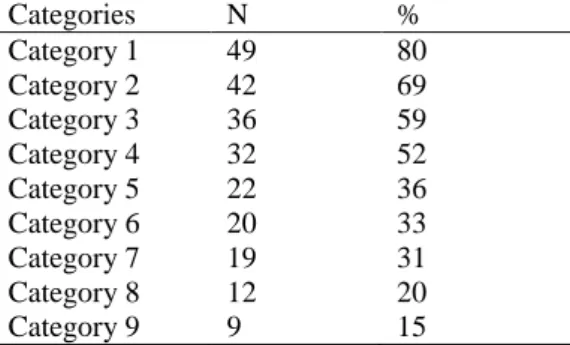
Answers coming from open-ended questionnaire and semi-structured interview questions were coded and categorized under meaningful themes which were found in related literature. Categories of needs assessment related to open-ended questionnaire were given in Table 1.
Table 1. Categories of pre-service teachers’ answers in terms of needs assessment open-ended questionnaire Category 1: More practical sessions
Category 2: Consistency between instructional methodologies and assessment technique Category 3: Making inter-disciplinary connections
Category 4: Using instructional materials accordingly with the aims of the course Category 5: Extention of the instructional activities
Category 6: More student-centered classroom setting to meet the course objectives Category 7: Periodical feedback
Category 8: Connection between theory and practice Category 9: Participation in the activities
Table 2. The frequency of the occurance of nine categories according to pre-service teachers’ answers related to needs asessment questionnaire.
Categories N %
Category 1 49 80
Category 2 42 69
Category 3 36 59
Category 4 32 52
Category 5 22 36
Category 6 20 33
Category 7 19 31
Category 8 12 20
Category 9 9 15
The most repeated code coming from pre-service teachers’ answers is for “more practical sessions” (49 people, 80% ). Description of other codes and their descriptive statistics are consistency between instructional methodologies and assessment technique (42 people, 69 %), making inter-disciplinary connections (36 people,59 %), using instructional materials accordingly with the aims of the course (32 people, 52 %) extention of the instructional activities (22 people, 36 %), more student-centered classroom setting to meet the course objectives (20 people, 33 %) periodical feedback (19 people, 31 %), connection between theory and practice (12 people, 20 %), participation in the activities (9 people, 15 %) in terms of Table 2. These codes show that practice of instructional models in the field, consistency between instructional methodologies and assessment techniques in the daily plans and making inter-disciplinary connections are the key points that the pre-service teachers expected from the course. Pre-service teachers emphasize the importance of classroom setting, material design and use, periodical assessment, meaningful learning with making connections between theory and daily life situations in learning environment and participation in the activities related to needs assessment process. They also claimed that they know the theoretical background of teaching and learning methodologies, strategies and techniques but they do not know how to implement all the strategies and techniques related to semi-structured interviews.
Semi-structured interview findings related to expectations of pre-service classroom teachers from the Practicum in Science Teaching course
When the expectations of the pre-service teachers were asked during semi-structured interviews. Sample quotations and explanations were listed as follows;
Researcher: “How did you feel about the previous semester Theory of Science Teaching course and what do you expect from Practicum in Science Teaching course?”
Pre-Service Teacher C (High Level) said that “We all learn the teaching strategies and techniques, if they hold an examination, I can answer the questions easily, but in the implementation process, I cannot apply those techniques to the elementary school students. Instructors should show the implementation process of these techniques for us”.
This participant emphasized the importance of implementation strategies, methods and techniques. Also, he claimed that instructors gave theoretical background in a good manner but they were suffering to show how they can be applied in elementary schools. He wants to see more implementations in classes.
-There is no consistency between teaching and learning strategies, techniques and assessment approaches. The pre-service teachers argue that learning and teaching strategies are process-based, but the assessment approaches that the instructors used are product-based.
Reseacher: “When you think of the previous semester related to Theory of Science course, what will you expect from science teaching methodology course and why?
Pre-Service Teacher B (Middle Level) said that “Teacher always told the importance of process-based assessment and she taught us how the portfolio assessment and performance- process-based
assessment can be applied to elementary school students but she gave importance to the
This participant complained about the inconsistency between the approaches which were used in learning-teaching and measurement-assessment processes. The content and philosophy of strategies should be consistent in every process of program implementation in terms of program development and evaluation principles. Diaries of Pre-Service Teachers From Science Teaching Methodology Courses
From 12 diaries, 10 of the pre-service teachers emphasized the importance of implementation of the instructional strategies and classroom settings in their diaries. 8 of them underlined the need of consistency between instructional methodologies and assessment practices in their portfolios. Sample quotations from diaries were listed below;
Pre-service Teacher E (Middle-Level): “I was very bored during the class today. He is continously emphasizing the importance of practice but he was stil presenting the content from slides. I tried to listen but I could not concentrate because of his monotonous voice …” This pre-service teacher complained about her instructor’s traditional design of the course and emphasized that methodology courses cannot be effective by using only teacher-oriented methodologies.
Pre-service Teacher F (High level): “Teacher gave examples about problem-based learning. I can understand what it is but I wish I want to implement this approach to elementary school students. How can I apply this methodology with 50 or 60 students in one class? How can I assess them with multiple techniques?...”This pre-service teacher underlined the necessity of micro-teaching practice in science teaching methodology courses and she is curious about making a connection between theory and real life situations.
Pre-service Teacher G (Low level): “I feel very sorry for inconsistency between instructional methodology and assessment techniques. Teacher told us that process-based assessment is very important but he told us that the considerable majority ofthe percantages of product-based final examination is 60%. This is a big contradiction…” This pre-service teacher showed that internal consistency of instructional strategies and assessment techniques were very critical and necessary for effective instructional design of curriculum.
Pre-Service Teacher D (High Level): “ We learn how we can use rubrics today and I am curious if we have a chance to prepare a rubric and make our decisions about our own examinations…” This pre-service teacher expressed the requirement of participating in the assessment process with the instructor and agreed that this process can develop learners’ reflective thinking skills and give them a chance to take their own responsibilities about their learning processes.
Semi-Structured Interview Findings with Instructors and Curriculum Specialist
Three instructors of science teaching methodology course and curriculum specialists’ reflections in terms of semi-structured interviews related to needs assessment process were given as follows;
Researcher: “What are your needs and expectations about your science teaching methodology course?”
Instructor I said; “When I think about the whole process, there are lots of things to do but I complained about my classroom setting, it is too cold and students cannot understand anything because of the physical conditions. I noticed that the social characteristics and behaviors of students affect my instructional design, students cannot concentrate and make much noise in the class…”
This instructor generally complained about physical conditions of the class and social characteristics of pre-service teachers. He claimed that instructor cannot do the activities that he planned owing to bad physical conditions and obstructive behaviors of pre-service teachers. He did not give concrete suggestions related to implementation process of strategies in science teaching methodology course. Researcher: “Are there any areas that are difficult for you when you are designing science teaching methodology course? What are your main needs about the course?”
This instructor said that the importance of having parallelism among the instructors and she stated that it is difficult to provide parallelism. She believed that she can transfer her experiences to her students. After this, students can plan and apply strategies in their science classes.
Researcher: “When you think of both previous and this semester what are your perceptions and need areas about the whole preparation and implementation processes of Practicum in ScienceTeaching course?”
Instructor III said; “I tried to apply new things in my class and I want them to inquire all the things in their surroundings. I believe that group experiment and newspaper presentations are very useful for them, but in the measurement and evaluation process we have some difficulties to identify the common criteria for the products”.
This instructor underlined the necessity of inquiry-based teaching. She provided students to inquire the educational concepts. She believed that group experiments and newspaper presentations helped to form inquiry-based teaching environments. She emphasized the importance of identifying criteria collaboratively with students and she told that they had a difficulty on this issue.
Researcher: “How can you assess the whole organization, implementation and evaluation processes of pre-service teacher education programs and teaching methodology courses without a printed curricula?”
Curriculum Specialist said; “Whatever program exists now, organization of the implementation process is very important and this depends on effective needs assessment process. This shows the future implementation of the program. After effective undergraduate education, teacher candidates should have a long-period in-service training for adaptation and the application of the newly developed curricula.”
Curriculum specialist took attention to the organization process of implementation. He underlined the importance of in-service training process. He also told that in-service training was a longitudinal process. Data coming from open-questionnaire, diaries of pre-service teachers, semi-structured interviews of instructors, pre-service teachers and curriculum specialist were consistent and showed that there was a big gap between theory and practice in science teching methodology course. Practice-based implementations like using creative drama, problem-based learning methods and approaches would meet the pre-service teachers’ expectations from the course in terms of this finding. Both pre-service teachers and instructors emphasized the need of effective assessment system which is consistent with course objectives and instructional methodologies. Furthermore, both instructors of the course and curriculum specialist underlined that effective implementation could be done with the help of concrete printed curriculum, effective in-service training and periodical needs assessment strategies. This means that longitudinal needs assessment process supported by multiple assessment tools and techniques plays a critical role in designing science methodology course, making periodical program evaluation studies and constructing eclectic and flexible science teaching curricula.
Discussion and Conclusion
Needs assessment study of science teaching method course was conducted by considering illuminative program evaluation model and this model provided qualitative data with eclectic approach using open-ended questionnaire, semi-structured interviews and diaries for this study. Pre-service classroom teachers claimed that there was a big gap and need for making practice of instructional strategies, methods and techniques, parallelism among the objectives, instructional methodologies and assessment techniques and inter-disciplinary approach in terms of needs assessment results. This finding is similar to research findings of Abell & Lederman, 2013; Lehesvouri et al., 2013; Miller & Cindy, 2011; Roth, 2008; Proctor& Capaldi, 2001. Needs assessment of this study underlined the importance of identifying need areas and origins with longitudinal processes by the aid of process-based tools and qualitative and detailed data analysis techniques.
doing collaborative works with the colleagues, classroom management issues and physical conditions for designing effective learning and teaching environments. This looks like the findings of Çalışkan & Kaptan, 2012; Chankook & Fortner, 2007.
Reliability and validity issues were considered in terms of using triangulation of qualitative data coming from open-ended questionnaire, diaries of pre-service teachers and semi-structure interviews of pre-service teachers, instructors and curriculum specialist. Multiple process based data collection tools and analysis techniques were preferred to use in this study for providing opportunities to comprehend the parallelism of findings from different sides. This means that data analysis were interrelated and described similar expectations of science teaching methodology course.
Findings of the need assessment study came from using illuminative program evaluation model was used to present and develop insights into more effective instruction in science teaching methodology course in this study. Curriculum specialist claimed that using process-based and in-depth perspectives for needs assessment and taking three different instructors’ perceptions helped to increase the validity and reliability of program evaluation process (Payne, 1994; Finkelflügel, Cornielje & Velema, 2008; Wen & Tsai, 2008; Karamustafaoğlu,
2009; Teddlie & Tashakkori 2009; Woltering, Herler, Spitzer& Cordon, 2009).
These research findings are important for giving suggestions to reconstruct science teaching methodology course program in terms of learners, instructors, curriculum specialist’s needs and elementary science program standards. The results of the needs assessment which were derived from a eclectic and flexible model provide opportunity to identify the needs and evaluate the program from different perspectives. In addition, this study showed the need of printed document in higher educational level based on eclectic models which allow to make improvements in the curricula. Practice-based fieldimplementations, consistency among aims, objectives and instructional strategies, pre-service teachers’ participation in the assessment process and collaborative work were identified as main need areas of science teaching methodology course.
Suggestions and Future Implications
Following suggestions can be given to instructors, students and practitioners in terms of needs assessment results;
-Longitudinal process-based and periodical needs assessment efforts and feedbacks will bring flexibility to curricula. This makes curricula more effective and brings contribution to economical issues and infrastructure of program development and assessment studies.
- Instructors can make detailed practice plans besides the general flowchart of the lesson plans and show the sample implementation of the theoretical aspects during the process.
- Instructors can inform pre-service teachers of the measurement and evaluation process before the course starts. For example, they can give a short seminar about the assessment process and show a sample implementation, making groups for identifying assessment criteria with the students.
- Instructors can use multimedia environments and make micro-teaching practice for showing real classroom environments to the pre-service teachers.
- Pre-service teachers can make more practice in the elementary level to see the problems of the real implementation environment. Instructors provide the facilities for them.
-Classrooms can have portable chairs and devices to provide movement capability.
-Curriculum specialists can define the practicum flowchart of the program in the description of the course and provide samples through in-service training.
- Origin and philosophy of science curricula can be reflected on every part of this practicum course.
-Instructors can use more technological instruments, inquiry and constructivist-based teaching and learning strategies during the course.
-More interactive strategies will be taken into consideration during the instructional design process for increasing the participation level of pre-service teachers.
References
Akerlind, G. S. (2005). Variation and commonality in phenomenographic research methods. Higher Education
Research &Development, 24(4), 321–334
Akerlind, G.S. (2012). Variation and commonality in phenomenographic research methods. Higher Education
Research & Development. 31(1), 115-127
Abell, S.K.& Lederman, N.G. (2013). Handbook of research on science education. Routledge Taylor and Francis Group: Newyork/London.
Bloor, M. & Wood, F. (2006). Keywords in qualitative methods. NY: Sage Publications.
Bickman, L. (1997). Evaluating evaluation: Where do we go from here? Evaluation Practice. 18, 1–16. Brinkerhoff, R.O. (1983). Program evaluation: A practitioner’s guide for trainers and educators. Boston:
Klumer-Nijhoff.
Bronwen, C. (2005). Student commentary on classroom assessment in science: a socioculturalinterpretation,
27 (2), 199-214. Retrieved May 1 2006 from http://web117.epnet.com/externalframe.asp Buaraphan, K. (2011). The impact of the standard-based science teacher preparation program on pre-service
science teachers’ attitudes toward science teaching. Journal of Turkish Science Education, 8 (1):
61-78.
Chankook, K.,& Fortner, R. (2007). Educators’ views of collaboration with scientists. Secondary Education, 35 (3): 29-53.
Çalışkan, İ. & Kaptan, F. (2012). Reflections of performance assessment on science process skills, attitude and retention in science education. Hacettepe University Journal of Education, 43, 117-129.
Didiş, N., Özcan, Ö. & Abak, M. (2008). Qunatum physics from students’ perspective: A qualitative study. Hacettepe University Journal of Education, 34: 86-94.
Finkenflügel, H., Cornielje, H. & Velema, J. (2008). The use of classification models in the evaluation of CBR programs. Disability and Rehabilitation, 30 (5), 348-354.
Fitzpatrick, J.L., Sanders, J.R. & Worthen, B.R. (2004). Program evaluation: Alternative approaches and practical guidelines. Pearson, US.
Gredler, M.E. (1996). Program Evaluation. Pearson: US.
Kaufman, R., & English, F. W. (1979). Needs assessment: Concept and application. Englewood Cliffs, NJ: Educational Technology Publications.
Karamustafaoğlu, O. (2009). A comparative analysis of the models of teacher education in terms of teaching practices in the USA, England and Turkey. Models of Teacher Education. 130 (2), 172-183. Kaya, M. & Bacanak, A. (2013). Fen ve teknoloji öğretmen adaylarının düşünceleri: Fen okur-yazarı birey
yetiştirmede öğretmenin yeri. Dicle Üniversitesi Ziya Gökalp Eğitim Fakültesi Dergisi, 21 (2013): 209-228.
Kesal, F. & Aksu, M. (2006). The perceptions of ELT students about constructivist learning activities and assessment strategies. Educational Research, 134-142.
Larson, M. &Cindy, S. (2011). Changing perceptions of science in undergraduate students: A mixed methods case study. Unpublished PhD dissertation, The University of Nebraska-Lincoln, 127pp. (ED533738). Lehesvouri, S., Jouni, V., Rasku-Puttonen, H., Moate, J. & Helaakoski, J. (2013). Visualizing communication structures in science classrooms: Tracing cumulativity in teacher-led whole class discussions. Journal of Research in Science Teaching. 50 (8): 912-939.
Ornstein, A.C. & Hunkins, F.P. (1998). Curriculum: Foundations, principles and issues. Allyn &Bacon, US. Önal, İ. (2005). İlköğretim fen eğitiminde performans dayanaklı değerlendirme üzerine bir çalışma
Yayımlanmamış yüksek lisans tezi. Hacettepe Üniversitesi Eğitim Bilimleri Bölümü Eğitimde Ölçme ve Değerlendirme Bilim Dalı.
Özer, D.Z. & Özkan, M. (2013). The effect of project based learning method on science process skills of prospective teachers of science education in biology lessons. International Online Journal of Educational Sciences. 5(3), 635-645.
Parlett, M. & Hamilton, D. (1988). ‘Evaluation as illumination: a new approach to the study of innovatory programs.’ In Murphy, R. & Torrance, H. (eds.).Evaluating education: issues and methods. London: Paul Chapman Publishing Ltd.
Payne, D.A. (1994). Designing educational project and program evaluations: A practical overview based on research and experience. Kluwer Academic Publishers/Boston/Dordrecht/London.
Proctor, R.W. & Capaldi, E.J. (2001). Improving the science education of psychology students: Better Teaching of methodology. Teaching of Psychology, 28 (3): 173-181.
Roth, W.F. (2008). Authentic science for all and the search for the ideal biology curriculum: A personal perspective. Journal of Biological Education (Society of Biology), 43 (1):3-5.
Wen, M.L. & Tsai, C. (2008). Online peer assessment in an inservice science and mathematics teacher education course. Teaching In Higher Education. (1), 55-67.
Woltering, V., Herler, A., Spitzer, K. & Spreckelsen, C. (2009). Blended learning positively affects students’ satisfaction and the role of the tutor in the problem-based learing process: Results of a mixed-method evaluation. Adv. in Health Sci. Educ. 14:725-738.