EXPLORING SELF-DISCLOSURE IN ONLINE SOCIAL NETWORKS
Javier Velasco-Martin
A dissertation submitted to the faculty of the University of North Carolina at Chapel Hill in partial fulfillment of the requirements for the degree of Doctor of Philosophy in the of Information and Library Science
Chapel Hill 2013
ABSTRACT
JAVIER VELASCO-MARTIN: Exploring Self-Disclosure in Online Social Networks (Under the direction of Gary Marchionini)
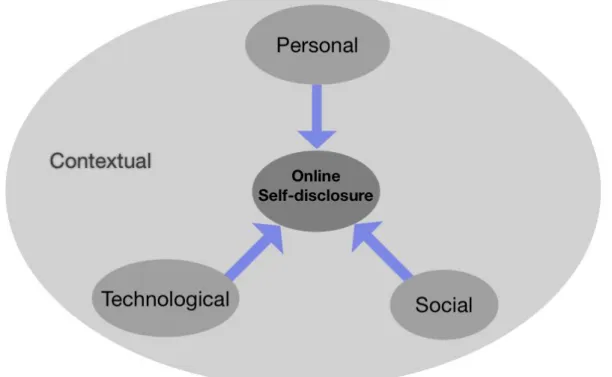
This project explores how experienced adult users of social media disclose personal information over online social networks (OSN). This work introduces a four-dimensional model to serve as a foundational framework for the study of online self-disclosure (OSD); these four dimensions are personal, social, technological and contextual, and support the complexity of decision-making behind OSD.
The dissertation is comprised of two complementary studies that explore OSD in quantitative (survey, n=1092) and qualitative (interviews, n=21) terms. Results reveal how variables related to the four dimensions of the model can have strong influence in OSD processes and how these variables and dimensions are interconnected. Findings reveal that there are differences in
perceptions of intimacy for particular channels and that this influences OSD behaviors, also that the intended audience plays a central role in OSD decisions, and that the intended audience is critical for channel selection. The first study provides robust data on some important factors that influence OSD, including frequency of use as a strong predictor of OSD: the second study gives a nuanced picture of how experienced users share personal information on OSN. These
interviews reveal a strong role of OSN in relationship maintenance and development; they also speak of a positive role of OSD in people’s lives.
DEDICATION
ACKNOWLEDGEMENTS
My first thanks go to Pilar Palacios, who provided priceless support though this endaevor, she gave me emotional support through this process, and beyond the typical help families can provide to doctoral students: her guidance helped me navigate the grad school system, she was a coach and voice of reason, and helped with many practical tasks to bring this project to port. Next, my advisor, Professor Gary Marchionini, who was supportive like nobody I had ever heard of before. To the rest of my committee who were extremely constructive through these years, always providing interesting questions and resources to make my work stronger. To Fred Stutzman, who’s work inspired me to focus on the topic of privacy in social media; his courses, advice and guidance were also fundamental in the development of this project. Thanks to Ricardo Baeza-Yates, who mentored me through the years that preceded my time in Grad School and helped me feel ready for this challenge.
To the people at the ODUM Institute who gave technical help during different stages of this process, including Teresa Edwards, Chris Wiesen, Paul Mihas, and the great staff at the Lab, especially to Jessica Pearlman. To Kaitlin Costello and Angela Murillo for help with
To my earlier teachers and professors who laid the foundation of what I am as a student, to those who instilled in me their love for writing, particularly Oriana Martinez and Susana Sanches, and for science, incluing Jose Riveros, Jaime Petit, Heriberto Soto and Eduardo Gaggero. Another special mention to Maria Eugenia Fontecilla, who led my undergrad thesis with my first approach to social science research. To my parents who laid the base of who I am, and always believed in me. Finally, to my son Victor, who always had a smile at hand to rescue me whenever I was tired and stressed during these long days of dissertation work.
And to everyone else I’m neglecting to mention and had important contributions to this work, I’m surely forgetting many people!
TABLE OF CONTENTS
LIST OF TABLES ... x
LIST OF FIGURES ... xi
CHAPTER 1 INTRODUCTION ... 1
Motivation ... 2
Central Concepts ... 3
Research Problem and Justification ... 7
Research Questions ... 7
2 LITERATURE REVIEW ... 9
Privacy and Self-Disclosure ... 9
Online Social Networks ... 12
Online Self-Disclosure ... 19
Four Dimensions for Online Self-Disclosure (OSD) ... 22
Conclusion ... 30
3 METHODS ... 32
Study 1: Survey “Mapping Self-Disclosure over Social Media” ... 34
Study 2: Interviews “Discussing Contexts and Motivations for Self-Disclosure on Social Media” ... 35
4 RESULTS ... 41
Results for Study 1 ... 41
5 DISCUSSION ... 64
Discussion for Study 1 ... 64
Discussion for Study 2 ... 65
Conclusions ... 73
Contributions... 76
Limitations ... 78
Future Work ... 79
APPENDICES ... 82
I– Interview Guide ... 82
II – Advance instructions for participants on Study 2 ... 85
III – Consent form for study 2 ... 86
IV: Consent and Questionnaire for Study 1 ... 90
V – IRB Approval for Study 1 ... 102
VI : IRB exemption for Study 2 ... 104
LIST OF TABLES
Table
1: Comparison of the two studies, complementing methodologies 32
2. Demographics of Survey Participants 34
3. Tool usage and perceptions 35
4. Variables and method of data collection 36
LIST OF FIGURES
Figure
1. Relationship between Social Distance and Self-Disclosure 11 2: A four-dimension model for explaining online self-disclosure 23
3: Mean intimacy for tools 41
4. Mean intimacy for scenarios 41
5: Mean OSD for tools, by scenario 42
6: Mean OSD for scenarios, by tool 42
7. Direction of audience-channel selection process 46
8: Change in emotional state after sharing the post 49 9. How truthful people were being at the time of sharing 49 10. How deliberate people were being at the time of sharing 50 11. How revealing the posts were from the participant’s point of view 50
12: Anticipated planning of post 51
13: Wordcloud, frequency of recurring terms from interview corpus data 52
14: Thinking of audience often 54
15: Closeness to imagined audience 54
16: Device used for sharing post 59
17: Location from where post was shared 62
CHAPTER 1
INTRODUCTION
Communication and interpersonal relationships are central to human nature and our evolution as a species (Dunbar, 1996; Maturana & Varela, 1987). As social animals, we seek companion, support and collaboration in others, and this has allowed the development of our culture. Social participation and organization do not involve sharing everything about our selves in the open; privacy is an integral component of social interaction. Privacy involves controlling access to the self and information about the self (Petronio, 2002; Westin, 1967), and this is frequently managed by trusting information to select others (Altman & Taylor, 1973; Petronio, 2002).
Balancing participation and withdrawal is a fundamental problem of our social lives (Petronio, 2002). We resolve this by selectively presenting aspects of our selves in particular contexts; by using our expressions to influence the impressions others will have of us, by way of
impression management we make sure particular people see their appropriate part of who we are (Goffman, 1959).
As the variety of communication technologies grows, our communication patterns will inevitably change as people embrace the new possibilities given by the new tools (McLuhan & Gordon, 2003). Currently, the fast evolution of computer-mediated
sharing private aspects of their lives to uncertain groups of others (Marwick & boyd, 2011; Stefanone & Jang, 2008), which include distant acquaintances and strangers alongside friends and relatives. This presents a challenge for impression management and privacy
management.
Given the variety of options that current communication technologies have to offer, people develop a sense of what is appropriate communication on particular tools, and the selection of specific tools for delivering a message conveys a meaning in itself (Trevino, Lengel & Daft, 1987). This research project explores how different tools of social media imply different privacy environments for people, and how this relates to their self-disclosure behaviors. An important focus of this study involves exploring how the uncertain audiences that social media tools impose affect the perceptions of the specific tools and self-disclosure behaviors.
Motivation
The problem of privacy in Online Social Networks (OSN) has quickly become an important research topic within Computer-Mediated Communication (CMC) and Human-Computer Interaction. There is evidence to suggest that in OSN, people are sharing private information that would not be available to such large groups of people by other means (Mesch & Becker, 2010; Stutzman, 2006). OSN are creating changes in the way we manage our privacy and disclose to others (Barnes, 2008; Palen & Dourish, 2003). Given that in face-to-face communication, the selection of an appropriate conversational partner is
example, people share more personally identifiable information on their OSN profiles than they would give to strangers on the street (Mesch & Becker, 2010).
This research project explores the phenomenon of online self-disclosure, with an emphasis on exploring the role of tool perceptions, and of the audience people envision when using these tools, in their acts of self-disclosure. As a growing number of people struggle to find a balance with their online participation and privacy, this becomes an increasingly important phenomenon to understand and clarify. The findings from this project should provide a base for future theoretical work in online self-disclosure, and should inform the development of a new generation of social media interfaces, where people can better keep track of who their audience is, and retain a better sense of control over their disclosures.
Central Concepts
In terms of experience with OSN, the goal is to work with people who are familiar with the media, people who have gone through an initial stage of experimentation with these tools of communication, who have found adequate patterns of behavior in their usage of these tools. The changes that media produce in people are not seen until the media have become transparent, once they have been adopted and adapted to people’s daily life (Haythornwaite & Wellman, 1998; McLuhan & Gordon 2003). Novice users are
experimenting with these new tools, students are going through important life transitions; thus, professional adults who are particularly experienced with these tools are more likely to use them in a stable manner. In operational terms, experienced users were defined as people who have been using these tools on a regular basis (several times a week or daily), for at least one year. Wellman and Hampton (1999) found that frequent Internet users tend to have larger networks and communicate more openly than others, this also supports our focus on this population as people who are more likely to disclose online.
Online social networks (OSN1). OSN will be defined for the purpose of this research as Internet communication platforms that allow people to broadcast and receive messages with others on their social network. Also referred to in the literature as Social Network Sites or Social Networking Sites (SNS), these tools share some common structural features including a user profile where users describe who they are, a list of contacts or friends, a time-based collection of all the messages the user has posted, and a screen where the user can view the posts made by her or his contacts or friends (boyd & Ellison, 2007).
1Commonly referred in the literature as Social Network Sites (Boyd & Ellison, 2007) or Social
This research explores people’s behavior with five social media tools, and then focuses on two popular OSN platforms, Facebook and Twitter.
Self-Disclosure (SD). SD is “the act of making yourself manifest, showing yourself to others so they can perceive you” (Jourard, 1971, p. 19), is a fundamental aspect of social relationships, and lies at the core of privacy management. An operational definition of Self-Disclosure from Adler, Rosenfeld and Proctor (2010) considers a series of factors:
Self disclosure (1) has the self as subject, (2) is intentional, (3) is directed at another person, (4) is honest, (5) is revealing, (6) contains information generally unavailable from other sources, and (7) gains much of its intimate nature from the context in which it is expressed. (p. 87)
Alternatives to self-disclosure are deception, equivocation, and hints (Rosenfeld, 1999). Social penetration theory (Altman & Taylor, 1973) measures self-disclosure in a three-dimensional space with depth, breadth and length as axes. Length refers to the amount of information being shared, for how long people speak about a personal topic. Breadth refers to the range of personal topics. Depth is associated with the intimate nature of the information being shared; the more intimate the information being shared, the deeper the act of self-disclosure. The basic premise of social penetration theory is that disclosures grow in these dimensions as relationships develop. That is, new acquaintances will only discuss a small range of topics superficially, close friends will have covered a wide range of deeply intimate information in longer conversations. In this project, the depth of disclosure was evaluated by the subjects themselves.
spaces for interpersonal communication, and the features of each tool provide a contextual setting for this communication (Mesch, 2009), influencing what appropriate behaviors are, and what levels of intimacy people attribute to each (CMC) tool.
Imagined audiences. While in face-to-face communication, people have reasonable control over who receives the information they share; in OSN, this control becomes highly uncertain. In a process that could be compared to traditional forms of broadcast media, such as television and radio, it becomes impossible to get a precise account of the people who will read what one will post on social media; yet, people will still keep a subset of their friends in mind when posting to their OSN accounts. Something similar happens to book writers, who develop a sense of an imagined audience, and keep this audience in mind when writing. When someone posts a note to an OSN, this note is broadcast towards their network of friends or followers. This network can range in the dozens, hundreds or thousands of
people—or millions in the case of celebrities (Marwick & boyd, 2011). At the same time, this note is also stored in the sender’s profile page, as a persistent archive that is sometimes public, available to any person who can browse the web, and to search engines. This scenario means that potentially, the note can reach anyone in the world. However, this is not very likely; most frequently, users of OSN are read by the people who follow them, and this list of followers is usually composed of friends, acquaintances and others who may have an interest in the person who writes—whether out of professional, personal interest, or otherwise. Usually, strangers only reach people’s OSN posts if they are looking for information on a particular topic (e.g., marketers actively hunting opinions on their
posting our messages online; as boyd’s (2007) ethnographic research on teens reveals, users of these platforms develop their own sense of an “imagined audience”, that includes the people who they are aware are following them (total list of followers can easily be lost track of) and more prominently, the people who engage in conversations with them via these tools. For any given post in time, it is impossible to determine the full list of people who read it (this could be called “factual audience”,) especially given the time-flow nature of these platforms where many messages can be lost in the mix of a daily flow, between all of the other writers each reader is subscribed to.
Research Problem and Justification
The problems around online privacy management are growing in importance with the pervasiveness of online social media. Of all the problems associated with the
phenomenon of online self-disclosure, the role of an imagined audience in mediated
communication stands out as an important challenge to people’s privacy management. While engaging in face-to-face communication, an appropriate conversational partner is key to the disclosure decisions (Rosenfeld & Kendrick, 1984); in social media, the audience is uncertain, yet people are choosing to disclose. Thus, understanding the role of these imagined
audiences in disclosure decisions is a relevant problem to explore in order to provide a basis for future theoretical work around online self-disclosure. This problem leads to a set of general research questions that were addressed in this project.
Research Questions
RQ1: Do people attribute different levels of intimacy to different CMC tools?
RQ2: Do people’s perceptions of tool intimacy relate to their levels of self-disclosure?
RQ4: Does the audience users have in mind when posting to social media affect the depth of their self-disclosure?
CHAPTER 2
LITERATURE REVIEW
Privacy and Self-Disclosure
Privacy. Privacy is a fundamental part of our social lives and especially in the development of intimate relationships. Its first discussions date only to 1890 when it was defined as the right to be left alone, free from the scrutiny of others (Warren & Brandeis, 1890). Privacy can be understood as a dynamic process where people manage the boundaries of what information about the self others will have access to in different contexts (Palen & Dourish, 2003; Petronio, 2002).In social terms, privacy is fundamental to all types of
extent information about them is communicated to others” (Westin, 1967, p. 7). This focus on privacy as related to control of access to personal information is central to this project.
Self-Disclosure (SD). When we talk about close relationships, there’s a common base of privacy as a fundamental part of such relationships, something is shared between these friends, which is not shared in public contexts, this something usually implies access to
information about oneself (self-disclosure) that is generally unavailable, that is, private information: “We cannot be close to someone without revealing some personal, and often private, information about ourselves. Friendship means sharing, and sharing means
relinquishing some privacy” (Ben-Ze’ev, 2003, p. 453). However, the sole sharing of private information does not constitute an emotionally intimate relationship unless that information is shared within a context of caring (Introna, 1997). Self-disclosure is a complex process that is largely dependent on context (Cozby, 1973); the topic discussed is not enough to consider what is a disclosure (Antaki, Barnes, & Leudar, 2005).
Intimate disclosures usually create an expectation for reciprocation (Jourard & Lasakow, 1958) in what is known as the reciprocity norm. Not only is SD basic for creating relationships, SD can lead to benefits in psychotherapy patients (Jourard, 1959); and furthermore, in a meta-analysis, Frattaroli (2006) compiled research where experimental disclosure was found to have beneficial impact for physical and psychological health of people in a variety of situations.
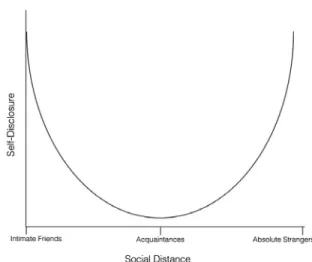
self-disclosure is associated with high levels of closeness and intimacy (Cozby, 1973). We could describe the relationship between SD and social distance as a U-shaped function, where both the closest friends and furthest strangers afford high levels of privacy, while fewest is shared with those people who fall in between (Figure 1).
Social penetration theory. Altman and Taylor (1973) put Self-Disclosure (SD) at the center of relationship development. This theory is framed within Social Exchange Theory and it proposes that communication participants will initially disclose superficially, and the level of depth in their SD will increase over time as the relationship develops. The level of disclosure to exchange on each interaction is determined by a reward/cost analysis each participant does, anticipating and forecasting the consequences. The deepening of the relationship is the reward people receive for their disclosure. At the same time, self-disclosure from your relational partner is usually considered a reward in itself (Worthy, Gary, & Kahn, 1969), a token of trust. Self-disclosure (SD) has been linked to liking: we disclose more to people whom we like, and people who disclose more are generally more likable, this can be analyzed as a Social Exchange process (Altman & Taylor, 1973; Thibaut & Kelley, 1959; Worthy, Gary & Kahn, 1969). Social Penetration can be considered an extension of Social Exchange theory that is focused on SD, and where time has been included as a critical factor (Cozby, 1973). Social penetration theory measures self-disclosure in terms of three
dimensions: breadth (range of topics), depth or intimacy, and duration or time spent developing an idea or argument.
Communication privacy management theory. In terms of interpersonal communication, Communication Privacy Management (CPM, Petronio, 2002) offers a powerful framework for describing how people regulate the disclosure of their private information through the creation of personal and collective boundaries, and the
management for the permeability of such boundaries. CPM starts by defining that people own their personal information, and therefore are entitled to decide which information they can share with whom; once information is shared, there is an expectation (somehow
negotiated) in regards of those others who now co-own such information, that they will handle its privacy in an adequate manner. When these expectations are violated, boundary turbulence occurs (Petronio, 2009). CPM has been developed from over a decade of research in different areas of application (Petronio, 2007), and has been used in research focused on social media for development of a measure for blog privacy (Child, Pearson & Petronio, 2009) as well as in research on Facebook privacy management (Waters & Ackerman, 2011). At the same time, the principles of CPM establish the underlying framework under which OSN interfaces allow users to control their privacy settings.
Online Social Networks
Evolution of CMC into OSN. Computer Mediated Communication (CMC) has penetrated the world to a point that it is now a regular part of life in all modern cities.
2004; boyd, 2007; Haythornthwaite, 2005; Quan-haase, 2007). This is consistent with the Media Ecological Perspective (Barnes, 2008).
Online Social Networks (OSN) are the most recent form of Online Community infrastructure and have quickly gained popularity throughout the world. As the natural next step in the evolution of CMCs, OSN are purposefully designed to take advantage of and empower their users’ social networks. This adaptation to our social reality, along with usable interfaces, has been critical to their rapid success. The basic premise behind OSN is that they allow people to hold group conversation with an audience of predefined contacts, which reflects their actual social network to some extent. Once in an OSN, participants broadcast their messages into their particular network.
Starting from a series of communication features often found in online communities, online social networks explicitly add the structure of people’s social networks into the
OSN have quickly become critical elements in our communications toolbox, and for college students in particular, OSN have become such an important component that not checking them (e.g., Facebook) will keep people out of what is happening among their peers (Golder, Wilkinson & Huberman, 2007). Although OSN are frequently associated with teenage use, their population has been steadily increasing towards older segments of the population (Levy, 2007). Part of this can be explained by a rising use as a means to keep in touch across generations within families, as older adults strive to learn about and keep in touch with their younger relatives who are leading important parts of their lives online (Pfeil, Arjan & Zaphiris, 2009), and due to the networked diffusion of OSN; the more older people get into them, the more likely their peers are to come online.
With the evolution of the Web, our information tools are merging with our
communication tools. People are using the Web daily to communicate with one another, not only for retrieving information, but also for actively exchanging it and for the maintenance of social relationships. Many of the most popular websites these days are focused on this social participation; social media as they are known, represent a new form of communication that is a hybrid between interpersonal and mass media, allowing ordinary people to
broadcast their messages to hundreds, thousands, or millions of people, depending their popularity.
Mayfield (2007) describes OSN as bottom-up, people-centric, user-controlled, context-driven, decentralized and self-organizing; in contrast with online communities, which he characterizes as top-down, place-centric, moderator-controlled, topic-driven, centralized and architected. The basic structure of an OSN contains a profile page that identifies an author, a list of his or her contacts or friends, and some space where these contacts can leave comments (boyd & Ellison, 2007). OSN can be generally classified into two groups, object-centered and ego-centered (Stutzman, 2009). Ego-centered platforms are shaped around the people themselves; some examples of these are Friendster, Myspace, Orkut, Windows Live Spaces, Hi5 and Facebook. Object-centered networks, on the other hand, are organized around the sharing and exchange of information objects; examples of these are Youtube and Vimeo (videos), Flickr and Fotolog (pictures), Livejournal, Xanga and La Coctelera (blogs), LastFM, iLike, Songza and Muxtape (music), LinkedIn (resumes), Slideshare (presentations), Twitter and Jaiku (microblogging).
All of these platforms share the common elements described before in one way or another, and include different approaches to their architecture that afford differences in their dynamics of participation. Some of these systems require bilateral sign-off before
establishing a relationship between people (non-directed network), while other systems let users follow people with no reciprocity (directed network), and although some of these describe all relationships between users in terms of friendships, the list of people that users collect ends up including both friends and weak ties equally. The user groups formed around these profile pages are not closed homogeneous groups, but rather, organically shaped heterogeneous groups just like our (offline) social networks.
research (Beer, 2008; Blanchard, 2004; Boyd & Ellison, 2007; Fogel & Nehmad, 2009; Gross & Acquisti, 2005; Java, Kolari, Finin, Joshi & Oates, 2007; Stutzman, 2006).
The popularity of websites that offer open access to the publication of contents by end users has led to the development of a new generation of CMC tools that is known as Social Media. Thanks to the traceable nature of CMC platforms, Social Network Analysis (SNA) can be applied to Computer Mediated Communication study in a straightforward manner: the World Wide Web (WWW) itself constitutes a social network, or a representation of the network of the different actors behind the websites that constitute the WWW. “When computer-mediated communication networks link people, institutions and knowledge, they are computer-supported social networks” (Wellman, 2001, p. 228).
Social Network Analysis (SNA) is a sociological framework that focuses on the relationship between people more than the individuals who compose the network. In SNA the social world is analyzed in terms of the connections between people; this view borrows from graph theory to describe society as a series of nodes (people) connected by arcs (ties, relationships), and some of the basic concepts of SNA include the distinction between strong and weak ties to describe close and distant relationships between people
(Granovetter, 1973, 1984). ONS appear as a technological evolution of online communities that are based on SNA and take the base of networked relationships to enable people to organize around technology platforms. Networks appear as a more natural and organic form of describing informal human groups than a fixed set of pre-established communities, focusing on social relations and structures (Wellman, 1999). For a review of Network Theory see Barabasi, 2002.
Sergi, 2004; Haythornwaite, 1996). Blogs have proven fruitful material for recent research, thanks to the way in which they prominently reveal connections between authors, readers and the author’s sources (Java,et al., 2007; Kolari et al., 2007).
Haythornthwaite (2005) establishes a direct relationship between tie strength, the need for privacy and the variety of media used, in a concept known as media multiplexity. She poses that the mere creation of a network infrastructure allows for the creation of latent ties as people join the system, and as people start to interact among each other there are more opportunities for weak ties to develop. Weak ties can be built upon common need, shared interest, or business. These group-only spaces are unlikely to develop strong ties. Strong ties require private channels of communication where a stronger sense of intimacy and trust can be developed: thus, growth of tie strength can be described in terms of moving from public to private exchanges—this falls in line with Social Penetration Theory (Altman & Taylor, 1973). If the online infrastructure is shut down or undergoes important changes that affect the dynamic of the network, weak ties will probably disappear, while stronger ties are more likely to prevail as these usually connect through a variety of media.
Scholars working under the Social Network Analysis approach, find a direct relationship between self-disclosure and tie strength (Granovetter, 1983; Marsden & Campbell, 1984). Recent research exploring the relationship of perceived privacy across multiple media (including some CMC tools) on disclosure reveals that perceived privacy of the tool affects disclosure, especially for topics regarded as intimate (Frye & Dornisch 2010).
more extroverted and share higher degrees of self-disclosure in their posts tend to maintain larger strong-tie networks around their blogs (Stefanone & Jang, 2008). For a review on the evolution of CMC, see Walther and Ramirez (2009).
Media ecological perspective. The Web has been available to us for over two decades and is now part of our daily routine. Computer-Mediated Communication (CMC) and Social Media are part of the set of communication tools we use for performing our work and sustaining our social relationships (Baym, Zhang & Lin, 2004; Haythornwaite, 2005). CMC and Social Media should not be analyzed in isolation; the concept of a cyberspace that exists independent of our physical world is no longer sustained (Baym, Zhang & Lin, 2004), social media are used in conjunction with other media and face-to-face connections
(Baiocco, Laghi, Schneider, Dalessio, Amichai-Hamburger, Coplan, …Flament, 2011; Mesch & Talmud, 2006). The Media Ecological Perspective (MEP), which was born before the Web, allows for the study of communication patterns taking place in social media and how these form part of our overall lives (Barnes, 2008).
MEP views media as arranged in a complex interconnected system that is best considered in ecological terms: as a media ecology that has an influence in our society and culture by means of its shape, independent of the messages exchanged. The Media
Ecological perspective argues that changes in technology will create changes in society, not in a techno-deterministic manner, but rather, because of the way in which people adapt it to form part of their lives; by how society incorporates it into their culture.
Over 45 years ago, McLuhan and Fiore (1967) depicted electronic media as
landscape. Developers of the first computer networks had similar ideas about enabling collaboration between people (Licklider & Taylor, 1968).
However, we cannot see the actual impact of a medium until it has become part of our everyday lives (Wellman, Salaff, Dimitrova, Garton, Gulia, & Haythornthwaite, 1996). Currently, media ecologists believe that the impact these tools have on our lives depends on how we use them (Barnes, 2008); this means that the media does not directly change our lives, but it is our usage of the tools that produce changes in our habits of behavior. This lies at the core of this research project: to understand how people’s use of online social networks is changing their self-disclosure behaviors.
Online Self-Disclosure
Intimacy on CMC. Initial CMC research questioned the utility of CMCs for
maintaining rich and complex relationships: The Information Richness Model sustained thattext format is best for concrete tasks, not personal communication (Daft & Lengel, 1986).The
Social Presence Model argued thattext only is a low presence medium, creating low levels of intimacy in communication (Short, Williams & Christie, 1976).The Cues-filtered-out view
proposed that lack of cues on CMC leads to depersonalization (Keisler, Siegel & McGuire, 1984). These early theories emphasized the limitations of the media and focused on the negative impact their broader adoption could bring into society.
As the Intrenet acquired more reach and its users were more familiar with it, and as the medium matured to offer more sophisticated and unique features, studies started finding opposite effects: Frequent Internet users tend to have more social contacts and engage in more open communication with their friends than otherwise (Wellman & Hampton, 1999). In response to concerns with lack of richness in the media, and lack of co-presence,
overcome the aforementioned limitations of the medium. For example, under the Social Information Processing Model, Walther found that our basic need for social bonding is satisfied the same on CMC as face to face (Walther, 1992).
Some researchers emphasize the capacity of CMC to create and sustain intimate social relationships, for example, Rheingold (1993) goes as far as attributing high levels of self-disclosure to the nature of the medium, and the role of screens as mediators. Rheingold points out how people who communicate through the internet usually will do so from private locations where they feel comfortable. Along similar lines, Walther proposes the theory of Hyperpersonal Communication, by stating that CMC can actually be more friendly, social and intimate than face-to-face communication (Walther, 1996.) “The increased level of intimacy of these micro-level behaviors may lead to perceptions of extraordinary affectionate relations, or hyperpersonal states” (Tidwell & Walther, 2002, p. 339). However, most of this research has been conducted in studies among dyads of strangers, and based on college students (Bargh, McKenna & Fitzsimons, 2002; Joinson, 2001a; Tidwell & Walther, 2002). College students may differ from the larger population in their use of CMC; as they are in a stage of life where they are thriving for establishing new relationships, and may not always be reflective on their privacy management.
Research on email use has found it is strongly used to sustain existing relationships (Stafford, Kline, & Dimmick, 1999), most people use email to communicate with their relatives (Lenhart, Rainie, Fox, Horrigan, & Spooner, 2000), and it helps people develop relationship with their peers (Jones & Madden, 2002).
Research over self-presentation in dating websites (Gibbs, Ellison & Heino, 2006) has found support for social penetration theory (including interaction anticipation), social information processing theory and the hyperpersonal perspective. In other words, users of online dating sites will share growingly intimate information as a relationship develops over time, they exchange personal information in order to adjust to the lack of cues in the mediated format, and finally, they share more intimate information through the mediated platform than they would share face to face.
Intimacy on OSN. The main reason people use social media technologies is to reduce the cost of sustained contact with the people on their social networks, particularly with their strong ties (Jang & Stefanone, 2011). As part of this sustained contact comes self-disclosure; SNA research finds that SD plays an important role in tie strength (Granoveter, 1983; Marsden & Campbell, 1984); verbal intimacy is correlated with relational intimacy.
If we factor in the frequency of these communications we can see that levels of verbal intimacy and affective intimacy are positively correlated with posting frequency (Rau et al., 2008); and that within intimate relationships, people communicate more frequently, and cover a broader variety of topics with deeper disclosure levels (Laurenceau, Barrett & Pietromanco, 1998; Marsden & Campbell, 1984). Moreover, when people have stronger relationships, they end up using a wider array of the available tools for their
There is already an important body of research on OSN, and some important advancements have been made in the area of blogs, the first of these tools to appear and frequently used as a research focus in the early OSN research. The success of these tools is proving how people are using CMCs to reach their contacts: “the reconfiguration of
websites into interactive blogs is symptomatic of the recurring trend to adopt technology for interpersonal communication” (Stefanone & Jang, 2008, p. 126).
Although most blogs can be considered online diaries, describing people’s lives, thoughts and feelings (Herring, 2004; Herring et al., 2005), and that most bloggers are truthful in the way they present themselves in their blogs, including information about their sexuality and romantic relationships (Huffaker & Calvert, 2005; Lenhart & Fox, 2006), most blog authors do not use the available controls that enable them to protect their information from the eyes of strangers. (Lenhart & Fox, 2006)
Extraversion and self-disclosure in blogs are an effective way to maintain
relationships (Stefanone & Jang, 2008), and that people choose sharing over withdrawal as a means to sustain their close relationships (Nardi, Schiano, & Gumbrecht & Swartz, 2004), which is consistent with Social Penetration Theory (Altman & Taylor, 1973), yet this comes at a cost as bloggers have run into trouble at some point for cause of their postings: Viégas (2005) found that 35% of bloggers in a 492-participant survey had gotten into some kind of trouble for information they had posted in their blogs, and that these problems were correlated with frequency of self-disclosure.
Four Dimensions for Online Self-Disclosure (OSD)
Context should also be kept in mind (Figure 2). Internal drivers for self-disclosure include psychological motivations, interpersonal differences, and several factors included in traditional cost/benefit analyses of self-disclosure. Social drivers cover elements that are determined by our social surrounding, including cultural norms of what adequate disclosure is for a given context, reciprocity norms, impression management, and relationship
management, to name a few. This dimension also includes some of the aspects traditionally included in cost/benefit analyses of self-disclosure. Technological drivers refer to features of the media that affect disclosure processes, even if we don’t notice this influence directly. There seems to be something in the way we relate to technology that leads to heightened disclosure, this effect has repeatedly found but is yet well understood. Finally, contextual
settings as have long been found to be influential to self-disclosure, must also be kept into consideration when researching acts of self-disclosure.
The following list describes some of the variables that represent the different dimensions for this model. This list is not exhaustive, but represents a starting point for broadening the understanding of the process of online self-disclosure, a seed towards a research track that could potentially develop a theoretical model.
Internal drivers for OSD. Internal drivers for OSD include individual differences between communicators, such as psychological traits and demographical indicators, as well as personal motivations that people may have at any given moment when deciding to disclose. These internal drivers are shared in interpersonal and mediated settings, for example: catharsis, self-clarification, and self-validation. Interpersonal differences include demographic and psychometric variables.
Catharsis. Catharsis is an important factor for disclosure, especially for disclosing to friends (Rosenfeld & Kendrick, 1984).
Self-clarification. Many times, putting thoughts into words or discussing our situations with others will help us clarify our ideas and points of view (Rosenfeld, 1999).
Self-validation. Self-disclosure is also used as a means of searching validation from others; it can help validate the self-concept according to how one is seen by others
(Rosenfeld, 1999).
Loneliness. Experimental research based on instant messaging found that loneliness was not related to disclosure depth, but inversely correlated with valence, accuracy and amount of self-disclosure between conversational partners (Leung, 2002).
preferred face-to-face interactions in these cases. Additionally, as the chance of rejection increased, email was preferred over face-to-face communication (Joinson, 2004).
General self-disclosure. Self-disclosure can be measured as a personality trait, with some people having greater propensity for disclosing than others (Wheeless, Nesser, & McCroskey, 1986).
Self-Consciousness. There are two aspects to self-consciousness; People high in private self-consciousness orient themselves towards their internal world, with a high awareness of the self. Conversely, people high in public self-consciousness are focused on the reaction of others to the self (Fenigstein, Scheier & Buss, 1975). People with high levels of private consciousness tend to disclose more than those high on public
self-consciousness (Reno & Kenny, 1992).
Sex. Gender differences have been of interest to the research on self-disclosure for decades. Meta-analysis shows higher tendency to disclose for females (Dindia & Allen, 1992).
Social drivers for OSD. As has been covered in this document, self-disclosure plays an important role in social relationships. The process of decision for self-disclosure is largely influenced by a series of social factors both in interpersonal and mediated settings. Here we will cover some frequent social motivations that lead people to disclose personal
information.
Reciprocity. Following the conversation of friends in CMC and OSN creates the same need for reciprocity as in other contexts. In collective spaces such as OSN this can even take the shape of peer pressure, where people feel the urge to share similar types of information that their friends are sharing (boyd, 2007). Further, Moon (2000) was able to yield higher levels of self-disclosure in conditions of reciprocity for people interviewed by a computer in experimental research: when computers revealed more information of their characteristics, people would share more personal information. Reciprocity has also been experimentally tested in the context of online surveys (Joinson, 2001a)
Intended audience. Just as the target person plays a central role in decisions about offline disclosure (Rosenfeld & Kendrick, 1984). Although OSN provide space for non-directed self-disclosure, the intended audience plays an important role in the intimacy of disclosure: Bloggers who target their strong tie network have been found to display a range of intimate content on their posts (Stefanone & Jang, 2008); although the exact audience that will read people’s posts in an OSN is not known, there is always a target audience the user is thinking of at the moment of disclosing, and this moderates her levels of disclosure. On another aspect of this, research based on dating websites has found that expectation of future interaction led to higher levels of self-disclosure, and more honesty in particular (Gibbs et al., 2006).
Relationship maintenance. Continued disclosure is positive for the sustenance and improvement of long-term relationships. Ceasing to disclose in existing relationships will “cool them off.” Disclosure has been found to be a predictor of marital satisfaction (Derlega, Metts, Petronio & Margulis, 1993; Rosenfeld & Bowen, 1991). In terms of
Spiekermann, Koroleva & Hildebrand, 2010; Stefanone & Jang, 2008). OSN are particularly convenient since one can broadcast a single message into one’s larger network of friends and acquaintances that are connected there. Considering how relationship maintenance and enhancement plays a fundamental driver for disclosing to friends (Rosenfeld & Kendrick, 1984), the convenience of an OSN for maintaining existing relationships becomes a powerful driver for this disclosure.
Cultural norms. Cross-cultural research on interpersonal self-disclosure has found that people’s cultural norms can influence what they disclose (Chen, 1995; Diaz-Peralta & Downey, 2003; He, Zhao, & Hinds, 2010). For example, Diaz-Peralta & Downey (2003) compared found that Argentineans presented higher levels of self-disclosure than people from the USA. Similar results have been found in CMC settings, including OSN, and have been validated by study 1 of the present project (Velasco, Stutzman, Capra & Marchionini, 2013).
Social capital. Finally, research on social media has found that people actively use these tools to increase and make use of their social capital (Burke, Kraut & Marlow, 2011; Yoder & Stutzman, 2011)
Technological drivers for OSD. Next, the literature on online self-disclosure reveals important evidence to suggest that the process of online self-disclosure differs from interpersonal settings in an important way. Technology seems to be playing a role in privacy management for mediated communication, and people appear to be sharing more intimate information online than they would otherwise. This problem dimension is central to the contribution of this research by exploring how technology is affecting the process of self-disclosure.
Buffer effect. The reduction of social cues, and physical isolation during CMC communication can lead people to forget some of the threats of self-disclosure. The use of telecommunication adds a layer of distance between conversational partners; this gap is sometimes described as “relative anonymity” that reduces our inhibitions while
communicating with friends and family, while acting as a barrier to access to us. This gradual reduction in social cues, that some authors frame in terms of a continuum of anonymity offered by CMC tools acts as a powerful control of privacy (Bargh, McKenna & Fitzimons, 2002; Christopherson, 2006; Joinson, 2001b; Mesch & Becker, 2010 Rheingold, 1993; Tanis & Postmes, 2007).
Social response. There is substantial evidence on how people treat computers and other media as social actors (Reeves & Nass, 1996; Nass & Moon, 2000; Moon 2000). When communicating through computers, people mindlessly apply social rules and expectations, including politeness and reciprocity although they are aware on a conscious level that machines are not human. When interacting with text-only interfaces, people are especially prone to orient themselves to the computer (Moon, 2000). In light of this, we can argue that people develop a relationship with the devices and media that they frequently use; and that this relationship—and the trust deposited in it—acts as a moderator of our online self-disclosure.
Social Response Theory by arguing that people who use CMC tools more frequently develop a sense of social closeness with these tools; Alternatively, a Dual Coding Theory explanation would posit that frequent users engage in CMC in a heuristic way while for less frequent users this behavior is more reflective.
Interactivity or immediacy of dialogue. Interactivity is another salient feature of the media that influence people’s engagement and feelings of co-presence. Some of these CMC tools afford quick dialogue, which in turn allow us to become focused in the
conversation and focused on the ostensible relational counterpart, thus a user may become immersed in a conversation and reduce their attention on the setting being used, and the possibility of an undesired audience reaching our information. Related to this, another important characteristic of some CMC platforms, and social media in particular, is how the audience is never absolutely clear.
Tool privacy.The sense of privacy that people have within a particular CMC tool will have an impact in their disclosure behaviors. This sense of privacy is composed of a variety of factors. Providing users with controls for managing their privacy settings can help mitigate the feelings of risk in disclosure for particular online environments (Krasnova et al., 2010; Stutzman, Capra & Thompson 2011); additionally, the consumption of the system’s privacy policy also moderates privacy risk (Stutzman et al., 2011). Perceptions of risk in online disclosure can also be mitigated by the user’s trust in the service provider (Krasnova et al., 2010; Stutzman et al., 2011).
you doing?”). In fact, a narration by one of the creators of Twitter of the initial description of the project by Evan Williams, “His idea was to make it so simple that you don’t even think about what you’re doing, you just type something and send it” (Sagolla, 2009). At the same time, some of these tools present a range of fields in the user’s profile (e.g. city, relationship status, date of birth) and actively encourage the user to fill them out by displaying a rate of completeness.
Contextual elements affecting OSD. As has been discussed before, self-disclosure is a highly contextual process. Contextual factors will have an important role in defining disclosure situations. Here we will cover a couple of the contextual factors and how they affect the process of OSD.
Physical context. Familiarity and perceived comfort of the location from where people are engaging in CMC has found to predict levels of OSD (Stefanone et al., 2009): As the use of CMC over mobile devices grows, communication tools are used from a wider range of contexts. People using CMC from intimate physical environments will feel more comfortable disclosing intimate information through these tools.
Environment norms. Context is an important factor in determining what constitutes self-disclosure and when it is appropriate (Adler et al., 2010). OSN can be considered public commons where people socialize and the interactions that take place in these spaces will define what appropriate disclosure is for these contexts (boyd, 2007).
Conclusion
them to reach their entire social network with a single posting action. This distribution model presents an inflection point in communication technologies, and is enabling social dynamics that are unique to this media.
CHAPTER 3
METHODS
This research project explores the phenomenon of online self-disclosure by way of a mixed methods approach. The combination of a quantitative exploratory study and a
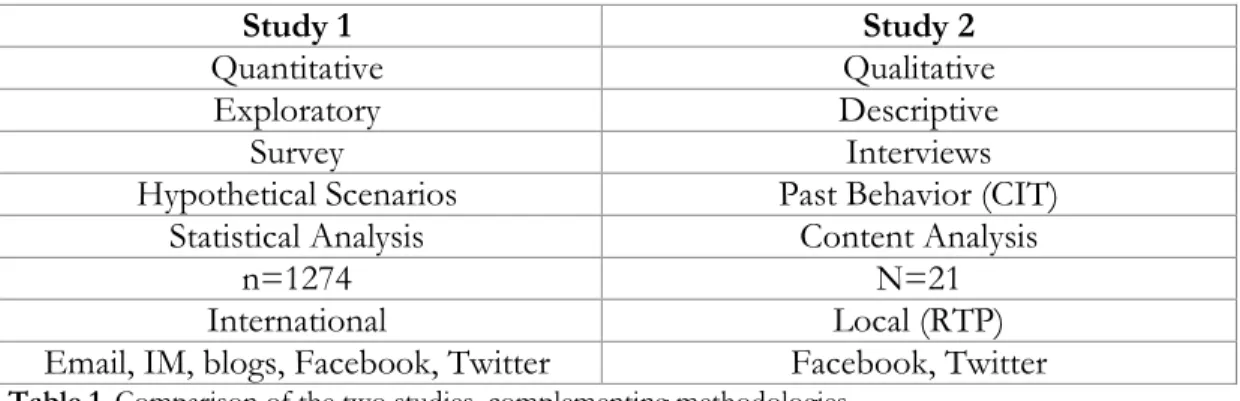
qualitative descriptive study allows for a better understanding of the variables of interest and how these interplay in the process of online self-disclosure (Table 1). The first study tests people’s likeliness to share personal information related to hypothetical scenarios; the second study adopts the Critical Incident Technique in order to stay grounded on people’s behavior, asking participants to explain the situation in which they actually shared personal
information in the recent past.
First, an exploratory study measures perceptions of tool intimacy and willingness to share different types of information across five tools of CMC, while controlling for
demographic, psychological, technology usage and cultural variables. The use of
questionnaires to collect self-reported data has been useful in social science research for
Study 1 Study 2
Quantitative Qualitative
Exploratory Descriptive
Survey Interviews
Hypothetical Scenarios Past Behavior (CIT)
Statistical Analysis Content Analysis
n=1274 N=21
International Local (RTP)
Email, IM, blogs, Facebook, Twitter Facebook, Twitter
decades for measuring both dependent and independent variables (Delvin, 2006). In order to account for the multiplicity of contexts for self-disclosure, willingness to share is inquired over four different communication scenarios; given this and the measurement across five different CMC tools, we have a multi-level design. Differences between participants were compared in terms of demographics, psychometrics and measures of usage for the CMC tools in question, and country of origin is measured as a cultural indicator.
Second, a descriptive study uses qualitative interviews to examine the experiences people have when sharing private information in OSN. While the first study accounts for a broad array of CMC tools and variables associated with OSD, this second focuses
exclusively on two popular OSN platforms: Facebook and Twitter. The conversations focus on a subset of central variables and how they interrelate: perceptions of the tool, relationship to imagined audience, and self-disclosure (DV). These interviews inform an inductive
analysis that helps generate a framework for understanding how these variables relate. By working with the Critical Incident Technique (Flanagan, 1954; Butterfield, Borgen, Amundson & Maglio, 2005), this study explores the context of self-disclosure decisions for behaviors that people report having committed in the past, specifically, acts of sharing via online social networks (i.e., posts). The CIT is appropriate for the study of information behaviors, it allows for the study of infrequent acts that may not be readily available by other means, and enables participants to more accurately recall specific incidents instead of their behavior in general (Luo & Wildemuth, 2009). Another advantage of the CIT is that it permits researchers to quickly find patterns in the data: categories stabilize with few subjects (Andersson & Nilsson, 1964). In this study, incidents are acts of online
the situation they were in at the moment of sharing, the questions around these posts in question cover the four dimensions of the model.
It has already been pointed out that this project focuses on intensive and experienced users; as results from the first study in this project suggest, higher intensity of usage is
associated with higher levels of self-disclosure. This supports the selection of experienced users as well suited for this second study, given that experienced users should have more, and more recent, incidents to recall.
Study 1: Survey “Mapping Self-Disclosure over Social Media”
The first study for this project involved a survey where self-disclosure was measured in the context of four communication scenarios that involve different levels of intimacy, across five communication tools. This study was conducted during October 2010 and was approved by UNC with IRB # 10-1498.
Sample. Participants were recruited through email lists, blogs and online social networks. A total of 1274 people responded to the survey, 1092 responses were considered complete for the analysis. This sample includes people from 53 different countries, their ages ranged from 16 to 69 years (M = 33.56, SD = 10.85), 60% of the sample is composed of women, and 45% of participants work in a field related to information systems (Table 2). They are experienced users of computer mediated communication tools (Table 3).
Measures. Online Self-Disclosure (OSD) was measured across five CMC tools (email, IM, blogs, Facebook and
Twitter) for four scenarios:
Mood, “You're having a very bad day.”
Family, “You've just had a
Demographic Values
Age M = 33.6, SD = 10.485 Education (yrs.) M = 17.1, SD = 4.567 Work Exp. (yrs.) M = 10, SD = 9.585
Gender 60.7% Female, 39.30% Male Info Sys. Work 45% Yes, 55% No
Countries (% of sample)
USA 57%, Chile 22.8%, Argentina 2.1%, Canada 2%, Mexico: 1.9%
conflict with someone in your close family.”
Politics, “You have just heard some political news that makes you upset.”
Health, “You just got very bad news from your doctor.”
Each scenario is presented
above a matrix of the CMC tools and a six point Likert scale: “How likely are you to share your feelings about this via [tool]?” Independent variables included tool intimacy, scenario intimacy, audience types, closeness to audience types, tool experience (in years), frequency of tool use, and tool expertise (Table 4). Controls included sex, age, country, education, work experience (Table 2) and psychometric scales for disclosiveness and self-consciousness. For psychometrics, we utilized a 15-item abbreviated version of the General Self-Disclosure Scale (GSDS) (Wheeless 1978). We also utilized the Public Self-Consciousness (PubSC) and Private Self-Consciousness Scale (PrivSC) by Fenigstein, Scheier and Buss (1975),
abbreviated to 10 items. All items in the psychometric measures were presented in randomized order for each respondent.
Study 2: Interviews “Discussing Contexts and Motivations for Self-Disclosure on Social Media”
A second study used qualitative interviews to explore people’s perceptions of different social media tools, their audiences, and how these variables affect what they share. The interviews were semi-structured and had a special interest in exploring how the
Email IM Blogs Faceb. Twitter
Users (%) 1,087 (100%) 884 (81%) 448 (41%) 924 (85%) 678 (62%)
Experience 14.52 (3.89) 11.09 (4.02) 5.70 (3.39) 3.98 (1.29) 2.53 (1.07)
Frequency 4.74 (.65) 3.67 (1.27) 2.37 (.85) 3.48 (1.15) 3.72 (1.23)
Expertise 3.49 (.65) 3.03 (.86) 2.59 (.90) 2.89 (.79) 2.62 (.94)
Intimacy 3.71 (1.49) 4.31 (1.44) 3.04 (1.40) 3.00 (1.35) 2.38 (1.3)
Audience Size 47.48 (91.12) 10.13 (29.11) 4.121 (11.23) 28.68 (174.0) 27.59 (309.3) Audience Closeness 4.49 (.67) 4.75 (.75) 4.05 (.96) 4.44 (.72) 4.06 (.94)
imagined audience could influence perceptions of the media, perceptions of intimacy in for the media, and the type of information people share through these tools.
Based on the Critical Incident Technique, the interviews asked participants to go over their history of social media tools and describe the context for posted messages that they regard as self-disclosure. Participants were asked to discuss two different cases where they had posted information that they somehow regard as intimate on either Facebook or Twitter. The conversations focus on subject’s conceptions of the channels being used, their
Variable For each Question Format
Tool
Experience Tool Prompt: “How long ago did you start using (tool)?” Choices: List of years, based on the age of the tool (e.g. Twitter started in 2006)
Tool
Frequency Tool Prompt: “How often did you use (tool) in the last month?” Choices: Never, A few times a month, A few times a week, About once a day, Several times a day.
Tool
Expertise Tool Prompt “How would you rate your (tool) expertise?” Choices: Novice, Average, Advanced, Expert. Audience
Size Tool Prompt: “Approximately, how many people did you communicate with via (tool) in the last week?” Open response
Tool
Intimacy Tool Prompt: “Intimate: Private information and personal thoughts/feelings. How intimate is (tool)?” Six-point bipolar scale: Not Intimate to Very Intimate.
Audience
Type Tool Prompt: “(Tool) is for communicating with:” Choices (check all that apply): Friends, Colleagues, Acquaintances, Grandparents, Online fans, Parents, Online friends, Coworkers, Spouse / Partner, Siblings, Sons & Daughters, Girlfriend or Boyfriend, Cousins”. These options were presented in counterbalanced order.
OSD Scenario
/ Tool For each scenario, for each tool, we asked: “How likely are you to share this information via (tool)?” Choices: Very Unlikely, Unlikely, Somewhat Unlikely, Somewhat Likely, Likely, Very Likely
People
Closeness Audience Type For each audience type, we asked: “How close do you feel to the following people?”
Choices: Very Close, Close, Somewhat Close, Somewhat Distant, Distant, Very Distant, Does not apply.
Scenario
Intimacy Scenario For each scenario, we displayed the description and asked: “How intimate is this information to you?” Six-point bipolar scale.: Not Intimate, Very Intimate.
Audience
Closeness Tool Computed as mean of (audience type) by (people closeness).
ideas about the audiences they are addressing, and information regarding the context of those acts of sharing.
Recruitment. Participants were recruited in North Carolina, focused on people from North Carolina Triangle and surrounding towns; The NC Triangle has as vertices the cities of Raleigh and Durham and the town of Chapel Hill. Printed calls for participation were posted with a title call asking “Do you use social media? ” at lunchtime hotspots for professionals and coffee shops in the area. Second, people were recruited via the TriUxPA newsletter, with 1200 local registrants. The newsletter included a call for participation on five different occasions. After a few slow weeks, there were some changes in the recruitment procedure: Eligibility was broadened to active users of either Facebook or Twitter, not necessarily both. The age range was expanded from 30-39 to 30-49. The copy on the recruitment material was edited to de-emphasize the focus on intensive users—to users— and on the sharing of personal information in favor of just information sharing, a $50 gift card drawing was added as incentive, and recruitment was released via OSN. This study was declared exempt by the IRB with file number 12-12480.
Potential participants were screened for age and social media experience, they were required to be active users of either Facebook or Twitter. Finally, selected participants were scheduled for an interview. The initial target was to reach 20 to 30 depending on
convergence in the results (Rubin & Rubin, 1995). The actual recruitment process collected 35 interested subjects, 23 interviews were recorded at which point initial notes started
For this study, the age group was narrowed from all adults to people in their thirties and forties, a range that spans Generation X and some Millenials (or Generation Y).
Focusing on generations helps control for cultural differences related to age. Generation X is particularly interesting to study in relationship with Internet technology as they are people who grew up in parallel as the technology itself: Gen Xers were in high school and college when Internet connectivity started reaching homes, as the web evolved, these people were solidifying their careers, and now being heads of family, the Internet has reached maturity and is an important part of these people’s life activities including commerce, banking, research, and interpersonal communication. Gen Xers are the adult group with the largest growth in social media use in recent years (Zickuhr, 2010). Millennials are younger, they were in grade and high school as the Internet became popular and are the most active group of adults online (Zickuhr, 2010).
Procedure. Face-to-face interviews were conducted with participants in a quiet location of their convenience; most interviews were conducted at cafes, or restaurants, two at subjects’ private offices and three at the subjects’ residences.
Interviews were planned to last 45 to 60 minutes, in reality they ranged from 22 to 77 minutes, with most of these lasting between 30 and 45 minutes. Upon scheduling, participants were informed about the nature of the study and requested to think in advance about the scenarios they would like to discuss during the interview. See Appendix II for participant instructions. Interview sessions were completed over a period of six weeks.
steps that would be taken in order to make the data anonymous in order to protect their identity. Finally, they were asked to sign a consent form for their participation in the study and audio recording of the session for later analysis.
Once the subject agreed to participate, the researcher began with some general questions or comments about the location or the weather in order to establish some rapport, and then proceeded to ask participants about their general usage patterns and thoughts about the OSN in question, asking them to compare their overall ideas of Facebook and Twitter and each tool’s audiences. Next, the researcher followed by asking the subject to focus on the two incidents of sharing they had chosen to discuss end taking them through the main topics of the interview in an unstructured manner that adjusts to focus on areas of interest that the subject does not cover spontaneously; these questions explore the four dimensions of the model. The interview guide can be found in Appendix I. Once the topics of relevance had been exhausted, the researcher thanked the participants for their insight into this project and noted the importance of their participation.
run based on the transcribed interviews, coding schemes were developed from the interviews around the central variables and concepts: incidents were then categorized for topic,
CHAPTER 4
RESULTS
Results for Study 1
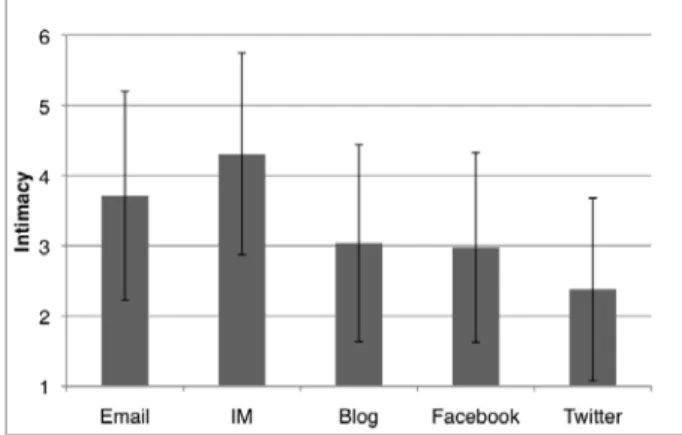
Repeated measures ANOVA found a main effect for tool intimacy (F=348.89, df=(4, 2903), p < .0001; Figure 3), responding to RQ1. With this, we find evidence to support differences in the intimacy levels that people see in different communication scenarios. Of note in this analysis is
that when conducting pair-wise comparisons using the Tukey-Kramer adjustment at an alpha level of 0.05, there was no
significant difference for the rated intimacy of Facebook and blogs, yet the difference was significant for all the other pairs.
Before testing the effect of scenarios and tools in
self-disclosure, repeated measures ANOVA was used to test the
Figure 3. Mean intimacy for tools, SD in bars. Intimacy rated on 6-point Likert scale.
effectiveness of the scenarios in covering a range of intimate information, a main effect for scenario intimacy was found
(F=2093.95, df=(3,3245), p < .0001; Figure 4). Counts on the types of people the participants communicate with via the given tools show
differences for audiences on these tools (Table 5), and answers RQ3. We then proceeded to conduct multi-level regression analysis to predict OSD across tools and scenarios. The
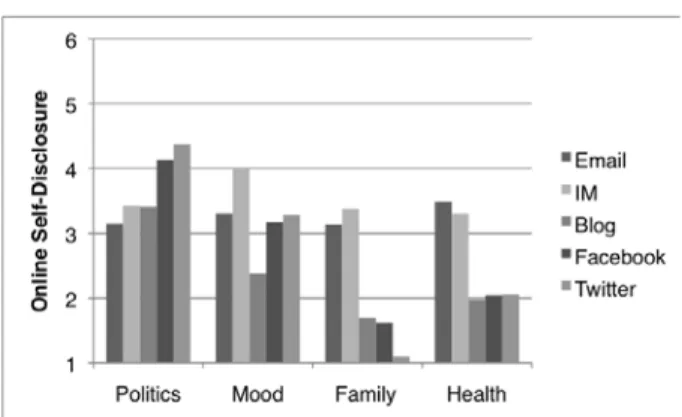
regression analysis (Table 6) revealed main effects for tool and scenario intimacy on OSD: with a positive relationship for tool intimacy (RQ2) and negative for scenario intimacy (comparisons of means for tools and scenarios can be visualized in Figures 5 and 6).
Frequency of use was a strong positive predictor of OSD, with experience in terms of years using the tool had a significant if small effect, and size of audience shows a negligible but statistically significant effect; this means that most intensive users display higher levels of self-disclosure. Self-rated expertise, however, was not related to OSD. Closeness to overall imagined audience for the tools was also related to OSD (RQ4), meaning that people share more on tools to which they associate communicating with closer people. Sex was positively related to OSD, however, education was not; women displayed higher levels of disclosure than men, and there is a slight but significant decrease in disclosure levels as age grows. All
Figure 5: Mean OSD for tools, by scenario. Disclosure measured on a 6-point Likert scale.