Time-kill Effect of Polymyxin in Combination with Meropenem against Multi-Drug Resistant Pseudomonas aeruginosa
By Kevin Tran
Honors Thesis
UNC Eshelman School of Pharmacy University of North Carolina at Chapel Hill
March 4th, 2020
Approved:
Dr. Gauri G. Rao
Abstract:
Introduction: As the susceptibility profiles of Pseudomonas aeruginosa grow increasingly
resistant to existing antimicrobial therapies, there is a critical need for effective combination
therapy. Polymyxin B based combinations may improve clinical outcomes by utilizing its rapid
killing potential in conjunction with the sustained action of meropenem. The objective of the
study is to evaluate the pharmacodynamic activity of polymyxin B in combination with
meropenem against Pseudomonas aeruginosa clinical isolates. Antibiotics used in combination
should have better pharmacodynamic killing activity against P. aeruginosa clinical isolates and
should result in suppressed regrowth patterns as compared to monotherapy.
Methods: In-vitro static time-kill experiments were performed using P. aeruginosa clinical
isolates with differing susceptibilities, polymyxin B resistant (PBr) strain PSA215 and polymyxin B
sensitive (PBs) strain PSA218 to evaluate the killing activity of polymyxin based combinations with
meropenem.
Results: Against PBr isolate, PSA215, combination therapy produced moderate improvements in
killing activity as well as slowed regrowth but was unable to achieve sustained killing over 24 h.
Against PBs isolate, PSA218, combination therapy showed moderate ability of sustained killing (3
of 8 combinations resulted in bactericidal activity) but not a significant improvement compared
to meropenem monotherapy.
Conclusion: While the results of the experiment showed the combination ineffective for the
bactericidal endpoint, potential improved killing and suppressed regrowth patterns with the
of varying susceptibilities are necessary to understand the extent of effect by this combination
Introduction:
Pseudomonas aeruginosa is an opportunistic pathogen capable of infecting a range of
tissues and ranking as one of the top six infectious disease threats.1 This major pathogen
contributes to mortality related to many respiratory diseases including cystic fibrosis (CF) and
hospital acquired pneumonia.1 Pseudomonas aeruginosa, as a Gram-negative pathogen that
commonly colonizes airways and forms biofilms that can proliferate and traverse the mucosa,
poses a great concern for CF patients, pneumonia, as well as bacteremia and infection of distant
organs.2 Resistance rates to major monotherapies are gradually increasing such as imipenem
resistance in nearly 40% of cases, fluoroquinolones in 33% of cases, and beta lactams in 26% of
cases.3 Unfortunately the pharmaceutical pipeline of antimicrobial therapies active against
multi-drug resistant Gram-negative bacteria has been limited.4 Over the last three decades, there has
been a resurgence of infectious disease as bacterial pathogens adapt and overcome the pressure
of antimicrobial therapies on their environment.5Pseudomonas aeruginosa presents a significant
challenge as it can develop resistance to multiple classes of antibacterial agents even within the
time of a course of treatment.5P. aeruginosa can develop resistance through genes imported by
utilizing horizontal gene transfer. Examples include the production of beta lactamases and
carbapenem-hydrolyzing enzymes.5 Some of these resistance mechanisms such as
carbapenemases come from genes imported from Klebsiella pneumoniae and Acinetobacter
baumanii while others are encoded within the P. aeruginosa through chromosomal mutations
such as the quinolone resistance mechanisms of gyrase and topoisomerase mutations.5
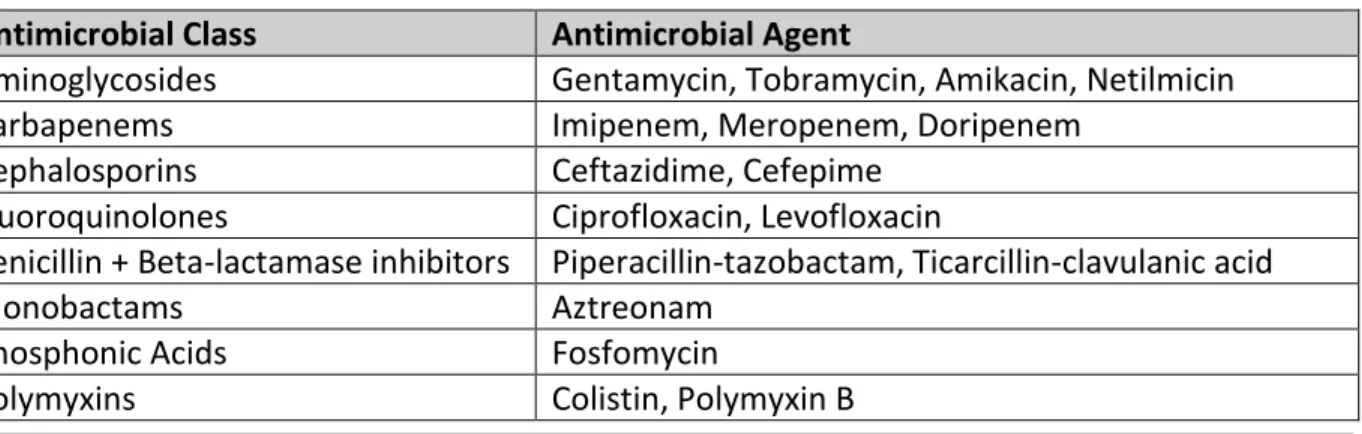
Levels of resistance are categorized as Multi-Drug Resistant (MDR), Extensively Drug
categories for Pseudomonas aeruginosa treatment. The categorizations of drug resistance are
sorted by the number of antimicrobial classes that the strain is resistant to, with MDR being
resistance to more than 1 agent from 3 classes, XDR as resistance to at least 1 agent from 6 of
the 8 classes, and PDR being resistance to all antimicrobials listed.
Antimicrobial Class Antimicrobial Agent
Aminoglycosides Gentamycin, Tobramycin, Amikacin, Netilmicin
Carbapenems Imipenem, Meropenem, Doripenem
Cephalosporins Ceftazidime, Cefepime
Fluoroquinolones Ciprofloxacin, Levofloxacin
Penicillin + Beta-lactamase inhibitors Piperacillin-tazobactam, Ticarcillin-clavulanic acid
Monobactams Aztreonam
Phosphonic Acids Fosfomycin
Polymyxins Colistin, Polymyxin B
While there is a large spectrum of bacteria that commonly cause hospital acquired
pneumonia, our lab’s focus is on ESKAPE pathogens like Klebsiella pneumoniae, Acinetobacter
baumanii, and Pseudomonas aeruginosa. Pneumonia due to Pseudomonas aeruginosa is
commonly associated with green sputum, abscess formation, and is commonly seen in patients
with cystic fibrosis or severely compromised respiratory defenses.5,7 It is an opportunistic
pathogen that commonly colonizes airways and forms biofilms that traverse the mucosa and
infect distant organs.2 As stated previously, P. aeruginosa employs many resistance mechanisms
such as the production of beta lactamases and carbapenemases. Thus, combination therapy may
prove an effective strategy by utilizing different mechanisms of action to circumvent resistance
mechanisms in bacterial colonies and enact stronger bactericidal activity for suppression of
further resistance. The severe lack of antimicrobial advancement for MDR Gram-negative
Table 1. Examples of antimicrobial agents to classify susceptibility to fit in MDR, XDR, and PDR
bacteria has caused a resurgence in the use of older antibiotics including polymyxin and
fosfomycin.4
Polymyxin is a class of antibiotics that work by binding to lipopolysaccharide in the outer
membrane of Gram-negative bacteria, damaging the hydrophobic tail and causing a
detergent-like action. This class of antibiotics displays extensive killing profiles in monotherapy, but
unfortunately presents rapid regrowth due to resistant subpopulations proliferating after
suboptimal treatment.8 Unfortunately, reaching therapeutic concentrations of polymyxin class
antimicrobial therapies presents an issue due to nephrotoxicity occurring in significant numbers
of patients.9 A strategy to work around this is a front loaded dosing regimen that utilizes the
polymyxin’s ability for extensive bactericidal activity while reducing overall cumulative drug
exposure.10 Using polymyxins as the initial agent may prove effective against the MDR P.
aeruginosa strains while relying on the other antibiotics for suppression of regrowth.
Carbapenems are consistently effective agents for treatment of serious P. aeruginosa
infections of susceptible strains.11 Carbapenems are members of the beta lactam class of
antibiotics and work by entering the cell through porins and acylate penicillin binding proteins
(PBP) that prevent the formation of the peptidoglycan layer.12 Carbapenems provide broad
spectrum coverage and are usually reserved for severe infections.12 Unfortunately, resistance
mechanisms have grown with the rise of MDR bacteria. Carbapenem resistance usually occurs
through loss of OprD, a porin protein present on the outer membrane of the Gram-negative
bacteria that regulates entry of carbapenems. Overexpression of MexAB-OprM, an intrinsic efflux
system and production of AmpC, for carbapenem-hydrolyzing beta lactamases, are other
Pharmacokinetic and pharmacodynamic studies of combination therapies in resistant
Pseudomonas aeruginosa strains are limited. Further studies should be promoted to better
characterize interaction, onset of action, and development of resistance. The aim of this project
is to combine the extensive killing profiles of polymyxin with the sustained activity of meropenem
to identify characteristics of combination effects and optimal doses for both PBr and PBs
Results:
Pseudomonas aeruginosa
isolate polymyxin B meropenem
PSA203 0.5 S 0.5 S
PSA200 1 S 0.5 S
PSA225 1 S 0.5 S
PSA218 1 S <0.5 S
PSA219 2 S 0.5 S
PSA202 8 R 16 R
PSA215 16 R 2 S
PSA205 64 R 4 I
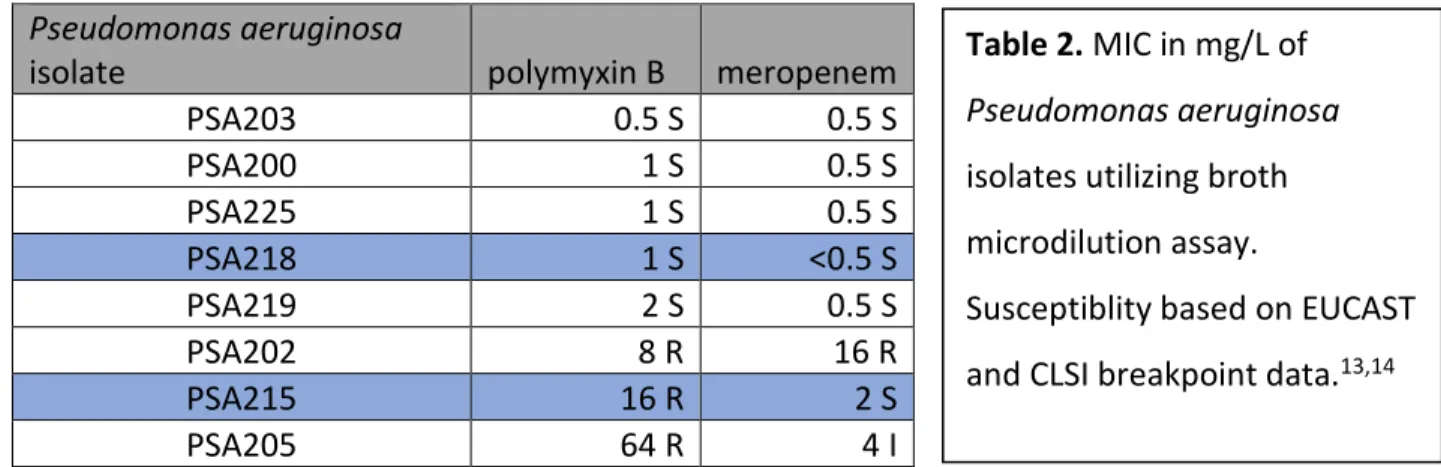
Minimum Inhibitory Concentration Testing. 8 Pseudomonas aeruginosa strains were tested with
MICs ranging from 0.5 to 64 mg/L for polymyxin B and 0.5 to 16 mg/L for meropenem (Table 2).
The two strains selected were PSA215 for its polymyxin B resistance compared to PSA218 for its
polymyxin B susceptibility, with both susceptible to meropenem. The polymyxin sensitivities of
PSA215 and PSA218 were 16 and 1 mg/L respectively. Their meropenem sensitivities were 2 and
<0.5 mg/L respectively.
Table 2. MIC in mg/L of
Pseudomonas aeruginosa
isolates utilizing broth
microdilution assay.
Susceptiblity based on EUCAST
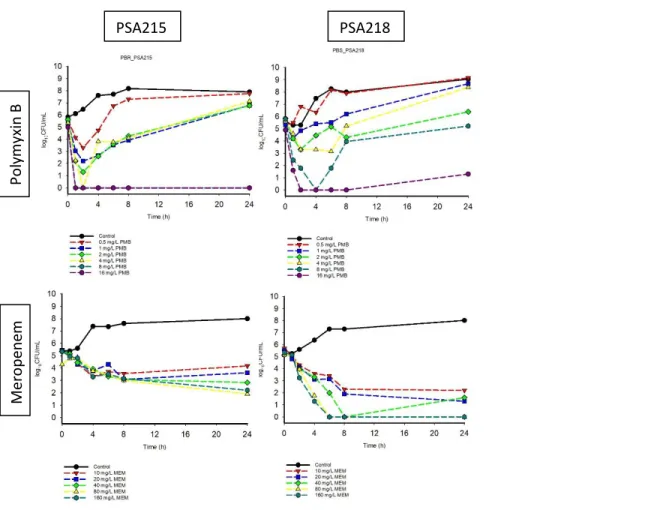
Pharmacodynamic activity. Monotherapy. Time-kill curves for polymyxin B and meropenem
monotherapies against P. aeruginosa strains PSA215 and PSA218 shown in Figure 1. The
polymyxin B resistant (PBr) strain PSA215 resulted in regrowth after initial killing for polymyxin B
concentrations of 0.5, 1, 2 and 4 mg/L but polymyxin concentrations of 8 and 16 mg/L resulted
in sustained killing. Increasing concentrations of meropenem against PSA215 produced
PSA215 PSA218
Mer
o
p
en
em
P
o
ly
m
yxin
B
Figure 1. Time-kill curves of polymyxin B (PMB) monotherapy at 0.5, 1, 2, 4, 8, 16 mg/L and
meropenem (MEM) monotherapy at 10, 20, 40, 80, 160 mg/L against an inoculum of ~106 CFU/mL
of the P. aeruginosa strains PSA215 (polymyxin B MIC, 16 mg/L; meropenem, 2 mg/L) and PSA218
concentration dependent killing. Increasing concentrations of both polymyxin b and meropenem
resulted in increased killing against PSA218 in a dose proportional manner. The extent of activity
≥3-log10 CFU/mL reduction in the inoculum was greater for meropenem monotherapy in PSA218
compared to PSA215.
PSA215 PSA218
M er o p ene m 1 0 m g/ L M e ro pe ne m 4 0 m g/ L
Figure 2. Time-kill curves of polymyxin B (PMB) at 0.5, 1, 2, 4 mg/L in combination with
meropenem (MEM) at 10 and 40 mg/L against an inoculum of ~106 CFU/mL of the P.
aeruginosa strains PSA215 (polymyxin B MIC, 16 mg/L; meropenem, 2 mg/L) and PSA218
Combination therapy. Time-kill curves for polymyxin B (0.5, 1, 2, 4 mg/L) and meropenem (10
and 40 mg/L) combination therapies against P. aeruginosa strains PSA215 and PSA218 are shown
in Figure 2. Polymyxin B in combination with meropenem against PSA215 resulted in increased
killing activity and delayed growth compared to either monotherapy. Combination therapy
against PSA218 resulted in increased killing and similar rates of regrowth compared to
meropenem monotherapy. Certain concentrations, namely 1 mg/L PMB; 10 mg/L MEM PSA215,
4 mg/L PMB; 10 mg/L MEM PSA215, 2 mg/L PMB; 40 mg/L MEM PSA215 and 4 mg/L PMB; 40
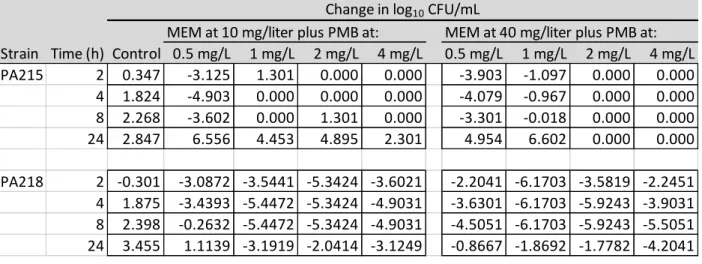
mg/L MEM PSA215 showed lack of initial CFU/mL data. The extent of killing is shown more
accurately in Table 3, where it is seen that only 3 combinations of PSA218 were able to meet the
criteria of bactericidal activity defined as ≥3-log10 CFU/mL reduction in the inoculum as
compared to PSA218 meropenem monotherapy which showed bactericidal activity at all tested
strengths.
MEM at 10 mg/liter plus PMB at: MEM at 40 mg/liter plus PMB at: Strain Time (h) Control 0.5 mg/L 1 mg/L 2 mg/L 4 mg/L 0.5 mg/L 1 mg/L 2 mg/L 4 mg/L PA215 2 0.347 -3.125 1.301 0.000 0.000 -3.903 -1.097 0.000 0.000 4 1.824 -4.903 0.000 0.000 0.000 -4.079 -0.967 0.000 0.000 8 2.268 -3.602 0.000 1.301 0.000 -3.301 -0.018 0.000 0.000 24 2.847 6.556 4.453 4.895 2.301 4.954 6.602 0.000 0.000
PA218 2 -0.301 -3.0872 -3.5441 -5.3424 -3.6021 -2.2041 -6.1703 -3.5819 -2.2451 4 1.875 -3.4393 -5.4472 -5.3424 -4.9031 -3.6301 -6.1703 -5.9243 -3.9031 8 2.398 -0.2632 -5.4472 -5.3424 -4.9031 -4.5051 -6.1703 -5.9243 -5.5051 24 3.455 1.1139 -3.1919 -2.0414 -3.1249 -0.8667 -1.8692 -1.7782 -4.2041
Change in log10 CFU/mL
Table 3. The change in log10 CFU per milliliter at 2, 4, 8, and 24 h during time-kill experiments
with combination therapy of polymyxin B and meropenem against an inoculum of ~106
Decision to not advance experimental data collection. Due to the time commitment required
to collect data for in vitro time kill assays, the decision was made that further data collection for
this study would be halted and continued at a further time by full time members of the lab
Discussion:
The threat of these MDR Gram-negative infections is increasing rapidly and suboptimal
treatment is a culprit to exacerbation of the resistance mechanisms. Current clinical regimens
are struggling to optimally treat Gram-negative infections, creating the opportunity for resistant
populations to flourish and regrow. Thus, the pharmacodynamic and pharmacokinetic data
derived from static time-kill assays are the pivotal first step to reformulating regimens for novel
dosing strategies that achieve therapeutic efficacy for infectious resolution as well as resistance
suppression.
This study compared the efficacy of the polymyxin B meropenem two-drug combinations
against a PBr strain and a PBs strain of P. aeruginosa. With the primary endpoint of bactericidal
killing defined as ≥3-log10 CFU/mL reduction in the inoculum, neither the monotherapy nor
combination therapy was able to achieve treatment success for the PBr PSA215. Despite this, the
results show the improved bactericidal activity early on in combination but were unable to
improve regrowth rates by 24 h compared to monotherapy. Overall improvement of the area
under the time-kill curve was the only visible benefit and requires additional data points for
conclusive analysis of polymyxin B meropenem combination in PBr strains. Also, 4 of the 8 tested
combinations in PSA215 showed experimentally erroneous data, namely: 1 mg/L PMB; 10 mg/L
MEM PSA215, 4 mg/L PMB; 10 mg/L MEM PSA215, 2 mg/L PMB; 40 mg/L MEM PSA215 and 4
mg/L PMB; 40 mg/L MEM PSA215.
Two drug combinations on PBs PSA218 resulted in improved killing compared to
polymyxin B monotherapy, but not compared to meropenem monotherapy. The extent of killing
regrowth at the 24 h time point was not significantly improved compared to meropenem
monotherapy. With all 4 concentrations of meropenem monotherapy reaching bactericidal
primary endpoint and only 3 of 8 combinations reaching bactericidal activity, the results cannot
conclude any combination effects in PBs and meropenem susceptible strains.
Overall this study shows that the combination of polymyxin B and meropenem has
potential in altering the bactericidal activity within the first 8 hours but does not improve the rate
of regrowth overall. This result is a limitation of the 24 h static time-kill as it does not accurately
assess dosing regimens such as extended infusion dosing intervals to translate pharmacokinetic
activity in the human body. While time-kill assay is a good indicator of pharmacodynamic activity,
future assessments of the polymyxin B and meropenem combinations should utilize
one-compartment and Hollow Fiber models to mimic clearance and various dosing regimens for
pharmacokinetic activity. A major disadvantage of the time-kill experiments is the need for
repeated sampling, which is quite labor-intensive and prone to experimental error.15 In vitro
analysis cannot assume straightforward in vivo efficacy as it does not examine toxicity and cannot
predict in vivo development of resistance, especially with host immune factors in play.16 A major
limitation of this study is that it assesses only two clinical isolates of PBr and PBs susceptibility.
Analysis of multiple PBr and PBs isolates could provide more useful trend information that is not
shown with time-kill assays of individual strains that cannot accurately represent the entirety of
MDR P. aeruginosa.
Tangden et al. evaluated the effects of colistin and meropenem against P. aeruginosa and
concluded that colistin and meropenem showed combination effects and improved early
reductions against 2, 3, and 5 of 8 strains respectively.15 These findings are in line with the results
of the current study which identifies improved pharmacodynamic profiles within the 8 h window.
Within the current literature, bactericidal activity of Pseudomonas aeruginosa increases
from 10 to 49% when combining polymyxins with carbapenems.16 Rates of colistin resistance
were also suppressed and delayed by combination with doripenem.17 Unfortunately, not all
literature agrees with these findings. While synergy with polymyxin carbapenem combinations
has been found often in Klebsiella pneumoniae and Acinetobacter baumanii, studies such as
Timurkaynak et al. show indifferent or only additive benefits to the combination.18,19 It has also
been identified that meropenem is the least synergistic carbapenem with polymyxins against
Pseudomonas aeruginosa.16
Combination therapy utilizing polymyxin-carbapenem regimens is becoming increasingly
studied and showing high rates of synergy with low antagonism and less resistance development.
Assessment of novel regimens such as front-loading antibiotics could utilize the
pharmacodynamic synergy of the combination while minimizing the exposure to polymyxin and
meropenem to lessens exposure of nephrotoxic and hepatotoxic risks.10
In conclusion, the in-vitro static time-kill assays of PSA215 and PSA218 did not show
marked improvement in 24 h sustained pharmacodynamic activity. Despite this, changes within
8 h pharmacodynamic activity showed the improved extent of killing that indicates combination
effects that may be viable for novel dosing regimens. Extended studies with models that allow
for variable dosing frequencies and drug clearance can further the understanding of these drug
combination effects and optimize regimens for practical clinical use that minimizes the adverse
To expand on the topics covered through this study, a review of literature was conducted
on Applications of Machine Learning for Clinical Decision Making in Infectious Disease to be
presented at ASHP Midyear as a poster presentation. Due to the time constraints of the pharmacy
student, this alternate project was pursued for continued scholarship within the lab group while
data continuing the analysis of P. aeruginosa time kill assays was put on hiatus for potential
Materials and Methods:
Over 30 Pseudomonas aeruginosa isolates were collected from adult cystic fibrosis
patients in Brazil. These isolates were analyzed in a separate part of the lab for hypermutators
and MICs were tested using a standard broth microdilution antimicrobial susceptibility test. The
strains focused on these experiments are non-hypermutators to provide comparison data to the
hypermutators. A range of MIC susceptibility allows for comparison in effectiveness of drug
combinations.
MIC Testing: Minimum inhibitory concentration (MIC) for these strains were determined
to understand the susceptibility of these strains to different monotherapies. MICs were
determined in triplicate using broth microdilution according to Clinical and Laboratory Standards
Institute (CLSI) guidelines.14
The selected Pseudomonas aeruginosa clinical isolates, PSA218 and PSA215, were
subjected to polymyxin B monotherapy, meropenem monotherapy, and dual combination
therapy. In-vitro static time-kill experiments were performed over 24 h to evaluate the rate and
extend of killing:
Time-Kill Preparation: Bacteria was applied to a Mueller-Hinton broth (Becton, Dickinson
and Company, Sparks, MD) to a targeted initial concentration of 107 CFU/mL. Varying
concentrations of polymyxin B (0.5, 1, 2, 4, 8, 16 mg/L) and meropenem (10, 20, 40, 80, 160 mg/L)
were prepared using sterile water and saline and was applied to each tube so that, along with a
control, a different combination of antibiotic dose was tested in each tube. The concentrations
were chosen based on free concentrations in the blood corresponding to currently existing
Time-Kill Experiment: Samples were collected at the 0, 2, 4, 6, 8, and 24-hour time points
to determine rates of killing and regrowth. The bacteria previously prepared are diluted into
warm Mueller-Hinton broth for a 1:10 dilution creating a 106 CFU/mL bacterial inoculum. At each
time point, individual samples were assessed for bacterial growth visually and diluted with
normal saline to achieve plate growth in a reasonable range for visual colony assessment.
Microbial Quantification: 50 µL samples were plated onto Mueller-Hinton II agar (MHA;
Becton, Dickinson and Company, Sparks, MD) using a Whitley Automated Spiral Plater II (Don
Whitely Scientific, West Yorkshire, UK) and incubated at 37°C for ~24 hours for assessment of
colony formation. Colony assessment, measured in log10 CFU/mL, was quantified using ProtoCOL
HR automated bacterial colony counter (Synbiosis, Frederick, MD)
Pharmacodynamics: Utilizing the data from the colony counter, data was graphed to
assess CFU/mL over time. Primary endpoint of bactericidal activity is defined as ≥3-log10 CFU/mL
reduction in the inoculum by 24h. With the results of minimal regrowth maintaining <2-log10
CFU/mL overall, therapies can be determined as successful and that data can be utilized to
References:
1. Silby MW, Winstanley C, Godfrey SAC, Levy SB, Jackson RW. Pseudomonas genomes:
Diverse and adaptable. FEMS Microbiol Rev. 2011.
doi:10.1111/j.1574-6976.2011.00269.x
2. Golovkine G, Reboud E, Huber P. Pseudomonas aeruginosa Takes a Multi-Target
Approach to Achieve Junction Breach. Front Cell Infect Microbiol. 2018;7(January):1-9.
doi:10.3389/fcimb.2017.00532
3. Morrissey I, Hackel M, Badal R, Bouchillon S, Hawser S, Biedenbach D. A review of ten
years of the Study for Monitoring Antimicrobial Resistance Trends (SMART) from 2002
to 2011. Pharmaceuticals. 2013. doi:10.3390/ph6111335
4. Bassetti M, Ginocchio F, Mikulska M. New treatment options against gram-negative
organisms. 2011.
5. Lister PD, Wolter DJ, Hanson ND. Antibacterial-resistant Pseudomonas aeruginosa:
Clinical impact and complex regulation of chromosomally encoded resistance
mechanisms. Clin Microbiol Rev. 2009;22(4):582-610. doi:10.1128/CMR.00040-09
6. Magiorakos AP, Srinivasan A, Carey RB, et al. Multiresistant, extensively
drug-resistant and pandrug-drug-resistant bacteria: An international expert proposal for interim
standard definitions for acquired resistance. Clin Microbiol Infect. 2012;18(3):268-281.
doi:10.1111/j.1469-0691.2011.03570.x
7. Tschernig T. Hospital-acquired pneumonia and community-acquired pneumonia: two
8. Ly NS, Bulitta JB, Rao GG, et al. Colistin and doripenem combinations against
Pseudomonas aeruginosa: Profiling the time course of synergistic killing and prevention
of resistance. J Antimicrob Chemother. 2014;70(5):1434-1442. doi:10.1093/jac/dku567
9. DeRyke CA, Crawford AJ, Uddin N, Wallace MR. Colistin dosing and nephrotoxicity in a
large community teaching hospital. Antimicrob Agents Chemother.
2010;54(10):4503-4505. doi:10.1128/AAC.01707-09
10.Rao GG, Ly NS, Haas CE, et al. New dosing strategies for an old antibiotic:
Pharmacodynamics of front-loaded regimens of colistin at simulated pharmacokinetics
in patients with kidney or liver disease. Antimicrob Agents Chemother.
2014;58(3):1381-1388. doi:10.1128/AAC.00327-13
11.Tsai MH, Wu TL, Su LH, et al. Carbapenem-resistant-only Pseudomonas aeruginosa
infection in patients formerly infected by carbapenem-susceptible strains. Int J
Antimicrob Agents. 2014;44(6):541-545. doi:10.1016/j.ijantimicag.2014.07.022
12.Papp-Wallace KM, Endimiani A, Taracila MA, Bonomo RA. Carbapenems: Past, present,
and future. Antimicrob Agents Chemother. 2011;55(11):4943-4960.
doi:10.1128/AAC.00296-11
13.EUCAST breakpoint tables for interpretation of MICs and zone diameters [cited 2016
June 20)]. Available from: http://www.eucast.org.
14.CLSI. 2016. Performance standards for antimicrobial susceptibility testing, 26th ed. CLSI
15.Tängdén T, Karvanen M, Friberg LE, Odenholt I, Cars O. Assessment of early combination
effects of colistin and meropenem against Pseudomonas aeruginosa and Acinetobacter
baumannii in dynamic time-kill experiments. Infect Dis (Lond). 2017;49(7):521-527.
16.Zusman O, Avni T, Leibovici L, et al. Systematic review and meta-analysis of in vitro
synergy of polymyxins and carbapenems. Antimicrobial and Agents Chemotherapy.
2013;57:5104–5111.
17.Karaiskos I, Antoniadou A, Giamarellou H. Combination therapy for extensively-drug
resistant gram-negative bacteria. Expert Rev Anti Infect Ther. 2017;15(12):1123-1140.
18.Diep JK, Jacobs DM, Sharma R, et al. Polymyxin B in Combination with Rifampin and
Meropenem against Polymyxin B-Resistant KPC-Producing Klebsiella pneumoniae.
Antimicrob Agents Chemother. 2017;61(2)
19.Timurkaynak F, Can F, Azap OK, Demirbilek M, Arslan H, Karaman SO. In vitro activities
of non-traditional antimicrobials alone or in combination against multidrug-resistant
strains of Pseudomonas aeruginosa and Acinetobacter baumannii isolated from
Report Addendum
Acknowledgements Gauri G. Rao, Rajnikant Sharma, Ahmed Osama El-Sheikh, Li Xian Ng,
Hongqiang Qiu, Kevin Straughn for their assistance and guidance in laboratory procedures,
concept discussions, data analysis, and general supervision. Bemnat Agegnehu for working
alongside me with a similar project and assisting with laboratory procedures.
Funding Support This research received no specific grant from any funding agency in the public,
commercial, or not-for-profit sectors.
Conflicts of Interest There are no transparency declarations.