Coronavirus Susceptibility to the Antiviral Remdesivir
(GS-5734) Is Mediated by the Viral Polymerase and the
Proofreading Exoribonuclease
Maria L. Agostini,
aErica L. Andres,
bAmy C. Sims,
cRachel L. Graham,
cTimothy P. Sheahan,
cXiaotao Lu,
bEverett Clinton Smith,
b,dJames Brett Case,
aJoy Y. Feng,
eRobert Jordan,
eAdrian S. Ray,
eTomas Cihlar,
eDustin Siegel,
eRichard L. Mackman,
eMichael O. Clarke,
eRalph S. Baric,
cMark R. Denison
a,baDepartment of Pathology, Microbiology, and Immunology, Vanderbilt University Medical Center, Nashville,
Tennessee, USA
bDepartment of Pediatrics, Vanderbilt University Medical Center, Nashville, Tennessee, USA
cDepartment of Epidemiology, University of North Carolina at Chapel Hill, Chapel Hill, North Carolina, USA
dDepartment of Biology, the University of the South, Sewanee, Tennessee, USA
eGilead Sciences, Inc., Foster City, California, USA
Received29 January 2018Accepted1 February 2018Published6 March 2018
CitationAgostini ML, Andres EL, Sims AC, Graham RL, Sheahan TP, Lu X, Smith EC, Case JB, Feng JY, Jordan R, Ray AS, Cihlar T, Siegel D, Mackman RL, Clarke MO, Baric RS, Denison MR. 2018. Coronavirus susceptibility to the antiviral remdesivir (GS-5734) is mediated by the viral polymerase and the proofreading
exoribonuclease. mBio 9:e00221-18.https://doi .org/10.1128/mBio.00221-18.
EditorKanta Subbarao, NIAID, NIH
Copyright© 2018 Agostini et al. This is an open-access article distributed under the terms of theCreative Commons Attribution 4.0 International license.
Address correspondence to Ralph S. Baric, [email protected], or Mark R. Denison, [email protected].
M.L.A. and E.L.A. contributed equally to this article.
This article is a direct contribution from a Fellow of the American Academy of Microbiology. Solicited external reviewers: Tom Gallagher, Loyola University Medical Center; Luis Enjuanes, Centro Nacional de Biotecnologia, CNB-CSIC. ABSTRACT
Emerging
coronaviruses
(CoVs)
cause
severe
disease
in
humans,
but
no
approved
therapeutics
are
available.
The
CoV
nsp14
exoribonuclease
(ExoN)
has
complicated
development
of
antiviral
nucleosides
due
to
its
proofreading
activity.
We
recently
reported
that
the
nucleoside
analogue
GS-5734
(remdesivir)
potently
in-hibits
human
and
zoonotic
CoVs
in
vitro
and
in
a
severe
acute
respiratory
syndrome
coronavirus
(SARS-CoV)
mouse
model.
However,
studies
with
GS-5734
have
not
re-ported
resistance
associated
with
GS-5734,
nor
do
we
understand
the
action
of
GS-5734
in
wild-type
(WT)
proofreading
CoVs.
Here,
we
show
that
GS-5734
inhibits
mu-rine
hepatitis
virus
(MHV)
with
similar
50%
effective
concentration
values
(EC
50) as
SARS-CoV
and
Middle
East
respiratory
syndrome
coronavirus
(MERS-CoV).
Passage
of
WT
MHV
in
the
presence
of
the
GS-5734
parent
nucleoside
selected
two
mutations
in
the
nsp12
polymerase
at
residues
conserved
across
all
CoVs
that
conferred
up
to
5.6-fold
re-sistance
to
GS-5734,
as
determined
by
EC
50.
The
resistant
viruses
were
unable
to
com-pete
with
WT
in
direct
coinfection
passage
in
the
absence
of
GS-5734.
Introduction
of
the
MHV
resistance
mutations
into
SARS-CoV
resulted
in
the
same
in
vitro
resistance
phenotype
and
attenuated
SARS-CoV
pathogenesis
in
a
mouse
model.
Finally,
we
dem-onstrate
that
an
MHV
mutant
lacking
ExoN
proofreading
was
significantly
more
sensitive
to
GS-5734.
Combined,
the
results
indicate
that
GS-5734
interferes
with
the
nsp12
poly-merase
even
in
the
setting
of
intact
ExoN
proofreading
activity
and
that
resistance
can
be
overcome
with
increased,
nontoxic
concentrations
of
GS-5734,
further
supporting
the
development
of
GS-5734
as
a
broad-spectrum
therapeutic
to
protect
against
contempo-rary
and
emerging
CoVs.
C
oronaviruses (CoVs) are positive-sense, single-stranded RNA viruses that infect a
wide range of animal hosts. In humans, CoVs were recognized as typically causing
and
virulence
of
MHV
and
SARS-CoV,
supporting
further
development
of
GS-5734
as
a
potential
effective
pan-CoV
antiviral.
KEYWORDS
RNA
polymerases,
SARS-CoV,
antiviral
agents,
antiviral
resistance,
coronavirus,
nucleoside
analogs,
pandemic
colds
and
pneumonia
until
the
emergence
of
severe
acute
respiratory
syndrome
coronavirus
(SARS-CoV)
in
2002
and
Middle
East
respiratory
syndrome
coronavirus
(MERS-CoV)
in
2012
from
zoonotic
sources
(1,
2).
Although
the
SARS
epidemic
was
controlled
by
public
health
measures
within
a
year
of
its
emergence,
the
virus
spread
to
over
30
countries
and
was
associated
with
a
10%
mortality
rate
(3).
Efforts
to
treat
SARS
patients
with
existing
antivirals
did
not
conclusively
provide
a
clinical
benefit
and
may
have
even
worsened
disease
(4–7).
MERS-CoV
continues
to
circulate
in
the
Middle
East,
with
a
case
fatality
rate
approaching
40%
(http://www.who.int/emergencies/mers
-cov/en/).
Currently,
there
are
no
FDA-approved
antivirals
or
vaccines
for
the
treatment
and
prevention
of
MERS-CoV
infection.
Supportive
care
and
prevention
of
complica-tions
constitute
the
current
standard
of
treatment
for
patients,
emphasizing
the
need
for
direct-acting
antivirals
(8,
9).
Furthermore,
SARS-
and
MERS-like
bat
CoVs
circulate
in
nature,
can
replicate
efficiently
in
primary
human
airway
cells,
and
use
the
same
cellular
receptors
for
entry
as
human
CoVs
(10–13).
The
imminent
threat
of
human
emergence
underscores
the
need
for
broadly
active
antivirals
to
combat
any
CoV
that
may
emerge.
Nucleoside
analogues
commonly
target
viral
replication,
particularly
the
viral
DNA
or
RNA
polymerase
(14),
and
have
succeeded
clinically
in
treating
multiple
viral
infections
(15).
However,
identification
and
development
of
antiviral
nucleosides
against
corona-viruses
have
been
hampered
by
the
presence
of
the
unique
CoV
proofreading
3
=
-5
=
exoribonuclease
(ExoN)
(16–18).
While
nucleoside
analogues
such
as
BCX4430
inhibit
CoVs
(19),
several
previously
tested
nucleoside
analogues
have
been
incapable
of
potently
inhibiting
CoV
replication,
and
others
have
demonstrated
poor
selectivity
indexes
(20,
21).
We
have
shown
that
CoV
resistance
to
the
mutagens
5-fluorouracil
(5-FU)
and
ribavirin
(RBV)
in
vitro
is
attributed
to
their
removal
by
the
proofreading
ExoN
(22),
supporting
the
hypothesis
that
an
effective
nucleoside
analogue
must
evade
proofreading
to
successfully
interfere
with
CoV
RNA
synthesis.
potent CoV inhibition by GS-5734, even in the setting of intact ExoN-mediated
proof-reading.
RESULTS
FIG 1 GS-441524 and GS-5734 inhibit MHV with minimal cytotoxicity. (A) GS-441524 is a 1=-cyano 4-aza-7,9-dideazaadenosine C-adenosine nucleoside analogue. (B) Change in viral titer of MHV compared to vehicle control after treatment with GS-441524. The data represent the results from 2 independent experiments, each with 3 replicates. Error bars represent standard error of the mean (SEM). (C) Viral titer data from panel B presented as the percentage of uninhibited control. The EC50of GS-441524 was calculated to be 1.1M. (D) Cell viability normalized to the vehicle control after treatment with GS-441524. The data represent the results from 3 independent experiments, each with 3 replicates. Error bars represent SEM. (E) GS-5734 is a monophosphoramidate prodrug of GS-441524. (F) Change in viral titer of MHV compared to vehicle control after treatment with GS-5734. The data represent the results from 4 independent experiments, each with 3 replicates. Error bars represent SEM. (G) Viral titer data from panel F presented as the percentage of uninhibited control. The EC50of GS-5734 was calculated to be 0.03M. (H) Cell viability normalized to vehicle control after treatment with GS-5734. The data represent the results from 3 independent experiments, each with 3 replicates. Error bars represent SEM.
GS-441524
and
GS-5734
inhibit
MHV
replication.
GS-441524,
a
1
=
-cyano
4-aza-7,9-dideazaadenosine
C-nucleoside
(Fig.
1A),
has
been
shown
to
inhibit
multiple
virus
families
in
vitro
(24,
26).
To
determine
if
GS-441524
inhibited
the
model

-2a
CoV,
murine
hepatitis
virus
(MHV),
we
infected
delayed
brain
tumor
(DBT)
cells
with
MHV
and
treated
them
with
increasing
concentrations
of
drug.
We
observed
a
dose-dependent
reduction
in
viral
titer
with
up
to
a
6-log
10decrease
at
11.1
M
GS-441524
(Fig.
1B).
The
half-maximum
effective
concentration
(EC
50)
value
resulting
from
GS-441524
treatment
was
1.1
M (Fig.
1C).
We
observed
minimal
detectable
cytotoxicity
within
the
tested
range,
with
the
concentration
resulting
in
50%
cytotoxicity
(CC
50)
⬎
300
M (Fig.
1D).
This
resulted
in
a
selectivity
index
(CC
50/EC
50) of
⬎
250.
Having
demonstrated
the
inhibition
of
MHV
by
GS-441524,
we
next
tested
its
monophosphoramidate
prodrug
GS-5734
(Fig.
1E).
Treatment
with
increasing
concentrations
of
GS-5734
resulted
in
up
to
a
6-log
10decrease
in
viral
titer,
and
virus
was
undetectable
by
plaque
assay
at
concentrations
above
0.5
M
GS-5734
(Fig.
1F).
GS-5734
inhibited
MHV
more
potently
than
GS-441524,
with
a
GS-5734
EC
50of
0.03
M (Fig.
1G),
consistent
with
higher
cellular
permeability
and
more
efficient
metabolism
of
the
prodrug
into
the
active
nucleoside
triphosphate
by
bypassing
the
rate-limiting
first
phosphorylation
step
(27,
28).
We
also
observed
minimal
cytotoxicity
at
concentrations
required
for
antiviral
activity
of
GS-5734,
in
line
with
previously
reported
extensive
cytotoxicity
studies
in
relevant
human
cell
types
(27),
with
a
CC
50value
of
39
M (Fig.
1H),
resulting
in
a
selectivity
index
of
⬎
1,000.
These
results
expand
the
breadth
of
GS-441524
and
GS-5734
inhibition
of
CoVs
to
include
the

-2a
model
CoV
MHV.
GS-441524
and
GS-5734
potently
inhibit
SARS-CoV
and
MERS-CoV
in
HAE
cells.
physi-ology of the epithelium in the human conducting airway (29). Previous results have
demonstrated that GS-5734 inhibits the viral titer of multiple CoVs in this model, but
did not assess the potency or the effect of delaying treatment with the compound.
Thus, we determined the EC
50values after treatment with GS-441524 and GS-5734 in
SARS-CoV- and MERS-CoV-infected HAE cultures. Mean EC
50values for both viruses
were approximately 0.86
M for GS-441524 and 0.074
M for GS-5734 (Fig. 2A). Further,
delaying addition of GS-5734 until 24 hours (h) postinfection resulted in decreased viral
titer in HAE cultures for both SARS-CoV (Fig. 2B) and MERS-CoV (Fig. 2C) at 48 and 72 h
postinfection. No measurable cellular toxicity was observed in HAE cultures for either
compound (Table 1). These results demonstrate a similar high potency of GS-5734
across divergent CoVs, supporting the utility of the model MHV system to study GS-5734
inhibition and resistance.
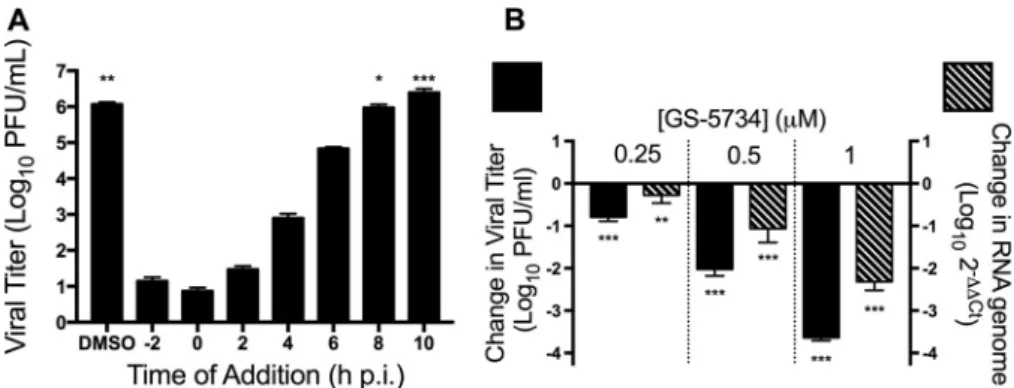
GS-5734 acts at early times postinfection to decrease viral RNA levels.
The
predicted mechanism of action of GS-5734 is through incorporation of the active
triphosphate into viral RNA (27). We therefore tested the hypothesis that GS-5734
would inhibit CoVs at early steps in replication by inhibiting viral RNA synthesis. To
determine which stage in the viral replication cycle GS-5734 inhibited CoVs, we infected
cells with MHV at a multiplicity of infection (MOI) of 1 PFU/cell, which with MHV results
in a single-cycle infection, and treated them with 2
M GS-5734 at 2-h intervals from
2 h preinfection to 10 h postinfection. We observed maximal inhibition when GS-5734
was added between 2 h preinfection and 2 h postinfection. Less inhibition was
detected when GS-5734 was added between 4 and 6 h postinfection, and no inhibition
was observed when GS-5734 was added after 8 h postinfection (Fig. 3A). These results
demonstrate that GS-5734 inhibits CoVs at early steps during infection. Because viral
RNA is synthesized early in infection and GS-5734 is implicated in inhibiting viral RNA
synthesis (25, 30, 31), we next determined the cellular level of viral RNA by real-time
quantitative PCR (qPCR) after treatment with GS-5734. Treatment with increasing
FIG 2 Antiviral activity of GS-441524 and GS-5734 and modeled therapeutic efficacy of GS-5734 against SARS-CoV and MERS-CoV in HAE cultures. (A) Mean EC50values of SARS-CoV and MERS-CoV-infected HAE cultures from three different patient isolates treated with GS-441524 or GS-5734. (B) Viral titers of SARS-CoV-infected HAE cultures when treated with various doses of GS-5734 24 h postinfection. (C) Viral titers of MERS-CoV-infected HAE cultures when treated with various doses of GS-5734 24 h postinfection.
TABLE 1 EC50and CC50values of GS-441524 or GS-5734 in MERS-CoV- or SARS-CoV-infected HAE culturesa
Virus
GS-441524 GS-5734
EC50(M) CC50(M) EC50(M) CC50(M)
MERS 0.86⫾0.78 ⬎100 0.074⫾0.023 ⬎10
SARS 0.18⫾0.14 ⬎100 0.069⫾0.036 ⬎10
concentrations of GS-5734 resulted in decreased viral RNA levels that correlated with
the decrease in titer we observed (Fig. 3B). These results suggest that GS-5734 inhibits
CoVs early after infection by interfering with viral RNA replication.
Viruses lacking ExoN-mediated proofreading are more sensitive to treatment
with GS-5734.
We have shown that the profound resistance of CoVs to the nucleoside
and base analogues RBV and 5-FU is due to the proofreading ExoN in nsp14, as
engineered ExoN(
⫺
) mutant MHV and SARS-CoV are profoundly more sensitive to
these compounds (22). We therefore compared the sensitivity of WT and ExoN(
⫺
) MHV
to GS-5734. ExoN(
⫺
) MHV demonstrated up to a 100-fold greater reduction in viral titer
at 0.25
M GS-5734 compared to WT virus (Fig. 4A), and the calculated EC
50for ExoN(
⫺
)
virus in this experiment was 0.019
M, a 4.5-fold decrease compared to the WT EC
50of
0.087
M (Fig. 4B). This increased sensitivity of ExoN(
⫺
) virus to GS-5734 is similar to
that of other nucleoside analogues and suggests that GS-5734 is incorporated into viral
RNA and can be removed by ExoN. However, the results also suggest there is a
fundamentally different relationship of GS-5734 with the CoV replicase and/or template
RNA compared with other nucleosides such as ribavirin or 5-fluorouracil, since GS-5734
potently inhibits CoVs with intact proofreading (22).
FIG 3 GS-5734 acts at early times postinfection to decrease viral RNA levels. (A) MHV viral titer after single-cycle infection and treatment with 2M GS-5734 at the indicated times postinfection. The data represent the results from 2 independent experiments, each with 3 replicates. Error bars represent SEM. Statistical significance compared to addition of GS-5734 at 0 h postinfection (p.i.) was determined by one-way analysis of variance (ANOVA) with Dunnett’spost hoctest for multiple comparisons and is denoted by asterisks:*,P⬍0.05;**,P⬍0.01;***,P⬍0.001. (B) Change in viral titer (black bars) and viral RNA levels (hatched bars) normalized to vehicle control 10 h postinfection after treatment with GS-5734. The data represent the results from 2 independent experiments, each with 3 replicates. Error bars represent SEM. Statistical significance compared to DMSO-treated samples was determined by one-way ANOVA with Dunnett’spost hoctest for multiple comparisons and is denoted by asterisks:**,P⬍0.01;***,P⬍0.001.
FIG 5 Two mutations in the predicted fingers domain of the nsp12 RdRp, F476L and V553L, arose after 23 passages in the presence of GS-441524, and these residues are completely conserved across CoVs. (A) Schematic of the MHV genome displaying proteins with mutations identified after passage with GS-441524. The nsp12 RdRp is shown in yellow, nsp13-helicase in purple, ns2 in green, and spike in blue. (B) Linear schematic of nsp12 showing the locations of F476L and V553L within the predicted fingers of the RdRp core domain. (C) The previously described (32) Phyre2 model of the MHV RdRp core domain was used to map the predicted locations of the F476L and V553L residues, shown here in orange. The SDD active site residues are shown in yellow, the palm in red, the fingers in blue, and the thumb in green. (D) Amino acid conservation of F476 and V553 residues across CoVs demonstrating that both of these residues are completely conserved.
Two
mutations
in
the
RdRp
mediate
partial
resistance
and
restoration
of
RNA
showed 2.4-fold resistance to GS-5734, and V553L virus demonstrated 5-fold resistance
to GS-5734, while combined mutations mediated 5.6-fold resistance to GS-5734 based
on EC
50values (Table 2). Because GS-5734 decreases viral RNA levels, we next tested if
resistance mutations restored RNA synthesis. We observed that RdRp resistance
muta-tions partially restored RNA levels in the presence of GS-5734 and that the degree of
FIG 6 The F476L and V553L mutations mediate resistance to GS-5734 and are associated with a fitness defect. (A) Change in viral titer of WT, F476L, V553L, F476L⫹V553L, and p23 viruses normalized to the vehicle control after treatment with GS-5734. The data represent 2 independent experiments, each with 3 replicates. Error bars represent SEM. Statistical significance compared to WT was determined by Kolmogorov-Smirnov test and is denoted by asterisks:*,P⬍0.05. (B) The change in genomic RNA levels of WT, F476L, V553L, and F476L⫹V553L MHV normalized to vehicle control after treatment with GS-5734. The data represent the results from 2 independent experiments, each with 3 replicates. Error bars represent SEM. Statistical significance compared to WT at each concentration was determined by one-way ANOVA with Dunnett’spost hoctest for multiple comparisons and is denoted by asterisks:*,P⬍0.05;**,P⬍0.01. (C) Multi-cycle replication kinetics of WT, F476L, V553L, or F476L⫹V553L MHV. The data represent the results from 2 independent experiments, each with 3 replicates. Error bars represent SEM. (D) Coinfection competition assay of WT and F476L V553L MHV at the indicated ratios. The percentage of the population of each mutation was assessed after four successive passages. The data are representative of 2 independent experiments each with 2 replicates. Error bars represent standard deviation (SD).
TABLE 2 F476L and V553L mutations confer up to 5.6-fold resistance to GS-5734 in MHVa
Virus EC50(M) Fold resistance
WT 0.024⫾0.011 1
F476L 0.057⫾0.040 2.4
V553L 0.12⫾0.06 5.0
F476L⫹V553L 0.13⫾0.06 5.6
aMeanEC
50values ⫾SDandfoldresistanceofGS-5734-resistantviruseswerecalculatedusingviraltiter
datafollowinginfectionofDBTcellswiththeindicatedvirusatanMOIof0.01PFU/cellandtreatmentwith increasingconcentrationsofGS-5734.FoldresistancewascalculatedasEC50ofmutant/EC50ofWT.The
restoration
of
RNA
levels
correlated
with
their
fold
resistance
to
GS-5734
(Fig.
6B).
Together,
these
results
are
consistent
with
a
mechanism
of
action
of
GS-5734
primarily
targeting
RdRp-mediated
RNA
synthesis.
GS-5734
resistance
mutations
impair
competitive
fitness
of
MHV.
To
assess
the
effect
of
GS-5734
resistance
on
viral
fitness,
we
first
determined
the
replication
capacity
of
recombinant
MHV
carrying
the
F476L,
V553L,
and
F476L
⫹
V553L
mutations.
Each
of
these
viruses
replicated
similarly
to
WT
MHV,
both
in
replication
kinetics
and
in
observed
peak
titer
(Fig.
6C).
We
next
tested
the
competitive
fitness
of
F476L
⫹
V553L
MHV
compared
to
WT
MHV
during
coinfection
over
multiple
passages.
Murine
DBT
cells
were
coinfected
with
WT
MHV
and
F476L
⫹
V553L
MHV
at
WT/mutant
ratios
of
1:1,
1:9,
or
9:1
in
the
absence
of
GS-5734,
and
infected
culture
supernatants
were
serially
passaged
3
times
to
fresh
cell
monolayers.
By
passage
2,
F476L
⫹
V553L
MHV
was
outcompeted
by
WT
MHV
in
the
population
at
every
input
ratio
(Fig.
6D),
demonstrat-ing
a
competitive
fitness
cost
of
the
F476L
⫹
V553L
mutations
in
the
absence
of
GS-5734.
This
competitive
fitness
cost
further
suggests
that
GS-5734
resistance
muta-tions
will
not
persist
in
the
absence
of
treatment.
Mutations
identified
in
GS-5734-resistant
MHV
also
confer
resistance
in
SARS-CoV.
Given
the
complete
conservation
of
the
F476
and
V553
residues
across
CoVs,
we
next
tested
whether
substitutions
at
the
homologous
SARS-CoV
residues
(F480L
and
V557L)
could
confer
resistance
to
GS-5734.
We
recovered
SARS-CoV
carrying
the
homologous
F480L
and
V557L
substitutions
and
tested
recovered
mutant
viruses
for
resistance
to
GS-5734
in
Calu-3
2B4
cells.
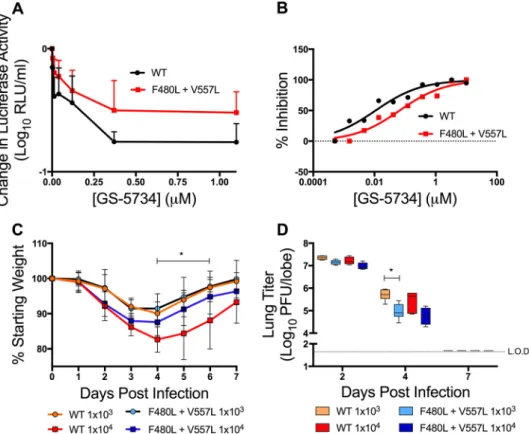
WT
SARS-CoV
demonstrated
dose-dependent
inhibition
by
GS-5734,
with
an
EC
50of
0.01
M (Fig.
7A).
The
F480L
⫹
V557L
recom-binant
virus
was
inhibited
by
GS-5734,
with
an
EC
50value
of
0.06
M,
representing
a
6-fold
resistance
to
GS-5734
(Fig.
7B),
nearly
identical
to
the
fold
resistance
of
F476L
⫹
V553L
MHV.
These
results
support
the
conclusion
that
the
conserved
residues
across
divergent
CoVs
reflect
conserved
functions
impaired
by
GS-5734,
potentially
implying
common
pathways
to
resistance
across
CoVs.
GS-5734-resistant
SARS-CoV
is
attenuated
in
vivo.
To
gain
insight
into
the
patho-genic
potential
of
GS-5734-resistant
viruses,
we
directly
compared
WT
SARS-CoV
and
F480L
V557L
SARS-CoV
following
non-lethal
high-dose
(10
4PFU)
and
low-dose
(10
3PFU)
inoculation
in
a
well-characterized
mouse
model
of
SARS-CoV
pathogenesis
with
disease
reminiscent
of
that
observed
in
humans
(38).
Mice
infected
with
a
high
dose
of
F480L
V557L
SARS-CoV
lost
significantly
less
weight
(
P
⬍
0.05)
than
WT
SARS-CoV-infected
mice
(Fig.
7C).
At
2
days
postinfection,
mouse
lung
viral
titers
were
similar
between
WT
and
F480L
⫹
V557L
SARS-CoV,
but
by
4
days
postinfection,
lung
viral
titers
were
significantly
reduced
(
P
⬍
0.05)
in
mice
infected
with
F480L
⫹
V557L
SARS-CoV
(Fig.
7D).
Together,
these
data
demonstrate
that
GS-5734-resistant
SARS-CoV
is
attenuated
in
its
ability
to
cause
disease
and
replicates
less
efficiently
than
WT
virus
in
robust
mouse
models
of
human
SARS-CoV
disease.
DISCUSSION
FIG 7 MHV resistance mutations confer resistance and are attenuated in SARS-CoV. (A) Change in luciferase activity normalized to vehicle control of WT or F480L⫹V557L SARS-CoV containing the NanoLUC reporter. The data are representative of the results from 2 independent experiments, each with 3 replicates. Error bars represent SEM. (B) Viral titer data from panel A presented as the percentage of vehicle control. This EC50value was calculated as 0.01M for WT and 0.06M for F480L⫹V557L virus, which represents a 6-fold increase in resistance. (C) Percent starting weight of BALB/c mice inoculated with WT or F480L⫹V557L SARS-CoV containing the NanoLUC reporter at 103or 104PFU. The data are representative of the results from 2 independent experiments, each with 10 to 12 animals per group. Error bars represent SEM. Statistical significance was determined by 2-way ANOVA and is denoted by asterisks:*,P⬍0.05. (D) Lung titers from animals in panel C 2, 4, and 7 days postinfection. The data are representative of the results from 2 independent experiments, each with 3 animals per group. Error bars represent SEM. Statistical significance was determined by Wilcoxon test and is denoted by asterisks:*,P⬍0.05.
of
the
homologous
substitutions
in
SARS-CoV
reproduced
the
fold
resistance
to
GS-5734
observed
in
MHV,
demonstrating
the
potential
for
common,
family-wide
drug
resistance
pathways
in
the
RdRp.
Potential
GS-5734
mechanism
of
action.
Nucleoside
analogues
can
have
multiple
Nucleoside
analogues
have
been
approved
to
treat
a
variety
of
RNA
and
DNA
viruses,
but
CoVs
have
been
refractory
to
inhibition
by
some
nucleoside
analogues
(22).
This
resistance
to
potent
inhibition
by
RBV
and
5-FU
has
been
attributed
to
the
CoV
nsp14
proofreading
exoribonuclease.
We
have
previously
reported
that
MHV
and
SARS-CoV
strains
lacking
the
proofreading
activity
of
ExoN
[ExoN(
⫺
)]
were
more
sensitive
to
5-FU
and
RBV,
underscoring
the
role
of
ExoN-mediated
proofreading
in
resistance
to
inhibition
by
these
compounds
(22).
These
results
suggest
that
to
effec-tively
inhibit
CoVs,
nucleoside
analogues
would
need
to
inhibit
ExoN
directly,
be
incorporated
so
efficiently
that
the
5
=
-3
=
elongation
reaction
is
much
faster
than
the
ExoN
cleavage
reaction,
or
not
be
recognized
for
ExoN-mediated
removal.
The
latter
mechanism
has
been
proposed
for
sensitivity
of
herpes
simplex
virus
(HSV)
to
acyclovir;
specifically,
that
the
HSV
exonuclease
is
unable
to
remove
acyclovir
(45).
Here,
we
show
that
ExoN(
⫺
)
MHV
is
more
sensitive
than
WT
MHV
to
GS-5734
treatment.
This
result
suggests
that
GS-5734
is
recognized,
at
least
partially,
by
a
functional
ExoN,
but
that
the
ExoN
activity
is
not
sufficient
to
prevent
potent
inhibition
of
CoV
replication.
One
possible
explanation
is
that
GS-5734
may
be
recognized
and
removed
by
ExoN
less
efficiently
than
these
mutagens
or
other
incorrect
nucleotides,
though
further
studies
are
needed
to
fully
understand
the
role
of
ExoN
in
GS-5734
inhibition
of
CoVs.
Overall,
the
enhanced
activity
of
the
monophosphate
prodrug,
the
increased
sensitivity
of
ExoN(
⫺
)
viruses
to
GS-5734
inhibition,
selected
resistance
mutations
in
the
modeled
RdRp
finger
domain,
the
time-dependent
viral
inhibition
profile,
and
decreased
viral
RNA
levels
support
the
hypothesis
that
GS-5734
directly
inhibits
viral
RNA
synthesis.
Mechanism
of
resistance
to
GS-5734.
Previous
studies
have
assessed
inhibition
by
GS-5734
in
multiple
viruses,
but
none
have
reported
resistance
mutations
during
treatment.
In
this
study,
passage
of
MHV
in
the
presence
of
GS-441524
resulted
in
selection
of
5.6-fold
resistance.
Sequencing
identified
consensus
nonsynonymous
F476L
and
V553L
mutations
in
the
nsp12
core
polymerase-coding
region.
A
similar
level
of
resistance
was
observed
for
the
homologous
F480L
and
V557L
substitutions
in
SARS-CoV.
As
these
mutations
are
not
in
the
immediate
vicinity
of
the
RdRp
active
site,
the
mechanism
of
resistance
to
GS-5734
remains
to
be
determined.
Both
of
these
residues
are
conserved
across
CoVs,
suggesting
that
they
mediate
conserved
functions.
Sequence
alignment
and
molecular
modeling
of
the
CoV
RdRp
predicts
that
V553L
lies
within
motif
F
of
the
fingers
domain,
which
forms
a
channel
for
incoming
NTPs
and
contacts
the
5
=
end
of
the
template,
while
F476L
is
not
within
any
defined
structural
motif
but
also
resides
in
the
fingers
domain
(33,
46).
Resistance
mutations
to
nucleoside
analogues,
including
those
that
lie
in
the
fingers
domain,
have
been
implicated
in
altering
replication
fidelity
as
a
mechanism
of
resistance
in
picornaviruses
and
HIV
(34,
47,
48).
In
a
previous
study,
using
homology
modeling
of
the
CoV
RdRp
based
on
the
coxsackievirus
B3
RdRp
structure,
we
predicted
and
confirmed
that
a
V553I
substitution
in
the
MHV
RdRp
increases
CoV
fidelity
in
ExoN(
⫺
)
viruses
(32),
suggesting
that
viral
replication
fidelity
modulation
may
also
impact
susceptibility
to
GS-5734.
This
is
supported
by
the
result
that
GS-5734,
while
highly
active
in
WT
virus,
is
even
more
potent
in
the
absence
of
nsp14
ExoN
proofreading
activity.
However,
the
CoV
replicase
encodes
many
proteins,
and
these
mutations
may
alter
protein-protein
interactions
among
these
components.
The
availability
of
an
in
vitro
biochemical
system
demon-strating
both
polymerase
and
exoribonuclease
activities
suggests
it
may
be
possible
to
define
specific
effects
of
GS-5734
resistance
mutations
on
polymerase
and
RNA
proof-reading
activities
(49,
50).
Thus,
it
will
be
interesting
to
determine
if
F476L
and
V553L
confer
class-level
resistance
to
nucleotide
analogues,
general
increased
fidelity,
changes
in
specific
nucleotide
selectivity,
alterations
in
replicase-protein
interactions,
or
other
novel
mechanisms.
Additionally,
we
also
identified
additional
non-RdRp
mutations
in
the
consensus
se-quence
of
passage
23
virus,
including
another
component
of
the
MHV
replicase,
the
nsp13
helicase.
It
will
be
important
to
determine
if
other
proteins
contribute
to
resistance,
as
well
as
using
GS-5734
as
a
probe
to
define
protein
interactions
and
functions
within
the
viral
replicase.
GS-5734
resistance
is
associated
with
a
fitness
cost
in
vitro
and
attenuation
in
vivo.
Identification
of
resistance
mutations
to
antiviral
compound
candidates
in
vitro
provides
an
opportunity
to
assess
the
concern
that
resistance
may
promote
viral
fitness,
leading
to
enhanced
transmission
or
greater
disease
severity.
The
resistance
of
MHV
to
GS-5734
was
very
slow
to
emerge
and
only
partial,
suggesting
a
high
genetic
barrier
to
resistance,
similar
to
that
seen
for
HCV
resistance
to
the
nucleotide
antiviral
sofosbuvir
(51).
Moreover,
although
recombinant
MHV
containing
both
F476L
and
V553L
repli-cated
similarly
to
WT
in
parallel
cultures,
resistant
virus
failed
to
compete
with
WT
MHV
during
coinfection
over
multiple
passages,
demonstrating
a
fitness
cost
associated
with
the
resistance
mutations
that
may
limit
emergence
during
treatment.
The
fitness
impairment
was
further
evidenced
in
vivo
by
attenuation
of
F480L
⫹
V557L
virus
in
a
SARS-CoV
mouse
model,
similar
to
that
reported
for
other
viruses
with
selected
resistance
to
nucleotide
analogues,
including
HIV
and
chikungunya
virus
(36,
52,
53).
This
fitness
impairment
may
be
due
to
alterations
in
RNA
replication,
fidelity,
nucleotide
incorporation,
or
protein
stability
but
suggests
that
GS-5734
resistance
will
not
lead
to
more
transmissible
or
pathogenic
virus.
In
summary,
our
work
provides
evidence
that
GS-5734
is
highly
active
against
CoVs
and
that
there
is
a
high
genetic
barrier
to
achieve
resistance.
Additionally,
resistant
virus
suffers
a
loss
of
competitive
fitness
in
vitro
and
attenuation
in
animals,
suggesting
these
mutations
will
not
favor
disease
emergence
and
are
likely
to
be
poorly
maintained
in
nature,
particularly
during
acute
infections.
Finally,
the
results
identify
potential
novel
determinants
of
polymerase
function
and
nucleotide
selectivity
or
fidelity
that
will
guide
future
structure-function
and
biochemical
studies
of
the
polymerase
and
GS-5734
mechanism.
Together,
these
results
argue
strongly
for
the
continued
clinical
development
of
GS-5734
to
treat
MERS-CoV
and
demonstrate
its
potential
utility
in
the
broad-spectrum
treatment
of
CoV
infections.
MATERIALS
AND
METHODS
Cellculture. Murineastrocytomadelayedbraintumor(DBT)cellsandbabyhamsterkidney21cells expressingtheMHVreceptor(BHK-R)(54)weremaintainedat37°CinDulbecco’smodifiedEaglemedium (DMEM;Gibco)containing10%fetalbovineserum(FBS;Invitrogen),penicillinandstreptomycin(Gibco), HEPES(Gibco),andamphotericinB(Corning).BHK-Rcellswerefurthersupplementedwith0.8mg/mlof G418(Mediatech).ThehumanlungepithelialcelllineCalu-3(clone2B4)waskindlydonatedbyC.T. Tseng(UniversityofTexasMedicalBranch)(55)andmaintainedinDMEM(Gibco),20%fetalbovineserum (HyClone),and1⫻Gibcoantibiotic-antimycoticsolution.Humantracheobronchialepithelialcellswere obtainedfromairwayspecimensresectedfrompatientsundergoingsurgeryunderUniversityofNorth CarolinaInstitutionalReviewBoard-approvedprotocolsbytheCysticFibrosisCenterTissueCultureCore (UNCTissueCore).Primarycellswereexpandedtogeneratepassage1cells,andpassage2cellswere platedatadensityof250,000cellsperwellonTranswell-COL(12-mm-diameter)supports.Humanairway epitheliumculturesweregeneratedbyprovisionofanair-liquidinterface(ALI)for6to8weekstoform well-differentiated,polarizedculturesthatresembledin vivo pseudostratifiedmucociliaryepithelium(29, 56,57).
Viruses.AllworkwithMHVwasperformedusingtherecombinantWTstrainMHV-A59(GenBank accessionno.AY910861) (54).SARS-CoVexpressinggreenfluorescentprotein(SARS-GFP)andMERS-CoV expressingredfluorescentprotein(MERS-RFP)werecreatedfrommolecularcDNAclonesaccordingto protocolsdescribedpreviously(29,57).
Compoundsandcellviabilitystudies. GS-441524andGS-5734weresynthesizedatGileadSciences, Inc.,andpreparedas50and20mMstocksolutionsindimethylsulfoxide(DMSO),respectively.Cell viabilitywasassessedusingCellTiter-Glo(Promega)in96-wellplatesaccordingtothemanufacturer’s instructions.DBTcellswereincubatedwithindicatedconcentrationofcompoundat37°Cfor24h.Cell viabilitywasdeterminedusingaVeritasmicroplateluminometer(Promega)withvaluesnormalizedto thoseofuntreatedcells.
resistancecapacityoftheF480L⫹V557LSARS-CoV,Calu-32B4cellswereseededin96-wellplatesata densityof5⫻105cells/well48hpriortoinfection.Themediumwasreplacedwithfreshmedium24h priortoinfectiontoencourageoptimalcellgrowth.CellsweretheninfectedwithSARS-CoVF480L⫹ V557L-NanoLuc orSARS-CoV-WT-NanoLucat anMOI of ~5 PFU/cellinthepresenceorabsenceof GS-5734at1:3dilutions,withDMSO(diluent)asanuntreatedcontrolandUV-inactivatedvirusasa nanoluciferasereporter(NanoLuc)backgroundcontrol.Cellswerelysedafterincubationat37°Cfor72h usinga PromegaNanoGlo assaykitandassayed ona luminescenceplatereader (SpectraMax M3; MolecularDevices).EC50valuesandcurvesweregeneratedwiththenonlinearregressioncurvefitin GraphPadPrismsoftware(LaJolla,CA).
Invitroefficacyinhumanairwayepithelialcells.FullymatureHAEcultureswereobtainedfrom theUNCTissueCore.At48hpriortoinfectiontheapicalsurfaceoftheculturewaswashedwith500 l 1⫻phosphate-bufferedsaline(PBS)for1.5hat37°C,andtheculturesweremovedintowellscontaining freshair-liquidinterface(ALI)medium(56).Immediatelypriortoinfection,500 lofPBSwasaddedto theapicalsurfaceoftheHAEculturesfor30minat37°C,thefirstwashwasremoved,andasecondwash was addedpriorto movingtheHAEculturesintoALI mediumcontainingGS-5734concentrations rangingfrom0.0016to10M,asindicatedforeachexperiment.Thesecondwashwasremoved,and 200 lofviralinoculum(MOIof0.5PFU/cellforMERS-RFPandSARS-GFP)wasaddedtotheapicalsurface oftheculturesfor 3 h at 37°C.Theviralinoculumwasthenremoved,andtheapicalsurfaceofthe cultureswaswashedthreetimeswith500 l 1⫻PBS,thefinalwashwasremoved,andthecultureswere incubatedat37°Cforatotalof48hpostinfection.Forallcultures,apicalwasheswereperformed(100 l 1⫻ PBS)to assessviral replication titers,and then totalRNA was collectedin 500lTRIzol (Life Technologies/ThermoFisher)andfrozenat⫺80°Cpriortoextractionforreal-timePCRanalysis.Thedata thatareshownarerepresentativeofduplicatesamplesetsperformedwithaminimumofthreedifferent patientisolates.ForthetherapeuticHAEexperiments,cultureswerewashedasdescribedabove,and HAEcellsremainedindrug-freeALImediumforthefirstdayofinfection.At24hpostinfection,cultures weremovedtoALImediumcontainingGS-5734concentrationsrangingfrom1to10Masindicated. Cultureswereharvestedat48hpost-drugtreatment,whichwas72hpostinfection.
Time-of-additionassay.SubconfluentmonolayersofDBTcellswereinfectedwithWTMHVatan MOIof1PFU/cellfor 1 h at 37°C.Thevirusinoculumwasremoved,andfreshmediumcontainingDMSO or2MGS-5734 wasaddedat theindicatedtimepostinfection.Supernatant washarvested12h postinfection,andtheviraltiterwasdeterminedbyplaqueassay.
Real-timeqPCRofviralgenomicRNA.SubconfluentDBTcellswereinfectedwiththeindicated virusatanMOIof1PFU/cell(Fig.3B)or0.01PFU/cell(Fig.6B).Theinoculumwasremovedafter 1 h of incubation at 37°C, and medium containingthe indicated concentrations of GS-5734 was added. Supernatantwascollected,andtotalRNAwasharvestedusingtheTRIzolreagent(Invitrogen)after10or 20h,respectively.Theviraltiterwasdeterminedbyplaqueassay,andRNAwasreversetranscribedusing SuperScriptIII(Invitrogen)togeneratecDNAthatwasquantifiedbyquantitativePCR(qPCR)as previ-ouslydescribed(22).
Selection of GS-5734resistancemutations. WTMHVwas passagedin triplicatein increasing concentrationsofGS-441524,rangingfrom1to12 M.Infectionwasinitiatedforpassage1atanMOI of 0.1PFU/cell.Supernatantwasharvestedandfrozenwhenthecellmonolayerdemonstrated80% cytopathiceffect(CPE) orafter24h.Aconstantvolume of16lwasusedtoinitiatesubsequent passages.Alllineagesweremaintaineduntilpassage17(p17).Lineages2and3werelostafterp17and p20, respectively,when virus CPEdid not reach above 50% uponmultiple efforts and at various concentrationsofGS-441524.Lineage1demonstratedanincreaseinvisibleCPE,andthuslineage1was carriedtopassage23.Aftereachpassage,totalRNAwasharvestedfrominfectedcellmonolayersusing theTRIzolreagenttobeusedforviralpopulationsequencing.Afterpassage23,RNAwasextractedand reversetranscribed usingSuperScriptIII,followed bygenerationof ampliconsforallthreelineages coveringnsp12andnsp14atpassage16and12PCRampliconstocoverthewholegenomeafter23 passagesoflineage1.DideoxyampliconsequencingwasperformedbyGenHunter(Nashville,TN)and analyzedtoidentifymutationsusingMacVector.
ModelingandconservationofresistancemutationsintheCoVMHVnsp12RdRp. TheF476and V553 residues were located on the previouslydescribed MHVRdRp model (32) using thePymol MolecularGraphicsSystem(Schrödinger, LLC).Multiplesequencealignmentsweregeneratedusing MacVector.
Cloning,recovery,andverificationofmutantviruses.QuikChangemutagenesiswasperformed according tothemanufacturer’sprotocol togenerate mutations inMHVindividualgenome cDNA fragmentplasmidsusingthepreviouslydescribedinfectiousclonereverse-geneticssystem(54). Mu-tantswererecoveredinBHK-Rcellsfollowingelectroporationofin vitro-transcribedgenomicRNA.All fragments containingmutationsaswell asvirusstocks weresequencedtoensuremutations were presentbeforeuseinfurtherstudies(GenHunter).TogenerateSARS-CoVencodingnsp12resistance substitutions,a 1,450-bpcassetteencodingthesubstitutions(F480LandV557L)wassynthesizedby BioBasic,Inc.ThesynthesizedcassettewasthenclonedintotheSARS-CoVDinfectiouscDNAplasmidat uniqueMluIandMstIsites,andthesubsequentselectedclonewassequenceverifiedacrossthecassette. SARS-CoVexpressingtheresistancesubstitutionsalongwiththeNanoLucreporterinplaceofORF7was producedasdescribedpreviously(58).
1. Ksiazek TG, Erdman D, Goldsmith CS, Zaki SR, Peret T, Emery S, Tong S, Urbani C, Comer JA, Lim W, Rollin PE, Dowell SF, Ling A, Humphrey CD, Shieh W, Guarner J, Paddock CD, Rota P, Fields B, DeRisi J, Yang J, Cox N, Hughes JM, LeDuc JW, Bellini WJ, Anderson LJ. 2003. A novel coro-navirus associated with severe acute respiratory syndrome. N Engl J Med 348:1953–1966.https://doi.org/10.1056/NEJMoa030781.
2. Zaki AM, van Boheemen S, Bestebroer TM, Osterhaus AD, Fouchier RA. 2012. Isolation of a novel coronavirus from a man with pneumonia in Saudi Arabia. N Engl J Med 367:1814 –1820.https://doi.org/10.1056/ NEJMoa1211721.
3. Chan-Yeung M, Xu RH. 2003. SARS: epidemiology. Respirology 8(Suppl): S9 –S14.https://doi.org/10.1046/j.1440-1843.2003.00518.x.
4. Stockman LJ, Bellamy R, Garner P. 2006. SARS: systematic review of treatment effects. PLoS Med 3:e343. https://doi.org/10.1371/journal .pmed.0030343.
5. Cheng VCC, Lau SKP, Woo PCY, Yuen KY. 2007. Severe acute respiratory syndrome coronavirus as an agent of emerging and reemerging infection. Clin Microbiol Rev 20:660 – 694.https://doi.org/10.1128/CMR.00023-07. 6. Cheng VCC, Chan JFW, To KKW, Yuen KY. 2013. Clinical management
and infection control of SARS: lessons learned. Antiviral Res 100: 407– 419.https://doi.org/10.1016/j.antiviral.2013.08.016.
7. Zumla A, Chan JFW, Azhar EI, Hui DSC, Yuen KY. 2016. Coronaviruses— drug discovery and therapeutic options. Nat Rev Drug Discov 15: 327–347.https://doi.org/10.1038/nrd.2015.37.
8. Chan JFW, Lau SKP, To KKW, Cheng VCC, Woo PCY, Yuen KY. 2015. Middle East respiratory syndrome coronavirus: another zoonotic
Beta-coronavirus causing SARS-like disease. Clin Microbiol Rev 28:465–522.
https://doi.org/10.1128/CMR.00102-14.
9. Arabi YM, Balkhy HH, Hayden FG, Bouchama A, Luke T, Baillie JK, Al-Omari A, Hajeer AH, Senga M, Denison MR, Nguyen-Van-Tam JS, Shindo N, Bermingham A, Chappell JD, Van Kerkhove MD, Fowler RA. 2017. Middle East respiratory syndrome. N Engl J Med 376:584 –594.
https://doi.org/10.1056/NEJMsr1408795.
10. Menachery VD, Yount BL, Jr, Sims AC, Debbink K, Agnihothram SS, Gralinski LE, Graham RL, Scobey T, Plante JA, Royal SR, Swanstrom J, Sheahan TP, Pickles RJ, Corti D, Randell SH, Lanzavecchia A, Marasco WA, Baric RS. 2016. SARS-like WIV1-CoV poised for human emergence. Proc Natl Acad Sci U S A 113:3048 –3053. https://doi.org/10.1073/pnas .1517719113.
11. Menachery VD, Yount BL, Debbink K, Agnihothram S, Gralinski LE, Plante JA, Graham RL, Scobey T, Ge XY, Donaldson EF, Randell SH, Lanzavecchia A, Marasco WA, Shi ZL, Baric RS. 2015. A SARS-like cluster of circulating bat coronaviruses shows potential for human emergence. Nat Med 21:1508 –1513.https://doi.org/10.1038/nm.3985.
12. Agnihothram S, Yount BL, Donaldson EF, Huynh J, Menachery VD, Gralinski LE, Graham RL, Becker MM, Tomar S, Scobey TD, Osswald HL, Whitmore A, Gopal R, Ghosh AK, Mesecar A, Zambon M, Heise M, Denison MR, Baric RS. 2014. A mouse model for Betacoronavirus sub-group 2c using a bat coronavirus strain HKU5 variant. mBio 5:e00047-14.
https://doi.org/10.1128/mBio.00047-14.
13. Yang Y, Du L, Liu C, Wang L, Ma C, Tang J, Baric RS, Jiang S, Li F. 2014. Receptor usage and cell entry of bat coronavirus HKU4 provide insight
Competitivefitnessof mutantviruses.Subconfluent DBTcellswere coinfectedwithF476L ⫹ V553LandWTMHVatinputratiosof1:9,1:1,or9:1atanMOIof0.01PFU/cellfor 1 h at 37°C.Thevirus inoculumwasremoved,andfreshmediumwasadded.At20hpostinfection,virussupernatantswere collected,andinfectedcellmonolayerswereharvestedusingtheTRIzolreagent.Sampleswerefrozen, andcellsupernatantwaspassagedontofreshDBTcellsforatotaloffourpassages.Supernatantsandcell monolayersinTRIzolwerecollectedfromeachpassagewhennearlyallofthemonolayerwasinvolved inCPE—approximately16hpostinfection.RNAwasextractedandreversetranscribedusingSuperScript III, andPCRamplicons coveringtheregionof themutationswere sequenced(GenHunter).Results representthecombinedfrequencyofF476LandV553Lmutationsasdeterminedbychromatographic tracesandanalyzedusingMacVector.
Assessmentofresistantvirusvirulenceinvivo.Groupsof10to1210-weekoldfemaleBALB/c (CharlesRiver,Inc.)micewereanesthetizedwithketamine-xylazineandintranasallyinfectedwitheither 104or103PFU/50lwild-typemouse-adaptedSARS-CoVexpressingnanoluciferase(WTSARS-CoV)or SARS-MA15NanoLucengineeredtoharborresistancemutationsinnsp12(F480L⫹V557LSARS-CoV). Animalswereweigheddailytomonitorvirus-associatedweightloss.Ondays2and4postinfection,5to 6animalspergroupweresacrificedbyisofluraneoverdoseandtheinferiorrightlobewasharvestedand frozenat⫺80°Cuntilthetiterwasdeterminedbyplaqueassayasdescribedpreviously(38). A 5- to 6-animalcohortwasmonitoredoutto7dayspostinfectioninordertocomparethekineticsofrecovery, afterwhichlungsampleswereharvestedandthetiterdeterminedasdescribedforprevioussamples.
Statistics. Statistical tests were performed using GraphPad Prism 7software (La Jolla, CA) as describedintherespectivefigurelegends.