COMING OUT OF OUR SHELLS: SAFETY AND VULNERABILITY IN REALITY
STORYTELLING
Sarah Beth Nelson
A dissertation submitted to the faculty at the University of North Carolina at Chapel Hill in partial fulfillment of the requirements for the degree of Doctor of Philosophy in the School of
Information and Library Science.
Chapel Hill 2019
Approved by:
Brian Sturm
Renée Alexander Craft
Sandra Hughes-Hassell
Charles Parrott
ABSTRACT
Sarah Beth Nelson: Coming Out of Our Shells: Safety and Vulnerability in Reality Storytelling (Under the direction of Brian Sturm)
Reality storytelling shows are a growing phenomenon across the United States. These
shows often take place monthly in bars. Ordinary people volunteer to tell brief, possibly edgy,
personal stories. This type of communication presents a unique opportunity for studying
embodied information practices. The field of LIS tends to conceptualize information as an
object, and discusses information separately from the bodies that interact with it.
Seeking to better understand the reality storytelling phenomenon and embodied
information practices, I undertook an ethnographic study of a particular reality storytelling
show. Carapace occurs once a month in Atlanta, Georgia. I began with the question:
How does
the Carapace community negotiate the making of meaning?
This question was crafted to guidemy understanding of the community and their information practices.
I attended six Carapace shows over seven months and conducted 18 interviews. I
performed as a storyteller at some of the shows I attended. I found that many of the practices
at Carapace focus on creating a safe space for personal storytelling. Tellers are meant to feel
safe to share any story they may wish to tell. Audience members are made to feel safe enough
to take the risk of hearing any story.
These safeties largely fall into two categories: “the water is fine,” and “it’s okay to stay
in your shell.” Organizers and community members try to make the environment generally
some things are out of their control, they also provide safety by allowing attendees to retreat
into the “shells.” This usually takes the form of partially, or completely, disengaging (e.g.,
avoiding eye contact, leaving the room). When attendees choose to “come out of their shells”
they experience moments of connection. The message at the heart of the Carapace experience
ACKNOWLEDGEMENTS
Within a week of moving to Chapel Hill in 2014, my husband and I discovered that our
four-year-old daughter Virginia had head lice, and so did we. Our two-year-old son Horatio
seemed to have escaped the lice, perhaps because he still didn’t have much hair. In the days
that followed I washed and combed Virginia’s hair with the lice comb. I washed my hair and
tried to comb it. But my hair is long and thick. And you are supposed to
examine
the scalp.I asked my husband John to help. He was hesitant, because I have so much hair. Then
he was out of town, traveling back to Georgia to tend to his legal practice. I was reminded of
dialog from the mini-series
I, Claudius
(Wise, 2000).
Early in the series, Tiberius is in the bathwith his brother. (It's a Roman bath.) They have the following conversation:
Drusus: A man should keep himself clean, not have slaves do it. Tiberius: And how's he supposed to scrape his own back? Drusus: He gets his brother to do it.
Tiberius: If he hasn't got a brother? Drusus: He gets his son.
Tiberius: If he hasn't got a son? Drusus: Gets his friend.
Tiberius: And if he hasn't got a friend?
Drusus: Then he should go and hang himself.
Tiberius: I've tried it. Better to have a slave scrape your back. (Wise, 2000)
I felt like Tiberius. I had moved away from my sister (and parents, and in-laws). I had no
friends in Chapel Hill. Who would comb my hair?
Fortunately, things got better. My amazing family, John, Virginia, and Horatio, agreed to
move with me to Chapel Hill in the first place because they believed in me. They were willing to
(even though our cats live exclusively indoors), and bed bugs. Chapel Hill has thrown almost
every type of annoying insect infestation at us, but still my family sticks with me and believes
this whole crazy adventure is worthwhile.
My extended family back in Georgia turned out not to be as remote as they felt at first.
My sister, Amanda Sacchitello visited to run the Rock and Roll Raleigh half marathon with me,
and came to cheer me on when I ran the full marathon the next year. My mother, Denise
Mount has stayed with my kids during that first week of UNC classes because public school
starts a week later. She and my step-father Mike also let me stay at their house during my visits
to Atlanta for Carapace, carpooled with me to the show, and let me think through my
observations aloud.
My mother-in-law Joyce Nelson usually houses us when our whole family travels to
Georgia to visit, and keeps me on her prayer list. My late father-in-law Bill Nelson, who was a
professor at Georgia State University, passed away before I started this program. I believe he
would have been proud to see another academic in the family, while perhaps still asking “why
not physics?”
The Carapace community was hard for me to leave behind when I moved to Chapel Hill.
However, some of us kept in touch, and they always welcomed me back when I happened to
be visiting Atlanta on a Carapace night. I am so grateful to this community for allowing me to
come into their space and perform with them as a researcher.
I’ve also made new connections in Chapel Hill. My first friends were my cohort:
Samantha Kaplan, Sandeep Avula, Heather Maneiro, and Ze-Kun Hu. Within my first semester
at SILS, Sami had volunteered to watch my kids, and Sandeep had bought them candy when I
had to bring them to school with me. We try to support each other, from reading each other’s
My fellow PhDungeon dwellers have made my workspace both productive and friendly,
despite the lack of sunlight. Emily Vardell, especially, has been a true friend. As a recent
graduate of the program, she continues to give me advice on teaching and the job search. We
also share pictures of Pokémon.
The North Carolina storytelling community has also taken me in. Ray Christian
introduced me to the local reality storytelling scene, and allows me glimpses of the life of a
national reality storyteller. Judith Valerie and I bonded over Boudica. Cynthia Raxter welcomed
me and my family to Bynum Front Porch storytelling like a mother hen. And, Sam Pearsall
continues to introduce me to new storytellers and opportunities.
Through the National Storytelling Network I have made connections with storytellers all
over the United States and beyond. Friends I’ve made in NSN have supported me through my
PhD with their well wishes and enthusiastic belief in me across state lines. NSN also saw
enough value in my work to help fund my dissertation research with a Member Grant.
Lastly, but certainly not leastly, my committee has labored with me over this
dissertation. Brian Sturm was my first contact at UNC. I was so excited to find a storyteller in
the program. His warm presence and gentle guidance have eased my journey. Reneé Alexander
Craft taught a Performance Ethnography class so chill I looked forward to it as a calm point in
my week. I am delighted she has brought her expertise to my committee. Ryan Shaw agreed to
be on the committee, even though I think he at first wasn’t sure why I chose him. His
suggestions about challenging information theory have helped me better connect this research
to the field of library and information science. So, I’ll retroactively say, “that’s why!” Sandra
Hughes-Hassell volunteered to be on the committee and has provided thoughtful comments and
encouragement. Charles Parrott and I met at the Atlanta Fringe Festival in 2015. I’ve been glad
part of the committee. Charlie has also been quick to respond to my communications, even
when they weren’t dissertation related, which I so appreciate.
Four-and-a-half years after moving to Chapel Hill, I no longer have to wonder who will
scrape my back or comb my hair. So very many people make up my village, helping me raise
my children (who are now 9 and 7), tell my stories, and undertake this dissertation. From the
TABLE OF CONTENTS
LIST OF FIGURES ... XIV
CHAPTER 1: AN INFORMATION SCIENTIST WALKS INTO A BAR ... 1
REALITY STORYTELLING ... 2
The Moth. ... 3
THE QUESTION ... 4
CHAPTER 2: LITERATURE ... 6
REALITY STORYTELLING ... 6
INFORMATION ... 10
Conduit metaphor. ... 10
Disembodied information. ... 12
Embodied information practices. ... 13
Sense-making. ... 15
CONTEXT:PLACE,SPACE, AND MEDIA ... 16
The bar. ... 17
Media. ... 18
The spoken word and collective unconscious. ... 22
PERFORMANCES ... 27
Types of performance. ... 27
Stage. ... 29
Overlapping performances. ... 30
CHAPTER 3: STUDYING CARAPACE ... 35
RESEARCHER AS INSTRUMENT ... 35
Personal history. ... 35
Parent. ... 37
Southern Order of Storytellers. ... 38
Insider. ... 39
Commuting. ... 40
SITE ... 41
OBSERVATION AND PARTICIPATION ... 42
ANALYSIS ... 48
PERFORMANCE ... 52
CHALLENGES OF METHOD ... 53
LIMITATIONS ... 54
CHAPTER 4: CARAPACE AS A SAFE SPACE ... 56
SPACE ... 56
The venue. ... 56
The room. ... 58
Refreshments. ... 59
The performance space. ... 60
The stage. ... 61
The microphone. ... 65
THE RITUAL ... 66
Performance. ... 67
It is a performance. ... 67
It isn’t a performance. ... 71
The rules. ... 76
Time limit. ... 79
“No comedy routines, no political rants, no poetry.” ... 83
True and personal. ... 84
Breaking the rules. ... 93
The hat. ... 98
The host. ... 103
THE PEOPLE ... 105
The people at Manuel’s. ... 105
Highly educated, middle-aged, white people. ... 105
Liberals. ... 106
Adults. ... 110
Friends and Frenemies. ... 114
Telling and listening to stories. ... 118
The storytellers. ... 118
The audience. ... 121
CHAPTER 5: THE MESSAGE ... 129
YOU ARE A STORYTELLER /YOU HAVE A STORY TO TELL ... 129
YOU ARE SAFE HERE ... 130
THIS IS THE TRUTH ... 131
CHANGE HAPPENS ... 132
Good and bad are intermingled (fortunately/unfortunately). ... 133
I learned a life lesson. ... 133
I changed my perspective. ... 134
I found beauty in tragedy. ... 135
I found comedy in tragedy. ... 135
I think I am great at X, but a thing happened that suggests otherwise (ironic) ... 136
I changed my situation. ... 138
Life is hard (I survived). ... 139
The truth came out and it was hard. ... 140
I lost something (or someone) that can never be regained. ... 141
YOU ARE NOT ALONE ... 141
MEANING ... 142
CHAPTER 6: TURTLES IN THE WATER ... 143
THE WATER IS FINE,BUT IT’S OKAY TO STAY IN YOUR SHELL ... 143
The water is fine. ... 145
It’s okay to stay in your shell. ... 149
Storytellers in shells. ... 153
CHAPTER 6: STIMULUS MANAGEMENT AND IMPRESSION MANAGEMENT ... 156
STIMULUS MANAGEMENT ... 157
IMPRESSION MANAGEMENT ... 159
DOING BOTH AT THE SAME TIME ... 161
CHAPTER 7: CONNECTING ... 163
TOUCHING ... 163
COLLECTIVE UNCONSCIOUS ... 165
CHAPTER 8: CLOSING REMARKS ... 170
EMBODIED INFORMATION PRACTICES ... 170
LIBRARIES ... 171
STORYTELLING FESTIVALS ... 173
BEYOND ... 175
APPENDIX A: MESSAGE ABOUT STUDY ... 176
APPENDIX D: CARAPACE CREATOR INTERVIEW QUESTIONS ... 180
APPENDIX E: CARAPACE ATTENDEE INTERVIEW QUESTIONS ... 182
APPENDIX F: EDITED INTERVIEW GUIDES ... 184
AUGUST 2017INTERVIEW QUESTIONS ... 184
CRIS GRAY (SEPTEMBER 2017)INTERVIEW QUESTIONS ... 186
SEPTEMBER 2017INTERVIEW QUESTIONS ... 188
OCTOBER 2017INTERVIEW QUESTIONS ... 190
JANUARY 2018INTERVIEW QUESTIONS ... 192
REFERENCES ... 194
LIST OF FIGURES
Figure 1. Information Theory (Day, 2000, p. 806) ... 11
Figure 2. Georges’s Model (Georges, 1969, pp. 320-321) ... 16
Figure 3. “Reversible goblet” (Colman, 2015, pp. 658-659) ... 19
Figure 4. Thinking about agents ... 50
Figure 5. Colorful coding of relationships ... 51
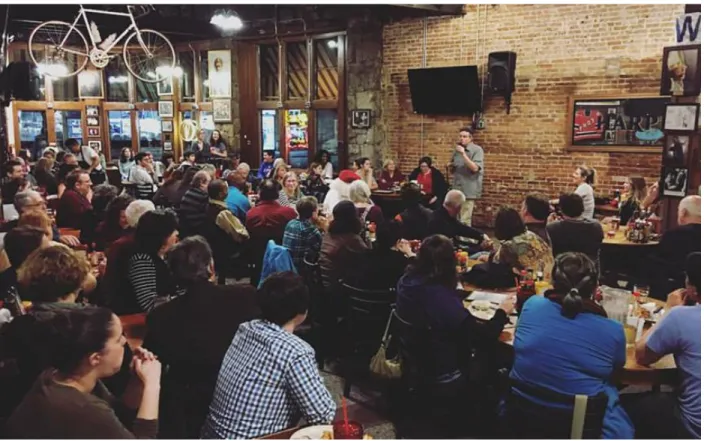
Figure 6. Carapace stage (Carapace, 2017) ... 61
Figure 7. Spectrum of Personal Storytelling Performance ... 75
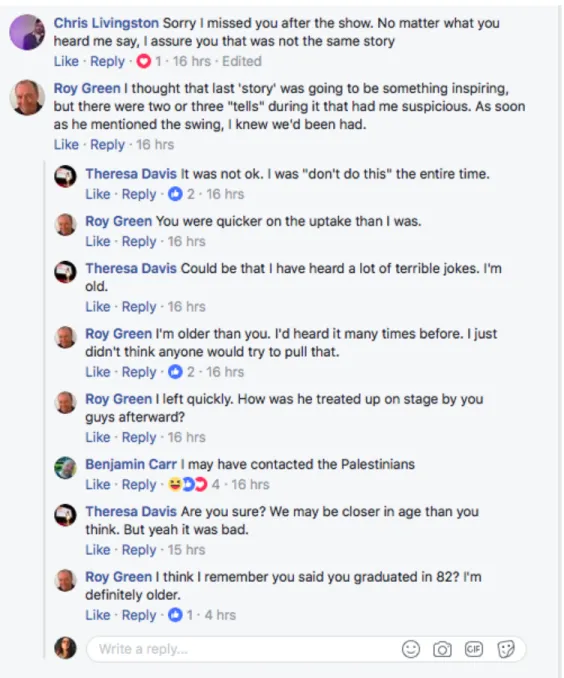
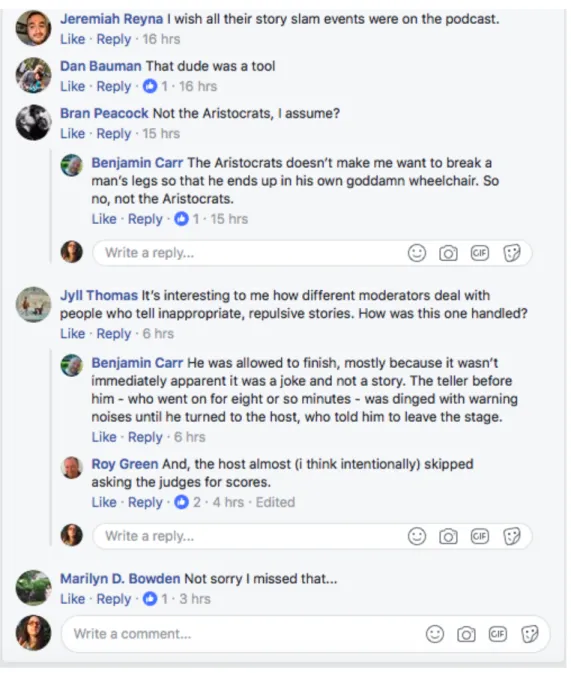
Figure 8. B. Carr Facebook post on Matan’s story ... 95
Figure 9. Comments on Carr’s post about Matan ... 96
Figure 10. More comments on Carr’s post about Matan ... 97
Figure 11. Image of Carapace banner (Carapace, 2011) ... 144
CHAPTER 1: AN INFORMATION SCIENTIST WALKS INTO A BAR It’s the second Tuesday of the month, and I drive through Atlanta traffic towards
Manuel’s Tavern. The GPS has suggested a “faster route,” which turns out to go through
neighborhoods. I wait in long lines for my turn at multiple four-way stops and then have to
make a left turn onto a road where traffic doesn’t stop. I curse the technology, under my
breath, and slowly make my way there, finally breathing a sigh of relief when I pass the final
light and roll into the Manuel’s parking lot. Parking is often stressful and expensive in Atlanta,
so going to a bar that has its own, free lot feels like a luxury.
I walk in the front door of Manuel’s. The bar and a row of booths are directly in front of
me. To my right are a couple of arcade games, the bathrooms, and a room that can be closed
off for events. I turn left toward another room, reserved that night for Carapace. There is no
closing door, just a doorway with a black velvet curtain pulled to the side. There is a paper flier
taped beside the doorway that says:
TONIGHT “CARAPACE”
PERSONAL STORY TELLING
IN THE MAIN DINING ROOM!
In spite of my “quicker route” I’m still there by 6pm, an hour early. The room is quiet. A
few people dine there, either early for Carapace, like me, or oblivious to the event. Those
oblivious will probably be done eating and gone before Carapace begins.
I sit at a small circular table that has been pushed into a line of small circular tables,
arranged around the room. I look at the walls. They are brick with numerous pictures and other
objects hanging from them. I notice a framed FDNY jersey, a clown, and a map. There are TVs
mounted high on the walls. Currently they are still on, displaying news with subtitles. I inhale
air, fragrant and heavy with grease, and my stomach rumbles. I order a burger.
Another regular sits down next to me. His GPS gave him the same “short cut” mine did.
The room fills up with people and the sounds of reconnecting, eating, and drinking. People,
some shyly, some deliberately, walk up to a small table to write their names on slips of paper
and drop them in the top hat.
Around 7pm, the curtains over the doorways close, the TVs turn off, and Cris Gray, the
host, steps up to the mic stand. The stand is in the middle of the stage space, but he holds the
microphone. “Welcome to Carapace, where ordinary people tell real life stories…”
After his intro, Cris draws the first name. The teller comes to the stage, takes the
microphone, and tells a story. Cris draws another name and the show continues, one story after
another, with brief comments from Cris in between. I wiggle in my hard, wooden chair, trying
to avoid butt numbness. At 8:30 Cris says we’re out of time, and invites those whose names are
still in the hat to come to the stage and share the first line, last line, or best line from their
stories. Cris thanks us, and says goodnight.
There is more conversation as friends say goodbye, as new friendships form over “I
loved your story!,” as people share untold stories with their table-mates. Slowly the room stops
being Carapace space and goes back to just being the dining room at Manuel’s.
Reality Storytelling
I call the type of storytelling that happens at Carapace “reality storytelling” for a few
reasons. An obvious reason is the reality of the stories. They are true, personal stories. Folk,
Going even further than the simple truth of these stories, is that they are authentic. The
first time I told a story at a reality event I was accused of using my “storyteller voice.” The
audience wants to hear from the performer as a person, not as a third-party intermediary who
is uninvolved in the story.
And finally, in a sort of ironic twist, despite their authenticity, or maybe because of it,
reality stories are not always technically historically accurate. As Lance Colley, the original host
of Carapace used to say, “the stories don’t have to be factual but they must be true.” Like
reality TV, reality storytelling is a performance. Performing reality often means editing the facts.
For these reasons (truth, authenticity, and flexible factual accuracy) I refer to this type
of performance as “reality storytelling.”
The Moth.
The reality storytelling show that seems to have the most name recognition is The Moth.
According to the website:
The Moth was founded [in 1997] by the novelist George Dawes Green, who wanted to recreate in New York the feeling of sultry summer evenings in his native Georgia, when moths were attracted to the light on the porch where he and his friends would gather to spin spellbinding tales. The first New York Moth event was held in George’s living room and the story events quickly spread to larger venues throughout the city. (Moth, 2018)
The Moth hosts storyslams, open mic storytelling competitions, and also curated shows
featuring selected tellers performing slightly longer (about 12 minute) personal stories. There
are currently regular Moth storyslams in cities across the United States, and a couple regular
slams in Australia and the United Kingdom (Moth, 2018). The Moth Mainstage (curated) shows
tour the country and the world. Moth stories air on public radio, and on The Moth’s podcast.
Carapace actually began as a Moth show, with the name MothUp Atlanta in 2010. Joyce
Mitchell, one of the founders loved The Moth radio show and was looking for a different way to
They advertised that they were going to start the MothUps across the different cities
so I signed up for it right away. I just pounced
and
signed the paperwork and put it into motion.
However, The Moth had rules about audience size. The Atlanta show and several
MothUps in other cities “wanted it to be bigger,” according to Joyce.
The gist is
everyone ended up
either getting kicked out or quitting before they were. We were one of them.
We quit before we were fired.
We did it on good terms.
The name changed to Carapace and they became an independent show.
In 2017 The Moth returned to Atlanta. Both events coexist, holding their monthly shows
on different nights. Many Carapace regulars also frequent The Moth, but each show also
attracts people who do not attend the other.
The biggest differences between Carapace and The Moth are that The Moth is ticketed
and is a slam (a competition). As Randy Osborne, Carapace organizer, says of Carapace in his
monthly Facebook event posts: “It's free and always will be, with no judging of any kind.” Both
events are open mic (names drawn randomly); feature true, personal stories connected to the
theme of the evening; and give storytellers a roughly 5 minute time limit.
The Question
Carapace’s host begins the show by sharing the rules:
Storytellers have five minutes to tell a true, personal story on the theme of the evening. No comedy routines, no political rants, no poetry.
There is no heckling from the audience.
Malinowski (1922), observes that there are “rules and regularities of tribal life,” which,
although, “crystallised and set, are nowhere
formulated
” (p. 11). Georges (1969) says thatstorytellers and story listeners have “duties” and “rights” that are “in accordance with socially
prescribed rules with which [they] and the other participants in the storytelling event are
familiar” (p. 318). McAuley (1999) claims that audience members enter into a “tacit contract” by
entering some performance spaces (p. 41).
Some of Carapace’s rules are explicit, but not all of them. The host, for example, does
not instruct the performer not to use her “storyteller voice.” The audience is told one of their
duties (be kind), but there are others. Regulars come to understand and expect a certain type
of story to be told at Carapace to a certain type of audience.
As I set out to better understand the stated and unstated rules of Carapace, what was
really going on at this event, I was guided by the question:
CHAPTER 2: LITERATURE Reality Storytelling
Hannah Harvey describes reality storytelling as being on the “fringe” of the storytelling
world, with the traditional festival located at the center. She notes differences in the feel of
festival-style telling and reality storytelling: “The evening I went, The Moth featured tales that
challenged us deeply -- if traditional festival performances nudge audiences into safe (perilous)
adventures, this festival’s stories pushed us into the corners of darkness and forced us to
ruminate in that uneasy space” (2008, p. 146). In her observations and research, Harvey sees
reality storytelling as allowing listeners to feel negative emotions that festival audiences are
shielded from, even in stories that involve “danger.”
Festival audiences have had negative reactions when reality storytelling has been
included in the program. Joseph Sobol recounts an incident from the 1985 National Storytelling
Festival in which Spalding Gray was a featured teller. Gray’s “dark autobiographical monologues
came as an unpleasant shock to some” (Sobol, 1999, p. 198). During the show, Gray used a
“four-letter word,” resulting in parents with young children leaving, and young adults moving
closer to the stage (p. 198). It was “polarizing.”
Harvey describes a somewhat similar incident in which a Kennesaw State University
student used profanity before the audience of the Southern Order of Storytellers Winter
Festival:
storytelling studies, generously granted by SOS. Upon winning the storytelling
scholarship from SOS, the student proceeded to give a heartfelt and powerful personal narrative story of his mother’s suicide. In one moment of the performance, the teller wailed in his grief, “Fuck you, and fuck God!” The performance had been prepared for a mature audience but due to the circumstances, was called to the stage in the presence of both adults and a small number of adolescents. While the teller had been an
adolescent at the time he experienced the events he narrated, and the language was fitting with the scene he described, the performance unsurprisingly marked a turning point for members of the sponsoring organization. Factions in favor of more progressive, mature storytelling spaces found themselves in contestation -- often, but not in all cases, along generational lines -- with those who felt there was no place for those words on their stage.
Since that performance, KSU has been greeted with friendly suspicion by some members of the Order.” (Harvey, 2008, p. 142)
Both of these unconventional performances (described by Sobol and Harvey) resulted in
mountains of feedback from audience members, some very positive, but some extremely
negative.
What may make reality storytelling uncomfortable for some listeners is Turner’s (1988)
“breach.” Turner describes breach as
breach
of regular norm-governed social relations made publicly visible by the infraction of a rule ordinarily held to be binding, and which is itself a symbol of the maintenance of some major relationship between persons, statuses, or subgroups held to be a key link in the integrality of the widest community recognized to be a culture envelope of solidary sentiments. (p. 34)A “social drama” begins with a breach (p. 34). Something happens that would not usually
happen in that situation. Social dramas lend themselves to becoming personal stories. Reality
storytellers are narrating their lives’ social dramas.
The breaches they discuss may be especially jarring for audiences, especially when the
storytellers behave more the way they did in the moment, than as detached narrators relating
the story later. The KSU teller experienced his mother’s suicide as a breach. He shared that
breach with the audience. He also shared his authentic reaction with the audience by calling out
Not only did the audience live this breach with him, they simultaneously lived a breach
in the ritual of the storytelling festival. The KSU teller’s language and performance were a
breach. The combination of these two breaches was too much for them.
Outside the world of festival storytelling, reality storytelling is the only kind of
storytelling that many people have heard of. Ben Lille, co-founder and host of Story Collider (a
science reality storytelling show), repeatedly uses the term “storytelling” when he is clearly only
talking about shows like Story Collider and The Moth in his interview for
Curator
(Linett, 2013).The lack of bracketed notes to clarify suggests that this is not confusing to the magazine
readers.
Lille believes that the reality storytelling movement is “part of a -- backlash is the wrong
word, but a hunger for something simpler and more stripped down” (Linett, 2013, p. 15).
Reality storytelling brings back something from an earlier time, something Lille thinks people
have missed.
Lille compares reality storytelling with radio; specifically,
This American Life
. Thedistinctions made by Lille, however, also serve to distinguish reality storytelling from festival
storytelling. He says that the shows are “intimate.”
The conceit of this whole art form is that you’re sitting in a bar telling your friends a story. And that’s actually not far from that. We intentionally hold the tapings in spaces that are small, where the performers are very close to the audience and there’s no separation -- the audience goes right up to the stage. There are no visuals, no stage design. So it’s sort of the same thing that radio does. There’s nothing to focus on other than the person talking. I think we’re trying to hit the same place, emotionally. (Linett, 2013, p. 15).
Reality storytelling is intentionally intimate: small audiences in a bar seated right up to
the stage. Festival storytelling audiences can be enormous, especially at Jonesborough, and the
Adult language and themes are repeatedly encountered as accepted within reality
storytelling, but not required. Lille has an interesting perspective on this as well. Linett
comments: “That reminds me how many four-letter words I’ve heard from your storytellers,
which is par for the course in storytelling but less so in science communication. Is that part of
how science can be pitched to grownups?” (2013, p. 19). Lille responds:
Yes, we very intentionally make the space safe for adults. People talk about making a place safe for kids, but it also works the other way. We hold our shows in bars that are 21-plus, and there’s an “explicit” label on the podcast on iTunes. So we have no
problems with our storytellers saying whatever they want. Some of the stories end up being very explicitly about sex, though that doesn’t happen very often. The goal is to make this a place where we engage with science in this very adult, convivial way, and ironically the way to do that is to swear a lot sometimes. Nobody’s sitting there worried about whether a kid will hear it. So they can dive into these really emotionally intense stories that come out. (Linett, 2013, p. 19)
This is quite different from the attitudes of those who objected to Spalding Gray and the
KSU teller’s performances on festival stages. They felt that the use of obscene language made
the space unfriendly, but Lille says the freedom to use that kind of language makes the reality
storytelling stage a “safe space.” The question might be “safe for whom?” Reality storytelling
seems to have more of an aim towards making the teller feel safe to tell any story, than assure
the audience that they will always be safe as listeners.
Harvey (2008), Sobol (1999), and Lille (Linett, 2013) illustrate how reality storytelling
goes beyond truth to authenticity. It is both uncomfortable and intimate.
My friend, Shannon McNeal, whom I interviewed in 2015, describes the factual flexibility
of reality storytelling. While performing at Carapace, Shannon got the signal that she was
almost out of time.
So I’m like
Okay I’m stringing everybody along. How I’m gonna wrap this up? And like
a year after all this happened
I was interviewed by 11Alive News and across the bottom it said Shannon McNeal, Lesbian. And that’s a great line. It’s true.
But it didn’t happen in this order. So I throw in that
there on the news there I am:
Shannon McNeal, Lesbian. (S. McNeal, personal communication, March 12, 2015).
Shannon took an event that historically happened outside the context of the story she was
telling and added it to her story because it created an effective and humorous conclusion. Not
many members of the reality storytelling community so freely divulge which parts of their
stories break with historical accuracy and I am grateful to Shannon for this honest glimpse into
her creative process.
This is what I began my study knowing about reality storytelling, and about Carapace.
Information
The field of Information and Library Science may seem like a strange home for research
on reality storytelling. However, I would argue that precisely because there is so little LIS
research on oral and embodied information, this study is needed in this field.
Conduit metaphor.
For one thing, our conceptualization of information tends to be based on the conduit
metaphor. The conduit metaphor suggests that:
(1) language functions like a conduit, transferring thoughts bodily from one person to another;
(2) in writing and speaking, people insert their thoughts or feelings in the words; (3) words accomplish the transfer by containing the thoughts or feelings and conveying them to others; and
(4) in listening or reading, people extract the thoughts and feelings once again from the words. (Reddy, 1979, p. 290)
Reddy (1979) points out a major flaw of this metaphor. It makes communication seem so easy
Information theory, built off this metaphor, somewhat addresses the issue of problems
in communication with “noise” as seen below.
Figure 1. Information Theory (Day, 2000, p. 806)
There may be some external force that distracts from or distorts the signal before it gets to the
receiver.
There are, however, other criticisms of information theory and the conduit metaphor.
Reddy (1979) points out that the metaphor also implies that “thoughts and feelings are ejected
by speaking or writing into an external ‘idea space’” and that “thoughts and feelings are reified
in this external space, so that they exist independent of any need for living human beings to
think or feel them” (p. 292). Although Reddy says that these ideas might be spoken, this model
hardly seems to resemble oral communication.
For similar reasons, Ong (2008) declines to use the term “media” in a work that digs
into the medium of orality (p. 172).
The reason is that the term can give a false impression of the nature of verbal
communication, and of other human communication as well. Thinking of a ‘medium’ of communication or of ‘media’ of communication suggests that communication is a pipeline transfer of units of material called ‘information’ from one place to another. My mind is a box. I take a unit of ‘information’ out of it, encode the unit (that is, fit it to the size and shape of the pipe it will go through), and put it into one end of the pipe (the medium, something in the middle between two other things). From one end of the pipe the ‘information’ proceeds to the other end, where someone decodes it (restores its proper size and shape) and puts in in his or her own boxlike container called a mind. This model obviously has something to do with human communication, but, on close inspection, very little, and it distorts the act of communication beyond recognition. (p 172).
Ong (2008) says that the most basic difference between verbal communication and
order to take place at all” (p. 173). He points out that “In the medium model, the message is
moved from sender-position to receiver-position. In real human communication, the sender has
to be not only in the sender position but also in the receiver position before he or she can send
anything” (p. 173).
The willingness to accept the conduit metaphor or the media model shows a
chirographic bias. Ong (2008) says that “chirographic cultures regard speech as more
specifically informational than do oral cultures, where speech is more performance-oriented,
more a way of doing something to someone” (pp. 173-174). He continues, “the written text
appears
prima facie
to be a one-way informational street, for no real recipient (reader, hearer)is present when the texts come into being” (p. 174).
Disembodied information.
The separation of words from humans is also problematic. Primary oral cultures can not
conceive of disembodied words because sound “comes from inside living organisms” (Ong,
2008, p. 32). Humorously, Ong points out:
Sound cannot be sounding without the use of power. A hunter can see a buffalo, smell, taste, and touch a buffalo when the buffalo is completely inert, even dead, but if he hears a buffalo, he had better watch out: something is going on. (p. 32)
Sound is intricately tied to life, and in an oral culture, that means words are, too.
This conceptualization information as a disembodied object seems to be due to “the
origins of information studies in the provision of information through libraries and digital
repositories” (Cox, et al., 2017, p. 1). Day (2010) also sees this coming from “the popular
understanding of intellectual freedom in library practice that holds that the researching subject
should have unfettered access to ‘information.’ The term ‘information’ is understood here as
something akin to naturally occurring empirical objects” (p. 5). As a result, “the evolution of
texts, an emphasis on cognition and a relative neglect of the role of the body” (Cox, et al.,
2017, p. 2). Libraries are interested in information objects, and research that comes out of
library science favors this type of information. It is unfortunate that research on information has
not been more influenced by the oral interactions that take place in libraries, such as reference
interviews and story time programs. The very persistence of the library as a physical space
implies there is value in the ability of patrons to bodily inhabit that space. The library could take
a role in rectifying this bias toward disembodied information.
Bauman (1977) describes a similar bias he has come up against in studies of verbal art.
He found the various approaches to understanding verbal art to all be “text-centered” (p. 8).
Bauman says that this text-centeredness places “severe constraints on the development of a
meaningful framework for the understanding of verbal art as performance, as a species of
situated human communication, a way of speaking” (p. 8). A focus on text makes it difficult to
discuss performance or oral communication in a live context.
Embodied information practices.
Some research has been conducted on the role of the body in information practices.
Lloyd (2010) says that “our bodies, the information they possess, produce and disseminate are
central for understanding the information experience we have created when we engage with
learning and knowledge acquisition through the collective and situated practices that shape our
specific information landscapes” (paragraph 5). Lloyd’s research, as described in Olsson & Lloyd
(2017a) “has led her to conclude that embodied information practices are rich sites of
knowledge in that they:
○ are always situated (in situ)
○ are expressed corporeally, and central to actors understanding the social and
epistemic modalities of the landscape;
○ act as sites for know-how knowledge, which cannot be effectively expressed in
○ are local/nuanced, drawing from expertise in situ and may be contingent and only available at the ‘moment of practice’.” (paragraph 8)
Olsson’s work is particularly relevant to the study of information in the context of live
performances.
For actors in particular embodiment is an essentially literal process: they need to physically become their character (at least for a few hours’ traffic upon the stage). Embodiment was important not only for their sensemaking as individuals, but also in allowing them to act as an embodied signifier for their audience (Olsson & Lloyd, 2017a, paragraph 25).
Actors are highly conscious of how they use their bodies to convey information.
There has also been some research on oral information. When seeking information to
help them create a production, Olsson’s (2010) theater participants were most greatly
influenced by “social interactions, including informal conversations with their colleagues or
mentors and interactions at rehearsals” (p. 275). They placed highest value on oral information.
It is possible Olsson’s participants had an oral bias due to their profession. However,
“information behavior researchers continuously find that people prefer to talk to other people
when seeking and using information” (Turner, 2010, p. 371). So, their oral preference could
also be a general human trait.
Turner (2010) found that orality is “persistent” (p. 371), “an enjoyable social activity”
(p. 372), and “the richest of all media” (p. 373). “When designing future studies that focus on
orally-based information,” (p. 380) she suggests considering the ways in which the use of
orality to convey information:
(1) is flexible in relation to how other modes are used; (2) is not easily replaced;
(3) can adapt in the event that the nature of information it is used to access changes; and
Sense-making.
There is a bit of research on sense-making through performance. Olsson (2010) found
that those who work in Shakespearean theater demonstrate “ongoing awareness that they need
to make sense of Shakespeare’s texts, not just for themselves but for their audience” (p. 278).
Viewers make sense of the text of the play through the performance, and this sense-making
must be facilitated by those putting on the show.
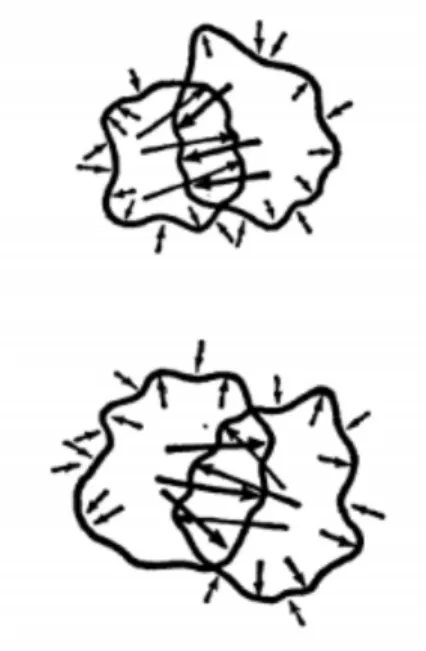
Georges’s (1969) model of what happens at a storytelling event visually shows the
storyteller and audience member merging as they ultimately make sense of the story together
(pp. 320-321). The teller and listener begin as two separate entities. As the listener receives the
message from the storyteller and the storyteller receives feedback from the listener they begin
Figure 2. Georges’s Model (Georges, 1969, pp. 320-321)
Audience members melt into the crowd and the listeners’ identities merge with the storyteller’s
until there are no individual personalities, but only the message.
Day (2000) calls for information studies to be “rethought outside the [current]
paradigm” (p. 811). Oral and performance interactions are outside the current paradigm. If we
are to understand information practices across the broad range of possible ways that human
beings communicate this is an area that deserves attention.
Context: Place, Space, and Media
and rendered meaningful with reference to relevant contexts” (Bauman, 1977, p. 27). Part of
the performance setting includes “culturally defined places where performance occurs” (p. 27).
People know that performances occur in certain locations.
Furthermore, the performance space gives clues as to what kind of performances
happen there. “[T]he place of performance itself provides a primary framework: spectators who
are intrigued by a certain kind of performance go to places where it is practiced and thereby
enter into a tacit contract with the performers not to be outraged by what happens” (McAuley,
1999, p. 41). For example, holding reality storytelling events in a bar helps communicate to the
audience that they ought to expect adult stories.
The bar.
Georges (1969) says that the storyteller and story listener have rights and duties. Both
parties act “in accordance with socially prescribed rules with which [they] and the other
participants in the storytelling event are familiar” (p. 118). It is possible that newcomers to any
event may not be fully aware of the socially prescribed rules. Although most people who come
to a bar to hear storytelling will not be outraged by the content of a reality storytelling show, it
is possible that a few haven’t read the fine print of the “tacit contract” they entered into by
showing up to the event.
Historically, festival audiences have expected the storytellers to keep them safe, but
bars, historically, have been the venue for edgier stuff.
Perhaps unsurprisingly, with the invention of the phonograph, a black market
immediately sprung up for “blue discs” (Smith, 2008, p. 61). The material on these discs ranged
from suggestive jokes to audio the listener was meant to believe represented an actual sexual
the phonograph industry was particularly hard hit by the Depression, and record sales plummeted. Fewer people could afford records for home use, so public listening became more widespread. This public listening was centered on the jukebox. (p. 58)
Smith (2008) continues: “Jukeboxes at the time were often found in bars and taverns”
(p. 58). The local bar was the place to go to listen to records. Among those records, were blue
discs. In fact, “blue discs made between the 1920s and 1950s seem to have been made largely
for a tavern jukebox audience” (p. 58). The records might have a song on one side and the blue
material on the other “so as to more easily hide the obscene material on jukeboxes” (p. 58).
Furthermore, advertising for one blue disc manufacturer, Larry Vincent’s risqué Pearl Records,
carried the slogan “Rockin’ the boxes” (p. 58). The blue discs were created with a bar audience
in mind.
We can speculate that the tradition of listening to blue discs at the tavern was built on
an older one of drinking buddies sharing suggestive jokes face to face and exaggerated stories
of sexual prowess. Holding a storytelling event in a bar sends a strong message about the
content audience members should expect. Lille (Linett, 2013) states that the bar also helps
create an intimate setting and the illusion that the listeners are simply chatting with friends.
Media.
It is worth considering the media used during a storytelling performance. Turner (1988)
says:
The ‘same’ message in different media is really a set of subtly variant messages, each medium contributing its own generic message to the message conveyed through it. The result is something like a hall of mirrors--magic mirrors, each interpreting as well as reflecting the images beamed to it, and flashed from one to the others. (pp. 23-24)
This is not as emphatic as McLuhan’s (1988) aphorism “the medium is the message” (p. 17),
but resonates with McLuhan’s (& Fiore, 2001) restatement that “the medium is the massage”
McLuhan discusses media being “hot” or “cold,” referring to the degree to which a
medium fills up one or more senses. McLuhan (2003) says:
A hot medium is one that extends one single sense in ‘high definition.’ ‘High definition is the state of being well filled with data. A photograph is, visually, ‘high definition.’ A cartoon is ‘low definition,’ simply because very little visual information is provided. Telephone is a cool medium, or one of low definition, because the ear is given a meager amount of information. And speech is a cool medium of low definition,
because so little is given and so much has to be filled in by the listener. On the other hand, hot media do not leave so much to be filled in or completed by the audience. Hot media are, therefore, low in participation, and cool media are high in participation or completion by the audience. (p. 39)
In
The Laws of Media
, the McLuhans (1988) state that an overheated medium “reverses.” This “involves dual action simultaneously, as figure and ground reverse position and take on acomplementary configuration. It is the peak of form, as it were, by overload” (p. 228).
Turning figure into ground is a reference to Gestalt psychology. Figure-ground reversal
is the shifting of perception “of which parts of the image represent the figure and which
represent the (back)ground” (Colman, 2015, p. 280). The “reversible goblet” created by the
Danish psychologist Edgar Rubin illustrates how figure and ground can be reversed. In this
instance the image can be seen as either a goblet or two faces depending on which color is
perceived as figure and which as ground.
Figure 3. “Reversible goblet” (Colman, 2015, pp. 658-659)
The microphone, stage, and lights are some of the media that may be present at reality
Sobol (1999) describes the microphone as “a rod of power” (p. 100). It is like a magic
speaking stick, not only giving the performer permission to take an extended turn at speaking,
but making her louder than everyone else in the room. It enhances the “private’ individual
voice” while doing away with “private space” (McLuhan & McLuhan, 1988, p. 143). The speaker,
presumably, sacrifices privacy to amplify her voice. Overheated, the microphone creates
“closed, collective space” (McLuhan & McLuhan, 1988, p. 143). The microphone is meant to
amplify a voice, making it more heard than others. Overamplification leads to the voice not just
being more heard, but the only sound heard. The McLuhans (1988) suggest this creates a
“wrap-around sound-bubble” (p. 143). An overheated microphone, rather than reaching an ever
larger audience, marks boundaries around an in-group of listeners. They are cut off from the
world outside the bubble because they can not hear it.
Smith (2008) offers an example of how the use of a microphone alters performance.
“The microphone’s ability to capture subtleties of vocal timbre and inflection faithfully opened
up the possibility of new forms of performance marked by a quiet intensity and subtle shadings
of inflection, suggestive of intimacy and emotional density” (Smith, 2008, p. 8). A mic-ed
storyteller can do things with her voice that a storyteller without a microphone can not. Rather
than worrying overly much about being loud and clear, the mic-ed performer can focus on really
using her voice to perform the story.
An important medium, on which the McLuhans (1988) are silent, is the stage. McAuley
(1999) sees theater space as divided: “it is a place of employment for some, a place of
entertainment and cultural enrichment for others. The two groups have their designated areas
within the space that is, in traditional theatres, quite rigidly demarcated” (p. 25). The stage is
one indicator of this division. Those on the stage are working. Those off the stage are being
The association with theater also causes audience members to expect what occurs on
stage to be a performance. “The behavior of actors onstage is marked; spectators know that it
is to be interpreted differently from apparently identical behaviors occurring in other places”
(McAuley, 1999, p. 39). It may seem obvious that storytelling is a performance, but certain
types of storytelling can have a non-performative feel. The fact that a stage signifies
“performance” does create a distance between teller and listeners.
Building on the McLuhans’ (1988) understanding of media as extensions of the human
body, we can also extrapolate that the stage gives the storyteller added height and visibility.
Perhaps it even sets the storyteller physically and metaphorically “above” the audience, as if he
or she is more important than they are. Certainly, the storyteller is the most visible and audible
person in the room and is given an extended turn to speak. The McLuhans’ (1988) Laws of
Media state, however, that each medium also contains the seeds of its own reversal.
Overheated, then, (perhaps too high, or with too much marked separation between performer
and audience) the stage turns the performer from a king on a throne, to the jester; the least
important person in the room, performing in service to a royal audience.
Lighting in performance is often used to draw the eye to the performer. The McLuhans’
(1988) say that electric light enhances “space as visual figure” and reverses into “blinding” (p.
194). Candles and oil lamps create pools of light. The light must be moved over the thing that
needs to be seen. Electric lights, as typically used in a home or public building, flood the entire
room with light. The whole space can be seen, not just the objects within a small pool of light.
In this way “space” becomes more “figure” - brought into greater focus.
The potentially blinding nature of light is one most people have experienced. When light
is shone into the eyes instead of on objects that a person wishes to see, the person becomes
see. Overexposure to light (like staring at the sun) can even cause long term damage to the
eyes resulting in a more permanent loss of vision.
Lighting goes along with the stage and microphone to create more or less of a feel of
connection between storyteller and audience. Equal lighting illuminates the entire room and
everyone in it. A spotlight highlights the storyteller, raising his or her visibility for the audience.
Spotlights also retrieve the pool of light cast by a candle or lamp. The light is only on the object
of interest. Stage lighting that lights up the entire stage (while the house lights stay low), is
more like a lit room. However, the difference in the lighting suggests that the stage is a
different room from the rest of the theater. Spotlights and bright full-stage lights also blind the
storyteller so that the audience is not visible to him or her. And, the “heat” may become literal
at this point, as some stage lights emanate enough heat to make the performer sweat. This
also furthers the idea that an overheated stage flips the storyteller into a subservient role, in
this case sacrificing his or her own vision and comfort in order to be more visible to the
audience.
The spoken word and collective unconscious.
An important, but easily overlooked, medium in use at Carapace is the spoken word.
Face to face oral communication is sometimes referred to as “unmediated,” however, this is
debatable. McLuhan (2003) treats language as a technology: “Each mother tongue teaches its
users a way of seeing and feeling the world and of acting in the world, that is quite unique” (p.
114). This may make us wonder, what truly unmediated communication would look like.
McLuhan (2003), drawing on the philosophy of Henri Bergson (2000), suggests that a
collective unconscious preceded language. Bergson (2000) says that we have a “language
whose signs - which cannot be infinite in number - are extensible to an infinity of things” (p.
and recombined allows for the creation of “an infinite array of new utterances” and that
“compositionality” is “the feature that makes language so much more powerful than any other
communication system” (p. 253). This flexibility of language allows humans to talk about
anything and it is what has separated mankind from the collective unconscious (McLuhan, 2003,
p. 113).
Bergson (2000) describes how language leads to higher thinking: “Now, this mobility of
words, that makes them able to pass from one thing to another, has enabled them to be
extended from things to ideas” (p. 153). Bergson (2000) credits language with the furthering of
human intelligence: “Without language, intelligence would probably have remained riveted to
the material objects which it was interested in considering. It would have lived in a state of
somnambulism, outside itself, hypnotized on its own work” (p. 153). Again, Mithen’s (2006)
hypothesis on the origins of language agrees. He imagines that “the first words may initially
have been of primary significance to the speaker” and that these words were used “to facilitate
their own thought and planning, rather than as a means of communication” (p. 259). Words
may have influenced thought even before they were used to communicate.
McLuhan (2003) compares the mobility of mind that language enables with the physical
mobility offered by the wheel:
Language does for intelligence what the wheel does for the feet and the body. It enables them to move from thing to thing with greater ease and speed and ever less involvement. Language extends and amplifies man but it also divides his faculties. His collective consciousness or intuitive awareness is diminished by this technical extension of consciousness that is speech. (p. 113)
Instead of being primarily engaged in his surroundings (as Bergson (2000) describes prelingual
existence) man becomes more inward-looking and more self-aware.
McLuhan (2003) explains that in extending our bodies and minds through technology we
63). Thus, the rise of the self-awareness through language numbs us to what McLuhan calls the
collective unconscious.
There very probably have been a couple of other layers of communication between the
collective unconscious and today’s prose speech. The Greek historian Strabo (1903) argues that
all oratorical forms are derived from poetry:
I answer, that flowery prose is nothing but an imitation of poetry. Ornate poetry was the first to make its appearance, and was well received. Afterwards it was closely imitated by writers in the time of Cadmus, Pherecydes, and Hecataeus. The metre was the only thing dispensed with, every other poetic grace being carefully preserved. As time advanced, one after another of its beauties was discarded, till at last it came down from its glory into our common prose. (Book 1, Chapter 2, Section 6)
There is evidence that language has evolved in a way not unlike what Strabo has
suggested. In studying oral cultures (cultures in which orality is the only or primary means of
communication) Ong (2008) has observed many characteristics of orality. Because there are no
external places for storing knowledge (e.g. scrolls, books, computers) oral people must “[t]hink
memorable thoughts” (Ong, 2008, p. 34). His description of “memorable thought” sounds a lot
like poetry: “heavily rhythmic, balanced patterns, in repetitions or antitheses, in alliterations and
assonances, in epithetic and other formulary expressions” (Ong, 2008, p. 34). The thing that
moved oral communication away from poetic expression to the (mostly) prose speech that is
familiar to us today, was writing.
Perhaps unsurprisingly, Mithen (2006) suggests that before poetry came music. Drawing
evidence from studies of modern day primates, Mithen (2006) proposes that our hominid
ancestors had a communication system that was “holistic, manipulative, multi-modal, and
musical” (p. 121).
By “holistic” Mithen (2006) means that the calls of primates “lack consistent and
vervet monkeys who have different alarm calls for danger above (e.g. an eagle) and danger
below (e.g. a snake), but do not use distinct words and grammar to say “beware of the snake”
(Mithen, 2006, p. 109). This is very different from the “mobility” of our words as described by
Bergson (2000. p. 153). The vervet alarm call for danger below can not be broken up into
words or syllables that can be rearranged to mean something else. No part of the call has a
separate meaning that could be used in another situation.
Mithen’s (2006) hominid communications are “manipulative” in that they are meant to
obtain a specific reaction from another individual, not to simply tell them about the world (p.
120). He uses the term “multi-modal” to describe the use of “gesture as well as vocalization”
(Mithen, 2063, p. 120). Finally, Mithen describes this communication as musical as it makes
“substantial use of rhythm and melody, and involve[s] synchronization and turn-taking”
(Mithen, 2006, p. 121). Mithen (2006) goes on to argue that the communications of our
ancestors were very musical before language, as we know it, developed.
Did poetry or music remove us from the collective unconscious, as McLuhan (2003) says
language did? Actually, Mithen (2006) points out that when “people join together for a group
activity - a family meal, a meeting with work colleagues, a football team assembling for a match
- they typically arrive from quite different immediate experiences” (p. 214). The group members
come together different. But music can make them more alike. “Those who make music
together will mould their own minds and bodies into a shared emotional state, and with that will
come a loss of self-identity and a concomitant increase in the ability to cooperate with others”
(Mithen, 2006, p. 215). By this description music brings us closer to a collective consciousness.
This also seems very like Georges’s (1969) model of what happens at a storytelling event,
When Mithen (2006) describes the main limitation of primate communication we get an
alternate view of what life was like before language. He says that primates lack theory of mind,
“the ability to imagine that the beliefs, desires, intentions and emotional states of another
individual might be different from one’s own” (Mithen, 2006, p. 128). Without theory of mind,
there is no reason for the more complex communication language provides. “If one assumes
that another individual has the same knowledge and intentions as one’s own, there is no need
to communicate that knowledge or to manipulate their behavior” (Mithen, 2006, p. 117). This
vision of the pre-language state of being suggests something a little different from collective
unconscious. Rather each individual imagined every other individual shared his thoughts or
feelings, but only because he could not imagine that it was possible to have different thoughts
or feelings.
Thought without theory of mind sounds very like Bergson’s (2000) assertion that
intelligence without communication remains “riveted to the material objects which it was
interested in considering” (p. 153). There is no thought outside of my thought. There are no
objects outside of these objects.
McLuhan (2003), making reference to Bergson (2000), says that “even consciousness is
an extension of man that dims the bliss of union in the collective unconscious. Speech acts to
separate man from man, and mankind from the cosmic unconscious” (p. 113). However,
Bergson (2000) sees intuition, an unconscious trait, and intelligence, a conscious trait, to be
inextricably intertwined. Intuition establishes a “sympathetic communication” between “us and
the rest of the living” (Bergson, 2000, p. 172). He calls this an “expansion of consciousness”
which “introduces us into life’s own domain” (Bergson, 2000, p. 172). And although intuition
the point it has reached” (Bergson, 2000, p. 172). Intuition connects us to other living things,
but in doing so expands our consciousness.
Along with the stage, microphone, and lights, the spoken word is a medium used at
Carapace. There seems to be some relationship between the spoken word and a theorized
collective unconscious. Perhaps, modern forms of face to face orality, such as reality
storytelling, help bring us a little closer this universal consciousness.
Performances
Finally, what happens at Carapace is more or less a performance. Jackson (2003) says
she finds performance “the most useful place from which to speculate upon the nature of
identity, space, temporality, and social interaction” (p. V).
Types of performance.
Schechner (2002) identifies eight kinds of performance:
1 in everyday life -- cooking, socializing, “just living”
2 in the arts
3 in sports and other popular entertainments
4 in business
5 in technology
6 in sex
7 in ritual -- sacred and secular
8 in play. (p. 25)
Goffman (1986) describes the first type, social performance as: “all the activity of a
given participant on a given occasion which serves to influence in any way any of the other
participants” (p. 15). This type of performance has to do with behaving appropriately in a social
situation.
Bauman (1977) sees performances as slightly different from other social interactions:
This sounds very like social performance, but Bauman goes on to differentiate verbal art as
different from the “simple talk” or “straight speech” of specific cultural groups. He aligns
performative speech with ceremony or invocation (pp. 12-13). Performance involves then,
behaving like a performer.
What Bauman (1977) has described could be called cultural performances. Conquergood
(2016) calls cultural performances: “ritual, ceremony, celebration, festival, parade, pageant,
feast, and so forth” (p. 94). He points out that even in “‘modern’ communities” cultural
performances “function as a special form of public address” (Conquergood, 2016, p. 94). These
are moments set somewhat apart from other regular social interactions. A few of Schechner’s
(2002) eight types of performance could be cultural performances: ritual, play, sports, possibly
others.
I wish to set artistic or aesthetic performance apart from cultural performance.
Schechner (2002) acknowledges that his eight types of performance are “sometimes separate,
sometimes overlapping” (p. 25). So, this distinction between cultural performance and aesthetic
performance is not neat or absolute. Some do not make this distinction at all (Turner, 1988, p.
81). However, in discussing performance as a spectrum, Schechner (2002) says: “Performing on
stage, performing in special social situations (public ceremonies, for example), and performing
in everyday life are a continuum” (p. 143). I take his “performing onstage” (p. 143) to
correspond primarily with his second type of performance, “in the arts” (p. 25), and my
understanding of aesthetic performance. Schechner’s “performing in special social situations”
like “public ceremonies” (p. 143) I am corresponding with cultural performance. Finally, the
everyday life performance is performance of self in ordinary social situations. At the same time
that Schechner (2002) is placing these performances on a continuum he is naming them
Stage.
Although I have aligned Schechner’s “performing onstage” (p. 143) with aesthetic
performance, I believe that a stage may be present in both aesthetic
and
cultural performances.My “stage” does not have to be a lit, mic-ed, elevated theatrical stage. It is simply a space set
aside for the performer (or performers). The stage separates the performer and audience.
Bergner (2013) describes the circle as what may have been the first stage:
This began as a space of ritual in early cultural developments. It represents the earliest form of the group dynamic, a place for storytelling and sharing. We hear of cave paintings that depict a central figure delivering a ritualistic reenactment of a hunt to a circle of fellow tribesmen. We have evidence of a tribal shaman in the center of a circle, perhaps by a fire, conducting a ritualistic dance for purposes of summoning the spiritual realm. These romantic images, seen with glowing color in television documentaries, help assert that the circle is a ritual space and one of the earliest inventions of sacred space. (p. 13)
We can imagine a circle naturally forming when a social interaction morphs into a
cultural performance. An individual is given an extended turn to speak as they begin telling a
story. Others gather around in a circle to listen. At parties that include dancing, a circle is
sometimes formed inside which one person or a small number of people show off their dance
moves. The circle is a simple stage - space left around the performer(s).
Bergner (2013) describes the square as a form of space also related to the stage, but it
is much more typical of theater stages. The proscenium is “a stage that is distinguished by the
rectangular portal that frames the playing area” (p. 14). The performance takes place “in a neat
box” (p. 14). The theater stage is often framed by a square or rectangle, which the audience
looks through like a window. Taking the shape into the third dimension, the stage space itself is
a large box.
Turner’s (1988) model of “the evolution of cultural models of performance” features
“separation” (e.g. “in special place”) as an important aspect of cultural performances (p. 9).
being discussed, I find it useful here to use a more liberal definition of stage. This definition
includes the circle, a simple allowance of space, to help distinguish cultural performances from
the performance of self in social situations.
Overlapping performances.
These various types of performance also overlap and interact with one another.
Schechner (2002) points out that there are “no clear boundaries separating everyday life from
family and social roles or social roles from job roles, church ritual from trance, acting onstage
from acting offstage, and so on” (pp. 143-146). A blurring of the boundaries and performance
within performance is to be expected.
In a staged storytelling performance “the storyteller and the story listener have a social
identity imposed by the storytelling event” (in addition to other social identities that will already
exist) (Georges, 1969, p. 318). Both parties have “duties” and “rights” (p. 318). He says:
The storyteller’s duties are to formulate, encode, and transmit a message in accordance with socially prescribed rules with which he and the other participants in the storytelling event are familiar; the storyteller’s rights are that the story listener receive, decode, and respond to the message in accordance with socially prescribed rules with which he and the other participants in the storytelling event are familiar. (p. 318)
The story listener’s rights and duties mirror those of the storyteller:
The story listener’s rights are that the storyteller formulate, encode, and transmit a message in accordance with socially prescribed rules with which he and the other participants in the storytelling event are familiar; the story listener’s duties are to receive, decode, and respond to that message in accordance with socially prescribed rules with which he and the other participants in the storytelling event are familiar. (p. 318)
Georges (1969) takes for granted that the storyteller and listener know how to play their
parts due to “socially prescribed rules with which [they] are familiar” (p. 318); however, they
may not be aware of all the social rules when they first encounter storytelling in general, or one