S.L.I.C.E. (Service-Learning in Communities of Elders):
A Program and Evaluation Plan by
Lindsay A. Wilson
A Master’s Paper submitted to the faculty of the University of North Carolina at Chapel Hill in partial fulfillment of the requirements for the degree
of Master of Public Health in the Public Health Leadership Program.
Chapel Hill
2012
_________________________________________ Advisor _________________________________________ Date _________________________________________
ABSTRACT
Demographic data indicate that the population in the United States is aging, resulting in
large numbers of older adults in the health-care system. Compared with younger adults, older
patients have “significantly more family physician visits (average of 4.4 visits per person per
year), emergency room visits (average of 0.22 ER visits per year per patient), diagnostic days
(average of 5.1 test days per person per year), health conditions (average of 7.7 per patient), and
medications (average of 8.2 medications per person).” 1 Despite this large volume, there is still a “worldwide shortage” of geriatricians.2
The influx of geriatric patients has resulted in leading
national medical organizations to recommend increased training in geriatrics for health
professionals.
Service-learning provides a unique opportunity for medical students to discover the
diversity of older adults and to reflect on these experiences with guidance from a
clinician-educator. While several medical student electives at other institutions include a service-learning
component, no electives require service-learning work with older adults. S.L.I.C.E.
(Service-Learning in Communities of Elders) is a curriculum for the medical student elective, MEDI 286,
Special Topics on Aging, at the University of North Carolina School of Medicine at Chapel Hill
that introduces first and second-year medical students to older adults in their communities,
outside of the medical system, through service-learning. This paper will describe the innovative
design and evaluation of the piloted S.L.I.C.E. curriculum and a review and analysis of the
Table of Contents
Introduction and Program Rationale 5
Introduction 5
Rationale 7
Systematic Review of Literature 7
Introduction 7
Methods for Literature Search and Search Criteria 8
Programs of Interest 9
Analysis 17
Program Plan 22
Program Context 22
Application of Program Theories 24
Implementation Plan and Objectives 26
Detailed Estimate Budget 30
Program Evaluation 31
Study Design 33
Study Methods 33
Dissemination Plan 35
Conclusion 36
Appendix 39
Definition of Service-Learning 39
Evaluation Tables 39
References 48
Tables
Table 1. Summary of studies reviewed 20
INTRODUCTION AND RATIONALE Introduction
Demographic data indicate that the population in the United States is aging, resulting in
large numbers of older adults in the health-care system. Compared with younger adults, older
patients have “significantly more family physician visits (average of 4.4 visits per person per
year), emergency room visits (average of 0.22 ER visits per year per patient), diagnostic days
(average of 5.1 test days per person per year), health conditions (average of 7.7 per patient), and
medications (average of 8.2 medications per person).” 1 Despite this large volume, there is still a “worldwide shortage” of geriatricians.2
The increasing volume of geriatric patients has resulted
in leading national medical organizations to recommend increased training in geriatrics for health
professionals. For example, in April 2008, the Institute of Medicine stated, “All licensure,
certification, and maintenance of certification for healthcare professionals should include
demonstration of competence in the care of older adults.”3
The American Geriatrics Society has
developed core competencies for medical students to promote the development of “competent,
compassionate care of older adults.”4
One of the key competencies states that medical students
should be able to “recognize that the elderly are a diverse group with different personalities,
different values, and different functional levels.”4
Service-learning provides a unique opportunity for medical students to discover this
diversity in communities of older adults and reflect on these experiences with guidance from a
clinician-educator. The medical school experience often isolates students in a bubble of
academics and clinical settings, separating future doctors from the communities that supply the
patients who they will see and treat. As a result, medical students graduate without an
understanding is important to the care of older adults as it impacts the delivery of healthcare
services. For example, a hospitalized patient from a Continuing Care Retirement Community
has a very different discharge plan from a hospitalized patient who lives in low-income senior
housing and goes to the local senior center every day.
Service-learning with older adults has other benefits aside from community and resource
exposure. First, older adults often possess a wealth of experiences, some positive and some
negative, from numerous interactions with the healthcare system. When working with medical
students, the older adults can share advice regarding how physicians can best interact with
patients. The older adults also can provide feedback to the learner in real-time, often detecting
poor communication skills or cultural insensitivity that cannot be noted by a clinician-teacher in
the classroom setting. Service-learning is reciprocal learning, and the medical students will
receive important lessons regarding communication and care from the older adults.
Secondly, service-learning provides an opportunity for the development of the skills
needed to be a successful team-member. One of the key competencies from the American
Geriatric Society states that “students should be open and willing to work with colleagues in
other disciplines.”4
Geriatric medicine is a team-sport; physicians must work well with family
members, physician colleagues, and other health-care professionals to ensure good patient care.
Similarly, service-learning requires teamwork and collaboration with a variety of individuals at
the community sites and within the classroom.5
Finally, service-learning reminds students of the rewards of serving individuals and
communities. The hope is that the interaction inherent in service-learning will restore the
altruistic goals that are sometimes lost through the training process and that may be necessary for
a career in geriatrics, a few may consider this career choice more strongly after the opportunity
to interact with older adults in the community through this coursework.
Rationale
The focus of this paper will be the program plan and evaluation of the curriculum
Service-Learning in Communities of Elders (S.L.I.C.E.). While several medical student
electives at other institutions include a learning component, no electives require
service-learning work with older adults. S.L.I.C.E. (Service-Learning in Communities of Elders) is a
curriculum for the medical student elective, Special Topics on Aging (MEDI 286), at the
University of North Carolina School of Medicine at Chapel Hill that introduces first and
second-year medical students to older adults in their communities, outside of the medical system,
through service-learning. After an analysis of the current literature, this paper will describe the
piloted S.L.I.C.E. curriculum (Spring 2012) and the design and evaluation plan for future
S.L.I.C.E. programs.
SYSTEMATIC REVIEW OF LITERATURE Introduction
The goal of this mini-systematic review was to identify and review preclinical medical
student curricula that utilize service-learning projects in order to understand the development,
implementation, and evaluation of this teaching methodology for medical students. Ideas from
the current programs guided the development, implementation, and evaluation of the S.L.I.C.E
program at the University of North Carolina at Chapel Hill School of Medicine. The S.L.I.C.E.
program was created for first and second year medical students with the following core
objectives: to provide a service-learning opportunity to medical students that included a
various communities of older adults in Chapel Hill, NC, and to require medical students to create
an educational product appropriate for older adults of varying health literacy backgrounds.
Methods for Literature Search and Search Criteria
For this literature search, the research questions were: What are the current
service-learning curricula used in the preclinical years of medical school education? What do the
service-learning projects entail? How much work is required of the medical students? How
have the curricula been received or evaluated?
I performed a systematic literature search to find examples of service-learning projects
utilized in medical education. Sixty-six articles were found by searching Medline (pubmed) with
the following: “medical education” AND “service-learning.” The abstracts from the 66 articles
in Medline were read to determine relevance to S.L.I.C.E. The following inclusion and
exclusion criteria were used to select the articles for review and analysis of their activities,
objectives, and evaluation methods and findings.
Inclusion Criteria:
● The article discusses a medical school course curriculum that includes a service-learning project.
● The goal of the implemented service-learning project is gaining skills and experience apart from basic clinical knowledge.
● The learners include preclinical medical students.
● The service-learning project is offered locally, in the learners’ communities. ● The article is in English.
Exclusion Criteria:
Service-learning projects developed through interest groups or resource centers were
excluded.
Systematic reviews of service-learning were excluded.
International projects were excluded.
● Service-learning projects that were part of a longitudinal (longer than one year) medical student track were excluded.
● Projects that required volunteering, not service-learning, were excluded. Programs of Interest
University of Kentucky College of Medicine’s PRIME Initiative6
The first program of interest is the service-learning curriculum developed at the
University of Kentucky College of Medicine as part of the Promoting, Reinforcing, and
Improving Medical Education (PRIME) grant. This service-learning curriculum (called PRIME
throughout this paper) was created as an add-on elective to the required preclinical course,
Patients, Physicians, and Society (PPS). PRIME’s objectives and goals reflect the core tenets of
service-learning: performance of a needs-assessment, first-hand experience in a community site,
and critical reflection. An advisory of senior medical students recommended potential
community agency sites based on their past volunteering experiences. The course creators
contacted these agencies to determine the agencies’ willingness to allow a needs-assessment of
their clients and the ability to support the students’ projects with adequate staff. Three
community agencies met these criteria: a daycare center for patients with dementia, a residential
The medical students who elected to participate in the PRIME add-on to the PPS course
were expected “to attend service-learning and public affairs workshops, work collaboratively
with their group and perform a needs-assessment in their agency, identify a project, devise and
implement an evaluation, and deliver an oral presentation summarizing their project goals and
outcomes to both community and campus audiences.”6
The students were also encouraged to
reflect on their experiences by intermittently completing questions about their experience.
The faculty preceptors and agency sites had clear responsibilities as well. The faculty
committed to two years of leading a PRIME group in PPS, attended a training session on
service-learning, and completed course evaluations. The agencies also committed two years to a
PRIME group, attended a service-learning workshop, approved the needs assessment, and
consulted with the students regarding the project “development, implementation, and
evaluation.”6
While the service-learning activities and course content were briefly mentioned, the
authors focused on the evaluation of this program and the evaluations of the students.
Evaluations of the medical students, both from the preceptors and the agencies, occurred several
times throughout the elective and included ratings on qualities such as enthusiasm and
dependability. The faculty preceptors reported positive experiences working with the students
who seemed more self-directed than students who were in the PPS course without the PRIME
add-on elective. The agencies also reported positive experiences and felt the students’ projects
benefited the clients. For example, the memory books created by the medical students for the
daycare center are still being used.
The PRIME students completed reflection questionnaires throughout the semester, which
of the semester, the students reflected on their team function and project development process.
Later in the semester, the students considered their projects’ impact as well as the personal
meaning they found through the process. These evaluations revealed positive responses: the
students reported improved communication and leadership skills, increased comfort level around
clients from various backgrounds, and a better understanding of community agencies.
Additionally, the students supported the coupling of this service-learning project to the existing
PPS course and did not feel that the additional 32-hour requirement was unreasonable. The
negative feedback related to the burden of logging hours; as a result, the course directors
modified the course to reduce the demands of the logs.
The authors noted that the evaluations of the projects’ success were not consistent from
the students’ and the agencies’ perspective. For example, the students felt that the adult daycare
center project failed due to lack of support from the clients’ families; however, the agency felt
that the students significantly contributed to their clients’ experiences. The agency actually
continued the project after the students’ involvement ended. While this positive feedback from
the agency was appreciated, the course directors more heavily valued the students’ perspective
and dropped the daycare center from the program.
The University of Kentucky College of Medicine’s “Start Small, Feel Better”7
The second program of interest is a corollary of the PRIME initiative in which seven
first-year medical students were required to complete their community-based intervention at the
Chrysalis House, a women’s residential substance abuse treatment program in Lexington,
Kentucky. The age of the women seeking rehabilitation at this center was not provided but was
assumed to be younger than geriatric age. This article thoroughly details the program’s design
The students started the program with the critical initial step of service-learning projects:
a community needs assessment. This needs assessment involved interviews of the staff and
surveys of the program participants. Based on the results, the students developed an educational
series that targeted five major health concerns: exercise, diet, weight, stress, and smoking. The
series, “Start Small, Feel Better,” consisted of individualized packets with educational materials
for the participants as well as one student-led presentation every week for six weeks. Apart from
the introduction and wrap-up session, which involved all seven students, the other sessions were
led by pairs of students. The program participants were asked to keep a journal of their
experience, highlighting their personal goals, efforts, successes, and setbacks. The participants
received small rewards, such as free massages during one session and snacks during another,
throughout the 6-week intervention.
The goals of each session and the primary methods for achieving them are outlined in this
article. For example, the goals for Session V on Stress and Relaxation were to describe the role
of stress, encourage identification of personal stressors, and provide methods for stress reduction.
The participants were introduced to massage, biofeedback, diaphragmatic breathing, various
muscle relaxation techniques, yoga, and meditation and provided with the opportunity to try
progressive muscle relaxation, biofeedback, and massage.
The program evaluation involved a survey completed by the program participants and
reflective papers completed by the students. In the survey, every resident reported that she had
learned something and changed her lifestyle in some way; for example, two women stopped
smoking and were still smoke-free weeks after the program ended. The reflective papers written
by the students illustrated that the students “learned practical skills that enhanced their medical
education.”7
and they established “excellent working relationships both with the participants and with each
other.”7
The authors commented on the weaknesses and strengths of their program plan. They
cited time as the major limitation to the intervention both for the medical students, who had
pressing academic demands, and the participants, who were involved in an intensive
rehabilitation program. Regarding their program’s strengths, the authors indicated the
importance of institutional support, both financial and “through commitment to service.”7 This
program was embraced by the institution; in fact, The University of Kentucky College of
Medicine now requires a service-learning component as part of the first year.
Boston University’s “Smoking Sleuths”8
The third program of interest is another elective for medical students, both first and
fourth-year, which involved creation and implementation of an educational product, entitled
“Smoking Sleuths.” The key goal of the program was to train adolescents to become adolescent
tobacco education leaders (ATELs). The first-year medical students participated in the course
over the summer as part of an elective, completing “mentored community service-learning” and
course work that included a written summary of their experience.8 The students did not complete a needs assessment, but the authors emphasized that the seven community sites were located in
neighborhoods with “high rates of tobacco abuse.”8
The medical student-developed curriculum
included six modules: “(1) Introduction to tobacco: What is it? What does it do to your body?
(2) Cigarette chemistry: Hands-on activities exploring the chemicals in cigarettes, cigarette
smoking, and your body; (3) Tobacco company marketing and tobacco counter-marketing; (4)
Field research: Children, led by medical students, explored tobacco prevalence and marketing in
taught peers and adults in the community.”8
The authors did not provide additional information
regarding the program’s content other than to say it was “paired with the Massachusetts
Curriculum Frameworks standards established by the state Department of Education for
preschool through high school education.”8
The authors emphasized that a key goal of the
program was to train adolescents to become educational leaders, or adolescent tobacco education
leaders (ATELs).
The results from the study were presented as quotes from the course evaluations that were
overall positive and emphasized the value of the project in teaching health education and
counseling skills. For example, one medical student reported, “I learned how to efficiently and
creatively present important health issues to the general public, and specifically a pediatric
population.”8
Additionally, the authors indicated the ATELs reached over 500 peers and adults
through various educational settings, such as school fairs and community day events.
Morehouse School of Medicine’s Community Health Course9
The fourth program of interest is the Morehouse School of Medicine’s Community
Health Course (CHC), a required service-learning course for all first-year medical students.
Over two semesters, the CHC curriculum covered “community health analysis, health-related
behavior, and community health promotion” through various instructional methods, ranging from
team-based learning projects to reading assignments.9 One assignment, for example, required the students to present the findings of their needs assessment to faculty, stakeholders, and
classmates. Often, the students were responsible for organizing their activities, and the faculty
leaders acted only as facilitators, providing guidance more than leadership.
The community sites for CHC, which were selected based on faculty recommendations,
have helpful staff, particularly an available liaison who could serve as the student contact, and an
on-site space for student meetings. The students engaged in activities at this site to familiarize
themselves with the site participants and conducted a “windshield survey,” in which they drove
around the community and made note of their observations.9 Then, they conducted a needs
assessment using interviews, focus groups, and surveys. For example, students assigned to a
local church spoke with priests and health ministry leaders, met with two focus groups of lay
members, and distributed a survey to all parishioners at a church service. This information from
the needs assessment guided the program plan and program evaluation. At the church, the
students created and implemented an educational program about nutrition and exercise, entitled
“A New Year, A New You,” with cooking demonstrations and a healthy potluck.
The CHC’s student assessment techniques included exams, papers, presentations, class
participation, and a reflection journal. In the paper, the students provided a description of the
community, the results of the needs assessment, a description of the program, and the results of
the evaluation. In the journal, the students answered questions such as, “What are some of the
general stereotypes or misconceptions you had?”9
These journal entries received a complete or
incomplete rather than a letter grade, perhaps allowing students to reflect more honestly and
openly. The two exams covered the introductory material presented in lectures about program
planning, design, and implementation.
The authors did not present feedback from the community sites or the students. The
numbers of students, which exceeded 500, and health programs, approximately 56, as well as
examples of partnerships with known organizations, such as the Boys and Girls Club, were
students’ decisions to choose primary care for a career; however, no quantitative data
strengthened this assertion.
Dartmouth Medical School’s Partners in Health Education10
The fifth program of interest is the Dartmouth Medical School’s Partners in Health
Education (PHE). This elective required 16 first and second-year medical students to teach
elementary school students about various health topics. After an informal needs assessment in
which the medical students observed their assigned elementary school classroom, the students
created interactive and engaging lessons that provided information on topics such as the brain,
nutrition, and tobacco use.
Evaluation of the medical students occurred through several different methods. First, the
classroom teachers as well as a professional observer provided feedback to the students
regarding their communication skills and lesson organization and quality. Second, the students
were videotaped during their first and fourth teaching sessions, and a research assistant coded the
behaviors, such as making eye contact with the students, as part of an evaluation. These
videotapes served as a pre- and post- evaluation method. Interestingly, the performances did not
appear to significantly change from the first to the fourth sessions based on this assessment.
Finally, the students completed a Patient Video Interview in which the students were video-taped
while interviewing a patient. This evaluation method, which was designed to assess
communication skills, occurred at both at the beginning and the end of the semester. The results
of the PVI indicated that medical students did in fact improve their communication with patients;
for example, they used less medical jargon after participation in the curriculum.
Student feedback regarding this curriculum, provided as summarized answers from
more effective communicators and that many described their role as educators as satisfying. No
feedback from the elementary school students is provided but the classroom teacher ratings of
the medical students’ rapport increased during the semester.
In conclusion, the authors of this article do not elaborate on the needs assessment,
program components, classroom didactics, and critical reflection requirements of PHE; instead,
the authors focus on the use of novel evaluation techniques, specifically the pre- and post-
Patient Video Interview.
Analysis
Despite meeting the inclusion and exclusion criteria, these five programs varied
considerably in the target communities, target topics, and time requirements. The target
audiences ranged from church members to elementary school students. Only the PRIME elective
included a program at a daycare center for older adults with dementia. No other program
targeted the unique needs of communities of older adults. Most of the educational products
focused on nutrition, exercise, or tobacco abuse. The time commitments required of the students
were unclear, except for the PRIME elective, which required an additional 32 hours in addition
to the standard Patient, Physicians, and Society course requirements.
These five programs greatly differed in how strictly they adhered to the service-learning
methodology: the requirement of a community needs assessment and assignments to promote
critical reflection. Morehouses’s Community Health Course (CHC), the only required first-year
course, best exemplified the service-learning principles. The CHC students completed a
comprehensive community needs assessment and critically reflected on their experience in
journals, papers, and presentations. Other programs, such as Smoking Sleuths and Partners in
Sleuths did not appear to include formal a needs assessment, and PHE only required a classroom
observation.
Of the programs selected, the PRIME add-on elective to the required Patient, Physician,
and Society Course best exemplified a service-learning curriculum for preclinical medical
students. This elective required a community needs assessment, provided the opportunity for
ample reflection, and immersed the students in a unique community setting. In addition, the
elective included an extensive discussion of methods used to evaluate PRIME. Using both the
preceptors and the agencies to evaluate the students was unique to PRIME. Understandably, this
method requires more effort and coordination and, as a result, may be avoided by many
instructors. However, given the preceptors of PRIME do not observe the students at the sites, the
agencies provided key formative and summative feedback that contributed to the students’
growth and development.
One notable common thread across all 5 programs was that the curricula evaluation relied
heavily on qualitative data. The success of the program was often demonstrated solely through
qualitative comments made by the students or agencies. Dartmouth Medical School’s Partners in
Health Education demonstrated the most extensive and unique evaluation techniques. The
students were videotaped twice in both the classroom setting and in patient interviews. The
change observed in the students’ communication styles when interviewing patients strengthened
the program evaluation for PHE, emphasizing that quantitative pre- and post- evaluations best
demonstrated a program’s effectiveness.
Only the PRIME elective included a program at a daycare center for older adults with
dementia. No other program targeted the unique needs of communities of older adults. As a
older adults. Therefore, our program, S.L.I.C.E., fills a niche in the service-learning curricula for
preclinical medical students.
In conclusion, this mini-systematic review reveals that most elective service-learning
curriculum for medical students do not address the unique needs of older adults. Therefore, our
program, S.L.I.C.E., fills a niche in the service-learning curricula for preclinical medical
Table 1. Summary of studies reviewed Authors, Journal, Year Published Program description Target community Student Evaluation Strategies Program Evaluation Strategies Program Strengths and Limitations Elam, CL, Sauer
MJ, Stratton TD, Skelton J, Crocker D, Musick DW.
Teach Learn Med. 2003.
Elective add-on to PPS course, required 32 additional hours at a community site, funded by PRIME grant
Residential addiction treatment center, daycare center for adults with dementia, community agency targeting under-served populations Agency and preceptor evaluations, Oral Presentation Student reflection questionaires, Agency and Preceptor feedback Strengths: Adhered to service- learning principles, multiple student evaluation strategies Limitations: No clear discussion of didactic content or program content, weak program evaluation Averill NJ, Sallee JM, Robinson JT, McFarlin JM, Montgomery AA. Burkhardt GA, Schulz-Burton MD, Elam CL., Teach Learn Med. 2007.
“Start Small, Feel Better” series that targeted five major health concerns of the community
Chrysalis House (Residential Addiction
Treatment Center)
Not addressed Survey completed by program participants, reflective paper completed by students Strengths: Detailed program description Limitations: Only one community site, weak program evaluation Powers CA, Thomson CC, Feuerstein I, Cross M, Powers EM, Prout M, Geller AC. J Cancer Educ. 2008. “Smoking Sleuths” series that targeted tobacco abuse Seven community sites in Boston
Not addressed Course evaluations, record of numbers reached
Strengths: Use of adolescent tobacco
learning priniciples Buckner AV, Ndjakani YD, Banks B, Blumenthal DS.
Acad Med. 2010.
Community Health Course: A required service- learning course for all first year medical students with different projects implemented at the various sites.
Multiple sites in downtown Atlanta Exams, papers, presentations, class participation, reflection journal Not addressed, record of numbers reached Strengths: Extensive information regarding course and student evaluations Limitations: No program evaluation information Olm-Shipman C, Reed V, Christian JG. Educ Health (Abingdon). 2003.
Partners in Health Education elective for first and second year medical students. Required teaching elementary school students about health topics. Elementary school classrooms Evaluations by the classroom teachers and professional observer Videotapes of the classroom lessons Patient Video Interview Open-ended feedback from students and elementary school teacher ratings
PROGRAM PLAN
This mini-systematic review of five elective service-learning courses helped guide the
development of the pilot phase of the S.L.I.C.E. curriculum, which was completed Spring
Semester 2012. Thirteen medical students from the preclinical years participated in this
service-learning course; half of the students were assigned to the Cedars of Chapel Hill, a continuing
care retirement community in Chapel Hill, NC, and the other half were assigned to the Robert
and Pearl Seymour Center, a senior center in Chapel Hill, NC. Both sites had wellness
coordinators that assisted the students in their projects. The students, supported by in-class
didactics and one-on-one interaction with the course instructors, developed educational products
on health literacy, falls prevention, and community resources that they shared with the older
adults at these two sites.
The program context as well as program theories at the individual, interpersonal, and
community levels will guide the program plan for the next phase (post-pilot) of the S.L.I.C.E.
curriculum. Many factors, including the political environment, state and local priorities, program
funding, program acceptability, program stakeholders, and anticipated challenges will be
considered when expanding and modifying the pilot curriculum.
Program Context
Political Environment: The two community sites, the Robert and Pearl Seymour Center, a senior center in Chapel Hill, NC, and the Cedars of Chapel Hill, a continuing care retirement
community in Chapel Hill, NC, are sites with large numbers of older adults, ideal given the aging
of the population on a local and national level. S.L.I.C.E. is consistent with the current political
environment that is increasingly aware of the needs of older adults. For example, older adults
Healthy People 2020.11 Additionally, service-learning is endorsed by the national medical school accrediting authority, the Liaison Committee on Medical Education.12 This organization
has written a new standard regarding service-learning that states “medical schools should make
available sufficient opportunities for medical students to participate in service-learning sites and
should encourage and support student participation.”12
State and Local Priorities: On a local level, several of UNC School of Medicine’s milestones for medical students can be met through service-learning. For example, one milestone, states
that medical students should be able to counsel patients about preventive care. A
service-learning curriculum can provide medical students with the opportunity to practice counseling on
preventive services outside of the often-rushed clinic experience.
Program Acceptability: Despite the advantages to this type of curriculum, the general acceptability to the majority of medical students remains uncertain. Medical students are
typically averse to work outside of the classroom in electives such as MEDI 286. Given the
essence of service-learning lies in work outside the classroom, this problem cannot be
completely solved. However, the amount of time in the classroom will be reduced to help offset
the time expectations. Additionally, the students will encouraged to reflect on the time outside
of the classroom as a positive experience that cannot be duplicated during class time.
The two sites chosen for the pilot semester are the Robert and Pearl Seymour Center and
the Cedars of Chapel Hill, two locations that are closely tied with the instructors and sites likely
to accept the program given they are sites with on-going educational programs and community
involvement.
educational products came from the UNC Division of Geriatric Medicine and the Center for
Aging and Health, thanks to the support of Dr. Jan Busby-Whitehead.
Program Stakeholders: A key factor to our program’s success is the support offered by the older adults at the two sites. Stakeholders include these older adults as well as our students and
instructors.
Challenges: Although our program has potential to succeed, several challenges existe. First, the two community sites already have ongoing educational program that compete with S.L.I.C.E.
Additionally, the students have ongoing educational demands that limited their time and
participation.
Application of Program Theories
Several program theories at the individual, interpersonal, and community levels will influence
the modification of our pilot phase curriculum of S.L.I.C.E.
Individual Level: On the individual level, two theories, The Consumer Information Processing Theory13 and the Health Belief Model13, are important in guiding how students provide
information to the older adults at the community sites.
The Consumer Information Processing Theory reflects the belief that people are limited in the amount of information they can acquire, use, and remember depending partly on their
motivation, attention, and perception as well as the amount, location, and convenience of the
information provided.13 This theory emphasizes that consumers relate new information to their
knowledge base and past experiences, which may be particularly important in an older adult
population. This model will be introduced to the students through a didactic session on health
literacy, which is the “degree to which individuals have the capacity to obtain, process, and
Many older adults have low health literacy; for example, one study found that 81% of older
adults could not understand basic prescription labels.14 The medical students will be encouraged
to use The Consumer Information Processing Theory as well as their knowledge of health literacy to create useful educational materials for the participants.
The second model that is important in this program plan is the Health Belief Model, which will help the students develop educational messages that were persuasive and effective in
promoting change.13 The students will be encouraged to include in their educational materials a
self-assessment to help the older adult have an idea of how susceptible he/she is to the medical
condition of interest as well as information about the severity of the health condition. The
students will include cues to action to instruct older adults of when to seek additional care or
more information. Finally, the older adults’ confidence in their ability to learn the new material
will be enhanced by having the students meet with them in the natural community setting that is
less intimidating than a clinical setting.
Interpersonal Level:
Social Learning Theory, particularly the concepts of observational learning and reinforcement, plays an important role in this program plan at the interpersonal level.13
Observational learning assumes that people learn what to expect through others’ experiences or
modeling from others.13 The students will have the opportunity to observe each other interacting with the older adults, learning communication strategies through positive and negative
reinforcement provided by the older adults’ feedback. This feedback from the older adults’ will
be included in the students’ final presentations and discussed as a class at the end of the
semester.
A couple of community level models, The Community Organization Theory13 and The Diffusion of Innovations Theory13, will complement the individual and interpersonal level theories. For the purpose of this program development, the class of medical students will be
considered a community. The Community Organization Theory utilizes the specific concepts of empowerment, community competence, and issue selection.13 This theory relates to the medical students ability to work together in teams to educate older adults in the community on a health or
social problem.13 In small groups, the medical students will identify a common problem (i.e.
issue selection) and goal for their educational product. They will hopefully discover a sense of
empowerment in working together to overcome obstacles and challenges (i.e. community
competence). The didactic sessions will provide useful tools and strategies to enhance
competence and confidence and stimulate problem solving.
Second, The Diffusion of Innovations Theory utilizes the specific concepts of
compatibility and trialability.13 This theory related to how the Service-Learning curriculum was disseminated.13 Our initial program sites were the pilot sites (i.e. trialability). Based on the
success at the sites during the next post-pilot phase, the program may be expanded to other sites
in the future. The program may be more compatible with a continuing care retirement
community, such as the Cedars, than with a Senior Center, such as the Seymour Center, or vice
versa (i.e. compatibility). Feedback from the students and site participants will guide future site
selections. In the meantime, there is no commitment to continuing this program at the two
current sites.
Implementation Plan and Objectives
The post-pilot curriculum plan and objectives will be implemented in Spring 2013. This
teach Health Literacy, Christine Kandelwahl, DO and Lindsay Wilson, MD. The class will be
offered as an elective (MEDI 286, Special Topics in Aging) for the UNC School of Medicine.
The students will once again be assigned one of the two community sites, The Cedars of Chapel
Hill (to be called the Cedars in this paper) or The Robert and Pearl Seymour Center (to be called
the Seymour Center in this paper).
During class, the instructors will provide background instruction on health literacy and
abnormal and normal sensory and cognitive changes of older adults. After this introduction, the
students will receive advice on how to design effective written material for older adults. For
example, written material for older adults should include larger font, significant contrast between
font color and background color, and adequate white space. The students will have the
opportunity to evaluate examples of written materials, noting ways to improve the format for
easier readability. They will then create their own written material on a relevant health topic,
using their newly acquired skills.
The health topic for the written material will be chosen based on an informal needs
assessment the students conducted at their community sites. The students will attend the sites,
participate in a class or event such as Happy Hour, and interview the Wellness Coordinators as
well as a couple of site participants. Through these interviews, the students will an
understanding of knowledge gaps and key health concerns that they want to address in their
educational intervention.
After the topic selection, the course instructors will provide lectures and resources so that
students have the needed knowledge base to confidently create and distribute educational
materials on the topic. For example, if the students choose to address falls, the course instructors
students will select the salient points they wish to share with their community participants in
their educational material. The instructors will be available to answer questions, provide
recommendations, and address concerns during the educational material creation phase.
After development, the educational materials will be distributed at the sites to at least 50
participants. The students will obtain feedback from at least half of these participants regarding
effectiveness and readability of their educational product. The students will reflect on this
feedback as well as the overall experience. At the end of the semester, the students will formally
present their reflections to the class, discussing successes and failures and lessons learned. They
will be encouraged to comment on changes in their attitudes toward working with older adults.
The following goals will apply to the post-pilot phase of the S.L.I.C.E. curriculum: At the end of the first 6 weeks (short-term goals):
● 50% of students will have visited either the Cedars or the Seymour Center
● 50% of students will have participated in a class or activity at the site
● Students will have increased their face-time interaction with older adults by at least 50%
At the end of the semester (long-term goals):
● 100% of students will have visited either the Cedars or the Seymour Center
● 100% of students will demonstrate knowledge of health literacy and a medical concern of older adults by designing an appropriate educational material
● Student-designed educational materials will be delivered to at least 50 older adults at the sites
● At least 25 older adults will provide the students with feedback on the educational material
● Students will report improved attitudes about working with older adults
● Students will report increased confidence in working with older adults
● The class will obtain support from another community site and expand to that site
At the end of each year (long-term goals):
Enrollment in the course will increase by 10% annually.
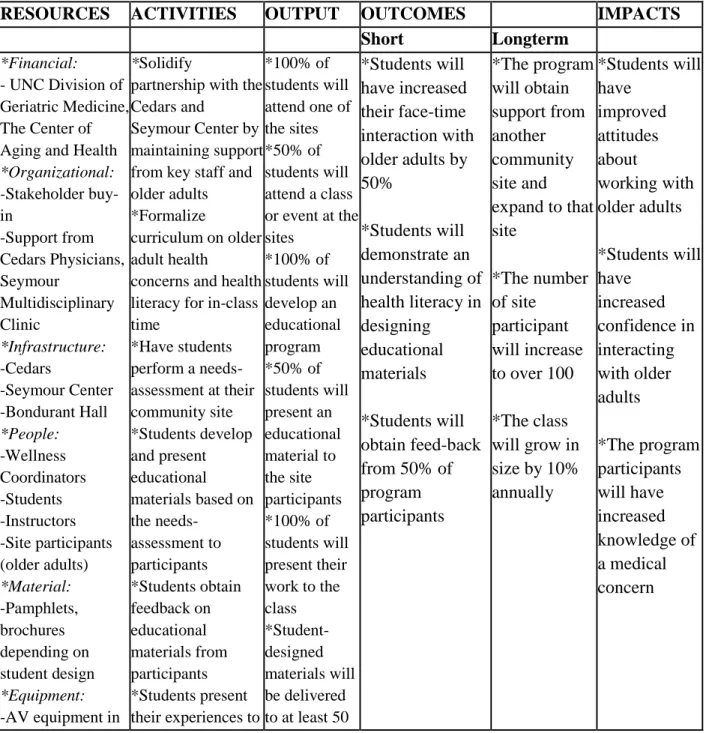
Table 2. Logic Model
RESOURCES ACTIVITIES OUTPUT OUTCOMES IMPACTS
Short Longterm
*Financial:
- UNC Division of Geriatric Medicine, The Center of Aging and Health
*Organizational: -Stakeholder buy-in -Support from Cedars Physicians, Seymour Multidisciplinary Clinic *Infrastructure: -Cedars -Seymour Center -Bondurant Hall *People: -Wellness Coordinators -Students -Instructors -Site participants (older adults) *Material: -Pamphlets, brochures depending on student design *Equipment: *Solidify
partnership with the Cedars and
Seymour Center by maintaining support from key staff and older adults *Formalize
curriculum on older adult health
concerns and health literacy for in-class time
*Have students perform a needs-assessment at their community site *Students develop and present educational materials based on the needs-assessment to participants *Students obtain feedback on educational materials from participants *Students present *100% of students will attend one of the sites *50% of students will attend a class or event at the sites *100% of students will develop an educational program *50% of students will present an educational material to the site participants *100% of students will present their work to the class *Student- designed materials will be delivered *Students will have increased their face-time interaction with older adults by 50%
*Students will demonstrate an understanding of health literacy in designing
educational materials
*Students will obtain feed-back from 50% of program participants *The program will obtain support from another community site and expand to that site
*The number of site
participant will increase to over 100
classroom the class
*Students evaluate the course
older adults at the sites
Detailed Estimate Budget
Budget Year 2 (Post-Pilot Semester)
PERSONNEL Salary %Effort Subtotal
Lead Course Instructor 48,000 5% 2,400.00
Course Instructor #2 96,000 2.5% 2,400.00
TRAVEL N/a
SUPPLIES Description Quantity Cost Subtotal
Posters 4 25 100.00
Brochures 100 2.00 200.00
PROGRAM EVALUATION
The pilot semester of S.L.I.C.E., completed Spring 2012, did not include a quantitative
evaluation component; nonetheless, informal qualitative feedback from the students, instructors,
and older adults revealed strengths and weaknesses in the program plan that will help guide the
post-pilot program plan and evaluation plan.
The Cedars students started the semester with a visit to the Health Center’s Happy Hour,
an hour of entertainment for the members with dementia, which was followed by an interview
with a member who was recovering in the Health Center from a recent surgery. The students
reported that both of these activities provided a helpful introduction to the Cedars. The students
then worked with the Wellness Coordinator to identify the needs of the community. Due to
members’ interests in falls prevention, the students designed and distributed a falls-risk reduction
pamphlet for adults with low or average health literacy to all 400 members of the Cedars
community. The students received positive feedback from approximately 25 older adults; for
example, the older adults appreciated the large font and easy-to-read text. The support and
guidance from the Wellness Coordinator as well as the obvious need for falls prevention
education ensured a successful experience for the students assigned to the Cedars.
Unlike the Cedars students, the Seymour Center students encountered a few challenges.
The students struggled to find a “need” as the Seymour Center appeared inundated with health
education materials and resources. They noted that every health condition had a well-designed
and informative brochure on the wall and that classes were provided on everything from
Facebook to lace-making. The students also felt discouraged that they were unable to visit the
Seymour Center during the busiest hours, mid-morning until after lunch, due to their class
For example, the Cedars Wellness Committee had recently focused its attention on the
dangers of falls. The students assisted this committee in providing educational pamphlets on risk
factors for falls and community resources, such as balance classes and home safety evaluations,
which target these risk factors
Despite these challenges, the instructors noted several significant benefits of including
the Seymour Center as a site. First, the students learned about the outstanding resources
provided at this center to older adults in Chapel Hill. The students educated their classmates
about these resources in their final presentation, which included illustrative pictures of the
beautiful building and grounds, the comprehensive newsletters and pamphlets, and the active and
social older adults. Second, the Seymour Center group learned about and educated their
classmates about the Wellness Clinic, a multidisciplinary free clinic that focuses on screening
and support for memory, mood, and mobility disorders. The students discussed the roles of the
pharmacist, physical therapist, occupational therapist, social worker, and geriatrician in their
final presentation, again informing their classmates about this important resource for older adults
and the benefits of a team-approach to care. Finally, unlike the Cedars, which is a predominantly
white, upper class community, the Seymour Center exposed the students to older adults from a
variety of socioeconomic and racial backgrounds, which is important given one of the objectives
for this curriculum is exposure to the diversity of older adults.
The qualitative feedback from my informal interviews with the students and my
co-instructor this semester, in addition to lessons learned from the mini-systematic review, will
Study Design
The program evaluation for the post-pilot phase will use a mixed approach, relying on
several qualitative and quantitative techniques to ensure a comprehensive assessment of the
program implementation and outcomes. Assessment of the outcomes will be completed using a
quasi-experimental design with pre- and post- surveys. The primary outcomes will be students’
attitudes toward older adults and confidence in working with older adults. A key part of the
survey will be the Carolina Opinions on Care of Older Adults (COCOA), a validated instrument
tested with first year medical students at the University of North Carolina School of Medicine at
Chapel Hill.13 Secondary outcomes will include the number and type of educational products
delivered to older adults in these communities.
Study Methods
The quantitative strategies will include pre-and post-tests and an activity log review. The
pre-test will be administered to the students at the beginning of the semester and will ask
questions regarding the amount of time the students spend at baseline with older adults and the
attitudes the students have toward working with older adults. The post-test delivered at the end
of the semester will evaluate program implementation and outcomes. Both the pre-test and the
post-test will include the COCOA survey. The post-test survey will also include questions
regarding feasibility of the assignments and ways the course could improve. The activity log
review will be completed by the students and will include their activities and hours.
The qualitative strategies include open-ended interviews and document reviews of the
reflection papers and final presentations. Open-ended questions of the medical students,
program implementation for strengths and weaknesses. Review of the reflection papers and final
presentations will provide additional information regarding the success of the program.
The open-ended interviews will be conducted with the students throughout the semester
but particularly at the end of the semester. The students will be prompted to comment on the
barriers to site visitation, utility of attending the class or activity at the site, and amount of time
required to produce their educational product. The students will also have the opportunity to
suggest ways the program could improve to better meet the objectives.
Open-ended phone interviews with wellness coordinators at the end of the semester will
illicit information regarding the types and quality of education materials, as well as the overall
experience of having students at the community sites. The wellness coordinators will be invited
to suggest ways to improve the students’ experience as well as the older adults’ experience.
Given they interact with both the students and the older adults, the wellness coordinators offer a
unique perspective of the course and should be thoughtfully interviewed at the end of the course.
An electronic survey may also gather the needed information from the wellness coordinators, and
this alternative method may be easier given the busy schedules of the wellness coordinators and
the data collectors.
Interviews with the older adults at the community sites will also be part of the evaluation
process. The older adults will be asked for feedback regarding the educational products and any
barriers to receiving the products or interacting with the students. This feedback may be elicited
by the students; however, the students may be biased in their data collection given they created
and distributed the educational products. An alternative method would utilize paper surveys
be interviewed at the end of the second semester regarding the long-term objectives to increase
the number of students enrolled and expand the course to an additional community site.
Document review of the reflection papers and final presentations will augment the
information provided by the open-ended interviews. More concrete information regarding types
and quality of educational materials produced as well as the numbers of older adults reached and
the feedback from the older adults will be shared in these assignments. The students are
encouraged to reflect on their experiences and offer feedback on ways the course could be
improved in their final presentation. This information will be useful evaluating S.L.I.C.E.
Dissemination Plan
At the end of the post-pilot semester, a final report will be written that will include
descriptions of the students’ projects as well as feedback from the students and the community
members. This report will be disseminated to the stakeholders, specifically to the Division of
Geriatric Medicine and the Department of Family Medicine teaching faculty and the wellness
coordinators at the community sites. The wellness coordinators will be encouraged to share the
results with the community members, perhaps through the sites’ monthly or quarterly
newsletters.
Presentations
The curriculum as well as the findings from the pre- and post- surveys from S.L.I.C.E.
will be presented to the Division of Geriatric Medicine teaching faculty at the University of
North Carolina at Chapel Hill during one of the weekly division meetings. If the program
appears to be associated with improved student attitudes and confidence levels, the program will
be potentially be presented regionally or nationally. Abstract summaries of the curriculum will
Reynolds’ Foundation Gerolina meeting, an annual meeting for all of the Reynolds-funded
schools in North and South Carolina. Both of these meetings provide a forum for geriatric
medicine clinician educators to present products and curricula. If accepted, the curriculum could
be presented as a poster or as a workshop describing how to create and evaluate a
service-learning curriculum. Finally, an abstract will be submitted to the American Geriatric Society
meeting for a poster session.
Publications
The first publication will be a web-based curriculum guide for POGOe, an online portal
of geriatric medical education, and MedEdPORTAL, an online peer-reviewed publication service
provided by the Association of American Medical Colleges (AAMC). This guide will include
the syllabus, assignments, and lectures for use at other institutions. The requirements put forth
by both POGOe and MedEdPORTAL will be followed to ensure successful submission.
The second phase of publication will focus on the program plan and evaluation. This
manuscript will discuss the program design, participants, evaluation techniques, and evaluation
results. Potential journals for submission include Medical Teacher, Education in Medicine,
Academic Medicine, Gerontology and Geriatrics Education, and the Journal of American
Geriatric Society.
CONCLUSION
In conclusion, this curriculum serves a critical need in medical student education by
requiring service-learning with healthy older adults in the community, outside of the medical
system. Demographic data indicate that the population in the United States is aging, resulting in
large numbers of older adults in the health-care system. The influx of geriatric patients has
for health professionals Service-learning provides a unique opportunity for medical students to
discover the diversity of older adults and to reflect on these experiences with guidance from a
clinician-educator.
S.L.I.C.E. (Service-Learning in Communities of Elders) is a curriculum for the medical
student elective, MEDI 286, Special Topics on Aging, at the University of North Carolina
School of Medicine at Chapel Hill that introduces first and second-year medical students to older
adults in their communities, outside of the medical system, through service-learning. During the
pilot semester of S.L.I.C.E., important lessons were learned that will guide improvement of the
in-class didactics and creation of evaluation tools for the next phase of the curriculum
development.
Prior to the next phase of S.L.I.C.E., in-class didactic sessions that complement the
service-learning assignments will be improved and formalized. During the pilot semester,
in-class didactics were given on health literacy, sensory and cognitive changes associated with
aging, and falls. Prior to the post-pilot phase, the in-class didactics will need to be enhanced
regarding content and presentation, ensuring that they meet the needs of the students as well as
the requirements for publication (based on POGOe and MedEdPortal guidelines).
Additionally, prior to next semester, surveys for the students and wellness coordinators
will be created that evaluate the program components as outlined in the program evaluation
section of this paper. This data, in addition to data from the pre- and post- COCOA, will
determine the impact of the program, resulting in a stronger program evaluation than those used
The hope is that the end-product will be a formal service-learning curriculum that
improves students’ attitudes toward and knowledge about older adults and can be re-created at
APPENDIX
Definition of Service-Learning: a teaching and learning strategy that integrates meaningful community service with instruction and reflection to enrich the learning experience, teach civic
responsibility, and strengthen communities.16
Evaluation Tables
These tables outline the evaluation plan for the post-pilot phase of S.L.I.C.E.
Short-term Objective 1: (Participant Objective)
By 6 weeks, 50% of students will have visited either the Cedars Retirement Community
or the Seymour Senior Center.
Evaluation Questions Participants Evaluation Methods By 6 weeks, had 50% of the students
visited the Cedars Retirement Community or the Seymour Senior Center?
Students Feedback during class time via open-ended questions, activity logs, survey at 6 weeks or the end of the semester
What were the barriers to the visitation, i.e. site’s schedule, transportation, competing demands?
Students Feedback during class time via open-ended questions, survey at 6 weeks or the end of the semester
How could the visitation be improved, i.e. meet with Wellness Coordinator, attend the Seymour Wellness Clinic?
Students Feedback during class time via open-ended questions, survey at 6 weeks or the end of the semester
How many students (percentage) had visited by six weeks?
Students Feedback during class time via open-ended questions, survey at 6 weeks or the end of the semester
Short-term Objective 2: (Participant Objective)
By 6 weeks, 50% of students will have participated in a class or activity at the site.
By 6 weeks, had 50% of the students participated in a class or activity at the sites?
Students Feedback during class time via open-ended questions, survey at 6 weeks or the end of the semester
What classes and activities did the students attend? Why did the students choose these activities?
Students Feedback during class time via open-ended questions, survey at 6 weeks or the end of the semester
Did the students benefit from attending these classes and activities, i.e. social cohesion, self-efficacy, knowledge about the sites, information to guide the needs assessment?
Students Feedback during class time via open-ended questions, survey at 6 weeks or the end of the semester, first reflection paper, final
presentation
How many of the students (percentage) attended a class or activity at the sites? Why did some of the students not attend a class or activity?
Students Feedback during class time via open-ended questions, survey at 6 weeks or the end of the semester
Do the sites support the students’ visitation of the classes and activities? How were the students supported?
Students, Wellness Coordinators
Feedback during class time via open-ended questions, survey at 6 weeks or the end of the semester, open-ended phone interview with the wellness coordinators
What were the barriers to the visitation of the classes, i.e. site’s schedule, transportation, competing demands?
Students Feedback during class time via open-ended questions, survey at 6 weeks or the end of the semester
How could the activities/classes be improved, i.e. provide a calendar, recommend classes, require a specific class?
Students Feedback during class time via open-ended questions, survey at 6 weeks or the end of the semester
Short-term Objective 3: (Participant Objective)
By 6 weeks, students will have increased their face-time interaction with older adults by
at least 50%.
What was the initial contact time with older adults prior to the semester?
Students Initial survey
By 6 weeks, did students increase their face-time with older adults by at least 50%?
Students Analysis of activity/time log, survey at 6 weeks or the end of the semester
Were students interacting with older adults outside of the required sessions?
Students Analysis of activity/time log, survey at 6 weeks or the end of the semester
How many hours were students spending with older adults as part of the class requirements?
Students Analysis of activity/time log, survey at 6 weeks or the end of the semester
Short-term Objective 4: (Participant Objective)
At the end of the semester, 100% of students will have visited either the Cedars
Retirement Community or the Seymour Senior Center.
Evaluation Questions Participants Evaluation Methods By the end of the semester, had 100% of the
students visited the Cedars Retirement Community or the Seymour Senior Center?
Students Feedback during class time via open-ended questions, activity logs, end-of-semester survey
How many times did the students visit their assigned site?
Students Feedback during class time via open-ended questions, activity logs, end-of-semester
survey
Did the students feel that the number of visits sufficiently introduced them to the site? Why or why not?
Students Feedback during class time via open-ended questions, end-of-semester
survey
At the end of the semester, 100% of students will demonstrate knowledge of health
literacy and a medical concern of older adults by designing an appropriate educational material.
Evaluation Questions Participants Evaluation Methods By the end of the semester, had 100% of
the students demonstrated knowledge of health literacy and a concern of older adults by designing an appropriate educational material?
Students, instructors
End-of-semester presentation, pre- and post- survey, open-ended phone interview with the instructors
What were the barriers in completing the appropriate educational materials, i.e. cost, time, insufficient didactics?
Students, instructors, wellness coordinators
Feedback during class time via open-ended questions, survey at the end of the semester, open-ended phone interview with the wellness coordinators
What led to the best quality of educational materials?
Students Feedback during class time via open-ended questions, survey at the end of the semester
Did the students gain other benefits besides knowledge of health literacy and the medical condition, i.e. teamwork experience, poster design experience?
Students Feedback during class time via open-ended questions, survey at the end of the semester, pre- and post- survey
Short-term Objective 6: (Process Objective)
At the end of the semester, student-designed educational materials will be delivered to at
least 50 older adults at the sites.
Evaluation Questions Participants Evaluation Methods By the end of the semester, had
student-designed educational materials been delivered to at least 50 older adults at the sites?
Students Analysis of activity logs, of-semester presentation, end-of-semester survey
quality of educational materials? What types of materials were created?
wellness coordinators
with the wellness coordinators and instructors
What were the barriers to delivering the educational materials, i.e. location, scheduling conflicts, transportation?
Students Feedback during class time via open-ended questions, end-of-semester survey
How many older adults received the educational materials?
Students Analysis of activity logs, end-of-semester presentation
Short-term Objective 7: (Process Objective)
At the end of the semester, at least 25 older adults will provide the students with feedback
on the educational material.
Evaluation Questions Participants Evaluation Methods By the end of the semester, had at
least 25 older adults provided the students with feedback on the educational material?
Students, older adults
Feedback during class time via open-ended questions, end-of-class
presentation, end-of-semester survey at the end of the semester, paper survey to older adults
What were the barriers to obtaining this feedback, i.e. time, comfort level of students, willingness of older adults?
Students, older adults
Feedback during class time via open-ended questions, end-of-class presentation, survey at the end of the semester, paper survey to older adults
Did the students gain other feedback from the participants regarding their professionalism, communication styles, or appearance?
Students Feedback during class time via open-ended questions, end-of-class presentation, survey at the end of the semester
How many older adults provided feedback?