Studies on carcinogenic effect on the veterans of
taking atmospheric nuclear weapons testing troops in
Gansu, China
INTRODUCTION
In recent years, much work and substantial monetary expenditures have been devoted to reducing radiation exposure from radiography and other medical procedures. The basis for that statement is the linear no-threshold theory of radiation carcinogenesis, it is commonly stated that “any radiation dose, no matter how small, can cause cancer”. The basis for that statement is
the linear-no threshold theory (LNT) of
radiation carcinogenesis. Thus the cancer risk is not zero regardless of how small the exposure (1,
2, 3).
Nuclear energy, safety, and health have become of the public concern after Fukushima
nuclear accident. For the accident, low-dose radionuclides are long-standing in the environment, and the change of environmental
radiation background may affect the health conditions of local residents.
It has been almost over 50 years since the
G. Liu
*, R. Zhang, l. Niu, Y. Li, X. Wu, Y. Liu
Gansu province center for disease control and prevention, Lanzhou, Gansu, China
ABSTRACT
Background:To explore the carcinogenic effect about the veterans of taking atmospheric nuclear weapons testing troops in Gansu, China. Materials and Methods: During 2005-2014, all the veterans of taking atmospheric nuclear weapons testing troops were required to have a medical examination in Gansu, 3721 veterans were requested to make an occupational health examination. They were exposed the radioactive fallout particles from atmospheric nuclear burst (the total β radioactive substances and the radio-nuclides: 3H, 90Sr, 137Cs, 239Pu, 99Mo 95Zr,97Zr,131I,133I,and 132Te etc.), they were away from testing sites 10-30 Km. Cancer patients were required to provide the in-patient case history and check pathologically report. For part of the veterans, the level of radiation dose was 100-150mSv. Results:
There were 40 primary tumor and 25 malignant tumors, incidence rate was 1075 /105 and 672/105; The cancer incidence of the transportation corps was 1253 /105, average age was 48.08 years, average service life was 6.08 years; The cancer incidence of the engineering corps is 762 /105,average age is 55.56 years, average service life was 5.48 years; The comparison of the cancer incidence was shown that the trend of escalation about the cancer incidence along with the servicing year increase; In order of the cancer incidence: gastric cancer, lung cancer, carcinoma of colon, esophagus cancer, rectum cancer and skin cancer, the incidence rate was remarkably increasing (p<0.01). Conclusion: It was shown that the trend of escalation about the cancer incidence along with the servicing year increase, the first was neoplasms of digestive system; it may be due to the contaminated radioactive materials transferred through the digestive tract, hence leading to in vivo irradiation.
Keywords: Radioactive fallout, carcinogenic effect, cancer incidence, the veterans, late effect of radiation.
*Corresponding authors: Dr. Gang Liu,
Fax: + 86 0931-8264944 E-mail: [email protected]
Revised: January 2019
Accepted: March 2019
Int. J. Radiat. Res., October 2019; 17(4): 683-688
►
Short Report
DOI: 10.18869/acadpub.ijrr.17.3.683
first atmospheric nuclear weapons testing in china,According to the international common
practice, the lowest natural morbidity of leukemia which is caused by the nuclear radiation and the increasing morbidity of thyroid cancer have been used for evaluating the nuclear radiations carcinogenic effect (4, 5,6).
Dependence of latent period on dose, leukemia was the first cancer to be associated
with atomic bomb radiation exposure, with preliminary indications of an excess among the survivors within the first five years after the bombings (4, 5). An excess of solid cancers became
apparent approximately ten years after radiation exposure. With increasing follow-up,
excess risks of most cancer types have been observed, the major exceptions being chronic lymphocytic leukemia, and pancreatic, prostate and uterine cancer, etc. (7,8,9).
This study tried to explore the carcinogenic effect on the veterans of taking atmospheric nuclear weapons testing troops in Gansu, China. During 2005-2014, all the veterans of taking atmospheric nuclear weapons testing troops in
Gansu were required to have a medical examination. They were exposed the radioactive
fallout particles from atmospheric nuclear burst (the total β radioactive substances and the radio -nuclides: 3H, 90Sr, 137Cs, 239Pu, 99Mo, 95Zr, 97Zr, 131I, 133I, and 132Te etc.), they were away from testing sites 10-30Km.Cancer patients were required to provide the in-patient case history and check pathologically report, 3721 veterans were had a occupational health examination. Part of the veterans, the level of radiation dose was 100-150mSv.the median age of patients in this trial was 53.95 years (range, 25-82 years). Male: 3704, female: 17, the mean service life is 5.36 years; the female service life is 4.12 years.
MATERIALS AND METHODS
Study subjects
During 2005-2014, all the veterans of taking atmospheric nuclear weapons testing troops in
Gansu were required to have a medical examination. They were exposed the radioactive
fallout particles from atmospheric nuclear burst (the total β radioactive substances and the radio -nuclides: 3H, 90Sr, 137Cs, 239Pu, 99Mo 95Zr, 97Zr, 131I, 133I, and 132Te etc.), they were away from testing sites 10-30 Km. Cancer patients were required to provide the in-patient case history and check pathologically report, 3721 veterans were had a occupational health examination. Part of the
veterans, the level of radiation dose was 100-150mSv.the median age of patients in this
trial was 53.95 years (range, 25-82 years). Male: 3704, female: 17, the mean service life is 5.36 years; the female service life is 4.12 years.
Statistical analysis
SPSS (Statistical Package for the Social Sciences, Chicago, IL, USA) version 21.0 was used for statistical analysis. It is adopted to investigate the incidence of cancer by retrospective and prospective cohort studies.
Calculated the total person-year and analyzed the relative risk of malignant tumor using poison regression model. In order to lessen logical error, it’s better to generate dedicated data entry program when entering data by keyboard. Verify the cases one by one to make no mistakes. It’s exploratory to analysis the radiobiological effect
by using poison regression technology to statistical analysis.
RESULTS
Tumor and the incidence rate
The radioactive fallout’s carcinogenic effect was the most serious posterior capsular opacity in radioactive fallout hazards. According to the in-patient case history and pathological diagnosis report, there were 40 primary tumor and 25 malignant tumors, incidence was 1075/105 and 672/105, there were 8 thyroid tumor and 7 other cancers, incidence rate was 215/105 and 188/105. The distribution features of the cancer incidence by the subject, digestive cancer 60%, lung cancer 16%, other kinds of cancer 24%. It was shown that the main cancer incidence was related to digestive system (table 1).
Tumor and the incidence rate by the service life and the arms
The comparison of the cancer incidence that the trend of escalation about the cancer incidence along with the servicing year increase
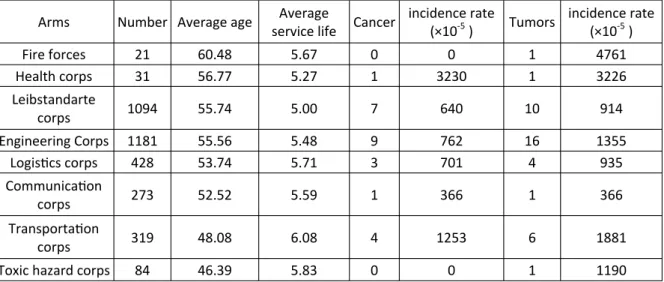
(table 2). The cancer incidence of the transportation corps is 1253/105, average age
was 48.08 years, and average service life was 6.08 years.
The cancer incidence of the engineering corps was 762/105, average age was 55.56 years, average service life was 5.48 years; the cancer incidence assumed the trend of escalation along
with the servicing year increase (table 3).
Comparison of malignancy’s incidence rate
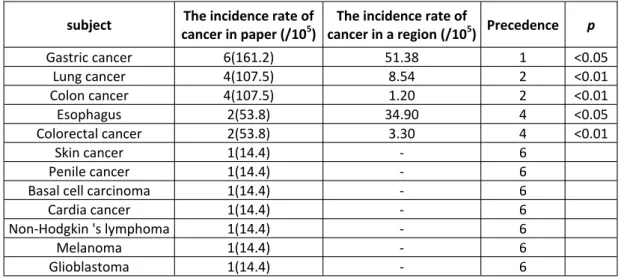
It was shown that the cancer incidence is increasing. The decreasing order of cancer incidence was gastric cancer, lung cancer, carcinoma of colon, esophagus cancer, rectum cancer and skin cancer.
It’s inconsistent in the aspect of the the veterans to compare with residents’ in Jiu quan. The lung incidence is obviously increasing (table 4).
685
Int. J. Radiat. Res., Vol. 17 No. 4, October 2019Table 1. The distribution features of tumor and the incidence rate
Table 2. The distribution features of tumor and the incidence rate by the service life.
Table 3. The distribution features of tumor and the incidence rate by the arms.
Servicing year Number Average age Cancer incidence rate (×10-5 ) Tumors incidence rate (×10-5 )
<4 689 44.98 4 581 7 1016
4 909 49.40 0 0 4 440
5 762 55.05 11 1443 14 1837
6 828 63.44 6 725 8 966
7 229 63.04 2 873 3 1310
≥8 306 49.85 2 654 4 1307
Servicing year Number Average age Cancer incidence rate (×10-5 ) Tumors incidence rate (×10-5 )
<4 689 44.98 4 581 7 1016
4 909 49.40 0 0 4 440
5 762 55.05 11 1443 14 1837
6 828 63.44 6 725 8 966
7 229 63.04 2 873 3 1310
≥8 306 49.85 2 654 4 1307
Arms Number Average age Average service life Cancer
incidence rate
(×10-5 ) Tumors
incidence rate (×10-5 )
Fire forces 21 60.48 5.67 0 0 1 4761
Health corps 31 56.77 5.27 1 3230 1 3226
Leibstandarte
corps 1094 55.74 5.00 7 640 10 914
Engineering Corps 1181 55.56 5.48 9 762 16 1355
Logistics corps 428 53.74 5.71 3 701 4 935
Communication
corps 273 52.52 5.59 1 366 1 366
Transportation
corps 319 48.08 6.08 4 1253 6 1881
Toxic hazard corps 84 46.39 5.83 0 0 1 1190
DISCUSSION
Multiple epidemiological studies on residents’ health conditions after the event and
animal studies on low level radiation exposure have been reported. Other articles focused on
the dose threshold of low dose radiation, absorbing and distribution of radionuclides in
human body, molecular mechanism of radionuclides’ carcinogenicity, and dose-effect
extrapolation model. Research progress of epidemiological studies on residents’ health conditions after other nuclear events was also reviewed (11). On basis of the criteria of data quality from NCCR, data submitted from 261 registries were checked & evaluated, and 193 registries data qualified for cancer registry annual report. Descriptive analysis included of incidence and mortality stratified by areas (urban/rural), gender, age group and cancer site. The top 10 common cancers in different groups, proportion and cumulative rate were also calculated. Chinese population census in 2000 and Sega’s population were used for age-standardized incidence/mortality. All 193 cancer registries (74 in urban and 119 in rural) covered a total of 198 060 406 population (100 450 109 in urban and 97 610 297 in rural areas). The estimates of new cancer cases and cancer deaths were 3586 thousands and 2187
thousands in 2012, respectively. The morphology verified cases (MV%) accounted for
69.13% and 2.38% of incident cases were identified through death certifications only (DCO%) with mortality to incidence ratio of 0.62. The crude incidence rate in Chinese cancer registration areas was 264.85/105 (males 289.30/105, females 239.15/105),
age-standardized incidence rates by Chinese standard population(ASIRC) and by world
standard population were 191.89/105 and 187.83/105 with the cumulative incidence rate (0~74 age years old) of 21.82%. The cancer incidence and ASIRC were 277.17/105 and 195.56/105 in urban areas whereas in rural areas, they were 251.20/105 and 187.10/105. respectively. The cancer mortality in Chinese cancer registration areas was 161.49/105
(198.99/105 in male and 122.06/105 in female), age-standardized incidence by Chinese
standard population (ASMRC) and by world standard population were 112.34/105 and 111.25/105, and the cumulative incidence rate (0~74 age years old) was 12.61%. The cancer mortality and ASMRC were 159.00/105 and 107.23/105 in urban areas, whereas in rural areas, they were 164.24/105 and 118.22/105
respectively. (11).
Data on morbidity and mortality of malignant tumors and central nervous system benign tumors among the resident population of Lanzhou City during 2005 and 2007 was collected by using the methods of cancer registration reports (12). The number of new Table 4. The comparison of malignancy’s incidence rate.
subject The incidence rate of cancer in paper (/105)
The incidence rate of
cancer in a region (/105) Precedence p
Gastric cancer 6(161.2) 51.38 1 <0.05
Lung cancer 4(107.5) 8.54 2 <0.01
Colon cancer 4(107.5) 1.20 2 <0.01
Esophagus 2(53.8) 34.90 4 <0.05
Colorectal cancer 2(53.8) 3.30 4 <0.01
Skin cancer 1(14.4) - 6
Penile cancer 1(14.4) - 6
Basal cell carcinoma 1(14.4) - 6
Cardia cancer 1(14.4) - 6
Non-Hodgkin 's lymphoma 1(14.4) - 6
Melanoma 1(14.4) - 6
Glioblastoma 1(14.4) - 6
687
Int. J. Radiat. Res., Vol. 17 No. 4, October 2019cancer cases, crude incidence and other indexes were calculated. Results between January 1, 2005 and December 31, 2007, a total of 10 594 cases of malignant tumors were reported in Lanzhou City. The overall incidence of malignant tumors was 204.39/105 (229.29/105 and
177.52/105for male and female, respectively).Age-adjusted incidence of malignant tumors by Chinese standard population was 164.98/105, it was 29.16% higher in male (191.51/105) than in female (138.51/105) (12).
In 1986 ,12 survey township population in jiu quan is 114290 people, male 59086, female 55204 people.12 years accumulative total population of 1276144 years, Malignant tumor
mortality rate of 85.57/105, standardized mortality rate of 103.06/105.Among them, 549
people died of cancer of the stomach, standardized mortality rate of 52.61/105, the
first of malignant tumor mortality. The second was the esophageal cancer and liver cancer. Leukemia deaths in 436, standardized mortality rate of 3.64/105, accounted for fourth place.
The comparison of cancer and malignancy’s incidence rate, this paper is shown that the malignant tumors incidence rate was 672/105, the comparison of the cancer incidence between the veterans and residents’ in Jiu quan, Lanzhou and China, the incidence rate is remarkably increasing (p<0.01). It is shown that the cancer incidence is increasing. The order of cancer incidence was gastric cancer, lung cancer, carcinoma of colon, esophagus cancer, rectum cancer and skin cancer. It’s inconsistent in the
aspect of the veterans to compare with residents’ in Jiu quan. The lung incidence was
obviously increasing.
CONCLUSION
This study is shown that the trend of escalation about the cancer incidence along with
the servicing year increase; in order of the cancer incidence: gastric cancer, lung cancer, carcinoma of colon, esophagus cancer, rectum cancer and skin cancer. The first was digestive
cancer, that the contaminated radioactive material was transferred through the digestive tract entering in vivo and irradiation. The lung
incidence was obviously increasing. The comparison of the cancer incidence, the incidence rate was remarkably increasing.
Conflicts of interest: Declared none.
REFERENCES
1. Barrington A, Darby SC, Weiss HA, and Doll R (2001) 100 years of observation on British radiologists; mortality from cancer and other causes, 1897-1997. Br J Radiol, 74: 507-519.
2. Bonner WN (2004) Phenomena leading to cell survival val-ues which deviate from linearquadratic models. Mutation Res, 568: 33-39.
3. Feinendegen LE (2005) Evidence for beneficial low level radiation effects and radiation hormesis. Brit J Radiol, 78: 3-7.
4. Feinendegen LE (2005a) Low doses of ionizing radiation: relationship between biological benefit and damage in-duction, a synopsis. World J Nuc Med, 4: 21-34.
5. Japanese Society for Radiation Oncology. Regular structur-al survey by JASTRO. [Internet]. 2011 [Cited 2016 May 21]. 6. Scorsetti M, Alongi F, Castiglioni S, Clivio A, Fogliata A, Lobefalo F, Mancosu P, Navarria P, Palumbo V, Pellegrini C, Pentimalli S, Reggiori G, Ascolese AM, Roggio A, Ar-cangeli S, Tozzi A, Vanetti E, Cozzi L (2011) Feasibility and early clinical assessment of flattening filter free (FFF) based stereotactic body radiotherapy (SBRT) treatments. Radiat Oncol, 6: 113.
7. Simard EP, Torre LA, Jemal A (2014) Interna_onal trends in head and neck cancer incidence rates: differences by country, sex and anatomic site. Oral Oncol, 50: 387-403. 8. Rathy R, Sunil S, Nivia M (2013) Osteoradionecrosis of
mandible: Case report with review of literature. Contemp ClinDent, 4: 251-253.
9. Sobin LH, Gospodarowicz MK, WiPekind Ch (2009) Interna
-onal Union against Cancer (UICC) TNM Classifica_on of Malignant Tumour.7th ed. Wiley-Blackwell, the United State of America.
10. NCI Common Terminology Criteria for Adverse Events v4.0 (CTCAE). National Cancer Institute, USA. Accessed Jul 17, 2015.
11. Chen WQ, Zheng RS, Zhang SW, Zen HM, Zuo TT, Jia MM, Xia CF, Zou XL, Hao J (2016) Report of Cancer Incidence and Mortality in China 2012. China Cancer, 25(1): 1-8. 12. Wang XH, Zhang XD, Li HL, Liu YQ (2012) Cancer
epidemiol-ogy research center, Gansu medical science institute, Lan-zhou 730050, China explores the incidence, trend and the
spectrum of tumors in Lanzhou City, 2005-2007. Chinese Journal of Disease Control & Prevention, 02: 50-56. 13. Dutta D, Balaji Subramanian S, Murli V, Sudahar H,
Gopala-krishna Kurup PG, Potharaju M (2012) Dosimetric compar-ison of Linac-based (BrainLAB(R)) and robotic radiosurgery (Cyber Knife (R)) stereotactic system plans for acoustic schwannoma. J Neurooncol, 106: 637-642.
14. Feuvret L, Noel G, Mazeron JJ, Bey P (2006) Conformity index: a review. Int J Radiat Oncol Biol Phys, 64: 333-42. 15. Chaturvedi AK, Anderson WF, Lortet-Tieulent J, Curado
MP, Ferlay J, Franceschi S, Rosenberg PS, Bray F, Gillison ML (2013) Worldwide trends in incidence rates for oral
cavity and or pharyngeal cancers. J Clin Oncol, 31: 4550-4559.
16. Simard EP, Torre LA, Jemal A (2014) International trends in head and neck cancer incidence rates: differences by country, sex and anatomic site. Oral Oncol, 50: 387-403. 17. Rathy R, Sunil S, Nivia M (2013) Osteoradionecrosis of
mandible: Case report with review of literature. Contemp ClinDent, 4: 251-253.
18. Sobin LH, Gospodarowicz MK, WiPekind Ch (2009) Interna-tional Union against Cancer (UICC) TNM Classification on of Malignant Tambours. 7th ed. Wiley-Blackwell, the Unit-ed States of America.