
Cable vibration caused by wind
Irena Golebiowska1,a,Kazimierz Peszynski21UTP University of Science and Technology, Faculty of Civil Eng., Al. prof. S. Kaliskiego 7, 85-796 Bydgoszcz, Poland 2UTP University of Science and Technology, Faculty of Mech.Eng., Al. prof. S. Kaliskiego 7, 85-796 Bydgoszcz, Poland
Abstract. The paper briefly presents selected basic kinds of excitation of cable vibration caused by dynamic effect of wind. It describes the aerodynamic phenomena such as vortex excitation, wind-rain excitation, galloping and buffeting. Cables are structures which are characterised by low internal damping, low rigidity and low weight, so they are not capable of total excitation energy dissipation, hence they can reach large amplitudes of vibration. Large amplitude of vibration causes excessive stress, thereby lowering the safety of the structure.
1 Introduction
In the twentieth century, along with the evolution of new materials, technologies and advanced calculation methods, modern bridges with long spans are being built. Jiashao Bridge (2800 m, 2013, China) is currently the longest and the widest six-pylon cable-stayed bridge in the world, while Messina bridge (3300 m, Italy), designed in the 90s of the twentieth century, will be the longest suspension bridge.
Increase of span length of such bridges requires the installation of increasingly longer cables. The cables are extremely sensitive to dynamic excitation due to low internal damping, high flexibility, light mass. Therefore, they can reach high vibration amplitudes. These high oscillations can cause fatigue destruction of the cables and/or damages at the mounting points.
The measurements of internal cable damping of cable-stayed bridges in Japan show a low level of structural damping, approximately 0.1% of critical damping (Fig. 1) [1].
Even though many various tests (observation, tunnel tests, numerical simulations etc.) regarding the understanding of cable vibration excitation mechanisms (mainly of inclined cables), have been carried out, some of phenomena still need to be explained.
Types and level of vibration depend on cable structural properties (damping, stiffness, mass), wind force conditions and interaction between wind and cables.
There are several types of cable vibration induced by wind [2]:
– Vortex excitation of an isolated cable or groups of cables;
– Wake galloping of groups of cables;
– Galloping of a single inclined cable to the direction of wind;
– Rain- and wind-induced vibration of cables; – Galloping of ice-covered cables;
– Galloping of cables in a wake of other structural elements;
– Motion due to turbulent buffeting; – Motion due to fluctuating cable tensions;
– Cable vibration induced by aerodynamic excitation of a bridge.
In order to assume an effective and efficient method of lowering the level of cable vibration, we need to have deep understanding of physical phenomena that take place under the influence of wind.
The paper describes basic types of cable vibration caused by wind, observable only in the cables of long-span bridges (suspension and cables-stay): vortex excitation, vortex excitation at high velocity, rain-wind induced excitation, galloping, galloping of dry inclined cables, wake galloping for groups of cables and buffeting.
2 Vortex excitation
Vortex excitation is characterised by vibration with limited amplitude occurring at relatively low velocities of wind. Vortex-induced cable vibrations are common and it is known that amplitudes of these vibrations are small and rarely reach the size of the cable cross-section [3].
Excitation of a single cable induced by vortexes occurs as the vortexes alternately detach from either side of the cable (vortex shedding) when the wind direction makes an approximately right angle with the cable axis. Occurrence and detachment of vortexes create oscillatory transverse force to the wind direction. Vortex shedding generates a periodic asymmetric flow, which is known as Karman vortex street. The frequency of vortex detaching is proportional to the wind velocity and inversely proportional to the diameter of cable cross-section. This type of vibration is particularly dangerous when the vortex shedding frequency fs is similar or
equal to the any engine-frequency of cablefci; resonance
will occur and the cable will be excited (Fig. 1).
Fig. 2. Lock-in phenomenon during vortex excitation.
The vortex resonance leads to strong interaction of cables with the surrounding flow when the critical velocities of wind Ucri is reached. An increase of the
flow velocity by a few percent does not change the shedding frequency which coincides with the natural frequency of cable. This phenomenon of synchronisation is referred to as the lock-in state.
Williamson and Roshko [4] studied the effect of the amplitude and frequency of oscillations on a wake of an oscillating cylinder, forced to translate in a sinusoidal trajectory. They gave a map showing when the various vortex patterns would occur using a non-dimensional wavelength - amplitude plane. The Reynolds number was not defined as an independent parameter in the study. The Reynolds number was kept within a certain range 300<Re<1000, but was never held fixed.
Each of periodic vortex wake pattern consisted of single vorticed (S) and vortex pairs (P), leading to combinations such as 2S (similar to the classical Karman vortices), 2P and P+S modes, which are the principal modes near the fundamental lock-in region. At the critical wavelength only two vortices are formed in each
cycle, resulting in more concentrated shed vorticity than at other wavelengths. Larger forces are induced by the shedding of more concentrated vorticity. This state is called a resonant synchronisation. Figure 3 shows the mapping of different patterns, or modes identified as functions of non-dimensional amplitude and wavelength (frequency).
Fig. 3. Map of vortex synchronisation patterns near the fundamental lock-in region, A/D is the amplitude ratio and /D is the wavelength ratio. The critical curve represents the transformation from one mode of vortex formation to another. Curves I and II represent locations of a sharp jump of the forces (acting) on the body [4].
3 High-speed vortex excitation
High-speed vortex excitation is characterised by limited amplitude of vibration, occurring for a restricted interval of wind velocities in the critical Reynolds number range.
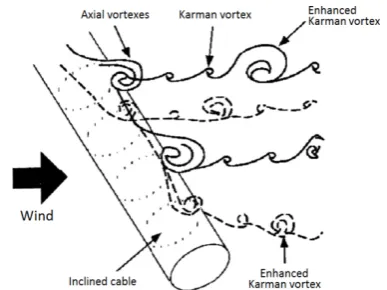
Vortex excitation of dry inclined cables at high wind velocities has been investigated, among others, by Matsumoto [5]. Their research demonstrates that this type of excitation is related to the interaction of Karman’s conventional two-dimensional vortexes with the axial vortexes which shed in a wake of the inclined cable, generating an amplified vortex once after every three Karman vortexes (Fig. 4). Frequency of the axial vortex shedding is approximately one-third of the conventional Karman frequency.
Axial vortex is proven by a wake of yawed cylinder of flow visualisation tests (Fig. 5)
Fig. 5. Visualised axial vortex in a wake of inclined cable (without end plate, =45o, V=0,5 m/s in smooth flow) [6].
Axial flow interrupts the interaction between two separated shear layers in a wake of the cable. This effect leads to the mitigation of Karman vortexes. The Karman vortex shedding suppression increases the sensitivity of separated flow to external excitation like body motion, resulting in enhancement of the instability [6, 7].
3 Rain-wind excitation
The rain - wind vibration induced instability are limited amplitude - type vibration.
Rain and wind induced vibration occurs under certain wind velocity range. However, only during rains and only on inclined cables. Vibration can reach high amplitudes at low frequencies.
During windy and rainy weather, on the surface of an inclined cable, water trickles as a single drop at low wind velocities, but these drops are knocked from the cable at high velocities. Only in a certain range of medium velocity, it is possible that along the surface of a cable, a rivulet of water will occur. Hikami et al. [8] noticed that when the wind velocity is low during the rain, raindrops gather on a cable forming a rivulet at the bottom part of a cable. The rivulet oscillates circumferentially with the same frequency as the vibrating cable. When wind velocity gets between 8 and 15 m/s, the second rivulet forms at the top of a cable. The rivulets oscillate with the same frequency of the cable movement.
Results of research in a wind tunnel carried out by Hikami, Y., Shiraisi N. demonstrate that the second rivulet occurred on the top windward surface of the cable and the occurrence of this second rivulet was related to the wind velocity. When the wind velocity was increased to a certain value, rain drops overcame the forces of friction and gravitation, forming the top rivulet [8]. The dependence between the angle of forming rivulets, their aerodynamic forces, and wind velocity is presented in Fig. 6.
Fig. 6. Variations of the angle of water rivulets and their aerodynamic forces with wind velocity [8].
Then, the oscillation of a single bottom water rivulet took place on the lee side of the cable. However, when the wind velocity exceeded 19 m/s, oscillations of both water rivulets, top and bottom, were observed [9]. According to Verwiebe, water rivulets circumferentially oscillate on the cable. The rivulet flow is affected by interaction, structure - liquid and forces acting on them. Changing the location of rivulets causes a continuous variation of cable cross-section, which leads to change of aerodynamic forces acting on the cable.
Fig. 7. Three mechanisms of rain-wind excitation, a) vibration within the wind direction, b) transverse vibration to the wind direction (two rivulets), c) transverse vibration to the wind direction (one rivulet) [9].
According to Matsumoto, the cables of cable-stayed bridges can be aerodynamically forced by three main factors: the top rivulet on the cable, axial flow in a close wake of inclined / yawed cable and Reynolds number (in the critical Reynolds number range) [10]. These factors can cause mainly unsteady galloping. However, the formation of a rivulet in a specific location can generate significant slope of the lift force (ie.
dCL d0 and may consequently cause quasi – steady
galloping [10]
Fig. 8. Factors considered in the aerodynamics of inclined cables [11].
Fig. 8 illustrates factors considered in the aero-dynamics of inclined cable during rain-wind excitation.
According to experimental studies carried out by Saito, vibration induced by rain and wind may be reduced to an acceptable level, assuming that the Scruton number (S m D2, where m – cable mass per unit
of length, – damping as ratio of critical damping, – air density [kg/m3], D – cable diameter [m]), is higher
than 10. Based on this criterion, we may determine the damping level which must be added to the cable in order to reduce vibration caused by this excitation [12], [13].
Although there are many causes of excessive cable vibration, around 95% of all reported problems with cable-stay bridges were caused by rain-wind excitation, according to literature.
Despite numerous analytical and experimental studies carried out by many scientific institutes, the basic physical mechanisms of this phenomenon are still unclear.
4 Galloping
Galloping is an aeroelastic self-excited phenomenon, characterized by low frequencies and high amplitudes. It was observed for the first time on ice-covered power lines subject to strong wind. Galloping is a typical instability induced by the coupling of aerodynamic forces, which affect the structure along with its vibration. Vibration of the structure periodically changes the angle of attack of wind. Changes in the angle of attack induce change in aerodynamic forces affecting the structure, changing the structure’s response. The first simplified criterion (assuming the model of a single-degree-of-freedom system) with regard to the instability connected with galloping was introduced by Glauert-Den Hartog and is as follows:
L D
0
0
dC C
d
(1)
where: is the angle of attack, CL and CD are
circular cross-section cannot gallop, because of its geometrical symmetry
dC dL 0
unless thecross-section is changed. Ice accumulation on a cable causes changes in its cross-section and, as a result, it leads to the cable’s aerodynamic instability.
According to Matsumoto [10], Den Hartog criterion is not always an essential condition for unsteady galloping.
4.1. Dry inclined cables galloping
Galloping of dry inclined cables is a new term within wind engineering, invented in the 80s. Single cables with circular cross-sections do not gallop if they are situated perpendicularly to the wind direction. However, if the wind velocity has a component which is not perpendicular to cable axis, we can observe an instability with the same features as galloping. Cables then make an elliptical motion. In the case of a single inclined cable, wind affects its elliptical cross-section [2]. Nakamura demonstrates that the mechanism which induces galloping is a broken connection between the upper and lower flow. Connection of these two separated flows may cause zero pressure difference at the top and bottom surface of a cylinder [14]. According to Matsumoto, “dry” galloping may be boiled down to two different mechanisms: quasi - steady galloping (divergent type) and unsteady galloping. The first mechanism corresponds to the conventional galloping and its responses may be explained with the quasi-steady theory. Unsteady galloping takes place when the mitigation of the Karman vortexes is insufficient and non-stationary and the amplitude of the response is changeable due to the fluctuation of Karman vortexes intensity [7, 15]. Unsteady cross-flow response of yawed / inclined cables at lower, reduced velocity than reduced velocity of divergent, according to Matsumoto, should be a kind of unsteady galloping which is generated by unsteady intensity of Karman vortex due to unsteady axial flow [10]. The possibility of forcing the divergent-type galloping of inclined cables was confirmed by numerous experimental studies carried out by Saito, with the assumption that the angle between a cable axis and wind direction ranged from 30° to 60° and the level of damping was low [13].
Fig. 9. Dependence between wind velocity and Scruton number [2].
For the engineering purposes, FHWA (Federal Highway Administration) proposes an original diagram of dependencies between wind velocity and Scruton number, used for specifying required level of damping [2].
Figure 9 illustrates the results of experimental studies conducted by FHWA and compares them with the instability line determined by Saito. The research suggests that even at low levels of damping ( 0.003), vibration caused by vortex shedding and galloping of inclined cables are insignificant. Such level of damping corresponds to the Scruton number amounting to approximately 3, which is lower than the minimum required to reduce the level of vibration caused by rain and wind. As illustrated in Figure 9, there is a big difference between both criteria. According to Matsumoto, FHWA criterion and Saito criterion correspond respectively to steady galloping and unsteady galloping. Parameters regulating the intensity of axial flow, as well as the mechanism of its occurrence have not been explained yet. However, it is known that cable inclination causes axial flow, which is the reason for the instability of aerodynamic phenomena.
4.2 Wake galloping for groups of cables
Wake galloping is an elliptical motion caused by the variability of forces that affects cables which are in the wake of other structural elements (e.g. pylons or other cables). This phenomenon occurs at high wind velocities and is associated with high vibration amplitudes. Cooper [16] has proposed an approximate global stability criterion in the form of minimum critical wind velocity above which wake galloping can be expected. Minimum critical velocity is proportional to a square root of the Scruton number, frequency of cable’s own vibration and to its diameter. At small distances between cables (from 2 to 6 x cable diameters), leeward cables move along an almost circular orbit; for larger distances, the orbit becomes elliptical, with the main axis of the ellipsis situated approximately in the same direction as the wind direction. These types of vibration have been observed on overhead power lines, with the amplitudes around 20 x cable diameters and with cables arranged with a span between them of 10 to 20 x diameters [2].
5 Buffeting
Buffeting is a kind of vibration forced randomly, caused by the turbulent component of wind. Characteristics of the responses depend on the turbulent nature of wind; vibration amplitudes are relatively small.
Conclusions
Semi-streamlined structures, such as cables in cable-stay bridges, hanger cables in suspension bridges, overhead power lines, are susceptible to wind-induced vibration, because of their low rigidity, low weight, and very low internal damping. Frequent excessive amplitudes of cable vibration cause their fatigue destruction at anchoring points. Understanding the excitations of cable vibration induced by wind and basic instabilities related to them are key to effective vibration control. Cable vibration caused by wind are a very complex phenomenon. Despite numerous experimental and theoretical studies, the problems of the instability of galloping or rain-wind excitation still remain unsolved.
References
1. Fujino Y., Vibration, control and monitoring of long-span bridges – recent, research, developments and practice in Japan, Journal od Constructional Steel Research 58, 2002, pp. 71-97
2. Kumarasena S., Jense N.P., Irvin P., Taylor P., Wind-Induced Vibration of Stay Cables. Report No. FHWA-HRT-05-083. US Department of Transportation, Turner-Fairbank Highway Research Center, 2007
3. Davenport, A. A Simple Representation of the Dynamics of a Massive Stay Cable in Wind, Proceedings of the IABSE/FIP International Conference on Cable-Stayed and Suspension Bridges, 1994
4. Williamson C.H,K, Roshko A., Vortex formation in the wake of an oscillating cylinder. Journal of Fluids and Structures 2, 1988, pp. 355-381
5. Matsumoto, M., Yamagishi, M., Aoki, J., Shiraishi, N., Various Mechanism of Inclined Cable Aerodynamics, Ninth International Conference on Wind Engineering, 1995
6. Matsumoto, M., Yagi, T., Shigemura, Y., Tsushima, D., Vortex-Induced Cable Vibration of Cable- Stayed Bridges at High Reduced Wind Velocity, Journal of Wind Engineering and Industrial Aero- dynamics 89(7-8), 2001, pp. 633-647
7. Matsumoto M., Yagi T., Hatsuda H., Shima T. and Tanaka M., Sensitivity of Dry-State Galloping of Cable Stayed Bridges to Scruton Number. Proceedings of the 7th International Symposium on Cable Dynamics, Vienna, Austria, December 10-13, 2007, 331-338
8. Hikami, Y., Shiraisi, N., Rain-Wind Induced Vibrations of Cables in Cable-Stayed Bridges, Journal of Wind Engineering and Industrial Aerodynamics, 1988
9. Verwiebe, C., Rain-Wind-Induced Vibrations of Cables and Bars, Bridge Aerodynamics, 1998. 10. Matsumoto. M., On galloping instability of stay
cables of cable – stayed bridges, ACEM’ 12, Seul, Korea, 2012, pp. 25-44
11. Fujino Y., Kimura K, Tanaka H., Wind Resistant Design of Bridges in Japan, Springer, 2012
12. Irwin P.A., Nedim A., Telang N., Wind induced stay cable vibration – A case study, in proceedings of the 3rd ISCD, Trondheim pp. 171-176, 1999
13. Saito T., Matsumoto M., Kitazawa M., Rain-Wind Excitation of Cables on Cable-Stayed Higashi- Kobe Bridge and Cable Vibration Control, Proceedings of the International Conference on Cable- Stayed and Suspension Bridges, Vol. 2, Deauville, October 1994
14. Nakamura K., Hirata K. (1994) The Aerodynamic Mechanism of Galloping. Transaction of the Japan Society for Aeronautical and Space Science 36 (114), pp. 257-269
15. Matsumoto M., Yagi T., Hatsuda H. Shima T., Tanaka M. and Naito H., Dry Galloping Characteristics and its Mechanism of Inclined/Yawed Cables, 2010
![Fig. 1. Relation between modal damping and natural frequency in stay cables [1].](https://thumb-us.123doks.com/thumbv2/123dok_us/8045279.1339922/1.595.313.537.543.715/fig-relation-modal-damping-natural-frequency-stay-cables.webp)
![Fig. 6. Variations of the angle of water rivulets and their aerodynamic forces with wind velocity [8]](https://thumb-us.123doks.com/thumbv2/123dok_us/8045279.1339922/3.595.312.538.68.564/fig-variations-angle-water-rivulets-aerodynamic-forces-velocity.webp)
![Fig. 8. Factors considered in the aerodynamics of inclined cables [11].](https://thumb-us.123doks.com/thumbv2/123dok_us/8045279.1339922/4.595.75.266.202.633/fig-factors-considered-aerodynamics-inclined-cables.webp)
![Fig. 9. Dependence between wind velocity and Scruton number [2].](https://thumb-us.123doks.com/thumbv2/123dok_us/8045279.1339922/5.595.59.279.611.733/fig-dependence-wind-velocity-scruton-number.webp)
