ABSTRACT
AMANDA LEIGH EDENS. Alternatives for the Management of
Pesticide Wastewater Treatment Sludges and Cancelled
Pesticides: An Analysis of Thermal Technologies and Regional
Management. (Under the direction of Dr. Alvis G. Turner)
The destruction efficiency and relative cost of fluidized bed
incineration and molten salt combustion of pesticide wastewater
sludges and cancelled pesticide materials are compared to
conventional high temperature incineration. Current disposal
practices of pesticide manufacturers, formulators and
applicators are discussed. A regional plan for the collection
and disposal of these sludges is proposed to reduce
TABLE OF CONTENTS
Page
LIST OF TABLES... i
LIST OF FIGURES... ii
ACKNOWLEDGEMENTS ... iii
I. INTRODUCTION... 1
II. LITERATURE REVIEW ... 7
III. PESTICIDE SLUDGES AND CANCELLED PESTICIDES ... 15
IV. CURRENT METHODS OF DISPOSAL... . 27
Landfilling... 27
Incineration ... 28
V. THERMAL ALTERNATIVES TO CONVENT"IONAL
INCINERATION FOR SMALL PESTICIDE INDUSTRIES ... 40
Fluidized Bed Incineration ... 42
Molten Salt Combustion ... 49
Comparison to Conventional Incineration ... 57
VI. REGIONAL MANAGEMENT OF PESTICIDE SLUDGES
AND CANCELLED PESTICIDES ... 61
VII. CONCLUSIONS ... ... 79
TABLES
Table 1: List of Potentially Hazardous Streams ... 3
Generated by Pesticides and Related
Chemicals Production
Table 2: Estimates of Sludge Generaged by Pesticide . . 21
Manufacturing and Formulation
Table 3: Operating Parameters of Incineration ... 29
Research Tests of Individual Pesticides
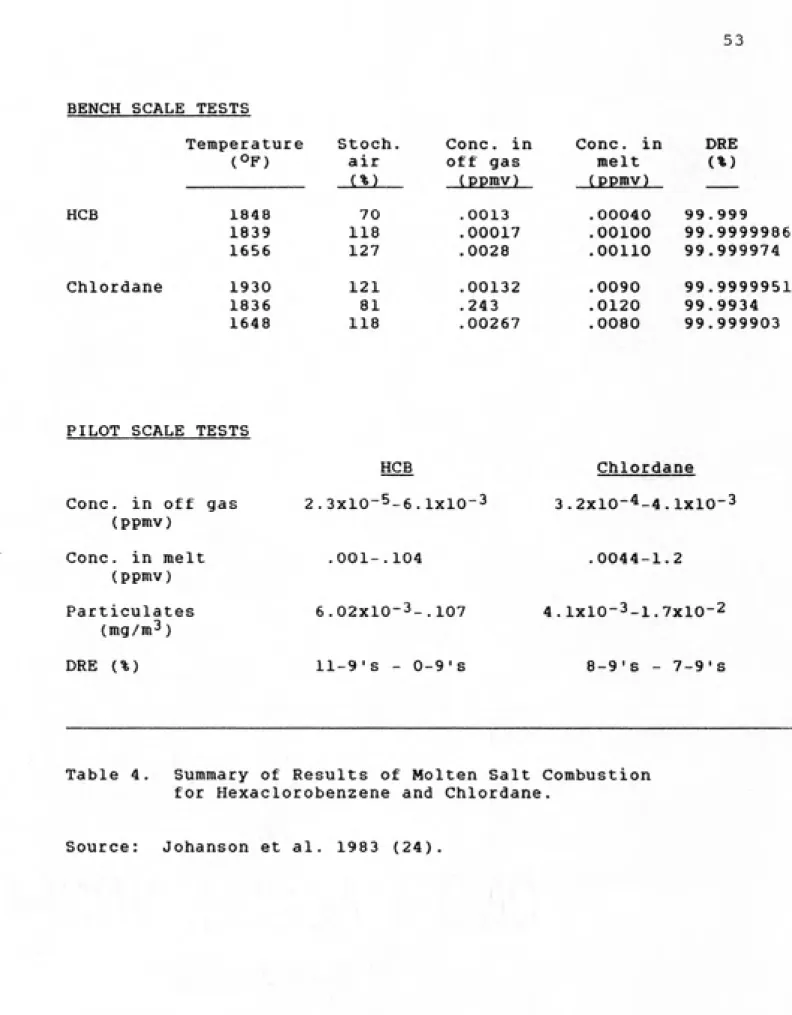
Table 4: Summary of Results of Molten Salt ... 53
Combustion for Hexachlorobenzene and Chlordane
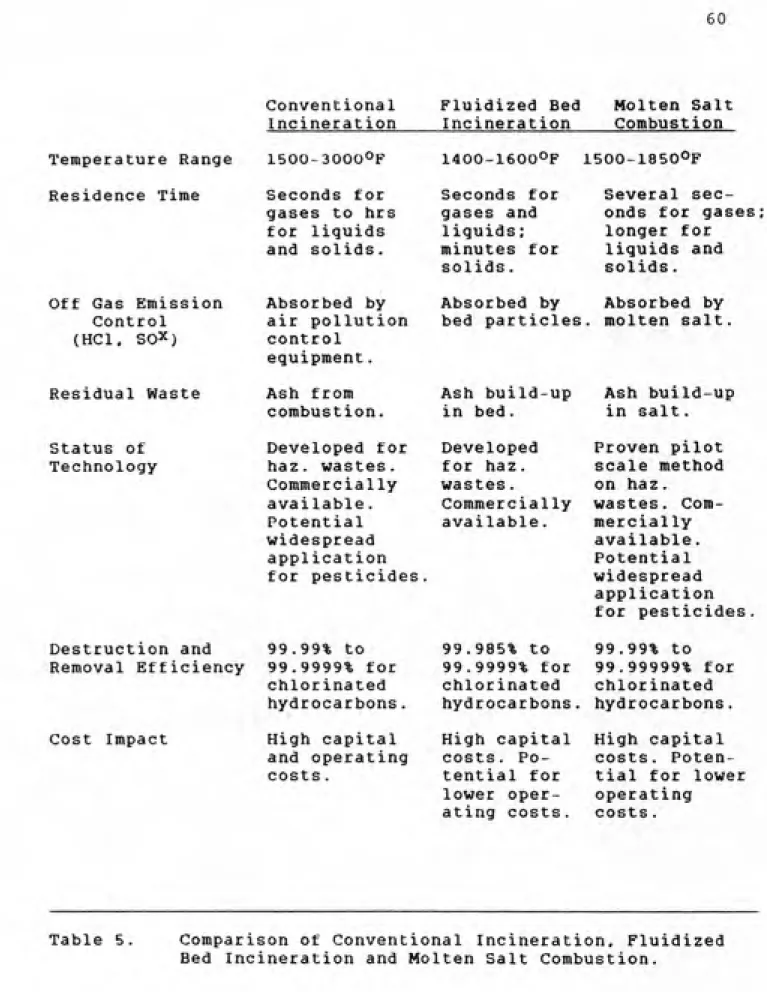
Table 5: Comparison of Conventional Incineration, ... 60
Fluidized Bed Incineration and Molten Salt Combustion
Table 6: Cost Estimate: Rotary Kiln Incineration . . . 65
of Chemical Wastes
Table 7: Transportation Release Rates ... 69
Table 8: Unit Annual Revenue Requirements of ... 69
Transport
Table 9: Operating Cost Estimate: Hazardous ... 75
11
FIGURES
Figure 1: Estimated Waste Stream Data for ... 17
Pesticide Wastewater Treatment Sludges
Figure 2: Unit Annual Revenue Requirements for .... 39 Disposal Technologies
Figure 3: Schematic of a Fluidized Bed Corobustor ... 43
Figure 4: Flowsheet for Sludge Incineration in a ... 44 Fluid Bed Furnace
Figure 5: Schematic of Molten Salt Combustion ... 50
Process
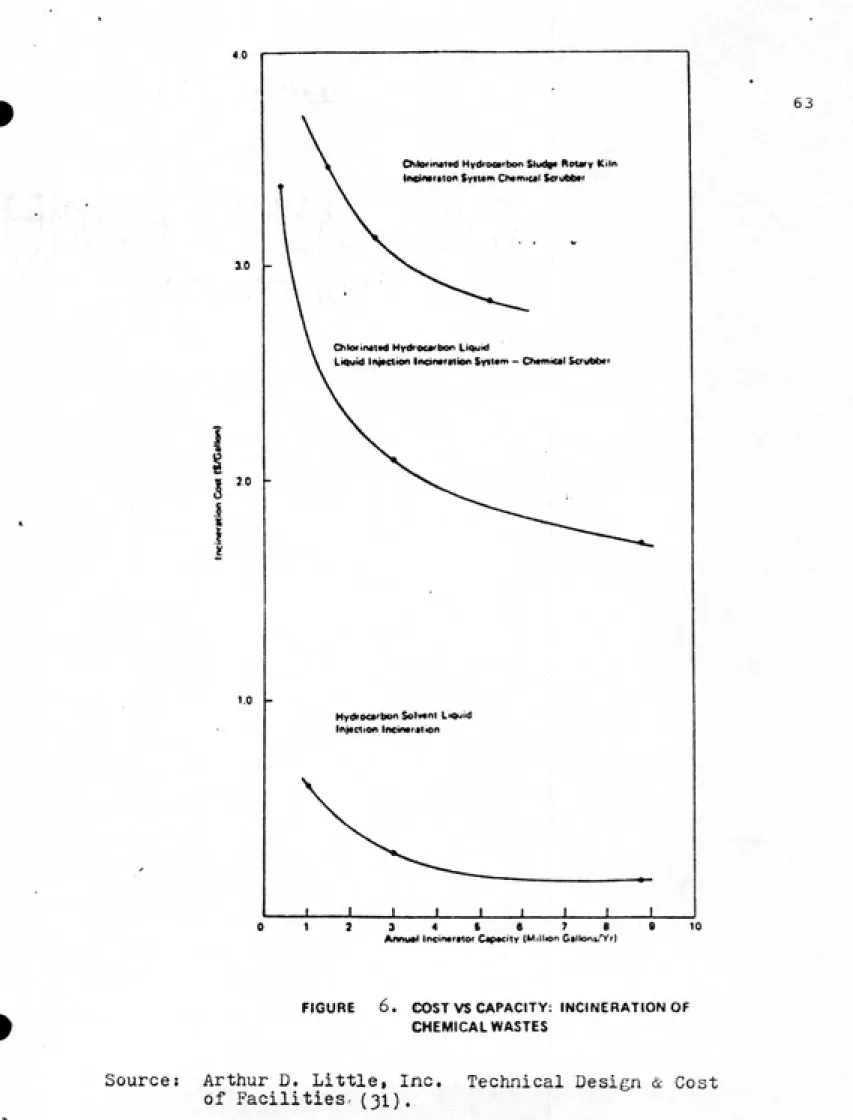
Figure 6: Cost v. Capacity: Incineration of...63 Chemical Wastes
Figure 7: Location of Pesticide Production Plants. . . 66
by State, 1976
Figure 8: Location of Pesticide Forraulators, by .... 67
State, 1976
Figure 9: Conditions Favoring On-Site Incineration . . 71 of Municipal Wastewater Treatment Sludge
Figure 10: General Three-Level Disposal System ... 73 Figure 11: Estimated Cost of Operation of a...76
ACKNOWLEDGEMENTS
I would like to thank Dr. Alvis Turner for his
guidance and assistance throughout the course of writing
my report. I would also like to thank Dr. Richard Andrews
and Dr. Linda Little for taking their time to read my
report and serve on my committee.
I especially appreciate my sister for typing and
proofreading ray report. Without her help and raoral
support I may never have finished. I would also like to
thank the rest of ray family, especially my parents, and my
friends for their moral support. Finally. I would like to
express my thanks to my fellow classmates Lee Tooly and
Jim Verderese for their friendship and companionship over
the past two years which has made life more enjoyable and
CHAPTER I
INTRODUCTION
Pesticides are those substances whose purpose is to
control various types of pests in order to increase
agricultural production or to eradicate distructive,
troublesome and possibly disease-bearing organisms.
Pesticides encompass a wide range of approximately 35,000
formulated and federally registered products including
various insecticides, herbicides, fungicides, algacides,
miticides, nematocides and rodenticides which are derived
from mixtures of one or mote of some 1400 registered
active ingredients (43).
The pesticide industry is similar to many chemical
industries in that they use various toxic and hazardous
substances in their production processes. For example,
hexachlorocyclopentadiene and arsenic trioxide. which are
both listed toxic hazardous wastes under the Resource
Conservation and Recovery Act (RCRA), are used as stock
chemicals for many organochlorine and organoarsenical
pesticides. Also, various toxic chemicals, some of which
phosgene and phenol, are used as solvents for carrier and
extraction media. These chemicals usually appear in
process waste streams and may create potential pollution
problems should their disposal result in release to the
environment.
The pesticide industry is dissimilar to other chemical
industries in that the product is intended to be toxic.
Without such toxicity the product would be of little use.
However, despite the usefulness of chemical pesticides in
pest management, wastes generated in production,
formulation and application processes usually contain
dilute concentrations of these pesticides and thus create
sources of potential pollution.
Many of these pesticide wastes have been studied and
technology and management techniques have been developed
to deal with them. Since many of these chemicals are
either relatively innocuous or readily biodegradable and
non-persistent, they often pose little threat to the
environment. However, a number of pesticides which are
quite persistent and toxic are present in various waste
streams (Table 1). Some of these chemicals are listed
hazardous wastes under RCRA while still others are limited
to restricted use or are under Rebuttable Presumption
rAirriKL list or KrrurTiAU.T
(SIC 2(t9)
Table 1.
HM>RU>JS STRtAttS CCMtHATRD BY rCSTtCIOeS AMI* NCLATRn QICItlCALS mOIXJCTUM
No<IUi«4 Maat* Product
SIC Cod* MaMMMr
2B7«.l ͣOil MSH* i caco<>ylic 2t7t.2 ͣ012 Chlordanc 2S74.1 B9I1 Chlordane
2«79.« K0)« Ctilordana
2»7».S — ChlotJana »T9.« K«1S Crcosot*
2«7*.T CO 19 Disulfoton
2ti«.a Ka)7 OlauKotoa
2*79.9 — Oi«ulfoto«>
2979.19 M19 Phorat*
2979.U K0)9 Phorat*
2»7«.t2 K040 Phorate
2979.IJ «a4i Toiaphan* 2979.1« — Toxaphen* 2979.19 K9«2 J.*,4-T
2979.19 ͣ •91 2.9-0 2979.t> -- Carbaryl
LAND TREATMEKT POTEHTIAI.*
M*3t« Rtrra*
Rata (Rt or C4|>acltY (C|
Ll»ttion Con»tttuant»
ͣ
y product salts
Mastax.'tci treatment sludqa Waataxatec t acrubvatar
froa the chlorlnatlon oC
cy dopant ad lecia
rliter solids IroM th* ni¬ tration o( hcxachloro'
cy dopant ad iane
Stripper dlsctiarqa tro«
citlordena chlorlnator
Mastcwatar traataaat alvdq*
Still bottoaa (roa toluana raelaiMtion dtatlllatlo«
Waatawatar traataant alwd9a
Uaracovcrad trlastar
Hast««at«r Cro* wasblnq aad
strlpplnq
Plltar caka fcoa the filtra¬ tion of diethylphoaptioro-dithorlc acid
Hastawatar treataeat sludq* Mastawatar traatatent sludqa
Plltar caka froa filtration of toxapttana
ͣ
eavy •"<)• °t distillation
rastdua froa distillation
of tattachlorotMtnsana Z.t-dlcblotoptvanul wast* Maavy cikIs of atst t > I Jtlon
reaiOuas
Araanic (C|i sodiua (BkCt
Heiadtlorocyclopantadicna (SkO ll«cacklorocyclot>antadien* (RkC)
Haiadilorocydopcntadlene (RkC)
Cblordana (lti>C> and heptactilor (RiC)
•a«so{A)PTr*na (ttOi baasolAlanthracena (•fcCti
ft*nsol (Bli fluoranthana (HfcC) TDlwana (9) and triaatara (>)
telaaaa (B) and tri«a_^t*r« (B)
Triaatara (B)
Ptmrat* IBti toraaldaliyds (B|| and estars o(
rethlolc and pttoaptwtrodltliiolc acids (
ͣ
)
Cacaca of pttosphorotMolc and phosphoroditbioic ac«4
Ptkorat* (B)
Toaaphana (RiCI Tosaph«n* |B»C)
ͣ
aaacklerobansan*. (ittC)i orth*-dtcblorab*ntaa* |m|
2.4-41ctiIorop«t*nol (Bit 2,t>4lcliloroplwnol (Bll
2.4,«-trlchlorop«»anol |BI
Table I. (cont.)
Hodlfi^d Hast« Product Waste Stream Rate (li> ot C*p»clti i'->
SIC Code Nuiwbgr__________________________________________________________________________________Liwtt ing C >. : C'tuewt^
2879.IB — Cii^j^ryl Wastewater treatiaent sluck)e
* Values for waste constituents f^ay vary; hence# loading) rates and capacities should be based on the analysis of the
specific waste to be land treated and on the results of the pilot studies performed. Or-ganic r^T^poundn are Libeled (C)
when it is b'^lieved that thAie i"ay be some soil conditions under whicti the comt>otiod may not dcijr-i »*? lapidly enouqh to
prevent tonicity hazards, either due to acctiwulat ion In soil or •Ifjratlo /ia water or air. Where tjot h initials (Hfc(') ."trp
indic-ited, there are ratr; llaitations atwl the possibility for the coi^pou. J to build-up in t»>e soil. In thr-s** causes, pilot
studies should be used to determine the soil ha It-life of the conifX)und and f ield i«r>ni tor in^ ot the re^ idu^l "^oi 1 aiw!
leachatc content of the coiwpound shou hi l>c ut I lizoi! to demonstrate that treatment Is takir^ij place.
Sourcet K.W. Brown and Associates, Inc. I98O (3).
2»T9.t') -- »i._'thoi«yl Hastewatec Methoayi (H); methyterw d ..;.te inni, pyridinn '
(RkC) i2*79.20 --> A'laziiie Scrubber and filter waste Atcazlne (RlCl '
2879.21 -- AtTa.:lne Wastewater treatment alud<je
2879.22 -- Al Irin, dielHrin Wastewater treataent sludqe Aldrln IRtC) and dieldrln (Pii >
2879.2J — Al.frln, dieldrin Wastewater froo oildation of Aldrln (Rir) and dlelJrlr, (ni.l
aldrin solution2*79.24 -- Aldrin, dieldrin Wastewater froai extraction Aldrln IRtC) and dieldrin (PK. !
of dieldrin solution2879.2S — Aldrin, dieldrin ruter cake Aldrin (RlC) and die.drln (Hk ; I
2879.2S — Halathion Wastewater treatment slud^n I
2879.27 — Halathion Wastewater fro« washtni and i
s t r I pp i ng I
2879.28 — Malathion rUter cake fro« filtration
of DKTA ( diaiethyl
Insecticide, Fungicide and Rodenticide Act (FIFRA) for
possible oncogenic, mutagenic or tetratogenic effects
(44,45). Despite these restrictions, many of these
pesticides are still being produced, resulting in
hazardous waste streams (50).
Two particular pesticide wastes which have received relatively little attention are pesticide wastewater
treatment sludges and cancelled pesticides. Sludges which
are by-products of the biological and/or chemical treatment of dilute wastestreams often contain higher
concentrations of these chemicals than the wastewater
being treated. Cancelled pesticides are usually containerized pesticides that, due to toxic or
carcinogenic properties, have been taken off the market and must be disposed of. The most prevalent disposal
methods for these wastes are either landfilling or
incineration. In the past landfilling, with its lower
costs, was most often used. However, leaking and
groundwater contamination from these landfills have
prompted an interest in other technologies. Short-term landfill costs are relatively "cheap", however, the costs for cleaning up these leaks are deferred to the future.
1000°C with two seconds residence time, can destroy
99.99% of most pesticides in sludges or containers.
Incineration also has its drawbacks. It is an
expensive technology, few incinerators capable of handling
solid wastes are in use. and hazardous combustion
by-products may be produced. Therefore, there is a need
for either alternative technologies better capable of
handling hazardous sludges or management plans which can
reduce costs and facilitate the siting of incineration
facilities.
Fluidized bed incineration and molten salt combustion
are two possible thermal treatment technologies which may
be equal to or better than conventional incineration.
Though they may provide comparable treatment with less
adverse environmental impact, they are still costly for
the typical small generator of pesticide sludges and
cancelled pesticides. Regional management of these wastes
can reduce these costs. The purpose of this paper will be
to examine these technologies and their applicability to
the management of pesticide sludges and cancelled
pesticides and to offer a management method by which these
CHAPTER II
LITERATURE REVIEW
Many studies, roost of which were completed in the mid
and late 1970's. have examined various aspects of the
pesticide industry in an attempt to characterize the major
participants in the production and use of pesticides as
well as their ability to manage resulting pesticide
wastes. Several of these studies have also attempted to
identify and evaluate various treatment methods and
technologies and their applicability to the different
types of waste generators.
Kelso et al (26), Archer (2). Fowler (15) and
U.S.E.P.A. (48) profile the pesticide industry as one: (a)
composed of a relatively small number of manufacturers
operating at the basic production level to make the active
ingredients; (b) supplying these chemicals to a much
larger number of formulators. at the marketing level, who
mix these active ingredients and other additives into a
product; and (c) which is distributed to an even greater
number of pesticide applicators, the majority of which are
^.iT*— --vsr- ?«c^
dominated by a smaller number of "major" producers who
manufacture millions of pounds of active ingredient.
These major manufacturers account for the majority of
active ingredients produced. Kelso et al found that most
plants produce only one active ingredient and those that
produce more than one often produce active ingredients
which are similar in nature and thus make use of similar
production processes and raw materials. Fowler points out
that whereas these major manufacturers tend to operate on
a large scale, most formulators operate on a small local
scale mainly because of the need for simple low-cost
facilities, the availability of low cost labor, the
advantages of quick response to local and seasonal demands
(thus preventing the build-up of expensive inventories)
and of avoiding the high cost of transporting ready-to-use
formulations.
This characterization also identifies the various
sources of potential pollution in the pesticide industry.
While Kelso and Fowler discuss the various potential
sources of waste pesticides. Archer focuses on air
emissions from production processes and EPA on priority
pollutants under the Clean Water Act (CWA). These studies
agree that the major sources of pesticide wastes are raw
carrier or extraction media, catalysts, and the
manufactured product. These chemicals may appear in air
emissions, process wastewaters, wastewater treatment
sludges, empty containers, off-specification batches,
cancelled products, and wastewater from equipment
washing.
Several important conclusions can be drawn from these
references:
(1) Manufacturers, even when producing only one
active ingredient, must deal with potentially
hazardous raw materials, intermediates, and
reaction by-products in addition to the active
ingredient itself. All of these may appear in
process waste streams.
(2) Manufacturers, due to the size and nature of
their operations, are more likely to be concerned
with pesticide releases to the environment and
can afford adequate wastewater treatment systems.
(3) Formulators do not handle raw materials or
generate any process by-products. However, they
still must handle active ingredients, more than
one for some products, and generate pesticide
wastes in wash water from equipment cleaning and
10
of some of these operations, formulators often
cannot afford extensive waste treatment
facilities.
Gruber (18) and Genser (17) address manufacturing
wastes and possible treatment alternatives. Both studies
review pesticides which are representative of the industry
and evaluate alternatives for the treatment and disposal
of different types of wastes generated by production
processes (i.e.. scrubbing solutions, spent carbon, filter
cakes, process wastes and sludge). Both investigators suggest management alternatives that make more use of
recycling and recovery and less use of methods relying on
land disposal. The U.S.E.P.A. (48) has also evaluated
possible treatment technologies, especially with reference
to priority pollutants. They estimated that biological
treatment was the most common method of treatment,
followed by activated carbon absorption, chemical
oxidation, and hydrolysis. Based on their evaluations,
they concluded that contract hauling, evaporation ponds
and activated sludge were the most cost-effective for
flows <.001 MGD. .001 < .01 MGD and > .01 MGD
respectively. They further describe pretreatraent
technologies applicable to particular types of priority
11
treatment. Studies at the Research Triangle Institute
(RTI) (32) also address the treatability of manufacturing
effluents by using activated carbon, when necessary,
followed by biological treatment.
While much attention has been concentrated on
manufacturing wastes, it has been recognized that pesticide applicators are also potential sources of pollution in the wastewater from washing equipment and accumulation of unused pesticides. Lawless et al (29)
proposed guidelines for disposing of small quantities of unused pesticides in the home or small farm operations. They point out the major constraints that the layman operates under when attempting to treat or dispose of
pesticide wastes, namely the prohibitive cost of many physical and chemical methods and the layman's lack of
technical expertise to operate and monitor more complex
treatment technology. They estimate that only 15% of unused pesticides could be properly treated by the
layman. Two similar studies, by Shih and Dal Porto (40)
and Lande (28), examined the possibility of using chemical
hydrolysis to detoxify wastes generated by pesticide
applicators. A majority of the pesticides which were investigated yielded by-products which were either of
12
such a nature that their toxic properties were
inadequately understood.
SCS Engineers (39) focused their research on the
disposal of dilute pesticide solutions generated from the
cleaning of application equipment. They present an
overview of the most common treatment and disposal
methods: land disposal, chemical treatment, biological
treatment, physical treatment, and incineration. They
point out the advantages and disadvantages of these
methods and evaluate their applicability for use by
pesticide applicators. The authors examine each method
for its reliability, costs, time required, and usefulness
for pesticide applicators. The most feasible methods,
based on their evaluations, were soil mounds,
transportation to incineration, and chemical treatment.
Whittaker et al (53) point out some of the inadequacies of
common disposal methods and suggest a two-stage treatment
process for use by applicators making use of a wastewater
collection system, treatment by coagulation-sedimentation,
filtration, and activated carbon absorption.
More recently, the American Chemical Society (ACS)
Symposium Series (27) published reports on new
technologies which address the use of lined evaporation
13
ozonation, and enzyme immobilization. Many of these
studies strongly emphasize the importance of developing
technologies that applicators can use to treat wastewaters
from washing their application equipment.
For pesticide wastes in general, Wilkinson et al (55)
review the state-of-the-art pesticide disposal research
which includes such innovative technologies as micropit
disposal, tapered fluidized bed reactors, microwave
reactors. UV ozonators and molten salt reactors. Ferguson
et al (14) discuss the feasibility of incinerating
pesticides.
As a result of new research (most of which has focused
on either process wastewaters, applicator wastewaters or
unused pesticides), more stringent environmental
regulations, and the increase in treatment costs,
manufacturers seem to be making an effort to
recover/recycle materials, up to the point where it is
economically feasible, and to install adequate control
technologies to meet NPDES effluent requirements. In
addition, applicators, due to the high price of pesticides
and environmental regulations, are more likely to reuse
washwater and rinsate from application equipment in
preparing a new batch of pesticide chemicals (42). Under
14
quantity generator to 100 kg/month, applicators using
potentially hazardous materials will most likely make
efforts to reuse these washwaters rather than dispose of
them and thus run the risk of coming under the purview of
RCRA regulations. Also, agencies such as the National
Agricultural Chemicals Association encourage applied
technologies such as those promoted by the Illinois
Department of Agriculture (23). which advises more
adequate measuring of cropland, calibration of application
equipment and pest scouting programs to reduce and
possibly prevent the accumulation of unused pesticides.
The triple-rinse method has long been advocated for
CHAPTER III
PESTICIDE SLUDGES AND CANCELLED PESTICIDES
Pesticide Wastewater Treatment Sludges
Most of the process waste streams from the
manufacture, formulation and application of pesticides are
dilute aqueous mixtures. Because they contain low
concentrations of active ingredients and other organic
consitutents, biological treatment is the most economical
means of treatment provided that appropriate pretreatment
methods are used to enhance the treatability of such
wastes.
Various combinations of treatment technologies can be
assembled to treat these waste streams (48). At some
point in this process, biological treatment is often
utilized, the by-product of which is sludge. These
sludges may become "sinks" for organic constituents and
can contain residuals of active ingredients, as well as
toxic raw materials, hazardous solvents, and process
by-products (41), Because of the confidential nature of
the pesticide industry, actual sludge quantities and
16
Technology, in their RCRA Risk Cost Analysis Model, has
described representative pesticide wastewater treatment
sludge waste streams (Fig. 1). Their data estimates the
quantity of sludge produced and its physical
characteristics such as % solids, heating value, and %
ash. It also includes estimates on the characteristics of
specific constituents of concern present in that
particular sludge. Table 2 provides estimates of sludge
quantities generated during the manufacture of various
pesticide classes.
Pesticide forroulators also generate dilute aqueous
waste streams from the washing of formulation equipment.
The fraction of active ingredient involved is usually 1%
or less of the capacity of the formulation equipment
(26). Because formulators tend to be small-scale
operations, biological treatment systems or evaporation
pits and ponds may provide the most economical treatment
for such dilute wastes. Sludge is a by-product of these
operations. Formulators can reduce the amount of
wastewater needing treatment by reusing the rinsate as a
diluent in the next batch formulation of that particular
pesticide. However, when formulation plants are located
to meet the demands of applicators, they often will
WASTE STREAM MUMBER : 02.01.0T
Fitjure 1
WAStf STREAM DATA BASE
EPA NUMBER : hOO1 SIC NUMBER : 2U9I
NAME : WASTEWATER TREATMENT SLUDGE fROM WOOD PRESERVING PROCESSES USING PENTACHLOROPHENOL
QUANTITY (1000 MT/YR) 15.no
NUMBER OF FACILITlES : 7U
I WASTE STREAM SPECIFIC IMFORMATION I
QUANTITY PER FACILITY
(KG/DAY) SOURCE UNCERTAINTY
600.0
CHARACTERISTICS :
60
FRACTION FRACTION SOLIOS AVC. HEATING FRACTION FRACTION BIODEGRAOATION
NONWATER SUSfCNOEO S.C. S.G. VALUE(KJ/KG) CL ASH PH RATE (PER DAY)
.UOO .090 '1,50 1.00 15000.0
.00 .05 5.1
.00
BOO(U) tHG/L)
.00
I CONSTITUENT SPECIFIC INFORMATION I
CONSTITUENT OF CONCERN
PENTACHLOROPHENOL
CHARACTERISTICS :
CONCENTRATION
(PPM) SOURCE UNCERTAINTY
780.00 3U.59
o
-n
CONSTITUENT OF CONCERN
PENTACHLOROPHENOL
HASS FRACTION MOLECULAR VAPOR PRESSURE SOLUBILITY BIOOCGRAOATION
FRACTION DISSOLVED WEIGHT (MM.HG)«25C. (MG/L)«25C. RATC(PER DAY)
0.000780 1.000 266.0 1100E-03
ͣ
»ͣ
1«l.00 .2760E-01
BOO(U) 0OOOE*O0
Representative Pesticide Wastewater Treatment Slu<jtge Waste Streams
S.G. = Specific Gravity» Uncertaintyi 2 = Calculated from partial data, 3 = Crude estimates i ^
Constituent of concern chosen by reference to listing of chemicals in Appendix VIII to -J
^0 CFR 261.
Figure 1 (cont.)
WAS1E STREAM DATA BASE
WASTE S'REAM NUHOFR : 02.03.01 EPA NUMBER : K0«4l. K098 SIC NUHBER : 28 79
NAME : lOXAPHENE WASTE
QUANTMY (1000 MIAVR) : 5.00 NUMBER OF FACILITIES :
t WASTE STREAM SPECIFIC INFORMATION I
QUANTITY PER FACILITY
(KG/DAY) SOURCE UNCERTAINTY
6900.0 CHARACTERISTICS :
FRACTION FRACTION NONWATER SUSPENDED
.250 .?20
SOLIDS AVG. HEATING FRACTION FRACTION
S.C. S.G. VALUE(IU/KG) CL ASH
1.30 1.08 10000.0 .00 .20
BIOOECRAOATION
PH RATE (PER DAY)
.0 .00
eoo(U) (MC/L) .00
I CONSTITUENT SPECIFIC INFORMATION I
CONSTITUENT OF CONCERN
CONCENTRATION
(PPM) SOURCE UNCERTAINTY
TOXAPHENE
CHARACTERISTICS :
10000.00
o
CONSTITUENT
OF CONCERN
TOXAPHENE
MASS FRACTION MOLECULAR VAPOR PRESSURE SOLUBILITY
FRACTION DISSOLVED WEIGHT (MM.HG)«25. (MG/L)«25C.
BIODEGRAOATION
RATE(PER DAY) BOO(O)
Fit,ure 1 (cent.)
WASIt STREAM DATA OA:>f
WASTE SMILAH NUHOtR : 02.03.91 EPA NUMBER : N
SIC NUMBER : ?919
NAME : PfSTICIDE WASTES - MOOERAIE TOXICITY N.O.S.
QUANTITY (1000 MT/YR) : 500.00 NUMBER OF FACIL1 I IES
i|39
I WASTE SJ REAM SPECIFIC INFORMATION I
QUANTITY PER fAGILITY
(KG/DAY J
3T00.0
CHARACTERISTICS :
SOURCE UNCERTAINTY
FRACTION FRACTION NONWATER SUSPENDED
.250 .200
SOLIDS AVC. HEATING FRACTION FRACTION
S.G. S.G. VALUE(KJ/KC) CL ASH
1.50 1.10 30000.0 ,00 .20
BlootGRADATION
PM RATE (PER DAY) .0 .00
eoo(U)
(MG/L)
.00
I CONSTITUENT SPECIFIC INFORMATION I
CONSTITUENT OF
CONCERN
CONCENTRATION
(PPM) SOURCE UNCERTAIHTY
CHLORDANE
CHARACTERISTICS
30000.OO
o
ͣ
n
CONSTITUENT OF CONCERN
CHLORDANE
MASS FRACTION MOLECULAR VAPOR PRESSURE SOLUBILITY BIOOEGRAOATION
FRACTION DISSOLVED WEIGHT (MM.HG)«25C. (MG/L)«25C. RATE(PER DAY) BOO(U)
0.030000 .000001 »10.0 , 1000C-04 .5600E-01 ,00OOE*OO
WASTE SIREAH NUMBER : 02.03.90
Figure 1 (cent.)
EPA NUMBER : N/A SIC NUMUJH : 78^9
NAME : PESTICIDE WASTES - HIGH TOXICITY N.O.S.
QUANTITY (1000 HI/YR) : 500.00 NUMBER or FACILITIES : Il39
t WASTE SIREAH SPECIFIC INFORMATION |
QUANTITY PER FACILITY
(KG/UAY) SOURCE UNCERTAINTY
3100.n
CHARACTERISTICS :
f 3
SOLIDS AVC. HEATING
S.G. S.G. VALUE(KJ/KG)
1.50 1.10 35000.0
FRACTION FRACTIOH
CL ASH .00 .20
PH
.0
BIODCCRAOATION
RATE (PER DAY)
.00
FRACTION FRACTION NONWAIER SUSPENDED
.250 .220
BOO(U) (HG/L)
.00
I CONSTITUENT SPECIFIC INFORMATION I
CONSTITUENT OF
CONCERN
PARATHION
CHARACTERISTICS
CONCENTRATION
(PPH) SOURCE UNCERTAINTY
30000.00
o
Tl
CONSTITUENT OF CONCERN PARATHION
MASS FRACTION MOLECULAR VAPOR PRESSURE SOLUBILITY BIOOEGRAOATION
FRACTION DISSOLVED WEIGHT (MM.HC)«25C. (MG/L)«25C. RATE(PERDAYJ BOOfUI
21
Pesticide
Organophosphorous manufacture
Toxaphene manufacture
Halogenated organic manufacture
Organonitrogen manufacture
Metallo-organic manufacture
Forraulators
Units sludge/time
300 lb/day 7.5 ton/day
1.200 lb/day
2.160-14.900 lb/day
5.140 lb/day 200 lb/day
Table 2
Estimates of Sludges Generated by Pesticide
Manufacturing and Formulation
22
required to prevent cross contamination. Storing various
rinsates for reuse may present a greater hazard and be more costly than providing treatment.
Pesticide applicators also generate dilute aqueous waste streams through the washing of application
equipment. However, an applicator may produce little
sludge. First, because of the economic and technical
constraints which limit the use of various treatment
technologies, applicators will have more incentive to
reuse rinsewaters. Most pesticides are applied at rates
lower than the maximum recommended label rate, thus
washing of equipment can be carried out in the field and
the rinsate can be applied to the crops without adverse
effect (23). Second, if the washwater is collected,
biological treatment would most likely not be feasible for
an applicator. Biological systems are very sensitive and
prone to upset from waste load changes in concentration
and constituents and would vary considerably from
applicator to applicator (23,29).
Pesticide sludges are similar in a general sense in
that they all pose similar disposal problems. One major
problem is the difficulty in handling sludge. Sludges
will require pretreatment to reduce water content in order
23
subsequent disposal. This pretreatment will increase the
cost of thermally treating these sludges.
Another problem in treating sludges is determining
when treatment is complete. This can be a major issue
especially when potentially hazardous constitutents such
as pesticides must be reduced to meet regulatory
standards. Because of the physical nature of sludge it is
difficult to analyze for constituents and their
concentrations (19), The constituents of concern may not
be distributed evenly throughout the sludge and may be
entrapped in sludge particles (17). This may impede the
gathering of representative samples for analysis. Also,
solvents, used to extract organics for analysis with gas
chromatography/mass spectrometers, may not have sufficient
contact with the sludge to obtain efficient extractions.
Vigorous mixing or homogenizing of sludge samples may
provide better extractions for analysis (19). However,
this will increase the cost and complexity of monitoring
treatment efficiencies.
Although they pose similar disposal problems, sludges
are still different from one another. Pesticide sludges
are very process dependent and will differ in relation to
the manufacturing and formulation process involved. Those
24
pesticides because of the difficulty in treating this
class of compounds. Several RCRA listed hazardous waste
sludges result from chlorinated pesticides such chlordane.
toxaphene. 2,4.5-T and 2,4-D. There are also other
non-chlorinated sludges which may contain potentially hazardous pesticides like phorate and disulfoton. Non-listed sludges from atrazine. a organonitrogen
triazine. may contain cyanuric chloride which is a toxic
cyanide source. Sludge from maneb, a dithiocarbamate, may
contain the degradation product ethylenethiourea (ETU)
which is suspected of causing liver tumors in rats.
Cancelled Pesticides
In order to reduce the amount of hazardous and
potentially carcinogenic and mutagenic pesticides used.
EPA has cancelled various pesticide products and placed several others under RPAR review. These cancellations
reduce the release of toxic substances to the environment
and potential human exposure. However, these
cancellations generate another form of hazardous solid waste that must be disposed of. Although, in some cases,
sufficient notice is given after cancellation to exhaust
existing stocks, many of these chemicals are often never
treated or disposed of. For example, in North Carolina,
25
found on occasion and require disposal (42). There are
also currently stockpiles of EDB, a recently cancelled
pesticide, awaiting disposal (51).
The disposal of these unused pesticides presents a
major problem to applicators and formulators. Applicators have few options other than contract disposal to handle these cancelled pesticides. Likewise, formulators may possess stockpiles of these pesticides and because of
economic constraints may also use off-site disposal
options.
Cancelled pesticides will most likely be containerized and thus may be more difficult to dispose of. It is
unlikely that they would be released from the container to facilitate treatment because this could possibly lead to
an increase in exposure to potential carcinogens. Many of
the cancelled pesticides are chlorinated, which adds to the difficulty of treatment. Chlorinated compounds, like other halogenated materials, contain strong bonds and thus
are very stable. Large amounts of energy are required to break down these compounds in short periods of time. Even in high energy treatments such as incineration,
halogenated compounds can inhibit flame propagation and
lead to the production of HCl and CI which can be toxic
26
Thus cancelled pesticides and pesticide sludges will present difficulties in collection, transportation,
treatment, and disposal. These wastes possess potentially hazardous properties and their physical form will make them more difficult to handle manually. They may require
special pretreatment before they can be collected and transported, thus increasing total management costs.
Also, the difficulty in thoroughly treating solid wastes, espcially chlorinated compounds, will further increase the
CHAPTER IV
CURRENT METHODS OF DISPOSAL
The two methods most frequently recommended for
disposing of pesticide wastewater sludges and cancelled
pesticides are landfilling and incineration.
Landfillinq
Landfilling. although widely used and once accepted as
an adequate method of ultimate disposal of solid wastes,
is losing favor and in fact may be quite inadequate for
dealing with pesticide wastes. First, landfilling is only
a short-terra solution. In the short-run it is currently
less expensive, but because the wastes are not treated or
detoxified in landfilling. any subsequent leaking in the
future may result in groundwater contamination. Because
of the persistence, mobility and toxic properties of
several pesticides, such leaks would be unacceptable. The
long-term costs of the clean-up of such leaks would be
very expensive. EPA has concluded that eventually all
landfill liners, including hazardous waste secure
landfills, will leak and migration of hazardous wastes and
28
that at low concentrations some pesticides may be
biodegradable in the soil environment. These same
pesticides, when disposed of in large concentrations, may
become more mobile and thus more prone to migrate away
from the disposal site (8).
Encapsulation of sludges has been suggested in order
to reduce the amount of leachate formed. However, highly
organic wastes, such as those from pesticides are not as
amenable to encapsulation or chemical fixation as
inorganic/metallic sludges. These organic compounds tend
to interfere with the physical and chemical processes
involved in binding wastes together (47). Thus
stabilization/fixation may not prevent the formation of
leachate and would only serve as an expensive method of
delaying probable leaks.
Incineration
Incineration provides a more adequate alternative for
the disposal of pesticide sludges and cancelled
pesticides. Several studies have reported destruction
efficiencies of 99.99% and greater for many pesticides
(14.37.55). Table 3 lists some of these results,
including the operating conditions and destruction
efficiencies for various pesticide formulations. The
TABLE 3. OPERATING PARAMETERS OF INCINERATION RESEARCH TESTS OF INDIVIDUAL PESTICIDES
PPSt IC 1J€ Formulae Ion Excrss Avo rafic Rot»»nt Ion Dest ruct Ion Organlzac Ion
formu itloni' feed rate air tcmper.lturff time eft Iciency Type of pe r f 0 nn I ng
Pest Iclde X by urlghc l/hr (g.il/l.r) a) "c (-F) (seclL'Z (7.) Inc Inerator Che test AMrln t>l.2 (EC) 2.69 (0.71) J80 600 (1120) 14.5 ,. > 99.99
41.2 (EC) 3.61 (0.96) 203 830 (15)01 8.9 > 99.99
41.2 (EC) 7.65 (2.02) 128 1020 ( 1870) 3.5 > 99.99 Plloc-icale mulclpte Midwest Research
41.2 '(EC) 2.95 (0.78) 70 1140 (2080) 4.4 > 99.99 chamber Innt itiite
1<> (U) 9.84 (2I.7)£/ 113 860 (1580) 6.2 > 99.99 19 <C) 9.98 (22.0)c/ 48 . 1150 (2100) 5.2 > 99.99 19 (C> 19.50 (4).0)c/ 118 1100 (2020) > 2.8 > 99.99 AtraxliM '.0.8 (re) 16.2 (4.28) 143 700 (1)00) 6.9 > 99.99 40.8 <rc) 6.55 (1.73) 52 1040 (1900) 5.5 > 99.99
40.8 (FC) 15.9 (4.20) 140 940 (1720) 2.9 > 99.99 Pllot-<cate mult iple Midwest Research
80 (WP) J.4 (7.5)c/ 146 940 (1720) 10.8 > 99.99 chamber institute
80 (WP) 3.6 (8.0)c/ 43 1050 (1920) 5,5 > 99.99
Captan 50 (WP) 6.17 (13.6)c/ 99 690 (1280) 13.5 > 99.99 Pilot-scale multiple Midwest Research 50 (WP) 3.54 (7.8)<:7 192 660 (1220) 8.1 > 99.99 chamber Institute 50 (WP) 6.44 (14.2)c/ 137 1000 (1830) 3.5 > 99.99
Ch lo rdana 5 (D) 0.45 (l.O)c/ 71 950 (1745) 0.13 > 99.99 5 (0) 0.45 (l.O)c/ . 6 1120 (2050) 0.51 > 99.99
,
72 (IC) 0.72 (0.19) 48 920 (1690) 0,53 > 99.99 Pllot-acala liquid TPM Systems Oroup 72 (EC) 0.72 (0.19) 98 840 (1540) 0.52 > 99.99 injection
72 (EC) 0.95 (0.25) 12 1150 (2105) 0.18 > 99.99
Chlordans/ 18/11 (EC) 2.8 (0.75) 7 920 (1695) 0.94 ' > 99.99 rilot.seals liquid TRW Systems Croup
Dlaldrln 18/11 (EC) 3.8 (1.0) 46 950 (1750) 0.48 > 99.99 Injection
18/11 (EC) 1.8 (l.O) 47 940 (1725) 0.17 > 99.99
i,4-D Not Btated 3.8 (l.O) -3 860 (1575) 0.90 > 99.99 Pllnt-scale liquid TKH System* Croup (E»ter) Not ttatrd 3.8 (1.0) 45 880 (1615) 0.60 > 99.99 injection
Not stated 3.8 (1.0) 13 910 (1575) 0.25 > 99.99
2,*-D/ Hot «tat»d 0.95 (0.25) -8 420 ( 780) 3.1 > 99,99 n lot-nc.nle liquid TRW Systems Croup
2,S5-T Nnt itatvd 0.95 (0.25) .8 900 (15 50) 0.70 > 99.99 Injection Unrez) Not stated 0.95 (0.25) 15 lioo (2010) 0.17 > 99.99
111 ml xtura
to
TABLE 3 (continued)
P.-5 Ic 111."
formulJt tona/
Prsclcld 7. by weight
PUT 20 (OS)
20 (OS) I'O (OS) 20 tf)S) 5 (K) 5 (OS) 5 (OS) 5 (OS) ' 5 (OS) 20 (OS) 20 (OS) 20 (OS) 25 (F.C) -25 (F.C) 25 (KC) 10 (U) 10 (D) 10 (U) 20 <K) 20 (K) 75 ([)) 75 (U) 75 (D) 75 (D) 10 (D) to (D) 25 (EC) 25 (EC) 20 (K)
Fo rmn 1 flt ion feed rai.e
?/hr (R3l/hr>
air
<7.)
Average
omp('r;ir u t
°C (°F)
Retent Ion
12'
T)» -ir: rue t loM
eff IclciKy Type of
< nr ln*» rato r
Orgfln i z^r lini
p*" r fo rm InR
ch«> ti»it
U) ()0) 182 (J.8) 113 (!n)
l«2 C.S)
205 (~ 55)
3.0 1.9 1.8 l.o 0.95 (0.75) (0.5) (1.0) (0.5) (0.25) 0.72 (0.14) 0.'»5 (0.25)
1.9 (0.5) 3.8 (1.0) 1.9 (0.5) 0.'i5 (l.O)c/ 0.'.5 (l.O)c/ 0.'.5 (l.O)c/ 0.91 (2.U)d/ 2.25 (5.0)d/
I.IB (2.f.)d/
3.0 (6.6)d/ 0.91 (2.0)d/ 2.25 (5.0)d/ 0.98 (7.l6)c/ 2.23 ('..91)c/ 1.91 (4.23)c/
4.6) (l0.25Tc/
19.9 (5.0)
157 16) 121
122
No due* 30 10 50 76 26 70 92 10 65 un 30 111 76 > 100 > 100 > IO<l > 10<) > 100 > 100 16<» 156 162 14)
8 71) ( 1600)
8 70 ( 1600) QflO {IROO) 980 (IBdO)
900 (1650) 1090 (2000) 12W) (2200)
1000 (1830)
860 (1580) l<yiO ( 1990) <»'.0 ( 1720) 120 (600)
890 (1660)
lO'.O (1900) 820 (1510) 1130 (2060) 1010 (1850) 910 (17Q5) 840 (1550) S/.O (15<.0) 760 ( 1410) 790 (1460)
630 (1170)
6)0 (1170)
910 (1710) 1020 (I860)
940 ( »710)
9)0 ( 1700)
3.4 2.9
'.0 i.O
No d«t« 0.7 0.5 0.2 0.9 0.5 0.2 0.2 1.2 0.14 0.) 0.14 0.14 0.1 1 45 mln 45 nln mln mln lalil min 6 2 45 45 -4 5 -4 5 2 )
Mo dat» 1400 (2550)
2.5 1.8 M)
99,'J9 f;omiin. re 1 a 1 liq-iid Injection General F,lectrlc
99,')9 vortex combiistnr 9<),MO
99.99
T- 99.99 PlluC-IcaU liquid Injection Canadian Defence Re¬
search Establishment
> 9i)/>q Plloc-.srali! liquid Injection TRW Syst-ma Croup
> 99,99 > 99,99 > 99.99 > 99.99
> 99.99
> 9<».>)8 •ͣ
> 99,99 > 99.U9 > 99,98 :> 99.99 > 99,99 > 99.99
> 99.99 Mloe-*ciilc mlttplc h««rth Versar, Inc., and > 99.99 Eiwlrotech, Inc.
> 99.99 > 99.99
99,98 Municipal multiple hearth VLTSar, Inc. and CItv of 99.98 sevage sludge Palo Alto, Callfornli
> 99.99
> 99,99 Pllot-scali; multiple chnmber Midwest Research > 99.99 Institute
> 99.99
? 99.99 Prototype ptint-scale liquid II,S, Army Land Uartare
ln|ectlon Laboratory
DUIdrln 15 (EC)
15 (F.C)
15 (EC) Herhlc Ida (FC)
0 rcinRH (EC)
(EC)
Kcpone Unknuwii£'
3.8 (1.0)
3.8 (1.0) 2.8 (0.75)
195 ('. 10)c/
260 (570)c/ 260 (5 70)c/
Unlinoin£/
-7 870 (1600) '46 970 (1785)
91 910 ( 1665)
17 1220 (2210)
52 lO/iO ( 1900)
53 980 ( 17'>0) Ho dnta 1090 (7000)
0,72 0.'.7 0.18 0.18 0.16 0.14 2.0 > 99.99
> 99,99 Pilot-scale liquid Injection TRW Syufems i;roup
> 99.99 > 99.99
' 99.99 nlot-scale SUt' burner Harquaidt Coiporstton
> 90.99
^99.99 Canmerclal h Igh-teaparature MidUnd-Ro»» Corporat Ion
sludge ItK-lnerator Surface Division ^
TABLE 3 (continued)
Pestle Ida
Pc St Ic ide
formulae ior\f'
X by w^ iBiht
Forma la t Ion feed rate
f/hr (g.il/hr)
Exc'-s air (7.) tpmpcrature RctPMt Ion t Imc
Op struct ion
<» f £ ir Irttcy Typ^ of
Inc. Incrato r
Orfi^ntrat loo per [u rmliiK
the test MndAne (U) (0) (0)-(EC) (KC) '(EC) Halaehlon (CO) (tr.) (EC) (WP) (WP) (WP)
Hire It 0,3 (B>
O.J (i)
0.3 (B) 0.3 (B> Plcloran 21.5 (VB)
21.5 (WS)
21.5 (WB)
10 (P)
10 (f) 10 if)
Z.-V.S-T 20 (PS)
20 (PS> 20 (PS) 20 (PS) Cat'-r i;»t«r t»tcr
0.7 (1.5)c/ 19 0.1 (I.5)c/ 89 0.'>5 (l.O)c/ 67 2.« (0.75) 2 3.8 (1.0) !2
2.8 (0.75) 31 2.38 (0.63) 176 6.47 (1.78) 95
3.60 (0.95) 130
13.2 (29)c/ 113
19.2 (42)c/ 37 13.8 (!!)£/ 156
10.1 (2<.)c/ 79
10.5 (23)c/ 225 10.9 (24)c/ 141
24.0 (i3)c/ 5 7 8.8 (2.3) 298 5.7 <1.5) 62
13.6 (3.6) 116 16.8 (37)c/ 226
32.2 (7l)c/ 72
17.3 (38)c/ 93
0.90 (2.0)d/ > 100
2.25 (5.0)d/ 7- 100 0.55 (t.2)d/ > 100
J.73 (J.S)d/ > 100 3.8 (1.0) -11
3.8 (l.o) 49
3.8 (l.O) 33
in/.o (1000) HIO (1490) 950 (1740) '(60 (1760) 1080 (1975) 1270 (2310)
620 (1140)
960 ( 1760) 1050 (1930) 730 <1340) 1040 (1900) 9)0 (1710) 700 (1290) 590 (1090) 920 ( 1690) 900 (1650) 530 (990) 930 (1700) 10)0 (1880) 640 (1190) 9J0 (17()0) 1020 (18 70) 780 (1430) 780 (14)0) 700 (1290) 700 (1291)) 920 (1680) 840 (1540) 880 (1613) 0.50 0.38 o.l^ 0.86 0.48 0.14 13.3 7.8 4.4 11.3 7.7 3.7 12.2 6.2 3.3 5.8 15.6 7.9 2.4 14.) 9.5 2.7 -45 ntn -45 mln
-4 5 lain -4 5 latn 0.93 0.65 0.2) > 99.99 > 99.99 > 99.99 > 99.99 > 99.99 > 99.99 > 99.99 > 99.99 > 99.99 > 99.99 > 99.99 > 99.99 > 99.JO > 98.21 > 99.97 > 99.98 > 99.99 > 99.99 > 99.99 > 99.99 > 99.99 > 9V.99
Pllot-SCalc liquid lri|ecCion TRW Systems Uruup
Pllot-9C<ic mtCLpte chaMbrr Hldw<st Research
InSt Itute
Pltot-sc«l« aiulClpl* ch**brr Midwest Research
Institute
Pllot-*caIa nuletpl* chanbvr Hldwst Research
Institute
> 99.99 Pilot-scale nuUtple hearth Vcrsar, Inc. and
> 99.99 ' Cnvlrotach, Inc.
> 99.99 Municipal muUIptr hearth Versar, Inc. and
7 99.99 M-waRe sludffe City of Palo Alto,
California > 99.99
> 99.99 Pllot-scaln llqiltd Infection TRW Systems Croup
> 99.99
(continued)
XABLE 3 (continued)
Pfstlcld«» Formulation Kxci"!s Av^rA^l' Retention D<'ir rn'"t. Ion Org;4ni zat ton
(ormul at lani' fo*»d rate air toiiipp rnr iiro t I mi-
ȉ
f [ Ic le nr y tvp^ of performlnn
Ti'stlctde 7. by uolnlit f/hr (^il/hr) (".) "': C'f) Isor^ (7.) Incinerator tho ti-5t
2.0 (CJi) 150 b'>0 (t?00) 11.2 > tq.lt 2.8 (0.7S) 47 lO'iO (1400) fi.Q > i»«.'('J
2.35 (0.62) 12'' qRO (IHOO) (..8 > >»y.<19 Pllot-iolo multiple chamber Midwest Research
15.0 (J))c/ '»'• h'O (12'.0) Ih.O > y^i.qq Institute16.i (1>))c/ 16f> (>;0 (I2'.0) 11.0 ^ ')<).99 14.5 ()2)c/ 121 iniO (lfl50) 5.2 > i>9.)<» *.3 (9.5)c/ 102 680 (1260) 10.1 > 99.99
2.3 (5.1)c/ 165 650 (1200) t.6 > 99.99 Ptlot-scslf multiple chmnber Midwest Rescirch
2.3 (5.1)c/ 151 9/iO((1730) 3.5 > <»9.<)V institute
a/ B = bait; 0 = dust; EC =» cmulslftable concentriCei FC = (lovjahli- concrntrale; 0 - (;rinul.ic; K " In kerosene; OS = oil solution; P - pellets!
PS ^ poly.ilcohol solutionl WB ͣͣ unter base Liquid; and WP — wettible poudcr*
I)/ Retention time for MRl data are the sian of the prlmnry and sccofid-iry chamber retention times.
c/ Quantities given In kilograms per hour (potinds per hour).
d/ Pesticide mixed vlth sludge fed to Incinerator at rate of US kg/hr (100 tb/hr).
e/ Keponc^ (4 kg maximum sample size) was mixed with sew.ige sLudgr fed to Incinerator.
Toxaphf^ne hO (F.C)
60 (EC)
60 (KC)
20 (0)
20 (D) 20 ID)
Zlncb 75 (WP)
75 (WP)
75 (wr)
Source: Wilkinson et al 1978
33
values while still achieving 99.99% destruction and
removal efficiencies. For example, residence times vary from 0.13 seconds to 45 minutes, excess air requirements
vary from -11% to 380% and temperatures range from 350°C
to 1400 C. Short residence times were achieved usually
as a result of increased temperatures and/or increased
excess air. Similarly, operating at lower temperatures
required increased residence time or excess air.
Therefore, optimizing for one parameter is usually done at
the expense of another and trade-offs between these
parameters are required in order to meet the 99.99%
destruction and removal efficiency. Of special note are
the cases which required residence times of 45 minutes. In these tests, DDT and 2,4.5-T were mixed with sewage sludge. Therefore, chlorinated pesticide wastewater
treatment sludges may also require long residence times.
With incineration, these sludges and cancelled
pesticides are greatly reduced in volume and pose a lesser
risk of groundwater contamination than does landfilling.
For these reasons the EPA recommends incineration over
landfilling for pesticide disposal, except for those
pesticides containing heavy metals (11).
Despite the advantages of incineration over
34
although controllable to some extent, are of major
concern. First, the incineration of pesticides can yield
toxic air pollutants. Chlorinated pesticides generate
hydrogen chloride (HCl), organophosphorus compounds may
generate phosphorus pentoxide (P^O^) and sulfur
dioxide (SO ) (for those containing sulfur atoms) and
organonitrogen pesticides may generate cyanides and
nitrous oxides (NO ). HCl and cyanides are undesirable
due to the toxic nature of chlorine and cyanide. SO
and NO can acerbate acid rain problems. P-,Oc andX £ o
sulfur are noxious by-products leading to odor problems.
These emissions can be reduced with the proper air
pollution control equipment, however there still exists
the possible risk of human exposure from fugitive
emissions should a mechanical failure occur. Even.with
properly functioning air pollution control equipment, some
studies have reported "dirty burns". For example, the
combustion of the organonitrogen pesticide Pichloram
produces a dark bluish plume and the incineration of
organophosphorus compounds has frequently produced
P O which resulted in notable and persistent white
plumes (14.37).
Another limiting factor is that most pesticide sludges
35
process industry estimates that biological sludges can be
dewatered to 15-20% solids but this is rarely achieved in
practice (36). The autogenous combustion of wastewater
sludges is only possible with 65-70% solids (49). For
municipal wastewater treatment sludges the dry content is
seldom greater than 20-25% solids and the volatile solids
content is usually less than 70%. resulting in an actual
fuel value of approximately 1400 BTU/lb of wet sludge, or
an average of 10.000 BTU/lb dry volatile solids (52).
These low energy sludges will require auxiliary fuel for
incineration. In contrast, pesticide wastes may contain
additional volatile constituents due to the presence of
solvents or raw materials, however, due to the high water
content, auxiliary fuel will still most li)tely be required
Incineration data indicates that most pesticide
compounds can be destroyed at temperatures of 1800°F
with two seconds residence time. However, these studies
used pure pesticide formulations. For sludges and
containerized wastes such as cancelled pesticides, longer
residence times will be required. To reduce residence
time and improve the efficiency of incineration, sludges
and containers will require pulverizing or shredding to
provide better combustion conditions.
36
these wastes is the rotary kiln. Its advantages include the ability to handle a wide variety of solid wastes
including drums and bulk containers, as well as its high
turbulence and oxidation potential (5). The 1980 EPA
Engineering Handbook for Hazardous Waste Incineration
rates the rotary kiln as an appropriate design for the potential incineration of pesticide wastewater treatment sludges regulated under RCRA including the K-list as well
as the pesticide compounds regulated under the U- and
P-lists (46).
Neither the rotary kiln or any other incinerator is recommended for the incineration of organometallic
pesticides such as MSMA and cacodylic acid which contain arsenic. FIFRA regulations recommend against incineration
of such compounds unless proper pretreatment has been
applied to recover the metals before incineration (11).
This is due to the fact that elemental metals cannot be
degraded and may be volatilized into small particles which
may in some cases be resistant to collection by air
pollution control equipment (35).
Summary
Conventional high temperature incineration has many
advantages over landfills for the treatment and/or
37
a. The rotary kiln incinerator can be used to burn
containers, solids, bulk liquids, or a
combination of these materials.
b. A properly constructed and operated incinerator
can convert organic materials to innocuous gases
which will not contribute to air or water
pollution.
c. No long-term maintenance will be required when
the incinerator facility is closed. Landfills
must be maintained and monitored for at least
thirty (30) years after closing.
d. Public opposition to the siting of an incinerator
facility is less likely than siting a landfill.
Many states are even considering the banning of
all hazardous waste landfills.
There are also technical and economic limitations in
the use of high temperature incineration for the
destruction of these materials:
a. Fugitive air emissions are a real possibility if
the incinerator is not carefully operated,
maintained, and monitored.
b. Since few high temperature incinerators are
currently in operation, long transport distances
38
costs of disposing of pesticide sludges and unused products. Currently there are only 350
operational incinerators in the country and only 11% of these facilities are capable of combusting
solids, containers, and liquid bulk waste (25). c. The cost of incinerating pesticide sludges and
discarded products are several-fold higher than landfilling these materials (Fig. 2). Landfill costs at large facilities have been estimated at $48.53 per metric ton while incinerator costs
(rotary kiln) average $123.19 per metric ton. While manufacturers of the active pesticide
ingredients may not find landfill or incineration costs exorbitant, small formulator and applicator companies
probably will not be able to afford these technologies and remain competitive. These small industries will either
require new technologies or a cooperative management
Figure 2
UNIT ANNUAL REVENUE REQUIREMENTS FOR DISPOSAL TECHNOLOGIES
($/metric ton or $/cubic meter)
39
Disposal Technology Small Large
Facilities a/ Facilities b/
Landfills ($/metric ton)
* Double Synthetic
Synthetic/Clay
Single Synthetic
1.0 m Clay
0,0 m Clay
Unlined
Surface Impoundments ($/m-^)
* Double Synthetic
Synthetic/Clay
Single Synthetic
1.0 m Clay 0.3 m Clay
Unlined
Land Treatment ($/metric ton) Waste Piles ($/m3)
Double Synthetic
Synthetic/Clay
Concrete/Ivlonitoring
Concrete/Inspection
Indoor
Incineration ($/metric ton)
* Liquid Injection
heat content 3,000 Btu/lb
heat content between 3,000 and
7,500 Btu/lb
heat content 7»500 Btu/lb * Solids kiln/hearth
heat content 3,000 Btu/lb heat content 3,000 Btu/lb Injection wells c/
* * * * * $466.80 465.00 444.90 449.60 422.90 315.90 194.40 200.60 185.90 191.90 170.70 111.10 228.30 55.33 60.09 63,41 56,56 123.90 83.82 115.20 206.44 164.95 48.53 44.46 ^1.55 41.36 37.85 23.18 26.24 25.85 24.62 24.95 22.62 17.42 42.83 5.23 5.40 5.42 5.43 5.09 79.82 79.82 79.82 123.19 123.19 $6.35
a/ Landfills = 500 MT/yr;.surface impoundments =0.25 acre;
land treatment" = 6.5 acre site; waste piles = 60 cubic meters volume
incineration = 3»900 MT/yr.
b/ Landfills = 60,000 MT/yr; surface impoundments =2.0 acre;
land treatment = 74.3 acre site; waste piles = 2,830 cubic meters
volume; incineration = 22,250 MT/yr.
c/ Injection wells have a capacity of 100,000 gallons of
waste per day.CHAPTER V
THERMAL ALTERNATIVES TO CONVENTIONAL INCINERATION
FOR SMALL PESTICIDE INDUSTRIES
Because conventional incineration can achieve a high
level of treatment for most hazardous pesticide wastes
given the proper operating conditions, any alternative
must at least achieve comparable treatment efficiencies in
order to be considered as a viable option. The RCRA
standard of 99.99% destruction/removal efficiency (ORE)
will likely be required of alternative thermal
technologies.
Potential alternative technologies for pesticide
wastewater treatment sludges and cancelled pesticides must
meet four primary criteria:
(1) The ability to handle sludges and solid bulk
wastes in a variety of containers.
(2) The ability to achieve destruction and removal
efficiencies of 99.99% or greater.
(3) The ability to handle chlorinated hydrocarbons
with few or no toxic air emissions.(4) Ideally, the costs should be less than
41
The ability to handle chlorinated hydrocarbons is an
important criterion because this is the class of pesticide
compounds which presents the most adverse environmental
effects and is also the most difficult to destroy. If a treatment method can destroy these compounds, less
refractory compounds will probably be destroyed also.
Alternative thermal technologies were evaluated. Wet
air oxidation (WAO) was eliminated as a potential option
because it has not been very effective in treating
municipal wastewater sludges. Even though WAO operates at
lower temperatures (347-608 F) than most thermal
technologies, is self-sustaining and would not reguire
dewatering of sludges before treatment, destruction
efficiencies for pesticides have not been entirely
satisfactory (9,54). Destruction efficiencies for
chlorinated compounds, such as Kepone. Arochlor and
chlorobenzene. of 31.0%. 63% and 72.0% respectively, have
been reported. The use of catalyzed WAO did not enhance
the destruction efficiencies of such chlorinated
pesticides as DDT and Mirex. Even with higher than normal
WAO temperatures and a catalyst, the destruction
efficiencies of DDT and Mirex were only increased to 93.5%
and 15.9% (34).
42
and molten salt combustion, appear to be viable options
for treating pesticide wastes.
Fluidized Bed Incineration
Although the use of fluidized bed incinerators for the
combustion of hazardous waste is a relatively new
application, the fluidized bed system was used as early as
1920 in the petroleum refinery industry. By 1942 it was
being used by the pharmaceutical and food industries for
drying powdery and granular materials. Since its first
use as an incinerator in the pulp and paper industry,
fluidized bed incinerators have been and still are used in
treating primary and activated sludges and refinery wastes
{10). In 1983 approximately 200 fluid bed combustors were
in use for municipal sludge combustion (35). Sludges with
high suspended solids, high water content and low heating
values are considered good candidates for such systems
(21).
Fluidized bed incinerators are relatively simple in
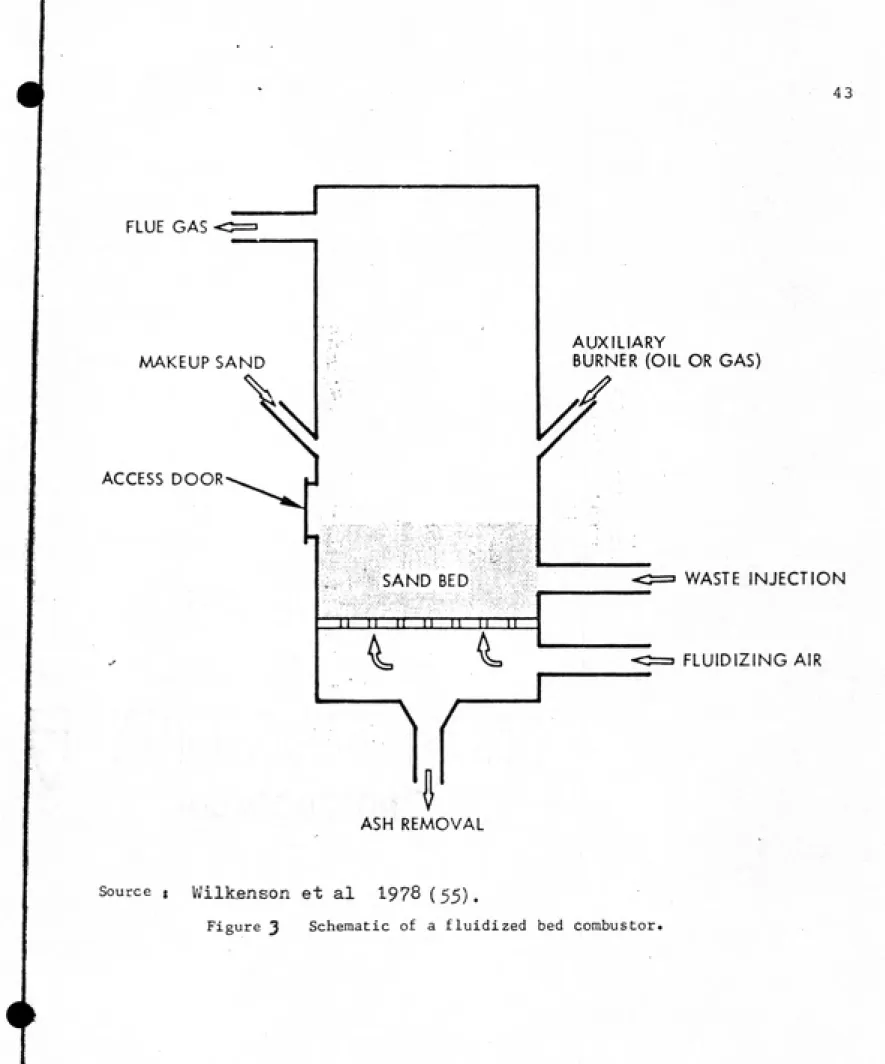
design and contain few moving parts. Figures 3 and 4 show
a schematic representation of this system and a flowsheet
for sludge combustion. Hot air is driven by a blower
upwards through a bed of either sand, alumina, sodium
carbonate, dolomite or granular ferrous oxide. This bed
i'-.
43
FLUE GAS
MAKEUP SAND
ACCESS DOOR
^
AUXILIARY
BURNER (OIL OR GAS)
./
V
SAND BED
11 II II II II II II
i i
\ /
I
ASH REMOVAL
WASTE INJECTION
FLUIDIZING AIR
Source j VJilkfinson et al I978 i^^),
44
FURNAcettWAoST MSCXH^ST COMBOtTlOIMAiB.
KSCUHHATOK
«HETSC«jB«fc,
^ «;f,^6<^
MlATefc
VfNTUW
fLMP RAHATION
S£0[£l£IfA^
onyLfMttff-AL^
NAIftUPWATFR
^
conwcrcowwBt^—Flowsheet for sludge inonercriion *\ 9. fluW be4 fumace.
Figure 4.
45
shell. The upward movement of the low pressure combustion
air agitates the bed and creates a dense yet turbulent medium into which sludges or other solid materials are
directly injected. The wastes are rapidly and uniformly
mixed due to the fluidization of the bed. The agitation
of wastes and bed granules allows for a thorough heat transfer which results in rapid combustion. Larger
particles are kept suspended in the bed until combustion
is complete. Offgases, containing some ash and fine bed
particles, exit through the top of the incinerator and are
collected with air pollution control equipment. The bed itself captures and neutralizes some combustion by-products. This can be an important
advantage when combusting pesticide sludges and cancelled pesticides which may generate such gases as HCl, SO and
NO . If limestone or dolomite is used in the bed.
there is a potential for the mixing of the bed to allow
the limestone to capture sulfur and thus reduce SO
emissions (7.33). In studies on the incineration of
polyvinyl chlorides. HCl emissions were reduced from 500 ppm to 135 ppm by switching from a silica and alumina bed to a dolomite bed (10). Recent tests on fluidized bed
performance for various chlorinated compounds have shown
46
J
emission rate of 0.087 Kg/hr (21). This meets the RCRA
performance standards of 99% HCl removal and 1.8 kg/hr
particulate limit.
In addition to these potential emission reductions,
lower operating temperatures than conventional
incineration, ranging from 1400-1600 F, reduces the
formation of nitrogen oxides. The air above the bed is
hotter than the bed materials and this will reduce noxious
by-products from pesticides such as PjO and sulfur if
they are formed (21).
Pesticide destruction has not been tested in the
fluidized bed incinerator. However, Rockwell
International has conducted tests on PCB's, which are very
refractory chlorinated compounds. They report DE
efficiencies of 99.9999% (6). In these tests 52% PCB and
48% trichlorobenzene transformer coolants were injected
into a two-stage fluid bed process. The second stage used
a chromic oxide catalyst fluid bed to neutralize off gases
not completely combusted in the first stage. These tests
were carried out at half the temperature of conventional
incineration. The combustion of chlorinated compounds,
such as 1,1.2 trichloro--l.2.2 trifluroethane,
trichloroethylene and tetrachloroethylene. achieved
47
respectively (21). Since PCB's are chemically similar to
chlorinated pesticides, destruction efficiency of these
compounds should be quite similar.
Fluidized bed incineration (when compared to
conventional incineration) may also offer several economic
advantages. It is simpler in design, easier to operate,
and maintenance costs are lower. This could reduce
downtime, fugitive emissions, and restart operations.
Fluidized bed incineration also uses less auxiliary fuel.
This is primarily due to lower operating temperatures and
the use of the bed as a heat reservoir. Exhaust
temperatures reach and may exceed 1400 F and therefore
no afterburner, which uses supplemental fuel, is needed
and lower excess air requirements (20-40%) also reduce
fuel requirements (3.49).
Few specific cost estimates have been made for
fluidized bed incineration. Most current cost comparisons
focus on conventional incineration. Crude estimates
suggest that the capital costs of a fluidized bed system
would be 20-50% higher than a conventional incinerator,
but the operating costs would be 30-50% lower (7).
Economic projections by the Army emphasize the cost
savings from lower operating costs. In their comparison
48
TNT slurries, they projected a cost savings of
$19.000-193.000/yr with a 112.5 kg/hr capacity and
$108.000-311.000/yr with a 450 kg/hr capacity (10), These
cost savings, if they are achieved in a continuously
operating unit, will promote the use of the fluidized bed
technology. In 1983 only 9 systems were in use in the
United States (35).
The principal disadvantages of these systems are that
ash is retained in the bed and must be disposed of.
Removal of these residuals from the bed may be difficult.
In the combustion of sludges, the feed system may become
clogged or jammed if the sludge is overdried. Erosion of
the scrubber system used to treat combustion off-gases may
occur due to a sandblasting effect resulting from bed
particles in the off-gases entering the scrubber.
Noncorabustible metals may have to be removed before
incineration. This may be particularly disadvantageous in
the case of cancelled pesticides stored in metal
containers. Lastly, certain organic compounds can cause
the bed to agglomerate. For example, chlorinated
compounds can lead to the production of NaCl. This salt
can react with Na„CO_ bed materials and form a