Sharif University of Technology
Scientia IranicaTransactions B: Mechanical Engineering http://scientiairanica.sharif.edu
Modeling and optimization of friction stir welding
parameters in joining 5086 H32 aluminium alloy
A. Goyal
and R.K. Garg
Department of Mechanical Engineering, Deenbandhu Chhotu Ram University of Science and Technology, Murthal Sonepat, India. Received 7 November 2017; received in revised form 20 February 2018; accepted 29 April 2018
KEYWORDS FSW;
RSM;
Aluminium alloys; Corrosion rate; Optimization.
Abstract.The present manuscript focuses on developing a mathematical model to predict the intergranular corrosion rate of friction stir welded AA5086 H32 aluminium alloy joints. Six factors-ve levels central composite design matrix, having 52 experiments, was used in the design of experiments. The developed model was used to examine the impact of studied process parameters, i.e., rotational speed, welding speed, tool shoulder diameter, tool hardness, tilt angle, and pin prole, on intergranular corrosion rate of the welded joints. Response surface methodology was used to optimize the process parameters in minimizing the susceptibility to intergranular corrosion attack. The optimum combination of studied parameters to have minimum corrosion rate, i.e., 3.2 mg/cm2, was 1296 rpm
rotational speed, 79.4 mm/min welding speed, 14.9 mm tool shoulder diameter, 47.4 HRC tool hardness, 2.38tilt angle, and square pin prole.
© 2019 Sharif University of Technology. All rights reserved.
1. Introduction
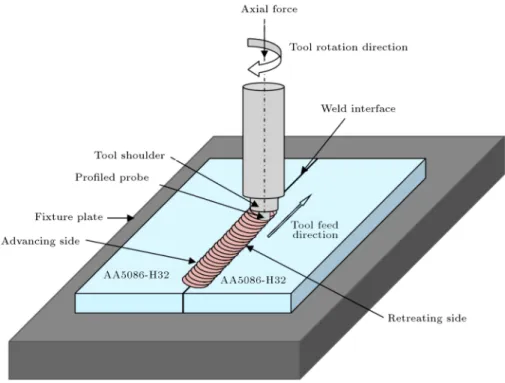
Friction Stir Welding (FSW) is a non-conventional technique used to weld similar or dissimilar materials with the application of frictional heat produced due to relative motion between the workpieces and rotating tool [1]. The rotating pin of the welding tool is inserted into the material until the top stratum of the work-pieces starts rubbing against the tool shoulder followed by feeding the tool transversely [2], as illustrated in Figure 1. The material gets softened due to frictional heat and starts owing with the pin, which acts as a stirrer for the softened material; consequently, extru-sion of the material starts from leading to trailing edges of the tool. The extruded material gets pressed by the forging action of the tool shoulder, which ultimately
*. Corresponding author. Tel.: +91 9813925505
E-mail addresses: [email protected] (A. Goyal); [email protected] (R.K. Garg).
doi: 10.24200/sci.2018.5525.1325
produces a solid bond between the workpieces to be joined. The pattern of material ow depends upon the FSW process parameters, which in turn determine the quality of the joint produced. The parameters showing dominance in aecting the performance characteristics of aluminium alloy joints fabricated using FSW are rotational and transverse speeds of the welding tool; however, other parameters like tool shoulder diameter, tilt angle, pin prole, and hardness of tool material also have considerable impact [3-5]. FSW is dierent from conventional joining methods in terms of temperature rise during the process, which is lower than the melting point of the workpiece materials in it, resulting in avoidance of many solidication defects that otherwise occur during the conventional welding techniques [6]. FSW is considered to be one of the most epochal inventions in the past decades as it has all the potential to join light structural materials like aluminium and its alloys, which are dicult to join using fusion welding methods [7,8].
The demand for aluminium and its alloys, in sheet and plate forms, is increasing in fabrication
Figure 1. Schematic view of friction stir welding.
industries for various applications like bridge decks, ship panels, aerospace, and transportation components due to their light weight and low distortion [9]. AA5086 is representative of non-heat-treatable 5xxx series of aluminium alloys having high formability and moderate strength. It has applications in marine, automotive, and aerospace industries in fabrication of light struc-tural components, where strength to weight ratio is a major concern and has to be as much as possible [10]. Colligan investigated the relevance of FSW to oshore and marine industries and suggested it as a cost-diminishing and defect-free joining method as compared to conventional joining methods [11]. Taban and Kaluc showed the superiority of FSW to the conventional joining methods in fabrication of AA5086 aluminium alloy joints [12]. Inuence of rotational and welding speeds on microstructural and mechanical properties of AA5086 joints was studied by Aval and Loureiro and a sensible correlation between the studied parameters was found [13]. Jamalian et al. suggested the appropriate combination of welding parameters to get sound and defect-free AA 5086 aluminium alloy joints produced using FSW [14]. Amini and Gharavi experimentally set up the proportional relation be-tween corrosion current density in heat aected zone and welding speed of tool in FSW of AA5086 alu-minium alloy [15]. The microstructural and mechanical properties of AA5086 joints are dierent from those of the base material as explained by the numerous studies reported in the literature; on the other hand, corrosion behavior of the joints has received rare attention.
RSM is a promising technique with the average
experimental error in predicting the response lower than those of the other optimization techniques. The signicance of square and interaction terms can more easily be understood through RSM, whereas other opti-mization techniques, e.g., Taguchi, can be used only for linear interactions due to the aliasing in the interaction with the main eects [16]. The variation of response, as a function of control factors, can clearly be visualized through 3D response surfaces in RSM, whereas Taguchi technique provides only the average value of a response for particular levels of control factors.
Hence, an attempt is made to explore the in-uence of FSW parameters on intergranular corrosion behavior of AA5086 H32 joints. A mathematical model is developed to predict intergranular corrosion rate as a function of rotational and welding speeds, shoulder diameter, hardness of tool material, tilt angle, and pin prole. Response Surface Methodology (RSM) is uti-lized for optimization of the studied FSW parameters to minimize intergranular corrosion rate of AA5086 H32 joints.
2. Materials and methodology
Aluminium alloy AA5086 H32 sheet of 5 mm thickness was cut into small rectangular pieces having dimensions 200 mm75 mm each, followed by edge preparation to secure precise butt conguration of two such pieces in welding. Tables 1 and 2 present the mechanical properties and chemical composition, respectively, of the base metal used in the study. The potential FSW process parameters aecting the quality of aluminium
Table 1. Mechanical properties of AA5086-H32. UTS
(MPa)
Yield strength (MPa)
Elongation (%)
Hardness (HV)
CR (mg/cm2)
288 248 12 88 9.2
Table 2. Chemical composition of AA5086-H32.
Elements Mg Mn Si Fe Cu Zn Cr Ti Ni Al
Wt (%) 4.2 0.59 0.07 0.16 0.05 0.15 0.08 0.06 0.01 Balance
alloy joints, namely tool rotational speed (N), tilt angle (A), pin prole (P ), welding speed (S), tool hardness (H), and diameter of tool shoulder (D), were identied based on their dominance and availability in experimental setup. The working range of the pa-rameters was selected through review of the literature and trial experiments [17]. Six factor-ve levels half fraction Central Composite Design (CCD) was chosen for Design Of Experiments (DOE). Table 3 shows the process parameters and their respective levels. The lower and upper levels of each parameter were coded as 2:37 and +2:37, while other three equidistant levels were coded as +1, 0, and 1. The selected DOE, consisting of 12 star points, 8 center points, and 32 fractional factorial design points (26=2 = 32), was
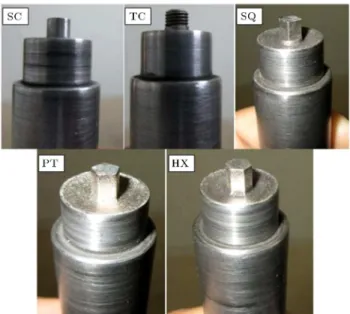
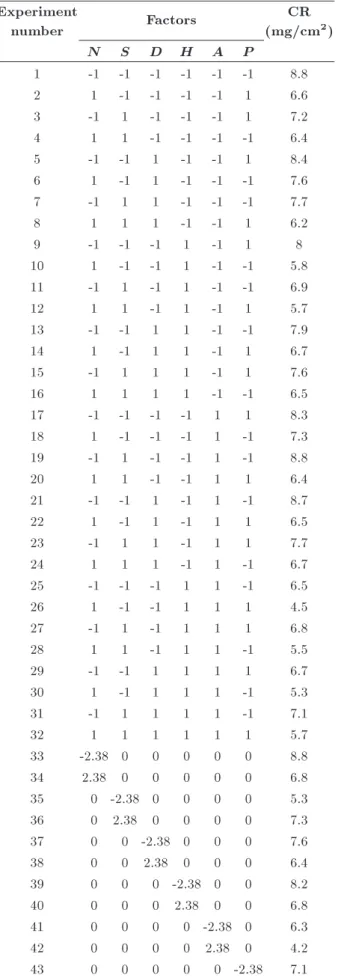
considered to be an ecient tool for prediction and optimization of performance characteristics of friction stir welded joints [18,19]. The matrix, having 52 combinations of dierent levels for the selected process parameters, is shown in coded form in Table 4. Fifteen tools of H13 steel, having dissimilarity in pin prole, hardness, and shoulder diameter, were fabricated to meet the requirements of the design matrix. Figure 2 presents the tool pin proles, i.e., Straight Cylindrical (SC), pentagonal (PT), square (SQ), hexagonal (HX), and Threaded Cylindrical (TC), used in the present study. A tailor made xture was fabricated to fasten the pieces so as to withstand the welding forces. Single pass welding, parallel to the rolling direction of parent alloy, was carried out to join the workpieces. A Computerized Numerically Controlled (CNC) vertical milling center was used to carry out the experiments.
Figure 2. Tool pin proles (SC, TC, SQ, PT, and HX).
Fifty-two experiments were performed by varying the parameters at a predened level, as suggested by the design matrix. The machine parameters, i.e., rotational and welding speeds of the tool, were controlled through CNC program. The tool parameters, i.e., shoulder di-ameter, pin prole, and tool hardness, were controlled by changing the welding tool for each experiment. Tool tilt angle was controlled by tilting the xture on which the workpieces rested during welding.
Intergranular corrosion rate of the welded speci-mens was studied as per the ASTM G67 standard [20]. Nitric Acid Mass Loss Test (NAMLT) was considered
Table 3. Identied parameters and levels.
Parameter Notation Unit Levels
2:37 1 0 1 +2:37
Rotational speed N rpm 724 1000 1200 1400 1675
Welding speed S mm/min 37 65 85 105 132
Shoulder diameter D mm 7.8 12 15 18 22.1
Tool hardness H HRC 33 40 45 50 56
Tilt angle A Degree 0.8 1.5 2 2.5 3.2
Table 4. DOE matrix and experimental results. Experiment
number Factors
CR (mg/cm2)
N S D H A P
1 -1 -1 -1 -1 -1 -1 8.8
2 1 -1 -1 -1 -1 1 6.6
3 -1 1 -1 -1 -1 1 7.2
4 1 1 -1 -1 -1 -1 6.4
5 -1 -1 1 -1 -1 1 8.4
6 1 -1 1 -1 -1 -1 7.6
7 -1 1 1 -1 -1 -1 7.7
8 1 1 1 -1 -1 1 6.2
9 -1 -1 -1 1 -1 1 8
10 1 -1 -1 1 -1 -1 5.8
11 -1 1 -1 1 -1 -1 6.9
12 1 1 -1 1 -1 1 5.7
13 -1 -1 1 1 -1 -1 7.9
14 1 -1 1 1 -1 1 6.7
15 -1 1 1 1 -1 1 7.6
16 1 1 1 1 -1 -1 6.5
17 -1 -1 -1 -1 1 1 8.3
18 1 -1 -1 -1 1 -1 7.3
19 -1 1 -1 -1 1 -1 8.8
20 1 1 -1 -1 1 1 6.4
21 -1 -1 1 -1 1 -1 8.7
22 1 -1 1 -1 1 1 6.5
23 -1 1 1 -1 1 1 7.7
24 1 1 1 -1 1 -1 6.7
25 -1 -1 -1 1 1 -1 6.5
26 1 -1 -1 1 1 1 4.5
27 -1 1 -1 1 1 1 6.8
28 1 1 -1 1 1 -1 5.5
29 -1 -1 1 1 1 1 6.7
30 1 -1 1 1 1 -1 5.3
31 -1 1 1 1 1 -1 7.1
32 1 1 1 1 1 1 5.7
33 -2.38 0 0 0 0 0 8.8
34 2.38 0 0 0 0 0 6.8
35 0 -2.38 0 0 0 0 5.3
36 0 2.38 0 0 0 0 7.3
37 0 0 -2.38 0 0 0 7.6
38 0 0 2.38 0 0 0 6.4
39 0 0 0 -2.38 0 0 8.2
40 0 0 0 2.38 0 0 6.8
41 0 0 0 0 -2.38 0 6.3
42 0 0 0 0 2.38 0 4.2
43 0 0 0 0 0 -2.38 7.1
Table 4. DOE matrix and experimental results (continued).
Experiment
number Factors
CR (mg/cm2)
N S D H A P
44 0 0 0 0 0 2.38 5.3
45 0 0 0 0 0 0 6.2
46 0 0 0 0 0 0 3.1
47 0 0 0 0 0 0 3.9
48 0 0 0 0 0 0 3.5
49 0 0 0 0 0 0 3.1
50 0 0 0 0 0 0 2.7
51 0 0 0 0 0 0 3
52 0 0 0 0 0 0 3.4
Figure 3. Corrosion test specimens (after test).
to examine the susceptibility of AA5086 H32 FSWed joints to intergranular corrosion. The weldments were sliced to prepare the corrosion test samples, as shown in Figure 3. The prepared samples were immersed in 5% NaOH solution and kept in hot air oven maintained at a temperature of 80C for 1 minute followed by
water rinse. Desmutting of the samples was done by immersion in nitric acid for 30 seconds followed by water rinse. An electronic weighing balance, having least count of 0.1 mg, was used to measure the weight of individual sample. The samples were immersed in test solution for 24 hours followed by water rinsing and gentle brushing to remove all corroded particles. The samples were weighted again with the same weighing balance and the loss of mass was calculated.
The testing was performed on a total of 104 samples taking two samples from each welded joint in order to reduce experimental errors. To get better accuracy, arithmetic mean was taken to determine the corrosion rate, i.e., mass loss per unit area, for each experiment/joint, which is given in Table 4.
3. Results and Discussion
The response variable, namely intergranular Corrosion Rate (CR), may be expressed as a function of input
process parameters, i.e., tool rotational speed (N), tilt angle (A), pin prole (P ), welding speed (S), tool material hardness (H), and tool shoulder diameter (D), as shown in Eq. (1):
CR = f(N; S; D; H; A; P ): (1) The response surface `Y ' can be represented as a second-order polynomial expression as given in Eq. (2):
Y = b0+
X bixi+
X biix2i +
X
bijxixj: (2)
The above expression can be expanded to a six factors-ve lefactors-vels design as shown in Eq. (3):
CR = b0+ b1(N) + b2(S) + b3(D) + b4(H) + b5(A)
+b6(P ) + b11(N2) + b22(S2) + b33(D2)
+b44(H2) + b55(A2) + b66(P2) + b12(NS)
+b13(ND) + b14(NH) + b15(NA) + b16(NP )
+b23(SD) + b24(SH) + b25(SA) + b26(SP )
+b34(DH) + b35(DA) + b36(DP ) + b45(HA)
+b46(HP ) + b56(AP ): (3)
The coecients of intercept (bo), single (bi), quadratic
(bii), and interaction (bij) terms in the above
expres-sion were calculated using the matrix method as ex-plained by Eq. (4) and put into Eq. (3) to determine the nal model for predicting the intergranular corrosion rate of FSWed AA5086 H32 joints. The developed model, in terms of coded factors, is presented in Eq. (5):
b = (X0X) 1X0Y; (4)
CR = 3:61 0:66(N) + 0:0031(S)
+ 0:015(D) 0:45(H) 0:24(A) 0:20(P ) + 0:75(N2) + 0:49(S2) + 0:61(D2) + 0:70(H2)
+ 0:30(A2) + 0:47(P2) + 0:072(NS)
+ 0:078(ND) + 0:0031(NH) 0:053(NA) 0:034(NP ) 0:016(SD) + 0:17(SH) + 0:20(SA) 0:0031(SP ) + 0:13(DH)
0:091(DA) + 0:016(DP ) 0:27(HA)
+ 0:15(HP ) 0:066(AP ): (5)
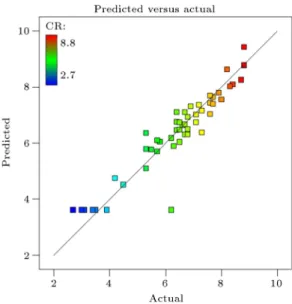
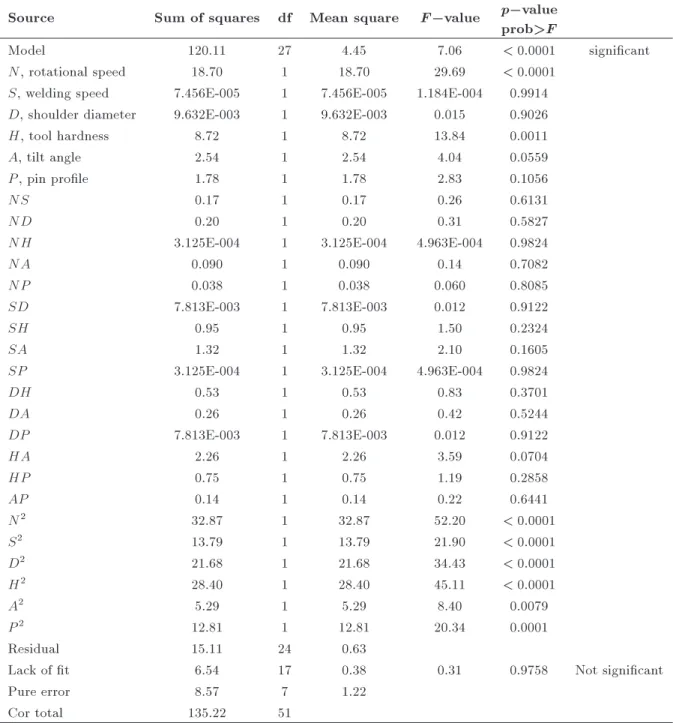
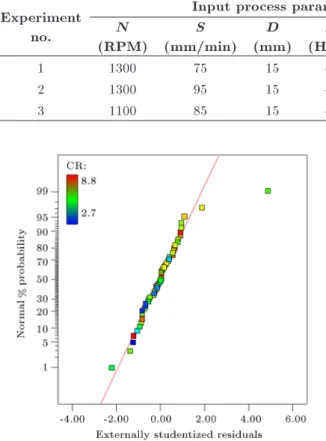
The adequacy of the developed mathematical model was checked by analysis of variance (ANOVA) at 95% condence level and the results are presented in Table 5. The results showed the signicant per-formance of the model, and intergranular corrosion rate of FSWed AA5086 H32 joints might be predicted without actual experimentation using the developed mathematical model. The `lack of t' in the model was determined to be insignicant relative to pure error, which was desirable for any model to t the predicted data. Figure 4 shows the deviation of observed valves of corrosion rate from the values predicted by the model. The coecient of determination, i.e., R2, is a statistical
term, ranging from 0 to 1, which measures the amount of variation that can be explained by the developed model and should approach unity for a model to be perfect. The value of R2, for the model developed
in the present research work, came out to be 0.8882, indicating that approximately 89% of the variation in the response was explained by the input variables. The dierence in predicted R2 and adjusted R2 should be
less than 0.2 to have reasonable agreement between the two and for the developed model, it came out to be 0.1339, which was within the desired limit. Figure 5 presents the normal plot of residuals showing the normal distribution of the externally studentized residuals about the mean. The signal to noise ratio can be quantied by the term `adequate precision', which must be greater than 4 for a model to be capable of navigating design space. The adequate precision for the developed model was 9.996, indicating the adequacy of the signal. The Coecient of Variation (C.V.) was used as the standardized measure of dispersion and should be as low as possible, ranging from 0 to 1. The C.V. for the developed model was 0.1245, indicating the satisfactory dispersion of the data. Three test
Table 5. ANOVA test results.
Source Sum of squares df Mean square F value p value prob>F
Model 120.11 27 4.45 7.06 < 0:0001 signicant
N, rotational speed 18.70 1 18.70 29.69 < 0:0001
S, welding speed 7.456E-005 1 7.456E-005 1.184E-004 0.9914 D, shoulder diameter 9.632E-003 1 9.632E-003 0.015 0.9026
H, tool hardness 8.72 1 8.72 13.84 0.0011
A, tilt angle 2.54 1 2.54 4.04 0.0559
P , pin prole 1.78 1 1.78 2.83 0.1056
NS 0.17 1 0.17 0.26 0.6131
ND 0.20 1 0.20 0.31 0.5827
NH 3.125E-004 1 3.125E-004 4.963E-004 0.9824
NA 0.090 1 0.090 0.14 0.7082
NP 0.038 1 0.038 0.060 0.8085
SD 7.813E-003 1 7.813E-003 0.012 0.9122
SH 0.95 1 0.95 1.50 0.2324
SA 1.32 1 1.32 2.10 0.1605
SP 3.125E-004 1 3.125E-004 4.963E-004 0.9824
DH 0.53 1 0.53 0.83 0.3701
DA 0.26 1 0.26 0.42 0.5244
DP 7.813E-003 1 7.813E-003 0.012 0.9122
HA 2.26 1 2.26 3.59 0.0704
HP 0.75 1 0.75 1.19 0.2858
AP 0.14 1 0.14 0.22 0.6441
N2 32.87 1 32.87 52.20 < 0:0001
S2 13.79 1 13.79 21.90 < 0:0001
D2 21.68 1 21.68 34.43 < 0:0001
H2 28.40 1 28.40 45.11 < 0:0001
A2 5.29 1 5.29 8.40 0.0079
P2 12.81 1 12.81 20.34 0.0001
Residual 15.11 24 0.63
Lack of t 6.54 17 0.38 0.31 0.9758 Not signicant
Pure error 8.57 7 1.22
Cor total 135.22 51
runs were conducted to conrm the predictions of the developed model, taking the combinations of input variables other than those in design matrix, and the results are shown in Table 6. The maximum error, out of three conrmatory test runs, came out to be 2.95%, conrming the adequacy of the developed mathematical model.
The inuence of process parameters on inter-granular corrosion rate of FSWed AA5086 H32 joints was analyzed using the developed model. MATLAB software package was used to generate a code for the developed mathematical relation between the corrosion rate and input variables and furthermore, to examine
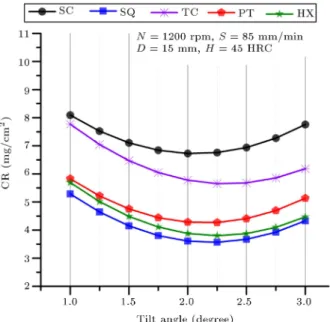
the eect of individual factors on corrosion rate by varying one factor at a time and keeping other factors at their intermediate levels. Figure 6 presents the eect of rotational speed on corrosion rate for all ve pin proles used in the present study. All the joints showed better corrosion resistance than the parent alloy irre-spective of the speed at which welding tool was rotated during welding process. An improvement in corrosion resistance was observed as rotational speed was raised up to 1300 rpm, beyond which an increase in corrosion rate was observed, and this trend was common for all pin proles. Figure 7 presents the impact of welding speed on the corrosion behavior of FSWed joints. It
Table 6. Conrmation test results. Experiment
no.
Input process parameters Response (CR) mg/cm2
Error (%) N
(RPM)
S (mm/min)
D (mm)
H (HRC)
A
(degree) P Predicted Experimental
1 1300 75 15 45 2.5 SQ 3.50 3.58 2.23
2 1300 95 15 45 2 SQ 3.61 3.72 2.95
3 1100 85 15 45 2.5 SQ 4.41 4.51 2.22
Figure 5. Normal probability plot of residuals.
Figure 6. Eect of rotational speed on corrosion rate.
is clear from the gure that the joints produced by 80 mm/min to 100 mm/min welding speed had less susceptibility to intergranular corrosion irrespective of the type of pin prole used. Figures 8, 9, and 10 show the variation in corrosion rate as a function of shoulder diameter, tool hardness, and tilt angle, respectively, and conrm that these parameters have signicant
Figure 7. Eect of welding speed on corrosion rate.
Figure 8. Eect of shoulder diameter on corrosion rate.
inuence on the joint performance. The proles of the tool pin also had considerable eect on corrosion rate as they were responsible for material movement during the welding process. The ratio of static to dynamic volume
Figure 9. Eect of tool hardness on corrosion rate.
Figure 10. Eect of tilt angle on corrosion rate.
along with pulsating action of the tool pin controls the material ow pattern and ultimately aects the weld quality. The square pin prole shows better results irrespective of the combination of other process parameters, followed by hexagonal and pentagonal pin proles. The square, pentagonal, and hexagonal pins produce 80 pulses/sec, 100 pulses/sec, and 120 pulses/sec, respectively, at 1200 rpm rotational speed during stirring of the materials. Although the pulse frequencies of pentagonal and hexagonal pin proles are more than that of the square pin prole, the latter one provides better quality joints due to its better static to dynamic volume ratio, namely 1.57, than the pentagonal and hexagonal having the ratios of 1.32
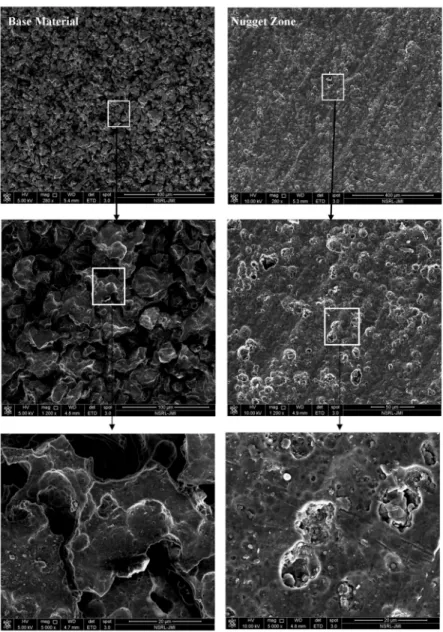
and 1.209, respectively. In NAMLT test, intergranular corrosion in AA5086 H32 aluminum alloy was made by dissolution of -phase (Al-Mg) in aluminum matrix. The preferential attack of the precipitates of the dis-solved compound around the grain boundaries caused the grains to corrode away from the specimen. Hence, the arrangement of -phase compound, and average size and pattern of grains of the test specimen have key role in identifying the susceptibility to intergranular corrosion attack. The microstructural examination presented in Figures 11 and 12 shows renement in grain size of nugget zone of the welded specimens as compared to the parent alloy and this justies the improvement in corrosion resistance.
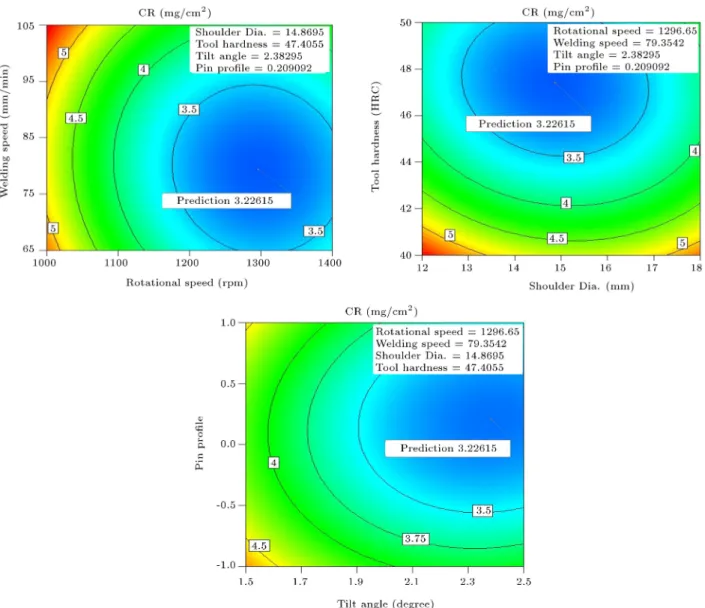
RSM was utilized for FSW parameters opti-mization to minimize the intergranular corrosion rate of AA5086 H32 joints. RSM is an ecient tool to establish mathematical relation between response and input variables aecting the response and hence, optimizing the process parameters as per the desired criteria [21]. The response surface and contour plots can be drawn as a function of interaction between any two input variables to explore the variation in response parameter. The apex and nadir of the surface give the optimum value if their desired criteria are to maximize and to minimize the response, respectively. In the present study, the desired criterion was to minimize the response; that is, it was intergranular corrosion rate, which should be as low as possible for any structure to be durable. The response surfaces and contour plots, showing the variation in corrosion rate, are presented in Figure 13. The input parameters corresponding to optimum value of corrosion rate, i.e., 3.2 mg/cm2, were observed to be 1296 rpm rotational
speed, 79.4 mm/min welding speed, 14.9 mm tool shoulder diameter, 47.4 HRC tool hardness, 2.38tilt
angle, and square pin prole. 4. Conclusion
FSW was successfully employed to join 5 mm thick AA5086 H32 aluminum alloy sheets. An adequate mathematical model was developed to predict inter-granular corrosion rate of the FSWed AA5086 H32 joints. The impact of various input variables on the corrosion rate of welded specimens was studied with the help of the developed model and it was concluded that the studied parameters signicantly aected the joint quality. The corrosion resistance of the FSWed specimens was found to be improved as compared to that of the base material. RSM was successfully utilized to optimize the process parameters and the optimum level of studied parameters were determined as 1296 rpm rotational speed, 79.4 mm/min welding speed, 14.9 mm tool shoulder diameter, 47.4 HRC tool hardness, 2.38 tilt angle, and square pin prole.
Figure 11. Microstructure of friction stir welded specimen.
Figure 13. Contour plots of interaction eect of input parameters on corrosion rate.
References
1. Thomas, W.M., Nicholas, E.D., Needham, J.C., and Dawes, C.J., International Patent Application No. PCT/GB92/02203 (1991).
2. Dinaharan, I., Murugan, N., and Parameswaran, S. \Developing an empirical relationship to predict the inuence of process parameters on tensile strength of friction stir welded AA6061/0-10 wt% ZrB2 in situ composite", Transactions of the Indian Institute of Metals, 65(2), pp. 59-170 (2012).
3. Peddavarapu, S., Raghuraman, S., Bharathi, R.J., Sunil, G.V.S., and Manikanta, D.B.N.S. \Micro struc-tural investigation on friction stir welded Al-4.5 Cu-5TiB2 Composite", Transactions of the Indian Insti-tute of Metals, 70(3), pp. 703-708 (2017).
4. Mehta, K.P. and Badheka, V.J. \Eects of tilt angle on the properties of dissimilar friction stir welding copper to aluminum", Materials and Manufacturing Processes, 31(3), pp. 255-263 (2016).
5. Aval, H.J. \Inuences of pin prole on the mechanical and microstructural behaviors in dissimilar friction stir welded AA6082-AA7075 butt joint", Materials & Design, 67, pp. 413-421 (2015).
6. Aziz, S.B., Dewan, M.W., Huggett, D.J., Wahab, M.A., Okeil, A.M., and Liao, T.W. \Impact of friction stir welding (FSW) process parameters on thermal modeling and heat generation of aluminum alloy joints", Acta Metallurgica Sinica (English Letters), 29(9), pp. 869-883 (2016).
7. Subbaiah, K., Geetha, M., Govindaraju, M., and Rao, S.K. \Mechanical properties of friction stir welded cast Al-Mg-Sc alloys", Transactions of the Indian Institute of Metals, 65(2), pp. 155-158 (2012).
8. Yan, Z.J., Liu, X.S., and Fang, H.Y. \Fatigue behav-ior of dissimilar Al-Mg-Si/Al-Zn-Mg aluminum alloys friction stir welding joints", Acta Metallurgica Sinica (English Letters), 29(12), pp. 1161-1168 (2016).
9. Reddy, G.M., Mastanaiah, P., Prasad, K.S., and Mo-handas, T. \Microstructure and mechanical property correlations in AA 6061 aluminium alloy friction stir welds", Transactions of the Indian Institute of Metals, 62(1), pp. 49-58 (2009).
10. Behnagh, R.A., Besharati Givi, M.K., and Akbari, M. \Mechanical properties, corrosion resistance, and microstructural changes during friction stir processing of 5083 aluminum rolled plates", Materials and Man-ufacturing Processes, 27(6), pp. 636-640 (2012). 11. Colligan, K.J. \Friction stir welding for ship
construc-tion", Contract, 14, pp. 1-6 (2004).
12. Taban, E. and Kaluc, E. \Comparison between mi-crostructure characteristics and joint performance of 5086-H32 aluminium alloy welded by MIG, TIG and friction stir welding processes", Kovove Materialy, 45(5), pp. 241-248 (2007).
13. Aval, H.J. and Loureiro, A. \Eect of welding pa-rameters on microstructure, mechanical properties and residual stress elds of friction stir welds on AA5086", Kovove Materialy, 53, pp. 51-58 (2015).
14. Jamalian, H.M., Farahani, M., Givi, M.B., and Vafaei, M.A. \Study on the eects of friction stir welding process parameters on the microstructure and mechan-ical properties of 5086-H34 aluminum welded joints", The International Journal of Advanced Manufacturing Technology, 83(1-4), pp. 611-621 (2016).
15. Amini, K. and Gharavi, F. \Inuence of welding speed on corrosion behaviour of friction stir welded AA5086 aluminium alloy", Journal of Central South University, 23(6), pp. 1301-1311 (2016).
16. Milkey, K.R., Samsudin, A.R., Dubey, A.K., and Kidd, P. \Comparison between taguchi method and response surface methodology (RSM) in modelling CO2 laser machining", Jordan Journal of Mechanical & Industrial Engineering, 8(1), pp. 35-42 (2014). 17. Goyal, A. and Garg, R.K. \Eect of tool rotational
and transverse speed on mechanical properties of friction stir welded AA5086-H32 aluminium alloy", International Journal of Microstructure and Materials Properties, 12(1-2), pp. 79-93 (2017).
18. Rajakumar, S., Muralidharan, C., and Balasubrama-nian, V. \Predicting tensile strength, hardness and corrosion rate of friction stir welded AA6061-T 6 aluminium alloy joints", Materials & Design, 32(5), pp. 2878-2890 (2011).
19. Rajakumar, S. and Balasubramanian, V. \Predicting grain size and tensile strength of friction stir welded joints of AA7075-T6 aluminium alloy", Materials and Manufacturing Processes, 27(1), pp. 78-83 (2012). 20. \Standard test method for determining the
suscepti-bility to intergranular corrosion of 5XXX series alu-minum alloys by mass loss after exposure to nitric acid (NAMLT Test)", ASTM International (2004). 21. Bouzid, L., Berkani, S., Yallese, M., Girardin, F., and
Mabrouki, T. \Estimation and optimization of ank wear and tool lifespan in nish turning of AISI 304 stainless steel using desirability function approach", International Journal of Industrial Engineering Com-putations, 9(3), pp. 349-368 (2018).
Biographies
Amit Goyal, born in India in 1985, is a research scholar in the Department of Mechanical Engineering at Deenbandhu Chhotu Ram University of Science and Technology, Murthal, Haryana, India. He obtained Diploma in Production Engineering from State Board of Technical Education, Haryana, India, in 2005. Then, he received the B.Tech and M.Tech degrees in Me-chanical Engineering from Kurukshetra University, Ku-rukshetra, and Guru Jambheshwar University, Hisar, Haryana, India in 2010 and 2014, respectively. He has more than 6 years of teaching and practical experience. His research interests include advanced manufacturing technology, and production and industrial engineering. Ramesh Kumar Garg, born in India in 1970, is working as full professor in the Department of Me-chanical Engineering at Deenbandhu Chhotu Ram Uni-versity of Science and Technology, Murthal, Haryana, India. He received BE with honors, ME, and PhD in Mechanical Engineering from M.D. University, Rohtak; Panjab University, Chandigarh; and M.D. University, Rohtak, Haryana, India, in 1991, 1996, and 2006, respectively. His research interests include industrial engineering and system design, reliability modeling and analysis, and computational techniques. Dr. Garg has published a number of research papers in international journals and conferences and guided a number PhD and M.Tech dissertations.