Radiation attenuation properties of shields
containing micro and Nano WO3 in diagnostic X-ray
energy range
INTRODUCTION
Over the past decades nanotechnology has enabled us to create a wide variety of life-changing products. This technology is also currently used for production of multipurpose radiation shields. Since the discovery of X-rays and radioactivity, lexible lead-based radiation shields have been widely used in radiology departments. Currently, the shielding design of X and g facilities, protective equipments and clothing is mainly based on lead materials.
concern expressed about the toxicity of lead (1). In addition the heaviness of the lead would cause back strain, and orthopedic injuries in radiation workers who wear the lead aprons for long durations (2-5). Therefore production of environmentally-friendly lead-free radiation shields with less weight compared to conventional lead-based shields is a challenging issue in diagnostic radiology and nuclear medicine (6-11). Different investigations have been performed to obtain the properties of aprons made by combining elements with
ABSTRACT
Background: It has recently been shown that the par cle size of materials used for radia on shielding can affect the magnitude of radia on a enua on. Over the past years, applica on of nano-structured materials in radia on shielding has a racted a en on world-wide. The purpose of this study was to inves gate the shielding proper es of the lead-free shields containing micro and nano-sized WO3 against low energy x-rays. Materials and Methods:The radia on shields were constructed using nano and micro WO3 par cles incorporated into an EPVC polymer matrix. The a enua on coefficients of the designed shields were evaluated for low energy x-rays (diagnos c radiology energy range). Results: The results indicate that nano-structured WO3/PVC shields have higher photon a enua on proper es compared to those of the micro-sized samples. Conclusion: Our experiment clearly shows that the smaller size of nano-structured WO3 par cles can guarantee a be er radia on shielding property. However, it is too early to draw any conclusion on the possible mechanisms of enhanced a enua on of nano-sized WO3 par cles.
Keywords: Radia on, a enua on, micro, Nano, WO3, in diagnos c radiology, X-ray.
A. Aghaz
1, R. Faghihi
1, S.M.J. Mortazavi
2*, A. Haghparast
3,
S. Mehdizadeh
4, S. Sina
41Nuclear Engineering Department, Shiraz University, Shiraz, Iran
2Medical Physics Department and The Center for Research on Radiological Sciences, Shiraz University of
Medical Sciences, Shiraz, Iran
3Medical Physics Department, Kermanshah University of Medical Sciences, Kermanshah, Iran 4Radiation Research Center, Shiraz University, Shiraz, Iran
*Corresponding author:
Dr. SMJ Mortazavi,
Fax: + 98 711 2349332
E-mail:
Revised: Sept. 2015
Accepted: Oct. 2015
Int. J. Radiat. Res., April 2016; 14(2): 127-131
► Original Article
DOI: 10.18869/acadpub.ijrr.14.2.127
barium, tungsten, antimony, yttrium, and lead (5,
6, 9, 12). Recently the use of Nanoparticles in the
design of lead-free radiation shields have been investigated (13). Protective materials with Nano particles have shown to have good mechanical properties to be used in developing radiation shields (1, 13-15). The size and concentration of Nano-particles used in making radiation shields are two important factors affecting the radiation attenuation properties of the protective materials (1, 13, 16). The purpose of this study is to design nano and micro-structured shields using WO3 particles incorporated in EPVC polymeric matrix, and to compare the radiation shielding properties of nano and micro-sized shielding materials.
MATERIALS
AND METHODS
Flexible sheets of WO3 were produced in a poly vinyl chloride (EPVC) polymeric matrix. In this experiment, the nano and micro-structured shields with the purity of +99% were constructed using WO3 particles incorporated in EPVC polymeric matrix with 20%, 50% and 60% of mass proportions. The grain sizes of nano particles used in construction of the shields were 20 to 100 nm, while the average micro WO3 particle size was less than 20 µm. The scanning electron microscope (SEM) image of the nano-sized WO3 powder is shown in igure 1.
The X-ray attenuation measurements were performed for tube voltages between 40 kVp and 100 kVp at 128 mAs ( iltration of 1.5 mm
Al). X-ray beam was generated by a Shimadzu diagnostic digital radiography machine with a tungsten anode tube powered by a three-phase generator. The X-ray transmission measure-ments were carried out by a calibrated solid state dosimeter (R100B model, Barracuda, Germany). The transmitted X-ray beam intensity (I) was measured by placing the samples at the distance of 28cm from the detector. The experimental set up used for measurement of the X ray intensity after the shields is shown in igure 2. The relative X-ray transition (δ) was obtained using equation 1.
The mass attenuation coef icient of the nano and micro-sized particles were then obtained from (I/I0) values. The relative mass attenuation coef icient values were obtained using the following equation.
RESULTS
The effect of the increase in weight fraction of nano and micro-sized WO3-PVC composite with thickness of 1±0.2 mm on relative X-ray transition (δ) for different X-ray tube voltages of 40, 50, 70, 80, and 100kv is shown in igure 3.
According to igure 3, there exists no observable difference in relative X-ray transition
Figure 1. The SEM image of the nano-WO3 powder.
Figure 2. The experimental setup used for measurement of the radia on intensity transmi ed through the samples.
(1)
(2)
(δ) for 20% weight percentage of both nano and micro-sized WO3 incorporated to EPVC for voltages of 80 kv. For voltage of 100 kv, all samples showed the same behavior.
For 40, 50, and 70 kv, the X-ray transitions (δ) for samples with 50%, and 60% nano-sized WO3 are at least 21% of the δ with micro-sized partcles.
The maximum relative X-ray transitions (δ) for samples with nano-sized WO3 relative to micro-sized WO3 were observed in 70 kv for 60% weight percentage of WO3. In voltage of 70 kvp, which is near the k edge of the tungsten, the average X-ray transition of the X-ray are more than other voltages, for all samples with 20% and 60% weight percentage, this is because of the fact that the X-ray attenuation increase in the energies equal to the k-edge of the elements. The total photon attenuation in shields decreases by increasing the photon energy. Therefore it can be concluded that the maximum differences in photon attenuation between Nano and micro-structured samples are observed for 40, 50, and 70 kvp. Such differences are more observed for samples containing 50 and 60% weight percentage of WO3.
Figure 4 compares the relative values of the mass attenuation coef icient (m) for voltages of 40, 50, 70, 80, and 100 kv for samples with all mass percentages. The igure indicates that the
maximum increase in the mass attenuation coef icient is observed at 70kvp and for the samples with 60% mass percentage of WO3. The results show that the samples containing Nano-sized particles can attenuate the 70 kvp beam better than samples with micro-sized wo3, while for higher energy beams, i.e. 80 and 100 kvp, the rate of increase in mass attenuation coef icient decrease and thus the mass attenuation become almost similar.
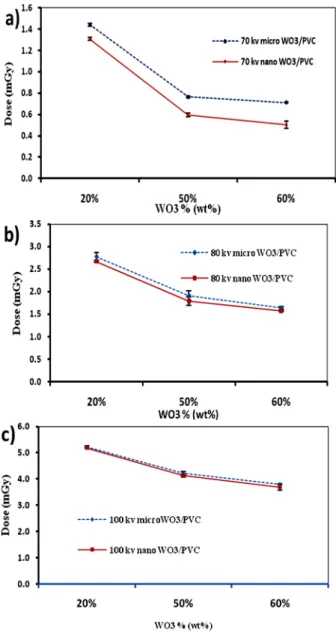
The radiation dose measured after the samples are compared for different photon energies in igures 5 and 6. According to igure 5, for tube voltage (kVp) of 40 kV, the Nano-structured shields with 20, 50, and 60% weight percentage of WO3, reduce the dose 12.15, 27.64, and 34.72% compared to micro-structured shields. Figure 6 indicates that for tube voltage of 100 Kv, the dose reductions due to Nano-shields with 20, 50, and 60% WO3 content were found to be 0.79, 2.11, and 2.98%. The maximum dose reductions were found to be 41.27% at 70kVp for samples with 60% weight percentage of WO3. According to the igures, for low kVps, the samples containing Nano-particles can reduce the dose signi icantly more than the micro-structured samples, while for higher energies, i.e. 80 and 100kvp, no considerable difference is observed for Nano and micro-structured samples.
Figure 3.The percentage difference between the X-ray transmission of nano and micro-structured samples, (δ), as
func on of WO3 weight percentage for different X-ray voltages.
Figure 4. percentage difference between the mass a enua on coefficients (m/ρ) of nano and micro-structured
samples, (m), as func on of WO3 weight percentage for
different X-ray voltages.
DISCUSSION
The X-ray beam attenuation by
nanostructured and microstructured materials has been investigated inthis study. The results of this study show that the 80, and 100 kvp X-ray beams lead to an almost unchanged dose after passing through both nano and micro-structured samples. While, for beams with 40, 50 and 70 kVp, the values of the dose after Nano-structured samples are less than the dose after micro-structured samples for all concentrations. The results also indicate that the Nano-structured WO3/PVC samples have greater absorption low energy X-ray photons compared to the samples produced with micro-structured WO3/PVC.
According to the results the nanostructure-based shields can reduce the radiation dose signi icantly in comparison with the micro-structured ones with the same proporsion of WO3/PVC. Because of the smaller sizes of the Nano particles, the crackle is blocked more ef iciently. Light, non-lead, and safer shields for use in diagnostic radiology, can be constructed using suitable weight percentage of Nano-WO3 powder.
Con lict of Interest: Declared none.
REFERENCES
1. Scuderi GJ, Brusovanik GV, Campbell DR, Henry RP, Kwone B, Vaccaro AR (2006) Evalua on of non–lead-based protec ve radiological material in spinal surgery. The Spine
Journa, 6: 577-582.
Figure 5. The dose measured a?er the micro and nano- structured shields with 1.1 cm thickness as a func on of the weight percentage (wt %) of WO3 for (a) 40 kV and (b) 50 Kv X-ray beam.
Figure 6.The dose measured a?er the micro and nano- structured shields with 1.1mm thickness as a func on of the weight percentage (wt %) of WO3 for (a) 70 kV (b) 80 Kv, and
c) 100kV X-ray beam.
2. Moore B., van Sonnenberg E., Casola G., Novelline R.A. (1992). The rela onship between back pain and lead apron use in radiologists. Am J Roentgenol, 158, 191-193. 3. Klein LW, Miller DL, Balter S, Laskey W, Haines D, Norbash
A, Mauro MA, Goldstein JA. (2009). Occupa onal health hazards in the interven onal laboratory: Time for a safer
environment. Catheteriza on and Cardiovascular
Interven ons, 73(3): 432-438.
4. Ross AM, Segal J, Borenstein D, Jenkins E, Cho S. (1997). Prevalence of spinal disc disease among interven onal cardiologists. Am J Cardiol, 79(1): 68-70.
5. Yaffe MJ, Mawdsley GE, Lilley M, Servant R, Reh G. (1991) Composite Materials for X-ray Protec on. Health Physics, 60(5): 661-664.
6. Takano Y, Okazaki K, Ono K, Kai M (2005) Experimental and theore cal studies on radia on protec ve effect of a lighter non-lead protec ve apron. Jpn J Radiol Technol,
61: 1027-1032.
7. Zuguchi M, Chida K, Taura M, Inaba Y, Ebata A, Yamada S . (2008) Usefulness of non-lead aprons for radia on protec on of physicians performing interven onal procedure. Radiat Prot Dosim, 131(4): 531–534.
8. Kumagai M, Shintani M, Kuranishi M (1999) Evalua on of X-ray shielding performance of protec ve aprons. Nihon
Hoshasen Gijutsu Gakkai Zasshi, 55: 379–384.
9. Christodoulou EG, Goodsi MM, Larson SC, Darner KL, SaL J, Chan HP (2003) Evalua on of the transmi ed exposure through lead equivalent aprons used in a radiology department, including contribu on from backsca er. Med Phys, 30: 1033-1038.
10. Webster EW. (1966). Experiments with medium Z-materials for shielding against low-energy X-rays. Radiology, 86(146).
11.Webster EW (1991) Addendum to ‘Composite materials for X-ray protec on. Health Phys, 61: 917–918.
12.Murphy PH, Wu Y, Glaze SA (1993) A enua on
proper es of lead composite aprons. Radiology, 186: 269 –272.
13.Botelho MZ, Kunzel R, Okuno E, Levenhagen RS, Basegio T, Bergmann CP (2011) X-ray transmission through nanostructured and microstructured CuO materials.
Applied Radia on and Isotopes, 69: 527-531.
14.Lines MG (2008) Nanomaterials for prac cal func onal uses Journal of Alloys and Compounds., 449, 249-252. 15.Moriarty, P., 2001. Nanostructured materials. Rep Prog
Phys, 64: 297–381.
16.Taylor EW (2007) Organics, polymers and
nanotechnology for radia on hardening and shielding applica ons. SPIE6713(671307): 1-10.