Munich Personal RePEc Archive
The welfare state and social trust: a
descriptive analysis
Tamilina, Larysa
Independent Research
1 January 2011
Online at
https://mpra.ub.uni-muenchen.de/96514/
THE WELFARE STATE AND SOCIAL TRUST: A DESCRIPTIVE ANALYSIS
Larysa Tamilina
Independent Research
Diakogianni Str. 7
Marousi Athens
15126 Greece
Phone: +30 210 7777640
E-mail: [email protected]
2011
Author Note
Correspondence concerning this paper should be addressed to Larysa Tamilina (E-mail:
1. Levels of interpersonal and institutional trust in OECD countries
Before proceeding to the analysis of the effects welfare state development has on social
trust formation, it is plausible to discuss trust level variation in the selected countries. The analysis
reveals that the average level of interpersonal trust in 18 OECD countries represents a satisfactory
value, equal to 0.41 out of 1, while the fluctuation among countries slightly exceeds 50% of the
average score. When looking at the country case analysis, it becomes visible how different
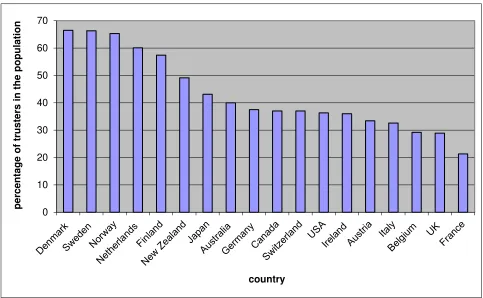
interpersonal trust indexes are among the chosen countries. The figure given below illustrates that
out of 18 countries, Scandinavian countries can be considered highly trusting nations: the
percentage of trusting people in Denmark, Sweden, Norway and Finland is around 60. These
findings confirm the vast literature on the corporatist and participatory nature of the economic and
political system of Northern Europe. At the same time, it also confirms a general opinion about
the outstanding level of trust in the Scandinavian countries, which suggests that Scandinavian
nations are outliers in all types of social capital discussions.
The Netherlands is also highly trusting. New Zealand follows Finland with about 50% of
people who give a positive answer to the trust question. The rest of the countries show little
variation in the percentage of trusting people, which fluctuates on average between 30 and 35
percent, being almost twice as less as the Scandinavian nations.
France was found to be the least trusting nation with slightly more than 20 percent of the
population believing that other people can be trusted. The latter is difficult to explain. There is no
economic and political instability in France, which is marked by foreign interventions, waves of
refugees and immigrants, or periods of civil war and dictatorships. However, it is possible to
assume that the development of civil society in France as well as in other countries with low trust
19.1 percent of people are members of different organizations. The same is also true for Italy and
the United Kingdom where membership in organizations hardly exceeds 20 percent, compared to
social democratic countries where the figure is around 80 percent.
The findings are generally consistent with the results provided by other studies, which
usually emphasize that the lowest levels of social capital can be found in the Mediterranean
countries while the highest can be found in the Scandinavian nations (Frane, 2008; Van Oorschot
[image:4.612.71.554.289.587.2]and Arts, 2005).
Figure 1.: Variation of interpersonal trust in OECD countries (Source: World Values Survey)
The analysis of the share of trusting populations by welfare regime type confirms the results
obtained in the country case study. In social democratic regime types, about 63 percent of
respondents believe that other people can be trusted. Surprisingly, liberal welfare regime types
precede conservative types in the ranking, showing that on average the share of trusting people is
slightly higher in the former than in the latter. The difference is however negligible: 38.3 percent
of the population is trusting in liberal regimes while the latter score equals 35.3 percent in
continental regimes.
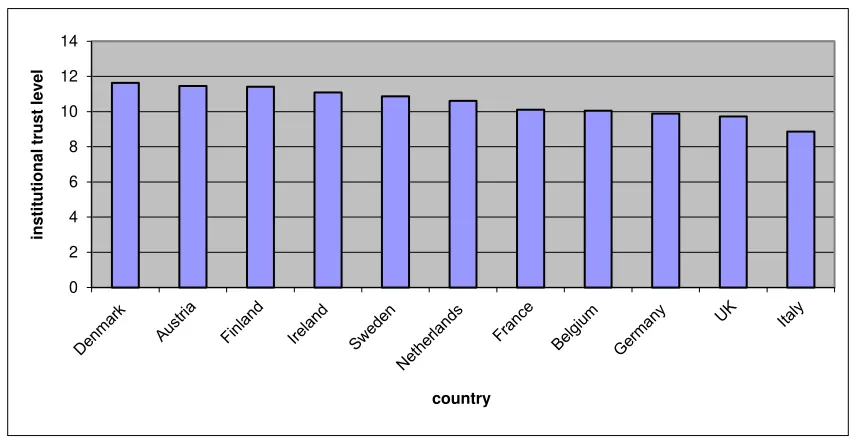
The analysis of the average level of institutional trust scores does not provide a clear
distribution. In total, the average value of institutional trust among selected countries equals 10
while the variation across nations constitutes about 30 percent of the average value. In Denmark,
Austria, and Finland the institutional trust level reaches almost 12. In Italy, the confidence in
institutions slightly exceeds 8 (out of 19), while the rest of the nations are situated somewhere in
[image:5.612.92.519.392.611.2]between: trust in the rest of the countries varies between 10 and 11.
Figure 2.: Variation of institutional trust in OECD countries Source: World Values Survey
If we move to the welfare regime typology, we see less fluctuation in trust levels compared
average institutional trust levels equal to 11.31. Liberal welfare regime types are in the middle
with a value of 10.44 (out of 19). It is followed by conservative welfare regime types where the
average institutional trust score equals 10.05.
One should note that liberal countries reveal high levels of institutional and interpersonal
trust. This result is observed despite the market liberalism that prevails in those countries.
Christoforou (2004) explains this paradox by the fact that social groups and organizations within
the economy’s sphere of voluntary activities work to supplement state welfare services, which
creates an environment she calls ‘mixed economy welfare’ or ‘welfare pluralism’.
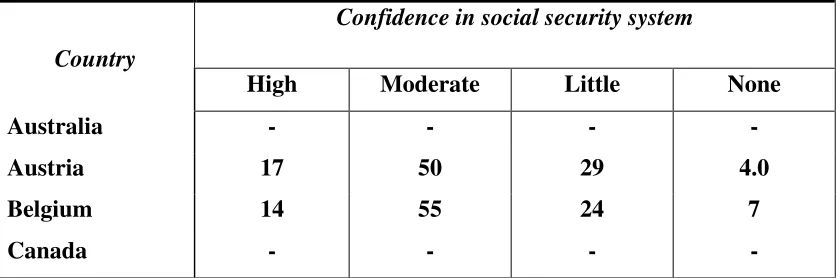
Special attention should be given to the analysis of the confidence people have towards the
social security system. Although the general tendency coincides with that of trust in institutions,
there are some specificities in the distribution of trust and mistrust among the selected nations.
Scandinavian countries, along with Austria, Belgium, France, and the Netherlands, show a great
deal of trust in their social security systems. Germany and Ireland are a bit behind but still have
high amounts of confidence in welfare institutions. The United Kingdom and Italy close the
ranking as the least trusting of their respective social security systems.
Table 1.: Distribution of trust and mistrust towards social security systems in 18 OECD countries
Country
Confidence in social security system
High Moderate Little None
Australia - - - -
Austria 17 50 29 4.0
Belgium 14 55 24 7
[image:6.612.98.518.569.708.2]Denmark 9 58 30 3
Finland 8 62 26 4
France 13 53 24 10
Germany 3 43 45 9
United Kingdom 4 30 50 16
Ireland 12 46 36 6
Italy 6 28 47 19
Japan - - - -
Netherlands 9 55 32 4
New Zealand - - - -
Norway - - - -
Sweden 4 46 45 5
Switzerland - - - -
United States - - - -
Source: World Values Survey
The descriptive analysis of trust distribution in the selected 18 countries provides results
which are in line with the existing findings. Social democratic countries come first in the level of
both forms of social trust: interpersonal and institutional. They are followed by the liberal and
continental welfare regime types which vary quite a bit in the case of interpersonal trust and
negligibly in the case of institutional trust. It should be also noticed that the gap between
continental and liberal countries is not as big as was expected.
2. Changes in social trust levels over time
As can be easily deduced from the research overview presented above, the theory
explaining causal mechanism in the relationship between welfare state development and social
negative direction are however more contradictory and ambiguous. The problem stems from the
fact that there is no agreement among scholars in not only the direction of the relationship between
these two variables of interest but also in the direction of social capital change over the last few
decades. Putnam (1995, 2000) claims for instance that there is a decline in social capital levels
over the period from 1930 to 1998 in the United States. He distinguishes four
socio-economic/demographic factors explaining this trend1 without taking account of the effects of the
welfare state.2 However, Putnam emphasizes the need to explore creatively how social policies
infringe on social capital formation. Moreover, he recognizes their potential dubious impact: on
the one hand, public policy may destroy highly effective social networks and norms while, on the
other hand, some social policy, like the agricultural-agent system, community colleges, and tax
deductions for charitable contributions, may encourage social capital formation.
Paxton goes further in his analysis than his predecessors by distinguishing between two
components of social capital: trust and associations (Paxton, 1999) with trust being further divided
into trust in institutions and trust in individuals. His analysis shows some decline in trust in
individuals over the period from 1975 to 94 (about 0.5% drop per year), but no general decline in
trust in institutions and no decline in associations. He does not analyze the effects of public policies
either, but his contribution consists in attempting to explain the lack of agreement among scholars
about the possible trends of social capital by the presence of a gap between the concept of social
capital and its measurement. The research conducted later settled this problem by presenting social
capital as a multidimensional concept and analyzing the dynamics of each component separately.
1 Among the key factors explaining this decline, he distinguishes between the movement of women into the labor
market, increased mobility of the people, other demographic transformations (fewer marriages, more divorces, fewer children, lower real wages and so on), and the technological transformation of leisure.
2 There are several studies that either contest this tendency (Ladd, 1996) or try to explain it with other factors (Costa
Uslaner (2000-2001) comes to the same conclusion concerning the dynamics of
interpersonal (generalized) trust found by Paxton. According to his calculations, over the past four
decades the share of Americans who believe that most people can be trusted plummeted from 58%
in 1960 to 36%. He demonstrates that this negative dynamics can be explained to some extent by
the rise of Christian fundamentalism among believers accompanied by a simultaneous growth of
the ‘unchurched’ in American society. But the main negative effect on social capital should have
stemmed, in his opinion, from the increased pessimism among Americans about their future
produced by the rise of income inequality.
The same tendency of social capital over the last two decades was found by You Jong-sung
(2005) in Korea. But again, he explains this negative trend only with political and economic factors
without considering social policies as a potential threat to social capital formation.
In European countries, the dynamics of social capital usually appears to be more favorable.
Hall (1999) find no erosion in social participation in Britain, but in line with Uslaner, he suggests
that overall levels of social trust declined between 1956 and 1990. He cites three main factors3 that
positively affect social capital in Britain, among which he mentions government actions, especially
those having to do with the delivery of social services. The impact of government policies is
however restricted to encouraging and sustaining voluntary community involvement by directly
funding these activities through local or central authorities. Welfare state activities are hence
largely ignored in his research.
No decline in social capital was found in the other three European countries: Switzerland
(Freitag, 2001), Finland (Siisiainen, 1999) and the Netherlands (De Hart and Dekker, 1999). But
3 Two other factors which may explain the absence of decline over the last decades are educational policy (a radical
linking these trends in social capital to the social policies existing in their countries was not the
subject of the analysis in those studies.
Others argue that it is impossible to track changes in social capital at all. They ask the
following question: if as Putnam argues, social capital is a phenomenon of long duration, how can
it be quickly eroded? Schuller, Baron, and Field (2000) explain for instance that there is no logical
requirement for temporal symmetry. In other words, it is not impossible for something which has
developed incrementally over a long period of time to be summarily destroyed. But inherent to
the analysis of factors such as trust is the difficulty of discerning movement over time and isolating
it from the range of other factors which in a long timescale is bound to present.
Hardin (2006) also supports this idea. He asserts that the decline of trust in the United
States and elsewhere is of too short a duration (a little more than four decades) to yield strong
secular conclusions. The data on European nations other than Sweden and the United Kingdom
are of a much shorter duration. There are other data, often much less focused, that tell us something
about the long term trend, but making sense of these is sufficiently difficult and has spawned a
large industry and many conflicting views.
The World Values Survey provides data over the last two decades which to some extent
represent too short a period to draw robust conclusions. Nevertheless, we use these data to describe
at least a short term trend of interpersonal and institutional trust among the selected 18 nations.
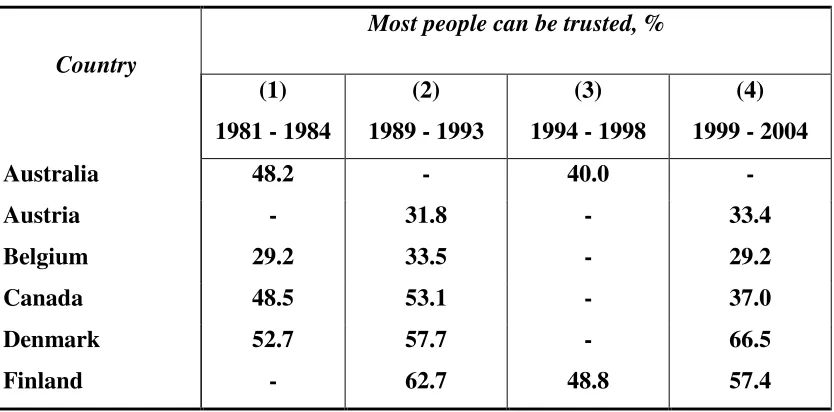
The results obtained give mixed evidence about the fluctuation of trust levels over the last two (or
in some cases even fewer) decades. In Australia, for instance, the share of people who positively
answered the trust question slightly declined over the period from 1981 to 1998. The same
appeared in the United Kingdom, where the share of trusting people in the population dropped
from 43.1 percent in 1981 to 28.9 percent in 1999.
In Austria, Denmark, Japan, the Netherlands, Norway, and Sweden, the percentage of the
trusting population increased over the analyzed period. A particularly strong tendency of positive
change was registered in the Netherlands: from 44.8 percent in 1981 to 60.1 percent in 1999. An
almost equal increase was also found in Denmark: from 52.7 percent in 1981 to 66.5 percent in
1999.
Mixed results were found in the remaining countries: Belgium, Canada, Germany Ireland,
and Italy. In these countries, the change in trust levels show some fluctuation: first, it increases
over a short period, which is followed by the sudden drop in trust levels. In Canada for instance,
trust increased from 1981 – 1993, when the share of the trusting population rose from 48.5 to 53.1
percent. But over the next decade it dropped to 37.0 percent. In Finland, the trend of trust indexes
indicate a completely different trend. It shows a sharp drop in the percentage of the trusting
[image:11.612.100.517.497.703.2]population from 62.7 to 48.8 percent, but over the next 5 years it increased to 57.4 percent.
Table 2.: Changes in interpersonal trust levels from 1981 – 2004
Country
Most people can be trusted, %
(1) 1981 - 1984
(2) 1989 - 1993
(3) 1994 - 1998
(4) 1999 - 2004
Australia 48.2 - 40.0 -
Austria - 31.8 - 33.4
Belgium 29.2 33.5 - 29.2
Canada 48.5 53.1 - 37.0
Denmark 52.7 57.7 - 66.5
France 24.8 22.8 - 21.3
Germany 32,3 37.9 41.8 31.9
United Kingdom 43.1 43.7 29.6 28.9
Ireland 41.1 47.4 - 36.0
Italy 26.8 35.3 - 32.6
Japan 41.5 41.7 42.3 43.1
Netherlands 44.8 53.5 - 60.1
New Zealand - - 49.1 -
Norway 60.9 65.1 65.3 -
Sweden 56.7 66.1 59.7 66.3
Switzerland 42.6 37.0 -
United States 40.5 51.1 35.9 36.3
Source: World Values Survey
A similar analysis of this trend is impossible for trust in institutions since the question about
confidence in the healthcare system was only asked in the last wave. Instead of analyzing the
synthetic indicator, the analysis of its elements will be done to observe the change in their levels.
The first element, the confidence in social security system, represents a special interest for us.
Again, this analysis is not possible for all countries since the data for some of them are either not
available at all or available only for one wave. For those countries where the question about
confidence was asked in both waves, one can derive two groups: the fist comprises those where a
drop in the confidence level was found, the second includes those where a slight increase in the
share of trustors in social security systems was observed. The former includes Austria, Denmark,
Finland, France, Germany, Ireland, Italy, and the Netherlands. One should mention here that
Germany represents an exceptional case in these groups of countries since the share of trustors
decreased over the decades from 65.2 to 46.2 percent. The second group includes three countries:
social security was observed. The increase was however so small that the change is almost
irrelevant: in Sweden from 46.0 to 49.9 percent, in the United Kingdom from 32.5 to 34.7 percent,
and in Belgium from 66.0 to 68.9 percent.
Table 3.: Changes in confidence in social security systems from 1989 - 2004
Country
Share of people having ‘a great deal’ or ‘quite a lot’ of confidence in the social security systems.
(2)
1989 - 1993
(4)
1999 - 2004
Australia - -
Austria 67 66
Belgium 66 68
Canada 61 -
Denmark 69 67
Finland 74 70
France 69 66
Germany 65 46
United Kingdom 32 34
Ireland 59 58
Italy 37 34
Japan 43 -
Netherlands 68 64
New Zealand - -
Norway 48 -
Sweden 46 49
Switzerland - -
United States 52 -
The change in the confidence in civic services, the police, parliament, and the juridical
system shows different trends. The common trend in all of them is however the fact that in different
countries the fluctuation of trust elements happened in a different way: in some of them, there was
a decline in confidence indicators, in others – an increase. In other words, there is no single pattern
that explains the change in confidence levels over time for the selected countries.
An analysis of the confidence in civil services reveals three main groups of countries (see
Appendix 1). The first group consists of Australia and France, where there was a clear decline in
trust indicators over the analyzed period. The second group includes Denmark, Finland, Ireland,
Italy, Japan, and Sweden, where confidence levels increased somewhat, although in some of the
countries, this increase was too small to suggest a rise in indicators of institutional trust elements.
Austria, Belgium, Canada, and the UK constitute the third group of countries, which can be
characterized by no change in confidence in civil services. Their indicators remain almost
unchanged during the analyzed period. Apart from these distinct groups, there are some countries,
where the trend of change had a non-linear shape. Germany and the Netherlands are good
examples: confidence levels in civil services tend to first increase but later decrease. In Norway,
the fluctuation of confidence levels showed the opposite trend: it first increased and then declined.
The confidence of people in parliament reveals similar trends (see Appendix 2). Again,
there is no clear pattern of change that can adequately apply to all countries. Australia, Austria,
France, Ireland and Japan are all characterized by a decrease in the share of the population who
have a lot of confidence in the parliament. Contrary to the countries mentioned above, there are
also those where a clear increase in confidence occurred. Among the latter, Denmark, Italy, the
Netherlands, and Sweden should be mentioned. Belgium and the United Kibgdom belong to those
decrease and thus no clear trend was obvious. The opposite fluctuation, characterized by an initial
decrease in the trusting population followed by an increase, was found in Canada, Finland,
Germany, and Norway. In some of them, particularly in Canada, Germany, and Norway, the rise
in the share of trusting people was not enough to off-set the initial decrease.
Newton (2001) analyzes the reasons for the decline of trust in institutions in Finland where
trust in parliament fell from 65 percent in 1980 to 34 percent in 1991. He specifies that the main
reason for this loss in institutional trust was of declining economic and political situation in the
country. In 1990 Finland fell into a deep economic recession in which unemployment grew,
government deficits tripled, taxes increased, and services and wages were cut. In the same period,
huge amounts of money fled the country and interest rates soared. Business bankruptcies
multiplied while open conflict developed between the government and the central bank. A cabinet
minister resigned and another minister was found guilty of corruption and expelled from
parliament. Although social trust remained high, confidence in parliament and other public
institutions collapsed. This led him to conclude that the problems of decline of institutional trust
lay in political events.
Change in confidence levels towards the police show more or less clear fluctuations (see
Appendix 3). There are two distinct groups of counties, which combine those nations where there
is a clear decline in trust and those where there is a clear increase in confidence in the police. More
specifically, a decline in confidence was found in Australia, Canada, the United Kingdom, the
Netherlands, and Norway. A rise trust towards the police was found in Austria, Denmark, Finland,
France, Germany, Ireland, and Italy. Belgium, Japan, and Sweden cannot be assigned to either of
these groups since their indicators tend to fall and then rise with the final indicators being less than
Confidence in the Justice system follows the trends described above (see Appendix 4): on
the one hand, there is again no single pattern of change inherent to all countries; on the other hand,
the change in many of the selected counties is too small to infer about a decline or rise in confidence
levels. In Australia, Belgium, Canada, Denmark, France, the United Kingdom, Italy, the
Netherlands, and Norway, the data provide evidence of some decline trust in justice system. An
especially sharp drop was found in Australia, where the share of trustors declined from 60.5
percent in 1981 to 34.7 percent in 1994. Austria represents a case with a slight increase in the share
of trust: the percentage of people who answered positively to the question increased from 58.4
percent in 1989 to 68.1 percent in 1999. The data for other counties show some fluctuation in the
confidence level over the selected periods. In Finland for instance, a slight increase in the share of
trustors was followed by an equally slight decrease so that the overall share of trustors remained
almost unchanged. In Germany, Ireland, Japan, and Sweden, the trend was the opposite: some drop
in the share of trustors was followed by an increase, however in some countries (Sweden) the
initial level of confidence was not attained in the end.
The analysis thus provides some evidence of fluctuation for both forms of trust:
interpersonal and institutional. The common aspect for all of them is the fact that there is no single
pattern that describes trust changes from 1981 – 2004 in all 18 selected countries. In some of them,
the decline in the share of trusting populations was found, in others some increase was present.
There are also countries which are characterized by a sharp fluctuation of trust levels within the
period pointing out either the fact that trust may change within short periods as a result of
economic, political, or social changes, or the problems of representation in the data for the selected
The interesting aspect here is the relationship between interpersonal and institutional trust.
Newton (2001) suggests that the relationship between these two types of trust is rather
asymmetrical: healthy stocks of political capital cannot be built up in nations lacking social capital,
but it also cannot dwindle rapidly in countries with well developed interpersonal trust. In the long
run, the two are likely to adjust to one another in the sense that higher levels of social capital tend
to be associated with higher levels of political (institutional) trust.
The results thus indicate that interpersonal trust is stable over the analyzed period, while
institutional trust may vary substantially within a short period of time. There is however no single
pattern that the change of institutional trust follows. Both increases and decreases of trust levels
were detected in the analysis.
3. Social trust and social expenditures: a descriptive analysis
Before proceeding to the preliminary analysis of the relationship between social trust and
social expenditures, it is worth investigating the level of social spending and its fluctuation over
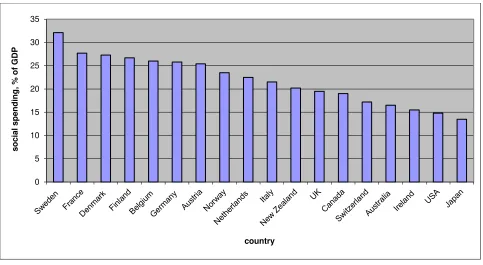
the last two decades. The figure given below illustrates social spending on average from 1990 –
2000 in 18 OECD countries. There is no clear trend in the level of social expenditures distribution.
Scandinavian and continental countries are among those with the highest social spending. English
speaking countries represent the least generous in terms of social expenditures. Japan closes the
Figure 3.: Social expenditures averaged from 1990-2000.
Source: own calculations based on OECD data(http://www.oecd.org/statisticsdata/ 20-04-2007)
When analyzing social expenditure levels by welfare regime type (Appendix 5), the data
provide evidence that support the expectations. Social democratic regimes are characterized by the
highest level of social expenditures – around 27.4 percent of GDP from 1990 – 2000. In the
countries belonging to the liberal welfare regime type, the level of social spending is substantially
lower, slightly exceeding 17 percent of GDP. Conservative welfare regimes are situated in between
with social expenditures from 1990 -2000 equal to 22 percent.
When tracking the change in the level of social spending in the selected countries
(Appendix 6), one should mention that the general logic of the trend is similar to what one expects.
From 1980 – 1990, there was an expansion of social expenditures in all countries which continued
in some of them up to the mid 1990s. This expansion was followed by a curtailment of social
It is however impossible to analyze how this affected social trust levels due to the lack of
longitudinal data for social trust.
One can nevertheless link social trust indexes to social expenditure levels in a static point
of time. In doing this, one obtains results that point to the existence of a certain relationship
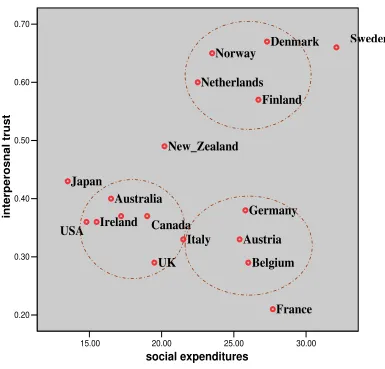
between the two variables of interest. In the case of interpersonal trust, there are three distinct
groups of countries which almost correspond to Esping-Andersen’s welfare regime typology. The
first group combines Scandinavian nations and the Netherlands where a high level of social
spending is associated with a high level of interpersonal trust. The second group of countries
represents those belonging to conservative regime types and where a relatively high level of
spending is associated with relatively moderate trust levels. The exceptional case here is France
where, in spite of relatively high social expenditures, the level of social trust remains low. The
third group comprises countries with liberal welfare regimes as well as Japan that have low social
Figure 4.: Relating interpersonal trust to social expenditures
Source: own calculations based on OECD (http://www.oecd.org/statisticsdata/ 20-04-2007) and the World Values
Survey
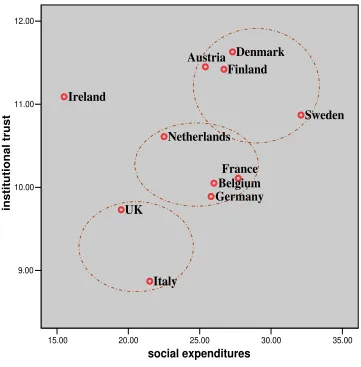
A similar relationship is seen in the case of institutional trust. Figure 5.5. points to the
existence of three distinct groups of countries with social spending levels corresponding to certain
institutional trust levels. The first group combines Scandinavian countries and Austria, where high
levels of social spending are associated with high levels of institutional trusts. The second group
of countries includes those belonging to continental welfare regime types that have relatively high
levels of social spending as well as relatively moderate levels of institutional trust. The third group
of countries represents liberal welfare regime types, where low levels of social spending are
15.00 20.00 25.00 30.00
associated with the lowest levels of confidence towards institutions. The exception here is Italy
and Ireland, which show the opposite trend. In Italy, high levels of social expenditures are found
to be associated with very low institutional trust levels. In Ireland, on the contrary, low levels of
public spending are linked to high levels of institutional trust almost equal to those in Scandinavian
[image:21.612.119.480.214.581.2]countries.
Figure 5.: Relating institutional trust to social expenditures
Source: own calculations based on OECD (http://www.oecd.org/statisticsdata/ 20-04-2007) and the World Values
Survey
15.00 20.00 25.00 30.00 35.00
social expenditures 9.00
10.00 11.00 12.00
inst
it
uti
onal
trust
Denmark Finland
Sweden
UK Ireland
Austria
Belgium France
Germany
Italy
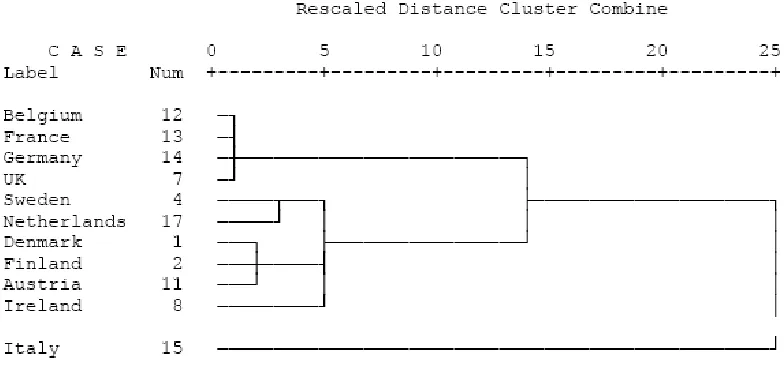
Similar results can be obtained when clustering countries according to their levels of social
trust. The hierarchical cluster analysis based on the method aimed at detecting the nearest neighbor
provides results which to some extent reflect Esping-Andersen’s typology. Conservative countries
including Belgium, France, and Germany together with the United Kingdom form a distinct group
which differs in trust levels from the rest of Europe. Scandinavian nations, together with the
Netherlands and Austria, can also be combined in a separate cluster which does show some
in-group variation of social trust levels. These two in-groups are quite distant from each other, but are
located as nearest neighborhood families. Italy is situated relatively far from them, forming a
distinct group with its own variations in trust levels. The latter supports the need to isolate
South-European countries from the rest of Europe in analyzing the trust levels. The absence of the liberal
group can be explained by the fact that only the United Kingdom and Ireland were included in the
[image:22.612.113.505.447.637.2]analysis due to a lack of data on institutional trust in other countries with liberal welfare regimes.
Figure 6.: Hierarchical cluster analysis of social trust
Thus, the cluster analysis reveals that there is a certain grouping of countries on the basis
of their social trust levels that coincides to some extent with Esping-Andersen’s welfare regime
typology. Hence, there must be some association between the level of welfare state intervention in
social arrangements and the trust behavior of individuals. The descriptive analysis thus confirms
this hypothesis but, in order to draw decent conclusions about the dependence of social trust scores
on the level of welfare state development, one should move to an exploratory analysis which would
allow one to control for possible spurious and interpretation effects of individuals’ and countries’
characteristics.
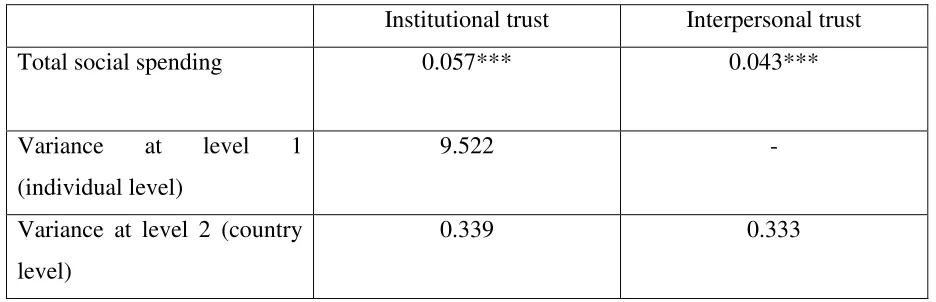
When empirically relating the level of interpersonal and institutional trust to total social
spending, we obtain results which again advocate for the presence of a certain relationship. A
multilevel analysis that includes only one variable at the second level, namely total social
[image:23.612.69.537.477.628.2]spending, provides the following results:
Table 4.: A multi-level analysis of the effects of social spending on social trust
Institutional trust Interpersonal trust
Total social spending 0.057*** 0.043***
Variance at level 1
(individual level)
9.522 -
Variance at level 2 (country
level)
0.339 0.333
Source: Own calculations based on the WVS
The results lead one to believe that social spending has positive effects on both forms of
for. An increase in total social spending by one percent increases institutional trust by 0.057 units
and increases the odds of trust by 4.4 percent. The values are not that high but still assume a
positive relationship between social trust and social spending, which requires a further
investigation of these effects. Moreover, controlling for the level of social spending reduces
variance at the country level from 0.672 to 0.339 for institutional trust. For interpersonal trust, this
decrease in variance is less substantial: from 0.335 to 0.333, pointing out that in the case of
interpersonal trust, macro-level characteristics play a weaker role in defining its levels.
The lack of longitudinal data poses a problem for analyzing the relationship between
welfare state development and social trust formation. The static view in this case gives us a limited
understanding about the dependence of trust levels on the intervention of the state in social
interactions. But even a static analysis points to the existence of a certain relationship between
social spending and the level of both types of social trust: interpersonal and institutional. To
conduct more inquiry into the nature and strength of this relationship, one should proceed to an
exploratory analysis, which will allow us to draw conclusions about the kind of effects social
policy conducts on social trust.
Overview and concluding remarks
This chapter analyzes the level of interpersonal and institutional trust among the selected
countries as well as its change over time. The analysis shows that the average value of both
interpersonal as well as institutional trust is highest in social democratic welfare regimes and is
followed by liberal welfare regimes, with conservative welfare regime sclosing the ranking.
However, when analyzing institutional trust, one reveals less fluctuation compared to the case of
evidence that points to fact that there is no single pattern followed by all selected countries. In
Australia, France, the United Kingdom, and Switzerland, the share of people who positively
answered the trust question slightly declined over the period from 1981 – 1998. In Austria,
Denmark, Japan, the Netherlands, Norway, and Sweden, the share of the trusting population
increased over the analyzed period. Mixed results were found in the remaining countries: Belgium,
Canada, Germany, Ireland, and Italy, where the trend of trust change shows some fluctuation. First,
it increases over a short period followed by a sudden drop in trust levels. The same pattern was
found when analyzing the fluctuation of institutional trust over the selected period. For those
countries, where the question of confidence in public welfare institutions was asked in all waves
of the survey, one can derive two groups: the first comprises those where a drop in confidence
levels was found (Austria, Denmark, Finland, France, Germany, Ireland, Italy, and the
Netherlands), the second includes those where a slight increase in the share of trustors was present
(Belgium, Sweden and the UK).
When linking social trust indexes to social expenditure levels in a static point of time, the
results point to the existence of a certain relationship between the two variables of interest. Scatter
plots allow us to visualize three distinct groups of countries which almost correspond to
Esping-Andersen’s welfare regime typology. The analogous results were obtained when using a
hierarchical cluster analysis, which provided a grouping of countries similar to welfare regime
typology. When relating social spending to social trust levels, we discovered a certain correlation
between these variables. Moreover, inclusion in the multilevel model of social spending explains
large share of variation in social trust, especially at the country level.
The descriptive analysis is not however based on the idea about the multidimensionality in
trust should thus be undertaken to estimate possible effects welfare states can have on social trust
levels. This analysis will be provided in the next three chapters, which will relate different
measures of welfare states development to social trust indexes. The first step in performing this
analysis will consist in disaggregating total social spending on a functional basis, which will allow
BIBLIOGRAPHY
Adelantado, J. and Cuevas, E.C. (2006), “Globalization and the welfare state: the
same strategies for similar problems?”, Journal for European Social Policy, Vol. 16, No. 4,
pp. 374 – 386.
Agresti, A. (1996), An Introduction to Categorical Data Analysis. University of
Florida Press.
Alesina, A. and La Ferrara, E. (2002), “Who trusts others?”, Journal of Public
Economics, Vol. 85. No. 2, pp. 207- 234.
Alesina, A., Devleeschauwer, A., Easterly, W. and Kurlat, S. (2003),
“Fractionalization”, Journal of Economic Growth, Vol. 8, pp. 155-194.
Allport, G. (1961), Pattern and Growth in Personality. New York: Holt, Rinehart
and Winston.
Aust, A. and Arriba, A. (2005), “Towards activation? Social assistance reforms and
discourses”, In: P. Taylor-Gooby (ed) Ideas and Welfare State Reform in Western Europe,
Palgrave Macmillian, pp. 100 - 123.
Babchuk, N. and Booth, Al. (1969), “Voluntary association membership: a
longitudinal analysis”, American Sociological Review, Vol. 34, No. 1, pp. 31-45.
Bambra, C. (2006), “Decommodification and the worlds of welfare revisited”,
Journal of European Social Policy, Vol. 16, No 1, pp. 73-68.
Bannink, D. and Hoogenboom, M. (2007), “Hidden changes: disaggregation of
welfare state regimes for greater insight into welfare state change”, Journal of European
Barber, B (1983), The logic and Limits of Trust. New Brunswick, NJ: Rutgers
University Press.
Bianchi, S., Milkie, M., Sayer, L. and Robinson, J. (2000), “Is anyone doing the
housework? Trends in the gender division of household labor”,Social Forces, Vol. 79, No.
1, pp. 191-228.
Billiet, J. and Cambree, B. (1999), “Social capital, active membership in voluntary
associations and some aspects of political participation”, In: J. Van Deth, M. Maraffi, K.
Newton and P. Whiteley (Eds.), Social capital and European democracy, London:
Routledge, pp. 240-262.
Bjornskov, Ch. (2005), The determinants of trust. Working paper of University of
Aarhus.
Blomberg, H. and Kroll, C. (2002), “Who wants to preserve the ‘Scandinavian
service state’? Attitudes to welfare services among citizens and local government elites in
Finland 1992-1996”, In: S. Svallfors and P. Taylor-Gooby (eds) The End of the Welfare
State? Responses to State Retrenchment, Routledge London and New York, pp. 52 – 86.
Bode, I. (2006), “Disorganized welfare mixes: voluntary agencies and new
governance regimes in Western Europe”, Journal of European Social Policy, Vol. 16, No.
4, pp. 346 – 359.
Boiix, C. and Posner, N. (2005), “Social capital: explaining its origins and effects on
government performance” (on-line: http://www.socialcapitalgateway.org/index.htm).
Bonein, A. and Serra, D. (2007), “Gender bias in trustworthiness”. MPRA Paper No.
Bönker, F. (2005), “Changing ideas on pensions: accounting for differences in the
spread of the multi-pillar paradigm in five EU social insurance countries”, In: P.
Taylor-Gooby (ed) Ideas and Welfare State Reform in Western Europe, Palgrave Macmillian, pp.
81 - 99.
Bonoli, G. (2001), “Classifying welfare states: a two-dimensional approach”,
Journal of Social Policies, Vol. 26, pp. 351 – 372.
Bonoli, G. (2004), “Modernizing post-war welfare states. Explaining diversity in
patterns of adaptation to new social risks”, Paper presented at the 2nd ESPAnet annual
conference, Oxford, September, 2004.
Booth, A. (1972), “Sex and social participation”, American Sociological Review,
Vol. 37, No. 2, pp. 183-193.
Booth, J. and Richard, P. (2001), “Civil society and political context in Central
America”, In: R. Edwards, M. W. Foley and M. Diani, (eds), Beyond Tocqueville: Civil
Society and Social Capital Debate in Comparative Perspective. Tufts University Press, pp.
43 -55.
Bouckaert, G. and Van de Walle, S. (2003), “Comparing measures of citizens trust
and user satisfaction as indicators of good governance: difficulties in linking trust and
satisfaction indicators”, International Review of Administrative Sciences, Vol. 69, pp. 329-
343.
Bourdieu, P. (1980), “Le capital social”. Acte de la recherche en Science Sociales,
Bourdieu, P. (1986), “The forms of capital”, In: Johm G. Richardson (ed.):
Handbook of theory and research for the sociology of education. New York: Greenwood
Press, pp. 241-258.
Branas-Garza, P., Rossi, M. and Zaclicever, D. (2006), “Individual’s religiosity
enhances trust: Latin American evidence for the puzzle”, DECON Working Paper, No.
05/06, 25 p.
Breen, R. and Cook, L. (2005) “The persistence of the gendered division of domestic
labor”,European Sociological Review, Vol. 21, No. 1, p. 43-57.
Brehm, J. and Rahn, W. (1997), “Individual Level Evidence for the Causes and
Consequences of Social Capital”, American Journal of Political Science, Vol. 41, No. 3, pp.
999-1023.
Brines, J. (1994), “Economic dependency, gender, and the division of labor at
home”,American Journal of Sociology, Vol. 100, pp. 652-88.
Buchan, N., Croson, R. and Solnick S. (2003), “Trust and gender in the investment
game”. Working paper, March 2003.
Burrows, R. and Loader, B. (1994), Towards a post-Fordist welfare state?
Routledge, London.
Bussemaker, J. and van Kersbergen, K. (1994), “Gender and Welfare states: some
theoretical reflections”, In: Sainsbury, D. (edit), Gendering Welfare States, Sage
publications, London.
Camoes, P. (2003), “Political Trust, Democratic Institutions, and Vote Intentions: a
Cross-National Analysis of European Democracies”, NEAPP Series III(7).
Chaudhuri, A. and Gangadharan, L. (2002), “Gender differences in trust and
reciprocity”, Paper presented at Annual Meeting of the Economic Science Association,
Boston, 2002.
Christoforou, A. (2004), “On the determinants of social capital in countries of the
European Union”, Paper prepared for the ESPAnet Conference, Oxford, England,
September 9th– 11th, 2004.
Christoforou, A. (2005), “On the determinants of social capital in Greece compared
to countries of the European Union”, Working paper.
Coleman, J. (1982), “Systems of trust: a rough theoretical framework”, Angewandte
Sozialforschung, Vol. 10, No. 3, pp. 277-299.
Coleman, J. (1990), Foundations of Social Theory. Cambridge, M.A.: Harvard
University Press.
Costa, D. and Kahn, M. (2003), “Understanding the American decline in social
capital, 1952-1998.”, Kyklos, Vol.56, No. 1, pp. 17-46.
Croson, R. and Buchan, N. (1999), “Gender and Culture: International experimental
evidence from trust games”, The American Economic Review, Vol. 89, No. 2, pp. 386 – 391.
Daniszewski, K. (2004), A Dewian social capital development theory. Preliminary
dissertation draft. 89 p.
De Hart, J. and Dekker, P. (1999), “Civic engagement and volunteering in the
Netherlands”. In: J. Van Deth & M. Maraffi & K. Newton & P. Whiteley (Eds.), Social
capital and European democracy. London: Routledge, pp. 75-107.
de Swaan, A. (1988), In Care of the State: Health Care, Education and Welfare in
Delhey, J. and Newton, K. (2003), “Who trusts? The origins of social trust in seven
societies”, European Societies, Vol. 5, No. 2, pp. 93-137.
Delhey, J. and Newton, K. (2005), Predicting Cross-National Levels of Social Trust:
Global Pattern or Nordic Exceptionalism? European Sociological Review, Vol. 21, No. 4,
pp. 311-327.
Deutsch, M. (1958), “Trust and Suspicion”, Journal of Conflict Resolution, Vol. 2,
pp. 187 – 197.
Doney, P., Cannon, J. and Mullen, M. (1998), “Understanding the influence of
national culture on the development of trust”, The Academy of Management Review, Vol.
23, No. 3, pp. 601 – 620.
Edlund, J. (2002), “Progressive taxation farewell? Attitudes to income redistribution
and taxation in Sweden, Great Britain and the United States”, In: S. Svallfors and P.
Taylor-Gooby (eds) The End of the Welfare State? Responses to State Retrenchment, Routledge
London and New York, pp. 106 – 134.
Edlund, J. (2006), “Trust in the Capability of the Welfare State and General Welfare
State Support: Sweden 1997-2002”, Acta Sociologica, Vol 49, No. 4, pp. 365-389.
Erikson, E. (1950), Childhood and Society, New York: Norton.
Espinal, R., Hartlyn, J. and Kelly, J. (2006), “Performance still matters: explaining
trust in government in the Dominican Republic”, Comparative Politcial Studies, Vol. 39,
No. 2, pp. 200-233.
Esping – Andersen, G. (1990), The three words of welfare capitalism, Cambridge:
Esping-Andersen, G. (1996), Welfare States in transition, national adaptations in
global economies, Sage, London.
Esping-Andersen, G. (2001), Why we need a new welfare state, Oxford: Oxford
University Press.
Etzioni, A. (1995), The spirit of community. London: Fontana Books.
Evans, P. (1996), “Government Action, Social Capital and Development: Reviewing
the Evidence on Synergy”, World Development, Vol. 24, No. 6, pp. 1119-1132.
Farell, H. (2005), “Trust and political economy”, Comparative Political Studies,
Vol. 38, No. 5, pp. 459 – 483.
Fedderke, J., Dekadt, R. and Luiz, J. (1999), “Economic growth and social capital”,
Theory and society, Vol. 28, No. 5, pp. 709 – 745.
Fisher, C. and Oliker S. (1982), “A research note on friendship, gender and the life
cycle”, Social Forces, Vol. 62, No. 1, pp. 124 – 133.
Flaquer, L. (2000), Family policy and welfare state in southern Europe. University
de Barcelona.
Flora, P. (1986), Introduction to growth to limits. The European Welfare States Since
World War II, Berlin: De Grueter.
Forma, P. (2002),”Welfare state opinions among citizens, MP candidates and elites:
Evidence from Finland”, In: S. Svallfors and P. Taylor-Gooby (eds) The End of the Welfare
State? Responses to State Retrenchment, Routledge London and New York, pp. 87 – 105.
Forma, P. and Kangas, O. (2002), “Need, citizenship or merit: public opinion on
The End of the Welfare State? Responses to State Retrenchment, Routledge London and
New York, pp. 161 – 189.
Fox, J. (1996), “How Does Civil Society Thicken? The Political Construction of
Social Capital in Rural Mexico”, World Development, Vol. 24, No. 6, pp. 1089 – 1103.
Frane, A. (2008), “Mapping social capital across Europe: findings, trends and
methodological shortcomings of cross national surveys”, Social Science Information, Vol.
47, No. 2, pp. 159 – 186.
Freitag, M. (2001), “Das Soziale Kapital der Schweiz: vergleichende Erzählungen
zu Aspekten des Vertrauens und der sozialen Einbindung“, Schweizerische Zeitschrift für
Politikwissenschaft, Vol. 7, pp. 87-117.
Freitag, M. (2003), “Social capital in (dis)similar democracies: the development of
generalized trust in Japan and Switzerland”, Comparative Political Studies. Vol. 36, No.8.
pp. 936-966.
Fukuyama, F. (2000), “Social capital and civil society”. Washington: IMF working
paper, 00/74.
Glaeser, E., Laibson, D., Scheinkman, J. and Soutter, C. (2000), “Measuring trust”,
The Quarterly Journal of Economics, Vol. 115, No. 3, pp. 811-846.
Gooding R. (1993), “Moral atrophy in the welfare state”, Policy sciences, No. 26,
pp. 63-78
Gornick, J. and Meyers, M. (2004), “Welfare regimes in relation to paid work and
care.”, In J. Zollinger Giele and E. Holst. (eds) Changing life patterns in western Industrial
Goul Andersen, J. (2002), “Changing labour market, new social divisions and
welfare state support: Denmark in the 1990s”, In: S. Svallfors and P. Taylor-Gooby (eds)
The End of the Welfare State? Responses to State Retrenchment, Routledge London and
New York, pp. 13 – 33.
Haas, D. and Deseran, F. (1981), “Trust and symbolic exchange”, Social Psychology
Quarterly, Vol. 44, No. 1, pp. 3-13.
Hackl, F., Halla, M., and Pruckner, G. (2009), “Volunteering and the State”,
Working paper No. 0901. Austrian Center for Labor and Welfare State.
Hall, P. (1999), “Social capital in Britain”, British Journal of Political Science, Vol.
29, No. 3, pp. 417-461.
Hardin, R. (2001), “Conceptions and explanations of trust”, In: Cook, K.S (ed.) Trust
in Society, New York: Russell Sage Foundation, pp. 2-39.
Hardin, R. (2006), Trust. Polity Press: Cambridge.
Held, V. (1968), “On the meaning of trust”, Ethics, Vol. 78, No.2, pp.156 – 159.
Heller, P. (1996), “Social capital as a product of class mobilization and state
intervention: industrial workers in Kerala, India”, World Developemnt, Vol. 24, No. 6, pp.
48 – 84.
Helliwell, J. and Putnam, R. (1999), “Education and social capital”, Working paper
7121. National bureau of economic research, 25 p.
Henriksen, L., Koch-Nielse, I., and Rosdahl, D.(2006), “Formal and informal
volunteering in a state friendly society”, Paper presented at CINEFOGO conference on the
Herreros, F. and Criado, H. (2008), “The state and the development of social trust”.
International Political Science Review, Vol. 29, No. 1, pp. 53-71.
Hosmer, L.T. (1995), “Trust: the connecting link between organizational theory and
philosophical ethics”, Academy of Management Review, Vol. 20, pp. 379 – 403.
Huinink J. and Schröder, T. (2008) Sozialstruktur Deutschlands, UVK
Verlagsgesellschaft mbH, Konstanz.
Inglehart, R. (1999), “Trust, well-being and democracy”, In: M. Warren (ed.),
Democracy and Trust, Cambridge University Press, New York & Cambridge.
Innocenti, A. and Pazienza, M-G. (2006), “Altruism and gender in the trust game”,
Working Paper, University of Siena, NO, 5/2006.
Jamal, A. (2007), “When is social trust a desirable outcome?” Comparative Political
Studies, Vol. 40, No. 11, pp. 1 – 22.
Jones, K. (1996), “Trust as an affective attitude”, Ethics, Vol. 107, No. 1, pp.4-25.
Kananen, J. (2005), “Current employment policy paradigms in the UK, Sweden and
Germany”, In: P. Taylor-Gooby (ed) Ideas and Welfare State Reform in Western Europe,
Palgrave Macmillian, pp. 124 - 144.
Kawachi, I., Kennedy, B., Lochner, K. and Prothrow, D. (1997), “Social capital,
income inequality and mortality”, American Journal of Public Health, Vol.87, No. 9, pp.
1491 - 1498.
Khodyakov, D. (2007), “Trust as a process: a three-dimensional approach”,
Sociology, Vol. 41, No.1, pp. 115-132.
Knack, S. (2002), “Social Capital and the Quality of Government: Evidence from
Knack, S. and Keefer, P. (1997), “Does social capital have an economic pay-off? A
cross-country investigation”, The Quarterly Journal of Economics, Vol. 25, No. 3, pp.
1251-1288.
Knack, S. and Zak, P. (2001), “Building Trust: Public Policy, Interpersonal Trust,
and Economic Development”, Supreme Court Economic Review, Vol. 12, pp. 134-151.
Kolberg, J. and Uusitalo, H.(1992), “The interface between the economy and the
welfare state: a sociological account”, In: Z.Ferge and J. Kolberg (eds) Social policy in a
changing Europe, Campus Verlag: Frankfurt, pp. 77-94.
Kumlin, S. and Rothstein, B. (2007), “Making and breaking Social Capital: The
Impact of Welfare State Institutions”, Comparative Political Studies. Vol. 38, No. 4, pp. 339
– 365.
Kvist, J. and Ploug, N. (2003), “Active labour market policies when do they work –
and where do they fail”. Paper to be presented at the RC 19 annual conference ‘New
challenges for welfare state reserach’, University of Toronto, August 21-24, 2003.
Kwak, N., Shah, D. and Lance Holbert, R. (2004), “Connecting, trusting, and
participating: the direct and interactive effects of social associations”, Political Research
Quarterly, Vol. 57, No. 4, pp. 643 – 652.
La Porta, R., Lopez de Silanes, F., Schleifer, F. and Vishny, R. (1999), “The quality
of government”, Journal of Law and Economics, Vol. 15, No. 3, pp. 222-228.
Ladd, E. (1996), “The data just don't show erosion of America's social capital”,
Larsen, T. (2005), “The myth of an adult worker society: new policy discourses in
European welfare states”, In: P. Taylor-Gooby (ed.) Ideas and Welfare State Reform in
Western Europe, Palgrave Macmillian, pp. 54-80.
Lewicki, R.J., McAllister, D.J. and Bies, R.J. (1998), “Trust”,The Academy of
Management Review, Vol. 23, No. 3, pp. 438 – 458.
Lewis, D. and Weigert, A. (1985), “Trust as a social reality”,Social Forces, Vol. 63,
No. 4, pp. 967 – 985.
Lewis, J. (1992), “Gender and the development of welfare regimes”, Journal of
European Social Policy, Vol. 3, pp. 159 – 173.
Li, Y., Pickles, A. and Savage, M. (2005), “Social capital and social trust”, European
Sociological Review, Vol. 21, No. 2, pp. 109 – 123.
Lin, N. (2000a), “Gender inequality in social capital: theory and research”. Paper
presented at the International Sunbelt Social Network Conference, Vancouver, Canada,
13-17 April.
Lin, N. (2000b), “Inequality in social capital”, Contemporary Sociology, Vol. 29,
No. 6, pp. 785-795.
Lin, N., Ensel, W. and Vaughn, J. (1981), “Social resources and strength of ties:
structural factors in occupational status attainment”, American Sociological Review, Vol.
46, No. 4, pp. 393-405.
Lowndes, V. (2000), “Women and social capital”, British Journal of Political
Science, Vol. 30, No. 3, pp. 533 – 537.
Luhmann, N. (1979), Trust and Power: Two works by Niklas Luhmann. Chichester:
Luke, D. A. (2004), Multilevel Modeling. Series in Quantitative Applications in the
Social Sciences, Sage Publications, Inc.
Mandel, H. (2005), “A welfare state paradox: state intervention and women’s
employment opportunities in 22 countries”. Paper presented at the ISA Research Committee
on Social Stratification and Mobility, August 2005, Los Angeles.
Matheson, G. and Wearing, M. (2002), “Within and without: Labour force status and
political views in four welfare states”, In: S. Svallfors and P. Taylor-Gooby (eds) The End
of the Welfare State? Responses to State Retrenchment, Routledge London and New York,
pp. 135 – 160.
Mayer, R., Davis, J. and Schoorman, F. (1995), “An integrative model of
organizational trust”, The Academy of Management Review, Vol. 20, No. 3. pp. 709 – 734.
McPherson, J. M. and Smith-Lovin, L. (1982), “Women and weak ties: differences
by sex in the size of voluntary organizations”, The American Journal of Sociology, Vol. 87,
No. 4, pp. 883 – 904.
McPherson, J. M. and Smith-Lovin, L. (1986), “Sex segregation in voluntary
associations”, American Sociological Review, Vol. 51, No. 1, pp. 61-79.
Mellinger, G.D. (1956), “Interpersonal trust as a factor in communication”,Journal
of Abnormal Social Psychology, Vol. 52, pp. 304 – 309.
Mihaylova, D. (2004), “Social capital in Central and Eastern Europe. A critical
assessment and literature review”. Centre for Policy study. Central European University,
167 p.
Miller, A. and Mitamura, T. (2003), “Are surveys on trust trustworthy?”, Social
Mishler, W. and Rose, R. (2001), “What are the origins of political trust? Testing
institutional and cultural theories in post-communist societies”, Comparative Political
Studies, Vol. 34, No. 1, pp. 30-62.
Mishler, W. and Rose, R. (2005), “What are the political consequences of trust? A
test of cultural and institutional theories in Russia”, Comparative Political Studies, Vol. 38,
No. 9, pp. 1050 -1078.
Misra, J. (2000), “Women as agents in welfare state development: a cross national
analysis of family allowance adoption”. SADRI Working paper series, June 2000.
Mizrachi, N., Drori, I. and Anspach, R. (2007), “Repertoires of trust: the practice
of trust in a multinational organization amid political conflict”, American Sociological
Review, Vol. 72, No. 1, pp. 143 – 165.
Möllering, G. (2005), “Rational institutional and active trust: just do it”, In: Katinka
Bijlsma-Frankema and Rosalinde Klein Woolthuis (eds) Trust under Pressure: empirical
investigations of trust and trust building in uncertain circumstances, Edward Elgar, pp.
17-36.
Möllering, G. (2006), Trust: Reason, Routine, Reflexivity. Elsevier Ltd.
Molm, L.D., Takahashi, N. and Peterson, G. (2000), “Risk and trust in social
exchange: an experimental trust of classical proposition”, The American Journal of
Sociology, Vol. 105, No. 5, pp. 1396 – 1427.
Moore, G. (1990), “Structural determinants of men's and women's personal
networks”, American Sociological Review, Vol.550, No. 5, pp. 726-735.
Moreno, L. (2002), “Mediterranean Welfare and Superwomen”, Working Paper
Moreno, L. and Palier, B. (2005), “The Europeanization of welfare: paradigm shifts
and social policy reforms”, In: P. Taylor-Gooby (ed) Ideas and Welfare State Reform in
Western Europe, Palgrave Macmillian, pp. 145 - 175.
Murphy, J. (2006), “Building trust in economic space”, Progress in Human
Geography, Vol. 30, No. 4, pp. 427-450.
Myles, J. and Quadagno, J. (1991), States, Labor markets and the future of old-age
policy, Temple University press, Philadelphia.
Naldini, M. (1999), Evolution of Social Policy and the Institutional Definition of
Family Models. The Italian and Spanish cases in Historical and Comparative Perspective.
Ph.D. thesis. Florence: European University Institute.
Newton, K. (1999a), “Social trust and democracy in modern Europe”, In: J. van
Deth, M. Maraffi, Ken Newton and P. Whiteley (eds) Social Capital and European
Democracy, London: Routledge, pp. 3-24.
Newton, K. (1999b), “Social and political trust in established democracies”, In: P.
Norris (ed.), Critical citizens: Global support for democratic government. Oxford: Oxford
Univeristy Press.
Newton, K. (2001), “Trust, Social Capital, Civil Society, and Democracy”,
International Political Science Review, Vol. 22, No. 2, pp. 201 - 214.
Newton, K. and Norris, P. (2000), “Confidence in public institutions: faith, culture
or performance?”, In: S.J. Pharr and R.D. Putnam (Eds), Disaffected democracies: What’s
troubling the trilateral countries. Princeton, NJ: Princeton University Press, pp. 52 – 73.
Nooteboom, B. (2006), “Social trust, institutions and trust”, CentER working paper
Orloff, A. S. (1993), “Gender and the social rights of citizenship: the comparative
analysis of gender relations and welfare states”, American Sociological Review, Vol. 58, No.
3, pp. 303 – 328.
Orloff, A. S. (1993), “Gender and the social rights of citizenship: the comparative
analysis of gender relations and welfare states”, American Sociological Review, Vol. 58, No.
3, pp. 303 – 328.
Orloff, A. S. (1996), “Gender in the Welfare State”, Annual Review of Sociology,
Vol. 22, pp. 51 – 78.
Orloff, A. S. (1996), “Gender in the Welfare State”, Annual Review of Sociology,
Vol. 22, pp. 51 – 78.
Orloff, A. S. (2002) “Women’s employment and welfare regimes: globalization,
export orientation and social policy in Europe and North America”, Program paper No. 12.
United nations research institute for social development.
Orren, G. (1997), “Fall from grace: the public’s loss of faith in government”, In: Why
Americans mistrust government, Cambridge, Mass: Harvard University Press.
Orsini, K. (2006), “Tax benefits reform and the labour market: evidence from
Belgium and other EU countries”, Working paper, KU Leuven.
Oyen, E. (2002), “Social capital formation as a poverty reducing strategy”, In: Social
capital and poverty reduction: which role for the civil society organizations and the state?
UNESCO publication, pp. 11-14.
Patulny, R. (2005), “Social Rights and Social Capital: Welfare and Co-operation in
Paxton, P. (1999), “Is social capital declining in the United States? A multiple
indicator assessment”, American Journal of Sociology, Vol. 105, No. 1, pp. 88-127.
Paxton, P. (2002), “Social capital and democracy: an interdependent relationship”,
American Sociological Review, Vol. 67, No. 2, pp.254 – 277.
Pierson, P. (1996), “The new politics of the welfare state”, World politics, Vol. 48,
pp. 143 – 179.
Platt, L. (2006), “Social participation: how does it vary with illness, caring and ethnic
group?” ISER Working Paper, No. 2006 – 18, 32 p.
Portes, A. (1998), “Social capital: Its origins and applications in modern sociology”,
Annual Review of Sociology, Vol. 24, pp. 1-24.
Portes, A. (2000), “Social capital: promise and pitfalls of its role in development”,
Journal of Latin American Studies, Vol. 32, No. 2, pp. 529 – 547.
Putnam, R. (1993), Making Democracy Work: Civic Traditions in Modern Italy.
Princeton, N.J.: Princeton University Press.
Putnam, R. (1995), “Bowling alone: America's declining social capital”, Journal of
Democracy, Vol. 6, No. 1, pp. 65-78.
Putnam, R. (2000), Bowling alone. New York: Simon & Schuster.
Read, W.H. (1962), “Upward communication in industrial hierarchies”, Human
Relations, Vol. 15, No. 3, pp. 3 -15.
Rosenberg, M. (1956), “Misanthropy and political ideology”, American Sociological
Review, Vol. 21, pp. 690- 695.
Rosenberg, M. (1957), “Misanthropy and attitudes towards international affairs”,