Subscriber Maximization in CDMA Cellular
Networks
Robert AKL
Department of Computer Science and Engineering
University of North Texas
Denton, TX, 76203
ABSTRACT
We calculate the maximum number of subscribers in a CDMA cellular network for a given GoS requirement, QoS requirement, network topology, and user distribution profile. We formulate a constrained optimization problem that maximizes the call arrival rates subject to upper bounds on the blocking probabilities and lower bounds on the bit energy to interference ratios. We present examples for traditional and optimized network topologies with uniform and non-uniform user distribution profiles and different mobility scenarios.
Keywords: CDMA, Call Admission Control, Mobility,
Optimization, Subscribers.
1. INTRODUCTION
Since the number of simultaneous calls that can be admitted in one cell in a code division multiple access (CDMA) network depends on the number of simultaneous calls in many cells in the network, efficient use of resources is a key design problem. Our goal is to maximize the number of subscribers in the network and provide consistent grade-of-service (GoS), i.e., the call blocking rate, for all the cells in the network while at the same time maintaining the quality-of-service (QoS), i.e., the probability of loss of communication quality, for all the users.
The optimization of network subscribers and throughput is a popular goal and several authors have considered this problem. In [1], the authors address the problem of jointly controlling the data rates and transmit powers of the users, so as to maximize the throughput. They formulate a classi-cal optimization problem, modeling the constraints arising from the data rate requirements and power budgets. In [2], the authors formulate the throughput maximization problem in terms of the spreading gains and transmit powers of the users, and solve it using a nonlinear programming approach. In [3], the authors investigate the maximum throughput that can be achieved through joint rate and power adaptation in a multi-rate CDMA system. They assume conventional matched filter detection with perfect channel information and an instantaneous BER constraint. They restrict their attention to multicode or multiple processing gain schemes. In [4], the authors examine the optimization of throughput for a wideband CDMA system, where the maximum trans-mission power is constrained and power control may not
be possible. They show that by optimally allocating rate using a dynamic programming algorithm, a higher bit-rate can be delivered within the same power constraint. In [5], the authors study the throughput optimization of data traffic for a power constrained voice/data CDMA system by scheduling of data users. They found that under a given received power budget and the constraints of transmission powers, the throughput of data traffic is maximized by selecting simultaneous data users and allocating powers according to the descending order of their received power capabilities, which is defined as the product between the transmission power limit and the channel gain.
In this paper, we calculate the maximum number of subscribers in a CDMA cellular network for a given GoS requirement, QoS requirement, network topology and user distribution profile. We take mobility of users into account [6]. The call arrival process to a cell is assumed to be a Poisson process independent of other call arrival processes. The call dwell time is a random variable with exponential distribution and is independent of earlier arrival times, call durations and elapsed times of other users [7]–[12]. At the end of a dwell time a call may stay in the same cell, attempt a handoff to an adjacent cell, or leave the network [13]. This mobility model is attractive because we can easily define different mobility scenarios by varying the values of these probability parameters [14].
We formulate a constrained optimization problem that maximizes the call arrival rates subject to upper bounds on the call blocking probabilities and lower bounds on the bit energy to interference ratios. The solution to the optimiza-tion problem yields the maximum number of subscribers and the maximum number of calls that should be admitted in each cell for the network to guarantee given GoS and QoS requirements. We present several cases for nontrivial network topologies with uniform and non-uniform user distribution profiles and different mobility scenarios.
The remainder of this paper is organized as follows. In section 2, we present our traffic and mobility model. In section 3, we formulate our subscriber optimization prob-lem. In section 4, numerical results are presented. Finally, the conclusions drawn from this paper are summarized in section 5.
2. TRAFFIC AND MOBILITY MODEL Inter-cell Interference
Consider two cells i and j. We assume that each user is always communicating with and is power controlled by the base station that has the highest received power at the user. Let Cj denote the region where the received
pilot-signal power from base station j is the highest among all base stations. A user located at coordinates (x, y) is at distance rj(x, y) from base station j. Let nj be the
number of users in cell j and Ar(Cj), the area of cell j.
It is assumed that the power control mechanism overcomes both large scale path loss and shadow fading. It does not, however, overcome the fast fluctuations of the signal power associated with Rayleigh fading [15]. The propagation loss of a user in cell j is modeled as the product of the mth power of distance and a log-normal component representing shadowing losses. Now letχi denote the Rayleigh random
variable that represents the fading on the path from this user to cell i. The average of χ2
i is the log-normal fading
on that path, i.e.,E[χ2
i|ζi] = 10−ζi/10[16], whereζiis the
decibel attenuation due to shadowing, and is a Gaussian random variable with zero mean and standard deviation σs. Consequently, the relative average interference at celli
caused by all users in cellj is given by [17] Iji=e(γσs) 2 nj Ar(Cj) Z Z Cj rm j (x, y) rm i (x, y) dA(x, y), (1)
where γ = ln(10)/10. Let κji denote the per user
inter-cell interference factor of inter-cell j to cell i, i.e., κji = Iji nj.
Note that in our model, κii equals zero. The inter-cell
interference factors are calculated only once for a given network topology and user distribution profile.
Equation (1) is used to calculate the relative average inter-cell interference for a uniform user distribution, i.e., when the relative user density at (x, y)in cellj is nj
Ar(Cj).
For a non-uniform user distribution, let ω(x, y) be the relative user density at (x, y). A hot spot is a region of a cell with a higher relative user density than the rest of the cell. The relative average inter-cell interference at celli caused by all users from celljfor the general case becomes
Iji=e(γσs) 2Z Z Cj rm j (x, y) rm i (x, y) ω(x, y)dA(x, y). (2)
A closed form expression can be derived forIjifor the case
of a uniform user distribution and a specific cell geometry (e.g., hexagonal). However, since for the case of non-uniform user distribution we evaluateIjiin (2) numerically,
we have used the same approach for the uniform case and have not obtained the closed form solution for (1).
Feasible States
Consider a multi-cell CDMA network with spread signal bandwidth ofW, information rate ofRbits/s, voice activity factor of α, and background noise spectral density of N0. Assuming a total of M cells with ni calls in cell i, the
bit energy to interference density ratio in celliis given by [18] E b I0 i = Eb/N0 α(Eb/N0) ni−1 + M P j=1 njκji ! /(W/R) + 1 , for i= 1, ..., M. To achieve a required bit error rate we must haveEb
I0
i≥
Γfor some constant Γ. Thus, rewriting (3), the number of calls in every cell must satisfy
ni+ M X j=1 njκji≤ W/R α 1 Γ− 1 Eb/N0 + 1=4cef f, for i= 1, ..., M. (3) A set of calls (n1, ..., nM) satisfying the above equations
is said to be a feasible call configuration, i.e., one that satisfies the EbI
0 constraint. The right hand side of (3) is a constant, determined by system parameters and by the desired maximum bit error rate and QoS requirements, and can be regarded as the total number of effective channels, cef f, available to the system. Let n= (n1, n2, ..., nM)be
the state of the network. Denote by Ωthe set of feasible states (feasible call configurations), i.e., the set of states n that satisfy (3).
Define the set of blocking states for celli as
Bi ={n∈Ω : (n1, ..., ni+ 1, ..., nM)6∈Ω}. (4)
If a new call or a handoff call arrives to celli, it is blocked if the state of celli, n, is inBi.
Mobility Model
The new call arrival process to cell i is a Poisson Process with meanλi independent of other new call arrival
processes. The call service time is a random variable with exponential distribution and mean1/µ, and it is indepen-dent of earlier arrival times, call durations and elapsed times of other users. At the end of a dwell time a call may stay in the same cell, attempt a handoff to an adjacent cell, or leave the network. Letqij be the probability that a call in
progress in cell i after completing its dwell time goes to cell j. If cell i and cell j are not adjacent then qij = 0.
Defineqii as the probability that a call in progress in cell
i remains in cell i after completing its dwell time. Let qi
be the probability of departure from the network of a call in progress in celli.
Let Ai is the set of cells adjacent to cell i. Let νji be
the handoff rate out of cellj offered to celli, for adjacent cells i andj. The handoff rate from cell j to an adjacent celliis the sum of the proportion of new calls accepted in cellj that go to celli, and the proportion of handoff calls accepted from cells adjacent to celljthat go to celli. Thus
νji=λj(1−Bj)qji+ (1−Bj)qji
X
x∈Aj
νxj, (5)
which can be rewritten as
sinceρj, the total offered load to cellj, is given by ρj =λj+ X x∈Aj νxj. (7) Admissible States
The cardinality of Ω, the set of feasible states, is O(cef fM). To compute the blocking probabilities, the
probability of each state in the feasible region needs to be calculated. Thus, the calculation of the blocking proba-bilities has a computational complexity that is exponential in the number of cells. The call admission control scheme requires global state, i.e., the number of calls in progress in all the cells of the network. In order to simplify the call admission control process, we consider only those which require local state, i.e., the number of calls in the current cell. To this end we define a state n to be admissible if
ni≤ Ni for i= 1, ..., M, (8)
where Ni is the maximum number of calls allowed to be
admitted in cell i. The state N = (N1, N2, ..., NM) at
which the network can operate belongs toΩ0and is chosen so as to maximize the number of subscribers in the network. The blocking probability for cell ibecomes
Bi=B(Ai, Ni) = ANi i /Ni! Ni P k=0 Ak i/k! , (9)
where Ai = ρi/µi = ρi/µ(1−qii) is the Erlang traffic
in cell i. With admissible region Ω0, the complexity to calculate the blocking probabilities isO(M). The resulting call admission control scheme is easily implementable in a network of any size, and still satisfies the QoS requirements.
3. MAXIMIZATION OF SUBSCRIBERS
We formulate an optimization problem that maximizes the call arrival rates subject to upper bounds on the block-ing probabilities and lower bounds on the bit energy to interference ratios. The maximum number of subscribers is the solution to the following optimization problem
max (λ1,...,λM),(N1,...,NM) M X i=1 λi, subject to B(Ai, Ni)≤η, Ni+ M X j=1 Njκji≤ cef f, for i= 1, ..., M. (10) The optimization problem in (10) is a mixed integer programming (MIP) problem. One technique to solve the MIP problem is based on dividing the problem into a number of smaller problems in a method called branch and bound [19]. Branch and bound is a systematic method for implicitly enumerating all possible combinations of the integer variables in a model. The number of subproblems and branches required can get very huge.
TABLE I
THE LOW MOBILITY PROBABILITIES. kAik qij qii qi
3 0.020 0.240 0.700 4 0.015 0.240 0.700 5 0.012 0.240 0.700 6 0.010 0.240 0.700
By relaxing the integer variablesNi,i= 1, ...M,to
con-tinuous variables, the optimization in (10) is solved using a Sequential Quadratic Programming method [20]. In this method, a Quadratic Programming subproblem is solved at each iteration. An estimate of the Hessian of the Lagrangian is updated at each iteration using the Broyden-Fletcher-Goldfarb-Shanno (BFGS) formulateula [21]. A line search is performed using a merit function [22]. The Quadratic Programming subproblem is solved using an active set strategy [23].
4. NUMERICAL RESULTS
The following results have been obtained for the twenty-seven cell CDMA network shown in Fig. 1. The base stations are located at the centers of a hexagonal grid whose radius is 1732 meters. Base station 1 is located at the center. The base stations are numbered consecutively in a spiral pattern. The COST-231 propagation model with a carrier frequency of 1800 MHz, average base station height of 30 meters, and average mobile height of 1.5 meters is used to determine the coverage region. We assume the following for the analysis. The path loss coefficient is 4. The shadow fading standard deviation is 6 dB. The processing gain is 21.1 dB. The bit energy to interference ratio threshold,Γ, is chosen to be 9.2 dB. The interference to background noise ratio is 10 dB. The voice activity factor is 0.375. The whole area is divided into small grids of size 150m by 150 m. The blocking probability threshold,η, is set to 0.02.
We define three mobility scenarios: no, low, and high mobility. We choose for the no mobility case the following probabilitiesqij= 0,qii= 0.3andqi= 0.7 for all cellsi
andj. For low and high mobility, the mobility probability parameters chosen are given in Tables I and II respectively. In all three cases, the probability that a call leaves the network after completing its dwell time is 0.7. Thus, the average dwell time of a call in the network is constant regardless of where the call originates and the mobility scenario used.
Traditional Network Topology and Uniform User Dis-tribution
We start with a traditional network topology, i.e., the base stations are located at the centers of a hexagonal grid. The users are uniformly distributed in each cell. The maximum number of calls that could be admitted in each cell, calculated from (10), is given in parentheses in Fig. 1, and the Erlang traffic per cell (the sum of the call arrival rates and the handoff rates, i.e., the total offered
TABLE II
THE HIGH MOBILITY PROBABILITIES. kAik qij qii qi
3 0.100 0.000 0.700 4 0.075 0.000 0.700 5 0.060 0.000 0.700 6 0.050 0.000 0.700
• kAikis the number of cells adjacent to celli. • qijis the probability a call in celligoes to cellj. • qiiis the probability a call in cellistays in celli. • qiis the probability a call in cellileaves the network.
q
Fig. 1. Erlang traffic and maximum number of calls that can be admitted for a twenty-seven cell CDMA traditional network topology with uniform user distribution.
load, divided by the departure rates) is shown in square brackets. The maximum number of subscribers is 15,140 assuming that each user generates 0.025 Erlangs of traffic. The smallest Erlang traffic in a cell is 11.1 Erlangs. It can be seen that for cells on the outer edges of the coverage area, the Erlang traffic is higher. This is due to the fact that the inter-cell interference for these cells is smaller than that for the cells in the interior of the coverage area.
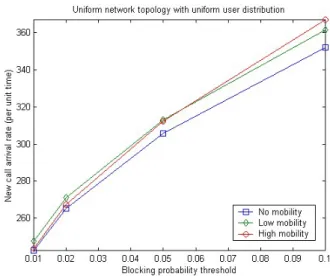
Fig. 2 shows the maximized call arrival rate for this network as the blocking probability threshold is varied from 0.01 to 0.1 for the case of no mobility, low mobility, and high mobility.
In what follows, we will vary the user distribution and see its effect on the Erlang traffic and the call arrival rates for the same traditional network topology.
Traditional Network Topology and Non-uniform User Distribution
In this section, the user distribution in a cell is no longer uniform. We consider three hot spot clusters as shown in Fig. 3. In a cell with a hot spot, the user distribution is not uniform. All three hot spot clusters have the same relative user density per grid point, which is five times that of a
Fig. 2. Maximized new call arrival rates versus blocking probability for no, low, and high mobility.
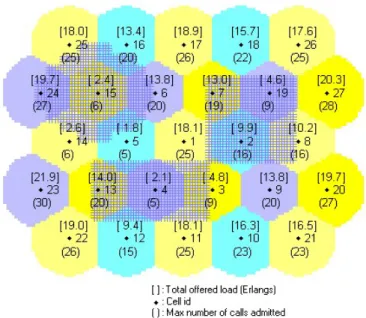
grid point with no hot spot. The first hot spot is circular in shape. Its center is located at (-4500, 2598) meters which coincides with base station 15 and has a radius of 3000 meters. The second hot spot is rectangular in shape. The lower left corner is at (-4600, -4200) meters and the upper right corner is at (1400, -1200) meters. The third hot spot is square in shape. The lower left corner is at (1600, -1000) meters and the upper right corner is at (6100, 3500) meters. The Erlang traffic in each cell is given in brackets in Fig. 3 and the maximum number of calls that could be admitted in each cell is given in parentheses. The maximum Erlang traffic for this network drops from 378.5 to 355.6 Erlangs. The maximum number of subscribers that this network can handle drops to 14,224. The Erlang traffic of cells 4, 15, and 19, which are inside the hot spots, has decreased from 11.4 to 2.1, 11.1 to 2.4, and 11.1 to 4.6 Erlangs, respectively. These cells suffer the most due to the increase in intra-cell interference and inter-cell interference because of the non-uniform user distribution. Fig. 4 shows the maximized call arrival rate for this network as the blocking probability threshold is varied from 0.01 to 0.1 for the case of no mobility, low mobility, and high mobility.
We now examine the values of Erlang traffic and new call arrival rates for the same non-uniform user distribution but for a network whose topology has been optimized for this non-uniform distribution.
Optimized Network Topology and Non-uniform User Distribution
Because of the hot spot clusters (non-uniform user dis-tribution), the network topology has changed to maximize the maximum number of simultaneous calls in all the cells in the network by optimizing the base station locations (see [13] for more details). This results in the network topology given in Fig. 5. The maximum Erlang traffic for this network increases from 355.6 to 379.1 Erlangs. As a result, the maximum number of subscribers increases to
Fig. 3. Erlang traffic and maximum number of calls that can be admitted for a twenty-seven cell CDMA traditional network topology with non-uniform user distribution for the low mobility case.
Fig. 4. Maximized new call arrival rates versus blocking probability for no, low, and high mobility.
15,164. The Erlang traffic in each cell is given in brackets in Fig. 5 and the maximum number of calls that could be admitted in each cell is given in parentheses. The Erlang traffic of cells 4, 15, and 19, which are inside the hot spots, has increased from 2.1 to 10.2, 2.4 to 7.4, and 4.6 to 9.5 Erlangs, respectively. Fig. 6 shows the maximized call arrival rate for this network as the blocking probability threshold is varied from 0.01 to 0.1 for the case of no mobility, low mobility, and high mobility.
5. CONCLUSIONS
We calculate the maximum number of subscribers that a CDMA cellular network can handle for a given GoS requirement, QoS requirement, network topology and user distribution profile. Our calculation also accounts for mo-bility. We formulate a constrained optimization problem
Fig. 5. Erlang traffic and maximum number of calls that can be admitted for a twenty-seven cell CDMA optimized network topology with non-uniform user distribution.
Fig. 6. Maximized new call arrival rates versus blocking probability for no, low, and high mobility.
that maximizes the arrival rates subject to upper bounds on the call blocking probabilities and lower bounds on the bit energy to interference ratios. The solution to the optimiza-tion problem yields the maximum number of subscribers and the maximum number of calls that could be admitted in each cell for the network to guarantee given GoS and QoS requirements. We present cases for a uniform user distribution profile and a traditional network topology, a non-uniform user distribution profile with three hot spot clusters, and a non-uniform user distribution profile and a non-traditional network topology that has been optimized to maximize the number of simultaneous calls.
REFERENCES
[1] D. Ayyagari and A. Ephremides, “Power control based admission algorithms for maximizing throughput in DS-CDMA networks with
multimedia traffic,” IEEE Wireless Commun. and Networking
Conf., vol. 2, pp. 631–635, September 1999.
[2] S. Ulukus and L. Greenstein, “Throughput maximization in CDMA uplinks using adaptive spreading and power control,” IEEE Sixth
International Symposium on Spread Spectrum Techniques and Applications, vol. 2, pp. 565–569, September 2000.
[3] S. Jafar and A. Goldsmith, “Adaptive multicode CDMA for uplink throughput maximization,” IEEE Veh. Technol. Conf., vol. 1, pp. 546–550, May 2001.
[4] S. Kahn, M. Gurcan, and O. Oyefuga, “Downlink throughput op-timization for wideband CDMA systems,” IEEE Commun. Lett., vol. 7, no. 5, pp. 251–253, May 2003.
[5] T. Shu and Z. Niu, “A channel-adaptive and throughput-efficient scheduling scheme in voice/data DS-CDMA networks with con-strained transmission power,” IEEE International Conf. on
Com-mun., vol. 3, pp. 2229–2233, May 2003.
[6] R. Akl, M. Hegde, and P. Min, “Effects of call arrival rate and mobility on network throughput in multi-cell CDMA,” IEEE
Inter-national Conf. on Commun., vol. 3, pp. 1763–1767, June 1999.
[7] E. D. Re, R. Fantacci, and G. Giambene, “Handover and dynamic channel allocation techniques in mobile cellular networks,” IEEE
Trans. Veh. Technol., vol. 44, no. 2, pp. 229–237, 1995.
[8] ——, “Research and simulation of intelligent call admission control method,” IEEE J. Select. Areas Commun., vol. 13, no. 2, pp. 397– 405, 1995.
[9] D. Hong and S. S. Rappaport, “Traffic model and performance analysis for cellular mobile radio telephone systems with prioritized and nonprioritized handoff procedures,” IEEE Trans. Veh. Technol., vol. 35, no. 3, pp. 77–92, 1986.
[10] Y. B. Lin, S. Mohan, and A. Noerpel, “Queueing priority channel assignment strategies for handoff and initial access for a PCS network,” IEEE Trans. Veh. Technol., vol. 43, no. 3, pp. 704–712, 1994.
[11] C. H. Yoon and C. K. Un, “Performance of personal portable radio telephone systems with and without guard channels,” IEEE J. Select.
Areas Commun., vol. 11, no. 6, pp. 911–917, 1993.
[12] T. S. Yum and K. L. Yeung, “Blocking and handoff performance analysis of directed retry in cellular mobile systems,” IEEE Trans.
Veh. Technol., vol. 44, no. 3, pp. 645–650, 1995.
[13] R. Akl, M. Hegde, M. Naraghi-Pour, and P. Min, “Call admission control scheme for arbitrary traffic distribution in CDMA cellular systems,” IEEE Wireless Commun. and Networking Conf., pp. 465–470, September 2000.
[14] C. Vargas, M. Hegde, and M. Naraghi-Pour, “Implied costs for multi-rate wireless networks,” accepted for publication by Journal of Wireless Networks.
[15] K. Gilhousen, I. Jacobs, R. Padovani, A. Viterbi, L. Weaver, and C. Wheatley, “On the capacity of a cellular CDMA system,” IEEE
Trans. Veh. Technol., vol. 40, no. 2, pp. 303–312, May 1991.
[16] H. Susuki, “A statistical model for urban radio propagation,” IEEE
Trans. Commun., vol. 25, pp. 673–680, July 1997.
[17] R. Akl, M. Hegde, M. Naraghi-Pour, and P. Min, “Multi-cell CDMA network design,” IEEE Trans. Veh. Technol., vol. 50, no. 3, pp. 711–722, May 2001.
[18] D. Everitt, “Analytic traffic models of CDMA cellular networks,”
Proceedings of the 14th International Teletraffic Congress, pp.
349–356, June 1994.
[19] G. Nemhauser and L. Wolsey, Integer and Combinatorial
Opti-mization. Wiley, 1988.
[20] M. Powell, “A fast algorithm for nonlinearly constrained optimiza-tion calculaoptimiza-tions,” Numerical Analysis, vol. 630, 1978.
[21] T. Coleman and Y. Li, “An interior, trust region approach for nonlinear minimization subject to bounds,” SIAM Journal on
Optimization, vol. 6, pp. 418–445, 1996.
[22] S. Han, “A globally convergent method for nonlinear programming,”
Journal of Optimization Theory and Applications, vol. 22, p. 297,
1977.
[23] P. Gill, W. Murray, and M. Wright, Practical Optimization. Aca-demic Press, 1981.