ISSN: 2147-611X
www.ijemst.com
Mathematization Competencies of
Pre-Service
Elementary
Mathematics
Teachers in the Mathematical Modelling
Process
Suha Yilmaz, Ayse Tekin-Dede Dokuz Eylul University
To cite this article:
Yilmaz, S. & Tekin Dede, A. (2016). Mathematization competencies of pre-service
elementary mathematics teachers in the mathematical modelling process.
International
Journal of Education in Mathematics, Science and Technology. 4
(4), 284-298.
DOI:10.18404/ijemst.39145
This article may be used for research, teaching, and private study purposes.
Any substantial or systematic reproduction, redistribution, reselling, loan, sub-licensing,
systematic supply, or distribution in any form to anyone is expressly forbidden.
Authors alone are responsible for the contents of their articles. The journal owns the
copyright of the articles.
Volume 4, Number 4, 2016
DOI:10.18404/ijemst.39145
Mathematization Competencies of Pre-Service Elementary Mathematics
Teachers in the Mathematical Modelling Process
Suha Yilmaz, Ayse Tekin-Dede
Article Info
Abstract
Article History
Received: 26 August 2015
Mathematization competency is considered in the field as the focus of modelling process. Considering the various definitions, the components of the mathematization competency are determined as identifying assumptions, identifying variables based on the assumptions and constructing mathematical model/s based on the relations among identified variables. In this study, pre-service elementary mathematics teachers’ mathematization competencies are tried to be elicit by investigating their solution approaches while solving a modelling problem. It was seen the participants started to solve the problem by using only verbal explanations and then their expressions became more mathematical throughout the process. The participants, who made validations frequently in the process, displayed more comprehensive mathematization competencies by correcting their assumptions, mathematical models and solution.
Accepted: 07 December 2015
Keywords
Mathematical modelling Mathematization Competency
Pre-service elementary mathematics teacher
Introduction
Mathematical modelling is defined as the process of expressing a real life problem situation mathematically and explaining this situation through the use of mathematical models (Blum & Niss, 1991). It is possible to define the real life situation mentioned in this definition as the whole world apart from mathematics in general (Pollak, 1979). In another definition which emphasizes the relationship between the real world and mathematical world, Heyman (2003) defines mathematical modelling as a simple way of applicability of mathematics, the relationship of mathematics with the real world, and revelation of this relationship, and it is stated that a mathematical model has to be constructed when mathematics is necessary to be benefitted from so as to explain real life problems, define and solve them (as cited in Peter Koop, 2004). In the modelling problems requiring mathematical models to be constructed, students mathematize real life situations and reach meaningful solutions depending on their experiences (Lesh & Doerr, 2003). In this context, in today’s world in which only school success is not sufficient, students’ performing mathematical modelling gains importance so that they will grow up as successful individuals in life and will be enabled to cope with the problems that they can encounter in real life.
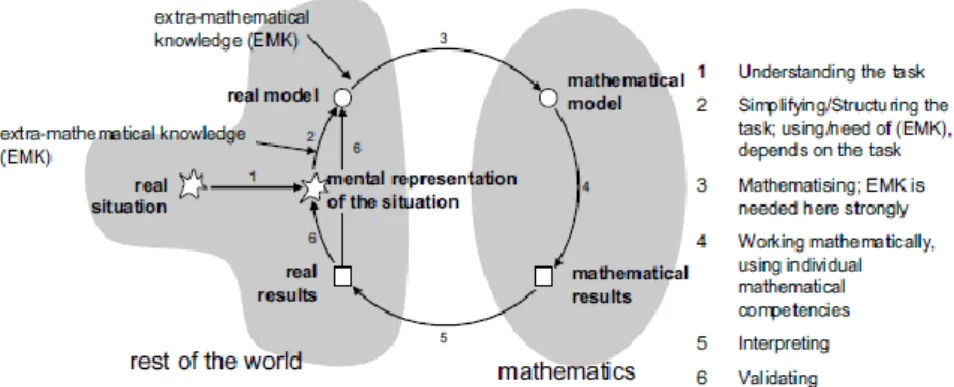
Figure 1. Modelling Cycle Under A Cognitive Perspective (Borromeo Ferri, 2006)
The primary purpose of integrating modelling into mathematics lessons within the frame of didactic discussions on modelling is expressed to ensure the development of students’ modelling competencies (Kaiser, 2007). Besides, it is stated that students have to use their modelling competencies to model real world situations (Tekin Dede &Yılmaz, 2013). Modelling competencies are defined as abilities and skills to complement the modelling process appropriately and purposefully in an independent way and individuals are stated to be required to be willing in this process (Kaiser & Maaß, 2007; Kaiser & Schwarz, 2006; Maaß, 2006; Maaß & Gurlitt, 2011). In another definition, modelling competencies are also defined as passing through all steps of modelling process independently and by understanding (Blomhøj & Jensen, 2003). In this case, within the modelling cycle in Figure 1, modelling competencies are considered as the competencies of understanding the problem, simplifying, mathematizing, working mathematically, interpreting and validating respectively.
When the studies on modelling are examined, it is understood that mathematization competency, which is dealt with as the transition from real model to mathematical model is seen as the focus of the modelling process. Berry and Davies (1996) define mathematization as the formulation of real life situation necessary for mathematical model to be constructed and for mathematical operations to take place. Grigoraş, Garcia and Halverscheid (2011) state that the greatest attention must be paid to mathematization step among sub-steps of modelling process for students to perform mathematical modelling independently. At this step, students start to use mathematical expressions by getting away from real life and form external illustrations through drawings and formulas (Borromeo Ferri, 2006). While performing mathematization, the verbal expressions of students become more mathematical and become farther away from reality. The overall aim of mathematization is to enable a logical, traceable and rational treatment of the given real life situations with the help of mathematical knowledge and tools (Grigoraş, 2010).
understanding the relationships between the language of the problem and the symbolic and formal language needed to understand it mathematically, finding regularities, relations and patterns, recognising aspects that are isomorphic with known problems, translating the problem into mathematics i.e. to a mathematical model”. Modelling applications must be integrated into daily mathematics lessons (Maaβ, 2006) because the development of students’ modelling competencies can be ensured through these applications (Blomhøj & Kjeldsen, 2006). Important roles fall within not only the researchers in the field but also the mathematics teachers to ensure the integration in question. Teachers must primarily have information on modelling so that they can benefit from modelling applications effectively in their classes. In this context, in order to perform modelling applications in mathematics lessons and to ensure the development of students’ modelling competencies, it is said to pre-service teachers that they should be taught these competencies during their under-graduate education (Kaiser, 2007). When the studies on modelling in literature are examined, it is observed that there are studies mostly examining the modelling competencies of students at middle and high school levels (Biccard & Wessels, 2011; Blomhøj & Jensen, 2010; Kaiser, 2007; Kaiser & Schwarz, 2006; Gatabi & Abdolahpour, 2013; Grünewald, 2012; Ji, 2012; Maaß, 2005). Besides this, it is noticed that there are not many studies about the research of modelling competencies of pre-service teachers. In one of the international studies, the solution approaches of pre-service elementary mathematics teachers were examined related to a problem given as to anaesthesia (Lingefjard, 2002). In another study about pedagogy of mathematical modelling which is not primarily focused on the competencies, the opinions of pre-service mathematics teachers after they had solved a modelling problem were examined and it was concluded that pre-service teachers should have the knowledge of proper mathematical knowledge and competencies, of mathematical pedagogy knowledge, and general pedagogy knowledge so that they will have detailed information on modelling (Kaiser, Schwarz & Tiedemann, 2010). Kaino (2012) evaluates students’ modelling competencies who are in the didactics of mathematics in South Africa by using forty different modelling activities and presents and assessment of analysis. While in international realm there are not many studies about modelling approaches of pre-service teachers, when national studies are examined, Bukova Güzel (2011) first researched the approaches pre-service mathematics teachers presented in forming mathematical modelling problems and to what extent they fulfilled the modelling process in solving these problems. Eraslan (2012) revealed the thinking processes of pre-service elementary mathematics teachers in the application of a model eliciting activity. Tekin Dede and Yılmaz (2013) examined the solution approaches of pre-service elementary mathematics teachers in a given modelling problem and investigated their modelling competencies.
The studies on modelling carried out with pre-service teachers in national and international field mostly deal with the modelling approaches holistically within the whole modelling process. In this study, on the other hand, the importance of having knowledge comes to the forefront about modelling competencies of pre-service elementary mathematics teachers who have been educated on mathematical modelling and who have solved many modelling problems. In this study, it was aimed that pre-service elementary mathematics teachers’ competencies of mathematization defined as the central part of modelling process tried to be examined while studying on a given modelling problem. Different from existing studies, only the participants’ mathematization competencies were examined in an atomistic way in this study and their approaches to construct mathematical model/s were tried to be explained. Borromeo Ferri (2006) said that differentiated some modelling stages and competencies among others empirically was a difficult job. Based on her reflections, we presented the participants’ approaches by being promoted by other competencies in our study. Dedicatedly just by focusing on mathematization, we tried to reveal on what respects the pre-service mathematics teachers cared for in constructing their mathematical models. With reference to the studies presented in literature, identifying assumptions, identifying variables based on the assumptions and constructing mathematical model/s based on the relations among the identified variables were chosen as the components of mathematization competencies. The component Identifying assumptions is related to what the assumptions are that are necessary for the solution of the problem and that are compatible with real life; the component Identifying variables based on the assumptions is related to what the mathematical variables are that are needed for solving the problem; and the component Constructing mathematical model/s based on the relations among the identified variables is related to constructing relations among the variables and constructing mathematical models by benefitting from proper mathematical representations.
Method
Participants
The participants of the study are five senior grade-pre-service elementary mathematics teachers, who have been educated at a state university in İzmir. There are no courses as to modelling in the department of elementary school mathematics so modelling was decided to be implemented in the course of Teaching Practice. This implementation was conducted as giving primarily theoretical information on modelling and then solution of different modelling problems during nine weeks. Because the knowledge on modelling process was mentioned to be effective in the development of the modelling competencies (Kaiser, Schwarz & Tiedemann, 2010; Maaß, 2006), it was found to be appropriate for the participants to be informed about the modelling process before the study. Within the frame of Modelling Cycle under a Cognitive Perspective by Borromeo Ferri (2006), the solutions of many modelling problems were carried out both as class activity and as homework. The participants were chosen among other pre-service teachers in terms of their willingness to take part in the study and they studied within the collaborative working group that they formed. Since collaborative working had positive effect on the development of the modelling competencies (Maaß, 2006; Maaß & Gurlitt, 2011), it was preferred for participants to work together instead of their working individually. The participants were asked to solve the given modelling problem without having any time limitations in, and they were told to make search on the internet if they needed. In presenting the findings within the context of the study, nick names were used instead of the real names of the participants.
Instruments
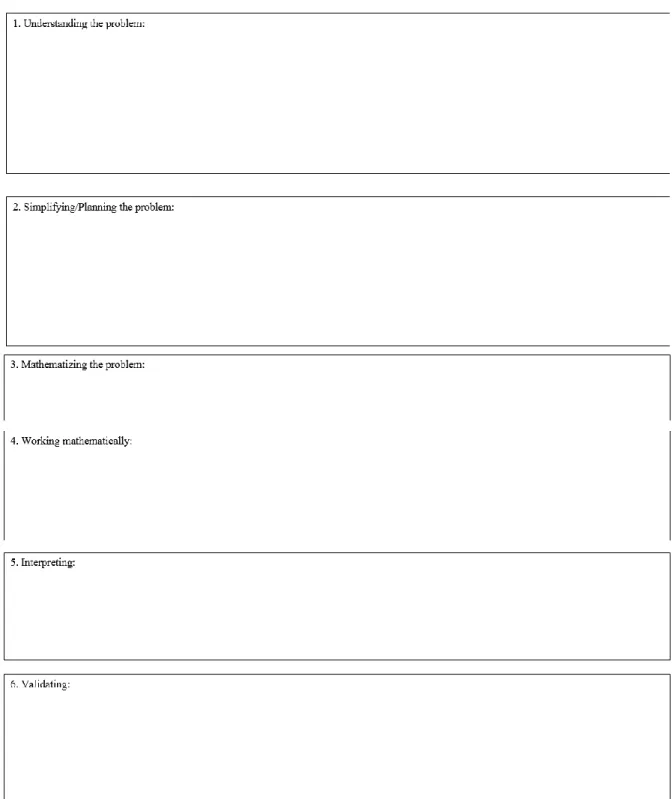
The mathematical modelling problems need constructing mathematical models but in some cases, even if participants construct a model, they do not express it in a clear way in their solution process. In the study aiming at revealing the mathematization competencies of the participants, constructed mathematical models are thought to be expressed mathematically. So chosen of the problem requiring expressing mathematical models explicitly had a central importance in the study. To that end, in order to reveal the mathematization competencies of the participants, the modelling problem named Step Problem (Hıdıroğlu, Tekin & Bukova Güzel, 2011) was carried out. In this problem it was asked to construct a model mathematically stating the relationship between the distance of one’s steps in walking and one’s height. On the paper which reads the problem status given to the participants, the steps of the Modelling Cycle under a Cognitive Perspective by Borromeo Ferri (2006) such as Understanding the problem, Simplifying/Planning the problem, Mathematizing the problem, Working mathematically, Interpreting and Validating were given and participants were asked to perform their solutions according to these steps (see Fig.2). The problem solving processes of the participants were recorded by video camera and the papers on which their solutions were written were taken after the solving process. The data collection tools of the study are composed of the transcriptions of the records of solution process and the solution papers of the study group.
Data Analysis
Figure 2. The written paper of the Step Problem prepared in the frame of the Modelling Cycle under a Cognitive Perspective
extracts to identify the statements of the participants and what the participants stated were tried to be explained more clearly or what they stated not by verbally but by their mimics were tried to be emphasized thanks to it.
Results and Discussion
In the findings it is described in a detailed way how the problem was solved and in the meantime, the participants’ solution approaches were presented in the context of the components of mathematization competency as Identifying assumptions, Identifying variables based on the assumptions and constructing mathematical model/s based on the relations among the identified variables.
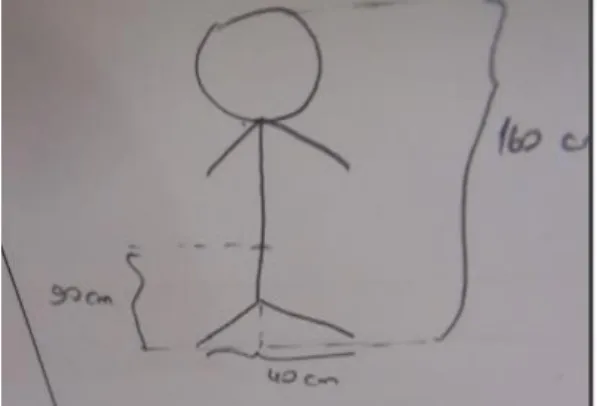
After the participants had read and understood the problem, they first drew a stickman and then they made a suggestion as to the solution of the problem by utilizing their own real life data. According to this suggestion, they formed verbal statements about the possible solution depending on the data of Sevil, one of the group members. On the picture they drew, they took the human height as 160 cm, leg length as 90 cm and the distance between the steps as 40 cm (see Fig. 3) in the context of the component Identifying assumptions. The moment the participants started to solve the problem, it was observed that they tried to develop a verbal solution with reference to the real model and they had not yet passed to mathematical world.
Figure 3. The drawing of the participants about the real model
The participants thought to make proportioning only on numeric values but they realized that they could not make a generalization and construct a model in this way. Thereon, they started to discuss on assumptions that can be needed for the solution of the problem.
Özlem: As he/she grows tall, his/her step distances lengthen. As the leg length gets bigger, the step distance also lengthens.
…
Özlem: It even depends on foot size.
Feyyaz: It depends on it, too; but if you progress over the body, for example if I stretch my leg a lot… Özlem: It is related to the angle. Namely, if the sides of the triangle are long, does the angle narrow? No, does it widen?
Feyyaz: The sides of the triangle are the legs. Leg length does not change. The distance changes only. Ferah: The angle changes.
Sevil: As the angle increases, the step distance will increase. Özlem: Yes the step distance will increase.
Selda: But again, one who is taller can take longer steps.
Özlem: But all people stretch their leg at a definite angle, don’t they? Take longer steps. Look now; there is a maximum angle that a person can stretch his/her legs, right?
Selda: Yes.
Özlem: But, because the legs of a man who is taller will be longer, the distance between two steps will have increases when he/she stretches his/her legs at the same angle. Understood? We can make such a variety.
made assumptions that height doubles the leg length and there is a certain angle between legs (identifying assumptions), and switched to mathematical world first based on the mentioned assumptions. The variables were determined by stating that the height is 2x, the leg length is x and the angle between the legs is 2𝛼 (identifying variables based on the assumptions). The participants, who noticed that they made a mistake in presenting the so-called variables on the geometrical picture they drew, corrected their drawings. When the participants completed the mathematization process by constructing the relationships between the variables and utilizing the formal, algebraic and geometric representations, they stated the mathematical model of the problem
as 2𝑦 = 2𝑥. 𝑠𝑖𝑛𝛼 (constructing mathematical model/s based on the relations among the identified variables).
Sevil: I call here α, and here y. Total height is 2x, right? The leg length is x.
Figure 4: Screen shot of the drawing of the mathematical model
Sevil: Now if the height is 2x in total, here is x, isn’t it?
Ferah: But if this [height of triangle] is x, this [the length of one of the equal sides] can’t be x?
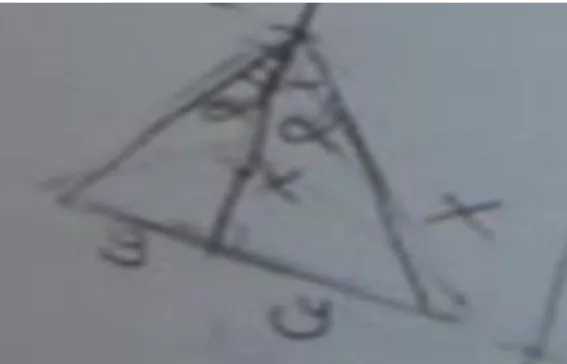
Figure 5: Screen shot of the drawing of the triangle’s angles and lengths
[Both the height of triangle and the length of one of the equal sides were written as x.]
Sevil: I didn’t call here [the length of one of the equal sides] x anyway. Ferah: Ok, let’s erase it
Sevil: … Then we’ll say sinα=y/x.
Figure 6: Screen shot of the corrected drawing
The participants having completed the mentioned solution approach decided to make validation, thinking that their assumption based on the relation between the leg length and the height could be wrong. Because Sevil claimed that her leg length is 90 cm, they stated the relation between it and the height of 160 cm as the leg length could be 10 cm more than the half of the height (identifying assumptions). They rearranged the variables depending on their assumptions and wrote the mathematical model as 2𝑦 = 2(𝑥 + 10). 𝑠𝑖𝑛𝛼 in line with the relation between them (constructing mathematical model/s based on the relations among the identified variable). Then, while they were searching, from the internet, what the so-called relation between them could be, they came across the knowledge on golden ratio and thought that they could utilize the golden ratio to solve the problem. In the meanwhile, Feyyaz applied the golden ratio to Sevil’s height through the operations he performed on another paper, and validated the assumption by stating that the leg length should be about 98cm. Thereon, the participants revised their assumptions in a way in which the leg length should be 20 cm more than the half of the height (identifying assumptions). They constructed the mathematical model as 2𝑦 = 2(𝑥 +
20). 𝑠𝑖𝑛𝛼 by identifying the variables based on the assumptions in question (identifying variables based on
assumptions and constructing mathematical model/s based on the relations among the identified variable).
Sevil: My leg length is 90 cm. Then, let’s say x plus something, what will it be then? Let’s say x+10 Selda: What is 10?
Sevil: It will be a little more than the half. We say it a little bit more than the half Ferah: Alright, let’s say it so x+10.
Sevil: Then sinα=y/(x+10). Here y=(x+10).sinα and 2y=2(x+10).sinα.
Figure 7: Screen shot of the search on the internet about human body
Feyyaz: [As the result of the internet search, they find that the leg length is 0.61 times of the height, in another site apart from the picture above.] For example the one who is 160 cm height has 98 cm leg length
Sevil: Then it is 20 cm more than the half. Feyyaz: Yes, nearly 20 cm more than the half
Sevil: Then let’s say it 20 here. [She writes y=(x+20).sinα and 2y=2(x+20).sinα].
Figure 8: Screen shot of the solution of the participants
the golden ratio (identifying assumptions). It was seen that the participants having corrected the variables based on the so-called assumptions (identifying variables based on the assumptions) did not state the mathematical model needed for solving the problem at that moment.
Selda: Here, 20 changes according to the height, indeed. Sevil: Yes, I thought if we call it p or something. Ferah: It isn’t a constant statement, in fact. Feyyaz: I think so. In fact we can call it 0,6x. Sevil: Then, 2x.0,6=1,2x and the leg length is 1,2x.
Figure 9: Screen shot of the corrected drawing
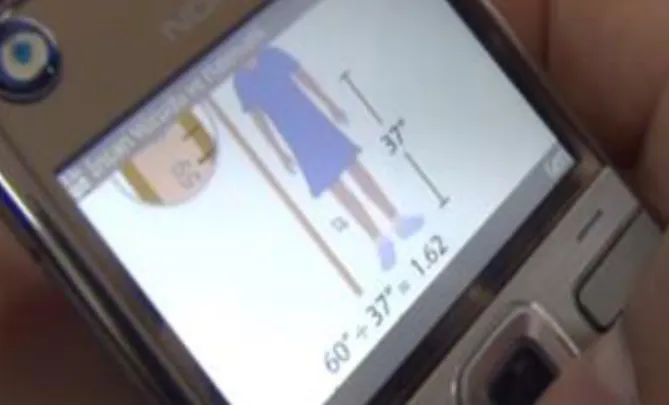
The participants started to discuss what the angle between the legs could be, to validate the variables. For this purpose, they decided to utilize Sevil’s measurements again. According to the assumptions they constructed in regard to the golden ratio, they questioned the relation of the leg length 98 cm, they found depending on the height of Sevil, with the estimate value of 90 cm regarding the leg length they found at the very beginning of the solution. In line with the mentioned relations, they discussed the value of the angle between the legs and the possibility of 𝛼 to be 30°. After this, the participants decided that they could not make any predictions regarding the angle in question and made measurements again on Sevil. They saw that the distance between Sevil’s steps should be 55-60 cm by utilizing the tiles on the ground. In this validation approach of them, they found that there was a mistake in their measurements since the ratio of the height to the leg length should be 1.62 according to the golden ratio. When they examined the golden ratio drawing on the internet again, they found out in the drawing that the waist is included to the leg length but a person opens his/her steps not from waist but from lower parts (see Fig 4).
Figure 10. The verification approaches of the participants based upon their own data
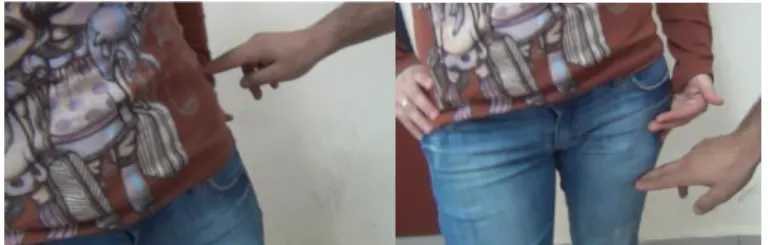
After this, the participants were observed to make measurements through hand span and to validate and correct their assumptions, variables and mathematical model they had constructed respectively. The participants measured the leg length from the waist to be 5 hand spans and that from which legs are opened to be 4 hand spans. In this context, they made a more realistic assumption that the leg length from which legs are opened would be 4/5 of the leg length from the waist (identifying assumptions). The mathematical model was constructed depending on the so-called assumption and on the assumption that the leg length is 0.6 times of the height.
Sevil: Look, isn’t our leg length 1.2x? Selda: We’ll take 4/5 of it
Sevil: What is the result? Feyyaz: 9,6.
Ferah: Isn’t it ok if we construct such a triangle? Well, it will have lowered one hand span. Sevil: We’ll say 0.96
…
Sevil: Look this is the value which we take from the point where we take our step, it is 0.96x. There will be 0.96x.
Figure 11: Screen shot of the value of sin ∝
When the statements of the participants are examined, it was observed that they revised the variables that the height is 2x and the leg length is 0.96x (identifying variables based on the assumptions) and states the mathematical model as 2𝑦 = 1,92𝑥. sin 𝛼 (constructing mathematical model/s based on the relations among the identified variable). All explanations of the participants as to the solution on their papers are given in Figure 5.
Figure 12. The solution approaches of the participants
The participants having completed their solutions discussed about what the distance between the steps could be according to the mathematical model they constructed in order to control the accuracy of their solution. In this context, they discussed whether the mathematical model is assured or not in the situation of angle being 44° based on Sevil’s measurements. They found that the distance between the steps could be 57 cm with the help of calculator by writing down the numeric values to the places of the variables in the mathematical model. The participants decided that the model they constructed is logical and concluded the solution process because they thought that they found a value close to the distance between the steps according to their measurements on tiles.
Selda: We took the angle as 44.
Sevil: x/96=4/5. x what comes out from here? Selda: 76,8.
Sevil: Let’s say it 77. [They found that leg length is about 77 cm. They calculate the distance between the steps by writing down the angle and the leg length in the mathematical model.]
Figure 13. Screen shot of the calculation of the model
Ferah: We’ll multiply it by 2. It is 57. Özlem, Seda: This is more normal.
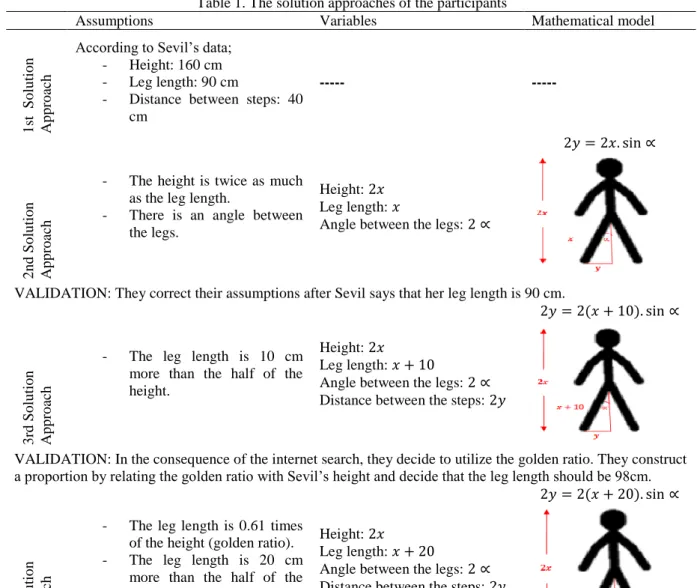
When the mathematization competencies of the participants in the process are examined, it is possible to summarize their solution approaches as the Table 1 to make a general view.
Table 1. The solution approaches of the participants
Assumptions Variables Mathematical model
1 st So lu tio n Ap p ro ac h
According to Sevil’s data; - Height: 160 cm - Leg length: 90 cm
- Distance between steps: 40 cm --- --- 2 n d So lu tio n Ap p ro ac h
- The height is twice as much as the leg length.
- There is an angle between the legs.
Height: 2𝑥 Leg length: 𝑥
Angle between the legs: 2 ∝
2𝑦 = 2𝑥. sin ∝
VALIDATION: They correct their assumptions after Sevil says that her leg length is 90 cm.
3 rd So lu tio n Ap p ro ac h
- The leg length is 10 cm more than the half of the height.
Height: 2𝑥 Leg length: 𝑥 + 10
Angle between the legs: 2 ∝ Distance between the steps: 2𝑦
2𝑦 = 2(𝑥 + 10). sin ∝
VALIDATION: In the consequence of the internet search, they decide to utilize the golden ratio. They construct a proportion by relating the golden ratio with Sevil’s height and decide that the leg length should be 98cm.
4 th So lu tio n Ap p ro ac h
- The leg length is 0.61 times of the height (golden ratio). - The leg length is 20 cm
more than the half of the height.
Height: 2𝑥 Leg length: 𝑥 + 20
Angle between the legs: 2 ∝ Distance between the steps: 2𝑦
2𝑦 = 2(𝑥 + 20). sin ∝
VALIDATION: They decide that 20 in x+20, the leg length, cannot be constant value and can differ for everyone.
5
th Solu
tio n Ap p ro ac
h - The leg length is 0.6 times
of the height.
Height: 2𝑥
Leg length: 1,2𝑥 (2𝑥. 0,6) Angle between the legs: 2 ∝ Distance between the steps: 2𝑦
---
VALIDATION: They use Sevil’s data to validate their assumptions. Since Sevil is 160 cm tall, her leg length is 98 cm according to their assumptions. They think that they found a value close to 90 cm which is an estimate value of the leg length at the beginning of process by Sevil. They think what the angle could be between the legs according to these values. They discuss its possibility to be ∝= 30°
6 th So lu tio n Ap p ro ac h
- The leg length from the point where it is opened in walking is 4/5 of the leg length from the waist. - The leg length is 0.6 times
of the height.
Height: 2𝑥
Leg length: 0,96𝑥 (1,2𝑥.4
5)
Angle between the legs: 2 ∝ Distance between the steps: 2𝑦
2𝑦 = 1,92𝑥. sin 𝛼
VALIDATION: They validated the ratio between the leg length and the height in their previous approach. Now, they validate the mathematical model according to the value that the angle can take. Namely, they investigate whether the value that angle can take is logical or not according to their values. When they open their legs with
2 ∝= 44° or 44º angle, they find with the help of a calculator that the distance between the steps of a person
who is 160 cm is 57cm. Because they think that they have found a value close to their measurements on the tiles, they decide that the model they constructed is logical.
Conclusion
In the study, the solution approaches in the context of mathematization competency was examined within the frame of the components identifying assumptions, identifying variables based on the assumptions and constructing mathematical model/s based on the relations among the identified variable in the process of solving a modelling problem which 5 pre-service elementary mathematics teachers realized as a group. At the beginning of the process, the participants were studying on the real world, while they moved on to the mathematical world the moment they started to discuss the variables that could be needed for the solution.
At the beginning of the solution process, it was thought that the participants’ assumptions that the height can be twice as much as the leg length or that the leg length can be 10 or 20 cm more than the half of the height are not realistic. The reason for it is that the group members constructed the so-called assumptions only on the basis of the measurements of one person in the group and that they did not anyhow consider the generalizability. In regard to the internet search on the golden ratio and their attempt to construct a more generalizable model, the participants made more realistic assumptions. Yet, based only on the golden ratio, their assumption as to the fact that the leg length can be 0,6 times of the height was thought not to be appropriate and generalizable for the solution of the problem completely. Because, although the participants thought to use a model over the golden ratio, they still utilized the measurements of a group member both in constructing their assumptions and in validation, but they did not consider whether the measurements of the person involved is compatible with the golden ratio or not. Besides, although it was necessary for them to construct a model for any person, they did not realize that they got away from a general model by performing a solution according to a person they thought to have the golden ratio. For this reason, the participants were thought to have trouble in simplifying the real life data and to construct simpler assumptions although they had nine-week modelling instruction and solved many modelling problems. Similarly, Maaβ (2005; 2006), in his two studies in which he integrated modelling into mathematics lessons, stated that students made simplifications more than needed without considering the reality in constructing assumptions. As Biccard and Wessels (2011) stated in their study, although the participants are equipped with better mathematical knowledge, they were observed to construct a model by only using ratio and proportion and trigonometric ratios in this study. In spite of this, the participants were understood to frequently benefit from different representations such as algebraic, formal and geometric representations in the solution process.
In general, considering the problem solving approaches of the participants, it was thought that more active solution approaches arose thanks to the fact that they realized the solution according to the steps of the modelling process by knowing this process. Similarly, Kaiser, Schwarz and Tiedemann (2010), and Maaβ (2006) state that the knowledge on the steps of modelling process contribute to richer and more active solution approaches. Correspondingly, based on the findings of the studies of Bukova Güzel (2011), Tekin Dede and Yılmaz (2013), it is stated that the education the pre-service teachers received as to modelling has positively contributed to their modelling competencies. In addition to this, as Blomhøj and Jensen (2003) stated, it was observed that the participants’ having developed a solution in parallel to the modelling cycle contributed generally to their whole modelling competencies and specifically to their mathematization competency.
Based on the findings of the study, it is thought that pre-service teachers present richer approaches not only in the sense of mathematization competency but in the sense of all modelling competencies in general. These rich approaches include diversity of solutions involving more comprehensive mathematical models gradually during the solution process. Besides, their mathematical models and ways of thinking seem to be more extensive by comparison with the nine weeks in the course of Teaching Practice before this implementation. This situation derives from the fact that they are informed about the modelling competencies and, depending on this, they solve modelling problems regarding the competencies. To reach more comprehensive data about pre-service teachers’ mathematization competencies and to reveal a pattern about these competencies, their model construction approaches would be examined in the solution processes of different modelling problems. Besides all these, it is thought to be of importance that pre-service teachers take courses in the context of modelling competencies and their development during their undergraduate education to enable to utilize modelling applications in their teaching life.
References
Berry, J. & Davies, A. (1996). Written Reports. In C. R. Haines & S. Dunthorne (Eds.), Mathematics Learning and Assessment: Sharing Innovative Practices (pp. 3.3-3.11). London: Arnold.
Biccard, P. & Wessels, D. (2011). Development of Affective Modelling Competencies in Primary School Learners. Pythagoras, 32(1), 1-9.
Blomhøj, M. & Jensen, T. H. (2003). Developing Mathematical Modelling Competence: Conceptual Clarification and Educational Planning. Teaching Mathematics and Its Applications, 22(3), 123-139. Blomhøj, M. & Jensen, T. (2010). What’s all the Fuss about Competencies? In W. Blum, P. L. Galbraith, H. W.
Henn, & M. Niss (Eds.), Modelling and Applications in Mathematics Education: The 14th ICMI Study (pp 45-56). Springer: New York.
Blomhøj, M. & Kjeldsen, T. N. (2006). Teaching Mathematical Modelling through Project Work. Zentralblatt für Didaktik der Mathematik-ZDM, 38(2), 163-177.
Blum, W. (1996). Anwendungsbezüge im Mathematik-unterricht – Trends und Perspektiven. In Kadunz, G. et al. (Eds.), Trends und Perspektiven. Schriftenreihe Didaktik der Mathematik, Vol. 23., Wien: Hölder-Pichler-Tempsky, 15 – 38.
Blum, W. (2011). Can Modelling Be Taught and Learnt? Some Answers from Empirical Research. In G. Kaiser, W. Blum, R. Borromeo Ferri, & G. Stillman (Eds.), Trends in Teaching and Learning of Mathematical Modelling. International Perspectives on the Teaching and Learning of Mathematical Modelling (pp. 15-30). New York: Springer.
Blum, W. & Niss, M. (1991). Applied Mathematical Problem Solving, Modelling, Applications, and Links to Other Subjects - State, Trends and Issues in Mathematics Instruction. Educational Studies in Mathematics, 22, 37-68.
Borromeo Ferri, R. (2006). Theoretical and Empirical Differentiations of Phases in the Modelling Process. Zentralblatt für Didaktik der Mathematik-ZDM, 38 (2), 86-95.
Bukova Güzel, E. (2011). An Examination of Pre-Service Mathematics Teachers’ Approaches to Construct and Solve Mathematical Modeling Problems. Teaching Mathematics and Its Applications, 30(1), 19-36. Cabassut, R. (2010). The Double Transposition in Mathematisation at Primary School. In V. Durand Guerrier,
S. Soury Lavergne, & F. Arzarello (Eds.), Proceedings of the 6th Congress of the European Society for Research in Mathematics Education CERME 6 (pp. 2156 – 2165). Lyon: Institut National de Recherche Pédagogique.
Creswell, J. W. (2013). Nitel, Nicel ve Karma Yöntem Yaklaşımları Araştırma Deseni. (S. B. Demir, Çev.) Ankara: Eğiten Kitap.
Gatabi, A. R., & Abdolahpour, K. (2013). Investigating Students’ Modeling Competency through Grade, Gender, and Location. In B. Ubuz, C. Haser & M. A. Mariotti (Eds.), Proceedings of the 8th Congress of the European Society for Research in Mathematics Education CERME 8. (pp. 1070-1077). Turkey: Middle East Technical University, Ankara.
Grigoraş, R. (2010). Modelling in Environments Without Numbers – A Case Study. In V. Durand-Guerrier, S. Soury-Lavergne & F. Arzarello (Eds.), Proceedings of the 6th Congress of the European Society for Research in Mathematics Education CERME 6 (pp. 2206-2215). Lyon: Institut National de Recherche Pédagogique.
Grigoraş, R., Garcia, J. & Halverscheid, S. (2011). Examining Mathematising Activities in Modelling Tasks with a Hidden Mathematical Character. In G. Kaiser, W. Blum, R. Borromeo Ferri, & G. Stillman (Eds.), Trends in Teaching and Learning of Mathematical Modelling. International Perspectives on the Teaching and Learning of Mathematical Modelling (pp. 85-95). New York: Springer.
Grünewald, S. (2012). Acquirement of Modelling Competencies – First Results of an Empirical Comparison of the Effectiveness of a Holistic Respectively an Atomistic Approach to the Development of (Metacognitive) Modelling Competencies of Students. 12th International Congress on Mathematical Education, 8 July-15 July 2012, COEX, Seoul, Korea.
Hıdıroğlu, Ç. N., Tekin, A. & Bukova Güzel, E. (2011). The Analysis of Student Teachers’ Thought Processes in the Mathematical Modelling through a Designed Fermi Problem. (Short Oral Presentation). 35th Conference of the International Group for the Psychology of Mathematics Education. 10-15 Temmuz 2011, ODTÜ, Ankara.
Ji, X. (2012). A Quasi-Experimental Study of High School Students’ Mathematics Modelling Competence. 12th International Congress on Mathematical Education, 8 July-15 July 2012, COEX, Seoul, Korea. Kaino, L. M. (2012). The Nature of Modelling Activities and Abilities of Undergraduates: Some Reflections on
Students’ Mathematics Portfolios. 12th International Congress on Mathematical Education. 8-15 July 2012, COEX, Seoul, Korea.
Kaiser, G. (2007). Modelling and modelling competencies in school. In C. Haines, P. Galbraith, W. Blum, & S. Khan (Eds.), Mathematical modelling (ICTMA 12): Education, engineering and economics: proceedings from the twelfth International Conference on the Teaching of Mathematical Modelling and Applications (pp. 110-119). Chichester: Horwood.
Kaiser, G. & Maaß, K. (2007). Modelling in Lower Secondary Mathematics Classroom – Problems and Opportunities. In W. Blum, P. L. Galbraith, H. W. Henn, & M. Niss (Eds.), Modelling and Applications in Mathematics Education: The 14th ICMI Study (pp 99-108). Springer: New York.
Kaiser, G. & Schwarz, B. (2006). Mathematical Modelling as Bridge between School and University. Zentralblatt für Didaktik der Mathematik-ZDM, 38, 196-208.
Kaiser, G., Schwarz, B. & Tiedemann, S. (2010). Future Teachers’ Professional Knowledge on Modeling. In R. Lesh, P. L. Galbraith, C. R. Haines, & A. Hurford (Eds.), Modeling Students’ Mathematical Modeling Competencies (pp. 433-444). New York: Springer.
Lesh, R. & Doerr, H.M., (2003). Foundations of a Models and Modeling Perspective on Mathematics Teaching, Learning, and Problem Solving. . In R. Lesh & H. Doerr (Eds.), Beyond Constructivism: Models and Modeling Perspectives on Mathematics Problem Solving, Learning, And Teaching (pp. 3-33). Hillsdale, NJ: Lawrence Erlbaum Associates, Inc.
Lingefjard, T. (2002). Mathematical Modeling for Preservice Teachers: A Problem From Anesthesiology. International Journal of Computers for Mathematical Learning, 7, 117–143.
Maaß, K. (2005). Barriers and Opportunities for the Integration of Modelling in Mathematics Classes: Results of an Empirical Study. Teaching Mathematics and Its Applications. 24 (2-3), 61-74.
Maaß, K. (2006). What are Modelling Competencies? Zentralblatt für Didaktik der Mathematik-ZDM. 38 (2), 113-142.
Maaß, K. & Gurlitt, J. (2011). LEMA – Professional Development of Teachers in Relation to Mathematical Modelling. In G. Kaiser, W. Blum, R. Borromeo Ferri, & G. Stillman (Eds.), Trends in Teaching and Learning of Mathematical Modelling. International Perspectives on the Teaching and Learning of Mathematical Modelling (pp. 629 - 639). New York: Springer.
Miles, M. B., & Huberman, M. A. (1994). Qualitative Analysis: An Expanded Sourcebook. Thousand Oaks, CA: Sage.
Peter Koop, A. (2004). Fermi problems in primary mathematics classrooms: Pupils’ interactive modelling processes. In I. Putt, R. Farragher, & M. McLean (Eds.), Mathematics education for the third millennium: Towards 2010. Proceedings of the 27th annual conference of the Mathematics Education Research Group of Australia (pp. 454-461). Townsville, Queensland: MERGA.
Tekin Dede, A. & Yılmaz, S. (2013). İlköğretim Matematik Öğretmeni Adaylarının Modelleme Yeterliliklerinin İncelenmesi. Turkish Journal of Computer and Mathematics Education. 4(3), 185-206.
Yin, R. K. (1987). Case Study Research Design and Methods. London: Sage Publications Inc.
Author Information
Suha YilmazDokuz Eylul University
Uğur Mumcu Street 135 Av. No:5, 35150 Buca-Izmir, TURKEY
Ayse Tekin-Dede Dokuz Eylul University