AUSTRALIAN JOURNAL OF BASIC AND
APPLIED SCIENCES
ISSN:1991-8178 EISSN: 2309-8414 Journal home page: www.ajbasweb.com
Open Access Journal
Published BY AENSI Publication
© 2016 AENSI Publisher All rights reserved
This work is licensed under the Creative Commons Attribution International License (CC BY).
http://creativecommons.org/licenses/by/4.0/
To Cite This Article: Noor Azura Dahalan, Muhamad Khalil Omar, Dayang Nailul Munna Abg Abdullah, Ridhawati Zakaria, Rashidah Rahman., Trainees’ Participation in Relations with Trainees’ Readiness, Commitment and Training Content. Aust. J. Basic & Appl. Sci., 10(11): 322-327, 2016
Trainees’
Participation
in
Relations
with
Trainees’
Readiness,
Commitment and Training Content
Noor Azura Dahalan, Muhamad Khalil Omar, Dayang Nailul Munna Abg Abdullah, Ridhawati Zakaria, Rashidah Rahman
Universiti Teknologi MARA, Centre for Management and Administration Studies, Faculty of Business and Management, 42300. Puncak Alam. Malaysia.
Address For Correspondence:
Noor Azura Dahalan. Name of Universiti Teknologi MARA, Centre of Management and Administration Studies, Faculty of Business and Management Studies, 42300. Puncak Alam. Selangor.
+60196141921 [email protected]
A R T I C L E I N F O A B S T R A C T Article history:
Received 3 March 2016 Accepted 2 May 2016 published 26 May 2016
Keywords:
Training Participation; Trainees’ Readiness; Trainees’ Commitment; Training Content
Background: Most of the organizations had allocated certain amount of money and invest in training and development for the purpose of development of employees. Quantitative research had been conducted by distributing questionnaires to 118 respondents in one of the oil and gas industry organization in Kuala Lumpur as a sample. Descriptive analysis, reliability analysis and Pearson’s correlation analysis were applied in this study to measure the association between independent and dependent variables. Objective: This research paper was aimed to identify the association between trainee’s commitment, trainee’s readiness and training content with training participation in a training program. Results: The finding of the study revealed that, training content was the most dominant variable affecting trainee’s participation, followed by trainee’s readiness and trainee’s commitment. It shows that all of the three factors were associated with trainee’s participation in a training program. Conclusion: These results explained that the higher commitment, readiness, and relevance of training content, the higher the number of trainee’s participation. Thus, employee’s performance can be improved and directly influence organization performance as well.
INTRODUCTION
The need for multinational firms to be as competitive in the global marketplace as possible has increased dramatically over the past twenty years. For international human resource management this has meant many strategic opportunities to explore. An excellent example of such an opportunity is the exists regarding the management of talent. This opportunity began to develop in the late 1990s with the advent of the challenge of ‘‘global talent management’’. During the past few years this opportunity has expanded to include challenges dealing with talent shortages, talent surpluses, locating and relocating talent, and compensation levels of talent. Together, these conditions are all ‘‘global talent challenges’’ (Schuler, Jackson, & Tarique, 2010).
Thus, talent management program has known from decades ago and nowadays the talent management development program became one of the vital factors for an organization to produce better and high quality product or services by using employee talent. Through development of talent management, employees able to learn new skills and knowledge while increasing competition among organization in healthy ways.
human capital such as human knowledge, skills and other abilities that can contribute to talent effectiveness but the way of talent transfer that can measure the successfulness of global talent management program.
Literature Review:
During scenario-based training, the scenario is dynamically adapted in real time to control the storyline and increase its effectiveness. A team of experienced staff members is required to manage and perform the adaptations. They manipulate the storyline and the level of support during their role-play of important characters in the scenario. The costs of training could be reduced if the adaptation is automated by using intelligent agent technology to control the characters within a virtual training environment (a serious game) (Peeters, Bosch, Meyer & Neerincx, 2013). However, such a system also needs a didactical component to monitor the trainee and determine necessary adaptations to the scenario. Different field of work will be differentiating the training scenario. The purpose of different training scenario is to give an opportunity for employees to adapt with difference working environment and while providing better learning process.
The personal capabilities and intentions of employees indicate their performance within their organization. It is important for the organization to capture this kind of tacit knowledge since the workforce are the true experts in perceiving the organization’s current reality and evaluating which assets require development – including themselves as knowledge assets(Kantola, Piirto, Toivonen, Chang & Vanharanta, 2011). The research explained that individuals characteristic in which the way of they apply and used the capabilities that they have is the factor of training scenario of improving tacit knowledge in nowadays become increase. Employees performance in organization also another factor that contribute to training scenario in nowadays such as class room learning, team building, E-learning and others training scenario which can improve employees performance and their motivation to perform.
Trainee’s Participation:
Participation can be define as individuals involvement whether in training, team work or community programs. According to previous research, the level of involvement in employee participation is based on employee’s attitudes and perceptions towards other participants, trainer and training program itself (Fox, Code, Gray & Smith, 2002). The previous journal article was supported by another journal titled ‘The Role of Individual and Training Design Factors on Training Transfer’ which is after completing of training program, trainees who highly confidence in transferring their capability and able to apply the new skills and knowledge that has been learn in training program previously is the trainees who has high level of confidence (Bhatti & Kaur, 2009). A study by Omar, Dahlan, Zakaria and Mohamed (2013) found that training was positively and significantly correlated with employee job satisfaction.
Trainee’s Commitment:
In ‘Training to raise unemployment youth’s work commitment in Tianjin’ journal articles indicate that work commitment is determine by training specific work motivation so that soft skills training would be particularly conductive for employees and unemployed youths in terms of their works commitment(Cheung & Ngai, 2009). Another research study indicates that the training objectives are achieved when the primary objective of training program of impart a new set of knowledge, skills, abilities and other (KSAs), behaviors or attitudes, and training effectiveness to the employees are successful achieved (Ghosh, Satyawadi, Joshi, Ranjan & Singh, 2012).
Traditionally, model of ethical decision-making have focused primarily on individual ethical decision frameworks (Wells & Schminke, 2001). The author argue that moral maturity is reflects three level of moral reasoning which are ‘pre-conventional’ level (rewards and punishment) morality are define by individuals as an action consequences or moral positions of authority figures, secondly ‘conventional’ level which factor that become more instrumental in determining what constitutes moral behavior are peers, family, and social norms while ‘post-conventional’ level define that moral principles causes of self-interest societal pressures, and authority figures.
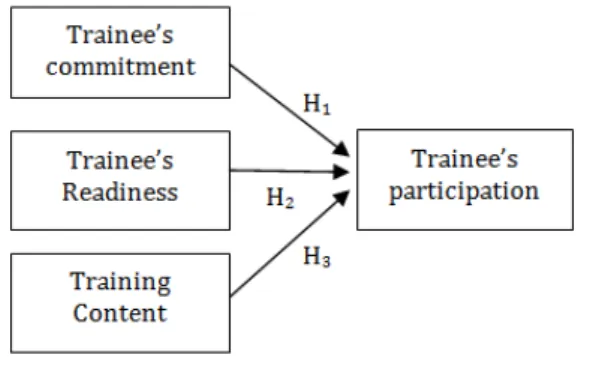
H1: Trainee’s commitment has a significant positive association with trainee’s participation.
Trainee’s Readiness:
motivation are well prepared and have greater learning outcomes due to the basis of their willingness to attend training (Aziz & Ahmad, 2011).
According to Gegenfurtner (2011) on his journal articles, motivation to transfer have been studied extensively over the past 25 years, because it is an important effects towards generation of theories training and training effectiveness and major impact on professional development. The previous statement has been prove by another author from their journal article highlight that motivation to transfer is the trainee’s desire to use and transfer the knowledge and skills that have been learned in training programs to their job.
H2: Trainee’s Readiness has a significant positive association with trainee’s participation.
Training Content:
According to Aziz and Ahmad (2011), distributive justice on training program refers to the fairness in terms of treatment towards participants and it also includes of giving an accurate information to the trainee regarding program their attended and unbiased when conducting training. Fair treatment also defines as concerning on trainee’s feelings, giving a consistent rules for trainees without any differentiate between one and another, and most important point is basis on prevailing ethical and moral standards in conducting training program. Other perceptions came out about training content in an ‘Ethical Development and Human Resources Training An Integrating Framework’ journal which is training program should not be designed and implemented as sessions but designed as systems since organizational ethics and HR systems in generally sharing a natural strong relationship, but there is a lack of research attention in this area. This is because, as we know the linking between ethical development and HR systems are interrelated but people are very little in knowledge in terms of efficacy of specific ethics training programs in order to provide effective training program.
Bhatti and Kaur (2009) suggested that training design, content and instructional strategies must be related to the objective of transfer, for to ensure the learning transfer to be realized whether the transfer is near or far. In order to design and delivery of training, time is the critical resource because needs identified in the training needs analysis will not be resolved, training investment will be waste, and training goals will not be achieved if the training is not long enough to permit delivery of training.
H3: Training Content has a significant positive association with trainee’s participation.
All the hypotheses derived earlier are illustrated in a research framework as per Figure 1.
Fig. 1: Research Framework
Methodology:
For this research study the researcher chose quantitative method for conducting research on trainee’s participation in an engineering services company. Descriptive (frequency analysis) study are undertaken to describe the characteristics of trainees (age, gender, department, year of employment, etc.). The research design also seeks answer of whom, where, when, and how questions that enables researcher to explain what is the factors that contribute to the variables that affect the different aspects in workplace environment. The population for this study is participants for external courses training programs in an engineering services company which consist of 31 branches offices around the world with more than 18,000 staff worldwide. However, the population that researcher interest to investigate only in one of its Kuala Lumpur branch and the population are 764 employees.
department who has attended external training program previously. In this research, the researcher used structured questionnaire that were given to the sample of population. The question is structured, meaning some standardization is imposed on the data collection. All respondent will received the same set of questionnaires. The researcher had used interval scale which also known as likert scale questions for section 2A until 2D. The range form 1 = ‘Strongly Disagree’ until to 5 = ‘Strongly Agree’ and another indicator of 1 = ‘Never’ until to 5 = ‘Very Frequent’.
Results:
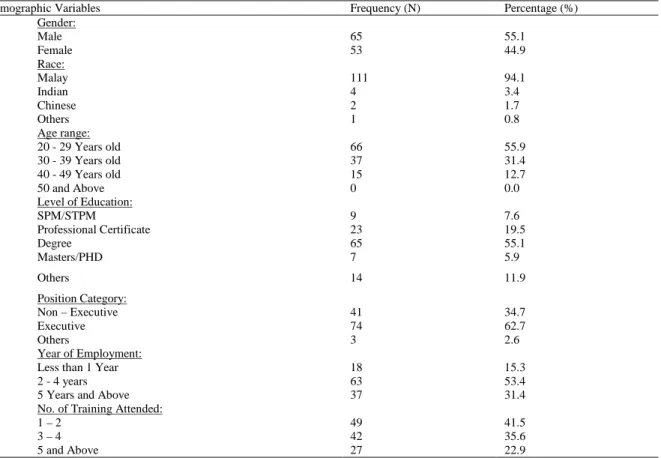
As per Table 1, the majority of the respondents are from male respondents with percentage of 55.1% (N=65) while female respondent’s percentages are 44.9% (N=53). Majority race are came from Malay with 94.1% (N=111) respondents, follow by Indian with 3.4% (N=4) respondents, Chinese with 1.7% (N=2) respondents and the minority number are from others race with 0.8% respondent only (N=1). Most of the respondents are came from 20 until 29 years old with 55.9% (N=66), the lowest are 40-49 years old with 12.7% (N=15), while none of the respondent are from age range of 50 and above. The highest education level of respondents are from degree level with 55.1% (N=65) and the lowest from Master/PHD level with 5.9% (N=7) only. The result indicated that most of the respondents are from degree level of education. The most of respondents are from supports department consists of human resource, finance, information technology, planning, proposal, and procumbent with (N=38) respondents of 32.2% followed by project services department with (N=17) respondents of 14.4% while the lowest respondents are from electrical and others which consist of document controller department with 2 respondents only of 1.7% each. Most of the respondents are from executive category with 62.7% (N=74) of respondents while 34.7% (N=41) of respondents from non – executive category, while the rest of 2.5% (N=3) of respondents are from others category but under engineering field.
Table 1: Demographic Profile of Respondents
Demographic Variables Frequency (N) Percentage (%)
Gender:
Male 65 55.1
Female 53 44.9
Race:
Malay 111 94.1
Indian 4 3.4
Chinese 2 1.7
Others 1 0.8
Age range:
20 - 29 Years old 66 55.9
30 - 39 Years old 37 31.4
40 - 49 Years old 15 12.7
50 and Above 0 0.0
Level of Education:
SPM/STPM 9 7.6
Professional Certificate 23 19.5
Degree 65 55.1
Masters/PHD 7 5.9
Others 14 11.9
Position Category:
Non – Executive 41 34.7
Executive 74 62.7
Others 3 2.6
Year of Employment:
Less than 1 Year 18 15.3
2 - 4 years 63 53.4
5 Years and Above 37 31.4
No. of Training Attended:
1 – 2 49 41.5
3 – 4 42 35.6
5 and Above 27 22.9
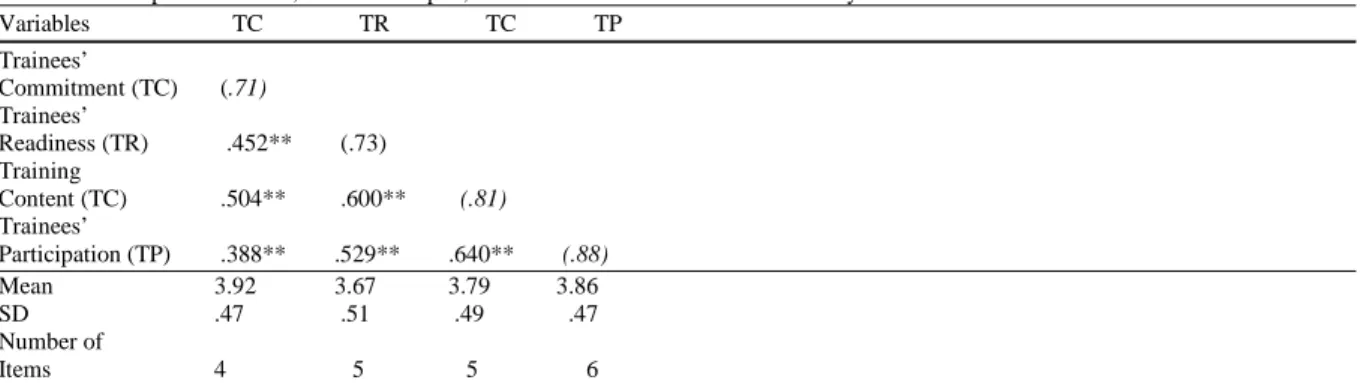
Table 2: Descriptive Statistics, Cronbach Alpha, and Zero-order Correlation of All Study Variables Variables TC TR TC TP
Trainees’
Commitment (TC) (.71) Trainees’
Readiness (TR) .452** (.73) Training
Content (TC) .504** .600** (.81) Trainees’
Participation (TP) .388** .529** .640** (.88)
Mean 3.92 3.67 3.79 3.86
SD .47 .51 .49 .47
Number of
Items 4 5 5 6
Note: ** Correlation is significant at the 0.01 level (2-tailed); Entries in parenthesis indicate Conbrach Alpha values.
The Table 2 shows the Pearson Correlation Analysis finding for association between independent variables and dependent variable for this research study. The first independent variable which is trainee’s commitment indicated that r = 0.388 while p = 0.000. The result shows that there is positive significant and moderate association between trainee’s commitments with trainee’s participation towards training program.
The second independent variable which is trainee’s readiness indicated that r = 0.529 while p = 0.000. The result shows that there is positive significant and strong association between trainee’s readiness with trainee’s participation towards training program. The last independent variable which is training content indicated that r = 0.640 while p = 0.000. The result shows that there is positive significant and strong association between training content with trainee’s participation towards training program.
Discussion:
The purposed of conducting this research study to identify whether three variables had been proposed are significant with each other or not. Based on the research finding using SPSS software, it can be concluded that there are positive association between independent variables and dependent variable which are trainee’s commitment, trainee’s readiness, and training content leads to trainee’s participation towards training program at an engineering services company. However, based on the finding only 44.3% independent variables can be explained the causes of dependent variables while remaining 55.7% may come from other factors such as training facilities, training environment, or organization on-going plan for trainees.
Trainee’s commitment is one of important aspect to determine whether number of participants increase or decrease because without the motivation, support and on-going planned by the organization might decrease the number of trainee’s participation. The lowest relationship between three variables which is trainee’s commitment and trainee’s participation can be explained due to participants’ lack of support from their superior or peers when attended training program. In addition, result indicated that organization has no clear on-going plan to build trainee’s commitment even though the respondents not stated clearly neither agree nor disagree about the statement.
The second independent variables of trainee’s readiness are also important in order to increase number of participants when attended training because trainees need to well-prepared before and during attended training program, as can be seen in the result of questionnaire collected which is most of the respondents admitted that they not voluntarily participated and do not study in advance regarding training module or trainer’s profile. This indicated that positively relation between dependent variable and independent variable. Based on the finding, the most affecting variable is training content. It means that most of the respondents agreed that training content are affected their participation towards training program. The relevancy of training content while meeting training requirement will increase the number of participants. The revised theoretical framework below indicated the finding after research had conducted.
Conclusions:
REFERENCES
Aziz, A.S.F. and S. Ahmad, 2011. Stimulating Training Motivation using the Right Training Characteristic.
Emerald, pp: 53-61.
Bhatti, M.A. and S. Kaur, 2009. The Role of Individual and Training Design on Training Transfer.
Emerald, pp: 656-672.
Cheung, C.K. and N.P. Ngai, 2009. Training to Raise Unemployed Youth's Work Committment in Tianjin.
Elsevier, pp: 298-305.
Fox, J.L., S. Code, R. Gray and K.L. Smith, 2002. Supporting Employee Partcipation: Attitudes and Perceptions in Trainees, Employees and Teams. Sage Publication, pp: 52-82.
Gegenfurtner, A., 2011. Motivation and Transfer in Profeessional Training: A meta-Analysis of the Moderation Effects of Knowledge Type, Instruction, and Assessment Conditions. Education Research Review, pp: 154-168.
Ghosh, P., R. Satyawadi, J.P. Joshi, R. Ranjan and P. Singh, 2012. Towards more Effective Training Programmes: a Atudy of Trainer Attributes. Emerald Group, pp: 194-202.
Kantola, J., A. Piirto, J. Toivonen, Y. Chang and H. Vanharanta, 2011. Target Training with Soft Computing Tools. Journal of Computational Science, pp: 207-215.
Keramati, A., M.A. Mofrad and A. Kamrani, 2011. The Role of Readiness Factors in E-learining outcomes: An Empirical Study. Science Direct, pp: 1919-1929.
Omar, M.K., S.N.A. Dahlan, A. Zakaria and B.A. Mohamed, 2013. The potential impact of HRM practices towards employee job satisfaction – A study of government hospital in Malaysia. Handbook on the Economic,
Finance and Management Outlooks, 867-872. Retrieved from
http://www.pakinsight.com/ebooks/ICEFMO-147-%20867-872.pdf
Peeters, M., K.V. Bosch, J.J. Ch. Meyer and M.A. Neerincx, 2013. The Design and effect of Automated Directions During Scenario-Based. Elsevier, pp: 173-183.
Schuler, R.S., S.E. Jackson and I. Tarique, 2010. Global Talent Management and Global Talent Challenges: Strategic Opportunities for IHRM. Elsevier, pp: 506-516.
Sekaran, U. and R. Bougie, 2009. Research Methods for Business: A Skill-Building Approach (6th ed.). United Kingdom: TJ International Ltd, Padstow, Cornwall.