Ocean Acidification:
The Other CO
2
Problem
Scott C. Doney,
1Victoria J. Fabry,
2Richard A. Feely,
3and Joan A. Kleypas
41Marine Chemistry and Geochemistry, Woods Hole Oceanographic Institution, Woods Hole,
Massachusetts 02543; email: [email protected]
2Department of Biological Sciences, California State University, San Marcos, California 92096;
email: [email protected]
3Pacific Marine Environmental Laboratory, National Oceanic and Atmospheric Administration,
Seattle, Washington 98115; email: [email protected]
4Institute for the Study of Society and Environment, National Center for Atmospheric
Research, Boulder, Colorado 80307; email: [email protected]
Annu. Rev. Mar. Sci. 2009. 1:169–92
First published online as a Review in Advance on August 29, 2008
TheAnnual Review of Marine Scienceis online at
marine.annualreviews.org This article’s doi:
10.1146/annurev.marine.010908.163834 Copyright c2009 by Annual Reviews. All rights reserved
1941-1405/09/0115-0169$20.00
Key Words
biogeochemistry, calcification, carbon dioxide, climate change, coral, ecosystem
Abstract
Rising atmospheric carbon dioxide (CO2), primarily from human fossil fuel
combustion, reduces ocean pH and causes wholesale shifts in seawater car-bonate chemistry. The process of ocean acidification is well documented in
field data, and the rate will accelerate over this century unless future CO2
emissions are curbed dramatically. Acidification alters seawater chemical spe-ciation and biogeochemical cycles of many elements and compounds. One well-known effect is the lowering of calcium carbonate saturation states, which impacts shell-forming marine organisms from plankton to benthic molluscs, echinoderms, and corals. Many calcifying species exhibit reduced
calcification and growth rates in laboratory experiments under high-CO2
conditions. Ocean acidification also causes an increase in carbon fixation rates in some photosynthetic organisms (both calcifying and noncalcifying).
The potential for marine organisms to adapt to increasing CO2and broader
implications for ocean ecosystems are not well known; both are high priori-ties for future research. Although ocean pH has varied in the geological past, paleo-events may be only imperfect analogs to current conditions.
Annu. Rev. Mar. Sci. 2009.1:169-192. Downloaded from www.annualreviews.org
Access provided by 71.195.196.201 on 03/07/16. For personal use only.
Click here for quick links to Annual Reviews content online, including:
• Other articles in this volume • Top cited articles • Top downloaded articles • Our comprehensive search
Further
ppmv: parts per million by volume
pH: a measure of
ocean acidity and
hydrogen ion H+
concentration;
pH= −log10[H+]
Ocean acidification: the addition of carbon dioxide in seawater that causes a reduction in ocean pH and shifts in carbonate speciation
HOT: Hawaii Ocean
Time-Series
pCO2: carbon dioxide
partial pressure Dissolved inorganic carbon (DIC): sum of
aqueous CO2gas,
carbonic acid, bicarbonate, and carbonate ions Saturation state: thermodynamic condition of seawater that describes the degree of supersaturation or undersaturation with respect to the particular phase of the
CaCO3mineral
Geochemical Sections (GEOSECS): a global-scale 1970s chemical
oceanography survey Calcite: a mineral form of calcium carbonate found in many marine plankton and invertebrates that is less soluble than high-magnesium calcite, which is found in some marine taxa such as echinoderms and coralline algae
INTRODUCTION
Over the past 250 years, atmospheric carbon dioxide (CO2) levels increased by nearly 40%, from
preindustrial levels of approximately 280 ppmv (parts per million volume) to nearly 384 ppmv in 2007 (Solomon et al. 2007). This rate of increase, driven by human fossil fuel combustion and deforestation, is at least an order of magnitude faster than has occurred for millions of years (Doney & Schimel 2007), and the current concentration is higher than experienced on Earth for at least
the past 800,000 years (L ¨uthi et al. 2008). Rising atmospheric CO2is tempered by oceanic uptake,
which accounts for nearly a third of anthropogenic carbon added to the atmosphere (Sabine &
Feely 2007, Sabine et al. 2004), and without which atmospheric CO2would be approximately 450
ppmv today, a level of CO2that would have led to even greater climate change than witnessed
today. Ocean CO2 uptake, however, is not benign; it causes pH reductions and alterations in
fundamental chemical balances that together are commonly referred to as ocean acidification.
Because climate change and ocean acidification are both caused by increasing atmospheric CO2,
acidification is commonly referred to as the “other CO2problem” (Henderson 2006, Turley 2005).
Ocean acidification is a predictable consequence of rising atmospheric CO2and does not suffer
from uncertainties associated with climate change forecasts. Absorption of anthropogenic CO2,
reduced pH, and lower calcium carbonate (CaCO3) saturation in surface waters, where the bulk
of oceanic production occurs, are well verified from models, hydrographic surveys, and time series data (Caldeira & Wickett 2003, 2005; Feely et al. 2004, 2008; Orr et al. 2005; Solomon et al. 2007). At the Hawaii Ocean Time-Series (HOT) station ALOHA the growth rates of surface
water pCO2and atmospheric CO2agree well (Takahashi et al. 2006) (Figure 1), indicating uptake
of anthropogenic CO2as the major cause for long-term increases in dissolved inorganic carbon
(DIC) and decreases in CaCO3saturation state. Correspondingly, since the 1980s average pH
measurements at HOT, the Bermuda Atlantic Series Study, and European Station for Time-Series in the Ocean in the eastern Atlantic have decreased approximately 0.02 units per decade (Solomon et al. 2007). Since preindustrial times, the average ocean surface water pH has fallen by approximately 0.1 units, from approximately 8.21 to 8.10 (Royal Society 2005), and is expected
to decrease a further 0.3–0.4 pH units (Orr et al. 2005) if atmospheric CO2concentrations reach
800 ppmv [the projected end-of-century concentration according to the Intergovernmental Panel on Climate Change (IPCC) business-as-usual emission scenario].
Fossil fuel combustion and agriculture also produce increased atmospheric inputs of
dissocia-tion products of strong acids (HNO3and H2SO4) and bases (NH3) to the coastal and open ocean.
These inputs are particularly important close to major source regions, primarily in the north-ern hemisphere, and cause decreases in surface seawater alkalinity, pH, and DIC (Doney et al. 2007). On a global scale, these anthropogenic inputs (0.8 Tmol/yr reactive sulfur and 2.7 Tmol/yr reactive nitrogen) contribute only a small fraction of the acidification caused by anthropogenic
CO2, but they are more concentrated in coastal waters where the ecosystem responses to ocean
acidification could be more serious for humankind.
Seawater carbon dioxide measurements have been conducted since the beginning of the nine-teenth century (Krogh 1904) but were sparse until the middle of the twentieth century (Keeling et al. 1965, Takahashi 1961) and particularly until the Geochemical Sections (GEOSECS) (1973– 1979) (Craig & Turekian 1976, 1980) and Transient Tracers in the Ocean (TTO) (1981–1983) (Brewer et al. 1985) programs. Even so, the GEOSECS and TTO measurements were significantly less precise than those of today. Although researchers recognized that the concentration of carbon
dioxide in the surface ocean was more or less in equilibrium with overlying atmosphere CO2, they
largely dismissed the potential impact on the ocean biota because calcite (the assumed CaCO3
mineralogy of most calcifying organisms) would remain supersaturated in the surface ocean.
Annu. Rev. Mar. Sci. 2009.1:169-192. Downloaded from www.annualreviews.org
400
375
350
325
300
275
4.50
4.00
3.50
3.00
6.50
6.00
5.50
5.00
1950 1960 1970 1980
Year
1990 2000 2010 2020
Ω
calciteΩ
aragonite
CO
2
a
Mauna Loa CO
2record
b
Aragonite saturation state
c
Calcite
saturation
state
8.38
8.33
8.28
8.23
8.18
8.13
8.08
8.03
pH
GEOSECS
GEOSECS
GEOSECS
y = -0.011x + 27.7 R2 = 0.127, st. err. = 0.0024
y = -0.0069x + 17.43 R2 = 0.097, st. err. = 0.0017 pH y = -0.0019x + 11.815
R2 = 0.2654, st. err. = 0.00025
CO2atmy = 1.74x - 3105.9 R2 = 0.94, st. err. = 0.029
pCO2SW y = 1.86x - 3364
R2 = 0.3104, st. err. = 0.223
160°W 158°W 156°W 23°N
22°
21°
20°
19°
Station Mauna Loa Station ALOHA
Figure 1
Time series of: (a) atmospheric CO2at Mauna Loa (in parts per million volume, ppmv) (red), surface ocean
pH (cyan), and pCO2(μatm) (tan) at Ocean Station ALOHA in the subtropical North Pacific Ocean; and
(b) aragonite saturation (dark blue) and (c) calcite saturation (gray) at Station ALOHA. Note that the increase
in oceanic CO2over the past 17 years is consistent with the atmospheric increase within the statistical limits
of the measurements. Mauna Loa data courtesy of Dr. Pieter Tans, National Oceanic and Atmospheric Administration/Earth System Research Laboratory (http://www.esrl.noaa.gov/gmd/ccgg/trends); Hawaii Ocean Time-Series (HOT)/ALOHA data courtesy of Dr. David Karl, University of Hawaii (http://hahana. soest.hawaii.edu). Geochemical Ocean Section Study (GEOSECS) data are from a station near Station ALOHA collected in 1973; GEOSECS data from Takahashi et al. (1980).
Annu. Rev. Mar. Sci. 2009.1:169-192. Downloaded from www.annualreviews.org
Calcification: a biological process that uses dissolved ions to form calcium carbonate minerals for shells and skeletal components Aragonite: a relatively soluble mineral form of calcium carbonate found in corals, pteropods and other molluscs, and a variety of other invertebrates and algae
Total alkalinity: a conserved thermodynamic measure of seawater acid-base chemistry that is equal to the charge difference between conservative cations and anions
Since then, multiple studies revealed several issues that elevate ocean acidification as a threat
to marine biota: (a) the calcification rates of many shell-forming organisms respond to the degree
of supersaturation (e.g., Smith & Buddemeier 1992, Kleypas et al. 1999); (b) aragonite, a more
soluble CaCO3mineral equally important in calcifying organisms, may become undersaturated in
the surface ocean within the early 21st century (Feely & Chen 1982, Feely et al. 1988, Orr et al.
2005); and (c) the biological effects of decreasing ocean pH reach far beyond limiting calcification.
OCEAN CARBONATE SYSTEM
Seawater carbonate chemistry is governed by a series of chemical reactions:
CO2(atmos)→←CO2(aq)+H2O→←H2CO3←→H++HCO−3 →←2H++CO23−. (1)
Air-sea gas exchange equilibrates surface water CO2to atmospheric levels with a timescale of
approximately one year. Once dissolved in seawater, CO2gas reacts with water to form carbonic
acid (H2CO3), which can then dissociate by losing hydrogen ions to form bicarbonate (HCO3−)
and carbonate (CO32−) ions. The seawater reactions are reversible and near equilibrium (Millero
et al. 2002); for surface seawater with pH of∼8.1, approximately 90% of the inorganic carbon is
bicarbonate ion, 9% is carbonate ion, and only 1% is dissolved CO2. Adding CO2to seawater
in-creases aqueous CO2, bicarbonate, and hydrogen ion concentrations; the latter lowers pH because
pH= –log10[H+]. Carbonate ion concentration declines, however, because of the increasing H+
concentrations. The projected 0.3–0.4 pH drop for the 21st century is equivalent to approximately
a 150% increase in H+and 50% decrease in CO
32−concentrations (Orr et al. 2005).
Over century and longer timescales, the ocean’s ability to absorb atmospheric CO2depends on
the extent of CaCO3dissolution in the water column or sediments:
CaCO3→←CO23−+Ca2+. (2)
The mineral CaCO3derives from shells and skeletons of marine organisms, including plankton,
corals and coralline algae, and many other invertebrates. In pelagic environments, carbonates fall through the water column and are either dissolved or deposited in shallow or deep-sea sediments
(Berelson et al. 2007, Feely et al. 2004). CaCO3formation and dissolution rates vary with saturation
state (), defined as the ion product of calcium and carbonate ion concentrations:
=[Ca2+]CO23−
/Ksp . (3)
The apparent solubility productKsp depends on temperature, salinity, pressure, and the particular
mineral phase; aragonite is approximately 50% more soluble than calcite (Mucci 1983). Because
[Ca2+] is closely proportional to salinity,is largely determined by variations in [CO
32−], which
can be calculated from DIC and total alkalinity data. Shell and skeleton formation generally occurs
where >1.0 and dissolution occurs where <1.0 (unless the shells or skeletons are protected,
for example, by organic coatings).
Saturation states are highest in shallow, warm tropical waters and lowest in cold high-latitude
regions and at depth, which reflects the increase in CaCO3solubility with decreasing temperature
and increasing pressure (Feely et al. 2004) (Figure 2). The aragonite and calcite saturation horizons
( = 1) are shallower in the Indian and Pacific Oceans than in the Atlantic Ocean because of
the longer deep-water circulation pathways and thus accumulation of more DIC from respired
CO2 (Broecker 2003). Anthropogenic CO2 penetration into the ocean is concentrated in the
upper thermocline (Sabine et al. 2004), and over time this has contributed to the shoaling of saturation horizons by 30–200 m from the preindustrial period to the present; evidence of aragonite undersaturation in thermocline waters in the North Pacific and Indian Oceans (Feely et al. 2002,
Annu. Rev. Mar. Sci. 2009.1:169-192. Downloaded from www.annualreviews.org
60°S 50°S 40°S 30°S 20°S 10°S 0° 10°N 20°N 30°N 40°N 50°N 60°N
60°S 50°S 40°S 30°S 20°S 10°S 0° 10°N 20°N 30°N 40°N 50°N
60°S 50°S 40°S 30°S 20°S 10°S 0°
0 10 20 30 40 50 60
10°N 20°N 0
500
1000
1500
2000
2500
3000
Atlantic
Latitude
Anthropogenic CO2 (µmol kg-1) Pacific
Indian
Saturation levels
Pressure (db
)
Pressure (db
)
Pressure (db
)
0
500
1000
1500
2000
2500
3000
0
500
1000
1500
2000
2500
3000
Present aragonite Preindustrial aragonite Present calcite Preindustrial calcite
Figure 2
Vertical distributions of anthropogenic CO2concentrations inμmol kg−1and the saturation state =1.0
horizons for aragonite (red) and calcite (white) for present (solid line) and preindustrial (dashed line) conditions
along north-south transects in the (a) Atlantic, (b) Pacific, and (c) Indian Oceans as in Feely et al. (2004).
Adapted with permission from AAAS.
Annu. Rev. Mar. Sci. 2009.1:169-192. Downloaded from www.annualreviews.org
Sabine et al. 2002); seasonal upwelling of seawater corrosive to aragonite (arag<1.0) onto the
western continental shelf of North America, approximately 40 years earlier than predicted by models (Feely et al. 2008); and an increase in areal extent of shallow undersaturated regions in the eastern tropical Atlantic (Chung et al. 2003, 2004).
BIOLOGICAL RESPONSES TO ACIDIFICATION
Early studies investigated responses of calcifying organisms to altered seawater carbonate chem-istry (Agegian 1985, Borowitzka 1981, Fabry 1990, Smith & Roth 1979), but usually for reasons
unrelated to anthropogenic CO2. Several ground-breaking studies, specifically designed to test
atmospheric CO2impacts, revealed potentially dramatic responses in corals (Gattuso et al. 1998,
Langdon et al. 2000, Marubini & Atkinson 1999, Marubini & Davies 1996), coral reef commu-nities (Langdon et al. 2000, 2003; Leclercq et al. 2000), and planktonic organisms (Bijma 1991, Riebesell et al. 2000). Numerous other studies mostly verified these results but also revealed the complicated nature of calcification responses, for example to Mg/Ca ratios (Ries 2005, Ries et al.
2006, Stanley et al. 2005) or CO2in combination with changing temperature (Reynaud et al. 2003)
or nutrients (Langdon & Atkinson 2005, Sciandra et al. 2003).
Calcifying organisms exert a variable degree of control over biomineralization, which generally involves passive and active ion movement in and out of a calcification compartment isolated from ambient seawater (Weiner & Dove 2003). Reduced calcification rates are observed following
acidification for a variety of calcareous organisms even when aragonite or calcite >1.0 (Royal
Society 2005, Kleypas et al. 2006, Fabry et al. 2008). The degree of sensitivity varies among species,
however, and some taxa may show enhanced calcification at CO2levels projected to occur over
the 21st century (Iglesias-Rodr´ıguez et al. 2008, Ries et al. 2008). However, calcification-CO2
response studies exist for a limited number of species in many calcifying groups, and we currently lack sufficient understanding of calcification mechanisms to explain species-specific differences observed in manipulative experiments.
Thus far, most of the elevated CO2response studies on marine biota, whether for calcification,
photosynthesis, or some other physiological measure, have been short-term experiments that range
from hours to weeks. Chronic exposure to increased pCO2may have complex effects on the growth
and reproductive success of calcareous plankton and could induce possible adaptations that are not observed in short-term experiments. Nevertheless, such laboratory experiments enable testing of single or multiple environmental variables in highly controlled settings and are critically needed to identify species’ preadapted sensitivities to increasing CO2.
Shallow-Water Tropical Corals and Coral Reefs
Scleractinian (stony) corals evolved in the Triassic period more than 200 million years ago (Mya),
and their ability to produce large quantities of CaCO3 has undoubtedly contributed to their
evolutionary success (Wood 2001). Scleractinian corals are an important group of hypercalcifiers,
organisms with the capacity to produce massive quantities of CaCO3but in which calcification
rates vary under different environmental conditions (Stanley & Hardie 1998).
A dramatic example is the work by Fine & Tchernov (2007) in which two species of corals
grown in highly acidified water completely lost their skeletons (Figure 3), then regrew them after
being returned to seawater of normal pH. The study highlights three points: (a) coral calcification
rates can vary greatly in response to changes in pH and aragonite saturation state, (b) the naked,
anemone-like coral polyps remained healthy, but (c) the fitness of organisms overall would change
because of the loss of the protective skeleton. These results also support the paleontologically
Annu. Rev. Mar. Sci. 2009.1:169-192. Downloaded from www.annualreviews.org
Ma: millions of years
a
b
2 mm 2 mm
Figure 3
Photos of scleractinian coralOculina patagonicaafter being maintained for 12 months in (a) normal seawater
(pH= 8.2) and (b) acidified seawater (pH =7.4). From Fine & Tchernov (2007). Reprinted with
permission from AAAS.
sudden appearance of scleractinian corals some 14 million years (Ma) after the Permian extinction event; that is, corals may have continued to exist as “naked corals” until ocean chemistry became favorable for skeletal formation (Stanley & Fautin 2001).
Many laboratory studies on a variety of coral species, indeed almost every study published to
date (Figure 4), confirm that coral calcification rates decrease in response to decreasing aragonite
saturation state. Analyses of cores from massive coral colonies of the Great Barrier Reef show that calcification rates declined 21% between 1988 and 2003, although this decrease exceeds that expected from lowered saturation state alone and probably reflects the composite effects of a suite of changing environmental conditions (e.g., saturation state, temperature, nutrients) (Cooper et al. 2008).
Annu. Rev. Mar. Sci. 2009.1:169-192. Downloaded from www.annualreviews.org
Species studied
Response to increasing CO2
a
b
c
d
Calcification Photosynthesis2 Nitrogen Fixation Reproduction Major group Coccolithophores1 Planktonic Foraminifera Molluscs Echinoderms1 Tropical corals
Coralline red algae
Coccolithophores3 Prokaryotes Seagrasses Cyanobacteria Molluscs Echinoderms Physiological response 4 2 4 3 11 1 2 2 4 2 11 1 1 – – 1 – – 1 – – – – – 1 – – – – –
bility, light, and temperature; 3) Under nutrient replete conditions.
2 2 5 – – – 2 – – 2 1 – – – – 1 4 1 – 4 1 1 – – – – – – – – Figure 4
Representative examples of impacts of ocean acidification on major groups of marine biota derived from experimental manipulation studies. The response curves on the right indicate four cases: (a) linear negative,
(b) linear positive, (c) level, and (d) nonlinear parabolic responses to increasing levels of seawater pCO2for
each of the groups. Note that in some cases strains of the same species exhibited different behavior in different experiments (cf. Fabry et al. 2008; Guinotte & Fabry 2008).
Many other benthic calcifying taxa are also both biogeochemically and ecologically important, including calcifying green algae and coralline red algae in particular. The contribution of calcifying
green algae in the genusHalimedato the global net CaCO3production may rival that of coral
reefs (Milliman & Droxler 1996, Rees et al. 2007). Coralline red algae are widespread, globally significant, but often overlooked benthic marine calcifiers (Foster 2001). A recent study on a common crustose coralline alga in Hawaii showed that both calcification rates and recruitment rates decline at lower carbonate saturation state (Kuffner et al. 2008), but relatively few studies have been conducted on either green or red algae.
Field measurements of reef calcification at the community scale (Bates 2002, Broecker & Takahashi 1966, Gattuso et al. 1995, Kawahata et al. 1999, Kayanne et al. 2005) consistently show that calcification rates are correlated with changes in a variety of components of the carbonate
system in seawater (alkalinity, pCO2, saturation state). A recent study suggests that inorganic
precipitation of calcium carbonate cements, an important binding component in coral reefs, is
Annu. Rev. Mar. Sci. 2009.1:169-192. Downloaded from www.annualreviews.org
correlated with saturation state and that the abundance of such cements may increase reef resistance to erosion (Manzello et al. 2008).
Coral reef ecosystems are defined by their ability to produce a net surplus of CaCO3that
pro-duces the reef structure (Kleypas et al. 2001). Reef structures typically span only 10–30 m in depth, but are structurally complex and support high marine biodiversity. During the repeated glacial to interglacial sea level transgressions from 3 Mya to the present, reef ecosystems thrived because their rapid accretion rates migrated the coral community upward and maintained the community within the minimum light levels for continued growth. Under increasing ocean acidification, not only will coral community calcification decrease, but also dissolution rates will increase (Langdon et al. 2000, Yates & Halley 2006), particularly for those reefs that are already near the limit for reef growth (e.g., higher latitude reefs). Interestingly, even though global warming may allow corals to
migrate to higher latitudes (Precht & Aronson 2004), the decrease in reef CaCO3production may
restrict reef development to lower latitudes where aragonite saturation levels can support calcium carbonate accumulation (Guinotte et al. 2003, Kleypas et al. 2001).
Deep-Water Corals and Carbonate Mounds
Deep-water scleractinian corals thrive in the subphotic waters of continental slopes, usually in depths of 200–1000 m. They are slow growing and often long lived, up to 1500 years old, and form habitat that supports high biodiversity and fisheries. The maximum depth of these commu-nities, particularly of the aragonitic scleractinian corals, appears to coincide with the depth of the
aragonite saturation horizon (Guinotte et al. 2006), which reaches an average depth of>2000 m
in the North Atlantic, but can be as shallow as 200 m in the North Pacific Ocean (Figure 2).
As in the case of their tropical counterparts, deep-water corals can produce large mounds of cal-cium carbonate, albeit much more slowly (Roberts et al. 2006). In contrast to the equatorward contraction of tropical coral reefs, it is the depth distribution of deep-water coral communities that will contract; the deepest communities will be the first to experience a shift from saturated to
undersaturated conditions (Figure 2).
Other Benthic Invertebrates
Calcareous skeletal hard parts are widespread among benthic invertebrate phyla, yet apart from
corals, few studies have investigated the effects of climate-relevant CO2increases on
calcifica-tion in these fauna. Gazeau and coworkers (2007) reported that calcificacalcifica-tion rates in the mussel
Mytilus edulisand the Pacific oysterCrassostrea gigasdecreased by 25% and 10%, respectively,
when grown at∼740 ppmv CO2. Similarly, reduced shell growth was observed in the gastropod
Strombus luhuanusand two sea urchin species when grown at 560 ppmv CO2over a 6-month
period (Shirayama & Thorton 2005). Moreover, mussels, sea urchins (Michaelidis et al. 2005,
Miles et al. 2007), and to a much lesser extent the crabNecora puber(Spicer et al. 2007) are
sensi-tive to internal acidification of body fluids and use shell dissolution to compensate. Calcification in the arms of a burrowing brittle star increased when organisms were grown in low pH water
(Wood et al. 2008;Figure 4, case b). However, decreased muscle mass in arms was also observed,
which would reduce arm movement and likely decrease respiration and feeding. Thus, the en-hanced calcification observed in short-term experiments would probably not be sustainable in the long-term.
The response of early developmental stages of benthic invertebrates to CO2-induced
acidifi-cation of seawater has been investigated in bivalves and sea urchins. Kurihara & Shirayama (2004) reported reduced fertilization success, developmental rates, larval size, and spicule skeletogenesis
Annu. Rev. Mar. Sci. 2009.1:169-192. Downloaded from www.annualreviews.org
microatmosphere (μatm): a measure of
seawater pCO2;
1μatm =10−6atm
with increasing CO2in the sea urchinsHemicentrotus pulcherrimumandEchinodetra mathei.When
gametes of the oysterC. gigaswere exposed to 2268μatm pCO2, no differences in rates of
fer-tilization or embryo development were observed, relative to the control group, until 24 h after
fertilization, when more than 80% of the D-shaped larvae grown in high-CO2seawater displayed
malformed shells or remained unmineralized (Kurihara et al. 2007).
Planktonic Calcification
The major calcareous plankton groups are calcite-forming coccolithophores and foraminifera and aragonite-forming euthecosomatous pteropods. Most planktonic studies have focused on coc-colithophores, although to date these studies have covered only four of approximately 250 to 500 living coccolithophore species (Young et al. 2005) and revealed nonuniform calcification
re-sponse to high-CO2/low-pH seawater (Figure 4). Many laboratory and mesocosm studies with
the bloom-forming coccolithophore species ofEmiliania huxleyiandGephyrocapsa oceanicareported
decreased calcification (Figure 4, case a) that ranged from –25% to –66% when pCO2was
in-creased to 560–840μatm (Riebesell et al. 2000; Zondervan et al. 2001, 2002; Sciandra et al. 2003;
Delille et al. 2005; Engel et al. 2005).
Recently, Iglesias-Rodr´ıguez and colleagues (2008) found a doubling of cell-specific
calcifica-tion rates for laboratoryE. huxleyicultures grown at 750μatm versus 300μatm pCO2(Figure 4,
case b). Overall size increased under high-CO2conditions, as did size and mass of individual calcitic
coccoliths that surround the cell surface. However, at the same time, significantly reduced growth
rates at elevated pCO2suggest that thisE. huxleyistrain would be more at risk of outcompetition
by other phytoplankton species under future high-CO2conditions.
Similarly, Langer and coworkers (2006) found differing responses to elevated pCO2for two
other coccolithophore species, both important in calcite export to sediments. The coccolithophore
Coccolithus pelagicusexhibited no significant change in calcification for CO2varying from 150 to
915μatm (Figure 4, case c). Calcification rates decreased and coccolith malformations increased
forCalcidiscus leptoporuscultures in response to pCO2levels both above and below present-day
values (Figure 4, case d). In contrast, examination of Atlantic Ocean sediments from the Last
Glacial Maximum (LGM), when surface water pCO2 was approximately 200 μatm, revealed
no malformed coccoliths inC. leptoporus, suggesting that this species was adapted to low CO2
during the LGM and has subsequently adjusted to elevated modern CO2. Such resiliency is
consistent with the findings of Iglesias-Rodr´ıguez and colleagues (2008), who examined a high-resolution sediment core and observed a distinct increase in the average coccolith mass,
domi-nated byC. leptoporousandC. pelagicus, from 1960 to 2000 that follows the rise in atmospheric
CO2.
In laboratory experiments with two species of symbiont-bearing, planktonic foraminifera, shell mass decreased as carbonate ion concentration decreased (Spero et al. 1997; Bijma et al. 1999,
2002). When grown in seawater chemistry equivalent to 560 and 740 ppmv CO2, the shell mass
of foraminifersOrbulina universaandGlobigerinoides sacculiferdeclined by 4–8% and 6–14%,
re-spectively, compared with preindustrial CO2controls.
Data from a single species of euthesomatous pteropod (Clio pyramidata) indicate net shell
dissolution occurs in live pteropods when the saturation state of seawater with respect to aragonite
is forced to <1.0 (Orr et al. 2005, Fabry et al. 2008). Even though the animals were actively
swimming, shell dissolution occurs within 48 hours when live pteropods, collected in the subarctic Pacific, are exposed to aragonite undersaturation levels similar to those projected for Southern Ocean surface waters by year 2100.
Annu. Rev. Mar. Sci. 2009.1:169-192. Downloaded from www.annualreviews.org
Primary Production and Nitrogen Fixation
Carbon-concentrating mechanisms enable most marine phytoplankton species to accumulate
in-tracellular inorganic carbon either as CO2or HCO3−or both (Giordano et al. 2005). Largely
be-cause of these mechanisms, most marine phytoplankton tested in single-species laboratory studies and field population experiments show little or no change in photosynthetic rates when grown
under high pCO2conditions equivalent to∼760μatm (Tortell et al. 1997, Hein & Sand-Jensen
1997, Burkhardt et al. 2001, Tortell & Morell 2002, Rost et al. 2003, Beardall & Raven 2004, Giordano et al. 2005, Martin & Tortell 2006). In contrast, the widely distributed coccolithophore
E. huxleyihas low affinity for inorganic carbon and could be carbon limited in the modern ocean
(Rost & Riebesell 2004). WhetherE. huxleyiwill show increased rates of photosynthesis with
pro-gressive oceanic uptake of atmospheric CO2may depend on nutrient and trace metal availability,
light conditions, and temperature (Zondervan 2007).
In a recent mesocosm CO2manipulation study with a phytoplankton community dominated
by diatoms and coccolithophores, Riebesell and coworkers (2007) reported 27% and 39% higher
CO2uptake in experimental pCO2treatments of 700 and 1050μatm, respectively, relative to the
350μatm pCO2treatment. Direct extrapolation of such experimental results to large-scale ocean
regions may be problematic, however. The global warming that accompanies ocean acidification increases thermal stratification of the upper ocean, thereby reducing the upwelling of nutrients, and has been linked to observed decreases in phytoplankton biomass and productivity on a global basis (Behrenfeld et al. 2006).
Fu and coworkers (2007) explored in culture the physiological responses of two key marine
photosynthetic cyanobacteria to warmer, more CO2-rich conditions. They observed only minimal
changes forProchlorococcus, whereas forSynechococcusthey measured greatly elevated photosynthesis
rates and a 20% increase in cellular C:P and N:P ratios. The CO2and temperature responses were
synergistic; that is, the change in photosynthesis for warm, high-CO2conditions was much greater
than the sum of the responses to either factor individually.
Although seagrasses are able to utilize HCO3−, most species do so inefficiently. In all species
tested to date, light-saturated photosynthetic rates increase dramatically with increased dissolved CO2(aq) concentration (Zimmerman et al. 1997, Short & Neckles 1999, Invers et al. 2001). In
experiments with the eelgrassZostera marina, Palacios & Zimmerman (2007) reported an increase
in biomass and reproductive output under high-CO2conditions, suggesting potentially higher
productivity of seagrasses that form a critical habitat for many fish and invertebrate species. The
benefits from CO2-enriched seawater, however, may be offset by the negative effects of increased
temperature on vegetative growth (Ehlers et al. 2008).
Nitrogen-fixing cyanobacteria in the genusTrichodesmium, which support a large fraction of
primary productivity in low nutrient areas of the world’s oceans, show increased rates of carbon and
nitrogen fixation and increased C/N ratios under elevated pCO2(Hutchins et al. 2007, Barcelos
e Ramos et al. 2007). At CO2levels of 750 ppmv,TrichodesmiumCO2fixation rates increased by
15–128% and N2fixation rates increased by 35–100% relative to the rates in present day CO2
conditions (Hutchins et al. 2007).
ECOLOGICAL AND BIOGEOCHEMICAL IMPACTS
Food Webs and Ecosystems
The limited number of studies conducted at climate-relevant CO2levels hampers predictions
of the impacts of ocean acidification on marine ecosystems (Fabry et al. 2008). Nevertheless,
many CaCO3-secreting organisms clearly exhibit reduced calcification with elevated CO2 and
Annu. Rev. Mar. Sci. 2009.1:169-192. Downloaded from www.annualreviews.org
decreasing pH and CO32−. Assuming calcified structures provide protection from predators and/or
other benefits to the organism, these calcifiers will either need to adapt to the changing seawater chemistry, shift their distributions to more carbonate ion–rich regions, or be adversely impacted. In an intriguing field study, Hall-Spencer et al. (2008) quantify dramatic shifts in the nearshore
benthic community in the vicinity of natural subsurface volcanic CO2 vents. Consistent with
expectations from laboratory studies, the regions near the vents under high-CO2, low-pH water
were marked by the absence of scleractinian corals and reduced abundances in sea urchins, coralline algae, and gastropds. The vent areas were dominated instead by seagrasses with an increased frequency of non-native, invasive species.
One clear threshold that will affect marine organisms is when surface waters become undersat-urated with respect to their shell mineralogy. Surface waters of high latitude regions, for example, are projected to become undersaturated with respect to aragonite as early as 2050 (Orr et al. 2005), and the progressive shoaling of the aragonite saturation horizon will likely limit aragonitic organ-isms and change food web dynamics. Euthecosomatous pteropods are important components of polar and subpolar regions, where their densities can reach upward of thousands of individuals per cubic meter (Bathmann et al. 1991, Pane et al. 2004), and they are prey for a variety of zoo-plankton and fish predators. In the North Pacific, pteropods can be important prey of juvenile
pink salmon, accounting in some years for>60% by weight of their diet (Armstrong et al. 2005).
If pteropods cannot adapt to living continuously in seawater that is undersaturated with respect to aragonite, their ranges will contract to shallower depths and lower latitudes. Detection of such acidification-driven population shifts will be difficult because of a lack of baseline data on their current distributions and abundances.
More subtle ecological effects are also likely to occur, but are less predictable and will be more difficult to detect. For one, the calcification thresholds of many organisms do not coincide with
the chemical threshold where saturation state = 1, but instead can occur at both higher and
lower values. Many reef-building corals, for example, appear to cease calcification at aragonite
saturation as high as 2.0. A slowdown in calcification for any organism may (a) reduce its ability
to compete with noncalcifying organisms, as observed when crustose coralline algae were exposed
to high-CO2conditions (Kuffner et al. 2008); (b) reduce the age at sexual maturity; (c) change
its buoyancy; or (d) change light behavior in the water column (Tyrrell et al. 1999). Given that
many taxa exhibit species-specific effects (Fabry 2008, Ries et al. 2008), each of these changes is likely to affect community dynamics in complicated ways, similar to the projected effects of temperature increases on terrestrial communities. Even small variations in species’ responses will become amplified over successive generations and could drive major reorganizations of planktonic and benthic ecosystems. In the North Sea, one study has provided an interesting link between decreasing ocean pH and increasing jellyfish frequency since 1970 (Attrill et al. 2007).
However, ocean acidification is not occurring in isolation; it is one of many stressors related to climate change and other factors. The already difficult challenge of predicting the ecological effects of ocean acidification is magnified by these simultaneous changes, especially because the pace of the changes is unprecedented except for the most abrupt catastrophic events in Earth’s history (e.g., the bolide impact that caused the Cretaceous-Tertiary extinction).
Oceanic CaCO3Budget
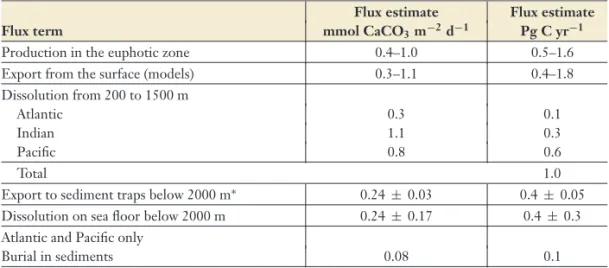
Despite the increasing evidence that calcification in many organisms will decline in the face of
in-creased CO2levels (Figure 4), the impact on the global CaCO3budget remains poorly constrained.
Estimates of carbonate production in the water column have large uncertainties that range from
0.6–1.6 ± 0.3 Pg C yr−1based on satellite- and sediment-trap-derived estimates of carbonate
Annu. Rev. Mar. Sci. 2009.1:169-192. Downloaded from www.annualreviews.org
Table 1 Summary of CaCO3flux estimates for the ocean updated from Berelson et al. (2007) Flux estimate Flux estimate
Flux term mmol CaCO3m−2d−1 Pg C yr−1
Production in the euphotic zone 0.4–1.0 0.5–1.6
Export from the surface (models) 0.3–1.1 0.4–1.8
Dissolution from 200 to 1500 m
Atlantic 0.3 0.1
Indian 1.1 0.3
Pacific 0.8 0.6
Total 1.0
Export to sediment traps below 2000 m∗ 0.24± 0.03 0.4±0.05
Dissolution on sea floor below 2000 m 0.24± 0.17 0.4±0.3
Atlantic and Pacific only
Burial in sediments 0.08 0.1
∗Data from Honjo et al. (2008).
Anthropogenic carbon dioxide: excess carbon dioxide added to ocean and atmosphere from human fossil fuel combustion and deforestation
production (Balch et al. 2007, Milliman 1993) (Table 1) to 0.4–1.8 Pg C yr−1based on models
of carbonate export (Moore et al. 2004, Murnane et al. 1999). Production rates estimated from
seasonal surface-ocean alkalinity changes yield a minimum estimate of 1.4± 0.3 Pg C yr−1(Lee
2001), which is consistent with the higher estimates. On the dissolution side, the estimates range
from 0.5–1.0 Pg C yr−1based on sediment trap studies (Honjo et al. 2008), alkalinity gradients and
water mass ages (Berelson et al. 2007, Feely et al. 2004, Sarmiento et al. 2002), and models (Gehlen et al. 2007). Carbonate burial in deep marine sediments is estimated to be 0.1 Pg C yr−1(Table 1).
Because ocean acidification is expected to decrease CaCO3saturation states (Figure 1bandc)
and increase dissolution rates, ocean alkalinity and the ocean’s capacity to take up more CO2from
the atmosphere will presumably increase. If all carbonate production were shut down by ocean
acidification, the atmospheric CO2would decline by approximately 10–20 ppmv (Gruber et al.
2004). In the near-term this may be observed first in coastal regions where coral reef calcifica-tion rates could decrease by as much as 40% by the end of this century (Andersson et al. 2005, 2007). However, over the same timeframe, the uptake rate of anthropogenic carbon dioxide from the atmosphere could completely overwhelm these natural buffering mechanisms so the ocean’s efficiency for taking up carbon will probably decline with time over the next two centuries.
Carbon and Nutrient Cycling
Ocean acidification also has the potential to alter ocean biogeochemical dynamics for organic carbon and nutrients via several more indirect pathways. Increased carbonate dissolution in the
water column could decrease the contribution of CaCO3to the ballasting of organic carbon to the
deep sea (Armstrong et al. 2002, Klaas & Archer 2002, Passow 2004), causing more organic carbon
to remineralize in shallow waters and decreasing the ocean’s CO2uptake efficiency. Laboratory and
mesocosm experiments suggest a shift toward organic matter with higher C/N ratios for individual
phytoplankton species and plankton communities grown at high CO2. This could degrade the food
quality for heterotrophic zooplankton and microbial consumers.
Changing elemental stoichiometries is one of the few mechanisms by which biology can alter ocean carbon storage (Boyd & Doney 2003), and higher C/N ratios in export material would make the ocean biological pump more efficient in exporting carbon to depth. Another such lever is nitrogen fixation because it decouples the otherwise tight connection between inorganic carbon
Annu. Rev. Mar. Sci. 2009.1:169-192. Downloaded from www.annualreviews.org
and nitrogen in the water column. Higher nitrogen fixation rates at elevated CO2would provide
additional new nitrogen in low-nutrient subtropical regions, zones where future primary pro-duction is expected otherwise to decline because of increased vertical stratification and reduced vertical nutrient inputs from below (Boyd & Doney 2002). The actual increase in nitrogen fixation, however, could be limited by phosphorus and iron supplies.
Chemical Speciation in Seawater
A major but underappreciated consequence of ocean acidification will be broad alterations of in-organic and in-organic seawater chemistry beyond the carbonate system. Analogous to the dramatic changes in the carbonate speciation, i.e., the measurable decrease in the concentration of carbonate
ion and the increase in bicarbonate and aqueous CO2, many other so-called weak acid species that
undergo acid-base reactions in seawater will undergo significant speciation shifts with decreasing pH. Affected chemical species include those major elements such as boron, minor elements includ-ing phosphorus, silicon, and nitrogen, and trace elements such as iron, zinc, vanadium, arsenic, and chromium. For example, plots of chemical species concentration versus pH for phosphate, silicate, fluoride, and ammonia species as a function of pH show large changes with decreasing pH (figure 1.2.11 in Zeebe & Wolf-Gladrow 2001). These changes in speciation are important for understanding and modeling the responses of phytoplankton and other components of the marine ecosystem to changes in pH.
Similarly, many trace element species that are strongly hydrolyzed in seawater (e.g., aluminum,
iron, chromium, bismuth, uranium) and form oxy-anion [MOx-(OH)n], hydroxyl [M(OH)n], or
carbonate complexes are also strongly influenced by variations in both temperature and pH (Byrne et al. 1988, Byrne 2002). These changes can directly affect their bioavailability to phytoplankton.
For those species complexed with Cl−ion, pH influences are much weaker. However, the details
of the metal speciation as a function of pH, as well as the speciation impacts on bioavailability, are not as well known for the trace elements as they are for the major and minor elements. Even less well known is the influence of pH on metal organic complexes that are also abundant in the euphotic regions of the oceans (Bruland & Lohan 2004).
In much the same manner, dissolved organic matter that undergoes hydrolysis reactions in seawater (e.g., organic acids, amino acids, nucleic acids, proteins, humic materials) will also be strongly influenced by changing pH. The overall impact of decreasing pH on the structure and function of these biologically important organic compounds is largely unknown. Consequently, more research is needed on how ocean acidification will impact trace metal and organic matter
speciation and biogeochemical processes in the high-CO2oceans of the future.
GEOLOGICAL AND HISTORICAL EVIDENCE
Historical evidence for changes in ocean carbonate chemistry and calcification rates has been sought over three basic timescales: the recent past (decades; preindustrial through present); glacial-interglacial cycles (thousands of years); and the Phanerozoic (past 540 Ma), with particular em-phasis on the Cenozoic (past 65 Ma). Boron isotope measurements, for example, are often used as a proxy for ocean pH (Palmer et al. 1998, Pearson & Palmer 2002, Sanyal et al. 1996), whereas
changes in the CaCO3response are inferred from organism calcification rates or the depth of
CaCO3deposition in the deep ocean.
Several studies have examined the coral calcification records from the previous decades to centuries for evidence of a recent decline in calcification. Many of these studies found little to no evidence that ocean acidification has caused a measurable decrease in calcification rates (Bessat &
Annu. Rev. Mar. Sci. 2009.1:169-192. Downloaded from www.annualreviews.org
PETM: Paleocene-Eocene thermal maximum
Buigues 2001; Lough & Barnes 1997, 2000). Analysis of coral calcification records is confounded by the difficulty of detecting an acidification signal within a naturally highly variable record, and ideally would include multiple cores across multiple locations (Lough 2004). As previously mentioned, one such analysis conducted on a suite of coral cores from widely spaced locations on the Great Barrier Reef showed that calcification rates declined by 21% between 1988 and 2003, although the cause of the decrease could not be specifically ascribed to ocean acidification (Cooper et al. 2008). Boron isotopes from coral skeletons have also been used to detect changes in seawater pH on a coral reef, but the recorded pH changes did not correlate well with the calcification signal (Pelejero et al. 2005); indeed, the use of boron isotopes in corals as a pH proxy is not uniformly accepted (Blamart et al. 2007, Honisch et al. 2004).
Over glacial-interglacial cycles (thousands of years), atmospheric CO2concentrations
fluctu-ated between approximately 180 and 290 ppmv in concert with changes in orbital changes that
affect solar forcing at the Earth’s surface. Concurrent cycles in CaCO3deposition and dissolution
occurred on the sea floor due to CaCO3compensation (Broecker & Takahashi 1978). In fact, the
term ocean acidification was first used to describe a decrease in carbonate ion concentration in the western equatorial Atlantic at the onset of the last glacial period (Broecker & Clark 2001). Various proxies (e.g., foraminiferal Zn/Ca and Mg/Ca ratios, boron isotopes, foraminiferal test character-istics) used to estimate changes in both surface and deep-ocean carbonate ion concentration tend
to reinforce the CaCO3compensation hypothesis, but direct evidence for changes in the ocean
carbonate system is lacking.
Over longer timescales (Ma), the paleontological record provides evidence for a strong
cor-relation between atmospheric CO2and global temperature (Doney & Schimel 2007), but a
less-than-convincing correlation between atmospheric CO2concentration and estimated ocean pH.
Periods of high atmospheric CO2concentrations are common throughout the geologic record
and some periods (e.g., Permian and Cretaceous) exhibit massive shallow-water CaCO3deposits,
including reef structures. Initially this appears to be a conundrum: If high atmospheric CO2
con-centration produces acidic seas, why were CaCO3production and preservation so prevalent in
these earlier high-CO2periods? The short answer to this question is that the carbonate saturation
states may have been high during those periods despite the high pCO2levels. Fluid inclusions of
seawater preserved in ancient halite deposits indicate that Ca2+, Mg2+and SO42−concentrations have varied by factor of two over the past 600 Ma (Mackenzie & Lerman 2006). The long an-swer is complicated and requires an understanding of the timescales over which various processes
(e.g., climate and atmospheric CO2, continental weathering, volcanism, methane clathrates, sea
floor spreading) affect the carbon cycle and carbonate system in seawater (Dickens et al. 1995, Doney & Schimel 2007, MacKenzie & Morse 1992), as well as other long-term factors that affect calcification (e.g., biological evolution).
The most salient paleo-analog to the current atmospheric CO2increase is the strong ocean
acidification event at the Paleocene-Eocene thermal maximum (PETM) 55 Mya. The PETM is marked by the sudden and massive carbon input to the ocean/atmosphere system, a shoaling of the deep ocean’s calcite saturation horizon by at least 2 km in less than 2000 years that did not
recover for tens of thousands of years, global warming of at least 5◦C in less than 10,000 years,
and major shifts in marine planktonic communities (Kennett & Stott 1991; Zachos et al. 1993, 2003, 2005). The only major extinctions occurred within the benthic foraminifera, though it is unclear whether ocean acidification was the main factor or whether changes in ocean circulation led to anoxia in bottom waters (Zachos et al. 2008).
However, the similarity of the PETM and several comparable, but smaller, Eocene events to modern conditions is incomplete. First, whether the carbon excursion at the PETM was as rapid as the present-day excursion remains unclear. Second, the PETM and smaller events occurred
Annu. Rev. Mar. Sci. 2009.1:169-192. Downloaded from www.annualreviews.org
within a background of already high CO2and global temperature. Third, the Mg:Ca ratio, an
important factor that affects the carbonate mineralogy of many organisms, was also significantly different from that of today (Stanley & Hardie 2001). Finally, the marine biota during the PETM were also different. Corals and coral reefs had not yet re-established following the Cretaceous-Tertiary extinction (Wood 2001); modern coccolithophores are very different from those of the early Tertiary (Young 1994); and modern thecosomatous pteropod families appeared after the PETM, in the Eocene and Miocene (Lalli & Gilmer 1989).
SUMMARY POINTS
1. The surface ocean currently absorbs approximately one-third of the excess carbon dioxide
(CO2) injected into the atmosphere from human fossil fuel use and deforestation, which
leads to a reduction in pH and wholesale shifts in seawater carbonate chemistry. 2. The resulting lowering of seawater carbonate ion concentrations and the saturation
state for calcium carbonate are well documented in field data, and the rate of change
is projected to increase over the 21st century unless predicted future CO2emissions are
curbed dramatically.
3. Acidification will directly impact a wide range of marine organisms that build shells from calcium carbonate, from planktonic coccolithophores and pteropods and other molluscs, to echinoderms, corals, and coralline algae. Many calcifying species exhibit reduced
calci-fication and growth rates in laboratory experiments under high-CO2conditions, whereas
some photosynthetic organisms (both calcifying and noncalcifying) have higher carbon
fixation rates under high CO2.
4. Our present understanding of potential ocean acidification impacts on marine organisms stems largely from short-term laboratory and mesocosm experiments; consequently, the response of individual organisms, populations, and communities to more realistic gradual changes is largely unknown (Boyd et al. 2008).
5. The potential for marine organisms to adapt to increasing CO2and the broader
impli-cations for ocean ecosystems are not well known; an emerging body of evidence suggests
that the impact of rising CO2on marine biota will be more varied than previously thought,
with both ecological winners and losers.
6. Ocean acidification likely will affect the biogeochemical dynamics of calcium carbonate, organic carbon, nitrogen, and phosphorus in the ocean as well as the seawater chemical speciation of trace metals, trace elements, and dissolved organic matter.
7. Acidification impacts processes so fundamental to the overall structure and function of marine ecosystems that any significant changes could have far-reaching consequences for the oceans of the future and the millions of people that depend on its food and other resources for their livelihoods.
8. Geo-engineering solutions that attempt to slow global warming without reducing
atmo-spheric CO2concentration, such as injection of stratospheric aerosols (Crutzen 2006),
will not reduce ocean acidification.
Annu. Rev. Mar. Sci. 2009.1:169-192. Downloaded from www.annualreviews.org
FUTURE ISSUES
A fully integrated program of laboratory, mesocosm, field monitoring, and modeling ap-proaches is required to provide policymakers with informed management strategies that address how humans might best mitigate or adapt to these long-term changes. This pro-gram should emphasize how changes in the metabolic processes at the cellular level will be manifested within the ecosystem or community structure, and how they will influence future climate feedbacks. A program should include the following components:
1. A systematic monitoring system with high-resolution measurements in time and space
of atmospheric and surface water pCO2, carbonate, alkalinity, and pH to validate model
predictions and provide the foundations for interpreting the impacts of acidification on ecosystems;
2. In regions projected to undergo substantial changes in carbonate chemistry, tracking of abundances and depth distributions of key calcifying and noncalcifying species at appropriate temporal and spatial scales to enable the detection of possible shifts and discrimination between natural variability and anthropogenic-forced changes;
3. Standardized protocols and data reporting guidelines for carbonate system perturbation and calcification experiments;
4. Manipulative laboratory experiments to quantify physiological responses, including cal-cification and dissolution, photosynthesis, respiration, and other sensitive indices useful
in predicting CO2tolerance of ecologically and economically important species;
5. New approaches to investigate/address long-term subtle changes that more realistically simulate natural conditions;
6. Mesocosm and field experiments to investigate community and ecosystem responses (i.e., shifts in species composition, food web structure, biogeochemical cycling, and feedback
mechanisms) to elevated CO2and potential interactions with nutrients, light, and other
environmental variables;
7. Integrated modeling approach to determine the likely implications of ocean acidification processes on marine ecosystems and fisheries, including nested models of biogeochemical processes and higher trophic-level responses to address ecosystem-wide dynamics such as competition, predation, reproduction, migration, and spatial population structure; and
8. Robust and cost-effective methods for measuring pH, pCO2, and dissolved total alkalinity
on moored buoys, ships of opportunity, and research vessels, floats, and gliders.
DISCLOSURE STATEMENT
The authors are not aware of any potential biases that might be perceived as affecting the objectivity of this review.
ACKNOWLEDGMENTS
This work was jointly supported by the National Science Foundation (NSF) and the National Oceanic and Atmospheric Administration (NOAA). S.D. acknowledges support from NSF grant ATM-0628582. We also specifically acknowledge program managers Phil Taylor and Don Rice
Annu. Rev. Mar. Sci. 2009.1:169-192. Downloaded from www.annualreviews.org