A Systematic Review of Safety and Immunogenicity of
Influenza Vaccination Strategies in Solid Organ Transplant
Recipients
Pearlie P. Chong,1 Lara Handler,2 and David J. Weber3,4
1Division of Infectious Diseases, Department of Medicine, University of Texas Southwestern Medical Center, Dallas; 2Health Sciences Library and 3Division of Infectious Diseases, University of
North Carolina, and 4Hospital Epidemiology, UNC Health Care, Chapel Hill, North Carolina
(See the Major Article by Natori et al on pages 1698–704.)
Immunogenicity from seasonal inactivated influenza vaccine (IIV) remains suboptimal in solid organ transplant recipients (SOTRs). We conducted a systematic review that compared the safety and immunogenicity of nonstandard influenza vaccination strategies with single-dose IIV in SOTRs. Booster doses and possibly high-dose (HD) influenza vaccination strategies seem to hold promise for improving vaccination immunogenicity in SOTRs. Administration of intradermal and MF59-adjuvanted trivalent IIV (IIV3) did not improve vaccine immunogenicity compared with single-dose intramuscular IIV. Alternative vaccine strategies were generally well tolerated; SOTRs who received HD, intradermal or adjuvanted IIV3 had a higher frequency of infection site reactions, while systemic adverse events were more frequent in SOTRs who received HD IIV3. Allograft rejection rates were similar in both groups. SOTRs should continue to receive standard-dose IIV annually in accordance with current recommendations, pending future studies to determine the optimal timing, frequency, and dosage of IIV using the booster-dose strategy.
Keywords. influenza vaccination; solid organ transplants; immunogenicity; immunization.
Influenza is an acute respiratory infection with a disease spec-trum that ranges from a self-limited febrile illness to a highly severe disease, accounting for up to 49 000 deaths annually in the United States [1]. Immunocompromised individu-als, including solid organ transplant recipients (SOTRs), are among those at highest risk for influenza-associated complica-tions, such as allograft rejection and secondary bacterial pneu-monia [2, 3].
The Centers for Disease Control and Prevention recommends use of annual influenza vaccination to reduce influenza-associ-ated complications [4]. In SOTRs, immunological responses to influenza vaccination tend to be lower and more heterogene-ous than in immunocompetent hosts, with seroprotection rates ranging from 15% to 90% [5–8]. Owing to the high likelihood of inadequate seroresponse secondary to intensified immuno-suppression in the early posttransplantation period, the 2013 Infectious Diseases Society of America Clinical Practice guide-line vaccinating immunocompromised hosts recommends annual administration of inactivated influenza vaccine (IIV)
>2 months after transplantation (strong, low recommenda-tion), except when influenza outbreaks occur, during which IIV should be offered and administered as early as 1 month after transplantation (weak, very low) [9].
Because influenza-associated complications continue to be an important cause of hospitalizations and deaths in SOTRs [10], various strategies such as high-dose (HD) influenza vaccines, a booster-dose (BD) strategy, intradermal vaccination, and adju-vanted vaccines have been used. However, it remains unclear whether these alternative strategies improve immunogenicity over the standard approach (single standard dose [SD], intramus-cularly administered IIV) in SOTRs. Understanding available data on the safety and immunogenicity of these nonstandard influ-enza vaccination strategies may help clinicians make informed decisions about which strategy to undertake. We conducted this systematic review to evaluate and synthesize current evidence to address our primary question of whether alternative influenza vaccination strategies are (1) more immunogenic and (2) as safe as the standard single-dose intramuscular IIV in SOTRs.
METHODS
Search Strategy
With the assistance of an experienced medical librarian, MEDLINE (1946 through June 2017) and EMBASE (1947 through June 2017) were searched, using a combination of search terms that included “influenza vaccine(s),” “flu shot,” Received 31 August 2017; editorial decision 3 November 2017; accepted 13 December 2017;
published online December 14, 2017.
Correspondence: P. P. Chong, Division of Infectious Diseases, UT Southwestern Medical Center, 5323 Harry Hines Blvd, Ste Y7.312C, Dallas, TX 75390-9113 ([email protected]).
Clinical Infectious Diseases® 2018;66(11):1802–11 © The Author(s) 2017. DOI: 10.1093/cid/cix1081
STANDARD
XX
“flu vaccine,” “influenza vaccination,” and “flu vaccination,” combined with “transplants,” “transplant,” “graft(s),” “trans-plant recipients,” and “organ trans“trans-plantation.” The reference lists of selected articles were also searched for potentially eligible studies.
Study Selection and Extraction
Two investigators (P .P. C and D. J. W) developed eligibility criteria a priori using PICOTS (population, intervention, com-parison, outcome[s], and study design) criteria. Our study population consisted of adult and pediatric SOTRs, defined as recipients of heart, lung, liver, kidney, pancreas, intestinal, or multivisceral transplants, alone or in combination. Studies performed in hematopoietic stem cell transplant recipients and other immunocompromised hosts, such as patients with rheumatologic diseases and human immunodeficiency virus infection, were excluded. Any alternative (nonstandard) influ-enza vaccination approach, predefined as use of intradermal or HD influenza vaccine, SD influenza vaccine administered more than once per season (BD strategy), and/or use of adjuvanted influenza vaccine was considered an intervention.
Studies were included only if they compared the safety and immunogenicity of alternative influenza vaccination approaches with that of single SD intramuscular trivalent IIV (IIV3) in adult and/or pediatric SOTRs. All studies that included a compara-tor group were eligible for inclusion, regardless of whether they were randomized controlled trials. Vaccine immunogenicity was defined based on the international European Agency for the Evaluation of Medicinal Products/Committee for Proprietary Medicinal Products 1997 criteria [11] and may include ≥1 of the following: (1) seroprotection rate, defined as the propor-tion of individuals achieving titers ≥1:40; (2) seroconversion rate, defined as postvaccination titers >1:40 if prevaccination serum was negative or ≥4-fold increase in antibody titers if it was positive; and (3) geometric mean titer (GMT), defined as the mean postvaccination antibody titer. Studies published in non-English languages and those with only abstracts available were excluded.
Two independent reviewers (P. P. C and D. J. W) reviewed the title and abstract search, with inclusion decisions for each article made independently based on inclusion and exclusion criteria. Any discrepancies were resolved by consensus after a full-text review by both reviewers. Data extraction for eligible studies was conducted independently, focusing on the safety and immunogenicity of various alternative influenza vaccin-ation strategies.
RESULTS
Study Range and Characteristics
The initial search yielded 1950 articles/abstracts (1372 arti-cles/abstracts from EMBASE and 578 artiarti-cles/abstracts from MEDLINE) (Figure 1). Of those, 428 were duplicates and
excluded. After titles and abstracts of the remaining 1522 publi-cations were screened, 17 articles were retrieved in full text and 7 studies met eligibility criteria. Reasons for exclusion include lack of (n = 4) [12–15] or non-SOTR (n = 2) [16, 17] comparator group, heterogeneous patient population including patients with rheumatologic disease and human immunodeficiency virus infection (n = 2) [18, 19], concerns regarding study methods (n = 1) [20], and duplicate trial results (n = 1) [21] (Figure 1).
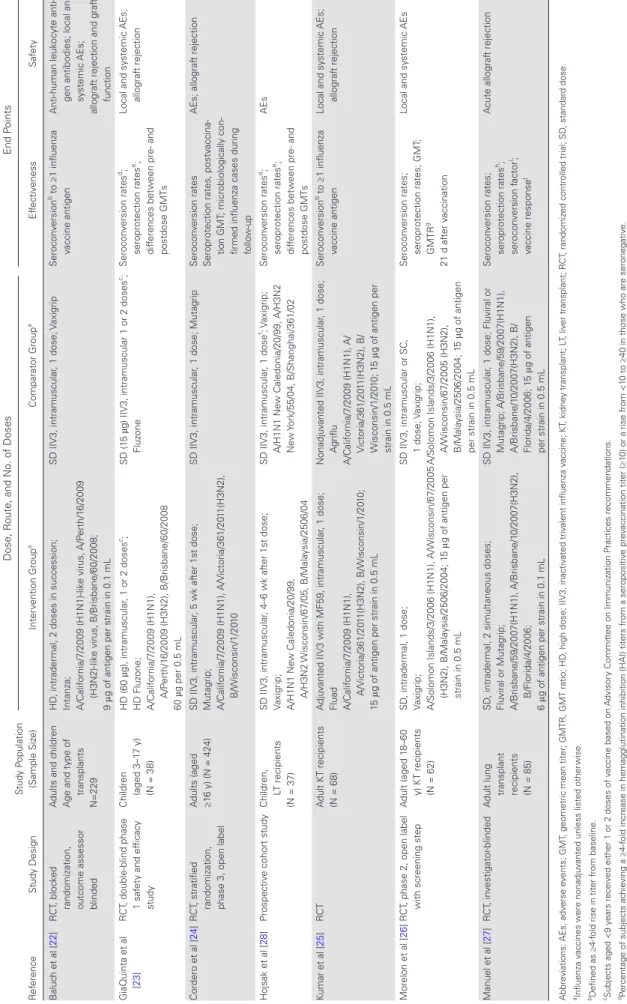
Table 1 summarizes characteristics of the 7 selected studies, including 6 randomized controlled trials [22–27] and 1 pro-spective cohort study [28]. Alternative influenza vaccination strategies evaluated in these studies included HD IIV3 [23] (n = 1), BD intramuscular IIV3 [24, 28] (n = 2), intradermal IIV3 [22, 26, 27] (n = 3), and adjuvanted IIV3 [25] (n = 1). All studies included SOTRs who received SD intramuscular IIV3 as a comparator group.
Patient Demographics and Inclusion/Exclusion Criteria
The 7 selected studies yielded a total of 943 patients (Table 1). Of these, 92% (868 of 943) were adult SOTRs, and 30% (279 of 943) were female. Transplant types included kidney (n = 422), liver (n = 229), lung (n = 181), heart (n = 89), intestinal (n = 1), and multiorgan transplants (n = 21). Most studies included SOTRs ≥3 months after transplantation (5 of 7 studies) and excluded those with a recent history of allograft rejection (5 of 7 studies) and those with a documented history of severe adverse reactions to influenza vaccination (4 of 7 studies).
Influenza Vaccine Characteristics and Vaccination Strategy
Table 1.
Characteristics of Assessed Studies
R ef erence St udy Design St udy P opulation (Sample Siz e) Dose, R
oute, and No. of Doses
End P oints Inter vention Group a Comparator Group a Ef fectiv eness Saf et y B aluc
h et al [
22 ] R CT , bloc ked
randomization, outcome assessor blinded
A
dults and c
hildren
A
ge and t
ype of
transplants
N=229
HD
, intradermal, 2 doses in succession;
Int anza; A/Calif ornia/7/20 09 (H1N1)-lik e vir us, A/P erth/1 6/20 09 (H3N2)-lik e vir us, B/Brisbane/60/20 08; 9 μ
g of antigen per strain in 0.1 mL
SD IIV3, intramuscular
, 1 dose;
Vaxigrip
Serocon
version
b to ≥1 influenza
vaccine antigen
Anti-human leuk
ocyte
anti-gen antibodies; local and systemic AEs;
allograf
t rejection and graf
t function GiaQuint a et al [ 23 ] R CT
, double-blind phase 1 saf
et
y and ef
ficacy
st
udy
Children (aged 3–1
7 y)
(N = 38)
HD (60
µ
g), intramuscular
, 1 or 2 doses
c; HD Fluz one; A/Calif ornia/7/20 09 (H1N1), A/P erth/1 6/20
09 (H3N2), B/Brisbane/60/20
08
60
µ
g per 0.5 mL
SD (1
5
µ
g) IIV3, intramuscular 1 or 2 doses
c; Fluz one Serocon version rates d; seroprotection rates e; dif ferences bet w
een pre- and
postdose GMTs
Local and sy
stemic
AEs;
allograf
t rejection
Cordero et al [
24 ] R CT , stratifi ed
randomization, phase 3, open label
A
dults (aged ≥16 y) (N = 424)
SD IIV3, intramuscular
, 5 wk af
ter 1st dose;
Mut agrip; A/Calif ornia/7/20 09 (H1N1), A/Victoria/361/20 11(H3N2), B/W isconsin/1/20 10
SD IIV3, intramuscular
, 1 dose; Mut
agrip
Serocon
version rates
Seroprotection rates, postv
accina-tion GMT
; microbiologically
con-firmed influenza cases during follo
w
-up
AEs; allograf
t rejection
Hojsak et al [
28
]
Prospectiv
e cohort st
udy
Children, LT recipients (N = 37)
SD IIV3, intramuscular
, 4–6 wk af
ter 1st dose;
Vaxigrip; A/H1N1 Ne
w Caledonia/20/99,
A/H3N2 W
isconsin/67/05,
B/Mala
ysia/2506/04
SD IIV3, intramuscular
, 1 dose
f; V
axigrip; A/H1N1 Ne w Caledonia/20/99, A/H3N2 Ne w Y ork/55/04, B/Shanghai/361/02 Serocon version rates d; seroprotection rates e; dif ferences bet w
een pre- and
postdose GMTs
AEs
Kumar et al [
25
]
RC
T
A
dult KT recipients (N = 68)
A
dju
vanted IIV3 with MF59, intramuscular
, 1 dose;
Fluad A/Calif ornia/7/20 09 (H1N1), A/Victoria/361/20 11(H3N2), B/W isconsin/1/20 10; 15 μ
g of antigen per strain in 0.5 mL
Nonadju
vanted IIV3, intramuscular
, 1 dose;
A griflu A/Calif ornia/7/20 09 (H1N1), A/ Victoria/361/20 11(H3N2), B/ W isconsin/1/20 10; 1 5 μ
g of antigen per
strain in 0.5 mL
Serocon
version
b to ≥1 influenza
vaccine antigen
Local and sy
stemic
AEs;
allograf
t rejection
Morelon et al [
26
]R
CT
, phase 2, open label with screening step
A
dult (aged 1
8–60
y) KT recipients (N = 62)
SD
, intradermal, 1 dose;
Vaxigrip; A/Solomon Islands/3/20
06 (H1N1), A/W isconsin/67/20 05 (H3N2), B/Mala ysia/2506/20 04; 1 5 μ
g of antigen per
strain in 0.5 mL
SD IIV3, intramuscular or SC, 1
dose; V axigrip; A/Solomon Islands/3/20 06 (H1N1), A/W isconsin/67/20 05 (H3N2), B/Mala ysia/2506/20 04; 1 5 μ
g of antigen
per strain in 0.5 mL
Serocon
version rates;
seroprotection rates; GMT
;
GMTR
g
21 d af
ter v
accination
Local and sy
stemic
AEs
Manuel et al [
27 ] R CT , in vestigator -blinded A
dult lung transplant recipients (N = 85)
SD
, intradermal, 2 simult
aneous doses;
Flu
viral or Mut
agrip; A/Brisbane/59/20 07(H1N1), A/Brisbane/1 0/20 07(H3N2), B/Florida/4/20 06; 6 μ
g of antigen per strain in 0.1 mL
SD IIV3, intramuscular
, 1 dose; Flu
viral or Mut agrip; A/Brisbane/59/20 07(H1N1), A/Brisbane/1 0/20 07(H3N2), B/ Florida/4/20 06; 1 5 μ
g of antigen
per strain in 0.5 mL
Serocon version rates; seroprotection rates h; serocon version f actor i; vaccine response j A cute allograf t rejection Abbre viations: AEs, adv erse e vents; GMT
, geometric mean titer; GMTR, GMT ratio; HD
, high dose; IIV3, inactiv
ated triv
alent influenza v
accine; KT
, kidne
y transplant; L
T, liv
er transplant; R
CT
, randomiz
ed controlled trial; SD
, st
andard dose.
aInfluenza v
accines w
ere nonadju
vanted unless listed other
wise.
bDefined as ≥4-f
old rise in titer from baseline.
cSubjects aged <9 y
ears receiv
ed either 1 or 2 doses of v
accine based on
A
dvisor
y Commit
tee on Immunization P
ractices recommendations.
dPercent
age of subjects ac
hie
ving a ≥4-f
old increase in hemagglutination inhibition (HAI) titers from a seropositiv
e pre
vaccination titer (≥1
0) or a rise from <1
0 to ≥40 in those who are seronegativ
e.
ePercent
age of subjects ac
hie
ving an HAI titer ≥1:40.
fHistorical controls (pre
vious influenza season of 20
04–20
05).
gDefined as ratio of GMT bet
w
een post- and pre
vaccination titers.
hPercent
age of subjects ac
hie
ving a HAI titer ≥1:32.
IRatio of hemagglutination inhibition titer bef
ore and af
ter v
accination.
jDefined as serocon
version to ≥1 of the 3 v
of HD IIV3 containing 60 µg of antigen per influenza virus strain; Kumar et al [25] evaluated an MF59-adjuvanted vaccine that contained 15 µg of antigen per strain. Studies that investi-gated the use of intradermal IIV3 used 6 µg of antigen per strain administered simultaneously in 2 doses (cumulatively, 12 µg of antigen per strain) [27], 9 µg of antigen per strain administered simultaneously in 2 doses (cumulatively, 18 µg of antigen per strain) [22] and 15 µg of antigen per strain in a single dose [26]. Cordero et al [24]. and Hojsak et al [28] evaluated BD strategies in which 2 sequential doses of SD IIV3 were administered 5 or 4–6 weeks apart, respectively.
The comparator group in all studies consisted of SOTRs who received SD IIV3 containing 15 µg of antigen of each of 2 A (H1N1 and H3N2) strains and 1 B strain of influenza given as a single 0.5-mL intramuscular dose. Selection of vaccine strains was dependent on the annual recommendations by the World Health Organization based on circulating influenza strains (Table 1).
Vaccination Immunogenicity
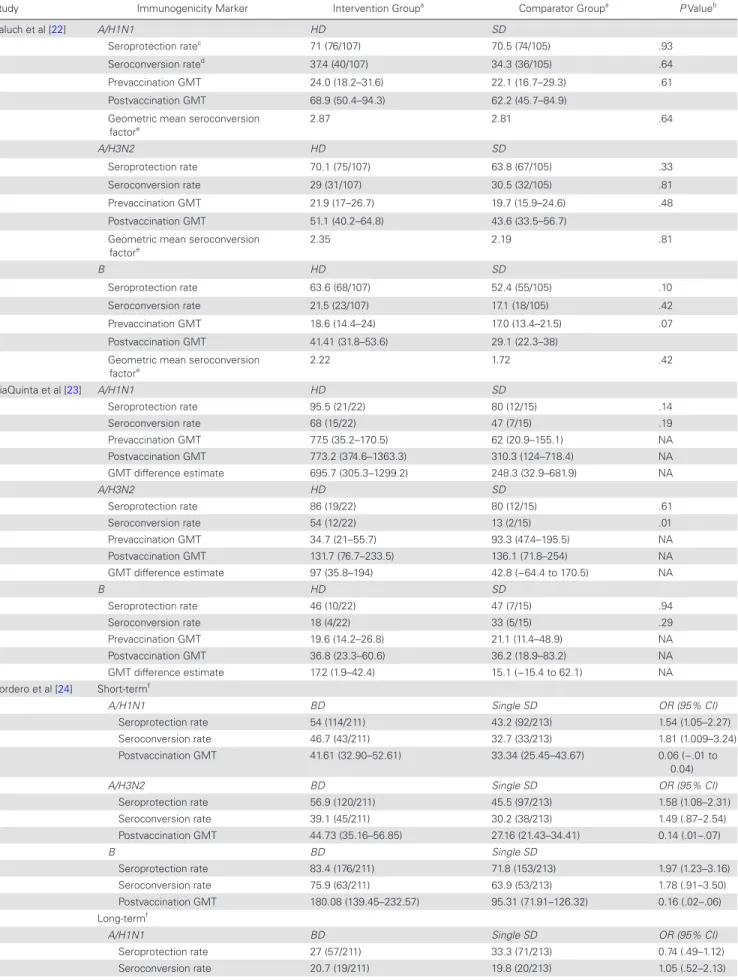
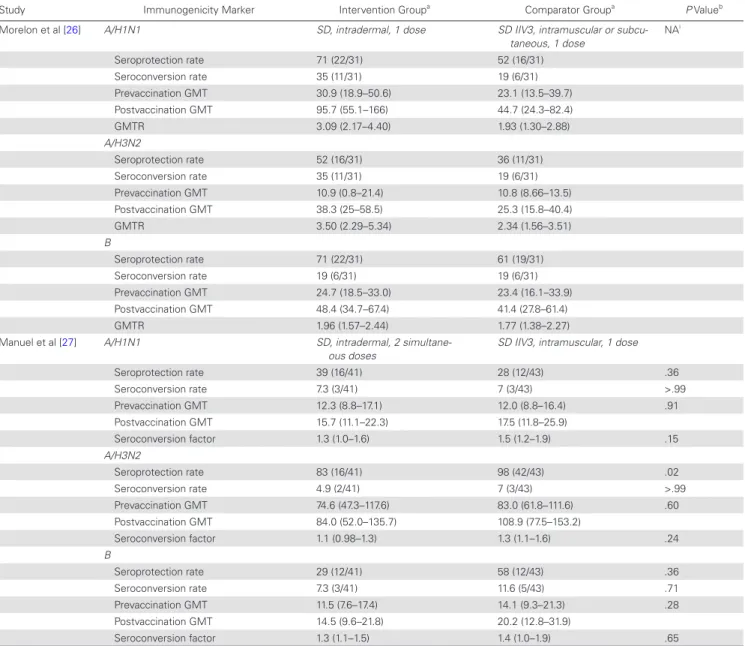
All 7 studies assessed for vaccination immunogenicity by meas-uring pre- and postvaccination strain-specific influenza antigen titers using hemagglutination inhibition assay (Table 2). The timing of serum sample collection varied, most commonly 4 weeks after vaccination but ranging between 3 [26] to 6 weeks after vaccination [23, 28]. Most studies (86%; 6 of 7) included seroconversion rate, seroprotection rate and differences in pre- and postvaccination GMT as measures of vaccine immunogen-icity. Short-term immunogenicity was assessed in all studies; long-term immunogenicity at 12 months after vaccination was evaluated in 1 study [24].
Intradermal Influenza Vaccine
Using a 2-dose simultaneous administration strategy, serocon-version rates to ≥1 influenza antigen did not differ between intradermal and intramuscular groups (48.2% [55 of 114] vs 42.6% [49 of 115; P = .47] [22] and 14.6% [6 of 41] vs 18.6% [8 of 43; P = .77] [27]). In addition, pre- and postvaccination GMT and seroprotection rates were also not different [22, 27]. Baluch et al [22] noted a trend toward higher postvaccination GMT (41.31 vs 29.1; P = .07) and seroprotection rate (63.6% vs 52.4%; P = .10) for influenza B in the intradermal group, but the differences was not significant. Manuel et al [27] reported sig-nificantly lower seroprotection rates for A/H3N2 (83% vs 98%;
P = .02) and influenza B (29% vs 58%; P < .01) in the intrader-mal group compared with the comparator group.
Morelon et al [26] reported higher seroconversion rates for influenza A/H1N1 (35% [11 of 31] vs 19% [6 of 31]) and A/ H3N2 (35% [11 of 31] vs 19% [6 of 31]) but not influenza B (19% [6 of 31 vs 19% [6 of 31]) in the intradermal group. Similarly, seroprotection rates were higher for influenza A/H1N1 (71% [22 of 31] vs 52% [16 of 31]), A/H3N2 (52% [16 of 31] vs 36% [11 of 31]) and similar for influenza B (71% [22 of 31] vs 61%
[19 of 31]) in the intradermal group. Postvaccination GMT was higher for influenza A/H1N1 in the intradermal group than in the comparator group (95.7% vs 44.7%); these values were sim-ilar in the 2 groups for A/H3N2 (38.3% vs 25.3%, respectively) and influenza B (48.4% vs 41.4%) [26].
Baluch et al [22] analyzed factors that influenced seroprotec-tion. SOTRs receiving ≥2 g/d of mycophenolate mofetil (MMF) (37.3% vs 62.7%; P = .02), lung transplant recipients (28% vs 72%; P = .02), and those <6 months after transplantation (8.7% vs 91.3%; P = .01) had a significantly lower seroprotection rate for A/H1N1. Patients receiving ≥2 g/d of MMF (36.6% vs 63.4%;
P = .04) and those <6 months after transplantation (6.5% vs 93.5%;
P < .01) also had lower seroprotection rates for influenza B [22].
HD Influenza Vaccine
In the study by GiaQuinta et al [23], 38 pediatric SOTRs were randomized to either HD or SD IIV3. Seroconversion for A/ H3N2 occurred in a higher proportion of the HD group com-pared with the SD group (54% vs 13%; P = .01) [23], but the seroprotection rate for A/H1N1 (95% vs 80%; P = .14) and in-fluenza B (46% vs 47%; P = .94) and postvaccination GMTs for A/H1N1 (GMT difference, 462.9; 95% confidence interval [CI], −85.9 to 1112.4) did not differ between the 2 groups [23].
BD Influenza Vaccine
Cordero et al [24] reported the results of the TRANSGRIPE 1-2 study, an open-label, phase 3, parallel-group, randomized con-trolled clinical trial that evaluated the safety and efficacy of a BD administered 5 weeks after an initial dose of IIV3 compared with the single SD intramuscular nonajuvanted IIV3 in SOTRs. Using modified intention-to-treat (mITT) analysis, 2 doses of influenza vaccine was associated with a higher seroconversion rate for influ-enza A(H1N1)pdm at 10 weeks using bivariable analyses (46.7% vs 32.7%; odds ratio [OR], 1.81; 95% CI, 1.01–3.24; P = .05) but not to other influenza strains, or after adjustment for potential confound-ers in multivariable analyses. In the per-protocol analysis, a BD of IIV3 was independently associated with a higher likelihood of seroconversion at 10 weeks for all influenza strains, with the num-ber needed to treat to achieve seroconversion being 7 [24].
Table 2. Summary of Vaccine Immunogenicity
Study Immunogenicity Marker Intervention Groupa Comparator Groupa P Valueb
Baluch et al [22] A/H1N1 HD SD
Seroprotection ratec 71 (76/107) 70.5 (74/105) .93
Seroconversion rated 37.4 (40/107) 34.3 (36/105) .64
Prevaccination GMT 24.0 (18.2–31.6) 22.1 (16.7–29.3) .61
Postvaccination GMT 68.9 (50.4–94.3) 62.2 (45.7–84.9)
Geometric mean seroconversion
factore 2.87 2.81 .64
A/H3N2 HD SD
Seroprotection rate 70.1 (75/107) 63.8 (67/105) .33
Seroconversion rate 29 (31/107) 30.5 (32/105) .81
Prevaccination GMT 21.9 (17–26.7) 19.7 (15.9–24.6) .48
Postvaccination GMT 51.1 (40.2–64.8) 43.6 (33.5–56.7)
Geometric mean seroconversion
factore 2.35 2.19 .81
B HD SD
Seroprotection rate 63.6 (68/107) 52.4 (55/105) .10
Seroconversion rate 21.5 (23/107) 17.1 (18/105) .42
Prevaccination GMT 18.6 (14.4–24) 17.0 (13.4–21.5) .07
Postvaccination GMT 41.41 (31.8–53.6) 29.1 (22.3–38)
Geometric mean seroconversion
factore 2.22 1.72 .42
GiaQuinta et al [23] A/H1N1 HD SD
Seroprotection rate 95.5 (21/22) 80 (12/15) .14
Seroconversion rate 68 (15/22) 47 (7/15) .19
Prevaccination GMT 77.5 (35.2–170.5) 62 (20.9–155.1) NA
Postvaccination GMT 773.2 (374.6–1363.3) 310.3 (124–718.4) NA
GMT difference estimate 695.7 (305.3–1299.2) 248.3 (32.9–681.9) NA
A/H3N2 HD SD
Seroprotection rate 86 (19/22) 80 (12/15) .61
Seroconversion rate 54 (12/22) 13 (2/15) .01
Prevaccination GMT 34.7 (21–55.7) 93.3 (47.4–195.5) NA
Postvaccination GMT 131.7 (76.7–233.5) 136.1 (71.8–254) NA
GMT difference estimate 97 (35.8–194) 42.8 (−64.4 to 170.5) NA
B HD SD
Seroprotection rate 46 (10/22) 47 (7/15) .94
Seroconversion rate 18 (4/22) 33 (5/15) .29
Prevaccination GMT 19.6 (14.2–26.8) 21.1 (11.4–48.9) NA
Postvaccination GMT 36.8 (23.3–60.6) 36.2 (18.9–83.2) NA
GMT difference estimate 17.2 (1.9–42.4) 15.1 (−15.4 to 62.1) NA
Cordero et al [24] Short-termf
A/H1N1 BD Single SD OR (95% CI)
Seroprotection rate 54 (114/211) 43.2 (92/213) 1.54 (1.05–2.27)
Seroconversion rate 46.7 (43/211) 32.7 (33/213) 1.81 (1.009–3.24)
Postvaccination GMT 41.61 (32.90–52.61) 33.34 (25.45–43.67) 0.06 (−.01 to
0.04)
A/H3N2 BD Single SD OR (95% CI)
Seroprotection rate 56.9 (120/211) 45.5 (97/213) 1.58 (1.08–2.31)
Seroconversion rate 39.1 (45/211) 30.2 (38/213) 1.49 (.87–2.54)
Postvaccination GMT 44.73 (35.16–56.85) 27.16 (21.43–34.41) 0.14 (.01–.07)
B BD Single SD
Seroprotection rate 83.4 (176/211) 71.8 (153/213) 1.97 (1.23–3.16)
Seroconversion rate 75.9 (63/211) 63.9 (53/213) 1.78 (.91–3.50)
Postvaccination GMT 180.08 (139.45–232.57) 95.31 (71.91–126.32) 0.16 (.02–.06)
Long-termf
A/H1N1 BD Single SD OR (95% CI)
Seroprotection rate 27 (57/211) 33.3 (71/213) 0.74 (.49–1.12)
Study Immunogenicity Marker Intervention Groupa Comparator Groupa P Valueb
Postvaccination GMT 15.94 (13.33–19.07) 17.48 (14.40–21.22) −0.03 (−.05 to
.02)
A/H3N2 BD Single SD OR (95% CI)
Seroprotection rate 48.3 (102/211) 53.5 (114/213) 0.81 (.56–1.19)
Seroconversion rate 40.9 (47/211) 45.2 (57/213) 0.84 (.50–1.40)
Postvaccination GMT 42.58 (32.69–55.45) 46.46 (35.61–60.62) −0.02 (−.03 to
.02)
B BD Single SD OR (95% CI)
Seroprotection rate 73.5 (155/211) 69 (135/213) 1.24 (.89–1.89)
Seroconversion rate 63.9 (53/211) 50.6 (42/213) 1.73 (.91–3.50)
Postvaccination GMT 77.67 (61.09–98.75) 69.55 (54.53–88.71) 0.03 (−.02 to
.04)
Hojsak et al [28] A/H1N1 BD Single SD …
Seroprotection rate (baseline) 48 (18/37) 58.8 (10/17)
Seroprotection rate (1 dose) 64.9 (24/37) (P = .08)g 64.7 (11/17) (P = .33)
Seroprotection rate (2 doses) 75 (27/32) (P = .005) NA
Seroconversion rate (1 dose) 40.5 (15/37) 17.6 (3/17)
Seroconversion rate (2 doses) 54.0 (20/37) NA
GMT (t1) 31.35 47.08
GMT (t2) 67.59 (P = .37) 65.25 (P = .09)
GMT (t3) 80.00 (P = .001) NA
A/H3N2
Seroprotection rate (baseline) 43.2 (16/37) 16.7 (3/18)
Seroprotection rate (1 dose) 70.3 (26/37) (P = .003) 47.1 (8/17) (P = .06)
Seroprotection rate (2 doses) 84.4 (27/32) (P ≤ .001) NA
Seroconversion rate (1 dose) 35.1 (13/37) 42.2 (7/17)
Seroconversion rate (2 doses) 56.7 (21/37) NA
GMT (t1) 39.26 12.6
GMT (t2) 89.52 (P = .028) 33.00 (P = .03)
GMT (t3) 103.75 (P = .001) NA
B
Seroprotection rate (baseline) 8.1 (3/37) 50 (9/18)
Seroprotection rate (1 dose) 35.1 (13/37) (P = .003) 58.8 (10/17) (P = .58)
Seroprotection rate (2 doses) 35.5 (11/32) (P = .009) NA
Seroconversion rate (1 dose) 40.5 (15/37) 16.7 (3/18)
Seroconversion rate (2 doses) 48.6 (18/37) NA
GMT (t1) 7.99 46.6
GMT (t2) 24.12 (P < .001) 69.48 (P = .13)
GMT (t3) 21.3 (P < .001) NA
Kumar et al [25]h A/H1N1 MF59-adjuvanted IIV3,
intra-muscular, 1 dose
Nonadjuvanted IIV3, intramuscu-lar, 1 dose
Seroprotection rate 83.9% 86.2% .80
Seroconversion rate 45.2% 48.3% .28
Prevaccination GMT 31.3 28.6 .77
Postvaccination GMT 136.8 123.0 .65
Seroconversion factor 4.37 4.30 .73
A/H3N2
Seroprotection rate 100% 93.1% .23
Seroconversion rate 48.4% 34.5% .28
Prevaccination GMT 62.6 71.0 .86
Postvaccination GMT 209.2 184.7 .96
Seroconversion factor 3.34 2.60 .56
B
Seroprotection rate 61.3% 65.5% .73
Seroconversion rate 32.3% 24.1% .49
Prevaccination GMT 28.6 22.0 .36
Postvaccination GMT 71.5 48.4 .33
Seroconversion factor 2.50 2.20 .98
vaccination, no differences in rates of seroconversion, seropro-tection, and GMTs were observed between treatment groups.
In a prospective cohort study performed in pediatric liver transplant recipients (n = 37), Hojsak et al [28] reported higher seroprotection rates after 2 sequential SDs of the intramuscular IIV3, 4–6 weeks apart during the 2005–2006 influenza season for all 3 strains compared with baseline, as follows: A/H1N1,
75% versus 48.6% (P = .005); A/H3N2, 84.4% versus 43.2% (P
≤ .001); and B, 35.5% versus 8.1% (P < .01). Seroprotection rates for the group that received single SD intramuscular IIV3 dur-ing the 2004–2005 influenza season were as follows, again com-pared with baseline seroprotection rates: A/H1N1, 64.7% versus 58.8% (P = .33); A/H3N2, 47.1% versus 16.7% (P = .06); and B, 58.8% versus 50% (P = .58).
Study Immunogenicity Marker Intervention Groupa Comparator Groupa P Valueb
Morelon et al [26] A/H1N1 SD, intradermal, 1 dose SD IIV3, intramuscular or
subcu-taneous, 1 dose
NAi
Seroprotection rate 71 (22/31) 52 (16/31)
Seroconversion rate 35 (11/31) 19 (6/31)
Prevaccination GMT 30.9 (18.9–50.6) 23.1 (13.5–39.7)
Postvaccination GMT 95.7 (55.1–166) 44.7 (24.3–82.4)
GMTR 3.09 (2.17–4.40) 1.93 (1.30–2.88)
A/H3N2
Seroprotection rate 52 (16/31) 36 (11/31)
Seroconversion rate 35 (11/31) 19 (6/31)
Prevaccination GMT 10.9 (0.8–21.4) 10.8 (8.66–13.5)
Postvaccination GMT 38.3 (25–58.5) 25.3 (15.8–40.4)
GMTR 3.50 (2.29–5.34) 2.34 (1.56–3.51)
B
Seroprotection rate 71 (22/31) 61 (19/31)
Seroconversion rate 19 (6/31) 19 (6/31)
Prevaccination GMT 24.7 (18.5–33.0) 23.4 (16.1–33.9)
Postvaccination GMT 48.4 (34.7–67.4) 41.4 (27.8–61.4)
GMTR 1.96 (1.57–2.44) 1.77 (1.38–2.27)
Manuel et al [27] A/H1N1 SD, intradermal, 2
simultane-ous doses
SD IIV3, intramuscular, 1 dose
Seroprotection rate 39 (16/41) 28 (12/43) .36
Seroconversion rate 7.3 (3/41) 7 (3/43) >.99
Prevaccination GMT 12.3 (8.8–17.1) 12.0 (8.8–16.4) .91
Postvaccination GMT 15.7 (11.1–22.3) 17.5 (11.8–25.9)
Seroconversion factor 1.3 (1.0–1.6) 1.5 (1.2–1.9) .15
A/H3N2
Seroprotection rate 83 (16/41) 98 (42/43) .02
Seroconversion rate 4.9 (2/41) 7 (3/43) >.99
Prevaccination GMT 74.6 (47.3–117.6) 83.0 (61.8–111.6) .60
Postvaccination GMT 84.0 (52.0–135.7) 108.9 (77.5–153.2)
Seroconversion factor 1.1 (0.98–1.3) 1.3 (1.1–1.6) .24
B
Seroprotection rate 29 (12/41) 58 (12/43) .36
Seroconversion rate 7.3 (3/41) 11.6 (5/43) .71
Prevaccination GMT 11.5 (7.6–17.4) 14.1 (9.3–21.3) .28
Postvaccination GMT 14.5 (9.6–21.8) 20.2 (12.8–31.9)
Seroconversion factor 1.3 (1.1–1.5) 1.4 (1.0–1.9) .65
Abbreviations: BD, booster dose; CI, confidence interval; GMT, geometric mean titer; GMT (t1), GMT at baseline,; GMT (t2), GMT after single-dose influenza vaccine; GMT (t3), GMT after 2 doses of influenza vaccine; GMTR, GMT ratio; HD, high dose; IIV3, inactivated trivalent influenza vaccine; NA, not applicable; OR, odds ratio; SD, standard dose.
aUnless otherwise specified, values represent % (proportion) of patients for seroprotection and seroconversion rates and [mean? median?] (95% CI) for GMT, GMTR, and GMT difference.
bValues represent P values unless otherwise specified.
cSeroprotection rates are defined as the percentage of subjects achieving a hemagglutination inhibition titer ≥1:40.
dSeroconversion rates are defined as the percentage of subjects achieving ≥4-fold rise in titer from baseline.
eThe geometric mean seroconversion factor is defined as the ratio of GMT between post- and prevaccination titers.
fResults presented are from intention-to-treat analysis.
gP values for Hojsak et al represent difference between immunogenicity marker after a single dose (or 2 doses) of influenza vaccine compared with baseline in the same study subject.
hProportions for rates and confidence intervals for GMTs were not provided by Kumar et al.
Adjuvanted SD Influenza Vaccine
In a clinical trial of adult kidney transplant recipients randomized to receive either MF59-adjuvanted IIV3 or nonadjuvanted IIV3, the seroprotection and seroconversion rates and postvaccination GMTs did not differ between the 2 groups [25]. A subgroup ana-lysis demonstrated that MF59-adjuvanted IIV3 was the only factor significantly associated with seroconversion (OR, 6.10; 95% CI, 1.2 –28.6) [25]. Use of MMF at ≥2 g/d (44.4% vs 71.4%; P = .05) and older age (OR per year of increasing age, 0.95; 95% CI, .90–.99) were significantly associated with lower seroconversion rates [25].
Vaccine Safety
Intradermal Influenza Vaccine
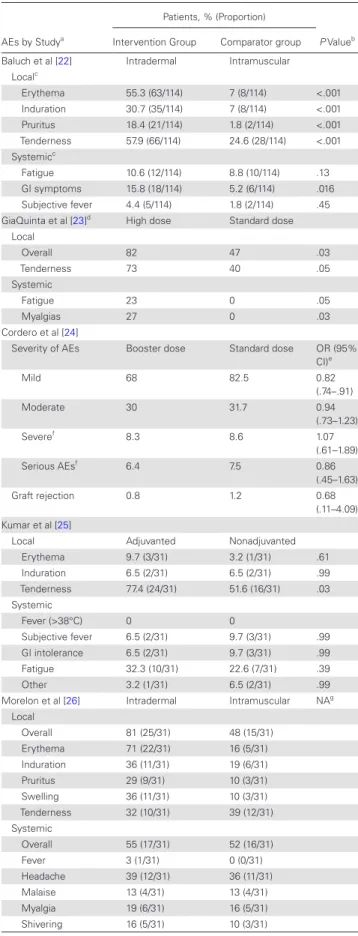
The proportion of local adverse events (AEs), such as erythema (P < .001), induration (P < .001), tenderness (P < .001), and pru-ritus (P = .005), were significantly higher with intradermal IIV3 [22, 26] (Table 3). Although Manuel et al [27] reported a higher percentage of local AEs, this difference was not statistically sig-nificant (41% vs 25%; P = .16). Local AEs were mild or moder-ate in severity, and their severity and duration did not different between the 2 groups.
Systemic AEs did not differ between the intradermal and com-parator groups in the studies by Morelon et al (55% vs 52%) [26] and Manuel et al [27] (7% vs 16%; P = .31). Baluch et al [22] reported a higher frequency of nausea and diarrhea in the intradermal group. Allograft rejection rates within 6 months after vaccination also did not differ between the intradermal and comparator groups; graft function was stable in all patients at the time of follow-up in this study, and confirmed development of de novo anti-human leuko-cyte antigen antibody was reported in only 1.4% (3 of 212) [22].
HD Influenza Vaccine
SOTRs who received HD IIV reported more injection site ten-derness (73% vs 40%; P = .05), erythema (82% vs 47%; P = .02), myalgias (27% vs 0%; P = .03), and fatigue (23% vs 0%; P = .05) [23]. Allograft rejection occurred in 2.6% (1 of 38) 6 months after influenza vaccination in the SD group and thus was deemed unrelated [23].
BD Strategy
Rates of allograft rejection rates and local and systemic AEs did not differ significantly between the BD and comparator groups (P
> .05) [24]. Most AEs reported were mild or moderate in severity.
Adjuvanted SD Influenza Vaccine
SOTRs who received the MF59-adjuvanted IIV3 were signifi-cantly more likely to develop injection site tenderness than those who received nonadjuvanted intramuscular IIV3 (77.4% vs 51.6%;
P = .03); other local and systemic AEs did not differ between the 2 groups. Only 1 episode of acute allograft rejection was reported 3 weeks after vaccination during the 6-month follow-up period, and this occurred in the nonadjuvanted vaccine group.
DISCUSSION
Despite alternative influenza vaccination strategies, seroconver-sion and seroprotection rates for influenza antigens were low in SOTRs. Neither intradermal [22, 26, 27] nor adjuvanted [25] influenza vaccine strategies improved immunogenicity com-pared with single SD intramuscular IIV3. Whereas HD and BD IIV3 conferred better seroprotection, antigen-specific immu-nogenicity varied substantially across studies. Pediatric SOTRs who received HD IIV3 were more likely than those in the SD IIV3 group to seroconvert for A/H3N2, but not for A/H1N1 or influenza B. In the TRANSGRIPE 1-2 study, a booster IIV3 dose administered 5 weeks after the first dose was significantly asso-ciated with a higher seroconversion rate for A/H1N1 but not for other strains [24]. The heterogeneity in influenza antigen-spe-cific immunogenicity seems unpredictable and independent of the vaccination strategy. A prospective cohort study performed in pediatric liver transplant recipients reported significantly higher seroprotection rates for all 3 influenza strains after 2 sequential SDs of the intramuscular IIV3, 4–6 weeks apart [28].
Among transplant types, lung transplant recipients had the lowest seroresponse rates to influenza vaccination. In add-ition to ≥2 g/d of MMF and vaccination within 6 months after transplantation, Baluch et al [22] found that lung transplant recipients had lower seroprotection rates to A/H1N1 and that intradermal influenza vaccine had greater immunogenicity in recipients of non-lung transplants in a subgroup analysis. In another study by Manuel et al [27], seroconversion rates to each of the IIV3 influenza antigens in lung transplant recipients ranged from 5% to 12% . Limited data are available regarding long-term immunogenicity of alternative influenza vaccination strategies. In the TRANSGRIPE 1-2 study, the 1-year postvacci-nation seroconversion, seroprotection rates and GMTs did not differ between the BD and SD groups. A decrease in the 1-year GMT was noted in both groups [24].
These nonstandard influenza vaccination strategies seem to be safe and generally well tolerated. SOTRs who received HD, intradermal, and adjuvanted IIV were more likely to experience local AEs, which were mild or moderate and transient injec-tion site reacinjec-tions. Systemic AEs were more frequent in SOTRs who received HD IIV3. Allograft rejection rates did not differ between the alternative and standard influenza vaccine groups.
Hojsak et al [28] aimed to compare a 2-dose standard intramus-cular IIV3 with findings in pediatric liver transplant recipients who received single-dose intramuscular IIV3 in the previous
influenza season, but statistical comparisons were not per-formed between the 2 groups, limiting interpretation of the results. Finally, there was variability in postvaccination serum sample collection (ranging from 3 to 6 weeks after vaccina-tion); it is unclear whether this variability contributed to vaccine immunogenicity differences across studies.
In conclusion, BD and HD influenza vaccination strategies seem to hold promise for improving vaccination immunogenic-ity and were generally well tolerated in SOTRs. Future studies should focus on clarifying the optimal timing, frequency, and dose and in assessing whether these strategies improve vac-cine immunogenicity. In the interim, SOTRs should continue to receive the SD IIV annually in accordance with current Infectious Diseases Society of America and Centers for Disease Control and Prevention recommendations.
Notes
Author contributions. Research idea and study design: P. P. C and D. J. W;
data acquisition: L. H.; data analysis/interpretation: P. P. C and D. J. W; supervision or mentorship: D. J. W; drafting of manuscript: P. P. C. Each author critically revised and approved of the final version of the manuscript.
Potential conflicts of interest. All authors: No reported conflicts of
interest. All authors have submitted the ICMJE Form for Disclosure of Potential Conflicts of Interest. Conflicts that the editors consider relevant to the content of the manuscript have been disclosed.
References
1. Centers for Disease C, Prevention. Estimates of deaths associated with seasonal
influenza—United States, 1976–2007. MMWR Morb Mortal Wkly Rep 2010;
59:1057–62.
2. Kumar D, Michaels MG, Morris MI, et al; American Society of Transplantation H1N1 Collaborative Study Group. Outcomes from pandemic influenza A H1N1 infection in recipients of solid-organ transplants: a multicentre cohort study.
Lancet Infect Dis 2010; 10:521–6.
Table 3. Adverse Events Attributed Attributed to Influenza Vaccination
AEs by Studya
Patients, % (Proportion)
P Valueb
Intervention Group Comparator group
Baluch et al [22] Intradermal Intramuscular
Localc
Erythema 55.3 (63/114) 7 (8/114) <.001
Induration 30.7 (35/114) 7 (8/114) <.001
Pruritus 18.4 (21/114) 1.8 (2/114) <.001
Tenderness 57.9 (66/114) 24.6 (28/114) <.001
Systemicc
Fatigue 10.6 (12/114) 8.8 (10/114) .13
GI symptoms 15.8 (18/114) 5.2 (6/114) .016
Subjective fever 4.4 (5/114) 1.8 (2/114) .45
GiaQuinta et al [23]d High dose Standard dose
Local
Overall 82 47 .03
Tenderness 73 40 .05
Systemic
Fatigue 23 0 .05
Myalgias 27 0 .03
Cordero et al [24]
Severity of AEs Booster dose Standard dose OR (95%
CI)e
Mild 68 82.5 0.82
(.74–.91)
Moderate 30 31.7 0.94
(.73–1.23)
Severef 8.3 8.6 1.07
(.61–1.89)
Serious AEsf 6.4 7.5 0.86
(.45–1.63)
Graft rejection 0.8 1.2 0.68
(.11–4.09)
Kumar et al [25]
Local Adjuvanted Nonadjuvanted
Erythema 9.7 (3/31) 3.2 (1/31) .61
Induration 6.5 (2/31) 6.5 (2/31) .99
Tenderness 77.4 (24/31) 51.6 (16/31) .03
Systemic
Fever (>38°C) 0 0
Subjective fever 6.5 (2/31) 9.7 (3/31) .99
GI intolerance 6.5 (2/31) 9.7 (3/31) .99
Fatigue 32.3 (10/31) 22.6 (7/31) .39
Other 3.2 (1/31) 6.5 (2/31) .99
Morelon et al [26] Intradermal Intramuscular NAg
Local
Overall 81 (25/31) 48 (15/31)
Erythema 71 (22/31) 16 (5/31)
Induration 36 (11/31) 19 (6/31)
Pruritus 29 (9/31) 10 (3/31)
Swelling 36 (11/31) 10 (3/31)
Tenderness 32 (10/31) 39 (12/31)
Systemic
Overall 55 (17/31) 52 (16/31)
Fever 3 (1/31) 0 (0/31)
Headache 39 (12/31) 36 (11/31)
Malaise 13 (4/31) 13 (4/31)
Myalgia 19 (6/31) 16 (5/31)
Shivering 16 (5/31) 10 (3/31)
AEs by Studya
Patients, % (Proportion)
P Valueb
Intervention Group Comparator group
Manuel et al [27] Intradermal Intramuscular
Overall 44 (18/41) 34 (15/44) .38
Local AEs 41 (17/41) 25 (11/44) .16
Systemic AEs 7 (3/41) 16 (7/44) .31
Abbreviations: AEs, adverse events; CI, confidence interval; GI, gastrointestinal; NA, not available; OR, odds ratio.
aProportions and percentages were unavailable for the published article by Hojsak et al,
despite personal communication with the corresponding author. bValues represent P values unless otherwise specified.
cPercentages and proportions obtained via personal communication with the
correspond-ing author.
dThe proportions were not provided in the original paper (GiaQuinta et al). For the paper by
Manuel et al, please refer to proportions that are provided below.
eCordero et al reported 95% confidence intervals for the odds of developing AEs in the
booster dose group compared to standard dose group. P-values were not reported in the original paper.
fSevere AEs were defined by Cordero et al as the inability to participate in daily activities.
Serious AEs were defined as graft rejection or loss, events leading to death or hospitaliza-tion or its prolongahospitaliza-tion, considered as life-threatening or medically important, or resulting in disability.
gStatistical testing was not performed by the authors owing to small sample size in each
3. Odongo FC, Azevedo LS, Neto ED, Yeh-Li H, Caiaffa H, Pierrotti LC. Clinical characteristics and outcomes of influenza a infection in kidney
transplant recipients: a single-center experience. Transplant Proc. 2016;
48:2315–8.
4. Grohskopf LA, Sokolow LZ, Broder KR, et al. Prevention and control of seasonal
influenza with vaccines. MMWR Recomm Rep 2016; 65:1–54.
5. Duchini A, Hendry RM, Nyberg LM, Viernes ME, Pockros PJ. Immune response
to influenza vaccine in adult liver transplant recipients. Liver Transpl 2001;
7:311–3.
6. Soesman NM, Rimmelzwaan GF, Nieuwkoop NJ, et al. Efficacy of influenza
vac-cination in adult liver transplant recipients. J Med Virol 2000; 61:85–93.
7. Blumberg EA, Albano C, Pruett T, et al. The immunogenicity of influenza
virus vaccine in solid organ transplant recipients. Clin Infect Dis 1996; 22:
295–302.
8. Sanchez-Fructuoso AI, Prats D, Naranjo P, et al. Influenza virus immunization effectivity in kidney transplant patients subjected to two different triple-drug therapy immunosuppression protocols: mycophenolate versus azathioprine.
Transplantation 2000; 69:436–9.
9. Rubin LG, Levin MJ, Ljungman P, et al; Infectious Diseases Society of America. 2013 IDSA clinical practice guideline for vaccination of the
immunocompro-mised host. Clin Infect Dis 2014; 58:e44–100.
10. Long CB, Ramos I, Rastogi D, et al. Humoral and cell-mediated immune responses to monovalent 2009 influenza A/H1N1 and seasonal trivalent influenza
vaccines in high-risk children. J Pediatr 2012; 160:74–81.
11. European Agency for the Evaluation of Medicinal Products (EMEA). Committee for Proprietary Medicinal Products (CPMP). 12 March 1997. Note for guidance on harmonisation of requirements for influenza vaccines. CPMP/BWP/214/96.
Available at: http://www.ema.europa.eu/docs/en_GB/document_library/
Scientific_guideline/2009/09/WC500003945.pdf.
12. Admon D, Engelhard D, Strauss N, Goldman N, Zakay-Rones Z. Antibody response to influenza immunization in patients after heart transplantation.
Vaccine 1997; 15:1518–22.
13. Haller W, Buttery J, Laurie K, Beyerle K, Hardikar W, Alex G. Immune response to pandemic H1N1 2009 influenza a vaccination in pediatric liver transplant
recipi-ents. Liver Transpl 2011; 17:914–20.
14. Manuel O, Humar A, Chen MH, et al. Immunogenicity and safety of an intrader-mal boosting strategy for vaccination against influenza in lung transplant
recipi-ents. Am J Transplant 2007; 7:2567–72.
15. Siegrist CA, van Delden C, Bel M, et al; H1N1 Study Group; Swiss HIV Cohort Study (SHCS). Higher memory responses in HIV-infected and kidney trans-planted patients than in healthy subjects following priming with the pandemic
vaccine. PLoS One 2012; 7:e40428.
16. Esposito S, Meregalli E, Daleno C, et al. An open-label, randomized clinical trial assessing immunogenicity, safety and tolerability of pandemic influenza A/H1N1 MF59-adjuvanted vaccine administered sequentially or simultaneously with sea-sonal virosomal-adjuvanted influenza vaccine to paediatric kidney transplant
recipients. Nephrol Dial Transplant 2011; 26:2018–24.
17. Salles MJ, Sens YA, Malafronte P, Souza JF, Vilas Boas LS, Machado CM. Antibody response to the non-adjuvanted and adjuvanted influenza A H1N1/09
monova-lent vaccines in renal transplant recipients. Transpl Infect Dis 2012; 14:564–74.
18. Evison J, Farese S, Seitz M, Uehlinger DE, Furrer H, Mühlemann K. Randomized, double-blind comparative trial of subunit and virosomal influenza vaccines for
immunocompromised patients. Clin Infect Dis 2009; 48:1402–12.
19. Quintana LF, Serra N, De Molina-Llauradó P, et al. Influence of renal replacement therapy on immune response after one and two doses of the A(H1N1) pdm09
vaccine. Influenza Other Respir Viruses 2013; 7:809–14.
20. Magnani G, Falchetti E, Pollini G, et al. Safety and efficacy of two types of influ-enza vaccination in heart transplant recipients: a prospective randomised
con-trolled study. J Heart Lung Transplant 2005; 24:588–92.
21. Martinez-Atienza J, Rosso-Fernández C, Roca C, et al; TRANSGRIPE 1-2 Study Group. Efficacy and safety of a booster dose of influenza vaccination in solid organ transplant recipients, TRANSGRIPE 1-2: study protocol for a multicenter,
randomized, controlled clinical trial. Trials 2014; 15:338.
22. Baluch A, Humar A, Eurich D, et al. Randomized controlled trial of high-dose intradermal versus standard-dose intramuscular influenza vaccine in organ
transplant recipients. Am J Transplant 2013; 13:1026–33.
23. GiaQuinta S, Michaels MG, McCullers JA, et al. Randomized, double-blind com-parison of standard-dose vs. high-dose trivalent inactivated influenza vaccine in
pediatric solid organ transplant patients. Pediatr Transplant 2015; 19:219–28.
24. Cordero E, Roca-Oporto C, Bulnes-Ramos A, et al; TRANSGRIPE 1-2 Study Group. Two doses of inactivated influenza vaccine improve immune response in solid organ transplant recipients: results of TRANSGRIPE 1-2, a randomized
controlled clinical trial. Clin Infect Dis 2017; 64:829–38.
25. Kumar D, Campbell P, Hoschler K, et al. Randomized controlled trial of adju-vanted versus nonadjuadju-vanted influenza vaccine in kidney transplant recipients.
Transplantation 2016; 100:662–9.
26. Morelon E, Pouteil Noble C, Daoud S, et al. Immunogenicity and safety of intra-dermal influenza vaccination in renal transplant patients who were
non-respond-ers to conventional influenza vaccination. Vaccine 2010; 28:6885–90.
27. Manuel O, Humar A, Berutto C, et al. Low-dose intradermal versus intramuscu-lar trivalent inactivated seasonal influenza vaccine in lung transplant recipients. J
Heart Lung Transplant 2011; 30:679–84.
28. Hojsak I, Avitzur Y, Mor E, et al. Antibody response to influenza vaccine in
![Table 1 summarizes characteristics of the 7 selected studies, including 6 randomized controlled trials [22–27] and 1 pro-spective cohort study [28]](https://thumb-us.123doks.com/thumbv2/123dok_us/8214274.2177757/2.891.465.812.62.399/summarizes-characteristics-selected-studies-including-randomized-controlled-spective.webp)