Introduction to Objective Caml
Jason Hickey
DRAFT. DO NOT REDISTRIBUTE.
Copyright © Jason Hickey, 2008.
This book has been submitted for publication by Cambridge University Press.
This draft may be used until the time the book appears in print.
Contents
Preface i
1 Introduction 1
1.1 Functional and imperative languages . . . 3
1.2 Organization . . . 3
1.3 Additional Sources of Information . . . 3
2 Simple Expressions 5 2.1 Comment convention . . . 5
2.2 Basic expressions . . . 5
2.2.1 unit: the singleton type . . . 6
2.2.2 int: the integers . . . 6
2.2.3 float: the floating-point numbers . . . 7
2.2.4 char: the characters . . . 8
2.2.5 string: character strings . . . 8
2.2.6 bool: the Boolean values . . . 9
2.3 Operator precedences . . . 10
2.4 The OCaml type system . . . 11
2.5 Compiling your code . . . 12
2.6 Exercises . . . 14
3 Variables and Functions 15 3.1 Functions . . . 16
3.1.1 Scoping and nested functions . . . 18
3.1.2 Recursive functions . . . 18
3.1.3 Higher order functions . . . 19
3.2 Variable names . . . 20
3.3 Labeled parameters and arguments . . . 21
3.3.1 Rules of thumb . . . 22
3.4 Exercises . . . 24
4 Basic pattern matching 29 4.1 Functions with matching . . . 30
CONTENTS CONTENTS
4.3 Values of other types . . . 31
4.4 Incomplete matches . . . 33
4.5 Patterns are everywhere . . . 34
4.6 Exercises . . . 35
5 Tuples, lists, and polymorphism 37 5.1 Polymorphism . . . 37
5.1.1 Value restriction . . . 38
5.1.2 Other kinds of polymorphism . . . 39
5.2 Tuples . . . 41
5.3 Lists . . . 42
5.4 Tail recursion . . . 44
5.4.1 Optimization of tail-recursion . . . 44
5.4.2 Lists and tail recursion . . . 45
5.5 Exercises . . . 47
6 Unions 49 6.1 Binary trees . . . 51
6.2 Unbalanced binary trees . . . 51
6.3 Unbalanced, ordered, binary trees . . . 52
6.4 Balanced red-black trees . . . 53
6.5 Open union types (polymorphic variants) . . . 55
6.5.1 Type definitions for open types . . . 56
6.5.2 Closed union types . . . 57
6.6 Some common built-in unions . . . 57
6.7 Exercises . . . 58
7 Reference cells and side-effects 61 7.1 Pure functional programming . . . 62
7.1.1 Value restriction . . . 64
7.2 Queues . . . 64
7.3 Doubly-linked lists . . . 65
7.4 Memoization . . . 67
7.5 Graphs . . . 69
7.6 Exercises . . . 73
8 Records, Arrays, and String 77 8.1 Records . . . 77
8.1.1 Functional and imperative record updates . . . 78
8.1.2 Field label namespace . . . 79
8.2 Arrays . . . 80
8.3 Strings . . . 80
8.4 Hash tables . . . 81
CONTENTS CONTENTS
9 Exceptions 87
9.1 Nested exception handlers . . . 89
9.2 Examples of uses of exceptions . . . 90
9.2.1 The exception Not_found . . . 90
9.2.2 Invalid_argument and Failure . . . 90
9.2.3 Pattern matching failure . . . 91
9.2.4 Assertions . . . 92
9.2.5 Memory exhaustion exceptions . . . 92
9.3 Other uses of exceptions . . . 93
9.3.1 Decreasing memory usage . . . 93
9.3.2 Break statements . . . 93
9.3.3 Unwind-protect (finally) . . . 94
9.3.4 Theexntype . . . 95
9.4 Exercises . . . 96
10 Input and Output 99 10.1 File opening and closing . . . 99
10.2 Writing and reading values on a channel . . . 100
10.3 Channel manipulation . . . 101
10.4 String buffers . . . 102
10.5 Formatted output with Printf . . . 103
10.6 Formatted input with Scanf . . . 105
10.7 Exercises . . . 106
11 Files, Compilation Units, and Programs 109 11.1 Single-file programs . . . 109
11.1.1 Where is the main function? . . . 109
11.1.2 OCaml compilers . . . 111
11.2 Multiple files and abstraction . . . 111
11.2.1 Defining an interface . . . 112
11.2.2 Transparent type definitions . . . 114
11.3 Some common errors . . . 115
11.3.1 Interface errors . . . 115
11.4 Usingopento expose a namespace . . . 117
11.4.1 A note aboutopen . . . 118
11.5 Debugging a program . . . 118
11.6 Exercises . . . 121
12 The OCaml Module System 125 12.1 Structures and signatures . . . 125
12.2 Module definitions . . . 127
12.2.1 Modules are not first-class . . . 128
12.2.2 Thelet moduleexpression . . . 128
12.3 Recursive modules . . . 129
12.4 Theincludedirective . . . 130
CONTENTS CONTENTS
12.4.2 Using include to extend implementations . . . 130
12.5 Abstraction, friends, and module hiding . . . 132
12.5.1 Using include with incompatible signatures . . . 133
12.6 Sharing constraints . . . 134
12.7 Exercises . . . 136
13 Functors 139 13.1 Sharing constraints . . . 141
13.2 Module sharing constraints . . . 141
13.3 Module re-use using functors . . . 143
13.4 Higher-order functors . . . 145
13.5 Recursive modules and functors . . . 145
13.6 A complete example . . . 146
13.7 Exercises . . . 150
14 Objects 155 14.1 Encapsulation and polymorphism . . . 156
14.2 Transformations . . . 158
14.2.1 Basis transformations . . . 158
14.2.2 Functional update . . . 159
14.3 Binary methods . . . 160
14.4 Object factories . . . 160
14.5 Imperative objects . . . 161
14.6 self: referring to the current object . . . 163
14.7 Initializers; private methods . . . 164
14.8 Object types, coercions, and subtyping . . . 165
14.8.1 Coercions . . . 166
14.8.2 Subtyping . . . 168
14.9 Narrowing . . . 170
14.9.1 Why narrowing is bad . . . 171
14.9.2 Implementing narrowing . . . 172
14.10Alternatives to objects . . . 172
14.11Exercises . . . 174
15 Classes and inheritance 179 15.1 Class basics . . . 179
15.1.1 Class types . . . 180
15.1.2 Parameterized classes . . . 181
15.1.3 Classes with let-expressions . . . 181
15.1.4 Type inference . . . 182
15.2 Inheritance . . . 183
15.2.1 Method override . . . 185
15.2.2 Class types . . . 186
15.2.3 Class type constraints and hiding . . . 187
15.2.4 Classes and class types as object types . . . 189
CONTENTS CONTENTS
15.4 Modules and classes . . . 193
15.5 Polymorphic methods and virtual classes . . . 195
15.5.1 Polymorphic methods . . . 196
15.5.2 Virtual (abstract) classes and methods . . . 198
15.5.3 Terminology . . . 199
15.5.4 Stacks . . . 199
15.5.5 Lists and stacks . . . 200
15.6 Exercises . . . 202
16 Multiple inheritance 209 16.1 Examples of multiple inheritance . . . 209
16.1.1 Inheriting from multiple independent classes . . . 210
16.1.2 Inheriting from multiple virtual classes . . . 210
16.1.3 Mixins . . . 211
16.2 Overriding and shadowing . . . 213
16.3 Repeated inheritance . . . 214
16.4 Avoiding repeated inheritance . . . 216
16.4.1 Is-avs. has-a . . . 216
16.4.2 Mixins revisited . . . 218
16.5 Exercises . . . 219
17 Polymorphic Classes 221 17.1 Polymorphic dictionaries . . . 221
17.1.1 Free type variables in polymorphic classes . . . 222
17.1.2 Instantiating a polymorphic class . . . 222
17.1.3 Inheriting from a polymorphic class . . . 223
17.2 Polymorphic class types . . . 224
17.2.1 Coercing polymorphic classes . . . 226
17.2.2 Variance annotations . . . 228
17.2.3 Positive and negative occurrences . . . 230
17.2.4 Coercing by hiding . . . 231
17.3 Type constraints . . . 232
17.4 Comparing objects and modules . . . 234
17.4.1 Late binding . . . 234
17.4.2 Extending the definitions . . . 236
17.5 Exercises . . . 242
Syntax 251 .1 Notation . . . 251
.2 Terminal symbols (lexemes) . . . 252
.2.1 Whitespace and comments . . . 253
.2.2 Keywords . . . 253
.2.3 Prefix and infix symbols . . . 254
.2.4 Integer literals . . . 254
.2.5 Floating-point literals . . . 255
CONTENTS CONTENTS
.2.7 String literals . . . 255
.2.8 Identifiers . . . 256
.2.9 Labels . . . 256
.2.10 Miscellaneous . . . 256
.3 Names . . . 256
.3.1 Simple names . . . 256
.3.2 Path names . . . 257
.4 Expressions . . . 259
.4.1 Patterns . . . 261
.4.2 Constants . . . 261
.4.3 Precedence of operators . . . 261
.5 Type expressions . . . 263
.6 Type definitions . . . 264
.7 Structure items and module expressions . . . 265
.8 Signature items and module types . . . 266
.9 Class expressions and types . . . 267
Preface
Objective Caml (OCaml) is a popular, expressive, high-performance dialect of ML developed by a research team at INRIA in France. This book presents a practical in-troduction and guide to the language, with topics ranging from how to write a program to the concepts and conventions that affect how affect how programs are developed in OCaml. The text can be divided into three main parts.
• The core language (Chapters 2–10).
• The module system (Chapters 11–13).
• Objects and class (Chapters 14–17).
This sequence is intended to follow the ordering of concepts needed as programs grow in size (though objects and classes can be introduced at any point in the development). It also happens to follow the history of Caml: many of the core concepts were present in Caml and Caml Light in the mid-1980s and early 1990s; Caml Special Light introduced modules in 1995; and Objective Caml added objects and classes in 1996.
This book is intended for programmers, undergraduate and beginning graduate stu-dents with some experience programming in a procedural programming language like C or Java, or in some other functional programming language. Some knowledge of basic data structures like lists, stacks, and trees is assumed as well.
The exercises vary in difficulty. They are intended to provide practice, as well as to investigate language concepts in greater detail, and occasionally to introduce special topics not present elsewhere in the text.
Acknowledgements This book grew out of set of notes I developed for Caltech CS134, an undergraduate course in compiler construction that I started teaching in 2000. My thanks first go to the many students who have provided comments and feed-back over the years.
CHAPTER 0. PREFACE
Heather Bergman at Cambridge University Press has been a most excellent editor, offering both encouragement and help. I also wish to thank Xavier Leroy and the members of the Caml team (project GALLIUM) at INRIA for developing OCaml, and also for their help reviewing the text and offering suggestions.
Chapter 1
Introduction
This book is an introduction to ML programming, specifically for the Objective Caml (OCaml) programming language from INRIA [5, 10]. OCaml is a dialect of the ML (Meta-Language) family of languages, which derive from the Classic ML language de-signed by Robin Milner in 1975 for the LCF (Logic of Computable Functions) theorem prover [3].
OCaml shares many features with other dialects of ML, and it provides several new features of its own. Throughout this document, we use the term ML to stand for any of the dialects of ML, and OCaml when a feature is specific to OCaml.
• ML is a functionallanguage, meaning that functions are treated as first-class values. Functions may be nested, functions may be passed as arguments to other functions, and functions can be stored in data structures. Functions are treated like their mathematical counterparts as much as possible. Assignment statements that permanently change the value of certain expressions are permitted, but used much less frequently than in languages like C or Java.
• ML isstrongly typed, meaning that the type of every variable and every expres-sion in a program is determined at compile-time. Programs that pass the type checker aresafe: they will never “go wrong” because of an illegal instruction or memory fault.
• Related to strong typing, ML usestype inferenceto infer types for the expres-sions in a program. Even though the language is strongly typed, it is rare that the programmer has to annotate a program with type constraints.
• The ML type system ispolymorphic, meaning that it is possible to write pro-grams that work for values of any type. For example, it is straightforward to define generic data structures like lists, stacks, and trees that can contain ele-ments of any type. In a language without polymorphism, the programmer would either have to write different implementations for each type (say, lists of integers
CHAPTER 1. INTRODUCTION
/*
* A C function to * determine the greatest * common divisor of two * positive numbers a and b. * We assume a>b.
*/
intgcd(int a, int b) {
int r;
while((r = a % b) != 0) { a = b;
b = r; } return b; }
(*
* An OCaml function to * determine the greatest * common divisor of two * positive numbers a and b. * We assume a>b.
*)
let rec gcd a b = let r = a mod bin if r = 0then
b else
gcd b r
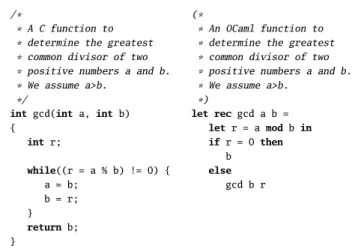
Figure 1.1: C is an imperative programming language, while OCaml is functional. The code on the left is a C program to compute the greatest common divisor of two natural numbers. The code on the right is equivalent OCaml code, written functionally.
• ML implements apattern matchingmechanism that unifies case analysis and data destructors.
• ML includes an expressivemodule systemthat allows data structures to be spec-ified and definedabstractly. The module system includesfunctors, which are are functions over modules that can be used to produce one data structure from an-other.
• OCaml is also the only widely-available ML implementation to include an ob-ject system. The module system and object system complement one another: the module system provides data abstraction, and the object system provides in-heritance and re-use.
• OCaml includes a compiler that supportsseparate compilation. This makes the development process easier by reducing the amount of code that must be recom-piled when a program is modified. OCaml actually includes two compilers: a
byte-codecompiler that produces code for the portable OCaml byte-code inter-preter, and anative-codecompiler that produces efficient code for many machine architectures.
CHAPTER 1. INTRODUCTION1.1. FUNCTIONAL AND IMPERATIVE LANGUAGES
1.1 Functional and imperative languages
The ML languages are mostly functional, meaning that the normal programming style is functional, but the language includes assignment and side-effects.
To compare ML with an imperative language, a comparison of two simple imple-mentations of Euclid’s algorithm is shown in Figure 1.1 (Euclid’s algorithm computes the greatest common divisor of two nonnegative integers). In a language like C, the algorithm is normally implemented as a loop, and progress is made by modifying the state. Reasoning about this program requires that we reason about the program state: give an invariant for the loop, and show that the state makes progress on each step toward the goal.
In OCaml, Euclid’s algorithm is normally implemented using recursion. The steps are the same, but there are no side-effects. The letkeyword specifies a definition, the reckeyword specifies that the definition is recursive, and thegcd a b defines a function with two argumentsaandb.
In ML, programs rarely use assignment or side-effects except for I/O. Pure func-tional programs have some nice properties: one is that data structures arepersistent, which means that no data structure is ever destroyed.
There are problems with taking too strong a stance in favor of pure functional pro-gramming. One is that every updatable data structure has to be passed as an argument to every function that uses it (this is called threadingthe state). This can make the code obscure if there are too many of these data structures. We take an intermediate approach. We use imperative code when necessary, but we encourage the use of pure functional approach whenever appropriate.
1.2 Organization
This book is organized as auser guideto programming in OCaml. It is not a reference manual: there is already an online reference manual. We assume that the reader already has some experience using an imperative programming language like C; we’ll point out the differences between ML and C in the cases that seem appropriate.
1.3 Additional Sources of Information
This book was originally used for a course in compiler construction at Caltech. The course material, including exercises, is available at http://www.cs.caltech.edu/ courses/cs134/cs134b.
The OCaml reference manual [5] is available on the OCaml home pagehttp:// www.ocaml.org/.
Chapter 2
Simple Expressions
Most functional programming implementations include a runtime environment that de-fines a standard library and a garbage collector. They also often include an evaluator that can be used to interact with the system, called atoploop. OCaml provides a com-piler, a runtime, and a toploop. By default, the toploop is calledocaml. The toploop
prints a prompt (#), reads an input expression, evaluates it, and prints the result .
Ex-pressions in the toploop are terminated by a double-semicolon ‘;;’.
% ocaml
Objective Caml version 3.10.0
#1 + 4;;
- : int = 5
#
The toploop prints the type of the result (in this case,int) and the value (5). To exit
the toploop, you may type the end-of-file character (usually Control-D when using a Unix1system, and Control-Z when using a Microsoft Windows system).
2.1 Comment convention
In OCaml, comments are enclosed in matching(* and*) pairs. Comments may be
nested, and the comment is treated as white space.
#1 (* this is a comment *)+ 4;;
- : int = 5
2.2 Basic expressions
OCaml is a strongly typedlanguage. In OCaml every valid expression must have a type, and expressions of one type may not be used as expressions in another type.
2.2. BASIC EXPRESSIONS CHAPTER 2. SIMPLE EXPRESSIONS
Apart from polymorphism, which we discuss in Chapter 5, there are no implicit coer-cions. Normally, you do not have to specify the types of expressions. OCaml usestype inference[2] to figure out the types for you.
The primitive types areunit,int,char,float,bool, andstring.
2.2.1
unit: the singleton type
The simplest type in OCaml is theunittype, which contains one element: (). This type seems to be a rather silly. However, in a functional language every function must return a value; () is commonly used as the value of a procedure that computes by side-effect. It corresponds to the typevoidin C.
2.2.2
int: the integers
The typeintis the type of signed integers: . . . ,−2,−1,0,1,2, . . . The precision is
finite. Integer values are represented by a machine word, minus one bit that is reserved for use by the runtime (for garbage collection), so on a 32-bit machine architecture, the precision is 31 bits, and on a 64-bit architecture, the precision is 63 bits.
Integers are usually specified in decimal, but there are several alternate forms. In the following table the symbolddenotes a decimal digit (‘0’..‘9’);odenotes an octal digit (‘0’..‘7’);bdenotes a binary digit (‘0’ or ‘1’); andhdenotes a hexadecimal digit (‘0’..‘9’, or ‘a’..‘f’, or ‘A’..‘F’).
ddd . . . anintliteral specified in decimal. 0oooo . . . anintliteral specified in octal. 0bbbb . . . anintliteral specified in binary. 0xhhh . . . anintliteral specified in hexadecimal.
There are the usual operations onints, including arithmetic and bitwise operations.
-ior~-i negation.
i + j addition. i - j subtraction. i * j multiplication. i / j division. i mod j remainder. lnot i bitwise-inverse. i lsl j logical shift lefti×2j.
i lsr j logical shift rightbi÷2jc(iis treated as an unsigned integer).
i asl j arithmetic shift lefti×2j.
i asr j arithmetic shift rightbi÷2jc(the sign ofiis preserved).
i land j bitwise-and.
i lor j bitwise-or.
i lxor j bitwise exclusive-or.
CHAPTER 2. SIMPLE EXPRESSIONS 2.2. BASIC EXPRESSIONS
#12345 + 1;;
- : int = 12346
#0b1110 lxor 0b1010;;
- : int = 4
#1 - - 2;;
- : int = 3
#0x7fffffff;;
- : int = -1
#0xffffffff;;
Characters 0-10: 0xffffffff;; ^^^^^^^^^^
Integer literal exceeds the range of representable integers of type int
2.2.3
float: the floating-point numbers
The floating-point numbers provide dynamically scaled “floating point” numbers. The syntax of a floating point requires a decimal point, an exponent (base 10) denoted by an ‘E’ or ‘e’, or both. A digit is required before the decimal point, but not after. Here
are a few examples:
0.2, 2e7, 3.1415926, 31.415926E-1, 2.
The integer arithmetic operators (+,-,*, /,. . .)do not workwith floating point values.
The operators for floating-point numbers include a ‘.’ as follows:
-.xor~-.x floating-point negation
x +. y floating-point addition.
x -. y floating-point subtraction.
x *. y float-point multiplication. x /. y floating-point division.
int_of_float x floattointconversion.
float_of_int x inttofloatconversion.
Here are some example floating-point expressions.
#31.415926e-1;;
- : float = 3.1415926
#float_of_int 1;;
- : float = 1.
#int_of_float 1.2;;
- : int = 1
#3.1415926 *. 17.2;;
- : float = 54.03539272
#1 + 2.0;;
Characters 4-7:
1 + 2.0;; ^^^
This expression has type float but is here used with type int
2.2. BASIC EXPRESSIONS CHAPTER 2. SIMPLE EXPRESSIONS
2.2.4
char: the characters
The character typecharspecifies characters from the ASCII character set. The syntax
for a character constants uses the single quote symbol’c’.
’a’, ’Z’, ’ ’, ’W’
In addition, there are several kinds of escape sequences with an alternate syntax. Each escape sequence begins with the backslash character “\”.
’\\’ The backslash character itself. ’\’’ The single-quote character. ’\t’ The tab character.
’\r’ The carriage-return character.
’\n’ The newline character.
’\b’ The backspace character.
’\ddd’ A decimal escape sequence.
’\xhh’ A hexadecimal escape sequence.
A decimal escape sequence must have exactly three decimal charactersd; it specifies the ASCII character with the given decimal code. A hexadecimal escape sequence must have exactly two hexadecimal charactersh.
’a’, ’Z’, ’\120’, ’\t’, ’\n’, ’\x7e’
There are functions for converting between characters and integers. The function
Char.codereturns the integer corresponding to a character, andChar.chrreturns the character with the given ASCII code. TheChar.lowercaseandChar.uppercase
func-tions give the equivalent lower- or upper-case characters.
# ’\120’;;
- : char = ’x’
# Char.code ’x’;;
- : int = 120
# ’\x7e’;;
- : char = ’~’
# Char.uppercase ’z’;;
- : char = ’Z’
# Char.uppercase ’[’;;
- : char = ’[’
# Char.chr 33;;
- : char = ’!’
2.2.5
string: character strings
In OCaml, character strings belong to a primitive typestring. Unlike strings in C,
character strings are not arrays of characters, and they do not use the null-character
’\000’for termination.
The syntax for strings uses the double-quote symbol"as a delimiter. Characters in
CHAPTER 2. SIMPLE EXPRESSIONS 2.2. BASIC EXPRESSIONS
"Hello", "The character ’\000’ is not a terminator", "\072\105"
The operator^performs string concatenation.
#"Hello " ^ " world\n";;
- : string = "Hello world\n"
#"The character ’\000’ is not a terminator";;
- : string = "The character ’\000’ is not a terminator"
#"\072\105";;
- : string = "Hi"
Strings also support random access. The expressions.[i]returns thei’th from string
s; and the expressions.[i] <- creplaces thei’th in stringsby characterc, returning aunitvalue. TheString module (see Section 8.3) also defines many functions to manipulate strings, including theString.lengthfunction, which returns the length of a string; and theString.subfunction, which returns a substring.
#"Hello".[1];;
- : char = ’e’
#"Hello".[0] <- ’h’;;
- : unit = ()
#String.length "Ab\000cd";;
- : int = 5
#String.sub "Abcd" 1 2;;
- : string = "bc"
2.2.6
bool: the Boolean values
The bool type includes the Boolean values true and false. Logical negation of Boolean values is performed by thenotfunction.
There are several relations that can be used to compare values, returningtrueif the comparison holds andfalseotherwise.
x = y xis equal toy.
x == y xis “identical” toy.
x != y xis not “identical” toy.
x <> y xis not equal toy.
x < y xis less thany.
x <= y xis no greater thany.
x >= y xis no less thany.
x > y xis greater thany.
These relations operate on two valuesxandy having equal but arbitrary type. For the primitive types in this chapter, the comparison is what you would expect. For values of other types, the value is implementation-dependent, and in some cases may raise a runtime error. For example, functions (discussed in the next chapter) cannot be compared.
The==deserves special mention, since we use the word “identical” in an informal
2.3. OPERATOR PRECEDENCES CHAPTER 2. SIMPLE EXPRESSIONS
so does the expression “x=y”. However it is still possible for “x=y” to betrueeven
if “x==y” is not. In the OCaml implementation from INRIA, the expression “x== y”evaluates totrueonly if the two valuesxandyare exactly the same value, similar to the==operators in C/Java, or the functioneq?operator in Scheme. The comparison
==is a constant-time operation that runs in a bounded number of machine instructions; the comparison=is not.
# 2 < 4;;
- : bool = true
# "A good job" > "All the tea in China";;
- : bool = false
# 2 + 6 = 8;;
- : bool = true
# 1.0 = 1.0;;
- : bool = true
# 1.0 == 1.0;;
- : bool = false
# 2 == 1 + 1;;
- : bool = true
Strings are compared lexicographically (in alphabetical-order), so the second example isfalsebecause the character ‘l’ is greater than the space-character ‘ ’ in the ASCII character set. The comparison “1.0 == 1.0” in this case returnsfalse(because the 2 floating-point numbers are represented by different values in memory), but it performs normal comparison onintvalues.
There are two logical operators: &&is conjunction (which can also be written&), and||is disjunction (which can also be writtenor). Both operators are the “short-circuit” versions: the second clause is not evaluated if the result can be determined from the first clause.
# 1 < 2 || (1 / 0) > 0;;
- : bool = true
# 1 < 2 && (1 / 0) > 0;;
Exception: Division_by_zero.
# 1 > 2 && (1 / 0) > 0;;
- : bool = false
Conditionals are expressed with the syntax if b then e1 else e2.
# if 1 < 2then 3 + 7 else
4;;
- : int = 10
2.3 Operator precedences
CHAPTER 2. SIMPLE EXPRESSIONS 2.4. THE OCAML TYPE SYSTEM
Operators Associativity
|| && left
= == != <> < <= > >= left
+ - +. -. left
* / *. /. mod land lor lxor left
lsl lsr asr right
lnot left
~- - ~-. -. right
2.4 The OCaml type system
The ML languages are statically and strictly typed. In addition, every expression has a exactly one type. In contrast, C is a weakly-typed language: values of one type can usually be coerced to a value of any other type, whether the coercion makes sense or not. Lisp is a language that is dynamically and strictly typed: the compiler (or interpreter) will accept any program that is syntactically correct; the types are checked at run time. The strictly typed languages are safe; both Lisp and ML aresafelanguages, but C is not.
What is “safety?” There is a formal definition based on the operational semantics of the programming language, but an approximate definition is that a valid program will never fault because of an invalid machine operation. All memory accesses will be valid. ML guarantees safety by proving that every program that passes the type checker can never produce a machine fault, and Lisp guarantees it by checking for validity at run time. One surprising (some would say annoying) consequence is that ML has no
nilorNULLvalues; these would potentially cause machine errors if used where a value is expected.
As you learn OCaml, you will initially spend a lot of time getting the OCaml type checker to accept your programs. Be patient, you will eventually find that the type checker is one of your best friends. It will help you figure out where errors may be lurking in your programs. If you make a change, the type checker will help track down the parts of your program that are affected. In the meantime, here are some rules about type checking.
1. Every expression has exactly one type.
2. When an expression is evaluated, one of four things may happen:
(a) it may evaluate to avalueof the same type as the expression, (b) it may raise an exception (we’ll discuss exceptions in Chapter 9), (c) it may not terminate,
(d) it may exit.
One of the important points here is that there are no “pure commands.” Even assign-ments produce a value—although the value has the trivialunittype.
2.5. COMPILING YOUR CODE CHAPTER 2. SIMPLE EXPRESSIONS
% cat -b x.ml
1 if 1 < 2 then
2 1
3 else
4 1.3
% ocamlc -c x.ml
File "x.ml", line 4, characters 3-6:
This expression has type float but is here used with type int
This error message seems rather cryptic: it says that there is a type error on line 4, characters 3-6 (the expression1.3). The conditional expression evaluates the test. If the
test istrue, it evaluates the first branch. Otherwise, it evaluates the second branch. In
general, the compiler doesn’t try to figure out the value of the test during type checking. Instead, it requires that both branches of the conditional have the same type (so that the value will have the same type no matter how the test turns out). Since the expressions
1and1.3have different types, the type checker generates an error.
One other issue: theelsebranch is not required in a conditional. If it is omitted, the conditional is treated as if theelsecase returns the()value. The following code has a type error.
% cat -b y.ml
1 if 1 < 2 then
2 1
% ocamlc -c y.ml
File "y.ml", line 2, characters 3-4:
This expression has type int but is here used with type unit
In this case, the expression1is flagged as a type error, because it does not have the same type as the omittedelsebranch.
2.5 Compiling your code
You aren’t required to use the toploop for all your programs. In fact, as your programs become larger, you will begin to use the toploop less, and rely more on the OCaml compilers. Here is a brief introduction to using the compiler; more information is given in the Chapter 11.
If you wish to compile your code, you should place it in a file with the.mlsuffix. In INRIA OCaml, there are two compilers:ocamlccompiles to byte-code, andocamlopt
compiles to native machine code. The native code is several times faster, but compile time is longer. The usage is similar tocc. The double-semicolon terminators are not necessary in.mlsource files; you may omit them if the source text is unambiguous.
• To compile a single file, useocamlc -g -c file.ml. This will produce a file file.cmo. Theocamlopt programs produces a filefile.cmx. The -goption causes debugging information to be included in the output file.
• To link together several files into a single executable, useocamlcto link the.cmo
CHAPTER 2. SIMPLE EXPRESSIONS 2.5. COMPILING YOUR CODE
% ocamlc -g -o program x.cmo y.cmo % ./program
...
There is also a debuggerocamldebugthat you can use to debug your programs. The
2.6. EXERCISES CHAPTER 2. SIMPLE EXPRESSIONS
2.6 Exercises
Exercise 2.1 For each of the following expressions, is the expression well-typed? If it is well-typed, does it evaluate to a value? If so, what is the value?
1. 1 - 2
2. 1 - 2 - 3
3. 1 - - 2
4. 0b101 + 0x10
5. 1073741823 + 1
6. 1073741823.0 + 1e2
7. 1 ^ 1
8. if true then 1
9. if false then ()
10. if 0.3 -. 0.2 = 0.1 then ’a’ else ’b’
11. true || (1 / 0 >= 0)
12. 1 > 2 - 1
13. "Hello world".[6]
14. "Hello world".[11] <- ’s’
15. String.lowercase "A" < "B"
16. Char.code ’a’
17. (((())))
18. ((((*1*))))
Chapter 3
Variables and Functions
So far, we have considered only simple expressions not involving variables. In ML, variables arenamesfor values. Variable bindings are introduced with theletkeyword.
The syntax of a simple top-level definition is as follows.
let identifier = expression
For example, the following code defines two variablesxandyand adds them together
to get a value forz.
# letx = 1;;
val x : int = 1
# lety = 2;;
val y : int = 2
# letz = x + y;;
val z : int = 3
Definitions usingletcan also be nested using theinform.
let identifier = expression1 in expression2
The expressionexpression2is called thebodyof thelet. The variable namedidentifier is defined as the value ofexpression1within the body. Theidentifieris defined only in the bodyexpression2and notexpression1.
Aletwith a body is an expression; the value of aletexpression is the value of the body.
# letx = 1in let y = 2in x + y;;
- : int = 3
# letz = let x = 1 in let y = 2 in x + y;;
3.1. FUNCTIONS CHAPTER 3. VARIABLES AND FUNCTIONS
Binding is static (lexical scoping), meaning that the value associated with a variable is determined by the nearest enclosing definition in the program text. For example, when a variable is defined in aletexpression, the defined value is used within the body of the let (or the rest of the file for toplevelletdefinitions). If the variable was defined previously, the previous definition is shadowed, meaning that the previous definition becomes inaccessible while the new definition is in effect.
For example, consider the following program, where the variablexis initially de-fined to be7. Within the definition fory, the variablexis redefined to be2. The value ofxin the final expressionx + yis still7, and the final result is10.
# let x = 7in let y =
let x = 2in x + 1 in
x + y;;
- : int = 10
Similarly, the value ofzin the following program is 8, because of the definitions that double the value ofx.
# let x = 1;;
val x : int = 1
# let z =
let x = x + xin let x = x + xin
x + x;;
val z : int = 8
# x;;
- : int = 1
3.1 Functions
Functions are defined with the keywordfun.
fun v1 v2 · · · vn -> expression
Thefunis followed by a sequence of variables that define the formal parameters of the function, the->separator, and then the body of the functionexpression. By default, functions are anonymous, meaning they are not named. In ML, functions are values like any other. Functions may be constructed, passed as arguments, and applied to arguments, and, like any other value, they may be named by using alet.
# let increment = fun i -> i + 1;;
val increment : int -> int = <fun>
CHAPTER 3. VARIABLES AND FUNCTIONS 3.1. FUNCTIONS
The syntax for function application (function call) is concatenation: the function is followed by its arguments. The precedence of function application is higher than most operators. Parentheses are required only for arguments that are not simple expressions.
#increment 2;;
- : int = 3
#increment 2 * 3;;
- : int = 9
#increment (2 * 3);;
- : int = 7
The keywordsbegin · · · endare equivalent to parentheses.
#incrementbegin 2 * 3end;;
- : int = 7
Functions may also be defined with multiple arguments. For example, a function to compute the sum of two integers might be defined as follows.
# letsum =fun i j -> i + j;;
val sum : int -> int -> int = <fun>
#sum 3 4;;
- : int = 7
Note the type for sum: int -> int -> int. The arrow associates to the right, so this type is the same asint -> (int -> int). That is,sumis a function that takes a single integer argument, and returns a function that takes another integer argument and returns an integer. Strictly speaking, all functions in ML take a single argument; multiple-argument functions are treated asnestedfunctions (this is called “Currying,” after Haskell Curry, a famous logician who had a significant impact on the design and interpretation of programming languages). The definition ofsumabove is equivalent to
the following explicitly-curried definition.
# letsum = (fun i -> (funj -> i + j));;
val sum : int -> int -> int = <fun>
#sum 4 5;;
- : int = 9
The application of a multi-argument function to only one argument is called apartial application.
# letincr = sum 1;;
val incr : int -> int = <fun>
#incr 5;;
- : int = 6
Since named functions are so common, OCaml provides an alternative syntax for func-tions using a letdefinition. The formal parameters of the function are listed in a
let-definition after to the function name, before the equality symbol.
let identifier v1 v2 · · · vn = expression
For example, the following definition of the sumfunction is equivalent to the ones
3.1. FUNCTIONS CHAPTER 3. VARIABLES AND FUNCTIONS
# let sum i j = i + j;;
val sum : int -> int -> int = <fun>
3.1.1 Scoping and nested functions
Functions may be arbitrarily nested. They may also be passed as arguments. The rule for scoping uses static binding: the value of a variable is determined by the code in which a function is defined—not by the code in which a function is evaluated. For example, another way to definesumis as follows.
# let sum i = let sum2 j =
i + j in
sum2;;
val sum : int -> int -> int = <fun>
# sum 3 4;;
- : int = 7
To illustrate the scoping rules, let’s consider the following definition.
# let i = 5;;
val i : int = 5
# let addi j = i + j;;
val addi : int -> int = <fun>
# let i = 7;;
val i : int = 7
# addi 3;;
- : val = 8
In theaddifunction, the previous binding definesias5. The second definition ofihas no effect on the definition used foraddi, and the application ofaddito the argument3
results in3 + 5 = 8.
3.1.2 Recursive functions
Suppose we want to define a recursive function: that is, a function that is used in its own definition. In functional languages, recursion is used to express repetition or looping. For example, the “power” function that computesximight be defined as follows.
# let rec power i x = if i = 0 then
1.0 else
x *. (power (i - 1) x);;
val power : int -> float -> float = <fun>
# power 5 2.0;;
- : float = 32
CHAPTER 3. VARIABLES AND FUNCTIONS 3.1. FUNCTIONS
# letpower_broken i x = if i = 0 then
1.0 else
x *. (power_broken (i - 1) x);;
Characters 70-82:
x *. (power_broken (i - 1) x);; ^^^^^^^^^^^^
Unbound value power_broken
Mutually recursive definitions (functions that call one another) can be defined using theandkeyword to connect severalletdefinitions.
# let recf i j = if i = 0 then
j else
g (j - 1) and g j =
if j mod 3 = 0then j
else
f (j - 1) j;;
val f : int -> int -> int = <fun> val g : int -> int = <fun>
#g 5;;
- : int = 3
3.1.3 Higher order functions
Let’s consider a definition where a function is passed as an argument, and another function is returned as a result. Given an arbitrary functionfon the real numbers, an approximate numerical derivative can be defined as follows.
# letdx = 1e-10;;
val dx : float = 1e-10
# letderiv f =
(fun x -> (f (x +. dx) -. f x) /. dx);;
val deriv : (float -> float) -> float -> float = <fun>
Remember, the arrow associates to the right, so another way to write the type is
(float -> float) -> (float -> float). That is, the derivative is a function that takes a function as an argument, and returns another function.
Let’s apply thederivfunction to the powerfunction defined above, partially
ap-plied to the argument 3.
# letf = power 3;;
val f : float -> float = <fun>
#f 10.0;;
- : float = 1000
# letf’ = deriv f;;
val f’ : float -> float = <fun>
#f’ 10.0;;
3.2. VARIABLE NAMES CHAPTER 3. VARIABLES AND FUNCTIONS
# f’ 5.0;;
- : float = 75.0000594962
# f’ 1.0;;
- : float = 3.00000024822
As we would expect, the derivative of x3 is approximately3x2. To get the second derivative, we apply thederivfunction tof’.
# let f’’ = deriv f’;;
val f’’ : float -> float = <fun>
# f’’ 0.0;;
- : float = 6e-10
# f’’ 1.0;;
- : float = 0
# f’’ 10.0;;
- : float = 0
The second derivative, which we would expect to be6x, is way off! Ok, there are some numerical errors here.
# let g x = 3.0 *. x *. x;;
val g : float -> float = <fun>
# let g’ = deriv g;;
val g’ : float -> float = <fun>
# g’ 1.0;;
- : float = 6.00000049644
# g’ 10.0;;
- : float = 59.9999339101
3.2 Variable names
As you may have noticed in the previous section, the single quote symbol (’) is a valid
character in a variable name. In general, a variable name may contain letters (lower and upper case), digits, and the’and_characters, but it must begin with a lowercase
letter or the underscore character, and it may not be an underscore_all by itself. In OCaml, sequences of characters from the infix operators, like +, -, *, /, . . .
are also valid names. The normal prefix version is obtained by enclosing them in parentheses. For example, the following code is a starting point for an Obfuscated ML contest. Don’t use this style in your code.
# let (+) = ( * ) and (-) = (+) and ( * ) = (/) and (/) = (-);;
val + : int -> int -> int = <fun> val - : int -> int -> int = <fun> val * : int -> int -> int = <fun> val / : int -> int -> int = <fun>
# 5 + 4 / 1;;
- : int = 15
com-CHAPTER 3. VARIABLES AND FUNCTIONS3.3. LABELED PARAMETERS AND ARGUMENTS
ment conventions—comments start with(*and end with*).
The redefinition of infix operators may make sense in some contexts. For example, a program module that defines arithmetic over complex numbers may wish to redefine the arithmetic operators. It is also sensible to add new infix operators. For example, we may wish to have an infix operator for thepowerconstruction.
# let( ** ) x i = power i x;;
val ** : float -> int -> float = <fun>
#10.0 ** 5;;
- : float = 100000
The precedence and associativity of new infix operators is determined by its first char-acter in the operator name. For example an operator named+/-would have the same
precedence and associativity as the+operator.
3.3 Labeled parameters and arguments
OCaml allows functions to have labeled and optional parameters and arguments. La-beled parameters are specified with the syntax~label: pattern. Labeled arguments are
similar,~label: expression. Labels have the same syntactic conventions as variables:
the label must begin with a lowercase letter or an underscore_.
# letf ~x:i ~y:j = i - j;;
val f : x:int -> y:int -> int = <fun>
#f ~y:1 ~x:2;;
- : int = 1
#f ~y:1;;
- : x:int -> int = <fun>
Within the type, a type expression of the formlabel: typespecifies a labeled function parameter.
When all parameters are labeled, the order of the arguments does not matter, so the expressionf ~y:1applies the function fto the argument labeled~y(the second argument), returning a function that expects an argument labeled~x.
Since labels are frequently the same as the parameter names, OCaml provides a shorthand where a parameter~labelspecifies both the parameter and label. Similarly, an argument~labelrepresents both the label and the argument (a variable with the same
name).
# letf ~x ~y = x - y;;
val f : x:int -> y:int -> int = <fun>
# lety = 1in let x = 2in f ~y ~x;;
- : int = 1
Optional parameters are like labeled parameters, using question mark ?instead of a
tilde~and specifying an optional value with the syntax?(label = expression).
3.3. LABELED PARAMETERS AND ARGUMENTSCHAPTER 3. VARIABLES AND FUNCTIONS
# let g ?(x = 1) y = x - y;;
val g : ?x:int -> int -> int = <fun>
# g 1;;
- : int = 0
# g ~x:3 4;;
- : int = -1
3.3.1 Rules of thumb
Labeled, unlabeled, and optional arguments can be mixed in many different combina-tions. However, there are some rules of thumb to follow.
• An optional parameter should always be followed by a non-optional parameter (usually unlabeled).
• The order of labeled arguments does not matter, except when a label occurs more than once.
• Labeled and optional arguments should be specified explicitly for higher-order functions.
The reason for following an optional parameter with an unlabeled one is that, oth-erwise, it isn’t possible to know when an optional argument has been omitted. The compiler produces a warning for function definitions with a final optional parameter.
# let f ~x ?(y = 1) = x - y;;
Characters 15-16:
Warning X: this optional argument cannot be erased. let f ~x ?(y = 1) = x - y;;
^
val f : x:int -> ?y:int -> int = <fun>
There is a slight difference between labeled and unlabeled arguments with respect to optional arguments. When an optional argument is followed only by labeled arguments, then it is no longer possible to omit the argument. In contrast, an unlabeled argument “forces” the omission.
# let add1 ?(x = 1) ~y ~z = x + y + z;;
val add1 : ?x:int -> y:int -> z:int -> int = <fun>
# add1 ~y:2 ~z:3;;
- : ?x:int -> int = <fun>
# let add2 ?(x = 1) ~y z = x + y + z;;
val add2 : ?x:int -> y:int -> int -> int = <fun>
# add2 ~y:2 3;;
- : int = 6
It is legal for a label to occur more than once in an argument list. If it does, then the arguments with that label are bound in the same order as the corresponding parameters.
# let h ~x:i ~x:j ?(y = 1) ~z = i * 1000 + j * 100 + y * 10 + z;;
val h : x:int -> x:int -> ?y:int -> z:int -> int = <fun>
# h ~z:3 ~x:4 ~y:5 ~x:6;;
CHAPTER 3. VARIABLES AND FUNCTIONS3.3. LABELED PARAMETERS AND ARGUMENTS
For the final rule, explicit annotation for higher-order functions, consider the following definition of a functionapply.
# letapply g = g ~x:1 2 + 3;;
val apply : (x:int -> int -> int) -> int = <fun>
Note that the compiler infers that the function~ghas a labeled, not an optional
argu-ment. The syntaxg ~x:1is the same, regardless of whether the labelxis labeled or
optional, but the two are not the same.
#apply (fun ?(x = 0) y -> x + y);;
Characters 6-31:
apply (fun ?(x = 0) y -> x + y);; ^^^^^^^^^^^^^^^^^^^^^^^^^
This function should have type x:int -> int -> int but its first argument is labeled ~?x
The compiler will always prefer to infer that an argument is labeled, not optional. If you want the other behavior, you can specify the type explicitly.
# letapply (g : ?x:int -> int -> int) = g ~x:1 2 + 3;;
val apply : (?x:int -> int -> int) -> int = <fun>
#apply (fun ?(x = 0) y -> x + y);;
3.4. EXERCISES CHAPTER 3. VARIABLES AND FUNCTIONS
3.4 Exercises
Exercise 3.1 Which of the following let-expressions is legal? For each expression that is legal, give its type and the value that it evaluates to. Otherwise, explain why the expression is not legal.
1. let x = 1 in x
2. let x = 1 in let y = x in y
3. let x = 1 and y = x in y
4. let x = 1 and x = 2 in x
5. let x = 1 in let x = x in x
6. let a’ = 1 in a’ + 1
7. let ’a = 1 in ’a + 1
8. let a’b’c = 1 in a’b’c
9. let x x = x + 1 in x 2
10. let rec x x = x + x in x 2
11. let (++) f g x = f (g x) in let f x = x + 1 in
let g x = x * 2 in
(f ++ g) 1
12. let (-) x y = y - x in 1 - 2 - 3
13. let rec (-) x y = y - x in 1 - 2 - 3
14. let (+) x y z = x + y + z in 5 + 6 7
15. let (++) x = x + 1 in ++x
Exercise 3.2 What are the values of the following expressions?
1. let x = 1 in let x = x + 1 in x
2. let x = 1 in let f y = x in let x = 2 in
f 0
3. let f x = x - 1 in let f x = f (x - 1) in
CHAPTER 3. VARIABLES AND FUNCTIONS 3.4. EXERCISES
4. let y = 2 in let f x = x + y in
let f x = let y = 3 in f y in
f 5
5. let rec factorial i =
if i = 0 then 1 else i * factorial (i - 1)
in
factorial 5
Exercise 3.3 Write a functionsumthat, given two integer boundsnandmand a function f, computes a summation.
sum n m f = Pmi=nf(i).
Exercise 3.4 Euclid’s algorithm computes the greatest common divisor (GCD) of two integers. It is one of the oldest known algorithms, appearing in Euclid’sElementsin roughly 300 BC. It can be defined in pseudo-code as follows, where ←represents assignment.
gcd(n, m) = whilem6= 0
if n > m n←n−m else
m←m−n return n
Write an OCaml function %% that computes the GCD using Euclid’s algorithm (so n %% mis the GCD of the integersnandm). You should define it without assignment, as
a recursive function. [Note, this is Euclid’s original definition of the algorithm. More modern versions usually use a modulus operation instead of subtraction.]
Exercise 3.5 Suppose you have a function on integersf : int -> intthat is
mono-tonically increasing over some range of arguments from 0 up to n. That is, f i < f (i + 1)for any 0 ≤ i < n. In additionf 0 < 0 andf n > 0. Write a
functionsearch f nthat finds the smallest argumentiwheref i ≥ 0.
Exercise 3.6 Adictionaryis a data structure that represents a map from keys to values. A dictionary has three operations.
• empty : dictionary
• add : dictionary -> key -> value -> dictionary
• find : dictionary -> key -> value
The valueemptyis an empty dictionary; the expressionadd dict key valuetakes an
existing dictionarydictand augments it with a new bindingkey -> value; and the
3.4. EXERCISES CHAPTER 3. VARIABLES AND FUNCTIONS
One way to implement a dictionary is to represent it as a function from keys to values. Let’s assume we are building a dictionary where the key type isstring, the
value type isint, and the empty dictionary maps every key to zero. This dictionary can be implemented abstractly as follows, where we write7→for the map from keys to values.
empty = key7→0
add(dict,key, v) = key07→
½
v ifkey0=key
dict(key) otherwise
find(dict,key) = dict(key)
1. Implement the dictionary in OCaml.
2. Suppose we have constructed several dictionaries as follows.
let dict1 = add empty "x" 1 let dict2 = add dict1 "y" 2 let dict3 = add dict2 "x" 3 let dict4 = add dict3 "y" 4
What are the values associated with"x"and"y"in each of the four dictionaries?
Exercise 3.7 Partial application is sometimes used to improve the performance of a multi-argument function when the function is to be called repeatedly with one or more of its arguments fixed. Consider a functionf(x, y)that is to be called multiple times withxfixed. First, the function must be written in a formf(x, y) =h(g(x), y)from some functionsgandh, wheregrepresents the part of the computation that uses only the valuex. We then write it in OCaml as follows.
let f x =
let z = g(x) in fun y ->h(z, y)
Callingf on its first argument computesg(x)and returns a function that uses the value (without re-computing it).
Consider one root of a quadratic equation ax2+bx+c = 0 specified by the quadratic formula r(a, b, c) = −b+√b2−4ac
2a . Suppose we wish to to evaluate the
quadratic formula for multiple values of awith b andc fixed. Write a function to compute the formula efficiently.
Exercise 3.8 Astreamis an infinite sequence of values supporting an operationhd(s)
that returns the first value in the streams, andtl(s)that returns a new stream with the first element removed.
One way to implement a stream is to represent it as a function over the nonnegative integers. Given a streams : int -> int, the first element is(s 0), the second is
(s 1),etc. The operations are defined as follows.
let hd s = s 0
CHAPTER 3. VARIABLES AND FUNCTIONS 3.4. EXERCISES
For this exercise, we’ll assume that we’re working with streams of integers, so the type
streamisint -> int. We’ll write a stream as a sequence(x0, x1, x2, . . .).
1. Define the following stream functions.
• (+:) : stream -> int -> stream. Add a constant to a stream. (x0, x1, x2, . . .) +: c = (x0+c, x1+c, x2+c, . . .).
• (-|) : stream -> stream -> stream. Subtract two streams pointwise.
(x0, x1, x2, . . .) -| (y0, y1, y2, . . .) = (x0−y0, x1−y1, x2−y2. . . .). • map : (int -> int) -> stream -> stream.
Apply a function to each element of the stream.
map f (x0, x1, x2, . . .) = (f x0, f x1, f x2, . . .).
2. A “derivative” function can be defined as follows.
let derivative s = tl s -| s
Chapter 4
Basic pattern matching
One of ML’s more powerful features is the use ofpattern matchingto define computa-tion by case analysis. Pattern matching is specified by amatchexpression, which has
the following syntax.
matchexpression with | pattern1 -> expression1
| pattern2 -> expression2
. . .
| patternn -> expressionn
The first vertical bar|is optional.
When amatchexpression is evaluated, the expressionexpression to be matched is first evaluated, and its value is compared with the patterns in order. If patterni is
the first pattern to match the value, then the expressionexpressioni is evaluated and
returned as the result of thematch.
A simple patternis an expression made of constants and variables. A constant pattern c matches values that are equal to it, and a variable patternx matches any expression. A variable patternxis a binding occurrence; when the pattern match is successful, the variablexis bound the the value being matched.
For example, Fibonacci numbers can be defined succinctly using pattern matching. Fibonacci numbers are defined inductively: fib 0 = 0,fib 1 = 1, and for all other
natural numbersi,fib i = fib (i - 1) + fib (i - 2).
# let recfib i = match iwith
0 -> 0 | 1 -> 1
| j -> fib (j - 2) + fib (j - 1);;
val fib : int -> int = <fun>
#fib 1;;
- : int = 1
#fib 2;;
- : int = 1
#fib 3;;
4.1. FUNCTIONS WITH MATCHINGCHAPTER 4. BASIC PATTERN MATCHING
# fib 6;;
- : int = 8
In this code, the argumentiis compared against the constants 0 and 1. If either of these cases match, the return value is equal toi. The final pattern is the variablej, which matches any argument. When this pattern is reached,jtakes on the value of the argument, and the bodyfib (j - 2) + fib (j - 1)computes the returned value.
Note that variables occurring in a pattern are always binding occurrences. For example, the following code produces a result you might not expect. The first case matches all expressions, returning the value matched. The toploop issues a warning for the second and third cases.
# let zero = 0;; # let one = 1;; # let rec fib i =
matchi with zero -> zero | one -> one
| j -> fib (j - 2) + fib (j - 1);;
Characters 57-60:
Warning: this match case is unused. Characters 74-75:
Warning: this match case is unused. | one -> one
^^^
| j -> fib (j - 2) + fib (j - 1);; ^
val fib : int -> int = <fun>
# fib 1;;
- : int = 1
# fib 2002;;
- : int = 2002
4.1 Functions with matching
It is quite common for the body of an ML function to be a match expression. To
simplify the syntax somewhat, OCaml allows the use of the keywordfunction(instead
offun) to specify a function that is defined by pattern matching. Afunctiondefinition
is like afun, where a single argument is used in a pattern match. Thefibdefinition
usingfunctionis as follows.
# let rec fib =function 0 -> 0
| 1 -> 1
| i -> fib (i - 1) + fib (i - 2);;
val fib : int -> int = <fun>
# fib 1;;
- : int = 1
# fib 6;;
CHAPTER 4. BASIC PATTERN MATCHING 4.2. PATTERN EXPRESSIONS
4.2 Pattern expressions
Larger patterns can be constructed in several different ways. The vertical bar|can be
used to define achoicepatternpattern1 | pattern2that matches many value matching
pattern1orpattern2. For example, we can write the Fibonacci function somewhat more succinctly by combining the first two cases.
let recfib i = matchi with
(0 | 1) -> i
| i -> fib (i - 1) + fib (i - 2);;
val fib : int -> int = <fun>
The patternpattern as identifiermatches that same values as the patternpatternand
also binds the matched value to the identifier. For example, we can use this to shorten the Fibonacci definition further.
let recfib = function (0 | 1) as i -> i
| i -> fib (i - 1) + fib (i - 2);;
val fib : int -> int = <fun>
The keywordashas very low precedence; the patterns(0 | 1) as iand0 | 1 as i
are the same.
Patterns can also be qualified by a predicate with the form
pattern when expression. This matches the same values as the pattern pattern,
but only when the predicateexpressionevaluates totrue. The expression is evaluated
within the context of the pattern; all variables in the pattern are bound to their matched values. Continuing with our Fibonacci example, we get yet another version.
let recfib = function iwhen i < 2 -> i
| i -> fib (i - 1) + fib (i - 2);;
val fib : int -> int = <fun>
4.3 Values of other types
Patterns can also be used with values having the other basic types, like characters, strings, and Boolean values. In addition, multiple patterns can be used for a single body. For example, one way to check for capital letters is with the following function definition.
# letis_uppercase = function
’A’ | ’B’ | ’C’ | ’D’ | ’E’ | ’F’ | ’G’ | ’H’ | ’I’ | ’J’ | ’K’ | ’L’ | ’M’ | ’N’ | ’O’ | ’P’ | ’Q’ | ’R’ | ’S’ | ’T’ | ’U’ | ’V’ | ’W’ | ’X’ | ’Y’ | ’Z’ ->
true | c ->
false;;
4.3. VALUES OF OTHER TYPES CHAPTER 4. BASIC PATTERN MATCHING
# is_uppercase ’M’;;
- : bool = true
# is_uppercase ’m’;;
- : bool = false
It is rather tedious to specify the letters one at a time. OCaml also allows pattern ranges
c1..c2, wherec1andc2are character constants.
# let is_uppercase = function ’A’ .. ’Z’ ->true | c -> false;;
val is_uppercase : char -> bool = <fun>
# is_uppercase ’M’;;
- : bool = true
# is_uppercase ’m’;;
- : bool = false
Note that the pattern variablecin these functions acts as a “wildcard” pattern to handle all non-uppercase characters. The variable itself is not used in the bodyfalse. This is another commonly occurring structure, and OCaml provides a special pattern for cases like these. The _pattern (a single underscore character) is a wildcard pattern that matches anything. It is not a variable, so it can’t be used in an expression. The
is_uppercasefunction would normally be written this way.
# let is_uppercase = function ’A’ .. ’Z’ ->true | _ -> false;;
val is_uppercase : char -> bool = <fun>
# is_uppercase ’M’;;
- : bool = true
# is_uppercase ’m’;;
- : bool = false
The values being matched are not restricted to the basic scalar types like integers and characters. String matching is also supported, using the usual syntax.
# let names = function "first" -> "George" | "last" -> "Washington" | _ -> ""
val names : string -> string = <fun>
# names "first";;
- : string = "George"
# names "Last";;
- : string = ""
Matching against floating-point values is supported, but it is rarely used because of numerical issues. The following example illustrates the problem.
# match 4.3 -. 1.2 with 3.1 -> true | _ -> false;;
CHAPTER 4. BASIC PATTERN MATCHING 4.4. INCOMPLETE MATCHES
4.4 Incomplete matches
You might wonder about what happens if the match expression does not include pat-terns for all the possible cases. For example, what happens if we leave off the default case in theis_uppercasefunction?
# letis_uppercase = function ’A’ .. ’Z’ -> true;;
Characters 19-49:
Warning: this pattern-matching is not exhaustive. Here is an example of a value that is not matched: ’a’
val is_uppercase : char -> bool = <fun>
The OCaml compiler and toploop are verbose about inexhaustive patterns. They warn when the pattern match is inexhaustive, and even suggest a case that is not matched. An inexhaustive set of patterns is usually an error—what would happen if we applied theis_uppercasefunction to a non-uppercase character?
#is_uppercase ’M’;;
- : bool = true
#is_uppercase ’m’;;
Uncaught exception: Match_failure("", 19, 49)
Again, OCaml is fairly strict. In the case where the pattern does not match, it raises an
exception(we’ll see more about exceptions in Chapter 9). In this case, the exception means that an error occurred during evaluation (a pattern matching failure).
A word to the wise:heed the compiler warnings!The compiler generates warnings for possible program errors. As you build and modify a program, these warnings will help you find places in the program text that need work. In some cases, you may be tempted to ignore the compiler. For example, in the following function, we know that a complete match is not needed becausei mod 2is always0or1—it can’t be 2 as the compiler suggests.
# letis_odd i = match imod 2 with
0 -> false | 1 -> true;;
Characters 18-69:
Warning: this pattern-matching is not exhaustive. Here is an example of a value that is not matched: 2
val is_odd : int -> bool = <fun>
#is_odd 3;;
- : bool = true
#is_odd 12;;
- : bool = false
However,do notignore the warning! If you do, you will find that you begin to ignore