Full Research Paper
Open AccessAddress:
1Department of Medicinal Chemistry and Molecular Pharmacology, College of Pharmacy, Purdue University, West Lafayette, IN 47907, USA and 2National Institute of Mental Health, Psychoactive Drug Screening Program, Department of Pharmacology, School of Medicine, University of North Carolina, Chapel Hill, NC 27599, USA
Email:
David E. Nichols* - [email protected]
* Corresponding author
§ Tel 765-494-1461; fax 765 494-1414
Keywords:
cyclopropanation; diazomethane; hallucinogen; 5-HT2A agonist; receptor probe; trans-2-phenylcyclopropylamines
Beilstein J. Org. Chem. 2012, 8, 1705–1709. doi:10.3762/bjoc.8.194
Received: 14 June 2012 Accepted: 06 September 2012 Published: 08 October 2012
This article is part of the Thematic Series "Synthetic probes for the study of biological function".
Guest Editor: J. Aube
© 2012 Pigott et al; licensee Beilstein-Institut. License and terms: see end of document.
Abstract
A strategy to replace the ethylamine side chain of 2,5-dimethoxy-4-iodoamphetamine (DOI, 1a), and 2,5-dimethoxy-4-bromo-amphetamine (DOB, 1b) with a cyclopropylamine moiety was successful in leading to compounds with high affinity at the 5-HT2
family of receptors; and the more potent stereoisomer of the cyclopropane analogues had the expected (−)-(1R,2S)-configuration. Screening for affinity at various serotonin receptor subtypes, however, revealed that the cyclopropane congeners also had increased affinity at several sites in addition to the 5-HT2A and 5-HT2B receptors. Therefore, at appropriate doses – although (−)-4 and (−)-5 may be useful as tools to probe 5-HT2 receptor function – one would need to be mindful that their selectivity for 5-HT2A receptors is somewhat less than for DOI itself.
Introduction
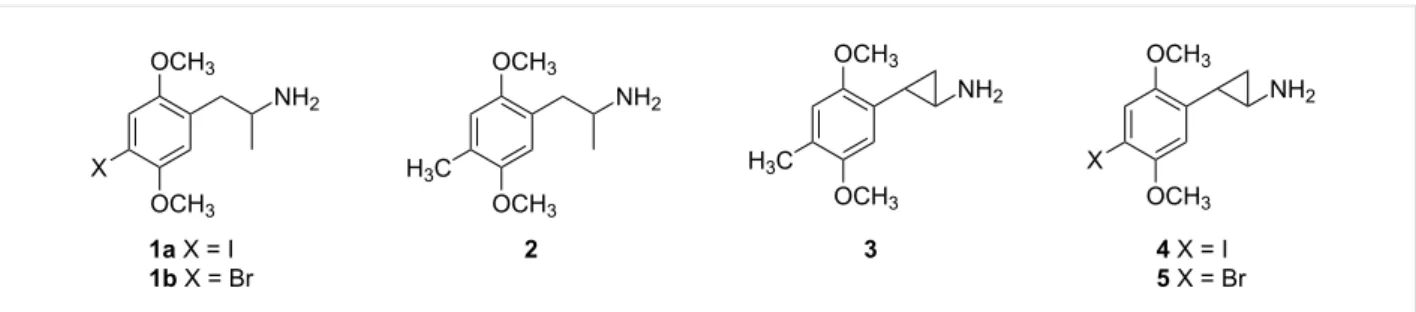
Among the molecules that have proven very valuable to neuro-scientists studying brain serotonin systems is the substituted phenethylamine derivative 2,5-dimethoxy-4-iodoamphetamine (DOI, 1a, Figure 1), a potent but nonspecific agonist ligand for serotonin 5-HT2A and 5-HT2C receptors. It is relatively
Figure 1: Structures of well-known serotonin 5-HT2A agonists 1a,b, 2, and 3, and compounds 4 and 5 reported in this paper.
been reported, this substance has been scheduled in a number of countries and has been considered for scheduling by the U.S. Drug Enforcement Administration (DEA). Classification as a controlled substance will be a setback to the neuroscience community because it effectively prevents experiments in any laboratory that does not have a proper license for the use of DOI. To illustrate this point, a related compound – bromo congener 1b (DOB) – presently is a controlled substance and only 52 hits for DOB + 5-HT2 were obtained from PubMed, compared with 577 for DOI over the same period of time.
Anticipating the potential need for a substance to replace DOI as a research tool, we sought to identify a molecule that might have pharmacological properties which are identical, or at least very similar to those of 1a. We had previously characterized the cyclopropane analogue of a hallucinogenic amphetamine known as DOM (2) and had shown that 3 (DMCPA) had high potency both in vitro and in vivo [1-3]. We thus considered whether the cyclopropane analogues 4 and 5 might be useful research tools. Accordingly, this report details the synthesis of racemic trans -1-(2,5-dimethoxy-4-iodophenyl)-2-aminocyclopropane (4) and its bromo homolog 5, the resolution of 4 into its (−)-(1R,2S )-enantiomer, as well as the resolution of the cyclopropane carboxylic acid precursor and subsequent bromination to provide both enantiomers of 5.
Results and Discussion
Racemic 4 and 5 were compared in radioligand competition assays against radiolabeled antagonists defined at the human 5-HT2A and 5-HT2C receptors and compared with racemic 1a and 1b. The results are shown in Table 1. As can be seen, the cyclopropane analogues 4 and 5 showed affinities for the 5-HT2A receptor 5–6-fold greater than 1a and 1b. Affinities at the 5-HT2C receptor were about two-fold higher than for 1a and 1b.
The more potent (−)-enantiomers were then tested for func-tional potency using a calcium release assay. The EC50 values and maximal effect at the 5-HT2A receptor were virtually iden-tical for 1a and 4, and for 1b and 5 (Table 2).
Table 1: Affinity values (Ki in nM) at human 5-HT2A and 5-HT2C recep-tors. All values represent mean and SEM from at least three inde-pendent experiments.
3H-ketanserin 3H-mesulergine Compound 5-HT2A
Ki in (nM)
5-HT2C Ki in (nM)
(±)-1a 7.6 ± 0.9 35 ± 6 (±)-1b 8.9 ± 0.5 31 ± 5 (±)-4 1.5 ± 0.1 17 ± 3 (±)-5 1.4 ± 0.3 7.5 ± 1.1
Table 2: Potency and percent max values for calcium release at 5-HT2A and 5-HT2C receptors. All values represent mean and SEM from at least three independent experiments.
5-HT2A 5-HT2C
Compound EC50
(nM)
%max EC50
(nM)
%max
(−)-1a 3.3 ± 0.7 87 ± 1 8.7 ± 0.2 50 ± 5 (−)-1b 5.8 ± 1.3 75 ± 7 28 ± 4 59 ± 7 (−)-4 2.0 ± 0.3 89 ± 4 21 ± 4 63 ± 6 (−)-5 6.3 ± 1.6 76 ± 10 32 ± 8 77 ± 6
At the 5-HT2C receptor 1a was the most potent, with an EC50
that was about three times lower than for 1b, 4, or 5. In func-tional assays, therefore, the cyclopropane analogues 4 and 5 compared to 1a or 1b appeared as potent and had a similar degree of maximal stimulation at each of the respective 5-HT2
receptors.
a<50% displacement at 10−6 M.
Scheme 1: Synthesis of arylcyclopropane carboxylic acids from the corresponding cinnamic acids, followed by halogenation. selectivity over the 5-HT1A receptor is less than 100-fold. As
shown in Table 1, both 4 and 5 are extremely potent ligands in vitro. Furthermore, as anticipated, it was the (−)-enantiomers that proved to have highest affinity. We included (+)-5 in Table 3 simply to illustrate the difference in affinity between the two enantiomers. We assume that the final compounds have the (−)-(1R,2S) and (+)-(1S,2R) absolute configurations based on our earlier work establishing the absolute configuration of 3 [2], and the fact that substitutions at the 4-position of the aromatic ring in chiral substituted amphetamines do not change the sign of optical rotation [4]. The biological data are consis-tent with those configuration assignments.
Chemistry
We reasoned that a palladium-mediated cyclopropanation of the corresponding cinnamic acids would provide the required cyclopropanecarboxylic acid (Scheme 1); which could be readily converted to the amine by a Curtius type rearrangement (Scheme 2). In our previous synthesis [2] we had employed an
N-carbobenzoxy intermediate, followed by catalytic debenzyla-tion over Pd(C); but those condidebenzyla-tions would lead to dehalogena-tion in the present series, so we instead employed acid-catalyzed removal of a BOC protecting group (Scheme 2).
Thus, we first prepared 2-(2,5-dimethoxyphenyl)cyclo-propanecarboxylic acid methyl ester (7) from the corres-ponding cinnamic ester 6 [5], followed by I2/AgNO3 iodination (Scheme 1), and base hydrolysis of the resulting ester to provide iodo acid 10a. Hydrolysis of ester 7 followed by bromination of acid 9 using Br2-dioxane complex gave a good yield of bromo acid 10b.
Scheme 2: Conversion of arylcyclopropane carboxylic acids 10a,b to the amines 4 and 5, and chemical resolution of 4 into its enantiomers.
Scheme 3: Chemical resolution of arylcyclopropane carboxylic acid 9 followed by bromination. The stereochemistry of the more potent enantiomer of DOI is
(−)-(R) [7], and of 3 is (−)-(1R,2S) [2]. We therefore undertook the resolution of the enantiomers of DOI by fractional crystal-lization of the diastereomeric salts prepared with di-O,O -benzoyltartaric acid. Unfortunately, we discovered that heating solutions of the dibenzoyltartrate salt of 4 in EtOH or iPrOH led to nearly complete decomposition, presumably through a cyclo-propane ring-opening pathway. The apparent need to recrystal-lize the O,O-dibenzoyltartrate salts from a nonprotic solvent led us to employ warm acetone, which proved satisfactory. The resolution went well, achieving constant optical rotation after only three crystallizations. The salt was converted to the free base, which was dissolved in dry Et2O, followed by addition of the stoichiometric amount of ethereal HCl. The salt precipitated out of solution and could be used directly for pharmacological experiments. Attempts to recrystallize the HCl salt from protic
solvents also led to nearly complete decomposition, although salts of bromo compound 5 appeared somewhat more stable.
We then followed a more efficient divergent approach to obtain the enantiomers of 5 that employed resolution of the cyclo-propane carboxylic acid, followed by bromination, and then conversion to the cyclopropylamine (Scheme 3). We are aware that the use of chiral auxiliaries in the cyclopropanation step could directly afford the chiral cyclopropane acids [8], but time and resources did not allow us to pursue that approach.
Conclusion
cyclo-tion at the 4-posicyclo-tion. This approach would be most appealing if a chiral auxiliary was used in the cyclopropanation step [8]. We also note that compound 4 was less stable than 5 under recrys-tallization conditions, an instability we did not observe during our earlier work with 3. We have observed even greater insta-bility in 2-(indol-3-yl)cyclopropylamines [8,9], suggesting that electron “excessive” π-systems, or the ability to “donate” elec-trons through resonance (i.e. Br and I), leads to cyclopropane ring instability in 2-arylcyclopropylamines.
Supporting Information
Supporting Information File 1
Experimental details for all new compounds as well as the pharmacological methods used to measure receptor affinity and functional activity.
[http://www.beilstein-journals.org/bjoc/content/ supplementary/1860-5397-8-194-S1.pdf]
Acknowledgments
This research was supported by the Robert C. and Charlotte P. Anderson endowment.
References
1. Nichols, D. E.; Pfister, W. R.; Yim, G. K. W. Life Sci. 1978, 22, 2165–2170. doi:10.1016/0024-3205(78)90567-2
2. Nichols, D. E.; Woodard, R.; Hathaway, B. A.; Lowy, M. T.; Yim, G. K. W. J. Med. Chem. 1979, 22, 458–460. doi:10.1021/jm00190a021
3. Johnson, M. P.; Mathis, C. A.; Shulgin, A. T.; Hoffman, A. J.; Nichols, D. E. Pharmacol. Biochem. Behav. 1990, 35, 211–217. doi:10.1016/0091-3057(90)90228-A
4. Nichols, D. E.; Barfknecht, C. F.; Rusterholz, D. B.; Benington, F.; Morin, R. D. J. Med. Chem. 1973, 16, 480–483.
doi:10.1021/jm00263a013
5. Peterson, J. R.; Russell, M. E.; Surjasasmita, I. B. J. Chem. Eng. Data
1988, 33, 534–537. doi:10.1021/je00054a042
6. Weinstock, J. J. Org. Chem. 1961, 26, 3511. doi:10.1021/jo01067a604 7. Johnson, M. P.; Hoffman, A. J.; Nichols, D. E.; Mathis, C. A.
Neuropharmacology 1987, 26, 1803–1806. doi:10.1016/0028-3908(87)90138-9
8. Vangveravong, S.; Nichols, D. E. J. Org. Chem. 1995, 60, 3409–3413. doi:10.1021/jo00116a028
Creative Commons Attribution License
(http://creativecommons.org/licenses/by/2.0), which permits unrestricted use, distribution, and reproduction in any medium, provided the original work is properly cited.
The license is subject to the Beilstein Journal of Organic Chemistry terms and conditions:
(http://www.beilstein-journals.org/bjoc)
The definitive version of this article is the electronic one which can be found at: