MAKING HEADS OR TAILS: AN ICONOGRAPHIC ANALYSIS OF LATE MISSISSIPPIAN RIM-EFFIGY BOWLS IN THE CENTRAL MISSISSIPPI RIVER
VALLEY
Madelaine C. Azar
A thesis submitted to the faculty at the University of North Carolina at Chapel Hill in partial fulfillment of the requirements for the degree of Master of Arts in the Department of
Anthropology.
Chapel Hill 2020
iii ABSTRACT
Madelaine C. Azar: Making Heads or Tails: An Iconographic Analysis of Late Mississippian Rim-Effigy Bowls in the Central Mississippi River Valley
(Under the direction of Dr. Vincas P. Steponaitis)
Symbolically charged ceramic rim-effigy bowls, characterized by figural head and tail adornments, are hallmarks of the Late Mississippian period in the central Mississippi River valley (CMV). Hundreds of whole rim-effigy bowls, most often depicting serpents, birds, or humans, have been collected at sites from southeastern Missouri to northwestern Mississippi. However, a comprehensive iconographic analysis of the CMV rim-effigy bowl corpus –
v
ACKNOWLEDGMENTS
TABLE OF CONTENTS
LIST OF TABLES...viii
LIST OF FIGURES...ix
CHAPTER 1: INTRODUCTION...1
CHAPTER 2: ARCHAEOLOGY, ICONOGRAPHY, AND THE CMV...9
I. Mississippian Archaeology in the CMV...9
II. Rim-Effigy Bowls in the CMV...18
CHAPTER 3: AN ORDERED APPROACH TO ICONOGRAPHY...22
I. Formulating an Iconographic Model...22
II. Conceptual Framework...27
CHAPTER 4: STYLE AND THEME...30
I. Stylistic Analysis...31
II. Thematic Analysis...51
III. Identifying Communities of Beholders Based on Visual Style and Theme...61
CHAPTER 5. AN ICONOGRAPHIC MODEL...77
I. Identifying Cosmic Referents...78
II. Rim-Effigy Bowls as Cosmograms...91
CHAPTER 6. BEYOND ICONOGRAPHY...99
I. Rim-Effigy Bowls in Context...99
vii
LIST OF TABLES
ix
LIST OF FIGURES
Figure 1. The central Mississippi River valley (CMV)...10
Figure 2. Late Mississippian archaeological phases in the Eastern Lowlands of the CMV...16
Figure 3. A stepwise approach to studying the iconography of precontact art corpora...23
Figure 4. Study area...32
Figure 5. Style 1 rim-effigy bowls...36
Figure 6. Style 2 rim-effigy bowls...38
Figure 7. Style 3 rim-effigy bowls...39
Figure 8. Style 4 rim-effigy bowls...41
Figure 9. Style 5 rim-effigy bowls...42
Figure 10. Style 6 rim-effigy bowls...44
Figure 11. Style 7 rim-effigy bowls...45
Figure 12. Style 8 rim-effigy bowls...47
Figure 13. Style 9 rim-effigy bowls...48
Figure 14. Style 10 rim-effigy bowls...49
Figure 15. Crested-bird rim effigies...53
Figure 16. Serpent-monster rim effigies...56
Figure 17. Human rim effigies...57
Figure 18. Bird of prey rim effigies...59
Figure 19. Correspondence analysis biplot showing the association between phases and rim-effigy bowl styles and phases...64
Figure 20. Density maps of rim-effigy bowl styles...65
Figure 22. Density maps of rim-effigy bowl themes...73
Figure 23. Correspondence analysis biplot showing the association between style and theme among rim-effigy bowls...75
Figure 24. The Mississippian cosmos...79
Figure 25. Bisected tree depicted in a Spiro shell engraving...83
Figure 26. A rim-effigy bowl as a cosmogram...92
Figure 27. Human rim-effigy bowl depicting a guilloche design below the rim. Cox-style gorget depicting a looped square motif...94
Figure 28. Examples of Hixon-style gorgets from the Hixon and Etowah sites...98
Figure 29. The Ramey Incised jar as a cosmogram...98
Figure 30. Crouching-human stone pipes identified by Steponaitis and colleagues to be representations of shamans or religious practitioners...106
CHAPTER 1 INTRODUCTION
Between AD 800 and 1600, Mississippian societies across the Eastern Woodlands espoused a cosmology rooted in a duality between the heavens and the underworld. This belief system informed the creation of ritual art objects adorned with symbolic motifs and images of culture heroes and supernatural beings. Embossed copper plates, carved stone figurines,
engraved whelk shells, and ceramic effigy vessels – all imbued with cosmic meaning – are only some of the intricately crafted items produced during the Mississippian period. These sacred objects served to reinforce both spiritual and earthly ideologies that became integral to the
maintenance of Mississippian lifeways (Brown 1976; Knight 1989; Pauketat and Emerson 1991). The iconography of Mississippian ritual paraphernalia is becoming an increasingly popular research topic among archaeologists. A number of recently published edited volumes offer detailed analyses of the symbolism, social function, and ideological significance of these objects (Lankford et al. 2011; King 2007a; Reilly and Garber 2007a; Townsend and Sharp 2004). Workshop settings – such as those organized by the Mississippian Iconography Conference – have encouraged collaborative research, resulting in a deluge of new scholarship on the materiality of Mississippian ritual and cosmology. In addition, the incorporation of Native worldviews and oral traditions into these investigations has strengthened relationships between archaeologists and indigenous communities while also stimulating new and novel insights into well-known Mississippian art corpora (see Townsend and Sharp 2004).
In many ways, this recent flourish of research on Mississippian iconography represents a culmination of scholarly interest stretching back more than one hundred years. Around the turn of the twentieth century, antiquarians William H. Holmes, Clarence B. Moore, and Gates P. Thruston, among many others, illustrated and described hundreds of Mississippian art objects during their exploratory surveys of eastern North America (see Brose and White 1999; Knight 1996a; Meltzer and Dunnell 1992; Mitchem 1999a, 1999b; Morse and Morse 1983; Moore 1910; Potter and Evers 1880; Thruston 1897). In 1945, Antonio Waring and Preston Holder published a seminal article synthesizing these findings, ultimately proposing that Mississippian art be
subsumed under one unifying concept termed the Southeastern Ceremonial Complex (SECC) (see also Williams 1968:73). They hypothesized that this “complex of specific motifs and ceremonial objects” (1945:1) grew out of a short-lived – but rapidly spreading – religious movement, which they called the Southern Cult. These conclusions were largely based on ritual paraphernalia recovered from three of the largest ceremonial mound centers in the Mississippian world: Spiro in far eastern Oklahoma, Etowah in northwestern Georgia, and Moundville in west-central Alabama. Collectively, these sites – which were highlighted for their artistically
remarkable and uncharacteristically large ritual corpora – are known as the “Big Three.” Discussions of the SECC continued throughout the twentieth century, centering largely on the origin and chronology of the complex and its materials. Efforts were specifically aimed at parsing the implications of the term “cult” and determining the impact – if any – of
art objects into readable records of the past, providing access to the potential cosmological meanings of certain symbols and images (see Knight 2013a). These tools have been
enthusiastically applied to the material originally recovered around the turn of the century and later reviewed by Waring and Holder. And while the spotlight largely remains fixed on
Moundville, Etowah, and Spiro, material from the Plains, Midwest, Appalachians, and Florida has recently trickled into discussions of the SECC (see King 2007a; Galloway 1989; Lankford et al. 2011; Reilly and Garber 2007a).
However, in response to increasing documentation of regional variation among Mississippian art objects, the SECC concept itself has faced growing skepticism regarding its status as a productive analytical tool (Brown 1976, 1989; Krieger 1945; Knight 2006; Knight et al. 2001; Muller 1989). In particular, it is now clear that Mississippian societies produced diverse forms of ritual paraphernalia, developing distinct stylistic, thematic, and material preferences. In other words, Mississippian art does not conform to the generalizing parameters of the SECC, as conceptualized by Waring and Holder. For instance, ceramics engraved with Beneath World symbols referencing death and the afterlife constitute a major portion of Moundville’s ritual art (Steponaitis and Knight 2004). In contrast, a large body of copper art depicting supernatural birdmen and falconoid imagery associated with the Above World has been recovered from Etowah’s Mound C (King 2007b; 2011). And at Spiro, excavations of the Craig Mound produced an impressive corpus of shell artifacts engraved with intricate designs and depictions of
legendary beings (Brown 2011; Knight 2006; Phillips and Brown 1978). Variation across the Big Three corpora suggests that – despite their broad classification as “Mississippian” – these
societies may have maintained distinct art traditions that oftentimes emphasized specific
cosmological principles. In many ways, this situation is akin to the adoption of patron saints in cities and towns across the Christian world.
This regional variation in ritual paraphernalia is often linked to the local sociopolitical contexts within which these objects functioned (see Brown 2001:30-32). For example, death-themed imagery among engraved ceramics at Moundville may reflect the function of the site as a necropolis after AD 1350 (Knight and Steponaitis 2011). At Etowah, the Mound C copper plates have been interpreted as prestige items deployed by rising elites to justify their power when the site was reoccupied after AD 1250 (King 2011). Further, myriad non-local ritual objects
recovered from Spiro, including nearly a third of the engraved shell corpus, indicate that – although the site was situated on the western margins of the Mississippian world – it maintained far-reaching relationships with other communities (Brown 2001:32; Brown and Kelly 2000). Overall, given the diversity of Mississippian art and iconography, it has become clear that the SECC was not a monolithic phenomenon.
advocating for the abandonment of the SECC altogether, emphasizing that some studies have advanced knowledge of Mississippian art, iconography, and cosmology without even deploying the concept (see also Brown 1985; 1989).
Although the retirement of the SECC would serve to curb misguided generalizations of Mississippian ritual paraphernalia, others continue to argue for the concept’s preservation. Specifically, King (2007d) has suggested that a focus on visual style, or the formal qualities of design, could help revive the SECC’s utility. Recent reviews of style indicate that crafting workshops existed throughout the Mississippian world, producing art objects that can now be situated in time and space in order to trace the origins and movements of SECC materials (Brown and Kelly 2000; Kelly et al. 2007; Knight et al. 2017; Moore et al. 2014; Sharp et al. 2011; Steponaitis et al. 2019). Alternatively, in line with Knight’s (2006) claim that the SECC impedes understandings of Mississippian art and iconography, others have suggested new acronyms that acknowledge regional variation and address the specific domains within which art objects functioned. These include the Southern Interchange Network (SIN) (Muller 2007), the Mississippian Art and Ceremonial Complex (MACC) (Reilly 2004), and the Mississippian Ideological Interaction Sphere (MIIS) (Reilly and Garber 2007b). However, likely due to both tradition and convenience, SECC continues to be the most widely used term in the literature.
But while discussions regarding the fate of the SECC persist in earnest, some
Mississippian art corpora have seemingly been forgotten. That is, much material has not been subjected to detailed iconographic research, despite continued efforts to transcend the geographic and temporal restrictions of the SECC concept. Existing corpora from many regions, while potentially informative, currently lack substantial scholarly attention – at least compared to the interest dedicated to the Big Three and now Cahokia. As a result, the range of variation in the
symbolism and materiality of cosmic veneration during the Mississippian period is still not fully understood. Additional examinations of understudied corpora are needed to further advance knowledge of regional variation among Mississippian ritual sacra.
In this regard, one potentially enlightening but overlooked region of the Mississippian world is the central Mississippi River valley (CMV), which extends along the Mississippi River from the mouth of the Ohio River in southern Illinois to the mouth of the Arkansas River in eastern Arkansas. Here, a wide range of finely crafted ceramics dating to the Late Mississippian period (AD 1350-1600) have been recovered by archaeologists, collectors, and pot hunters alike. Hundreds of whole vessels from the CMV – including painted, engraved, and effigy vessels – exist in museum and university collections across the country. Notably, Waring and Holder briefly commented on the appearance of Southern Cult materials in Arkansas and even posited a Middle Mississippi Valley origin for the spread of their complex (1945:30). Since then, CMV ceramics have occasionally been recognized as vehicles for SECC motifs and symbolism (Dye 1998; Rands 1956; Morse and Morse 1989). More recently, research has focused on the distribution and symbolism of the region’s distinctive ceramic effigy vessels (Cobb and Drake 2008; Dye 2018, 2019; Fisher-Carroll and Mainfort 2012; Lankford and Dye 2014).
CMV does not contain a dominant regional mound center that produced high quantities of impressive ritual paraphernalia. Rather, the CMV’s finely crafted ceramics are distributed across the region, perhaps making it more difficult to address aspects of elite ideology and
sociopolitical hierarchy – topics that have been integral to studies of the Big Three corpora. In fact, the Late Mississippian CMV may have been a highly competitive and politically
fragmented landscape, a phenomenon that has previously been attributed to increased levels of factional conflict and interpolity warfare (Rees 2001). Spanish accounts of Hernando de Soto’s entrada into the region in the mid-sixteenth century indeed suggest a tangled web of rivalries and alliances (Varner and Varner 1951:434-435; see also House 1991:68-69).
In short, Late Mississippian CMV communities existed within a sociopolitical milieu that contrasted greatly with the large mound centers favored by past and present studies of the SECC. The ways in which this competitive climate may be reflected in the production, function, and distribution of ritual paraphernalia within the region has not been sufficiently explored. In the following study, I attempt to address the CMV’s underrepresentation in recent scholarship through a systematic iconographic analysis of a major regional art corpus – ceramic rim-effigy bowls. These vessels, which are characterized by the presence of vertical rim adornments
depicting a range of living beings, are considered hallmarks of the Late Mississippian period and have been recovered from sites across southeastern Missouri, northeastern Arkansas, western Tennessee, and northwestern Mississippi. Notably, the corpus has yet to be comprehensively evaluated for its imagery. Ultimately, the goal of this study is thus to present an iconographic model of rim-effigy bowls that clarifies their cosmological meaning and ritual function among Late Mississippian communities in the CMV. More broadly, I intend to provide foundational insights into the iconography of an art corpus that has hitherto been largely overlooked by
CHAPTER 2
ARCHAEOLOGY, CERAMICS, AND THE CMV
The central Mississippi River valley (CMV) is composed of the low-lying alluvial plain stretching from the mouth of the Ohio River in Cairo, Illinois to the mouth of the Arkansas River about 45 km north of Greenville, Mississippi (Figure 1). The majority of the CMV lies on the west side of the Mississippi River, encompassing both the St. Francis and White river drainages. Crowley’s Ridge, a remnant upland that dissects the Mississippi alluvial plain, divides the region in two, creating the Eastern and Western lowlands. In total, the CMV contains about 40,000 km2 of fertile soils and productive riverine habitats. From the Paleoindian period until the onset of European contact in the sixteenth century, the valley hosted a continuous indigenous population, making the CMV one of the richest archaeological regions in the country (Morse and Morse 1983:1-10).
I. Mississippian Archaeology in the CMV
The term “Mississippian” refers to a number of politically independent societies that populated the Eastern Woodlands of North America from AD 800 to 1600. Thus,
“Mississippian” can be used as both a cultural and temporal designation. Mississippian-period cultural manifestations are generally identified based on a specific collection of traits, including maize agriculture, fortified towns or villages with earthen platform mounds, hierarchical social organization, and ritual traditions focused on fertility, ancestors, or war (see Blitz 2010:3). These
traits, as identified by their archaeological analogs, are considered to differentiate Mississippian societies from earlier groups that occupied the Eastern Woodlands. However, while
Mississippian societies were culturally linked by these traits, significant developmental and organizational differences likely existed among communities. That is, individual expressions of Mississippian culture varied across space and time (see Blitz 2010; Pauketat 2001, 2007).
In the CMV, the emergence and florescence of Mississippian culture has long been linked to parallel developments occurring upstream in the American Bottom. Evidence of trade in raw materials as well as similarities in ceramic traditions, microlith industries, and architecture have been cited as indicators of contact between nascent Mississippian communities in the American Bottom and CMV (McNutt 1996:230-240; Morse and Morse 1983:201-202, 238; Phillips 1970:929). In addition, ceramic types produced in the CMV have been identified at upland American Bottom settlements linked to the rise of Cahokia (Alt 2006). Indeed, the initial expansion of Mississippian culture in the CMV was approximately contemporaneous with the Emergent Mississippian period in the American Bottom. Radiocarbon dates indicate that the Mississippian period in the CMV began around AD 800, succeeding prior Woodland Baytown traditions or – in the southern portion of the region – replacing Coles Creek manifestations (McNutt 1996:222-229). By AD 1000, the “shift” to Mississippian appears to have been complete, possibly indicating the presence of complex chiefdoms in the region (see D. Morse 1989:110-111; P. Morse 1981:14; Morse and Morse 1996).
Morse and Morse (2009: 203-215) posit that these Early Mississippian manifestations (AD 800-1000) – including the Big Lake, Hayti, and Hoecake cultural traditions – likely developed when independent tribal groups began sharing resources, leading to the growth of mutual dependencies. The fertile alluvial soils and ecological diversity of the region would have
allowed these groups to establish permanent settlements supported by agriculture. Among other outcomes, these conditions are thought to have led to food surpluses and population growth. Resulting demographic and social changes are thought to have prompted the emergence of sociopolitical hierarchy in the region. Importantly, these early groups portrayed many classic Mississippian traits, including shell-tempered pottery, mound and plaza architecture, and maize agriculture (see also D. Morse 1989:110-111).
By AD 1050, CMV communities appear to have had coalesced into several independent Mississippian polities. Villages and dispersed farmsteads became increasingly associated with specific civic-ceremonial centers in a clear site hierarchy. Based on this settlement pattern, the Middle Mississippian period in the CMV (AD 1050-1350) is generally associated with
increasing sociopolitical complexity. Notably, however, there is little evidence of warfare among communities. Rather, people appear to have more often engaged in the exchange of raw
materials, including salt and lithics. The majority of the region’s population was likely
concentrated in the Cairo Lowland of southeastern Missouri, as evidenced by the frequency of large mound centers and concentration of exotic goods (e.g. copper plates and shell gorgets). Innovative ceramic techniques emerged during this period as potters began experimenting with new forms, such as beakers, plates, and bottles. Decorative wares, including painted, incised, and effigy vessels, appeared for the first time (Morse and Morse 2009:237-266).
have shifted south, concentrating into mound and village sites along the meander belt regions of the Mississippi and St. Francis rivers. It has been suggested that the alluvial soils here were better suited supporting large, nucleated settlements founded upon intensive agriculture (Morse and Morse 1983:280-301). Survey work indicates that this area was very densely populated, lacking unsettled buffer zones around central sites (see House 1991:65-70; P. Morse 1981:45-59). Palisades were constructed around nearly every village as the need for protection against warfare and raiding increased. This level of nucleation and resulting conflict represents a major departure from earlier, more dispersed settlement patterns in the region (Morse and Morse 1983:266-284; D. Morse 1989:105; P. Morse 1981).
As levels of competition and violence increased in the Late Mississippian CMV, artistic expression also flourished. During this time, the region witnessed an impressive honing of ceramic craftsmanship (Cobb and Drake 2008; Morse 1989:107; Morse and Morse 1983:284; O’Brien and Dunnell 1998:1). Elaborately painted and engraved ceramics as well as finely crafted effigy vessels were produced in such quantity that the CMV has, since the early twentieth century, been a hotbed for pot hunting and collecting (Cobb and Drake 2008; O’Brien and Dunnell 1998:1-10). As large-scale, plow agriculture became the lifeblood of the valley, Euro-American farmers began churning up whole vessels in great quantities – most often from burials. This, combined with the ascension of salvage anthropology, encouraged collectors and
pothunters to literally mine the region for artifacts that could be sold on the lucrative market for American Indian cultural objects (O’Brien and Dunnell 1998:2-3).
While collectors and pothunters scoured the landscape for valuable artifacts, professional archaeologists took a dramatically different approach to their explorations of the region. Rather than concentrating their efforts on whole pottery vessels, mid twentieth-century archaeologists
like Philip Phillips, James A. Ford, and James B. Griffin focused their research on broken pottery, or potsherds, recovered from surveys and controlled excavations (see Phillips et al. 1951). Together they classified ceramics in the Mississippi River valley into types defined by paste, decoration, and form. Phillips (1970) later elaborated upon this system, adding further classificatory divisions in the form of ceramic varieties. Phillip’s so-called type-variety system includes more than 40 types and 88 varieties (see also O’Brien and Fox 1994:26).
Pottery sherd analysis – grounded in this type system – structured fundamental
archaeological understandings of the Late Mississippian CMV (see Brown 2005; O’Brien 1994). In particular, much of the research in the region has been focused on identifying, characterizing, and evaluating materially distinct geographic foci referred to as phases (O’Brien and Fox 1994:48-49). Archaeological phases were initially defined by Willey and Phillips as:
...an archaeological unit possessing traits sufficiently characteristic to distinguish it from all other units similarly conceived, whether of the same or other cultures or civilizations, spatially limited to the order of magnitude of a locality or region and chronologically limited to a brief period of time [1958:22].
In the Late Mississippian CMV, phases are defined based on the distributions of specific ceramic types – mainly Neely’s Ferry Plain, Bell Plain, Barton Incised, Parkin Punctated, and Old Town Red (McNutt 2008; Phillips 1970; Phillips et al. 1951). Sites with similar ceramic assemblages are grouped into specific phases. In theory, the ceramic types used to define an archaeological phase should be exclusive to that particular phase. Diagnostic ceramic types should not be shared among phases. In the densely populated CMV, however, there can be significant ceramic
The four best defined Late Mississippian phases in the region include Nodena, Parkin, Kent, and Walls (Figure 2). Willey and Phillips (1958:22) intended for these phases to simply constitute “practical and intelligible unit[s] of archaeological study,” much like ceramic types. However, the phase concept in the Late Mississippian CMV has arguably been pushed beyond this interpretive framework. Attempts to understand Late Mississippian sociopolitical
organization based on site function and settlement hierarchy has been largely unsuccessful (House 1991:69; D. Morse 1989) (but see P. Morse 1981 for descriptions of the Parkin site). That is, unlike in other areas of the Mississippian world, no single Late Mississippian site in the CMV – based on size or architecture – has been identified as a dominant sociopolitical center with extensive regional influence. In turn, the Nodena, Parkin, Kent, and Walls phases are often treated, in and of themselves, as independent polities or chiefdoms (see Dye and Cox 1990; D. Morse 1989:105; P. Morse 1981:88). Much debate surrounds the legitimacy of using phases in this way, as they are first and foremost culture-historical constructs that may not accurately reflect “real” political and social entities (O’Brien and Dunnell 1998:26).
Since the 1950s, Late Mississippian CMV phase names and boundaries have been adjusted and readjusted as more research is conducted (see Mainfort 2003, 2005; McNutt 2008; Dye and Cox 1990). Based on preliminary ceramic studies, Griffin (1952:233) originally defined the area from Mississippi County, Arkansas to Desoto County, Mississippi as home to the Walls-Pecan Point complex. After further reviews of region’s ceramics, the complex was further
subdivided into the Nodena phase in the north and the Walls phase in the south (see Phillips et al. 1951). The Nodena phase extends southward from the extreme southeastern portions of Missouri to the area just northwest of Memphis. Dan Morse (1989) has noted further that Nodena phase sites occur in three distinct geographic clusters (from north to south), but are united by similar
ceramic frequencies. Phillips’s (1970) definition of the Walls phase includes Late Mississippian sites within the Memphis subarea on both the west and east sides of the Mississippi River. More recently, Smith (1990) has provided a more restricted definition of the Walls phase, only
including sites on the eastern side of the Mississippi river.
West of the Nodena and Walls phases, Phillips (1970) originally divided the area along the St. Francis River into the Parkin and Kent phases. The Parkin phase, located in the northern portion of this area, has been explored intensively since the late nineteenth century and was part of a state-funded archaeological project in the 1970s (P. Morse 1981; P. Morse 1990:120). Its definition in the literature has remained relatively constant over time due to the frequent presence of ceramics with distinctive coarse shell temper. Smith (1990:155) places sites within the lower St. Francis River drainage in the Kent phase, suggesting that the southernmost sites of Phillips’s Parkin phase should actually be included in the Kent phase. Further, Smith posits the existence of an additional phase, termed the Horseshoe Lake phase, in the area between the Kent and Walls phases on the west side of the Mississippi River. However, Phyllis Morse includes Smith’s Horseshoe Lake sites in the Walls phase, referring to them as “Walls West” or Belle Meade phase sites (P. Morse 1990:131; see also House 1991:45-49; Morse and Morse 1983:296).
Ultimately, the variability and lack of agreement in the definitions of Late Mississippian archaeological phases should raise questions about the utility of such culture-historical units in investigations of sociopolitical organization (see Mainfort 2003, 2005; McNutt 2008). Even so, accounts of Hernando de Soto’s expedition into the American South are often deployed as evidence that CMV archaeological phases do in fact reflect the spatial extent of independent sociopolitical entities (see McNutt 2008). After de Soto’s men crossed the Mississippi River in 1541, reports clearly state that the entrada passed through several provinces in the region – each
headed by a paramount chief living in a central town (see D. Morse 1989:111). Specifically, the provinces of Pacaha, Casqui, Aquixo/Quizquiz, and Quiguate, have been identified as aligning with Nodena, Parkin, Walls East/Walls West, and Kent phases, respectively (House 1993; D. Morse 1990; P. Morse 1990; Smith 1990). Pacaha, or the Nodena phase, was apparently the dominant political force in the region, often in conflict with Casqui, or the Parkin phase:
For many centuries back this Cacique Casquin and his parents, grandparents, and more remote ancestors had waged war upon the lords of Capaha [Pacaha], a province bordering their own. And since these lords were more powerful in both vassals and lands, they had pushed and were still pushing Casquin into a corner [Varner and Varner 1951:434-435]. In contrast, Walls phase sites on both sides of the Mississippi River, believed to be the provinces of Quizquiz and Aquixo, were reportedly vassals to Pacaha (Griffin 1990; D. Morse 1990; P. Morse 1990). Ultimately, although Spanish reports of the de Soto entrada are certainly tainted by cultural and interpretive biases, there is arguably enough substantive evidence in these accounts to suggest the presence of several Late Mississippian CMV polities characterized by centralized leadership and hierarchical social organization (House 1991:68).
II. Rim-Effigy Bowls in the CMV
Rim-effigy bowls are found throughout the CMV. However, they occur most frequently in the region’s Eastern Lowlands, which extend southward from the “bootheel” of Missouri to Helena, Arkansas and westward from Memphis, Tennessee to Crowley’s Ridge. Beyond the CMV, Mississippian rim-effigy bowls have also been recovered in central Arkansas, the lower Mississippi River valley, Alabama, Florida, and the Tennessee Cumberland Plateau (see Phillips 2002; Brose and White 1999:100-120; Howell 2011; Steponaitis 1983). Although refined
sites that date to the later part of the Middle Mississippian period (Morse and Morse 1983:239, 254, 271-301). Later examples are known from protohistoric Quapaw contexts near the mouth of the Arkansas River (Hathcock 1983).
Formally, these bowls are characterized by two rim adornos – affectionately referred to as “rim riders” – that together create the image of a living being, usually a serpent, bird, or human. Most often, an effigy head is affixed opposite a tail adorno, although some vessels exhibit a second effigy head in place of a tail adorno. Effigy heads generally face outward, however inward facing effigy heads are also common (D. Morse 1989:108). Occasionally, effigy heads are hollow, containing a single ceramic rattle. X-rays indicate that this feature is intentional, not a consequence of wear or deterioration (Howell 2011). Tail adornos can be either tabular, coiled, or curved. Tabular forms may feature a “tail rider,” or miniature effigy figure that sits atop the tail adorno. Tail riders most often represent animals such as birds, turtles, or panthers. Vessel bodies are often reminiscent of prevalent bowl or jar forms found throughout the CMV (see House 2005:52; Phillips et al. 1951:Fig. 102).
Rim-effigy bowls have previously been interpreted as representations of supernatural cosmic beings (Bomar 2011; Dye 2017b; Lankford and Dye 2014). This interpretation, in addition to their frequent presence in burials (see House 2005; D. Morse 1989:14), suggests that these vessels were not simply utilitarian items but likely were associated with ritual activity at some level. An account by Father Paul du Ru, a Jesuit missionary who travelled throughout indigenous Louisiana in the early eighteenth century, further supports this conclusion. Upon a visit to a local Taensa temple, du Ru noted:
One sees only elders lamenting and shouting, cantors praying, and people bearing
offerings… Among other things there are six large wooden bowls with handles, of which one represents the tail of a swan and the other the neck, which are filled with flour and carried solemnly to the temple [Butler 1934:42].
Although the Taensa bowls in du Ru’s account are wooden, it is reasonable to infer that
precontact Mississippians in the nearby CMV would have utilized their ceramic rim-effigy bowls in comparable ceremonial contexts. Indeed, Morse and Morse (2009:239) suggest that rim
effigies may have been copies of wooden effigies.
Rim-effigy bowls recovered in the CMV are well documented in archaeological reports and other publications. In the nineteenth and early twentieth centuries, C.B. Moore, W.B. Potter and Edward Evers, and William Henry Holmes published illustrations of rim-effigy bowls recovered during their exploratory surveys of the region (Moore 1910; Morse and Morse 1983; Potter and Evers 1880). For his dissertation, Philip Phillips (1939) photographed many more of these and other excavated vessels. Further, in their seminal survey of the Lower Mississippi River Valley, Phillips, Ford, and Griffin (1951) discuss rim-effigy bowls, describing the form as “one of the most constant features of the Middle Mississippi vessel complex” (1951:161). More recent site reports and compendiums of private collections provide further record of these vessels (Bogg and Bogg 2016; Hathcock 1983, 1988; Morse 1981; Morse 1989; O’Brien 1994; Perino 1967).
CMV rim-effigy bowls have also been included in a handful of iconographic studies. Specifically, Lankford and Dye (2014) have analyzed rim-effigy bowls from the Memphis area featuring human effigies with conical heads or caps. Dye (2017b, 2018) has offered further examinations of CMV rim-effigy bowls, including those with distinctive serpent and warrior effigies. However, due to their focus on specific themes or elements of ritual, these analyses do not constitute comprehensive reviews of the region’s full corpus. Broader interpretations of rim-effigy bowl iconography and ritual function simply do not exist, despite extensive
Knight 2006; Knight et al. 2001; Reilly and Garber 2007b), careful study of regionally specific art objects constructed from preferred media can shed light upon the ways in which the cosmos was diversely conceived and expressed throughout the Mississippian world. An iconographic analysis of CMV rim-effigy bowls thus stands to provide further insight into the range of variability in material manifestations of Mississippian cosmology and ritual.
CHAPTER 3
AN ORDERED APPROACH TO ICONOGRAPHY
Unlike other archaeological studies, this study is not oriented toward resolving its research problem with hypothesis testing. Rather, the purpose of this analysis is to reach a fuller understanding of CMV rim-effigy bowl iconography and ritual significance – beyond simple description or conjecture. For the sake of clarity, iconography should be thought of as the relationship between visual imagery and its meaningful referents (Knight 2013a:2). Thus, my objective is to connect elements of rim-effigy bowl imagery to aspects of Mississippian
cosmology and, in turn, ritual activity among CMV communities. To accomplish this, I intend to produce an iconographic model that approximates emic understandings these vessels. That is, I want to know what these vessels meant to the people that used them. This type of model building has been conducted for other Mississippian ritual art corpora, but not for material recovered from the CMV (see Phillips 2012; Steponaitis et al. 2019).
I. Formulating an Iconographic Model
corpus in question,1 (2) identifying visual styles of execution, (3) defining subject matter themes within imagery, and (4) connecting this imagery to referents through ethnographic analogy derived from related descendant populations. These lines of inquiry together culminate in an iconographic model, which Knight defines as a description of a corpus’s representational imagery according to native perceptions of meaning (2013:165). Each element of Knight’s iconographic method is described in turn below.
Defining a Corpus
Prior to initiating any iconographic study, Knight suggests that the largest possible sample of material be assembled. This material should be organized according to chronology, artifact type, and the medium used, when possible. Photographs of items can suffice, but the study of physical objects is always preferred. When photographs are used, multiple images of each object, taken from various angles, should be consulted. The assembled sample of material should approximate the entire available corpus of the works or imagery under review. Because iconographic analyses often rely on internal comparisons, sample size is essential to the
production of a robust model. However, the limitations of using archaeological materials, which are subject to breakage, wear, and recovery biases, are of course insurmountable (Knight
2013a:34-35).
Stylistic Analysis
After a comprehensive sample of the specified art corpus has been assembled, Knight advises that a stylistic analysis be performed. A visual style may be understood as a cultural model “governing the form of all things artificial” in the eyes of both art producers and
observers. Therefore, a stylistic analysis focuses on defining the formal properties of a related set of images rather than evaluating their subject matter. A visual style can manifest in several ways, inclusive of decorative effects, design field layouts, degrees of elaboration, scale, and general aesthetic quality (Knight 2013a:23-51). Within a related set of images, these co-occurring aspects of style jointly constitute a stylistic canon. These canons are generally confined to geographic and temporal boundaries, as style tends to vary across time and space according to the conventions or preferences of producers and observers (Knight 2013a:162-163). Thus, specific visual styles within a corpus, rather than a general style in the abstract sense, should be identified during this phase of the iconographic method.
Thematic Analysis
Following a stylistic analysis, an assessment of visual themes – or the representational content of the imagery – within a corpus should be conducted. It is important that a stylistic analysis be completed prior to the evaluation of themes in any iconographic study that intends to expound upon the meaning or ritual significance of a given art corpus. This order of operations allows style and theme to be reviewed as separate elements, where style reflects rules of
execution and theme consists of the subject matter of the imagery. That is, stylistic analysis is an essential preliminary step in the iconographic method because, as Knight suggests, it limits conjecture and provides a degree of control over the process. Specifically, the identification of
different visual styles within an art corpus can reveal important trends in production choices, expose the range of variation in thematic content, and indicate the local or non-local nature of certain objects. All of these factors are integral to formulating viable interpretations of an art corpus (see Knight 2013b).
Visual themes should be defined based on internal comparisons of imagery within the sample of material. Unlike studies of Western iconography as expounded by Erwin Panofsky (1939), reviews of prehistoric imagery cannot be evaluated based on associated,
contemporaneous written texts. Further, because these images existed in a chronologically and culturally distant past, their referents are not self-evident (Knight 2013a:58). Thus, to classify visual themes within an art corpus, a configurational analysis should be conducted.
Configurational analysis was originally developed by art historian George Kubler (1962, 1967, 1970), who argued that visual themes can be deduced without the presence of
accompanying texts by tracking recurring figurative elements throughout a corpus of imagery. Specifically, visual themes, which characterize the entire composition of an image, can be
broken down into constituent salient features such as motifs or attributes. It is the configurational relationships among these features indicate the overall theme of the composition (Knight
2013a:88-110). A configurational analysis is thus an assessment of how salient features are deployed among images in a corpus. Knight suggests that elements of natural history and
analysis does not address the larger concepts, principles, myths, or narratives that certain visual themes may reference.
Ethnographic Analogy
Because it does not link images with written texts, a configurational analysis alone cannot produce a robust iconographic model. Although Kubler (1962) originally argued against the use of analogy in interpreting imagery (see also Greider 1975), Knight suggests that a visual theme’s native referents may be sought in ethnohistoric and ethnographic accounts of related cultures or societies. Such sources include observations of ritual activities, religious beliefs, oral histories, and cultural practices. This step in the iconographic method allows for the identification of themes of reference as opposed to visual themes (Knight 2013a:165). Thus, in an iconographic analysis, the search for ethnographic cognates logically follows a thematic configurational analysis, which itself must be independent of a stylistic analysis. According to Knight, a logical progression through this order of operations should result in a reliable iconographic model that can be used to relate the visual aspects of an artistic corpus to inferred referents derived from ethnographic analogies (2013a:166). However, this type of iconographic model – produced by modern analysts – can of course only ever approximate the native iconographic models that past people used to interpret imagery and derive meaning from art objects.
II. Conceptual Framework
By focusing on style, theme, and referent, Knight’s approach to studying prehistoric iconography attempts to analyze and interpret imagery from the perspective of its intended viewers. In this way, the methodology deliberately eschews the tendency to study art objects
from the vantage of production rather than consumption. Specifically, Knight posits that many archaeological studies of art objects rely on the use of “task models,” which characterize the culturally accepted ways in which certain repetitive undertakings – like craft production – are accomplished (see Shore 1996:65). Task models highlight the actions, routines, and tools involved in material production. However, task models generally concentrate on the choices of the artisan or craftsperson, ignoring that observers must also understand the rules that govern the form – or style – of the made objects they consume (Knight 2013a:25). In other words, producers create objects that are accessible to their target audience.
In that it does not prioritize producers, Knight’s iconographic method is more inclusive – focusing on larger communities of beholders. As noted above, among imagery produced and viewed by groups of people are cultural standards that dictate the formal properties of specific images (Knight 2013a:25). Given a medium, an artist, craftsperson, or workshop will execute an image with appropriate style, or “fixity of form” (sensu Boas 1951:163). This allows the
In the following analysis of CMV rim-effigy bowls, I follow Knight’s iconographic method. Firstly, I define the visual styles and themes that exist within the Late Mississippian CMV rim-effigy bowl corpus. In order to identify potential communities of beholders, I then examine the distribution of bowl styles throughout the CMV. I also assess the distribution of visual themes across and within these communities in order to better characterize the use of imagery in the region. Using ethnohistorical sources, I then attempt to identify themes of
reference, connecting rim-effigy bowl imagery to specific elements of Mississippian cosmology. Finally, through the synthesis of these analyses, I offer an iconographic model of Late
Mississippian CMV rim-effigy bowls that elucidates their potential native meaning and ritual function.
CHAPTER 4 STYLE AND THEME
To begin my evaluation of CMV rim-effigy bowls, I assembled a comprehensive sample of whole vessels from published photographs and illustrations. The majority of these
photographs derive from three sources: archaeologist Philip Phillips’s dissertation (1939; see also Phillips 2002) and collector Roy Hathcock’s publications on Mississippi River valley ceramics (1988) and Quapaw pottery (1983). Several other publications and site reports were also consulted (Bogg and Bogg 2016; Brown 2005; House 2005; D. Morse 1989; O’Brien 1994; Perino 1967; Phillips et al. 1951). Most of these vessels were recovered from mortuary contexts, although those that were not professionally collected lack provenience (House 2005; D. Morse 1989:108). Consequently, evaluations of depositional context were unattainable. I strived to assemble the largest sample of rim-effigy bowls possible. When I was able, I reviewed multiple photographs and illustrations of each vessel (see Chapter 3). The rim-effigy bowls included in the sample derive from the four best-defined Late Mississippian archaeological phases in the Eastern Lowlands of the CMV: Nodena, Parkin, Kent, and Walls (see Chapter 2) (Mainfort 2003, 2005; Morse and Morse 1983: 271-302). 2 This study area was chosen for the large number of rim-effigy bowls recovered and the continued, widespread use of these archaeological phases
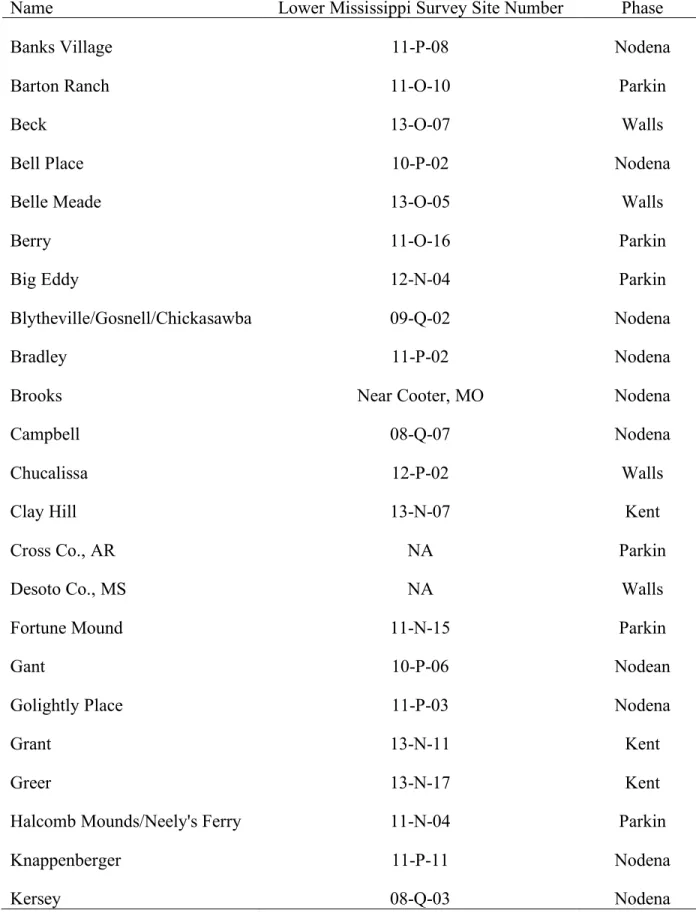
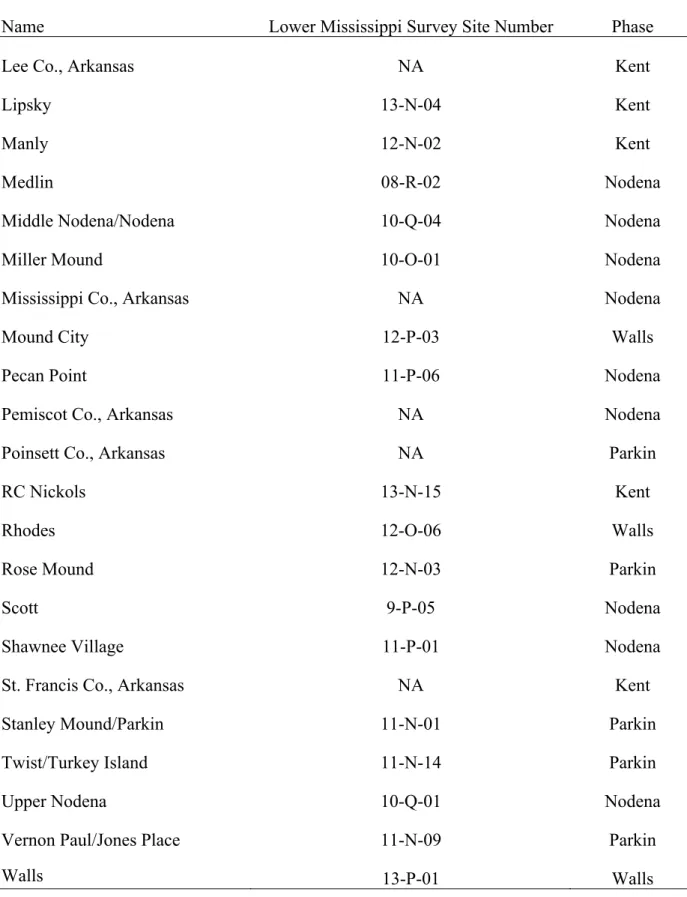
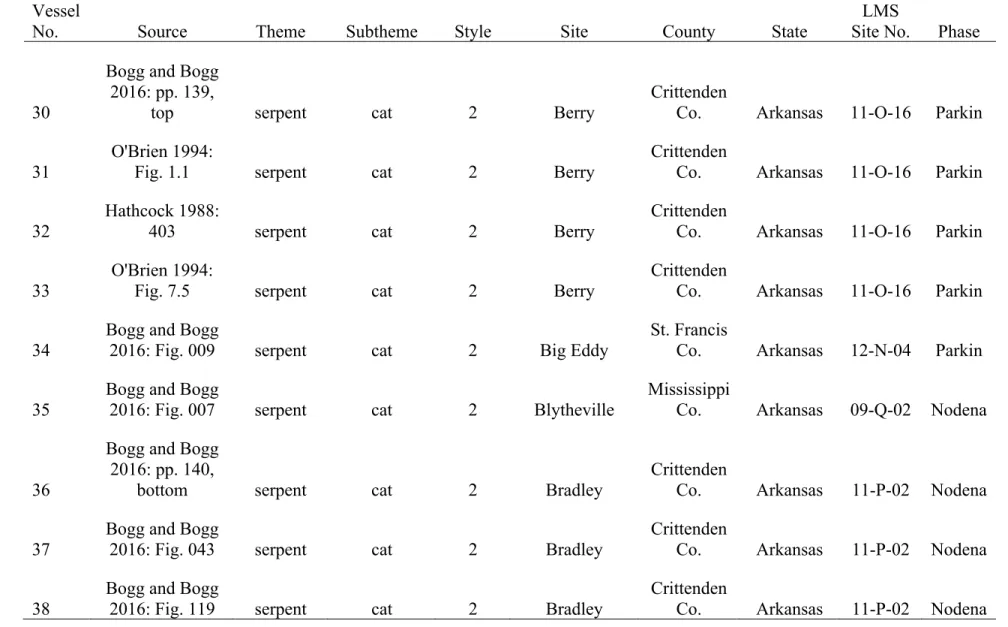
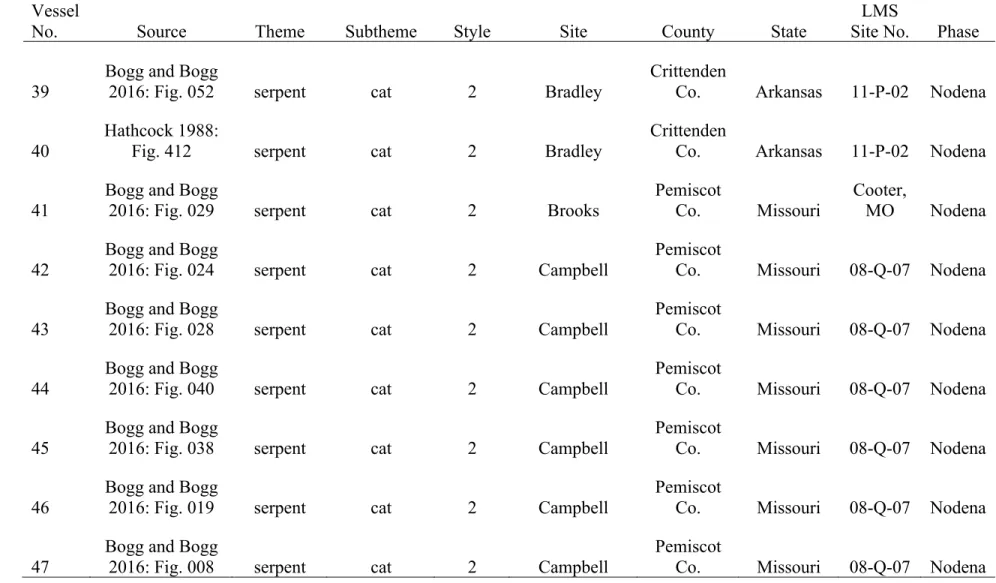
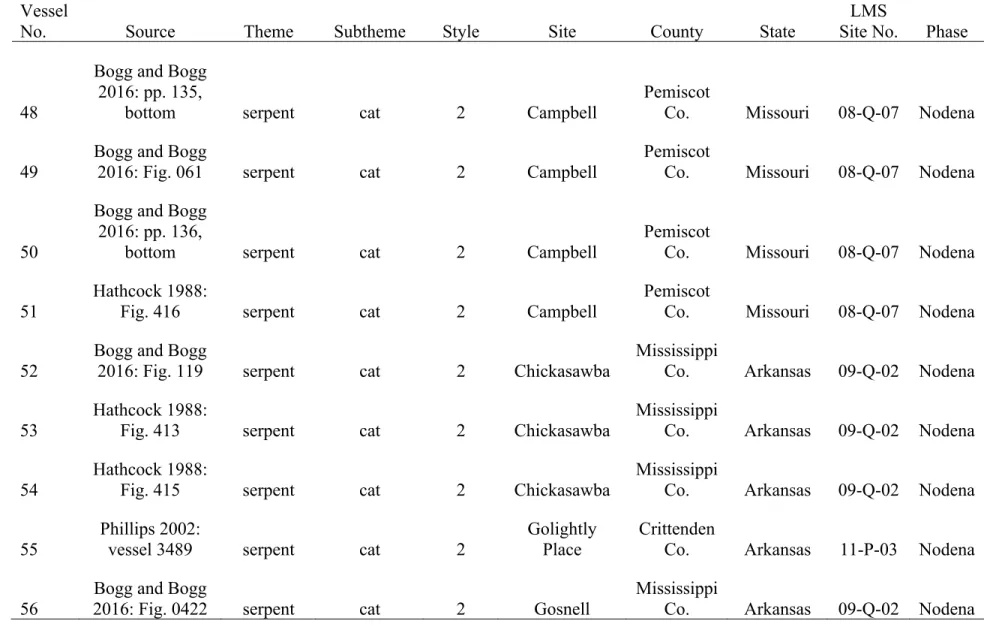
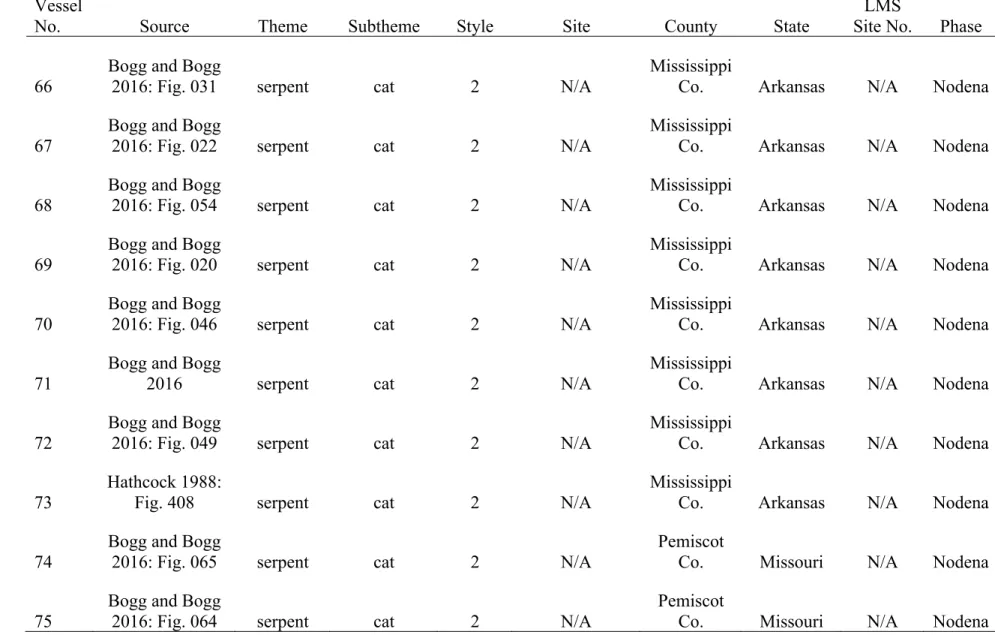
throughout the literature on the CMV. In total, I reviewed 245 rim-effigy bowls from 38 different sites and eight different counties within these phases (see Figure 4 and Table 1).3
I. Stylistic Analysis
Following Knight’s protocol, I first performed a stylistic analysis (see Chapter 3). While identifying styles, I considered several different criteria. Decorative effects served as the primary indication of style. Specifically, the way in which effigies were formed from wet clay became an important stylistic determinant. Rim-effigy heads in the CMV are either flat, two-dimensional renderings or life-like, three-dimensional portrayals of the chosen subject matter. The use of applique versus incising to depict features like eyes, ears, teeth, noses, beaks, and plumage was also considered. Further, decorative features of the vessel body served as another distinguishing factor in the initial stylistic analysis. In particular, the presence or absence of red slip, incised designs, and beaded rims emerged as salient features in several CMV rim-effigy bowl styles. Beyond decoration, scale and shape were particularly useful when delineating styles. Both effigy size and vessel size, as well as the ratio between the two, proved useful for
distinguishing between different bowl styles. Further, I often used bowl shape (i.e. flat-bottomed versus globular and shallow versus deep) to discriminate between styles. The degree of
elaboration also varied consistently across styles. In particular, the level of detail in the depiction of certain features (e.g. eyes, ears, teeth, noses, beaks, and plumage) among effigies served as a reliable stylistic differentiator. Some effigies do not depict secondary features at all, while others
3 Not all bowls in the sample had site-specific proveniences. Some bowls could only be identified to the county level. If a bowl could only be identified to the county level, only those deriving from counties that could be confidently assigned to a single phase were included in the analysis.
Table 1. CMV Localities Included in Analysis
Name Lower Mississippi Survey Site Number Phase
Banks Village 11-P-08 Nodena
Barton Ranch 11-O-10 Parkin
Beck 13-O-07 Walls
Bell Place 10-P-02 Nodena
Belle Meade 13-O-05 Walls
Berry 11-O-16 Parkin
Big Eddy 12-N-04 Parkin
Blytheville/Gosnell/Chickasawba 09-Q-02 Nodena
Bradley 11-P-02 Nodena
Brooks Near Cooter, MO Nodena
Campbell 08-Q-07 Nodena
Chucalissa 12-P-02 Walls
Clay Hill 13-N-07 Kent
Cross Co., AR NA Parkin
Desoto Co., MS NA Walls
Fortune Mound 11-N-15 Parkin
Gant 10-P-06 Nodean
Golightly Place 11-P-03 Nodena
Grant 13-N-11 Kent
Greer 13-N-17 Kent
Halcomb Mounds/Neely's Ferry 11-N-04 Parkin
Knappenberger 11-P-11 Nodena
Kersey 08-Q-03 Nodena
Table 1. CMV Localities Included in Analysis (continued)
Name Lower Mississippi Survey Site Number Phase
Lee Co., Arkansas NA Kent
Lipsky 13-N-04 Kent
Manly 12-N-02 Kent
Medlin 08-R-02 Nodena
Middle Nodena/Nodena 10-Q-04 Nodena
Miller Mound 10-O-01 Nodena
Mississippi Co., Arkansas NA Nodena
Mound City 12-P-03 Walls
Pecan Point 11-P-06 Nodena
Pemiscot Co., Arkansas NA Nodena
Poinsett Co., Arkansas NA Parkin
RC Nickols 13-N-15 Kent
Rhodes 12-O-06 Walls
Rose Mound 12-N-03 Parkin
Scott 9-P-05 Nodena
Shawnee Village 11-P-01 Nodena
St. Francis Co., Arkansas NA Kent
Stanley Mound/Parkin 11-N-01 Parkin
Twist/Turkey Island 11-N-14 Parkin
Upper Nodena 10-Q-01 Nodena
Vernon Paul/Jones Place 11-N-09 Parkin
are highly realistic. Finally, aesthetic quality, despite its cultural relativity, varied significantly among CMV rim effigy vessels. When compared to each other internally, the quality of effigy modelling, including aspects of symmetry and realism, appears to be correlated consistently with other stylistic criteria. It is possible that some styles were produced by skilled craftspeople while others were produced by part-time potters.
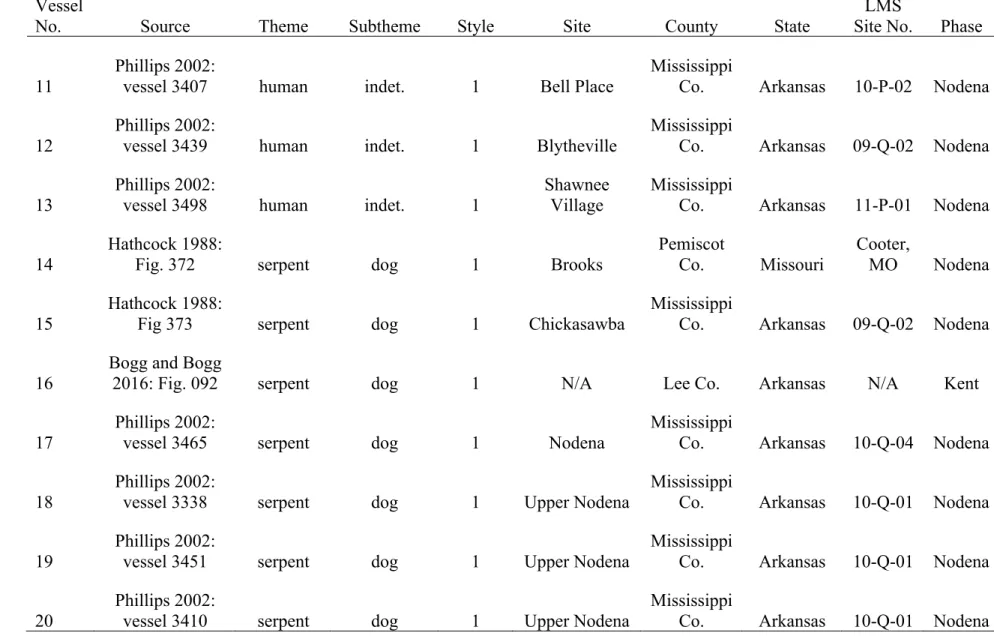
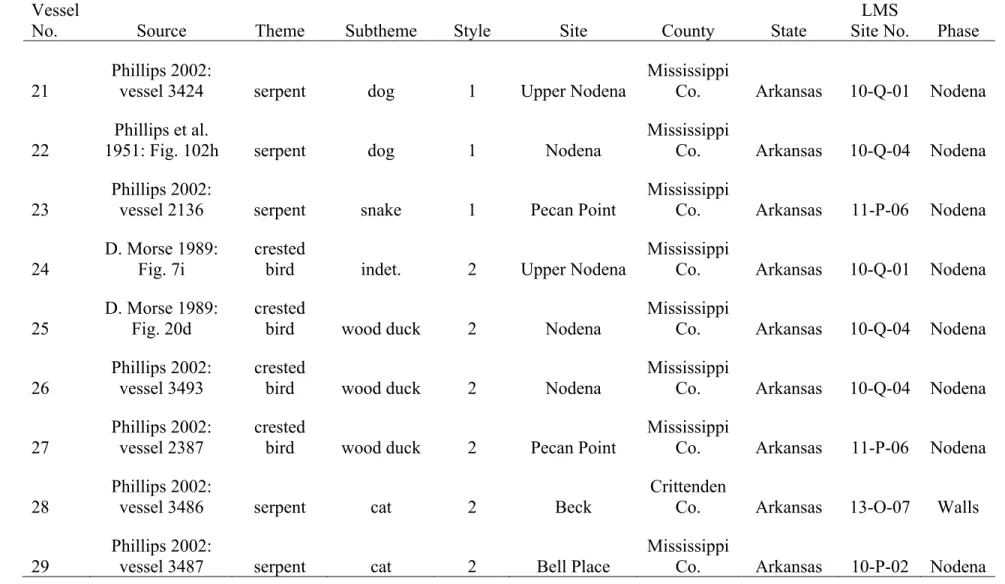
Based on the above criteria, I identified ten distinct styles within the sample (figures 5-14). Each style contains at least five vessels (see Table 2 for a count of a count of vessel styles by phase). It should be noted that although many of these styles could have been combined or further divided into a greater number of styles, all vessels belonging to a certain style are more similar to each other than to any other group. All ten styles and their defining characteristics are outlined below.
Style 1
Style 1 bowls are defined by reverse-facing effigy heads. Effigies are generally three-dimensional and quite detailed, including features such as eyes, mouths, hair, beaks, snouts, and noses. These features are depicted using both applique and incising. Effigy heads tend to be angled upward, as if the figure’s line of sight is slightly above horizontal. Most effigy heads do not have prominent necks. That is, many of the heads are simply appended directly to the rim of the bowl. Tail effigies generally consist of large clay tabs affixed directly to the rim. Style 1 bowls are generally deep with relatively large effigy heads and tails. Beaded rims are common.
Style 2
Style 2 bowls are characterized by forward-facing effigy heads that exhibit very detailed incising and modelling. Features depicted include horns, eyes, snouts, and mouths in addition to other minor features such as whiskers and teeth. Despite these details, Style 2 effigy heads tend to be flatter than Style 1 bowls. That is, head adornos appear to have been cut from slabs of clay rather than modeled in three dimensions. In further contrast to Style 1, effigy necks are long and “S” shaped, emerging directly from the bowl below the rim. Tail effigies are substantial,
generally consisting of clay coils or prominent wedges affixed directly to the rim. Compared to effigy head and tail size, bowl size is relatively small among Style 2 vessels. Beaded rims and incised designs, such as scrolls, swirl crosses, and guilloches, are common. This was the most frequently occurring style in the sample, including 61 vessels or nearly 25% of the sample.
Style 3
Style 3 is defined by extremely shallow bowls and forward-facing effigy heads. Style 3 effigies are small relative to the size of the bowl. Head effigies tend to be appended directly to the rim of the bows, exhibiting short or nearly non-existent necks. Many head adornos appear tabular in nature, with modelled applique features added to create detail. Consequently, effigy heads generally have flat backs but highly three-dimensional fronts. Incising is also used to create features such as eyes and mouths. Tail effigies are generally small, consisting of small tabular outcroppings or clay strips appended to the rim opposite the head adorno. Many Style 3 bowls are either entirely red-slipped or exhibit a band of red slipping directly below the rim. All Style 3 bowls exhibit plain rims.
Figure 7.Style 3 rim-effigy bowls.(a) Bird of prey (from Hathcock 1983:Fig.83).(b) Serpent(from Phillips 2002:Vessel2059).(c) Human (from Hathcock 1983:Fig.100).
Style 4
Style 4 is similar to Style 3. Bowls are shallow, flat bottomed, and exhibit red slipping – either in full or in a strip directly below the rim. However, Style 4 effigy heads are flat, or almost tabular, in nature. Further, effigy heads are appended directly to the rim either at an oblique angle or in reverse. Style 4 bowls never feature forward-facing effigy heads. Effigy tails are usually very small compared to the size of the bowl and the effigy head – sometimes they are nonexistent. Effigy features can be depicted using applique or incising. Effigy heads are usually very detailed and include features such as eyes, noses, mouths, teeth, and even eyebrows.
Style 5
Style 5 is defined by very deep, globular bowls. The vessel body is very similar in morphology to utilitarian Neely’s Ferry Plain bowls found most frequently in the Parkin phase (see House 2005:52; Phillips et al. 1951: Figs. 100a, 100b). Effigy heads are forward-facing and relatively flat, lacking dimension. However, they are not as flat as Style 4 effigies. In relation to bowl size, effigy heads are very small and tend to be void of features or details. Only the features necessary for discerning effigy subject matter are included, such as beaks, ears, and snouts. Necks are short or absent, with the effigy head being appended directly to the rim. Tail effigies are simple, often only consisting of a small tabular projection opposite the head adorno.
Figure 8.Style 4 rim-effigy bowls.(a) Human (from Hathcock 1988:Fig.93).(b) Indeterminate theme (from Hathcock 1983:Fig.233).
Style 6
Style 6 is defined by forward-facing effigy heads and includes either flat-bottomed or globular bowls similar in size and shape to Style 5. However, compared to Style 5, Style 6 effigies are relatively large and detailed. Effigy heads exhibit basic features such as eyes, noses, snouts, and crests. Effigy features are generally depicted using clay applique with limited examples of incising. Eyes are often quite bulging, due to the utilization of clay applique. Necks are relatively long and emerge directly from the bowl below the rim, similar to Style 2. Tail effigies consist of either clay coils or prominent, rectangular tabs that occasionally include incised designs, such as circles or lines. Bowls are undecorated and rim notching or beading is nearly absent. In many ways, Style 6 is very similar to Style 5 in terms of bowl size and shape, but can be distinguished by its relatively large effigy heads in relation to bowl size. It is possible that Style 5 bowls represent poorly executed versions of what could otherwise be classified as Style 6 bowls.
Style 7
Style 7 bowls are defined by the presence of large, highly detailed, forward-facing effigy heads. These effigies are finely crafted, exhibiting realistic depictions of hair, ears, noses, mouths, lips, eyes, and even head coverings. Many different decorative techniques are used, including modeling, applique, and incising. This style consists exclusively of human effigies, as no animal effigies were executed with as much detail. Human ears are usually depicted as molded spirals, while lips, noses, and chins tend to protrude outward in a distinctive manner. Effigy necks are short and emerge from the bowl directly beneath the rim. Tails are generally rectangular tabs. Vessel bodies often exhibit incised horizontal parallel lines blow the rim.
Style 8
Style 8 is defined by effigy heads constructed from clay coils, which are appended to tabular outcroppings at the rim of the bowl. This style seems to have been used exclusively for producing bird-themed bowls. Effigy heads do not depict significant detail beyond the structural use of coils. Incising and applique are generally absent. Tail effigies are often fan-shaped, but can also be tabular. Tabular tails are always accompanied by tail riders, which appear to have been modeled separately and then appended to the rim of the bowl. Vessel bodies are generally large, deep, and undecorated. Style 8 bowls, due to lack of decoration, do not appear to be as finely crafted as styles 2 or 7.
Style 9
Style 9 bowls exhibit large, reverse-facing effigy heads. Effigy heads are extremely flat, lacking dimension. Features like beaks and crests are two-dimensional, visible only in profile. Other features, namely eyes, are only occasionally depicted through trailing or modeling. When present, eyes are characteristically round and large. Necks are moderate in length, emerging from the vessel body directly beneath the rim. Tail effigies consist of triangular tabs appended to the rim opposite the head adorno. Bowls are generally deep with flattened bottoms. The quality of execution varies significantly among vessels, despite their use of similar stylistic elements.
Style 10
Table 2. Counts of Rim-Effigy Bowl Styles by Phase
Style Nodena Parkin Kent Walls Total
Style 1 19 1 1 2 23
Style 2 48 7 4 2 61
Style 3 3 1 15 2 21
Style 4 1 1 4 - 6
Style 5 2 17 - - 19
Style 6 5 15 - - 20
Style 7 1 - 1 6 8
Style 8 - 7 1 - 8
Style 9 4 7 - - 11
used in place of applique. Necks are long and emerge directly from the bowl below the rim, similar to Style 2 and Style 6. Tail adornos generally consist of flat, rectangular tabs. Bowls are undecorated and rim notching or beading is nearly absent. However, rims tend to exhibit rolled lips. Like Style 7, all of the effigies in Style 10 are humans. All of the effigy heads in this style exhibit bulbous applique eyes, simple modeled noses, and gaping or wide mouths. Ears are generally absent. Head adornos are tall and pointed – as if the cranium has been vertically
stretched. This may indicate that Style 10 effigies were meant to depict a specific supernatural or superhuman figure.
II. Thematic Analysis
Following the identification of distinct styles of execution, I defined four major visual themes within the sample. These include crested birds, serpents, humans, and birds of prey. I considered theme to be independent of style (see Chapter 3). In other words, effigies of the same theme could be executed in different styles. I approached each effigy bowl as a single unit of imagery. A configurational analysis – or internal comparison of features (e.g. heads, tails, eyes, ears, teeth, noses, beaks, and plumage) among bowls within the sample – led to the identification of several broad visual themes (figures 15-18). The features used to define these visual themes are referred to as classifying attributes, or generalized attributes that define the visual theme. For example, classifying attributes among human effigies include eyes, noses, mouths, and hair. Below I provide an overview of rim-effigy themes based on classifying attributes.4 Where possible, I also discuss the potential natural or cultural prototypes – termed subthemes –
4 Themes are polythetic, meaning that not all attributes needed to be present to classify a vessel under a specific umbrella theme or subtheme.
represented within broader thematic groups. These subthemes were identified based on identifying attributes, or distinctive characteristics that allow for the recognition of a specific subject within a broader theme. For example, human effigies may have identifying attributes such as hair buns and mace-shaped tails – in addition to their classifying attributes – that distinguish them as warriors. The different subthemes contained within a theme share the same set of classifying attributes but differ in terms of identifying attributes (see Hemeren 1969:10; Knight 2013a:98-102).
In total, nearly 90% of the rim-effigy bowls in this sample depict either crested birds, serpent monsters, or humans (Table 3). Only about 10% of the sample could be identified as belonging to the bird of prey theme. Rim-effigy bowls that did not conform to a specific theme were categorized having indeterminate subject matter. These vessels, when they conformed to a particular style, were only used in the stylistic analysis. Vessels that I could not confidently assign to a particular style but could classify according to subject matter were used in the
thematic analysis. Many stylistically ambiguous, or idiosyncratic (see Steponaitis et al. 2019:15), vessels were often poorly executed, making it difficult to determine effigy theme as well. These vessels, which could not be classified according to style or theme, were omitted from the sample. The four major themes and their subthemes are described below.
Crested Birds
a
b
c
Figure 15.Crested-bird rim effigies.(a) Woodpecker,Style 6 (Phillips 2002:Vessel1439;image from House 2005:Pl.10).(b) Fantailcrested bird,Style 8 (Phillips 2002:Vessel1334;image from House 2005:Pl.9).(c) Wood duck,Style 9 (Phillips 2002:Vessel1595;image from House 2005:Pl.5).
the Late Mississippian CMV.5 Firstly, a large portion of crested-bird effigies appear to represent male wood ducks (Aix sponsa), or drakes. These effigies are defined by the presence of long, rounded beaks and smooth, downturned crests emerging from the area above the beak and
terminating at the base of the neck. Late Mississippian CMV communities would have frequently witnessed waterfowl migrations up and down the Mississippi Flyway (Morse and Morse 1983; O’Brien and Dunnell 1994), making wood ducks a viable natural cognate for rim effigies in this sample. In addition, the crested-bird theme also includes what appear to be woodpecker effigies. These effigies are defined by the presence of head adornos with straight, pointed beaks and prominent crests that terminate directly above the neck. Given the shape of the beak and crest, these effigies may represent pileated woodpeckers (Dryocopus pileatus). These and other species of crested birds (e.g. blue jays, cardinals, and other crested songbirds) would have present
throughout the deciduous forests of the CMV during the Late Mississippian period.
Several bowls in the sample exhibit crested-bird effigies that lack a clear naturalistic cognate. These bowls are defined by the presence of elongated head adornos and fanned tails with distinctive spokes (see Style 8 description above). Due to this tail shape, these bowls have previously been interpreted as representations of turkeys (see Brain and Phillips 1996:12-16; House 2005; Phillips 2002). However, among these bowls, the head adornos always exhibit distinctive crests constructed from clay coils that emerge from the top of the head and terminate at its base near the rim. Occasionally, rather than a fanned tail, these head adornos are
accompanied by a tabular tail featuring a tail rider.
Serpent Monsters
Serpent-monster effigy bowls share several classifying attributes. Their serpentine nature is imparted by the presence of head effigies featuring elongated or S-shaped necks as well as curved or spiraled tail adornos. This theme’s “monstrous” mien is conveyed through the depiction of sharp teeth, horns, antlers, and forked or elliptical eye surrounds. Due to this combination of traits, true naturalistic cognates cannot be identified. However, many
mythological examples of this supernatural being have been noted in studies Native cosmology and folklore, which will be discussed further below (see Dye 2018; Lankford 2007; Reilly 2007). Several serpent-monster subthemes – with distinct identifying characteristics – emerged during the thematic analysis. In particular, many serpent-monster effigy heads exhibit cat-like traits, such as short snouts, small pointed ears, and long spiraled tails. Alternatively, other bowls resemble dogs, featuring head adornos with longer snouts and inward curving tail adornos. In contrast, some serpent-monster effigy bowls are more snake-like rather than mammalian in appearance, composed of spiraled tails and S-shaped effigy heads without horns or antlers.
Humans
Human effigy bowls are defined by several anthropomorphic classifying attributes, including eyes, ears, noses, mouths, and hair. Several human subthemes were identified based largely on head coverings and hairstyles. Specifically, conehead effigies are defined by the presence of an elongated, pointed effigy head and a tabular tail (see Lankford and Dye 2014 for a review of this subtheme). Some conehead effigy heads are unnaturally conical, resembling popular images of space aliens. That is, there is no indication that this head shape is imparted by a cap or head covering. Other conehead effigies do not appear to have unnatural head shapes, but
a
b
c
Figure 16.Serpent-monster rim effigies.(a) Dog-like serpentmonster,Style 1 (from Hathcock 1988:Fig.372).(b) Cat-like serpentmonster,Style 2 (from Phillips 2002:Vessel3486).
are clearly wearing conical hats. These differences were considered to be stylistic. Further, twin-themed effigy bowls were identified based on the appearance of two nearly identical human heads situated on the rim opposite one another. That is, rather than a head and tail adorno, these bowls feature two human heads. Finally, warrior-themed bowls exhibit effigy heads with spikey hair, scalp locks, or animal-pelt caps, which are often accompanied by tail adornos depicting war clubs or maces (see Brown and Dye 2011; Dye 2017b).
Birds of Prey
Bowls depicting birds of prey share several classifying attributes. Effigy heads exhibit beaks but – in contrast to the crested-bird theme – rarely have crests of plumage. When crests are present, they are serrated – resembling the bald head of a turkey vulture. Further, beaks tend to be short, pointed, or downturned. Based on identifying attributes, two subthemes can be
identified within this theme. Firstly, raptor-themed bowls exhibit effigy heads with flattened or downturned beaks and simple tabular tail adornos. These bowls resemble falcons, hawks, or eagles. Some raptor bowls feature talons in place of a tabular tail. The head adorno on these vessels is always turned inward, creating the image of an overturned or “belly-up” raptor. Further, I identified several owl-themed bowls. These vessels exhibit rounded effigy heads with short, pointed beaks and large circular eyes accompanied by tabular or triangular tail adornos.
Vessels as Bodies
Table 3. Counts of Rim-Effigy Bowl Themes and Subthemes by Phase
Theme Nodena Parkin Kent Walls Total
Crested Bird
Wood duck 8 11 2 - 21
Woodpecker 1 9 - - 10
Fantailed - 6 - - 6
Indeterminate 5 5 2 1 13
Serpent Monster
Cat
50 11 6 5 72
Dog 9 2 5 - 16
Snake 5 11 - - 16
Indeterminate 5 9 - - 14
Human
Conehead
9 - 5 5 19
Warrior 1 - 7 3 11
Twins 4 1 - - 5
Indeterminate 5 2 5 4 17
Bird of Prey
Raptor 12 4 3 1 19