Copyright © 2015 European Crohn’s and Colitis Organisation (ECCO). Published by Oxford University Press. All rights reserved.
For permissions, please email: [email protected] 276
doi:10.1093/ecco-jcc/jju025 Original Article
Original Article
Back/joint Pain, Illness Perceptions and Coping
are Important Predictors of Quality of Life and
Work Productivity in Patients with Inflammatory
Bowel Disease: a 12-month Longitudinal Study
Mike van der Have
*
1, Lianne K. P. M. Brakenhoff
*
2, Sanne J. H. van Erp
2,
Ad A. Kaptein
3, Max Leenders
1, Margreet Scharloo
3, Roeland A. Veenendaal
2,
Désirée M. F. M. van der Heijde
4, Andrea E. van der Meulen-de Jong
2,
Daan W. Hommes
2,5, Herma H. Fidder
1,21Department of Gastroenterology and Hepatology, University Medical Centre Utrecht, Utrecht, The Netherlands 2Department of Gastroenterology and Hepatology, Leiden University Medical Centre, Leiden, The Netherlands 3Section of Medical Psychology, Leiden University Medical Centre, Leiden, The Netherlands 4Department of
Rheumatology, Leiden University Medical Centre, Leiden, The Netherlands 5Centre for Inflammatory Bowel Diseases,
UCLA Health System, Los Angeles, CA, USA *These authors contributed equally to the article.
Corresponding author: Mike van der Have, MD, Department of Gastroenterology and Hepatology, UMCU, PO Box 85500, 3500 GA Utrecht, The Netherlands. Tel: 0031 08875 50721; Fax: 0031 08875 55533; Email: [email protected],
Abstract
Background and aims: Back and joint pain are the most common extraintestinal symptoms reported by patients with inflammatory bowel disease (IBD). We assessed the impact of back/joint pain, illness perceptions, and coping on quality of life (QOL) and work productivity in patients with IBD.
Methods: Our cohort included 155 IBD patients with and 100 without arthropathy. Arthropathy was defined as daily back pain for ≥3 months and/or peripheral joint pain and/or joint swelling over the last year. At baseline and at 12 months, patients completed questionnaires on the extent of back/ joint pain, IBD disease activity, illness perceptions, coping, QOL, and work productivity. The impact of back/joint pain, illness perceptions and coping on QOL and work productivity was determined, using linear mixed models.
Results: In total, 204 IBD patients (72% Crohn’s disease, 40% male, mean age 44 ± 14 years) completed questionnaires at both time points. At both time points, IBD patients with back/joint pain reported a significantly lower QOL and work productivity compared with IBD patients without back/joint pain. Predictors of low QOL were back/joint pain (β = −1.04, 95% confidence interval [CI] −1.40, −0.68), stronger beliefs about the illness consequences (β = −0.39, 95% CI −0.59, −0.18) and emotional impact of IBD (β = −0.47, 95% CI −0.66, −0.28), and the coping strategy ‘decreasing activity’ (β = −0.26, 95% CI −0.48, −0.03). Predictors of work productivity were back/joint pain (β = 0.22, 95% CI 0.07, 0.37) and illness consequences (β = 0.14, 95% CI 0.06, 0.22).
Conclusion: Back/joint pain, illness perceptions, and coping are significant predictors of QOL and work productivity, after controlling for disease activity.
1. Introduction
Arthropathies are the most common extraintestinal manifestations in patients with inflammatory bowel disease (IBD), with prevalence rates ranging between 1 and 46%.1–10 In general, arthropathies affect young IBD patients at the peak of their working life and are there-fore potentially associated with high morbidity and increased costs.11 IBD-associated arthropathy is considered a subtype of spondy-larthropathy and may involve both peripheral and axial joints. Back and joint pain (hereafter referred to as ‘back/joint pain’) are the most important clinical manifestations of IBD-associated arthropathy.
Although back/joint pain is major problem in the general popu-lation,12 data on the impact of back/joint pain on the quality of life (QOL) and work disability in patients with IBD are scarce. According to a population-based study3 and a cross-sectional study,4 QOL was significantly reduced in IBD patients with non-inflammatory joint pain and self-reported arthritis, respectively. Yet the impact of back/ joint pain on work productivity and the relationships between back/ joint pain, illness perceptions, coping, and important outcomes such as QOL and work productivity has not been assessed before.3,4
It has been shown clearly that QOL and other health outcomes are associated not only with the disease itself, but also with factors such as illness perceptions and coping. The relationships between disease characteristics, illness perceptions, coping, and health out-come are supported by the Common Sense Model.13,14 According to this model, patients generate both cognitive and emotional repre-sentations (known as illness perceptions) in response to a perceived health threat or illness. Illness perceptions provide a framework for patients to make sense of their symptoms and create a coherent view of their illness. This in turn guides coping strategies, such as decreas-ing or pacdecreas-ing activities, with potential impact on health outcomes such as QOL and work productivity. Thus, the impact of illness perceptions on health outcomes may be attenuated by adopting a certain coping strategy.
The efficacy and validity of the Common Sense Model has been shown in patients with various chronic illnesses, such as rheuma-toid arthritis and multiple sclerosis.15,16 Previous studies in IBD have also found strong relationships between illness perceptions, coping, and various health outcomes, including QOL, psychological distress (depression and anxiety), sexual health, and disability.17–25
Improving our understanding of the relationships between back/ joint pain, illness perceptions, and coping behaviors in patients with IBD may provide possible targets for biopsychosocial interventions aimed at reducing morbidity and costs and increasing patients’ QOL.
In this prospective study we aimed to examine the impact of back/joint pain, illness perceptions, and coping on QOL and work productivity in a carefully selected group of IBD patients, after con-trolling for demographic and clinical characteristics.
2. Materials and methods
2.1. Patient population and study design
Between July 2009 and February 2010, 258 IBD patients were systematically assessed by a multidisciplinary team of gastroen-terologists and rheumatologists at the JOINT outpatient clinic of the Leiden University Medical Centre. The systematic assessment consisted of a medical history (extraintestinal manifestations, medi-cation use), physical examination (distribution of painful joints, enthesitis,26 dactylitis26), laboratory tests (C-reactive protein, eryth-rocyte sedimentation rate, HLA-B27), and signs of sacroiliitis on X-ray (optional).27 Based on this assessment 155 (60.1%) patients with and 100 (38.8%) patients without arthropathy were identified.
Arthropathy was defined as chronic back pain for at least 3 months, and/or peripheral joint pain/swelling at presentation or during the previous year. Three patients (1.1%) with fibromyalgia were excluded.
Patients were then prospectively followed for 12 months. At baseline and at 12 months of follow-up, patients completed a web-based or postal questionnaire covering demographic characteristics (age, gender, and working status), the presence and extent of back/ joint pain, illness perceptions, coping strategies, QOL, work produc-tivity, and activity impairment (see below). Variables concerning IBD subtype and the Montréal classification were obtained from medical records.
As we were primarily interested in the impact of current back/ joint paint on QOL and work productivity, the patient popula-tion was divided into patients with and without back/joint pain as reported at baseline. Obviously, as we relied on self-reported data, the presence of joint swelling could not be ascertained.
The study was centrally approved by the Ethics Committee of the Leiden University Medical Centre. All patients an signed informed consent form.
2.3. Predictors
2.3.1. Back/joint pain and IBD clinical disease activity
Back/joint pain was quantified using two 11-point numeric rating scales, one for back pain and one for joint pain, ranging from 0 (‘no back/joint pain’) to 10 (‘worst imaginable back/joint pain’) during the previous week. The mean score was used for patients reporting both back and joint pain. Clinical IBD activity was measured with the well-validated Harvey–Bradshaw Index (10 items, excluding the question about abdominal mass)27 and the Simple Clinical Colitis Activity Index (nine items)28 for patients with Crohn’s disease (CD) and ulcerative colitis (UC), respectively. A score >4 indicated active disease.
2.3.2. Illness perceptions
Illness perceptions were measured with the Revised Illness Perception Questionnaire (IPQ-R).29 For the present study, eight subscales of the IPQ-R were used: Illness identity (number of symptoms that patients associate with IBD); Timeline chronic (expected duration of IBD); Timeline cyclical (expected cyclical symptomatology of IBD); Consequences (negative consequences for the patients’ lives); Personal control (perceived personal control over IBD); Treatment control (perceived efficacy of treatment); Emotional representations (negative emotions resulting from IBD); and Coherence (personal understanding of IBD). The Illness identity subscale is calculated by summing the symptoms (range 0–14) that patients associate with IBD. For the other subscales items are rated on a five-point Likert scale (from ‘strongly disagree’ to ‘strongly agree’). To facilitate inter-pretation of these subscales, mean scores are presented. Subscales showed a high internal reliability (Cronbach’s α ranging from 0.76 to 0.89), except for the Treatment control subscale (0.59), which was therefore excluded from further analysis.
2.3.3. Coping
Decreasing activities (eight items), and Diverting attention (thinking about something nice; eight items). Coping strategies directed at lim-itations included Optimism (five items), Pacing (adapting one’s level of activity; 10 items), and Creative solution seeking (finding crea-tive solutions to cope with limitations in work, household activities, leisure time, and hobbies; eight items). Coping strategies directed at dependency included Accepting (making an effort to accept one’s level of dependency; six items) and Consideration (thoughtful con-cern for others; seven items). For each item, patients reported how often they employed a particular coping strategy (1 = ‘seldom or never’, 2 = ‘sometimes’, 3 = ‘often’, 4 = ‘very often’). Higher scores indicate more frequent use of a particular coping strategy. Internal reliability within the subscales was high (Cronbach’s α ranging from 0.78 to 0.86).
2.3.4. Health outcomes: QOL, work productivity, and activity impairment
The QOL was measured with both a disease-specific and a generic questionnaire. The Short Inflammatory Bowel Disease Questionnaire (SIBDQ) was developed as a short version of the IBDQ, and is a simple, validated 10-item questionnaire that assesses disease-specific QOL of patients with IBD.32,33 Total scores range from 10 to 70, with a higher score indicating better QOL. The Short-Form 36 (SF-36) is a generic questionnaire comprising 36 items, grouped within a Physical Component Score (PCS) and a Mental Component Score (MCS).34 The PCS consist of physical functioning, role of limitations due to physical health problems, bodily pain, and general health perception. The MCS consists of vitality, social function, role limi-tations due to personal or emotional problems, and mental health. Each component score has a score ranging from 0 to 100, with a high score indicating better functional status.
The Work Productivity and Activity Impairment questionnaire (WPAI) assesses the impact of IBD on work productivity and daily activities during the previous 7 days.35,36 It generates four component scores: percentage of work time missed (absenteeism); percentage of impairment while working (presenteeism); percentage of over-all work impairment (absenteeism and presenteeism combined); and percentage of activity impairment. Unemployed patients only answered questions relating to employment status and activity impairment. Scores for WPAI range from 0% (‘no impairment’) to 100% (‘total loss of work productivity/activity’).
2.4. Statistics
Data analyses were performed using SPSS 20.0 and SAS 9.2. Descriptive statistics were used to characterize CD and UC patients. Means and medians were reported with a standard deviation (SD) and interquartile range (IQR), respectively. Mean baseline differ-ences with regard to QOL, work productivity, and activity impair-ment between patients with and without back/joint pain were determined using the paired Student’s t-test. Univariate analyses were performed to assess associations between back/joint pain, ill-ness perceptions, coping, and outcomes, including QOL, work pro-ductivity, and activity impairment. To correct for multiple testing, the level of significance was set at p < 0.007 (0.05/7) and p < 0.006 (0.05/8) for the illness perceptions (seven IPQ-R subscales) and coping (eight CORS subscales), respectively. Linear mixed models with random intercept were used to assess the independent effects of back/joint pain, illness perceptions, and coping on QOL, work productivity, and activity impairment. Independent variables that reached significance in univariate analyses were included. Based on previous data,37 gender and disease activity were included as
covariates. To assess whether back/joint pain, illness perceptions, and coping contributed to the variance of outcomes, multiple linear mixed models were used. With the Common Sense Model as the theoretical framework, back/joint pain was entered in the first step, illness perceptions in the second step, and coping strategies in the third step. The likelihood ratio test (difference of −2 log likelihood between two steps) was performed to assess whether each step sig-nificantly improved our model.
3. Results
3.1. Baseline characteristics of study population
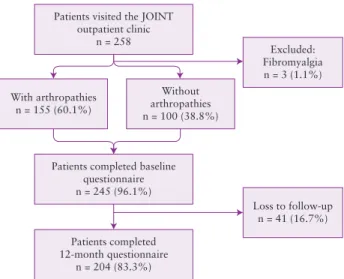
The baseline questionnaire was completed by 245/255 patients (response rate 96.1%), of whom 204 also completed the follow-up questionnaire at 12 months (loss to follow-up 16.7%) (Figure 1). Thus, the 204 patients who completed questionnaires at both time points constituted our study population.
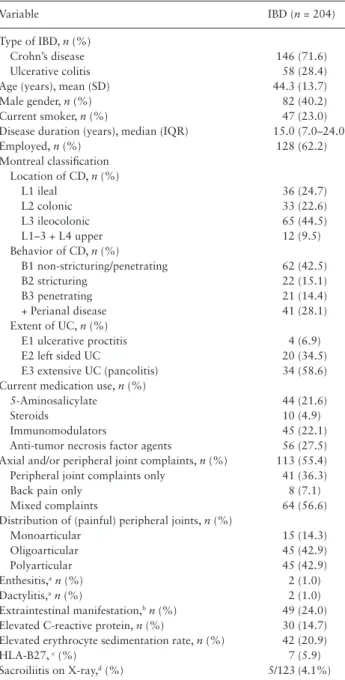
Of the 204 patients, 146 (71.6%) had CD and 58 (28.4%) had UC, with a mean age of 44.3 (SD 13.7) years and a median dis-ease duration of 15.0 (IQR 7.0–24.0) years (Table 1). In CD, ileoco-lonic disease (65/146; 44.5%), and inflammatory behavior (62/146; 42.5%) were the most common disease phenotypes. In UC, pan-colitis (34/58; 58.6%) was the dominant disease phenotype. Based on the numeric rating scale, back/joint pain was present in 113/204 (55.4%) patients, of whom 41 (36.3%) had peripheral joint pain, 8 (7.1%) had back pain, and 64 (56.6%) had mixed complaints. At physical examination, 45/105 (42.9%) patients with peripheral or mixed joint complaints had four or more tender joints (polyar-ticular). Enthesitis was present in 2 (1.0%) patients, dactylitis in 2 (1.0%), and extraintestinal manifestations in 49 (24.0%) patients. Further investigations revealed an elevated C-reactive protein in 30 (14.7%) patients, elevated erythrocyte sedimentation rate in 42 (20.9%), HLA-B27 seropositivity in 7/118 (5.9%), and sacroiliitis on X-ray in 5/123 (4.1%) patients.
Online Supplementary Material A shows data on baseline
demo-graphic and clinical variables in completers and noncompleters. There were no relevant statistically significant differences between the two groups, except that noncompleters had a significantly younger mean age (38.4 versus 44.3 years, p = 0.011).
Patients visited the JOINT outpatient clinic
n = 258
Excluded: Fibromyalgia n = 3 (1.1%) Without
arthropathies n = 100 (38.8%) With arthropathies
n = 155 (60.1%)
Patients completed baseline questionnaire n = 245 (96.1%)
Patients completed 12-month questionnaire
n = 204 (83.3%)
Loss to follow-up n = 41 (16.7%)
3.2. Baseline levels of quality of life, work, and activity impairment
Patients with IBD who had back/joint pain had significantly lower lev-els of disease-specific QOL (SIBDQ 47.8 ± 10.7 versus 55.1 ± 8.7) and generic QOL (SF-36–PCS 41.9 ± 8.9 versus 52.1 ± 7.6; SF-36–MCS 45.1 ± 10 versus 48.7 ± 8.6) at baseline compared with IBD patients with-out back/joint pain (Figure 2). Additionally, IBD patients with back/joint pain had significantly higher levels of work impairment (45.0 ± 9.9 versus 22.0 ± 3.3) and activity impairment (37.0 ± 8.1 versus 19.0 ± 2.9) at baseline compared with IBD patients without back/joint pain (Figure 2).
3.3 Predictors of QOL and work activity impairment
Based on the univariate analyses (Online Supplementary Material B), each of the illness perceptions and coping strategies were signifi-cantly associated with QOL, work impairment, and activity impair-ment and were therefore included in multiple linear mixed models. Clinical disease activity was significantly associated with back/joint pain (β = 2.04, p < 0 .00), with a variance inflation factor of 1.00, indicating no multicollinearity.
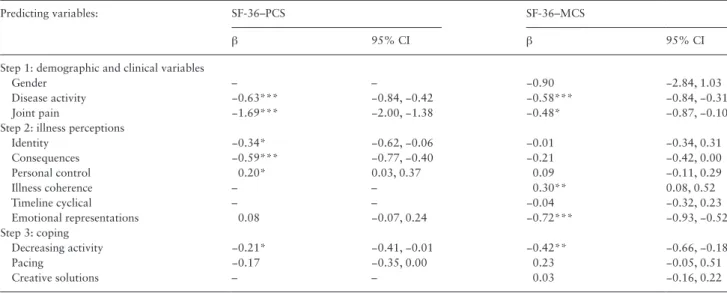
In the first step of our multivariate model we assessed whether back/joint pain was associated with disease-specific QOL (SIBDQ), generic QOL (SF-36–PCS and SF-36–MCS), work impairment, and activity impairment (Tables 2–4), while controlling for gender and IBD activity. Back/joint pain was significantly associated with SIBDQ (β = −1.04, 95% CI −1.40, −0.68), SF-36–PCS (β = −1.69, 95% CI
0
SIBDQ
SF-36-PCS SF-36-MCS
Work impairmentActivit impairment 20
Le
vel of quality of life
Le
vel of w
ork and acti
vity
impairment (%)
Joint pain No joint pain
40 60
p=0.000 p=0.000 p=0.012 p=0.000 p=0.000 80
100
0 20 40 60 80 100
Figure 2. Mean baseline levels of generic quality of life (SF-36–PCS, SF-36– MCS), disease-specific quality of life (SIBDQ), Work and Activity Impairment
(WPAI) in IBD patients with (n = 113) and without (n = 91) joint pain.
Table 2. Linear mixed model with SIBDQ as outcome variable and demographic/clinical variables (step 1), illness perceptions (step 2), and coping (step 3) as independent variables.
Predicting variables Quality of life
β 95% CI
Step 1: demographic and clinical variables
Disease activity −1.17*** −1.41, −0.93 Joint pain −1.04*** −1.40, −0.68 Step 2: illness perceptions
Identity −0.17 −0.48, 0.14
Consequences −0.39*** −0.59, −0.18 Personal control −0.08 −0.27, 0.10 Illness coherence 0.14 −0.08, 0.35 Timeline cyclical −0.36** −0.63, −0.10 Emotional representations −0.47*** −0.66, −0.28 Step 3: coping
Decreasing activity −0.26* −0.48, −0.03
Pacing 0.11 −0.06, 0.28
Results of linear mixed model showing the independent influence of predict-ing variables on SIBDQ, represented as β = coefficients. These coefficients refer to how many standard deviations SIBDQ will change per standard deviation increase in the predicting variable.
*p < 0.05; **p < 0.01; ***p < 0.001. Table 1. Demographic and clinical variables of the study population.
Variable IBD (n = 204)
Type of IBD, n (%)
Crohn’s disease 146 (71.6) Ulcerative colitis 58 (28.4) Age (years), mean (SD) 44.3 (13.7) Male gender, n (%) 82 (40.2) Current smoker, n (%) 47 (23.0) Disease duration (years), median (IQR) 15.0 (7.0–24.0) Employed, n (%) 128 (62.2) Montreal classification
Location of CD, n (%)
L1 ileal 36 (24.7)
L2 colonic 33 (22.6)
L3 ileocolonic 65 (44.5) L1–3 + L4 upper 12 (9.5) Behavior of CD, n (%)
B1 non-stricturing/penetrating 62 (42.5) B2 stricturing 22 (15.1) B3 penetrating 21 (14.4) + Perianal disease 41 (28.1) Extent of UC, n (%)
E1 ulcerative proctitis 4 (6.9) E2 left sided UC 20 (34.5) E3 extensive UC (pancolitis) 34 (58.6) Current medication use, n (%)
5-Aminosalicylate 44 (21.6)
Steroids 10 (4.9)
Immunomodulators 45 (22.1) Anti-tumor necrosis factor agents 56 (27.5) Axial and/or peripheral joint complaints, n (%) 113 (55.4) Peripheral joint complaints only 41 (36.3)
Back pain only 8 (7.1)
Mixed complaints 64 (56.6) Distribution of (painful) peripheral joints, n (%)
Monoarticular 15 (14.3)
Oligoarticular 45 (42.9)
Polyarticular 45 (42.9)
Enthesitis,an (%) 2 (1.0) Dactylitis,an (%) 2 (1.0) Extraintestinal manifestation,bn (%) 49 (24.0) Elevated C-reactive protein, n (%) 30 (14.7) Elevated erythrocyte sedimentation rate, n (%) 42 (20.9)
HLA-B27, c (%) 7 (5.9)
Sacroiliitis on X-ray,d (%) 5/123 (4.1%)
aEnthesitis and dactylitis are defined in accordance to reference 26. bSkin: psoriasis, erythema nodosum, pyoderma gangrenosum. Joints: ar-thritis, dactylitis, heel enthesitis, ankylosing spondylitis. Eyes: acute anterior uveitis (current or past).
−2.00, −1.38), SF-36–MCS (β = −0.48, 95% CI −0.87, −0.10), work impairment (β = 0.22, 95% CI 0.07, 0.37), and activity impairment (β = 0.48, 95% CI 0.39, 0.58).
In the second step of our multivariate model we assessed whether the addition of illness perceptions significantly improved our first model, using the likelihood ratio test (difference of −2 log likeli-hood between the two models). The addition of illness perceptions improved the first model for all health outcomes (p = 0.01). Illness consequences were significantly associated with SIBDQ (β = −0.39, 95% CI −0.59, −0.18), SF-36–PCS (β = −0.59, 95% CI −0.77, −0.40), work impairment (β = 0.14, 95% CI 0.06, 0.22) and activity
impairment (β = 0.13, 95% CI 0.07, 0.18), meaning that low QOL and work and activity impairments were associated with stronger beliefs that IBD will have negative consequences for the person’s life. Emotional representations were significantly associated with SIBDQ (β = −0.47, 95% CI −0.66, −0.28), SF-36–MCS (β = −0.72, 95% CI −0.93, −0.52), and activity impairment (β = 0.06, 95% CI 0.01, 0.12), meaning that low QOL and high activity impairments were associated with negative beliefs about how the illness affects one’s emotional well-being.
In our third model we assessed whether the addition of coping significantly improved our second model. The addition of coping Table 4. Linear mixed model with work productivity and activity impairment (assessed with WPAI) as outcome variables and demographic/ clinical variables (step 1), illness perceptions (step 2), and coping (step 3) as independent variables.
Predicting variables Work productivity Activity impairment
β 95% CI β 95% CI
Step 1: demographic and clinical variables
Gender 0.26 −0.22, 0.75
Disease activity 0.41*** 0.29, 0.53 0.19*** 0.12, 0.25
Joint pain 0.22** 0.07, 0.37 0.48*** 0.39, 0.58
Step 2: illness perceptions
Identity 0.05 −0.08, 0.19 0.10* 0.01, 0.19
Consequences 0.14** 0.06, 0.22 0.13*** 0.07, 0.18
Personal control −0.03 −0.08, 0.02
Illness coherence −0.08 −0.17, 0.01 0.01 −0.05, 0.07
Timeline cyclical −0.00 −0.11, 0.10 0.02 −0.06, 0.09
Emotional representations 0.04 −0.04, 0.12 0.06* 0.01, 0.12 Step 3: coping
Decreasing activity 0.07 −0.02, 0.16 0.10** 0.04, 0.17
Pacing 0.04 −0.04, 0.11 0.02 −0.03, 0.07
Results of linear mixed model showing the independent influence of predicting variables on work productivity or work impairment, represented as β coefficients. These coefficients refer to how many standard deviations work productivity or work impairment will change per standard deviation increase in the predicting variable.
WPAI, Work Productivity and Activity Impairment questionnaire. *p < 0.05; **p < 0.01; ***p < 0.001.
Table 3. Linear mixed models with SF-36–PCS and SF-36–MCS as outcome variables and demographic/clinical variables (step 1), illness perceptions (step 2), and coping (step 3) as independent variables.
Predicting variables: SF-36–PCS SF-36–MCS
β 95% CI β 95% CI
Step 1: demographic and clinical variables
Gender – – −0.90 −2.84, 1.03
Disease activity −0.63*** −0.84, −0.42 −0.58*** −0.84, −0.31
Joint pain −1.69*** −2.00, −1.38 −0.48* −0.87, −0.10
Step 2: illness perceptions
Identity −0.34* −0.62, −0.06 −0.01 −0.34, 0.31
Consequences −0.59*** −0.77, −0.40 −0.21 −0.42, 0.00
Personal control 0.20* 0.03, 0.37 0.09 −0.11, 0.29
Illness coherence – – 0.30** 0.08, 0.52
Timeline cyclical – – −0.04 −0.32, 0.23
Emotional representations 0.08 −0.07, 0.24 −0.72*** −0.93, −0.52 Step 3: coping
Decreasing activity −0.21* −0.41, −0.01 −0.42** −0.66, −0.18
Pacing −0.17 −0.35, 0.00 0.23 −0.05, 0.51
Creative solutions – – 0.03 −0.16, 0.22
Results of linear mixed model showing the independent influence of predicting variables on SF-36–PCS or SF-36–MCS, represented as β coefficients. These coef-ficients refer to how many standard deviations SF-36–PCS or SF-36–MCS will change per standard deviation increase in the predicting variable.
improved the second model across SF-36–PCS (p = 0.00), SF-36– MCS (p = 0.00), and activity impairment (p = 0.00). Decreasing activity was significantly associated with SIBDQ (β = −0.26, 95% CI −0.48, −0.03), SF-36–PCS (β = −0.21, 95% CI −0.41, −0.01), SF-36– MCS (β = −0.42, 95% CI −0.66, −0.18), and activity impairment (β = 0.10, 95% CI 0.04, 0.17). In addition, we assessed whether the impact of illness perceptions on health outcomes was mediated by particular coping strategies. Decreasing activity mediated the impact of illness identity and illness consequences on both SF-36–PCS and SF-36–MCS.
4. Discussion
In this prospective study of patients with IBD-associated arthropa-thy, we found that back/joint pain had a negative impact on QOL and work productivity. This negative impact on QOL and work pro-ductivity remained significant during a follow-up of 12 months, after controlling for gender and IBD activity. Additionally, the QOL and work productivity of IBD patients were also highly determined by several illness perceptions and, to a lesser extent, by coping.
To our knowledge, this is the first study to date assessing the impact of illness perceptions and coping on QOL and work produc-tivity in patients with IBD-associated arthropathy.
Although QOL and work productivity were mainly determined by back/joint pain and activity of IBD, illness perceptions contrib-uted significantly to the variance of these outcomes. Our findings are in line with previous studies in CD and UC assessing the impact of disease characteristics and illness perceptions on various health outcomes.17,18,23 In these studies, disease characteristics (mainly dis-ease activity) contributed 49–68%20,21,26 and 23%17 of the variance of QOL and disability, respectively. Illness perceptions contributed an additional 9–21%17,18,23 and 23%17 of variance of QOL and disability, respectively. In this study we have demonstrated that a decrease in QOL was highly associated with stronger beliefs that IBD will have negative consequences for one’s life (i.e. illness con-sequences), and negative beliefs about how IBD affects one’s emo-tional well-being (i.e. emoemo-tional representations). The strong impact of illness consequences and emotional representations has been con-firmed by previous studies in IBD. For instance, in a study of 80 IBD patients it was shown that illness consequences were moder-ately or strongly associated with different aspects of adjustment to their disease, including psychological distress, QOL and functional independence.17
We also examined whether coping added significantly to the vari-ance of health outcomes, after controlling for gender, disease activ-ity, and remaining illness perceptions. Coping is defined as ongoing cognitive or behavioral efforts to manage psychological distress.39,40 Coping strategies (or styles) can either be active (problem-based) or passive (emotion-based). Active coping (creative solution seek-ing, decreasing activities, and pacing) aims to alter or eliminate the source of stress, while passive coping (consideration, accepting, opti-mism) aims to reduce the emotional distress caused by the situation. Patients with IBD are more likely to rely on passive coping strate-gies.41–43 Consistent with previous evidence in IBD, we found that coping significantly added to the variance of QOL and impairments in daily activity.24,25 However, other studies in IBD did not observe a contributory role of coping with respect to QOL, psychological distress and functional independence.17,23 This may be explained by the fact that in these studies coping was assessed with a generic coping questionnaire, which tends to obscure associations between illness-specific coping, QOL, and activity and work impairments.
In the present study we used the disease-specific coping question-naire, which addresses coping strategies directed at the most impor-tant stressors of immune-mediated inflammatory diseases, including pain, limitations, and dependency.
Additionally, we found that the behavioral coping strategy ‘decreasing activities’ was negatively associated with QOL and activity impairments. This association has not been observed in IBD before. In patients with rheumatoid arthritis and ankylosing spon-dylitis, decreasing activity has been clearly found to be negatively associated with QOL,44 functional status,45,46 and work productiv-ity.47 It has been postulated that avoidance (i.e. decreasing activities) may have beneficial effects in the short term by facilitating healing in rheumatoid arthritis. However, in the long term it becomes a mala-daptive coping strategy by limiting joint movement and inducing muscle weakness and disuse.48–50
Finally, we have demonstrated that the impact of illness percep-tions, in particular illness identity and illness consequences, on QOL is reduced when patients do not decrease activity in order to cope with pain. This mediating effect supports the Common Sense Model,13,14 which states that the impact of illness perceptions on health outcomes may be attenuated by adopting a particular coping strategy.
This study has several important strengths. First, all patients were systematically examined by a multidisciplinary team of gastroenter-ologists and rheumatgastroenter-ologists. Second, patients were prospectively followed for 12 months, which enabled us to assess the predictive value of back/joint pain, illness perceptions, and coping on several important patient-reported health outcomes. Third, the results of our multiple linear mixed models strongly support the well-validated Common Sense Model.
This study has also several limitations. First, as reflected by the relatively high proportion of anti-tumor necrosis factor users, our study included a selected patient group. Therefore, extrapolation of our data to the general IBD population may be limited. However, the primary aim of the present study was to determine associations between back/joint pain, illness perceptions, and coping that are also applicable to population-based samples. Second, attrition bias may have occurred due to differences between patients who did and did not complete the follow-up period. However, demographic and dis-ease characteristics were similar between the two groups, except for the lower age of the noncompleters. We consider that this difference did not affect our outcomes, since age was not found to be associated with QOL and work productivity (Online Supplementary Material B). Third, as the CORS has not been validated in patients with IBD-associated arthropathy, coping strategies directed at IBD-specific stressors such as abdominal pain, urgency, and diarrhea might have been missed. However, the CORS has been extensively validated in patients with rheumatoid arthritis, a comparable immune-medi-ated inflammatory disease with regard to pathogenesis, stressors and treatment. Besides, IBD studies that used a generic—though validated—coping questionnaire failed to identify relevant coping strategies. Fourth, although we adjusted for the most important founders, such as gender and clinical disease activity, residual con-founding cannot be completely excluded.
work disability and associated costs. Nevertheless, many patients with IBD-associated arthropathy remain undiagnosed.54 Apart from providing these patients with the appropriate medical treatment, their QOL and work productivity can be further improved by behav-ioral interventions. These interventions should be aimed at eliciting and addressing patients’ illness perceptions and stimulating adaptive coping strategies. Previous studies have already shown that behav-ioral interventions based on the Common Sense Model can change illness perceptions and coping strategies of patients after myocardial infarction and patients with end-stage renal disease, and thereby improve major components of QOL (e.g. return to work).55–58
In conclusion, back/joint pain persistently and negatively impacted the QOL and work productivity of patients with IBD-associated arthropathy. Illness perceptions and coping also had a significant impact on QOL and work productivity. As potentially modifiable factors, illness perceptions and coping may provide addi-tional targets for behavioral interventions, aimed at improving QOL and increasing work productivity. Multidisciplinary teams, incorpo-rating such interventions, are warranted.
Funding
NoneConflict of Interest
None declared.Acknowledgments
LKPMB and MvdH had full access to all data in the study and take responsibility for the integrity of the data and the accuracy of the data analysis. DWH, MvdH, HHF: Study concept and design. LKPMB, DWH, DMFMvdH, HHF, AEvdMdJong, RAV: Patient enrollment. LKPMB, SJHvE: Acquisition of data. MvdH: Drafting of manuscript. MvdH, HHF, AAK, MS: Analysis and interpretation of data. All authors: Critical revision of the manuscript. ML, MvdH: Statistical analysis. DWH: Study supervision. HHF has acted as a consultant for Abbvie. AAK has received payments for lectures from Ferring and acted as a consultant for Abbvie and Shire. AEVdMdJ has acted as consultant for Abbvie. RAV has acted as a consultant for Abbvie, MSD, and Genzyme.
Online Supplementary Material
Appendix A.
Demographic and clinical characteristics of completers (n = 204) and noncompleters (n = 41).
Appendix B. Univariate analysis.
aVariables were entered into the linear mixed model.
References
1. Salvarani C, Vlachonikolis IG, van der Heijde DM, et al. Musculoskeletal manifestations in a population-based cohort of inflammatory bowel dis-ease patients. Scand J Gastroenterol 2001;36:1307–13.
2. Vavricka SR, Brun L, Ballabeni P, et al. Frequency and risk factors for extraintestinal manifestations in the Swiss Inflammatory Bowel Disease Cohort. Am J Gastroenterol 2011;106:110–9.
3. Palm O, Bernklev T, Moum B, Gran JT. Non-inflammatory joint pain in patients with inflammatory bowel disease is prevalent and has a significant impact on health related quality of life. J Rheumatol 2005;32:1755–9.
4. Pizzi LT, Weston CM, Goldfarb NI, et al. Impact of chronic conditions on quality of life in patients with inflammatory bowel disease. Inflamm Bowel Dis 2006;12:47–52.
5. D’Incà R, Podswiadek M, Ferronato A, Punzi L, Salvagnini M, Sturniolo GC. Articular manifestations in inflammatory bowel disease patients: a prospective study. Dig Liver Dis 2009;41:565–9.
6. Bernstein CN, Blanchard JF, Rawsthorne P, Yu N. The prevalence of extraintestinal diseases in inflammatory bowel disease: a population-based study. Am J Gastroenterol 2001;96:1116–22.
7. Lakatos L, Pandur T, David G, et al. Association of extraintestinal mani-festations of inflammatory bowel disease in a province of western Hun-gary with disease phenotype: results of a 25-year follow-up study. World J Gastroenterol 2003;9:2300–7.
8. Lanna CC, Ferrari ML, Rocha SL, Nascimento E, de Carvalho MA, da Cunha AS. A cross-sectional study of 130 Brazilian patients with Crohn’s disease and ulcerative colitis: analysis of articular and ophthalmologic manifestations. Clin Rheumatol 2008;27:503–9.
9. Turkcapar N, Toruner M, Soykan I, et al. The prevalence of extraintestinal manifestations and HLA association in patients with inflammatory bowel disease. Rheumatol Int 2006;26:663–8.
10. De Vlam K, Mielants H, Cuvelier C, De Keyser F, Veys EM, De Vos M. Spondyloarthropathy is underestimated in inflammatory bowel disease: prevalence and HLA association. J Rheumatol 2000;27:2860–5. 11. Siebert U, Wurm J, Gothe RM, Arvandi M, Vavricka SR, von Känel R.
Predictors of temporary and permanent work disability in patients with inflammatory bowel disease: results of the Swiss inflammatory bowel dis-ease cohort study. Inflamm Bowel Dis 2013;19:847–55.
12. Picavet HSJ, Schouten JSAG. Musculoskeletal pain in the Netherlands: prevalences, consequences and risk groups, the DMC3-study. Pain 2003;102:167–178.
13. Hagger MS, Orbell S. A meta-analytic review of the Common Sense Model of illness representations. Psychol Health 2003;18:141–84.
14. Leventhal H, Brissette I, Leventhal EA. The Common-Sense Model of self-regulation of health and illness. In: Cameron LD, Leventhal H, editors. The Self-Regulation of Health and Illness Behaviour. London: Routledge; 2003: 42–65.
15. Vaughan R, Morrison L, Miller E. The illness representations of multiple scle-rosis and their relations to outcome. Br J Health Psychol 2003;8:287–301. 16. Scharloo M, Kaptein AA, Weinman J, et al. Illness perceptions, coping and
functioning in patients with rheumatoid arthritis, chronic obstructive pul-monary disease and psoriasis. J Psychosom Res 1998;44:573–85. 17. Dorrian A, Dempster M, Adair P. Adjustment to inflammatory bowel
disease: the relative influence of illness perceptions and coping. Inflamm Bowel Dis 2009;15:47–55.
18. Han SW, McColl E, Barton JR, James P, Steen IN, Welfare MR. Predictors of quality of life in ulcerative colitis. The importance of symptoms and illness representations. Inflamm Bowel Dis 2005;11:24–34.
19. Kiebles JL, Doerfler B, Keefer L. Preliminary evidence supporting a framework of psychological adjustment to inflammatory bowel disease.
Inflamm Bowel Dis 2010;16:1685–95.
20. Knowles SR, Wilson JL, Connell WR, Kamm MA. Preliminary examina-tion of the relaexamina-tions between disease activity, illness percepexamina-tions, coping strategies, and psychological morbidity in Crohn’s disease guided by the common sense model of illness. Inflamm Bowel Dis 2011;17:2551–7. 21. Taft TH, Keefer L, Artz C, Bratten J, Jones MP. Perceptions of illness
stigma in patients with inflammatory bowel disease and irritable bowel syndrome. Qual Life Res 2011;20:1391–9.
22. Rochelle TL, Fidler H. The importance of illness perceptions, quality of life and psychological status in patients with ulcerative colitis and Crohn’s disease. J Health Psychol 2013;18:972–83.
24. Knowles SR, Gass C, Macrae F. Illness perceptions in IBD influence psy-chological status, sexual health and satisfaction, body image and relational functioning: a preliminary exploration using Structural Equation Mod-eling. J Crohns Colitis 2013;7:e344–50.
25. Knowles SR, Cook SI, Tribbick D. Relationship between health status, ill-ness perceptions, coping strategies and psychological morbidity: a prelimi-nary study with IBD stoma patients. J Crohns Colitis 2013;7:e471–8. 26. Heuft-Dorenbosch L, Spoorenberg A, van Tubergen A, et al. Assessment of
enthesitis in ankylosing spondylitis. Ann Rheum Dis 2003;62:127–32. 27. Van der Linden S, Valkenburg HA, Cats A. Evaluation of diagnostic
cri-teria for ankylosing spondylitis. A proposal for modification of the New York criteria. Arthritis Rheum 1984;27:361–8.
28. Harvey RF, Bradshaw JM. A simple index of Crohn’s disease activity. Lan-cet 1980;1:876.
29. Walmsley RS, Ayres RC, Pounder RE, Allan RN. A simple clinical colitis activity index. Gut 1998;43:29–32.
30. Moss-Morris R,Weinman J, Petrie KJ. The revised Illness Perception Ques-tionnaire (IPQ-R). Psychol Health 2002;17:1–16.
31. Van Lankveld W, Naring G, van der Staak C, van ’t Pad Bosch P, van de Putte L. De ontwikkeling van de CORS. Coping met Reuma Stressoren.
Gedrag en Gezond 1993;21:40–8 [in Dutch].
32. Van Lankveld W, Näring G, van der Staak C, van ’t Pad Bosch P, van de Putte L. Stress caused by rheumatoid arthritis: relation among subjec-tive stressors of the disease, disease status, and well-being. J Behav Med 1993;16:309–21.
33. Irvine EJ, Zhou Q, Thompson AK. The Short Inflammatory Bowel Dis-ease Questionnaire: a quality of life instrument for community physicians managing inflammatory bowel disease. CCRPT Investigators. Canadian Crohn’s Relapse Prevention Trial. Am J Gastroenterol 1996;91:1571–8. 34. Han SW, Gregory W, Nylander D, et al. The SIBDQ: further validation in
ulcerative colitis patients. Am J Gastroenterol 2000;92:145–51. 35. Ware JE, Sherbourne CA. The MOS 36-item Short-Form health survey (SF
36). Conceptual framework and item selection. Med Care 1992;30:473–83. 36. Reilly MC, Zbrozek AS, Dukes EM. The validity and reproducibility of a work productivity and activity impairment instrument. Pharmacoeconom-ics 1993;4:353–65.
37. Reilly MC, Gerlier L, Brabant Y, Brown M. Validity, reliability, and respon-siveness of the work productivity and activity impairment questionnaire in Crohn’s disease. Clin Ther 2008;30:393–404.
38. Van der Have M, van der Aalst KS, Kaptein AA, et al. Determinants of health-related quality of life in Crohn’s disease: a systematic review and meta-analysis. J Crohns Colitis 2014;8:93–106.
39. Lazarus RS. Psychological stress and coping in adaptation and illness. Int J Psychiatry Med 1974;5:321–33.
40. Lazarus RS. Coping theory and research: past, present, and future.
Psycho-som Med 1993;55:234–47.
41. McCombie AM, Mulder RT, Gearry RB. How IBD patients cope with IBD: a systematic review. J Crohns Colitis 2013;7:89–106.
42. Jones MP, Wessinger S, Crowell MD. Coping strategies and interpersonal support in patients with irritable bowel syndrome and inflammatory bowel disease. Clin Gastroenterol Hepatol 2006;4:474–81.
43. Graff LA, Walker JR, Clara I, et al. Stress coping, distress, and health per-ceptions in inflammatory bowel disease and community controls. Am J Gastroenterol 2009;104:2959–69.
44. Van Lankveld W, Näring G, van ’t Pad Bosch P, van de Putte L. Behavioral coping and physical functioning: the effect of adjusting the level of activity on observed dexterity. J Rheumatol 1999;26:1058–64.
45. Evers AW, Kraaimaat FW, Geenen R, Jacobs JW, Bijlsma JW. Pain coping and social support as predictors of long-term functional disability and pain in early rheumatoid arthritis. Behav Res Ther 2003;41:1295–310.
46. Scharloo M, Kaptein AA, Weinman JA, Hazes JM, Breedveld FC, Rooij-mans HG. Predicting functional status in patients with rheumatoid arthri-tis. J Rheumatol 1999;26:1686–93.
47. Chorus AM, Miedema HS, Boonen A, Van Der Linden S. Quality of life and work in patients with rheumatoid arthritis and ankylosing spondylitis of working age. Ann Rheum Dis 2003;62:1178–84.
48. Vlaeyen JW, Kole-Snijders AM, Boeren RG, Van Eek H. Fear of movement/ (re)injury in chronic low back pain and its relation to behavioral perfor-mance. Pain 1995;62:363–72.
49. Dekker J, Boot B, van der Woude LH, Bijlsma JW. Pain and disability in osteoarthritis: a review of biobehavioral mechanisms. J Behav Med 1992;15:189–214.
50. Kottke FJ. The effects of limitation of activity upon the human body. JAMA 1966;196:825–30.
51. Van der Valk ME, Mangen MJ, Leenders M, et al. Risk factors of work dis-ability in patients with inflammatory bowel disease – a Dutch nationwide web-based survey. J Crohns Colitis 2013;8:590–7.
52. Van der Valk ME, Mangen MJ, Leenders M, et al. Healthcare costs of inflammatory bowel disease have shifted from hospitalisation and sur-gery towards anti-TNFα therapy: results from the COIN study. Gut 2014;63:72–9.
53. Yu AP, Cabanilla LA, Wu EQ, Mulani PM, Chao J. The costs of Crohn’s disease in the United States and other Western countries: a systematic review. Curr Med Res Opin 2008;24:319–28.
54. Stolwijk C, Pierik M, Landewé R, Masclee A, van Tubergen A. Prevalence of self-reported spondyloarthritis features in a cohort of patients with inflammatory bowel disease. Can J Gastroenterol 2013;27:199–205. 55. Petrie KJ, Cameron LD, Ellis CJ, Buick D, Weinman J. Changing illness
perceptions after myocardial infarction: an early intervention randomized controlled trial. Psychosom Med 2002;64:580–6.
56. Broadbent E, Ellis CJ, Thomas J, Gamble G, Petrie KJ. Further develop-ment of an illness perception intervention for myocardial infarction patients: a randomized controlled trial. J Psychosom Res 2009;67:17–23. 57. Karamanidou C, Weinman J, Horne R. Improving haemodialysis patients’
understanding of phosphate-binding medication: a pilot study of a psy-cho-educational intervention designed to change patients’ perceptions of the problem and treatment. Br J Health Psychol 2008;13:205–14. 58. Jansen DL, Heijmans M, Rijken M, Kaptein AA. The development of