New Impossible Differential Attacks on Camellia
Dongxia Bai1, Leibo Li2,3
1 Department of Computer Science and Technology,
Tsinghua University, Beijing 100084, China [email protected]
2 Key Laboratory of Cryptologic Technology and Information Security,
Ministry of Education, Shandong University, Jinan 250100, China
3 School of Mathematics, Shandong University, Jinan 250100, China
Abstract. Camellia is one of the most worldwide used block ciphers, which has been selected as a standard by ISO/IEC. In this paper, we propose several new 7-round impossible differentials of Camellia with 2F L/F L−1 layers, which turn out to be the first 7-round impossible differentials with 2F L/F L−1layers. Combined with some basic techniques including the early abort approach and the key schedule consideration, we achieve the impossible differential attacks on 11-round Camellia-128, 11-round Camellia-192, 12-round Camellia-192, and 14-round Camellia-256, and the time complexity are 2123.6, 2121.7, 2171.4 and 2238.2 respectively. As far as we know, these are the best results against the reduced-round variants of Camellia. Especially, we give the first attack on 11-round Camellia-128 reduced version withF L/F L−1 layers.
Key words: Camellia, Impossible Differential, Cryptanalysis, Impossible Differential Attack.
1 Introduction
Camellia is a 128-bit block cipher jointly developed by NTT and Mitsubishi in 2000, and supports 128-, 192-, and 256-bit key lengths [1]. It was adopted by cryptographic evaluation projects such as CRYPTREC [5] and NESSIE [22], as well as the standardization activities at IETF [23]. Then it was accepted by ISO/IEC [9] as an international standard.
Camellia has a Feistel structure withF L/F L−1layers inserted every 6 rounds. TheF L/F L−1
functions are keyed linear functions which are designed to provide non-regularity across rounds and destroy the differential property [1]. As one of the most widely used block cipher, Camel-lia has attracted a significant amount of attention of the cryptology researchers. The security of Camellia against various attacks are discussed in many papers, such as linear and differen-tial cryptanalysis [24], higher order differendifferen-tial cryptanalysis [7,11], truncated differendifferen-tial attack [5,10,14,25], impossible differential cryptanalysis [4,16,17,18,20,21,25,26], collision attack [15,27], square attack [8,15,28], square like attack [6] et.al. Among these methods, the impossible differ-ential attack [3,12] is the most efficient.
In recent years, there are a number of results on simple versions of Camellia which ex-clude the F L/F L−1 layers. In [4], the authors present the first 6-round impossible differentials with F L/F L−1 functions, and give the impossible differential attacks on Camellia-192/-256 withF L/F L−1 functions. Then some 7-round impossible differentials withF L/F L−1 functions are introduced in [16,17]. In this paper, we propose some new 7-round impossible differentials including 2 F L/F L−1 layers, which are the first 7-round impossible differentials including 2
F L/F L−1 layers. Due to our new 7-round impossible differentials including one moreF L/F L−1
Supported by the National Natural Science Foundation of China (Grant No. 60931160442), and the Tsinghua
layer than all of those impossible differentials above, using our new impossible differentials could achieve better attacks. Combined with the early abort approach [19] and the key schedule con-siderations, we first present the attack on 11-round Camellia-128, which requires 2120.5 chosen plaintexts and 2123.6 11-round encryptions. Then we give attacks on 11-round Camellia-192, 12-round Camellia-192, and 14-12-round Camellia-256, and the time complexity are 2121.7, 2171.4 and 2238.2 respectively.
The rest of this paper is organized as follows. We give some notations and briefly describe the block cipher Camellia in Section 2. Some properties of Camellia and 7-round impossible differentials with 2 F L/F L−1 layers are given in Section 3. Section 4 presents the impossible differential attacks on reduced-round Camellia with F L/F L−1 layers. Finally, we conclude the paper in Section 5.
2 Preliminaries
2.1 Notations
In this paper, we will use the following notations:
Lr−1,Lr−1 : the left 64-bit half of ther-th round input,
Rr−1,Rr−1 : the right 64-bit half of ther-th round input,
ΔSr : the output difference of the S-box layer of ther-th round
Kr : the subkey used in ther-th round
Xl : thel-th byte of a 64-bit wordX(l= 1, . . . ,8)
Y{i} : thei-th bit of a bit stringY (1≤i≤128)
xy : the concatenation ofx andy x≪i : the left rotation of xby ibits
⊕,∩,∪ : bitwise exclusive-OR(XOR), AND, OR
2.2 Description of Camellia
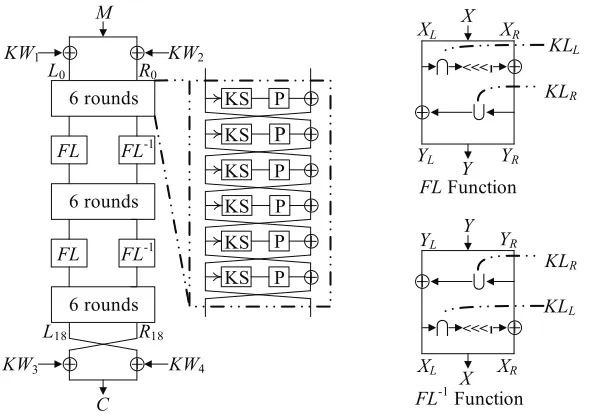
Camellia [1] is a 128-bit block cipher with Feistel structure. It has 18 rounds for 128-bit key and 24 rounds for 192-/256-bit key. We give the encryption procedure of Camellia-128 as follows, see Fig. 1.
Encryption Procedure. First a 128-bit plaintextM is XORed with subkeysKW1KW2 and
separated into two 64-bit intermediate values L0 and R0 :L0R0 = M ⊕(KW1KW2). Then the following operations are performed fromr = 1 to 18, except for r= 6 and 12:
Lr=Rr−1⊕F(Lr−1, Kr), Rr=Lr−1,
forr = 6 and 12, do the following:
Lr =Rr−1⊕F(Lr−1, Kr), Rr=Lr−1,
Lr =F L(Lr, KLr/3−1), Rr=F L−1(Rr, KLr/3).
Finally the 128-bit ciphertextC is calculated as:C = (R18L18)⊕(KW3KW4).
F is the round function defined below:
⊕ ⊕ ⊕ ⊕ ⊕ ⊕ 6 rounds 6 rounds 6 rounds ⊕ ⊕ ⊕ ⊕ M C
KW1 KW2
KW4 KW3 FL-1 FL FL-1 FL L0
L18 R18
R0 P KS KS KS KS KS KS P P P P P ⊕ ⊕ U I <<<1
X
Y XL XR
YL YR
KLL
KLR
⊕
I <<<1
Y
X XL XR
YL YR
KLL
⊕ U KLR
FL Function
FL-1Function
Fig. 1. Encryption procedure of Camellia-128
where S and P are defined as follows:
S: (GF(2)8)8 →(GF(2)8)8 (x1, x2, . . . , x8)→(y1, y2, . . . , y8),
y1=S1(x1), y2=S2(x2), y3=S3(x3), y4=S4(x4), y5=S2(x5), y6=S3(x6), y7=S4(x7), y8=S1(x8),
here S1, S2, S3 and S4 are the 8×8 S-boxes.
P : (GF(2)8)8→(GF(2)8)8 (y1, y2, . . . , y8)→(z1, z2, . . . , z8),
z1=y1⊕y3⊕y4⊕y6⊕y7⊕y8, z5=y1⊕y2⊕y6⊕y7⊕y8, z2=y1⊕y2⊕y4⊕y5⊕y7⊕y8, z6=y2⊕y3⊕y5⊕y7⊕y8, z3=y1⊕y2⊕y3⊕y5⊕y6⊕y8, z7=y3⊕y4⊕y5⊕y6⊕y8, z4=y2⊕y3⊕y4⊕y5⊕y6⊕y7, z8=y1⊕y4⊕y5⊕y6⊕y7.
The inverse of P is as follows:
P−1 : (GF(2)8)8 →(GF(2)8)8 (z1, z2, . . . , z8)→(y1, y2, . . . , y8),
F L is defined below:
F L:GF(2)64×GF(2)64→GF(2)64 (XLXR, KLLKLR)→(YLYR),
YR= ((XL∩KLL)≪1)⊕XR, YL= (YR∪KLR)⊕XL.
F L−1 is the inverse ofF L, and all of them are linear as long as the keys are fixed [2].
Similarly to Camellia-128, Camellia-192/-256 have 24-round Feistel structure withF L/F L−1
layers inserted after 6, 12, 18 rounds. Before the first round and after the last round, there are pre- and post-whitening layers which use bitwise exclusive-or operations with 128-bit subkeys, respectively.
Key Schedule. Two 128-bit variables KA and KB are generated from the main key K =
KLKR. For Camellia-128, KL is the 128-bit K, and KR is 0. For Camellia-192, KL is the left 128-bit of K, and the concatenation of the right 64-bit ofK and its complement is used as KR. For Camellia-256,KLis the left 128-bit ofK, andKRis the right 128-bit ofK. All of the subkeys are derived from rotating KL, KR, KA or KB, and KB is only used in Camellia-192/-256. For details of Camellia, we refer to [1].
3 New 7-round Impossible Differentials of Camellia with 2 F L/F L−1 layers
In this section, we give some useful properties of Camellia, and then present several new 7-round impossible differentials.
Property 1 (from [13]) Let x, x, k be 32-bit values, and Δx = x⊕x, then the differential properties of AND and OR operations are:
(x∩k)⊕(x∩k) = (x⊕x)∩k=Δx∩k,
(x∪k)⊕(x∪k) = (x⊕k⊕(x∩k))⊕(x⊕k⊕(x∩k)) =Δx⊕(Δx∩k).
Property 2 For F L−1 function, if the input difference is ΔY = (a,0,0,0,0,0,0,0), where a is a non-zero byte whose most significant bit is 0, then the output difference is ΔX = (a,0,0,0, A,0,0,0), where A is an unknown byte.
Proof. By Property 1, apparently we can get the output difference below (note that the most significant bit of ais 0):
ΔXL=XL⊕XL = (YL⊕(YR∪KLR))⊕(YL ⊕(YR ∪KLR)) =ΔYL⊕ΔYR⊕(ΔYR∩KLR) =ΔYL= (a,0,0,0),
ΔXR=XR⊕XR = ((XL∩KLL)≪1)⊕YR)⊕((XL ∩KLL)≪1)⊕YR) =ΔYR⊕((ΔXL∩KLL)≪1) = (A,0,0,0).
here Y and X are the 64-bit input value and output value of F L−1 function, and KL is the 64-bit subkey used in F L−1 function, andA is an unknown byte.
Property 3 (from [16]) ForF L−1 function, if the output difference isΔX = (0,0,0,0, b,0,0,0), wherebis a non-zero byte, then the input difference should satisfy the formΔY = (B,0,0,0, b,0,
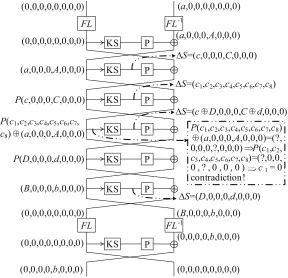
Impossible Differential. We now demonstrate that the 7-round differential
((0,0,0,0,0,0,0,0); (a,0,0,0,0,0,0,0))→7R((0,0,0,0, b,0,0,0); (0,0,0,0,0,0,0,0))
is impossible, where a is a non-zero byte whose most significant bit is 0, and b is an arbitrary non-zero byte, see Fig. 2.
(0,0,0,0,0,0,0,0)
(0,0,0,0,0,0,0,0)
(a,0,0,0,0,0,0,0)
(a,0,0,0,A,0,0,0)
(a,0,0,0,A,0,0,0)
∆S=(c,0,0,0,C,0,0,0)
P(c,0,0,0,C,0,0,0)
∆S=(c1,c2,c3,c4,c5,c6,c7,c8)
P(c1,c2,c3,c4,c5,c6,c7, c8)Ͱ(a,0,0,0,A,0,0,0)
(0,0,0,0,b,0,0,0) (0,0,0,0,0,0,0,0) (0,0,0,0,0,0,0,0)
(0,0,0,0,0,0,0,0)
(0,0,0,0,b,0,0,0) (B,0,0,0,b,0,0,0) (B,0,0,0,b,0,0,0)
∆S=(D,0,0,0,d,0,0,0) P(D,0,0,0,d,0,0,0)
∆S=(cͰD,0,0,0,CͰd,0,0,0)
⊕ ⇒ FL-1 FL P KS ⊕ P KS ⊕ P KS ⊕ P KS ⊕ P KS ⊕ P KS
FL FL-1
⊕
P KS
⇒
P(c1,c2,c3,c4,c5,c6,c7,c8) Ͱ(a,0,0,0,A,0,0,0)=(?, 0,0,0,?,0,0,0)→P(c1,c2, c3,c4,c5,c6,c7,c8)=(?,0,0, 0 , ? , 0 , 0 , 0 )→c1= 0 contradiction!
Fig. 2. 7-round impossible differential with 2F L/F L−1 layers
By Property 2, the input difference of the first round is ((0,0,0,0,0,0,0,0); (a,0,0,0, A,0,0,0)), and then the output differences of the second and third round are
(P(c,0,0,0, C,0,0,0); (a,0,0,0, A,0,0,0)) and
(P(c1, c2, c3, c4, c5, c6, c7, c8)⊕(a,0,0,0, A,0,0,0); P(c,0,0,0, C,0,0,0)),
where (c,0,0,0, C,0,0,0) is evolved from (a,0,0,0, A,0,0,0) after key-addition layer and S-box layer, (c1, c2, c3, c4, c5, c6, c7, c8) is evolved fromP(c,0,0,0, C,0,0,0) (note thatP(c,0,0,0, C,0,0,
0) = (c, c⊕C, c⊕C, C, c, C, C, c⊕C)), c, c1, c5 are unknown non-zero bytes, and C, ci(i = 2,3,4,6,7,8) are unknown bytes. So we can get that the input difference of S-box layer of the fourth round is
P(c1, c2, c3, c4, c5, c6, c7, c8)⊕(a,0,0,0, A,0,0,0).
In the backward direction, the input difference of the seventh round is ((0,0,0,0,0,0,0,0); (0,
0,0,0, b,0,0,0)), and the output difference of the sixth round deduced by Property 3 is ((0,0,0,
where (D,0,0,0, d,0,0,0) is evolved from (B,0,0,0, b,0,0,0) after key-addition layer and S-box layer, d is an unknown non-zero byte, andD is an unknown byte. Hence, the output difference of S-box layer of the fourth round is
P−1(P(c,0,0,0, C,0,0,0) ⊕P(D,0,0,0, d,0,0,0)) = (c⊕D,0,0,0, C ⊕d,0,0,0).
Now the input and output differences of S-box layer of the fourth round are all determined. According to the output difference of S-box layer, the input difference of S-box layer should satisfy the form (?,0,0,0,?,0,0,0) (? denotes an unknown byte). So we can get:
P(c1, c2, c3, c4, c5, c6, c7, c8)⊕(a,0,0,0, A,0,0,0) = (?,0,0,0,?,0,0,0)
⇒ P(c1, c2, c3, c4, c5, c6, c7, c8) = (?,0,0,0,?,0,0,0) ⊕(a,0,0,0, A,0,0,0) = (?,0,0,0,?,0,0,0)
⇒ c1 = 0,
which contradicts with c1= 0. As a result, the differential
((0,0,0,0,0,0,0,0); (a,0,0,0,0,0,0,0))→7R((0,0,0,0, b,0,0,0); (0,0,0,0,0,0,0,0)) is impossible. Actually, we can get three more 7-round impossible differentials with 2 F L/F L−1
layers, which are:
((0,0,0,0,0,0,0,0); (0, a,0,0,0,0,0,0)) 7R((0,0,0,0,0, b,0,0); (0,0,0,0,0,0,0,0)),
((0,0,0,0,0,0,0,0); (0,0, a,0,0,0,0,0)) 7R((0,0,0,0,0,0, b,0); (0,0,0,0,0,0,0,0)),
((0,0,0,0,0,0,0,0); (0,0,0, a,0,0,0,0)) 7R((0,0,0,0,0,0,0, b); (0,0,0,0,0,0,0,0)),
where a, bare non-zero bytes, and the most significant bit ofais 0.
4 Impossible Differential Attacks on Camellia with F L/F L−1 Layers
In this section, we present some new impossible differential attacks on 11-round Camellia-128, 11-round Camellia-192, 12-round Camellia-192, and 14-round Camellia-256, using the new 7-round impossible differential proposed in Section 3. All of these attacks start from the middle round, and exclude the whitening layers to not change the structure of the algorithm.
4.1 Impossible Differential Attack on 11-round Camellia-128
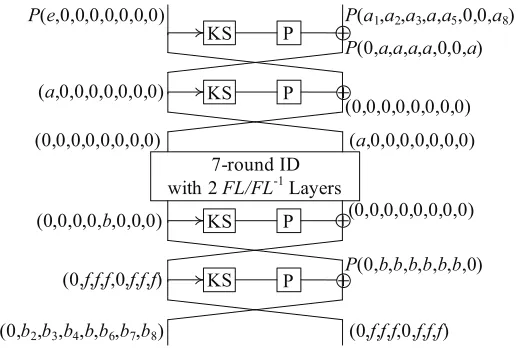
As illustrated in Fig. 3, the 7-round impossible differential is applied in rounds 7 to 13, and the attack is from round 5 to 15. The attack procedure is as follows.
1. Take 2n structures of plaintextsM = (L4, R4) with following form:
(P(x1, α2, α3, α4, α5, α6, α7, α8); P(y1, y2, y3, y4, y5, β6, β7, y8)),
where αi(i = 2, . . . ,8), βj(j = 6,7) are fixed constants, x1, yi(i= 1,2,3,5,8) take all the 8-bit values, andy4 takes all the 7-bit values with the most significant bit fixed. As a result, each structure contains 255 plaintexts which can provide about 2109 plaintext pairs with the difference
(P(e,0,0,0,0,0,0,0);P(a1, a2, a3, a, a5,0,0, a8)),
(0,0,0,0,b,0,0,0)
P(0,b2,b3,b4,b,b6,b7,b8)
(0,f,f,f,0,f,f,f) P(0,b,b,b,b,b,b,0) (0,0,0,0,0,0,0,0)
(0,f,f,f,0,f,f,f)
⊕
P KS
⊕
P KS (a,0,0,0,0,0,0,0)
(0,0,0,0,0,0,0,0)
(a,0,0,0,0,0,0,0) P(a1,a2,a3,a,a5,0,0,a8) P(0,a,a,a,a,0,0,a) P(e,0,0,0,0,0,0,0)
(0,0,0,0,0,0,0,0)
⊕
P KS
⊕
P KS
7-round ID with 2FL/FL-1Layers
Fig. 3. Attack on 11-round Camellia-128
2. Obtain the ciphertexts of each structure and choose only the pairs that satisfy the following difference by birthday paradox
(P(0, b2, b3, b4, b, b6, b7, b8); (0, f, f, f,0, f, f, f)),
whereb,b8,f are non-zero bytes, andbi=b(i= 2,3,4,6,7) are unknown bytes. We expect to have about 2n+109−64= 2n+45 pairs remaining with this condition.
3. For each plaintext pair, we immediately get the differenceΔS5=P−1(P(a1, a2, a3, a, a5,0,0, a8)⊕P(0, a, a, a, a,0,0, a)) = (a1, a2⊕a, a3⊕a,0, a5⊕a,0,0, a8⊕a). So for l= 1,2,3,5,8 guess K5,l and keep only the pairs whose ΔS5,l is equal to the corresponding value above. The probability of this event is 2−40, thus there remains 2n+45−40 = 2n+5 pairs. Note that
K5,l(l=1,2,3,5,8)=KA{16−39,48−55,72−79}.
4. For each ciphertext pair corresponding to a remaining plaintext pair, obtain the difference
ΔS15= (0, b2⊕b, b3⊕b, b4⊕b,0, b6⊕b, b7⊕b, b8). Based on the fact that the bitsKA{16−30}
are already known, perform the following substeps.
4.1 The value of K15,8(KA{23−30}) is already known, so use it to partially decrypt every remaining ciphertext pair and keep only the pairs satisfyingΔS15,8=b8. The probability of this event is 2−8, thus the expected number of remaining pairs is 2n+5−8 = 2n−3. 4.2 Since K15,7 = KA{15−22}, 7 bits including KA{16−22} are already known and guess the
only unknown bitKA{15}. Keep only the pairs satisfyingΔS15,7=b7⊕b. The probability of this event is 2−8, so we expect 2n−3−8= 2n−11 pairs remain.
4.3 The values of K15,l(l=2,3,4,6)(KA{7−14,103−126}) are unknown, so for l = 2,3,4,6 respec-tively guess K15,l and choose only the pairs whose ΔS15,l is equal to the corresponding value above. The probability of this event is 2−32, thus the expected number of such pairs is 2n−11−32= 2n−43.
4.4 Guess K15,1 and decrypt every remaining pair to get (L13,5, L13,5), so this step does not effect the number of the remaining pairs.
5. For each remaining pair, obtain the difference ΔS14 = (0,0,0,0, f,0,0,0). Guess K14,5 and choose only the pairs satisfyingΔS14,5=f. The probability of this condition is 2−8, thus we expect 2n−43−8 = 2n−51 pairs remain.
7. For every remaining pair, guess the 8-bit value of K6,1 and calculate the difference ΔS6,1. The probability thatΔS6,1 is equal to a fixed value eis 2−8, whereeis already determined by ΔL4. Such a difference is impossible, so if there exits a pair satisfying this condition, discard the 121-bit wrong subkey guess. Unless the initial assumption on the subkeys K5,
K15,l(l=1,2,3,4,6,7,8) and K14,5 is correct, it is expected that we can discard the whole 8-bit value of K6,1 for each guessed 113-bit value above since the 121-bit wrong value remains with a very small probability by choosing a propern. Hence if there remains a value of K6,1
after the filtering, we can assume that the guessed value above is right.
Complexity. After analyzing the 2n−51 remaining pairs, the expected number of remaining
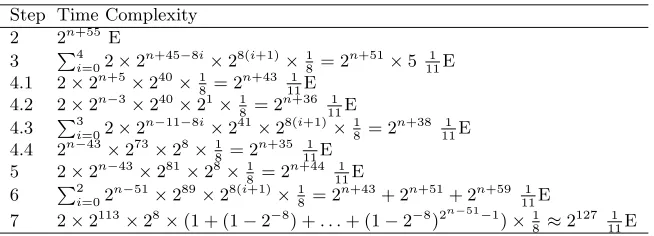
121-bit wrong keys isN = (2121−1)(1−2−8)2n−51. In order to let N 0, we choosen= 65.5. Then the data complexity is 2120.5 chosen plaintexts. The memory complexity is dominated by storing the 2110.5 proper pairs in step 2, which requires 2115.5 bytes. Table 1 shows the time complexity of each step, so the total complexity of the attack, in encryption unit, is about 2127/11≈2123.6.
Table 1.Time Complexity of the Attack on 11-round Camellia-128
Step Time Complexity 2 2n+55 E
3 P4i=02×2n+45−8i×28(i+1)×18 = 2n+51×5 111E 4.1 2×2n+5×240×18 = 2n+43 111E
4.2 2×2n−3×240×21×18 = 2n+36 111E
4.3 P3i=02×2n−11−8i×241×28(i+1)×18 = 2n+38 111E 4.4 2n−43×273×28×18 = 2n+35 111E
5 2×2n−43×281×28×18 = 2n+44 111E
6 P2i=02n−51×289×28(i+1)×18 = 2n+43+ 2n+51+ 2n+59 111E
7 2×2113×28×(1 + (1−2−8) +. . .+ (1−2−8)2n−51−1)×18 ≈2127 111E
4.2 Impossible Differential Attack on 11-round and 12-round Camellia-192
In this section, first we give a brief description of the attack on 11-round Camellia-192, and then present the attack on 12-round Camellia-192.
Attack on 11-round Camellia-192. A similar 11-round attack as described in Section 4.1
is equally applicable to Camellia-192 from round 11 to 21, utilizing the 7-round impossible differential in rounds 13 to 19 as shown in Fig.3. According to the key schedule of Camellia-192/-256, we get
K11=KA{46−109}, K12,1 =KA{110−117},
K20,5 =KR{63−70}, K21,l(l=1,2,3,4,6,7,8) =KA{7−30,95−126}.
Attack on 12-round Camellia-192. We add one round on the bottom of the 11-round attack, and give a 12-round attack on Camellia-192, which is from round 11 to 22, see Fig. 4. The attack procedure is as follows.
P(g1,g2,g3,g4,g5,g6,g7,g8) (a,0,0,0,0,0,0,0)
(0,0,0,0,0,0,0,0)
(a,0,0,0,0,0,0,0)
(0,0,0,0,b,0,0,0)
P(0,b2,b3,b4,b,b6,b7,b8)
P(0,0,0,0,f,0,0,0) (0,f,f,f,0,f,f,f) P(0,b,b,b,b,b,b,0)
(0,0,0,0,0,0,0,0) P(a1,a2,a3,a,a5,0,0,a8) P(0,a,a,a,a,0,0,a) P(e,0,0,0,0,0,0,0)
(0,0,0,0,0,0,0,0)
7-round ID with 2FL/FL-1Layers
⊕
P KS
⊕
P KS
⊕
P KS
⊕
P KS
⊕
P KS
P(0,b2,b3,b4,b,b6,b7,b8)
Fig. 4. Attack on 12-round Camellia-192
1. The choice of plaintexts is the same as the 11-round attack, and the ciphertext pairs are sieved by the difference
(P(g1, g2, g3, g4, g5, g6, g7, g8); P(0, b2, b3, b4, b, b6, b7, b8)),
where b, b8 are non-zero bytes, and gi(i = 1, . . . ,8), bj = b(j = 2,3,4,6,7) are unknown bytes. The probability of this condition is about 2−8, so the expected number of remaining pairs is about 2n+109−8 = 2n+101.
2. Obtain the differenceΔS11= (a1, a2⊕a, a3⊕a,0, a5⊕a,0,0, a8⊕a), then forl= 1,2,3,5,8 guessK11,land keep the pairs whoseΔS11,l is equal to the corresponding value above. So we expect 2n+101×2−40= 2n+61pairs remain. Note thatK11,l(l=1,2,3,5,8)=KA{46−69,78−85,102−109}. 3. We can get the difference ΔS22= (g1, g2, g3, g4, g5⊕f, g6, g7, g8) (ΔS22,5 =g5 sincef = 0),
and the bitsKA{46−69,78−85} are already known. Then perform the following substeps. 3.1 The values of K22,l(l=3,4)(KA{47−62}) are already known, so for l = 3,4 ΔS22,l can be
computed, then choose the pairs satisfyingΔS22,l =gl. Thus there remains 2n+61×2−16= 2n+45 pairs.
3.2 SinceK22,7=KA{79−86}, guess the only unknown bitKA{86}and keep the pairs satisfying
ΔS22,7 =g7. Next K22,2=KA{39−46}, guess the unknown 7 bits KA{39−45} and keep the pairs satisfying ΔS22,2 = g2. Similarly, as K22,6 = KA{71−78}, we guess the unknown 7 bits KA{71−77} and keep the pairs satisfying ΔS22,6 =g6. Thus the expected number of remaining pairs is 2n+45×2−24= 2n+21.
3.3 The values of K22,l(l=1,8)(KA{31−38,87−94}) are unknown, so for l = 1,8 guess K22,l and choose the pairs satisfying ΔS22,l = gl. Then 2n+21 ×2−16 = 2n+5 pairs remain. As
ΔS22,5 =g5. The probability of this event is (28−1)/28 ≈1, thus we expect about 2n+5 pairs remain. And now the intermediate values (L21R21, L21R21) also can be computed. 4. We can obtain ΔS21= (0, b2⊕b, b3⊕b, b4⊕b,0, b6⊕b, b7⊕b, b8), and the bits KA{102−109}
are already known. So perform the substeps below.
4.1 AsK21,2 =KA{103−110}, guess the only unknown bitKA{110} and keep the pairs satisfying
ΔS21,2 =b2⊕b. Then we expect 2n+5×2−8= 2n−3 pairs remain.
4.2 The values of K21,l(l=3,4,6,7,8)(KA{7−30,111−126}) are unknown, so forl= 3,4,6,7,8 guess
K21,l and keep only the pairs whose ΔS21,l is equal to the corresponding value above. Then the expected number of such pairs is 2n−3×2−40= 2n−43.
4.3 SinceK21,1 =KA{95−102}, guess the unknown 7 bitsKA{95−101} and get (L19,5, L19,5). 5. Obtain the difference ΔS20 = (0,0,0,0, f,0,0,0), then guess K20,5 and choose the pairs
satisfying ΔS20,5=f. So there remains 2n−43×2−8 = 2n−51 pairs.
6. The values ofK11,l(l=4,6,7)(KA{70−77,86−101}) are already known, so we can get (L11,1, L11,1). 7. Since K12,1(KA{110−117}) are already known, for every remaining pair, ΔS12,1 can be com-puted. We expect with probability of 2−8 that we get a pair withΔS12,1 =e, where eis a fixed value determined byΔL10. Such a difference is impossible, and every subkey we guessed that proposes such a difference is definitely a wrong key. If there remains a value of K12,1
after the filtering, we can assume that the guessed value above is right.
Complexity. The number of remaining 128-bit wrong keys after analyzing all the 2n−51 pairs is N = (2128−1)(1−2−8)2n−51. In order to let N 0, we choose n = 65.6. Then the data complexity is 2120.6 chosen plaintexts. The memory complexity is dominated by storing the 2166.6 pairs in step 2, which is about 2171.6 bytes. The time complexity is dominated by step 3, which is about 2n+107×5/12 = 2172.6×5/12≈2171.4 12-round encryptions. The details see Table 4 in Appendix A.
4.3 Impossible Differential Attack on 14-round Camellia-256.
We add one more round respectively on the top and bottom of the 12-round attack, and present a 14-round attack on Camellia-256, which is from round 10 to 23 as illustrated in Fig. 5. The attack procedure is below.
1. Take 2n structures of plaintextsM = (L9, R9) with following form:
(P(x1, x2, x3, x4, x5, α6, α7, x8); P(y1, y2, y3, y4, y5, y6, y7, y8)),
whereαi(i= 6,7) are fixed constants, xi (i= 1,2,3,5,8), yj(j= 1, . . . ,8) take all the 8-bit values, andx4 takes all the 7-bit values with the most significant bit fixed. It is obvious that each structure contains 2111plaintexts which can provide about 2221 plaintext pairs with the difference
(P(a1, a2, a3, a, a5,0,0, a8);P(h1, h2, h3, h4, h5, h6, h7, h8)),
wherea1, aare non-zero byte (the most significant bit of ais 0), and ai = a(i= 2,3,5,8),
hj(j= 1, . . . ,8) are unknown bytes. Hence, we can collect about 2n+221plaintext pairs, then obtain the ciphertexts of each structure.
2. We can get that ΔS10 = (h1⊕e, h2, h3, h4, h5, h6, h7, h8) (ΔS10,1 = h1 since e= 0), so for
l = 2, . . . ,8,1 respectively guess K10,l and choose only the pairs with ΔS10,l satisfying the condition above. Then we expect about 2n+221 ×2−56 = 2n+165 pairs remain. Note that
P(e,0,0,0,0,0,0,0) P(h1,h2,h3,h4,h5,h6,h7,h8) P(a1,a2,a3,a,a5,0,0,a8)
P(g1,g2,g3,g4,g5,g6,g7,g8) (a,0,0,0,0,0,0,0)
(0,0,0,0,0,0,0,0)
(a,0,0,0,0,0,0,0)
(0,0,0,0,b,0,0,0)
P(0,b2,b3,b4,b,b6,b7,b8) P(0,0,0,0,f,0,0,0) (0,f,f,f,0,f,f,f) P(0,b,b,b,b,b,b,0)
(0,0,0,0,0,0,0,0) P(0,a,a,a,a,0,0,a) (e,e,e,0,e,0,0,e)
(0,0,0,0,0,0,0,0)
P(j1,j2,j3,j4,j5,j6,j7,j8)
7-round ID with 2FL/FL-1Layers
⊕
P KS
⊕
P KS
⊕
P KS
⊕
P KS
⊕
P KS
⊕
P KS
⊕
P KS
P(g1,g2,g3,g4,g5,g6,g7,g8) P(0,b2,b3,b4,b,b6,b7,b8)
Fig. 5. Attack on 14-round Camellia-256
3. We can obtain the differenceΔS23= (j1, j2⊕b2, j3⊕b3, j4⊕b4, j5⊕b, j6⊕b6, j7⊕b7, j8⊕b8) (ΔS23,5 =j5 sinceb= 0), and the bits KL{1−45,112−128} are already known.
3.1 The values of K23,l(l=1,...,7)(KL{1−39,112−128}) are already known, so for l = 1, . . . ,7,
ΔS23,l can be computed, then choose only the pairs satisfyingΔS23,1=j1 andΔS23,5 =
j5. The probability of this condition is 2−8 ×((28 −1)/28) ≈ 2−8, thus the expected number of remaining pairs is 2n+165−8 = 2n+157.
3.2 Since K23,8 = KL{40−47}, guess the unknown 2 bits KL{46,47} and get the intermediate values (L22R22, L22R22 ).
Next, we perform the steps 4 to 9, which are totally the same as steps 3 to 8 of Section 4.2. Finally we expect 2n+5 pairs remain.
Complexity. The expected number of remaining 194-bit wrong keys after analyzing all the
2n+5 pairs isN = (2194−1)(1−2−8)2n+5. In order to letN 0, we choose n= 10.2. Then the data complexity is 2121.2 chosen plaintexts. The memory complexity is dominated by storing the 2n+165 = 2175.2 pairs in step 2, which is about 2180.2 bytes. The time complexity is dominated by step 2 and step 4, which is about (2n+230+ 2n+229×5)/14 = 2n+228 = 2238.2 encryptions. Table 5 in Appendix A shows the details of each step.
5 Conclusion
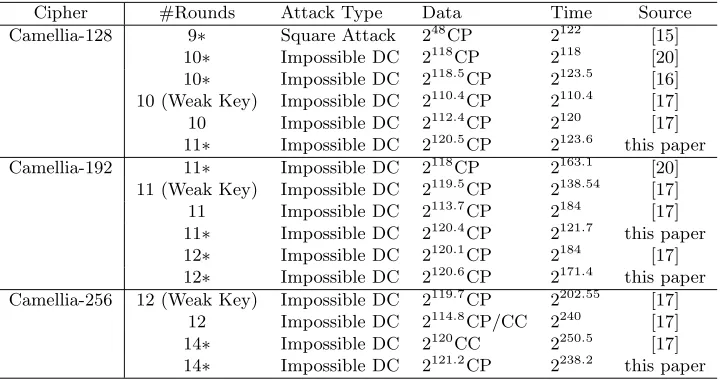
Table 2.Summary of Attacks on Camellia withF L/F L−1 Layers Cipher #Rounds Attack Type Data Time Source Camellia-128 9∗ Square Attack 248CP 2122 [15]
10∗ Impossible DC 2118CP 2118 [20] 10∗ Impossible DC 2118.5CP 2123.5 [16] 10 (Weak Key) Impossible DC 2110.4CP 2110.4 [17] 10 Impossible DC 2112.4CP 2120 [17] 11∗ Impossible DC 2120.5CP 2123.6 this paper Camellia-192 11∗ Impossible DC 2118CP 2163.1 [20]
11 (Weak Key) Impossible DC 2119.5CP 2138.54 [17] 11 Impossible DC 2113.7CP 2184 [17] 11∗ Impossible DC 2120.4CP 2121.7 this paper 12∗ Impossible DC 2120.1CP 2184 [17] 12∗ Impossible DC 2120.6CP 2171.4 this paper Camellia-256 12 (Weak Key) Impossible DC 2119.7CP 2202.55 [17]
12 Impossible DC 2114.8CP/CC 2240 [17] 14∗ Impossible DC 2120CC 2250.5 [17] 14∗ Impossible DC 2121.2CP 2238.2 this paper ∗: the attack does not include the whitening layers;
Weak Key: the weak key space which contains 3×2126 keys
References
1. Aoki, K., Ichikawa, T., Kanda, M., Matsui, M., Moriai, S., Nakajima, J., Tokita, T.: Camellia: a 128-bit block cipher Suitable for Multiple Platforms – Design and Analysis. In: SAC 2000. LNCS, vol. 2012, pp. 39–56. Springer, Heidelberg (2001)
2. Aoki, K., Ichikawa, T., Kanda, M., Matsui, M., Moriai, S., Nakajima, J., Tokita, T.: Specification of Camellia– a 128-bit block cipher. version 2.0 (2001), http://info.isl.ntt.co.jp/crypt/eng/camellia/specifications.html 3. Biham, E., Biryukov, A., Shamir, A.: Cryptanalysis of Skipjack reduced to 31 rounds using impossible
differ-entials. In: Stern, J. (ed.) EUROCRYPT 1999. LNCS, vol. 1592, pp. 12–23. Springer, Heidelberg (1999) 4. Chen, J., Jia, K., Yu, H., Wang, X.,: New Impossible Differential Attacks of Reduced-Round Camellia-192
and Camellia-256. In: ACISP 2011, LNCS 6812, pp. 16–33. Springer, Heidelberg (2011)
5. CRYPTREC-Cryptography Research and Evaluation Committees, report, Archive (2002), http://www.cryptrec.go.jp/english/index.html
6. Duo, L., Li, C., Feng, K.: Square like attack on Camellia. In: Qing, S., Imai, H., Wang, G. (eds.) ICICS 2007. LNCS, vol. 4861, pp. 269–283. Springer, Heidelberg (2007)
7. Hatano, Y., Sekine, H., Kaneko, T.: Higher Order Differential Attack of Camellia (II). In: Nyberg, K., Heys, H.M. (eds.) SAC 2002. LNCS, vol. 2595, pp. 129–146. Springer, Heidelberg (2003)
8. He, Y., Qing, S.: Square Attack on Reduced Camellia Cipher. In: Qing, S., Okamoto, T., Zhou, J. (eds.) ICICS 2001. LNCS, vol. 2229, pp. 238–245. Springer, Heidelberg (2001)
9. International Standardization of Organization (ISO), International Standard-ISO/IEC 18033-3, Information technology-Security techniques-Encryption algorithms-Part 3: Block ciphers (2005)
10. Kanda, M., Matsumoto, T.: Security of Camellia against Truncated Differential Cryptanalysis. In: Matsui, M. (ed.) FSE 2001. LNCS, vol. 2355, pp. 119–137. Springer, Heidelberg (2002)
11. Kawabata, T., Kaneko, T.: A Study on Higher Order Differential Attack of Camellia. In: The 2nd open NESSIE workshop (2001)
12. Knudsen, L.R.: DEAL–a 128-bit Block Cipher. Technical report, Department of Informatics, University of Bergen, Norway (1998)
13. K¨uhn, U.: Improved Cryptanalysis of MISTY1. In: Daemen, J., Rijmen, V. (eds.) FSE 2002. LNCS, vol. 2365, pp. 61–75. Springer, Heidelberg (2002)
14. Lee, S., Hong, S.H., Lee, S.-J., Lim, J.-I., Yoon, S.H.: Truncated Differential Cryptanalysis of Camellia. In: Kim, K.-c. (ed.) ICISC 2001. LNCS, vol. 2288, pp. 32–38. Springer, Heidelberg (2002)
15. Duo, L., Li, C., Feng, K.: New Observation on Camellia. In: Preneel, B., Tavares, S. (eds.) SAC 2005. LNCS, vol. 3897, pp. 51–64. Springer, Heidelberg (2006)
17. Li, L., Chen, J., Wang, X.: Security of Reduced-Round Camellia against Impossible Differential Attack, http://eprint.iacr.org/2011/524.pdf
18. Lu, J.: Cryptanalysis of Block Ciphers. PhD Thesis, Department of Mathematics, Royal Holloway, University of London, England (2008)
19. Lu, J., Kim, J.-S., Keller, N., Dunkelman, O.: Improving the efficiency of impossible differential cryptanalysis of reduced Camellia and MISTY1. In: Malkin, T.G. (ed.) CT-RSA 2008. LNCS, vol. 4964, pp. 370–386. Springer, Heidelberg (2008)
20. Lu, J., Wei, Y., Kim, J., Fouque, P.A.: Cryptanalysis of Reduced Versions of the Camellia Block Cipher. To appear in: SAC 2011. (2011)
21. Mala, H., Shakiba, M., Dakhilalian, M., Bagherikaram, G.: New Results on Impossible Differential Crypt-analysis of Reduced-Round Camellia-128. In: Jacobson Jr., M.J., Rijmen, V., Safavi-Naini, R. (eds.) SAC 2009. LNCS, vol. 5867, pp. 281–294. Springer, Heidelberg (2009)
22. NESSIE–New European Schemes for Signatures, Integrity, and Encryption, final report of European project IST-1999-12324. Archive (1999), https://www.cosic.esat.kuleuven.be/nessie/Bookv015.pdf
23. NTT Information Sharing Platform Laboratories: Internationally Standardized Encryption Algorithm from Japan “Camellia”, http://info.isl.ntt.co.jp/crypt/index.html
24. Shirai, T.: Differential, linear, boomerang and rectangle Cryptanalysis of Reduced-Round Camellia. In: Pro-ceedings of the Third NESSIE Workshop, Munich, Germany, (November 6–7, 2002)
25. Sugita, M., Kobara, K., Imai, H.: Security of reduced version of the block cipher Camellia against truncated and impossible differential cryptanalysis. In: Boyd, C. (ed.) ASIACRYPT 2001. LNCS, vol. 2248, pp. 193–207. Springer, Heidelberg (2001)
26. Wu, W., Zhang, W., Feng, D.: Impossible differential cryptanalysis of Reduced- Round ARIA and Camellia. Journal of Computer Science and Technology 22(3), 449–456 (2007)
27. Wu, W., Feng, D., Chen, H.: Collision Attack and Pseudorandomness of reduced-round Camellia. In: Hand-schuh, H., Hasan, M.A. (eds.) SAC 2004. LNCS, vol. 3357, pp. 252–266. Springer, Heidelberg (2004) 28. Yeom, Y., Park, S., Kim, I.: On the Security of Camellia against the Square Attack. In: Daemen, J., Rijmen,
A Time Complexity of Attacks in Section 4
Table 3.Time Complexity of the Attack on 11-round Camellia-192
Step Time Complexity 2 2n+55E
3 P4i=02×2n+45−8i×28(i+1)×18 = 2n+51×5 111E 4.1 2×2n+5×240×21×18 = 2n+44 111E
4.2 P4i=02×2n−3−8i×241×28(i+1)×18 = 2n+44×5 111E 4.3 2n−43×281×27×18 = 2n+42 111E
5 2×2n−43×288×28×18 = 2n+51 111E 6.1 2n−51×296×21×18 = 2n+43 111E
6.2 P1i=02n−51×297×28(i+1)×18 = 2n+51+ 2n+59 111E
7 2×2113×(1 + (1−2−8). . .+ (1−2−8)2n−51−1)×18 ≈2119 111E
Table 4.Time Complexity of the Attack on 12-round Camellia-192
Step Time Complexity 2 2n+55 E
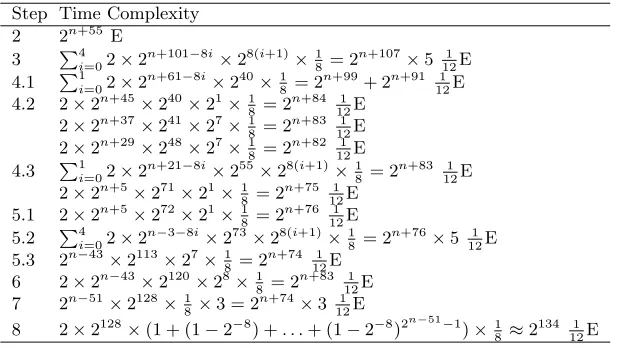
3 P4i=02×2n+101−8i×28(i+1)×18 = 2n+107×5 121E 4.1 P1i=02×2n+61−8i×240×18 = 2n+99+ 2n+91 112E 4.2 2×2n+45×240×21×18 = 2n+84 112E
2×2n+37×241×27×18 = 2n+83 112E 2×2n+29×248×27×18 = 2n+82 112E
4.3 P1i=02×2n+21−8i×255×28(i+1)×18 = 2n+83 112E 2×2n+5×271×21×18 = 2n+75 112E
5.1 2×2n+5×272×21×18 = 2n+76 112E
5.2 P4i=02×2n−3−8i×273×28(i+1)×18 = 2n+76×5 121E 5.3 2n−43×2113×27×18 = 2n+74 112E
6 2×2n−43×2120×28×18 = 2n+83 112E 7 2n−51×2128×81×3 = 2n+74×3 121E
Table 5.Time Complexity of the Attack on 14-round Camellia-256 Step Time Complexity
1 2n+111E
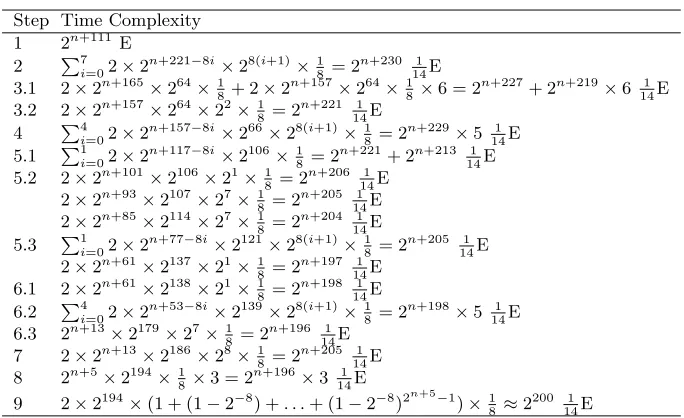
2 P7i=02×2n+221−8i×28(i+1)×18 = 2n+230 114E
3.1 2×2n+165×264×18 + 2×2n+157×264×18×6 = 2n+227+ 2n+219×6 141E 3.2 2×2n+157×264×22×18 = 2n+221 114E
4 P4i=02×2n+157−8i×266×28(i+1)×18= 2n+229×5 141 E 5.1 P1i=02×2n+117−8i×2106×18 = 2n+221+ 2n+213 114E 5.2 2×2n+101×2106×21×18 = 2n+206 114E
2×2n+93×2107×27×18 = 2n+205 114E 2×2n+85×2114×27×18 = 2n+204 114E
5.3 P1i=02×2n+77−8i×2121×28(i+1)×18= 2n+205 114E 2×2n+61×2137×21×18 = 2n+197 114E
6.1 2×2n+61×2138×21×18 = 2n+198 114E
6.2 P4i=02×2n+53−8i×2139×28(i+1)×18= 2n+198×5 141 E 6.3 2n+13×2179×27×18 = 2n+196 114E
7 2×2n+13×2186×28×18 = 2n+205 114E 8 2n+5×2194×81×3 = 2n+196×3 141E