http://www.ijpediatrics.com pISSN 2349-3283 | eISSN 2349-3291
Original Research Article
Effectiveness of a training workshop on perceptions and practice of
interns in management of acute diarrheal diseases in children
T. G. Sindhu*, M. G. Geeta, P. Geetha, MD Fiji
INTRODUCTION
Acute Diarrheal Disease (ADD) accounts for 8% of under- five mortality in children.1 Oral Rehydration
Therapy (ORT) has revolutionized the management of diarrhoea. ORS (Oral Rehydration Salt) solution has saved maximum number of children with ADD. The WHO Program for the Control of Diarrheal Disease began in 1978. Activities in diarrheal disease control programs vary widely from country to country. These include social marketing and mass media campaigns, the involvement of political figures and religious leaders, educational campaigns in schools, training of partly skilled health care workers, changes to medical school
curricula, distribution schemes, as well as the establishment of outpatient oral rehydration centers.2-4
However, coverage of ORS in India remains low at less than 59%, and eight out of 100 children nationwide continues to experience diarrhoea in any 2-week period.5
Recently Zinc has been recognized as an important adjuvant in treating ADD. Other medicines including antibiotics are not routinely indicated in treating ADD in Children.6,7
The MBBS students are taught about ADD during several phases during under graduate years both in paediatrics and community medicine.8,9 During their internship they
ABSTRACT
Background: There is a perceived lack of competency of interns in managing common childhood conditions like acute diarrheal diseases (ADD). In the present system there is no formal training is given to the interns. Additional structured training programs during internship will help to improve their performance. This is of special importance in the context of current shift towards a competency based medical education (CBME). This study was conducted at a government medical College in North Kerala to find out the effect of a workshop on perceptions and practice of interns in management of acute diarrheal diseases in children.
Methods: 15 interns posted in Paediatric department during July 2015 were administered a pre-test to assess their perceptions and practice about managing ADD by using short answer questions (SAQ), questionnaire and Objective Structured Clinical Examination (OSCE). After the pre-test a training workshop on management of ADD was conducted. The feedbacks were obtained. A post test was conducted 3 days later. The pre and post workshop scores were compared using student t test.
Results: There was an improvement in knowledge, skills and self-perceived level of confidence of the interns in managing ADD in children after the workshop.
Conclusions: A training workshop will improve the knowledge, skills and confidence of interns in managing a child presenting with acute diarrhoea.
Keywords: Child, Competencies Diarrhoea management, Interns, Workshop Department of Paediatrics, Government Medical College Kozhikode, Kerala, India
Received: 09 April 2018
Accepted: 14 April 2018
*Correspondence:
Dr. T. G. Sindhu,
E-mail: [email protected]
Copyright: © the author(s), publisher and licensee Medip Academy. This is an open-access article distributed under the terms of the Creative Commons Attribution Non-Commercial License, which permits unrestricted non-commercial use, distribution, and reproduction in any medium, provided the original work is properly cited.
are having posting in DTU (Diarrhoea Training and Treatment Unit) where they are actively involved in managing the children with ADD.
It usually observed that when the students pass the final year exam and come to the internship what they had studied is not practiced. The interns are not confident in dealing a child presenting with diarrhoea. The students are studying these only to pass the exam.
They are not oriented it to the actual management of a child. Managing a child with diarrhoea is a must know competency for all Indian Medical Graduate. It can be considered as social need an Indian medical graduate should be competent enough to manage a child presenting with diarrhoea.
A workshop will be appropriate for training the interns in management of ADD in children. A workshop is defined as assembled group of ten to twenty-five persons who share a common interest or problem. They work together to improve their individual skill of a subject through intensive study, research, practice and discussion.
This method relies heavily on the involvement of the learner in formulating or constructing knowledge through hands-on, small-group and individual explorations, using concrete objects or technology. The workshops are organized to develop the psychomotor aspects of the learner.10 It is an efficient way to develop the skills to
perform a task independently. In a training workshop high degree of individual participation is encouraged.
This study was conducted to demonstrate the effect of a workshop on perceptions and practice of paediatric interns in management of acute diarrheal diseases in children.
METHODS
It was a quasi-experimental study conducted during May 2015 to September 2015. Interns posted in the department of pediatrics during the month of July 2015 were included. The interns who were absent on the day of workshop and assessment were excluded
Preparation and validation of pre and post-test: The pre-test and post-pre-test consist of Short Answer Questions (SAQ) to assess knowledge, questionnaire to assess perceptions and an OSCE to assess the practice. The SAQ constructed in a way to include all basic theoretical aspects in management of diarrhoea.
The questionnaires pertaining to perceptions include the self-assessed confidence level in various aspects of (giving correct instructions for preparing and administering ORS, assessing the degree of dehydration, giving feeding advise and answering the mother’s queries) managing a child presenting with diarrhoea and
the adequacy of training during undergraduate period and internship.
A five-point Likert scale was used for this. 15-point single station Objective Structured Clinical Examination (OSCE) was used to assess skills. In OSCE the student is asked to perform a task and is evaluated using a standardized checklist. OSCE is used because it assesses the shows how level of Miller’s pyramid and it has been recognized as the standard tool for assessment of competencies. MCI and National Board of examinations (NBE) recommend 50% as the minimum acceptable mark. A global rating of OSCE in a five-point scale was also designed.11,12 In global rating the student is rated on
a scale of 1 to 5 (poor/fail, borderline, average, good, exceptional,).
The SAQ, questionnaire and the OSCE checklist were pre-validated.13 The construct validity was done by two
senior faculty of the department. The inter-rater reliability of OSCE was tested by administering this to 5 interns of the previous batch by 3 faculty in the paediatrics department.
Conduction of pre-test, workshop and feedback: The workshop was conducted 5 days before the completion of one month posting in paediatrics. This period was selected to find out the intern’s knowledge and skills by the end of the usual paediatric internship posting. They were administered the pre-test 1 hour before the workshop.
A training workshop on management of ADD included a short lecture on basics of ADD, hands on training on preparation of ORS, administration of ORS, case scenario discussions for assessment of dehydration status, prescription writing for ADD, role play and group discussions.
Feedbacks from the interns were obtained. Their own rating of their pre and post workshop level of knowledge, skills and self confidence in various aspects of managing a child with ADD were recorded on a 5-point score (retro pre- post-test).14
In Post-test, 3 days after the workshop the interns were reassessed with the post-test consisting of SAQ to assess knowledge, questionnaire to assess the perceptions regarding management of ADD and an OSCE to assess the practice.
Statistical analysis
RESULTS
19 interns were posted in paediatrics during the study period. Three interns who were absent on the day of workshop were excluded. One intern was not able to attend the workshops. So, 15 interns were taken for final analysis (n=15). Both the pre-workshop and post workshop scores in SAQ were above the pass level of 5. The difference in scores were analysed using student’s t test and it was found to be significant (p value <0.01) (Table no 1).
Table 1:Re and post workshop scores of SAQs.
Maximum score 10 P
value
Pre-workshop
Post- workshop
Difference
Mean SD Mean 0.003 Mean SD <0.0 1 8.13 1.27 9.23 0.68 1.1 1.2
The mean pre-workshop scores for OSCE were below the pass level of 7.5. Only one candidate obtained a score above 7.5. The mean post workshop scores were above the pass level of 7.5. 14 interns scored above 7.5 in the post workshop OSCE. The difference in scores were analysed using student’s t test and it was found to be significant (p value <0.01) (Table no 2).
Table 2:Pre and post workshop scores of OSCE.
Maximum score 15
P value
Pre-workshop
Post- workshop
Difference
Mean SD Mean SD Mean SD
<0.01 5.6 2.15 9.7 2.0 4.7 (2.5)
In global rating of OSCE the mean pre-workshop scores were below the pass level of 3. The mean post workshop scores were above the pass level of 3. The difference in scores were analysed using student’s t test and it was found to be significant (p value <0.01) (Table no 3).
Table 3:Pre and post workshop scores in Global rating of OSCE.
Maximum score 5
P value
Pre-workshop
Post workshop
Difference
Mean SD Mean SD Mean SD
<0.01 2.8 0.82 3.87 0.64 1.07 0.88
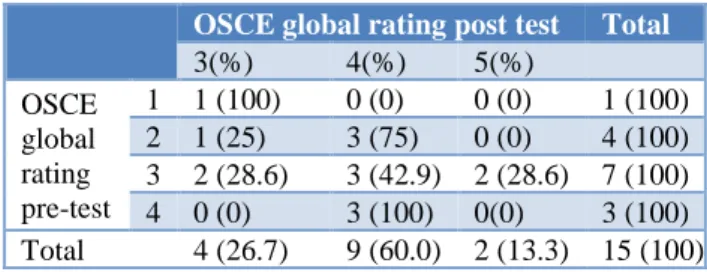
All interns who scored low in the pre-test OSCE (<3) improved their scores to higher levels. Majority of the interns (71.5%) who scored average (3) in the pre-test improved their scores to higher levels.
Those who scored high (4) in retained the same score (Table no 4). Before the workshop itself the interns were
having high level of confidence with a mean value of 20, which increased to 22.87 after attending the workshop.
Table 4:Improvement in OSCE Global rating following workshop.
OSCE global rating post test Total
3(%) 4(%) 5(%) OSCE
global rating pre-test
1 1 (100) 0 (0) 0 (0) 1 (100) 2 1 (25) 3 (75) 0 (0) 4 (100) 3 2 (28.6) 3 (42.9) 2 (28.6) 7 (100) 4 0 (0) 3 (100) 0(0) 3 (100) Total 4 (26.7) 9 (60.0) 2 (13.3) 15 (100)
The difference in pre and post workshop scores regarding the perception of level of confidence in managing a child with ADD was compared using student t test and was found to be significant (<0.01) (Table no 5).
Table 5:Pre and post workshop level of confidence perception in managing a child presenting with
diarrhea.
Maximum score 25
P value
Pre-workshop
Post workshop
Difference
Mean SD Mean SD Mean SD
<0.01 20.0 1.309 22.87 2.1 2.87 1.73
The interns have the perception that they are adequately trained mean value more than 5 in both groups. The difference in pre and post workshop scores regarding the perception of adequacy of training was compared by using student t test and found to be significant (p value <0.01) (Table no 6).
Table 6: Pre and post workshop perception of adequacy of training in managing a child with ADD
during undergraduate period and internship
Maximum score 10
P value
Pre-workshop
Post workshop
Difference
Mean SD Mean SD Mean SD
<0.01 7.4 1.45 8.93 1.33 1.53 1.64
The difference was found to be significant using the student t test. All of them opined that the workshop was useful. Two third of them pointed the role play station demonstrating the communication with the mother as the most useful station. The other common points where it was very informative and helped to uplift the level of their confidence. Need for conduction more similar workshops was came out as a suggestion from them.
DISCUSSION
mortalities.1,2 But this can be treated promptly with ORS
and zinc.6,7 Management of ADD is included in the
undergraduate curriculum worldwide.2,8,9
The undergraduate students are taught several occasions about various aspects of ADD. Most of them are having adequate theoretical knowledge about it. This is very well evident by the mean scores they got in the pre-test in assessing knowledge. When it comes to the shows how level of Millers pyramid, which is usually evaluated by an OSCE, their performance is much worse. The mean pre-test score obtained for pre-test OSCE was far below the minimum expected. This is more important in the present context of gradual implementing CBME by MCI.15 Entrustable Professional Activity (EPA) has a
major role in assessment of CBME and managing a child presenting with diarrhoea can be considered as an Entrustable Professional Activity (EPA) in pediatrics.16, 17
Though EPA appears more suitable for postgraduate medical education, it can be utilized for graduate training also.16 For the present group of interns who are trained in
the traditional curriculum, an extra training during internship will be beneficial. Managing a child with diarrhoea involves a significant proportion of affective and communication domains which are not addressed adequately during the undergraduate training.8,9
The training workshop incorporating role play stations to improve the communication skills is very important in this regard. There was a significant increase in post-workshop OSCE scores.14 interns scored the required
minimum score in the post work shop OSCE compared to the only one in the pre-workshop OSCE.
An Indian multicentre study among the interns and residents showed an inadequacy in the level of training of interns in management of acute diarrhea in children and recommends hands on training programs for them.18
Charan Anugrah has demonstrated the effectiveness of a structured teaching program on diarrhea case management for ASHA workers.19 Salazar et al has
evaluated the effectiveness of a training program on diarrhea for the physicians and nurses. In that study pretest and posttest questionnaire and observational surveys were used to assess the improvement. The study concludes that the training was very effective.20
Though the performance in the pre-workshop OSCE was poor, their perceived level of self-confidence was very high. This is shows a dissonance between the perceived level of skill level and actual skill level.
The dissonance between the perceived level of skill level and actual skill level (unconscious incompetence) is a real concern. The feedback from the participants showed good acceptance of the training workshop and all of them found such programs very useful. Regular training workshops dealing with common paediatric problems like ADD can be conducted during internship to improve their competencies.
CONCLUSION
The skills of interns in managing a child presenting with acute diarrhoea are generally poor. The knowledge, confidence and skills of interns in managing acute diarrhoea can be improved by a training workshop. There is need for competency-based training of interns for acquiring core clinical skills.
ACKNOWLEDGEMENTS
I am grateful to interns of 53rd batch of Government Medical College, Kozhikode who cooperated with the study. My heartfelt thanks to Dr. Biju George, Associate professor of Community medicine, Government Medical College, Kozhikode for the statistical support. I would like to thank the faculty at MCI Nodal centre Kottayam, especially my Faculty mentor Dr Lijo K Mathew for the support and guidance.
Funding: No funding sources Conflict of interest: None declared
Ethical approval: Clearance was obtained from Institutional Research Committee and Ethical Committee (GMCKKD/RP 2015/IEC/03/06 dated 27/06/2015)
REFERENCES
1. Causes of child mortality. World Health Organization. 2018. Available from: http://www.who.int/gho/child_health/mortality/caus es/en/
2. Santosham M, Chandran A, Fitzwater S, Fischer-Walker C, Baqui A, Black R. Progress and barriers for the control of diarrhoeal disease. The Lancet. 2010;376(9734):63-7.
3. Lenters L, Das J, Bhutta Z. Systematic review of strategies to increase use of oral rehydration solution at the household level. BMC Public Health. 2013;13(3):S28.
4. UNICEF: Diarrhoea: why children are still dying and what can be done. Geneva: UNICEF/WHO; 2009
5. National family health survey (NFHS-4) 2012–14. Mumbai: International Institute for Population Sciences (IIPS) and Macro International; 2009. Available from: http://www.rchiips.org/nfhs/nfhs4. shtml.
6. WHO: Clinical management of acute diarrhoea: WHO/UNICEF joint statement. Geneva: World Health Org. 2004:1–8
7. Bhatnagar S, Bhandari N, Mouli UC, Bhan MK.Consensus statement of IAP National Task Force:Status report on management of acute diarrhea. Indian Pediatr. 2004;41:335-48
8. Medical Council of India Regulations on Graduate Medical Education, 1997 (amended upto February 2012. Iafmonline.in. Available from:
9. Workshop- An Instructional Method. Available from: http://www.vkmaheshwari.com/WP/?p=385 10. Gupta P, Dewan P, Singh T. Objective structured
clinical examination (OSCE) revisited. Indian Pediatr. 2010;47(11):911-20.
11. Turner K, Bell M, Bays L, Lau C, Lai C, Kendzerska T et al. Correlation between Global Rating Scale and Specific Checklist Scores for Professional Behaviour of Physical Therapy Students in Practical Examinations. Education Research International. 2014; 2014:1-6.
12. Validating a Questionnaire. Dave Collingridge
Available from:
https://www.methodspace.com/validating-a-questionnaire/
13. Using a Retrospective Pre-Post Questionnaire to Determine Program Impact. Available from: https://www.joe.org/joe/2003august/tt4.php
14. Medical Council of India. Vision 2015; 2011.
Available from:
http://www.mciindia.org/tools/announcement/MCI_ booklet. pdf.
15. Modi J, Gupta P, Singh T. Competency-based medical education, entrustment and assessment. Indian Pediatr. 2015;52(5):413-20.
16. Dhaliwal U, Gupta P, Singh T. Entrustable Professional Activities: Teaching and assessing clinical competence. Indian Pediatr. 2015;52(7):591-97.
17. Patwari AK, Anand V, Kumar H, Aneja S, Mullick D.Knowledge and perceptions of residents regarding case management of acute diarrhea. Indian Pediatr. 1991 Aug;28(8):887-92.
18. Charan A. Study to Assess Effectiveness of a Structured Teaching Programme on Knowledge and Practices of ASHA Workers Regarding the Case Management of Children with Diarrhea at Home Situation as per IMNCI Guidelines. International Journal of Nursing Education. 2015;7(2):137. 19. Salazar-Lindo E, Chea-Woo E, Kohatsu J, Miranda
PR. Evaluation of clinical management training programme for diarrhoea. J Diarrhoeal Dis Res. 1991 Sep;9(3):227-34.