A Robust Carrier Frequency Offset Estimation
Algorithm in Burst Mode Multicarrier CDMA based
Ad Hoc Networks
Muhammad Zeeshan and Shoab Ahmed Khan
College of Electrical & Mechanical Engineering, National University of Sciences and Technology, Rawalpindi, Pakistan
[email protected], [email protected]
Abstract: The future wireless communication systems demand
very high data rates, anti-jamming ability and multiuser support. People want large amount of data to be continuously accessible in their personal devices. Direct Sequence (DS) spread spectrum based techniques such as Code Division Multiple Access (CDMA) fulfil these requirements but, at the same time, suffer from the Intersymbol Interference (ISI). Multicarrier CDMA (MC-CDMA) is an emerging technology to be used in mobile devices operating in an ad hoc setting due to its immunity towards ISI and having all the advantages of spread spectrum communication. One of the major problems with MC-CDMA is the high sensitivity towards carrier frequency offsets caused due to the inherent inaccuracy of crystal oscillators. This carrier frequency offset destroys the orthogonality of the subcarriers resulting in Intercarrier Interference (ICI). In this paper, we propose a computationally efficient algorithm based on Fast Fourier Transform (FFT) and biquadratic Lagrange interpolation. The FFT is based on the use of overlapping windows for each frame of the data instead of non-overlapping windows. This gives a coarse estimate of the frequency offset which is refined by the successive application of Lagrange quadratic interpolation to the samples in the vicinity of FFT peak. The proposed algorithm has been applied to the multiuser ad hoc network and simulated in Stanford University Interim (SUI) channels. It has been shown by simulations that the proposed algorithm provides better performance of almost 1~2 dB as compared to the well-known algorithms.
Keywords: MC-CDMA, CFO, SUI, FFT, Interpolation.
1.
Introduction
Multicarrier code division multiple access (MC-CDMA) is emerging as a new multiple access scheme [1]. It is a combination of DS-CDMA and orthogonal frequency division multiplexing (OFDM). Due to this reason it sometimes referred to as OFDM-CDMA [2]. MC-CDMA is a major candidate for transmission technology of the next generation communication systems [3]. In MC-CDMA, data symbol of each user is transmitted simultaneously on narrowband sub-channels which are then multiplied by the user specific spreading sequence.
MC-CDMA, like CDMA, provides high data rate, anti-jamming ability and multiuser support. Additionally, it provides immunity towards Intersymbol Interference (ISI) by reducing the symbol rate. In very high chip rate systems, this ISI reduction is very significant [2]. Due to narrowband subcarriers used in MC-CDMA systems, the communication quality is degraded by the Intercarrier Interference (ICI) in the presence of carrier frequency offset.
The algorithm proposed in this paper is generic to be used for both the ad hoc networks and uplink MC-CDMA systems. First, a basic estimation algorithm has been proposed which uses FFT and quadratic interpolation. Secondly, to an enhanced CFO estimator has been proposed which is based on modified FFT and biquadratic interpolation techniques. The simulations have been performed using Stanford University Interim (SUI) channel models.
The paper is organized as follows. Section 2 presents the research work related to CFO estimation. Section 3 presents the system model to be used in the paper. The proposed basic CFO estimator has been presented in section 4. The proposed enhanced estimator is given in section 5. Simulation results are given in section 6. Computational complexity analysis of the proposed algorithm is presented in section 7 followed by conclusion and references.
2.
Related Work
Though Multicarrier CDMA (MC-CDMA) is robust against the interference caused by the multipath fading channels, it is sensitive to the factors that destroy the orthogonality between the carriers. In this regards, the carrier frequency offset (CFO) caused by the local oscillators at the transmitter and receiver is very destructive. The problem of handling this offset is very critical since it becomes more destructive in the presence of Doppler spread. The impact of CFO on the performance on single-user MC-CDMA system is investigated in [4]. The study of [4] has been extended to a multiuser system in [5] and [6]. Also, the performance of MC-CDMA system degrades strongly by increasing the number of carriers in the presence of CFO or Sampling Clock Offset [7]. Due to its critical role, CFO estimation has been investigated by many researchers. Here, we expose different algorithms which address the estimation of CFO in either asynchronous uplink or ad hoc networks.
selective fading channels but it is computationally very extensive. A decoupled approach for the estimation of CFO using oversampling has been presented in [12] for asynchronous MC-CDMA systems. This approach is computationally less extensive since it decouples the multiuser estimation problem into many single user estimation problems but the performance is not so impressive because there is almost a difference of 10 dB when comparing the Mean Square Error (MSE) of the estimator to the Cramer Rao Bound (CRB). A Modified Maximum Likelihood Multistage Parallel Interference Cancellation (M-ML-MPIC) algorithm is proposed in [13] for the estimation of CFO and Multiple Access Interference (MAI) simultaneously. This algorithm doesn’t much improve the BER performance of the overall system. The reason is the high variance of the estimator due to multiple parameter estimation even at high SNR values. A zero-Intermediate Frequency (IF) based frequency synchronization approach is given in [14]. This complexity of this algorithm is very high. A recursive algorithm for the estimation and updating of CFO using Expectation Maximization (EM) algorithm is given in [15] based on linear estimation theory. This algorithm shows very good performance in terms of BER and the estimator variance. The problem with this algorithm is that by increasing the number of users, the acquisition time of the estimator increases. This increased acquisition time is not suitable for high data rate systems. To avoid this increased acquisition time, a subspace based algorithm for joint estimation of CFO and Channel Impulse Response (CIR) is proposed in [16] which is a Non-Data-Aided (NDA) non-recursive approach. The estimator proposed in this paper is linear, unbiased and its variance is very close to CRB, but at low SNRs, the variance is very high.
The CFO estimator proposed in this paper almost overcomes all the problems present in the above mentioned estimators. The estimator has very less MSE, approaching to CRB even at low SNR values. It is simple and easy to implement since it only involves FFT and quadratic interpolation stages. Also, the estimator is robust to multipath fading effects, as will be shown in later section.
3.
Carrier Frequency Offset Modeling
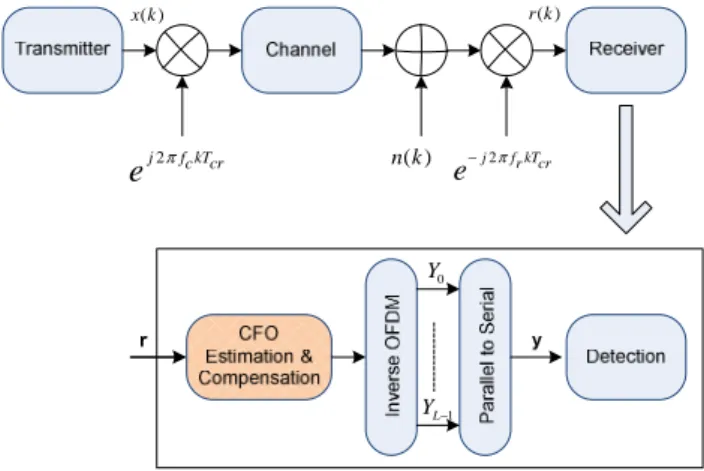
Carrier frequency offset arises when the oscillator at the receiver oscillates at a different frequency to that of the transmitter [17]. This frequency error is seen as a frequency offset to the receiver. In this section, we discuss the generation of a carrier frequency offset and establish the mathematical model used to formulate the problem of carrier frequency offset estimation. In order to illustrate the generation of a carrier frequency offset, consider Figure 1. It shows a model used in a digital communication system using a crystal oscillator at the transmitter and receiver.
The data to be transmitted x(k) is up-converted using a crystal controlled oscillator with frequency fc. The modulated signal is then propagated through multipath fading channel modeled by Stanford University Interim (SUI) channel [18] with an additive white Gaussian noise n(k). At the receiver, the signal is down-converted using a crystal oscillator with
frequency fr and sampled at the chip period Tcr to give r(k). The received signal at sampling instant k can be expressed as,
( ) ( ( ) * ( ( ) exp( 2 )) ( )) exp( 2 )
,
c crr cr
r k h k x k j f kT
n k j f kT
π
π
κ
=
+ −
(1)
Here, h(κ,k) represents the channel impulse response at the instant k. It can be given as in [2].
1
, 0
(
,
)exp( 2
)
(
)
N
p d p p p p
h
κ
ka
j
π
f
k
ϕ δ κ κ
− =
=
∑
+
−
(2)where p represents the multipath index of the SUI channel and ap, κp and fd,p are the attenuation, delay spread and Doppler spread corresponding to the pth multipath.
2
j f kTr cr e− π
2 j f kTc cr
e
π n k( )( )
x k r k( )
0 Y
1
L Y−
Figure 1. Carrier Frequency Offset Modeling
Equation (1) can be further manipulated to give,
1
, 0 0
( ) 2
exp( 2 ) exp( 2 ) exp( 2 )
exp( 2 )
exp(
(
) (
)
.
( )
)
N
p d p p p n p
c cr c cr r cr r cr
r k j f n
j f kT j f kT j f kT
j f kT
a
x k
n
n k
π ϕ
π π π
π
δ κ κ
∞ −
= =
= +
− −
−
−
−
+
∑ ∑
r k( )=rmultipath( ) exp(k −j2
π
∆fkTcr)+
n k
'( )
(3) where,1
,
0 0
( ) 2
exp( 2 )
exp(
)
( ) ( ).
multipath
N
p d p p p
n p
c cr
r k j f n
j f kT
a π ϕ x k n
π
δ κ κ
∞ −
= =
= +
−
− −
∑ ∑
In (3), ∆ =f fc− fris the carrier frequency offset (CFO). The challenge posed to the MC-CDMA receiver designer is to find some estimate that compensates the frequency error
f
FFT & Average Lagrange Quadratic Interpolation of Peak Detection Windowing Peak Detection
1, , 1
peak peak peak
f − f f +
Received Burst ∆fest basic( )
Figure 2. Block diagram of the proposed basic CFO estimator
4.
Proposed Basic Algorithm
This section presents the proposed basic algorithm for CFO estimation using FFT and Lagrange quadratic interpolation. In MC-CDMA, the received signal first goes through inverse OFDM before spreading, so the spread received signal r(k) has to be used to estimate wideband CFO. In burst mode of communication, each burst is affected by a different frequency offset, so the proposed estimator finds the CFO estimate for each burst independently [19].
Let N be the number of samples in each received burst. Firstly, each received burst of length N is divided into N0(basic)
windows, each of length W=2R, where R may be any integer from 1 to log2(N). To achieve better FFT resolution, the
window size W must be greater than 32 (i.e. R > 5). Then, FFT is applied to each window and average of FFT coefficients for all windows is calculated. The frequency corresponding to the maximum value FFT coefficient is a coarse frequency offset estimate with an error of eFFT = ∆f - fm. This error is very large due to the limited resolution of FFT. It is then reduced by the use of quadratic interpolation. Figure 2 shows the block diagram of the proposed basic estimator.
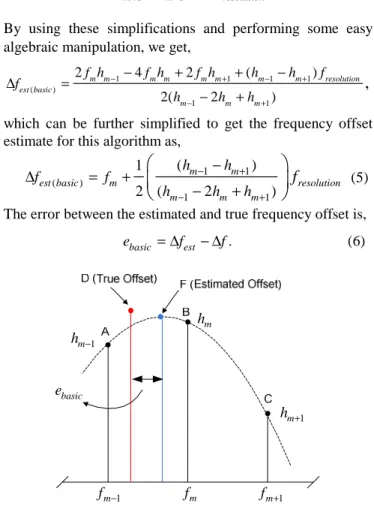
This interpolation is applied to the peaks of the resulting FFT of the received burst. Figure 3 illustrates the technique of finding the peak of the spectrum from three adjacent spectral lines. Point B (fm,hm) is the point of maximum FFT energy detected by the receiver, whereas points A (fm-1,hm-1) and C (fm+1,hm+1) are the spectral lines adjacent to it. The index m represents the position of the FFT peaks. The true frequency f is located at Point D.
A quadratic polynomial is then applied between the spectral peaks A, B and C to estimate the true peak which is located at point D. A quadratic polynomial obtained using these three points is obtained by using Lagrange polynomial interpolation [20]. This polynomial is given as,
1 1 1
1
1 1 1 1 1
1
1
1 1 1
( )( ) ( )( ) ( ) ( )( ) ( )( ) ( )( ) (4) ( )( )
m m m m
m m
m m m m m m m m
m m
m
m m m m
f f f f f f f f
L f h h
f f f f f f f f
f f f f
h
f f f f
+ − + − − − + − + − + + − + − − − − = + − − − − − − + − −
The point of maximum amplitude can be found by differentiating (4) with respect to f such that,
[
]
[
]
[
]
1 1 1
1
1 1 1 1 1
1
1
1 1
(2 ( ) (2 ( )
( )
( )( ) ( )( )
(2 ( )
( )( )
m m m m
m m
m m m m m m m m
m m
m
m m m m
f f f f f f
dL f
h h
df f f f f f f f f
f f f
h
f f f f
+ − + − − − + − + − + + + − + − + = + − − − − − + + − −
Now the point of maximum/minimum amplitude can be obtained by letting,
( ) 0
dL f
df =
If the frequency resolution of FFT is fresolution = fm - fm-1, then the following simplifications can be made accordingly.
1
1
1 1
( )
( )
( ) 2
m m resolution m m resolution m m resolution
f f f
f f f
f f f
+ − + − − = − − = − − =
By using these simplifications and performing some easy algebraic manipulation, we get,
1 1 1 1
( )
1 1
2 4 2 ( )
2( 2 )
,
m m m m m m m m resolution
est basic
m m m
f h f h f h h h f
f
h h h
− + − +
− +
− + + −
∆ =
− +
which can be further simplified to get the frequency offset estimate for this algorithm as,
( ) 1 1
1 1
( )
1
2 ( 2 )
m m
est basic m resolution m m m
h h
f f
h h h
f
− + − + − ∆ = + − +
(5)The error between the estimated and true frequency offset is, ebasic = ∆fest − ∆f. (6)
1
m
f − fm fm+1
1 m h + m h 1 m h − basic e
Figure 3. Quadratic interpolation applied to the FFT peaks
1, , 1
peak peak peak
f − f f + fpeak' −1,fpeak' ,fpeak' +1
( ) est enh
f
∆
Figure 4. Block diagram of the proposed enhanced CFO estimator
5.
Proposed Enhanced Algorithm
It has been mentioned in the previous section that the CFO estimation uncertainty present in quadratic interpolation results in large amount of ICI. To reduce this uncertainty, we propose an enhanced algorithm which is based on overlapping windows based FFT and successive use of quadratic interpolation on the FFT coefficients of the received data. Figure 4 shows the block diagram representation of the proposed CFO estimation algorithm. It consists of the following three steps;
Step I: Each received burst of size N is divided into N0(enh)
overlapped windows, each of size W, such that
(
)
0(enh) / 1
N = N rW −
where r is the overlapping factor. The reason for using overlapped windows is to avoid the loss of data near the window boundaries [21]. Moreover, to avoid the spectral leakage effect, Hamming windows can be used to instead of rectangular windows [22]. The concept of overlapping windows is illustrated in Figure 5. Now, applying a similar procedure as mentioned in the basic algorithm, frequency corresponding to the maximum absolute FFT coefficient is found.
Step II: After detecting the point of highest energy (fm, hm) in the FFT data, Lagrange quadratic interpolation is applied to this highest energy point (fm, hm) and its two adjacent points (fm-1, hm-1) and (fm+1, hm+1). The maxima/minima are calculated by the derivative procedure followed in section 3.
Step III: The frequency point (∆fest) obtained in the previous step using (3) is considered as the centre point and quadratic interpolation is again applied to the point (∆fest, ∆hest) and its two adjacent points (fm-1, hm-1) and (fm, hm) as shown in Figure 6.
Now, for applying quadratic interpolation again, first we have to find ∆hest. It can be calculated by using equation (4) and putting f =∆fest such that
∆hest
=
L(∆fest basic( )) (7)After calculation of this FFT energy, we interpolate these points by Lagrange polynomial method. The Lagrange polynomial will be,
1
2 1
1 1 1
1
1
( )( ) ( )( )
( )
( )( ) ( )( )
( )( )
( )( )
est m m m
m est
m est m m est m est m
m est
m
m m m est
f f f f f f f f
L f h h
f f f f f f f f
f f f f
h
f f f f
− −
− − −
− −
− ∆ − − −
= +
− ∆ − ∆ − ∆ − − − ∆
+
− − ∆
∆
The point of maximum amplitude can be obtained by letting,
2( ) 0
dL f
df =
Figure 5. Concept of overlapped FFT windows
1
m
f
−f
mf
m+11
m
h
+m
h
1
m
h
−est
f ∆
est
h ∆
η
( )
est enh
f ∆
enh
e
Figure 6. Concept of overlapped FFT windows
It is worth mentioning here that the data points for this interpolation are not uniformly spaced, so we cannot use the FFT resolution thoroughly in this case. However if we define
η as the fractional distance of the peak ∆fest from fm-1 and also set fm-fm-1 =fresolution then we can write,
1
( )
( ) (1 )
est m resolution
m est resolution
f f f
f f f
η η
−
∆ − = −
− ∆ = −
Using these simplifications, the new frequency offset estimate comes out to be,
1 1 1
1
( )
[ ] [(1 ) ] [(1 ) ]
(8)
2[(1 ) ]
m m est est m m m m est
m est m
est enh
f h h f h h f h h
f
h h h
η η η η
η η
− − −
−
−∆ +∆ − − + − −∆
∆ =
From Figure 6, it is clear that the estimation error of the proposed algorithm is less than that of the basic algorithm. This observation will be made clearer by presenting the simulation results.
6.
Simulation Results
In this section, we present the simulation results of the proposed basic and enhanced CFO estimation algorithms. Simulations have been performed in MATLAB. The simulation parameters used for this purpose are summarized in Table 1. Gold codes have been selected as spreading code due to its good autocorrelation properties [23]. Since the transmission of data in ad hoc networks is usually asynchronous [24, 25], Gold code is a good choice for spreading. It is mentioned in earlier sections that Stanford University Interim (SUI) channels provide good model for wireless networks including ad hoc and mesh networks. These channels are selected to model the fading channel with uniform Multipath Intensity Profile.
Table 1. Simulation Parameters
Parameter Value/Description
Spreading Gain (G) 16
Number of Subcarriers (L) 32
Number of Users (M) 8
Window Size (W) 128
Window Type Hamming
FFT Size 128
Burst Length (N) 160 × 16 = 2560
Overlapping Factor (r) 0.8
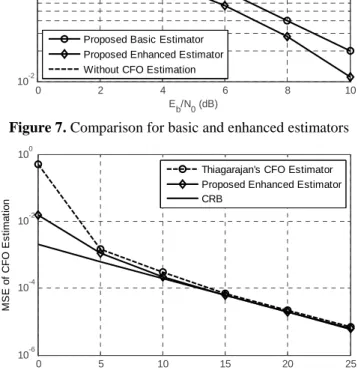
Firstly, we compare the BER performance of the proposed basic and enhanced estimators with M = 8, G = 16 and K = 3. We have introduced a wideband carrier frequency offset (WCFO) of 20 kHz for carrier frequency of 2 GHz. This offset has been selected since the mostly available crystal oscillators have an accuracy of about 3-13 ppm [26], which is translated to the CFO range of 6-26 KHz. SUI-3 channel model has been used as the multipath fading channel model. Figure 7 shows the BER performance comparison of the two proposed CFO estimators. It can be seen that the enhanced estimator is almost 1 dB superior to the basic estimator. It can also be seen that BER becomes the worst without using CFO estimation.
Next, we compare the Mean Square Error (MSE) of the proposed enhanced CFO estimator with the Thiagarajan’s CFO estimator [16] and Cramer-Rao Bound (CRB). The Cramer-Rao Bound is computed by following the steps mentioned in [27, 28]. All the simulation parameters are the same as given in Table 1. The MSE comparison is shown in Figure 8. It can be seen that the proposed CFO estimator outperforms Thiagarajan’s estimator even at low SNR values. Also, the MSE of the proposed estimator is very close to the
CRB at all SNR values. This shows that the proposed enhanced estimator is robust to multipath fading effects even at low SNRs.
0 2 4 6 8 10
10-2 10-1 100
E
b/N0 (dB)
B
E
R
Proposed Basic Estimator Proposed Enhanced Estimator Without CFO Estimation
Figure 7. Comparison for basic and enhanced estimators
0 5 10 15 20 25 10-6
10-4 10-2 100
E
b/N0 (dB)
M
S
E
o
f
C
F
O
E
s
ti
m
a
ti
o
n
Thiagarajan's CFO Estimator Proposed Enhanced Estimator CRB
Figure 8. MSE comparison for CFO estimation
Now we compare the BER performance of the proposed enhanced CFO estimator, Chien’s CFO estimator [15] and the case where CFO is known to the receiver. The comparison is shown in Figure 9 which shows that the proposed estimator outperforms the Chien’s estimator by giving a performance improvement of almost 1~2 dBs. Also, the proposed estimator has performance close to the case where CFO is known. It affirms the effectiveness of the proposed algorithm in multipath fading channels.
0 2 4 6 8 10
10-2 10-1 100
Eb/N0 (dB)
B
E
R
Known CFO Chien's Estimator [13] Proposed Enhanced Estimator No CFO Estimation
7.
Computational Complexity
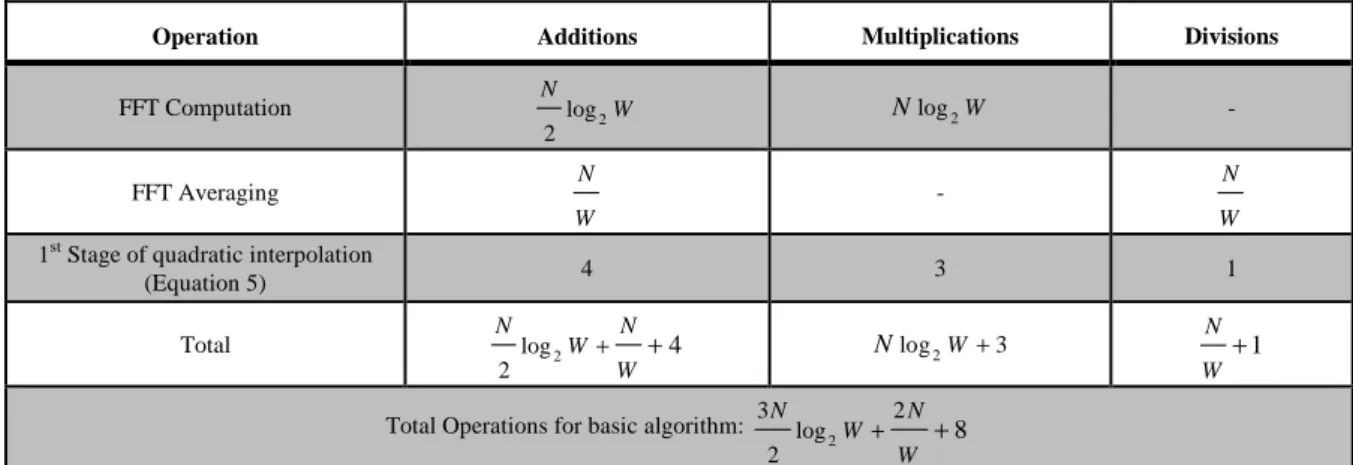
In this section, we describe the computational complexity of the proposed CFO estimation algorithms. The computational complexities of the proposed basic and enhanced algorithms in terms of number of additions, multiplications and divisions for one burst of data are shown in Tables 2 and 3. For a burst length N, window overlapping factor of r and window size of
W, the total number of FFT windows for the proposed basic
and enhanced algorithm is given by,
0( )
0( ) 1.
basic
enh
N N
W N N
rW =
= −
Since, a W-point FFT requires (W/2)log2(W) complex
additions Wlog2(W) complex multiplications [29], therefore
the total number of operations for the FFT computation in the both the algorithms will be calculated as follows.
- For basic algorithm:
2 2
Complex Additions: log ( ) log ( )
2 2
N W N
W W
W
⇒
2 2
Complex Multiplications: NWlog (W) Nlog (W) W
⇒
- For enhanced algorithm:
2 2
Complex Additions: log ( ) log ( )
2 2
N rW W N rW
W W
rW r
− −
⇒
2 2
Complex Multiplications: N rWWlog (W) N rW log (W)
rW r
− ⇒ −
The next step is the FFT windows averaging which results in the number of additions and divisions equal to the number of windows in each case. The number of multiplications, additions and divisions for the two stages of interpolation is calculated by using (5) and (8). Table 4 shows the numerical values of all the operations for the basic and enhanced algorithms by using the parameters listed in Table 1.
Table 2. Computational complexity of the proposed basic CFO estimation algorithm
Operation Additions Multiplications Divisions
FFT Computation log2
2
N
W Nlog W2 -
FFT Averaging N
W
- N
W
1st Stage of quadratic interpolation
(Equation 5) 4 3 1
Total log2
2
4
N N
W W
+ + Nlog2W+3 1
N W
+
Total Operations for basic algorithm: 2
3 2
log 2
8
N N
W W
+ +
Table 3. Computational complexity of the proposed enhanced CFO estimation algorithm
Operation Additions Multiplications Divisions
FFT Computation log2 2
N rW
W r
−
2 log
N rW
W r
−
-
FFT Averaging N rW
rW
−
- N rW
rW
−
1st Stage of quadratic interpolation
(Equation 5) 4 3 1
2nd Stage of quadratic interpolation
(Equation 8) 8 6 1
Total log2
2
13
N rW N
W
r rW
−
+ + log2 9
N rW
W r
−
+ N 1
rW
+
Total Operations for enhanced algorithm:
2
3( ) 2
log 2
23
N rW N
W
r rW
−
+ +
Table 4. Computational complexity comparison of the basic and enhanced algorithms for parameters listed in Table 1
Operation Total Additions Total Multiplications Total Divisions Total
Basic algorithm 8984 17923 21 26928
It can be seen that the major contribution towards the complexity is due to the overlapping windowed FFT operation. The inclusion of second stage of quadratic interpolation contributes very less towards the total computations. Also, the percentage increase in the total computational complexity for enhanced estimation algorithm is about 20.5%. On the other hand, the enhanced algorithm gives a BER performance improvement of almost 1~2 dB in SUI-3 channel. Therefore, the proposed enhanced algorithm is a promising technique to be used for CFO estimation in MC-CDMA systems. It gives a performance improvement of almost 1~2 dB when compared to the Chien’s estimator.
8.
Conclusion
In this paper, we have presented a very effective and method for the estimation of wideband carrier frequency offset (WCFO) in MC-CDMA based ad hoc networks. Firstly, a basic estimation algorithm has been proposed which uses windowed FFT and Lagrange quadratic interpolation based method to estimate CFO. Then, an enhanced algorithm has been proposed which is based on overlapped windowed FFT and a new technique of biquadratic Lagrange interpolation. The proposed enhanced algorithm improves the estimation process to considerable extent to decrease the amount of ICI. The proposed technique provides a fine estimate from the coarse estimate obtained through the FFT and quadratic interpolation method. The proposed algorithm has been verified for effectiveness by means of simulation in SUI multipath fading channels and compared to the basic algorithm and the reference BER performance. Simulation results show a BER performance improvement of almost 1~2 dBs when compared to the Chien’s estimator. Also, the proposed estimator approaches the CRB even at low SNRs.
References
[1] S. Hara, and R. Prasad, “Overview of Multicarrier CDMA”, IEEE Communication Magazine, Vol. 35, No. 12, pp. 126-133, 1997.
[2] K. Fazel, and S. Kaser, “Multicarrier and spread spectrum systems”, John Wiley & Sons, 2003.
[3] P. Fan, “Multiple access technologies for next generation mobile communications”, in Proceedings of 6th International Conference on ITS Telecommunications, Vol. 1, pp. 10-11, 2006.
[4] L. Tomba and W. A. Krzymien, “Sensitivity of the MC-CDMA access scheme to carrier phase noise and frequency offset”, IEEE Transactions on Vehicular Technology, Vol. 48, No. 5, pp. 1657-1665, 1999. [5] J. Jang and K. B. Lee, “Effects of frequency offset on
MC/CDMA system performance”, in Proceedings of IEEE 49th Vehicular Technology Conference, Vol. 1, pp. 566-570, 1999.
[6] Y. Kim, K. Bang, S. Choi, C. You and D. Hong, “Effect of carrier frequency offset on performance of MC-CDMA systems”, IEEE Electronics Letters, Vol. 35, No. 5, pp. 378-379, 1999.
[7] H. Steendam and M. Moeneclaey, “The effect of synchronization errors on MC-CDMA performance”, in
Proceedings of IEEE International Conference on Communications, Vol. 3, pp. 1510-1514, 1999.
[8] X. Hu and Y. H. Chew, “A new approach to study the effect of carrier frequency offset on the BER performance of asynchronous MC-CDMA systems”, in Proceedings of IEEE Wireless Communications and Networking Conference, Vol. 1, pp. 177-182, 2005. [9] A. Purwoko, and H. Ali, “A new frequency offset
estimation technique for up-link MC-CDMA systems”, in Proceedings of IEEE International conference on Acoustics, Speech and Signal processing, Vol. 4, pp. 769-772, 2004.
[10]A. Nagate, and T. Fujii, “A study on frequency synchronization methods for MC-CDMA systems”, in proceedings of IEEE 59th Vehicular Technology Conference, Vol. 3, pp. 1523-1527, 2004.
[11]F. Yang, K. H. Li and K. C. Teh, “Performance of carrier frequency offset estimation in MC-CDMA systems over frequency selective fading channels”, in Proceedings of the Joint Conference of the 4th International Conference on Information, Communications and Signal Processing and 4th Pacific Rim Conference on Multimedia, Vol. 1, pp. 673-677, 2003.
[12]X. Hu and Y. H. Chew, “A Joint blind timing and frequency offset estimator for asynchronous multicarrier CDMA systems”, in Proceedings of IEEE Military Communications Conference, Vol. 1, pp. 1-7, 2006. [13]Y. Hu and A. Boukerche, “Joint detection of frequency
offset and MAI for MC-CDMA sysetms”, in Proceedings of IEEE International Conference on Communication Technology, Vol. 1, pp. 1-4, 2006. [14]B. Akbil, B. Nsiri, G. Ferre and D. Aboutajdine, “Carrier
frequency offset estimation in MC-DS-CDMA systems with zero-IF receivers”, in Proceedings of 5th International Conference on I/V Communications and Mobile Network, Vol. 1, pp. 1-4, 2010.
[15]F-T. Chien and C-C. J. Kuo, “Blind recursive tracking of carrier frequency offset (CFO) vector in MC-CDMA systems”, IEEE Transactions on Wireless Communications, Vol. 6, No. 5, pp. 1246-1255, 2007. [16]L. B. Thiagarajan, S. Attallah, K. A-Meraim, Y-C. Liang
and H. Fu, “Non-Data-Aided joint carrier frequency offset and channel estimator for uplink MC-CDMA systems”, IEEE Transactions on Signal Processing, Vol. 56, No. 9, pp. 4398-4408, 2008.
[17]Y. Jay Guo, “Advances in Mobile Radio Access Networks”, Artech House Mobile Communication Series, 2004.
[18]D.S. Baum, Simulating the SUI channel Models, IEEE 802.16 Broadband Wireless Access Working Group. [19]S. Attallah, L. B. Thiagarajan, H. Fu and Y-C. Liang,
“Joint Channel and carrier offset estimation for synchronous uplink CDMA systems”, IEEE Transactions on Vehicular Technology, Vol. 56, No. 5, pp. 2769-2774, 2007.
[20]R. L. Burden and J. D. Faires, “Numerical Analysis”, 9th Ed., Brooks/cole, Cengage learning, 2010.
[22]Ramirez and W. Robert, “The FFT, Fundamentals and concepts”, Prentice-hall, New Jersey, 1985.
[23]M. B. Mollah and M. R. Islam, “Comparative analysis of Gold codes with PN codes using correlation property in CDMA technology”, in Proceedings of 2012 International Conference on Computer, Communication and Informatics, Vol. 1, pp. 1-6, 2012.
[24]C. H. Park, M. Lee, A. So and Y. S. Cho, “A bidirectional successive detection technique for asynchronous OFDMA-based wireless mesh networks”, Vol. 61, No. 7, pp. 3346-3352, 2012.
[25]Z. Cai, S. Ji, J. He and A. G. Bourgieos, “Optimal distributed data collection for asynchronous cognitive radio networks”, in Proceedings of 32nd IEEE International Conference on Distributed Computing Systems, Vol. 1, pp. 246-254, 2012.
[26]Y.P.E Wang and T. Ottosson, “Cell search in WCDMA” IEEE Journal on Selected Areas in Comm., Vol. 18, No. 8, pp. 1470-1482, Aug. 2000.
[27]P. Stoica and E. G. Larsson, “Comments on “‘Linearization method for finding Cramer-Rao bounds in signal processing’,” IEEE Transactions on Signal Processing, Vol. 49, No. 12, pp. 3168–3169, 2001. [28]E. de Carvalho, J. Cioffi, and D. Slock, “Cramer-Rao
bounds for blind multichannel estimation,” in Proc. IEEE Global Telecommunications Conference, Vol. 1, pp. 1036–1040, 2000.