Cross Layered Network Condition Aware
Mobile-Wireless Multimedia Sensor Network Routing
Protocol for Mission Critical Communication
A.Ajina
*, Mydhili K.Nair**
*Department of Computer Science and Engineering, Sir M Visvesvaraya Institute of Technology, Bangalore, India **Department of Information Science and Engineering, M.S.Ramaiah Institute of Technology, Bangalore, India
Abstract:The high pace emergence in wireless technologies have given rise to an immense demand towards Quality of Service (QoS) aware multimedia data transmission over mobile wireless multimedia sensor network (WMSN). Ensuring reliable communication over WMSN while fulfilling timely and optimal packet delivery over WMSN can be of great significance for emerging IoT ecosystem. With these motivations, in this paper a highly robust and efficient cross layered routing protocol named network condition aware mobile-WMSN routing protocol (NCAM-RP) has been developed. NCAM-RP introduces a proactive neighbour table management, congestion awareness, packet velocity estimation, dynamic link quality estimation (DLQE), and deadline sensitive service differentiation based multimedia traffic prioritization, and multi-constraints based best forwarding node selection mechanisms. These optimization measures have been applied on network layer, MAC layer and the physical layer of the protocol stack that eventually strengthen NCAM-RP to enable QoS-aware multimedia data transmission over WMSNs. The proposed NCAM-RP protocol intends to optimize real time mission critical (even driven) multimedia data (RTMD) transmission while ensuring best feasible resource allocation to the non-real time (NRT) data traffic over WMSNs. NCAM-RP has outperform RPAR based routing scheme in terms of higher data delivery, lower packet drops and deadline miss ratio. It signifies that NCAM-RP can ensure minimal retransmission that eventually can reduce energy consumption, delay and computational overheads. Being the mobility based WMSN protocol, NCAM-RP can play significant role in IoT ecosystem.
Keywords: Wireless Multimedia Sensor Network, Cross Layer Architecture, Network Condition Aware Routing Protocol, Qos, Mission Critical Communication.
1.
Introduction
The high pace emergence in wireless technologies and associated applications have motivated academia-industries to develop more effective and low cost communication system to serve major needs. The decentralized and Ad-hoc nature of Wireless Sensor Networks (WSNs) make it a potential solution to fulfil major communication requirements. The tremendous growth in WSNs have given rise to a new communication paradigm called wireless multimedia sensor network (WMSN) which is capable enough to solve major real-world communication problems. WMSNs can play significant role in major applications such as intelligent transport system (ITS), health monitoring, environmental monitoring, surveillance systems, industrial automation and many more. Generally, WMSNs are comprised of multiple wirelessly interfaced small scale electronic components that enable retrieving different multimedia data such as audio,
video, and still images, which is eventually reported to the destination node [1]. In last few years, world has witnessed the significantly high pace research, especially for WMSNs that as a result has given a new dimension to enable Internet of Things (IoTs) [2][3]. WMSN based IoT applications have been gaining momentum because of the remarkable development in embedded systems and associated technologies, which has given rise to the small size embedded devices and the never ending efforts towards optimal communication systems. It has given a new dimension of the sensor network called WMSNs that explore the feasibility of achieving recognition of their segregated endeavors by other networking community. However, the significance of low-power systems such as 6LowPAN [4] towards IPv6 also motivates this research as it provides vital opportunity to employ WMSNs for the applications such as Internet based remote monitoring and surveillance systems.
In fact, in major conventional multimedia systems, there is a streaming server that takes multimedia data as the input from purpose-oriented sophisticated devices and transmits it over wideband connections to multiple users to avail subscribed services. Here, the server is sufficient to perform computationally intensive processes such as encoding using techniques like MPEG and others. On the other hand, decoder that functions in a slave mode to the encoder performs content decoding. Interestingly, the multimedia sensors deployed in WMSNs suffer from various issues, such as resource (bandwidth constraints), energy consumption, memory allocation, and computation that make encoding approaches an infeasible solution to be considered. On the other hand, the generic communication approach in WMSNs operates on a many-to-one transmission paradigm where a sink node used to be the final destination, where the sensors intend to transmit its data and is capable of performing decoding to retrieve transmit media content. In addition, the data generated by the sensors depict significantly higher spatial correlation because of the dense node deployment across the network area. Enabling multimedia communication in varied wireless networks, such as wireless broadband links, satellite communication, and MANETs can enable an array of services [5][6][7]. However, enabling timely data transfer to the sink has always been a problem to ensure quality of service (QoS) in WMSNs.
multimedia data transmission where transmission of mission critical or the event driven multimedia data is of paramount significance. However, ensuring in practice ensuring mission critical multimedia data communication is a highly intricate task, primarily because of link dynamism, channel capacity, resource allocation issues etc. On the contrary, enabling time critical multimedia data transmission over WMSNs is vital to ensure QoS delivery. The optimization of multi-layered metrics in the routing protocol stack may enable QoS data delivery. However, as per the present knowledge not much significant efforts have been made to optimize multi-layered routing protocols for WMSNs. The efforts made with single layer optimization could not enhance overall network performance primarily because of the direct coupling in between the PHY and the upper layers of the protocol stack. Such limitations make the conventional routing protocol inefficient for WMSNs. Taking into consideration of the functional characteristics of WMSNs the cross layered design can be a potential approach as an alternative to the conventional routing protocols [8]. With an objective to provide QoS delivery, a few efforts have been made [9-11]. These works emphasize on facilitating QoS to the individual stream as per the current network conditions. However, these approaches are not sufficient and adaptive to ensure mission critical multimedia data communication over WMSNs. In addition, no significant effort has been made to consider WMSN under mobility scenario, which seems relevant towards emerging IoT applications. Mobility with WMSNs may cause various issues like topological volatility, resource allocation issues, data drop caused retransmission and energy exhaustion etc. It may degrade overall performance of the network. To deal with these issues, the multi-parametric optimization across the protocol stack can enable QoS assurance of the WMSNs. Considering these motivations, in this paper an enhanced cross layered routing protocol has been proposed. The proposed system primarily emphasizes on achieving an optimal mission critical multimedia data (RTMD) communication over WMSNs. To ensure optimal performance, the proposed system embodies an enhanced pro-active neighbour table management, congestion awareness model, velocity estimation, dynamic link quality estimation (DLQE), and service differentiation based prioritization to ensure optimal QoS enriched RTMD data delivery. One of the key novelties of the proposed cross-layered WMSN routing protocol is its node mobility feature that enables it to be applied in major mobility based low-cost heterogeneous network, particularly for mission critical RTMD transmission serving an array of IoT applications.
The other sections of the presented manuscript are divided as: Section II discusses the related works, which is followed by the discussion of our proposed cross layered routing protocol for mobile WMSNs in Section III. Results obtained and their significances are presented in Section IV, while the overall conclusion and future scopes are discussed in Section V.
2.
Related work
The cross-layer models was suggested for resource constrained WMSN [1] and QoS provision [3, 12]. A cross layer model including transport, network and PHY was
based route decision or have considered MAC optimization as the solution to ensure timely data delivery. However, no significant work has been done to address mobility in WSN and respective link quality variation and resulting impact on network performance. The effectiveness of [33] where authors suggested incorporating packet velocity as an indicator to signify node’s ability for data transfer motivates us to consider it for best forwarding node selection. In addition, the application of other parameters such as dynamic link quality and buffer availability information retrieved through proactive node management motivate author to develop a cross layer model based routing scheme. Considering these motivations in this paper, a robust cross layered network condition aware mobile-wireless multimedia sensor network routing protocol for mission critical communication has been developed. The brief discussion of the proposed routing scheme is presneted in the following sections.
3.
Our contribution
In this section the proposed cross-layered WMSN routing protocol is discussed.
3.1 Network Condition Aware Routing Protocol for Mobile WMSN (NCAM-RP)
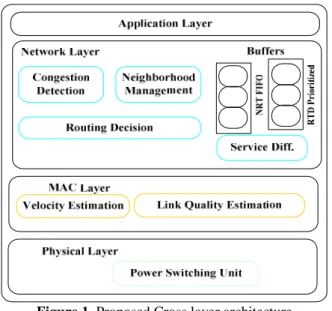
For a WMSN network, delay sensitive data transmission and optimal resource utilization are the key factors to be ensured. Similarly, with mobility the WMSN network might undergo turbulent topological variations, resulting into packet collision, node table management issues, data retransmission, elevated end-to-end delay and prominently energy exhaustion. However, alleviating these issues might certainly enable an optimal routing scheme that can facilitate a low cost communication paradigm to serve an array of applications. Unlike major existing approaches, in this paper, a robust network condition aware routing protocol for mobile WMSN (NCAM-RP) is proposed that can be of paramount significance for major applications, including advanced IoT ecosystem. The proposed system incorporates cross-layered architecture, especially crafted for mobility based WMSN communication. The proposed work deals with both the mobile communication as well as time critical multimedia transmission across sensor network. In the proposed routing scheme, the WMSN nodes handover multimedia packets to the neighboring node which is selected on the basis of a multi-constraints best forwarding node selection approach. Unlike existing works, the proposed routing protocol incorporates mobility based neighborhood node management, congestion awareness and mitigation, velocity estimation, fair resource scheduling, data prioritization based on deadline time, and dynamic link quality estimation (DLQE) models to perform mission critical multimedia data communication over mobile WMSN network. Figure 1 represents the overall cross-layer routing protocol. In summary, the proposed system can be stated as a multilevel optimization measure with a cross-layered design that intends to enable mission critical multimedia communication over mobile WMSN network.
Figure 1. Proposed Cross layer architecture
The overall proposed mobile WMSN routing protocol is discussed as follows:
3.1.1 Cross Layer Architecture
3.1.1.1 Network Layer
In the proposed routing scheme, the network layer comprises three prominent components or functions. These are:
a) Proactive Neighbor Table Management (P-NTM) b) Service Differentiation Model (SDM)
c) Congestion Awareness Model (CDM)
A brief discussion of these components is given as follows: a) Proactive Neighbor Table Manager (P-NTM)
As stated, this research proposed routing protocol for mobile WMSN applications that is prone to undergo turbulent topological variations. The change in network topology, even with WSN alike greedy network may introduce numerous issues such as collision, packet drop etc. To deal with this, this paper proposes a pro-active neighboring node table management scheme (P-NTM) that updates node locations as well as its associated significant features such as buffer availability, distance between nearest sink etc. It enables swift and precise decision process to perform best forwarding node selection. In the proposed model, individual node updates its node table (NT) distinctly which is followed by the transmission of a beacon message to its one-hop distant neighbor node. The beacon message embodies key node information such as node ID, buffer capacity, buffer availability, current link quality, and the coordinates of node location. One significant novelty of the proposed mobile-WMSN routing protocol is that it avoids any acknowledgement message from the beacons. In this study, to transmit WMSN traffic data, the individual packet size of 42 bytes is selected, where each data packet is split into three distinct fields. Here, the first field is of 16 bits that embodies node ID, the second field of 192 bits comprises the key constructs (information) like node’s total buffer capacity and current availability, link quality and packet injection rate of the velocity. Similarly, the location coordinates of node is stored in the third field of 128 byte size. To deal with collision issue, each node sends a beacon message along with a random offset timer (ROT). Here, the ROT is decided based on a uniform distribution mechanism. Listening packet transmission node resets its ROT. In the proposed routing model, the subset of the one hop distant neighboring nodes with equal or shorter distance to the nearest sink (destination) is updated to the NT.
Let, N be the one-hop distant neighboring node, N be the possible best forwarding node, E and E be the Euclidean distance from connected BFN and the source to the nearest destination node, respectively. Then the total number of nodes N stored in NT can be estimated as (1):
= ∈ | − ≥ 0 (1)
For wireless multimedia sensor network, prioritization of event driven or the mission critical data is of paramount significance. Delivering multimedia traffic within deadline time plays vital role in assuring QoS. To enable optimal multimedia traffic prioritization (deadline sensitive), in this paper a novel service differentiation model (SDM) model is proposed. The proposed SDM and QoS oriented traffic scheduling is briefed in the follwing sub-section.
b) Service Differentiation Model (SDM)
Being mission critical and deadline sensitive transmission paradigm multimedia data transmit over WMSN, there is an inevitable need of a fair and QoS oriented traffic prioritization. In typical communication system there used to be real time data (RTD) as well as non-real time data (NRT). However, in major IoT application scenarios, ensuring QoS oriented RTD delivery is of paramount significance. With this objective, in this paper a novel SDM based real time multimedia data (RTMD) prioritization scheme has been developed. The proposed scheme gives higher priority to the RTMD delivery of NRT traffic; however it ensures that the RTMD data deliver optimal throughput while ensuring that there is least possible losses of NRT data. The proposed SD mechanism applies a novel differentiation paradigm that gives higher priority to the mission critical RTMD traffic over NRT data. Once in resource constrained communication scenario, a forwarding node finds its buffer capacity full and needs supplementary memory to perform transmit real time multimedia traffic (RTMD) data, it borrows additional buffer space from the memory assigned for NRT traffic. In the proposed SDM, two distinct buffers have been assigned for RTMD and NRT data. In this way, borrowing additional buffer space from the specific buffer assigned for NRT traffic, RTMD traffic data is assigned memory so as to support timely data delivery. In case whenever NRT buffer is filled, SDM performs scheduling in such a way that few of the NRT traffic are dropped to give required buffer space for RTMD transmission to enable QoS delivery without violating deadline time. In the proposed SDM model, NRT traffic data is stored in first-in-first-out (FIFO) manner and hence dropping few of the lastly added elements in the queue can’t impact overall throughput significantly. Unlike generic paradigms, the proposed model neither drops high data elements (drops minimal feasible elements to meet current buffer need to transmit RTMD data) not needs any additional memory space. It makes the proposed routing system cost effective and efficient for reliable multimedia data transmission over WMSNs. In summary, the proposed routing scheme intends to deliver maximum or optimal RTMD data while ensuring minimal possible NRT drop.
c) Congestion Awareness
node (BFN) and thus avoids congestion. The dynamic congestion level awareness plays significant role in the proposed BFN selection scheme that as a result helps in QoS-aware multimedia data delivery over WMSN network. Taking into consideration of real time network conditions, at the network layer each node is allotted fixed buffer space to store both the RTMD as well as NRT data. Considering event driven or the mission critical data transmission over WMSN network the RTMD data is stored with a priority based hash table. Here, it should be noted that the proposed routing scheme decides priority of the RTMD traffic on the basis of deadline time to reach destination node. In the proposed routing model, the NRT data is stored in the generic first input first output (FIFO) queuing manner. In addition to the congestion level, the relative distance from source to sink (destination) node is used for RTMD prioritization. The RTMD packet with least priority has the lowest _, where t !" # $!_ signifies the remaining deadline time and dstates for the Euclidian distance in between the forwarding node i and the intended destination node j. To calculate the remainingt !" # $!_, the arrival time of each packet is stored and before transmitting any packet, the queuing period is subtracted from its deadline timet !" # $!.
To assist congestion awareness facility, individual node updates its current buffer capacity dynamically. As, in practical WMSN scenario, the buffer capacity of a node can vary dynamically due to traffic variations, and therefore the proposed routing scheme introduces a factor called cumulative congestion degree CCD+.Here, CCD+ contains the local node information in addition to the impact of the neighboring node in a subset, say S$. In mathematical form, CCD+ is calculated as follows (2):
--./=-.-.01/+ -.3/
01/456+ -.3/ 456+ 7 --./ 8
9:
(2)
where CD$;+ and CD<+ state the available buffer space in the normal queue and prioritized queue, respectively. The other parameters CD$;+="> and CD<+ ="> represent the maximum buffer capacity of the normal and the prioritized queues, correspondingly. In addition, CCD+ reflects the total number of nodes in S$. In this way, estimating buffer availability the BFN selection has been performed that avoids data collision significantly and thus supports other QoS constructs such as minimal data drop, end-to-end delay and energy consumption. It results into timely multimedia data delivery over WMSN network.
3.1.1.2 MAC Layer
In the proposed cross layer architecture, at MAC layer, two models have been introduced. These are:
a) Velocity Measurement Unit (VMU), b) Dynamic Link Quality Estimation (DLQE).
a) Velocity Measurement Unit (VMU),
One of the predominant novelties of the proposed cross-layered routing protocol can be the implementation of a velocity measurement unit (VMU) that employs transmission packet delay for calculating the distance between the neighbor
nodes to the nearest destination. It significantly helps in reducing data drop, especially when mission critical multimedia traffic data delivery is of utmost significance for WMSN network. Furthermore, the approach that the smallest distance between neighboring nodes to forward data can play significant role in reducing data drop, is applied to decide BFN selection. To calculate data velocity (in other words, the packet injection rate), in this paper four parameters; the Euclidian distance between the source and the nearest destination node, and relative distance in between the neighboring node, average round trip time, and the speed of radio signal have been applied (3).
In practice, to enable mission critical multimedia transmission over WMSN, the information about the neighboring node velocity can be of paramount significance to perform optimal BFN selection or the nearest sink S, because nearer the sink node, higher the probability of successful RTMD transmission. Equation (4) presents the proposed velocity estimation model.
?3= @
A.BCD− .B8C
EF G
H456C3II J (3)
where V< represents packet velocity at transmission powerTp, DNOP represents the Euclidean distance between source i and the nearest sink node. The distance between node i and the nearest destination is DNQO and the round trip time of a packet is given byTR . The maximum speed of the radio signal is stated in terms ofR=">O<!! , which is taken as the speed of light over the distance from node i to the nearest sink node. In this research, TR is taken as the difference between the time of packet transmission and its acknowledgement (ACK) receiving. TR can be estimated using equation (4).
EF =∑ HUV− WXV
8
9Y (4)
where, SZ represents the time when a packet is transmitted, and R[ represents the time at which the ACK is received. Here, N gives the total number of success transmission. b) Dynamic Link Quality Estimation (DLQE- \)
[32] is applied. Mathematically, DLQE ]Ψ_is derived as follows:
` = a ∗ ` + ]1 − a_ ∗ d/ (5)
where,
d/ = A /6 V6G
(6)
Where N> signifies the total number of transmitted packets, and N+> gives the total numbers of received packets. In addition to the packet received rate]P+_, in this paper an additional factor α(where,α ∈ [0 … 1]) is used.
3.1.1.3 PHY Layer
As the proposed mobility based WMSN routing protocol is formulated as a cross layered architecture, the packet injection rate or the velocity estimation can be introduced in conjunction with a power switching unit at PHY. It can play vital role in tuning of the transmission power as per expected packet injection rate or packet velocity. In addition, it can be of significant to optimize bandwidth utilization and mission critical data transmission. To strengthen the proposed routing scheme, a physical switching unit (PSU) has been applied on PHY layer of the protocol stack.
a) Physical Switching Unit (PSU)
The proposed PSU at PHY layer enables tuning of the transmission power ]Tp_ to the expected velocity leveljV<k, where VMU can function in association with the PSU so as to vary the value of Tp. It can enable tuning of the packet injection rate or the packet velocity estimation so as to meet application demands.
3.2 Multiconstraint Best Forwarding Node Selection (M-BFNS)
Selection of the best forwarding node can play significant role in assuring QoS-aware transmission over WMSNs. With this motivation, in this paper, a multi-constraint best forwarding node (BFN) selection scheme is developed. Considering requirement of minimal data drop, least possible retransmission, minimum end-to-end delay, optimal throughput and minimum energy exhaustion, in this paper, multiple constraints is applied to formulate a novel BFNS scheme. Here, three constraints or the parameters; dynamic link quality, buffer availability, inter-node distance, end-to-end delay, packet velocity etc are applied to derive M-BFNS model. The proposed routing protocol performs M-BFNS estimation at each node. In order to estimate a cumulative score metrics while balancing the parameters such as, remaining buffer capacity, dynamic link quality Ψ, and packet velocity, an additional parameter called weight factor β is introduced. The node score matrix for each node is estimated using following equation (7):
Cl1/I= m:∗ ` + mn--./+ mo∗ ?3 (7) where, NOp;+! signifies the node (N) score matrix, Ψ presents the dynamic link quality of the node N, BR gives the remaining buffer capacity of N, and V< reflects the packet
velocity. It should be noted that in the proposed M-BFNS model, the weight factors jβ:,βn and βokwhich represents the weight assigned to each constraint satisfies the following condition (8).
7 m = 1 o
9:
(8)
For simulation, in this paper the static weight parameters ]β_
was used, however it can be assigned dynamically based on expected significance level. Thus, estimating the score matrix for each node, the BFN selection algorithm has been executed which is followed by transmission of the multimedia data. The proposed BFN selection algorithm is given in Figure 2.
Algorithm: Best Forwarding Node Selection
uvwxy: {|} − ℎ•€ •‚ƒ„…|„ }‚†ℎ‡•ˆ‰‚|† |••}ƒ, WŠ•‰} ‹…„‰‚Œ ••‰ }…Šℎ |••}. •xywxy: •}ƒ„ ••‰‘…‰•‚|† |••}
’|‚„‚…“‚”} WŠ•‰} 456]W•_ = −1;
—˜™š›œ• }‚†ℎ‡•‰ |••} ‚ •• WŠ•‰}žŸ//I0V
= m]‘}‚†ℎ„_. ` ∗ {| − ℎ•€ •‚ƒ„…|„ ••}[‚]. `
+ m. •/]•ˆ••}‰ ‰}‹…‚|‚|†_ ∗ {|
− ℎ•€ •‚ƒ„…|„ ••}[‚]. •/]•ˆ••}‰ ‰}‹…‚|‚|†_
+ m. ?3∗ {| − ℎ•€ •‚ƒ„…|„ ••}[‚]. ?3;
’• WŠ•‰} 456≤ WŠ•‰}žŸ//I0V„ℎ}| •}ƒ„ ••‰‘…‰•‚|†|••} ]•¡ ¢D_ = ’; šv£
šv£
Figure 2. Best Forwarding node selection
4.
Results and Discussion
Table 1. Simulation Environment
Simulation Environment System
Configuration
Windows 2010, 4GB RAM, Intel i3 processor.
Simulator Matlab 2015a
Network Mobile WMSN
Network Protocol
Network Condition Aware Routing Protocol for Mobile-WMSN (NCAM-RP)
Data Link CSMA
Physical IEEE 802.15.4
Nodes 50
Range 100m
Payload 500, 1000, 1500, 2000, 2500, 3000, 3500, 4000, 4500, 5000.
Mobility Pattern
Circular Mobility pattern (Running competitive scenario)
Simulation period
800 second
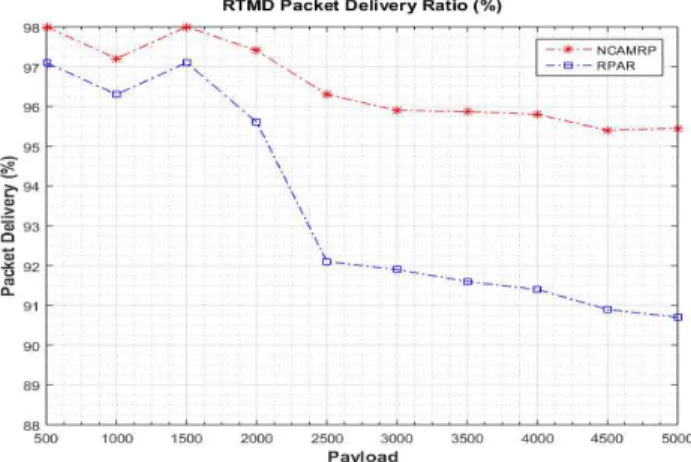
For multimedia data transmission over WMSN network, optimal resource allocation, minimum end-to-end delay, minimum data drop and retransmission probability, and minimal deadline miss ratio is of paramount significance. An assumption that lower data drop (i.e., higher data delivery rate) can result into higher throughput and minimum retransmission that as a result can reduce delay and energy exhaustion, has been considered in this research. Here, performance assessment was done in terms of data delivery ratio, data drop ratio, and deadline miss ratio for both the RTMD data as well as NRT data traffic. To justify the robustness of the proposed NCAM-RP protocol, the comparison was one with a well know mobile WSN protocol named Real Time Power Aware Routing Protocol (RPAR) [33] was developed for multimedia data transmission over WMSN network. RPAR is an application specific, delay sensitive, power aware traffic forwarding WSN protocol. However, it suffers from issues such as signaling overheads, etc. Unlike proposed NCAM-RP protocol which considers multiple network constraints for BFN selection, RPAR applies packet velocity of the nodes for transmission scheduling. As depicted in Figure 3, it can be found that the proposed NCAM-RP protocol delivers RTMD traffic up to 98.2%. On average NCAM-RP exhibits 87.6% RTMD delivery, while RPAR could deliver 84.9%. Similarly, for NRT traffic transmission over WMSN network, it can be observed (Figure 4) that the proposed NCAM-RP protocol delivers 83.53% average delivery. On the contrary, RPAR exhibited 81.9% NRT delivery, which is 1.98% lower than the proposed NCAM-RP protocol.
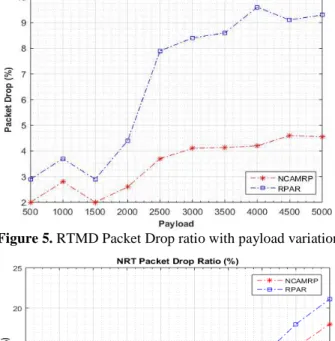
Here, the significance of the implementation of proposed service differentiation and deadline sensitive traffic prioritization scheme could be visualized through the results. Exploring in depth, it can be found that with low traffic payload both the protocols exhibit similar performance, while increasing payloads RPAR depicts higher data drop than the proposed NCAM-RP protocol (Figure 4 and Figure 5). In fact, increasing multimedia traffic load influences BFN selection mechanism that as a result increases the deadline violence (Figure 6). Observing Figure 5, it can be seen that NCAM-RP protocol exhibits lower drop of 3.15% (min. 2%, max. 4.5%) for RTMD traffic, while RPAR shows on average 6.06 % drop (min. 2.9%, max. 9.3%). For NRT traffic,
NCAM-RP exhibits 7.37% data drop (min. 1.6%, max. 18%), while RPAR exhibits approximate 9.0% drop (min. 2.9, max. 21.1%).
Figure 3. Real time multimedia data (RTMD) delivery with
payload variation
Figure 4. Non-real time multimedia data (NRT) delivery with
payload variation
Figure 5. RTMD Packet Drop ratio with payload variation
Figure 6. NRT Packet Drop ratio with payload variation
Figure 7. Deadline miss ratio for varying RTMD payloads
Table 2 presents a comparative presentation of the proposed routing scheme and other existing approaches.
Here, it can be observed that the proposed NCAM-RP protocol exhibits 3.1% deadline miss, while RACE suffers higher delay and hence shows 5.01% deadline miss. These results confirms that the proposed NCAM-RP protocol not only ensures higher real time multimedia data (RTMD) delivery but also assures that the deadline miss is minimum or the minimum delay is maintained. It can be stated as the result of the proposed SDM based prioritization, deadline sensitive resource allocation, adaptive packet injection rate scheduling or the velocity estimation, and optimal best forwarding node
selection. In cumulative perception, the results affirm that the proposed system can be an effective solution for WMSN, even with mobile scenario and hence can be applied for major IoT applications.
Table 2. Comparative Features
R
ef
.
D
is
ta
n
ce
D
el
a
y
D
ea
d
li
n
e
V
e
lo
ci
ty
/I
n
je
ct
io
n
r
a
te
L
Q
E
(S
D
)
P
ri
o
ri
ti
za
ti
o
n
B
W
R
T
D
[5] × × × × ×
[6] × × × × × ×
[10] × × × × × ×
[15] × × × × × × ×
[13]
[14] × × × × × ×
[17] × × × × ×
[18] × × × × × ×
[23] [25] [27]
× × × × × ×
[28] × × × × × ×
[30] × × × × × × ×
[33] × × × × ×
NC AM-RP
Here, it can be observed that the proposed NCAM-RP protocol cosniders multiple constraints for BFN selection that as a results enables optimal performance for multimedia data transmission over mobile-WMSN network.
5.
Conclusion
scenarios. In future, the proposed routing scheme could be examined in terms of energy efficiency, overheads, latency and signal to noise ratio efficiency with real time multimedia payload (image or video data) transmission.
References
[1]I. F. Akyildiz, T. Melodia, and K. R. Chowdhury, “Asurvey onwireless multimedia sensor networks”, Comput. Net, vol. 51, no. 4, pp. 921–960, 2007.
[2]D. Guinard, V. Trifa, T. Pham, and O. Liechti, “Towards Physical Mashups in the Web of Things”, in Proc. INSS’09, pp. 1–4, 2009. [3]“Web of Things”, Available in: <http://www.webofthings.org/>,
Dec. 2011.
[4]M. Geoff, “The 6LoWPAN architecture”, in Proc. ACM EmNets’07, pp. 78–82, 2007.
[5]P. F. James, C. How, D. Bull, and A. Nix, “Distortion-based link adaptation for wireless video transmission”, EURASIP J. Adv. Signal Process., vol. 2008, pp. 17, 2008.
[6]M. V. Schaar and D. S. Turaga, “Cross-layer packetization and retransmission strategies for delay-sensitive wireless multimedia transmission”, IEEE Trans. Multimedia, vol. 9, no. 1, pp. 185– 197, 2007.
[7]Y. P. Fallah, P. Nasiopoulos, and H. Alnuweiri, “Efficient transmission of H.264 video over multirate IEEE 802.11e WLANs”, EURASIP J. Wireless Commun. Net, vol. 2008, p. 14, 2008.
[8]T. Melodia and I. F. Akyildiz, “Cross-layer QoS-Aware communication for ultra wide band wireless multimedia sensor networks”, IEEE J. Select. Areas Commun., vol. 28, no. 5, pp. 653–663, 2010.
[9]L. Shu, M. Hauswirth, L.Wang, Y. Zhang, and J. H. Park, “Cross-layer optimized data gathering in wireless multimedia sensor networks”, in Proc. CSE’09, pp. 961–966, 2009.
[10]F. Oldewurtel, J. Ansari, and P. Mahonen, “Cross-layer design for distributed source coding in wireless sensor networks”, in Proc. SENSORCOM’ 08, pp. 435–443, 2008.
[11] L. Zhou, X. Wang, W. Tu, G. Mutean, and B. Geller, “Distributed scheduling scheme for video streaming over multi-channel multi-radio multi-hop wireless networks”, IEEE J. Select. Areas Commun., vol. 28, no. 3, pp. 409–419, 2010.
[12] “Amendment 8 Medium Access Control (MAC) Quality of Service (QoS) Enhancements”, IEEE Std. 802.11e, Jul. 2005. [13] H. P. Shiang and M. Var der Schaar, “Distributed resource
management in multi-hop cognitive radio networks for delay sensitive transmission”, IEEE Trans. Veh. Technol., vol. 58, no. 2, pp. 941–953, 2009.
[14] P. Frossard, J. C. De Martin, and R. Civanlar, “Media streaming with network diversity”, Proc. IEEE, vol. 96, no. 1, pp. 39–53, 2008.
[15] M. Chen, V. C. Leung, S. Mao, and Y. Yuan, “Directional geographical routing for real-time video communications in wireless sensor networks”, Comput. Commun., vol. 30, no. 17, pp. 3368–3383, 2007.
[16] J. B. Othman and B. Yahya, “Energy efficient and QoS based routing protocol for wireless sensor networks”, J. Parallel Distrib. Comput., vol. 70, no. 8, pp. 849–857, 2010.
[17] X. Huang and Y. Fang, “Multiconstrained QoS multipath routing in wireless sensor networks”, Wireless Net, vol. 14, no. 4, pp. 465–478, 2008.
[18]E. Felemban, S. Member, C. Lee, and E. Ekici, “MMSPEED:Multipath multi-SPEED protocol for QoS guarantee of reliability and timeliness in wireless sensor networks”, IEEE Trans. Mobile Comput., vol. 5, no. 6, pp. 738–754, 2006. [19] S. Li, R. Neelisetti, C. Liu, S. Kulkarni, and A. Lim, “An
interference aware routing algorithm for multimedia streaming over wireless sensor networks”, Int. J. Multimedia Appl., vol. 2, no. 1, pp. 10–30, 2010.
[20] N. Saxena, A. Roy, and J. Shin, “Dynamic duty cycle and adaptive contention window based QoS-MAC protocol for
wireless multimedia sensor networks”, Comput. Net, vol. 52, no. 13, pp. 2532–2542, 2008.
[21] O. Farrag, M. Younis, and W. D. Amico, “MAC support for wireless multimedia sensor networks”, in Proc. IEEE GLOBECOM’09, pp. 3781–3786, 2009.
[22] H. Kimand and S. G. Min, “Priority-based QoSMAC protocol for wireless sensor networks”, in Proc. IEEE IPDPS’09, pp. 1–8, 2009.
[23] G. Vithya and B. Vinayagasundaram, “Actuation sensor with adaptive routing and QOS aware checkpoint arrangement on Wireless Multimedia Sensor Network”, in Recent Trends in Information Technology (ICRTIT), International Conference, pp. 444-449, 2011.
[24] S. Ehsan and B. Hamdaoui, “A Survey on Energy-Efficient Routing Techniques with QoS Assurances for Wireless Multimedia Sensor Networks”, in Communications Surveys & Tutorials, IEEE , vol.14, no.2, pp.265-278, 2012.
[25] B. Yahya and J. Ben-Othman, “An energy efficient and QoS aware multipath routing protocol for wireless sensor networks”, in Local Computer Networks, IEEE 34th Conference, pp.93-100, 2009.
[26] W. Xiao-ming, C. Li, J. Lu, and D. Liu, “QoSPMR: QoS-Aware and Priority-Based Multipath Routing Algorithm for WMSNs”, in Engineering and Technology (S-CET), pp.1-5, 2012.
[27] Y. Ozen, N. Bandirmali, and C. Bayilmis, “Two tiered service differentiation mechanism for wireless multimedia sensor network MAC layers”, in Signal Processing and Communications Applications Conference (SIU), 23th, pp.2318-2321, 2015. [28] V. A. Amala and V. Nagarajan, “Energy Efficient Routing
Protocol for Mobile Wireless Sensor Network”, Int. Journal of Computer Applications, vol.43, no.21, 2012.
[29] S. Zhuo, Z. Wang, S. Ye-Qiong, Z. Wang, and A. Luis, “iQueue-MAC: A Traffic Adaptive duty-cycled MAC Protocol with Dynamic Slot Allocation”, IEEE International Conference on Sensing, Communications and Networking (SECON), 2013. [30] S. E. Azlan and A. Al-Anbuky, “Modelling the Integrated QoS
for Wireless Sensor Networks with Heterogeneous Data Traffic”, Open Journal of Internet Of Things (OJIOT) vol.1, no.1, 2015. [31]M. A. Gustavo and L. B. Becker, “A Network Conditions Aware
Geographical Forwarding Protocol for Real-Time Applications in Mobile Wireless Sensor Networks”, 2011 IEEE International Conference on Advanced Information Networking and Applications, pp. 38-45, 2011.
[32] A. Woo and D. Culler, “Evaluation of efficient link reliability estimators for low-power wireless networks”, EECS Department, University of California, Berkeley, Tech. Rep. UCB/CSD-03-1270, 2003.
[33] O. Chipara, Z. He, G. Xing, Q. Chen, X.Wang, C. Lu, J. Stankovic, and T. Abdelzaher, “Real-time Power-Aware Routing in Sensor Networks”, IEEE International Workshop on Quality of Service, New Haven, CT, pp-83-92, 2006.
[34]V. Sarasvathi, S. Snehanshu, S.N. Iyengar and K. Mahalaxmi, “Coefficient of Restitution based Cross Layer Interference Aware Routing Protocol in Wireless Mesh Networks”, International Journal of Communication Networks and Information Security (IJCNIS), vol. 7, no. 3, pp. 177-185, 2015.