Languages for
the future
Which languages the UK needs most and why
www.britishcouncil.org
This report was commissioned by the British Council and prepared
by Teresa Tinsley and Kathryn Board of Alcantara Communications.
Teresa Tinsley is a linguist with over 30 years’ experience in national organisations devoted to languages education. At CILT, the National Centre for Languages, she led the organisation’s information, research and publications activities. She established CILT’s ‘Language Trends’ series of reports and produced statistics and policy developments published as Languages Yearbooks 1995–2007. She was involved in several European research projects on multilingualism and is a member of the European Commission’s ‘Languages in Education and Training’ group. Since founding Alcantara Communications, she has conducted policy research on languages issues for clients including the British Academy and CfBT Education Trust.
Kathryn Board was Chief Executive of CILT, The National Centre for Languages from 2008 and has worked with specialists and a wide range of educational institutions to provide advice on educational policy as well as on initiatives aimed at increasing language learning across the UK. Before joining CILT, she spent 30 years working for the British Council in a number of international and management roles. Now partially retired, she continues to work on research projects where she can bring in her expertise. Kathryn speaks Spanish, German and Dutch and is working hard on improving her Arabic.
Alcantara Communications provides expertise to national and international organisations, private companies and third sector bodies on language education policies, multilingualism and languages in employment and undertakes research and analysis in this field.
about the
british CounCiL
The British Council is the UK’s international organisation for educational opportunities and cultural relations. We create international opportunities for the people of the UK and other countries and build trust between them worldwide.
We work in more than 100 countries and our 7,000 staff – including 2,000 teachers – work with thousands of professionals and policy makers and millions of young people every year teaching English, sharing the arts and in education and society programmes. We are a UK charity governed by Royal Charter. A publically-funded grant-in-aid provides less than a quarter of our turnover which last year was £781 million. The rest we earn from English teaching, UK exams and services which customers around the world pay for, through education and development contracts and from partnerships with other institutions, brands and companies. All our work is in pursuit of our charitable purpose and creates prosperity and security for the UK and the countries we work in all around the world. For more information, please visit: www.britishcouncil.org You can also keep
in touch with the British Council through http://twitter.com/britishcouncil
and http://blog.britishcouncil.org
Contents
Foreword
2
Executive summary
3
Introduction
4
The UK’s language challenge
6
Identifying the languages the UK needs
10
Conclusion and recommendations
19
The top ten languages
22–41
Appendix: Matrix of language indicators
weightings and scores
42
foreword
On a poster on the wall in a university in Beijing, I recently read these
remarkable words from Nelson Mandela: ‘If you talk to a man in a
language he understands, that goes to his head. If you talk to him in his
own language, that goes to his heart.’ Nearly 1,000 people were taking
their English exams that day.
I am proud to work for an organisation which offers millions of learners worldwide access to the education, job opportunities and social mobility that English brings. But in the UK we must accept that speaking English alone is not enough in a world where multilingualism is becoming the norm. There can be no doubt that the UK needs more of its people to speak foreign languages – for employability, for trade and the economy, and for our cultural life. But, let’s be honest, there are big barriers to this. So many people worldwide do speak English, and learning foreign languages in the UK has often been seen as an academic pursuit rather than a vital skill. Much of this revolves around the difference between being ‘fluent’ or ‘functional’ in a language. The British Council’s experience of English language teaching is that what matters most is being able to understand and to be understood; whether the need is for basic vocabulary to give directions to a taxi driver or for a more extensive vocabulary to be an international business person. It is hard to know, especially at a young age, which language is likely to be of most use. So perhaps a more ‘functional’ focus – having enough – might be the key to promoting language learning in the UK. Not to impoverish or lessen the academic or cultural value of long-term
unable – to travel, explore, navigate and engage at some level with people in other languages.
The analysis of economic and cultural indicators in this report suggests not that people in the UK are learning the wrong languages, but that we need far more people learning a much wider range of languages in the future. French, Spanish and German will continue to be important but we will also need significantly more Arabic, Mandarin Chinese and Portuguese speakers as well as speakers of Italian, Japanese, Russian and Turkish. It is worth remembering that when we think of languages in the UK, we tend to think of ‘going away’. However, given that Japanese car manufacturers, Chinese infrastructure developers and French utility companies all make huge contributions in the UK, you do not need to cross the equator or even the English Channel to find situations and jobs where even a little Chinese, Japanese, or French can be a real career enhancer. Five or ten phrases will enable most people to navigate many countries at a basic level. 1,000 words can be enough to feel autonomous, confident and secure in another country and brings some cultural understanding. ‘Fluent’ is an inhibitor, ‘functional’ is a liberator. It begins with a few words and phrases – and that small investment can grow into a lifetime
John Worne
Director of strategy, British Council
John Worne is responsible for the British Council’s global strategy, governance, web and digital presence and reputation. He writes and speaks on the value of culture and the importance of languages and international skills for the UK’s young people. He is a regular media commentator on soft power and the UK’s standing in the world. A French speaker, John has lived and worked in Paris as well as Hong Kong, Colombia, Russia, Indonesia and Malaysia. He has also held senior positions at the Cabinet Office and the Department of Health.
It is a widely held – if not undisputed – view that the UK is lacking in the necessary language skills for the future, partly because of the status of English as the language of international communications.
This report seeks to provide a strategic analysis of the UK’s long-term language needs, looking at a variety of economic, geopolitical, cultural and educational indicators and scoring different languages against these. It identifies a list of ten languages which will be of crucial importance for the UK’s prosperity, security and influence in the world in the years ahead.
The indicators used are: 1. current UK export trade
2. the language needs of UK business 3. UK government trade priorities 4. emerging high growth markets 5. diplomatic and security priorities 6. the public’s language interests 7. outward visitor destinations 8. UK government’s International
Education Strategy priorities 9. levels of English proficiency
in other countries
10. the prevalence of different languages on the internet.
From the analysis of languages against these indicators – and it is worth remembering that they include cultural and educational priorities as well as economic ones – comes a list of the ten most important languages for the UK’s future; in order:
1 Spanish
2 Arabic
3 French
4 Mandarin Chinese
5 German 6 Portuguese 7 Italian 8= Russian 8= Turkish 10 Japanese
A survey commissioned by the British Council for this report suggests that three quarters of the UK public are unable to speak any of these languages well enough to hold a conversation. These findings suggest not that people in the UK are learning the wrong languages, but the UK needs to develop its citizens’ competence in a wider range of languages, and in far greater numbers, in order to reap the economic and cultural benefits available to those who have these skills.
The conclusion of this analysis is that the UK must take a strategic approach in planning for effective development of the language capacity which this country needs. This has implications for:
• The four UK governments, in terms of linking language education policy to national aspirations for international engagement in business, education and cultural fields.
• Governments and business, in that they must work together to develop educational policy and priorities relating to languages.
• Businesses, in that they should invest in the development of the language skills from which they will directly benefit.
• Policy makers, businesses, diaspora communities and minority communities; in terms of ensuring these groups’ language skills and cultural skills are utilised in the education system and for business purposes.
• School curricula in all four countries, in that they should be enriched by the inclusion of new languages and an increased focus on understanding other cultures.
• Schools, in exploiting the many languages and cultural resources available; whether funded, free, local, online or through international links and partnerships with other countries.
• Young people – and their parents – in that they should seek out more opportunities to learn languages and experience other cultures, both in school and outside – and receive more consistent advice about the benefits of doing so.
• The UK’s international partnerships with language and cultural institutes of other countries which enable access to resources, support and learning from good practice in the teaching and learning of languages.
• UK adults who currently do not speak any of the key languages should endeavour to learn the basics of one of them.
exeCutive summary
David Crystal has written passionately about the need to appreciate and understand the world’s linguistic heritage in the same way that we value its biological diversity. 1 All languages
are equal from a linguistic point of view. It is as wrong to judge the value of one against another as it would be to compare the relative value of, say, the culture of Renaissance Italy with that of Imperial China. But when it comes to investing time, money and effort in the learning of languages, practical factors inevitably come into play. Politicians, taxpayers, parents and learners all want to be able to invest in those languages where their efforts and resources are going to prove most effective for their particular needs.
There is no denying the importance of English as a common means of communication across the world, or its strength as the first foreign language of choice for most non-Anglophone countries. 2 But David Graddol’s 2006
analysis of global language trends was a timely warning against complacency regarding the predominance of English worldwide. 3 He predicted that the
competitive advantage of English will ebb and that monolingual English
speakers, unable to tap into the multilingual environments enjoyed by others, would face a bleak economic future.
Studies for the European Commission have shown that the economic benefits of competence in more than one language are not limited to English. 4
A wide range of languages are needed to exploit the benefits of the single market and keep improving trade between peoples worldwide. Even when others have a high level of proficiency in English, this does not mean that their languages can be ignored. In order to develop relations between countries and individuals based on mutual respect and trust as well as to do business effectively, there is a need for an understanding of the social, political, and technical systems of a country, as well as the innumerable aspects of daily life that are important to that nation’s identity and culture.
Of course people learn languages for more than purely instrumental purposes, but learners do want to be able to use the languages they have learned, and taxpayers and governments want to see their education resources spent in a way that will provide the greatest possible
long-term benefits. It is important, therefore, to attempt to address the difficult question of which languages are likely to provide the best outcomes, and to identify criteria by which we may be able to judge the potential value of one over another in terms of the UK’s future economic prosperity and security. Public debate about which languages are important to learn is often dominated by the particular interests of the individual commentator and too often lacks a solid and balanced information base. In shaping policy and priorities it is also important to balance economic with non-market interests – cultural, intellectual, individual and societal factors. Current needs and the demands of the present must also be considered alongside changing global patterns of economic and cultural exchange, and what this might mean for languages needed in the future. The UK’s position in the world depends not only on its membership of organisations like the Commonwealth and the European Union (EU), but also on considering where trust between other countries and the UK could be enhanced by a greater understanding of their languages and cultures.
introduCtion
Languages are the bedrock of the world’s cultural heritage.
Every language offers a rich and unique insight into different
ways of thinking and living as well as into the history of the
myriad of cultures and peoples across the globe.
This publication focuses on the UK’s long-term strategic needs for languages and asks which of them are most likely to meet the UK’s needs and aspirations over the next 20 or so years.
It uses a number of criteria, based on both economic and non-economic factors, to help identify language requirements for global engagement, using evidence from a range of sources. It does not seek to provide the definitive answer – recognising that politics and priorities are very likely to change over time – but rather to provide material for an informed discussion of the issues.
Neither does it set out to provide an in-depth consideration of the use of particular languages in different contexts and environments, but to provide a strategic analysis to feed into public debate.
It cannot be stressed strongly enough that all languages are valuable and this report does not seek to advise against learning a language which might suit an individual’s interests and particular needs. The knowledge of any language in addition to one’s mother tongue not only expands linguistic capability, but can also give access to employment,
enrich cultural understanding and provide a valuable resource which can be drawn on in overcoming communication barriers in an international context. All and any languages are worth having – this report simply indicates those the UK needs most.
Poster on a wall of Beiji
ng Language and C
The CurrenT LAnguAge DefiCiT In many ways the UK is linguistically rich. It has major indigenous languages: Welsh, Gaelic, Irish, Scots, Ulster Scots, Manx and Cornish; and in total somewhere between 200 and 300 languages are represented amongst its diverse population. 5 The 2011 UK Census
identified Polish as the most widely spoken ‘main language’ after the UK’s own indigenous languages (but the formulation of the census question meant that many other languages spoken by more established immigrant groups were under-represented). Pupil censuses carried out by the Department for Education (DfE), 6 the Scottish Executive, 7
education authorities in Wales 8 and
research conducted by the Northern Ireland Department of Education 9 show
that the top ten languages spoken by schoolchildren in the UK consist of four from the Indian subcontinent (Panjabi, Urdu, Gujarati and Bengali), three from Europe (Polish, French and Portuguese), and Arabic, Tamil and Somali. The linguistic skills of these children should be taken into account in any consideration of how language skills can be developed to enhance future cultural and economic contacts between the UK and countries where these languages are spoken.
Despite this apparent richness, the need for the UK to improve its capability in languages is incontestable, as shown by the following factors:
• The achievement of pupils in England in the European Survey on Language Competences was poorer than that of pupils from any other country taking part. 10 In fact, 30 per cent of 15 year
olds about to take their GCSE exams did not achieve any measurable level at all in the language they were studying.
• The number of students taking A-levels in languages has been falling for a number of years – in 2013 alone by five per cent. Languages now make up only 3.8 per cent of all subject entries, meaning that fewer than one in every 26 students learns a language beyond a basic level. French and German entries fell by ten per cent and 11 per cent respectively, following on from five per cent and seven per cent declines in 2012. 11
In Scotland there is concern about the continuing decline in French and German in both Standard Grade and Higher examinations. 12 • There is concern about the low
numbers of students taking language degree courses. 13 As a front page
article in the Observer recently noted,
the 4,700 students who have been accepted in 2013 to start language degrees is dwarfed by almost ten times that number taking business studies. 14 • British employers regularly express
dissatisfaction with school and college leavers’ skills in languages. In a 2013 survey of businesses by the Confederation of British Industry only 36 per cent were satisfied with their employees’ language skills, compared with 93 per cent who were satisfied or very satisfied with school and college leavers’ skills in the use of IT. 15 Seven out of ten businesses
stated that they value language skills in their employees.
• In their 2012 publication Exporting is good for Britain, the British Chambers of Commerce 16 argued that an inability
to trade in languages other than English is damaging the UK’s export performance. Their report stated that ‘the extent of the language deficit in the UK is truly serious: up to 96 per cent of respondents had no foreign language ability for the markets they served, and the largest language deficits are for the fastest-developing markets.’ 17
• The British Academy has made a powerful case for languages not
the uK’s Language ChaLLenge
5. John Eversley et al. (2010) Language Capital. Mapping the Languages of London’s Schoolchildren, CILT/Institute of Education.
6. National Association for Language Development in the Curriculum (2011) School Census January 2011 Language Data. Number of Compulsory School Age Pupils in Primary, Secondary and Special Schools by Declared First Language: www.naldic.org.uk/research-and-information/eal-statistics/lang
7. National Statistics (2011) Pupils in Scotland 2011. Main Home Language.
8. Welsh Assembly Government (2010) School Census: http://wales.gov.uk/topics/statistics/headlines/schools2011/110906/?lang=en
9. Department of Education Northern Ireland (2013) Newcomer Pupils: www.deni.gov.uk/index/support-and-development-2/additional-educational-support/newcomer-policy.htm 10. European Commission (2012) First European Survey on Language Competences. Final Report: http://ec.europa.eu/languages/eslc/index.html
11. Joint Council for Qualifications (2013) A, AS and AEA Results, Summer 2013.
12. Scottish Qualifications Authority (2013) National Course and Awards Result Statistics 2013.
13. See latest statement from the Higher Education Funding Council for England at www.hefce.ac.uk/whatwedo/crosscutting/sivs/data 14. The figures on which this article is based are published at www.ucas.com/sites/default/files/daily-clearing-analysis-subject-130816.pdf 15. Confederation of British Industry and Pearson (2013) Changing the Pace. CBI/Pearson Education and Skills Survey 2013.
16. British Chambers of Commerce (2012) Exporting Is Good for Britain – Skills:
only in relation to trade and global economy, but also for greater intercultural understanding, as well as highlighting their value as both the object and vehicle of study and research. 18 It states that ‘Understanding
the languages, cultures and societies of others, as well as the way in which languages interact with each other and with English, is an important means of improving intercultural interactions and enhancing social well-being at home as well as overseas.’
• A recent survey conducted by YouGov for the British Council highlights that 75 per cent of the adult UK population is unable to hold a conversation in any of the ten languages highlighted as important in this report.
MAKing sense of The uK’s LAnguAge neeDs
But which languages does the UK most need? Unlike their peers in many countries of the world, people in English-speaking nations do not have one obvious language which everyone should learn. Traditionally our schools and universities have taught French and German, but these are the languages that have suffered most from recent declines. The number of people studying Spanish has increased steadily – to the extent that it has now overtaken German as the UK’s second most popular language to learn. But is this what the UK needs, given the strength of the German economy, its status as the UK’s number one trading partner and known employer demand for German in the UK? Indeed, should the UK be looking at European languages
at all, or instead be putting its energies into developing competence in major global languages such as Mandarin Chinese and Arabic? And what about Russian and Japanese, heralded some years ago as upcoming languages, but stubbornly resistant to significant growth within our education systems? In terms of numbers of first language speakers, Mandarin Chinese is easily the most predominant language in the world today, and collectively, all Chinese languages total 1,197 million native speakers. 19 Many of the languages in
Chart 1 below also have very large numbers of second language speakers. It would be easy to conclude that we should align our language learning efforts accordingly, but does this reflect the true balance of the UK’s future needs?
Chart 1: Top ten most widely spoken languages, by first language speakers (millions)
Javanese
84
Japanese
122
Russian
162
Bengali
193
Portuguese
203
Arabic (all varieties)
223
Hindi
260
English
335
Spanish
406
Mandarin Chinese
848
Source: Ethnologue: www.ethnologue.com/statistics/size
English is of course widely used as a lingua franca as well as in international organisations such as the International Monetary Fund (IMF) and the World Bank, where it is the only official language. But a number of other languages also appear frequently as co-official languages in international organisations. The United Nations (UN), for example, has as its official languages Arabic, Chinese, English, French, Russian and Spanish while the International Labour Organisation (ILO) uses English, French and Spanish. French is an official language alongside English at the Organisation for Economic Co-operation and Development (OECD), the International Olympic Committee and the Council of Europe, while Spanish and Portuguese are co-official in pan- American institutions, as are Portuguese and French in African international organisations. In the EU, the national languages of all member states are official, with English, French and German considered ‘procedural languages’. Table 1 shows a ranking of the top 15 economies based on GDP in 2010 and 2020 by Euromonitor. The growing importance of emerging economies will have implications for global influence, consumption, investment and the environment. Their developing consumer markets present enormous opportunities for businesses (although it is worth noting that income per capita will remain higher in the established economies).
Table 1: ranking of economies with the largest gDP in 2010 versus 2020 (PPP i$)
rAnK 2010 2020
1 United States China
2 China United States
3 Japan India
4 India Japan
5 Germany Russia
6 Russia Germany
7 United Kingdom Brazil
8 France United Kingdom
9 Brazil France
10 Italy Mexico
11 Mexico South Korea
12 South Korea Indonesia
13 Spain Italy
14 Canada Canada
15 Indonesia Spain
Source: Euromonitor International 2010
(http://blog.euromonitor.com/2010/07/special-report-top-10-largest-economies-in-2020.html)
Purchasing power parity (PPP) is a method of measuring the relative purchasing power of different countries’ currencies over the same types of goods and services, thus allowing a more accurate comparison of living standards.
MeThoDoLogy
Investment in language learning, whether by central government, educational institutions or private sector organisations, requires a systematic analysis of which languages can bring most benefits, whether to people, society at large or our economy. This publication seeks to take forward this analysis by identifying a number of criteria which can be used to aid the prioritisation of languages and has taken into account both market and non-market factors. Economic indicators have been balanced with cultural indicators, public interest in learning different languages, and the need to develop strong relationships for diplomatic, educational or strategic purposes.
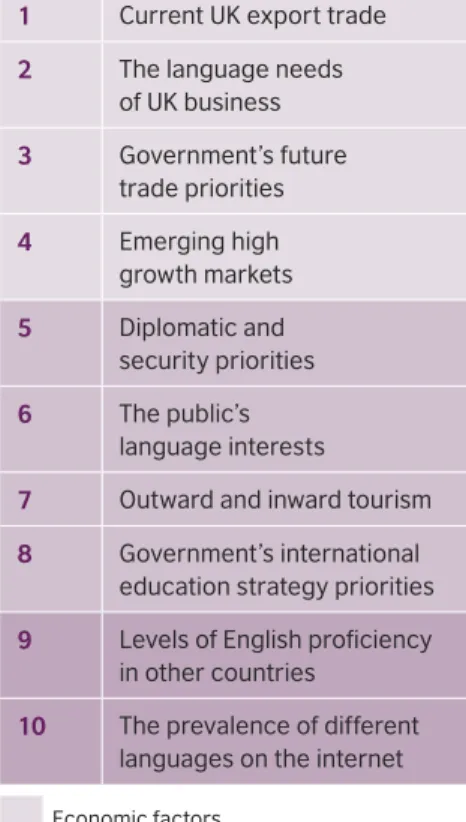
Economic and cultural factors have been weighted equally and then qualified with two additional contextual factors: the extent to which people in the countries concerned are proficient in English and the representation of different languages on the internet.
Table 2: The ten factors
1 Current UK export trade
2 The language needs of UK business
3 Government’s future trade priorities
4 Emerging high growth markets
5 Diplomatic and security priorities
6 The public’s language interests
7 Outward and inward tourism
8 Government’s international education strategy priorities
9 Levels of English proficiency in other countries
10 The prevalence of different languages on the internet Economic factors
Cultural, educational and diplomatic factors Balancing factors
The ten indicators chosen take into account future requirements as well as current practice. Evidence has been gathered from international organisations, from UK government sources, from business organisations and from independent research. The criteria have been selected to capture ‘bottom up’ indications from business organisations and the general public, as well as the way in which languages can support ‘top down’ government policy. The research does not make value judgements about the relative worth of different cultures.
The methodology is open to refinement with the addition of new indicators or alternative weighting, should this be thought beneficial. For example, the extent to which languages or their scripts are related could be factored in – the ability to read the Arabic alphabet gives access not only to Arabic, but to Urdu, Farsi and other languages; and vice versa. Similarly one might wish to include the extent to which different languages are easy to learn for English speakers. Consistent with the macro focus of the research, the data used relates, in general, to the whole of the UK; data taken from sources of evidence relating to the individual nations of the UK might give slightly different results for England, Scotland, Northern Ireland or Wales respectively. As has been noted above, the aim is not to provide a definitive answer, but to open up a discussion about which languages are most important.
identifying the Languages
eConoMiC fACTors
Current uK export trade (indicator 1)
The main source for current demand is the Office of National Statistics (ONS) data on the UK’s top export markets in 2012. These are set out in Chart 2. A simple matching exercise makes it possible to identify the languages most associated with these countries. For the purpose of this exercise, regional or lesser-used languages have been omitted. More detailed patterns of language use in business in different countries have not been taken into
account, since this would necessitate a much more complex piece of research. However, the likely extent to which business can be done in English has been factored in – see Table 8 on page 15. It is recognised, however, that there is no straightforward relationship between one nation and one language, and that global mobility and the internet are creating ever more complex multilingual societies.
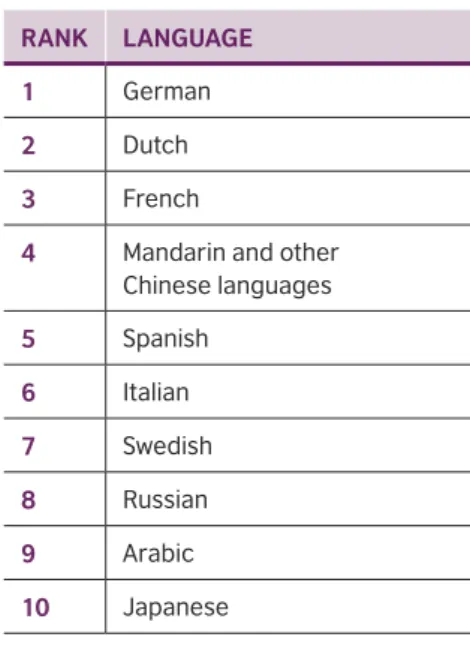
The top ten languages associated with the UK’s current largest export markets are shown in Table 3.
Table 3: Top ten languages of the uK’s current most important export markets (excluding english)
rAnK LAnguAge
1 German
2 Dutch
3 French
4 Mandarin and other Chinese languages
5 Spanish
6 Italian
7 Swedish
8 Russian
9 Arabic
10 Japanese
Chart 2: uK’s top export markets in 2012
0 £9,000 £18,000 £27,000 £36,000 £45,000
Japan United Arab Emirates Hong Kong Russia Sweden Switzerland Italy Spain China Belgium and Luxembourg Ireland France The Netherlands Germany
United States 41,089
Value (millions)
32,669 25,204
20,213 17,532 14,675 10,538
8,546 8,126 6,777 5,772 5,587 5,369 5,364 4,922
Source: Office for National Statistics (2013) Publications Tables UK Trade February 2013: www.ons.gov.uk/ons/publications/re-reference-tables.html?edition=tcm:77-279148 Note: This chart shows goods export figures from 2012. Equivalent figures for services in 2012 were not available at the time of publication. An analysis of 2011 services export figures suggests that including services would not alter our list of top ten languages (shown on page 17 in this report).
The language needs of uK business (indicator 2)
The second source of evidence used in relation to the current language needs of business is the Confederation of British Industry’s 2013 Education and Skills Survey. 20 It reports that 70 per cent of
responding businesses value language skills among their employees, particularly in helping to build relationships with clients, customers and suppliers. From this report the top ten languages most in demand are shown in Chart 3.
uK government future trade priorities (indicator 3)
In its strategy for future international business engagement, Trade and Investment for Growth, 21 the UK
government stresses the continuing importance of trade with existing partners including the EU, mentioning in particular Germany, France and Benelux, as well as the Nordic and Baltic countries. But it also mentions India, Brazil, South Korea, Mexico, the Gulf States, South Africa, Turkey and Indonesia.
In part this adds further weight to German, French, Dutch, Swedish, Spanish and Arabic which have already been mentioned above, but it also introduces some new languages into the mix: Portuguese, Korean, Turkish and Indonesian as well as the languages of India and South Africa. All these languages have been treated equally and not put into any rank order.
Chart 3: Percentage of companies rating this language as useful to their organisation
0 20 40 60 80 100
Japanese Portuguese Russian Cantonese Arabic Mandarin Chinese Polish Spanish German
French 49
45 34
29 28 16
16 13 13 8
20. Confederation of British Industry and Pearson (2013) Changing the Pace. CBI/Pearson Education and Skills Survey 2013. 21. Department for Business, Innovation and Skills (2011) Trade and Investment for Growth.
22. Confederation of British Industry/Ernst & Young (2011) Winning Overseas: Boosting Business Export Performance.
emerging high growth markets (indicator 4)
Evidence was used from the joint CBI/ Ernst & Young publication Winning Overseas, 22 which is explicit about the
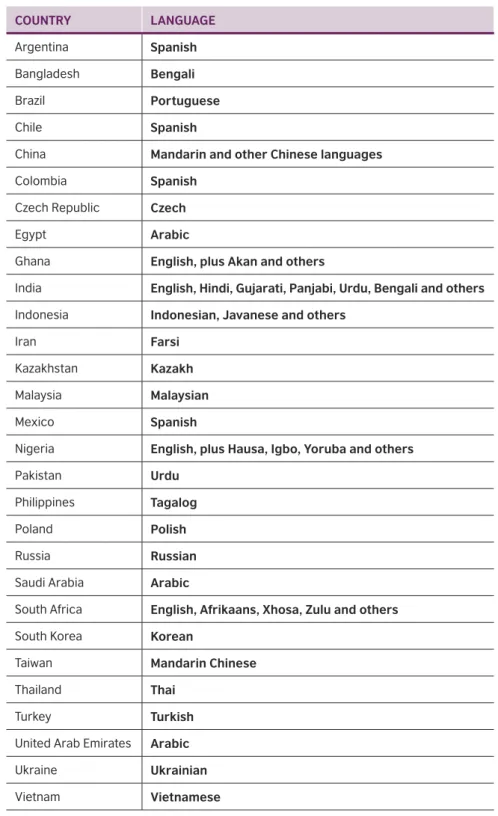
need for better language skills in order to improve the UK’s export potential. It calls for a more strategic approach in order to target high-growth markets in less developed countries, citing not only the so-called BRIC(S) countries but also the ‘Next 11’ identified by Goldman Sachs and the ‘25 high growth markets’ set out by Ernst & Young. Combining the ‘Next 11’ and ‘25 high growth markets’ produces the list of countries and associated languages shown in Table 4. This listing introduces a number of languages not yet mentioned, as well as giving further weight to some of those already identified. Spanish and Arabic score particularly highly on this indicator. Making predictions for future economic importance can be precarious, and political events may intervene to change expectations, as can be seen in Egypt, in the time since this analysis was undertaken by the CBI and its partners. For this reason a range of sources has been used for this research to balance the score.
An explanation of individual scores and how points were awarded is provided in the Appendix.
Table 4: high growth markets and their languages
CounTry LAnguAge
Argentina spanish
Bangladesh Bengali
Brazil Portuguese
Chile spanish
China Mandarin and other Chinese languages
Colombia spanish
Czech Republic Czech
Egypt Arabic
Ghana english, plus Akan and others
India english, hindi, gujarati, Panjabi, urdu, Bengali and others
Indonesia indonesian, Javanese and others
Iran farsi
Kazakhstan Kazakh
Malaysia Malaysian
Mexico spanish
Nigeria english, plus hausa, igbo, yoruba and others
Pakistan urdu
Philippines Tagalog
Poland Polish
Russia russian
Saudi Arabia Arabic
South Africa english, Afrikaans, Xhosa, Zulu and others
South Korea Korean
Taiwan Mandarin Chinese
Thailand Thai
Turkey Turkish
United Arab Emirates Arabic
Ukraine ukrainian
Vietnam Vietnamese
interim analysis of languages needed for economic reasons
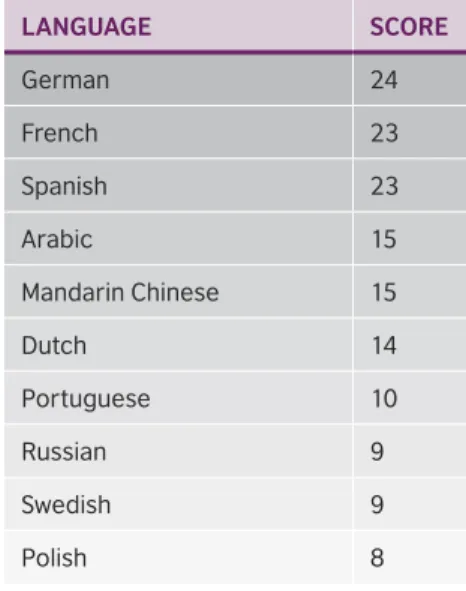
Combining the evidence from the four economic indicators used, the languages already most widely taught in the UK education system (German, Spanish and French) emerge as the most important languages for UK trade. These are followed by Arabic, Mandarin Chinese, Dutch and Portuguese, then Russian and Swedish, with Polish in tenth place.
Table 5: Languages needed for economic purposes
LAnguAge sCore
German 24
French 23
Spanish 23
Arabic 15
Mandarin Chinese 15
Dutch 14
Portuguese 10
Russian 9
Swedish 9
Polish 8
Details of the scores, evidence and rationale behind each indicator are provided in the Appendix.
CuLTurAL, eDuCATionAL AnD DiPLoMATiC fACTors
Diplomatic and security priorities (indicator 5)
For this indicator researchers drew on a recent inquiry carried out by the British Academy to establish how languages are used by the UK government in meeting public policy objectives in the areas of diplomacy and security. 23 The inquiry took evidence
from organisations including the Foreign
and Commonwealth Office (FCO), the Serious and Organised Crime Agency and the Government Communication Headquarters (GCHQ), among others. The report reflected the growing importance now being given to language competence within the FCO’s Diplomatic Excellence initiative, with specialist knowledge of foreign states, languages, and peoples now explicitly acknowledged to be an important element of the British diplomat’s skill set. It also made the case that the national security agenda now encompasses conflict prevention and peace-building, activities in which language assumes an important role. At the same time new linguistic skills are required to counter the growth of cybercrime, organised crime enabled by the ease of global communications, and terrorism. Although the British Academy’s report did not seek to identify priority languages, our review of its findings shows Arabic and Mandarin Chinese
as the most frequently cited. These are followed by spanish, Portuguese and farsi (Persian) as well as Korean,
Pashto and Turkish. A wide range of other languages, including French, German, Polish, Urdu and Vietnamese are cited as important.
The public’s language interests (indicator 6)
This indicator seeks to represent grassroots public demand for language learning in the UK, with the caveat that demand is often conditioned by the availability of courses, rather than vice versa.
Looking at A-level entries, 24 it is evident
that Spanish, Polish, Russian, Arabic, Turkish, Portuguese and Mandarin Chinese are all increasing, but this may reflect populations of speakers of these languages resident in the UK, rather than wider public demand.
A Eurobarometer survey carried out in 2012, 25 which interviewed 1,000
adults across the UK, found that French, followed by Spanish, German, Chinese, Italian and Russian, were regarded as the most useful languages to learn. However, this survey only provided respondents with a choice of six languages and is perhaps more indicative of past practice than future intent.
The decision was taken to use the availability of beginner courses for adults as an indicator of public interest in learning particular languages, since such courses can be provided on a more flexible basis than languages in schools or universities, and reflect grassroots public interest, rather than past practice. Research into part-time evening courses 26 – selecting
those which do not lead to qualifications, since formal qualifications are not available for all languages – shows that Spanish is the most popular language by this measure and the top ten languages are shown in the table below.
Table 6: Languages offered as evening classes
LAnguAges MosT frequenTLy offereD As PArT-TiMe eVening CLAsses ACross The uK (WiThouT quALifiCATions) nuMBer of PAges of WeB LisTings Spanish 9 French Italian 7 7 German Japanese 4 3 Mandarin Chinese Arabic Polish Portuguese Russian 2 2 2 2 2 Source: www.hotcourses.com
23. British Academy (forthcoming) Lost for words. The Need for Languages in UK Diplomacy and Security. We are grateful to the British Academy for allowing us access to a pre-publication copy of this report. 24. Joint Council for Qualifications (2013) A, AS and AEA Results, Summer 2013.
25. European Commission (2012) Europeans and Their Languages. Special Eurobarometer 386. 26. www.hotcourses.com
outward visitor destinations (indicator 7)
Overseas visitor figures provide a good indication of interchange between different countries and peoples, the sort of contact that people in the UK typically experience with speakers of other languages.
Research by Populus commissioned by the British Council 27 showed that 22 per
cent of British adults say they have paid more for goods or services as a result of not being able to speak the local language when overseas, 18 per cent report that they have stayed primarily in resorts – avoiding the local culture – when on holiday and eight per cent admit they have caused offence on holiday as a result of a lack of understanding of the local culture. The most visited non-English-speaking countries by people from the UK in 2012 were (in descending order) Spain, France, Germany, Portugal, Greece, Poland and Turkey. 28 Points have therefore
been given to spanish, french,
german, Portuguese, greek, Polish
and Turkish in descending order. Languages are also useful for providing information and a warmer welcome to visitors to the UK. According to Visit Britain, the largest inbound tourist markets were France, Germany, The Netherlands, Spain, Italy, Poland and Belgium. An explanation of individual scores and how points were awarded is provided in the Appendix.
uK government international education strategy priorities (indicator 8)
In July 2013 the UK government published its International Education Strategy, 29
setting out the opportunities it sees as a result of demographic changes in rapidly emerging economies. This involves both attracting international students to the UK and supporting transnational education. Although the teaching and learning of English is an important element of this strategy, the government wants to demonstrate that the UK seeks to build relationships based on mutual respect and a two-way exchange of ideas and people.
The International Education Strategy identifies eight priority countries and one region as the primary focus of international education partnerships. These are China, India, Brazil, Saudi Arabia, Colombia, Turkey, Mexico, Indonesia and the Gulf. The languages involved are Chinese languages, indian languages,
Portuguese, Arabic, spanish, Turkish
and indonesian. The education sectors in these countries are more likely to want to engage with those who can meet them halfway and demonstrate mutual respect and understanding by working in the language of the host country. Four points were allocated each time a country was mentioned in the report and this favoured Arabic and Spanish, which are used in more than one of the countries mentioned.
interim analysis of languages needed for cultural, educational and diplomatic reasons
By combining evidence from the four indicators used in this section, the following interim ranking of languages most needed for cultural, educational and diplomatic reasons emerges:
Table 7: Languages for cultural, educational and diplomatic purposes
LAnguAge sCore
Spanish 35
Arabic 20.5
Portuguese 20
French 18
Mandarin Chinese 16.5
Italian 16.5
German 14.5
Turkish 11
Polish 7.5
Farsi 7
Comparing this ranking with the top languages required for economic purposes, it is interesting to note that Italian, Turkish and Farsi have come into the list at the expense of Russian, Dutch and Swedish.
Details of the scores, evidence and rationale behind each indicator are provided in the Appendix.
BALAnCing fACTors
The findings on economic and cultural/ diplomatic needs have been qualified with two further indicators: the degree to which populations in different countries are able to speak English, and the extent of use of different languages on the internet.
Levels of english proficiency in other countries (indicator 9)
The English Proficiency Index 30
benchmarks English proficiency in 54 countries using a sample of just under two million people:
One point per language per country was allocated for those with only a moderate level of English, two points for those with low proficiency and three points for those with very low proficiency (see Table 8).
The prevalence of different languages on the internet (indicator 10)
Chart 4, compiled from Internet World Stats, shows that, although English is still the most dominant language on the internet, Chinese is running a close second. Spanish and Japanese are the next most frequently used languages. Details of the scores, evidence and rationale behind each indicator are provided in the Appendix.
Table 8: english proficiency
LeVeL of ProfiCienCy in engLish
CounTries reLeVAnT To This sTuDy
LAnguAges ConCerneD
Very low Chile, Kuwait, Brazil,
Egypt, UAE, Colombia, Saudi Arabia
spanish, Arabic, Portuguese
Low Indonesia, Iran, Russia,
Taiwan, Vietnam, Turkey, China, Qatar, Mexico
spanish, indonesian, farsi, russian, Chinese languages, Vietnamese, Turkish, Arabic
Moderate Spain, Portugal, Japan,
France, Italy
indian languages, french, german, spanish, Portuguese, Japanese, italian
High Belgium, Austria,
Germany, Poland, Singapore, Malaysia
Dutch, french, german, Polish, Malaysian
Very high Sweden, The Netherlands,
Norway
swedish, Dutch, norwegian
Source: English Proficiency Index: www.ef.co.uk/epi
Chart 4: internet use by language
English Chinese Spanish Japanese Portuguese German Arabic French Russian Korean Other languages 27%
24% 8%
5% 4% 3% 3% 3% 3% 2%
18%
The Ten MosT iMPorTAnT LAnguAges
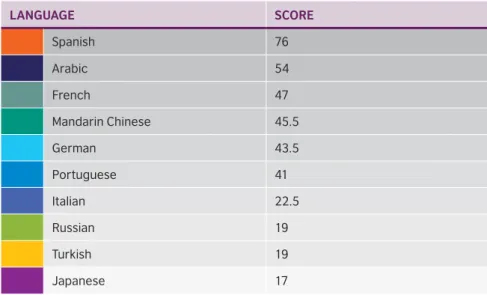
Taking all ten indicators used in this analysis into account, the ten languages which emerge as the most important for the UK are as set out in Table 9. Details of the scores for different languages appear in the Appendix along with an explanation of the evidence underlying each indicator. The British Council commissioned a survey from YouGov to find out to what extent the UK population was able to communicate in the languages identified. The results can be seen in Chart 5. It is clear that considerable work needs to be done to increase the UK’s language capacity and this report offers a set of recommendations to address the deficit.
Table 9: The top ten languages
LAnguAge sCore
Spanish 76
Arabic 54
French 47
Mandarin Chinese 45.5
German 43.5
Portuguese 41
Italian 22.5
Russian 19
Turkish 19
Japanese 17
Chart 5: Language skills in the uK’s adult population
Question: Which, if any, of the following languages can you speak well enough to hold a conversation? (Please tick all that apply)
D
on
't k
no
w
P
o
rt
ug
ue
se
Tu
rk
is
h
R
us
sia
n
Ma
nd
ar
in
C
hi
ne
se
Ja
pa
ne
se
A
ra
b
ic
It
al
ia
n
Spa
ni
sh
G
er
man
Fr
en
ch
No
ne
o
f t
he
se
0 10 20 30 40 50 60 70 80 90 100
Survey of language skills in the UK’s population (per cent)
75
15
6 4
2 1 1 1 1 0.43 0.43 3
Source: Survey of 4,171 UK adults, YouGov. Fieldwork was undertaken 1–4 October 2013. The survey was carried out online. The figures have been weighted and are representative of all UK adults (aged 18+).
oTher LAnguAges
Beyond the ‘top ten’ languages identified, there were four other languages, or groups of languages, which emerged as important for the UK according to the indicators used in this report, scoring above ten points each. These were Dutch, Polish, Indian languages and Korean.
The position of Dutch reflects the fact that The Netherlands is the second most important non-English speaking goods export market for the UK after Germany. 31
Belgium, in which Dutch is an official language, and Luxembourg are in fourth place. This accounts for the high demand for Dutch in job advertisements. 32 Dutch
people are the third most frequent travellers to the UK of any non-English speaking country.
The status of Polish is based on Poland being identified as one of the world’s rapidly growing markets and the fact that Poland is one of the top ten
destinations for visitors from the UK. The 2011 UK census revealed that Polish is now the third most widely spoken language in the UK after English and Welsh. With over 47,000 speakers, it is the fourth most widely spoken language by English schoolchildren with English as an additional language. 33
Among Scottish pupils it is the most widely spoken language after English with more than 7,000 speakers. 34
indian languages are important because of India’s position as the second most populous country in the world and a growing economic power. 35
India is currently the UK’s 18th largest goods export market worth £4.6 billion in 2012. Indian languages are widely spoken in large minority communities in the UK. Department for Education statistics show Panjabi, Urdu and Bengali as the top three languages spoken by English schoolchildren with English as an additional language. 36
Together these account for more than
a third of a million children. In Scotland, Urdu and Panjabi are second and third in importance respectively. 37 However,
Indian languages are currently taught at the margins of mainstream education, supported by families and local
communities. 38 Entry numbers at A-level
and at GCSE are small 39 and Indian
languages are not widely available at degree level in British universities. 40
Korean is spoken as a first language by some 78 million people and is the official language of South Korea, North Korea and parts of China. South Korea is cited by the CBI 41 as one of the world’s fastest
growing markets and important for the UK’s economy over the next decade and beyond. It was a very early adopter of the internet and Korean usage currently accounts for two per cent of the global figures for internet use. 42 Korean is not
available in the UK either as a GCSE or A-level subject.
31. Office for National Statistics (2013) Publications Tables UK Trade February 2013: www.ons.gov.uk/ons/publications/re-reference-tables.html?edition=tcm:77-279148 32. Anne Marie Graham (2013) Labour Market Intelligence Report – a Picture of the Jobs Market, Summer 2012 in British Academy/Teresa Tinsley,
The State of the Nation. Demand and Supply of Language Skills in the UK: www.britac.ac.uk/policy/State_of_the_Nation_2013.cfm
33. National Association for Language Development in the Curriculum (2011) School Census January 2011 Language Data. Number of Compulsory School Age Pupils in Primary, Secondary and Special Schools by Declared First Language: www.naldic.org.uk/research-and-information/eal-statistics/lang
34. National Statistics (2011) Pupils in Scotland 2011, Main Home Language?
35. Office for National Statistics (2013) Publications Tables UK Trade February 2013: www.ons.gov.uk/ons/publications/re-reference-tables.html?edition=tcm:77-279148 36. National Association for Language Development in the Curriculum (2011) School Census January 2011 Language Data. Number of Compulsory School Age Pupils in Primary,
Secondary and Special Schools by Declared First Language: www.naldic.org.uk/research-and-information/eal-statistics/lang 37. National Statistics (2011) Pupils in Scotland 2011, Main Home Language.
38. CILT, SCILT and CILT Cyrmu (2005) Community Language Learning in England, Wales and Scotland.
39. Teresa Tinsley and Kathryn Board (2012) ‘Language Learning in Primary and Secondary Schools in England – Languages Trends Survey’, CfBT Education Trust 40. British Academy/Teresa Tinsley (2013) The State of the Nation. Demand and Supply of Language Skills in the UK, British Academy:
www.britac.ac.uk/policy/State_of_the_Nation_2013.cfm
41. Confederation of British Industry/Ernst and Young (2011) Winning Overseas: Boosting Business Export Performance.
The resulting language deficit, if not tackled, is a threat to our competitiveness, influence and standing in the world, as well as to our citizens’ ability to play a meaningful role in the global economy and an increasingly networked and interconnected world.
Our analysis has identified those languages which are likely to be of greatest importance to the UK in the next 10–20 years, based on a range of criteria relating to both economic and non-economic factors. Unsurprisingly, there is not a complete coincidence between the languages needed for economic purposes and those required to build trust, deepen international influence and cultural relationships, and keep our country safe. This analysis has identified ten languages (Spanish, Arabic, French, Mandarin Chinese, German, Portuguese, Italian, Turkish, Russian and Japanese) which have the potential to add most value to the UK’s strategic interests. However, the survey commissioned by the British Council for this report shows that there is a low capacity in these key languages in the UK adult population. French, Spanish and German, the UK’s first, second and third most widely taught languages respectively, all appear in the top ten list, as do a number of languages which have very little representation in UK education
systems. The greatest gaps are perhaps in Arabic and Mandarin Chinese, which both appear in the top five. However, Portuguese and Turkish, also present significant challenges for our education systems and Italian, Russian and Japanese also require increased effort to achieve a critical mass of speakers.
The overall conclusion therefore, is not that people in the uK are learning the wrong languages, but that the country needs to build on its existing language learning profile to include a wider range of languages and to enable far greater numbers of people to learn languages. This is crucial in order to prevent the current deficit in linguistic skills from increasing and to enable the UK to reap the economic and cultural benefits available to those who have more than one language at their disposal. We therefore recommend that:
1. All four governments of the UK should take a more strategic approach to language education policy, linking it to national aspirations for international engagement in business, education and culture. Languages should be held in the same high regard as science, technology, engineering, and mathematics (STEM) subjects. 2. Government and business should
work together to develop educational
policy relating to languages and international skills, as these have a direct impact on the UK’s prosperity and international influence.
3. Businesses should be encouraged to invest in the development of the linguistic skills in their own organisations from which they will benefit directly.
4. Policy makers should find effective ways of utilising the vital language and cultural skills of the UK’s diaspora and minority communities. This talent should be used to enable education systems to increase opportunities to learn the ten languages identified here. 5. The teaching and learning of
languages should be enriched by the inclusion of new languages in the curriculum, and an increased focus on the need to understand other cultures.
6. Schools should fully exploit the range of free or funded resources available to support language learning, which are available locally, online or through international links. These include language assistants, exchanges and overseas trips, and international cultural institutes in the UK.
ConCLusion and
reCommendations
This report argues that, while millions of people around the world are
learning English, the UK has fallen behind by not devoting sufficient
time, resources and effort to language learning.
7. Young people should be given opportunities to sample a range of languages and cultures during their school career. They and their parents should also seek out more opportunities for language learning outside school, and all students should receive appropriate advice about the benefits of competence in another language for work and adult life.
8. Policy makers and practitioners in the UK should establish wider and deeper partnerships and co-operation with foreign education and cultural bodies in order to access resources and support as well as to learn from best practice in the teaching and learning of languages directly from the countries in which the languages are used.
9. The 75 per cent of UK adults unable to hold a conversation in any of the ten key languages should make efforts to learn the basics of at least one new language, as advocated by Speak to the Future’s 1000 Words campaign. 43
Catriona Maciver is a Scottish designer working in
Scotland and India. Language has played a significant
role in her work throughout college and continues
to be an area of interest.
This poster was a response to a brief on language whilst studying at Central Saint Martins College of Art and Design (University of the Arts, London). Using a quote by Ludwig Wittgenstein, the poster shows how word order changes from one language to the next, thus potentially changing the meaning. The reader can track the word order in different languages by identifying which word each colour is assigned to.
Arabic has official status, sometimes as one of two languages, in many places: Algeria, Bahrain, Chad, Comoros, Djibouti, Egypt, Eritrea, Iraq, Israel, Jordan, Kuwait, Lebanon, Libya, Mauritania, Morroco, Oman, Qatar, Saudi Arabia, Sudan, Syria, Tunisia, United Arab Emirates and Yemen, and the Occupied Palestinian Territories. Many of these have low or very low proficiency in English. Because of the common written standard form of the language and a shared cultural/religious heritage, most speakers regard all varieties of Arabic as forms of one language. In most Arabic-speaking countries, however, only those with a formal education are proficient in standard Arabic. Modern colloquial Arabic differs significantly from one region to another and exists as a dialect continuum across the Arabic speaking region. Arabic script is also used in languages such as Farsi, Urdu and Pashto.
Arabic is used as an official language of the United Nations, International Criminal Court, African Union, Arab League amongst others.
Three per cent of internet usage is conducted in Arabic. 45 The Middle
East and Africa are amongst the fastest growing regions in terms of internet use. 46
Business BenefiTs
Six Arabic speaking countries appear among the UK’s top 50 export market in goods, with a combined value to the economy of over £12 billion in 2012 – more than the value of UK exports to Spain, China or Italy. 47 The
Gulf economies are booming as they diversify away from oil and gas, open up their economies and bring down barriers to trade and investment. Significant opportunities exist for British companies, particularly in supporting the vast infrastructure work planned in the region. Egypt, Saudi Arabia and the United Arab Emirates have all been identified by the Confederation of British Industry as priority markets. 48 This is endorsed
by the Department for Business, Innovation and Skills.
inTernATionAL ConneCTions
Arabic has emerged as one of the priority languages for the Foreign and Commonwealth Office. It is their intention to increase the number of diplomats trained in Arabic by 40 per cent.
Morocco, Egypt and Tunisia are popular holiday destinations for tourists from the UK though Arabic speaking countries have not been prioritised for tourist links. The World Cup will be hosted by Qatar in 2022 and will attract large numbers of visitors. 49
In its international education strategy, the UK government identifies both Saudi Arabia and the Gulf as priorities for the development of educational partnerships in response to the region’s economic growth and expanding political influence as well as its increasing interest and investment in education. 50
A number of UK universities have established a campus presence in the region, specifically in the United Arab Emirates. These include Heriot-Watt and Exeter universities and the London and Manchester business schools. 51
arabiC
Arabic is a Semitic language. With over 230 million native speakers
and a further 100–200 million people across northern Africa and
western Asia for whom it is their second language, Arabic ranks as
the fourth most widely spoken language in the world.
44ArABiC in The uK
In 2010 there were some 20,000 Arabic speakers among London schoolchildren, making Arabic the sixth most commonly spoken heritage language in the capital. This number is increasing. 52
Approximately four per cent of English secondary schools teach Arabic, often as an extra-curricular subject. It is also widely taught in the 172 schools belonging to the Association of Muslim Schools and in the supplementary sector. 53
Arabic was first offered as a GCSE subject in 2002 with the number of entries rising by 82 per cent to 3,236 in 2012, making Arabic the eighth most popular language at GCSE. 54
A-level Arabic was also introduced in 2002 and had 299 entries, rising to 604 in 2012, making Arabic the tenth most popular language at A-level. Scottish examinations taken at school level are not available in Arabic. 55
Arabic is offered at degree level by 15 UK universities. 56
Only one per cent of the UK’s adult population report that they speak Arabic well enough to hold a conversation. 57
furTher inforMATion
Arab British Centre:
www.arabbritishcentre.org.uk
WhiCh LAnguAge AnD Why 23
‘In my work, Arabic has enabled me to relate to contacts in
the Middle East and North Africa on their own terms. People
respect the fact that I have invested time and effort in their
language and culture. Knowledge of Arabic – I am far from
being fluent, but that’s not the point – helps understanding
what is going on around me.
At the personal level, Arabic allows me to feel at home in
Beirut and Baghdad, Damascus and Tripoli, and now in
Jerusalem. It means I can make lasting friendships. Since
I have no sense of direction, when I get lost while driving –
a frequent occurrence – I can ask passers-by for directions
and, on a good day, understand what they say!’
Vincent fean, British Consul general, Jerusalem
44. Ethnologue: www.ethnologue.com/statistics/size
45. Top ten internet languages – Internet World Stats: www.internetworldstats.com/stats7.htm 46. British Academy (forthcoming) Lost for Words. The Need for Languages in UK Diplomacy and Security.
47. Office of National Statistics (August 2013) ‘UK Trade, June 2013’ in Statistical Bulletin; available at www.ons.gov.uk/ons/dcp171778_318161.pdf 48. Confederation of British Industry/Ernst & Young (2011) Winning Overseas: Boosting Business Export Performance.
49. House of Commons library (2013) Tourism. Standard Note SN/EP/6022. 50. HM Government (2013) International Education: Global Growth and Prosperity.
51. British Academy/Teresa Tinsley (forthcoming) The State of the Nation. Demand and Supply of Language Skills in the UK: www.britac.ac.uk/policy/State_of_the_Nation_2013.cfm 52. John Eversley et al. (2010) Language Capital. Mapping the Languages of London’s Schoolchildren, CILT/Institute of Education.
53. Teresa Tinsley (unpublished) The Teaching of Arabic language and culture in UK schools, British Council.
54. Teresa Tinsley and Kathryn Board (2012) ‘Language Learning in Primary and Secondary Schools in England – Languages Trends Survey’, CfBT Education Trust. 55. ibid.
56. British Academy/Teresa Tinsley (2013) The State of the Nation. Demand and Supply of Language Skills in the UK: www.britac.ac.uk/policy/State_of_the_Nation_2013.cfm 57. YouGov (October 2013) (available on request from the British Council).
ALGEBRA
MAGAZINE
TARIFF
SOFA
English words derived or adopted from Arabic include:
French is the official language in France, Monaco, Gabon, Togo, Benin, Guinea, Mali, Niger, and Ivory Coast.
It is also an official language in Belgium, Burkina Faso, Burundi, Cameroon, Canada, Central African Republic, Chad, Comoros, Djibouti, Equatorial Guinea, Haiti, Luxembourg, Madagascar, Rwanda, Seychelles, Switzerland, and Vanuatu.
It is closely linked to other Romance languages: such as Italian, Spanish and Portuguese. Varieties of spoken French can vary considerably and may be considered separate languages, e.g. Walloon spoken in Belgium. French is an official language of many international organisations including the United Nations, International Criminal Court, World Trade Organisation, Universal Postal Union, Organisation
of Islamic Cooperation, International Labour Organisation, International Olympic Committee, International Telecommunications Union, Inter-parliamentary Union, Organisation for Economic Co-operation and Development, African Union, Benelux, Common Market for East and South Africa (and other international African organisations), Council of Europe, European Union, North Atlantic Treaty Organisation and the Organisation for Security and Cooperation in Europe. In terms of internet usage, French is currently the language of choice for 60 million users, making it the eighth most widely used language on the internet. 58
Business BenefiTs
France is the UK’s third most important non-English speaking export market.
Combined, France, Belgium and Luxembourg account for nearly £35 billion of British goods exports. 59
French speaking countries are also a major source of imports into the UK with France in fourth place. A 2011 report from the Department for Business, Innovation and Skills states that: the EU is likely to remain the major market for British trade and investment over the medium term, with Germany, France and Benelux countries likely to remain our most important trade partners. 60
French is the language most sought after by those employers looking for language skills (49 per cent). 61 It was
also the second most frequently requested language in a survey of job advertisements carried out by Graham in 2012. 62 A survey carried out by
the British Chambers of Commerce
frenCh
français
French is a Romance language spoken by more than 70 million
people as their first language, although it is estimated that a
further 100–200 million people around the world speak French
as a second language.
58. Top ten internet languages – World Internet Stats: www.internetworldstats.com/stats7.htm
59. Office of National Statistics (August 2013) ‘UK Trade, June 2013’ in Statistical Bulletin; available at www.ons.gov.uk/ons/dcp171778_318161.pdf 60. Department for Business, Innovation and Skills (2011) Trade and Investment for Growth.
61. Confederation of British Industry and Pearson (2013) Changing the Pace. CBI/Pearson Education and Skills Survey 2013.
62. Anne Marie Graham (2013) Labour Market Intelligence Report – a Picture of the Jobs Market, Summer 2012 in British Academy/Teresa Tinsley,
The State of the Nation. Demand and Supply of Language Skills in the UK: www.britac.ac.uk/policy/State_of_the_Nation_2013.cfm 63. British Chambers of Commerce (2012) Exporting is Good for Britain – Skills.
64. House of Commons library (2013) Tourism. Standard Note SN/EP/6022. 65. English Proficiency Index: www.ef.co.uk/epi
66. National Association for Language Development in the Curriculum (2011) School Census January 2011 Language Data. Number of Compulsory School Age Pupils in Primary, Secondary and Special Schools by Declared First Language: www.naldic.org.uk/research-and-information/eal-statistics/lang
67. National Statistics (2011) Pupils in Scotland 2011. Main Home Languages.
68. John Eversley et al. (2010) Language Capital. Mapping the Languages of London’s Schoolchildren, CILT/Institute of Education.
69. Teresa Tinsley and Kathryn Board (2012) ‘Language Learning in Primary and Secondary Schools in England – Languages Trends Survey’, CfBT Education Trust. Scottish Qualifications Authority (2013) National Course and Awards Result Statistics 2013.