ARTICLE
Clinically, mastoiditis may be acute, sub-acute or chronic. Acute mastoiditis is defined as an acute inflammatory disease of the mastoid air cell complex arising as a result of spread of infection from acute otitis media. Computed tomography (CT) scanning has been used to try to identify different stages of acute mastoiditis – acute mastoiditis without either periostitis or osteitis, acute mastoiditis with periostitis and acute mastoiditis with osteitis1 – in an attempt to define the stage of the disease and determine appropriate treatment (antibiotics with or without surgery).
Sub-acute mastoiditis may develop if an acute middle ear or mastoid infection is treated but fails to resolve totally. Clinical signs of mastoiditis may not be overt because of the treatment the patient has received, but the disease is still active and can progress. This stage has also been termed ‘masked mastoiditis’.
The presumed cause for progression of a patient with chronic suppurative otitis media to acute mastoiditis (‘acute-on-chronic mastoiditis’) is development of mastoid osteitis from an underlying chronic mastoid mucositis. In many of these patients an underlying cholesteatoma has caused the chronic suppurative otitis media. Neglected causes of chronic mastoid osteitis may result in progression to sinus formation with or without bony sequestration.
Chronic mastoiditis is less well defined. At this stage chronic mastoid mucositis is present, with or without granulation tissue formation but not of a sufficient degree to cause the clinical features of overt mastoiditis that occur in non-resolving chronic suppurative otitis media (sometimes referred to as being a ‘mastoid reservoir of infection’). It is either related to ‘nonspecific’ pathogens or to ‘specific’ pathogens such as Mycobacterium tuberculosis. It is also a term that could be applied to infected cholesteatoma with chronic infection with or without granulation tissue formation in the mastoid air cell system.
One of the major changes in the epidemiology of mastoiditis has been the significant decline in incidence with the widespread use of antibiotics, although some authors report a rise in the incidence in recent years – not surprising given the inherent and potential risks of resistance associated with the use (or abuse) of antibiotics.2-4
The typical features of mastoiditis include signs of middle ear disease, mastoid tenderness, post-auricular swelling, sagging of the posterior canal wall, and evidence of bone breakdown.5 The clinical presentation of the disease is varied and some more obvious features such as post-auricular erythema or oedema, fever and discharge from the ear may not be present.6,7 In this retrospective study we looked at recent experience of the clinical presentation, microbiology, management and outcome of children with mastoiditis admitted to Red Cross War Memorial Children’s Hospital, a hospital catering for children up to 12 years of age, predominantly from the poorer socio-economic communities of Cape Town.
Patients and methods
The clinical records of all patients admitted with a diagnosis of mastoiditis during the 5-year period 1999 - 2003 were reviewed.
Data collected and analysed included age, sex, ear affected, previous history of ear infections, length of current history, use of antibiotics prior to admission, clinical features, imaging studies, surgery performed, presence of cholesteatoma or other disease, microbiology, length of hospital stay, complications and outcome at 6 months.
Bacteriological samples were taken during surgery under sterile conditions and submitted for aerobic, anaerobic and mycobacterial culture. Biopsy of any granulation tissue present was submitted for histological examination.
Wakisa Mulwafu, MB ChB
Division of Otolaryngology, University of Cape Town
C A J Prescott, MB ChB, FRCS
Division of Otolaryngology, University of Cape TownMastoiditis at Red Cross War
Memorial Children’s Hospital,
Cape Town, 1999 - 2003
S
A
Jo
ur
nal
of Child
H
ea
lth
S
A
Jo
ur
nal
of Child
H
ea
lth
S
A
Jo
ur
nal
of Child
H
ea
lth
During the 5-year period 1999 - 2003, we treated 36 children with a clinical diagnosis of mastoiditis. Post-auricular tenderness, swelling or abscess was the presenting feature in all cases. Twenty of these children had acute mastoiditis, 12 had acute-on-chronic mastoiditis and 4 had a post-auricular abscess and no signs of mastoiditis on mastoid exploration (pseudomastoiditis). No pathogenic organisms were cultured from 25% of cases overall, but among those with positive culture Streptococcus pyogenes and Staphylococcus aureus were the commonest organisms in the acute mastoiditis group and Proteus mirabilis was the commonest in the acute-on-chronic group.
In the acute mastoiditis group (20 patients) only 1 patient was successfully treated with antibiotics, the rest requiring cortical mastoidectomy.
In the acute-on-chronic mastoiditis group (12 patients) 9 children had cholesteatoma and underwent an open cavity procedure and the other 3, who underwent cortical mastoidectomy, all had positive histology/culture for tuberculosis.
ARTICLE
Results
There were 36 patients. Twenty had acute mastoiditis, 12 had acute-on-chronic mastoiditis (9 of these had cholesteatoma and 3 tuberculosis), and 4 had a post-auricular abscess but no signs of mastoiditis on mastoid exploration.
In the acute mastoiditis group, the age range was 6 months to 13 years with an average of 6 years. There were 10 males and 10 females and the left ear was most often affected (67%). Only 1 patient had had antibiotics prior to admission. Four of the patients presented to hospital with a history longer than 1 week’s duration. No patient had intracranial complications. Only 1 patient was successfully managed with intravenous antibiotics, all the rest needing surgery in the form of cortical mastoidectomy.
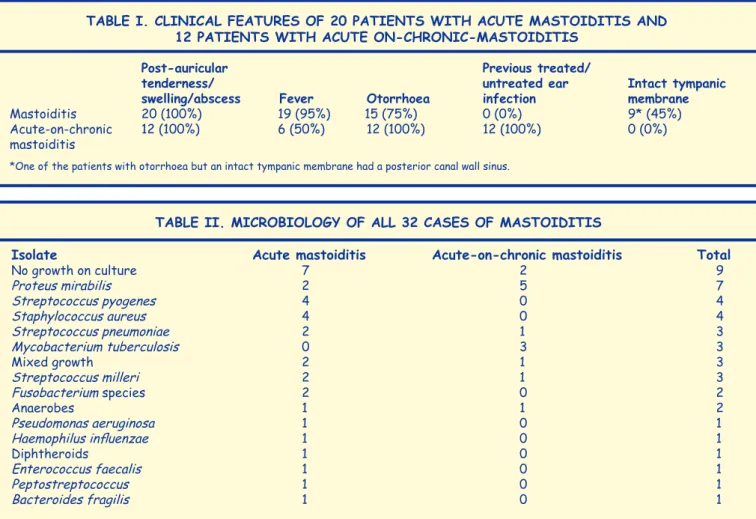
Clinical features in the acute mastoiditis group are summarised in Table I.
Culture results from swabs taken at surgery are summarised in Table II. The ‘old enemies’ (Streptococcus pyogenes and Staphylococcus aureus) predominated, with surprisingly few cases of the usual organisms implicated in otitis media. There was no growth in 7 of the 20 cases.
The age range in the acute-on-chronic group was 7 - 11 years with an average of 9 years. There were 6 males and 6 females, and the left and right ears were equally affected. The 9 patients in whom cholesteatoma was identified during mastoid surgery all underwent an open-cavity procedure. The 3 patients diagnosed with tuberculosis after bacterial culture and histology of granulation tissue had all undergone cortical mastoidectomy.
Clinical features in the acute-on-chronic group are summarised in Table I and culture results from bacteriological swabs taken at surgery in Table II. There was a predominance of Proteus mirabilis and no growth in only 2 of the 12 cases.
At surgery 4 patients (11%) with clinical features of mastoiditis were found to have a post-auricular abscess but no sign of mastoiditis on exploration of the mastoid.
Radiological investigations were only done in 5 patients. Plain film X-rays of the mastoids were obtained in 2 patients in an attempt to distinguish a simple post-auricular abscess from mastoiditis, and 3 patients with complications had a computed tomography (CT) scan.
All the 3 patients with complications had mastoiditis secondary to cholesteatoma.
• One patient had meningitis and a posterior fossa abscess, which was drained at mastoid surgery. He spent 3 weeks in hospital but had no postoperative complications.
• One patient had meningitis with an extradural posterior fossa abscess (drained during mastoid surgery) and a cerebellar abscess (drained via a burr hole). She had postoperative wound breakdown and spent 2 weeks in hospital. At 6 months she required revision mastoidectomy because of chronic infection in the mastoid cavity, but no residual cholesteatoma was found.
• One patient, who spent 8 days in hospital, had facial nerve palsy. At 6 months’ follow-up nerve function had not recovered completely.
There were no deaths.
Table I. ClInICal feaTuRes of 20 PaTIenTs WITH aCuTe MasToIdITIs and 12 PaTIenTs WITH aCuTe on-CHRonIC-MasToIdITIs
Post-auricular Previous treated/
tenderness/ untreated ear Intact tympanic
swelling/abscess fever otorrhoea infection membrane
Mastoiditis 20 (100%) 19 (95%) 15 (75%) 0 (0%) 9* (45%)
Acute-on-chronic 12 (100%) 6 (50%) 12 (100%) 12 (100%) 0 (0%) mastoiditis
*One of the patients with otorrhoea but an intact tympanic membrane had a posterior canal wall sinus.
Table II. MICRobIology of all 32 Cases of MasToIdITIs
Isolate acute mastoiditis acute-on-chronic mastoiditis Total
No growth on culture 7 2 9
Proteus mirabilis 2 5 7
Streptococcus pyogenes 4 0 4
Staphylococcus aureus 4 0 4
Streptococcus pneumoniae 2 1 3
Mycobacterium tuberculosis 0 3 3
Mixed growth 2 1 3
Streptococcus milleri 2 1 3
Fusobacterium species 2 0 2
Anaerobes 1 1 2
Pseudomonas aeruginosa 1 0 1
Haemophilus influenzae 1 0 1
Diphtheroids 1 0 1
Enterococcus faecalis 1 0 1
Peptostreptococcus 1 0 1
ARTICLE
discussion
Despite the dramatic decrease in incidence coinciding with the introduction of antibiotic therapy, mastoiditis still persists as a serious infection affecting the paediatric population.8 On a global scale there are an estimated 28 000 deaths annually from complications of chronic suppurative otitis media.
In theory one would expect that in acute mastoiditis related to acute otitis media the causative organisms would be those commonly implicated in acute otitis media. We do not have data on local bacteriology of acute otitis media, although the Otitis Media Research Group in Johannesburg demonstrated a similar pattern to that elsewhere in the world, namely predominance of Haemophilus influenzae, S. pneumoniae and Moraxella cattarhalis. What
was notable in our acute mastoiditis cases was the number of unusual organisms. The ‘old enemies’ from the pre-antibiotic era, namely S. pyogenes and S. aureus, predominated with 2 cases caused by S. milleri, which is an emerging problematic pathogen in our local population. It is probable that otitis media caused by these more virulent organisms is more likely to progress to mastoiditis than infection by the more ‘usual’ organisms.
Cholesteatoma is a disease with a tendency to progress to mastoiditis. In their recent review of 52 children with mastoiditis over a period of 15 years from Islamabad, Pakistan, Khan and Shahazad8 found that 80.7% had extensive cholesteatoma, although other authors have reported a lower percentage of cholesteatoma in mastoiditis patients9,10 and in our series only 25% had cholesteatoma.
Surgery for cholesteatoma in the presence of acute mastoiditis is often difficult or less than ideal. A combination of inexperience and extensive inflamed/granulation tissue can make identification of landmarks difficult. In such a situation it may be better initially to limit surgery to a cortical mastoidectomy and plan a more formal procedure for when infection has been brought under control with antibiotics. In our local situation, where follow-up is known to be poor, our policy is to undertake open cavity cholesteatoma surgery, with removal of all cholesteatoma matrix if possible. However, the presence of granulation tissue around the ossicular chain can lead to hearing impairment. Sepsis in overlying soft tissue from which graft tissue needs to be harvested often precludes grafting of the open cavity and predisposes these children to recurrent/persistent infection in the cavity.
Post-auricular abscess without mastoiditis can sometimes be difficult to distinguish from mastoiditis. Standard thinking is that if the middle ear is normal, i.e. if the tympanic membrane appears normal, then mastoiditis is unlikely. However, sometimes it is not possible to see the tympanic membrane if the soft tissue in the ear canal is swollen. Discharge from the ear canal is suggestive of middle ear cleft involvement, but again this is not reliable because an abscess in post-auricular lymphadenitis can discharge into the ear canal. In theory plain film X-rays can be helpful in this situation, the presence of an aerated mastoid air complex excluding mastoiditis, but again it is not entirely reliable owing to the presence of an
overlying soft-tissue swelling. At times, as in our series, the only way to exclude mastoiditis is by opening the mastoid air cell complex.
The above raises the question of whether or not CT scanning is an essential investigation – a much-debated topic. The answer usually depends on availability. In our institution, emergency CT scanning of patients with a clinical diagnosis of mastoiditis is insisted on when it is needed to confirm or exclude the presence of suspected intracranial sepsis or when there is a local complication such as facial nerve palsy. Apart from this vitally important role when clinical signs of mastoiditis are present, CT scan is not required so much to confirm the presence of infection, even when the latter is indicated by radiological features in the mastoid air cell complex – since CT cannot distinguish between mucosal oedema effusion and purulent exudates – as to demonstrate anatomy prior to surgery, particularly for the inexperienced. As an aside, mastoid air cell effusions and mucosal oedema detected as an incidental finding on a CT scan are a frequent cause for referral to ENT, since radiologists usually report such findings as ‘mastoiditis’.
TB mastoiditis was not found in the series from Red Cross Hospital reported 20 years ago by Mathews and Oliver.11 Since then the incidence of TB in the local population has increased alarmingly. In the year before this study it was 430/100 000,12 and it can be expected to increase further with the increasing prevalence of HIV.
No bacterial pathogens were isolated in 25% of our cases (35% in the acute mastoiditis group). This is a common problem in determining appropriate antibiotic therapy. The reason for failure to isolate pathogens is unknown, although some authors report that it may be due to treatment with antibiotics before culture material is obtained.8 This is frequently the situation in acute mastoiditis, when patients are often started on empirical intravenous antibiotic therapy on admission, or an intravenous infusion is commenced at the start of surgery. Management guidelines for acute mastoiditis are continually being reviewed as new series of cases are published. A limitation to these studies is that they are usually retrospective, and so far there has been no prospective, randomised and controlled study comparing medical treatment alone and together with surgical intervention.13,14
There seems to be general agreement regarding management of acute mastoiditis associated with acute otitis media, with most recent authors proposing surgical drainage via myringotomy (with or without placement of a ventilation tube) in combination with intravenous antibiotic therapy as the standard treatment regimen in uncomplicated early cases. Progression to a subperiosteal abscess indicates more aggressive surgical treatment – either drainage of the abscess to supplement surgical therapy or appropriate mastoid surgery. In our institution it is rare to see patients with early uncomplicated mastoiditis. It is possible that this is because they are managed at primary or secondary levels. When a patient presents with complicated mastoiditis, the initial intravenous therapy is ampicillin and metronidazole, and
At times, the only way
to exclude mastoiditis
is by opening the
mastoid air cell
complex.
S
A
Jo
ur
nal
of Child
H
ea
lth
S
A
Jo
ur
nal
of Child
H
ea
lth
S
A
Jo
ur
nal
of Child
H
ea
lth
ARTICLE
antibiotics are adjusted when culture and sensitivity results are available. Our patients are treated with antibiotics for at least 10 days.
One question still awaiting clarification is whether or not closed cavity surgery is appropriate when mastoiditis is caused by an underlying cholesteatoma. In theory a staged procedure would render this an option, with cortical mastoidectomy as a primary procedure to supplement antibiotic therapy until infection is controlled, when the definitive closed cavity surgery can be undertaken. It remains to be seen whether this will prove to be a ‘safe’ approach.
No matter what type of mastoiditis is present, development of intracranial complications requires appropriate mastoid surgery, the appropriate neurosurgical procedures and aggressive antibiotic therapy.
In summary, the clinical presentation, causative organisms and management of mastoiditis in our setting is similar to that reported in the literature, apart from the number of cases of ‘pseudomastoiditis’ and TB mastoiditis.
References
1. In: Alper CM, Bluestone CD, Dohar JE, Mandel EM, Casselbrant ML, eds. Advanced Therapy of Otitis Media. Hamilton, London: BC Decker, 2004: 5.
2. Bahadroni RS, Schwartz RH, Ziai M. Acute mastoiditis in children: an increase in frequency in Northern Virginia. Pediatr Infect Dis J 2000; 19: 212-215.
3. Van Zuijen DA, Schilder AG, Van Balen FA, Hoes AW. National differences in incidence of acute mastoiditis: relationship to prescribing patterns of antibiotics for acute otitis media? Pediatr Infect Dis J 2001; 20: 140-144.
4. Ruiz Diaz AI, del Castillo MF, Bilbao GA, Diaz RC, Garcia MJ, Borque AC. Acute mastoiditis: an increasing entity. An Esp Paedtr 2002; 57: 427-431.
5. Palva T, Pulkkine K. Mastoiditis. J Laryngol Otol 1959; 73: 573-588. 6. Luntz M, Brodsky A, Nusem S, et al. Acute mastoiditis – the antibiotic
era: a multicenter study. Int J Pediatr Otorlaryngol 2001; 57: 1-9. 7. Gliklich RE, Eavey RD, Iannuzzi RA, Camacho AE. A contemporary
analysis of acute mastoiditis. Arch Otolaryngol Head Neck Surg 1996; 122: 135-139.
8. Khan I, Shahazad F. Mastoiditis in children. J Laryngol Otol 2003; 117: 177-181.
9. Urwald O, Merol JC, Legros M. Acute mastoidistis in children: a series of 38 cases. Ann Otolarynogol Chir Cervicofac 2002; 119: 264-270. 10. Tarantino V, D’Agostino R, Taborelli G, Melagrana A, Porcu A, Stura
M. Acute mastoiditis: a 10-year retrospective study. Int J Pediatr Otorhinolaryngol 2002; 66: 143-148.
11. Mathews TJ, Oliver SP. Bacteriology of mastoiditis (A five year
experience at Groote Schuur Hospital). J Laryngol Otol 1998. 102: 397-398.
12. South Africa Demographic and Health Survey – 1998. http://www. doh.gov.za/facts/1998/sadhs98 (accessed 28 March 2007).
13. Taylor MF, Berkowiz RG. Indications of mastoidectomy in acute mastoiditis in children. Ann Otol Rhinol Laryngol 2004; 113: 69-72 14. Cohen-Kerem R, Uri N, Rennert H, et al. Acute mastoiditis in children:
Is surgical treatment necessary? J Laryngol Otol 1999; 113: 1081-1085.
Orders/Enquiries:
HMPG
Private Bag X1, Pinelands, 7430 Tel: 021 – 657 8200
Fax: 086 695 0461
e-mail: [email protected] / [email protected]