http://www.sciencepublishinggroup.com/j/cbb doi: 10.11648/j.cbb.20170504.12
ISSN: 2330-8265 (Print); ISSN: 2330-8281 (Online)
Review Article
Fundamental Engineering for Brain-Computer Interfacing
(BCI): Initiative for Neuron-Command Operating Devices
Md. Sadique Shaikh
Institute of Management & Science (IMS), Sakegaon, Bhusawal, M.S, India
Email address:
[email protected]To cite this article:
Md. Sadique Shaikh. Fundamental Engineering for Brain-Computer Interfacing (BCI): Initiative for Neuron-Command Operating Devices.
Computational Biology and Bioinformatics. Vol. 5, No. 4, 2017, pp. 50-56. doi: 10.11648/j.cbb.20170504.12
Received: March 23, 2017; Accepted: April 14, 2017; Published: November 7, 2017
Abstract:
For many years people have speculated that electroencephalographic activity or other electrophysiological measures of brain functionmight provide a new non-muscular channel for sending messages and commands to the external world – a brain– computer interface (BCI) [4]. Over the past 15 years, productive BCI research programs have arisen [4]. Encouraged by new understanding of brain function, by the advent ofpowerful low-cost computer equipment, and by growing recognition of the needs and potentials of people with disabilities, these programsconcentrate on developing new augmentative communication and control technology for those with severe neuromuscular disorders, such asamyotrophic lateral sclerosis, brainstem stroke, and spinal cord injury [34]. The immediate goal is to provide these users, who may be completelyparalyzed, or ‘locked in’, with basic communication capabilities so that they can express their wishes to caregivers or even operate word processing programs or neuroprostheses [4]. Present-day BCIs determine the intent of the user from a variety of different electrophysiologicalsignals [4]. These signals include slow cortical potentials, P300 potentials, and mu or beta rhythms recorded from the scalp, and cortical neuronalactivity recorded by implanted electrodes [4]. They are translated in real-time into commands that operate a computer display or other device [4]. Successful operation requires that the user encode commands in these signals and that the BCI derive the commands from the signals [4]. Thus, the user and the BCI system need to adapt to each other both initially and continually so as to ensure stable performance [29]. Current BCIs havemaximum information transfer rates up to 10–25 bits/min [4]. This limited capacity can be valuable for people whose severe disabilities preventthem from using conventional augmentative communication methods [4].Keywords:
NCOD, BCI, Neuron -Engineering, Brain-Interfacing, Biomedical Interfacing1. History
Star date 3012.4: The U.S.S. Enterprise has been diverted from its original courseto meet its former captain Christopher Pike on Star base 11. When Captain Jim Kirk and his crew arrive, they find out that Captain Pike has been severely crippled by a radiation accident. As a consequence of this accident Captain Pike is completely paralyzed and confined to a wheelchair controlled by his brain waves. He can only communicate through a light integrated into his wheelchair to signal the answers “yes” or “no”. Commodore Mendez, the commander of Starbase 11, describes the condition of Captain Pike as follows: “He is totally unable to move, Jim. His wheelchair is constructed to respond to his brain waves. He
environment is with a device thatcan read brain signals and convert them into control and communication signals. Such a device is called a brain–computer interface (BCI). Back in the 60s, controlling devices with brain waves was considered pure science fiction, as wild andfantastic as warp drive and transporters. Although recording brain signals from the human scalp gained some attention in 1929, when the German scientist Hans Berger recorded the electrical brain activity from the human scalp, the required technologies for measuring and processing brain signals as well as our understanding of brain function were still too limited. Nowadays, the situation has changed. Neuroscience research over the last decades has led to a much better understanding of the brain.
Signal processing algorithms and computing power have advanced so rapidly thatcomplex real-time processing of brain signals does not require expensive or bulky equipment anymore. The first BCI was described by Dr. Grey Walter in 1964. Ironically, this was shortly before the first Star Trek episode aired. Dr. Walter connected electrodes directly to the motor areas of a patient’s brain. (The patient was undergoing surgery for other reasons.) The patient was asked to press a button to advance a slide projector while Dr. Walter recorded the relevant brain activity. Then, Dr. Walter connected the system to the slide projector so that the slide projector advanced whenever the patient’s brain activity indicated that he wanted to press the button. Interestingly, Dr. Walter found that he had to introduce a delay from the detection of the brain activity until the slide projector advanced because the slide projector would otherwise advance before the patient pressed the button! Control before the actual movement happens, that is, control without movement – the first BCI! Unfortunately, Dr. Walter did not publish this major breakthrough. He only presented a talk about it to a group called the Ostler Society in London. There was little progress in BCI research for most of the time since then. BCI research advanced slowly for many more years. By the turn of the century, there were only one or two dozen labs doing serious BCI research. However, BCI research developed quickly after that, particularly during the last few years. Every year, there are more BCI-related papers, conference talks, products, and media articles. There are at least 100 BCI research groups active today, and this number is growing. More importantly, BCI research has succeeded in its initial goal: proving that BCIs can work with patients who need a BCI to communicate. Indeed, BCIresearchers have used many different kinds of BCIs with several different patients. Furthermore, BCIs are moving beyond communication tools for people who cannot otherwise communicate. BCIs are gaining attention for healthy users and new goals such as rehabilitation or hands-free gaming. BCIs are not science fiction anymore. On the other hand, BCIs are far from mainstream tools. Most people today still do not know that BCIs are even possible. There are still many practical challengesbefore a typical person can use a BCI without expert help. There is a long way to go from providing communication for some specific patients, with considerable expert help, to providing a range of functions for any user without help [25].
2. Indirect/Traditional/Present Brain
Computer Interfacing (BCI)
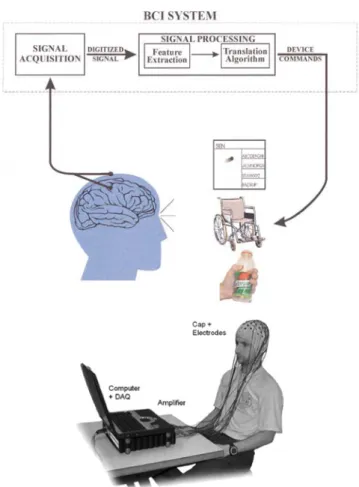
Any natural form of communication or control requires peripheral nerves and muscles. The process begins with the user’s intent [22]. This intent triggers a complex process in which certain brain areas are activated, and hence signals are sent via the peripheral nervous system (specifically, the motor pathways) to the corresponding muscles, which in turn perform the movement necessary for the communication or control task. The activity resulting from this process is often called motor output or efferent output. Efferent means conveying impulses from the central to the peripheral nervous system and further to an effectors (muscle). Afferent, in contrast, describes communication in the other direction, from the sensory receptors to the central nervous system. For motion control, the motor (efferent) pathways essential The sensory (afferent) pathway is particularly important for learning motor skills and dexterous tasks, such as typing or playing a musical instrument. A BCI offers an alternative to natural communication and control. A BCI is an artificial system that bypasses the body’s normal efferent pathways, which are the neuromuscular output channels. Figure illustrates this functionality. Instead of depending on peripheral nerves and muscles, a BCI directly measures brain activity associated with the user’s intent and translates the recorded brain activity into corresponding control signals for BCI applications. This translation involves signal processing and pattern recognition, which is typically done by a computer. Since the measured activity originates directly from the brain and not from the peripheral systems or muscles, the system is called a Brain–Computer Interface. A BCI must have four components. It must record activity directly from the brain (invasively or non-invasively) [24]. It must provide feedback to the user, and must do so in real-time. Finally, the system must rely on intentional control hat is, the user must choose to perform a mental task whenever s/he wants to accomplish a goal with the BCI. Devices that only passively detect changes in brain activity that occur without any intent, such as EEG activity associated with workload, arousal, or sleep, are not BCIs Although most researchers accept the term “BCI” and its definition, other terms has been used to describe this special form of human–machine interface. Here are some definitions of BCIs found in BCI literature: Wolpaw et al.: “A direct brain-computer interface is a device that provides the brain with a new, non-muscular communication and control channel”.
Donoghue et al.: “A major goal of a BMI (brain-machine interface) is to provide a command signal from the cortex. This command serves as a new functional output to control disabled body parts or physical devices, such as computers or robotic limbs” Levine et al.: “A direct brain interface (DBI) accepts voluntary commands directly from the human brain without requiring physical movement and can be used to operate a computer or other technologies.”Schwartz et al.: “Microelectrodes embedded chronically in the cerebral cortex hold promise for using neural activity to control devices with enough speed and agility to replace natural, animate movements in paralyzed individuals. Known as cortical neural prostheses (CNPs), devices based on thistechnologyare a subset of neural prosthetics, a larger category that includes stimulating, as well as recording, electrodes.” Brain–computer interfaces, brain–machine interfaces (BMIs), direct brain interfaces (DBIs), neuroprostheses – what is the difference? In fact, there is no difference between the first three terms. BCI, BMI, and DBI all describe the same system, and they are used as synonyms. “Neuroprosthesis,” however, is a more general term. Neuroprostheses (also called neural prostheses) are devices that cannot only receive output from the nervous system, but can also provide input. Moreover, they can interact with the peripheral and the central nervous systems. Figure presents examples of neuroprostheses, such as cochlear implants (auditory neural prostheses) and retinal implants (visual neural prostheses). BCIs are a special category of neuroprostheses.
3. How BCIs Work
BCIs measure brain activity, process it, and produce control signals that reflect the user’s intent To understand BCI operation better, one has to understand how brain activity can be measured and which brain signals can be utilized. In this chapter, we focus on the most important recording methods and brain signals [2].
Direct Brain Computer Interface (BCI)
Brain activity produces electrical and magnetic activity. Therefore, sensors can detect different types of changes in electrical or magnetic activity, at different times over different areas of the brain, to study brain activity. Most BCIs rely on electrical measures of brain activity, and rely on sensors placed over the head to measure this activity. Electroencephalography (EEG) refers to recording electrical activity from the scalp with electrodes. It is a very well established method, which has been used in clinical and research settings for decades. Figure shows an EEG based BCI. EEG equipment is inexpensive, lightweight, and comparatively easy to apply. Temporal resolution, meaning the ability to detect changes within a certain time interval, is very good. However, the EEG is not without disadvantages: The spatial (topographic) resolution and the frequency range are limited. The EEG is susceptible to so-called artifacts, which are contaminations in the EEG caused by other electrical activities. Examples are bioelectrical activities caused by eye movements or eye blinks (electrooculographic activity EOG) and from muscles (electromyographic activity, EMG) close to
the recording sites. External electromagnetic sources such as the power line can also contaminate the EEG. Furthermore, although the EEG is not very technically demanding, the setup procedure can be cumbersome. To achieve adequate signal quality, the skin areas that are contacted by the electrodes have to be carefully prepared with special abrasive
Figure 2. A typical EEG based BCI consists of an electrode cap with electrodes, cables that transmit the signals from the electrodes to the biosignal amplifier, a device that converts the brain signals from analog to digital format, and a computer that processes the data as well as controls and often even runs the BCI application.
10–20 System. It is widely used in clinical EEG recording andEEG research as well as BCI research.
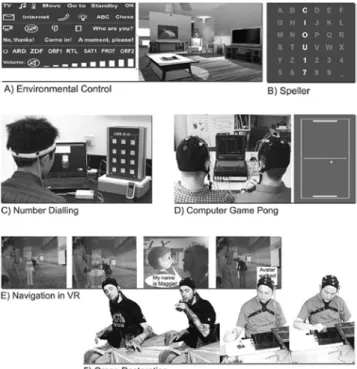
Figure 3. Various Applications of BCI.
4. Modeling
4.1. Brain-Device Interface Model
Figure 4. Brain-Device Interface Model.
This is my first engineered model about Brain-Device-Interfacing (BDI) having the two sections Human with three stages and NCOD (Neurons Command Operating Device) with three stages with Interfacing Section I. in Human side we need connectivity for change at interface in electrical signals hence first need Neurons Pattern/Code Generator which further saved in neuron pattern memory. At Natural-Artificial Intelligence Interface (NAII) encode
neurons codes for command accepted and decoded in electrons codes for command simply can say “Neurons-Electrons Converter”. This is fed to Electrons Pattern/Code Generator for decoding and than to Binary/Digital Command/Signal Processing unit which accepted by the AI of NCOD to carry brain command and control action by the devices.
4.2. NCOD-Execution Model
This simple model gives idea how NCOD function. This model is expansion NCOD section of first model to give detail idea for NCOD execution. Mainly function based on five phases as 1) Neurons Sensation Unit, where several body or head mounted electrodes/probes neuron sensor accept neuron data from users brain who want to command & control NCOD. 2) Amplifiers & signal converters/Conditioning units accept
understand and amplify small neurons patterns/code into big one for decoding. 3) Decoding unit decode encoded neurons signal into equivalent electronic signal for digital processing by NCOD logic chip of AI. 4) Binary/digital neuron like command generate by this unit. 5) Further these signals/codes given to processing & control chamber to execute commanded action by NCOD.
4.3. NCOD Design Diamond
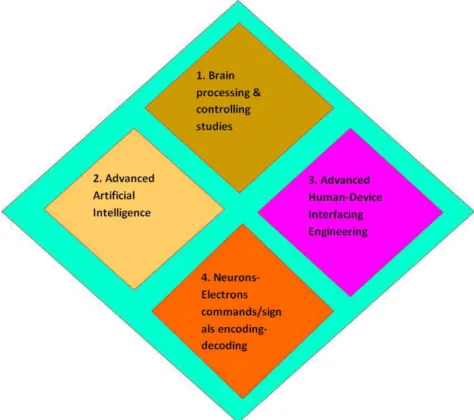
Figure 6. NCOD Design Diamond.
This is my last simple and lucid model labeled as “NCOD Design Diamond (NDD)” which gives you guideline to analyze and design NCOD. This diamond split into four sub diamonds in its inside. Viz. 1) Brain processing & controlling studies involvedall related studies regarding Neuroscience, Brain functions, AI & NCOD engineering studies 2. Advanced Artificial Intelligence deals with all literature review, books studies and circuits analysis and related hardware’s and software’s designing and development etc. 3. Advanced Human-Device Interfacing Engineering deals with how Brain-Device interfaces possible with Neurons-Electrons Exchange In/Out communication for complete control as well as their circuit & software designing and development. 4. Neurons-Electrons commands/signals encoding-decoding is similar like language translator which converts “Neuron Command” into “Electronic command” to establish communication between Brain and NCOD.
5. Conclusion
A BCI is new direct artificial output channel. A
communication and control to users with less severe disabilities, and even healthy users in some situations. BCIs may also provide new means of treating stroke, autism, and other disorders. These new BCI applications and groups will require new intelligent BCI components to address different challenges, such as making sure that users receive the appropriate visual, proprioceptive, and other feedback to best recover motor function. As BCIs become more popular with different user groups, increasing commercial possibilities will likely encourage new applied research efforts that will make BCI seven more practical. Consumer demand for reduced cost, increased performance, and greater flexibility and robustness may contribute substantially to making BCI sin to more mainstream tools.
References
[1] www.beck-shop.de/fachbuch/leseprobe/9783642020902_Exce rpt_001.pdf
[2] www.ijarcsse.com/docs/papers/Volume_4/9_September2014/ V4I9-0411.pdf
[3] link.springer.com/chapter/10.1007/978-3-642-02091-9_1/fullt ext.html
[4] www.cs.cmu.edu/~tanja/BCI/BCIreview.pdf
[5] www.citeulike.org/user/xawen/article/3826136
[6] www.cs.cmu.edu/afs/cs/Web/People/chongw/citeulike/docs/do c3476.html
[7] www.citeulike.org/user/sebwills/article/244110
[8] https://www.scienceopen.com/document/id/ba37ba15-7acf-4c 34-92da-1590464cd41f
[9] cat.inist.fr/?aModele=exportN&cpsidt=13743693
[10] muniratips.blogspot.com/feeds/posts/default
[11] www.ijoar.org/Conference_Paper/A-REVIEW-...ELECTRIC-SIGNALS.pdf
[12] https://www.semanticscholar.org/paper/Pi...3f1c1855c58/figur e/0
[13] https://www.semanticscholar.org/paper/Pi...3f1c1855c58/figur e/1
[14] www.intechopen.com/download/pdf/30727
[15] www.ijets.in/Downloads/Published/E0140102014.pdf
[16] www.academia.edu/6887492/Brain_Computer_Interfaces_A_ Gentle_Introduction
[17] documents.mx/engineering/braincomputer-interface.html
[18] www.ijarcce.com/upload/2015/august-15/IJARCCE 10.pdf
[19] https://wiki.nus.edu.sg/download/attachments/85887374/Kana vKhurana[CA1].pdf
[20] scholarscompass.vcu.edu/cgi/viewcontent.cgi?article=2910&c ontext=etd
[21] esjournals.org/journaloftechnology/archive/vol1no3/vol3no10/ vol3no10_3.pdf
[22] esjournals.org/journaloftechnology/archive/vol3no10/vol3no1 0_3.pdf
[23] esjournals.org/journaloftechnology/archive/vol2no1/vol2no1_ 11.pdf
[24] research.shahed.ac.ir/WSR/SiteData/PaperFiles/5429_Asadi.p df
[25] www.slideshare.net/AnuMVijayan/bci-report-49632260
[26] https://www.ijareeie.com/upload/2016/august/42_4_Noise.pdf
[27] citeseer.ist.psu.edu/showciting?cid=3369308
[28] citeseerx.ist.psu.edu/viewdoc/summary?doi=10.1.1.117.8348
[29] citeseerx.ist.psu.edu/showciting?cid=6221750
[30] www.academia.edu/8066972/comm_and_control-bci
[31] multisystemsnig.com/jmqs/index.php/?option=com_k2&view =itemlist&task=user&id=17517
[32] https://www.slideshare.net/Odane_smith/pppbci-1
[33] https://www.researchgate.net/profile/Jay...n=publication_detail
[34] link.springer.com/chapter/10.1007/978-3-642-02091-9_1
[35] ethesis.nitrkl.ac.in/5433/1/211EC3312.pdf
[36] www.sciencedirect.com/science/article/pii/S13882457020005 73
[37] https://www.researchgate.net/profile/Jay...n=publication_detail
[38] adsabs.harvard.edu/abs/2010bci..book....1G
[39] www.degruyter.com/dg/viewarticle.fullcon...10178-012-0037-4.xml
[40] wenku.baidu.com/view/c45754d950e2524de5187e48.html
[41] www.clinph-journal.com/article/S1388-2457(02)00057-3/abst ract
[42] www.doc88.com/p-145637502436.html
[43] www.ijana.in/Special Issue/S65.pdf
[44] https://www.slideshare.net/NISHANTHANANDANADARA/ final-report1-50164959
[45] https://www.researchgate.net/profile/Abb...n=publication_deta il
[46] www.eng.ucy.ac.cy/cpitris/courses/ECE370/presentations/Eng lish/08. BCIs_EN.pdf
[47] https://www.facebook.com/BrainComputerInterfacebci/
[48] https://www.researchgate.net/profile/Ham...n=publication_det ail
[49] neuro-it.net/pdf_dateien/summer_2004/Babiloni slides.pdf
[50] www.diva-portal.org/smash/get/diva2:228631/FULLTEXT01. pdf
[52] https://www.researchgate.net/publication..._Gentle_Introducti on
[53] https://www.scribd.com/document/58901092/Abstract
[54] psycnet.apa.org/psycinfo/2002-15205-001
[55] citeseerx.ist.psu.edu/viewdoc/summary?doi=10.1.1.301.4821
[56] core.ac.uk/display/20831460
[57] www.esa.int/gsp/ACT/doc/ARI/ARI%20Study%...-_Pisa_E_P iaggio.pdf
[58] https://www.researchgate.net/publication...itation_after_stroke
[59] www.slideshare.net/JayanarayanJayakumar/braincomputer-int erface-34191649
[60] www.mdpi.com/1424-8220/12/2/1211/pdf
[61] schwartzlab.neurobio.pitt.edu/pub/ARN.pdf
[62] “PQC-M-86124.pdf" dated 2017-01-27
[63] https://ijirset.com/upload/2014/icets/200_EE485.pdf
[64] worldcomp-proceedings.com/proc/p2013/ICA3048.pdf
[65] https://www.majortests.com/essay/Brain-Computer-Interface-588517.html
[66] salsaflavors.com/index.php?option=com_k2&view=itemlist&t ask=user&id=16038
[67] www.slideshare.net/NISHANTHANANDANADARA/final-re port1-50164959
[68] www.sciencedirect.com/science/article/pii/S1567424X097040 03
[69] www.academia.edu/3700620/Brain_Computer_...n_Locked-in _Patients
[70] https://www.scribd.com/document/29388663/Babiloni-Slides
[71] www.mdpi.com/1424-8220/13/8/10561/pdf
[72] www.wendangxiazai.com/b-3f5186156c175f0e7cd137e5.html
[73] https://www.researchgate.net/profile/Mar...n=publication_deta il
[74] www.ichacha.net/supplementary control.html
[75] www.lwdoc.com/ykexue/2013/4969.html
[76] www.colmillosportgear.com/index.php?option=com_k2&view =itemlist&task=user&id=213186
[77] digitalindia.gov.in/newsletter/2016_november/index.php
[78] wiki.nus.edu.sg/download/attachments/85887374/KanavKhur ana[CA1].pdf
[79] https://link.springer.com/chapter/10.1007/978-3-319-40355-7_ 25
[80] www.academia.edu/6629815/Brain-Computer_Interface_and_ Its_Applications_A_Review
[81] www.mdpi.com/2072-6651/6/3/784/pdf
![Figure 1. A BCI bypasses the normal neuromuscular output channels [2].](https://thumb-us.123doks.com/thumbv2/123dok_us/8030281.2126520/2.892.521.770.949.1101/figure-bci-bypasses-the-normal-neuromuscular-output-channels.webp)