Creating Appropriate Corpus for Information Retrieval and Natural Language
Processing in Persian Language
Zahra Abdolhosseini
Department of Computer Engineering, Alzahra University, Tehran, Iran
Mohammad Reza Keyvanpour Department of Computer Engineering, Alzahra
University, Tehran, Iran [email protected]
Marjan Shabani Asl
Department of Computer Engineering, Shariaty University, Tehran, Iran
Abstract
Persian natural language processing (NLP) researchers have many limitations to access linguistic tools which are suitable for text processing. Therefore, research in Persian text processing is very limited. Since dataset is an important requirement for experiments and their evaluation, we aimed to create appropriate corpora for information retrieval and natural language processing in Persian. The provided corpora in this article are based on HAMSHAHRI dataset which is appropriate for simple information retrieval and simple natural language processing because it has not been tagged. We converted this dataset to tagged collection and increased its text quality. The new corpora minimize the text preprocessing requirement. Here we have used STep-1 tools for text processing and have proposed some ideas to remove the bugs of these tools in order to increase their quality. At the end we used the new corpora for text retrieval and results showed performance improvement.
Keywords: Persian Text Corpus, Persian Tagged Texts, Improved Hamshahri, Improved STeP1.
Introduction
Checking, Chunking and the other (Shamsfard et al., 2010). Also many works have been done for corpora creation in other languages (Yang et al., 2004; Talvensaari et al., 2008; Miangah 2009).
Text processing of languages with limited resources such as Persian is complex and time consuming (Shamsfard et al., 2010). Therefore, researchers who work in this scope, create their tools in a limited domain. This problem limits the suitable tools for all applications in text processing scope. Therefore moving in the direction of creating these tools is very important. Since dataset is an important requirement for experiments and their evaluation, in this article we have tried to create appropriate corpora for information retrieval and natural language processing in Persian. Among few current Persian texts corpora, HAMSHAHRI collection (Aleahmad et al., 2009) is a standard dataset for experiment and evaluation methods. The provided corpora in this article are based on HAMSHAHRI collection which is appropriate for simple information retrieval and simple natural language processing because it has not been tagged. We converted this dataset to tagged collection and increased its text quality. The new corpora minimize the text preprocessing requirement. DOTIR (Darrudi et al., 2008) and BIJAN KHAN Corpora (Oroumchian et al., 2006) are the other Persian texts datasets which DOTIR is appropriate for information retrieval but has not been tagged and BIJAN KHAN is appropriate for only natural language processing but this dataset is not free. Notice produced corpora in this article are useful for both of Persian text retrieval and natural language processing. Here we have used STep-1 tools for text processing and have proposed some ideas to remove the bugs of these tools in order to increase their quality.
The rest of the paper is organized as follows. In Section 2 we presented more details of HAMSHAHRI corpora and STeP1 tools. In section 3 we expressed our system architecture and proposed methods for bugs removal from STeP1 and introduced structure of new corpus. Next we showed experiments results. Finally in section 5 conclusion is presented.
Background
In this section we describe the details of used data and tools.
HAMSHAHRIand the Other Persian Corpora
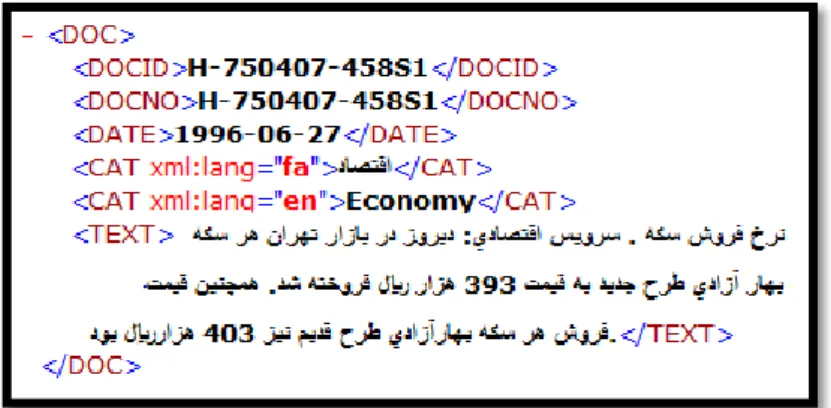
started by Oroumchian et al. (2004) so that researchers employed a crawler to download available online news from the web site of HAMSHAHRI newspaper and presented some advantageous statistics of HAMSHAHRI corpora based on characteristics of the Persian language. This dataset were completed gradually until converted to current format. Previous version of the collection contains 58 queries that were not prepared based on TREC specifications but last version was prepared based on TREC specifications and these corpora were converted to standard corpus. The current version includes more than 160000 documents, 100 queries and their related judgments. The preparation steps of dataset were previously described (Oroumchian et al., 2004). Each document is shown by an ID, publication date, category, and text property. Figure 1 shows the sample of documents in this corpus.
Figure 1: The sample of a document in HAMSHAHRI collection
STeP-1 Tools
Among the introduced tools for Persian text processing, STeP-1 is the first step in processing texts written in Persian language. Shamsfard et al. (2010) presented these tools. STeP-1 performs tokenization, morphological analysis and POS tagging. Users can select arbitrary combination of these services in different depths for their own task and application. In general it proposes the following activities for conversion of texts into a standard one.
1. Defining a computational standard script:
Adding short-spaces between different parts of a word (or a compound word). b) Adding Spaces between words and phrases
c) Introducing the spacing rules between punctuations, numbers and special cases (ex. date)
d) Creating a lexicon with different spellings of words. 2. Converting texts to the standard script
Looking up in a dictionary b) Checking the spelling c) Correcting the spacing
o replace white spaces with short spaces
STep1 can be used as style correction and preprocessing tools in many natural language processing applications in Persian language. Also STep1 can be used as a stemmer. Text stemming is one of the works which are done for texts preprocessing. Stemming is a widely used method of word standardization designed to allow the matching of morphologically related terms (Tashakori et al., 2002). If, for example, a searcher enters the term stemming as part of a query, it is likely that he or she will also be interested in such variants as stemmed and stem.
Generally in natural language processing and other fields such as information retrieval (IR), stemmers play an important role. In information retrieval using stemmed words instead of the original words, could increase the level of the exhaustively of indexing, and could increase overall performance. Also stemming reduces the size of indexing files. Since a single stem typically corresponds to several full terms (Tashakori et al., 2002). (Karimpour et al., 2009) improved Persian information retrieval systems using stemming and part of speech tagging. Up to now some works are done for Persian texts stemmer. Such as (Berenjian, 2013) presented the Persian stemmer systems for stemming verbs and (Rashidi & Zolfy Lighvan, 2014) implemented a novel hierarchical Persian stemming approach. In the other work (Mehrad & Berenjian, 2011) provided a Persian language singular stemmer system. Also (Berenjkoob et al., 2009) presented a stemming method for Persian text summarization. (Estahbanati & Javidan, 2011) implemented a new stemmer for Farsi language with combination methods.
Proposed Method
This section includes three subsections. In first subsection we present the classification of STep1 bugs and suggest the ideas for them and in second subsection describe our system architecture. In third subsection we introduce the structure of produced data.
The Classification of STep1 Bugs and Removing Them
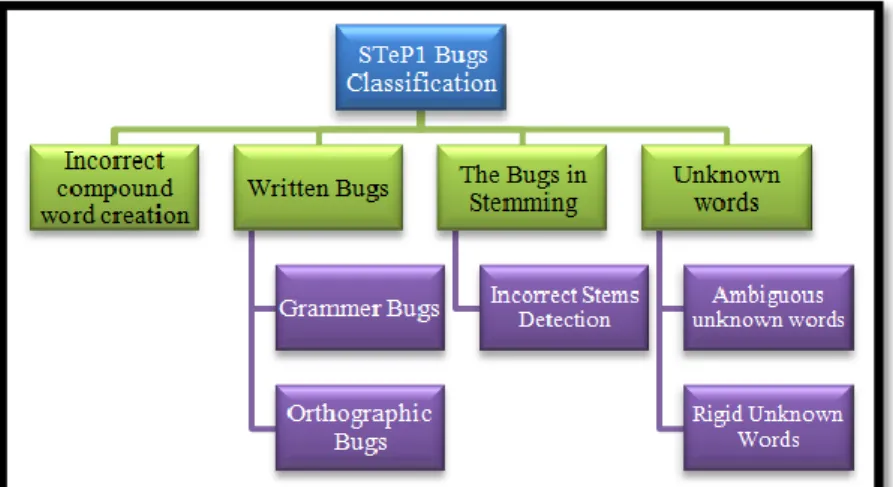
In this Subsection we describe STeP1 Bugs and introduce the ideas for removing them. Figure 2 shows the classification of these bugs.
Incorrect Compound Word Creation
We can correct the spaces between compound words by STeP-1. Also we can set the option that does not allow correction. If correction was done by STep1 tokenizer, a bug might occur. That bug is incorrect compound word creation. It occures when two successive and meaningful words are presented in text whose compound is meaningful. In these times STeP1 deletes the space between words and considers them as compound word whereas it is likely that there is no need to delete the space. For example in sentence of " یم دهشم هب لاس ره ام میور" (We go to Mashhad every year) STeP1 connects "ام" and "ره" and converts them to "رهام". The produced word is an adjective in Persian language. We proposed a method For removing this bug. We can compare the words of the main text with the words of tokenized text which is the produced text after applying tokenizer on text, If there is not accordance between two words and the new word has been produced by merging current word and next word, it is possible that this bug has been occured. Next we compare frequency of produced word with frequency of two words in main text, if frequency of produced word is very lower than frequency of two words, we do not allow to merge words. However this idea is not strong and it is possible we don't detect this bugs correctly. The other idea is using the grammatical structure of the sentence. In the previous example there is no accordance between the new produced word and sentence verb. Then we can consider the new produced word as incorrect.
Written Bugs
There are two bugs in this category: grammatical bugs and orthographic bugs. For example if there is no accordance between subject and verb in the sentence, STep1 cannot correct it. Using tagged dataset is necessary for correcting grammatical bugs. The new produced corpus in this article helps perform the methods for removing this bug. Also STeP1 cannot correct orthographic bugs. There are other studies on orthographic bugs (Sheykholeslam et al., 2012; Rezvan et al., 2009).
The Bugs in Stemming
This category includes detection of incorrect stems bugs. There is a bug in STep-1 stemmer. STep-1 stemmer sometimes considers word stem by removing the suffix and prefix of word. This method creates a problem because in the Persian language the specified suffix and prefix may not be actually the suffix or prefix and they may be parts of the main word. For example in the word "نیشام"(car), "نی" is considered as suffix and "شام" as stem. Whereas "نی" is part of main word and there is no suffix. We will describe the method for removing this bug in the next section.
Unknown Words
words like “همان زور” (newspaper) and writes its parts with no space or with half space but it cannot correct compound word if its parts be connected like "ناگدننکبیرخت" (the ruinous) and considers it as an unknown word. Also this tool sometimes cannot detect a word because there isn't any space between two independent words, in this time it produces different forms of word. For example "VaGhodrat,تردقو " can be split to [تر دق و ،تردق و ،تردقو]. This problem is the other bug. Therefore we categorized these bugs to rigid unknown words and ambiguous unknown words. In other subsection we will describe the ideas for removing these bugs.
Proposed System Architecture
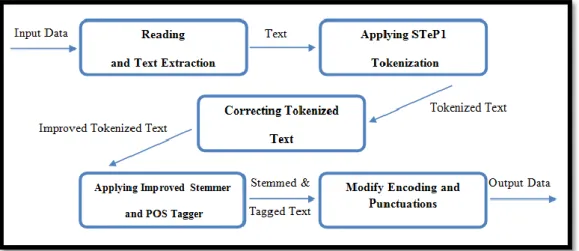
This subsection describes our system architecture. Our system includes five steps. In this system input data format is xml and first we had to extract text elements from xml files. After text extraction we applied STeP-1 tokenization on text. Next STep1 tokenization and stemmer is improved. After improving tools and applying them on texts, we saved the results as xml file. The encoding of the produced files is utf-16; therefore, it is necessary that we convert it to utf-8. Also we again corrected the spaces between punctuations and words at the end. Further we will describe the third and fourth steps. Fig 3 shows these steps.
Figure 3. The proposed System Architecture
Correcting Tokenized Text
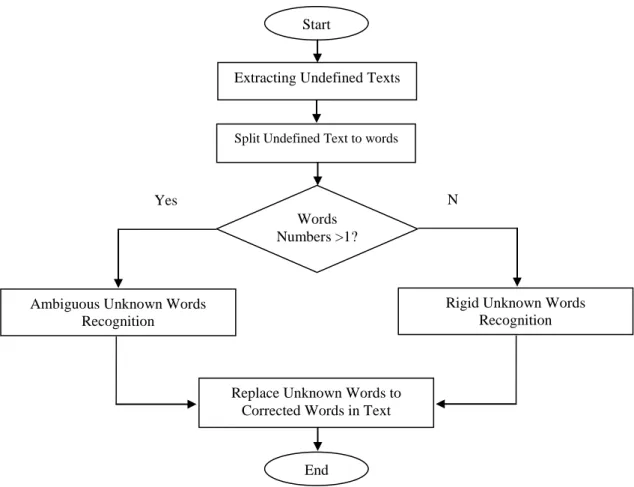
Figure 4. The Flowchart of correcting tokenized text
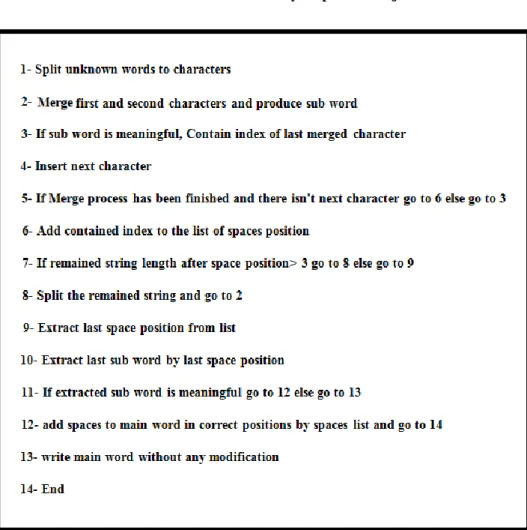
Correcting Ambiguous unknown words
After extracting unknown words we split them with"," and a space and produce UWs.
UWs={T1,T2,...,Tn} Ti={ w1,w2,...,wn}
Where UWs is the set of different terms after splitting unknown text with ',', Ti is one of the produced forms from ambiguous unknown words. Next we split Ti with space; Wi is the word in Ti. If all words of Ti be meaningful, then we will process Ri and Fi , Ri refers to term rank and Fi is item frequency. Fi is calculated by equation (1), and Ri is calculated based on the count of meaningful words in Ti. The term rank is high if Ti has lower word count. In case of forms with the same rank we select the form that have higher frequency and are more possible. Also we used some rules for meaningful word recognition. In these rules we process word frequency and POS tag.
Fi={ Fw1+Fw2+...+Fwn} (1)
Where Fwi is the frequency of Wi. For example STep1 cannot detect many special nouns. Such as STep1 produce for "یدرجورسخ" word two forms like "]ید رج ورسخ ،یدرجورسخ[". Since every word in produced form has acceptable POS tag we use frequency feature to detect the correct form. In "یدرج ورسخ" form, " رج" ("JAR") word is meaningful but in
Ambiguous Unknown Words Recognition
Start
Extracting Undefined Texts
Split Undefined Text to words
Words Numbers >1?
Rigid Unknown Words Recognition
Yes N
o
Replace Unknown Words to Corrected Words in Text
HAMSHAHRI texts has not been used and its frequency feature value is very lower than threshold. Then "ید رج ورسخ" form is not considered and "یدرجورسخ" saved. We sometimes use POS tag for detects correct form. Namely STep1 produce for "نازومآ شناد" (Students) word two forms like "]نازومآ ،نا زومآ[". After processing all words of forms, we delete " زومآ نا" form. Because "نا" has not acceptable POS tag and is not an independent word. Table 1 shows more samples that have been corrected by our proposed method.
Table 1
Some Samples for Corrected Ambiguous unknown words
Corrected Ambiguous unknown words Ambiguous unknown words
ار دوخ ]ار دوخ ،ارد وخ ،اردوخ[
ناسنا دنتسه اه ناسنا[
]دنتسهاهناسنا ،دنتسه اه
لماوع ]لم اوع ،لماوع[
ینانآ ]ین انآ ،ینانآ[
هب دامتعا اب و ]هب دامتعا ابو ،هب دامتعا اب و[
هب دوخ ]هب دوخ ،هبد وخ[
Correcting Rigid unknown words
Figure 5. The Pseudo code of Rigid Unknown Words Correction
Table 2 shows some samples for corrected rigid unknown words.
Table 2
Some Samples for Corrected Rigid unknown words
Corrected Rigid Unknown Words Rigid Unknown Words
تیحلاص بلطواد ]تیحلاصبلطواد[
برغ لامش ]برغلامش[
هتنملک ]هتنملک[
ناولهپ باختنا ]ناولهپباختنا[
باعشنا طیارش ]باعشناطیارش[
درک بلج ]درکبلج[
Applying Improved Stemmer and POS Tagger
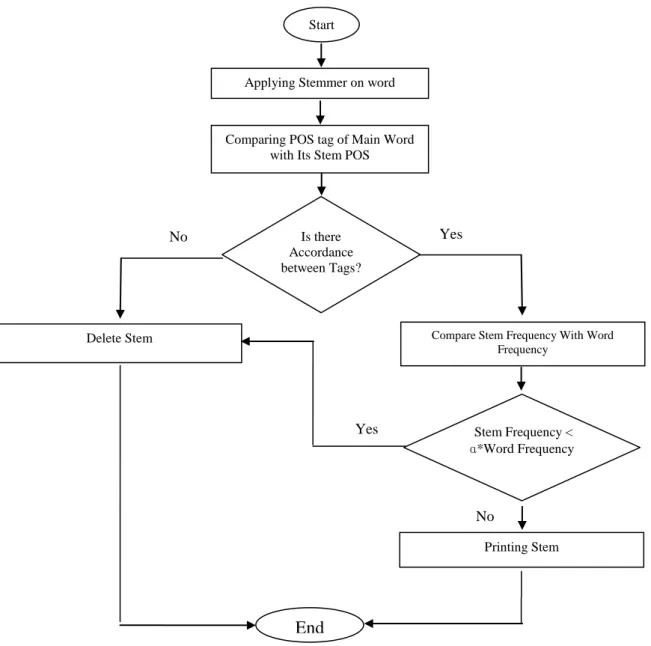
Fig. 6. The steps of removing stemmer bug
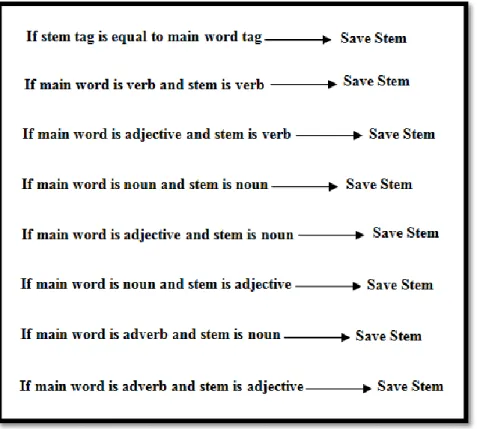
Firstly we applied STeP-1 stemmer on text. Stemmer detects POS tag, stem, frequency and suffix and prefix of words. This frequency has been calculated based on "bijan khan" data set. Next we improved stemmer result. We compared the POS tag of the main word with POS tag of the word stem according to some rules presented in figure 7. If we found no accordance between tags, we deleted that stem but if there was accordance we compared stem frequency with word frequency. In fact, if stem frequency is not very low, we realized that the stem is normal. For example "شام" is the stem with very low frequency than "نیشام" therefore this stem is not saved. Notice the best calculated value for ɑ is "0.25". we found this value by some experiments. There are other methods for true stem recognition. We can introduce standard suffix and prefix for each word in lexicon (Eslami et al. 2004) and remove false stems from text but this method is time consuming. Also word sense disambiguation for some words such as homograph words can be useful. Table 3 shows some samples for incorrect stems.
No Yes
Start
Applying Stemmer on word
Comparing POS tag of Main Word with Its Stem POS
Is there Accordance between Tags?
Delete Stem Compare Stem Frequency With Word
Frequency
Stem Frequency <
ɑ*Word Frequency
Printing Stem
End No
Figure 7. The used rules for comparing main word tag and stem tag
Table 3
Some Samples for Incorrect Stems
)هج( ناهج نویلیم
اه )لیم,یلیم,نویلیم( )نی( نیب
)هراو ,راومه( هراومه )سا( تسا
)کل,لب,هکل( هکلب
)سگ,رتسگ( شرتسگ )قن( شوقن
)لم,کلم( هکلم
)دز( دیدزاب )داس( هداس
)شک,روشک( یاهروشک
The Structure of Produced Dataset
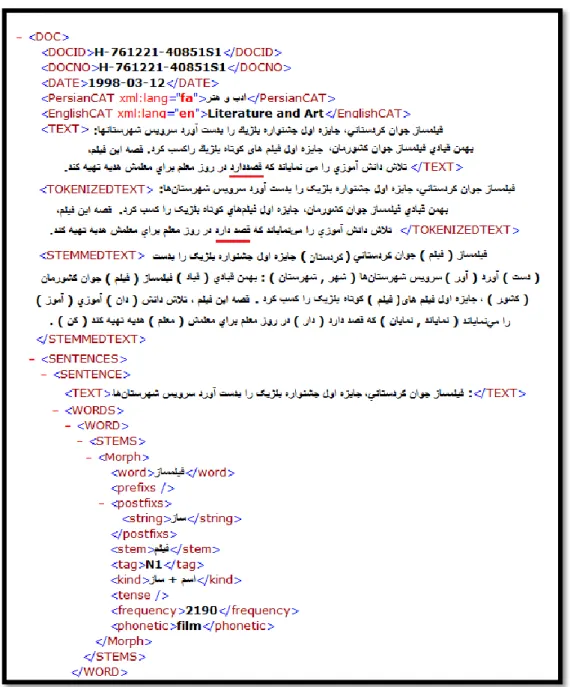
The produced corpora are useful for information retrieval and natural language processing. We tried to produce file names of new corpora and some properties similar to the
main dataset. Also we added tokenized text, stemmed text, document sentences, words of every sentence, their stems and their POS tags and we saved word stems as well as the main word. The saving form of stemmed text is presented as follows:
Main word (stem1, stem2... stemn)
Figure 8. The structure of produced corpora
Experiments Results
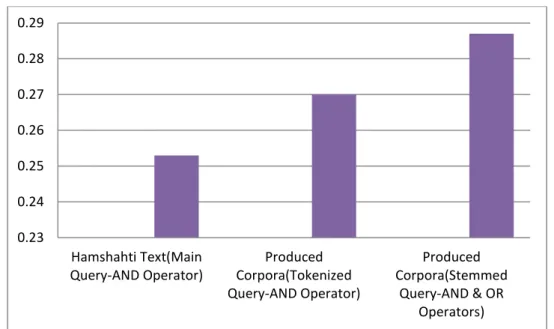
presents some different applications in information retrieval and natural language processing scopes and describes the influence of the produced corpus on increasing their performance.
Figure 9. The comparing MAP meseaure on main and Produced Corpora
Table 4
Comparing P@5 and P@10 and P@20 measures on main and produced corpora
Text & Query Type P@5 P@10 P@20
Hamshahri Text
(Main Query) 0.58 0.52 0.48
HAMTA Text
(Tokenized Query) 0.6 0.54 0.48
HAMTA Text
(Stemmed Query) 0.61 0.55 0.51
Table 5
Comparing the influence of produced corpora on increasing applications performance
Application Name The influence of produced corpora on increasing their performance
Query Expansion
Since information retrieval is required for implementing many methods in query expansion process therefore better retrieval of data can affect on effective query expansion. Also query expansion doesn't need preprocessing dataset using new dataset.
Question and Answering
One step in implementing QA systems is preprocessing which is not required in this system by new dataset. Also extracted sentences and tagged words help to improve the performance.
Text Summarization
This application doesn't need to preprocessing dataset using new dataset and extracted sentences and tagged words help to improve the performance.
0.23 0.24 0.25 0.26 0.27 0.28 0.29
Hamshahti Text(Main Query-AND Operator)
Produced Corpora(Tokenized Query-AND Operator)
Produced Corpora(Stemmed
Application Name The influence of produced corpora on increasing their performance
Sense Disambiguation and Conceptual Graph Construction
The tagged words are very effective and concept extraction would be comfortable. Also above notes is included in this application.
Named Entity Recognition Using true written and stemmed and tagged dataset can improve the precision of named entity recognition.
Semantic Search Engine Creation
This dataset Helps to concept extraction and retrieval precision improvement. Also This application doesn't need to preprocessing dataset using new dataset.
Conclusion
In this research, we focused on creating a suitable dataset for information retrieval and natural language processing in the Persian language. The results showed that the new dataset is effective in improving performance of many applications in Persian information retrieval and Persian natural language processing systems. In future works we will improve our methods for correcting STeP1 bugs and finally we will produce suitable linguistic tools for Persian.
References
Aleahmad, A., Amiri, H., Rahgozar, M. Oroumchian, F. (2009). Hamshahri: A standard Persian Text Collection. Knowledge-Based Systems, 22(5), 382-387.
Amtrup, J.W., Mansouri Rad, H., Megerdoomian, K., Zajac, R.(2000). Persian-English Machine Translation: An Overview of the Shiraz Project. NMSU, CRL, Memoranda in Computer and Cognitive Science (MCCS-00-319).
Berenjian, S.H. (2013). Persian Simple (Past, Present & Future) Verb Stemmer, Shiraz: Takhte Jamshid. Available At: http://www.ricest.ac.ir. (Persian)
Berenjian, S.H. (2013). The Stemmer of Past and Present from the Infinitive Non Transient Verbs in Persian Language, Shiraz: Navid. Available At: http://www.ricest.ac.ir.(Persian) Berenjkoob, M. , Mehri, R., Khosravi, H., Nematbakhsh, M.A. (2009). A Method for
Stemming and Eliminating Common Words for Persian Text Summarization, Natural Language Processing and Knowledge Engineering, NLP-KE International Conference on, 1-6.
Darrudi E., Baradaran Hashemi, H., AleAhmad, A., Zare Bidoki, A.M., Habibian, A.H., Mahdikhani, F., et al. ( 2008). dorIR collection for Persian web retrieval. Technical Report No. DBRG-TR-02.
Eslami, M., Sharifi, M., Alizadeh, S., Zandi, T. (2004). Persian ZAYA Lexicon. 1st Workshop on Persian Language and Computer, Tehran, Iran.
Estahbanati, S., Javidan, R. (2011). A New Stemmer for Farsi Language. Computer Science and Software Engineering(CSSE), CSI international Symposium on, 3(1), 25-29.
Mehrad, j., Berenjian, S.R. (2011). provided a Persian language singular stemmer system, International Journal of Information Science and Management, 9(2).
Miangah, T.M. (2009). Constructing a Large-Scale English-Persian Parallel Corpus. Meta:Translators' Journal 54(1), 181-188.
Oroumchian, F., Tasharofi, S., Amiri, H., Hojjat, H., Raja, F.(2006). Creating a Feasible Corpus for Persian POS Tagging. UOWD Technical Reports Series , Number TR 3. Oroumchian, F., Darrudi, E., Hejazi, M.R. (2004). Assessment of a modern Persian corpus.
Proceedings of The 2nd Workshop on Information Technology & its Disciplines (WITID), ITRC, Iran.
Rashidi, A., Zolfy Lighvan, M. (2014). HPS: A Hierarchical Persian Stemming Method. International Journal on Natural Language Computing (IJNLC), 3(1).
Rezvan, Y., Ghandchi, M., Rezvan, F. (2009). Suggesting Correct Words Algorithms Developing in FarsiTeX. Proceedings of the European Computing Conference.
Shamsfard, M., Jafari, H.S., Ilbeygi, M. (2010). STeP-1: A Set of Fundamental Tools for Persian Text Processing. LREC 2010 - 8th Language Resources and Evaluation Conference, 19-21 May, Malta.
Sheykholeslam, M.H., Minaei-Bidgoli, B., Juzi, H. (2012). A Framework for Spelling Correction in Persian Language Using Noisy Channel Model. In Proceedings of Language Resources and Evaluation Conference (LREC).
Sheykh Esmaili, K., Abolhassani, H., Neshati, M., Behrangi, E., Rostami, A., Mohammadi, M. (2007). Mahak: A Test Collection for Evaluation of Farsi Information Retrieval Systems. IEEE/ACS International Conference on Computer Systems and Applications. Taghiyareh, F., Darrudi, E., Oroumchian, F., Angoshtari, N.(2003). Compression of Persian
Text for Web-Based Applications, Without Explicit Decompression. WSEAS Transactions on Computers, 2(4), 961-966.
Talvensaari, T., Pirkola, A., Jãrvelin, K., Juhola, M., Laurikkala, J. (2008). Focused web crawling in the acquisition of comparable corpora. Information Retrieval 11, 427- 445. Tashakori, M., Meybodi, M.R., Oroumchian, F. (2002). Bon: The Persian
Stemmer. Information and Communication Technology - EurAsia-ICT , 487-494.