3GPP TS 25.225
V3.12.0
(2003-06)
Technical Specification
3rd Generation Partnership Project;
Technical Specification Group Radio Access Network;
Physical layer – Measurements (TDD)
(Release 1999)
The present document has been developed within the 3rd Generation Partnership Project (3GPPTM) and may be further elaborated for the purposes of 3GPP.
Keywords
UMTS, radio, layer 1
3GPP Postal address
3GPP support office address
650 Route des Lucioles - Sophia Antipolis Valbonne - FRANCE
Tel.: +33 4 92 94 42 00 Fax: +33 4 93 65 47 16
Internet
http://www.3gpp.org
Copyright Notification
No part may be reproduced except as authorized by written permission. The copyright and the foregoing restriction extend to reproduction in all media.
© 2003, 3GPP Organizational Partners (ARIB, CWTS, ETSI, T1, TTA, TTC). All rights reserved.
Contents
Foreword ...4
1 Scope ...5
2 References ...5
3 Abbreviations ...6
4 Control of UE/UTRAN measurements ...6
4.1 General measurement concept... 6
4.2 Measurements for cell selection/reselection ... 7
4.3 Measurements for Handover ... 7
4.4 Measurements for DCA... 7
4.5 Measurements for timing advance... 7
5 Measurement abilities for UTRA TDD...7
5.1 UE measurement abilities... 8
5.1.1 P-CCPCH RSCP ... 8
5.1.2 CPICH RSCP... 9
5.1.3 Timeslot ISCP... 9
5.1.4 UTRA carrier RSSI... 9
5.1.5 GSM carrier RSSI... 9
5.1.6 SIR ... 9
5.1.7 CPICH Ec/No ... 10
5.1.8 Transport channel BLER ... 10
5.1.9 UE transmitted power ... 10
5.1.10 SFN-SFN observed time difference... 11
5.1.11 SFN-CFN observed time difference ... 12
5.1.12 Observed time difference to GSM cell ... 12
5.1.13 UE GPS Timing of Cell Frames for UE positioning... 12
5.2 UTRAN measurement abilities ... 13
5.2.1 RSCP ... 13
5.2.2 Timeslot ISCP... 13
5.2.3 Received total wide band power ... 13
5.2.4 SIR ... 13
5.2.5 Transport channel BER... 13
5.2.6 Transmitted carrier power... 14
5.2.7 Transmitted code power... 14
5.2.8 RX Timing Deviation ... 14
5.2.9 UTRAN GPS Timing of Cell Frames for UE positioning ... 14
Annex A (informative): Monitoring GSM from TDD: Calculation Results ...15
A.1 Low data rate traffic using 1 uplink and 1 downlink slot...15
A.1.1 Higher data rate traffic using more than 1 uplink and/or 1 downlink TDD timeslot ... 16
Foreword
This Technical Specification (TS) has been produced by the 3rd Generation Partnership Project (3GPP).
The contents of the present document are subject to continuing work within the TSG and may change following formal TSG approval. Should the TSG modify the contents of the present document, it will be re-released by the TSG with an identifying change of release date and an increase in version number as follows:
Version x.y.z where:
x the first digit:
1 presented to TSG for information; 2 presented to TSG for approval;
3 or greater indicates TSG approved document under change control.
y the second digit is incremented for all changes of substance, i.e. technical enhancements, corrections, updates, etc.
1 Scope
The present document contains the description and definition of the measurements done at the UE and network in TDD mode in order to support operation in idle mode and connected mode.
2 References
The following documents contain provisions which, through reference in this text, constitute provisions of the present document.
• References are either specific (identified by date of publication, edition number, version number, etc.) or non-specific.
• For a specific reference, subsequent revisions do not apply.
• For a non-specific reference, the latest version applies. In the case of a reference to a 3GPP document (including a GSM document), a non-specific reference implicitly refers to the latest version of that document in the same Release as the present document.
[1] 3GPP TS 25.211: "Physical channels and mapping of transport channels onto physical channels (FDD)".
[2] 3GPP TS 25.212: "Multiplexing and channel coding (FDD)". [3] 3GPP TS 25.213: "Spreading and modulation (FDD)". [4] 3GPP TS 25.214: "Physical layer procedures (FDD)". [5] 3GPP TS 25.215: "Physical layer measurements (FDD)".
[6] 3GPP TS 25.221: "Physical channels and mapping of transport channels onto physical channels (TDD)".
[7] 3GPP TS 25.222: "Multiplexing and channel coding (TDD)". [8] 3GPP TS 25.223: "Spreading and modulation (TDD)". [9] 3GPP TS 25.224: "Physical layer procedures (TDD)". [10] 3GPP TS 25.301: "Radio Interface Protocol Architecture". [11] 3GPP TS 25.302: "Services provided by the Physical layer".
[12] 3GPP TS 25.303: "UE functions and interlayer procedures in connected mode". [13] 3GPP TS 25.304: "UE procedures in idle mode".
[14] 3GPP TS 25.331: "RRC Protocol Specification".
[15] 3GPP TR 25.922: "Radio Resource Management Strategies". [16] 3GPP TR 25.923: "Report on Location Services (LCS)".
[17] 3G TS 25.102: "UTRA (UE) TDD; Radio transmission and Reception" [18] 3G TS 25.105: "UTRA (BS) TDD; Radio transmission and Reception"
3 Abbreviations
For the purposes of the present document, the following abbreviations apply:
BCH Broadcast Channel
BCCH Broadcast Control Channel (GSM)
BER Bit Error Rate
BLER Block Error Rate
CFN Connection Frame Number
CPICH Common Pilot Channel (FDD)
CRC Cyclic Redundancy Check
DCA Dynamic Channel Allocation
DCH Dedicated Channel
DPCH Dedicated Physical Channel
Ec/No Received energy per chip divided by the power density in the band
FACH Forward Access Channel
FCCH Frequency Correction Channel (GSM) FDD Frequency Division Duplex
GSM Global System for Mobile Communication GPS Global Positioning System
ISCP Interference Signal Code Power
P-CCPCH Primary Common Control Physical Channel
PCH Paging Channel
PLMN Public Land Mobile Network PRACH Physical Random Access Channel PDSCH Physical Downlink Shared Channel PUSCH Physical Uplink Shared Channel
RACH Random Access Channel
RSCP Received Signal Code Power RSSI Received Signal Strength Indicator
S-CCPCH Secondary Common Control Physical Channel
SCH Synchronisation Channel
SCTD Space Code Transmit Diversity
SF Spreading Factor
SFN System Frame Number
SIR Signal-to-Interference Ratio
TDD Time Division Duplex
TDMA Time Division Multiple Access
TrCH Transport Channel
TTI Transmission Time Interval
UE User Equipment
UMTS Universal Mobile Telecommunications System USCH Uplink Shared Channel
UTRA UMTS Terrestrial Radio Access
UTRAN UMTS Terrestrial Radio Access Network
4
Control of UE/UTRAN measurements
In this clause the general measurement control concept of the higher layers is briefly described to provide an understanding on how L1 measurements are initiated and controlled by higher layers.
4.1 General
measurement
concept
L1 provides with the measurement specifications a toolbox of measurement abilities for the UE and the UTRAN. These measurements can be differentiated in different measurement types: intra-frequency, inter-frequency, inter-system, traffic volume, quality and internal measurements (see [14]).
messages will be described in the RRC Protocol) and measurements in the UTRAN (the messages will be described in the NBAP and the Frame Protocol).
To initiate a specific measurement the UTRAN transmits a ‘measurement control message’ to the UE including a measurement ID and type, a command (setup, modify, release), the measurement objects and quantity, the reporting quantities, criteria (periodical/event-triggered) and mode (acknowledged/unacknowledged), see [14].
When the reporting criteria is fulfilled the UE shall answer with a ‘measurement report message’ to the UTRAN including the measurement ID and the results.
In idle mode the measurement control message is broadcast in a System Information.
Intra-frequency reporting events, traffic volume reporting events and UE internal measurement reporting events described in [14] define events which trigger the UE to send a report to the UTRAN. This defines a toolbox from which the UTRAN can choose the needed reporting events.
4.2
Measurements for cell selection/reselection
Whenever a PLMN has been selected the UE shall start to find a suitable cell to camp on, this is ‘cell selection’. When camped on cell the UE regularly searches for a better cell depending on the cell reselection criteria, this is called ‘cell reselection’. The procedures for cell selection and reselection are described in [13] and the measurements carried out by the UE are explained in this specification.
4.3
Measurements for Handover
For the handover preparation the UE receives from the UTRAN a list of cells (e.g. TDD, FDD or GSM).which the UE shall monitor (see ‘monitored set’ in [14]) in its idle timeslots.
At the beginning of the measurement process the UE shall find synchronization to the cell to measure using the
synchronization channel. This is described under ‘cell search’ in [9] if the monitored cell is a TDD cell and in [4] if it is an FDD cell.
For a TDD cell to monitor after this procedure the exact timing of the midamble of the P-CCPCH is known and the measurements can be performed. Depending on the UE implementation and if timing information about the cell to monitor is available, the UE may perform the measurements on the P-CCPCH directly without prior SCH synchronisation.
4.4
Measurements for DCA
DCA is used to optimise the resource allocation by means of a channel quality criteria or traffic parameters. The DCA measurements are configured by the UTRAN. The UE reports the measurements to the UTRAN.
For DCA no measurements are performed in idle mode in the serving TDD cell.
When connecting with the initial access the UE immediately starts measuring the ISCP of time slots which are communicated on the BCH. The measurements and the preprocessing are done while the UTRAN assigns an UL channel for the UE for signalling and measurement reporting.
In connected mode the UE performs measurements according to a measurement control message from the UTRAN.
4.5
Measurements for timing advance
To update timing advance of a moving UE the UTRAN measures ‘Received Timing Deviation’, i.e. the time difference of the received UL transmission (PRACH, DPCH, PUSCH) in relation to its timeslot structure that means in relation to the ideal case where an UL transmission would have zero propagation delay. The measurements are reported to higher layers, where timing advance values are calculated and signalled to the UE.
5
Measurement abilities for UTRA TDD
In this clause the physical layer measurements reported to higher layers. (this may also include UE internal measurements not reported over the air-interface) are defined.
5.1
UE measurement abilities
The structure of the table defining a UE measurement quantity is shown below.
Column field Comment
Definition Contains the definition of the measurement.
Applicable for States in which RRC state according to [14] a measurement shall be possible to be performed. For RRC connected mode states information is also given on the possibility to perform the measurement on intra-frequency and/or inter-frequency.
The following terms are used in the tables:
Idle = Shall be possible to perform in idle mode; URA_PCH = Shall be possible to perform in URA_PCH; CELL_PCH = Shall be possible to perform in CELL_PCH; CELL_FACH = Shall be possible to perform in CELL_FACH; CELL_DCH = Shall be possible to perform in CELL_DCH;
For all RRC connected mode states i.e. URA_PCH, CELL_PCH, CELL_FACH and CELL_DCH Intra appended to the RRC state = Shall be possible to perform in the corresponding RRC state on an intra-frequency cell;
Inter appended to the RRC state = Shall be possible to perform in the corresponding RRC state on an inter-frequency cell.
Inter-RAT appended to the RRC state = Shall be possible to perform in the corresponding RRC state on an inter-RAT cell.
NOTE 1: Measurements for TDD which are specified on the Primary CCPCH (CCPCH) are carried out on the P-CCPCH or on any other beacon channel, see [6].
NOTE 2: For the beacon channels [6], the received power measurements shall be based on the received power for midamble m(1) if no Space Code Transmit Diversity (SCTD) is applied to the P-CCPCH and on the sum of the received powers for midambles m(1) and m(2) if SCTD is applied to the P-CCPCH.
NOTE 3: The UTRAN has to take into account the UE capabilities when specifying the timeslots to be measured in the measurement control message.
NOTE 4: The line ‘applicable for’ indicates whether the measurement is applicable for inter-frequency and/or intra-frequency and furthermore for idle and/or connected mode.
NOTE 5: The Interference part of the SIR measurement will be dependent on the receiver implementation, and will normally be different from the Timeslot ISCP measurement.
NOTE 6: The measurement ‘Timeslot ISCP’ is only a measure of the intercell interference.
NOTE 7: The term "antenna connector of the UE" used in this sub-clause to define the reference point for the UE measurements is defined in [17].
NOTE 8: Performance and reporting requirements for the UE measurements are defined in [19].
5.1.1 P-CCPCH
RSCP
Definition Received Signal Code Power, the received power on P-CCPCH of own or neighbour cell. The reference point for the RSCP shall be the antenna connector of the UE.
Applicable for Idle,
URA_PCH intra, URA_PCH inter, CELL_PCH intra, CELL_PCH inter, CELL_FACH intra, CELL_FACH inter, CELL_DCH intra, CELL DCH inter
5.1.2 CPICH
RSCP
Definition Received Signal Code Power, the received power on one code measured on the Primary CPICH. The reference point for the RSCP shall be the antenna connector of the UE. (This measurement is used in TDD for monitoring FDD cells while camping on a TDD cell).
If Tx diversity is applied on the Primary CPICH the received code power from each antenna shall be separately measured and summed together in [W] to a total received code power on the Primary CPICH.
Applicable for Idle,
URA_PCH inter, CELL_PCH inter, CELL_FACH inter, CELL_DCH inter
5.1.3 Timeslot
ISCP
Definition Interference Signal Code Power, the interference on the received signal in a specified timeslot measured on the midamble. The reference point for the ISCP shall be the antenna connector of the UE.
Applicable for CELL_FACH intra, CELL_DCH intra
5.1.4
UTRA carrier RSSI
Definition The received wide band power, including thermal noise and noise generated in the receiver, within the bandwidth defined by the receiver pulse shaping filter, for TDD within a specified timeslot. The reference point for the measurement shall be the antenna connector of the UE.
Applicable for CELL_DCH intra, CELL_DCH inter
5.1.5
GSM carrier RSSI
Definition Received Signal Strength Indicator, the wide-band received power within the relevant channel bandwidth Measurement shall be performed on a GSM BCCH carrier. The reference point for the RSSI shall be the antenna connector of the UE.
Applicable for Idle,
URA_PCH inter-RAT, CELL_PCH inter-RAT, CELL_FACH inter-RAT, CELL_DCH inter-RAT
5.1.6 SIR
Definition Signal to Interference Ratio, defined as: (RSCP/Interference)xSF. Where:
RSCP = Received Signal Code Power, the received power on the code of a specified DPCH or PDSCH.
Interference = The interference on the received signal in the same timeslot which can’t be eliminated by the receiver.
SF = The used spreading factor.
The reference point for the SIR shall be the antenna connector of the UE.
Applicable for CELL_FACH intra, CELL_DCH intra
5.1.7 CPICH
Ec/No
Definition The received energy per chip divided by the power density in the band. The CPICH Ec/No is identical to CPICH RSCP/UTRA Carrier RSSI. The measurement shall be performed on the Primary CPICH. The reference point for the CPICH Ec/No shall be the antenna connector of the UE. (This measurement is used in TDD for monitoring FDD cells while camping on a TDD cell) If Tx diversity is applied on the Primary CPICH the received energy per chip (Ec) from each antenna shall be separately measured and summed together in [Ws] to a total received chip energy per chip on the Primary CPICH, before calculating the Ec/No.
Applicable for Idle,
URA_PCH inter, CELL_PCH inter, CELL_FACH inter, CELL_DCH inter
5.1.8 Transport
channel
BLER
Definition Estimation of the transport channel block error rate (BLER). The BLER estimation shall be based on evaluating the CRC on each transport block.
Applicable for CELL_DCH intra
5.1.9
UE transmitted power
Definition The total UE transmitted power on one carrier in a specified timeslot. The reference point for the UE transmitted power shall be the antenna connector of the UE.
5.1.10
SFN-SFN observed time difference
Definition SFN-SFN observed time difference is the time difference of the reception times of frames from two cells (serving and target) measured in the UE and expressed in chips. It is distinguished by two types. Type 2 applies if the serving and the target cell have the same frame timing.
The reference point for the SFN-SFN observed time difference type 1 and 2 shall be the antenna connector of the UE.
Type 1:
SFN-SFN observed time difference = OFF×38400 + Tm in chips, where:
Tm = TRxSFNi - TRxSFNk, given in chip units with the range [0, 1, …, 38399] chips
TRxSFNi = time of start (defined by the first detected path in time) of the received frame SFNi of
the serving TDD cell i.
TRxSFNk = time of start (defined by the first detected path in time) of the received frame SFNk of
the target UTRA cell k received most recently in time before the time instant TRxSFNi in
the UE. If this frame SFNk of the target UTRA cell is received exactly at TRxSFNi then
TRxSFNk= TRxSFNi (which leads to Tm=0).
OFF = (SFNi- SFNk) mod 256, given in number of frames with the range [0, 1, …, 255]
frames
SFNi = system frame number for downlink frame from serving TDD cell i in the UE at the time TRxSFNi.
SFNk = system frame number for downlink frame from target UTRA cell k received in the UE at the time TRxSFNk.(for FDD: the P-CCPCH frame)
The reference point for the SFN-SFN observed time difference type 1 shall be the antenna connector of the UE.
Type 2:
SFN-SFN observed time difference = TRxTSk - TRxTSi, in chips, where
TRxTSi : time of start (defined by the first detected path in time) of a timeslot received from the
serving TDD cell i.
TRxTSk : time of start (defined by the first detected path in time) of a timeslot received from the
target UTRA cell k that is closest in time to the start of the timeslot of the serving TDD cell i.
The reference point for the SFN-SFN observed time difference type 2 shall be the antenna connector of the UE.
Applicable for Type 1: CELL_FACH intra
Type 2:
Idle,
URA_PCH intra, URA_PCH inter, CELL_PCH intra, CELL_PCH inter, CELL_FACH intra, CELL_FACH inter, CELL_DCH intra, CELL_DCH inter
5.1.11
SFN-CFN observed time difference
Definition The SFN-CFN observed time difference is defined as:
Tm for an FDD neighbour cell (i.e. the value is reported in chips),
OFF for a TDD neighbour cell (i.e the value is reported in frames), where:
Tm = TUETx - TRxSFN, given in chip units with the range [0, 1, …, 38399] chips.
TUETx = the time at the beginning of the frame with the connection frame number CFNTX
considering the transmission from the UE in the serving TDD cell.
TRxSFN = the time (defined by the first detected path in time) at the beginning of the frame with
the system frame number SFN (for FDD neighbour cells: P-CCPCH frame is considered) received at the UE from a neighbour cell. TRxSFN is the time instant most
recent in time before the time instant TUETx
OFF = (SFN-CFNTX) mod 256, given in number of frames with the range [0, 1, …, 255]
frames.
CFNTx = the connection frame number for the UE transmission.
SFN = is the system frame number for the neighbouring cell frame (for FDD neighbour cells: P-CCPCH frame) received in the UE at the time instant TRxSFN.
The reference point for the SFN-CFN observed time difference shall be the antenna connector of the UE.
Applicable for CELL_DCH intra, CELL_DCH inter
5.1.12
Observed time difference to GSM cell
Definition Observed time difference to GSM cell is reported as the time difference Tm in ms, where
Tm= TRxGSMk - TRxSFN0i
TRxSFN0i : time of start (defined by the first detected path in time) of the received frame SFN=0
of the serving TDD cell i
TRxGSMk.: time of start of the GSM BCCH 51-multiframe of the considered target GSM
frequency k received closest in time after the time TRxSFN0i. If the next GSM BCCH
51-multiframe is received exactly at TRxSFN0i then TRxGSMk = TRxSFN0i (which leads to
Tm=0). The beginning of the GSM BCCH 51-multiframe is defined as the beginning of
the first tail bit of the frequency correction burst in the first TDMA-frame of the GSM BCCH 51-multiframe, i.e. the TDMA-frame following the IDLE-frame.
The reference point for the Observed time difference to GSM cell shall be the antenna connector of the UE.
The reported time difference is calculated from the actual measurement in the UE. The actual measurement shall be based on:
TMeasGSM,j: The start of the first tail bit of the most recently received GSM SCH on frequency j
TMeasSFN,i: The start of the last frame received in TDD cell i before receiving the GSM SCH on
frequency j
For calculating the reported time difference, the frame lengths are always assumed to be 10 ms for UTRA and (60/13) ms for GSM.
Applicable for Idle, URA PCH inter-RAT, CELL PCH inter-RAT, CELL_DCH Inter-RAT
5.1.13
UE GPS Timing of Cell Frames for UE positioning
Definition TUE-GPSj is defined as the time of occurrence of a specified UTRAN event according to GPS Time
Of Week. The specified UTRAN event is the beginning of a particular frame (identified through its SFN) in the first detected path (in time) of the cell j P-CCPCH. The reference point for TUE-GPSj
shall be the antenna connector of the UE.
5.2 UTRAN
measurement
abilities
NOTE 1: If the UTRAN supports multiple frequency bands then the measurements apply for each frequency band individually.
NOTE 2: The Interference part of the SIR measurement will be dependent on the receiver implementation, and will normally be different from the Timeslot ISCP measurement
NOTE 3: The term "antenna connector" used in this sub-clause to define the reference point for the UTRAN measurements refers to the "BS antenna connector" test port A and test port B as described in [18]. The term "antenna connector" refers to Rx or Tx antenna connector as described in the respective
measurement definitions.
5.2.1 RSCP
Definition Received Signal Code Power, the received power on one DPCH, PRACH or PUSCH code. The reference point for the RSCP shall be the Rx antenna connector.
5.2.2 Timeslot
ISCP
Definition Interference Signal Code Power, the interference on the received signal in a specified timeslot measured on the midamble. The reference point for the ISCP shall be the Rx antenna connector.
5.2.3
Received total wide band power
Definition The received wide band power in a specified timeslot including the noise generated in the receiver, within the bandwidth defined by the pulse shaping filter. In case of receiver diversity the reported value shall be the linear average of the power in the diversity branches. The reference point for the Received total wideband power measurement shall be the output of the pulse shaping filter in the receiver.
5.2.4 SIR
Definition Signal to Interference Ratio, defined as: (RSCP/Interference)xSF. Where:
RSCP = Received Signal Code Power, the received power on the code of a specified DPCH, PRACH or PUSCH.
Interference = The interference on the received signal in the same timeslot which can’t be eliminated by the receiver.
SF = The used spreading factor.
The reference point for the SIR shall be the Rx antenna connector.
5.2.5 Transport
channel
BER
Definition The transport channel BER is an estimation of the average bit error rate (BER) of DCH or USCH data. The transport channel (TrCH) BER is measured from the data considering only non-punctured bits at the input of the channel decoder in Node B.
It shall be possible to report an estimate of the transport channel BER for a TrCH after the end of each TTI of the TrCH. The reported TrCH BER shall be an estimate of the BER during the latest TTI for that TrCH. Transport channel BER is only required to be reported for TrCHs that are channel coded.
5.2.6
Transmitted carrier power
Definition Transmitted carrier power, is the ratio between the total transmitted power and the maximum transmission power.
Total transmission power is the power [W] transmitted on one DL carrier in a specific timeslot from one UTRAN access point.
Maximum transmission power is the power [W] on the same carrier when transmitting at the configured maximum transmission power for the cell.
The measurement shall be possible on any carrier transmitted from the UTRAN access point. The reference point for the transmitted carrier power measurement shall be the Tx antenna connector.
In case of Tx diversity the transmitted carrier power is the ratio between the sum of the total transmitted powers of all branches and the maximum transmission power.
5.2.7 Transmitted
code
power
Definition Transmitted Code Power, is the transmitted power on one carrier and one channelisation code in one timeslot. The reference point for the transmitted code power measurement shall be the Tx antenna connector.
5.2.8 RX
Timing
Deviation
Definition ‘RX Timing Deviation’ is the time difference TRXdev = TTS – TRXpath in chips, with
TRXpath: time of the reception in the Node B of the first detected uplink path (in time) to be used in the detection process. The reference point for TRXpath shall be the Rx antenna connector.
TTS: time of the beginning of the respective slot according to the Node B internal timing
NOTE: This measurement can be used for timing advance calculation or location services.
5.2.9
UTRAN GPS Timing of Cell Frames for UE positioning
Definition TUTRAN-GPS is defined as the time of occurrence of a specified UTRAN event according to GPS
Time Of Week. The specified UTRAN event is the beginning of the transmission of a particular frame (identified through its SFN) transmitted in the cell. The reference point for TUTRAN-GPSj shall
Annex A (informative):
Monitoring GSM from TDD: Calculation Results
A.1
Low data rate traffic using 1 uplink and 1 downlink
slot
NOTE: The section evaluates the time to acquire the FCCH if all idle slots are devoted to the tracking of a FCCH burst, meaning that no power measurements is done concurrently. The derived figures are better than those for GSM. The section does not derive though any conclusion. A conclusion may be that the use of the idle slots is a valid option. An alternative conclusion may be that this is the only mode to be used, removing hence the use of the slotted frames for low data traffic or the need for a dual receiver, if we were to considering the monitoring of GSM cells only, rather than GSM, TDD and FDD.
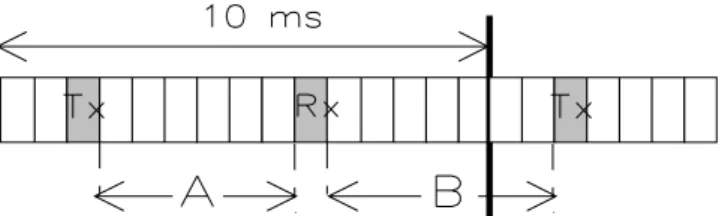
If a single synthesiser UE uses only one uplink and one downlink slot, e.g. for speech communication, the UE is not in transmit or receive state during 13 slots in each frame. According to the timeslot numbers allocated to the traffic, this period can be split into two continuous idle intervals A and B as shown in the figure below.
Figure A.1: Possible idle periods in a frame with two occupied timeslots
A is defined as the number of idle slots between the Tx and Rx slots and B the number of idle slots between the Rx and Tx slots. It is clear that A+B=13 time slots.
In the scope of low cost terminals, a [0.8] ms period is supposed to be required to perform a frequency jump from UMTS to GSM. This lets possibly two free periods of A*Ts-1.6 ms and B*Ts-1.6 ms during which the mobile station can monitor GSM, Ts being the slot period.
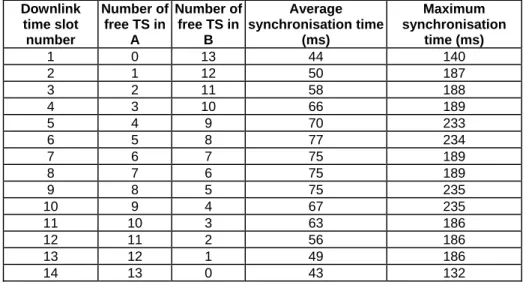
Following table evaluates the average synchronisation time and maximum synchronisation time, where the announced synchronisation time corresponds to the time needed to find the FCCH. The FCCH is supposed to be perfectly detected meaning that the FCCH is found if it is entirely present in the monitoring window. The FCCH being found the SCH location is unambiguously known from that point. All the 13 idle slots are assumed to be devoted to FCCH tracking and the UL traffic is supposed to occupy the time slot 0.
Table A.1: example- of average and maximum synchronisation time with two busy timeslots per frame and with 0.8 ms switching time (*)
Downlink time slot number Number of free TS in A Number of free TS in B Average synchronisation time (ms) Maximum synchronisation time (ms) 1 0 13 44 140 2 1 12 50 187 3 2 11 58 188 4 3 10 66 189 5 4 9 70 233 6 5 8 77 234 7 6 7 75 189 8 7 6 75 189 9 8 5 75 235 10 9 4 67 235 11 10 3 63 186 12 11 2 56 186 13 12 1 49 186 14 13 0 43 132
(*) All simulations have been performed with a random initial delay between GSM frames and UMTS frames. Each configuration of TS allocation described above allows a monitoring period sufficient to acquire synchronisation.
A.1.1
Higher data rate traffic using more than 1 uplink and/or 1
downlink TDD timeslot
The minimum idle time to detect a complete FCCH burst for all possible alignments between the GSM and the TDD frame structure (called ‘guaranteed FCCH detection’), assuming that monitoring happens every TDD frame, can be calculated as follows (tFCCH = one GSM slot):
26
ms
35
2
13
ms
10
2
min, guaranteed
=
×
t
synth+
t
FCCH+
=
×
t
synth+
t
- (e.g for tsynth =0ms: 3 TDD consecutive idle timeslots needed, for tsynth =0,3ms: 3 slots, for tsynth =0,5ms: 4 slots,
for tsynth =0,8ms: 5 slots). Under this conditions the FCCH detection time can never exceed the time of 660ms.
- (For a more general consideration tsynth may be considered as a sum of all delays before starting monitoring is
possible).
- For detecting SCH instead of FCCH (for a parallel search) the same equation applies.
Table A.2: FCCH detection time for a dual synthesizer UE monitoring GSM from TDD every TDD frame FCCH detection time in ms occupied slots= 15-idle slots cases Average maximum 2 105 37 189 3 455 46 327 4 1365 58 419 5 3003 72 501 6 5005 90 646 7 6435 114 660 8 6435 144 660 9 5005 175 660 10 3003 203 660 11 1365 228 660 12 455 254 660 13 105 - - 14 15 - -
In the table above for a given number of occupied slots in the TDD mode all possible cases of distributions of these occupied TDD slots are considered (see ‘cases’). For every case arbitrary alignments of the TDD and the GSM frame structure are taken into account for calculating the average FCCH detection time (only these cases are used which guarantee FCCH detection for all alignments; only the non-parallel FCCH search is reflected by the detection times in the table 2).
The term ‘occupied slots’ means that the UE is not able to monitor in these TDD slots.
For a synthesiser switching time of one or one half TDD timeslot the number of needed consecutive idle TDD timeslots is summarized in the table below:
Table A.3: Link between the synthesiser performance and the number of free consecutive TSs for guaranteed FCCH detection, needed for GSM monitoring
One-way switching time for the synthesiser
Number of free consecutive TDD timeslots needed in the frame for a guaranteed FCCH detection
1 TS (=2560 chips) 5
0.5 TS (=1280 chips) 4 0 (dual synthesiser) 3
Annex B (informative):
Change history
Change history
Date TSG # TSG Doc. CR Rev Subject/Comment Old New
14/01/00 RAN_05 RP-99595 - Approved at TSG RAN #5 and placed under Change Control - 3.0.0
14/01/00 RAN_06 RP-99700 001 1 Primary and Secondary CCPCH in TDD 3.0.0 3.1.0
14/01/00 RAN_06 RP-99701 002 1 Block STTD capability for P-CCPCH, TDD component 3.0.0 3.1.0
14/01/00 RAN_06 RP-99700 003 1 Update concerning measurement definitions, ranges and mappings 3.0.0 3.1.0
14/01/00 - - - Change history was added by the editor 3.1.0 3.1.1
31/03/00 RAN_07 RP-000071 004 1 Correction of CPICH measurements and ‘RX Timing Deviation’
range
3.1.1 3.2.0
31/03/00 RAN_07 RP-000071 005 2 Editorial modifications to 25.225 3.1.1 3.2.0
31/03/00 RAN_07 RP-000071 006 1 Corrections to 25.225 Measurements for TDD 3.1.1 3.2.0
26/06/00 RAN_08 RP-000275 009 - Clarifications on TxDiversity for UTRA TDD 3.2.0 3.3.0
26/06/00 RAN_08 RP-000275 010 - Removal of Range/mapping 3.2.0 3.3.0
26/06/00 RAN_08 RP-000275 011 - Removal of transport channel BLER 3.2.0 3.3.0
23/09/00 RAN_09 RP-000348 012 1 Alignment of TDD measurements with FDD : GPS related
measurements
3.3.0 3.4.0
23/09/00 RAN_09 RP-000348 013 1 Alignment of TDD measurements with FDD :SFN-CFN observed
time difference
3.3.0 3.4.0
23/09/00 RAN_09 RP-000348 014 - Clarification of the Timeslot ISCP measurements 3.3.0 3.4.0
23/09/00 RAN_09 RP-000348 015 - Terminology regarding the beacon function 3.3.0 3.4.0
23/09/00 RAN_09 RP-000348 016 - Removal of Physical Channel BER 3.3.0 3.4.0
23/09/00 RAN_09 RP-000348 017 - Update of TS25.225 due to recent change for FDD: Reporting of
UTRAN TX carrier power
3.3.0 3.4.0
15/12/00 RAN_10 RP-000545 018 2 Corrections and Clarifications to 25.225 3.4.0 3.5.0
15/12/00 RAN_10 RP-000545 019 1 Corrections and Clarifications to 25.225 3.4.0 3.5.0
15/12/00 RAN_10 RP-000545 020 1 Clarification of measurement reference points 3.4.0 3.5.0
15/12/00 RAN_10 RP-000545 021 - Removal of incorrect note relating to RSCP measurements 3.4.0 3.5.0
16/03/01 RAN_11 RP-010066 023 - Correction of the observed time difference to GSM measurement 3.5.0 3.6.0
15/06/01 RAN_12 RP-010339 026 1 Addition to the abbreviation list 3.6.0 3.7.0
15/06/01 RAN_12 RP-010339 028 - Renaming of LCS measurements 3.6.0 3.7.0
21/09/01 RAN_13 RP-010526 033 - Clarification of the Beacon Measurement in TS25.225 3.7.0 3.8.0
14/12/01 RAN_14 RP-010743 035 1 Removal of references to Block STTD 3.8.0 3.9.0
14/12/01 RAN_14 RP-010743 039 - Correction of measurement definition for UTRA carrier RSSI and
CPICH_Ec/No
3.8.0 3.9.0
07/06/02 RAN_16 RP-020312 046 2 Clarification of UE measurements Applicability 3.9.0 3.10.0
20/09/02 RAN_17 RP-020558 059 - Correction of UE SFN-SFN type 1 measurement for TDD 3.10.0 3.11.0
24/06/03 RAN_20 RP-030365 072 - Correction of transmitted carrier power definition in case of Tx diversity