Escape Mutants of Severe Acute Respiratory Syndrome Coronavirus
Mridula Rani,aMeagan Bolles,fEric F. Donaldson,eThomas Van Blarcom,bRalph Baric,eBrent Iverson,a,cand George Georgioua,b,d
Institute of Cellular and Molecular Biology,aDepartment of Chemical Engineering,bDepartment of Chemistry and Biochemistry,cand Department of Molecular Genetics and Microbiology,dThe University of Texas at Austin, Austin, Texas, USA; Department of Epidemiology, School of Public Health, University of North Carolina at Chapel Hill, Chapel Hill, North Carolina, USAe; and Department of Microbiology and Immunology, University of North Carolina at Chapel Hill, Chapel Hill, North Carolina, USAf
Even though the effect of antibody affinity on neutralization potency is well documented, surprisingly, its impact on
neutraliza-tion breadth and escape has not been systematically determined. Here, random mutagenesis and DNA shuffling of the
single-chain variable fragment of the neutralizing antibody 80R followed by bacterial display screening using anchored periplasmic
expression (APEx) were used to generate a number of higher-affinity variants of the severe acute respiratory syndrome
coronavi-rus (SARS-CoV)-neutralizing antibody 80R with equilibrium dissociation constants (
K
D) as low as 37 pM, a
>
270-fold
improve-ment relative to that of the parental 80R single-chain variable fragimprove-ment (scFv). As expected, antigen affinity was shown to
corre-late directly with neutralization potency toward the icUrbani strain of SARS-CoV. Additionally, the highest-affinity antibody
fragment displayed 10-fold-increased broad neutralization
in vitro
and completely protected against several SARS-CoV strains
containing substitutions associated with antibody escape. Importantly, higher affinity also led to the suppression of viral escape
mutants
in vitro
. Escape from the highest-affinity variant required reduced selective pressure and multiple substitutions in the
binding epitope. Collectively, these results support the hypothesis that engineered antibodies with picomolar dissociation
con-stants for a neutralizing epitope can confer escape-resistant protection.
C
oronavirus-mediated severe acute respiratory syndrome
(SARS) emerged from zoonotic reservoirs and caused
epi-demic disease outbreaks in late 2002 and early 2003 that posed a
threat to public health worldwide. The disease is characterized by
a rapidly progressive atypical pneumonia, and the causative agent
was identified as a novel group 2b coronavirus (SARS-CoV) (
16
).
Though the disease is now largely contained, a few sporadic cases
were reported in late 2003 and 2004 that were caused by different
isolates of SARS-CoV (
15
).
SARS-CoV is an enveloped, single-stranded positive-sense
RNA virus that infects the host cell via the binding of the spike (S)
glycoprotein of the viral envelope to the ACE2
(angiotensin-con-verting enzyme 2) receptor of the host cell (
3
,
13
). The
receptor-binding domain (RBD), a 193-amino-acid fragment located in the
S1 region of the S protein, is responsible for the initial binding
event (
3
). Sequence analyses of different SARS-CoV isolates have
revealed that the RBD is subject to strong selective pressure by
antibody immune responses in the host. Amino acid substitutions
within the RBD have played a major role in the ability of
SARS-CoVs to overcome the species barrier, initially allowing
animal-to-human transmission and subsequent adaptation to
transmis-sion among humans (
39
).
The high immunogenicity of the S protein as well as its crucial
role in the recognition of the host cell receptor and the initiation of
infection has made it an important target for both vaccine and
therapeutic development (
3
). Several monoclonal antibodies
(MAbs) to the S protein have been developed and shown to
pro-tect against SARS-CoV infection
in vitro
(
18
,
32
). Additionally, a
variety of neutralizing antibodies (
7
,
20
,
27
,
44
) have been shown
to confer protection in a mouse model. The best characterized of
these neutralizing antibodies, 80R, was isolated from a large naïve
human single-chain variable fragment (scFv) library using phage
display. 80R binds the S protein with a reported equilibrium
dis-sociation constant (
K
D) equal to 32 nM while recognizing a
con-formational epitope that overlaps the RBD in the S1 domain (
28
).
However, antibody-mediated selective pressure
in vitro
is known
to result in antigenic drift within the RBD, leading to the
accumu-lation of mutations that abolish neutralization by 80R (
26
).
Various strategies have been explored for developing broadly
neutralizing antibodies that can both protect against
heterovari-ant SARS-CoV strains present in the natural reservoirs and hinder
the generation of escape mutants when the virus is challenged with
the neutralizing antibody. Rockx et al. and ter Meulen et al.
achieved broader neutralization against SARS-CoV escape
mu-tants using a combination of two monoclonal antibodies that
rec-ognize nonoverlapping neutralizing epitopes on the S protein (
20
,
29
). Rockx et al. were successful in isolating four broadly
neutral-izing antibodies from human memory B cells that neutralized
both zoonotic and human strains, and a cocktail of these
antibod-ies was proposed as a means for providing better protection
against infection (
21
). However, the development of a therapeutic
strategy comprising two or more recombinant antibodies raises
serious practical concerns. As an alternative, Sui and coworkers
engineered variants of the 80R scFv by structure-guided
random-ization of key residues in the V
light chain. The resulting library
was screened by phage display toward the S protein RBD
contain-ing the dominant mutations found in escape variants (D480A or
D480G) from human SARS-CoV isolates (
26
). Two antibody
vari-ants, fm6 and fm39, were shown to be broadly neutralizing in an
in
vitro
neutralization assay with pseudotyped virus containing the
Received1 February 2012Accepted6 June 2012
Published ahead of print13 June 2012
Address correspondence to George Georgiou, [email protected].
Copyright © 2012, American Society for Microbiology. All Rights Reserved.
Tor2 or GD03 strain RBD or the D480A or D480G mutation.
These broadly neutralizing antibodies exhibited 10-fold-lower
af-finity than 80R for the Tor2 strain RBD, but unlike 80R, they also
bound RBD (D480A) and RBD (D480G) with nanomolar affinity.
The results of Sui et al. (
26
) revealed that
in vitro
selections can be
used to engineer broadly neutralizing antibodies; however, they
are predicated upon knowledge of the relevant escape mutations
and the availability of the respective protein variants required for
panning experiments.
It is well established that the potency of neutralizing antibodies
for either viruses or bacterial toxins depends on affinity (
17
,
35
,
36
). Surprisingly, engineering antibodies with increased affinity
has not been investigated as a strategy for conferring broader
pro-tection as a means to hinder escape. A higher antigen affinity
re-sults from a higher
⌬
G
binding. While antibody-antigen interactions
are often dominated by interactions with a binding “hot spot” on
the antigen, a high
⌬
G
bindingcan also arise from additional
inter-actions between the epitope and the paratope (
14
). Accordingly,
we hypothesized that increasing the affinity of 80R for the RBD
can elicit broader neutralization. Variants of the 80R scFv
anti-body fragment exhibiting up to 280-fold-higher affinity for the
RBD were generated by random mutagenesis and screening using
Escherichia coli
display by anchored periplasmic expression
(APEx) (
9
). As expected,
in vitro
neutralization potency against
the icUrbani strain correlated directly with affinity. Importantly,
neutralization of viruses containing the RBD D480A or D480Y
mutation that evaded neutralization by 80R (
28
) also correlated
with affinity. Only reduced selective pressure with lower
concen-trations of the high-affinity antibody led to the evolution of
SARS-CoV escape mutants, which contained, in addition to D480Y or
D480A, secondary amino acid substitutions within the 80R
epitope.
MATERIALS AND METHODS
Bacterial strains and plasmids.Escherichia coliJude1 (DH10B F::Tn10) cells (8) were used for all the cloning and protein expression experiments reported here. Plasmid pAPEx1 was used forN-terminal APEx display of scFv and the construction of scFv libraries (9). pMopac16 contains apelB
leader followed by SfiI sites used for cloning the scFv gene, a human kappa light-chain constant domain for single-chain-antibody-fragment (scAb) expression, a C-terminal 6-histidine tag for purification, and the Skp chaperone to aid soluble-protein expression in the periplasmic space (10). Viruses and cells. Recombinant viruses icUrbani (AY278741), icGD03-MA, and icHC/SZ/61/03 were propagated in Vero E6 cells (22, 24,38). Vero E6 was maintained in minimal essential medium (MEM) (Invitrogen, Carlsbad, CA) supplemented with 10% Fetal Clone II (Hy-Clone, South Logan, UT) and gentamicin and kanamycin (UNC Tissue Culture Facility). Growth curves were performed in Vero E6 with the different wild-type or mutant recombinant-derived escape mutant vi-ruses at a multiplicity of infection (MOI) of 0.1 for 1 h and overlaid with medium. Virus samples were collected at various time points postinfec-tion and stored at⫺70°C until viral titers were determined by plaque assay.
Virus titers were determined as PFU by plating 6-well plates with 5⫻ 105Vero E6 cells per well and inoculating cultures with 200l from the 10-fold serial dilutions. Cells were incubated with the virus for 1 h at 37°C and overlaid with 3 ml of 0.8% agarose in complete medium. Plates were incubated for 2 days at 37°C, and plaques were visualized by staining with neutral red for 3 to 6 h. Virus concentration was calculated as PFU/ml. All virus work was performed in a class II biological safety cabinet in a certi-fied biosafety level 3 laboratory containing redundant exhaust fans; work-ers wore Tyvek suits and powered air-purifying respirators.
Construction of an scFv library.The 80R single-chain antibody gene (27) was constructed by overlap extension PCR (25). The heavy- and light-chain variable regions of the antibody were amplified by PCR, and a (Gly4Ser)4 linker was introduced by overlap extension PCR. The ampli-fied 80R scFv PCR product was digested with SfiI and cloned into the SfiI-digested pAPEx1 vector (9) for bacterial display. The 80R scFv gene was subjected to random mutagenesis by error-prone PCR using standard protocols (6). A library of 1.6⫻108independent transformants was ob-tained. Sequencing of 10 random clones revealed a nucleotide substitu-tion rate of 1.3%.
Cloning, expression, and purification of receptor-binding domain. A gene encoding the S protein of the SARS-CoV Urbani strain (AY278741) was generously provided by S. Makino (UTMB-Galveston) and used to amplify the receptor-binding domain (RBD), consisting of amino acids 318 to 518. The RBD was cloned into pFastbac vector (Invit-rogen) with the N-terminal honeybee melittin signal sequence (30) for secretion in insect cells, a C-terminal FLAG tag for screening, and an N-terminal 6-His tag for purification. Bacmid DNA was prepared and transfected into SF9 cells by using a Bac-Bac system (Invitrogen) accord-ing to the manufacturer’s instructions to generate and amplify baculovi-rus particles, and the titers were determined by following the Bac-Bac protocol. High Five cells (Invitrogen) were cultured in insect Xpress me-dium (Cambrex, Walkersville, MD) supplemented with 10% fetal bovine serum (Sigma) and penicillin and streptomycin (Sigma) at 27°C as a monolayer. To produce the RBD, insect cells were seeded at a density of 106/ml in 250 ml of medium and infected at a multiplicity of infection of 5 with recombinant RBD baculovirus. Media were harvested after 90 h, and the culture supernatant was dialyzed against 1⫻IMAC (immobilized metal affinity chromatography) buffer (10 mM Tris-HCl, 0.5 M NaCl [pH 8.0]) at 4°C. Following dialysis, the culture supernatant containing the RBD was incubated with 1 ml of nickel-nitrilotriacetic acid (Ni-NTA) agarose (Qiagen, Hilden, Germany) for 2 h at 4°C. The mixture was then loaded onto a 5-ml column and washed with 10 column volumes of 1⫻ IMAC buffer. Protein was eluted with 3 column volumes of 1⫻IMAC buffer with 300 mM imidazole. The protein eluate was further purified on a Superdex-200 (GE Healthcare) size exclusion column via fast protein liquid chromatography (FPLC). Protein samples were analyzed for purity on a 4 to 20% polyacrylamide gel (NuSep, Lawrenceville, GA) and stained with Coomassie blue.
Screening and selection of high-affinity scFv variants by APEx.E. colistrain Jude1 cells transformed with the 80R scFv library in the pAPEx1 vector were used to inoculate shake flasks containing 20 ml of Terrific broth (TB) medium (Difco, Sparks, MD) supplemented with chloram-phenicol (Cm) at 35g/ml to an optical density at 600 nm (OD600) of 0.1. Cells were grown at 37°C with shaking until the OD600reached 0.5, at which point cultures were transferred to a 25°C shaker for 30 min. Protein synthesis was induced with isopropyl--D-thiogalactopyranoside (IPTG)
re-sorted immediately. scFv genes in the re-sort solution were amplified by PCR, cloned into the pAPEx1 vector, transformed into cells, and plated on agar plates. The resulting clones were then subjected to an additional three rounds of sorting as described above, except that decreasing concen-trations of the RBD were used to increase the stringency of sorting as follows: 100 nM in the first round, 50 nM in the second, 25 nM in the third, and 20 nM in the final round.
After the fourth round of sorting via FACS, genes were rescued by PCR and cloned into pMopac16 (11) for soluble expression. For high-through-put off-rate screening based on dissociation rate constants, colonies were inoculated into a 96-well seed plate containing 200l of TB with 2% glucose and 200g/ml ampicillin per well. After overnight growth at 37°C with shaking, 20l of the culture from each well was used to inoculate fresh 96-well plates with the same growth medium. The seed plate was stored with 15% glycerol at⫺20°C for future use. After overnight growth at 37°C with shaking, cultures were pelleted by centrifugation at 4,500 rpm for 10 min. The medium was discarded; the cell pellets were resus-pended in 200l of expression medium (TB with 200g/ml ampicillin and 1 mM IPTG) and then incubated at 25°C for 3 h. The cells were pelleted again by centrifugation at 4,500 rpm for 10 min, resuspended in 200l of lysis buffer (20% BugBuster HT-Novagen in HBS-EP buffer), and incubated with shaking at room temperature for 2 h. The lysates were centrifuged to precipitate the insoluble fraction, and the lysate superna-tant was transferred to a 96-well multiscreen HTS filter plate (Millipore, Billerica, MA), set on a collection plate, and centrifuged for 10 min, and clarified filtrate was collected in a 96-well collection plate. The clarified filtrate was used forkoffdetermination by surface plasmon resonance (SPR) analysis using a BIAcore 3000 instrument (GE Healthcare, Uppsala, Sweden) as follows: purified RBD was first covalently immobilized in 10 mM sodium acetate (pH 5.9) on a CM5 sensor chip (carboxymethylated dextran matrix; GE Healthcare, Uppsala, Sweden) by using 1-ethyl-3-(3-dimethylaminopropyl) carbodiimide–N-hydroxysuccinimide chemistry to the level of 300 response units (RUs). Bovine serum albumin (BSA) was similarly coupled to the chip as an in-line subtraction standard. Kinetic analysis was performed in HBS-EP buffer (GE Healthcare, Uppsala, Swe-den) at a flow rate of 25l/min at 25°C. Samples were injected over the immobilized RBD for 2 min followed by a 5-min dissociation phase. The surface was regenerated by injection of 10l of 4 M MgCl2at a 50l/min flow rate. Dissociation kinetics were calculated using BIAevaluation soft-ware, and clones with the lowest off rates compared to that of 80R were selected for further analysis.
Shuffling and random mutagenesis of isolated clones for additional screening.The four highest-affinity scFv genes isolated from the off-rate analysis described above, along with the 80R scFv gene, were chosen for DNA shuffling. The four isolated genes were first amplified individually by PCR, and the DNA products were pooled with a 4-fold molar excess of 80R scFv and then digested with 0.125 U of DNase I (Roche, Germany) per 3g of DNA at room temperature for 30 min. The reaction was stopped by heat inactivation at 80°C for 10 min, and DNase I digest frag-ments of 50 to 100 bp were gel purified using a QIAEX II (Qiagen) gel extraction kit. The DNA fragments were reassembled by PCR for a few rounds without primers; then full-length DNA was amplified using exter-nally flanking primers encoding SfiI sites. DNA was separated by agarose gel electrophoresis, and a band⬃750 bp in length was excised, gel purified using the Qiagen gel extraction kit (Qiagen), digested with SfiI, and then ligated to SfiI-digested pAPEx1 vector. Following electroporation, 5.4⫻ 107transformants were obtained, and DNA sequencing of 10 clones se-lected at random revealed the presence of recombination events as ex-pected. PCR product after the assembly was also used as a template for error-prone PCR as described above, and the DNA product from that reaction was cloned into pAPEx1 vector to generate a library of 1.5⫻107 transformants with a nucleotide substitution rate of 0.5%.
The shuffled library and the error-prone library were pooled and sub-jected to three rounds of FACS screening as described above. The concen-tration of the RBD used for labeling was reduced in successive rounds as
follows: 20 nM for the first round, 10 nM for the second round, and 5 nM for the final round. After the final round of sorting, scFv genes were PCR amplified and subcloned into pMopac16. Subsequently, 96 colonies were inoculated for high-throughput screening, cell lysates were prepared, and dissociation rate constants were measured using SPR as described above. Expression and purification of single-chain antibody fragments (scAbs).Antibody fragments were expressed as scAbs by inserting the scFv genes into pMopac16 vector, a pAK400 derivative in which the scFv is fused in frame to a C-terminal human kappa light-chain constant do-main.
Antibody fragments were expressed inE. coliJude1 (DH10BF::Tn10) (11). Individual colonies were inoculated into 50 ml TB medium with 200
g/ml ampicillin and 2% glucose and were grown overnight at 37°C. Overnight cultures were used to inoculate 500 ml of TB medium with 200
g/ml ampicillin, and the cells were grown at 37°C for 3 h. Cultures were transferred to 25°C for 30 min, and protein expression was induced with 1 mM IPTG. After 4 h of incubation at 25°C, cells were collected by centrif-ugation, and protein was purified from the osmotic shock fraction (11). Briefly, cells were resuspended in 12 ml of ice-cold Tris-sucrose solution (0.75 M sucrose, 100 mM Tris [pH 8]) with the addition of 1 ml of 30
g/ml lysozyme in Tris-sucrose buffer. Cells were gently mixed for 10 min at 4°C, and 24 ml of 1 mM EDTA was added dropwise and allowed to mix for an additional 20 min at 4°C. A 1.7-ml portion of 0.5 M MgCl2was added, and the mixture was incubated further for 10 min. The samples were centrifuged at 12,000 rpm for 15 min, and the resulting supernatant was dialyzed against 1⫻IMAC buffer (10 mM Tris-HCl, 0.5 M NaCl [pH 8.0]). ScAbs were purified from the supernatant by IMAC using Ni-NTA agarose according to the manufacturer’s protocol (Qiagen, Hilden, Ger-many), followed by size exclusion FPLC on Superdex 200 (GE Healthcare) as described above. The purity of isolated scAb was verified by gel electro-phoresis on a 4 to 20% SDS-PAGE gel (NuSep, Lawrenceville, GA) stained with Coomassie blue.
To remove the endotoxin from the purified scAbs forin vitro neutral-ization assays, the purified protein samples were passed three times through Detoxi-gel endotoxin removal columns (Pierce, Rockford, IL) according to the manufacturer’s instructions. The endotoxin levels in the samples were measured by the limulus amebocyte lysate (LAL) assay (As-sociates of Cape Cod, East Falmouth, MA) as described by the manufac-turer.
BIAcore analysis for affinity measurement.The purified RBD was immobilized on aCM5 chip as described above, and BSA was used as in-line subtraction. Kinetic analysis was performed in HBS-EP buffer at a flow rate of 50l/min at 25°C. The affinity of the FPLC-purified scAbs was analyzed by injecting the samples over the chip for 1 min for the associa-tion phase followed by 10 min dissociaassocia-tion. Five different concentraassocia-tions of antibodies from 9 nM to 36 nM were analyzed in duplicate, along with a blank as a reference. The surface regeneration was performed with a 12-s injection of 4 M MgCl2. Binding kinetics were calculated using BIA eval-uation software (GE Healthcare, Uppsala, Sweden). Calculated fits were based on the Langmuir 1:1 model, with2values below 1.
Isolation of escape mutants under neutralizing antibody selective pressure.icUrbani (1⫻106PFU) was incubated with 20g of a neutral-izing scAb (RSK, SK4, or 80R) in a 200-l volume for 30 min and then inoculated onto VeroE6 cells in the presence of the respective scAb anti-body fragment at a concentration of 20g/ml. The development of cyto-pathic effect (CPE) was monitored over 72 h, and progeny viruses were harvested. Antibody treatment was repeated two additional times, and more rapid CPE was noted with each passage. The viruses from passage 4 were plaque purified in the presence of antibody; neutralization-resistant viruses were stored at⫺80°C, and titers were determined on VeroE6 cells as described above. The S glycoprotein genes from four individual plaques for each experiment were sequenced, and the neutralization titers between wild type and antibody-resistant viruses were determined as described below.
ex-tinction of parent viruses on three separate occasions. To increase the probability of escape mutant evolution, we incubated 1⫻106PFU of icUrbani with decreasing concentrations of SK4 ScAb antibody fragment (15, 10, 5, and 1g) for 30 min and then infected cultures in the presence of 5g/ml SK4 antibody. Depending on treatment conditions, cytopa-thology either was evident within 48 h (5- and 1-g doses) or was minimal after 4 days (15 and 10g). Low-dose-SK4-treated progeny viruses (1-and 5-g doses) were treated with 5g of SK4 for two passages and then selected with two additional treatments of 10- and 15-g doses each, resulting in highly antibody-resistant viruses that produced extensive CPE in cultures within 24 to 36 h. High-dose-treated stocks were passaged once in the absence of antibody (pass 2) to restore virus titers and then rese-lected twice in the presence of 5g antibody. Two final treatments of 10 and 15g of SK4 antibody resulted in highly resistant populations that rapidly produced CPE in culture. Two to four plaques were isolated from each treatment regimen (9 plaques total) in the presence of 20g SK4 antibody, and the S glycoprotein gene was sequenced.
Plaque reduction neutralization test (PRNT).Each scAb in the panel (80R, RSK, RS2, and SK4) was serially diluted 1:2 in PBS starting at 30
g/ml. Wild-type icUrbani, icGD03-MA, and icHC/SZ/61/03 were di-luted, and approximately 100 PFU of each was added to the scAb dilution series for 30 min at 37°C. The percentage neutralization was calculated as [100⫺(number of plaques with antibody/number of plaques without antibody)] ⫻ 100. For 50% plaque reduction neutralization titers (PRNT50s) of single-substitution variants, the viruses were diluted to 100 PFU and added to 2-fold serial dilutions of SK4 starting at 5g/ml. The single-substitution variants are escape mutants developed against mono-clonal antibodies, as previously described (L443R and T332I [21] and D480G [26]) or as described above (Y436H, Y442S, and N479I).
RESULTS
Generation of high-affinity variants of the 80R scFv antibody.
The RBD fused to a C-terminal FLAG peptide epitope
(RBD-FLAG) was produced in High Five insect cells, with a yield of
approximately 1.2 mg/liter. RBD-FLAG was purified to
⬎
95%
homogeneity and was shown to bind to the 80R scAb (an scFv
fragment fused to a human C
chain for improved expression and
stability) with a dissociation constant in the nanomolar range,
consistent with earlier reports (
27
).
The 80R scFv library was expressed as a fusion to the signal
peptide and the first 6 amino acids of NlpA using the pAPEx1
vector. The short NlpA fusion anchors the scFv on the outer side
of the
E. coli
inner membrane (
9
). Following spheroplast
forma-tion, a limiting amount of labeled antigen (RBD-FLAG) was
added, followed by the addition of anti-FLAG PE; then screening
by FACS led to enrichment in higher-affinity variants. Around 5%
of the spheroplasts with the highest fluorescence were collected
and re-sorted. The scFv genes from the sorted cells were rescued
by PCR amplification and cloned back into pAPEx1. After three
additional rounds of sorting with decreasing concentrations of
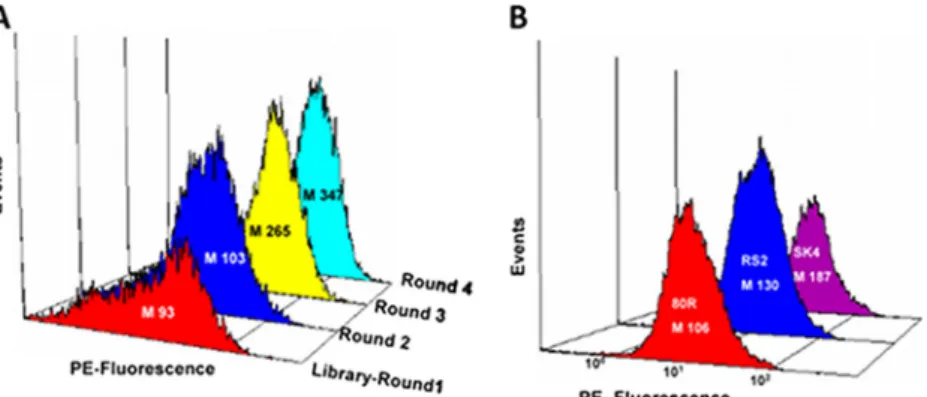
RBD-FLAG from 100 nM to 20 nM (
Fig. 1A
), scFv genes were
rescued by PCR and expressed as soluble scAb antibody fragments
for biochemical analysis.
A total of 88 randomly picked colonies from round 4, as well as
8 colonies of cells expressing 80R scAb as controls, were grown in
a 96-well plate. Following chemical lysis, the
k
offrate constants of
the scAb proteins in the lysates were rank ordered by surface
plas-mon resonance (SPR) analysis. Four scAb antibody fragments
dis-playing the lowest antigen dissociation rates were expressed and
purified to near homogeneity by IMAC followed by gel filtration
FPLC. SPR analysis revealed that all the isolated scAbs exhibit
significantly lower
K
Dvalues for RBD binding than the 80R
anti-body fragment and that the improvements in
K
Dvalues arose
primarily because of lower
k
offvalues (
9
). The
K
Dvalues of the
scAb variants ranged from 0.86 nM to 0.05 nM, with the
highest-affinity clone, RS2, exhibiting a
k
offof 1.34
⫻
10
⫺4s
⫺1(
Table 1
).
This represents a
⬎
200-fold improvement in affinity relative to
80R (
K
D⫽
10.5 nM).
Sequence analysis of the isolated clones revealed a variety of
mutations distributed over the entire length of the scFv gene (5 to
8 amino acid substitutions per gene). Most of the amino acid
substitutions were present in the framework regions, with only
one consensus mutation, S167N, being observed in the CDR1
light chain of all four clones (data not shown). S167 is located at
the interface of the cocrystal of the 80R-RBD complex (
12
),
indi-FIG 1Comparison of fluorescence histograms.E. colispheroplasts were labeled with 20 nM RBD, and binding was detected with 200 nM anti-FLAG PE. (A)
Mean fluorescence intensity (M) ofE. colispheroplast clones recovered after three successive rounds of sorting compared to a library of random mutants of the 80R scFv. (B) Mean fluorescence intensity (M) ofE. colicells expressing the RS2 and SK4 scFvs compared to 80R scFv.
TABLE 1Equilibrium dissociation constant values (KDs) of scAbs with
RBD, as measured by SPR analysis
Clonea k
a(1/Ms) kd(1/s) KD(nM)
Fold difference
80R 1.50⫻106⫾0.06 1.60⫻10⫺3⫾0.001 10.5⫾0.09 1 RS2 2.69⫻106⫾0.12 1.34⫻10⫺4⫾0.43 0.05⫾0.01 210 SK4 2.03⫻106⫾0.8 6.91⫻10⫺5⫾0.9 0.037⫾0.01 270 RSK 1.73⫻105⫾0.009 1.91⫻10⫺4⫾0.4 0.11⫾0.03 95 a
cating its possible involvement in RBD binding. The significance
of this mutation was recently highlighted by the studies of Sui and
coworkers (
26
), who reported that an S167N substitution in 80R is
important for broad neutralization of SARS-CoV icUrbani strain
escape variants containing a D480A or D480G mutation.
The four high-affinity clones described above, together with
the parental antibody 80R, were subjected to
in vitro
recombina-tion by DNA shuffling followed by random mutagenesis using
error-prone PCR. In DNA shuffling reactions, the 80R scFv was
used at a 4-fold molar excess in order to reduce the number of
neutral mutations. Two libraries were constructed, a shuffled
li-brary comprising 5.4
⫻
10
7transformants and an error-prone
library of 1.5
⫻
10
7transformants. The libraries were pooled and
screened by APEx with antigen concentrations starting at 20 nM
in the first round and decreasing to 5 nM in the third and final
round. The antigen dissociation rate constants for 80 clones from
the third round were analyzed by SPR analysis, and two clones
with lower off rates were identified. SPR analysis of the purified
monomeric scAb protein from the highest-affinity clone, SK4,
yielded a
K
Dvalue of 37 pM and a
k
offof 6.91
⫻
10
⫺5s
⫺1(
Fig. 1B
;
Table 1
). Overall, the SK4 antibody fragment displayed 270-fold
higher affinity than 80R and contained eight amino acid
substitu-tions, including three mutations in common with RS2: N57S,
S167N, and S188N (
Fig. 2
).
To determine the role of the N57S, S167N, and S188N amino
acid substitutions in affinity enhancement, the respective
muta-tions were introduced into the 80R scAb by site-directed
mu-tagenesis to construct a variant referred to as RSK (
Fig. 2
). SPR
analysis of the RSK antibody fragment revealed a
K
Dvalue of 110
pM, indicating that some or all of these three amino acid
substi-tutions confer affinity improvement (
Fig. 2
;
Table 1
).
SARS CoV neutralization and escape.
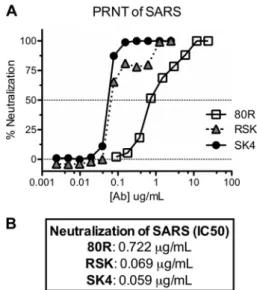
To evaluate the
neutral-izing ability of the purified 80R, SK4, and RSK scAbs, we
con-ducted plaque reduction neutralization titer assays with each of
the scAbs against SARS-CoV (icUrbani). As expected, the
neutral-ization potencies of the antibodies increased according to affinity.
Compared to 80R (IC
50, 0.722
g/ml), both RSK and SK4
exhib-ited 10-fold-greater neutralization (IC
50, 0.069
g/ml and 0.059
g/ml, respectively) (
Fig. 3
). For antibodies 80R and RSK,
in vitro
FIG 2Sequence comparison of the engineered, high-affinity variants RS2, SK4, and RSK with parental 80R scFv. Single-chain antibody fragments were
constructed in the variable heavy (VH)–linker–variable light (VL) orientation.
FIG 3Neutralization activity of the SK4 and RSK scAbs in comparison to 80R.
neutralization escape mutants of the icUrbani strain emerged
after three passages in cell culture, and four plaques for each
antibody were picked for sequence analysis. Three of the four
80R escape mutants carried a mutation from aspartic acid to
alanine at position 480 (D480A), and one had a mutation of
aspartic acid to tyrosine (D480Y), replicating the D480 residue
identified by previous selection with the full IgG version of this
antibody (
26
,
28
). In the case of the RSK antibody, three of the
four escape variants had the D480Y mutation and one had a
Y436H mutation (
Table 2
).
Importantly, the SK4 antibody exhibited very high neutralizing
potency, and 20
g was sufficient to completely extinguish 1
⫻
10
6PFU of the parent virus, yielding no escape variants. Therefore,
the initial concentration of SK4 scAb was decreased to reduce the
selective pressure and was incrementally increased over multiple
viral passages. A total of nine plaques were isolated from the final
selection with 20
g SK4 and sequenced.
All nine of the isolated escape mutants contained two
muta-tions: N479I and D480Y (
Table 2
). Both D480 and N479 have
been found to be highly adapted RBD residues that allow specific
binding to hACE2, and mutations at these positions decrease their
affinity for hACE2 and hence infectivity (
37
). D480 has been
shown to have a critical role in the binding of the parental
anti-body 80R to the RBD (
12
,
28
), and substitution to a tyrosine has
been shown not to affect the binding of the RBD (and therefore
the virus) to the human ACE2 receptor (
34
). The mutation N479I
had been found in bananin-resistant virus, and this position is
found to correspond to a highly variable site in the RBD (
33
).
Cross neutralization studies with mutant viruses encoding
ei-ther D480A or D480Y, which mediated escape from 80R and its
derivatives, were performed with all three antibodies (
Fig. 4
).
Im-portantly, SK4 successfully neutralized both escape mutants,
sug-gesting an enhanced role for high affinity in overcoming the effect
of D480 substitutions. We note, however, that none of the scAbs
could neutralize the civet strain icHC/SZ/61/03 or the
mouse-adapted variant of the human 03/04 strain, icGD03MA; the latter
strain carries a Y436H mutation associated with increased mACE2
receptor usage (
1
,
19
) (data not shown). The spike proteins of
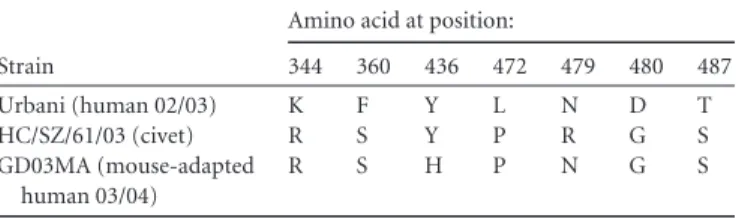
GD03 MA and HC/SZ/61/03 each differ from that of the
icUrbani strain at six other amino acid positions within the
RBD (
Table 3
), and evidently, at least some of these are critical
for antibody binding.
To further assess the breadth of SK4 neutralization, we tested
SK4 neutralization against several viruses that emerged as escape
variants to other monoclonal antibodies reported earlier (
21
,
26
).
These viruses contained single substitutions in the RBD, both
within and outside the 80R/SK4 interface. Two escape variants,
L443R and T332I, were developed under selection with the
broadly neutralizing antibodies s230.15 and s109.8, respectively
(
21
). Residue 443 is a contact interface site with ACE2 but not with
80R, while residue 332 does not directly interface with either 80R
or ACE2. The escape variants Y436H, Y442S, N479I (data not
shown), and D480G emerged following selection with 80R
deriv-ative antibodies and contain substitutions that interface with 80R
and, except for D480G, also interface with the ACE2 receptor (
12
).
SK4 was capable of neutralizing all six of these antibody escape
variants. Three of the escape variants, namely, Y436H, Y442S, and
T332I, were neutralized with an efficacy comparable to that
ob-served with icUrbani (IC
50s of 0.049
g/ml, 0.039
g/ml, and
0.109
g/ml, respectively, compared to 0.059
g/ml for icSARS)
(
Fig. 5
). Importantly, SK4 neutralized three other escape variants,
with IC
50s lower than the IC
50displayed by 80R for icUrbani
[0.234
g/ml (L443R), 0.432
g/ml (N479I), and 0.542
g/ml
(D480G), compared to an IC
50of 0.722
g/ml for 80R with
icUrbani]. Thus, viruses containing amino acid substitutions at
either N479 or D480, which when combined mediated escape
from SK4, were neutralized with a lower IC
50than that of 80R for
icUrbani.
DISCUSSION
SARS was the first new major infectious disease to challenge the
world population in the 21st century (
42
). Though the number of
deaths resulting from the disease was small in comparison to
pre-vious pandemics, such as those caused by plague and influenza,
the widespread fear and resulting travel restrictions resulted in a
global economic cost estimated at 59 billion dollars (
42
). Since the
identification of the virus, significant research effort has been
fo-cused on the development of neutralizing antibodies for use in
both prophylaxis and therapy. Antibodies targeting the RBD
re-gion of the viral spike S protein have been shown to be protective
FIG 4Cross neutralization studies of high-affinity scAbs with escape mutants
with the D480A and D480Y mutations.
TABLE 3Amino acid differences in the RBD of the spike protein
Strain
Amino acid at position:
344 360 436 472 479 480 487
Urbani (human 02/03) K F Y L N D T
HC/SZ/61/03 (civet) R S Y P R G S
GD03MA (mouse-adapted human 03/04)
R S H P N G S
TABLE 2Amino acid changes in the RBD of spike protein found in the
neutralization escape mutants
ScAb Mutation(s)
No. of clones with mutation/ total sequenced
80R D480A 3/4
D480Y 1/4
SK4 N479I⫹D480Y 9/9
RSK D480Y 3/4
in both
in vitro
and in the mouse challenge model by blocking the
viral attachment to the host cell receptor (
27
,
28
,
44
). However,
the SARS-CoV S protein is subject to antigenic drift that has been
documented both in clinical isolates and in escape variants
iden-tified from
in vitro
antibody neutralization experiments. The use
of antibody cocktails consisting of multiple monoclonal
antibod-ies for preventing the evolution of escape mutants is generally
impractical as a therapeutic approach, due to both high cost and
long development times. Alternatively, we show here that
anti-body engineering strategies can be employed to induce broader
neutralization breadth and/or higher potency based on affinity
improvement. Earlier, Sui and coworkers developed broadly
neu-tralizing antibodies by selecting for variants of 80R that could
recognize the RBD D480A or D480G escape mutants as well as
icUrbani (
26
) by relying on
a priori
knowledge of naturally
occur-ring escape mutations in the RBD.
Here we used random mutagenesis and screening using the
bacterial display technique APEx (
9
) to engineer a series of 80R
scFv variants with increased antigen affinity. Variants with
disso-ciation constants (
K
Ds) of 0.86 nM, 50 pM, and 37 pM were
ob-tained, representing a
⬎
270-fold improvement compared to the
parent 80R antibody (
K
Dof 10.5 nM on a BIAcore 3000
instru-ment) (
Table 1
). Only one consensus mutation, S167N, in CDR1
of the light chain, was observed in all of the affinity-improved
variants (
Fig. 2
). Interestingly, S167N was also identified by Sui
and coworkers in all 80R variants selected to bind to RBD(D480A)
or RBD(D480G) and showing broader neutralization (
26
).
How-ever, the S167N-containing variants in that study displayed only a
modest (3-fold) increase in antigen affinity. A structure-based
prediction of the interaction between these antibody variants with
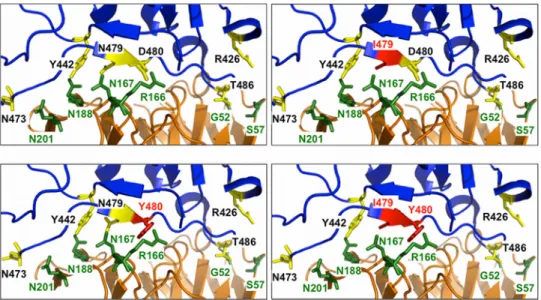
RBD suggests that in wild-type 80R, S167 is proximal to D480 of
the RBD and likely interacts with D480, perhaps through a
hydro-gen-bonded water molecule. The bulkier S167N mutation appears
to preclude the presence of any bound water molecule for steric
reasons. The slightly bulkier Asn likely moves the hydrogen
bind-ing potential away from D480, allowbind-ing a higher-affinity
electro-static interaction between D480 and R166 (
Fig. 6
). Two more
mutations, N57S and S188N, were conserved in the high-affinity
variants RS2 and SK4 (
Fig. 2
). When S167N, N57S, and S188N
were introduced into 80R, the affinity of the resulting antibody,
RSK, increased nearly 100-fold, suggesting that the combination
of all three mutations allows a much better fit to the RBD interface.
In addition to the enhanced binding to D480, the S167N
substi-tution may also mediate direct interactions with N479. Finally,
molecular modeling indicates that the N57S mutation removes
interactions with R426 and T485 of the RBD, suggesting that these
mutations work in concert to allow a better fit to the RBD
inter-face. (
Fig. 6
).
Our
in vitro
neutralization studies have provided compelling
evidence that an antibody engineered with higher affinity can lead
to more potent and broader virus neutralization. In particular, the
SK4 and RSK antibody fragments exhibited markedly higher
neu-tralization potency against the icUrbani strain (
Fig. 3
) than 80R.
In addition, cross neutralization studies revealed that SK4
success-fully neutralized the 80R escape mutants containing either the
D480A or D480Y mutation in the RBD. These mutations probably
eliminate the electrostatic interaction between D480 of the RBD
and R166 of SK4. However, the polar interactions of N167, N188,
and N201 of SK4 with N473, Y442, and N479 of the RBD would
probably be sufficient to preserve strong binding between SK4 and
these mutants (
Fig. 6
).
Individually, the substitutions N479I and D480G each cause a
shift in neutralization that is nonetheless insufficient to escape
SK4, reinforcing the necessity of double substitutions to escape
the high-affinity neutralization by SK4. Additional substitutions
either selected by 80R-derived antibodies or derived
indepen-dently of 80R antibodies are also incapable of providing escape
from SK4. It is worth noting, however, that while SK4 is capable of
neutralizing each of the single-substitution spike variants we
tested, it is unable to neutralize the more divergent spikes, i.e.,
those containing variants in six or seven positions relative to the
icUrbani strain. This suggests that high-affinity neutralizing
anti-bodies like SK4 would provide excellent resistance to escape and
would be best paired with a broadly neutralizing antibody for a
highly effective therapeutic cocktail.
Just as important as neutralization breadth, higher affinity
ap-peared to suppress the formation of viral escape mutants. At a
concentration of 80R that readily gave rise to escape mutants,
incubation with the highest-affinity antibody, SK4, led to no CPE
or viral plaques after multiple attempts. In order to further
under-stand the potential role affinity might play during simulated
in-fection, the anti-RBD antibodies were intentionally used at
sub-neutralizing concentrations in an effort to generate viral escape
mutants. Sequencing revealed that the most common RBD
muta-tion observed in the escape mutants generated by all antibodies
was D480Y. For SK4, the highest-affinity antibody in the study,
escape mutants could be generated only when the concentration
of antibody was reduced further, and it required two mutations in
the RBD: N479I and D480Y. The accumulation of two mutations
for escape from the action of the neutralizing antibody would of
course be expected to be a much more rare event, and thus the
incidence of such escape variants in a therapeutic setting would
likely be low. However, we do note that even SK4 failed to
neu-tralize SARS-CoV HC/SZ/61/03 and GD03MA, presumably
be-cause the RBD in these strains contains multiple mutations that
drastically alter the character of the binding epitope (
Table 3
).
All of the high-affinity 80R variants used in this study were
isolated after just one round of random mutagenesis followed by
DNA shuffling using bacterial display by APEx. This approach
should be equally applicable to new and evolving strains and could
be employed for the generation of SK4 variants that can also
rec-ognize civet and human strains that presently are not neutralized
by this antibody.
A number of studies have established that antibody affinity
plays a critical role in toxin or virus neutralization potency
in vivo
(
17
,
36
). It is thought that during the germinal center reaction in
the immune system, kinetic considerations impose a limit on the
affinity during B-lymphocyte selection, keeping
K
Dvalues in the
range of 1 nM (
5
). Thus, antibodies displaying higher affinities,
with
K
Ds in the picomolar range or lower (
4
), typically must be
generated using
in vitro
mutagenesis and screening techniques.
In a recent study, Zhang et al. used a sequential antigen
pan-ning (SAP) method and successfully isolated broadly
cross-reac-tive antibodies with two- to threefold lower IC
50s than the parent
HIV-1-neutralizing antibody scFv X5 (
41
). Upon further
charac-terization, they found that the highly potent m9 antibody not only
exhibited broad neutralizing activity but also suppressed the
gen-eration of escape mutants upon immune selection (
40
).
Addi-tional studies on broadly neutralizing antibodies to HIV from
memory B cells also suggest that affinity has an important role in
breadth and potency of neutralization (
23
,
31
).
However, one needs to proceed with caution. In the case of
motavizumab, a high-affinity variant of palivizumab (Synagis), a
higher incidence of immunogenicity was seen in phase III clinical
trials that led to discontinuation of its development as a
therapeu-tic agent (
2
,
31
,
43
). Collectively, our results together with
evi-dence from earlier studies support the notion that very
high-af-finity neutralizing antibodies may be particularly useful in a
therapeutic setting and suppress the emergence of escape variants.
ACKNOWLEDGMENTS
This work was supported by the Texas Higher Education Coordinating Board, Norman Hackerman Advanced Research Program (grant 003658-0066-2009), and by the National Institutes of Health (award 1 U01AI078008). R.B. was supported by the National Institutes of Health (R0 1AI085524), and M.B. was supported by the University of North Carolina—Chapel Hill Medical Science Training Program (T32GM008719).
We thank S. Makino, UTMB Galveston, for assistance in some of the early studies related to this work and Sara Sawyer for comments on the manuscript.
REFERENCES
1.Becker MM, et al.2008. Synthetic recombinant bat SARS-like
coronavi-rus is infectious in cultured cells and in mice. Proc. Natl. Acad. Sci. U. S. A.
105:19944 –19949.
2.Cingoz, O.2009. Motavizumab. MAbs1:439 – 442.
3.Du L, et al.2009. The spike protein of SARS-CoV—a target for vaccine
and therapeutic development. Nat. Rev. Microbiol.7:226 –236.
4.Foote J, Eisen HN.2000. Breaking the affinity ceiling for antibodies and
T cell receptors. Proc. Natl. Acad. Sci. U. S. A.97:10679 –10681.
5.Foote J, Winter G. 1992. Antibody framework residues affecting the
conformation of the hypervariable loops. J. Mol. Biol.224:487– 499.
FIG 6Effect of escape mutations on SK4. (Top left) SK4 interacts robustly with RBD via polar interactions involving N167, N188, and N201 of SK4 with N473,
6.Fromant M, Blanquet S, Plateau P.1995. Direct random mutagenesis of gene-sized DNA fragments using polymerase chain reaction. Anal. Biochem.224:347–353.
7.Greenough TC, et al.2005. Development and characterization of a severe
acute respiratory syndrome-associated coronavirus-neutralizing human monoclonal antibody that provides effective immunoprophylaxis in mice. J. Infect. Dis.191:507–514.
8.Griswold KE, et al.2005. Evolution of highly active enzymes by
homol-ogy-independent recombination. Proc. Natl. Acad. Sci. U. S. A.102: 10082–10087.
9.Harvey BR, et al. 2004. Anchored periplasmic expression, a versatile
technology for the isolation of high-affinity antibodies from Escherichia coli-expressed libraries. Proc. Natl. Acad. Sci. U. S. A.101:9193–9198.
10. Hayhurst A.2000. Improved expression characteristics of single-chain Fv
fragments when fused downstream of theEscherichia colimaltose-binding protein or upstream of a single immunoglobulin-constant domain. Pro-tein Expr. Purif.18:1–10.
11. Hayhurst A, et al.2003. Isolation and expression of recombinant
anti-body fragments to the biological warfare pathogen Brucella melitensis. J. Immunol. Methods276:185–196.
12. Hwang WC, et al.2006. Structural basis of neutralization by a human
anti-severe acute respiratory syndrome spike protein antibody, 80R. J. Biol. Chem.281:34610 –34616.
13. Li F, Li W, Farzan M, Harrison SC.2005. Structure of SARS coronavirus
spike receptor-binding domain complexed with receptor. Science309: 1864 –1868.
14. Li Y, Lipschultz CA, Mohan S, Smith-Gill SJ.2001. Mutations of an
epitope hot-spot residue alter rate limiting steps of antigen-antibody pro-tein-protein associations. Biochemistry40:2011–2022.
15. Liang G, et al.2004. Laboratory diagnosis of four recent sporadic cases of
community-acquired SARS, Guangdong Province, China. Emerg. Infect. Dis.10:1774 –1781.
16. Marra MA, et al.2003. The Genome sequence of the SARS-associated
coronavirus. Science300:1399 –1404.
17. Maynard JA, et al.2002. Protection against anthrax toxin by recombinant
antibody fragments correlates with antigen affinity. Nat. Biotechnol.20: 597– 601.
18. Nie Y, et al.2004. Neutralizing antibodies in patients with severe acute
respiratory syndrome-associated coronavirus infection. J. Infect. Dis.190: 1119 –1126.
19. Roberts A, et al.2007. A mouse-adapted SARS-coronavirus causes
dis-ease and mortality in BALB/c mice. PLoS Pathog.3:e5. doi:10.1371/ journal.ppat.0030005.
20. Rockx B, et al.2008. Structural basis for potent cross-neutralizing human
monoclonal antibody protection against lethal human and zoonotic se-vere acute respiratory syndrome coronavirus challenge. J. Virol.82:3220 – 3235.
21. Rockx B, et al.2010. Escape from human monoclonal antibody
neutral-ization affects in vitro and in vivo fitness of severe acute respiratory syn-drome coronavirus. J. Infect. Dis.201:946 –955.
22. Rockx B, et al. 2007. Synthetic reconstruction of zoonotic and early
human severe acute respiratory syndrome coronavirus isolates that pro-duce fatal disease in aged mice. J. Virol.81:7410 –7423.
23. Scheid JF, et al.2009. Broad diversity of neutralizing antibodies isolated
from memory B cells in HIV-infected individuals. Nature458:636 – 640.
24. Sheahan T, et al.2011. Successful vaccination strategies that protect aged
mice from lethal challenge from influenza virus and heterologous severe acute respiratory syndrome coronavirus. J. Virol.85:217–230.
25. Stemmer WP, Crameri A, Ha KD, Brennan TM, Heyneker HL.1995.
Single-step assembly of a gene and entire plasmid from large numbers of oligodeoxyribonucleotides. Gene164:49 –53.
26. Sui J, et al.2008. Broadening of neutralization activity to directly block a dominant antibody-driven SARS-coronavirus evolution pathway. PLoS Pathog.4:e1000197. doi:10.1371/journal.ppat.1000197.
27. Sui J, et al.2004. Potent neutralization of severe acute respiratory
syn-drome (SARS) coronavirus by a human mAb to S1 protein that blocks receptor association. Proc. Natl. Acad. Sci. U. S. A.101:2536 –2541.
28. Sui J, et al.2005. Evaluation of human monoclonal antibody 80R for
immunoprophylaxis of severe acute respiratory syndrome by an animal study, epitope mapping, and analysis of spike variants. J. Virol.79:5900 – 5906.
29. ter Meulen J, et al.2006. Human monoclonal antibody combination
against SARS coronavirus: synergy and coverage of escape mutants. PLoS Med.3:e237. doi:10.1371/journal.pmed.0030237.
30. Tessier DC, Thomas DY, Khouri HE, Laliberte F, Vernet T. 1991.
Enhanced secretion from insect cells of a foreign protein fused to the honeybee melittin signal peptide. Gene98:177–183.
31. Toran JL, et al.2001. Improvement in affinity and HIV-1 neutralization
by somatic mutation in the heavy chain first complementarity-determining region of antibodies triggered by HIV-1 infection. Eur. J. Immunol.31:128 –137.
32. Traggiai E, et al.2004. An efficient method to make human monoclonal
antibodies from memory B cells: potent neutralization of SARS coronavi-rus. Nat. Med.10:871– 875.
33. Wang Z, et al.2011. On the mechanisms of bananin activity against severe
acute respiratory syndrome coronavirus. FEBS J.278:383–389.
34. Wong SK, Li W, Moore MJ, Choe H, Farzan M.2004. A 193-amino acid
fragment of the SARS coronavirus S protein efficiently binds angiotensin-converting enzyme 2. J. Biol. Chem.279:3197–3201.
35. Wu H, et al.2007. Development of motavizumab, an ultra-potent
anti-body for the prevention of respiratory syncytial virus infection in the up-per and lower respiratory tract. J. Mol. Biol.368:652– 665.
36. Wu H, et al.2005. Ultra-potent antibodies against respiratory syncytial
virus: effects of binding kinetics and binding valence on viral neutraliza-tion. J. Mol. Biol.350:126 –144.
37. Wu K, Peng G, Wilken M, Geraghty RJ, Li F.2012. Mechanisms of host
receptor adaptation by severe acute respiratory syndrome coronavirus. J. Biol. Chem.287:8904 – 8911.
38. Yount B, et al.2003. Reverse genetics with a full-length infectious cDNA
of severe acute respiratory syndrome coronavirus. Proc. Natl. Acad. Sci. U. S. A.100:12995–13000.
39. Zhang CY, Wei JF, He SH.2006. Adaptive evolution of the spike gene of
SARS coronavirus: changes in positively selected sites in different epi-demic groups. BMC Microbiol.6:88.
40. Zhang MY, et al.2010. Potent and broad neutralizing activity of a single
chain antibody fragment against cell-free and cell-associated HIV-1. MAbs2:266 –274.
41. Zhang MY, et al.2004. Improved breadth and potency of an
HIV-1-neutralizing human single-chain antibody by random mutagenesis and sequential antigen panning. J. Mol. Biol.335:209 –219.
42. Zhao GP.2007. SARS molecular epidemiology: a Chinese fairy tale of
controlling an emerging zoonotic disease in the genomics era. Phil. Trans. R. Soc. Lond. B Biol. Sci.362:1063–1081.
43. Zhu Q, et al.2011. Analysis of respiratory syncytial virus preclinical and
clinical variants resistant to neutralization by monoclonal antibodies palivizumab and/or motavizumab. J. Infect. Dis.203:674 – 682.
44. Zhu Z, et al.2007. Potent cross-reactive neutralization of SARS