PROPENSITY SCORE METHODS FOR COMPETING RISKS
Natnaree Aimyong
A dissertation submitted to the faculty at the University of North Carolina at Chapel Hill in
partial fulfillment of the requirements for the degree of Doctor of Public Health in the
Department of Biostatistics in the Gillings School of Global Public Health.
Chapel Hill
2014
!
ABSTRACT
Natnaree Aimyong: Propensity Score Methods for Competing Risks
(Under the direction of Jason P. Fine and M. Alan Brookhart)
Non-experimental studies have increasingly been used to examine the safety and
effectiveness of medication. Challenges to this method include confounding, which may cause
the estimator to be biased. Propensity score (PS), which is the conditional probability of
receiving treatment given all confounders, may be used to control for confounding. Analysis of
vulnerable populations may involve competing risks, which may occur before the event of
interest. Statistical methods that account for competing risks are needed to obtain valid causal
estimate. However, little knowledge attention has been given to this topic in the literature.
The objective of this research was to investigate the performance of estimators under
implementation of various PS methods in competing risk survival analyses for estimating
marginal and conditional treatment effects. The competing risk models were a cause-specific
hazard model and subdistribution hazard model.
According to simulation results, the weighted method produced efficient estimators for
marginal treatment effects. However, it leads to an inflated variance when low incidence of event
and strong confounder effects. A bootstrapping method can be used to estimate the variance
under this scenario. For the conditional treatment effect, PS adjustment in the model performed
the best for the null model. Depending on the sample size and the number of confounding
variables, the subclassification and matching methods yield best performance under the
Heterogeneity of treatment effect associated with statin therapy may be present in el- derly
who experience myocardial infarction. Examining treatment effect across age groups and the
revascularization procedure illustrated the heterogeneity of statin effects. Statins significantly reduce
risks of heart failure among younger age groups. The combination of statins with revascularization
procedures presents better treatment effects than occurs with statins alone. Application of propensity
score methods to competing risks is illustrated in this study, with the analysis of treatment effects
providing an improved understanding of the heterogeneity of the effects of statins therapy.
The efficiency of implementing propensity score method to competing risks is illustrated in
this study. Analyzing the treatment effects by subgroup and medical procedure contributes better
I dedicate this work to all mothers, who always support,
ACKNOWLEDGMENTS
I wish to express sincere thanks to all who contributed many types of supports especially
the following:
First, I would like to thank Royal Thai Government for the scholarship they provided to me
and Mahidol University for the full scholarship and the partial scholarship I was awarded. I also
appreciate the support from the officers and staff of the Office of Educational Affairs of the
Royal Thai Embassy.
I would like to convey my gratefulness to Dr. Jason P. Fine for his excellent academic
guidance and inspiration beyond this dissertation. I also express my gratitude to Dr. M. Alan
Brookhart for his support and for introducing me to the field of Pharmacoepidemiology. Both of
them give me the opportunity to work in professional environment with kindness and patience. I
would like to thank my dissertation committee: Dr. Chirayath M. Suchindran, Dr. Richard
Bilsborro, Dr. Anastasia Ivanova and Dr. Todd Schwartz, for their valuable advice and
comments.
I am very grateful to my parents for their inspiration and courage. I am appreciative to all
friends for their help and support.
Last, I would like to express my appreciation to all of my teachers, instructors and
professors. They have all contributed to my store of knowledge, especially my kindergarten
TABLE OF CONTENTS
LIST OF TABLES………...
………x
LIST OF FIGURES………..
………xii
CHAPTER 1: Introduction……… ………1
1.1 Motivating Examples……… ………1
1.2 Causal Inference………..
………3
1.3 Propensity score and non-experimental studies………
………4
1.3.1 Matching……….. ………5
1.3.2 Subclassification……… ………7
1.3.3 Propensity score covariate adjustment………. ………7
1.3.4 Weighting……….. ………8
1.3.5 Variables selection for propensity score model………
………8
1.3.6 Assessment of the balance of the covariates………
………10
1.4 Marginal and conditional models………..
1………11
1.5 Competing risks model………..
………11
1.5.1 Notation………
………12
1.5.2 Latent failure times………
………12
1.5.3 Cause-specific hazard function………
………13
1.5.4 Subdistribution hazard function………
………13
1.7 Objective and outline………. ……..………15
CHAPTER 2: Marginal Treatment Effects of Completing Risks
Model………..….
….
...………….…………18
2.1 Introduction……….
……..………18
2.2 Methods……….. ……..………21
2.2.1 Monte Carlo simulation………. ……..………21
2.2.2 Simulation for subdistribution hazard function………. ……..………22
2.2.3 Simulation for cause-specific hazard function……….. …….…….………22
2.2.4 True marginal treatment effect……….. ……..………23
2.2.5 Propensity-based estimation of the treatment effect in
simulations………
…………..………24
2.2.6 Propensity-based estimation of the treatment effect in case
study………...
..………25
2.3 Monte Carlo simulation results………. …………..………25
2.3.1 True marginal treatment effects……… …………..………25
2.3.2 Propensity-based estimation performance……… …………..………26
2.4 Case study results………
…………..………30
2.5 Discussion……….. …………..………34
CHAPTER 3: Conditional Treatment Effects of Competing Risks
Models………..…
…………..………37
3.1 Introduction……….
…………..………37
3.2 Methods………..
…………..………38
3.2.1 Monte Carlo simulation……… …………..………38
3.2.2 Propensity-based estimation of the treatment effect in
simulations……….………40
3.3 Simulation results……….. ………..…………43
3.3.1 Under the null model………
………..…………43
3.3.2 Under the alternative model………
………44
3.4 Case study results……….. ………..…………49
3.5 Discussion……….. ………..…………51
CHAPTER 4: Application of Propensity Score methods for competing risks
under Heterogeneity………..…………
………53
4.1 Introduction……… ………..…………53
4.2 Method……… ………..…………56
4.2.1 Source of data and population………
…………..………56
4.2.2 Outcome and covariates………. …………..………56
4.2.3 Statistical analysis………. …………..………56
4.3 Results……….
………57
4.3.1 Propensity Score model………..
…………..………58
4.3.2 Treatment effects of statins for different age groups………
………59
4.3.3 Treatment effects of statins for patients who had a
revascularization procedure………..
…………..………64
4.4 Discussion……….. …………..………64
CHAPTER 5: Conclusion………
…………..………68
Appendix I: Propensity Score model………..
…………..………71
BIBLIOGRAPHY……… …………..………82
LIST OF TABLES
Table 1.1 Variables included into propensity score model...17
Table 2.1 True marginal treatment effect...26
Table 2.2 Simulation results of marginal treatment effect
using competing risks (sample size=500) ...27
Table 2.3 Simulation results of marginal treatment effect
using competing risks (sample size=2000)...28
Table 2.4 Number and percent of observed outcomes...30
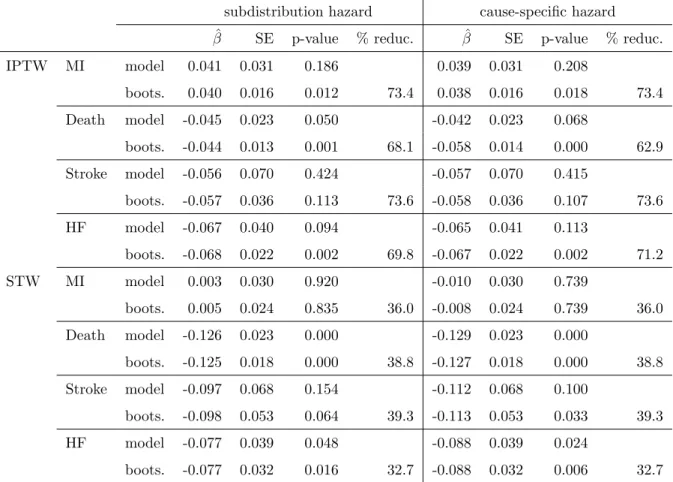
Table 2.5 The treatment effects of statins for elderly who were
hospitalized for an AMI...32
Table 2.6 Comparison of the variance of the model-base
sandwich and bootstrapping method……….33
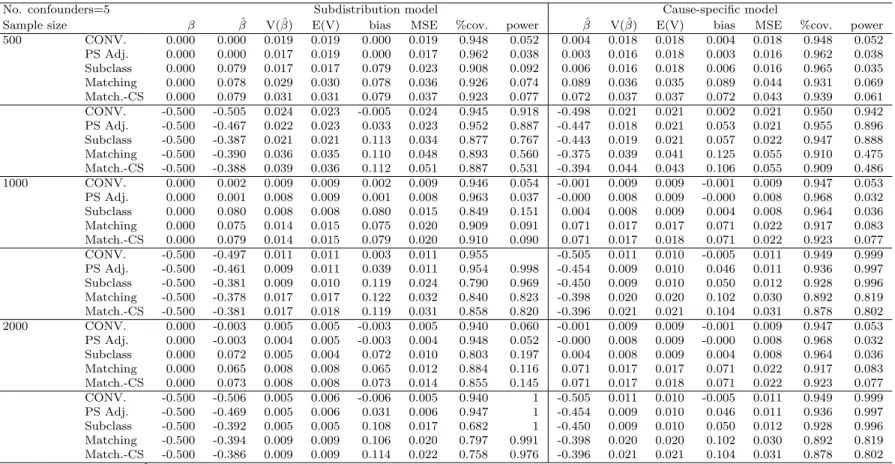
Table 3.1 Simulation result of conditional model of 5 confounders………..45
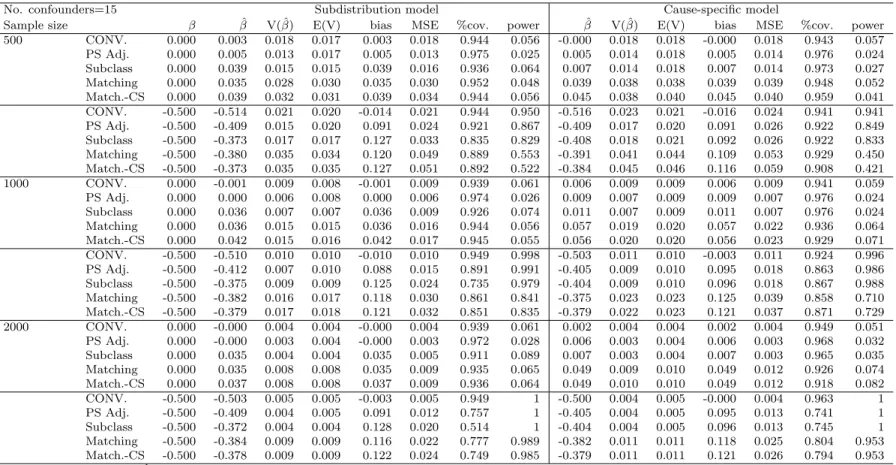
Table 3.2 Simulation result of conditional model of 15 confounders………46
Table 3.3 Simulation result of conditional model of 50 confounders………47
Table 3.4 Simulation result of conditional model of 100 confounders…...………...48
Table 3.5 The estimated treatment effects of statins from
conditional ...50
Table 4.1 Number and percent of observed events...58
Table 4.2 Results of treatment effects from the marginal, conditional risks
and competing risks models by age group...63
Table 4.3 Treatment effects of statins by status of revascularization procedure………...…65
Table 5.1 Propensity score model ...71
Table 5.2 Propensity score model by age groups...75
LIST OF FIGURES
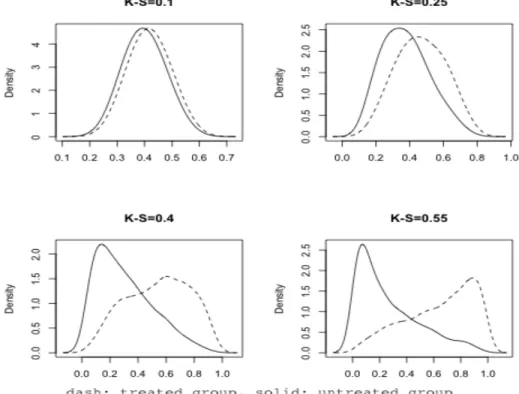
Figure 2.1 Density plots of treated and untreated group in four scenarios………26
Figure 4.1 Distribution of propensity score of statins users and non-users
by age group……….60
Figure 4.2 Distribution of propensity score of statins user and non-user
by revasucularization status ... 61
Figure 5.1 Distribution of the propensity score of statins users and non-users
Chapter 1
Introduction
1.1
Motivating Examples
Cardiovascular disease (CVD) is the leading cause of mortality and is a major cause
of morbidity in the United States and worldwide (108). Increasing steadily with age, the
prevalence of CVD events is even higher in the population older than 65 years of age,
a
ff
ecting more than 70% of both men and women and 66% of CVD deaths occur in people
age above 75 years old (92). As the population is aging, more people are likely to have
cardiovascular complications. Increasing attention has been drawn to the management
of CVD in the elderly population.
Non-experimental studies are increasingly used to evaluate the safety and e
ff
ective-ness of medications when used in usual clinical care (11). It is an appealing design for
investigation of statin treatment e
ff
ects among post MI patients. However, two major
challenges are present. The first challenge is presence of possible confounding systematic
di
ff
erences in prognosis between patients treated with statins and those untreated. If
left uncontrolled, the observed di
ff
erence in outcome risks cannot be interpreted as a
causal e
ff
ect solely due to statins. Another challenge is the presence of competing risks,
as the occurrence of some events may precede and thus preclude the occurrence of the
event of interest. In the elderly population after an acute MI, multiple comorbidities and
worsened health status put them at a higher risk of mortality. Death may thus preclude
the occurrence of the event of interest, (such as another MI) and make the evaluation
of the e
ff
ect of statins on MI di
ffi
cult. Sophisticated methods such as competing risks
survival analyses are needed in this setting (7, 64). Statistical methods that can account
for both competing risks and confounding are needed to obtain a valid causal estimate.
A competing risks survival analysis is a method to address the presence of multiple
events in a survival analysis of the time between the start of follow-up and either the
occurrence of the event(s) of interest or a censoring event (51). The outcomes of
compet-ing risk model are three mutually exclusive events includcompet-ing occurrence of the event of
interest, occurrence of a competing event, and a censoring event (lost to follow-up, end
of follow-up etc.). The regression models in competing risks may be used to estimate the
treatment e
ff
ects.
treatment e
ff
ects without relying on modeling the outcome, are an approach being
in-creasingly used in non-experimental studies (96).
Competing risk survival analyses with PS methods to control for confounding can then
be used to investigate e
ff
ect of statin treatment on cardiovascular events among post MI
patients. However, this approach has not been extensively explored, and little is known
about the performance of this approach compared to the existing standard methods. It is
of great interest to investigate the performance of competing risk models using propensity
score methods to control confounding for estimating marginal and conditional treatment
e
ff
ects.
1.2
Causal Inference
Causal inference is the process of drawing a conclusion about whether a causal
rela-tionship does in fact exist (43). Let
Yi(1) and
Yi(0) be the potential outcomes that would
have been observed for individual
i
in the treatment group or the control (untreated)
group, respectively. Individual causal e
ff
ects can then be obtained by contrasting the
values of the two potential outcomes. However, only one of the potential outcomes is
ob-served for each individual, thus, in general, individual causal e
ff
ects cannot be obtained.
Since it is generally impossible to identify individual causal e
ff
ects, an aggregated
causal e
ff
ect, the average causal e
ff
ect in a population of individuals, becomes the focus of
interest. Let
P
[Yz
= 1] be the counterfactual risk of outcome
Yz
, or the risk of developing
outcome
Y
in all subjects in the population receiving counterfactual treatment
z. An
average causal treatment e
ff
ect is present when
P
[Yz
=1= 1]
�
=
P
[Yz
=0= 1].
assumption is the independence of treatment assignment and outcomes conditional on
the covariates.
In randomized trials, only one potential outcome is observed for each individual.
However, the randomization process ensures that the balancing between the background
variables between treated and untreated groups. In other words, the randomization
pro-cess ensures the independent predictors of the outcome are equally distributed between
the treated and untreated groups. The treated and untreated groups are exchangeable,
and the exchangeability thus implies lack of confounding (65).
In non-experimental studies, treatment is not randomly assigned and the reason for
receiving treatment is likely to be associated with some predictors of the outcome. Thus,
exchangeability is not guaranteed. However, in weaker conditions, conditioning on many
pre-exposure covariates of the treated and untreated groups is often reasonable to allow
exchangeability. Let
L
be the confounding or background covariates. The conditional
exchangeability implies
P
[Y
= 1
|
L
= 1, Z
=
z] =
P
[Yz
= 1
|
L
=
l]
PS is the conceptual tool used to achieve accurate causal inference by balancing or
conditioning on the background variables of treated and untreated subjects (57).
1.3
Propensity score and non-experimental studies
validity of the treatment e
ff
ect estimated from non-experimental studies is a concern if
these biases are left uncontrolled.
Propensity score methods have emerged as a useful method to control for confounding
in the non-experimental setting. It is widely used in a variety of areas, including medical
(95), economic (42) and social research (67). The methods were formalized by Rosenbaum
and Rubin (80) and were shown to be able to control confounding. At the beginning,
the propensity score was developed to estimate the causal e
ff
ect of binary treatment
(48). A propensity score is the conditional probability of receiving treatment given all
confounders. Among patients with the same PS, treatment is unrelated to confounders.
Therefore, the two treatment groups have the same distribution of measured confounders.
The true propensity score of non-randomization studies is unknown. However, it can
be estimated from observed data. Statistical methods such as logistic regression and other
discriminant models can be used to estimate PS. Multivariable logistic regression is the
most widely used method for PS estimation. The estimation of the propensity score can
be implemented as a continuous variable via standard approaches including matching,
subclassification (stratification) by propensity score, propensity score adjustment to the
multivariate model, and weighting (96).
1.3.1
Matching
Matching on certain covariates to remove confounding by the matching variables
has been used extensively in cohort studies (96). Matching methods attempt to choose a
single or multiple patients from the untreated group with the same values of the matching
variables for each patient in the treated group. It can be easily implemented when
matching only needs to be done for a small number of covariates. A large number of
confounders in a non-experimental study makes matching on all confounders di
ffi
cult.
PS as a summary score reduces these multidimensional confounders to one dimension,
which helps overcome this limitation (19).
first option is nearest available matching on the estimated PS. The treated and
un-treated patients are first randomly ordered, and the first un-treated patient is matched with
the first untreated patient who has the nearest PS. The second option is Mahalanobis
metric matching (84). The Mahalanobis distance is the distance between two
dimen-sional points scaled by the statistical variation in each component of the point. Treated
and untreated patients are first randomly ordered, and then each treated patient is
pair-matched with the first untreated patient who has the closest Mahalanobis distance. The
third alternative is nearest available Mahalanobis metric matching within calipers defined
by PS. The treated group is first randomly ordered. For each treated patient, a group of
untreated patients are chosen given that the di
ff
erence of PS between the treated patient
and the untreated patient is less than the caliper (a constant value). From this group of
untreated patients, the patient who has the closest Mahalanobis distance to that of the
treated patient is selected as the match. The third matching method produces the best
balance for the covariate distributions between the treated and untreated groups and is
considered to outperform the first two.
The two popular algorithms for creating PS matched sets are greedy matching and
optimal matching . In greedy matching, a treated patient is first selected at random.
The untreated patient whose PS is closest to this patient is chosen as a match for this
patient. This process is repeated until all the untreated patients have been matched to all
the treated patients or when all the treated patients have been matched. In contrast to
the greedy matching, which finds the nearest untreated patient, optimal matching tries
to minimize the total within-pair distance di
ff
erences (83).
to have improved bias reduction. Full matching results in matched sets consisting of
ei-ther one treated patient and multiple untreated patients or one untreated patient and at
least one treated patient (77). Full matching removes bias better than pair matching and
may achieve the closer match than M:1 matching (37). However, fullmatching method
result in a wide range of ratio of treated to untreated patients (94).
In analyses using Cox proportional hazard models, PS pair-matching has been shown
to have the smallest amount of bias when compared to other methods (26, 4). Martens
showed the analysis from real data showed larger treatment e
ff
ects from matching and
subclassification compared to conventional Cox proportional hazard model (62).
1.3.2
Subclassification
Another method used to implement PS to control confounding is subclassification or
stratification of PS into equal-sized strata, estimation of the treatment e
ff
ect within these
strata and then combining the stratum-specific e
ff
ect estimates using a weighted-average
approach. Both treated and untreated groups are grouped into equal-sized strata based
on their PSs. In general, quintiles of PS are used to create the strata. Previous reports
have shown that subclassification into five strata can remove approximately 90% of initial
bias (81) despite the fact that it can also increase the variance of the estimator (104).
1.3.3
Propensity score covariate adjustment
Adding the PS to a multivariable outcome model is the least appealing method of PS
implementation, since the validity of this approach depends upon a correct specification
of both PS and outcome models. If the PS is included as a linear term in the outcome
model, an assumption is made that there is a linear relationship between the PS and the
outcome, which is likely to be violated in real world applications.
variances of the treated and untreated groups di
ff
er (19). When this method is applied
to studies using survival analysis to estimate e
ff
ects, the fixed parameters of the PS
vari-able suggest that the probability of receiving treatment given all measured covariates
has a constant e
ff
ect on the hazard ratio. Results from our simulation study showed
that the e
ffi
ciency of propensity score adjustment depended on the overlap area and the
specification of variables included into propensity score model (35).
1.3.4
Weighting
Standardization with weights generated from the PS can also be used to control
confounding. Unlike matching, this approach does not result in reduction of the original
sample size. Individuals within the original sample are weighted based on their PS to
create a pesudo-population where the covariates are well balanced in the two treatment
groups, and no association exists between the confounders and treatment. The weighting
method plays an importance role in the estimation of marginal treatment e
ff
ects. There
are two types of weighting commonly used: inverse probability of treatment weighted
(IPTW), standardized mortality ratio weighted (SMRW).
SMRW is set to one one for treated patients and defined as the ratio of the estimated
PS to one minus the estimated PS for the untreated (86). The untreated patients are thus
weighted to be representative of the treated population. The resulting e
ff
ect estimate
is generalizable to the treated population from which the observed treated sample was
drawn. Unlike PS matching, which also often estimates average treatment e
ff
ect in the
treated, no treated patients are excluded from the analysis.
In all weighting analyses, statistical methods are needed to account for the relation
between the replicated individuals created by the process of weighting. A robust sandwich
variance estimate is required to calculate the variance. This approach results in confidence
intervals that are conservative and wider than the nominal coverage.
Many studies have applied weighted methods to survival analysis. Cole and
Her-nan presented an approach to produce adjusted survival curves with inverse probability
weights which o
ff
ers direct interpretation of the data (16). Hernan et al (40) applied
IPTW to study zidovedine (AZT) treatment e
ff
ects on mortality and compared it to an
unweighted analysis. The weighted analysis showed that AZT reduced risks of mortality
but the unweighted analysis with a basic baseline adjustment model produced an adverse
e
ff
ect of AZT on mortality (which was contrary to reality).
Simulation studies showed survival analysis via Cox model with application of the
IPTW method produced the smallest amount of bias for the estimator of interest (4, 26).
1.3.5
Variables selection for propensity score model
the estimator of the average treatment e
ff
ect for the treated group when applying the
matching method and using a multinomial model for the outcome estimation (18, 110).
1.3.6
Assessment of the balance of the covariates
Once the PS model is fit, it is recommended to explicitly evaluate the performance of
the estimated PS model by assessing the balance of covariates after PS implementation
either through matching or weighting . Approaches to assess the covariate balance under
PS methods have been developed (3).
Evaluation of the lack of fit of the PS model is performed using the logistic regression
goodness-of-fit statistics and the c-statistic. the goodness of fit statistic summarizes the
deviation between the observed and predicted outcomes. The c-statistics value indicates
the capacity of a model to discriminate between treated subjects and untreated subjects
(46). However, both methods fail to detect the balancing of background variables between
treated and untreated groups (106).
1.4
Marginal and conditional models
A marginal treatment e
ff
ect is the average treatment e
ff
ect for the population, while a
conditional treatment e
ff
ect is the average treatment e
ff
ect for the individual (3). In the
absence of confounding, the di
ff
erence in means and risk di
ff
erence are collapsible, and the
conditional and marginal e
ff
ects are the same. In randomized studies, the covariates are
balanced between the two treatment groups, therefore the crude di
ff
erence in means and
the adjusted di
ff
erence in means will be equal. In non-experimental studies, the marginal
and conditional estimates will coincide if there was no unmeasured confounding, the
outcome was continuous, and the true outcome model was known (31). However, when
the outcome is either binary or time-to-event, and the odds ratio or the hazard ratio
is used as the e
ff
ect measure, then the marginal and conditional e
ff
ect will not coincide
even in the absence of confounders (34, 25).
For PS methods, the estimators from the conventional model (adjusting for
con-founders in the outcome regression model), covariate adjustment (adding the PS to a
multivariable outcome model) and matching method are estimating the conditional
treat-ment e
ff
ect. The PS based weighting methods yield estimates of the marginal treatment
e
ff
ect for the population.
1.5
Competing risks model
A survival analysis explores the time period from a certain point until the occurrence
of the event of interest. A competing risks survival analysis is the special case of survival
analysis where multiple events may occur and the occurrence of one event may preclude
the occurrence of the other. Competing risk events threaten the validity of studies, even
in randomized control trials. Individuals who are at higher risk of competing risk events
may be less likely to experience the absolute benefit of treatment (64). Care is needed
in statistical analysis to ensure that treatment e
ff
ects are appropriately quantified.
likelihood of the occurrence of a particular competing risk can be summarized using the
distribution of the observed data or using models representing the underlying mechanisms
that generated the observed data (54). When modeling the observed data, so-called crude
functions are utilized. The cause specific hazard and cumulative incidence functions
described below are the most widely used quantities. A popular mechanistic model
is the latent failure time model discussed below. The net function is the probability
of the occurrence of the event of interest corresponding to the latent failure time in
the hypothetical situation where the particular risk of event is the only risk present.
Additional properties of the crude and net approaches are now discussed.
1.5.1
Notation
For this discussion, the following notations are used. Let
Y
and
C
be failure and
censoring times, and
ε
∈
{
1,
2, ..J
}
be the failure event. For each individual
i, i=1,...,n,
the observed failure time was
Ti,
T
= (Y
∧
C), and the observed event be
ε
i,∆
ε
=
I(Y
≤
C) when I(
·
) is indicator function. Let
Z
be one for treated group and zero for untreated
group.
1.5.2
Latent failure times
There are J mutually exclusive types of failure events, and the corresponding time
until each failure type is
Tij
�
. The observed time is
minj
(
Tij
�
), with each
Tij
�
defined as
if the other causes were not present, and with the observed cause of failure
ε
being the
index of the observed latent failure time. The hazard function for latent failure times is
a net hazard function defined as:
�
λ
ij= lim
∆t→01
∆
t
P
(t
≤
Tij
�
< t
+
∆
t,
ε
=
j
|
Tij
�
≥
t), j
= 1, ..., J.
1.5.3
Cause-specific hazard function
To model competing risk using a cause-specific hazard function, the type-specific or
cause-specific hazard function is defined as:
hj
(t) = lim
∆t→01
∆
t
P
(t < T < t
+
∆
t,
ε
=
j
|
T
≥
t), j=1,...m.
The cause-specific hazard function is the instantaneous rate for a failure of type
j
at
time
t, in the presence of all other failure types (54). With this cause-specific hazard
function approach, an event
k
(k
�
=j) is censored at time
T
if events other than type
j
are
observed. The cumulative incidence function,
P
(T
≤
t,
ε
=
j),which is the probability of
occurrence of event
j
at time
t
is defined as:
Fj
(t) =
�
t0
hj(s)S(s)d
s
, where S is the survival function for T.
Defining
Si(t) to be the survival function based on
hi(t) where
S(t) =
�
iSj(t), one
may show that the naive Kaplan-Meier estimator for
Si(t) is a biased estimator for
Fi(t),
generally underestimating this quantity (73).
From the definition of the specific hazard function, the parameters of the
cause-specific hazard model can be estimated using a Cox proportional hazard model. The
treatment e
ff
ects of event
j
can be obtained by maximizing the factor of the partial
likelihood function involving event
j
when other event(s) are treated as censoring events.
The semiparametric model of cause-specific hazard function is defined as:
hj(t) =
h
0j(t)exp
{
β
j�Z
}
1.5.4
Subdistribution hazard function
The subdistribution hazard function is the other type of competing hazard function
which is derived directly from cumulative incidence function (30),
The subdistribution hazard function is probabilistically defined as
λ
j(t) = lim ∆t→01
∆
t
P
(t < T < t
+
δ
t,
ε
=
j
|
T
≥
t
∪
(T
≤
T
∩
ε
�
=
j
).
For the subdistribution function, the cumulative probability of occurrence of cause
J
remains less than one, the subdistribution satisfies the definition of an improper
proba-bility distribution. This occurs because an individual who had an event
k
no longer is at
risk of failure from causes
j
�
=
k.
Similarly to the cause specific hazard, a proportional hazards model may be specified
for the subdistribution hazard function to describe the treatment e
ff
ect on the risk of
a particular cause of interest. The parameters of this model can be estimated using
methods for the Fine-Gray model (21). The semiparametric model for subdistribution
hazard function is:
λ
j(t) =
λ0
j(t)exp{
β
j�Z
}
1.6
The application using Real Data
For this example, we identified a cohort of Medicare beneficiaries who just had a
hospitalization stay for acute MI (AMI) in 2008. The condition AMI was identified from
Medicare inpatient claims files using relevant International Classification of Diseases,
Ninth Revision, Clinical Medication (ICD-9-CM) codes (410.01, 410.11, 410.21, 410.31,
410.41, 410.51, 410.61, 410.71, 410.81, 410.91). Personal identifiers were removed from
all analytical data files.
to 1/1/2008 and were discharged on or after 1/1/2008. Other exclusions were patients
who had discharge code to hospice (40, 41, 42, 50, 51), transfered to other hospitals
for inpatient care, patients who were discharged or transfered to SNF or long-term care
facilities for inpatient care, or who did not have a prescription claim within 30 days after
the index AMI discharge.
The exposure of interest was statin use after discharge. Patients initiating statin
therapy were considered statin users while patients without statin prescriptions were
considered nonusers. The follow up of these patients started at 31 days following the
date of discharge and ended at the occurrence of the outcome or at the end of the study.
The outcome of interest was the occurrence of MI or heart failure (HF) or stroke or
all-cause mortality. The e
ff
ect of interest in this example was the marginal and conditional
treatment e
ff
ect of statins on the cardiovascular outcomes or mortality in the presence
of competing risks.
Potential confounding covariates were created, including demographic characteristics
and clinical conditions based on claims occurring in the 12-month baseline period prior to
admission were created. These covariates were identified a priori based on the literature,
substantive knowledge, and the availability of covariates within the data. The variables
included both demographic and medical record at baseline, during admission and follow
up period. A list of these covariates appears in Table 1.1.
1.7
Objective and outline
Table 1.1: Variables included into propensity score model
General character
gender, age, race, income, medicare doughnut
Charlson Comorbidity AMI, Cerebrovascular Disease,
index
Congentive HF, Periphral vascular disease,
Renal disease, Chronic Obstructive Pulmonary disease,
Diabetes,Peptic Ulcer disease, Cancer, Dementia,
Connective Tissue disease, Rheumatic disease,
Mild liver disease, Moderate to severe liver disease,
Paralysis, Metastatic Carcinoma, AIDS/HIV,
Diabetes with and without complication
Baseline disease
CABG, STENT, PTCA, unstable angina
Ischemic heart disease, Hyperkalemia
Atrial fibrillation, Hypertension, Hyperlipidemia,
End-stage renal disease, Osteroporosis, Asthma,
Hypotension,Rhabdomyolysis, Sinus bradycardia
heart block, Angioedema&hyperkalemia, CCI total score
Baseline medication
statins, STENT/PTCA, Beta blocker, ACEI/ARB
hospital admission in baseline, Number of admission
Number of days stay in hospital
Admission procedure
Subendocardial infarction,Congestive HF
/diagnosis
Cardiogenic shock, Acute renal failure, Hypotension,
Cardiac dysrhythmias, cardiac catheterization, CABG,
PTCA, Angiocardiography, Platelet inhibitors
Thrombolytics and platelet inhibitors
Acute respiratory failure in AMI admission
Septic shock in AMI admission, Days stay in ICU
Days stay in coronary care unit, Total days in hospital
Medication record
Physician visit, Cardiologist visit,
during Follow-up
Revascularization procedure,
Number of admission to short-term acute care hospital,
Number of days to short term acute care hospital,
Co-medication
angiotensin-converting-enzyme inhibitor (ACEI)/
angiotensin receptor blocker (ARB), Beta blockers
Current comorbidity
Valvular disease or rheumatic heart disease
and assistance
Hypothyroidism, Other neurological disorders
Obesity, Coagulation deficiency, Substance abuse
Weight loss, Fluid/electrolyte disorder
Blood loss, deficiency anemia
Pulmonary Circ. Disorders, Parkinson’s disease
Osteoarthritis, Gastrointestinal bleed, Use of rehabilitation
Use of screening, use of wheelchair
Chapter 2
Marginal Treatment Effects of Completing Risks Model
2.1
Introduction
is the latent failure time model, but it cannot be used without strong and unverifiable
assumptions making it unattractive for practical usage (72). When modeling the observed
data, so-called crude functions are utilized. The cause-specific hazard and cumulative
incidence functions, which are based on the observed data, are the most widely used. For
non-experimental studies of a time-to-event outcome with competing events, statistical
methods that account for both competing risks and the e
ff
ect of confounding are needed
to obtain a valid causal estimate of the marginal treatment e
ff
ect.
IPTW, generated from the propensity score, can be used to control for confounding.
The IPTW is defined as the inverse of the estimated likelihood of receiving the treatment
actually received, which is the propensity score for the treated patients and one minus the
propensity score for the untreated patients (76). The IPTW method creates a
pseudo-population representative of the patient characteristics of the source pseudo-population, thus
producing an e
ff
ect estimate generalizable to the population from which the sample was
drawn. Assuming that the PS model was correctly specified, the measured covariates of
the pseudo-population are balanced across the two treatment groups, and no association
exists between measured confounders and treatment.
than nominal coverage (59).
The objective of this study was to investigate the performance of the IPTW and the
STW in estimating the marginal treatment e
ff
ect using competing risks survival analysis
model. Both simulation and application in a substantive data analysis were performed.
2.2
Methods
2.2.1
Monte Carlo simulation
A series of Monte Carlo simulations were conducted in order to examine the
per-formance of inverse probability treatment weighting methods with two competing risk
models: the subdistribution hazard model and the cause-specific hazard model.
Let
Z
be the binary exposure and
X
be a vector of 10 confounding variables. For each
simulated dataset, the 10 covariates ,
Xl, l= (1,...,10) were generated from a Bernoulli
distribution with parameter 0.5. The probability that the exposure
Z
was equal to one,
which is the true propensity score, was estimated as a function of the covariates (
α
) using
a logistic model. The exposure indicator Z was drawn from a Bernoulli distribution with
probability set by
P r(Z
= 1
|
Xl) =
α0
+
Σ
lα
lX
lproportions of event of interest (
ε
=1) were generated, proportion (p) set in turn to 0.4,
0.6 and 0.8. The right censored times (Ci
) were generated from a uniform distribution on
[0, 6] to have 20% censoring. All failure time variables were generated using a competing
risk model where treatment
Z
and covariates
X
were predictor variables. For individual
i, where the e
ff
ect of treatment,
β
j,, for failure
ε
=1 (with either the cause-specific hazard
or subdistribution hazard) was fixed at -0.5 and for failure
ε
=2 was fixed at -0.06, which
is the conditional treatment e
ff
ects.
The next two sections describe how the failure times were generated under the two
di
ff
erent hazard functions under presence of competing risks. After which the detail of
estimating true treatment e
ff
ect for marginal model and PS estimated is described.
2.2.2
Simulation for subdistribution hazard function
The simulation method followed procedures described by Fine and Gray (21). The
failure time for
ε
=1, was generated from
P r(T
i≤
t,
ε
= 1
|
Z, X) = 1
−
[1
−
p
{
1
−
exp(
−
t)
}
]
exp(Zβ1+Xlγl).
which is unit exponential with mass 1-p at infinity,
Z,
X
=0 and p
∈
{
0.4,
0.6,
0.8
}
. The
subdistribution for
ε
= 2 was generated from
P r(
ε
= 2
|
Z
) = 1
−
P r(
ε
= 1
|
Z) and
the time until failure event conditionally on
ε
= 2 was generated from an exponential
distribution with rate exp
{
β2
Z
+
γ
l2Xl
}
.
2.2.3
Simulation for cause-specific hazard function
Let
h
1(t
|
Z, X) =
θ1
exp
{
β1
Z
+
γ
l1Xl
}
and
h
2(t
|
Z, X) =
θ2
exp
{
β2
Z
+
γ
l2Xl
}
be the
cause-specific hazard function, which is dependent on Z and
Xl, of event
ε
= 1 and event
ε
= 2, respectively. The overall hazard rate was
h(t
|
Z, X
) =
h
1(t
|
Z, X
) +
h
2(t
|
Z, X). The
failure time for each subject was generated from exponential distribution with hazard
rate
h(t
|
Z, X
). The event types,
ε
were generated from a Bernoulli experiment,
where the parameter values were chosen such that
P
(
ε
= 1
|
T < t) were 0.4, 0.6 and
0.8 for all
t
(9, 8).
2.2.4
True marginal treatment effect
As discussed earlier, the true marginal treatment e
ff
ect can be estimated from a
ran-domized trial. We simulated a dataset with the same parameters and settings described
above to estimate the true marginal treatment e
ff
ect. This approach is necessary because
performing simulations using the models in 2.2.2 and 2.2.3 does not result in a marginal
proportional hazards model, that is, the marginal treatment e
ff
ect is not correctly
spec-ified via the proportional hazard models. If one employs the misspecspec-ified proportional
hazard model in a data analysis, the resulting estimator estimates a parameter defined
in large samples as the limiting value to which that estimator converges. This problem
generally occurs in survival settings, when confounders are included in the true survival
model and marginalizing over the confounders does not generally result in a proportional
hazard model. The notion of convergence just described is standard with misspecified
models, where parameter estimators do not converge to true values of parameters in the
underlying models.
2.2.5
Propensity-based estimation of the treatment effect in simulations
For the simulated dataset, four di
ff
erent types of marginal models were fitted with the
two di
ff
erent competing risk analysis approaches: a crude model, a crude model based on
region of common support (13), weighted regression using IPTW and weighted regression
using STW. A conventional multivariable regression model, which is a conditional model,
was also fitted to investigate the performance of estimating marginal treatment e
ff
ects.
For the two competing risk approaches, treatment e
ff
ects from the cause-specific hazard
function were estimated using a Cox proportional hazard model, while treatment e
ff
ects
from the subdistribution hazard function were obtained from the Fine-Gray model. The
analyses were performed in R 3.0.1 (102) using the package
survival
for Cox models (103)
and the package
cmprsk
for the Fine-Gray model (29).
For the weighted analyses, weights were calculated from the estimated PS. We
esti-mated the PS, ˆ
p
for individual
i, using a multivariable logistic regression model:
logit(ˆ
p) = ˆ
α
0+
Σ
lα
ˆ
lX
lWeights for IPTW and STW were calculated using the following formulas:
IP T W
=
Z
iˆ
pi
+
1
−
Z
i1
−
pi
ˆ
ST W
=
Z
Z
¯
ˆ
p
i+ (1
−
Z)
1
−
Z
¯
1
−
p
ˆ
i,
where ¯
Z
was the proportion of treated patients in the study sample.
The performance of the various estimation approaches were evaluated through several
measures: the bias of the estimator from the true marginal treatment e
ff
ect, the mean
squared error (MSE) and the percent coverage (% coverage) of the nominal 0.95
con-fidence intervals. All performance measures were averaged over the 1,000 replications.
Two di
ff
erent sample sizes, 500 and 2000, were used for each simulated sample.
2.2.6
Propensity-based estimation of the treatment effect in a case study
The five di
ff
erent models described above were also applied to the post-MI cohort to
evaluate the marginal treatment e
ff
ects of statins on three di
ff
erent cardiovascular
out-comes (MI, heart failure, and stroke) and all-cause mortality in the presence of competing
events. The PS was estimated using the covariates listed in Section 1.4.
2.3
Monte Carlo simulation results
2.3.1
True marginal treatment effects
The true marginal treatment e
ff
ects for the three scenarios of competing risks are
summarized in Table 2.1. The true marginal treatment e
ff
ects decreased inversely to the
proportion of the event of interest in both hazard models.
Table 2.1: True marginal treatment e
ff
ect
proportion of
ε
=1
Model
0.4
0.6
0.8
subdistribution hazard
-0.420
-0.390
-0.373
cause-specific hazard
-0.426
-0.392
-0.384
2.3.2
Propensity-based estimation performance
Table 2.2: Simulation results of marginal treatment effect using competing risks (sample size =500)
p=0.4 p=0.6 p=0.8
ˆ
β Var( ˆβ) E(V) bias MSE %co. βˆ Var( ˆβ) E(V) bias MSE %co. βˆ Var( ˆβ) E(V) bias MSE %co. K-S=0.10
SH crude -0.406 0.027 0.026 0.014 0.027 0.940 -0.379 0.019 0.018 0.011 0.019 0.940 -0.363 0.014 0.014 0.010 0.014 0.960 cru. CS -0.409 0.027 0.026 0.011 0.027 0.940 -0.381 0.018 0.019 0.009 0.018 0.950 -0.365 0.014 0.015 0.008 0.014 0.960 IPTW -0.439 0.023 0.027 -0.019 0.023 0.960 -0.410 0.015 0.020 -0.020 0.016 0.980 -0.391 0.010 0.015 -0.018 0.011 0.980 STW -0.414 0.025 0.026 0.005 0.025 0.960 -0.387 0.017 0.019 0.003 0.017 0.960 -0.371 0.013 0.015 0.002 0.013 0.970 Conv. -0.521 0.028 0.027 -0.101 0.039 0.910 -0.511 0.020 0.019 -0.122 0.035 0.870 -0.513 0.014 0.015 -0.140 0.034 0.810 CSH crude -0.395 0.030 0.028 0.031 0.031 0.940 -0.369 0.020 0.018 0.023 0.020 0.940 -0.352 0.015 0.013 0.032 0.016 0.930 cru. CS -0.398 0.030 0.029 0.028 0.031 0.950 -0.372 0.019 0.019 0.020 0.020 0.940 -0.355 0.014 0.014 0.029 0.015 0.940 IPTW -0.417 0.028 0.030 0.009 0.028 0.960 -0.392 0.017 0.020 -0.000 0.017 0.960 -0.378 0.012 0.014 0.006 0.012 0.970 STW -0.412 0.027 0.030 0.014 0.028 0.960 -0.387 0.017 0.019 0.005 0.017 0.960 -0.373 0.012 0.014 0.011 0.012 0.960 Conv. -0.511 0.034 0.031 -0.085 0.041 0.910 -0.511 0.022 0.020 -0.119 0.036 0.860 -0.514 0.017 0.014 -0.130 0.034 0.790 K-S=0.25
SH crude -0.262 0.026 0.025 0.158 0.051 0.810 -0.241 0.018 0.018 0.149 0.040 0.790 -0.233 0.014 0.014 0.140 0.033 0.790 cru. CS -0.277 0.025 0.026 0.143 0.046 0.840 -0.254 0.018 0.019 0.135 0.037 0.840 -0.246 0.013 0.015 0.127 0.030 0.830 IPTW -0.450 0.026 0.031 -0.030 0.027 0.960 -0.421 0.018 0.022 -0.031 0.019 0.980 -0.405 0.013 0.018 -0.032 0.014 0.980 STW -0.352 0.025 0.028 0.068 0.029 0.940 -0.327 0.017 0.021 0.062 0.021 0.940 -0.315 0.012 0.016 0.058 0.016 0.960 Conv. -0.510 0.031 0.029 -0.090 0.039 0.910 -0.502 0.023 0.021 -0.112 0.035 0.870 -0.507 0.016 0.016 -0.134 0.034 0.830 CSH crude -0.279 0.031 0.029 0.147 0.052 0.840 -0.256 0.019 0.019 0.136 0.037 0.830 -0.286 0.035 0.034 0.098 0.044 0.910 cru. CS -0.291 0.031 0.030 0.135 0.049 0.860 -0.268 0.019 0.019 0.124 0.034 0.850 -0.298 0.035 0.035 0.086 0.042 0.930 IPTW -0.433 0.033 0.035 -0.007 0.033 0.960 -0.407 0.019 0.023 -0.015 0.020 0.960 -0.444 0.038 0.041 -0.060 0.042 0.950 STW -0.413 0.032 0.035 0.013 0.032 0.970 -0.388 0.019 0.022 0.004 0.019 0.960 -0.425 0.037 0.040 -0.041 0.038 0.950 Conv. -0.512 0.038 0.034 -0.086 0.045 0.910 -0.509 0.022 0.021 -0.117 0.036 0.880 -0.513 0.042 0.039 -0.129 0.059 0.890 K-S=0.40
SH crude -0.640 0.027 0.028 -0.221 0.075 0.740 -0.595 0.020 0.019 -0.205 0.062 0.700 -0.566 0.016 0.015 -0.193 0.053 0.660 cru. CS -0.599 0.028 0.029 -0.179 0.060 0.830 -0.554 0.020 0.021 -0.165 0.047 0.800 -0.527 0.016 0.016 -0.154 0.040 0.790 IPTW -0.429 0.046 0.048 -0.009 0.046 0.960 -0.389 0.031 0.034 0.001 0.031 0.960 -0.375 0.022 0.026 -0.002 0.022 0.970 STW -0.474 0.042 0.044 -0.055 0.045 0.950 -0.433 0.028 0.031 -0.043 0.030 0.950 -0.415 0.020 0.024 -0.042 0.022 0.960 Conv. -0.524 0.038 0.036 -0.104 0.048 0.920 -0.511 0.028 0.025 -0.121 0.042 0.880 -0.509 0.021 0.020 -0.136 0.039 0.830 CSH crude -0.588 0.027 0.028 -0.162 0.053 0.850 -0.557 0.018 0.018 -0.165 0.045 0.780 -0.536 0.013 0.014 -0.152 0.037 0.770 cru. CS -0.555 0.028 0.030 -0.129 0.045 0.910 -0.524 0.019 0.020 -0.132 0.036 0.850 -0.503 0.014 0.015 -0.119 0.028 0.850 IPTW -0.422 0.043 0.048 0.004 0.043 0.960 -0.386 0.029 0.032 0.006 0.029 0.960 -0.368 0.021 0.023 0.016 0.021 0.960 STW -0.434 0.041 0.046 -0.008 0.041 0.960 -0.398 0.027 0.030 -0.006 0.027 0.970 -0.379 0.019 0.022 0.005 0.020 0.970 Conv. -0.525 0.040 0.038 -0.099 0.049 0.920 -0.516 0.027 0.025 -0.124 0.042 0.870 -0.515 0.020 0.018 -0.131 0.037 0.840 K-S=0.55
SH crude -0.744 0.030 0.028 -0.324 0.134 0.510 -0.691 0.020 0.019 -0.302 0.111 0.410 -0.658 0.014 0.015 -0.285 0.095 0.360 cru. CS -0.665 0.031 0.031 -0.245 0.091 0.710 -0.614 0.022 0.022 -0.224 0.072 0.690 -0.585 0.015 0.017 -0.212 0.060 0.650 IPTW -0.434 0.097 0.077 -0.014 0.097 0.920 -0.398 0.065 0.056 -0.008 0.065 0.940 -0.377 0.047 0.044 -0.004 0.047 0.960 STW -0.477 0.090 0.071 -0.057 0.094 0.920 -0.437 0.059 0.052 -0.047 0.062 0.940 -0.414 0.042 0.040 -0.040 0.044 0.960 Conv. -0.524 0.044 0.041 -0.104 0.055 0.910 -0.509 0.031 0.029 -0.119 0.045 0.880 -0.511 0.024 0.023 -0.138 0.043 0.840 CSH crude -0.675 0.031 0.028 -0.249 0.093 0.670 -0.647 0.019 0.018 -0.255 0.084 0.510 -0.631 0.013 0.014 -0.247 0.074 0.440 cru. CS -0.613 0.032 0.031 -0.187 0.067 0.820 -0.583 0.019 0.020 -0.191 0.055 0.720 -0.564 0.014 0.015 -0.180 0.047 0.690 IPTW -0.419 0.073 0.067 0.007 0.073 0.950 -0.405 0.048 0.046 -0.013 0.048 0.950 -0.382 0.035 0.037 0.002 0.035 0.970 STW -0.433 0.069 0.063 -0.007 0.069 0.950 -0.417 0.046 0.044 -0.025 0.046 0.950 -0.393 0.033 0.035 -0.009 0.033 0.970 Conv. -0.508 0.044 0.043 -0.082 0.051 0.930 -0.511 0.028 0.028 -0.119 0.042 0.900 -0.514 0.021 0.021 -0.130 0.038 0.860 p=proportion ofε=1, ˆβ=estimator, Var( ˆβ)= empirical variance, E(V)=average variance, SH=subdistribution hazard function,
CSH=cause-specific hazard function, conv.=conventional model Crude = Crude model: λ1(t|Z) =λ0(t)exp{βZ},Cru.-CS= crude model under common support , IPTW= weighted model by IPTW, STW=weighted model by stabilized weighted,Conv.=conventional model.
Table 2.3: Simulation results of marginal treatment e
ff
ect using competing risks (sample size =2000)
p=0.4 p=0.6 p=0.8
ˆ
β Var( ˆβ) E(V) bias MSE %co. βˆ Var( ˆβ) E(V) bias MSE %co. βˆ Var( ˆβ) E(V) bias MSE %co. K-S=0.10
SH crude -0.398 0.006 0.006 0.022 0.007 0.950 -0.376 0.004 0.005 0.013 0.004 0.960 -0.358 0.003 0.004 0.015 0.003 0.950 cru. CS -0.398 0.006 0.006 0.022 0.007 0.960 -0.377 0.004 0.005 0.013 0.004 0.960 -0.358 0.003 0.004 0.015 0.003 0.950 IPTW -0.430 0.006 0.007 -0.010 0.006 0.970 -0.406 0.004 0.005 -0.016 0.004 0.970 -0.386 0.003 0.004 -0.013 0.003 0.980 STW -0.401 0.006 0.006 0.019 0.006 0.960 -0.380 0.004 0.005 0.010 0.004 0.960 -0.361 0.003 0.004 0.012 0.003 0.960 Conv. -0.502 0.007 0.007 -0.082 0.013 0.830 -0.502 0.005 0.005 -0.113 0.017 0.620 -0.501 0.003 0.004 -0.128 0.020 0.450 CSH crude -0.395 0.007 0.007 0.031 0.008 0.930 -0.372 0.004 0.005 0.020 0.005 0.940 -0.349 0.003 0.003 0.035 0.005 0.910 cru. CS -0.395 0.007 0.007 0.031 0.007 0.940 -0.372 0.004 0.005 0.020 0.005 0.950 -0.349 0.003 0.003 0.035 0.004 0.910 IPTW -0.418 0.007 0.007 0.008 0.007 0.970 -0.396 0.004 0.005 -0.004 0.004 0.980 -0.374 0.003 0.004 0.010 0.003 0.980 STW -0.412 0.006 0.007 0.014 0.006 0.960 -0.391 0.004 0.005 0.001 0.004 0.980 -0.370 0.003 0.003 0.014 0.003 0.980 Conv. -0.502 0.008 0.007 -0.076 0.013 0.850 -0.504 0.005 0.005 -0.112 0.017 0.630 -0.502 0.004 0.004 -0.118 0.018 0.500 K-S=0.25
SH crude -0.263 0.007 0.006 0.157 0.031 0.480 -0.245 0.005 0.005 0.145 0.025 0.420 -0.231 0.004 0.004 0.142 0.024 0.340 cru. CS -0.267 0.007 0.006 0.153 0.030 0.500 -0.249 0.005 0.005 0.141 0.024 0.460 -0.235 0.003 0.004 0.138 0.022 0.360 IPTW -0.449 0.007 0.007 -0.029 0.007 0.950 -0.423 0.004 0.005 -0.033 0.005 0.960 -0.401 0.003 0.004 -0.028 0.004 0.970 STW -0.343 0.006 0.007 0.077 0.012 0.860 -0.323 0.004 0.005 0.067 0.009 0.860 -0.305 0.003 0.004 0.068 0.008 0.840 Conv. -0.505 0.007 0.007 -0.085 0.014 0.830 -0.502 0.005 0.005 -0.113 0.018 0.640 -0.500 0.004 0.004 -0.126 0.020 0.480 CSH crude -0.398 0.007 0.007 0.028 0.007 0.930 -0.377 0.005 0.004 0.015 0.005 0.940 -0.358 0.003 0.003 0.026 0.004 0.920 cru. CS -0.398 0.007 0.007 0.028 0.008 0.930 -0.376 0.005 0.004 0.016 0.005 0.940 -0.357 0.003 0.003 0.027 0.004 0.920 IPTW -0.413 0.007 0.008 0.013 0.007 0.960 -0.391 0.004 0.005 0.001 0.004 0.960 -0.370 0.003 0.004 0.014 0.003 0.960 STW -0.412 0.007 0.008 0.014 0.007 0.960 -0.390 0.004 0.005 0.002 0.004 0.960 -0.369 0.003 0.004 0.015 0.003 0.950 Conv. -0.501 0.008 0.008 -0.075 0.014 0.860 -0.503 0.006 0.005 -0.111 0.018 0.650 -0.500 0.004 0.004 -0.116 0.017 0.510 K-S=0.40
SH crude -0.628 0.007 0.007 -0.208 0.050 0.290 -0.594 0.005 0.005 -0.204 0.047 0.170 -0.566 0.004 0.004 -0.193 0.041 0.120 cru. CS -0.610 0.007 0.007 -0.190 0.043 0.370 -0.576 0.005 0.005 -0.187 0.040 0.240 -0.549 0.004 0.004 -0.176 0.035 0.190 IPTW -0.412 0.011 0.012 0.008 0.011 0.960 -0.386 0.007 0.008 0.004 0.007 0.970 -0.368 0.005 0.006 0.006 0.005 0.970 STW -0.465 0.010 0.011 -0.045 0.012 0.940 -0.436 0.006 0.008 -0.047 0.008 0.940 -0.416 0.005 0.006 -0.043 0.007 0.940 Conv. -0.501 0.009 0.009 -0.081 0.015 0.860 -0.499 0.006 0.006 -0.110 0.018 0.700 -0.500 0.005 0.005 -0.127 0.021 0.550 CSH crude -0.583 0.007 0.007 -0.157 0.032 0.560 -0.560 0.005 0.005 -0.168 0.033 0.290 -0.537 0.004 0.003 -0.153 0.027 0.260 cru. CS -0.569 0.007 0.007 -0.143 0.028 0.630 -0.545 0.005 0.005 -0.153 0.028 0.380 -0.522 0.004 0.003 -0.138 0.023 0.350 IPTW -0.398 0.011 0.012 0.028 0.012 0.950 -0.377 0.006 0.008 0.015 0.007 0.960 -0.356 0.004 0.006 0.028 0.005 0.960 STW -0.413 0.010 0.011 0.013 0.011 0.960 -0.391 0.006 0.007 0.001 0.006 0.970 -0.369 0.004 0.006 0.015 0.004 0.980 Conv. -0.503 0.009 0.009 -0.077 0.015 0.870 -0.507 0.006 0.006 -0.115 0.019 0.690 -0.503 0.004 0.004 -0.119 0.019 0.570 K-S=0.55
SH crude -0.732 0.007 0.007 -0.312 0.104 0.030 -0.693 0.005 0.005 -0.303 0.097 0.010 -0.663 0.004 0.004 -0.290 0.088 0.000 cru. CS -0.693 0.007 0.007 -0.273 0.082 0.090 -0.656 0.005 0.005 -0.266 0.076 0.040 -0.627 0.004 0.004 -0.254 0.068 0.020 IPTW -0.406 0.020 0.022 0.014 0.020 0.960 -0.388 0.015 0.016 0.002 0.015 0.960 -0.373 0.012 0.012 -0.000 0.012 0.960 STW -0.455 0.017 0.020 -0.035 0.019 0.950 -0.431 0.013 0.014 -0.041 0.015 0.940 -0.413 0.010 0.010 -0.040 0.012 0.930 Conv. -0.497 0.010 0.010 -0.078 0.016 0.870 -0.499 0.007 0.007 -0.109 0.019 0.760 -0.506 0.006 0.006 -0.133 0.024 0.580 CSH crude -0.672 0.007 0.007 -0.246 0.067 0.150 -0.641 0.005 0.005 -0.249 0.067 0.030 -0.622 0.003 0.003 -0.238 0.060 0.020 cru. CS -0.642 0.007 0.007 -0.216 0.054 0.290 -0.610 0.005 0.005 -0.218 0.052 0.100 -0.590 0.003 0.004 -0.206 0.046 0.070 IPTW -0.398 0.019 0.020 0.028 0.020 0.960 -0.374 0.012 0.013 0.018 0.012 0.960 -0.358 0.009 0.010 0.026 0.010 0.960 STW -0.414 0.018 0.019 0.012 0.018 0.960 -0.388 0.011 0.013 0.004 0.011 0.960 -0.371 0.008 0.010 0.013 0.009 0.970 Conv. -0.503 0.010 0.010 -0.077 0.016 0.880 -0.502 0.007 0.007 -0.110 0.019 0.730 -0.503 0.005 0.005 -0.119 0.019 0.620 p=proportion ofε=1, ˆβ=estimator, Var( ˆβ)= empirical variance, E(V)=average variance, SH=subdistribution hazard function,
CSH=cause-specific hazard function, conv.=conventional model Crude = Crude model: λ1(t|Z) =λ0(t)exp{βZ},Cru.-CS= crude model under common support , IPTW= weighted model by IPTW, STW=weighted model by stabilized weighted,Conv.=conventional model.