Proteinuria and function loss
Koop, Klaas
Proteinuria and function loss in native and transplanted kidneys Thesis, Leiden University, Leiden, The Netherlands
Cover The glomerular filtration barrier at ~48,000 times magnification.
Adapted from Pavenstadt H, Kriz W, Kretzler M: Cell biology of the glomerular podocyte. Physiological Reviews 2003, used with permission.
Proteinuria and function loss in native and transplanted kidneys
Proefschrift
ter verkrijging van
de graad van Doctor aan de Universiteit Leiden,
op gezag van Rector Magnificus prof. mr. P.F. van der Heijden,
volgens besluit van het College voor Promoties
te verdedigen op woensdag 2 september 2009
klokke 16:15 uur
door
Klaas Koop
geboren te ’s Hertogenbosch
Promotiecommissie
Promotor: Prof. dr. J.A. Bruijn
Co-promotores: Dr. E. de Heer Dr. M. Eikmans
Overige leden: Prof. dr. G.J. Navis
Universitair Medisch Centrum Groningen
Prof. dr. B. van de Water
Prof. dr. A.J. van Zonneveld
The studies described in this thesis were performed at the Department of Pathology (head: prof. dr. G.J. Fleuren), Leiden University Medical Center, Leiden, The Netherlands.
Contents
Chapter 1 General introduction
The kidney: development, anatomy and function Causes and consequences of proteinuria Long-term dysfunction of kidney transplants
Chapter 2 Expression of podocyte-associated molecules in acquired human kidney diseases. J Am Soc Nephrol. 2003 Aug;14(8):2063-71
Chapter 3 Selective loss of podoplanin protein expression accompanies proteinuria and precedes alterations in podocyte morphology in a spontaneous proteinuric rat model.
Am J Pathol. 2008 Aug;173(2):315-26
Chapter 4 Glomerular expression profiling in spontaneously proteinuric rats reveals regulation of cytoskeleton-associated genes, and protein overload-affected genes.
Submitted for publication
Chapter 5 Differentiation between chronic rejection and chronic cyclosporine toxicity by analysis of renal cortical mRNA.
Kidney Int. 2004 Nov;66(5):2038-46
Chapter 6 Early interstitial accumulation of collagen type I discriminates chronic rejection from chronic cyclosporine nephrotoxicity.
J Am Soc Nephrol. 2003 Aug;14(8):2142-9
Chapter 7 General discussion
Chapter 8 Nederlandse samenvatting
Appendices Color figures
General introduction
The kidney: development,
anatomy and function
Causes and consequences
of proteinuria
Long-term dysfunction of
kidney transplants
chapter 1 8
Contents
PART 1. THE KIDNEY: DEVELOPMENT, ANATOMY AND FUNCTION 11
Overview of kidney anatomy and function Development
The glomerulus Glomerular cell types
Glomerular extracellular matrix Cell biology of the podocyte
Cytoskeleton Apical membrane Slit diaphragm region Interaction with the GBM Receptors and signaling pathways Cell cycling and transcription factors
Glomerular filtration: characteristics and theoretical models Characteristics of glomerular filtration
Different explanations for permselectivity Integrative views of glomerular filtration Synthesis
The tubular system
Interstitium and the extracellular matrix
PART 2. CAUSES AND CONSEQUENCES OF PROTEINURIA 36
Epidemiology Causes of proteinuria
Causes of proteinuria in various kidney diseases Minimal change disease
Focal segmental glomerulosclerosis (FSGS). Diabetic nephropathy
Membranous nephropathy Consequences of proteinuria
Effects of proteinuria on the glomerulus
Effect of proteinuria on the tubulointerstitial compartment Cardiovascular risk
Progression of renal disease
9 contents Mechanisms of interstitial fibrosis
Inflammation
Cells that contribute to fibrosis; EMT ECM composition and regulation Damage is progressive
PART 3. LONG-TERM DYSFUNCTION OF KIDNEY TRANSPLANTS 54
General description and definitions Limited improvement in long-term survival Definitions of long-term graft failure Chronic allograft dysfunction
Clinical manifestations Scope of the problem Risk factors
Immunological risk factors Non-immunological risk factors
The pathology of chronic allograft dysfunction Changing definitions
Causes and course of CAN Histopathologic features
Lesions related to specific etiology Chronic rejection
Calcineurin inhibitor toxicity
Pathophysiologic processes in chronic allograft dysfunction Alloimmunity
Immunosuppressive drug toxicity Accelerated senescence
Molecular diagnostics in chronic allograft dysfunction Diagnostic markers at the tissue level
Genomics
Single gene measurements The problem of prediction Microarray studies
Proteomics, metabolomics, urinomics
OUTLINE OF THE THESIS 72
chapter 1 10
“Bones can break, muscles can atrophy, glands can loaf, even the brain can go to sleep, without immediately endangering our survival, but when the kidneys fail to manufacture the proper kind of blood neither bone, muscle, gland nor brain can carry on”.
Homer Smith, From Fish to Philosopher (1).
11 overview of kidney anatomy and function
THE KIDNEY: DEVELOPMENT,
ANATOMY AND FUNCTION
Overview of kidney anatomy and function
The kidney is a bean-shaped organ with a length of about 11 cm and a weight of approximately 150 grams. The kidneys are located in the retroperitoneal space at either side of the vertebral column, just below the diaphragm. The concave part of the kidney forms the renal sinus that contains the renal vessels, nerves, and the renal pelvis. The arterial blood supply sprouts directly from the aorta; the renal veins drain into the vena cava. Via the ureter the renal pelvis is continu-ous with the bladder and the outside world. The functional tissue of the kidneys surrounds the renal sinus, and is divided into cortex and medulla.
The human kidney contains about one million functional units or nephrons (30,000 in rats). A nephron consists of a filtration body – a tuft of anastomosing capillaries called glomerulus – connected to a long, tortuous tubule. The glomerular capillaries function as a microfilter that restricts passage of blood cells and proteins, but is permeable for smaller plasma components and waste products dissolved in the plasma water. Some ten percent of the blood that flows into the glomerulus is filtered, and the ultrafiltrate is delivered into the tubule (see below for a more comprehensive description of glomerular filtration). The blood that escapes filtration flows into the capillary network in the tubular compartment. Here, the tubular epithelial cells exchange substances between the fluids in the tubular lumen and the blood, thus gradually converting the ultrafiltrate into urine. Most of the exchange is from tubular lumen to the blood: the tubular epithelial cells reabsorb almost all water filtered in the glomerulus, together with salts, glucose, amino acids, vitamins, and other small molecules. But there is also active excretion of substances from the blood into the tubular lumen. When the urine via the collecting ducts flows into the renal pelvis, it is a concentrated solution of dissonants that the nephron has produced to maintain the harmonious composition of the blood.
In the next paragraphs, the microscopic anatomy of the nephron is described in some more detail, along with an overview of glomerular filtration. First, a brief overview of kidney development is provided.
chapter 1 > the kidney: development, anatomy and function 12
Development
Pathophysiologic processes sometimes recapitulate mechanisms that play a role in embryonic development (2). It is therefore of importance to understand some of the processes that take place during the organogenesis of the kidney. This paragraph describes the development of the kidney, with a focus on the development of the glomerulus. For more extensive overview of the developmental processes and their molecular regulation the reader is referred to several reviews on the topic (3-7).
The kidneys develop from the intermediate mesoderm of the embryo. The intermediate meso-derm is made up of two tissue compartments, the nephric duct and the nephrogenic cord, that form the different structures of the kidney. Deri-vates of the nephric duct form the collecting sys-tem of the kidney. The glomerular and tubular parts of the nephron arise from the nephrogenic cord.
During embryonic development, a sequential de-velopment of three more or less separate excre-tory systems, referred to as the pro-, meso-, and metanephros, takes place through interaction between the nephrogenic cord and the nephric duct. The pronephros is formed first and most cranial. It is a transient, non-functional structure that consists of a few tubules that connect to the nephric duct. Caudal to the pronephros the nephric duct induces the formation of the me-sonephros, a structure consisting of a glomeru-lus and a relatively simple tubule. Though also transient, the mesonephron forms a functional excretory organ (8). The blood supply to each glomerulus sprouts directly from the aorta, while the tubules drain into the nephric duct that at this stage of development is called the meso-nephric or Wolffian duct.
Subsequent to the development of the me-sonephros, and again more caudally, the
13 development development of the permanent kidney or metanephros starts. The metanephros develops through reciprocal interactions between the mesonephric duct and a condensed part of mesenchyme re-ferred to as the metanephric blastema. The metanephric blastema induces the formation of a bud from the mesonephric duct. This ureteric bud grows into the metanephric blastema, and induces it to form a cap on the ureteric bud. The mesenchymal cap in turn induces dichotomous branching of the ureteric bud. The close apposition of the tips of the ureteric bud and the prolif-erating mesenchyme leads to continuous branching of the ureteric bud (a movie of ureteric bud branching will play in the upper right corner when quickly thumbing through the pages of this book from back to front. Courtesy of dr. Frank Constantini, Columbia University Medical Center). This reciprocal stimulation eventually produces an arborized system of ducts, of which each final branch is in close proximity to a mesenchymal condensate. Remodeling, ie, coalescence of the branched ducts shapes a system of collecting ducts that via the renal calyces, renal pelvis and ureter drains into the bladder; the mesenchymal condensate undergoes a sequence of events that transforms it into a functional nephron that connects to the collecting duct.
The invasion of the ureteric bud into the metanephric mesenchyme rescues the mesenchymal cells from apoptosis, and induces expression of the genes paired box 2 (PAX2) and Wilms Tumor 1 (WT1). In the presence of PAX2 and WT1 expression, and through stimulation by Wnt-4 and Bone morphogenetic protein 7 (BMP-7), mesenchymal cells acquire an epithelial phenotype, a process called mesenchymal-to-epithelial transition (MET) (9-12). After completing MET, the condensed cells start to form a vesicle. The renal vesicle then undergoes a series of morphologic changes: it first changes into a comma-shaped body that then elongates and folds back on itself to form an S-shape (figure 1a). The molecular mechanisms that regulate this process are not completely known. From this stage onward, epithelia in different parts of the S-shaped body start to dif-ferentiate, thus forming the at least 15 different epithelial cell lineages of the future nephron (5). During differentiation, expression of PAX2 is downregulated, probably through increasing expression of WT1 (13). This occurs most prominently in the proximal part of the S-shaped body, where the future podocytes show high expression of the WT1 protein, which continues to be a marker of podocytes throughout differentiation and in the mature glomerulus (14,15). The pre-sumptive podocytes that surround the capillary tuft are first organized as a columnar epithelium, but progressively lose their lateral cell-cell adhesions and begin to form cellular extensions called foot processes. Eventually, the cell bodies of the podocytes float freely in the urinary space, and the adhesion between two adjacent podocytes is restricted to the slit diaphragm between the in-terdigitating foot processes (figure 1d) (16,17). Exactly which signals drive foot process formation is currently unknown, although the interaction with the GBM seems to be of crucial importance (17).
chapter 1 > the kidney: development, anatomy and function 14
through incorporation of endothelial cells sprouting from nearby vessels (19,20), leads to the re-cruitment of endothelial cells into the cleft of the S-shaped body adjacent to the future podocytes (figure 1a,b) (14,21). In turn, endothelial cells of the capillaries express platelet-derived growth factor-B (PDGF-B), thus recruiting mesangial cells – of which the origin remains elusive (22) – that express PDGF receptor-β (figure 1c) (23). Through further branching of capillaries, differentiation of epithelial cells, and deposition of extracellular matrix, the three glomerular cell types shape the glomerulus (17,23).
The tubules elongate and differentiate and the most distal part of the S-shaped body connects with the branch of the ureteric bud that has developed into the collecting duct. By week 34 of fetal development, the formation of nephrons is complete. Further differentiation of the renal tissues continues postnatally (24).
The glomerulus
As the renal artery enters the kidney, it subdivides in smaller arteries and arterioles. The last branch, the afferent arteriole, gives rise to a tuft of anastomosing capillaries called the glomeru-lus. Like all capillaries, the glomerular capillary lumen is lined by endothelial cells. At the inside, the tuft of capillaries is held together by mesangial cells, while the outer aspect of the capillaries is covered by the visceral epithelial cells or podocytes. The glomerulus is surrounded by Bowman’s capsule and its parietal epithelial cells. Bounded by the visceral and parietal epithelial cells is the urinary space, which is continuous with the lumen of the tubuli. The different glomerular cell types will be discussed, followed by an overview of podocyte cell biology and glomerular filtra-tion.
Glomerular cell types
The endocapillary lumen is lined with endothelial cells that are fenestrated. The cells rest on the glomerular basement membrane (GBM). With special staining techniques, a thick layer of gly-cocalyx has been visualized on glomerular endothelial cells, a finding that may shed light on the contribution of endothelial cells to glomerular filtration (25-27).
15 the glomerulus > glomerular extracellular matrix functions, through which they are able to clear macromolecules and immune complexes from the glomerulus.
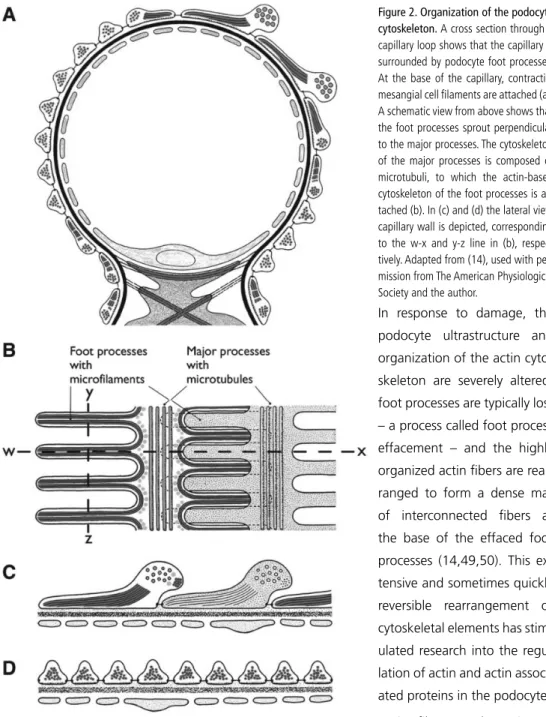
The outer aspect of the GBM is covered by visceral epithelial cells, or podocytes. These are highly differentiated cells with a complex, arborized phenotype. The podocyte cell body floats in the urinary space and gives rise to primary processes. The podocyte attaches to the GBM by means of foot processes, further cellular extensions that sprout perpendicularly from the major processes. Foot processes of two adjacent primary processes interdigitate, leaving a 40 nm space or ‘slit pore’ between them that is bridged by the slit diaphragm. In this way, the podocyte foot pro-cesses and the interposed slit diaphragm completely enwrap the glomerular capillaries. Recent three-dimensional ultrastructural analysis of the podocyte revealed an even further complexity. The space between the foot processes and the overlying cell body and primary processes ap-peared to be more restricted than previously appreciated, delineating a so-called sub-podocyte space. The finding that this space covers as much as 60 percent of the glomerular surface may bring important insights into the mechanisms of glomerular filtration (29,30).
Apart from its role in glomerular filtration, the podocyte probably also functions as a structure-stabilizing cell, providing forces to counteract capillary distension (31). Additionally, podocytes produce the extracellular matrix components that make up the GBM, and they provide growth factors like TGF-β and VEGF. The latter plays a role in the maintenance of the glomerular endo-thelium. The cell biology of the podocyte will be discussed in more detail in the next paragraph.
In contrast to the elaborately shaped podocytes and not reminiscent of their common embryonic origin, parietal epithelial cells (PECs) appear as a simple flat epithelium that lines Bowman’s cap-sule. Recent reports have made clear that occasionally podocyte-like cell types can be found at parietal cell positions (32). These cells may be PECs that transdifferentiate to become podocytes (33). PECs themselves have long been regarded as relatively inert cells that, although they may show secondary reactivity in response to glomerular pathology, play no crucial role in glomerular diseases. Recent studies have changed this view (34). Several reports have indicated that PECs do play a role in animal models of focal segmental glomerulosclerosis (35,36) and HIV-associated nephropathy (37), as well as in human glomerular diseases (38,39).
Glomerular extracellular matrix
During the development of the glomerulus, endothelial cells and podocytes together produce the extracellular matrix they rest on and that separates the two cell types: the 300 nm thick GBM. In the mature glomerulus, all three glomerular cell types synthesize components of the GBM (40-42)
chapter 1 > the kidney: development, anatomy and function 16
laminin (isoform α5β2γ1), collagen IV (isoform α3α4α5), heparan sulphate proteoglycans agrin, perlecan, collagen XVIII, syndecan, fibronectin, and nidogen/entactin. The collagen IV and laminin chains are crosslinked by nidogen, and form a strong, porous, network. The GBM proteoglycans are responsible for the negative charge of the GBM, thought to be instrumental in glomerular ultrafiltration (see below).
Mesangial cell extensions and mesangial ECM fibers are continuous with the GBM, and are thought to reinforce the glomerular structure (44). The mesangial matrix is composed of fibronec-tin, collagen IV (isoform α1α1α2), laminins (isoform α5β1γ1) and proteoglycans, with – similar to the GBM – heparansulphate as the major glycosaminoglycan (45). Many glomerular diseases result from an imbalance between mesangial matrix synthesis and degradation. For example, expansion of mesangial matrix is an important feature of diabetic nephropathy.
Cell biology of the podocyte
The molecular processes that support the podocyte’s complex architecture and provide the basis for its function have received much attention in recent years. The elucidation of genetic causes of rare hereditary disorders, the generation of conditional and inducible knock-out mice, and the possibility to culture human and rodent podocytes have been instrumental in the advancement of understanding the cell biology of the podocyte.
Cytoskeleton
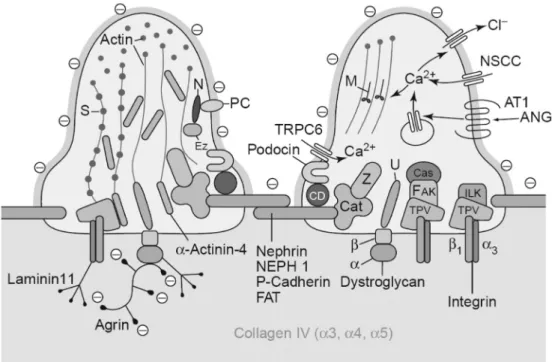
An elaborate cytoskeleton that combines strength with flexibility is indispensable for the correct shape and function of the podocyte. In the foot processes all membrane domains are physically linked to the cytoskeleton, and at the functional level the establishment of a connection between membrane associated molecules and the cytoskeleton has become a common theme.
17 the glomerulus > cell biology of the podocyte > cytoskeleton
In response to damage, the podocyte ultrastructure and organization of the actin cyto-skeleton are severely altered: foot processes are typically lost – a process called foot process effacement – and the highly organized actin fibers are rear-ranged to form a dense mat of interconnected fibers at the base of the effaced foot processes (14,49,50). This ex-tensive and sometimes quickly reversible rearrangement of cytoskeletal elements has stim-ulated research into the regu-lation of actin and actin associ-ated proteins in the podocyte. Actin filament elongation is regulated by Rho GTPases such as RhoA, rac, and cdc42, and these molecules probably have an important role in the formation of the cytoskeleton of the podocyte (51). Indeed, mice that lack an inhibitor of Rho GTPases, ie, in which these proteins are more active, develop heavy protein-uria and foot process effacement (52). Others have shown that the deleterious effect that plasma
chapter 1 > the kidney: development, anatomy and function 18
proteins have on podocytes is regulated in a RhoA dependent manner (53). Other actin regulating molecules including cortactin, Ena/VASP, and Arp2/3 are expressed in podocytes, illustrating the wide range of actin cytoskeleton activity displayed by podocytes (48).
The crucial role of the actin cytoskeleton is underscored by the fact that dysregulation of actin associated molecules results in a loss of adequate glomerular function. For example, MYH9, the gene coding for myosin heavy chain IIA, is related to the development of Fechtner syndrome that includes podocyte abnormalities (54). An upregulation of α-actinin-4 was shown to precede proteinuria and development of foot process effacement in PAN nephrosis (55). Later, mutations in ACTN4, the gene coding for α-actinin-4, were shown to be the cause of a hereditary form of late-onset focal segmental glomerulosclerosis (56). These mutations lead to an increased affinity of α-actinin-4 for actin, probably reducing cytoskeletal dynamics (56). At the same time, these mutations increase the protein degradation rate (57), and mice that lack α-actinin-4 also have glomerular disease (58), showing that both gain- and loss-of-function mutations in ACTN4 impair correct podocyte function.
Heat shock protein 27 has been reported to play a role in actin polymerization, and has been implicated in foot process effacement (59-61). Synaptopodin, also called pp44, was identified by Mundel et al to be an actin binding protein which expression is restricted to podocytes and neurons (62,63). Disruption of synaptopodin does not lead to glomerular disease, but seems to lower the threshold for development of glomerular abnormalities (64,65). This may relate to the involvement of synaptopodin in actin dynamics: synaptopodin regulates the actin bundling activ-ity of α-actinin-4 (64) and prevents the proteasomal degradation of RhoA (66).
Apical membrane
19 the glomerulus > cell biology of the podocyte > slit diaphragm region and ezrin, and that this linkage is disrupted in foot process effacement (72). Follow-up studies showed that podocalyxin may also directly bind ezrin and activate RhoA, showing additional actin-modulating properties (73).
Recently, the heavily glycosilated negatively charged α-subunit of dystroglycan has been sug-gested to perform a function similar to that of podocalyxin (74). Loss of dystroglycan from the apical membrane may result in foot process effacement, in addition to a pathogenic role that loss of dystroglycan from the basal site of the foot process may have (discussed below) (75).
The transmembrane glycoprotein podoplanin adds further negative charge to the apical mem-brane (76-78). Little is known about the intracellular connections of podoplanin in the podocyte, although in other cell types this protein has been shown to interact with ezrin (79,80).
GLEPP-1 (protein tyrosine phosphatase receptor type O) is a phosphatase expressed in the apical membrane of the podocyte. As demonstrated in knock-out mice, the protein has a role in the correct shaping of the actin cytoskeleton (81), but the substrates of its phosphatase function remain undefined (14).
Slit diaphragm region
The slit diaphragm that spans the space between two adjacent foot processes is inserted in the basolateral membrane of the foot process. The multitude of proteins and protein-lipid complexes that make up and support the slit diaphragm and both physically and functionally link the struc-ture to other parts of the cell, make this a highly specialized cell compartment.
Molecular architecture of the slit diaphragm
Although the slit diaphragm and some of its morphological characteristics have been recognized since the application of electron microscopy in kidney research (82,83), its molecular constituents have long remained obscure. The tight junction protein zonula occludens-1 (ZO-1) was one of the first molecules described to be associated with the slit diaphragm. Reiser et al showed that P-cadherin and ZO-1 co-localize at the slit diaphragm region, suggesting that the slit diaphragm is a modified adherens junction (84).
In 1988, Shimizu’s group showed that the injection of monoclonal antibody raised against a component of rat glomeruli (mAb 5-1-6) in rats produced massive and transient proteinuria. The epitope recognized by this antibody localized almost exclusively to the slit diaphragm (85). Pro-teinuria, induced through infusion of the antibody or through protamine sulfate, caused an apical dislocation and internalization of the protein (86,87).
chapter 1 > the kidney: development, anatomy and function 20
localized to the slit diaphragm (90-92). In retrospect, the epitope recognized by mAb 5-1-6 ap-peared to be identical to rat nephrin (93). Because nephrin, a member of the Ig protein superfam-ily, has a large extracellular domain and could form homodimers in vitro (94), it was suggested that nephrin strands from opposing foot processes may form the actual slit diaphragm through nephrin-nephrin interactions (95). This hypothesis was tested in an extensive study using electron tomography in combination with immuno-gold labeling of nephrin in glomeruli from various mammalian species, both in health and disease (96). From this study, it was concluded that nephrin, together with other proteins that were not molecularly identified, contributes to the slit diaphragm. In CNF patients the slit pore was much smaller and did not contain a slit diaphragm. Confirming these findings, different reports on nephrin knockout mice consistently showed heavy proteinuria and early death of the mice, with absence of the slit diaphragm (97-99), although foot processes were assembled normally (17). These studies established nephrin as an important structural component of the slit diaphragm.
21 the glomerulus > cell biology of the podocyte > slit diaphragm region Since the discovery of nephrin several other molecular components of the slit diaphragm have been identified. The nephrin homologues NEPH1-3 were identified in the mouse. As is the case with nephrin, NEPH1 deficient mice show proteinuria and neonatal death (100). Several groups subsequently showed that NEPH1 and nephrin form homo- and heterodimers, suggesting a shared role in formation of the slit diaphragm (101,102). Injection of individually subnephrito-genic doses of antibodies against nephrin and NEPH1 induced proteinuria (103), underscoring the functional link between these two molecules. NEPH3 (syn. filtrin, KIRREL2) is expressed at the slit diaphragm region, and its expression was found to be reduced in acquired proteinuric diseases, both at the protein and the mRNA level (104,105).
In a search for other cell-cell adhesion proteins that may be of relevance, Inoue et al found that the protocadherin FAT1 is expressed at the site of the slit diaphragm (106). Mice that lack FAT1 develop, among other abnormalities, proteinuria and foot process effacement (107).
Anchoring to the actin cytoskeleton
The slit diaphragm is inserted in a highly organized membrane region modified by lipid rafts. Podocin is one of the proteins that localizes to this region, and like nephrin is present in lipid rafts (108-110). The protein has a hairpin structure, with both the N- and C-terminus ending in the cytoplasm. Mutations in NPHS2, the gene encoding podocin, lead to a steroid-resistant form of nephrotic syndrome (111). Podocin interacts with several components of the podocyte foot pro-cess, including nephrin and CD2-associated protein (CD2AP). TRPC6, coding for a cation channel with a preference for Ca2+, was recently found to be mutated in patients with a late-onset form of FSGS (112). Subsequent analysis showed that TRPC6 localizes to the slit diaphragm region, and associates with other components such as nephrin and podocin (113,114).
chapter 1 > the kidney: development, anatomy and function 22
Signaling at the slit diaphragm
The studies mentioned so far have established numerous structural components of the slit dia-phragm and their intracellular connections; a major finding was that several of the proteins lo-cated in the slit diaphragm region participate in signaling pathways. Signal transduction in cells is mostly regulated by the attachment or detachment of phosphate groups on serine, threonine, or tyrosine residues of proteins, enabling the binding of other proteins (120). Both the intracellular (C-terminal) part of nephrin and NEPH1 contain tyrosine residues that can be phosphorylated by kinases such as Fyn; the importance of this is underscored by the fact that Fyn knockout mice show foot process effacement and proteinuria (121). Nephrin tyrosine phosphorylation results in activation of AP1, an effect that is enhanced by binding of nephrin to podocin (122). Later experiments showed that in vivo, phosphorylated nephrin in conjunction with CD2AP activates PI3 kinase. This in turn initiates a series of phosphorylations that may lead to intracellular re-sponses including cell survival, actin dynamics, proliferation, metabolism, and endocytosis. Two examples that give some insight in the importance of signaling for podocyte integrity are listed here; more in-depth reviews are provided in references (120) and (123). One specific response is the regulation of apoptosis: nephrin and CD2AP induced PI3 kinase activity may increase AKT expression, thus suppressing TGF-β signaling and preventing podocyte apoptosis (124,125). As will be discussed in a later paragraph, loss of podocytes is linked to the progression of renal dis-ease (126). Secondly, two different groups showed that nephrin phosphorylation by Fyn is crucial for its binding to the adaptor protein nck (127-129). Nck is able to recruit a protein complex that regulates actin polymerization. This suggests that the phosphorylated nephrin – nck interaction may be of importance in states with high dynamic activity such as development and foot process effacement or rearrangement (128-130).
The different interactions between the proteins in the slit diaphragm region, both in physical attachments of proteins and in signaling, make clear that protein complexes rather than single molecules are responsible for a correct podocyte and slit diaphragm function. And not only pro-teins, but also lipids may be involved. The role of lipid rafts in the cell membrane has already been alluded to; in addition, recent studies by Huber et al indicate that the regulation of TRPC6 by podocin requires binding of cholesterol by podocin (114).
Interaction with the GBM
At the basal site, the ‘sole’ of the foot process, the podocyte attaches to the matrix they have in part themselves produced: the GBM. This interaction is accomplished by several transmembrane matrix binding proteins, including integrins and dystroglycan.
chapter 1 > the kidney: development, anatomy and function 24
importance for the correct function of the glomerular filtration barrier: reactive oxygen species were found to decrease the adherence of dystroglycan to agrin, possibly leading to podocyte detachment (75). In a comparable study, Kojima et al found that protamine as well as reactive oxygen species disrupted the link between dystroglycan and its ligands (144). This resulted in a disorganization of the lamina rara externa of the GBM, substantiating the hypothesis, as put forward by Kerjaschki (50,142), that via dystroglycan the actin cytoskeleton of the podocyte may function as a blueprint for the organization and spacing of GBM proteins.
Other proteins that are located at the basal membrane include megalin/gp330 (in rats) and neu-tral endopeptidase/CD10 (in humans). These proteins have been discovered to be the pathogenic antigens in Heymann nephritis and neonatal membranous nephropathy, respectively (145-148). Megalin may be linked to the cytoskeleton via the adaptor protein MAGI-1 (149).
Podoplanin has also been reported to be present in the basal membrane of the foot processes, its predominant localization being at the apical membrane domain. As discussed above, the intracellular linkers of podoplanin in the podocyte have not been identified, nor is the function of podoplanin at this location clear. In lymphatic endothelial cells podoplanin has been reported to play a role in the shaping of a gradient of the chemokine SLC/CCL21 (150), which is also expressed in podocytes, and which is important for mesangial function (151). It is tempting to speculate that podoplanin is important for the mediation of this cross-talk between podocytes and the mesangium.
Exocytosis of ECM molecules and matrix modifying enzymes such as metalloproteinases takes place at the basal membrane of the podocyte. Also, growth factors such as VEGF are excreted at the basal site of the podocyte, although little is known about the kinetics and precise mecha-nisms by which this occurs (152). But interactions at the basal membrane of the podocyte are not restricted to binding and modifying the GBM, several other interactions take place. For example, there is extensive endocytosis in this membrane compartment, as can be inferred from the wide-spread presence of clathrin-coated pits and vesicles (14,153). In vitro, podocytes were shown to endocytose albumin, possibly important in clearing the glomerular filter from macromolecules (154). Others have also found that the podocyte is able to perform transcytosis, yielding a tran-scellular rather than paracellular, ie, slit diaphragm, route between the intracapillary lumen and Bowman’s space (155).
Receptors and signaling pathways
25 the glomerulus > cell biology of the podocyte > cell cycling and transcription factors molecules. These include vasoactive compounds as nitric oxide, atrial natriuretic peptide, hor-mones (156), and medication (including dexamethason (157) and cyclosporine (158)). Of some importance, also from a clinical point of view, is the fact that podocytes carry both types of the angiotensin II receptor, AT1 and AT2, suggesting podocytes have a local renin-angiotensin system (RAS) (159). It is well known that ACE inhibitors or AT1 antagonists have a beneficial effect on the kidney, which is not completely explained by their blood pressure lowering properties (152). The inhibition of angiotensin II receptor mediated effects may be the explanation for these observa-tions. Indeed, hypertrophy in podocytes was prevented by ACE inhibition (14), and several other studies have shown a ‘podoprotective’ effect of RAS inhibition (160-163). Conversely, transgenic rats that overexpress the human AT1 receptor specifically in podocytes develop albuminuria, podocyte foot process effacement, and eventually FSGS (164).
Rastaldi et al found that podocytes express several molecules associated with neuronal synaptic vesicles, and showed that in podocytes these molecules also associate with vesicles (165). These findings expand the extent of similarities between neurons and podocytes. Indeed, the branched appearance, cell cycle quiescent phenotype, cytoskeletal organization (166), and gene expression pattern (167) of these cells are strikingly similar. Moreover, these findings could indicate that apart from intracellular signaling, also an intercellular communication by means of synaptic-like exocytosis of glutamate may take place in podocytes (168).
Cell cycling and transcription factors
chapter 1 > the kidney: development, anatomy and function 26
nephron loss, also certain glomerular diseases have been associated with a proliferating podocyte phenotype. Almost all of these diseases show a detrimental course when left untreated. Moeller et al studied transgenic mice with tagged podocytes and showed that podocytes contribute to cellular crescents, seen in some forms of glomerulonephritis (172). In HIV-associated nephropathy podocytes are presumed to be able to escape their cell-cycle control and re-proliferate, leading to FSGS of the collapsing type with a rapidly progressive clinical course (173-175). It has been difficult to prove that these cells are really podocytes – the cells are dedifferentiated, they have lost their typical markers and they are allegedly podocytes merely on the basis of their localization in the glomerulus. Studies by Dijkman and Smeets et al brought evidence for the role of parietal epithelial cells in proliferative glomerular diseases (34,39).
Transcription factors that regulate podocyte development and maintenance include PAX2, pod1, Kreisler, Lmx1b, and WT1 (176). WT1 has been linked to the expression of several podocyte mark-ers, including nephrin and podocalyxin (177-180). The crucial role for WT1 is underscored by the fact that mutations in the gene cause syndromes (Denys-Drash, Frasier, and WAGR syndrome, OMIM 607102) that frequently involve podocyte and glomerular abnormalities.
Mutations in the gene that encodes the transcription factor Lmx1b cause nail-patella syndrome, characterized by the absence of the patella and nails and by the occurrence of nephropathy. Two groups of investigators studied Lmx1b knockout mice and found that this transcription factor is important for the expression of collagen α3(IV) and α4(IV), and the slit diaphragm associated proteins podocin and CD2AP (181,182), indicating a role for this transcription factor in both GBM formation and slit diaphragm function.
Glomerular filtration: characteristics and theoretical models
How exactly the kidneys produce urine has been investigated for over 150 years and remains unresolved. Initially, the question was whether the glomerulus takes at all part in formation of urine. At that time, tubular secretion probably was a more plausible option, as secretive epithelia in salivary, gastrointestinal, lactating glands etc. had just been extensively studied. The notion that urine is formed by glomerular filtration and tubular resorption and excretion was only proven through micropuncture studies in the 1920-60s (183-185). Still, the molecular mechanism of glomerular filtration remains incompletely understood.
27 the glomerulus > glomerular filtration: characteristics and theoretical models > characteristics of glomerular filtration Characteristics of glomerular filtration
Amounts and concentration of fluids
The kidney receives about 20 percent of the cardiac output, ~1.2 liters of blood per minute. Some ten percent of this total volume is filtered in the glomerulus, and enters the tubular system as pre-urine; the total volume of pre-urine thus amounts to 180 liters per day. Most of the pre-urine is reabsorbed in the tubules, leaving an average of 1.5 liters of urine each day for excretion (range 0.8 – 20 liters). The ultrafiltrate has almost the same composition as plasma-water, it is acellular and contains a low amount of protein. It is generally agreed upon that the concentration of albu-min in the pre-urine is about 25 µg/ml, compared to a plasma albualbu-min concentration of 45mg/ml. This indicates that the glomerular filter is restrictive for proteins, a feature referred to as glomeru-lar permselectivity. The extent of restriction differs for each protein (see below), and is expressed as the glomerular sieving coefficient (Bowman’s space-to-plasma concentration ratio) θ, theta.
Forces that drive filtration
There are different forces that drive transport of fluids through the glomerular capillary wall. These so-called Starling forces include the hydrostatic and colloid osmotic pressure, determined by the fluid-pressures and the colloid osmotic value of the fluids, respectively. These two forces work in opposite directions: the hydrostatic pressure in the glomerular capillaries is higher than that in Bowman’s space, providing an outward force. Instead, the colloid osmotic pressure within the capillaries exceeds that in Bowman’s space, and this will drive transport of fluids inwards. In the upstream part of the glomerular capillaries, the hydrostatic outward force is higher than the colloid osmotic inward force, resulting in filtration. Since the filtration barrier is restrictive to proteins, the extraction of fluids from inside the capillaries will increase the intracapillary protein concentration, and thus the colloid osmotic pressures. Eventually, in the downstream part of the glomerular capillaries this will lead to an osmotic inward force that equals the hydrostatic outward force, the so-called filtration pressure equilibrium. Downstream of the point where the filtration pressure equilibrium is reached, there is no filtration.
The amount of filtration is further influenced by the characteristics of the filter, represented in the ultrafiltration coefficient Kf, the constant that indicates the resistance to fluid flow through a bar-rier. Higher levels of Kf indicate a higher permeability. Both the GBM and the cellular constituents of the filter contribute to the resistance to flow.
Small molecules are mainly transported by convection, and thus hold pace with the transport of the fluids over the capillary wall, while macromolecular transport is determined by both convec-tion and diffusion.
Biochemical and biophysical properties of the glomerular filter
chapter 1 > the kidney: development, anatomy and function 28
for each macromolecule. Because macromolecular transport is passive, θ varies between 1 (free passage through the filtration barrier) and 0 (complete restriction). The different determinants of glomerular permeability will be discussed here.
Size selectivity – The size of a molecule, commonly indicated by its Stokes-Einstein radius (SE radius), is influenced by the compactness of the molecule and its molecular weight. For albumin (molecular weight 3000 kDa, SE radius 36 Å) the sieving coefficient θ is about 6∙10-4 (25 µg/ ml, the albumin concentration in Bowmans’ space divided by 45 mg/ml, the plasma albumin concentration). The θ for smaller proteins is considerably larger, and proteins smaller than 14 Å have a θ that is 1, indicating that these molecules are not restricted by the glomerular filtra-tion barrier. For larger proteins such as IgG (molecular radius 55 Å) or IgM (molecular radius 120 Å), the θ is considerably smaller; these molecules may even be completely absent from the ultrafiltrate in Bowman’s space. The exact size selectivity of the glomerulus has been difficult to determine: direct measurement of proteins should be performed in the glomerular ultrafiltrate, before reabsorption in tubules may occur. This requires micropuncture techniques that have been criticized because they may measure proteins released as a result of the tubular damage associ-ated with the measurement itself, or by contamination of peritubular capillary blood proteins. The most reliable direct measurements of protein concentrations are probably experiments by Tojo and Endou (186), who used sophisticated techniques to circumvent the problems associ-ated with micropuncture techniques. These studies have established the before mentioned θ for albumin of 6∙10-4. Furthermore, patients with Fanconi syndrome have been used for estimations of the glomerular filtration selectivity. These patients have an impaired tubular protein uptake, and the protein concentration in urine is thus a reflection of their glomerular protein filtration. In these studies, the θ for albumin was found to be ~8∙10-5, which is even lower than that of rodents (187). Probes of different sizes, such as the polysaccharides dextran and Ficoll as well as different proteins, have been used to get insight in the exact size characteristics of the filter. Results from these experiments have been used in models of glomerular size selectivity, in which the glomerular filtration barrier is considered to be perforated by pores with a certain diameter. In most models, there are two ‘pore-populations’: a large number of restrictive small pores with a radius between 37 and 55 Å, and far less frequent unrestrictive large pores or ‘shunts’, with a radius of 80 – 100 Å (43,188-191).
29 the glomerulus > glomerular filtration: characteristics and theoretical models > different explanations for permselectivity hyperpermeable, probably due to the compressibility of Ficoll (188). This indicates that the form, globular or linear, and deformability of a molecule is of importance for its sieving characteristics.
Charge selectivity – Several studies have demonstrated that the capillary wall restriction for an-ionic proteins is higher than that for neutral or catan-ionic proteins, indicating the presence of charge selectivity (192-194). The extent of this charge selectivity has, however, been difficult to quantify. This relates in part to the use of tracers that may not truly mimic the behavior of pro-teins in the capillary wall: negatively charged sulfated dextrans may more rapidly interact with the components of the glomerular filter, thus retarding their passage (188). As pointed out before, the capillary wall seems to be hyperpermeable for Ficoll in comparison to albumin of the same size. This has led to the suggestion that the negative charge of albumin accounts for the appar-ent restriction, which would fit with an important charge barrier (195), although the divergappar-ent behavior may in fact be related to the compressibility of Ficoll. Furthermore, comparison of tracers such as sulfated dextrans and carboxymethyl Ficoll (tracers that have been rendered negatively charged) with their neutral counterparts even showed an increased permeability of negatively charged tracers (196). Removal of molecular constituents of the negative charge in the GBM – using enzymatic and genetic methods – failed to induce proteinuria, further questioning the role of the GBM in charge selectivity (197-201). It has been suggested that the actual charge barrier may reside in the endothelium rather than in the GBM (see below). Also, a charge effect could be built up by negatively charged components of the blood, such as albumin, which accumulate during filtration or interact with the endothelial cell glycocalyx (202). An indirect proof for this is the observation by Ryan and Karnovsky, that a continuous blood flow is needed to maintain a normal filtration barrier (203). Direct proof for this mechanism is lacking. Thus, although most authors acknowledge the presence of charge selectivity, at least with regard to the filtration of proteins, its relative contribution to permselectivity remains controversial.
Different explanations for permselectivity
The description of the functional characteristics of glomerular filtration directly relates to the question how filtration is accomplished on a structural level. In the literature, the different struc-tural components of the glomerular filter have all been given attention, with a recent skewing towards the contribution of the podocyte. An overview of the different explanations and hypoth-esis is lined out below.
The GBM as the main filter for plasma proteins
chapter 1 > the kidney: development, anatomy and function 30
cross-linked collagen IV networks, and removal of some essential components leads to the devel-opment of proteinuria. Localization of the charge restriction in the GBM has been inferred from the observation of regularly spaced anionic sites demonstrated using for example polyethylenei-mine, and the corresponding molecules have been identified as the glycosaminoglycan sidechains of proteoglycans such as agrin, perlecan, and collagen XVIII. In conclusion, charge and size selec-tivity can both be explained by the structural and molecular properties of the GBM. Yet, this view leaves several observations unexplained. For example, while IgG is mostly absent from the glo-merular ultrafiltrate, injection of IgG directed against nephrin and megalin binds these antigens expressed on the podocyte membrane (85,145), indicating that these IgGs have passed through the GBM. The contribution of GBM proteoglycans to the charge selectivity has been criticized by investigators pointing out that in other tissues such as cartilaginous tumors albumin is found in the stroma, which is even more rich in proteoglycans than the GBM (205,206).
Furthermore, fitting data obtained from experiments with isolated GBM into a theoretical model of glomerular filtration, Deen et al concluded that the contribution of the GBM to permselectiv-ity is relatively small in comparison to that of the cellular components of the filter (26,207,208). These could then either be the endothelial or the epithelial cells. Over the last decade, the contri-bution of the podocyte to the permselectivity of the glomerular filter has received most attention.
The podocyte slit diaphragm is the main barrier for plasma proteins
Tryggvason and coworkers, after the discovery of nephrin, argued that the podocytes and espe-cially the slit diaphragm would be the main site of ultrafiltration (95,209-211). This hypothesis was supported by observations by Rodewald en Karnovsky in the 1970’s, who observed that the slit diaphragm had a zipper-like ultrastructure and suggested that this could explain the glomeru-lar size selectivity (83). Using electron tomography, Wartiovaara et al visualized nephrin strands spanning the slit pore and leaving lateral pores of about the size of an albumin molecule (96). The fact that absence or abnormal function of many other slit diaphragm-associated proteins leads to proteinuria brings additional evidence for the importance of the slit diaphragm in glomerular permselectivity, and possibly for its dominant role in ultrafiltration.
31 the glomerulus > glomerular filtration: characteristics and theoretical models > integrative views of glomerular filtration are frequently observed at the basal membrane, and in vitro podocytes have been shown to be capable of large scale endocytosis (154).
Alternatively, the restrictive properties of the glomerulus could be localized to the other cellular component, the endothelium.
The endothelial cells restrict passage of proteins
Deen showed that theoretically the endothelial layer is able to contribute notably to the glomeru-lar filtration barrier (208). Early studies of glomeruglomeru-lar permselectivity had ruled out a contribu-tion of the glomerular endothelium, as it was recognized that the fenestracontribu-tions would be too large to restrict passage of macromolecules (204). Later studies, however, have changed this view. Rostgaard and Qvortrup used special fixation and staining techniques that allowed them to study the ultrastructural organization of the glomerular capillary wall in the absence of changes that would be caused by lower blood pressure or anoxia. They found that the endothelial cells are covered with a 300nm thick glycocalyx, and that the fenestrae of the endothelial cells were bridged by filaments (25). In a later study, the same authors described the presence of a surface coat, presumably made up of proteoglycans on the endothelial cells, which extended into and filled up the endothelial fenestrations (213). This led them to hypothesize that these ‘sieve plugs’ or ‘fascinae fenestrae’ would be the actual basis for the glomerular permselectivity (213). Oth-ers have shown that the glomerular endothelial cells produce negatively charged proteoglycans (214). Taken together, the glomerular endothelial cells may indeed play a more important role in glomerular filtration than has been generally acknowledged (43,202,208,211).
Integrative views of glomerular filtration
Some explanations bring a more integrative view of the filter. These include the view of the glo-merular filration barrier as size and charge barriers in series, the ‘Electrokinetic glomerulus theory’ by Douglas Somers, and Oliver Smithies’ ‘Permeation diffusion hypothesis’.
Size and charge barriers in series
In the classic view of the glomerular filtration barrier, the GBM and the podocyte slit diaphragm are two size and charge selective barriers that are placed in series. The GBM functions as a coarse filter for the larger molecules, while the slit diaphragm is the fine filter (204,215). If this view of the glomerular filtration barrier were correct, this would lead to a concentration polarization, ie, a clogging of the filter. Thus, this view of glomerular filtration seems to suffer from the combined inconsistencies mentioned in the discussion of the individual components of the filter.
Electrokinetic glomerulus theory
chapter 1 > the kidney: development, anatomy and function 32
negative charge at the urinary space side of the GBM. In steady-state conditions, this will lead to a charge gradient with the highest negative charge downstream in the GBM. The increasing negative charge provides the restriction to negatively charged molecules such as albumin and, ac-cording to this model, explains the glomerular filtration characteristics. The observation that the concentration of molecular tracers was higher in the subendothelial than the subepithelial part of the GBM (193,216) has been explained to support this view of an increasingly restrictive barrier, although other explanations are possible for this finding.
Because ion transport takes place by convection, the formation of the charge gradient is depen-dent on flow. Flow, as described above, is dependepen-dent on the filtration pressure characteristics in the glomerulus: the combined pressure and osmotic forces that drive the fluids out of the capil-laries minus those that would drive fluids in. Halfway the glomerulus the in- and outward forces are similar (“raising the question why we have an efferent capillary in the first place”), resulting in a filtration pressure equilibrium. Consequently, in the glomerular capillaries downstream of the filtration pressure equilibrium, there will be no flow and thus no negative charge will build up. This would result in a loss of albumin by simple diffusion through the GBM. To explain the fact that this does not seem to occur, Somers suggests that the podocyte, by crossing the space between different capillaries, may transport the negative charge built up in afferent capillaries to efferent capillaries. This is compatible with the negatively charged surface of the podocyte’s major and foot processes that would prevent a loss of charge through an ‘electric shortcut’.
One of the predictions of this model is that proteinuria will occur in situations where GFR is de-creased, because the subepithelial negative charge will not build up completely. Indeed, Rippe et al recently found that the sieving coefficient of Ficoll is increased (meaning that Ficoll is less effectively retained by the glomerular barrier) in low GFR conditions (217).
Permeation/diffusion hypothesis
33 the glomerulus > glomerular filtration: characteristics and theoretical models > synthesis albuminuria. In other words, the transport of albumin into Bowman’s space is fairly constant, but the absence of the diluent is responsible for proteinuria. In this view, albuminuria is not necessar-ily the result of a pathologic change in the glomerular filtration barrier, but may be the physiologic result of a decrease in GFR. On the other hand, changes in the glomerulus do induce albuminuria if they increase the hydrodynamic resistance of the filtration barrier, as for example in podocyte foot process effacement (218), or if they change the properties of the GBM (219). The experi-ments by Rippe et al, showing increased sieving coefficients for Ficoll in low-GFR conditions, are in line with this theory of glomerular filtration.
In general, rodents have a relatively higher urinary protein excretion than humans. This could pos-sibly be explained to be in line with the permeation diffusion theory: if the protein concentration is determined by the diffusion of albumin and the filtration of the diluent, the factors that deter-mine these two variables are, respectively, the surface available for diffusion, and the amount of filtrated fluids. Human glomeruli are larger than those of rodents, and thus the diffusion surface and fluid content of human glomeruli is also larger than that of rodents. But diffusion surface increases with a factor to the power 2, while fluid content increases with a factor to the power 3. Thus more diluent is available, suggesting that larger glomeruli would elaborate a more dilute pre-urine.
The permeation-diffusion theory does not readily explain the proteinuria seen in situations with a normal GFR and normal foot process morphology, as has been observed in animal models and sporadic human cases (85,103,143,220).
Absence of glomerular permselectivity
The most extreme view of glomerular filtration is that there is no, or at least very limited glomeru-lar permselectivity, a hypothesis that has been fueled by several studies of Comper and cowork-ers. Their hypothesis explains the inconsistencies that remain in the other theories concerning glomerular selectivity, but brings up another problem: if the glomerulus would filter ‘nephrotic levels of albumin’ (221), this would result in an albumin excretion of about 600 g per day (202). To explain the fact that only limited amounts of this reach the urine, Comper et al have hypoth-esized that there is a high capacity albumin retrieval pathway in the proximal tubulus. Over the years, Comper et al have brought evidence for the absence of glomerular size and charge selec-tivity (205), the presence of tubular retrieval pathways for example through tubular transcytosis (221), and have raised a hypothesis to explain proteinuria seen in glomerular diseases (222). Al-though the potential interest of their findings is acknowledged (223), the methods of the experi-ments have been criticized (14,43,202,223,224) and their results could not be reproduced (190).
Synthesis
chapter 1 > the kidney: development, anatomy and function 34
a more important role to one of the three (225). Indeed, damage to any of the three layers can be associated with the development of proteinuria (see below). Although intuitively true – why else would the glomerular capillary wall be endowed with its special properties – this view leaves the question as to how exactly the glomerulus elaborates its low-protein ultrafiltrate unanswered.
From Bowman’s space, the glomerular ultrafiltrate empties into the tubular lumen, where its com-position is modified on its way to the collecting ducts. The tubular system will be discussed next.
The tubular system
Each glomerulus is connected to a ~5 cm long renal tubule that is built of a proximal, intermedi-ate, and distal segment. The proximal segment starts as a contortuous tube, containing cells with a prominent brushborder, and connects to a straight part. This part of the proximal tubule forms the transition to the intermediate segment that loops through the medulla as Henle’s loop. As-cending from the medulla, Henle’s loop connects to the distal convoluted tubule that on its path to the collecting duct makes contact with the glomerular arterioles at the macula densa (226).
The different segments of the tubule contain cells with a different morphology and accordingly different functions. The main function of proximal tubular cells is reabsorption of water and the dissolved salts and small molecules of the ultrafiltrate. To this end, the cells are equipped with mi-crovilli that provide a ~40 times increase in apical surface area. At the beginning of Henle’s loop, the amount of ultrafiltrate has been reduced to about 70 percent. The cells in Henle’s loop further reabsorb water and salts, with a predominance of salts, thereby increasing the medullary salt concentration. This forms the basis for the concentration of urine that is eventually performed in the collecting ducts. The distal collecting duct further reabsorbs NaCl as well as calcium. Water is less efficiently reabsorbed in this segment, resulting in a hypoosmotic fluid that is delivered into the collecting duct.
35 interstitium and the extracellular matrix introductory chapter. In the interest of a discussion on the effects of filtered proteins on tubular epithelial cells, the mechanisms of tubular protein resorption will be discussed in some more detail.
Proteins are mainly reabsorbed in the proximal tubules through receptor-mediated endocytosis. The main receptors for albumin in the proximal tubule are cubulin and megalin. Both are multi-ligand endocytic receptors that are able to bind albumin. Binding of albumin to these receptors is followed by endocytosis and transport of the endocytic vesicles to the lysosome. Here albumin is degraded into amino acids that are subsequently excreted in the PTCs, while the receptors are recycled to the apical membrane (227,228). One research group has found that other ways of albumin transport may exist, namely through transcytosis (221). The endocytosed albumin is transported through the cell and delivered undegraded into the circulation. This way of albumin transport awaits further confirmation.
The tubular epithelial cells manufacture and rest on a basement membrane (TBM) of collagen IV (isoforms α1α1α2), laminins (111 and 511), and HSPGs (mainly perlecan).
Interstitium and the extracellular matrix
Between tubuli and glomeruli is the interstitium, which contains the blood vessels, peritubular capillaries (PTCs) as well as lymphatics. These vascular structures are embedded in a loose extra-cellular matrix, produced by the interstitial fibroblasts. Other interstitial cell types include macro-phages and – more recently described – dendritic cells that form a network surrounding the tubuli and glomeruli (229,230).
The normal interstitial matrix contains collagens type I, III, V, VII, fibronectin, and tenascin. These molecules are present only in small amounts, for in the normal kidney cortex the interstitial space is limited: tubuli are normally positioned side by side, and the intervening PTCs fill most of the remaining space, often fusing their basement membranes with the TBM, at least optically.
chapter 1 > causes and consequences of proteinuria 36
CAUSES AND CONSEQUENCES
OF PROTEINURIA
Proteinuria, the presence of abnormally high amounts of plasma proteins in the urine, is a symp-tom associated with many different kidney diseases. Although the causes of proteinuria are di-verse, the consequence of proteinuria in different diseases is similar, in that it confers an increased risk of loss of kidney function, in association with an increased risk of cardiovascular complica-tions. This, together with the fact that the development of proteinuria may be modifiable, makes it an important risk factor in both native and transplant renal disease. In this paragraph, a brief overview of the epidemiology of proteinuria and the kidney diseases in which proteinuria is seen is provided. The paragraph focuses on the causes and consequences of proteinuria on the his-topathological and molecular levels. The paragraph ends with a more general discussion of the mechanisms implicated in the progression of renal disease.
Epidemiology
Several large population screenings have established the epidemiological characteristics of teinuria. In the district of Okinawa, Japan, more than 100,000 individuals were screened for pro-teinuria and follow-up was recorded for more than 20 years (231). From these studies it became clear that proteinuria is an important independent predictor of the development of end stage renal disease. In Groningen, The Netherlands, a large population study, the PREVEND study, was performed in which about 40,000 persons were screened for albuminuria (232,233) (www.pre-vend.org). These studies made clear that in 6.6 percent of the otherwise healthy population mi-croalbuminuria was present. Furthermore, not only was mimi-croalbuminuria found to be associated with the progression of renal disease, it also was an important predictor of cardiovascular diseases (232,233). Several other epidemiologic studies have found a strong correlation between protein-uria and the progression of renal disease (234-236). Based on this association, in 2006 the Dutch Kidney Foundation started the ‘Niercheck’, a national campaign to detect kidney damage in an early, preclinical stage on the basis of macroalbuminuria measurements (www.nierstichting.nl).
37 causes of proteinuria
Causes of proteinuria
Proteinuria can either be caused by a failure of tubular reabsorption of the small amounts of fil-tered proteins, or by a loss of glomerular permselectivity, leading to larger amount of proteins in the pre-urine that saturate the tubular retrieval systems.
Examples of the first include the Fanconi syndrome, in which there is a dysfunctional proximal tubular reabsorption mechanism (187). Such ‘tubular proteinuria’ usually results in only mild in-creases in the protein content of the urine. Instead, glomerular proteinuria can be associated with large increases of albumin and other proteins in the urine, and may lead to the development of a nephrotic syndrome (see below).
Glomerular proteinuria can be associated with damage to all different levels of the glomerular filtration barrier, the endothelium, the GBM, and the podocyte.
For example, preecclampsia is associated with endothelial cell damage and profound proteinuria. In the glomerulus, swelling of endothelial cells (endotheliosis) is seen. Pathogenetically, the de-velopment of preecclampsia has been linked to the excess production of a soluble VEGF receptor (soluble Fms-like tyrosine kinase, sFlt), that binds and inactivates VEGF. In the glomerulus, VEGF-A produced by podocytes may therefore not reach the endothelial compartment in sufficient amounts, leading to a loss of endothelial viability (21,237,238). Enzymatic breakdown of the endothelial glycocalyx resulted in an increased permeability for proteins that was mainly due to a loss of charge selectivity (239).
The correct molecular make-up of the GBM is crucial for a normal filtration barrier; impaired as-sembly of the GBM components leads to proteinuria or an otherwise more permeable GBM. This is most clearly underscored by hereditary syndromes that have been associated with mutations in genes coding for GBM components. Patients with Alports syndrome carry a mutation in one of the collagen chains of the mature GBM. Alports syndrome is characterized by hematuria, pro-teinuria, and loss of renal function (240). Similarly, in nail-patella syndrome, a malfunction of the transcription factor Lmx1b leads to an aberrant collagen IV assemblage, followed by nephrotic syndrome (241). Also, incorrect assembly of the GBM matrix components as seen in the ILK knockout mice (139), is related to the development of proteinuria.
chapter 1 > causes and consequences of proteinuria 38
Recently, it was recognized that the cause of Pierson’s syndrome is a mutation in the gene coding for laminin β2 (244,245).
Strikingly, mice that in a podocyte-specific fashion lack expression of perlecan (200) or large parts of agrin (197,199) – the major heparin sulphate proteoglycans of the GBM – show no proteinuria, although perlecan null mice seem to be more susceptible to glomerular damage (246). Likewise, mice that lack Ext, the protein responsible for heparan sulphate biosynthesis, in podocytes are not proteinuric (201). Also, in vivo degradation of heparan sulphates in the GBM does not cause proteinuria (198). As discussed before, this indicates that the charge barrier of the GBM may be of less importance for the correct function of glomerular permselectivity than previously thought.
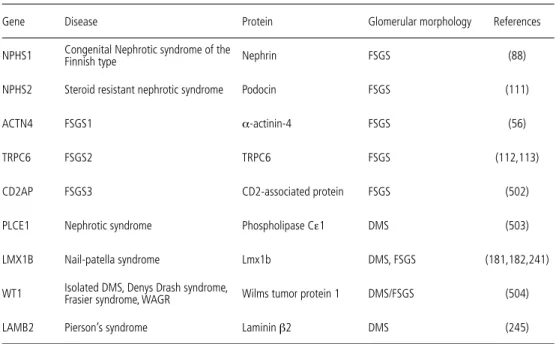
Damage of podocytes is almost always accompanied by proteinuria. There are several ways in which podocytes can be damaged, including through genetic, inflammatory, and infectious dis-eases, through growth factors, cytokines, medication, and mechanical stress. Several of the he-reditary forms of proteinuria have already been discussed, as they have been closely related to the elucidation of the cell biology of the podocyte. The currently known forms of hereditary protein-uria are listed in table 1. Other forms of podocyte damage will be illustrated in the description of proteinuria that occurs in various kidney diseases.
Causes of proteinuria in various kidney diseases
Proteinuria is a symptom of many kidney diseases and is especially seen in diseases characterized by a glomerular involvement. These comprise among others minimal change disease, focal seg-mental glomerulosclerosis, diabetic nephropathy, membranous nephropathy, membranoprolif-erative nephropathy, and lupus nephritis. In these diseases, proteinuria can occur as a component of the nephrotic syndrome, characterized by a loss of more than 3,5 gram of protein per 24 hours (nephrotic range proteinuria), edema, and hypoalbuminemia.
How does the development of proteinuria in these different diseases relate to the different pro-cesses discussed above?
Minimal change disease
39 causes of proteinuria in various kidney diseases > minimal change disease patients may show relapses, and some may even be steroid resistant. In such cases FSGS should be suspected.
The histopathology of MCD, as the name implies, does not show gross abnormalities on light microscopy. On electron microscopic evaluation, extensive effacement of podocyte foot processes is seen. The pathogenesis of MCD remains unknown, although several mechanisms have been hypothesized (247). A T-cell derived permeability factor has been suggested to induce the devel-opment of MCD (248), although definitive proof for this is lacking. Several cytokines have been shown to be upregulated in MCD, and these could act via cytokine receptors that have been found to be expressed by podocytes (249). Van den Berg et al (250) found that through the ac-tion of IL-4 and IL-13 on podocytes, the activity of the proteases cathepsin L and heparanase in the GBM is increased. This may subsequently lead to a degradation of heparan sulphate in the GBM, leading to proteinuria. Indeed, alterations of the heparan sulphate moieties in the GBM have been repeatedly found in MCD (251).
The group of Bakker and coworkers has postulated that hemopexin might be the circulating factor that is responsible for the development of MCD. Injection of hemopexin in rats resulted in a disorganization of the anionic sites at the subendothelial side of the GBM, and transient proteinuria (252).
Table 1. Hereditary forms of proteinuria
Gene Disease Protein Glomerular morphology References
NPHS1 Congenital Nephrotic syndrome of the Finnish type Nephrin FSGS (88)
NPHS2 Steroid resistant nephrotic syndrome Podocin FSGS (111)
ACTN4 FSGS1 α-actinin-4 FSGS (56)
TRPC6 FSGS2 TRPC6 FSGS (112,113)
CD2AP FSGS3 CD2-associated protein FSGS (502)
PLCE1 Nephrotic syndrome Phospholipase Cε1 DMS (503)
LMX1B Nail-patella syndrome Lmx1b DMS, FSGS (181,182,241)
WT1 Isolated DMS, Denys Drash syndrome, Frasier syndrome, WAGR Wilms tumor protein 1 DMS/FSGS (504)
LAMB2 Pierson’s syndrome Laminin β2 DMS (245)