ARTICLE ADDENDUM
Potential sites of CFTR activation by tyrosine kinases
Arnaud Billeta,b, Yanlin Jiaa,b, Timothy J. Jensenc, Yue-Xian Houc, Xiu-Bao Changc, John R. Riordanc, and John W. Hanrahana,b,d
a
Department of Physiology, McGill University, Montreal, Quebec, Canada;bCF Translational Research Center, McGill University, Montreal, Quebec, Canada;cDepartment of Biochemistry and Biophysics & CF Research Center, UNC Chapel Hill, Chapel Hill, NC, USA;dResearch Institute of the McGill University Hospital Center, Montreal, Quebec, Canada
ARTICLE HISTORY
Received 19 November 2015 Revised 23 November 2015 Accepted 23 November 2015
ABSTRACT
The CFTR chloride channel is tightly regulated by phosphorylation at multiple serine residues. Recently it has been proposed that its activity is also regulated by tyrosine kinases, however the tyrosine phosphorylation sites remain to be identified. In this study we examined 2 candidate tyrosine residues near the boundary between the first nucleotide binding domain and the R domain, a region which is important for channel function but devoid of PKA consensus sequences. Mutating tyrosines at positions 625 and 627 dramatically reduced responses to Src or Pyk2 without altering the activation by PKA, suggesting they may contribute to CFTR regulation.
KEYWORDS
CFTR regulation; cystic
fibrosis; phosphotyrosine; Pyk2; Src
Introduction
Cystic Fibrosis is caused by mutations in the cysticfi bro-sis transmembrane conductance regulator (CFTR) anion channel. Like other members of the ATP-binding cassette (ABC) transporter family, CFTR channel activ-ity is regulated by the binding and hydrolysis of ATP molecules by the Nucleotide Binding Domains (NBDs).1,2In addition, CFTR catalytic activity is initi-ated and reguliniti-ated by phosphorylation of its unique, intrinsically disordered regulatory region or R-domain.
The phosphorylation state of CFTR is controlled by both kinases and phosphatases3and many serines lie within consensus sequences for phosphorylation by PKA and PKC.4 Several studies have suggested that tyrosine kinases may also influence CFTR gating either directly or indirectly. Direct tyrosine kinase reg-ulation was suggested by exposing excised membrane patches to c-Src kinase5and by the sensitivity of mus-carinic stimulation of CFTR to tyrosine kinase inhibi-tors.6 Indirect regulation through a mechanism in which tyrosine phosphorylation unmasks a potential Casein Kinase 2 (CK2) phospho-acceptor site (Ser511) in NBD1 has also been reported.7,8 We recently reported that that tyrosine phosphorylation can be a potent and direct (PKA/C-independent)
stimulus for CFTR activation.9 Moreover, we found that the tyrosine kinases c-Src and Pyk2 are both able to phosphorylate CFTR on tyrosine residues, and acti-vate chloride currents which are 80% as large as those stimulated by PKA.
The serine/threonine phosphorylation sites on CFTR have been identified10,11and their contributions to channel regulation have been characterized in detail,12-14however the tyrosine residues that mediate direct regulation of channel activity remain unknown. We have attempted to identify these sites using mass spectrometry but so far that approach has not been successful despite clear radiolabeling after incubation with Src and [g-32P]-ATP and detection of a CFTR band in immunoprecipitates when immunoblots are probed with anti-phosphotyrosine antibody. In the present work, we used a site-directed mutagenesis/ functional assay approach, focusing on 2 candidate tyrosine residues near the c-terminal end of NBD1 (Y625 and Y627). We found that substituting these 2 tyrosine residues with phenylalanine (CFTR-YY625,627FF mutant) dramatically reduced (but did not abolish) tyrosine kinase stimulated currents with-out altering those stimulated by PKA.
CONTACT Arnaud Billet [email protected]
Addendum to: Billet A, et al. Regulation of the Cystic Fibrosis Transmembrane conductance Regulator (CFTR) anion channel by tyrosine phosphorylation. FASEB J. 2015; 29(9):3945-53. http://dx.doi.org/10.1096/fj.15-273151.
© 2016 Taylor & Francis
Results
None of the 40 tyrosine residues on CFTR are situated in canonical strong sites for phosphorylation by Src or other tyrosine kinases.15As afirst step toward localiz-ing the critical tyrosines we examined the ability of Src to phosphorylate CFTR peptide fragments (Fig. 1). Polypeptides corresponding to full-length CFTR (a.a. 1-1480, lane 1and2),first membrane domainCNBD1 (a.a. 1-640, lane 3&4), first membrane domain C NBD1CR domain (a.a. 1-830, lane 5&6) or all of the CFTR sequence that is distal to the fourth transmem-brane segment (a.a. 281-1480, lane 7&8) were stably expressed in BHK cells. Peptides were immunopreci-pitated from the control (¡) or v-Src expressing (C) cells using a mouse monoclonal antibody against anti-phosphotyrosine, and immunoblots were probed with the anti-CFTR antibody L12B4. When co-expressed with the consitutively active tyrosine kinase v-Src, all CFTR peptides could be immunoprecipitated by
anti-phosphotyrosine antibody as indicated by bands at their predicted molecular weights (Fig. 1 black arrows). Tyrosine phosphorylation of all 3 peptides might be explained by the phosphorylation of one or more tyrosines between a.a. 281-640, the region of CFTR which is shared by these peptides, which we refer to as the “optimistic hypothesis”. Alternatively, the results are also consistent with the presence of multiple phosphotyrosines distributed throughout the molecule.
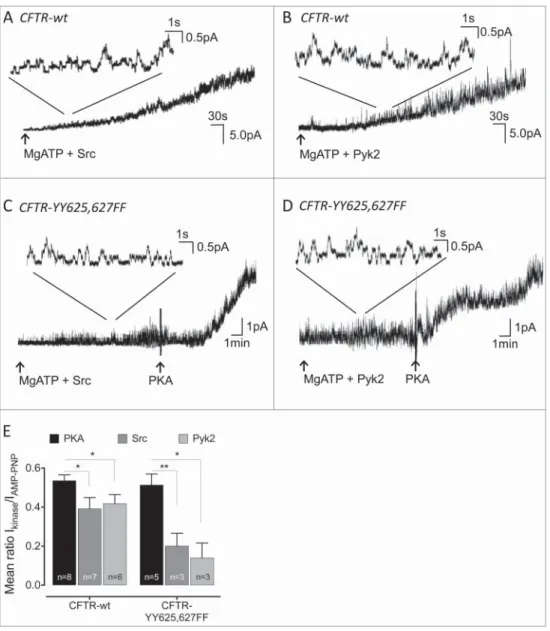
We tested the optimistic hypothesis (i.e., that phosphotyrosine is detectable on all the peptides because it is situated in the region of overlap) by substituting the most likely candidate tyrosine resi-dues, Y625 and Y627, simultaneously with phenylala-nine. Silent patches were excised from BHK stably expressing the double mutant (CFTR-YY625,627FF) and exposed to active phospho-Src or to the catalytic domain of Pyk2 (30U/ml for both kinases). Wt-CFTR current was strongly activated by both tyrosine kinases. Figure 2A and B show representative traces of wt-CFTR activity induced by Src and Pyk2, respec-tively. By contrast, CFTR channel activation by the 2 tested tyrosine kinases was strongly decreased in the double mutant compared to the normal responses to PKA (75 nM), which was added at the end of each experiment (Fig. 2C and D). Strong activation by PKA confirmed the presence of mutant CFTR chan-nels in the patch and indicate that substituting phe-nylalanine at Y625 and Y627 did not grossly affect channel function.
To compare the activation by different kinases we added the non-hydrolysable ATP analog AMP-PNP (1mM) at the end of experiments and calculated the current ratio to help normalize for variation in the number of channels per patch as described previ-ously.9 Figure 2E shows a histogram of the current ratios obtained in presence of 30U/ml Src, Pyk2, or 75nM PKA. The ratios revealed a dramatically decrease in the activation of YY625,627FF CFTR by Src or Pyk2 (current ratios 0.20 and 0.13 respectively, nD3) compared to wild-type CFTR. This contrasted with the current ratio during application of PKA, which was similar for mutant (current ratio 0.51, n D 5) and wild-type channels. These data strongly suggest that phosphorylation of one or both tyrosines contributes to CFTR activation by Src and Pyk2, although part (25–40%) of the response is apparently due to other sites which remain to be identified.
Discussion
In a previous study we found that the tyrosine kinases Src and Pyk2 can activate wild-type CFTR, producing currents that reach 80% of those stimulated by PKA.9 Here we observed a dramatic decrease in tyrosine kinase-activated currents when Y625 and Y627 were mutagenized to phenylalanine (YY625,627FF) in full-length CFTR. Since PKA stimulation was not altered in the double mutant, one or both tyrosine residues may contribute to CFTR activation by tyrosine kinases.
As a first approach toward localizing the site we coexpressed peptides corresponding to different regions of CFTR together with v-Src and examined theirin vivophosphorylation by immunoprecipitation with anti-phosphotyrosine antibody and blotting with anti-CFTR antibody. Phosphotyrosine was detected on all 3 peptides, therefore we focused on tyrosines in the region of overlap (amino acids 281 –640), which occur in the sequence KILI[LHEGSSY625]FY627GTF.
Based on the preferential phosphorylation of sequences in a peptide library, E(2-3)-I/V-Y- G/
Figure 2.Effect of Src and Pyk2 on activity of the CFTR double mutant YY625,627FF. (A–D): Effect of Src (A & C) and Pyk2 (B & D) on channel activity in patch excised from cell expressing wt (A&B) or YY625,627FF (C & D) CFTR. (E): Comparison of the mean ratio of the kinase- stimulated currents measured before and after addition of 1 mM AMP-PNP. Error bars show SE for number of cells indicated., p<0.05;, p<0.01 with student t-test. The wt-CFTR results from Billet et al 20159obtained under identical conditions are reproduced
E-X-F15was proposed to be the ideal Src consensus. The three residues following Y627fit this consensus, however the non-polar residue and 2 or 3 upstream glutamates are lacking. This divergence from the ideal consensus may explain why high activity, i.e., heterol-ogous expression of constitutively active v-Src, was needed to be able to detect tyrosine phosphorylation in intact cells. We cannot exclude other explanations however as the specificity may depend on factors other than the primary sequence, and Src kinases are known to phosphorylate a range of target sequences.16 The sequence upstream of Y625 and Y627 bears some resemblance to the generic protein tyrosine kinase (PTK) consensus R/K-[X(2/3)-D/E-X(3/2)-Y], sug-gesting these sites in CFTR might also be a substrates for other tyrosine kinases under physiological condi-tions. The lack of PKA sites near these sites reinforce the notion that phosphotyrosine acts specifically rather than as a surrogate for phosphoserine.
Interestingly, Y625 and Y627 are situated at the junction between NBD1 and the R domain, a region in which structural integrity is crucial for channel reg-ulation and pharmacology.17,18 Further studies of tyrosine kinase regulation may provide a better understanding of R domain structure and the confor-mational changes associated with CFTR channel regulation.
Methods
Plasmid and cell culture
Baby hamster kidney (BHK) cells stably expressing wild-type CFTR or the YY625,627FF-CFTR mutant10 were plated on plastic coverslips at low density and cul-tured in MEM (Life Technologies, Burlington, ON, Canada) containing 5% FBS and the selecting drug methotrexate (300-500mM) for 2 days with 5% CO2at 37C. To express peptides comprising different regions of CFTR, cDNAs encoding amino acids 1-640, 1-830, and 281- 1480 were prepared by PCR mutagenesis, inserted into the pNUT vector, and stably transfected into BHK cells. The role of tyrosines 625 and 627 of CFTR in the activation by Src was examined by substi-tuting them with phenylalanines using site-directed mutagenesis. An expression plasmid containing v-Src cDNA was kindly provided by Dr. R. Huganir (Depart-ment of Neuroscience, Johns Hopkins University) and co-transfected with large T antigen plasmid into BHK cells using calcium phosphate co-precipitation.
Tyrosine phosphorylation
To detect phosphotyrosine on CFTR, cells in 25 cm2 dishes were transiently transfected using calcium phos-phate coprecipitation with 5mg of v-Src plasmid DNA and 1mg of a large T-antigen expressing plasmid. Two days after Src transfection, cells were lysed in RIPA buffer and subjected to sequential immunoprecipitation and immunoblotting. For immunoprecipitation we used an anti-phosphotyrosine monoclonal antibody, which recognizes an epitope between residues 1365 and 1395 of CFTR. The monoclonal antibody L12B4, which recognizes an epitope between residues 386 and 412 of CFTR, was used for immunoblotting.
Patch clamp
Microscopic CFTR currents were recorded from inside-out patches as previously described.9 The ratio of currents activated by kinase in the absence vs pres-ence of AMP-PNP (which further increases open probability to near Po D 1.0) allowed CFTR responses to be normalized for variations in the number of channels per patch. Recombinant Src (30U/ml) was from EMD Millipore; the catalytic domain of Pyk2(30U/ml) was from Cedarlane (Bur-lington, ON, Canada); PKA (final concentration, 75 nM–30 U) was from Promega (Madison, WI, USA); MgATP (1 mM) was from Sigma-Aldrich, and AMP-PNP (1 mM) was from Sigma-Aldrich (St. Louis, MO, USA).
Acknowledgments
AB was supported by fellowships from the Groupe d’Etude des Proteines Membranaire (GEPROM), the Groupe de Recherche Axe sur la Structure des Proteines (GRASP), the McGill CIHR Program in Chemical Biology and the McGill Faculty of Medi-cine. YJ was supported by the Respiratory Health Network of Centers of Excellence and fellowships from the Canadian Lung Association/Medical Research Council and Canadian Cystic Fibrosis Foundation.
Disclosure of potential conflicts of interest No potential conflicts of interest were disclosed.
Funding
References
[1] Aleksandrov L, Aleksandrov AA, Chang XB, Riordan JR. The first nucleotide binding domain of cystic fibrosis transmembrane conductance regulator is a site of stable nucleotide interaction, whereas the second is a site of rapid turnover. J Biol Chem 2002; 277:15419 -25; PMID:11861646; http://dx.doi.org/10.1074/jbc. M111713200
[2] Basso C, Vergani P, Nairn AC, Gadsby DC. Prolonged non-hydrolytic interaction of nucleotide with CFTR’s NH2-ter-minal nucleotide binding domain and its role in channel gating. J Gen Physiol 2003; 122:333-48; PMID:12939393; http://dx.doi.org/10.1085/jgp.200308798
[3] Wilkinson DJ, Strong T V, Mansoura MK, Wood DL, Smith SS, Collins FS, Dawson DC. CFTR activation: additive effects of stimulatory and inhibitory phosphory-lation sites in the R domain. Am J Physiol 1997; 273: L127-33; PMID:9252549
[4] Gadsby DC, Nairn AC. Control of CFTR channel gating by phosphorylation and nucleotide hydrolysis. Physiol Rev 1999; 79:S77-107; PMID:9922377
[5] Fischer H, Machen TE. The tyrosine kinase p60c-src reg-ulates the fast gate of the cysticfibrosis transmembrane conductance regulator chloride channel. Biophys J 1996; 71:3073-82; PMID:8968578; http://dx.doi.org/10.1016/ S0006-3495(96)79501-2
[6] Billet A, Luo Y, Balghi H, Hanrahan JW. Role of Tyrosine Phosphorylation in the Muscarinic Activa-tion of the Cystic Fibrosis Transmembrane Conduc-tance Regulator (CFTR). J Biol Chem 2013; 288:21815-23; PMID: 23760269; http://dx.doi.org/ 10.1074/jbc.M113.479360
[7] Cesaro L, Marin O, Venerando A, Donella-Deana A, Pinna LA. Phosphorylation of cysticfibrosis transmem-brane conductance regulator (CFTR) serine-511 by the combined action of tyrosine kinases and CK2: the impli-cation of tyrosine-512 and phenylalanine-508. Amino Acids 2013; 45:1423-9; PMID:24178769; http://dx.doi. org/10.1007/s00726-013-1613-y
[8] Venerando A, Cesaro L, Marin O, Donella-Deana A, Pinna LA. A“SYDE”effect of hierarchical phosphoryla-tion: possible relevance to the cysticfibrosis basic defect. Cell Mol Life Sci 2014; 71:2193-6; PMID:24566881; http://dx.doi.org/10.1007/s00018-014-1581-8
[9] Billet A, Jia Y, Jensen T, Riordan JR, Hanrahan JW. Reg-ulation of the cysticfibrosis transmembrane conductance regulator anion channel by tyrosine phosphorylation. FASEB J 2015; 29:3945-53; PMID:26062600; http://dx. doi.org/10.1096/fj.15-273151
[10] Seibert FS, Chang XB, Aleksandrov AA, Clarke DM, Hanrahan JW, Riordan JR. Influence of phosphorylation by protein kinase A on CFTR at the cell surface and endoplasmic reticulum. Biochim Biophys Acta 1999; 1461:275-83; PMID:10581361; http://dx.doi.org/10.1016/ S0005-2736(99)00163-7
[11] Chappe V, Hinkson DA, Zhu T, Chang X-B, Riordan JR, Hanrahan JW. Phosphorylation of protein kinase C sites in NBD1 and the R domain control CFTR channel activa-tion by PKA. J Physiol 2003; 548:39-52; PMID:12588899; http://dx.doi.org/10.1113/jphysiol.2002.035790
[12] Vais H, Zhang R, Reenstra WW. Dibasic phosphoryla-tion sites in the R domain of CFTR have stimulatory and inhibitory effects on channel activation. Am J Physiol Cell Physiol 2004; 287:C737-45; PMID:15140750; http:// dx.doi.org/10.1152/ajpcell.00504.2003
[13] Csanady L, Seto-Young D, Chan KW, Cenciarelli C, Angel BB, Qin J, McLachlin DT, Krutchinsky AN, Chait BT, Nairn AC, et al. Preferential phosphorylation of R-domain Serine 768 dampens activation of CFTR channels by PKA. J Gen Physiol 2005; 125:171-86; http://dx.doi. org/10.1085/jgp.200409076
[14] Chappe V, Hinkson DA, Howell LD, Evagelidis A, Liao J, Chang X-B, Riordan JR, Hanrahan JW. Stimulatory and inhibitory protein kinase C consensus sequences regulate the cysticfibrosis transmembrane conductance regulator. Proc Natl Acad Sci U S A 2004; 101:390-5; PMID:14695900; http://dx.doi.org/10.1073/pnas.0303411101
[15] Songyang Z, Carraway KL, Eck MJ, Harrison SC, Feldman RA, Mohammadi M, Schlessinger J, Hubbard SR, Smith DP, Eng C. Catalytic specificity of protein-tyrosine kinases is critical for selective signalling. Nature 1995; 373:536-9; PMID:7845468; http://dx.doi.org/10.1038/373536a0 [16] Pearson RB, Kemp BE. Protein kinase phosphorylation
site sequences and consensus specificity motifs: Tabula-tions. Methods Enzymol 1991; 200:62-81; PMID:1956339; http://dx.doi.org/10.1016/0076-6879(91) 00127-I
[17] Billet A, Melin P, Jollivet M, Mornon J-P, Callebaut I, Becq F. C terminus of nucleotide binding domain 1 con-tains critical features for cystic fibrosis transmembrane conductance regulator trafficking and activation. J Biol Chem 2010; 285:22132-40; PMID:20435887; http://dx. doi.org/10.1074/jbc.M110.120683