VERTICALIZATION, WARTIME AMERICANIZATION EFFORTS, AND THE GERMAN-TO-ENGLISH SHIFT AMONG THE MENNONITE BRETHREN OF HILLSBORO, KANSAS
Kayla Vix
A thesis submitted to the faculty at the University of North Carolina at Chapel Hill in partial fulfillment of the requirements for the degree of Master of Arts in the Department of Linguistics.
Chapel Hill 2014
© 2014 Kayla Vix
ABSTRACT
Kayla Vix: Verticalization, Wartime Americanization Efforts, and the German-to-English Shift Among the Mennonite Brethren of Hillsboro, Kansas
(Under the direction of Dr. David Mora-Marín)
In the early to mid-twentieth century, the Mennonite Brethren (MB) community of Hillsboro, Kansas, underwent a systematic language shift from German to English. Many attribute this shift to the anti-German sentiment and resulting discriminatory governmental measures caused by the World Wars. However, like many American communities in the early twentieth century, the MB in Hillsboro also underwent a process of community change called verticalization. Verticalization refers to the process by which a community’s connections become less internally and locally bound (horizontal) and more externally and hierarchically bound (vertical). In recent scholarship (Salmons 2002; Lucht, Frey, & Salmons 2011), verticalization— and not the World Wars or other factors like urban–rural asymmetry—has been seen to have the strongest correlation with language shift. Using US census data, information about the
community’s German-language press, and meeting minutes from two area churches, this project traces the shift from German to English in this community as well as its verticalization.
ACKNOWLEDGEMENTS
I would guess an accomplishment like this one could be possible without help, but I know firsthand how encouraging and motivating the support of family, friends, mentors, and
colleagues can be. I must first acknowledge my gratitude to my thesis advisor, Dr. David Mora-Marín, for guiding me through this project with wisdom and nuance, as well as for his inspiring teaching that stretched me as a student and scholar. I thank my committee members: Dr. Ben Frey, for helping me further understand the nature of this theory; and Dr. Patrick O’Neill, for providing valuable, instructive feedback (and for teaching one of my favorite classes to date). I am grateful also to the rest of the Linguistics faculty at UNC-Chapel Hill for their instruction, advice, and questions that have made me an all-around better thinker than I was at the start of this program.
Thanks to my remarkable colleagues and friends in this department, who have inspired me by creating amazing work and introducing me to new ideas. I give special thanks to my officemates, Caleb Hicks and Greg Stephan, for their feedback and support as well as for many strange yet stimulating conversations that have made my time at UNC unforgettable.
Thanks to various faculty at Tabor College for first inspiring me to dig deeply into
language, especially to Dr. Christopher Dick for prompting me to consider doing a project on my own people. And the hugest possible thank-you to Peggy Goertzen, helpful historian and friend whose knowledge is as immense as the goodness of her heart.
TABLE OF CONTENTS
ABSTRACT... iii
ACKNOWLEDGEMENTS... iv
TABLE OF CONTENTS... vi
LIST OF TABLES... viii
LIST OF FIGURES ... ix
CHAPTER 1: INTRODUCTION... 1
CHAPTER 2: REVIEW OF LITERATURE... 3
Verticalization ... 3
Verticalization and Language Shift ... 9
Language Shift ... 11
World Wars ... 14
CHAPTER 3: COMMUNITY BACKGROUND... 19
CHAPTER 4: QUESTIONS, MATERIALS, AND METHODS ... 29
Questions... 29
Materials... 30
Methods... 34
Census Evidence ... 38
Frequency Study Evidence... 43
CHAPTER 6: VERTICALIZATION RESULTS... 48
Census Evidence ... 48
Frequency Study Evidence... 51
Anecdotal Evidence from Meeting Minutes... 55
German-Language Publication Evidence... 56
CHAPTER 7: WORLD WAR LANGUAGE POLICIES AND AMERICANIZATION ... 61
Kansas State Laws ... 61
State Council of Defense ... 65
CHAPTER 8: DISCUSSION... 69
CHAPTER 9: CONCLUSIONS AND FUTURE RESEARCH ... 76
LIST OF TABLES
Table 1 - Birthplace of German Monolinguals ages 10 and older, 1900 to 1930... 41
Table 2 - Mean age for each reported language (for individuals 10 and older)... 42
Table 3 - Occupations held by monolingual German speakers of working age (14 to 65) ... 43
Table 4 - Number of English Sentences per Year for Each Church, 1941 to 1944... 46
Table 5 - Selected Occupations from 1880, 1910, and 1930 Censuses for Hillsboro, Kansas... 49
Table 6 - Number of Words per Category for Each Church, 1920, 1930, 1940... 51
Table 7 - English Language Occupations and Positions Used in Each Church’s Minutes, 1930 & 1940... 52
LIST OF FIGURES
Figure 1 - The German Alphabet in Gothic Script Handwriting ... 32
Figure 2 - A Page from Ebenfeld Church's 1940 Meeting Minutes ... 33
Figure 3 - Reported Inability to speak English, 1900 to 1930... 39
Figure 4 - Year of Immigration of German Monolinguals in 1900 to 1930 Censuses ... 40
Figure 5 - Distribution of German Monolinguals’ Ages, 1910 & 1920 ... 42
Figure 6 - Percentage of English Words for Each Church, 1920 to 1940 ... 44
Figure 7 - Percentage of English Words for Each Church, 1940 to 1949 ... 45
CHAPTER 1: INTRODUCTION
If you ask a member of the Mennonite Brethren community of Hillsboro, Kansas, what caused her ancestors to stop speaking German in favor of English, she will mostly likely tell you that it was because of governmental intervention and anti-German sentiment during the World Wars. This idea fits in with the Mennonites’ long history of persecution and suffering for their beliefs and values, a story of which they are deservedly very proud. However, while admirable, this explanation fails to capture the full complexity of the language shift issue. An examination of such complexity involves more events than just the wars. It demands a survey of the linguistic climate and how it changed over time. It must be informed by other non-linguistic, non-war-related events that shaped the community. The real question is: does the language-shift data available actually correspond with a World-War-influence explanation, or does it correspond more closely with some other explanation?
This study seeks to trace the language shift of this Hillsboro, Kansas, Mennonite Brethren community and to explore the factors that contributed to its process. The project employs the theory of verticalization, the process by which shifting connections from the local or regional level to the state or national level changes a community’s structure. This theory can be applied to language shift in that these shifting connections cause a community to become “looser.” This weakens the community’s capacity for language maintenance and allows it to assimilate to the language of its extra-community ties.
language press, language laws, and Americanization activities. These data show that the process of verticalization began in the Hillsboro community long before World War I, occurring most noticeably between the late nineteenth century and 1910. This process paved the way for language laws and other anti-German-language efforts to have an effect on the community before and during World War I. The study found that the process of verticalization correlates with the language shift of this community, and the World War I efforts correlate with an increase in this shift.
The structure of the project will be as follows: 1. assessment of the literature on verticalization, language shift, and World War effects on German; 2. background on the
CHAPTER 2: REVIEW OF LITERATURE Verticalization
The theory of verticalization comes from a model for community change in the United States during the early to mid-twentieth century developed by Roland Warren (1972). Warren calls this model the “Great Change,” which he defines as “a series of interrelated developments which constitute the mainstream of change in American society as well as in other parts of the world” (1972: 343). He outlines these “interrelated developments” as:
1. Division of labor
2. Differentiation of interests and association
3. Increasing systemic relationships to the larger society 4. Bureaucratization and impersonalization
5. Transfer of functions to profit enterprise and government 6. Urbanization and suburbanization
7. Changing values
some will perpetuate or cause the development of others and vice versa. It will be useful to describe in further detail each of these seven factors that together comprise the Great Change. Division of labor can be characterized by increased specialization and diversity of jobs in a community. As a community undergoes increased division of labor, this also generates growing interdependence between individuals, because their own specializations do not cover all of their needs. (Warren 1972: 57). At the same time, this weakens the community cohesion that comes from shared occupation and occupational interests (Warren 1972: 59). As members of a
community become more specialized in their occupations, they become more interdependent but also less like-minded due to lack of shared experience. As Warren states, “People become united through this complex interdependent network of specialized effort on which they are jointly dependent, united as functionally interrelated parts of a complex system, rather than by virtue of sharing the same type of occupational skills, problems, and points of view” (Warren 1972: 57). In this way, people’s personal connections are borne more out of necessity than out of shared experience, making them less likely to make decisions together as a community.
with various interest groups with which they are functionally much more closely interrelated than with their neighbors” (1972: 62). This effectively restructures the local community because its members no longer make decisions based on shared locality but instead on values they share with others living outside their local community.
Increasing systemic relationships to the larger society is the process by which a
community increases its ties to extra-community systems via its own internal systems. Examples of this include community-based units like the local post office or the local health association— units which are located within and serve the community itself but which are tied to structures that exist outside the community. These types of units belong in two different worlds at once: “the world of the local community and the world of their own respective state or national systems” (Warren 1972: 63). The increased establishment and incorporation of these types of relationships that extend outside the community perpetuate the change of the community structure.
As a community becomes more complex and increasingly tied to extra-community
systems, increased bureaucratization and impersonalization become necessary for the community to maintain functionality. This is because bureaucratic organization “is the most efficient means for organizing and administering the complex interrelated institutional systems of contemporary society” (Warren 1972: 67). At the community level, bureaucratization appears in the process of decision-making. It is a movement from individuals making decisions collectively to a carefully established structure that makes decisions “in a deliberate and organized fashion” (Warren 1972: 69). This takes the form of any type of administrative body that makes decisions on behalf of the community’s individuals. Impersonalization, then, is a natural consequence that accompanies bureaucratization. Warren argues that impersonalization is a necessary effect of
whim, and the misuse of power” (Warren 1972: 70). Bureaucratic systems strive above all to be fair, to treat every situation the exact same, without exception. This weakens community
cohesion since the organization is “designed to favor the organization’s own goals” (Warren 1972: 72) as opposed to those of the community or individual.
To explain transfer of functions to profit enterprise and government, Warren outlines five possible groups to which various functions are allocated in the modern American community: “1. Individuals (families), 2. Special ad hoc groupings larger than the family, 3. Voluntary
associations, 4. Business enterprise, 5. Government” (Warren 1972: 73). This component of verticalization is a movement from the Individual side of this continuum to the Business enterprise and Government side. This movement is tied very closely with division of labor. Warren explains:
As an individual specializes, he depends on other people to perform functions he formerly performed himself. He pays for them with the money he earns by performing his own specialized function. He pays directly to an individual business enterprise or indirectly, through taxes, for the functions which the government performs. The net result is to get these functions standardized, to get them ‘into the price system,’ and to have them financed either through the operation of the market or through taxes. (1972: 73) Prior to the transfer of functions, an individual’s necessary goods and services were provided by local community members outside the money-price market—family members, friends,
neighbors—those in his primary group. As his job becomes more specialized, he relies
of the units which perform important functions in the community.
Both urbanization and suburbanization are part of the same “process of spatial
distribution of complex and ever larger concentrations of people in metropolitan areas” (Warren 1972: 76). Urbanization is the process by which a population becomes more concentrated and centralized, moving toward city structures. Urbanization is heavily intertwined with those factors of the Great Change already presented because “the city as a form of social organization is ideally suited to embody” them (Warren 1972: 77). The process of industrialization that began in the eighteenth century gave another strong boost to urbanization and the city as a social form. Factories that required large numbers of concentrated workers and close proximity to power sources were conducive to the development of cities.
Suburbanization, is the process by which populations disperse and become decentralized. Warren describes suburbanization as a reaction against the effects of urbanization—the
impersonalization, division of labor, profit and tax-supported enterprise, etc. (1972: 78 ff). But while suburbanization may have created something resembling a return to “older values” before the effects of urbanization took place, Warren argues that this is essentially “rootless” and “superficial” (Warren 1972: 85). Suburban communities still maintain mostly vertical ties and lack the cohesion of the pre-verticalized local communities they strive to be.
governmental activity in areas such as education, industrial development, and health and welfare services. Other factors such as bureaucratization and transfer of functions to profit enterprise and government influence and are influenced by this change.
The second value change Warren identifies is the “gradual change from a moral to a causal interpretation of human behavior” (Warren,1972: 90, italics in original). An individual’s reaction to socially unacceptable behavior transitions from moral outrage or demand for
punishment to a more therapeutic approach, calling for an understanding of the underlying environmental causes of such behavior. This change can be seen in public opinion reagrding issues such as mental health, homosexuality, and juvenile delinquency.
Another closely related value change is the “change in community approach to social problems from that of moral reform to that of planning” (Warren 1972: 91, italics in original). This change is most prevalent in “problem” fields, such as poverty, crime, and family
breakdown. Instead of attempting to reform wrongdoers, the focus shifts toward rational planning of the community. This requires increased specialization and reliance on special delegate agencies to work toward prevention and control in these fields.
Finally, the last value change Warren describes is the “change of emphasis from work and production to enjoyment and consumption” (Warren 1972: 91, italics in original). As this occurs, the community does not undergo a renunciation of those old values but instead undergoes a shift in their emphasis. There is a stronger emphasis on conformity rather than individualism, on finding one’s value through one’s dedication to the organized group, and on science and practicality as a means for achieving happiness (Warren 1972: 93).
very different rates. What is important about these factors is that they are all effects of
verticalization and therefore serve as a basis for identifying and tracing a community’s process of verticalization. Additionally, Salmons explains that the communities Warren describes do not function as whole units but instead as a series of “groups with specified functions” (2002: 181). This means that a community is made up of several domains which may have different ties to external structures and will therefore undergo the effects of verticalization at different rates and to different degrees. The effects of each domain’s verticalization contribute to the verticalization of the community as a whole.
Verticalization and Language Shift
In their 2011 article, “Urban-Rural Asymmetries in Language Shift,” Lucht, Frey, and Salmons compare the German-to-English language shift in three German-speaking communities of Wisconsin using Warren’s (1972) “Great Change” model to account for the shift. In their paper, Lucht et. al test the idea that Milwaukee underwent language shift at a faster rate than Wisconsin’s rural communities because the city experienced urbanization that did not affect Watertown and Lebanon to the same degree. They found that there was not, in fact, a strong asymmetry between the language shift of these communities based solely on urbanization. Instead, they found a correlation between the shift in all three of these communities and Warren’s Great Change theory.
community shifted its dependencies toward more extra-community systems quicker than did Watertown and Lebanon.
In an examination of census data, church service language data, and Wisconsin German-language publication information, Lucht et. al find evidence for “increased division of labor and specialization,” “increasing orientation to extra-community organizations,” and “the growth of cities and their suburbs” (where urbanization has an effect but is still only one factor) (2011: 350; 370 for evidence), all of which are factors in the Great Change outlined by Warren. As such, Lucht, Frey, and Salmons (2011) serves as the model for this project because it provides a framework for exploring the effects of verticalization on language shift from the community level.
The idea of verticalization as a correlate to language shift is relatively new, so few studies exist on the subject (see Salmons 2002, 2005b; Frey 2013; and Lucht 2007 for some examples). In his 2002 article, “The Shift from German to English, World War I and the German-language Press in Wisconsin,” Joseph Salmons concentrates on the case of the German-language press in Wisconsin as representative of the German-to-English language shift of Wisconsin German speakers. He cites Milroy and Milroy’s (1992) argument that “loose” social networks encourage language shift, while those with a denser internal structure encourage language maintenance (as cited in Salmons 2002: 180 ff).
social fabric that was indispensable for language maintenance” (Salmons 2002: 182). The evidence Salmons finds suggests that the German-language press in Wisonsin suffered the same fate as all small newspapers during the beginning of the twentieth century: increased
verticalization and weakening of community density caused them to be phased out in favor of larger publication conglomerates.
Language Shift
The definition of language shift on which this study operates is: the failure of intergenerational language transmission that occurs systematically throughout an entire community. This study is primarily interested in the language shift of an entire community, recognizing that language shift occurs at the level of the family or individual but that the community functions as a unit in its decision-making processes. This gives the community the power to allow or forestall structural changes that may influence language shift and/or
maintenance.
Calvin Veltman’s 1983 book Language Shift in the United States offers a model of language shift in America based on linguistic demographics and subpopulations, not on individual communities. Veltman’s linguistic subpopulations are made up of all the native speakers of a particular language living in the United States. Veltman implements a population model which
He modifies this model to apply it to linguistic subpopulations in America, focusing on what he calls linguistic emigration. In Veltman’s view, the language maintenance of a linguistic
subpopulation is linked primarily to the number of speakers in that linguistic subpopulation. This is why, for example, in Veltman’s brief examination of 1940 and 1960 census data pertaining to mother tongue and “usual language,” he maintains that the “German language group” in the United States underwent “rapid erosion” during this time while the “Spanish language group” grew: because the German language group was no longer receiving immigrants to bolster its numbers while the Spanish language group was (Veltman 1983: 2 ff).
Veltman’s model is enticing for its highly empirical approach, and it can provide insight into the status of these languages in the United States at a given time. However, for the purpose of understanding the process of language shift itself, the model is lacking in several areas. First, Veltman’s model’s analysis of a “minority language group” as an entire population of speakers cannot accurately represent any useful information regarding language maintenance. The group examined is too broad to exhibit anything about the language maintenance of the people within the group. The model does not trace communities or individuals, so it cannot trace linguistic trends at this level. Therefore, it does not account for language maintenance on the small-community level.
speaker population numbers of an entire country, however, the only explanation it can give for language shift of a language minority group is decreased or discontinued immigration. It cannot truly measure the contributing factors to language shift because too many other metrics are relevant for an accurate assessment. Veltman is quick to cast off what he calls “indirect measures” (1983: 1) of tracing language shift, deriding their tediousness and questioning their quality. While the development of a purely empirical measure of language shift that does not include these “indirect measures” is admirable, they seem necessary, in addition to more direct measures, in order to get a fuller picture of language shift.
Susan Gal does employ more “indirect measures” to trace language shift in Austria. She writes, “In studying language shift, I was studying the impact of large-scale historical processes on the minute details of intimate verbal interaction and of individuals’ linguistic expressions of their own identities” (1979: XI). In her study, she finds that speakers in Oberwart, Austria, chose which language to use based on how they wanted to present themselves to their listeners. In this way, Gal focuses on the social decisions of individual speakers as being influenced by outside sources rather than the linguistic decisions of an entire community, as the verticalization model does. Individual speaker volition becomes a factor in language shift once a community or the majority of a community becomes bilingual. It is at this point when a speaker can begin to make the kinds of choices Gal describes.
systematic way (Gal 1979: 6), while verticalization argues that this systematic link with outside influence occurs in the linguistic decisions of a community unit. Both the individual and the community may make different linguistic decisions for different domains (for the individual, those it experiences in day-to-day life; for the community, those of which its structure is comprised). The difference between the models has to do with who has the power to make linguistic decisions.
World Wars
The most commonly cited cause for German-to-English language shift in the United States is the anti-German sentiment and resulting targeting Americanization measures by governmental organizations that came from negative attitudes about the Germans during the World Wars. Work has been done on the language policies and Americanization efforts from WWI (Wiley 1998; Luebke 1990; and Bender 1956) in addition to work on the effects of WWI on the Mennonites in America and elsewhere (Juhnke 1989 and Hartzler 1921), all of which claim that the war had a huge impact on the German language in America. This idea is most often based on stories of harassment, either by English-speaking U.S. citizens or by government entities of German-speaking Americans during the war. The Mennonites themselves also hold a similar view, though mostly anecdotally. State-mandated Americanization efforts in Kansas during WWI include the work of the Kansas State Council of Defense (Blackmar 1920) as well as measures regarding language use in education during this time (Luebke 1990). Little has been done to link language use in the United States to World War II, but Juhnke (2010) gives a thorough account of the Kansas Mennonites’ activities in the years leading up to U.S. involvement in the Second World War.
fate of German in North America,” offers a comprehensive look at how the political and social climate from the beginning of U.S. politics to the years just following World War I can be linked to language policy changes and the targeting of German speakers in America. He explains that the period between 1880 and 1900, the period of largest German immigration, experienced, as Macías (1992) puts it, “increased repressive and exclusive language legislation” (as cited in Wiley 1998: 218). In Kansas this took the form of a law which required that English be the language of instruction in schools. This did not seem to have much of an effect at the time, largely because of a lack of real government control.
Wiley goes on to describe the increase of suspicion and distrust of German-speaking Americans in the years leading up to U.S. involvement in the war. State governments set up State Councils of Defense to rally support and gather resources for the war effort. However, Wiley explains, it soon became clear that the purpose of these organizations was to investigate
suspicions of sabotage and disloyalty on the local level. One of the chief signals of a true lack of patriotism was the use of the German language. He cites Crawford (1995), saying that at this time “some 18,000 persons in the Midwest alone were fined for language violations” (as cited in Wiley 1998: 223). German-speaking communities were pressured to give up their language and endured persecution in the form of harassment, boycott, and even arson from super-patriots. Wiley mentions the Mennonites as one of these groups. He describes investigations launched by State Councils of Defense of schools, churches, universities, and unions to discourage the use of any language other than English. Americanization efforts were begun around this same time, pressuring foreign-born citizens and children of foreign-born parents to participate in
cited in Wiley 1998: 235).
What Wiley describes in his review of U.S. wartime language policies on German speakers is rather bleak and upsetting. However, he offers few statistics on the actual effect of these policies on the German-speaking population. He cites Conzen (1980), stating that the Missouri Synod of Lutheran Churches held more English-language services at the end of the war than at the beginning of it. However, he does not acknowledge that something else may have caused an increase in English use. He also does little to speculate on the idea that these German-speaking communities might have had the volition and the power to resist such harassment and pressure—indeed, most of what he reports is from the perspective of the state councils and governments and not from the perspective of the German speakers themselves.
Interestingly, the little scholarship that deals with the Mennonites and/or German-speakers in the United States during World War II does not their explore language shift during this period1. James Juhnke (2010) gives an account of the Mennonites’ political ideals and activities in the years leading up to the second world war. Most of his report focuses on the General Conference Mennonites2, however, who have often been more politically-minded than the Mennonite Brethren. Together with the Friends/Quakers and the Church of the Brethren, two other pacifist groups, the Mennonites formed a cooperation of the historic peace churches. In January 1940, after months of letter-writing and correspondence with state representatives, a delegation of the historic peace churches met with President Franklin D. Roosevelt to voice their opposition to the prospect of a military draft. Nonetheless, draft registration took place on October 16, 1940, an event which the Mennonites had feared would launch the country into war
1 Juhnke does mention language use but does not link it to the political activity of the time.
2
during peacetime.
Juhnke explains that Peter Berg, editor of the Hillsboro Journal, which was read primarily by Mennonite Brethren, did advocate for the Republican platform before the election of 1940. The Mennonite people also demonstrated similar leanings when they voted
overwhelmingly Republican that year, fearing that Roosevelt’s decisions would lead the country into war (Juhnke 2010). When the draft was issued, the Mennonites were able to serve in the Civilian Public Service as conscientious objectors. To what extent the creation of such a service came from the influence of the historic peace churches is difficult to say. Nevertheless, several church agencies, including the Mennonite Central Committee, operated CPS camps through connection with the newly-created National Service Board for Religious Objectors (Hershberger 1990).
Joseph Salmons explicitly deals with the notion that WWI anti-German sentiment contributed to—or even further, was the main contributing factor to—German-to-English language shift among German communities in America (2002; 2005a; and 2005b). He explores the validity of this idea in an investigation of German language press in Wisconsin during the early twentieth century and offers a different explanation by demonstrating that the shift was already underway in German-speaking communities in Wisconsin prior to WWI. What he finds is that language shift correlates more closely with verticalization than with WWI because verticalization of the German-language press was already underway prior to the war.
the interesting difference in the Mennonite Brethren community of Hillsboro is that they spoke two dialects of German: Standard German in church settings and with other Germans in the town (Lutherans, mostly), and a dialect of Low German unique to them, called Plautdietsch, at home and amongst themselves in informal settings. This is true for nearly all Mennonites who
immigrated from Russia.
Moreover, while the shift from Standard German to English appears to have occurred between 1920 and 1950, a fair amount of Mennonite Brethren maintained their Plautdietsch even until today, when the oldest of the population can still speak it. So it is possible that the World Wars may have had an influence on the Standard German of the Mennonite Brethren community of Hillsboro that did not touch the Plautdietsch in the same way. If this is true, it is possible that their Standard German was affected by both verticalization and the World Wars—likely by a combination of the two. It should be noted that the Standard German production of these
CHAPTER 3: COMMUNITY BACKGROUND
As stated above, the community under investigation for this project, the Mennonite Brethren people of Hillsboro, Kansas, spoke two dialects of German prior to their shift to English. They spoke High German (or Standard German) in their religious affairs and among other non-Mennonite German speakers, and they spoke a dialect of Low German (called
Plautdietsch) in their everyday affairs among themselves. Some people of the older generation of Mennonites can still speak Plautdietsch fluently or near-fluently today. The Mennonite Brethren have always been a highly religious people, valuing piety, seclusion, thrift, and pacifism. They are not strangers to relocation, especially for religious reasons, and throughout their history they have always sought homes where they might have religious freedom and minimal interaction with outside cultures or governments. This propensity for living separate from “the world” has aided their German language maintenance throughout their history.
The Mennonite Brethren of Hillsboro, Kansas, are not the only Mennonite Brethren living in the world today. Indeed, there are Mennonites and Mennonite Brethren communities all over the world. But, of course, not all Mennonite Brethren of today are descendants of the first Mennonites from the Netherlands and Switzerland (Epp 1993). Those that are can be found concentrated in the Midwestern United States (heavily in Kansas, Nebraska, Minnesota, North and South Dakota, and Oklahoma), along the Pacific (in the Central Valley area of California), Ontario, Manitoba, Saskatchewan, Alberta, and British Columbia.
background. The Mennonite Brethren people have long been a linguistic minority. Though they spoke two dialects of German, they originally migrated to the Midwestern United States from Russia and Prussia. This is because the Mennonite Brethren are an offshoot of the Mennonites, most of whom were of Dutch (Frisian) or Swiss origin. The Mennonites are a subset of
Anabaptists, who originated in the Frisia Triplex, which consisted of West Friesland, Groningen, East Friesland (today, the Netherlands, northern Germany, and Belgium) (Epp 1993).
During the Protestant Reformation, those not satisfied with existing religious institutions found refuge in the Frisia Triplex. These “nonconformists” included a group who had become convinced of “believer’s baptism”—baptism in adulthood—and these were appropriately called the Anabaptists (from the Greek for “rebaptizer”), though they themselves used the German term
Wiedertäufer or the Dutch term Wederdooper (Bender 1990). Soon the Anabaptists in the Frisia Triplex were joined by Flemish Anabaptist refugees from Flanders and some from southern Germany (Epp 1993: 50–51).
In the 1530s, a Roman Catholic priest from West Friesland named Menno Simons became convinced of the Anabaptist ideology and soon became their faithful elder and leader (Epp 1993: 51). It is from Menno Simons that the Mennonites took their name. Simons wrote many theological works, mostly in Dutch, about pacifism, a major tenet of the Mennonite identity and belief system.
also Low German in order to communicate with the other Mennonites (Epp 1993: 53). Most Mennonites who could write did so in Dutch, though it was frequently termed “impure Dutch” by Mennonite leaders in Amsterdam.
In 1534–1535, a group of radical Anabaptists called the Münsterites carried out a violent insurrection in the city of Münster. The rebellion prompted the authorities to consider all
Anabaptists a threat, even the peaceful Mennonites. They posted proclamations against them in Friesland and Groningen, but East Friesland was more tolerant, so the peaceful Mennonites fled there. They remained in East Friesland until the Holy Roman emperor Charles V issued an edict ordering all Anabaptists out of East Friesland in 1549 (Epp 1993).
Around the same time as the Anabaptist persecution, the Mennonites were invited by landowners and city councils in Polish Royal Prussia to resettle in the lowlands of the Vistula River delta (Epp 1993: 64). The councils were aware of the Mennonites’ reputation for farming and hoped they would populate and agriculturally develop the swampy region. When the
Mennonites began to arrive in 1540, the Vistula delta was already partially inhabited by German peoples. Most of these spoke Low German, and so the Mennonites moved into a linguistic area similar, with some dialectal differences, to that which they had just left (Epp 1993).
They continued to live in Royal Prussia, the majority of them in the Vistula delta, for over two more centuries (1540–1789). During this time, the Mennonites’ Low German
Low German). Concerning the Mennonites during this linguistic transition, Epp states, “The Mennonites continued to speak their Low German among themselves, using it or Dutch as their language of worship” (1993: 71). It wasn’t until two centuries later, at the end of the eighteenth century, that the Mennonite churches transitioned to using High German for religious affairs. And in the nineteenth century, young Mennonites began to learn High German in school. By the time they left for New Russia, they had all but replaced their use of Dutch with High German in worship and writing (while still maintaining their Low German at home).
The first Mennonites who came to Russia settled in the area along the middle Volga River in 1762 at the invitation of Catherine II (Catherine the Great), who had heard of their farming abilities and was interested in the agricultural development of this region. In exchange for their coming to settle the land, Catherine promised the Mennonites, in a manifesto of July 1763, “free lands, expenses for the move, freedom from taxation for 30 years, and exemption from civil and military service for themselves and their descendants” (Saul 1974). These
promises were enticing to the Mennonites because they were a peaceful people who preferred to live in secluded communities free from governmental influence.
In Russia, the Mennonites raised settlements in Chortitza in 1788 and later in Molotschna in 1803. It was from these settlements that the Mennonite Brethren formed. Objections to the Mennonite church’s practices and subsequent disagreements caused several of the Brethren to form a new, independent church in 1860. Two new groups had formed independently in both settlements, but eventually the two joined together into one like-minded church. Despite strained relationships with the existing Mennonite Church, the Mennonite Brethren people continued to reside alongside them in Chortitza and Molotschna. The Mennonite Brethren Church then spread to new settlements all over South Russia as far east as the Volga River settlements (Lohrenz 2011).
Beginning in the 1840s, the Mennonite people’s relationship with the Russian central government had begun to change. Catherine the Great was dead and the government had
transferred all responsibilities of property to the Ministry of State Domains. This led the imperial government increasingly to scrutinize the Mennonite colonies and “to treat the colonists more and more as Russian state peasants” (Saul 1974). In the following decades, the reform movement sought to equalize landholdings among the agricultural population, which had a profound effect on the South Russian Mennonite way of life. This led to greater governmental interference overall, threatening internal community institutions such as separate schools and economic autonomy. Then, in 1870, the Russian government instated mandatory military service for all citizens (Lohrenz 2011).
Russian-German Mennonites to Kansas that “the arriving immigrants in Kansas did not appear to include a particularly large number of recruitment age” (1984). Even then, the universal draft mandate was later modified to allow persons not willing to participate in the military to “substitute work in the forestry department instead” (Lohrenz 2011). So while it appears the expiration of their military exemption was not the main factor in the Mennonites’ decision to migrate, it may have been a catalyst for this idea. A survey of other events around this time paints the issue as quite complex.
As stated above, it was around this time that disputes within the Mennonite Church had caused several members to separate and generated the formation of the Mennonite Brethren church. As Saul puts it, “[d]isputes over church doctrine added to the impulse to get away and start over—to make a trek—which was already a part of the Mennonite tradition of founding daughter colonies” (1974). At this time the region was also undergoing a land population crisis and a decline in grain prices due to competition from the United States. These things, in
conjunction with increased government interference, contributed to the idea of emigrating from Russia.
Meanwhile, in Kansas, the railroad boom had created opportunities for expansion in rural parts of the state. The railroads companies had been given eight and a half million acres of Kansas prairie and were looking for industrious people to whom to sell the land. Carl Bernhard Schmidt, a German-speaking Santa Fe railroad land agent and head of the newly formed governmental immigration office, learned of the Russian-Germans and their desire to emigrate through Russian-German Mennonite Cornelius Jansen. One of the Mennonites’ only contacts in the Russian government, Jansen had learned of the government’s planned changes and
He was expelled from Russia for doing so. By the time he met Schmidt in the summer of 1873, the Russian Mennonites had already organized and sent a delegation to Kansas. The delegation toured the area under the guidance of Santa Fe railroad agents, and by the end of October they had accepted a preliminary purchase agreement with Schmidt (Saul 1974).
Word from the reconnaissance mission soon circulated around the Mennonite colonies of South Russia, and in 1874 around 3,000 Russian-Mennonites settled in Kansas (more than any other state). The immigrants sometimes moved together as families and small groups, but often they would move and settle as whole congregations. The Krimmer Mennonite Brethren, another offshoot of the Mennonites independent of the Mennonite Brethren, were some of the first to leave Russia and settle in Marion County, Kansas, where Hillsboro is located. They settled together as one village, Gnadenau, which only lasted two or three years until the town of Hillsboro was built two miles to the north (Bender 1957). Other Mennonites and Mennonite Brethren came to Hillsboro mostly from parts of the Molotschna settlement in Russia (Krahn 1956). Others followed in the subsequent decade, bringing the total estimated number of
Russian-Mennonite immigrants in Kansas in the 1870s to 12,000 (Saul 1974). Saul describes the Mennonites’ linguistic experience upon first settling in Kansas:
When they first arrived in Marion County, the Mennonite Brethren settled in “fairly compact groups of single farmsteads” (GAMEO United States of America). Eventually they began to establish churches and school buildings in and around the town of Hillsboro. Two Mennonite Brethren families living among the Krimmer Mennonites of Gnadenau established Ebenfeld Mennonite Brethren Church and built their first church building in 1883 (Baerg 1956). The Mennonite Brethren in the area established Hillsboro Mennonite Brethren Church in 1881 and built their first church building in 1890 (Hiebert & Thiessen 2014). These are the two churches on which the frequency study portion of this project (frequency of English words in church meeting minutes) focuses. It is important to note that, even now, Ebenfeld remains a rural church and Hillsboro has always been located “in town.” This distinction may have contributed to the different rates of both linguistic change and verticalization experienced by both churches.
In 1879, the Mennonite Brethren congregations in Kansas, Nebraska, Minnesota, and South Dakota formed the General Conference of Mennonite Brethren Churches. As John H. Lohrenz states, “The purpose for organizing was to build up the churches in their spiritual life, to give united expression to the position the church holds on various points, and to work unitedly in the various church activities” (Lohrenz 2011). A few years later, in 1884, the conference began to consider the idea of establishing a “Fortbildungsschule” (training school) in order “to retain the German language and to train teachers and mission workers” (Prieb 1959). Then, in 1907, the plan for a college was approved by both MB and Krimmer MB representatives, and in 1908 Tabor College was established (Prieb 1959).
and religious matters. It is unclear at what point the Mennonite Brethren children would have begun to attend secular schools, but students with Mennonite names can be seen in Marion County public school records as far back as 1880, when the public school district was first organized (Van Meter 1972: 196).
Through the 1880s, the Mennonite Brethren contributed to the growth of the town of Hillsboro with businesses of their own despite the language barrier: “Language differences and difficulties did not seem to retard the growth of the new town. There was work to be done and goods to be exchanged. With some body language and if necessary, an interpreter, needs were understood” (Van Meter 1972: 179). They established grocery stores and retail businesses, and, in 1883, Hillsboro’s very first German-language newspaper, Der Farmer Anzeiger. Several other small, short-lived publications followed, taking advantage of the ripe conditions for starting a newspaper in the 1880s when all that was required was “a hand-operated press, a few stick-fuls of type and a few dollars” (Van Meter 1972: 184). Then, in 1913, the Mennonite Brethren Conference purchased a printing establishment in Hillsboro, where the Mennonite Brethren Publishing House was moved from McPherson.
Following the end of the 19th century, the Mennonites gradually began to shift from German to English as their primary language. Different domains in the community experienced different rates of shift; however, it appears that the shift was complete among most of the population by the 1960s. The only members left at this time who still spoke Standard German were the oldest of the population, and Standard German resources for them were dwindling by this time.
CHAPTER 4: QUESTIONS, MATERIALS, AND METHODS Questions
The overall objective of this project is to research evidence for verticalization in this community and evidence for language shift in this community and then to examine the two side-by-side for correlations. Alongside this objective will be a research of wartime policies and Americanization efforts that will then be examined for correlations with the above findings.
Research questions for the study include:
1. When and how does the German-to-English shift occur in the Mennonite Brethren community of Hillsboro? When did it start and when did it end?
1a. How did the frequency of English and German words used among this community change from year to year?
1b. In what semantic spheres did the use of English first occur?
2. How did this community experience verticalization? How did they experience any of the following changes:
1. Division of labor
2. Differentiation of interests and association
3. Increasing systemic relationships to the larger society 4. Bureaucratization and impersonalization
3. How was this community’s language use and/or verticalization affected by the World Wars? 4. How do each of these elements (language shift, verticalization, and World Wars) affect one another? Are there correlations among them?
I expect to find that the German-to-English shift among the Mennonite Brethren of Hillsboro is consistent with the verticalization of this community. I also expect to find a correlation between German-to-English shift and the implementation of wartime English language policies and Americanization efforts by governmental organizations.
Materials
The materials for this project include: 1. federal census records for Hillsboro, Kansas; 2. German-language press published in Hillsboro, Kansas; 3. church meeting minutes for two Hillsboro-area churches; 4. Kansas State governmental documents and historical accounts.
The federal censuses for Hillsboro, Kansas, were obtained from Ancestry.com, where they are available for download as pictures. Data was taken from each of the 1880, 1900, 1910, 1920, and 1930 censuses. The 1940 census differs slightly from the earlier ones in that it only asked questions pertaining to language and industry to a small random sample (two individuals per census page). Unfortunately because of this methodology, there was not enough useful information to gather for a comparison. Information on the German-language press was taken from Arndt & Olson (1976) as well as from the archives of the Center for Mennonite Brethren Studies (CMBS) in Hillsboro.
The church meeting minutes from the years 1920, 1930, 1940, and 1941 to 1950 were copied from the archives at CMBS. The study examined all meeting minute documents from 1920, 1930, and 1940, and samples of 4 to 5 pages for the years between 1941 and 1950.
study. All minutes from Ebenfeld and those from Hillsboro MB for the year 1920 are
handwritten in German Gothic Script (with occasional names, places, and English words written in standard script). The Hillsboro MB minutes for 1930 and onward are typewritten in the standard script.
Gothic Script, or Gotische Schrift, was developed by German scribes and used by German speakers in the eighteenth, nineteenth, and twentieth centuries. The term “Gothic,” in this instance, has no connection with Gothic architecture or Gothic tribes; instead it was “derisively applied to denote inferiority” (The Center for Family History & Genealogy and Department of History, Brigham Young University 2014). The term “Gothic Script” refers to both the typeface(s)4 and the handwriting, but since the material dealt with for this project is the latter, the handwritten Gothic alphabet can be seen in Figure 1 below. Unfortunately, actual written letters are not often this easy to decipher, especially when they are being written hurriedly and with ample variation and shorthand.
All meeting minutes are recorded in Standard German, but it is possible that the meetings were held in Plautdietsch and transcribed by the secretary into Standard German because
Plautdietsch has no writing system. The German of the meeting minutes may also be “colored” by Low German. Additionally, the language shift of these meeting minutes probably does not coincide exactly with the language shift of the community at large. Most likely, they are a
Figure 2. A page from Ebenfeld Church's 1940 meeting minutes. Notice the combination of German and English. Copied from the archives at the Center for Mennonite Brethren Studies at Tabor College in Hillsboro, Kansas.
necessary information that would be asked of them by the state government for tax exemption purposes.
The information for governmental war-related activity includes both original documents, such as documentation of the work of the Kansas State Council of Defense, and historical accounts of such activity.
Methods
The census records were examined for both linguistic information and evidence for verticalization. As the data available differs from census year to census year, different data was taken from each census. Information from the age, place of birth, and occupation fields was collected for every census except 1880, for which only occupation information was gathered. For the 1910, 1920, and 1930 censuses only, information was also gathered from the immigration year and industry fields. Information on language use differs depending on the frame of the question. In 1900, it was very simple: “Whether able to speak English.” In 1910, it became more specific: “Whether able to speak English; or, if not, give language spoken.” In 1920, this had changed to two columns: “Whether able to speak English” and “Mother tongue,” and in 1930 they changed to “Whether able to speak English” and “Language spoken in home before coming to the United States.”
reported an inability to speak English in addition to one of two other parameters: 1. they listed German as the language they spoke at home before coming to the United States, or 2. they were born in the United States but had parents who were born in Russia or other family members who listed German as their home language prior to immigration.
The information collected for the German-language publications of Hillsboro included mostly number of publications per year, subscribers per year, and start and end dates of
publication. Information regarding language use and subject matter for specific publications was obtained from microfiche copies and historical accounts. In addition, historical accounts were also a source for the general activities of the publications as anecdotal evidence for
verticalization.
The church meeting minutes were analyzed by way of a frequency study. All words were counted and then placed in one of the following categories: German, English, Name, Place, Title, or Questionable. The Title category included words that were a part of an institutional title, such as “Tabor” in “Tabor College” (“College” was considered an English word). Names, places, and titles were excluded from the final percentages, but they were needed in order to calculate the average number of words per page that was used for the Hillsboro MB Church calculations.
When a cognate appeared that could be spelled the same in both German and English, it was considered German if it was written entirely in Gothic Script and English if it was written entirely in standard script. If the word was typewritten, it was considered questionable. Similarly, words were also considered questionable if they were abbreviations that were not distinguishable as English or German because of the nature of their abbreviation. For example, when
“February” or “Februar”), it was impossible to tell whether English or German was the target language because the abbreviation was the same in both languages.
The Questionable category also included words that were written in a mixture of Gothic Script and standard script and/or used a mixture of German and English spelling. Most of the words in this category were cognates between German and English, which contributed to their ambiguity. For example, on one page of the 1940 documents from Ebenfeld, the word “program” is written twice, a couple of lines apart. The first time, it is written in standard script as
“Programm,” with German spelling; the second time, it is also written with German spelling, but with only the first half of the word written in standard script and the latter half written in Gothic Script. Both of these instances were considered questionable since the German spelling was contradicted by the standard script, most likely because “programm” is a cognate of the English “program.”
Most words labeled as questionable were similar to this one. There were a few others, however, that were questionable because of the origin of the word. Several times throughout all the documents, the word “per” appeared. This word is of Latin origin, and it is difficult to say whether it entered the Mennonite Brethren’s German from Latin (which would make it a German word, for the purposes of this study) or from English. This is a complicated question because the Mennonites at this time had no ties to the contemporary German, and so their High German had evolved slightly differently than that of other German-speakers at the time.
generate a completed data set in order to match that of Ebenfeld, the total number of pages for each year was recorded and the average number of words per page substituted for the missing pages, with all the words on these pages counted as German. For both churches for the years between 1941 and 1950, samples of 4 to 5 pages were taken for those years still containing German. Any years containing only English words were scanned closely but were not analyzed for specific word counts.
CHAPTER 5: LANGUAGE SHIFT RESULTS Census Evidence
Information for language shift in Hillsboro was taken from United States Federal Census reports from 1900, 1910, 1920, and 1930. Throughout these years, the vast majority of Hillsboro residents born outside the U.S. had immigrated from Russia and Prussia. Respondents’
immigration years are concentrated between 1874 and 1888, during the largest wave of
immigration. Thereafter, immigration is sparse, meaning that the community no longer benefited from the language maintenance effects of a continued influx of German-speaking immigrants. For this reason, 1900 was chosen as the first census year in the study because it was the first census taken in Hillsboro’s post-immigration years. The data here presented cannot effectively trace the loss of German in the community because it relies on self-reported language use, which is often skewed by a number of factors including social pressure, and questions with limited scope (the 1930 census only asked for mother tongue if the person was foreign-born). However, it can help paint a picture of how German monolinguals—their presence and their
environment—changed over this time.
The linguistic environment following the period of most concentrated immigration can be evaluated through reported language use data. Figure 3 below shows the percentage of
Most of these from 1910 reported German as their language spoken, and most from 1920 and 1930 reported German as their mother tongue. Those from 1900 were not asked any details about their language use beyond English speaking ability. It must be noted that some of the drop from 1910 to 1920 may be the fault of underreported German use or over-reported English ability due to social pressure from World War I.
To get a better understanding of how the linguistic environment changed from year to year, we can focus in on German monolinguals. These are defined as respondents who listed German as the language they spoke in 1910, as well as those who both reported an inability to speak English and who listed German as their mother tongue for 1920 and 19305. Those from 1900 reported an inability to speak English and listed Russia or Germany as their place of birth. German monolinguals’ immigration years (for those born outside the United States) consistently
5
fall in the period of peak immigration (1874 to 1888) from census year to census year, indicating that the linguistic environment in the community was such that these German speakers were able 6to survive without knowing English for around ten to fifty years after their initial immigration. Figure 4 below displays the distribution of immigration years for German monolinguals ages 10 and older.
Table 1. Birthplace of German Monolinguals ages 10 and older, 1900 to 1930
Birthplace 1900 1910 1920 1930
Germany6 12 23 14 5
Russia 42 88 57 63
United States 1 5 2 3
Other 0 2 2 0
Total 55 118 75 71
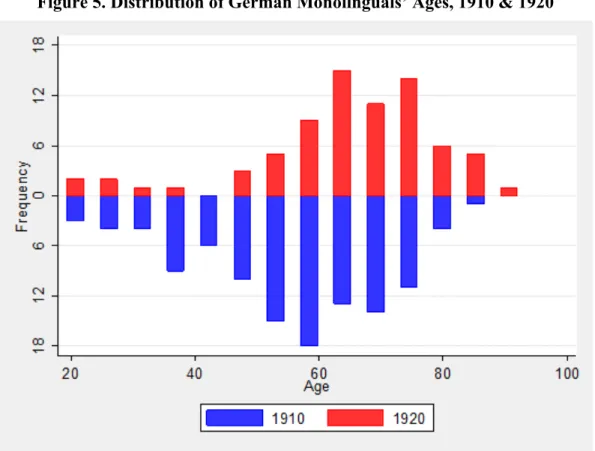
The age distribution for German monolinguals shows the most overall increase in age from 1910 to 1920. Little change occurs from 1920 to 1930, and there is a moderate increase from 1900 to 1910. Table 2 below compares the mean ages for English speakers and German monolinguals across all years for individuals 10 years old and older. The results for English show a trend toward more midpoint ages, especially in the change from 1910 to 1920. In the same years, there is a shift in German monolinguals’ average age, toward the older generation. This suggests an “aging out” of German monolingualism and a relative normalization of English use across all ages.
6
Table 2. Mean age for each reported language (for individuals 10 and older) 1900 1910 1920 1930
English 27 25 33 35
German 44 53 65 63
Examining closer the period of greatest change, 1910 to 1920, we can see this “aging out” of German even clearer. Figure 5 below compares the age distribution of German
monolinguals from 1910 and 1920 for individuals 10 years old and older. Here, two things are happening: German monolingualism is no longer being replenished in people of younger ages, and German is becoming a language of the older generation. For this reason, 1910 to 1920 appears to be the period of greatest shift from German monolingualism to some English use and/or bilingualism.
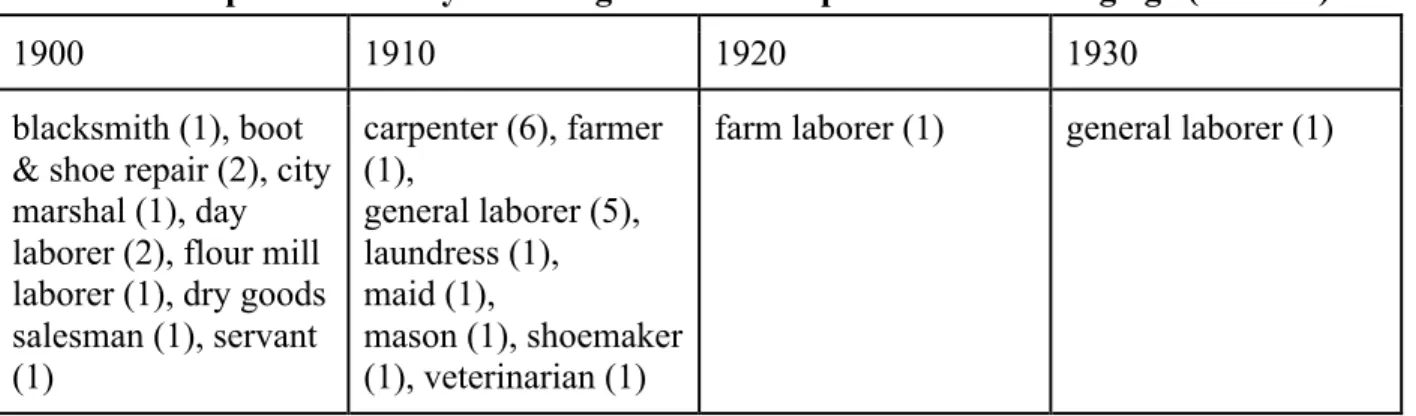
Finally, the employment statistics of German monolinguals from year to year show that opportunity for non-English speakers (of working age) in Hillsboro significantly changed from 1910 to 1920. These results are shown in the table below. While the majority of monolingual Germans listed “none” (or some form of housekeeping at home), “own income,” or nothing, those that worked held jobs almost exclusively in 1900 and 1910. The later years show one worker each, and even then the occupation (laborer) is probably one of the last to necessitate English usage. This sizeable drop in opportunities for German monolinguals suggests a change in the linguistic environment towards bilingualism.
Table 3. Occupations held by monolingual German speakers of working age (14 to 65)
1900 1910 1920 1930
blacksmith (1), boot & shoe repair (2), city marshal (1), day laborer (2), flour mill laborer (1), dry goods salesman (1), servant (1)
carpenter (6), farmer (1),
general laborer (5), laundress (1), maid (1),
mason (1), shoemaker (1), veterinarian (1)
farm laborer (1) general laborer (1)
Frequency Study Evidence
Results for each church’s use of English words for the years 1920, 1930, and 1940 are displayed in Figure 6 below. A close scanning of all 1950 data showed 100% English use for both churches, and so the breakdowns from this year are not included.
The amount of English and German holds generally steady from 1940 to 1941 for both churches. In 1942 Ebenfeld nearly doubles its percentage of English words while Hillsboro MB’s English is only a third of what it was the previous year. The slight downward trend in Hillsboro’s English use from 1940 to 1942 may be indicative of some pushback against using English either by the speakers in the meetings or by the transcriber. Whatever the case, Hillsboro MB’s
numbers began to rise again in 1943 and then very steeply until they reached 100% English use in 1946. In fact, both churches experience a meaningful increase in the percentage of English words in 1943 and an even larger increase from 1943 to 1944. Hillsboro MB was slower to adopt English but reaches 100% English use two years earlier than Ebenfeld. It should be mentioned that no definitively German words were found for Ebenfeld in 1947—the only holdout to 100% English use in these documents is a small percentage of questionable words.
over as the dominant language, the German occurs largely in passage form. The fact that German appears almost exclusively in passage form during the English-dominant years makes the use of German in these later years seem very deliberate. Likewise, the increase in English passages in the years leading up to English dominance indicates a high command of English in these years. Table 4 below displays the number of full English sentences for each year leading up to its dominance.
Table 4. Number of English Sentences per Year for Each Church, 1941 to 1944 Ebenfeld Hillsboro
1941 0 4
1942 1 0
1943 20 7
1944 71 43
English sentences are first observed in 1940 (four found in Ebenfeld documents, three in Hillsboro MB), but the numbers from these years are not included in the table because they come from full collections of documents, unlike the samples from 1941–1947, and therefore cannot be directly compared to the data from these years. From these results, it seems likely that either the participants in these meetings or the transcriber were bilingual at the time full English sentences are first used. As 1940 marks the first use of full English sentences in the data, this is the earliest year during which bilingualism is attested in the data, though it certainly may have been present in earlier documents between 1930 and 1940. No full English sentences were found in 1920 or 1930.
The sharpness of the increase in English use in 1942–1946 might mean that it was
that the churches’ adoption of English in these years lags behind that of the general community. This would make sense given the increased passage form of English in the years leading up to its dominance and German thereafter. If the community was not already bilingual, this extreme growth in English use would not have been possible, and there would not be a reason for
CHAPTER 6: VERTICALIZATION RESULTS Census Evidence
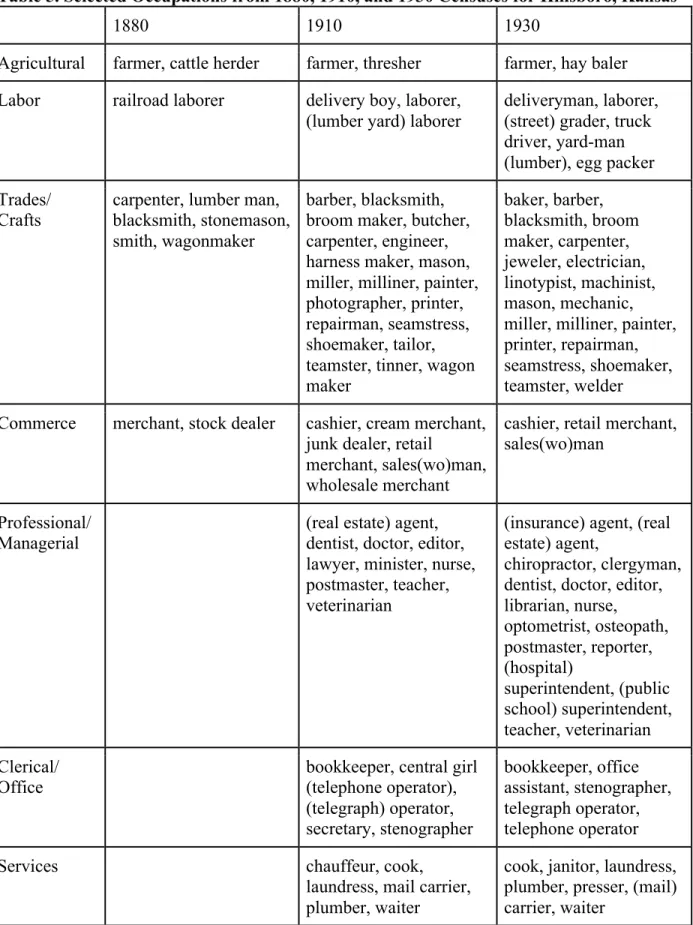
As community structure becomes more verticalized, one of the indicators of structural change is increased specificity and diversity of jobs. This creates a situation in which peoples’ social connections are based more on functionality and less on shared experience. The
Table 5. Selected Occupations from 1880, 1910, and 1930 Censuses for Hillsboro, Kansas
1880 1910 1930
Agricultural farmer, cattle herder farmer, thresher farmer, hay baler Labor railroad laborer delivery boy, laborer,
(lumber yard) laborer
deliveryman, laborer, (street) grader, truck driver, yard-man (lumber), egg packer Trades/
Crafts
carpenter, lumber man, blacksmith, stonemason, smith, wagonmaker
barber, blacksmith, broom maker, butcher, carpenter, engineer, harness maker, mason, miller, milliner, painter, photographer, printer, repairman, seamstress, shoemaker, tailor, teamster, tinner, wagon maker baker, barber, blacksmith, broom maker, carpenter, jeweler, electrician, linotypist, machinist, mason, mechanic, miller, milliner, painter, printer, repairman, seamstress, shoemaker, teamster, welder Commerce merchant, stock dealer cashier, cream merchant,
junk dealer, retail
merchant, sales(wo)man, wholesale merchant
cashier, retail merchant, sales(wo)man
Professional/ Managerial
(real estate) agent, dentist, doctor, editor, lawyer, minister, nurse, postmaster, teacher, veterinarian
(insurance) agent, (real estate) agent,
chiropractor, clergyman, dentist, doctor, editor, librarian, nurse, optometrist, osteopath, postmaster, reporter, (hospital) superintendent, (public school) superintendent, teacher, veterinarian Clerical/ Office
bookkeeper, central girl (telephone operator), (telegraph) operator, secretary, stenographer bookkeeper, office assistant, stenographer, telegraph operator, telephone operator
Services chauffeur, cook,
laundress, mail carrier, plumber, waiter
The greatest change in job specialization and diversity happens between 1880 and 1910. It is evident from these samples that verticalization is taking place in the community at this time by means of division of labor. There is less change from 1910 to 1930, indicating that the peak of verticalization occurred prior to 1910. However, the community does still experience an increase in specificity and diversity of professional or managerial occupations. This can especially be seen in the increasing diversity of medical occupations from 1910, with doctor, nurse, and dentist only, to 1930, with doctor, nurse, dentist, optometrist, osteopath, and chiropractor. It makes sense that professional/managerial jobs are more prone to continued verticalization because they often belong to fields that experience continued specialization, like the medical field.
Further evidence for verticalization among the census documents is largely qualitative. From the occupations listed in the 1880 census as well as other historical accounts (Saul 1974), we know that there was a railroad and accompanying railway station located in Hillsboro during this time. Listed occupations from the 1910 census show that their was a flour mill in town at that time, and later censuses show that it continued operation at least until 1930. The 1910 census also showed the introduction of a lumber yard, which continued into 1940. Other industry
developments shown through census data include: a post office in 1900; an ice plant, department store, telephone exchange, and college in 1910; a hospital in 1920; and a library and light and power company in 1930. The increase in industries indicates a transfer of functions to profit enterprise and government and also increasing systemic relationships to the larger society with such industries as the post office and hospital, which are located in the community but are tied to an extra-community system.