A Comparative Effectiveness Trial of Alternate Formats
for Presenting Benefits and Harms Information
for Low-Value Screening Services
A Randomized Clinical Trial
Stacey L. Sheridan, MD, MPH; Anne Sutkowi-Hemstreet, MPH; Colleen Barclay, MPH; Noel T. Brewer, PhD; Rowena J. Dolor, MD, MHS; Ziya Gizlice, PhD; Carmen L. Lewis, MD, MPH; Daniel S. Reuland, MD, MPH; Carol E. Golin, MD; Christine E. Kistler, MD, MASc; Maihan Vu, DrPH; Russell Harris, MD, MPH
IMPORTANCEHealthcare overuse, the delivery of low-value services, is increasingly recognized as a critical problem. However, little is known about the comparative
effectiveness of alternate formats for presenting benefits and harms information to patients as a strategy to reduce overuse.
OBJECTIVETo examine the effect of different benefits and harms presentations on patients’ intentions to accept low-value or potentially low-value screening services (prostate cancer screening in men ages 50-69 years; osteoporosis screening in low-risk women ages 50-64 years; or colorectal cancer screening in men and women ages 76-85 years).
DESIGN, SETTING, AND PARTICIPANTSRandomized clinical trial of 775 individuals eligible to receive information about any 1 of the 3 screening services and scheduled for a visit with their clinician. Participants were randomized to 1 of 4 intervention arms that differed in terms of presentation format: words, numbers, numbers plus narrative, and numbers plus framed presentation. The trial was conducted from September 2012 to June 2014 at 2 family medicine and 2 internal medicine practices affiliated with the Duke Primary Care Research Consortium. The data were analyzed between May and September of 2015.
INTERVENTIONSOne-page evidence-based decision support sheets on each of the 3 screening services, with benefits and harms information presented in 1 of 4 formats: words, numbers, numbers plus narratives, or numbers plus a framed presentation.
MAIN OUTCOMES AND MEASURESThe primary outcome was change in intention to accept screening (on a response scale from 1 to 5). Our secondary outcomes included general and disease-specific knowledge, perceived risk and consequences of disease, screening attitudes, perceived net benefit of screening, values clarity, and self-efficacy for screening.
RESULTSWe enrolled and randomly allocated 775 individuals, aged 50 to 85 years, to 1 of 4 intervention arms: 195 to words, 192 to numbers, 196 to narrative, and 192 to framed formats. Intentions to accept screening were high before the intervention and change in intentions did not differ across intervention arms (words, −0.07; numbers, −0.05; numbers plus narrative, −0.12; numbers plus framed presentation, −0.02;P= .57 for all comparisons). Change in other outcomes also showed no difference across intervention arms. Results were similar when stratified by screening service.
CONCLUSIONS AND RELEVANCESingle, brief, written decision support interventions, such as the ones in this study, are unlikely to be sufficient to change intentions for screening. Alternate and additional interventions are needed to reduce overused screening services.
TRIAL REGISTRATIONclinicaltrials.gov Identifier:NCT01694784
JAMA Intern Med. 2016;176(1):31-40. doi:10.1001/jamainternmed.2015.7339 Published online December 28, 2015. Corrected on January 5, 2016.
Invited Commentarypage 41
Supplemental contentat jamainternalmedicine.com
Author Affiliations:Author affiliations are listed at the end of this article.
D
elivery of low-value services, also known as health care overuse, is a critical problem for US health care. Low-value services are those in which the degree of ben-efit does not justify the harms and costs.1The United States spends an estimated $192 billion annually on delivery of such services.2This results in physical, psychological, and finan-cial harms; hassle; and opportunity costs without potential benefit for patients.3However, the best ways to address health care overuse are unknown. It is unclear whether the same strategies that increase use of effective health care services work equally well to reduce overuse of health care services.4Furthermore, little compara-tive effeccompara-tiveness research is available to guide prevention and deimplementation of strategies targeted at overuse.5,6
Any comprehensive strategy to address health care over-use must include messages for patients.6While the message might vary based on several factors, experts agree that key com-ponents to inform patients about health care services include the likelihood of acquiring and dying from the targeted dis-ease; the benefits and harms of the health care service; and en-couragement to make a decision about whether to have the ser-vice based on the patient’s individual preferences and values.7 The effectiveness of such messages is likely to be influ-enced by many factors, including their presentation format. Convincing literature8suggests that words describing prob-ability do not have shared meaning and that the format of num-bers has substantial impact on understanding and behavioral intention.9,10Furthermore, different narratives and framed presentation formats differentially affect these same outcomes.11-13However, to our knowledge, no studies have compared the effectiveness of these presentation formats in reducing intentions or behavior for low-value or potentially low-value screening services.
Therefore, our goal was to examine the comparative ef-fectiveness of 4 alternate formats for presenting benefits and harms information in reducing intentions for screening and changing secondary behavioral and decision-making out-comes for patients eligible for 1 of 3 low-value or potentially low-value screening services.
Methods
Study Overview and Setting
We conducted a randomized clinical trial in a convenience sample of four community-based practices (2 family medi-cine, 2 internal medicine), with 26 810 patients and 32 clini-cians, that were affiliated with the Duke Primary Care Re-search Consortium (PCRC). The institutional review boards at the University of North Carolina and Duke University ap-proved the study, and a data safety monitoring committee monitored the study. The trial protocol is provided in
Supplement 1.
Participants and Their Recruitment
From weekly practice patient lists, study staff recruited a con-secutive sample of individuals, ages 50 to 85 years, who re-ceived continuing care for more than 1 year at any of the
par-ticipating PCRC sites, had an upcoming medical visit with their clinician, and were eligible to receive information about any 1 of the 3 screening services of interest. These services had either net harm at the population level (ie, prostate cancer screening in men ages 50-69 years) or small net benefit (making it likely that some individuals would benefit and some be harmed; ie, osteoporosis screening in low-risk women ages 50-64 years or colorectal cancer screening in men and women ages 76-85 years). We chose these services because they represent a spec-trum of net benefit, encompass a variety of test types (a labo-ratory test, a procedural test, and a radiographic study), and are applied to a spectrum of adult patients. Because age groups did not overlap, each patient was eligible for only 1 service. Al-though we initially planned to include cardiovascular screen-ing in low-risk men and women as an additional service, we dropped this service before recruitment given low numbers of eligible patients at study sites. Additional inclusion and exclu-sion criteria are published elsewhere.14
We identified eligible patients for each service through electronic clinical records and consecutively sampled them un-til we reached target enrollment (n = 775). Patients provided written informed consent and were given $35 in compensa-tion for participating. We stratified recruitment by site and ser-vice and attempted to recruit at least 25% of the sample with no prior screening for each service (although this was not al-ways possible). We mailed letters to all potentially eligible pa-tients and then followed up with up to 3 telephone calls to reach the patient and verify eligibility.
Procedures
Staff invited eligible participants to a study visit before or af-ter a regularly scheduled physician’s appointment or at a sepa-rate time if necessary. At the study visit, patients gave in-formed consent, completed a preintervention survey, and were assigned using central computerized randomization to 1 of 4 intervention arms for a single screening service. Randomiza-tion was stratified by site, screening service, and prior screen-ing with allocation concealed from staff in a computerized da-tabase until after baseline survey completion. Patients were told only that they were participating in a study about how to best communicate with patients about screening. Patients read their 1 assigned evidence-based decision support sheet and completed postintervention surveys but did not discuss the materials with their clinicians.
Intervention
encourage-ment to make a decision. We represented overdiagnosis only indirectly by showing that incident disease rates exceed clini-cally important outcomes (see eTable 1 inSupplement 2) and, for prostate cancer only, overtreatment as a physical harm in which participants received unnecessary treatment for harm-less disease. Decision support sheets within each screening ser-vice were identical, except that we provided information on the benefits and harms of screening in 1 of the 4 alternate presen-tations: words, numbers, numbers plus narrative (narratives), or numbers plus a framed presentation (framed) (see eFigures 1-16 inSupplement 2). We chose these formats to represent pre-sentations of information that might affect intentions for ac-cepting screening based on behavioral, communication, and economic theory21-23and other literature.10,11
The words presentation format used ordered descriptions for probabilities (eg, “many,” “few,” or “very few” people af-fected). The numbers format presented probabilities in a fre-quency format with a common denominator (x/1000) in text and a separate “facts box.” Benefits were presented among those screened, and harms were presented among those treated, which may have presented a slightly more negative view of screening than if harms had been presented among those screened. The narrative format built on an approach that we pre-viously used24and was designed to engage readers, inform them about the screening decision, and model the process of decision-making.13Narratives included (1) photographs of 4 ra-cially diverse patients in the screening age group, and (2) text that showed individuals investigating the facts. The framed for-mat was designed to dissuade screening. It used a gain frame to promote risk aversion and discourage screening instead of a loss frame to promote risk-seeking in the face of the risky op-tion of screening to detect disease. The format presented the benefits of not screening (ie, harms avoided by not screening) rather than the harms of screening, which was presented in the other study arms. We tested the quantitative vignette during a linked qualitative study, revising it based on participant feed-back. We then created the other intervention formats and tested them among administrative staff.
Measures
Study outcomes were intention to accept screening (primary outcome) and multiple decision-making and behavioral theory–related outcomes (secondary outcomes).
Primary Outcome
Intention is a measurable antecedent to behavior25and explains as much as 30% of variance in health behavior.26The survey mea-sured intention to accept screening by assessing patients’ plans to be screened for the service for which they were eligible dur-ing the usually recommended screendur-ing interval (1 year for pros-tate cancer screening, 5 years for osteoporosis screening, and 10 years for colon cancer screening). The 5-point response scale ranged from strongly disagree (coded as 1) to strongly agree (5).
Secondary Outcomes
General Screening KnowledgeThe survey assessed knowledge of key screening concepts using 8 items created by the study team that addressed: the
definition of screening, false-positive results, false-negative results, overdiagnosis (3 questions regarding harmless dis-ease and the need to live long enough and have effective treat-ments in order to benefit from screening), overtreatment, and the potential for harm. Response options were true, false, and don’t know, with scoring based on total number of correct re-sponses, from 0 to 8.
Disease-Specific Knowledge About Overdiagnosis and Harms The survey assessed disease-specific knowledge using 2 items for each service that we adapted from prior work27,28or, in the case of osteoporosis screening, we developed. For prostate screening, items were (1) “Some men can live long, normal lives with untreated prostate cancer”; and (2) “Problems with sexual function and urination are common side effects of prostate can-cer treatments.” For colorectal cancan-cer screening, items were (1) “Most polyps in the bowel never become cancer”; and (2) “Bleeding and tears in the bowel are complications of a colo-noscopy.” For osteoporosis screening, items were (1) “Broken hip bones are uncommon before the age of 65”; and (2) “Treat-ments for osteoporosis can sometimes result in bone damage.” Response options were true, false, and don’t know, with scor-ing based on total number of correct responses, from 0 to 2.
Perceived Risk of Disease
The survey assessed patients’ perceived risk of disease with a single question: “How likely is it that you will get diseasexin the next 10 years?” The 4-point response scale ranged from not at all likely (coded as 1) to very likely (coded as 4).
Perceived Disease Severity
The survey assessed perceived severity of the disease using the Lay Perceptions of Serious Illnesses Scale that had 4 items as-sessing perceptions that the “disease is very serious,” “has se-rious financial consequences,” “affects the way the person sees himself as a person,” and “causes difficulties for those close to the patient” (α .66).29The 5-point response scale ranged from strongly disagree (coded as 1) to strongly agree (5). For this and the remaining multi-item measures, we averaged items to create a scale except as noted.
Positive Disease-Specific Screening Attitudes
The survey measured disease-specific screening attitudes using 6 items developed by investigators that assessed agreement that screening is a good idea in a healthy person of the pa-tient’s age, not a special responsibility (reverse coded), asso-ciated with little harm, owed to one’s family or physician, and would be regretted if not done. The 5-point response scale ranged from strongly disagree (coded as 1) to strongly agree (5).
Perceived Net Benefit of Screening
Values Clarity
We assessed values clarity using the Values Clarity Subscale of the Decisional Conflict Scale that had 3 items that assessed whether patients agreed that they are clear about which ben-efits and harms matter most and whether benben-efits or harms are most important (α >.78). The 5-point response scale ranged from strongly agree (coded as 0) to strongly disagree (100), so that lower scores indicated greater clarity about personal values.
Self-efficacy for Screening
We measured self-efficacy for screening using a single item, for each type of screening that read “How confident are you that you could get screened for diseasexif you wanted to?” The 5-point response scale ranged from not at all confident (coded as 1) to very confident (5).
Potential Moderators of Intervention Impact
To support exploratory analysis of moderators of the inter-vention’s effect, we measured variables related to the ability and motivation to process information. These included edu-cation; numeracy (3 items, reported in aggregate as percent-age correct, “Imagine that we flip a fair coin 1000 times. What is your best guess about how many times the coin would come up heads in 1000 flips?”; “In the lottery, the chance of win-ning the prize is 1%. If 1000 people each buy a single ticket to the lottery, how many people would win the prize?”; “In a pub-lisher’s sweepstakes, the chance of winning a car is 1 in 1000. What percent of tickets in this sweepstakes win a car?”)30; need for cognition (3 items with the highest item-total correlations from an 18-item scale: “thinking is not my idea of fun”; “I would rather do something that requires little thought than some-thing that is sure to challenge my thinking abilities”; and “I find satisfaction in deliberating hard and for long hours”)31; antici-pated regret of not screening (1 item, reported on a 5-point scale from strongly disagree [1] to strongly agree [5], “I would re-gret opting not to get screened if I later tested positive for disease.”)32; worry (3 items from the Illness Attitudes Scale, with responses on a 5-point scale from “no” [0] to “most of the time” [4] and summed from 0 to 12: “Do you worry about your health?”; “Are you worried you might get a serious ill-ness in the future?”; “Does the thought of serious illill-ness scare you?”)33; prior screening noted on medical chart review; and prior information (5 investigator-developed items with a com-mon stem reported on 5-point scales from “never” [1] to “al-ways” [5] and summed for a range of 1-25; items addressed ex-posure to screening information through newspapers, magazines, the Internet, television, or friends and family). We also assessed demographics.
Potential Harm of the Intervention
We monitored potential harms of our intervention by assess-ing increases in illness-related worry between preinterven-tion and postintervenpreinterven-tion.33
Other Preintervention-Only Measures
As important characteristics of the sample, we also measured general screening attitudes using 11 items, in 2 subscales, de-veloped and validated as part of this study rather than used
as an outcome as originally planned (Jessica DeFrank, PhD, email communication, May 5, 2015). These items were about the perceived benefits of screening (α .82) and feelings of duty or obligation to screen (α .84) and were correlated with inten-tion for screening (r= 0.25 andr= 0.35, respectively).
Sample Size and Power
We calculated our sample sizes to be able detect a mean dif-ference in pre-post changes in intention to accept screening of at least 0.5 points across intervention groups overall and within specific screening services. Based on prior work, we considered this 0.5 point difference the minimally clinically important difference in intention to accept screening ser-vices; this difference corresponds to a 21% reduction in screening intention.3 4Assuming 2-sidedt tests with α = .001 and a standard deviation of change of 1,35we calcu-lated that we would need 184 participants in each of the 4 intervention arms to give 95% power to detect this differ-ence. This sample size provided about 80% power to detect a 0.5-point mean change in intention in subgroup analyses of the 3 screening services.
Statistical Analysis
We summarized sample characteristics using descriptive sta-tistics. Per a priori plans, we tested the effectiveness of inter-vention formats on change in intention-to-accept screening in our overall sample, and subsequently in subgroups of screen-ing services. We conducted analysis of covariance that in-cluded format as the key variable of interest, baseline intent for screening, and other covariates that differed among inter-vention arms. We compared several approaches for assessing change and found that all produced similar effects.36,37 Simi-lar analyses were conducted for secondary outcomes (using logistic regressions for binary outcomes). Per a priori plans, we first tested the difference between all study arms using an om-nibusFtest. If this test result was negative after accounting for multiple comparisons (in which we consideredP<.001 sig-nificant), we did not pursue additional statistical testing be-tween intervention arms. To examine potential moderators of the impact of the interventions on our primary outcome, we visually depicted moderation and added interaction terms to the models. To examine pre-post changes in primary and sec-ondary outcomes, we used pairedttests for continuous out-comes and McNemar χ2tests for binary ones. Within sub-groups of screening services, we repeated similar analyses (finding similar effects, thereby supporting our decision to com-bine analyses).
Results
Patient Characteristics
slightly more educated (Table 1). Baseline characteristics were less well balanced in subgroups (eTables 2-4 in the Supplement).
Intervention Effects
Primary Outcome: Change in Intention-to-Accept Screening The intervention arms had high intention-to-accept screen-ing at baseline (words, 3.56; numbers, 3.71; narrative, 3.66; framed, 3.53 out of 5.00;Table 2). The 4 intervention arms did not differ in change in screening intentions (adjustedP= .57). In analyses within each arm, the narrative format had lower intention-to-accept screening at postintervention compared with preintervention (−0.12; 95% CI, −0.22 to −0.02 on a 5-point scale), but other interventions arms had no changes from baseline. In separate subgroup analyses for the 3 screen-ing services, we observed a similar pattern of findscreen-ings (see Table 2 and eTables 5-7 inSupplement 2).
Secondary Outcomes
Overall and subgroup analyses found no statistically signifi-cant differences in change in intention for screening across in-tervention arms for any of the secondary study outcomes af-ter accounting for multiple comparisons. However, within intervention arms, some secondary outcomes improved from baseline (eg, screening knowledge, screening attitudes, and perceived net benefit of screening; see Table 2 and eTables 5-7 inSupplement 2).
Moderators
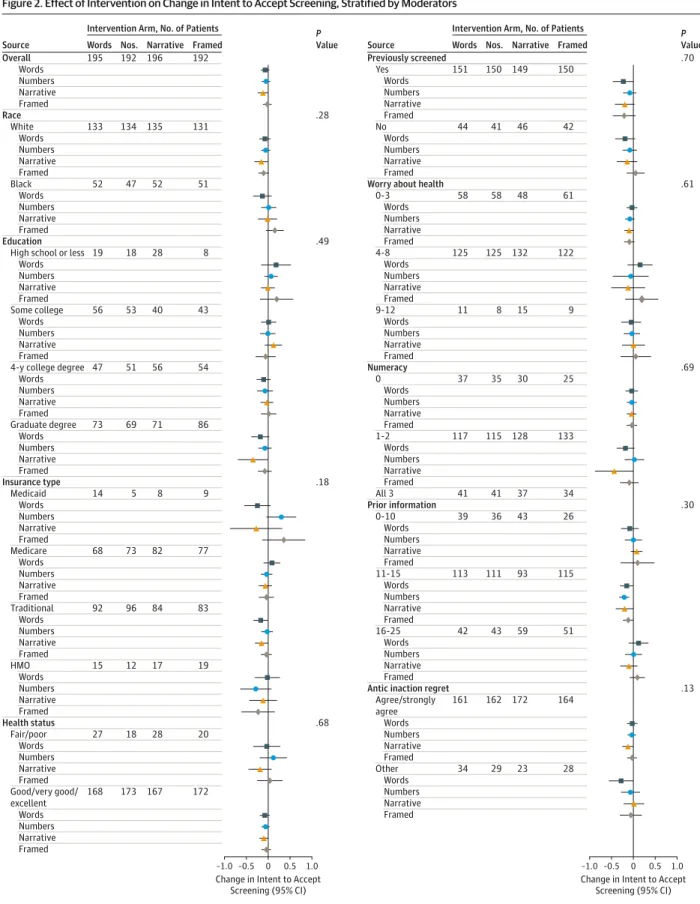
In the overall sample, change in intention for screening did not differ across study arms for subgroups of patients defined by ability, motivation, or demographics (Figure 2).
Potential Harm of the Intervention
We observed no evidence of increase in postintervention illness-related worry.
Discussion
In a randomized clinical trial of 4 formats for presenting ben-efits and harms of 3 screening services with low-value or po-tentially low-value, we found no differences in change in in-tention for screening across intervention arms. Furthermore, while secondary outcomes showed small improvements from baseline, none of these changes were sufficient to change in-tentions to accept screening. There were no clinically impor-tant differences in subgroups of patients defined by ability, mo-tivation, or demographics and no evidence of harm from the interventions.
Our findings are consistent with those of systematic reviews38showing that patient decision aids produce in-creases in screening knowledge and improve other decision-making outcomes; however, they also suggest that single, brief, written decision support sheets, such as those used in this trial, are unlikely to be sufficient to change intention for screening of low-value or potentially low-value screening services, re-gardless of their format. Decisions about screening are driven by a complex interplay of attitudes, social norms, and self-efficacy, many of which often strongly favor screening. Fur-thermore, many decision-makers rely on emotions and heu-ristic decision-making, rather than the rational processes involved in weighing harms and benefits, and are subject to a host of cognitive biases that make foregoing health care ser-vices difficult.14,39,40This suggests that either more inten-Figure 1. CONSORT Diagram of Participant Flow
3190Patient eligible for ≥1 exemplar service
2415Excluded
1136Declined participation
58Missed study visit
14Excluded for other reasons
711Could not be contacted
496Ineligible after telephone screening or service already filled
775Randomized
192Randomized to receive framed intervention
192Received intervention as randomized
64PSA subgroup
64Osteo subgroup
64CRC subgroup
196Randomized to receive narrative intervention
196Received intervention as randomized
66PSA subgroup
65Osteo subgroup
65CRC subgroup
192Randomized to receive quantitative (numbers) intervention
192Received intervention as randomized
63PSA subgroup
63Osteo subgroup
66CRC subgroup
195Randomized to receive qualitative (words) intervention
195Received intervention as randomized
65PSA subgroup
66Osteo subgroup
64CRC subgroup
192Analyzed
196Analyzed
192Analyzed
195Analyzed
8406Patient medical charts reviewed
sive interventions or new approaches will be needed. More in-tensive decision support interventions for prostate cancer screening have been shown to reduce screening intentions and behavior (one by 22% at 9 months),24,41likely through their inclusion of more detailed information and additional com-ponents such as modeling self-discovery about harms. Such interventions may have an important role in reducing screen-ing intentions for low-value services. However, even more intensive interventions may not be enough.
Rather than simply intensifying current clinical interven-tions, effective approaches to reducing overuse of low-value ser-vices may need to take a comprehensive approach. The most successful campaigns have targeted multiple levels of the
pub-lic health pyramid.6It may be that prevention and deimple-mentation of low-value care will require combinations of inter-ventions such as (1) patient and clinician engagement through campaigns, like Choosing Wisely; (2) aligned recommenda-tions and incentives42,43; (3) committed leaders and champi-ons; (4) the time and space for change; (5) system-level supports42,44-47; and (6) more intensive clinician and patient de-cision support than the 1-page written dede-cision support sheets provided in this study.24,48Possible adjunctive decision-making interventions include highlighting the financial and op-portunity costs of screening, emphasizing the potential harms of overdiagnosis and overtreatment,49increasing the salience of harms through video or other media, and testing appeals to Table 1. Participant Characteristics at Baseline
Characteristic
No. (%)
All Participants (n = 775)
Intervention Arm Words (n = 195)
Numbers (n = 192)
Narrative (n = 196)
Framed (n = 192)
Mean age, y 65 65 65 66 66
Female sex 53 54 54 53 53
Race
White 535 (69) 133 (68) 135 (70) 136 (69) 131 (69)
Black 202 (26) 52 (27) 47 (25) 52 (27) 51 (27)
Asian 15 (2) 9 (<1) 4 (2) 6 (3) 4 (2)
More than one race 20 (3) 8 (4) 6 (3) 2 (1) 4 (2)
Unknown 2 (<1) 1 (<1) 0 0 1 (<1)
Hispanic 14 (2) 3 (2) 8 (4) 1 (<1) 2 (1)
Education
<High school 17 (2) 5 (3) 3 (2) 8 (4) 1 (<1)
High school graduate 57 (7) 14 (7) 16 (8) 20 (10) 7 (4)
Some college 121 (16) 30 (15) 38 (20) 28 (14) 25 (13)
2-y degree 71 (9) 26 (13) 15 (8) 12 (6) 18 (9)
4-y degree 209 (27) 47 (24) 51 (27) 57 (29) 54 (28)
Graduate school 299 (39) 73 (37) 69 (36) 71 (36) 86 (45)
Insurance coverage 764 (99) 190 (98) 192 (100) 193 (99) 189 (98)
Type of Insurance
Medicaid 37 (5) 14 (7) 5 (3) 9 (5) 9 (5)
Medicare 327 (42) 80 (41) 76 (40) 89 (45) 82 (43)
Health maintenance organization 107 (14) 25 (13) 23 (12) 31 (16) 28 (15)
Traditional insurance 552 (71) 142 (73) 143 (74) 133 (68) 134 (70)
Other, eg, Veterans Administration 38 (5) 9 (5) 12 (6) 6 (3) 11 (6)
Excellent/very good/good health 682 (88) 168 (86) 174 (91) 168 (86) 172 (90)
Previously screened 602 (78) 151 (77) 151 (79) 150 (77) 150 (78)
Prior screeninga
Osteoporosis 146 (57) 38 (58) 36 (57) 36 (55) 36 (56)
Prostate 206 (80) 52 (80) 51 (81) 52 (79) 51 (80)
Colorectal cancer 250 (97) 61 (95) 64 (97) 62 (95) 63 (98)
Any prior bad screening experience 95 (12) 21 (11) 24 (13) 25 (13) 25 (13)
General screening attitudes
Benefits of screening, mean score,
95%; range 1-5b 3.7 3.8 3.7 3.7 3.8
Screening as a duty, mean score;
range 1-5b 3.5 3.5 3.5 3.5 3.6
Need for cognition, mean score; range -6 to 6
1.8 1.7 1.9 1.6 1.9
Numeracy, mean score; range 0-3 1.6 1.5 1.5 1.6 1.6
aParticipants with prior screening for
condition/total participants allocated to receive information about that screening.
b
Figure 2. Effect of Intervention on Change in Intent to Accept Screening, Stratified by Moderators
–1.0 0 0.5 1.0 Change in Intent to Accept
Screening (95% CI) –0.5
P
Value Intervention Arm, No. of Patients
Words Nos. Narrative Framed
Source
Race
White 133 134 135 131
195 192 196 192
Overall
.49
.18
.68
Black 52 47 52 51
.28
Words Numbers Narrative Framed
Words Numbers Narrative Framed Education
High school or less 19 18 28 8
Some college 56 53 40 43
Words Numbers Narrative Framed
Words Numbers Narrative Framed
4-y college degree 47 51 56 54
Graduate degree 73 69 71 86 Words
Numbers Narrative Framed
Words Numbers Narrative Framed Insurance type
Medicaid 14 5 8 9
Medicare 68 73 82 77
Words Numbers Narrative Framed
Words Numbers Narrative Framed
Health status
Fair/poor 27 18 28 20
Good/very good/ excellent
168 173 167 172
Words Numbers Narrative Framed
Words Numbers Narrative Framed
Traditional 92 96 84 83
HMO 15 12 17 19
Words Numbers Narrative Framed
Words Numbers Narrative Framed Words Numbers Narrative Framed
–1.0 0 0.5 1.0 Change in Intent to Accept
Screening (95% CI) –0.5
P
Value Intervention Arm, No. of Patients
Words Nos. Narrative Framed
Source
Previously screened
Yes 151 150 149 150
.70
No 44 41 46 42
.61
.69
.30
.13 Words
Numbers Narrative Framed
Words Numbers Narrative Framed Worry about health
0-3 58 58 48 61
4-8 125 125 132 122
Words Numbers Narrative Framed
Words Numbers Narrative Framed
9-12 11 8 15 9
Words Numbers Narrative Framed Numeracy
0 37 35 30 25
1-2 117 115 128 133
Words Numbers Narrative Framed
Words Numbers Narrative Framed
Prior information
0-10 39 36 43 26
Words Numbers Narrative Framed
All 3 41 41 37 34
11-15 113 111 93 115
16-25 42 43 59 51
Words Numbers Narrative Framed
Antic inaction regret Agree/strongly agree
161 162 172 164
Words Numbers Narrative Framed
Other 34 29 23 28
Words Numbers Narrative Framed Words Numbers Narrative Framed
peripheral cues that are persuasive to those who do not cen-trally process benefits and harms information.22,40,46
In interpreting our results, readers should consider the limi-tations of our study. First, we tested decision support sheets for only 3 screening services. Similar interventions for other screening services could produce other results, particularly if services have different rates of overuse or public visibility. Second, some of our measures were single items or previ-ously unvalidated measures adapted from other studies. Different measures may produce different results.50Third, some characteristics differed across trial arms at baseline. Analyses controlled for these potential confounders, but re-sidual confounding remains a possibility. Fourth, the success of our gain framed option depended on patients’ perceptions that screening is the riskier option; however, we did not mea-sure this perception explicitly. Fifth, we may have slightly over-estimated the rate of osteonecrosis of the jaw in average-risk
individuals in the osteoporosis decision support sheet, how-ever, this does not change net benefit of the service. Finally, we conducted the study in 4 clinics in the southeastern United States. To the extent that screening rates, clinician training, local decision-making patterns, or patient characteristics (eg, education, numeracy, insurance, presence of usual source of care) are different, results could be different in future studies.
Conclusions
Despite limitations, our study provides important insights about what is required to change decision-making about low-value screening services. A single brief decision support in-tervention, regardless of format, is unlikely to be sufficient to change intentions for screening. Alternate and additional in-terventions should be explored.
ARTICLE INFORMATION
Accepted for Publication:October 29, 2015.
Published Online:December 28, 2015. doi:10.1001/jamainternmed.2015.7339.
Correction:This article was corrected on January 5, 2016, to clarify editorial issues in the abstract, text, and Figure 2 title and caption.
Author Affiliations:University of North Carolina Research Center for Excellence in Clinical Preventive Services, Cecil G. Sheps Center for Health Services Research, University of North Carolina at Chapel Hill, Chapel Hill (Sheridan, Sutkowi-Hemstreet, Barclay, Brewer, Gizlice, Reuland, Golin, Kistler, Vu, Harris); Division of General Medicine and Clinical Epidemiology, Department of Medicine, School of Medicine, University of North Carolina at Chapel Hill, Chapel Hill (Sheridan, Reuland, Golin, Harris); Gillings School of Global Public Health, University of North Carolina at Chapel Hill, Chapel Hill (Sheridan, Brewer, Golin, Vu, Harris); Center for Health Promotion and Disease Prevention, University of North Carolina at Chapel Hill, Chapel Hill (Sheridan, Gizlice, Vu); Community Programs, Napa County Office of Education, Napa, California
(Sutkowi-Hemstreet); University of North Carolina Lineberger Comprehensive Cancer Center, University of North Carolina at Chapel Hill, Chapel Hill (Brewer, Reuland); Duke Clinical Research Institute and Department of Medicine, Duke University School of Medicine, Durham, Chapel Hill (Dolor); Division of General Medicine, University of Colorado School of Medicine, Denver (Lewis); Department of Family Medicine, School of Medicine, University of North Carolina at Chapel Hill, Chapel Hill (Kistler).
Author Contributions:Dr Sheridan and Ms Sutkowi-Hemstreet had full access to all of the data in the study and take responsibility for the integrity of the data and the accuracy of the data analysis. Study concept and design:Sheridan, Brewer, Gizlice, Lewis, Golin, Kistler, Harris.
Acquisition, analysis, or interpretation of data: Sheridan, Sutkowi-Hemstreet, Barclay, Brewer, Dolor, Gizlice, Reuland, Golin, Kistler, Vu, Harris.
Drafting of the manuscript:Sheridan, Barclay,
Brewer, Harris.
Critical revision of the manuscript for important intellectual content:All authors.
Statistical analysis:Sutkowi-Hemstreet, Brewer,
Gizlice.
Obtained funding:Sheridan, Brewer, Lewis, Golin,
Harris.
Administrative, technical, or material support: Sutkowi-Hemstreet, Barclay, Brewer, Vu, Harris.
Study supervision:Sheridan, Sutkowi-Hemstreet,
Lewis.
Conflict of Interest Disclosures:None reported.
Funding/Support:This project was supported by the Agency for Healthcare Research and Quality (AHRQ) Research Centers for Excellence in Clinical Preventive Services, grant P01 HS021133-03.
Role of the Funder/Sponsor:The Agency for Healthcare Research and Quality (AHRQ) Research Centers for Excellence in Clinical Preventive Services had no role in the design and conduct of the study; collection, management, analysis, and interpretation of the data; preparation, review, or approval of the manuscript; and decision to submit the manuscript for publication.
Disclaimer:The content of this paper is solely the responsibility of the authors and does not necessarily represent the official views of the Agency for Healthcare Research and Quality.
Additional Contributions:We are grateful for the participation of the clinicians and staff at Duke Primary Care Croasdaile, Sutton Station Internal Medicine, Duke Primary Care Pickett Road, and Duke Primary Care Timberlyne; and for data collection by the coordinators and trial assistants at Duke PCRC–Erica Suarez, Liz Fisher, Lynn Harrington, Kathlene Chmielewski, Nick Walter, Beth Patterson, Luis Ballon, and Sarah Ricker. Clinicians participating in the study received no reimbursement; however, practices received reimbursement ($1000/y) for assisting with recruitment letters and use of clinic space to conduct study visits. Coordinators and trial assistants were reimbursed at an hourly rate for their assistance.
REFERENCES
1. Harris RP, Wilt TJ, Qaseem A; High Value Care Task Force of the American College of Physicians. A value framework for cancer screening: advice for high-value care from the American College of Physicians.Ann Intern Med. 2015;162(10):712-717.
2. Berwick DM, Hackbarth AD. Eliminating waste in US health care.JAMA. 2012;307(14):1513-1516.
3. Harris RP, Sheridan SL, Lewis CL, et al. The harms of screening: a proposed taxonomy and application to lung cancer screening.JAMA Intern Med. 2014; 174(2):281-285.
4. Davidoff F. On the undiffusion of established practices.JAMA Intern Med. 2015;175(5):809-811.
5. Prasad V, Ioannidis JP. Evidence-based de-implementation for contradicted, unproven, and aspiring healthcare practices.Implement Sci. 2014;9:1.
6. Frieden TR. A framework for public health action: the health impact pyramid.Am J Public Health. 2010;100(4):590-595.
7. Makoul G, Clayman ML. An integrative model of shared decision making in medical encounters.
Patient Educ Couns. 2006;60(3):301-312.
8. Berry D, Raynor T, Knapp P, Bersellini E. Over the counter medicines and the need for immediate action: a further evaluation of European Commission recommended wordings for communicating risk.Patient Educ Couns. 2004;53 (2):129-134.
9. Zipkin DA, Umscheid CA, Keating NL, et al. Evidence-based risk communication: a systematic review.Ann Intern Med. 2014;161(4):270-280.
10. Trevena LJ, Zikmund-Fisher BJ, Edwards A, et al. Presenting quantitative information about decision outcomes: a risk communication primer for patient decision aid developers.BMC Med Inform Decis Mak. 2013;13(suppl 2):S7.
11. Bekker HL, Winterbottom AE, Butow P, et al. Do personal stories make patient decision aids more effective? A critical review of theory and evidence.
BMC Med Inform Decis Mak. 2013;13(suppl 2):S9.
12. Gallagher KM, Updegraff JA. Health message framing effects on attitudes, intentions, and behavior: a meta-analytic review.Ann Behav med. 2012;43(1):101-116.
13. Shaffer VA, Zikmund-Fisher BJ. All stories are not alike: a purpose-, content-, and valence-based taxonomy of patient narratives in decision aids.
Med Decis Making. 2013;33(1):4-13.
screening tests: a qualitative study.J Gen Intern Med. 2015;30(11):1618-1626.
15. U.S. Preventive Services Task Force. Screening for colorectal cancer: U.S. Preventive Services Task Force recommendation statement.Ann Intern Med. 2008;149(9):627-637.
16. U.S. Preventive Services Task Force. Screening for osteoporosis in postmenopausal women: recommendations and rationale.Ann Intern Med. 2002;137(6):526-528.
17. Moyer VA; U.S. Preventive Services Task Force. Screening for prostate cancer: U.S. Preventive Services Task Force recommendation statement.
Ann Intern Med. 2012;157(2):120-134.
18. U.S. Preventive Services Task Force. Screening for osteoporosis: U.S. preventive services task force recommendation statement.Ann Intern Med. 2011; 154(5):356-364.
19. National Cancer Institute. Surveillance, Epidemiology, and End Results (SEER) Program. http://seer.cancer.gov/.Accessed March 13, 2012.
20. Melton LJ III, Chrischilles EA, Cooper C, Lane AW, Riggs BL. Perspective: how many women have osteoporosis?J Bone Miner Res. 1992;7(9):1005-1010.
21. Neuwirth K, Dunwoody S, Griffin RJ. Protection motivation and risk communication.Risk Anal. 2000;20(5):721-734.
22. Petty RE, Barden J, Wheeler SC. The elaboration likelihood model of persuasion: Health promotions that yield sustained behavioral change. In: DiClemente RJ, Crosby RA, Kegler MC, eds. Emerging Theories in Health Promotion Practice and
Research.San Francisco CA: Jossey- Bass;
2002:71-99.
23. Salovey P, Wegner D.Communicating about Health: Message Framing, Persuasion, and Health Behavior. Social Psychological Foundations of Health
and Illness.Malden, MA: Blackwell Publishing;
2003:54-81.
24. Sheridan SL, Golin C, Bunton A, et al. Shared decision making for prostate cancer screening: the results of a combined analysis of two
practice-based randomized controlled trials.BMC Med Inform Decis Mak. 2012;12:130.
25. Fishbein M. The role of theory in HIV prevention.AIDS Care. 2000;12(3):273-278.
26. Sheeran P. Intention-behavior relations: a conceptual and empirical review.Eur Rev Soc Psychol. 2002;12(1):1-36.
27. Lewis CL, Pignone MP, Sheridan SL, Downs SM, Kinsinger LS. A randomized trial of three videos that differ in the framing of information about mammography in women 40 to 49 years old.J Gen Intern Med. 2003;18(11):875-883.
28. McCormack LA, Bann CM, Williams-Piehota P, et al. Communication message strategies for increasing knowledge about prostate cancer screening.J Cancer Educ. 2009;24(3):238-243.
29. Figueiras MJ, Alves NC. Lay perceptions of serious illnesses: an adapted version of the Revised Illness Perception Questionnaire (IPQ-R) for healthy people.Psychol Health. 2007;22(2):143-158.
30. Schwartz LM, Woloshin S, Black WC, Welch HG. The role of numeracy in understanding the benefit of screening mammography.Ann Intern Med. 1997; 127(11):966-972.
31. Cacioppo JT, Petty RE, Kao CF. The efficient assessment of need for cognition.J Pers Assess. 1984;48(3):306-307.
32. Sheeran P, Orbell S. Augmenting the theory of planned behavior: roles for anticipated regret and descriptive norms.J Appl Soc Psychol. 1999;29(10): 2107-2142.
33. Kellner R, Abbott P, Winslow WW, Pathak D. Fears, beliefs, and attitudes in DSM-III
hypochondriasis.J Nerv Ment Dis. 1987;175(1):20-25.
34. Volk RJ, Spann SJ, Cass AR, Hawley ST. Patient education for informed decision making about prostate cancer screening: a randomized controlled trial with 1-year follow-up.Ann Fam Med. 2003;1(1): 22-28.
35. Betsch C, Ulshöfer C, Renkewitz F, Betsch T. The influence of narrative v. statistical information on perceiving vaccination risks.Med Decis Making. 2011;31(5):742-753.
36. Vickers AJ, Altman DG. Statistics notes: analysing controlled trials with baseline and follow up measurements.BMJ. 2001;323(7321):1123-1124.
37. Frison L, Pocock SJ. Repeated measures in clinical trials: analysis using mean summary statistics and its implications for design.Stat Med. 1992;11(13):1685-1704.
38. Stacey D, Bennett CL, Barry MJ, et al. Decision aids for people facing health treatment or screening decisions.Cochrane Database Syst Rev. 2011;10 (10):CD001431.
39. Roman BR, Asch DA. Faded promises: the challenge of deadopting low-value care.Ann Intern Med. 2014;161(2):149-150.
40. Ubel PA, Asch DA. Creating value in health by understanding and overcoming resistance to de-innovation.Health Aff (Millwood). 2015;34(2): 239-244.
41. Volk RJ, Hawley ST, Kneuper S, et al. Trials of decision aids for prostate cancer screening: a systematic review.Am J Prev Med. 2007;33(5): 428-434.
42. Colla CH. Swimming against the current: what might work to reduce low-value care?N Engl J Med. 2014;371(14):1280-1283.
43. Lesser LI, Krist AH, Kamerow DB, Bazemore AW. Comparison between US Preventive Services Task Force recommendations and Medicare coverage.Ann Fam Med. 2011;9(1):44-49.
44. Donahue KE, Newton WP, Lefebvre A, Plescia M. Natural history of practice transformation: development and initial testing of an
outcomes-based model.Ann Fam Med. 2013;11(3): 212-219.
45. Helfrich CD, Weiner BJ, McKinney MM, Minasian L. Determinants of implementation effectiveness: adapting a framework for complex innovations.Med Care Res Rev. 2007;64(3):279-303.
46. Johnson EJ, Shu SB, Dellaert BG, et al. Beyond nudges: tools of a choice architecture.Mark Lett. 2012;23(2):487-504.
47. Moriates C, Shah N. Creating an effective campaign for change: strategies for teaching value.
JAMA Intern Med. 2014;174(10):1693-1695.
48. World Innovation Summit for Health (WISH). Global Diffusion of Healthcare Innovation: Accelerating the Journey. Report of the Global Diffusion of Healthcare Innovation (GDHI) Working Group 2015.http://dpnfts5nbrdps.cloudfront.net /app/media/1744.Accessed July 4, 2015.
49. Hersch J, Barratt A, Jansen J, et al. Use of a decision aid including information on overdetection to support informed choice about breast cancer screening: a randomised controlled trial.Lancet. 2015;385(9978):1642-1652.
50. Sepucha KR, Borkhoff CM, Lally J, et al. Establishing the effectiveness of patient decision aids: key constructs and measurement instruments.
Invited Commentary
Patient Decision Aids for Discouraging Low-Value
Health Care Procedures
Null Findings and Lessons Learned
Judith J. Prochaska, PhD, MPH; Ashley Sanders-Jackson, PhDPer-capita health care spendingin the United States is dispro-portionally higher than that of other industrialized nations, while life expectancy is appreciably lower. In 2013, US health care spending totaled $2.9 trillion.1At $9255 per per-son, this was 42% higher than the next highest per-capita spender. Yet, the United States ranks 50th for life expectancy among 221 nations and 27th out of the 34 industrialized Organisation for Economic Co-operation and Development (OECD) countries. With a focus on maximizing the return of health care spending, of interest are best practices for reduc-ing the use of medical procedures that offer low net benefit or, at the population level, possible net harm.
In this issue ofJAMA Internal Medicine, Sheridan and colleagues2conducted a randomized clinical trial comparing alternative versions of printed patient decision support ma-terials to discourage acceptance of low-value preventive health services. The targeted health services were prostate cancer screening with prostate-specific antigen (PSA) (for men ages 50-69 years), osteoporosis screening (for women ages 50-64 years), and colorectal cancer screening (for both sexes, ages 76-85 years). The information, printed on a single page in 4 for-mats, varied only in how harms and benefits were presented. The formats were qualitative (words only), quantitative (with numbers), quantitative with a narrative (a story of an indi-vidual thinking about the numbers), and quantitative with framing (to promote risk aversion and discourage screening). Overall, the study showed no significant change in inten-tion to screen preinterveninten-tion to postinterveninten-tion and no dif-ference between the 4 formats. Addressing an important clini-cal and public health issue, the investigators andJAMA Internal Medicineare commended for publishing these null findings. We interpret the findings herein with consideration of the study’s patient sample, risk communication strategy, and evaluation methods, and identify potential future research directions.
Described as a convenience sample, participants aver-aged 65 years of age, were highly educated (>90% were col-lege educated, many with advanced degrees), nearly all in-sured, and all receiving continuity care within 4 selected community-based, primary care practices. Despite attempts to recruit patients not screened previously, most had in the past completed the screening tests of interest (>80% for PSA and nearly 100% for colorectal cancer screening). Just over one-third (39%) of invited eligible patients enrolled. No financial incentive was provided for study participation. Patient fac-tors predictive of study enrollment were not reported. It is likely that interest in screening related to participation. Notably, the
sample’s intention for screening at baseline was character-ized as high. Unknown is how study findings generalize to younger, more socioeconomically disadvantaged groups, and those without interest and prior screening experience.
The primary outcome was patient self-reported inten-tion to accept future screening, not medical chart documen-tation of actual screening behavior. The investigators2 acknowledged that intention is an incomplete measure, pre-dicting a maximum of 30% variance in behavior. Research3,4 in various wide-ranging fields has consistently found that past behavior is the best predictor of future behavior. It is unsur-prising then that in a patient group compliant in the past with clinician screening recommendations, the effect of this low-intensity patient-focused intervention would be null.
Some points are worth mentioning with regard to the risk communication approach. Although aimed at reducing accep-tance of screening, the study materials used gain-framed mes-saging (eg, foregoing a PSA test would avoid biopsy, worry, and unnecessary treatments). Best practices suggest the utility of gain-framed messages for promoting behavior and loss-framed messages for reducing a behavior.5The decision aids emphasized the problem of overdiagnosis, represented indi-rectly with reference to how incident disease rates exceed clini-cally important outcomes, such as mortality or fractures. While the quantified benefits were reported for the number of pa-tients screened (eg, 1 fewer death in every 1000 men screened), the event rates for treatment complications applied only to treated patients (eg, 300 of 1000 men treated have sexual dys-function and urinary tract problems), which the investigators2 acknowledged likely portrayed an overly negative view of screening. The investigators2pilot tested only the quantita-tive vignette with patients; unknown is the degree to which patients noted and appreciated the subtle differences in each risk communication format. Finally, the materials were static without tailoring to patient race or ethnicity, personal or fam-ily medical history (eg, cancer, fractures), prior screening be-havior, or current intention. Research generally has found that patients have greater recollection for and are more respon-sive to tailored health communications.6Process measures that would have been useful to collect include the amount of time patients spent reading the material and comprehensibility and perceived usefulness of the information.
ongoing feedback have positively influenced clinician behavior.7The study’s analyses also did not adjust for clus-tering by clinician or within clinic. One would expect shared variance in use of preventive health services among patients treated by the same clinician and within the same clinic.
While none of the methods decreased participants' inten-tions to participate in the screening programs, small improve-ments were found in general and disease-specific knowl-edge, screening attitudes, and perceived net benefit, though again, not differentially so by treatment arm. Most of the as-sessments were study-created scales, many lacking informa-tion on validity, internal consistency, and stability over time; hence, the implication of these small reported changes are un-known. Needed are validated scales of patient behavior and intentions regarding low-value medical practices.
Given the highly educated sample and small increases in knowledge found, it seems that acceptance of screening was largely unrelated to transferred knowledge, at least as com-municated on a single-page information sheet varied only in written presentation of risks and benefits. That is, the inter-vention tested was brief, static, and subtle in the degree to which the 4 formats differed.
Reducing the use of low-value health services is a com-plex issue, with significant clinical and health policy implica-tions. The study by Sheridan and colleagues2provides a use-ful vantage point for informing future efforts. Certainly, hindsight is 20/20. In interpreting study findings, key
consid-erations included the representativeness of the sample, the quality of the outcome measures, intervention characteris-tics, and the fidelity of delivery. To inform clinical practice, future study is needed with more diverse patient samples, process measures of patient-clinician communications, and tracking of outcomes to actual behavior. Furthermore, the null findings suggest the need for novel approaches to dis-suade low-value health services that move beyond 1-size-fits-all patient education interventions. More personalized and tailored approaches would include computer-assisted behav-ior change coaching, applied virtual reality technologies, and interactive digital games. Also important are strategies that consider the dyadic nature of the patient-clinician relation-ship. A leading National Institutes of Health research priority and health movement backed by President Barack Obama, personalized or precision medicine recognizes that variability in response to medical treatment and prevention exists because of individual differences in genes, environment, and lifestyle.8Personalized approaches tailored to familial and genetic risk, environment, and lifestyle are worth testing for coaching patient decision making around low-value medical procedures. That most of the study sample had been screened prior, likely within the clinical practice through which the intervention was being tested, without ill-reported effects and with intention to screen again, suggests the appropriateness of a more personalized and multilevel systems approach.
ARTICLE INFORMATION
Author Affiliations:Stanford Prevention Research Center, Department of Medicine, Stanford University, Stanford, California (Prochaska); Department of Advertising and Public Relations, College of Communication Arts and Sciences, Michigan State University, East Lansing (Sanders-Jackson).
Corresponding Author:Judith J. Prochaska, PhD, MPH, Stanford University, Medical School Office Building, X316, 1265 Welch Rd, Stanford, CA 94305-5411 ([email protected]).
Published Online:December 28, 2015. doi:10.1001/jamainternmed.2015.7347.
Conflict of Interest Disclosures:None reported.
Funding/Support:This study was supported by the National Heart, Lung, and Blood Institute grant R01HL117736.
Role of the Funder/Sponsor:The National Heart, Lung, and Blood Institute had no role in the collection, management, analysis, and
interpretation of the data; preparation, review, or approval of the manuscript; and decision to submit the manuscript for publication.
REFERENCES
1. Hartman M, Martin AB, Lassman D, Catlin A; National Health Expenditure Accounts Team. National health spending in 2013: growth slows, remains in step with the overall economy.Health Aff. 2015;34(1):150-160.
2. Sheridan SL, Sutkowi-Hemstreet A, Barclay C, et al. A comparative effectiveness trial of alternate formats for presenting benefits and harms information for low-value screening services: a randomized clinical trial [published online December 28, 2015].JAMA Intern Med. doi:10.1001 /jamainternmed.2015.7339.
3. Albarracín D, Wyer RS Jr. The cognitive impact of past behavior: influences on beliefs, attitudes, and future behavioral decisions.J Pers Soc Psychol. 2000;79(1):5-22.
4. Ouellette JA, Wood W. Habit and intention in everyday life: the multiple processes by which past behavior predicts future behavior.Psychol Bull. 1998;124(1):54-74.
5. Rothman AJ, Bartels RD, Wlaschin J, Salovey P. The strategic use of gain-and loss-framed messages to promote healthy behavior: how theory can inform practice.J Commun. 2006;56(s1):S202-S220.
6. Noar SM, Benac CN, Harris MS. Does tailoring matter? meta-analytic review of tailored print health behavior change interventions.Psychol Bull. 2007;133(4):673-693.
7. Grimshaw JM, Shirran L, Thomas R, et al. Changing provider behavior: an overview of systematic reviews of interventions.Med Care. 2001;39(8)(suppl 2):II2-II45.