International Journal Advances in Social Science and Humanities
Available online at: www.ijassh.com
RESEARCH ARTICLE
Perspectives on Psychosocial Challenges Facing Integrated Learners
with Physical Disabilities (LWPD) in Selected Kenyan Mainstream
Secondary Schools
Sr Pauline Waititu, Peter JO Aloka*, Belainesh Araya
Department of Psychology, Catholic University of Eastern Africa, Langata Campus, Nairobi, Kenya.
*Corresponding Author: E-mail:[email protected]
Abstract
The study investigated the perspectives on psychosocial challenges facing integrated learners with physical disabilities (LWPD) in the selected mainstream secondary schools in Olkalou District in Nyandarua County, Kenya.
The study was informed by the Chickering Psychosocial Development Theory. The study adopted a Mixed Methods
design. The study participants comprised teachers and integrated LWPD learners in secondary schools. The sample size comprised 48 students integrated in the selected secondary schools from Olkalou rehabilitation centre in the previous four years and 60 teachers. Questionnaires and interviews were used to collect data. The results indicated that learners with physical disabilities in integrated schools suffer low self-esteem, and they also found it very hard to fit into the world of non-disabled learners. The study recommended a comprehensive implementation of inclusive education policy and proper guidelines integration of special needs learners in Kenyan mainstream schools.
Keywords: Perspectives, Psychosocial, Challenges, Integrated, Learners with Physical Disabilities (LWPD),
Mainstream, Secondary schools.
Introduction
People with disabilities (PWD) make up 10% of the total population of Kenya, approximately 3.5 million people (WHO, 2006). According Kenya National Survey for Persons with Disabilities (2008), the prevalence of disability in Kenya is 4.6 %. Out of this 1.6% have physical disabilities. 67% of PWDs attain a primary level of education and only a small proportion attains secondary level (19%). Very few reach university (2%). 7% of PWDs are denied enrolment in school because of their disability. 6% of PWDs drop out of school because of their disabilities, 9% because of illness and 9% because of lack of interest. Physical impairment is highest in central 39 % [1]. Education plays an important role in addressing the issues that impede the education of children with special needs in Kenya. Significant gains have been realized in the provision of education to children with special needs over the past six years, for example, there has been increased funding to Special Needs Education, (SNE) and support to teacher training for SNE at KISE [2]. According to the Kenyan Constitution promulgated on 27th August 2010, persons with
disabilities are entitled to enjoy all the rights and fundamental freedom set out in the Bill of Rights. They have the right to access education, institutions and facilities for persons with
disabilities that are as integrated into society as a whole as is compatible with the interests of those persons.
Peter JO Aloka et.al.| Dec. 2013 | Vol.1 | Issue 3|01-10 2
Much of zeal for the practice of integration is a blanket-policy system from the anticipated effects in the social-emotional domain, where physically handicapped children, accepted because of contact and familiarity, will naturally model the appropriate behaviors of peers; will not suffer the stigma of special classes and will be provided a more real life environment of learning [5]. Integration program is aimed at removing existing barriers that make them become anti-social members of the society [6]. In addition, the government continues to train primary school teachers in special education at Kenya Institute of Special Education (KISE) as well as in tertiary and university level in order to improve the national capacity of teachers of special education in regular schools. The substantive significance of integration is that the learner will get opportunity to model other physically handicapped learners who have adjusted despite the same obstacle of disability [7].
The study was informed by the Social Theory of disability and Chickering Psychosocial Development theory. The Social theory of disability is an approach to disability that sees the problems disabled people face as a result of society‟s barriers rather than the person‟s medical conditions. It recognizes the solution as to rid off the barriers created by the society, rather than relying on curing all people who have impairments, which in most cases is not possible [4]. The theory argues that because people with impairments are viewed as unfortunate, useless, different, oppressed and sick, they posed direct challenge to the commonly held western values. This is so because they are unable to enjoy material and social benefits of modern society, to contribute to the economic good of the community and they are perceived as abnormal and different [4].
The Chickering psychosocial development theory argues that, it is essential for students to go through seven vectors of development in order to establish a self-identity [8]. This includes (1) developing competence; (2) managing emotions;
(3) moving through autonomy toward
interdependence; (4) developing mature interpersonal relationships; (5) establishing identity; (6) developing purpose; (7) and developing integrity, [4]. In an influential model of student departure [9], for students to successfully matriculate in school/ college, they must first leave their family, friends, and community fully behind in order to interact with the new institutional setting. Tinto posits that students are more likely to remain enrolled in an
institution if they become connected to the social and academic life of that institution. Students who become integrated into an institution by developing connections to individuals, participating in clubs, or engaging in academic activities, are more likely to persist than those who remain on the periphery. Preventing this integration process may be incongruence, or a lack of institutional fit. Therefore, students who do not feel at home in an institution or do not believe that an institution can help them meet their goals are unlikely to persist, and such isolated students are less likely to persist in the institution. In Tinto‟s student interactional model, both academic and social integration are essential for student persistence at four-year residential in schools/colleges.
Previous studies on challenges facing integrated learners with disabilities have been documented. For example, isolation impacts negatively on the learner‟s self-concept as well as social interaction in the society [10] learners with physical disabilities integrated into mainstream schools resist integration, drop out or regress in performance [11] and that such learners are discriminated against when in mainstream schools [4]. Konza reiterates that [3] challenges facing integration of LWPD include inadequate teacher training, large class sizes, insufficient resources and low teacher efficacy. Mutisya [11], observes that learners with physical disabilities resist integration into mainstream schools due to various reasons; lack of proper facilities to cater for their impairment, long distances to and from school, segregation by the peers, lack of psychological preparation, negative attitude from teachers\parents\ schoolmates. Therefore, discrimination and isolation impede education [12]. Moreover, [1] found out that in spite of LWPD being included in regular education, they prefer being in special education because they felt safe and valued. Another study by [4] on challenges facing integration into mainstream schools in Iowa country, North America, found that, children in educational mainstreaming programs can be at heightened risk for rejection by their peers even with the strong support of the school administration. In addition, children with behavior disorders are at greatest risk for rejection in both mainstreaming and ordinary classroom situations.
Ndinda [4] studied on the root causes of
Peter JO Aloka et.al.| Dec. 2013 | Vol.1 | Issue 3|01-10 3
challenged learners lacked counselling, health care, adequate facilities among others. This greatly affected their self-esteem, ambitions, goals and self-motivation. Similarly, Sitienei [10] studied the effects of integration on self-concept of physically handicapped learners in primary schools Eldoret municipality, Kenya. The study found out that integration has positive effects on the self-concept of physically handicapped children in primary schools. Keitany [13] study found out that, head teachers viewed inclusive education as a good idea, but, majority of the teachers were of the view that the training they got did not prepare them adequately to meet the educational needs of learners with disabilities. Another study was carried out in Israel by
Schreuer [14] on socio-cultural factors affecting
inclusion of students with disabilities in higher education institutes in Israel. The findings were that achievements of students with disabilities proved only slightly below those of students
without disabilities. Muigai [12] study found out
that discrimination and isolation impede education of girls with physical disabilities; lack of conducive school environment and structures discourage girls with physical disabilities from continuing schooling.
The above reviewed studies have left a gap in their study in that they didn‟t focus on psychosocial challenges facing integrated learners in mainstream schools, and secondly they failed to sample learners with physical disabilities. While certain studies reviewed investigated the variable of self-concept on integration, the current study focused on psychosocial challenges facing integrated learners with physical disabilities. Moreover, the current study adopted both purposive and simple random sampling techniques unlike the above reviewed study which used random sampling only. In addition, most of the reported studies adopted either quantitative or qualitative approaches, but the current study adopted a mixed research design which produced comprehensive data on the phenomenon being investigated.
Goals of the Study
The study investigated the perspectives on psychosocial challenges facing integrated Learners with Physical Disabilities (LWPD) in selected Kenyan mainstream secondary schools The research study was also guided by the following research questions:
What are the psychological challenges facing integrated learners with physical disabilities (LWPD) in the selected mainstream secondary
schools in Olkalou District in Nyandarua County, Kenya?
What are the sociological factors affecting integrated LWPD in the selected mainstream secondary schools in Olkalou District in Nyandarua County, Kenya?
Participants and Setting
The study was carried out in Olkalou District in Nyandarua County, Kenya. A total of 48 students integrated in the selected secondary schools from Olkalou rehabilitation centre in the previous four years and 60 teachers in mainstream secondary schools participated in the study. Simple random sampling method was used to sample the class teachers while learners were sampled using the purposive sampling technique.
Research Instruments
Both questionnaires and interviews were used to collect data on psychological challenges facing integrated LWPD in the selected mainstream secondary schools.
Questionnaires
Questionnaires were administered to teachers and also learners with physical disabilities in the selected secondary schools. The questionnaires sought information on five aspects including the demographic information, psychological and sociological challenges, learning challenges and teacher related factors that challenge integration of LWPD. The information solicited helped the researcher to identify factors that pose as challenges to LWPD.The items in the questionnaire had close-ended type of questions. The responses of the close-ended questions were in five option Likert scale where, the learners ticked their preferred choices, with the options, Strongly Agree (SA), Agree (A), Undecided (U), Disagree (D) and Strongly Disagree (SD).
Interview Guides
Peter JO Aloka et.al.| Dec. 2013 | Vol.1 | Issue 3|01-10 4
faced by LWPD in the dormitories and their relationship with peers.
The validity of the questionnaires was ascertained through a pilot study which was done in a school with similar characteristics with the population. Source triangulation was used to validate the instruments by making teachers and learners to respond to some similar questions as well as method triangulation. It entails use of questionnaires and interview guides to collect similar information. The rationale behind using method triangulation was to ensure validity of the data. Reliability of questionnaires was ensured by using the used split half method. This involved splitting the items in the questionnaires into two halves (odd and even numbers). The odd numbers, set A, were administered separately and scored accordingly and the even numbers, set B, was done the same. The scores of the two tests were then computed by Pearson‟s Product moment coefficient and found to be 0.615. This was to determine an estimate of reliability coefficient of the whole questionnaire. Spearman Brown prophecy formula recommends that a reliability coefficient of 0.6 and above is a good measure of reliability [16].
Procedure
Ethical consideration to conduct the study was first obtained from the Catholic University of Eastern Africa. Thereafter, the researchers obtained a research permit from the Ministry of Education to collect data from the selected schools. There after the researcher visited the Education office in Nyandarua County and submitted copies of the research permit to the County Director of Education and the District Education Officer in order to obtain permission to conduct the research in the selected schools. After meeting the principals, copies of permit were given and permission sought to collect data from their institutions. The researcher booked the days for conducting the interviews, administering the questionnaires in the various schools. Each school had a different day but the time allocation was in the afternoon. On the material day the researcher administered the research instruments to participants; questionnaires to the teachers and students and interviews to teachers. The researcher ensured that the purpose of this study was fully and clearly explained in advance to the participants before conducting the exercise. Informed consent was obtained from the respondents after the explanation. The participants were free to participate in the present study. Confidentiality was observed by
ensuring anonymity of both the students and the schools. Anonymity of the identity of the respondents was safeguarded by use of numbers.
Data Analysis
Quantitative data was analyzed by using the Statistical Package for Social Sciences (SPSS), version 19.0. The percentage of subjects who respond to questionnaires is adequate if it is 50%, good at 60% and very good at 70%. Quantitative data was summarized using descriptive statistics including frequencies, means, percentages, and inferential statistics.
Qualitative data obtained from the interviews conducted to the teacher counsellors was analyzed using the thematic framework. This involved systematic searching, arranging, organizing, breaking the data units, synthesizing, searching the patterns and discovering what is to be learnt as brought out by the respondents. The researcher then categorized data into themes according to research objectives and used thematic analysis through discussions and presented in form of narratives, interview transcripts as shared by the participants. The results were organized into themes around psychological and sociological challenges facing integrated LWPD in selected mainstream secondary schools.
Results and Discussion
The final student participants were 48, 5 teacher-counsellors and 18 teachers. The total number of the actual study participants was 71 out of the 72 earlier anticipated by the researcher which gave 98.7% of the return rate.
The Table 1 presents the demographic information of teacher participants. From the information in the Table 1, 55% of participants (n = 11) were male teachers while 45% (n = 9) were female teachers. 55% of the teachers were graduates, 25% were diploma holders while 20% were special trained teachers. The information also indicates that 80% of the respondents were class tutors. In addition, 45% of teacher participants had 11-20 years teaching experience, 30% had 5-10 years of teaching experience while 25% had the lowest teaching experience of between above 20 years.
Peter JO Aloka et.al.| Dec. 2013 | Vol.1 | Issue 3|01-10 5
Variable Frequency Percentage
Gender
Male 11 55.0
Female 9 45.0
Level of Education
Graduate 11 55.0
Diploma 5 25.0
Special Trained Teacher 4 20.0
Role
Class Teacher 18 90.0
Teacher counselor 2 10.0 Teaching experience
5 – 10 Years 6 30.0
11 – 20 Years 9 45.0
Above 20 years 5 25.0
Table 2: Demographic Information of Learner participants
Demographic data Frequency Percentage
Gender
Male 24 50
Female 24 50
Age
12-14years 4 8.3
14-16 years 20 41.7
Above 16 years 24 50.0
Class
Form 1 12 25.0
Form 2 5 10.4
Form 3 16 33.3
Form 4 15 31.3
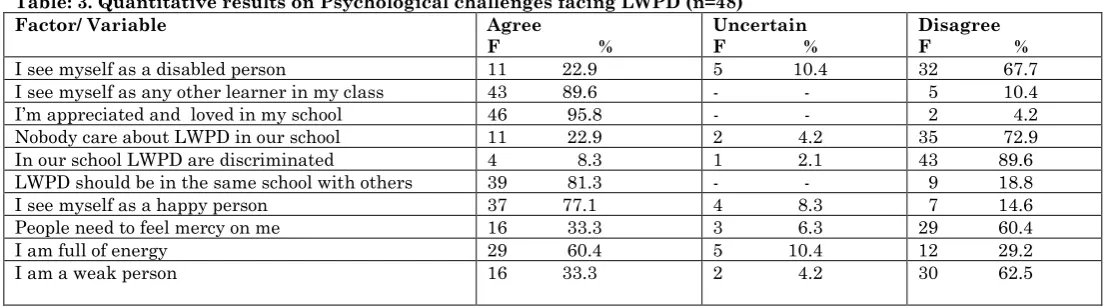
Psychological Challenges Facing LWPD This research question aimed at gathering information about psychological challenges students suffering from physical disability go through in their integrated school after rehabilitation. The results presented in Table 3 indicates that, majority of learners with physical impairment viewed themselves as ordinary people (89.6%) and many (67.7%) disagree that they see themselves as disabled persons. It is apparent that those who feel accepted and loved by their family members see themselves like any other students, while those who feel rejected in the family they see themselves as disabled. Majority of LWPD describe themselves as happy people (77.1%) and energetic, while many (60.4%) feel they need no mercy from other learner. The findings are similar to [4] who asserts that a person with a disability does not necessarily need help. He says that most people with disabilities try to be as independent as possible and will ask for assistance only if need be, such learners fall under the majority group (89.9%) who feel they are like any other learner. The study presents majority of the participants as wishing to remain integrated with ordinary students (81.3%).
Table: 3. Quantitative results on Psychological challenges facing LWPD (n=48)
Factor/ Variable Agree
F %
Uncertain F %
Disagree F % I see myself as a disabled person 11 22.9 5 10.4 32 67.7 I see myself as any other learner in my class 43 89.6 - - 5 10.4 I‟m appreciated and loved in my school 46 95.8 - - 2 4.2 Nobody care about LWPD in our school 11 22.9 2 4.2 35 72.9 In our school LWPD are discriminated 4 8.3 1 2.1 43 89.6 LWPD should be in the same school with others 39 81.3 - - 9 18.8 I see myself as a happy person 37 77.1 4 8.3 7 14.6 People need to feel mercy on me 16 33.3 3 6.3 29 60.4
I am full of energy 29 60.4 5 10.4 12 29.2
I am a weak person 16 33.3 2 4.2 30 62.5
The qualitative results from the Teacher-counsellors Psychological Challenges Facing LWPD indicated that, most students with physical disability suffered from low self-esteem due to lack of self-acceptance. Majority of the participants unanimously agreed that students with physical disabilities suffered low self-esteem. Most teacher-counsellors said that most of the issues presented during counselling sessions are issues on self-concept, self-acceptance and lack of basic needs. One counsellor declared that rarely do the students go for one-on-one counselling sessions. Some participants felt that the low self-esteem was due to poor self -concept which leads
to lack of self-acceptance. The results also indicated that most of the learners suffering from physical impairment were stigmatized not only by the society but also by their own families. This contributes greatly to poor self-concept as the child advances in age. The following are some of the interview transcripts from the teacher-counsellors:
Peter JO Aloka et.al.| Dec. 2013 | Vol.1 | Issue 3|01-10 6
school or the teachers have to cater for these needs”.
“My parents don‟t love me, they reject me. I know it because since I was in the primary school up to now that am in Form 2 they always come to get me 2-3 days after the schools are closed down. They don‟t turn up until they are called by the school administration. I don‟t know how will be my future after school”.
“I am happy when am here in school because my teachers are loving and care about me. At home nobody cares about me. My parents show me that I cannot do most of the house chores since I am a disabled. I don‟t like school-holidays”.
“My mother doesn‟t love me. She says I am the reason why they separated with my dad. They separated when I was two years old after seeking medical treatment for me in many hospitals. When he realized my condition couldn‟t be treated, he moved away. He married and got other children and none of them have a physical disability”.
Sociological Challenges Facing LWPD in the Selected Secondary Schools
The Table 4 presents the findings on Teachers‟ Perceptions on Sociological Challenges Facing
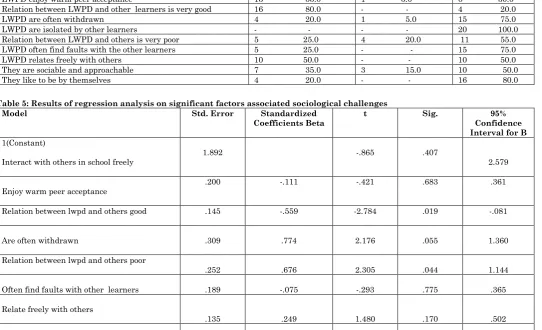
LWPD. The results reveals that all the teachers unanimously agree that LWPD are not isolated by their fellow students, however, their relation with others is only fair 50%. This clearly shows that even though others don‟t isolate or discriminate them, they interact more among themselves. Only 30% interacted freely with the other students. However, 65% enjoy warm peer acceptance while only 25% seem to be withdrawn. According to their teachers there exist a good relationship between LWPD and those without disabilities, 80%. Tested at 95% confidences interval, LWPD are found to enjoy warm peer acceptance (P-value = 0.019). It is expected that contact with disabled individuals would be associated with increased expressed acceptance towards disabled peers. In addition, majority of respondents shows relationship of LWPD with other learners being very good (P-value = 0.055). Hence, the results were found statistically significant.
A regression analysis was carried out to find out the significant factors associated with teaching experience and sociological challenges facing LWPD. The results are presented in Table 5
Table 4: Quantitative results on Teachers’ Perception on Sociological Challenges Facing LWPD
Factor/ Variable Agree
F % Uncertain F % Disagree F % LWPD interact with others in school freely 6 30.0 - - 14 70.0 LWPD enjoy warm peer acceptance 13 65.0 1 5.0 6 30.0 Relation between LWPD and other learners is very good 16 80.0 - - 4 20.0 LWPD are often withdrawn 4 20.0 1 5.0 15 75.0 LWPD are isolated by other learners - - - - 20 100.0 Relation between LWPD and others is very poor 5 25.0 4 20.0 11 55.0 LWPD often find faults with the other learners 5 25.0 - - 15 75.0 LWPD relates freely with others 10 50.0 - - 10 50.0 They are sociable and approachable 7 35.0 3 15.0 10 50.0 They like to be by themselves 4 20.0 - - 16 80.0
Table 5: Results of regression analysis on significant factors associated sociological challenges
Model Std. Error Standardized
Coefficients Beta
t Sig. 95%
Confidence Interval for B 1(Constant)
Interact with others in school freely 1.892 -.865 .407 2.579
Enjoy warm peer acceptance
.200 -.111 -.421 .683 .361
Relation between lwpd and others good .145 -.559 -2.784 .019 -.081
Are often withdrawn .309 .774 2.176 .055 1.360
Relation between lwpd and others poor
.252 .676 2.305 .044 1.144
Often find faults with other learners .189 -.075 -.293 .775 .365
Relate freely with others
.135 .249 1.480 .170 .502
Peter JO Aloka et.al.| Dec. 2013 | Vol.1 | Issue 3|01-10 7 Like to be by themselves
.133 .480 2.262 .047 .598
Dependent Variable: Teaching experience
From the results of the regression analysis, shown on Table 5, it is clear that there was a warm peer acceptance with a P value 0.19, which indicated that learners with physical disabilities were warmly accepted by their fellow students without disability unlike in their families where they were not fully accepted. Similarly, the relationship between LWPD and those without disabilities was quite remarkable, P= 0.055. Moreover, the majority of the teachers disagreed that the
learners were often withdrawn P= 0.044. Tested at 95% Confidence Interval, the teacher‟s experience played a greater role in rooting out the sociological challenges facing students with physical impairment.
Perspective Sociological Challenges facing LWPD
Table 6 presents the results of perspectives of LWPD on the sociological challenges they faced in their mainstream schools. To achieve this statistical analysis was carried out and the results are presented in Table 6.
Table 6: Quantitative results on Sociological challenges facing LWPD
Factor/ Variable Agree
F % F % Uncertain F % Disagree
The other student discriminate me 11 22.9 1 2.1 36 75.0 I am loved by my classmates 41 85.4 1 2.1 6 12.5 In school I interact more with LWPD 27 56.3 5 10.4 16 33.3 I interact freely with learners without disability 35 72.9 5 10.4 8 16.7 I sympathize with others who are disabled 26 54.2 2 4.2 20 41.7 I don‟t feel mercy for LWPD in our school 10 20.8 1 2.1 37 77.1 I relate very well with others 41 85.4 1 2.1 5 10.4
I am often aloof or alone 11 22.9 - - 37 77.1
I enjoy to be in company of LWPD 39 81.3 3 6.3 6 12.5 I don‟t like company of other learner 9 18.8 1 2.1 38 79.2
The results in Table 6 shows that majority of the learners (75%) disagreed with the fact that the other students discriminated them while only 11% agreed that they were discriminated. Apparently, LWPD felt loved (85.4%) by the other learners and as a result majority agree (77%) they are not aloof. They related well with others (85.4%) and enjoyed company of both learners with and without disability. Comparatively, small number learners with severe disabilities were often aloof 22.9%, often don‟t relate well with others 10.4%, and don‟t enjoy the company of others 18.8%. Most LWPD were found to interact freely with learners without disability (72.9%) than with their counterparts (56.3%). This concurs with the fact that integration helps the children with special conditions to interact with their peers.The study also indicates that in course of daily living, some LWPD do feel pity amongst themselves (77.1%). Physically challenged children may react negatively to their disabilities and hence develop poor self-concept.
The qualitative results from the teacher-counsellors show that majority of LWPD integrated into mainstream schools related quite well with the „normal‟ learners. Few teachers reported that the students relate poorly with others who are not physically challenged. Majority of the participants felt that, there was
warm peer acceptance between the physically challenged learners and the ones without
disabilities. Most teacher-participants described the relation among learners with physical disabilities as very good, and all teachers also agreed that there was no labelling of students with physical disabilities neither from the peers nor from the teachers. The following are some interview transcript of the learners‟ sharing with some of the participants:
“In class my classmates are always willing to assist me. I have friends who are concerned about me while few other are rude and don‟t care whether am able or not”.“Even though most of the times I am alone, it is not because my classmates don‟t love but because am often thinking about the problems in my family. My parents are often fighting, makes me feel bad. Am happy to be in this school”
Peter JO Aloka et.al.| Dec. 2013 | Vol.1 | Issue 3|01-10 8
home. School environment seem to compensate for what they lack.
Discussion
The study investigated the perspectives on psychosocial challenges facing integrated learners with physical disabilities (LWPD) in the selected mainstream secondary schools in Olkalou District in Nyandarua County, Kenya. The findings indicated that the psychological challenges suffered by LWPD were low self-esteem and poor self-concept. Over 90% of the learners who participated in the study revealed lack of self-esteem and poor concept. These findings are in line with [17], who argued that, for a person to achieve high self-esteem; physiological and psychological needs have to be met first. Thus, psychological aspects such as esteem, self-acceptance and self-concept are factors for smooth integration into a new environment. Similarly, [11], argues that if intervention is done to remove the psychological barriers which come as a result family background there is possibility that in integration will be easily embraced and the learners with physical disability would be easily assimilated into the schools as well as in to the society. The findings further revealed that, only 30% of the teachers agreed that LWPD showed a sense of belonging in their integrated schools. This finding agrees with [18], who argues that there is a relationship between psychosocial factors and effective integration which eventually lead to academic performance and as a consequence self-esteem is raised. Sitienei [10] asserts that the degree of psychosocial development depends on severity of disability, age of its onset, the degree of visibility, emotional support and encouragement the child gets from parents and other significant figures. The attitude of people towards the child‟s social status with his/her peers; functionality of the affected body part can also affect the child‟s psychological development.
However, the findings differ with the policy of [6] which reported that those children who are placed in special educational program due to physical disabilities, which are not severe, may end up developing negative self-concept as they continue interacting with their peers who are severely challenged. This can reduce their opportunity to relate with other non-physically challenged peers diminishing their competence and self-esteem, alienate them from others, nurture a meanness of spirit and make them less persons than they could become. In real life situation, physically challenged children find it very hard not only to
fit into the world of non-disabled people but also in their own families where they are born and bled. Parent and significant others often find it hard to accept and love them unconditionally, as observed by the researcher. Psychologically as they grow up they are affected and these precipitate low self-esteem as they advance in age. The self-concept of a learner who is physically challenged depends on the way they view their disabilities and the way others treat them. In our society, the disabled persons are socially devalued and this gives clear evidence why disabled persons have low self-concept especially when they are in un-conducive environment. These children require a lot of emotional support from their parents, teachers, peers and the society at large. They need to be assisted to be mobile as possible through rehabilitation after which they are integrated into regular schools for inclusive education. When they are ignored, shown rejection and neglected, they develop negative self-concept. It is the school‟s responsibility to provide an amiable environment, where teachers and peers understand and encourage them to see themselves as any other learner. Moral support is needed from both the school and the home.
The findings on sociological challenges indicated that, majority of the learners disagreed with the fact that the other students discriminated them while only a few agreed that they were discriminated against. This is in line with Chickering theory as pointed out by [8] that the degree of psychosocial development depends on severity of disability, age of its onset, the degree of visibility, emotional support and encouragement the child gets from parents and significant others. Moreover, Chickering argues that not only does change occur in the students‟ academic and social development, but also in their psychosocial development [8]. The results are similar to [11] who found that for physically challenged children, self-concept depended on the way they viewed that their disabilities and the way others view them. Muigai [12] argues that discrimination and isolation impede education of girls with physical disabilities; lack of conducive school environment and structures discourage girls with physical disabilities from continuing schooling. The findings show the learners are not discriminated neither isolated, thus can go through psychosocial developmental stages [8].
Melinda [9] also reported that students are more
Peter JO Aloka et.al.| Dec. 2013 | Vol.1 | Issue 3|01-10 9
Comparatively, integration program according [6] is aimed at removing existing barriers that make them become anti-social members of the society. However a minimal number of LWPD don‟t interact freely with their counterparts, therefore there is a great need to offer counselling services to physically impaired children both in the rehabilitation centres and in the mainstream schools. It is a known fact that disability always has some emotional problems tied to it. The impaired student may see that they are different from other students and keep on nursing the trauma of disability as they grow up. This greatly inhibits psychosocial growth and development.
Keitany [13] echoes similar sentiments when he
says counselling and interactive integration can be open doors to exposure and experiences that the child needs in order to grow in competence, to become a person sure of his/her worth and appreciative of the worth of others, and thus live with zest and know joy.
Implications of the Study
The findings indicated that, the disabled persons feel socially devalued and this gives clear evidence why they have low self-concept especially when they are in un-conducive environment. The implication of this finding is that, LWPD require a lot of emotional support from their parents, teachers, peers and the society at large, in that, they need to be assisted to be mobile as possible through rehabilitation after which they are integrated into regular schools for inclusive education. Therefore, it is the school‟s responsibility to provide an amiable environment, where teachers and peers understand and encourage them to see themselves as any other learner. There is an alarming call for comprehensive implementation of inclusive education policy and proper guidelines on mainstreaming of special needs education at all levels and in the country.
The study further showed that LWPD whose early experiences was unsatisfactory, inconsistent, unhappy their social life was affected, their relations with others who were not physically challenged was strained. For example, they identified easily with other learners who had the same problems. Therefore, the severe the disability the greater the risk physiological and social maladjustment, which include learners confined to wheelchairs and those imputed after an accident or an ailment. The implication is that, to assist these learners to come out of their cocoons of self-pity they should be offered opportunity to interact with others freely and feel accepted in the school community regardless of
their disabilities. Teacher and school counsellors have a great role to play in the lives of physically challenged learners as well as their parents. Social acceptance of physically challenged children in school community is a way of helping them to view their disability more positively. Although the Government has made progress in the provision of educational services for persons with special needs and disabilities, there is great need for training and in service of teachers who handle learners with special needs. Moreover, schools should employ qualified counsellors to assist the physically impaired learners.
Limitations of the Study
The area of disability is very broad; this study is limited to learners living with physical disability in selected mainstream secondary schools. With physically challenged learners the researcher refers to learners, who are impaired, a condition that limits and restricts their mobility and ability to perform activities in a way that is considered normal for human beings [19-21].
Conclusion
From the study it is evident that learners with physical disabilities in integrated schools suffered low self-esteem and they found it very hard not only to fit into the world of non-disabled people. Therefore, an enabling and supportive environment for physically handicapped children would minimize psychological and sociological problems the learner may face in the learning institutions. The Social model theory of disability emphasizes on first seeing the strength of the learner rather than the disability unlike the society‟s view. In an inclusive setting, it is the school‟s responsibility to re-adjust to meet the learners‟ needs but not the learner to adjust to meet the requirements of the school. The study also found out that, warm social relationship from their fellow peers and teachers impacts positively on integration of physically impaired learners in the new environment. There is great need to offer counselling services to physically impaired children in the mainstream schools, to help the student come out of the stigma acquired from the society. The impaired student may see that they are different from other students and keep on nursing the trauma of disability as they grow up. This greatly inhibits psychosocial growth and development. It is through the intervention of a psychological counsellor that the learner will learn that disability is not disability.
Peter JO Aloka et.al.| Dec. 2013 | Vol.1 | Issue 3|01-10 10
order to unleash their potentials. Those with mild disability should be integrated in public primary schools. Those with very severe disabilities need to be given priority in special schools. The Government should provide special trained teachers to mainstream schools. Remedial classes should be given especially when they miss school due some medical issues. These learners may not move at the same rate with their classmates and so they greatly need some emotional support and understanding from the teachers and the peers. The integration of physically handicapped learners into mainstream schools has positive
effects in the formation of self-concept of the learner with disability as observed in recent findings. This means that when they learn in integrated schools they gain enough opportunities to exercise their potentials in all spheres of life to the full. Therefore, integrated schools are credited for their role in interactions and socialization of physically handicapped children as a way of preparing them to meet the demands of the larger society later in life. These schools should be better facilitated to create a better learning environment for all learners irrespective of their physical status.
References
1. Bookhart PY (1999) Perceptions of an Inclusive Program by Secondary Learning Disabled Students,Their Teachers and Support Staff. Thesis M.Ed Virginia Polytechnic Institute and State University.
2. Ministry of Education (2009) The National Special Needs Education Framework Policy. Nairobi:Government Printer.
3. Konza D (2008)Inclusion of students with disabilities in new times:responding to the challenge.Retrieved from http://ro.uow.edu.au/cgi/viewcontent.cgi?article=1036&con text=edupapers on 1st October, 2013.
4. Ndinda MH (2005) Integrating the Physically Disabled Children into Regular Schools in Kenya. An Analysis of Causes of Marginalization, the Life Situation of the Disabled Children and Proposals forenhancing their Inclusion and Welfare. PhD Dissertation University of Osnabruck, Califonia.
5. Kauffman JM, McGee K, Brigham M (2004) Enabling or Disabling? Observations on Changes in special
education. Phi Delta Kappan, April, pp 613-620.
6. Ministry of Education (2005) Kenya Education Sector Support Programme 2005-2010. Delivery Quality Education and Training to all Kenyans. Nairobi: Government Printer.
7. Westwood P, Graham L (2003) Inclusion of Students with Special Needs: Benefits and Obstacles Perceived By Teachers in New South Wales and South Australia. Australian J. Learning Disabilities, 8(1):3-15.
8. Leigh AL (2002) The Role of Social Integration in Students‟ Psychosocial Development. Dissertation; Phd. Nashville, Tennessee.
9. Melinda M, Katherine L, Lauren O (2008) An exploration of Tinto‟s integration framework for community college students. Community College Research Center. Teachers‟ College, ColumbiaUniversity.
10.Sitienei EC, Mulambula MS (2012) Challenges facing physically challenged children and interventional measures in Kenya. Department of Educational Psychology, Moi University,Eldoret,Kenya. Received: 5 September 2012 / Accepted: 30 September 2012/ Published online 3 October 2012.
11.Mutisya CMS (2004) Factors influencing inclusion of learners with special needs in regular primaryschools in Rachuonyo district, kenya. retrieved from http://irlibrary.ku.ac.ke/bitstream/handle/123456789/903/ mutisya%20syanda%20muthili%20celina.pdf?squenc=3 on 1st october, 2013.
12.Muigai NW (2012) Challenges facing the education of girls with physical disabilities: a case of Joytown secondary school in Thika Municipality, Kenya. Retrieved from http://irlibrary.ku.ac.ke/handle/123456789/6051 on 1st October, 2013.
13.Keitany JJ (2011)Factors influencing the attitude of students, teachers and other educators towards inclusive education: a case of Nairobi Integrated educational
programme, Kenya. Retrieved from
http://irlibrary.ku.ac.ke/handle/123456789/5956 on 30th september, 2013.
14.Schreuer N, Sachs D (2011) Inclusion of Students with Disabilities in Higher Education: Performance and participation in student's experiences. Retrieved from http://dsq-sds.org/article/view/1593/1561 on 1st October, 2013.
15.Cohen L, Manion L, Morrison KL (2007) Research Methods in Education. The Qualitative Paradigm. New York: Routledge.
16.Kothari CR (2004) Research Methodology Methods & Techniques 2nd Ed, New Delhi: New Age International
limited publisher.
17.Corey M, Corey G (2002) Groups: process and practice. (6th ed.). Pacific Grove, CA: Brooks and Cole.
18.Kitty D (2011) Psychosocial Factors Predicting Students Performance. Fort Hall; South Africa.
19.Kothari CR (2008) Research Methodology: Methods and Techniques. New Delhi: New Age International Publishers.
20.Republic of Kenya (1999) Kenya Education Commission. Nairobi: Government printers.
21.World Health Organization, (2011). World Report on Disability.