International Journal Advances in Social Science and Humanities Available online at: www.ijassh.com
RESEARCH ARTICLE
An Analysis of Relationship Between Sustainable Tourism and
Sustainable Profitability In Tourism Sector, The Case of Turkey
Tugce Uzun Kocamis¹, Aysegul Gungor²
¹Department of Accounting and Tax, Vocational School of Social Sciences, Istanbul University,Turkey. ²Department of Accounting and Financial Management, Faculty of Economics andAdministrative Sciences, Nisantasi University,Turkey.
Abstract
In this study, the financial performance of the companies in tourism sector trading in Istanbul Stock Exchange (BIST) was analyzed through statistical analysis method. The main purpose of this study is to examine the relationship between service production cost and Earn Before Interest and Tax (EBIT) and Earn Before Interest, Tax, Depreciation, and Amortization (EBITDA) for the companies that are trading in tourism sector. It is established that there is a signifcant relationship between service production cost and EBIT, EBITDA. Furthermore, by calculating Return on Assets (ROA) and Return on Equity (ROE)’s of the companies trading in tourism sector, this study emphasized that the companies are required to produce sustainable profitability with strong equity and efficiency strategies.
Keywords:Sustainable profitability, Performance analysis, Tourism companies in Turkey, EBIT, EBITDA.
Introductıon
Tourism has become one of the most favorite sectors of the world in recent years. Share of this sector in the world’s economy is showing a tendency to increase. This economic aspect of tourism is an indicator of the fact that it is going to remain on the agenda in the coming years.
Tourism sector, which plays a significant role in solution of the economic problems, is undertaking a locomotive function in economy, and tourism makes contribution to economy as a service sector. In Turkey, especially after the year 1980, importance of tourism has been realized, efforts on tourism have been given weight to, and the tourism sector which has developed starting from 1980 has made significant contributions in the development of Turkey’s economy.
It is known that, the tourism sector provides employment more than other sectors in economy, and energizes many sectors. In the Turkish tourism sector, although the number of tourists has increased in the recent years, the fact that the profit - loss equilibrium has not been ensured in the
desired level, has made significant the concept of sustainable profitability. In the fierce competition environment, where the demand continuously changes, fixed capital investments are high, risks and uncertainty exists, and control of expenditures and costs grows difficult, factors influencing the profitability become more of an issue in the tourism enterprises, profit margins of which decrease. Determination of the factors which influence the profitability levels of the enterprises is significant in identification of productivity and efficiency.
Primary aim of these studies is to measure the financial performance, by determining with statistical analysis the relationship between service production costs of the publicly held corporations carrying on business in the tourism sector, and basic profitability and financial indicators.
Literature Survey
investigating the variables affecting the direct profitability. Some studies, through which the capital structure decisions in various sectors in different countries in international and national basis, and various variables affecting the profitability of enterprises are investigated, are as follows:
In consequence of the analysis that they have made by using the data in the period of 1997 - 2006, of the retailer companies, share certificates of which companies are traded at Istanbul Stock Exchange, for the purpose of determining the variables affecting the profitability of the retailer companies carrying on business in Turkey, and putting forward a set of suggestions to these companies within the frame of increasing the profitability, Külter and Demirgüneş [1] have ascertained that, profitability decreases depending upon size of the company and increase of the debt level; and increases depending upon increase of operation capital investments and market share.
Albayrak and Akbulut [2] have made a study aimed at determining the financial factors affecting the profitability structures of the enterprises which have carried on business in IMKB industry and service sectors in the tears 2004, 2005 and 2006. They have investigated the turnover rate, capital structure, and signals of the market value variables, which are significant indicators in determining the return on equity of the enterprises, and ascertained that, return on equity has positive relations with the turnover rate, size of enterprise, and indicators of the market value, and negative relations with the capital structure variables.
Akkaya [3] has made a study with regression analysis, on the Leather - Textile Sector Enterprises carrying on business in IMKB, in order to put forward the relations with the capital structure, assets and profitability. In this study, Tobin Q and leverage ratios have been considered as the enterprise performance variables, in consequence of the analysis, and they have ascertained that, Tobin Q ratio has a positive relation with beta, mdv and scale
variables, and a negative relation with the growth variable.
Kandır et al. [4] have investigated the relationship between the improvements in ratio of tourism revenues in the national dividend and occupancy ratio of tourism enterprises, and financial performances of Turkish tourism enterprises, on the Sector Financial Statements of Central Bank of the Turkish Republic. In this context, financial performance has been measured with return on investment, return on equity, and profitability of sales, and they have ascertained that, the relationship between occupancy ratios and of Turkish tourism enterprises and their financial performances are positive, and the relationship between the three performance criteria and ratio of tourism revenues in the national dividend is negative.
For the purpose of analyzing the relationship of profitability, capital structure composition and performance, Kabakçı [5] has investigated the financial performances of enterprises, by scrutinizing the relationship of the debts in the enterprise liabilities with the return on equity, making use of 6 years of financial statement and income table data of 22 Companies registered at IMKB. In consequence of the analysis, a negative relationship has been identified between the capital structure and return on equity. As a result, it has been concluded that, low debt ratio have an impact upon the companies reaching high profitability values.
For the purpose of analyzing the effect of indebtedness levels of enterprises on their financial performances, Ebaid [7] have analyzed the financial tables of publicly held corporations in Egypt in respect of the period of 1997-2005, making use of the Assets Turnover Rate, Equity Capital Turnover Rate, and gross profit margins. In consequence of the analysis, it has been ascertained that, the relationship of short - term debts and total debts with asset profitability is negative, no meaningful relationship has been established with the long - term debts, and as a result, the capital structure has a weak impact on the financial performance.
In consequence of the analysis made by Nawaz et al. [8] in the textile sector in Pakistan, aimed at measuring the capital structure and financial performances of the enterprises, they have ascertained that, there is a positive relationship between their
capital structure and financial
performances.
In order to measure the impact of capital structures of the enterprises on their financial performances, in the study that they have made, Niranji and Priya [9] have analyzed the financial tables of the publicly held trade enterprises in Sri Lanka in respect of the period of 2006 - 2010. In consequence of the analysis, it has been ascertained that, there is a positive relationship between the capital structures and financial performances of the enterprises.
In the study that they have made, Demireli, Başçı and Karaca [10] have tried to analyze the effects of operating capital components on sectoral profitability, making use of the averages on sectoral basis between the years 1998 and 2010. In the analysis, it has been ascertained that, variables of Current Ratio (CR), Leverage Ratio (LR) and Circulating Assets/Total Assets (CATA) are statistically meaningful in accounting for the dependent variables Return on Assets (ROA) and return on equity (ROE).
Economic Aspect of Turkey Tourism
Sector
Tourism sector is a dynamic sector, which is
in touch with social, cultural and natural environment, and significance of which sector in the economies of the countries is increasing every passing day. Tourism sector also provides entertainments and services in order to ensure the requests and motivations demanded by the tourists [11]. The increase in the income per capita and concordantly, the increase in the level of wellfare, and improvements made in transportation and communication technology, are contributing to improvement of tourism. Especially from the viewpoint of the countries that are developing and that are endeavoring to cope with crisis, they are taking advantage of the dynamism created by tourism.
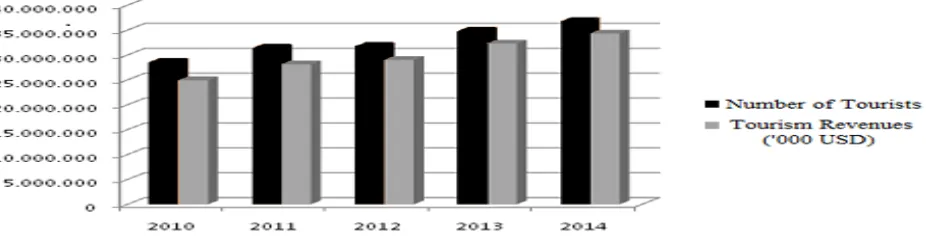
As it is across the globe, tourism is making continuous progress also in Turkey. When the data of Ministry of Tourism are examined, progress of Turkey in the field of tourism in the last quarter - century is seen obviously. While number of visitors across the country coming for touristic purposes was 4.4 million in nineties when the tourism has started, in 2000’s this figure has exceeded 10 million. When we came to 2010’s, tourism sector has gained a significant place in the world market, and number of tourists has exceeded 30 million [12].
As it will be seen on the above figure, tourism incomes have increased % 6.2 in the year 2014 in proportion to the previous year, and realized as 34 billion 305 million 904 thousand $. % 81,5 of the tourisms has been acquired from foreign visitors, and % 18,5 of it has been acquired from visits of our citizens resident in abroad.
At this point, Turkey has taken its place in the category of countries which are most preferred as touristic destination, in the 6th place in world ranking. By continuing with this stability, and by creating alternative
tourism resources and alternative
Relationship between Sustainable
Tourism
and
Sustainable
Profitability
Sustainability is the method of realizing the efforts of economic growth and increasing the welfare level, by protecting the environment and the life quality of all people in the world. It is evaluated under the headings of economic, environmental and social sustainability. In case environmental, economic and social sustainability is ensured, sustainable development can be realized.
Sustainability has gained significance in the tourism sector. There is a powerful relationship between sustainability and competitiveness. Among the primary objectives of sustainable tourism, economic sustainability also takes place [13]. Tourism sector, especially with its contribution to employment and exportation in the developing countries, has been positioned in the Millenium Development Goals as a key sector to make contribution to targets such as struggle against poverty, environmental sustainability, and global partnership in development. While responsible and sustainable tourism provides economic benefit to enterprises and regions, it also creates opportunities to minimize the negative impacts on the environmental and cultural heritage [13].
Primary objective of the institutions is sustainable profitability and growth. Corporations regard the growth as a good development. Bur what is important is that the company has a sustainable growth while gaining profit [14]. Transition of Turkish
tourism into sustainable tourism
management without loosing its competitive power, depends on providing finance under suitable conditions [13].
Primary objective of the companies is to survive and to maximize the value of the company, by growing in profitability, in compatibility with their environment. The role of managerial accounting is also necessary to be emphasized in optimizing the economic performance of the enterprises. Sustainable profitability is also possible with effective utilization of managerial
accounting means. Such an enterprise management shall have powerful means in taking into record the planning and control means and their social and environmental effects [15] and all economic and financial transactions ensure accuracy in order to develop reliable estimations, and their contribution to sustainability is positive.
Companies are obliged to use debts or equity capital finance in order to finance their growth. If a company doesn’t have enough finance, and if the company is growing in an uncontrolled way, the company shall have difficulty in sustaining its growth. On the other hand, if the company grows very slowly, it shall become stationary and shall not grow. It is necessary to form the relationship between sustainability and commercial income and profitability in a permanent way. From the viewpoint of enterprises, investors and entrepreneurs, sustainability is effective also in terms of profitability and performance.
Financial Performance Indicators
Financial performance indicators are being utilized in order to determine the realization degree of profitability, efficiency, and growth rate targets of the enterprise. By playing a role in effective realization of decision making, planning and control functions of the enterprise, financial performance measuring also contributes to the process of strategic decision making against rapid changing market conditions.
Financial measurements are regarded as basis for performance measurement of the enterprises. Although many methods can be used in financial performance analysis of the enterprises, one of the most popular and most significant methods is ratio analysis [16]. With ratio analysis, which is among the traditional performance measurement methods based on accounting data, the degree of reaching the sustainable profitability and success objectives of the enterprise can be ascertained. It is alleged
that, since the accounting based
performance indicators focus on the past, they fall short in making the strategic decisions to rapidly adapt to changing
conditions in highly competitive
the traditional financial performance indicators in which accounting based data are used, are used together with the prospective value based performance methods in which the capital cost is taken
performance is evaluated with all its
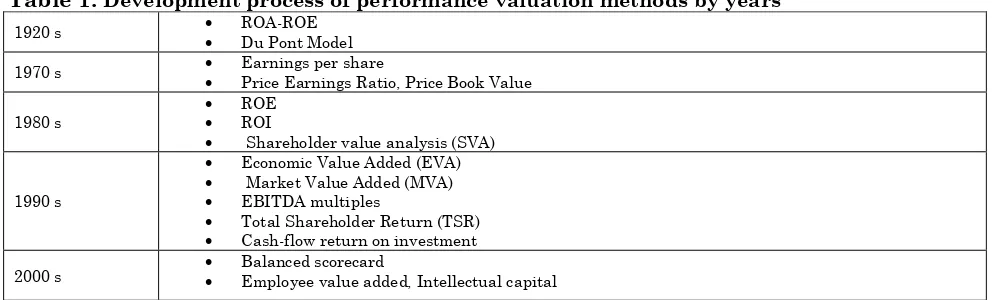
aspects. Development process of
performance valuation methods by years is shown on Table 1.
Table 1: Development process of performance valuation methods by years
1920 s ROA-ROE
Du Pont Model
1970 s Earnings per share
Price Earnings Ratio, Price Book Value
1980 s
ROE
ROI
Shareholder value analysis (SVA)
1990 s
Economic Value Added (EVA)
Market Value Added (MVA)
EBITDA multiples
Total Shareholder Return (TSR)
Cash-flow return on investment
2000 s Balanced scorecard Employee value added, Intellectual capital
The intended purpose have a place in to determine the indicators of financial performance. Profitability being one of the
outstanding traditional measures of
performance is obtained from the traditional financial statement which are profit, loss account and balance sheet [17].
In the analysis of this study, profitability and financial ratios such as earnings before interest and taxes (EBIT), earnings before
interest, taxes, depreciation and
amortization (EBITDA), net profit of the period, ROE, and ROA are employed.
Net profit /loss of the period : It is defined as tax and other legal liabilities related to the business activity period occurs after the fulfillment of the profit.
Earnings Before Interest and Taxes (EBIT); EBIT which shows real operating profit/loss of firm is formulated as follows;
EBIT = net sales- cost of sales- operating costs
Earnings Before Interest, Taxes,
Depreciation and Amortization (EBITDA), EBITDA which is an indicator of profitability and efficiency of operating activities is calculated by addition of Interest Expense, Income Tax Expense, Depreciation, and Amortization to the Net Income [18].
Return on Assests (ROA); The financial ratio Return on Assets (ROA), a measurement for
effective and productive usage of assests of firm, is calculated as follows [19].
𝐑𝐞𝐭𝐮𝐫𝐧 𝐨𝐧 𝐀𝐬𝐬𝐞𝐬𝐭𝐬 =𝐧𝐞𝐭 𝐢𝐧𝐜𝐨𝐦𝐞(𝐩𝐫𝐨𝐟𝐢𝐭 𝐚𝐟𝐭𝐞𝐫 𝐭𝐚𝐱) 𝐭𝐨𝐭𝐚𝐥 𝐚𝐬𝐬𝐞𝐭
Return on Equity (ROE); Return on Equity (ROE) which shows the return equity shareholders possess for investing risk capital is calculted as Profit after Tax divided by total equity capital [20].
𝐑𝐞𝐭𝐮𝐫𝐧 𝐨𝐧 𝐄𝐪𝐮𝐢𝐭𝐲 =𝐧𝐞𝐭 𝐢𝐧𝐜𝐨𝐦𝐞 (𝐩𝐫𝐨𝐟𝐢𝐭 𝐚𝐟𝐭𝐞𝐫 𝐭𝐚𝐱) 𝐭𝐨𝐭𝐚𝐥 𝐞𝐪𝐮𝐢𝐭𝐲 𝐜𝐚𝐩𝐢𝐭𝐚𝐥
Since return on equity shows the profits of the shareholders, it is expected to be over the capital cost. For this reason, sufficiency of the return on equity must be compared with alternative utilization choices of the capital. Return on equity’s being high, is also an indication of that the operation costs are under control.
measurement of financial performances of the companies, offering solution proposals to the companies carrying on tourism sector is aimed.
Methodology
In this part, some information is given on reaching the financial tables of the analyzed tourism enterprises, forming the data set, and statistically analyzing the data.
Sample and Data Collecting
In establishing the data set analyzed in the study, past financial tables of 11 companies have been used, which are traded at Istanbul Stock Exchange in tourism sector (hotels, motels, guest houses, camps and other accommodations), in the period of 2008 - 2014, prepared in accordance with UFRS and underwent independent inspection. Data acquired from the official web site of Public Disclosure Platform (www.kap.gov.tr) have been evaluated using The Statistical Package for the Social Sciences (SPSS) 17.0 packaged software. Companies investigated within the context of the analysis are presented in Annex 1. Since the financial tables of two companies within the scope of the analysis for the years 2008 - 2010 could not be reached, the deficiency in the number of periods included into the data set constitutes restriction of this study, which has a cross - sectional characteristics.
Results and Discussion
Whether there is any relationship with the production costs at the enterprises carrying on business in tourism sector, and net profit / loss of period, EBIT and EBITDA are tested statistically within the frame of the following hypotheses;
H1: There is a meaningful relationship between service production cost and Net Profit / Loss of Period
H2: There is a meaningful relationship between service production cost and EBIT. H3: There is a meaningful relationship between service production cost and EBITDA.
Statistically meaningfulness of the relationships between the variables is regarded to be at p < 0,05 level. In consequence of the correlation analysis used to measure the degree of linear relationship between the variables, existence of a meaningful relationship has been identified between the service production cost and EBITDA. Another result of the correlation analysis is that, there is no meaningful relationship between the service production cost and net profit of period, and between the service production cost and EBIT. Result of the correlation analysis is shown on Table 2.
Table 2 . Pearson correlation analysis between variables
Service production cost with r p
EBITDA (N=62) 0,270* 0,034
EBIT (N=69) 0,033 0,786
Net profit (N=69) 0,177 0,145
Distribution of assets profitability rates belonging to the enterprises examined within the context of analysis from the
viewpoint of effective utilization of the operation assets, which is one of the primary fundamentals of sustainable profitability, has been realized as Figure 2.
Figure 2: ROA distribution between the years 2008-2014
Return on Assests, which shows the extent to which the enterprise assets are used effectively, takes a negative value as a result of the fact that enterprises are predominantly making loss in the financial periods. Since return on assests determines the income rate of material and financial investments, it is expected to bear a positive value. It is seen that, the decrease in net profit of period has a negative impact on the assets profitability. In tourism sector, in
which sector investments have significance, sustainable asset management and the investments made, are aimed to be focused on value creating.
Distribution of the return on equity, which is centered upon the investment made by the shareholders of enterprises examined within the context of the analysis, has been realized as Figure 3.
Figure 3: ROE distribution between the years 2008-2014
Sufficiency of return on equity indicator is determined by comparing with opportunity cost of capital, risk free interest rates, and alternative utilization opportunities of investment. As in the assets profitability rates, it is also seen in the return on equity
Conclusion
The aim of tourism, which is one of the corner stones of Turkish economy, is sustainable tourism and sustainable profitability. There’s no doubt that, competitive companies, capital structures of which are powerful, shall have positive contribution in development of tourism. In the light of findings obtained as a result of the study, it has been ascertained that,
tourism enterprises need correct and applicable financial disciplines for the sake of strengthening their financial structures. As a result, it is significant that the enterprises carrying on business in tourism sector create sustainable profitability and efficiency strategies and apply efficient cost management in a powerful equity capital. It is thought that, they can have satisfactory profitability indicators in this way.
References
1. Külter B, Demirgüneş K (2007) Perakendeci Firmalarda Karlılığı Etkileyen Değişkenler Hisse Senetleri İMKB' de İşlem Gören Perakendeci Firmalar Üzerinde Amprik Bir Çalışma. Ç.Ü. Sosyal Bilimler Enstitüsü Dergisi, 16(1):445-460.
2. Albayrak AS, Akbulut R (2008) Karlılığı Etkileyen Faktörler: İMKB Sanayi ve Hizmet Sektörlerinde İşlem Gören İşletmeler Üzerine Bir İnceleme. ZKÜ Sosyal Bilimler Dergisi, 55-83.
3. Akkaya C (2008) Sermaye Yapısı, Varlık Verilmliliği ve Karlılık: İMKB' de Faaliyet Gösteren Deri-Teksitl İşletmeleri Üzerine Bir Uygulama. Erciyes Üniversitesi İktisadi ve İdari Bilimler Fakültesi Dergisi, (30):1-13. 4. Kandır S, Karadeniz, E, Özmen M, Önal YB
(2008) Türk Turizm Sektöründe Büyüme Göstergelerinin Turizm İşletmelerinin Finansal Performansına Etkisinin İncelenmesi. Dokuz Eylül Üniversitesi Sosyal Bilimler Enstitüsü Dergisi, 10(1):211-237.
5. Kabakçı Y (2008) Sermaye Yapısı İle İşletme Performansı Arasındaki İlişki: Gıda Sekötürnde Bir Uygulama. Ege Akademik Bakış, 167-182.
6. Karadeniz E, İskenderoğlu Ö (2011) İstanbul Menkul Kıymetler Borsası’nda İşlem Gören Turizm İşletmelerinin Aktif Kârlılığını Etkileyen Değişkenlerin Analizi. Anatolia: Turizm Araştırmaları Dergisi, 22(1):65-75. 7. Ebaid IES (2009) The impact of
capital-structure choice on firm performance:empirical evidence from Egypt. The Journal of Risk Finance, 10(5):477-487.
8. Nawaz A, Rizwan A, Naseem MA (2011) Relationship between capital structure and firms performance: A case of textile sector in Pakistan. Global Business and Management Research: An International Journal, 3(3&4):270-275.
9. Nirajini A, Priya KB (2013) Impact of capital structure on financial perfromance of the listed
trading companies in Sri Lanka. International Journal of Scientific and Research Publications, 3(5): 1-9.
10. Demireli E, Başçı ES, Karaca, SS (2014) İşletme Sermayesi ve Performans Göstergeleri Arasındaki İlişkiler: Borsa İstanbul Üzerine Bir Uygulama. Ege Stratejik Araştırmalar Dergisi, 79-98.
11. Briciu S, Scorte, C, Meşter I (2013) The impact of accounting information on managerial decisions- EMprical study conducted in the hospitality industry entities in Romania. Tlieoretical and Applied Economics, 27-38. 12. TÜROFED (tarih yok). Turizm Raporu 2014.
Mart 10, 2015 tarihinde http://www.turofed.org.tr/PDF/DergiTr/Turizm _Raporu-TUROFED%20RAPOR.pdf
adresinden alındı
13. TÜSİAD (2012) Sürdürülebilir Turizm.
İstanbul: TÜSİAD.
http://www.tusiad.org.tr/__rsc/shared/file/Surd urulebilirTurizm-rapor.pdf
14. Vitezic N, Vuko T, Mörec B (2012) Does Financial Performance Have An Impact On Corporate Sustainability And CSR Disclosure -A Case Of Croatian Companies. Journal of Business Management, 40-47.
15. Dutescu A, Popa AF, Ponorıca AG (2014) Sustainability Of The Tourism Industry, Based On Financial Key Perfromance Indicators. Amfiteatru Economic, 1048-1062.
16. Hagzy M, Hegazy S (2012) The Development of key financial performance ındicators for UK construction companies. Accountability Performance, 17(1&2):59-60.
17. Chandra NK (2011) Performance measures: An application of value added statement. Journal of Operations Management, 10(3):39-61.
K,(2012) The Relationship Between Supply Chain.Fit and Return on Assets of the Firm.Munich Personal RePEc Archive, MPRA Paper No. 53195, posted 28.,s.1-11
20. Sur D, Mitra S, Maji S B (2014) Disintegrating Return on Equity Using the DuPont Model: A Case Study of Tata Steel Ltd.Journal Of Management Research In Emergıng Economıes; 2(2):20.
21. Aydeniz E (2009) Makroekonomik Göstergelerin Firmaların Finansal Performans Ölçütleri Üzerindeki Etkisinin Ölçülmesine Yönelik Bir Araştırma: İMKB’ye Kote Gıda ve İçecek İşletmeleri Üzerine Bir Uygulama.
277.
22. Financial Peformance (2015) http://pascal.iseg.utl.pt/~jcneves/handouts_mc1 6_performance.pdf adresinden alındı
23. http://www.istekobi.com.tr/sektorler/turizm-s2/sektore-bakis/turizm-b2.aspx.
24. http://www.tuik.gov.tr/PreTablo.do?alt_id=107 2. (tarih yok). Şubat 20, 2015 tarihinde alındı
25. http://www.borsaistanbul.com
26. http://www.landlearnnsw.org.au/sustainability/ what-is-sustainability