Available online throug
ISSN 2229 – 5046
RADIATION AND VISCOUS DISSIPATION EFFECTS ON STEADY MHD MARANGONI
CONVECTION FLOW OVER A PERMEABLE FLAT SURFACE
WITH HEAT GENERATION/ABSORPTION
P. Sreenivasulu
a, N. Bhaskar Reddy
aand M. Gnaneswara Reddy
b*a
Department of Mathematics, Sri Venkateswara University, Tirupati- 517502.A.P.
b
Department of Mathematics, Acharya Nagarjuna University Ongole Campus, Ongole-523001.A.P.
(Received on: 16-11-12; Revised & Accepted on: 22-02-13)
ABSTRACT
A
steady, two-dimensional, Marangoni convection flow of a viscous incompressible electrically conducting and radiating fluid along a permeable flat plate in the presence of magnetic field and heat generation/absorption is analyzed. The governing partial differential equations are transformed into a set of ordinary differential equations using similarity transformations. The resultant equations are then solved using Range-Kutta method along with shooting technique. The behavior of velocity and temperature as well as Nusselt number for different values of governing parameters are computed and discussed in detail.Keywords: Marangoni convection, Boundary layer, Thermal radiation, MHD, Viscous dissipation.
1. INTRODUCTION
In recent times a good deal of attention has been devoted to the studies of Marangoni convection. This is mainly because it is important in crystal growth melts and greatly influences other industrial processes. The surface tension gradient variations along the interface may induce the Marangoni convection. Many researchers such as Okano et al.
[1], Christopher et al. [2], Arafune et al. [3], Pop et al. [4]and Christopher and Wang [5] and etc. have investigated Marangoni convection in various geometries.
On the other hand, the study of magnetohydrodynamics (MHD) is important in the heat and mass transport processes. In view of this, there are many attempts to study the effect of the magnetic field on the Marangoni convection. Witkowski and Walker [6] and Munakata et al. [7] employed the magnetic field on the Marangoni convection in the floating zone (FZ) silicone melt. Al-Mudhaf and Chamkha [8] studied numerically and analytically the MHD thermo-solutal Marangoni convection along a permeable surface with heat generation or absorption. Recently, Magyari and Chamkha [9] reported exact analytical solutions for the velocity, temperature and concentration fields of steady thermo-solutal MHD Marangoni convection.
For some industrial applications such as glass production and furnace design, electrical power generation, astrophysical flows, solar power technology, which operates at high temperatures, radiation effects can be significant. Chamkha et al.
[10] studied the radiation effects on free convection flow past a semi-infinite vertical plate with mass transfer. Elbashbeshy and Dimian [11] investigated the effect of radiation on the flow and heat transfer over a wedge with variable viscosity. Chaudhary et al. [12] presented the radiation effect with simultaneous thermal and mass diffusion in MHD mixed convection flow from a vertical surface with Ohmic heating. Bataller [13] studied the radiation effects in the Blasius flow. Ishak [14] investigated the radiation effects on the flow and heat transfer over a moving plate in a parallel stream. He showed that the existence of thermal radiation is to reduce the heat transfer rate at the surface.
In all the studies mentioned above, viscous dissipation is neglected. But, viscous dissipation in the natural convection flow is important, when the flow field is of extreme size or in high gravitational field. Gebhart and Mollendorf [15] considered the effects of viscous dissipation for external natural convection flow over a surface. Soundalgekar [16] analyzed viscous dissipative heat on the two-dimensional unsteady free convective flow past an infinite vertical porous plate. Israel-Cookey et al. [17] investigated the influence of viscous dissipation and radiation on unsteady MHD free convection flow past an infinite heated vertical plate in a porous medium with time dependent suction. Ramachandra Prasad and Bhaskar Reddy [18, 19] and Suneetha and Bhaskar Reddy [20] studied the effects of radiation and viscous dissipation on MHD free convection flow past a vertical plate with varied boundary conditions.
Corresponding author:M. Gnaneswara Reddyb*
In this paper an attempt is made to study the radiation and viscous dissipation effects on MHD Marangoni flow over a permeable flat surface with heat generation/absorption.
2. MATHEMATICAL ANALYSIS
A steady, two-dimensional, laminar boundary layer flow of a viscous incompressible electrically-conducting and radiating fluid past a semi infinite flat surface is considered. The fluid is assumed to be gray, absorbing but non scattering. The x-axis is taken along the surface and y- axis normal to it. The surface is assumed to be in the presence of surface tension due to temperature gradient at the wall. Further, a strong magnetic field of strength B0 is applied normal
to the surface which then produces the magnetic forces along the surface. Under the above assumptions and with the usual boundary layer approximations, the governing equations are (Hamid et al. [21]) as follows
0
u
v
x
y
∂
+
∂
=
∂
∂
(1)(2)
(3)
The boundary conditions for the velocity and temperature fields are
(4)
where u and v are the velocity components in the x and y directions, respectively, is the kinematic viscosity, Δ is the
electric conductivity, σ is the surface tension, B0 is the uniform magnetic field strength, is the thermal diffusivity, ρ
is the density of the fluid, cp is the specific heat at constant pressure, T is the fluid temperature, T∞ is the fluid
temperature far from the surface, A is the temperature gradient coefficient, μ is the dynamic viscosity and qr is the
radiative heat flux. The second, third and fourth terms on the right hand side of equation (3) represents the viscous dissipation, radiation and heat generation or absorption respectively.
Using the Rosseland approximation for radiation, the radiative heat flux is simplified as
(5) where σ* is the Stefan-Boltzmann constant and k * is the mean absorption coefficient. It is assumed that the temperature differences within the flow is small, so that the term T4may be expressed as a linear function of temperature. Hence by expanding T4in a Taylor’s series about
T
∞3and neglecting higher-order terms, thus(6)
Using (5) and (6), equation (3) reduces to (Ishak [14])
(7)
where is the thermal diffusivity and is the radiation parameter.
Further, we use the similarity transformations as presented by Al-Mudhaf and Chamkha [8] and the standard definition of the stream function such that and to obtain the similarity solution of the problem. The similarity transformations are given by
(8) where (9) 2 2 0 2
B
u
u
u
u
v
u
x
y
ν
y
ρ
∆
∂
∂
∂
+
=
−
∂
∂
∂
2 2 0 21
(
)
r(
)
p p p
Q
q
T
T
T
u
u
v
T
T
x
y
y
C
y
C
y
C
ν
α
ρ
ρ
∞∂
∂
∂
∂
∂
+
=
+
−
+
−
∂
∂
∂
∂
∂
2 0( , 0)
,
( , 0)
,
0
( ,
)
0,
( ,
)
u
d
T
v x
v
T x
T
Ax
at
y
y
dT
x
u x
T x
T
as
y
σ
µ
∞ ∞∂
∂
=
=
+
= −
=
∂
∂
∞ =
∞ =
→ ∞
ν
α
* 4 *4
3
rT
q
k
y
σ ∂
= −
∂
4 3 4
4
3
T
≈
T T
∞−
T
∞2 2
0 2
(1
)
(
)
p
Q
T
T
T
u
u
v
Nr
T
T
x
y
y
Cp
y
C
ν
α
ρ
∞
∂
+
∂
=
+
∂
+
∂
+
−
∂
∂
∂
∂
/ (
)
k
Cp
α
=
ρ
* 3 *16
/ (3
)
Nr
=
σ
T
∞kk
/
u
= ∂
ψ
∂
y
v
= −∂
ψ
/
∂
x
1 2
1 2
[ ( , )
]
,
( )
( , ) ,
( )
T x y
T
C y
f
C x
x y
x
A
η
=
η
=
−ψ
θ η
=
−
∞ −2 2
3 3
1 2 2
(
/
)
/
,
,
(
/
)
A d
dT
A
T L
C
C
A d
dT
ρ
σ
ρ
µ
µ
σ
With L being the length of the surface and ∆T is the constant characteristic temperature. Substituting (8) into equations (2) and (7), we obtain the following ordinary differential equations:
(10)
(11)
where primes denote differentiation with respect to and is the Prandtl number and
is the magnetic field parameter and is the Eckert number. It should be
mentioned here that the viscous dissipation effect is examined using the Eckert number Ec.
The dimensionless form of the boundary conditions become
(12)
The surface velocity is given by (Christopher and Wang [5])
(13)
The temperature gradient coefficient can be defined in terms of the total temperature difference along a surface of
length L as , so the Marangoni number can then be defined for a general temperature profile as
(14)
The Reynolds number defined in terms of the surface velocity is then related to the Marangoni number as
(15)
The total mass flow in the boundary layer per unit width is given by
(16)
This can be written in dimensionless form as
(17)
Analysis of the similarity transformation shows that both are true if
(18)
The numerical results can be used to show that the boundary layer assumptions hold within the momentum boundary layer for MaL/Pr>106 .
3. PRANDTL NUMBER EFFECTS
It is possible to obtain approximate analytical solutions for the energy equation depending on the order of magnitude of the Prandtl number. For example, for small Prandtl numbers, the thermal boundary-layer thickness is much greater than
that of the momentum boundary layer. In this case, ( is essentially zero over most of the domain and the
2 2
(
)
0
f
′′′
+
ff
′′
−
f
′
−
M f
′
=
2
Pr
[
2
(
)
]
0
(1
Nr
)
f
f
Ec f
θ
′′
+
θ
′
−
′
θ
+
′′
+
φθ
=
+
η
Pr
=
ν α
/
2 2
0 2
/
1M
= ∆
B C
ρ
C
Ec
=
C
12/
AC C
p 220
(0)
2,
(0)
,
(0)
1
( )
0,
( )
0
f
f
f
f
θ
θ
′′
= −
=
=
′ ∞ =
∞ =
23
((
/
) )
( , 0)
d
dT A
(0)
u x
σ
f
x
ρµ
′
=
2
/
A
= ∆
T L
2 3
(
/
)(
/
)
L
d
dT
T L L
Ma
σ
µα
∆
=
(
d
σ
/
dT
)
TL
µα
∆
=
2/3 2/3
( , 0)
Re
Lu x
L
f
(0)
Ma
LPr
ν
′
−=
=
3
0
( )
d
m
udy
A
f
x
dT
σ
ρ
ρµ
∞=
∫
=
∞
1/3 1/3Re
xρ δ
u
f
( )
Ma
xPr
µ
−=
=
∞
3
3
1 2
(
d
/
dT A L
)
C L
σ
ρ
( can be replaced by ( . Taking this fact into consideration, the energy equation can be approximated by
(19)
The solution of equation (19) subject to the boundary conditions given in equation (12) can be approximated by
(20)
The wall temperature gradient for small Prandtl numbers is given by
(21)
For large prandtl numbers, is essentially zero over most of the domain and can be replaced by
for small values of . Taking this fact into consideration, the energy equations can be approximated by
(22)
The solution of equation (22) subject to the boundary conditions given in equation (12) can be approximated by
(23)
The corresponding temperature gradient at the surface is given by
(24)
The local Nusselt number is given by
(25)
For small Prandtl numbers, The local Nusselt is given by
(26)
For large Prandtl numbers, The local Nusselt is given by
(27)
4. SOLUTION OF THE PROBLEM
The nonlinear ordinary differential equations (10) and (11) subject to the boundary conditions (12) are solved numerically using the Runge - Kutta fourth order method along with shooting technique. The edge of the boundary layer, is chosen to be between 3 to 15, which is in accordance with the standard practice in the boundary layer
analysis. First, higher order non linear differential equations (10) and (11) are converted into simultaneous linear differential equations and then they are transformed into an initial value problem by applying the shooting technique (Jain et al.[22]). The resultant initial value problem is solved by employing Runge - Kutta fourth order technique. The initial step size h = Δη = 0.01is used to obtain the numerical solution with five decimal place accuracy as the criterion of convergence.
(1
+
Nr
)
θ
′′
+
Pr ( )
f
∞
θ
′
+
Pr
φθ
=
0
2 2
Pr ( )
Pr
( )
4(1
) Pr
( )
exp
2(1
)
f
f
Nr
Nr
φ
θ η
=
−
∞ +
∞ −
+
η
+
2 2
Pr ( )
Pr
( )
4(1
) Pr
(0)
2(1
)
f
f
Nr
Nr
φ
θ
′
= −
∞ +
∞ −
+
+
( )
f
η
f
′
( )
η
f
′
(0)
η
(1
+
Nr
)
θ
′′
−
2 Pr
f
′
(0)
θ
+
Pr
φθ
=
0
2 Pr
(0) Pr
( )
exp
(1
)
f
Nr
φ
θ η
=
−
′
−
η
+
2 Pr
(0) Pr
(0)
(1
)
f
Nr
φ
θ
′
= −
′
−
+
1
( )
(0)
[ ( , 0)
]
x
q x x
Nu
C x
T x
T
θ
λ
∞′′
′
=
= −
−
1/3 1/3
,
Pr
( / ) (0)
x L T
Nu
= −
Ma
−x L
θ
′
2 2
1/3 1/3
,
Pr ( )
Pr
( )
4(1
) Pr
Pr
( / )
2(1
)
L T
f
f
Nr
Ma
x L
Nr
φ
−
∞ +
∞ −
+
=
+
1/3 1/3,
Pr
( / ) (0)
x L T
Nu
= −
Ma
−x L
θ
′
1/3 1/3
,
2 Pr
(0) Pr
Pr
( / )
(1
)
L T
f
Ma
x L
4. RESULTS AND DISCUSSION
The nonlinear ordinary differential equations (10) and (11) subject to the boundary conditions (12) were solved numerically using the Range-Kutta method along with shooting technique. A representative set of numerical results are shown in Figs.1-12 which illustrates the influence of physical parameters viz., the magnetic parameter M, Prandtl number Pr, radiation parameter Nr, Eckert number Ec, heat generation/absorption parameter and suction or injection parameter on the velocity and temperature.
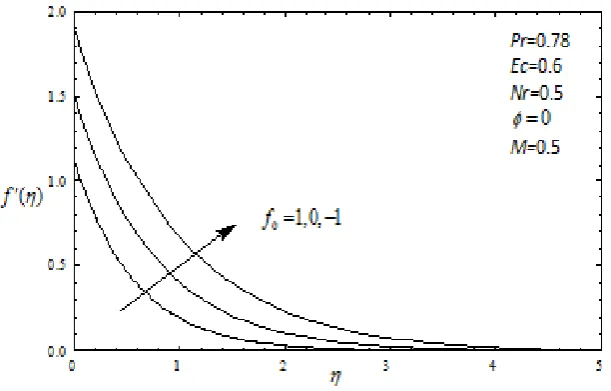
Figures 1 and 2 illustrate the influence of the suction or injection parameter f0 on the velocity and temperature,
respectively. Physically speaking, imposition of fluid suction (f0>0) at the wall has the tendency to decrease the fluid
velocity and the thickness of the hydrodynamic boundary layer. As a result, the fluid temperature and the thermal boundary layer decrease as well. However, fluid injection (f0<0) produces the opposite effect, namely an increase in the
fluid velocity and temperature.
Figures 3and 4present typical velocity and temperature profiles for various values of the magnetic field parameter M, respectively. Application of a transverse magnetic field results in a drag-like force called the Lorentz force. This force tends to slow down the movement of the fluid along surface and to increase its temperature. This behavior is evident in the decreases in the velocities and increases in the temperature as M increases. In addition, as the strength of the magnetic field increases, the hydrodynamic boundary layer decreases while the thermal boundary layer increases. It is also observed from Figure 3 that the wall velocity is nonzero due to the Marangoni or surface tension effect and it decreases as M increases.
Effect of radiation parameter Nr on temperature of the fluid with the influence of the suction or injection parameter is presented in Figures 5 to 8. Figure 5 displays the variation with Nr of the reduced temperature gradient, with different values of . It is seen that the reduced temperature gradient, decreases as Nr increases. Thus, the heat transfer rate at the surface decreases in the presence of radiation. This result qualitatively agrees with expectations, since the effect of radiation is to decrease the rate of energy transport to the fluid, thereby decreasing the temperature of the fluid. From Figures 6 to 8, it is observe that the temperature profiles increase as the radiation parameter Nr
increases. Thus, radiation can be used to control the thermal boundary layers quite effectively.
Figure 9 presents the effect of the viscous dissipation on the temperature profiles. It is noted that increases as the Eckert number increase the temperature. Figure 10 depicts the effect of the heat generation or absorption coefficient on the temperature. In general, while heat absorption has a tendency to cool down the fluid temperature, while heat generation increases it. However, for the parametric values employed to produce this figure, significant heat generation causes a temperature deficit where the fluid temperature goes below that of the free stream and oscillates thereafter until it reaches the free stream value.
The variation of the local Nusselt number with the Marangoni number and location is shown in figure 11 for low Prandtl number (Pr = 0.01) and in figure 12 for high Prandtl number (Pr = 100). The increased flow at higher Marangoni numbers has a significant effect on the heat transfer even for low Prandtl numbers (liquid metals) where conduction is significant.
Fig.1. Velocity profiles for different values of
φ
0
f
0
f
(0)
θ
′
−
0
f
−
θ
′
(0)
Fig.2. Temperature profiles for different values of
Fig.3. Velocity profiles for different values of M .
Fig.5 Effectsof Nr on the surface temperature gradient .
Fig.6. Temperature profiles for different values of Nr when = 1.
Fig.7. Temperature profiles for different values of Nr when = 0
(0)
θ
′
−
0
f
Fig.8 Temperature profiles for different values of Nr when = -1
Fig.9 Temperature profiles for different values of Ec.
Fig.10 Temperature profiles for different values of 0
f
Fig. 11 Predicted local Nusselt Number for low Prandtl number (Pr=0.01).
Fig. 12 Predicted local Nusselt Number for high Prandtl number (Pr=100).
5. CONCLUSIONS
Marangoni convection flow of a viscous incompressible electrically conducting and radiating fluid along a permeable flat plate in the presence of magnetic field and suction or injection parameter was analyzed numerically. The governing partial differential equations are reduced to a system of self-similar equations using the similarity transformations. The resultant equations are then solved numerically using the Runge-Kutta method along with shooting technique. The effects of governing thermophysical parameters on the velocity, temperature profiles as well as Nusselt number are computed and presented in graphical form and discussed.
It can be drawn from the present results that when the radiation parameter increases, the heat transfer rate at the surface decreases. Meanwhile, the imposition of suction is to decrease the fluid velocity and temperature profiles, whereas injection shows the opposite effects.
REFERENCES
1. Okano, Y., Itoh, M. and Hirata, A. 1989. Natural and Marangoni convections in a two-dimensional rectangular open boat. Journal of Chemical Engineering of Japan, 22: 275-281.
2. Christopher, D. M. and Wang, B. 1998. Marangoni convection around a bubble in microgravity, heat transfer, in: Lee J.S. (Ed.), Proceedings of the 11th International Heat Transfer Conference, Taylor & Francis, Levittown, 3: 489–494.
3. Arafune, K., Sugiura, M. and Hirata, A. 1999. Investigation of thermal Marangoni convection in low and high Prantdl number fluids. Journal of Chemical Engineering of Japan, 32: 104-109.
4. Pop, I., Postelnicu, A. and Grosan, T. 2001. Thermosolutal Marangoni forced convection boundary layers.
Meccanica, 36: 555-571.
(0)
5. Christopher, D. M. and Wang, B. 2001. Prandtl number effects for Marangoni convection over a flat surface.
International Journal of Thermal Sciences, 40: 564-570.
6. Witkowski, L.M. & Walker, J.S. (2001). “Flow Driven by Marangoni Convection and Rotating Magnetic Field in a Floating-Zone Configuration”. Magnetohydrodynamics.
Vol. 37. No. 1-2, pp. 112-118
7. Munakata, T., Someya, S., & Tanasawa, I. (2002). “Suppression of Marangoni Convection in the FZ Melt by High-Frequency Magnetic Field”. Journal of Crystal Growth.Vol. 235. No. 1-4, pp. 167-172
8. A. Al-Mudhaf and A. J. Chamkha, Similarity solutions for MHD thermosolutal Marangoni convection over a flat surface in the presence of heat generation or obsorption effects. Heat and Mass Transfer, Vol. 42, 2005, pp. 112-121.
9. E. Magyari and A. J. Chamkha, Exact analytical results for the thermosolutal MHD Marangoni boundary layers. Int. J. Thermal Sciences, Vol. 47, 2008, pp. 848-857.
10. Chamkha, A. J., Takhar, H. S. and Soundalgekar, V. M. 2001. Radiation effects on free convection flow past a semi-infinite vertical plate with mass transfer. Journal of Chemical Engineering of Japan, 84:335-342.
11. Elbashbeshy, E. M. A. and Dimian, M. F. 2002. Effect of radiation on the flow and heat transfer over a wedge with variable viscosity. Applied Mathematics and Computation, 132: 445- 454.
12. Chaudhary. R. C., Sharma, B. K. and Jha, A. K. 2006. Radiation effect with simultaneous thermal and mass diffusion in MHD mixed convection flow from a vertical surface with Ohmic heating. Romanian Journal of Physics, 51: 715-727.
13. Bataller, R. C. 2008. Radiation effects in the Blasius flow. Journal of Applied Mathematics and Computations, 198: 333-338.
14. Ishak, A. 2009. Radiation effects on the flow and heat transfer over a moving plate in a parallel stream. Chinese Physics Letters, 26(3): 034701(1-4).
15. Gebhart B. and Mollendorf J. (1969), Viscous dissipation in external natural convection flows, J. Fluid Mech., Vol.38, pp.97-107.
16. Soundalgekar V.M. (1972), Viscous dissipation effects on unsteady free convective flow past an infinite vertical porous plate with constant suction, Int. J. Heat Mass transfer, Vol.15, Pp.1253-1261.
17. Israel-Cookey. C., Ogulu A. and Omubo-Pepple V.B. (2003), Influence of Viscous dissipation on unsteady MHD free-convection flow past an infinite heated vertical plate in porous medium with time-dependent suction, Int. J. Heat Mass Transfer, Vol.46, pp-2305-2311.
18. V. Ramachandra Prasad and N.Bhaskar Reddy, Radiation and Mass transfer Efffects on MHD free convection flow past a heated vertical plate in a porous medium with viscous dissipation, Thermal Applied Mechanics, Vol.34, No.2, pp.135-160, 2007.
19. V. Ramachandra Prasad and N. Bhaskar Reddy, Radiation and Mass transfer Efffects on MHD free convection flow past a semi infinite vertical peramable moving plate embedded in a porous medium with viscous dissipation, Indian Journal of Pure and Applied Phisics, Vol.46, No.2, pp.81-92, Feb., 2008.
20. S. Suneetha and N. Bhaskar Reddy, Radiation effects on MHD flow of a chemically reacting fluid past a vertical plate with viscous dissipation, Journal of Energy, Heat and Masss transfer, Vol.32, Pp.243-263,2010.
21. R.A.Hamid, N.Md Arfin, R. Naazar and F. Md Ali (2011), Radiation effects on Marangoni Convection over a flat surface with suction and injection, Malaysian Journal of Mathematical sciences, 5(1):13-25.
22. Jain M.K., Iyengar S.R.K. and Jain R.K (1985), Numerical methods for Specific and Engineering Computation, Wiley Eastern Ltd., New Delhi, India.)