SYNTHESIS OF SCHIFF BASE METAL COMPLEXES: A
CONCISE REVIEW
Saima Akhter,
[a]Hilal Ul Zaman,
[a]Shafia Mir,
[b, c]Ayaz Mahmood Dar
[b]*and Sarita Shrivastava
[a]Keywords: Schiff base, metal ion, dentation, synthesis, coordination.
Schiff bases are a group of compounds prepared by the condensation of primary amines and active carbonyl compounds. The Schiff bases have a general structure RRʹC=N-Rʹʹ (where R, R’ and Rʹʹ are alkyl, cyclohexyl, hydroxyalky1, hydroxyary1, etc). Herein the different synthetic routes of Schiff Base complexes like, direct synthesis, in situ method, oxidation of coordinated secondary amine, amine exchange approach, metal exchange and ligand exchange reaction are reviewed. A concise survey of literature on the coordination modes of complexes of Schiff base ligands is also presented in this article. The coordination complexes have been successfully screened against different strains of bacteria where they depicted the potential antimicrobial behaviour.
* Corresponding Authors Phone: +91 92869902447
E-Mail: [email protected], [email protected] [a] Department of chemistry, Govt. Motilal Vigyan
Mahavidyalaya Bhopal 4462009 M.P, India
[b] Department of chemistry, Govt. Degree College Kulgam 192231 (University of Kashmir), J&K, India
[c] Department of Chemistry, OPJS University, Churu 331001, Rajasthan, India
Introduction
The chemistry of coordination compounds is well known and widely studies, yet many new developments are continuously taking place in this area of inorganic chemistry. The preparative work of Jorgenson, Werner and many others during the turn of the century opened up new vistas in coordination chemistry of transition metals. It was Alfred Werner1 who systematized the subject coordination
chemistry, by propounding theory in 1893, for which he awarded Nobel Prize in 1913. These ideas have considerably enriched the understanding of the nature of metal-ligand bonds, structure and chemistry of metal complexes, their stabilities and liabilities and other properties. It is now the need of time that new ligands of specified design should be synthesized which could lead to metal complexes with special desired and possible predictable properties. The steady improvement in synthetic methodology allows us to foresee coordinating chemistry entering a phase of creative chemistry.
For a long time the coordination compounds were considered as a rare and special class but now they have been recognized as the most resourceful type of compounds which help the nature to convert simple inorganic molecules into organic matter. For instance CO2 and H2O are converted
into sugars by coordination compound, called chlorophyll, the magnesium porphyrin complex present in plants. A similar iron porphyrin complex present in hemoglobin of animals operates in the red bloods cells as a carrier of oxygen for the oxidation of organic matter to produce carbon dioxide water and energy. Hemoglobin is also concerned with the transport of CO2 and acid base balance
of the body.
Many metallo-enzymes are involved in diverse metabolic pathways including DNA synthesis, sugar metabolism and protein modification.2
Coordination chemistry is now recognized as an independent discipline covering a wide range of areas from medicine to environment. In recent past there has been a great upsurge in the studies of metal complexes of bioinorganic medicinal relevance. The discovery and basic concepts of medicinal inorganic chemistry have recently reviewed.3-5 The field now encompasses active metal
complex, metal ions and even metal ions can be removed from a biological system by judicious use of metal binding molecules (termed ligands from the Latin word ligare, meaning that which binds).
Medicinal inorganic chemistry is at the interface between medicine and inorganic chemistry, and includes metal- based drugs, metal sequestering and mobilizing agents and metal containing diagnostic aids.6,7 In the early systematic
study of metals in medicine (during the early to middle part of the twentieth century), recognition of the essentiality of some metal ions (e.g. iron, zinc and copper) for the avoidance of deficiency disease was a major step forward. Not only some many metal ions are essential nutrients, but many are also becoming increasingly prevalent components of diagnostic or the therapeutic agents to study or treat wide variety of disease and metabolic disorders.3,7,8 The list of
metal ions that qualify for essential status is a work in progress; it includes not only expected members such as zinc, copper and manganese but also man formerly thought of only a poisonous, such as selenium and molybdenum.9,10
Included in the “possibly essential” list are such unexpected candidates as arsenic, nickel, silicon, and vanadium.10-12
The applications of metal complex in qualitative and quantitative chemical analysis have also been the subject of numerous studies during the past decade.13 To understand
The development of complexes for application in medicine is an obvious example of investigation and creativity. Remarkable example is cis-platin, cis-PtC12
(NH3)2 introduced by Rosenberg,14 which is successfully
employed world wide as anticancer drugs.15,16 Use has been
made of the calcium complexed EDTA as a scavenger for removing heavy metals like Pb(II), Cd(II) etc in case of such heavy metal poisoning in human. Antitumour activity of Cu(I) and Cu(II) complexes have a attracted much attention.17 Another important use of metal complexes and
chelating molecules is in the field of therapy. The use of gold complexes in the treatment of tuberculosis dates back to 1917 and many complexes of gold are known to be useful in the treatment of arthritis since 1927. In the course of study of a number of lipid soluble gold complexes for possible application of arthritis therapy, Winstock and coworkers18 prepared an unusual complex of gold. Many
drugs are known to be potentiated by complexation with Mn+ ions. Thus, Fe(III) increases antibacterial activity of
8-hydroxyquionline significantly, antibercular activity of isonicotinic acid hydrazide is increased tenfold by Cu(II), carcinostatic activity of many drugs is enhanced by chelation.19
The insulin-like effect of vanadium salts in cells20,21 and
diabetic animals22-28 is been known since the 1980s. Diabetic
patients frequently have both abnormal glucose and lipid metabolism that can be normalized by treatment with insulin. Studies testing compounds in animal model systems 23-28 and
in human beings29-32 show that simple vanadium salts and
vanadium complexes alleviate the symptoms of diabetes.
Coordination compounds involving Schiff bases
In 1864, Schiff33 prepared a series of compounds by the
condensation of primary amines and active carbonyl compounds and since then they are known as Schiff bases. The Schiff bases have a general structure RRʹC=N-Rʹʹ (where R, R’ and Rʹʹ are alkyl, cyclohexyl, hydroxyalky1, hydroxyary1, etc). The Schiff bases contain an azomethine group and have azomethine moiety (C=N). The donating properties of the lone pair of electron increases when a functional group such as -SH or -OH is sufficiently near to the azomethine moiety and this facilities the formation of a stable metal complex.
The coordination chemistry of the metal chelates of Schiff bases is known for more than a century. In 1840, Ettling34
prepared the copper(II) complex with salicylideneimine. Since then a good amount of literature35-52 on Schiff bases
and their metal complexes have appeared.
Layer in 1963 revived the synthesis of Schiff bases and also studies their physical and chemical properties.53 Dwyer
and Mellor54 described their chelating characteristics in a
monograph. Holmes and co-workers55 have presented an
excellent review of the metal complexes of Schiff bases and Bayer indicated a novel approach to the structure and specificity of the organic chelating agents including some of the Schiff bases. Jungeis et al.57 in 1969 have described the
detailed applications of Schiff bases in inorganic analysis.
Synthetic routes to Schiff base complexes
Major development in the chemistry of transition metal complexes of Schiff bases took place in the last two decades and much emphasis had been laid on synthesis and structure. The synthesis, properties and structure of the Schiff base complexes depend upon nature of the Schiff base and metal ion. The following methods have generally been used for the synthesis of metal complexes of Schiff base.58
Direct synthesis
In this method, the Schiff base is allowed to react with metal ion in a suitable solvent. In order avoid the hydrolysis of azomethine group the use of organic solvent is preferred, although in a number of cases the use of binary azeotropic mixture of water and an organic solvent has been reported.
In situ method
In this method the metal ion is added during or shortly after the mixing of the aldehyde and amine. In a number of cases, it has been reported that the metal ion coordinates with one component and then reacts with other components, thus facilitating the reaction of complexation.
Oxidation of coordinated secondary amine
Here the metal ion facilities the oxidative dehydrogenation of the secondary amine and the Schiff base complexes are obtained directly.59 One such reaction is given in scheme 1.
where R = H, n-C4H9, C6H5, Rʹ = C4H9, C6H5, o-HSC6H4
Scheme 1. Formation of Schiff base from secondary amine
Amine exchange reaction
In this method, an amine reacts with transition metal complex of Schiff bases and exchange of alky/aryl groups take place as illustrated below.60
Ni(o-OC6H4CH=NR)2 + 2RʹNH2
Ni(o-OC6H4CH=NRʹ)2 + 2RNH2 (1)
where R = H, n-C4H9, C4H10, C6H5, o-HSC6H4
Metal exchange reaction
This method is used for the preparation of Schiff base complexes, which are difficult to obtain by any other method.
NH HN OH HO
R'
R R'
R N N
O O
R'
R R'
R
Ba Ba(OH)2
A typical example of metal exchange reaction is illustrated below.
CuCl2 +TiSalen = Cu(Salen) + TiCl2 (2)
Ligand exchange reaction
This method is preferably used for the preparation of dioxomolybdenum(VI) complexes that are extremely difficult to synthesize by other methods. A typical reaction is given below.61
MoO2(acac)2 + SalenH2 MoO2(Salen) + 2acaeH (3)
where acacH = acetylacetone
Coordination modes of Schiff base ligands/mixed
ligands
It is well known that the Schiff base/mixed ligands coordinates as bi-, tri-, tetra-, penta-, hexa- and hepta-dentate ligands. A brief survey of literature on the coordination complexes of ligand is presented below.
Coordination complexes with bidentate Schiff base ligands / mixed ligands.
The Schiff base derived from aromatic o-hydroxyaldehyde and primary amine behave as bidentate ligands. Generally the stereochemistry of the bidentate Schiff base complexes depend upon the group present in the Schiff base on increasing the size of the R group the stereochemistry changes from square planar to tetrahedral. The Co(II) complexes of bidentate Schiff base (Figure 1) (R = H, OH) are square planar.
Figure 1. A bidentate Schiff base ligand.
Topich62 has achieved synthesis of a heterochelate
complex MoO2(Acac)L (where LH = Schiff base) by the
reaction of MoO2(acac)2 and Schiff base (Figure 2) in
ethanol or ethyl acetate.63 Only one acetylacetone moiety
was not displaced even when the metal to ligand ratio was greater than unity. IR data indicates that the ligand coordinates through to oxygen atom of the carboxylic acid group and nitrogen atom of azomethine group and not through the phenolic oxygen atom.
Figure 2. A Schiff’s base ligand
Dioxomolybdenum(VI) complexes of the type cis-MoO2L2 have also been prepared with the Schiff bases
derived from hydroxylamine and o-hydroxyacetophenone or 2,4-dihydroxyacetophenone.64 Hill et al.65 have described
the synthesis of complex of the type MoO2L2 with the Schiff
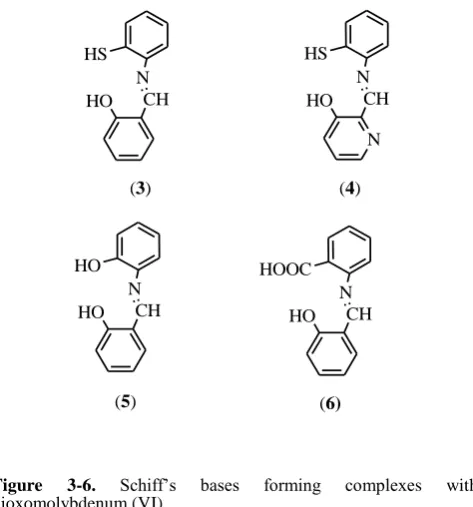
bases (Figure 3 and 4) by the reaction of bis(acetylacetonato)dioxomolybdenum (VI) and the Schiff bases in THF. The Schiff base (4) yielded a tetrameric complex of the type Mo4O11L2. The ligands in complexes of
the type cis-MoO2(acac)L are (5) and (6). Although the
ligands are potentially tridentate, they behave as OH donor bidentate monobasic and NS donor bidentate monobasic ligands in cis-MoO2L2 and only signal due to the
azomethine proton in the NMR spectra of dioxomolybdenum (VI) complexes (3) and (5)confirms the presence of a cis-MoO2 structure.
Figure 3-6. Schiff’s bases forming complexes with
dioxomolybdenum (VI).
Synthesis of two series of metal chelates66 viz., (i)
mononuclear chelates of composition [VO(L1)2]H2O and
[WO2(SCN)C2H5OH)2(L1)] (where L1H=
N-(4’-butyrylidene-3’-methyl-1ʹ-phenyl-2ʹ-pyrazolin-5-one)-p -ani-sidine, 9BUMPHP-AH), N-(4-butyrylidene-3ʹ-methyl-1ʹ-phenyl-2ʹ-pyrazolin-5ʹ-one)-m-toluidine (BUMPHP-MTH),
N-4ʹ-butyrylidene-3ʹ-methyl-1ʹ-phenyl-2ʹ-pyrazolin-5ʹ-one)-o-phenylenediamine (BUMPHP-OPHDH2),
N,Nʹ-bis-(4’-butyrylidene-3’-methyl-1’-pheny1-2’-pyrazolin-5’-one)-m -phenylenediamine (BMPH-MPHDH2), or VO(L2’)(H2O]
(where L2’H2
=N,N’-bis(4’-butyrylidene-3’-methy1-1ʹ-pheny1-2ʹ-pyrazolin-5’-one)-m-phenylenediamine (BMPHP -MPHDH2), and binuclear chelates of composition,
[[VO(H2O)(OHO]2L2] and [[WO2(SCN)(H2O)]2(L2)], where
L2H2
=N,Nʹ-bis(4ʹ-butyrylidene-3ʹ-methyl-1ʹ-pheny1-2ʹ-py-razolin-5’-one(-p-phenylenediamine (BMPH-PPHDH2) or N,N’-bis(4ʹ-butyrylidene-3ʹ-methyl-1ʹ-pheny1-2ʹ-pyrazolin-5ʹ-one)benzidine (BMPHP–BZh2) have been reported.67
Six new binuclear dioxomolybdenum(VI) complexes or the composition [{MoO2(O11)2}2(L)21, where
L=N-(4'- benzoylidene-3'-methyl-1’-pheny1-2'-pyrazoline-5'-one)sul-phamethoxazole (BMPHP-SMZ, N-(4'-benzoylidene-3'-
R
OH
C H X
NR
OH
C H
N HOOC
HO CH
N HOOC
HO CH
N HO
N
HO CH
N HS
HO CH
N HS
(3) (4)
methyl-1’-pheny1-2'-pyrazoline-5-one)sulphadimidine (BMPHP-SIAM), benzoylidene-3-methy1-1-phenyl-2'-pyrazoline-5'-one)sulphadiazine (BMPHF-SDZ), N-(4'- benzoylidene-3'-methy1-1'-pheny1-2'-pyrazo1ine-5'-one)-sulphanilamide (BMPHP-SNM), N-(4'-benzoylidene-3'-methyl-1'-phenyl-2'-pyrazolin-5'-one)sulphamerazine (BWIPT-TP-STVIR) or benzoylidenethy1-1’-pheny1-2’-pyrazolin-5’-one)sulphadimethoxine (BMPHP-SMX) have recently been reported by Maurya et al.67 These complexes
are reported to be obtained by the interaction of bis(acetylacetonato)dioxomolybdenum(VI) with the said sulpha drug based ligands in ethanol.
A new series of novel mixed-ligand complexes of Cu(II), Ni(II), Co(II), Zn(II), Sm(III) and U(VI)O2 with the Schiff
base derived from salicylaldehyde and the sulfadrug sulfamerazine, [N-(salicylidene)sulfamerazine] (LH) (Figure 7) and the heterocyclic base, 2,2'-bipyridine (bpy) have been synthesized and characterized by Maurya et al.68 through IR,
NMR, diffuse reflectance spectra and magnetic, thermal, and molar conductance measurements. The coordination by the azomethine nitrogen is inferred by the down field shirting or the -CH=N- signal in the NMR spectra and the shift of v(C=N) to lower frequencies by 1540 cm-1 in the IR
spectra upon complexation. Conductance measurements confirm the non-electrolytic nature of these complexes. The presence or lattice and coordinated water molecules are indicated by thermograms of the complexes. The general compositions of the complexes were found to be [M(L)(bpy)(OAc)(H2O)], [Sm(L)(bpy)(OAc)2(H2O)]2H2O
and [UO2(L)(bpy) (OAc)(H2O)H2O, where M=Cu(II), Ni(II),
Co(II) or Zn(II) and HOAc=acetic acid.
Figure 7. [N-(salicylidene)sulfamerazine] (LH).
Thompson et al.69 have reported
bis(3-hydroxy-4-pyranato)oxovanadium(IV) and tris(3-hydroxy-4-pyrone)vanadium(III) complexes, assessed them for insulin mimetic potential.70 Key feature of these ligands are a six
member ring, with a ring N or O atom either ortho or para to ketone group, and hydroxypyridinones are characterized by synthetic versatility and high affinity for a range of metal ions, rendering these ligands excellent choices for the formulation of therapeutic and/or diagnostic metallopharmaceuticals.
A series of bis(maltolato)oxoyanadium(IV) (BMOV), bis(maltolato)dioxomolybdenum(VI), bis(maltolato)chro-mium(III), bis(maltolato)copper(II) and bis(malto-lato)cobalt(II) complexes have recently reported by Thornpson et al.71
In view of insulin mimetic properties of oxovanadiurn(IV), Mohammadi et a1.72 have synthesized novel
bis(4-hydroxy-3-methoxyphenyI)-1,6-heptadiene-3,5-dione (curcumin) complexes with the formula, ML3, where M is is Ga(III) or
In(III), or of the formula, ML2 where M is [VO]2+ and
characterized by mass spectrometry, infrared absorption
spectroscopy and elemental analysis. The ligand curcumin behave as monobasic bidendate in these complexes.
Four new solid derivatives, [V(IV)O(1,2-diethy1-3-hydroxyl–4-pyridonate)2],
(V(IV)O(1-(p-toly1)-2-ethy1-3-hydroxyl-4-pyridonato)2,], [V(IV)O(1-P-(n-buty1)pheny1)-2-ethy1-4 pyridiononato)2] and (V(IV) O(1-hexyl)
phenyl-2-ethy1-3-hydroxyl-4-pyridonato)2], were isolated and
characterized by Garribba et al.73 Aqueous solution studies
regarding the identification and characterization of complexes formed by the V(IV)O ion and 3-hydroxyl-4- pyridone derivatives have been performed using EPR and UV-Vis spectroscopic techniques. Garribba et al.74 have
recently reported 2-pyrazinecarboxylic acid and three of its derivatives (5-methyl-2-pyrazinecarboxylic, 2,3-pyrazinedicarboxylic and 5-hydroxypyrazinecarboxylic acids) coordinate the V(IV)O ion forming VOL, VOL2 and
(VO)2L2H2 species in acidic and neutral solutions. Bis
chelated species are hexacoordinated and are characterized by a cis/trans isomerism, with the trans arrangement favoured with respect to the cis one. The ligand used in this synthesis behave as monobasic bidentate with an N,O coordination are characterized by an (Naromatic, COO-) donor
set.
Coordination complexes with tridentate Schiff base ligands/mixed ligands
The tridentate Schiff bases are obtained by the condensation of amines containing OH or SH group and o-anisidine-hydroxycarbonyl compounds or β-diketones. The ligand (Figure 8) derived from salicylaldehyde and o -aminophenol is an important example of tridentate Schiff base. The tridentate Schiff base ligands react with the metal ions to give metal complexes having novel structural, magnetic and spectroscopic properties.75-77
Figure 8. Substituted (E)-2-(hydroxybenzylideneamino)phenols.
Figure 9. Schiff’ base forming complex with oxovanadium(IV).
The oxovanadium(IV) complexes of the type VOL (Figure 9, Substituent(s) = 5-chloro; 5-chloro, 5-bromo, 5-nitro, 3,5-dichloro, 5,6-benzo) have been reported by Lee et al.78 The
magnetic moments of these complexes are in the range
1.27-OH
C H
N S N
H N
N
CH3
O
O
C N OH
OH R
R'
R = H, R' = H, CH3, Br, NO2
R = Cl, R' = H, Cl R = NO2, R' = H, Br
C N SH
OH R
1.32 B.M. The magnetic moments decrease considerably with lowering of temperature indicating the presence antiferromagnetic exchange. The v(V=O) stretch of the complexes lies in the range 900-1005 cm-1. The electronic
spectra of the complexes exhibit a broad band in the region 13,300-20,000 cm-1 due to the d-d transition. It has been
noticed that oxovanadiuin(IV) complexes with ONS donor sites exhibit a greater degree of antiferromagnetism than the oxovanadium (IV) complexes with ONO donor sites.
A series of copper(II) and zinc(II) complexes involving a tridentate O,N,O-donor79 Schiff base derived from
salicylaldehyde and β-alanine {i.e. N-salicylidene-β-alanine(2-), L} having the composition [Cu2(L2)H2O)].H2O,
[Cu(L)(H2O)]n and [Zn(L)(H2O)]n (3) have been prepared
and characterized by elemental analyses. UV-Vis, FT-IR and electron spray ionization mass (ESI-MS) spectra and thermal analyses. Complexes (1) and (2) have been investigated by single X-ray analysis and also by temperature dependent magnetic susceptibility measurements (294-80 K). All complexes have been evaluated by the antiperoxynitrite activity assay and alloxan-induced diabetes model. The significant antioxidant activities have been found in the case of both Cu(II) complexes. In spite of this first two complexes, the Zn(II) complex, as well as the potassium salt of the ligand (KHL) showed only insignificant protective effect against the tyrosine nitration in vitro.
Coordination complexes with tetradentate bases/mixed ligands.
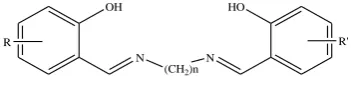
The tetradentate Schiff bases arc obtained by the condensation of an aromatic o-hydroxycarbonyl compound and a diamine. The important examples of the quadridentate Schiff bases (Figure 10) are the condensation products of salicylaldehyde or substituted salicylaldehyde and diamines. These Schiff bases enforce a high degree of planarity to the metal chelates.80 With the change of
n from 2 to 4, the
stereochemistry of the Cu(II) and Co(II) complexes of Schiff bases changes from square planer to tetrahedral.81-83
Figure 10. A tetradentate Schiff base ligand.
A binucleating tetradentate Schiff base ligand, bis (
o-vanillin)benzidine (o-v2bzH2), and its seven new binuclear
complexes have been synthesized (Scheme 2) and characterized on the basis of elemental analysis, IR, NMR, electronic, magnetic, thermal studies and conductance measurements. The compositions of these complexes were found to be [M(o-v2bz)2.nH2O, where M = Cu(II), Ni(II),
Co(ID, Zn(II), Mn(II) or UO2(V1), and
{Sm(o-v2bz)(OAc)(H2O)]2.
The 1HNMR spectrum of one of the compounds,
[Zn(o-v2bz)]2 shows the absence of proton signal for phenolic
oxygen (-OH). Low magnetic moment values, high thermal stability and insolubility in common organic solvents support the binuclear structure of these complexes. Suitable binuclear structures (Figure 11) have been assigned. The 3D
molecular modeling (Fig. 14) and analysis for bond lengths and bond angles have also been carried out of one of the representative compounds, [Ni(o-v2bz)2] (2).
Scheme 2. Synthesis of bis(o-vanillin)benzidine.
M = Cu(II), n= 0, 2; Co(II), n = 0; Zn(II), n = 0; Mn(II), n = 0
Figure 11. Structure of binuclear complexes of a tetradentate Schiff’s base.
Coordination Complexes with Penta-, Hexa- and Heptadentate Schiff Base/ Mixed Ligands.
Relatively few reports on the metal complexes of the Schiff bases having potential penta-, hexa- and heptadonor sites have appeared as compared to the metal complexes with bi-, tri- and tetradenate Schiff bases. The Schiff base (Figure 12) derived from diethylenetriamine and salicyladehyde behaves as a dibasic pentadentate (N3O2)
donor’s ligand.
Figure 12. A dibasic pentadentate Schiff’s base.
The coordination of pentadendate ligand to the central metal ion can make place only when the fifth axial donor atom present is flexible. The five-coordinated compounds can acquire two different geometries depending upon the flexibility of chelate ring and length of chain between the two coordinated atoms. Thus, the metal complex would have a trigonal bipyramidal geometry if the chelate ring is quite flexible and if the length of chain is small the resulting complex will be of square pyramidal geometry.
N (CH2)n
N
OH HO
R' R
O OH H3CO
NH2
H2N
N N
HO H3CO
OCH3
OH
-2H2O
N N
O H3CO
OCH3 O
N N O
OCH3 H3CO
O
M M nH2O
N
N OH
HO
Dioxouranium(VI) complex of the type UO2L (where
LH2=Figure 12) has been prepared by the reaction of an
equimolar mixture of dioxouranium(VI) acetate and Schiff base.85 The Schiff base behaves as a neutral pentadentate
ligand. UO2X2 and UO2(ClO4)2 react with the Schiff base
shown in Figure 12 as a result nine coordinated complexes UO2(LH2)X2 and UO2L (where X=Cl-, I-, NO3- and 0.5SO42-)
are formed, respective. The Schiff base behaves as a neutral pentadentate in UO2(LH2)X2 and dibasic pentadentate ligand
in UO2L. The nitrate ion behaves as a monodentate ligand
while the sulphate ion behaves as a bidentate ligand.
Dioxouranium(VI) complexes of the type UO2L (where
LH2=Schiff base derived from salicylaldehyde and
1,5-diamino-3-oxopentane) have been reported.84 The
complexes exist in α- and β-forms. In both the modifications uranium is pentagonal bipyramidal with the pentadentate ligand coordinated in a plane normal to UO2. These are
conformational isomers differing mainly in the spatial arrangement of the ethylenic chains. The UO2 group is
non-linear in both the forms.
Dioxouranium(VI) complex of the type [UO2(LH2)(NO3)2]2- [UO2(NO3)4] (where LH2=Schiff base
2,6-diaeetylpyridine bis(2'-pyridylhydrazone) has been prepared by the reaction of uranyl nitrate and the Schiff base.87 The Schiff base behaves as a neutral pentadentate
ligand. IR data indicate the monodentate behavior of nitrate group in the cationic moiety while the bidenate behavior of two nitrate group and the remaining two as monodentate in the anionic part giving a six fold coordination of oxygen atoms in the equatorial plane normal to uranyl group.
The Schiff bases (LH2) derived from substituted
salicylaldehydes and aminopropyl)amine or bis(3-aminopropyl)methylatninc from high-spin five coordinated complexes ML with manganese(II), cobalt(II), nickel(II) copper(II) and zinc(II).88 The Schiff bases behave as dibasic
pentadentate ligands. The nickel(II) complex when dissolved in pyridine forms hexacoordinated pyridine adducts.
Ten-coordinated dioxouranium(VI) complex, UO2(LH4)X2
(where LH4 = Schiff base prepared by the condensation of
salicylaldehyde and triethylenetetraamine, X=C1-, I-, NCS-,
0.5SO4-) has been reported.89 IR data indicate that the Schiff
base function; as neutral hexadentate (N4O2 donors) ligand.
The nitrate and thiocyanate groups behave as monodentate ligands while the sulphate behaves as a bidentate ligand.
A pentadentate Schiff base, 2,6,10-thiazo-1,11-bis(2-aminophenyl)undeca-1,10-diene (L) and complexes of general formula MLX2 (where M=Cu(II), Ni(II), X = Cl, Br,
I, NO3- and C1O4-) have been reported.90 IR data show an
interaction between halide anion of the outer coordination sphere and the complexes amino group. ESR and electronic spectral data of the copper(II) compound are consistent with a square pyramidal geometry. Since crystal ESR studies of CuL(NO3)2 and CuLBr2 revealed that the copper atoms in
the former compound occupy two magnetically non-equivalent places in the lattice while the copper atoms in the later compound take identical sites.
Synthesis and characterization of pentagonal bipyramidal complexes of nickel(II), cobalt(II), iron(II), manganese(II) and zinc(II) with the heptadentate base derived from 2,6-diacetylpyridine and diethylenetriamine have been
reported.91 The complexes are of the type [ML]X 2.YH2O
(where M=Co(II), Ni(II), Fe(II), Mn(II), Zn(II), X=C1O4-,
BPh4, Y=0 or 1). A single crystal X-ray analysis of
[CuL](C1O4)2 confirms the pentagonal bipyramidal
structure.
A new mononuclear copper(II) complex [Cu(HL)(Cl)PF6
having a donor92 ligand
(HL=N,N'-bis(2-pyridylinethyl)-1,3-diaminopropane-2-ol) has been synthesized and structurally characterized by X-ray crystallography. It shows a 1D chain in packing structure through intermolecular O-H…C1 strong hydrogen bonding interaction {O-H...C1, 1.99(4) Å and the angle (O-H...C1) 163(4)o}. The packing structure also shows stacking. The morphology of sub micrometer rod of the complex has been studied by SEM.
Raman et al.93 reported the synthesis, characterization and
electrochemical behaviour of Cu(II), Co(II), Ni(II) and Zn(II) complexes derived from acetylacetone and p -anisidine and studied their antimicrobial activity. They found that neutral tetradentate N2O2 type complexes of
Cu(II), Ni(II), Co(II) and Zn(II) synthesized using the Schiff base formed by the condensation of acetylacetone and p -anisidine possess square-planar geometry. All the title complexes were screened for antimicrobial activity by the well diffusion technique using DMSO as solvent. The minimum inhibitory concentration (MIC) values were calculated at 37 °C for a period of 24 h. It was found that all the complexes are antimierobially active and show higher activity than the free ligand.
Imran et al.94 studied the in vitro antibacterial studies of
ciprofloxacin-imines and their complexes with Cu(II), Ni(II), Co(II) and Zn(II). These were synthesized and characterized on the basis of physical properties, conductance measurements, elemental analysis, UV-vis, infrared and nuclear magnetic resonance spectroscopy. These ligands as well as their metal complexes were also evaluated for their antibacterial activity against several bacterial strains, such as
Staphylococcus aureus, Bacillus subtilus, Salmonella typhae, and E. coli. They found that metal complexes are more antibacterial as compared to uncomplexed ligands.
Nida et al.95 studied the synthesis, characterization and
anti-bacterial studies of some metal complexes of Schiff base derived from benzaldehyde and sulfonamide. The research group subjected the complexes for their antimicrobial activity against E. Coli and Salmonella Typhae. The metal complexes of Cu(II), Ni(11) and Co(II) were found to show enhanced antimicrobial activity as compared to uncomplexed ligand.
Kavitha et al.96 reviewed biological activities of schiff
Singh et al.97 surveyed synthesis and bioactivity of some
metallo-sulpha drugs as per reports of that era. They summarized that compounds containing the sulphonamide group have long been used as drugs for various diseases. The biological activity of these drugs is enhanced on undergoing complexation with metal ions.
Sahu et al.98 also recently reviewed the summary of
medicinal chemistry features of schiff base and its enhancement of biological activities on complexation.
Donde et al.99 reported the synthesis, characterization and
biological activity of mixed ligand Co(II) complexes of schiff base 2-amino-4-nitrophenol-N-salicylidene with some amino acids. The Schiff base and its mixed ligand complexes, in general, were non-hygroscopic and stable solids. The compounds were subjected to simultaneous thermogravimetric analysis to study their decomposition mechanism and thermal stability. The Schiff base and mixed ligand complexes were preliminary screened against various strains of microbes to study their biological effect.
Tharinamj et al.100 brought to light the synthesis and
spectral characterization of some transition metal complexes of azomethine derivative of diaminomalononitrile. New complexes of VO(II), Mn(II), Co(Il), Ni(II), Cu(II), and Zn(II) were synthesized and characterized by analytical and physicochemical techniques. These metal complexes were also tested for their antibacterial and antifungal activities to assess their inhibiting potential. Metal-mediated fluorescence enhancement is observed on complexation of the azo Schiff base ligand. The synthesized compounds were investigated for nonlinear optical properties, and the surface morphology of the Cu(II) complex was studied by scanning electron microscopy.
Complexes of Co(II), Ni(II) and Zn(II) with Schiff bases derived from 4-anisaldehyde were reported by Ndahi and Nasiru 2012.101 The electronic spectral data reported by
them indicates that the compounds are six coordinated. The molar conductance values showed that the complexes are non-electrolytes, The compounds were screened in vitro for antibacterial activity against some pathogenic bacteria:
Escherichia Coli, Pseudomonas aeruginosa, Salmonella typhi, Bacillus subtilis and Staphylococcus aureus using the agar-well diffusion method. The synthesized Schiff base complexes exhibit higher antibacterial activity against the tested pathogens compared to the free Schiff base because of chelation.
Antibacterial studies of some Schiff base metal complexes containing Zn(II), Cu(II), Ni(II), Co(II), Mn(II), Cr(III) and Cd(II) with some novel antibiotics have recently reported by Bukhari et al.102 The antibacterial activity showed the
following trend: Metal complexes > Schiff base ligands> Parent drugs.
Mahendra et al.103 carried out synthesis, characterization
and biological activities of 5-chloroisatin Schiff base and its metal complexes comprising of copper(II), cobalt(II), nickel(II) and zinc(II). The ligand and its metal complexes have been screened for their antibacterial activity against
Staphylococcus aureus, Escherichia coli, etc. and antifungal activity against Aspergillus niger, Aspergillus flavous, etc.
The activities of both the samples have shown significant and noticeable changes on complexation.
Transition metal complexes with mixed nitrogen-sulphur donor macrocyclic schiff base ligand of their synthesis, spectral, electrochemical and antimicrobial studies were recently updated by Shiekh et al.104 with Cu(II), Co(II),
Ni(II) and Mn(II). The results indicate that the complexes are having potential antibacterial and antifungal properties.
Besides experimental studies in the above systems computational aspects are very well studied. As per the application assets of the field various measures are guessed using theoretical field. Recently Ahmad et al.105 reported
inhibition effects of a synthesized novel 4-aminoantipyrine derivative on the corrosion of mild steel in hydrochloric acid solution together with quantum chemical studies, electronic properties such as highest occupied molecular orbital energy (HOMO), lowest unoccupied molecular orbital energy (LUMO) and dipole moment (μ) were calculated and discussed. The results showed that the corrosion inhibition efficiency increased with an increase in the HOMO values but with a decrease in the LUMO value.
Sulfa drug based complexes have been recently also studied with so many transition metals. Sharma et al. 106
brought to light the coordination chemistry of Ca(II) and Mn(II) with Schiff base of sulfaguanidine [4-amino-N-{amino(imino)methyl}benzenesulfonamide' and salicyl-aldehyde. The ligand behaves as a bidentate with N,O donor atoms. Complexes have been characterized by elemental analysis, UV-visible and IR spectral studies.
Conclusion
A concise survey of literature on the coordination modes of complexes of Schiff base ligands is also presented in this review article. It is clear from this review article that the Schiff bases coordinate as bi-, tri-, tetra-, penta-, hexa- and heptadentate ligands to the metal ions. The five-coordinated compounds can acquire two different geometries depending upon the flexibility of chelate ring and length of chain between the two coordinated atoms. The coordination complexes have been successfully screened against different strains of bacteria where they depicted the potential antimicrobial behavior.
Acknowledgements
Authors thank the Head, Department of Chemistry, Govt. Motilal Vigyan Mahavidyalaya Bhopal for providing necessary research facilities. Facilities provided by UGC for their generous research support are also gratefully acknowledged.
Reference
1Werner, Z., Inorg. Chem., 1893, 3, 267-269.
2Banerjea, D., Indian J. Chem., 2000, 39, 1340-1344.
3Guo, Z. J., Sadler., Angew. Chem., int. ed., 1999, 38, 1513-1517. 4Thompson K. H., Orvig, C., Science 2003, 300, 936-939.
https://doi.org/10.1126/science.1083004
5Tompson K. H., Orvig., C., Medicinal Inorganic Chemistry, in
Concepts and Model Bioinorganic chemistry Ed., John Wiley Press, Weinheirn, Gerrnany, 2006.
6Farell, N., Coord. Chem. Rev., 2002, 1, 232-238.
7Orvig, C., Abrams. M. J., Chem. Rev. 1999, 99, 2201-236.
https://doi.org/10.1021/cr980419w
8Farell, N. P., Uses of Inorganic Chemistry in Medicine, RSC,
Cambridge, U.K., 1999.
9Institute of Medicine, Dietary Reference Intakes for Vitamin A.,
Vitamin K, Arsenic, Boron, Chromium, Copper, Iodine, Iron, Molybdenum, Nickel, Silicon, Vanadium and Zinc, Food and Nutrition Board, Washington, DC, 2001.
10National Research Council, Recommended Dietary Allowances,
10th ed., National Academy Press, Washington, DC, 1989. 11Nielsen, F., Race, J., J. Elem. Exp. Med, 2000, 13, 113-118.
https://doi.org/10.1002/(SICI)1520-670X(2000)13:1<113::AID-JTRA13>3.0.CO;2-D
12Mortey, J. E., in Geriatric Nutrition, Mortey, J. E., Glick, L. I.,
Rubenstein, Eds., 2nd ed.,Raven, New York, 1995.
13Sangal, S. P., Proc. Nat. Seminar on Recent Facts in
Coordination Chemistry, Nagpur, 1999
14Rosenberg, B., Nature 1969, 222, 385-388.
https://doi.org/10.1038/222385a0
15Cleare, M. J., Hoesehele, I. D., Platinum-Met. Rev., 1973, 17, 2-8. 16Clears., M. J., Coord. Chem. Rev., 1974, 12, 349-354.
17Silver, C. J., Ann. Rep, Prof. Chem., 1987, 84, 271-276.
18Weinstock, J., Sutton, B. M., Kuo, G. Y., Walz D. T., Dimartion,
M. J. J. Med. Chem., 1974, 17, 139-145.
https://doi.org/10.1021/jm00247a029
19Schubert, C., Metal Binding in Medicine, J. B. Lippincott,
Philadelphia, 1960,325
20Scechter, Y., Karlish. S. J. D., Nature, 1980, 284, 556-559 21Mcyerovitch, J., Farfel, Z., Sack, J., Shechter. Y., J. Biol. Chem.,
1987, 262, 6658-6664
22Heyliger, C. E., Tahilliani, A. G., McNeill. J. H., Science,1985,
227, 1479-1483
23Sakurai, H., Tsuchiya, K., Nukalsuka, M., Softie, M., Kawada, J.,
J. Endocrinal., 1990, 126, 451- 455
24McNeill, J. H., Yuen, V. G., Hoveyda. H. R., J. Med. Chem.,
1992, 35, 1489-1495. https://doi.org/10.1021/jm00086a020
25Yuen, V. G., Carvan, P., Gelmini, L., Glover, N., McNeill, J. H.,
Sctyawati, 1. A., Zhou, Orvie, Y. C., J. Inorg. Biochem.,
1997, 68, 109-113. https://doi.org/10.1016/S0162-0134(97)00082-2
26Kawabe, K., Toclokor, M., Kojima, Y., Fujisawa, Y., Chinese
Chem. Lett., 1998, 9, 14-18
27Renal, B. A., Amin, S. S., Bucket, J. P., Ongernba, L. N., Craris,
D. C., Brichard. S. M., J. Pharm., 1999, 126, 467-472
28Grans, D. C., Yang, I., Alfano, J. A., Chi, L. H., Tin, W.,
Mahroof, T., Robbins, K., Chan, L. K., Plante, A. J., Grayson, R. Z., Willisky, G. R., Coord. Chem. Rev., 2003, 237, 13-19. https://doi.org/10.1016/S0010-8545(02)00292-8
29Roden, C., Chen, X., Ruiz, J., Van Rossum, G. D., Turco, S.,
Metabolism 1996, 45, 1130-1135.
https://doi.org/10.1016/S0026-0495(96)90013-X
30Halberstam, M., Cohen, N., Shlimovich, P., Rossetti, L.,
Shamoore, H., Diabetes, 1996, 45, 659-664.
https://doi.org/10.2337/diab.45.5.659
31Goil, A. K., Ptti, M. L., Zuberi, I., Goldstein, B. J., Bine, L. R.,
Landaker, E. J., Ling, Z. Y. G., Wilisky, R., Kahn. C. R., Metabolism, 2000, 49, 400-406.
32Crafts, D. C., Since, J. J., Gaidmausks, E., Yang. L., Chem. Rev.,
2004, 104, 849-857
33Schiff, H., Ann.1864, 131, 118-119 34Ettling, C., Ann. Chem., 1840, 35, 242-246 35Schiff, H, Ann. Chem., 1869, 150, 193-197. 36Delepine, M., Bull. Soc. Chim., 1899, 21, 943-947.
37Dubsky J. V., Solkol, A., Coll. Czech. Chem. Commun., 1925, 3,
595-598.
38Pfeiffer, P., Buchholz, E., Bauer, O., J. Prakt. Chem., 1931, 129,
163-168. https://doi.org/10.1002/prac.19311290112
39Pfeiffer, P., Breith, E., Lubbe, E., Tsumaki, I., Ann. Chem, 1933,
505, 84-87.
40Pfeiffer, P., Thiclert, H., Chem. Ber., 1938, 71B, 119-122.
https://doi.org/10.1002/cber.19380710120
41West, B. O., New Pathways in Inorganic Chemistry, Cambridge
University press, London, 1966.
42Yamada, S., Coord. Chem. Rev., 1966, 1, 415-421.
https://doi.org/10.1016/S0010-8545(00)80184-8
43Lindoy, L. F., Quart. Rev., 1971, 25, 379-383.
https://doi.org/10.1039/qr9712500379
44Tobday, M. D., Smith, T. D., Coord. Chem. Rev., 1973, 9,
313-318.
45Ali, M. A., Livingstone, S. E., Coord. Chem. Rev., 1974, 13
,101-107. https://doi.org/10.1016/S0010-8545(00)80253-2
46Cleare, M. J., Coord. Chem. Rev., 1974, 12, 379-384.
https://doi.org/10.1016/S0010-8545(00)82029-9
47Zetzsche, F., Silberman, R., Viely, C., Helv. Chem. Acta, 1925, 8,
596-599. https://doi.org/10.1002/hlca.19250080187
48Maslen H. S., Waters, 'I'. N., Coord. Chem. Rev., 1975, 17,
137-142. https://doi.org/10.1016/S0010-8545(00)80302-1
49Preiffer P., Pfitzinger, H., Prakt. Chem., 1936, 145, 243-247.
https://doi.org/10.1002/prac.19361450304
50Curtis, N. F., Coord. Chem. Rev., 1966, 1, 415-421.
https://doi.org/10.1016/S0010-8545(00)80184-8
51West, B. O., Rev. Pure Appl. Chem. 1960, 10, 207-211.
52Trolin, R. H., Everett, G. W., Chakravorty, A., Frog. J. Chem.
1966, 11, 83-87.
53Layer, R., Chem. Rev., 1963, 63, 489-495.
https://doi.org/10.1021/cr60225a003
54Dwyer, R. P., Mellor, D. M., Chelating Agents and Metal
Chelates, Academic Press, New York, 1964.
55Holmes O. G., Mclure, D. S., J. Chem. Phys., 1958, 26,
1686-1889. https://doi.org/10.1063/1.1743606
56Payer, F., Alit. Ges. Brit., 1958, 802, 774-777.
57Jungecs, E., Thabet, S., Analytical applications of Schiff bases in
Analytical Chemistry, Vol. 2, Marcel Dekker, New York
1969, 2, 149-155
58Yamada, S., Coord. Chem. Rev., 1966, 1, 415-420.
https://doi.org/10.1016/S0010-8545(00)80184-8
59Krumholz, P., J. Am. Chem. Soc., 1953, 75, 2163-2167.
https://doi.org/10.1021/ja01105a043
60Olszwske, E. J., Martin, D. F. J., Inorg. Nucl. Chem., 1965, 27,
345-349. https://doi.org/10.1016/0022-1902(65)80349-9
61Yamanouchi, K., Yamada, S., Inorg. Chem. Acta, 1974, 9,
161-165. https://doi.org/10.1016/S0020-1693(00)89899-0
62Topieh, J., Inorg. Chem., 1981, 20, 3704-3708.
63Gupta B. D., Malik, W. V., Less. Comm. Met., 1979, 17, 62-65. 64Singh, J., Lal, K., Gupta, S. P., S. Afr. J. Sci., 1979, 75, 62-66 65Noatabay, W. E. H., Mc Auliffe, C. A., McCullough, F. P.,
Razzoki, S. M., Inorg. Chim. Acta, 1979, 35, 35-39.
66Maurya, R. C., Singh, H., Pandey, A., Singh, T., Indian. J. Chem.,
2001, 40A, 1053-1063.
67Maurya, R. C., Pandcy, A., Sutradhar, D., Indian J. Chem., 2004,
43A, 763-766,
68Maurya, R. C., Patel, P., Rajput, S., Synth. React. Inorg. Met. Org.
Chem., 2003, 33, 801-805. https://doi.org/10.1081/SIM-120021647
69Thompson, K. H., Barta, C. A., Orvig, C., Chem. Soc. Rev., 2006,
35, 545-551. https://doi.org/10.1039/b416256k
70Melchior, M., Rciting, B. L., Hioirin, K. H., Thompson, V. G.,
Yuen, J. H., McNeill, J, H., Orvig, C., Inorg. Chem., 2001, 40, 4686-4690. https://doi.org/10.1021/ic000984t
71Thompson, K. H., Chiles, J., Yuen, V. G., Tse, J., McNeill, J. H.,
Orvig, C., J. Inorg. Biochem., 2004, 98, 683-686.
https://doi.org/10.1016/j.jinorgbio.2004.01.006
72Mohammadi, K., Thompson K. H., Idiridc, B. O., Star, T.,
Martins, C., Polislichuk, E., Yuen, V. G., McNeill, J. H., Orvig, C., J. Inorg. Biochem.. 2005, 99, 2217-2224.
https://doi.org/10.1016/j.jinorgbio.2005.08.001
73Rangel, M., Leite, A., Arnorim. M. J., Inorg. Chem., 2006, 45,
8086-8090. https://doi.org/10.1021/ic0605571
74Garribba, E., Miccra, G., Chruscinska, E. L., Sanna, D.,
European J. Inorg. Chem., 2006, 2690-2700.
https://doi.org/10.1002/ejic.200600230
75Tata, W. B. I., 1until, J., Whyrnan, R., Transition Metal Chem.,
1969, 5, 47-52.
76Syamal, A., Theriot, L. J., J. Coord. Chem., 1973, 2, 241-246.
https://doi.org/10.1080/00958977308072980
77Hatfield, A. P., Inmen, C. W., J. Inorg. Nucl. Chem., 1969, 31,
1376-1380. https://doi.org/10.1021/ic50076a036
78Ginsberg, A. P., Kouheek, F., William, H. J., Inorg. Chem., 1966,
5, 1956-1959.
https://doi.org/10.1021/ic50044a005
79Vanco, J., Marek, J., Travnieck, Z., Racanska, E., Muselik, J.,
Svajlenova, O., J. Inorg. Biochem., 2008, 102, 595-605.
https://doi.org/10.1016/j.jinorgbio.2007.10.003
80Jones, D. R., Symmerville D. A., Basolo, F., Chem. Rev., 1979,
79, 139-146. https://doi.org/10.1021/cr60318a002
81Bailey G.E., Graddon, D. P., Aust. J. Chem., 1967, 20, 885-889.
https://doi.org/10.1071/CH9670885
82Hariharan M., Urbach, F. L., Inorg. Chem., 1969, 8, 559-563.
https://doi.org/10.1021/ic50073a029
83Hoyl, W. C., Everette, G. W., Inorg. Chem., 1969, 8, 2013-2017.
https://doi.org/10.1021/ic50079a043
84Maurya, R. C., Chourasia, J., Sharma, P., Indian J. Chem., 2007,
46A, 1594-1604.
85 Dash, K. C., Mohanta, H., Synth. React. Inorg. Met. Org. Chem.,
1970, 9, 325-330.
86Brack, A. M., Cook, D. I. L., Fenton, D. E., Bombieri, G.,
Forseliini, L. Benetallo, F., J. Inorg. Nucl. Chem., 1978, 40, 1551-1557.
87Paolucci, G., Marangoni, G., Inorg. Chim. Acta, 1977, 74, 15-19. 88Sacconi L., Bertini, I., J. Am. Chem. Soc. 1960, 88, 5180-5186.
https://doi.org/10.1021/ja00974a027
89Dash K. C., Mohanta, H., Russ. J. Inorg. Chem., 1980, 25,
587-591.
90Jankowska, A., Polyhedron, 1985, 4, 1191-1196.
https://doi.org/10.1016/S0277-5387(00)84104-2
91Kumar, A., Chandra, U., Synth. React. Inorg. Met. Org. Inorg
Chem., 1992, 22, 971-97.
https://doi.org/10.1080/15533179208016605
92Dhara, K., Roy, P., Manassero M., Banerjee, P., Indian. J. Chem.,
2008, 47A, 18-21.
93Raman, N., Muthuraj, V., Ravichandran, S., Kulandaisamy, A.,
Proc. Indian Acad. Sci., 2003, 115(3), 161-167.
https://doi.org/10.1007/BF02704255
94Imran, M., Iqbal, J. S., Liaz, N., Turk. J.Biol., 2007, 31, 67-72. 95Nida J. I., Imran, M., J. Sci. Res., 2009, 1, 39-43.
96Arulmuruganl, S., Helen, P., Kavitha, S., Venkatraman, B. R.,
Rasayan J. Chem. 2010, 3(3), 385-410.
97Singh, V., Kaushik, N. K., Singh, R., Asian J. Res. Chem., 2011,
4(3), 31-36 .
98Sahu, R., Thakur D S., Kashyap, P., Int. J. Pharm. Sci. Nanotech.,
2012, 5, 45-49.
99Ajay, R. P., Kamini, J., Donde, S. S., Vishwanath, R., Patil, R.,
Lokhande, R. S., J. Chem. Pharm. Res., 2012, 4(2), 1413-1425.
100Anitha., C. Sheela, C. D. Tharmaraj, P. and Shanmugakala, R.
Int. J. Inorg. Chem., 2013, 20, 12-17.
101Ndahi, N., Nasiru, R., Inter. J. Pharm. Sci. Res., 2012, 3(12),
5116-5120.
102Nazir, F., Bukhari, I. H., Arif, M., Riaz, M., Naqvi, S. A. R.,
Bokhari T. H., Jamal, M. A., Int. J. Curr. Pharm. Res., 2013, 5(3), 40-47.
103Rao, R., Reddy, K. R., Mahendra, K. N., Chem. Sci. Trans.,
2013, 2(3), 1063-1069.
104Shiekh, R. A., Rahman, I. A., Malik, M. A., Luddin, N., Masudi,
S. M., Al-Thabaiti, S. A., J. Electrochem. Sci., 2013, 8, 6972-6987.
105Al-Amiery, A. A., Junaedi, S., Kadihum, A., Kadhum, A. A. H.,
Mohamad, A. B., Int. J. Mol. Sci., 2013, 14, 11915-11928.
https://doi.org/10.3390/ijms140611915
106Sharma, S., Sharma, N., Malik, S., Jain, B., Int. J. Pharm. Sci.
Res., 2013, 2, 9-13.
![Figure 7. [N-(salicylidene)sulfamerazine] (LH).](https://thumb-us.123doks.com/thumbv2/123dok_us/7827105.2088520/4.595.370.480.614.703/figure-n-salicylidene-sulfamerazine-lh.webp)