A Cognitively Designed Error Correction Log for Facilitating the Learning of Grammatical
Structures
David Frear*
Institute of Leadership and Education Advanced Development (ILEAD), Xi’an Jiaotong-Liverpool University, 111 Ren’ai Rd, Suzhou Dushu Lake Science and Education Innovation District, Suzhou Industrial Park, Suzhou, P. R. China, 215123
Corresponding Author: David Frear, E-mail: [email protected]
ABSTRACT
The exploratory study investigated the effectiveness of a new tool referred to as the error correction log (ECL). It was designed from a cognitive SLA perspective to facilitate learning, in the context of this study, of grammatical structures, following the receipt of written corrective feedback (WCF). The uniqueness of the ECL is that it guides learners through the cognitive processes deemed to underlie acquisition of grammatical structures, namely, noticing-the-gap (Schmidt & Frota, 1986), noticing (Schmidt, 1990, 2001) and noticing with metalinguistic understanding (Leow, 1997; Schmidt, 2001), and in the process potentially change the type of WCF available to learners. As the ECL was designed by the author, no study has investigated its effectiveness against a more established means of attending to WCF. In the case of the study presented here, the ECL was compared against studying WCF for a period of time. Utilizing a quasi-experimental design (a pre-test, treatment, immediate post-test, and delayed post-test), the treatment was a focused direct WCF plus ECL group versus a focused direct WCF plus study group. A control group received no WCF. The tests were three writing tasks; the target structure was regular past tense verbs. While the ECL group improved over time, the study group and the control group did not. The ECL group outperformed the control group in the delayed post-test, whereas the study group did not. An analysis of whether the corrected past tense verbs were subsequently used or not used in the post-tests demonstrated a lack of correct use for the ECL group; this, with an analysis of the ECLs for the provision of a metalinguistic explanation, suggest learners may have been able to change direct WCF (potential noticing) to direct WCF plus metalinguistic explanation (potential noticing plus metalinguistic understanding) leading to the suggestion these learners likely drew on the corrected verbs, their preexisting vocabulary-learned knowledge and preexisting metalinguistic knowledge (implicitly and explicitly acquired) when completing the delayed post-test. These results will be discussed in relation to research, theory and practice.
Key words: SLA, Written Corrective Feedback, Focused Feedback, Direct Written Corrective Feedback, Error Correction Log, Awareness
INTRODUCTION
The ECL is new in that if it is completed correctly, it not only guides learners through the cognitive processes deemed to underlie acquisition but also potentially changes the type of WCF a learner has available to them. With regard to this study, direct WCF (the provision of the correction) is possi-bly changed to direct WCF with metalinguistic explanation (the provision of the correction and a metalinguistic rule). In the process, learners have the opportunity to become aware at both the lower level of awareness, noticing (Schmidt, 1990, 2001), and the higher level of awareness, noticing with metalinguistic understanding (Leow, 1997, Schmidt, 2001). Leow (1997) was able to demonstrate that the higher level of awareness more positively correlated on production and
Published by Australian International Academic Centre PTY.LTD.
Copyright (c) the author(s). This is an open access article under CC BY license (https://creativecommons.org/licenses/by/4.0/) http://dx.doi.org/10.7575/aiac.ijalel.v.8n.2p.30
recognition tests than the lower level of awareness. Direct WCF can, in addition, be seen to provide opportunities for noticing while direct WCF plus metalinguistic explanation allows opportunities for noticing with metalinguistic under-standing. Shintani and Ellis (2013) were able to demonstrate that direct WCF did not lead to awareness of a rule, whereas metalinguistic explanation did. Metalinguistic explanation solely provides the metalinguistic rule. There is then a sound theoretical base for the value of direct WCF plus metalin-guistic explanation. Results from research into the effec-tiveness of direct WCF plus metalinguistic explanation and direct WCF are mixed, however; it is contended here that it may well be the issue of the response of studying the WCF that may account for these mixed results which contrast with ARTICLE INFO
Article history
Received: November 17, 2019 Accepted: January 16, 2019 Published: March 31, 2019 Volume: 8 Issue: 2
Advance access: February 2019
the theory underlying these two types of WCF. Herein lies the research problem, and it was on this basis that the ECL was designed. The primary aim of this study was to measure the effectiveness of the ECL as a means to attend to WCF directed at grammatical structures by comparing its perfor-mance against an established means of attending to WCF, namely, studying WCF for a period of time. Additional goals were to establish whether the verbs that were corrected were subsequently used in new pieces of writing and if learners actually recorded a metalinguistic rule in the ECL.
LITERATURE REVIEW The Theory
The cognitive theory underlying WCF has been well docu-mented in the literature (Bitchener, 2012). From a cognitive perspective, there are two major theories informing WCF re-search: skill acquisition theories (Anderson, 1982, 1983) and the Interaction Hypothesis (Long, 1996). In the context of this study, it is the Interaction Hypothesis that is of particular relevance as it serves as a basis for the design of the ECL.
The Interaction Hypothesis identifies the need for two types of evidence: positive evidence and negative evidence. Positive evidence represents comprehensible input (Krashen, 1985). This takes the form of grammatically correct struc-tures, for instance, and this positive evidence is required to prime acquisition. Negative evidence is the provision of in-formation that is not correct, and it occurs in the form of oral and written corrective feedback received during an act of the negotiation of meaning when there is a breakdown in communication between a more proficient speaker and a less proficient one or a more advanced reader and writer (e.g., a writing teacher) and a less advanced writer (e.g., a writing student).
During an act of the negotiation of meaning, there are opportunities for the cognitive process deemed to underlie acquisition to occur, namely, noticing-the-gap, noticing, no-ticing with metalinguistic understanding, and pushed output. Noticing-the-gap (Schmidt and Frota, 1986) is a process whereby a learner becomes aware of a gap between some in-put they receive that they cannot produce in their outin-put. No-ticing (Schmidt, 1990) refers to the detection of the surface features of a structure such as attaching the –ed morpheme to the infinitive form of a verb (e.g., walked). Noticing with metalinguistic understanding (Leow, 1997; Schmidt, 2001) represents attaching some metalinguistic explanation to a noticed structure. A learner, for instance, attaches the –ed morpheme to an infinitive verb and then connects a rule-of-thumb to that noticed structure. For example, I add the –ed morpheme to regular past tense verbs when I want to write about an action or a state in the past. Pushed output (Swain, 1995) comprises the process of learners becoming aware of a gap between what they write or say and what they can write or say by pushing their preexisting linguistic resources to their outer limits.
Noticing and noticing with metalinguistic understanding represent part of a larger view of awareness. Drawing on the work of Posner and Peterson (1990), Tomlin and Villa
(1994) conceptualized awareness in three ways: awareness as alertness, awareness as orientation and awareness as de-tection. Schmidt (2001: p. 17) reinterpreted these notions with awareness as alertness corresponding to “…motivation, interest in the L2 and readiness to learn.” Awareness as ori-entation was reinterpreted as whether learners orient them-selves to focus on meaning or form; awareness as conscious detection is noticing or noticing with metalinguistic under-standing. Alertness is seen as priming orientation which en-ables detection.
Cognitive Processes Underlying Written Corrective Feedback Strategies and Responses
Sheen and R. Ellis (2010) provide two important distinctions in corrective feedback in general (oral and written). First, it can be input providing and thereby facilitates noticing pro-cesses, or it can be output prompting and hence encourag-es pushed output. The second distinction is that corrective feedback can be implicit in that a learner is not aware of the information provided, or it can be explicit in that a learner is aware of the information provided. Unlike oral corrective feedback, WCF is always explicit and may be input provid-ing or output promptprovid-ing dependprovid-ing on different combina-tions of WCF strategies and WCF responses.
Drawing on this information, the aforementioned cog-nitive processes and R. Ellis’ (2009) typology of written corrective feedback strategies (direct, metalinguistic and in-direct) and responses (revisions required and no revisions required), Frear and Chiu (2015) separated WCF strategies into direct strategies or indirect strategies and whether these strategies are focused or unfocused. This distinction between direct WCF and indirect WCF, as opposed to other pedagog-ical delineations of direct and indirect WCF (e.g., Ferris, 2003), was based on whether the learners were provided new input (direct strategies) or relied on their preexisting levels of linguistic knowledge (indirect strategies). It was posited that there are two direct WCF strategies: direct WCF plus metalinguistic explanation and direct WCF. Frear and Chiu (2015) also separated indirect WCF strategies into two types. The first is metalinguistic coded WCF, a learner is provid -ed some metalinguistic code such as ‘vt’ for verb tense, and such feedback typically locates where the error is. The sec-ond type of indirect WCF is referred to as simply indirect WCF and comprises the underling or the circling of an error and providing a cursor (^) for missing words. R. Ellis, Sheen, Murakami and Takashima (2008), furthermore, identified the difference between focused and unfocused WCF strategies. Focused WCF entails feedback on one or a few preselected structures, whereas unfocused WCF is feedback on all or a collection of structures. It is this interpretation of existing typologies that inform this study.
correct-ed piece of writing (Frear, 2012; Van Beuningen, De Jong, & Kuiken, 2012). If a learner is required to study direct or indirect WCF, this is input providing and hence promotes noticing processes (e.g., noticing-the-gap and noticing). Direct WCF types provide opportunities to notice-the gap, notice and notice with metalinguistic understanding for di-rect WCF plus metalinguistic explanation because the actual correction plus a metalinguistic explanation is provided, or opportunities to notice-the-gap, notice and possibly notice with metalinguistic understanding for direct WCF as the spe-cific correction is provided. Indirect types, on the other hand, rely on both a learner’s preexisting knowledge of the codes (metalinguistic coded WCF) and on a learner’s overall pre-existing linguistic knowledge to notice-the-gap and perhaps notice and notice with metalinguistic understanding (meta-linguistic coded WCF and indirect WCF). When, however, learners are required to incorporate corrections into a revised draft, different WCF strategies promote either input-provid-ing noticinput-provid-ing processes or output-promptinput-provid-ing pushed output. Direct types provide input-providing opportunities for no-ticing-the-gap and noticing due to the mechanical nature of copying the direct WCF into a revised draft (direct WCF); they can facilitate promoting noticing-the-gap and noticing with metalinguistic understanding (direct WCF plus meta-linguistic explanation). Indirect WCF types, in contrast, re-quire learners to push the output of their preexisting levels of linguistic knowledge when incorporating the WCF in a revised draft. Pushed output also occurs when learners are provided with no WCF when, in other words, they are given opportunities for writing practice.
Cognitive Processes Underlying Written Corrective Feedback Strategies and Responses
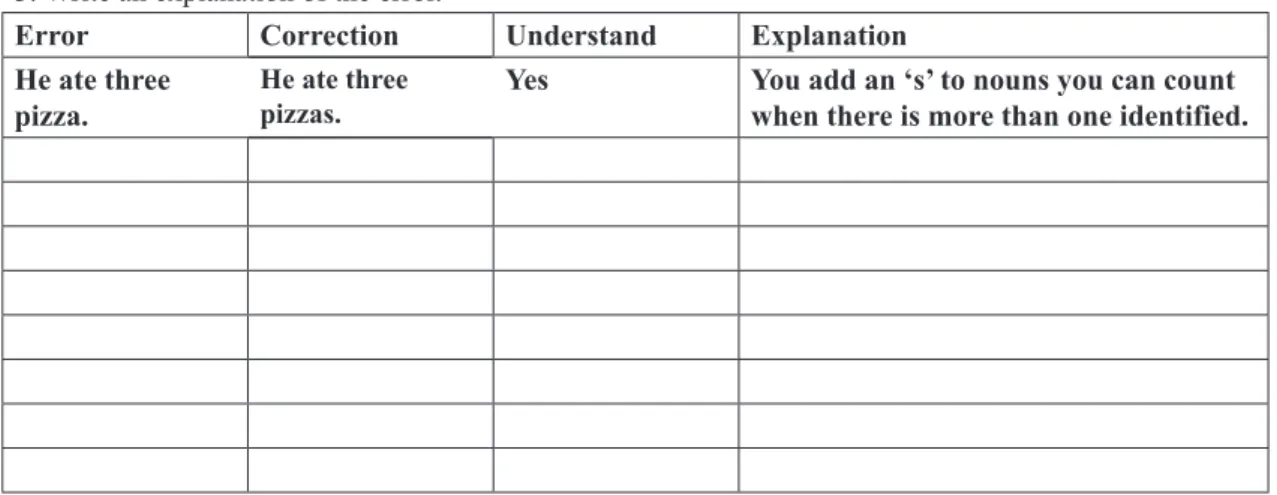
While studying WCF for a period of time or incorporating it into a revised draft are the established ways of attending to WCF, the ECL (Figure 1) was designed to facilitate the aforementioned cognitive processes of noticing-the-gap,
noticing and noticing with metalinguistic understanding. Figure 1 presents the ECL. It has a table with four columns. The title of the first column is error, the second correction, the third understand, and the fourth explanation. The third column is an important one. It asks the learners whether they understand why they made the error. If they answer yes, they can go on and provide a metalinguistic explanation of a grammatical structure. If they answer no, they should not guess an answer as this could lead to the maintenance or development of fossilization. An example not related to the target structure is provided in the first row. There are three instructions to the learners: 1) record the error and the cor-rection of the error; 2) study the error and the corcor-rection to see if you understand why you made it; 3) write an explana-tion of the error.
This ECL facilitates different combinations of cognitive processes dependent upon the WCF strategy used. If a learner is provided direct WCF plus metalinguistic explanation, the learner can potentially notice-the-gap (columns 1 and 2), no-tice (column 2) and nono-tice with metalinguistic understanding (columns 2, 3 and 4). When provided direct WCF, a learner can possibly notice-the-gap (columns 1 and 2) and notice the structure (column 2); however, when it comes to noticing with metalinguistic understanding, learners need to rely on their preexisting metalinguistic knowledge to provide a met-alinguistic explanation (column 4). If a learner successful-ly provides a metalinguistic rule following direct WCF, the feedback is changed from direct WCF into direct WCF plus metalinguistic understanding. With indirect metalinguistic coded WCF and indirect WCF, learners are solely dependent on their preexisting levels of linguistic knowledge when completing the research ECL. For metalinguistic coded WCF, if learners have the requisite preexisting levels of both the knowledge of the codes and the linguistic knowledge of the correction, they could notice-the-gap (columns 1 and 2), notice the structure (column 2), and if they possess the met-alinguistic knowledge, they might notice with metmet-alinguistic
Figure 1. Error correction log Error Correction Log Name: ____________________ ID: ___________________ 1. Record the error and the correction of the error.
2. Study the error and correction to see if you understand why you made it. 3. Write an explanation of the error.
Error Correction Understand Explanation
He ate three
understanding (columns 2, 3 and 4). If learners possess the required knowledge with indirect WCF, they could notice-the-gap (columns 1 and 2), notice the structure (column 2), and they could push their output to notice with metalinguis-tic understanding (columns 2, 3 and 4).
What Kind of Response is the Error Correction Log? As the design of the ECL is informed by the concepts of noticing-the-gap, noticing and noticing with metalinguis-tic explanation, it is not easily categorized into established tasks that focus purely on accuracy. It bears some similari-ty conceptually to input processing tasks (VanPatten, 1996) because it provides information about processing strategies in an attempt to change or guide learners through the afore-mentioned cognitive processes associated with awareness. However, the goal with the ECL, for grammatical structures, is to draw on awareness at the level of understanding and as such it is also, in its research version at least, closely aligned with consciousness-raising tasks (R. Ellis, 2003).
Written Corrective Feedback Research
Studies investigating the effectiveness of direct WCF plus metalinguistic explanation with the response of studying the WCF for a period of time have provided mixed results. Sheen (2007) found that a focused direct WCF group plus metalin-guistic explanation group outperformed a control group in an immediate post-test and a delayed post-test. Bitchener and Knoch (2008) also found a focused direct WCF and meta-linguistic explanation group outperformed a control group. Bitchener and Knoch (2010) demonstrated in a longitudinal study that their direct WCF and metalinguistic explanation group outperformed a control group not only in an immedi-ate post-test but also in three additional post-tests. Stefanaou and Révész (2015) found a focused direct WCF group plus metalinguistic group outperformed a control group. How-ever, Bitchener (2008) reported no significant differences between a focused direct WCF group and metalinguistic ex-planation group and a control group.
Studies investigating focused direct WCF and the re-sponse of study have demonstrated improvement over time in an immediate test (Frear, 2010) and in a delayed post-test (Frear, 2012). Group differences have also been found between focused direct WCF groups and control groups in an immediate post-test (Bitchener and Knoch, 2010, Frear, 2012; Sheen, Wright, & Moldawa, 2009) and in a delayed post-test (R. Ellis, et al., 2008; Frear, 2012; Sheen, et al., 2009) or in delayed post-tests (Bitchener and Knoch, 2010). Group differences between a focused direct WCF and a con-trol group, in general, have also been reported by Stefanaou and Révész (2015).
Studies comparing group differences between direct WCF plus metalinguistic explanation and direct WCF with the response of studying the WCF have also provided mixed results. Sheen (2007) reported the while both a focused di-rect group and focused didi-rect WCF group outperformed a control group in an immediate post-test, the focused direct WCF group with metalinguistic explanation outperformed
both the focused direct WCF group and the control group in a delayed post-test. However, Bitchener (2008) found a di-rect WCF group outperformed a control group, whereas the focused metalinguistic WCF group did not. There were no significant differences between these two groups. Still other studies have found that both focused direct WCF plus met-alinguistic explanation and focused direct WCF performed equally and there were no group differences between them (Bitchener and Knoch, 2008; Bitchener and Knoch, 2010; Stefanaou and Révész, 2015).
As the ECL is a uniquely designed and guided response to WCF directed, in the context of this study, at grammatical structures, no research has been undertaken on its effective-ness. Error logs have been used in methodological approach-es (Hartshorn, et al., 2010; Lalande, 1982); however, thapproach-ese logs were solely used with metalinguistic coded WCF and served to purely log the quantity and type of errors. As such, they bear no resemblance to the cognitively informed ECL under investigation here. These approaches will, therefore, not be reviewed here.
There is then clearly a conflict between theory underly -ing direct WCF plus metal-inguistic understand-ing (i.e., no-ticing with metalinguistic understanding) and direct WCF (noticing) and the mixed results of research into these two types of WCF separately and when they have been compared with each other. This is when the response used is studying the WCF for a period of time. It is contended here that the mixed results may in whole or in part be due to the response of studying the WCF. Some learners may have attended to the WCF whilst others may not. The ECL focuses learners’ attention by guiding them through the cognitive process deemed to underlie acquisition, and, in the case of the study presented here, attempts to change the direct WCF to direct WCF plus metalinguistic explanation. If such a successful change occurs, this should provide enhanced opportunities for learners to notice with metalinguistic understanding. The study presented here then will compare the effectiveness of direct WCF with the guided response of the ECL as opposed to direct WCF with the response of studying the WCF for a period of time. In an attempt to better understand some of the processes possibly occurring with the target structure, the regular past tense, an examination the use of corrected verbs in the post-tests will be undertaken. To examine if the ECL can actually change direct WCF into direct WCF plus metalinguistic explanation, an examination of the completed ECLs themselves will be undertaken.
RESEARCH QUESTIONS
RQ. 1What is the effectiveness of focused direct written cor-rective feedback plus the error correction log as opposed to focused direct written corrective feedback plus the re-quirement of study on the accuracy of regular past tense verbs in new pieces of writing?
RQ.2 How likely were corrected verbs in the pre-tests subse-quently used in the post-tests?
METHODOLOGY Setting
The research was undertaken in a bridge program at a uni-versity in the Middle East. Bridge programs, as the term sug-gests, prepare learners with a proficiency level below that set by a university to enter major programs. They are designed with the purpose of improving the proficiency of learners so they reach the requisite level to enter the university proper. The population was then pre-university Middle Eastern stu-dents, all from the same country attending a university-run bridging program. The sample came from three intact classes of female students in the highest level of the program. The learners were of an intermediate level of proficiency (IELTS 4.5 – 5.0) A total of 36 students began the study, and 33 com-pleted it. This attrition rate is due to learners not attending all of the data collection sessions (one learner) or to learners scoring 100% on the pre-test. Having made no errors, these learners were considered to have already acquired the target structure and were removed from the study (two learners).
Structure
Feedback was provided only on regular past tense verbs and the participating teachers provide were instructed that at no time across the duration of the study should there be any explicit instruction or feedback on any past tense structures. Regular past tense verbs, furthermore, are interesting be-cause they are frequently taught as a vocabulary item in trip-lets during learners’ English classes at elementary school, junior high school, high school and bridge programs. By triplets, I am referring to the infinitive verb (e.g., walk), the past tense verb (walked) and the past participle verb form (e.g., walked). Regular past tense verbs have, however, a rule. Namely, you add the –ed morpheme to the verb walk, for example, when you are referring to the completed action of having walked in the past. In the terms of R. Ellis (1999), regular past tense verbs start as an item-learned structure (vocabulary), and then can become a system-learned one (i.e., grammatical tense). This can happen as a result of explicit instruction as often occurs in the aforementioned school contexts and the bridge program where this study was undertaken, or it can be an implicit process where learners break down chunks of language to notice the structure and perhaps notice it with metalinguistic understanding (N. Ellis, 1996, 1997). N. Ellis (2002) acknowledges, moreover, that explicit instruction speeds the process of rule formation and understanding.
Design
The design was quasi-experimental. That is, there was a writ-ten pre-test, a treatment (WCF session), a writwrit-ten immediate post-test, and a written delayed post-test. The students from three intact classes were randomly assigned to one of three groups: an ECL group, a study group, or a control group (writing practice with no WCF). Data collection was held over a four-week period. In week one, the ethics approval documents were explained, participation was acknowledged
as voluntary, and consent forms were signed. Immediately following this, the pre-test was completed. The researcher then took away the pre-test and corrected all regular past tense errors using focused direct WCF for the ECL group and the study group. None was provided with the control group because it received no WCF. The following week a WCF session occurred for the ECL group (completing the ECL) and the study group (studying the WCF) before they completed the immediate post-test. During the WCF session, the control group solely completed the immediate post-test. Two weeks later, the delayed post-test was administered for all three groups. The example below represents part of one student’s feedback they received on the pre-test.
happened
The accident happen at 10 o’clock when a dog ran in front the red car and
tried
when he try to avoid the dog, he make an accident with the black car, so
shouted
when these two men come out and shout to each other, they were…
Data Collection Materials
There were two instruments used for data collection: three writing tasks, and the ECL. The three writing tasks were based on fictional newspaper reports titled ‘Lucky Dog’, ‘Landslide’, and ‘Lost Bag’, and they were presented as part of a writing task package. Each task package had a newspa-per report (text), six pictures corresponding to the content of the text, and a lined piece of paper with the first sentence of the text written on it. All of these sentences had an example of a regular past tense verb and a time expression referring to the past (e.g., Last Tuesday). The verbs used in the texts were drawn from West’s (1953) General Service List. The three texts were counterbalanced to account for the possibil-ity of varying degrees of task difficulty. Counterbalancing comprises taking any one group (e.g., the study group) and dividing it equally into three subgroups. Subgroup one com-pleted one of the writing tasks (e.g., ‘Lucky Dog’), subgroup two completed another task (e.g., ‘Landslide’), and subgroup three the final one (e.g., ‘Lost Bag’). The procedure was re -peated at the immediate post-test, but the three subgroups completed a different task they had yet to compete. For the delayed post-test, the process was repeated with the final series of yet to be completed tasks. The ECL has been dis-cussed at great length above so needs no further explanation here.
Procedures
piece of paper containing the first sentence of the text by us -ing the content of the pictures. The teachers gave no addition-al help to the students other than explaining the instructions. There was no time limit on the writing process.
For the WCF session, the corrected pre-test was returned to the students in the ECL group and the study group. The ECL group was given five minutes to complete the ECL, and when they finished it, both the corrected pre-test and the ECL were collected by the teacher. The study group was asked to study their corrections for five minutes, and when they finished, the teacher gathered the corrected pre-test.
Scoring and Analysis
For research question 1, the three tests were scored using Pica’s (1983) Target-Like-Use Analysis, a version of obliga-tory occasion analysis that takes into account the overgeneral-ization of one morpheme on to an infinitive verb (e.g., sayed or goed). As it provides a percentage, the formula used was the one presented in R. Ellis and Barkhuizen (2005).
n correct suppliances in contexts ×100 n obligatory occasions +
n suppliancein non - obligatory contexts
Two issues became evident in the scoring process. If a learner failed to provide a past tense verb when the context required one, this was not scored as an obligatory context as either a regular or irregular past tense verb could be used. If, furthermore, the context allowed another past tense type such as the past perfect, these instances were also not scored as obligatory occasions. The scores for research question 1 were analysed for changes over time using repeated measures ANOVA and post-hoc paired-sampled t-tests, and they were also examined for group differences using one-way between groups ANOVA with post-hoc Tukey tests. The analysis of the use of corrected verbs for research question 2 simply required the identification of those regular past tense verbs that were corrected in the pre-test for the two experimental groups, and then examining if they were successfully used in the immediate post-test and the delayed post-test; these were classified as used. If a corrected error in the pre-test was used incorrectly or was not used at all in the post-tests, they were categorized as not used. These scores were then subject to Chi-squared goodness-of-fit tests and percentages generated. To address research question 3, the fourth column of the ECL (explanation) was examined to establish whether the learners were able to use their preexisting metalinguistic knowledge to provide some type of metalinguistic explana-tion. Percentage scores for these data were generated.
RESULTS
Distribution, Analysis of the Scores and Reliability Due to the small sample size, it was important to establish whether the pre-test scores met the assumption of normali-ty. First of all, the means and trimmed means for the pre-test scores were inspected to see whether they were extremely
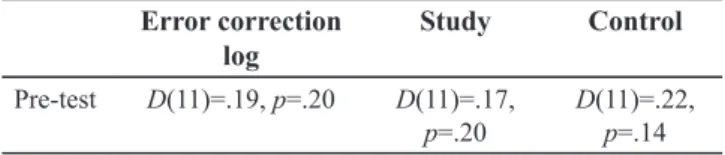
close. For all three groups, they were. Next, an examination of the three pre-test scores was conducted to see if there were any extreme outliers, and there were, in each case, none. As presented in Table 1, Kolmogorov-Smirnov Tests of Normal-ity were also undertaken, and they demonstrated there were no significant differences in the normal distribution of the pre-tests; hence, parametric as opposed to non-parametric tests could be used. Another important issue relating to the distribu-tion of the scores was whether there were any significant dif -ferences between the three groups’ pre-test scores. A one-way between groups ANOVA demonstrated there were no differ-ences (F(2,30) = .120, p = .89). All of the tests used in the study met their respective assumptions, so they could be conducted. For analyses using mean scores, the confidence level was 95%; thus, a significance value of p <.05 was employed. A series of parametric tests were undertaken using SPSS version 20.
It was important to establish the reliability of the scoring of the tests. The tests were scored twice by the researcher to establish an intra-rater reliability, and once by an experi-enced researcher to determine an inter-rater reliability. Using Pearson Product Moment Correlation, there was an intra-rat-er reliability of r = .99 and an intintra-rat-er-ratintra-rat-er reliability of r = .98.
Number of Corrections Received
The number of regular past tense corrections received on the pre-test by the ECL group and the study group was also ex-amined. The descriptive statistics are presented in Table 2. An independent samples t-test showed there were no sig-nificant differences in the amount of corrections received (t(21) = -1.48, p = .88).
The Effectiveness of Direct Written Corrective Feedback Plus the Error Correction Log as Opposed to Direct Written Corrective Feedback Plus the Requirement of Study
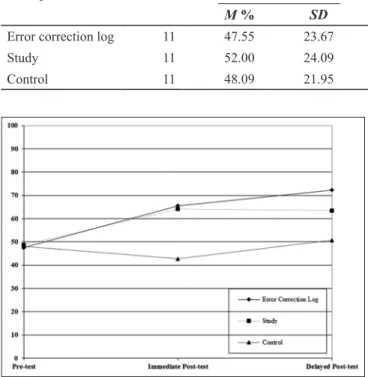
The descriptive statistics for research question 1 are pre-sented in Table 3 and the mean scores across time in Figure 2. To assess the performance of the three groups across time, repeated measures ANOVAs were undertak-en demonstrating there were no changes over time for the
Table 1. Kolmogorov-Smirnov tests of normality on the pre-test
Error correction
log Study Control
Pre-test D(11)=.19, p=.20 D(11)=.17,
p=.20 D(11)=.22, p=.14
Table 2. Descriptive statistics for regular past tense verb corrections received on the pre-test
Group N Corrections M SD Range
Error correction log
11 29.00 2.64 1.63 1.00-7.00
control group (F(2,31) = .278, p = .76) and the study group (F(2,31) = 3.05, p = .10); however, there was for the ECL group (F(2,31) = 4.64, p = .04). This group had a partial eta effect size of η² = .51. Because the ECT group reached signif -icance, post-hoc paired-samples t-tests were completed to de-termine where the improvements occurred across time. This comprised undertaking three paired tests from the pre-test to the immediate test, the pre-test to the delayed post-test and the immediate post-post-test to the delayed post-post-test, and hence a Bonferroni adjustment for three comparisons was required (p = .017). It was demonstrated that the ECT group improved significantly from the pre-test to the delayed post-test (t(10) = -2.91, p = .016). One-way between groups ANO-VA with post-hoc Tukey Tests were completed to see whether there were any differences between the three groups in the immediate post-test or the delayed post-test. There were none in the immediate post-test (F(2,31) = 2.89, p = .071); however, there was in the delayed post-test (F(2,30) = 3.36, p = .048). This had an effect size of η² = .18. The post-hoc Tukey Tests revealed that only the ECL group outperformed the control group (p = .04). The study group did not.).
Use of Corrected Verbs in the Post-tests
Table 4 shows the use as opposed to no use of corrected verbs in the immediate post-test and the delayed post-test for those regular past tense verbs corrected in the pre-test (RQ2). Chi-squared goodness-of-fit tests (50/50) demon -strated significant levels of no use for the ECL group in both the immediate post-test (c2 (1, n = 29) = 25.14, p <.001) and the delayed post-test (c2 (1, n = 29) = 21.55, p <.001) as there were for the study group in the immediate
post-test (c2 (1, n = 33) = 22.09, p <.001) and delayed post-test (c2 (1, n= 33) = 25.49, p <.001). More specifically, the ECL group used 3.45% of corrected structures in the immediate post-test, and 6.90% in the delayed post-test, and the study group 9.09% in the immediate post-test and 6.06% in the de-layed post-test.
Provision of a Metalinguistic Explanation in the Error Correction Log
In order to examine whether the learners were able to pro-vide a metalinguistic explanation (RQ3), the provision of some type of metalinguistic explanation versus the non-pro-vision was calculated as a percentage. As 10 of the 11 learn-ers provided a type of metalinguistic explanation, 91% of the participants provided an explanation. It should be noted, however, that these explanations ranged in explicitness from a simple statement of the verb tense (e.g., “this is the simple past tense”) to the metalinguistic rule (e.g., “You add -ed to the verb to talk about the past”).
DISCUSSION
It was important to establish that the treatment groups re-ceived the same amount of corrections because differing quantities of WCF could be seen as being responsible for any improvements over time or differences between groups. It was demonstrated there were no differences in the amount of corrections received in the pre-test for either the ECL group or the study group. Differing quantities of WCF cannot then be seen as influencing the results.”).
The Effectiveness of Focused Direct Written Corrective Feedback plus the Error Correction Log as Opposed to Focused Direct Written Corrective Feedback plus the Requirement of Study
Research question one examined the effectiveness of direct WCF and the ECL, direct WCF plus study, and the control Table 3. Descriptive statistics for the focused direct written corrective feedback plus error correction log group, the focused direct written corrective feedback plus study group, and the control group
Group N Pre-test Immediate post-test Delayed post-test
M% SD M% SD M% SD
Error correction log 11 47.55 23.67 65.55 17.97 72.27 16.30
Study 11 52.00 24.09 64.09 29.07 63.46 20.24
Control 11 48.09 21.95 42.73 27.06 50.73 21.81
Table 4. Use and no use of those regular past tense verbs corrected in the pre-test
Group Immediate
post-test post-testDelayed Use No use Use No use
Error correction log 1 28 2 27
Study 3 30 2 31
group on the accuracy of the regular past tense verbs in new pieces of writing. The results showed only the ECL group improved over time with a medium effect size according to Cohen’s (1988) criteria. It was further demonstrate this im-provement occurred between the pre-test and the immediate post-test. For the group differences, only the ECT group out-performed the control group in the delayed post-test with a small effect size, whereas the study group did not. In sum, the ECL would appear to be an effective means for attend-ing to focused direct WCF for the grammatical structure in question.
These findings for the ECL are not surprising as the de -sign of the ECL guides learners to study their errors and corrections (two cognitive processes of noticing-the-gap and noticing) and then provide an explanation for why they made the error (the cognitive process of noticing with metalinguis-tic understanding), while the instruction to study the error and correction provides opportunities for facilitating only two cognitive processes (noticing-the-gap and noticing). The finding that there were no group differences in the delayed post-test for the study group, however, is surprising as previ-ous studies have found direct WCF plus study outperformed control groups receiving no WCF. As mentioned earlier, it is not known whether learners in the study group were actually attending to the WCF. Considering this, a possible explana-tion for the failure of the study group to outperform the con-trol group in the delayed post-test could lay in the context. R. Ellis (2004) reports the two major individual differences affecting language acquisition are motivation and aptitude. In the context where this study was undertaken, it has been demonstrated that learners are, by and large, extrinsically as opposed to intrinsically motivated (Kocatepe, 2017). Second language learning research has shown intrinsically motivat-ed learners outperformmotivat-ed extrinsically motivatmotivat-ed learners and amotivated ones (Noels, Clement & Pelletier, 2001). As there was no observable reward for the learners to complete the study, perhaps this contributed to a failure to attend to the WCF when asked to study the feedback for the direct WCF plus study group. As discussed in section 2.1, Schmidt (2001) acknowledged that alertness is seen as priming ori-entation which facilitates detection. However, for the direct WCF plus ECL group, the participants were guided to first study the WCF after writing down the error and the correc-tion, and then they provided a metalinguistic explanation during the completion of the ECL. This then is potentially good news for teachers who may work with learners that are extrinsically motivated or amotivated, but clearly this issue is in need of further investigation.”).
Corrected verbs in the pre-test in the subsequent post-tests and implications of these findings
The extent to which there was any use of the verbs corrected in the pre-test in the subsequent immediate post-test and the delayed post-test was examined in research question two for both the ECL group and the study group. The results clearly demonstrate that neither group showed any significant use of the corrected verbs. For the ECL group, in fact, only 3.45% of corrected verbs were subsequently used in the immediate
post-test and 6.90% in the delayed post-test. Only, 9.09% and 6.06%, respectively, were used in the immediate post-test and the delayed post-post-test for the study group. This is explicable by the acknowledgement that differing contexts presented in new pieces of writing dictate which structures can actually be used (Bruton, 2009; Van Beuningen, et al., 2012). However, the findings from research question 1 clear -ly demonstrate the ECL group outperformed the control group in the delayed post-test. How then were the learners in the ECL group able to outperform the control group in the delayed post-test, whereas the study group did not? There are five possible explanations for this: (1) the correct use of cor -rected verbs occurred for some high frequency regular past tense verbs; (2) the process of completing the ECL triggered preexisting knowledge of already acquired item-learned regular past tense verbs that were subsequently drawn upon when the learners pushed their output while writing the de-layed post-test; (3) the learners were able to draw on their metalinguistic understanding of the structure following the completion of the ECL when pushing their output in the de-layed post-test through previous explicit instruction; (4) the learners drew on previously implicitly derived metalinguis-tic rules through the analysis of chunks of language (N. Ellis, 1996, 1997); (5) the learners used a combination of the above processes. A better insight into which of these options were possibly being used by learners will be available following the discussion of the findings for the final research question.
The Provision of a Metalinguistic Explanation in the Error Correction Log
Research question three demonstrated that ten of the eleven learners were able to use their preexisting linguistic knowl-edge to provide some type of metalinguistic explanation. The ECL was then effective in changing the initial input of direct WCF to direct WCF plus metalinguistic explanation show-ing, furthermore, that at the time of completing the ECL, the learners possessed a degree of the higher level of awareness of noticing with metalinguistic understanding. Learners may have been able to draw on this higher level of awareness when pushing their output in the delayed post-test.
Implications of Research Questions 1, 2 and 3
rule was explicitly taught as part of the sequence of courses in which this study was undertaken, and as noted earlier by N. Ellis (2002), explicit instruction speeds up the process of both noticing and metalinguistic knowledge of a given structure. For both the item-learned and system-learned reg-ular past tense, these findings can account for how focused direct WCF in unison with the ECL can be generalized into new written contexts.
CONCLUSION
What the study demonstrates is that focused direct WCF plus the ECL outperformed a control group receiving no WCF in the delayed post-test, whereas the focused direct WCF plus study group did not. The analysis of the use of corrected verbs clearly demonstrated that they were not used to any significant degree in subsequent new pieces of writing sug -gesting other processes were at work. In light of this, five pos -sible alternatives were suggested for the performance of the ECL group as opposed that of the study group. It was shown that through the completion of the ECL learners changed the available input from direct WCF (potential noticing) to direct WCF plus metalinguistic explanation (potential noticing with metalinguistic understanding), and this was in some instances possibly available to learners when they completed the post-tests. In the context where the research was undertaken, it was surmised that four processes were likely at work follow-ing the receipt of direct WCF and the completion of the ECL for the target structure when learners were completing the post-tests: option (1), option (2), option (3) and option (4).
There are of course limitations to the study. Despite all of the necessary steps being taken to ensure that each group was normally distributed and hence parametric tests could be em-ployed, a larger sample size would have improved the ability to make generalizations about the findings. The issue of sam -ple size, however, will always be a problem when conducting classroom-based research. The duration between the immedi-ate post-test and the delayed post-test could have been longer than two weeks to see whether the pattern of continued im-provement demonstrated by the ECL group was maintained or not. There was, furthermore, an apparent gender bias as all the participants were female. However, this did legitimately reflect the context where the research was undertaken.
The study presents a number of areas that could be researched in the future. Clearly, as an exploratory study, larger scale studies involving the ECL need to be undertak-en. The effectiveness of the ECL, furthermore, could also be investigated for other types of WCF such as focused metalin-guistic coded WCF for grammatical structures. An examina-tion of whether learners were actually using metalinguistic understanding when completing an immediate post-test or a delayed post-test is an important issue. It was also sug-gested that perhaps the cognitively designed nature of the ECL may have meant that its performance is not affected by motivation. This could be considered from the perspective of self-determination theory (i.e., intrinsic motivation, ex-trinsic motivation and amotivation) and/or task motivation. The value, if any, of the ECL could also be investigated for non-grammatical structures.
REFERENCES
Anderson, J. R. (1982). Acquisition of cognitive skill. Psychological Review, 89, 369-406.
Anderson, J. R. (1983). The architecture of cognition. Cam-bridge: Harvard University Press.
Bitchener, J. (2008). Evidence in support of written correc-tive feedback. Journal of Second Language Writing, 17, 102-118.
Bitchener, J. (2012). A reflection on ‘the language learning potential’ of written CF. Journal of Second Language Writing, 21, 348-363.
Bitchener, J., & Knoch, U. (2008). The value of written cor-rective feedback for migrant and international students. Language Teaching Research, 12, 409-431.
Bitchener, J., & Knoch, U. (2010). The contribution of writ-ten corrective feedback to language development: A writ- ten-month investigation. Applied Linguistics, 31, 193-214. Bruton, A. (2009). Designing research into the effect of error
correction in L2 writing: Not so straightforward. Jour-nal of Second Language Writing, 18, 136-140.
Cohen, J. W. (1988). Statistical power analysis for the be-havioral sciences. New York: Erlbaum.
Ellis, N. (1996). Sequencing in SLA: Phonological memory, chunking, and points of order. Studies in Second Lan-guage Acquisition, 18, 91-126.
Ellis, N. (1997). Vocabulary acquisition: Word structure, col-location, word class, and meaning. In N. Schmidt and M. McCarthy (Eds.). Vocabulary: description, acqui-sition and pedagogy (pp. 123-129). Cambridge: Cam-bridge University Press.
Ellis, N. (2002). Frequency effects in language processing: A review with implications for theories of implicit and explicit language acquisition. Studies in Second Lan-guage Acquisition, 24, 143-188.
Ellis, R. (1999). Item versus system learning: Explaining free variation. Applied Linguistics, 20, 460-480.
Ellis, R. (2003). Tasked-based language earning. Oxford: Oxford University Press.
Ellis, R. (2004). Individual Differences in Second Lan-guage Learning. In A. Davies and C. Elder (Eds.). The handbook of applied linguistics (pp. 525-521). Oxford: Blackwell Publishing.
Ellis, R. (2009). A typology of written corrective feedback types. English Language Teaching Journal, 63, 97-107. Ellis, R., & Barkhuizen, G. (2005). Analyzing learner
lan-guage. Oxford: Oxford University Press.
Ellis, R., Sheen, Y., Murakami, M., & Takashima, H. (2008). The effects of focused and unfocused written corrective feedback on Japanese university students’ use of English articles in narratives. System, 36, 353-371.
Ferris, D. (2003). Response to student writing: Implications for second language students. Mahwah: Erlbaum. Frear, D., & Chiu, Y. (2015). The effect of focused and
un-focused indirect written corrective feedback on EFL learners’ accuracy in new pieces of writing. System, 53, 24-34.
of English. (Unpublished doctoral dissertation). The University of Auckland, New Zealand.
Frear, D. (2010). The effect of focused and unfocused direct CF on a new piece of writing. College English: Issues and Trends, 3, 59-71.
Hartshorn, K. J., Evans, N.W., Merrill, P. F., Sudweeks, R.R., Strong-Krause, D., & Anderson, N. J. (2010). Effects of dynamic corrective feedback on ESL writing accuracy. TESOL Quarterly, 44, 84-109
Kocatepe, M. (2017). Extrinsically motivated homework behaviour: Student voices from the Arabian Gulf. In J. Kemp (Ed). Proceedings of the 2015 BALEAP confer-ence (pp. 97-106). Reading: Garnet Publishing.
Krashen, S. (1985). The input hypothesis: Issues and impli-cations. London: Longman.
Lalande, J. (1982). Reducing composition errors: An experi-ment. Modern Language Journal, 66, 140-149.
Leow, R. (1997). Attention, awareness and foreign language behavior. Language Learning, 47, 467-505.
Long, M, (1996) The role of the linguistic environment in second language acquisition. In: W. Ritchie and T. Bha-tia (Eds). Handbook of second language acquisition (pp. 413-468). San Diego: Academic Press.
Noels, K. A., Clement, R., & Pelletier, L. G. (2001). Intrin-sic, extrinIntrin-sic, and integrative orientations of French Ca-nadian learners of English. CaCa-nadian Modern Language Review 57, 424-442.
Pica, T. (1983). Adult acquisition of English as a second lan-guage under different conditions of exposure. Lanlan-guage Learning, 33, 465-497.
Posner, M., & Petersen, M. (1990). The attention system of the human brain. Annual Review of Neural Science 13, 25-42.
Schmidt, R. (1990). The role of consciousness in second lan-guage learning. Applied Linguistics, 11, 17-46.
Schmidt, R. (2001). Attention. In P. Robinson (Ed.) Cogni-tion and second language instrucCogni-tion. Cambridge: Cam-bridge University Press.
Schmidt, R., & Frota, S. (1986). Developing basic sec-ond language ability in a secsec-ond language: A case
study of an adult learner. In R. Day (Ed.) Talking to learn: Conversation in second language acquisition (pp. 237-236). Rowley, Mass.: New Bury House. Sheen, Y. (2007). The effect of focused written corrective
feedback and language aptitude on ESL learners’ acqui-sition of articles. TESOL Quarterly, 41, 255-283. Sheen, Y., & Ellis, R. (2010). Corrective feedback in L2
teaching. In E. Hinkel (Ed.). Handbook of research in second language teaching and learning. New York: Routledge.
Sheen, Y., Wright, D., & Moldawa, A. (2009). Differential effects of focused and unfocused written correction on the accurate use of grammatical forms by adult ESL learners. System, 37, 556-569.
Shintani, N., & Ellis R. (2013). The comparative effect of direct written corrective feedback and metalinguistic ex-planation on learners’ explicit and implicit knowledge of the English indefinite article. Journal of Second Lan-guage Writing, 22, 286-306.
Stefanou, C., & Révész, A. (2015). Direct written corrective feedback, learner differences, and the acquisition of sec-ond language article use for generic and specific plural reference. Modern Language Journal 99, 263–282. Swain, M. (1995). Three functions of output in second
lan-guage learning. In G. Cook & B. Seidlhofer (Eds.), Prin-ciple and practice in applied linguistics (pp. 125-144). Oxford: Oxford University Press.
Tomlin, R., & Villa, V. (1994). Attention in cognitive science and second language acquisition. Studies in Second Lan-guage Acquisition 16, 183-203.
Van Beuningen, C., De Jong, N., & Kuiken, F. (2012). Evi-dence on the effectiveness of comprehensive error cor-rection in second language writing. Language Learning, 62, 1-41.
VanPatten, B. (1996). Input processing and grammar in-struction in second language acquisition. Norwood: New Jersey.