ISSN: 2147-611X
www.ijemst.com
Investigating the Effect of Origami
Instruction on Pre-service Teachers’
Spatial Ability and Geometric Knowledge
for Teaching
Peter Akayuure1, S. K. Asiedu-Addo1, Victor Alebna2 1
University of Education, Winneba 2Bosco’s College of Education
To cite this article:
Akayuure, P., Asiedu-Addo, S.K., & Alebna, V. (2016). Investigating the effect of origami
instruction on pre-service teachers’ spatial ability and geometric knowledge for teaching.
International Journal of Education in Mathematics, Science and Technology, 4
(3), 198-209.
DOI:10.18404/ijemst.78424
This article may be used for research, teaching, and private study purposes.
Any substantial or systematic reproduction, redistribution, reselling, loan, sub-licensing,
systematic supply, or distribution in any form to anyone is expressly forbidden.
Authors alone are responsible for the contents of their articles. The journal owns the
copyright of the articles.
Volume 4, Number 3, 2016
DOI:10.18404/ijemst.78424
Investigating the Effect of Origami Instruction on Preservice Teachers’
Spatial Ability and Geometric Knowledge for Teaching
Peter Akayuure, S. K. Asiedu-Addo, Victor Alebna
Article Info
Abstract
Article History
Received: 19 February 2015
Whereas origami is said to have pedagogical benefits in geometry education, research is inclusive about its effect on spatial ability and geometric knowledge among preservice teachers. The study investigated the effect of origami instruction on these aspects using pretest posttest quasi-experiment design. The experimental group consisted of 52 students while students in the control group were 42. Paper folding test and mental rotation test were used to assess two subscales of spatial ability of the pre-service teachers and achievement test was also used to assess geometric knowledge for teaching shape and space. Data were analyzed using (M)ANOVAs at .05 significance level. The results of univariate ANOVAs show statistical and practical significant effect on spatial orientation and geometric knowledge for teaching, but unpredictably no statistical significant difference in spatial visualization between groups was found. The MANOVA however indicated overall statistically significant difference in posttest mean scores between groups with treatment accounting for 17% of multivariate variance of dependent variable. Implications for adopting origami instructions at the colleges of education were discussed.
Accepted: 13 October 2015
Keywords
Origami instruction Spatial ability
Geometric knowledge for teaching
Shape and space
Introduction
The importance of geometry instruction is widely recognized in literature. Arici and Aslan-Tutak (2013) contended that geometry instruction develops students’ spatial and perceptual abilities to interpret the dimensionality of the physical world. According to Ministry of Education, Science and Sports (MOESS) (2007), the essence of geometry instruction is to enable students develop logical and divergent reasoning in problem solving situations and in their everyday mathematical communication processes. In elementary geometry lessons, Jones (2002) also noted that shapes and space are taught to foster the learning of higher mathematics such as mechanics, vector and mensuration. In view of the above, many countries are concerned about how teachers teach or how students learn aspects of geometry in the basic school mathematics curriculum (Gunhan, 2014; Golan, 2011; Boakes, 2009; Mullis, Martin & Foy, 2008).
In the Ghanaian mathematics curriculum, Geometry is treated as either a course (Institute of Education, 2005) or one of six strands of mathematics at the higher levels. At the primary school level, Geometry is treated as Shape and Space and occupies approximately 17% of six major content areas covered in the mathematics teaching syllabus. The rationale for treating shape and space is to give emphasis to pupils’ early development of spatial visualization and mental rotation abilities and to enable them “organize and use spatial relationships in two or three dimensions, particularly in solving problems” (MOESS, 2007, p. ii) and for progress in learning higher mathematics.
At the colleges of education in Ghana, “the inclusion of geometry in both content and methodology is not only to equip pre-service teachers with subject matter, but more especially to expose them to more pedagogy on how to teach it effectively at the basic level of education” (Institute of Education, 2005; Acquah, 2011, p.1). Regrettably however, a trend of weak knowledge in geometry appears apparent among these preservice teachers who offer Geometry as a course. An analysis of reports on Colleges of Education External Examinations results indicated the abysmal performance of preservice teachers in geometry. In particular, it was identified in the Chief Examiners’ Report 2007 that, out of a total of 9,168 candidates who took Mathematics II (Geometry & Trigonometry) paper, 5,212 candidates (56.8%) scored below an average of 50% (Institute of Education, 2007a). In 2009, out of 1,492 candidates who took the Geometry paper, 31.8% obtained scores below an average of 50% (Institute of Education, 2009; Alebna, 2010).
Similar reports have revealed preservice teachers’ inabilities to tackle spatial related questions in Methods of Teaching Junior High School Mathematics course. In the 2006 end of semester external examinations, more than 75% of the preservice teachers were reported to have difficulty in explaining Rotational symmetry resulting into wrong representation of geometrical diagrams and solutions. Similarly, in 2007, almost all candidates, who wrote Geometry in the end of semester examinations, were not able to state some fundamental properties of
Reflection (Institute of Education, 2006; 2007b). Gogoe’s (2009) empirical study corroborated with the above evidences where majority of Ghanaian preservice teachers who took part in that study scored low marks in a test conducted to assess geometrical knowledge for teaching.
The trend is worrying and has implication for geometry instruction and students’ progress to courses in higher mathematics, engineering and visual arts which require strong spatial skills and geometric reasoning. Gogoe (2009) cautioned that the preservice teachers’ weak geometric knowledge suggests they may not be able to properly guide children at the basic school level to develop sound spatial abilities and geometric reasoning. As these preservice teachers originated from the primary through senior high schools in Ghana, we argue that their weak ability in geometry is instigated by a limited spatial experience or underdeveloped reasoning skills about
Shape and Space at their early stages of schooling. Therefore, we are of the view that improving upon the spatial experience and geometrical knowledge of the current preservice teachers will impact positively on their ability to teach geometry at the basic school level in Ghana. Empirical studies on ways of improving preservice teachers’ spatial ability and knowledge on elementary geometry are currently limited in Ghana.
The present study is focused on how teachers could foster spatial experiences and geometrical knowledge for teaching among preservice teachers. Available evidence suggests that current conventional textbook-chalkboard teaching strategies promote limited spatial experience (Fletcher & Anderson, 2012; Institute of Education, 2009) and, perhaps, accounted for the cycle of weak knowledge in geometry among Ghanaian students (Gogoe, 2009). In a not too distant study on Ghanaian preservice teachers’ level of geometrical knowledge for teaching, Gogoe (2009) suggested the need for educators to adopt model-based teaching moves that seek to build bridges between preservice teachers’ proxy or existing geometrical knowledge and the new one. Elsewhere, empirical studies have found that different instructional programs, visual treatments and manipulatives, sketching activities and computer software can enhance students’ spatial ability, geometric reasoning and achievement (Golan & Jackson, 2009; Sriraman & English, 2005; Strutchens, Harris & Martin, 2001). Although uncommon in the Ghanaian classroom, the mathematics curriculum (MOESS, 2007) recommends the use of realia and model-based instructions. Origami instruction is one of the model-model-based instructions recommended by many authors in literature for geometry instruction.
Origami Instruction
Origami instruction refers to a lesson delivery where the teacher leads students to discover or deduce geometric properties, theorem, etc. from a resultant origami figure in the process of folding (Boakes, 2009). Historically, the word origami was coined from two Japanese words ORU and KAMI in 1880. İt was an art of FOLDing of
PAPER which was widely used for religious and aesthetic purposes among the Koreans, Chinese and Japanese. However, the pedagogical value of origami became wide spread after Yoshizawa Akira, the grandmaster of origami, employed origami techniques in teaching geometric concepts to factory workers. His first book,
In recent times, some researchers (Fenyvesi, Budinski & Lavicza, 2014; Arici & Aslan-Tutak, 2013; Golan, 2011; Golan, & Jackson, 2009) have found that the use of origami in instruction can promote students’ planar thinking, spatial reasoning and analytic abilities. Boakes (2009) noted that origami activity generates multi-modal learning in the form of visual, verbal and kinesthetic learning modes. Research on learning reveals that such multi-modal learning environment promotes effective geometric reasoning among students with different learning styles (Gunhan, 2014). This implies that origami instruction can help students to visualize, reason and discover fundamental properties of shapes including their geometrical relations and transformations.
From our review of literature, research on origami instruction appears to be concentrated around cognitive issues with few focusing on affective aspects like attitudes of students and teachers. Majority of the contemporary studies on origami instruction have largely focused on spatial abilities, geometric reasoning, geometric knowledge and geometric achievement of students. For instance, Cakmak (2009) looked at the effect of origami instruction on spatial ability. The result showed significant improvement in spatial visualization skills among students in grades four, five and six after origami instructions. In Turkey, Cakmak, Isiksal and Koc (2014) recently investigated the effect of origami-based instruction on elementary students’ spatial skills and perceptions. Their study found that origami instruction had positive effect on the students’ spatial ability scores and opinions about origami-based instruction and its relationship with mathematics. Earlier study by Arici and Aslan-Tutak (2013) investigated the effect of origami instruction on Turkey high school students’ spatial visualization skills, geometric knowledge and geometric achievement. According to them, origami instruction was substantially beneficial to students. İn Isreal, research on origametria program in 2009-2010 by Isreali Origami Center revealed that students could better understand, recognise and define terms and shapes when origami activities were incorporated in mathematics lessons. Specifically, origami activities were found to have helped pre-school teachers teach their students to progress rapidly through levels 0 (visualization) and 2 (abstraction) of van Hieles geometric thinking (Golan, 2011; Golan, & Jackson, 2009). A study by Fenyvesi, Budinski and Lavicza (2014) on connecting origami and GeoGebra in a Serbian High School reported that origami allowed students not to just imagine or see objects in pictures or virtual environment but to also feel the objects created. Their study further revealed that students were able to obtain solution to the famous Delian problem of doubling the cube, which was unsolvable with Euclidean geometry methods. On the contrary, a study in America reported of statistically insignificant difference in students’ geometric knowledge between control and origami instruction groups (Boakes, 2009). Georgeson (2011) also noted that origami may not be beneficial if teachers allow students to dwell much on the fun aspect of the origami activity.
Despite the availability of literature elsewhere like Asia (Arici & Aslan-Tutak, 2013), Europe (Golan, & Jackson, 2009) and the America (Boakes, 2009), empirical research on origami instruction is still limited in sub-Saharan Africa. In Ghana for instance, there is currently limited or possibly unreported empirical evidence regarding the effect of origami instruction on students’ knowledge and spatial ability in geometry. The present study therefore sought to fill this gap by investigating the effect of origami instruction on preservice teachers’ subject matter knowledge in shape and space. The outcome of the study should provide empirical information on the potential of using origami in teaching geometry at the Colleges of Education. The study will also help to clarify the impact of origami instruction on preservice teachers’ spatial abilities and geometric knowledge and contribute to the limited literature on origami instructions in geometry in the sub Saharan African.
Spatial Ability
Spatial ability refers to the ability of an individual to perceive the visual world accurately and infer about the relationships between various geometric entities (Taylor & Tenbrink, 2013). According to Guven and Kosa (2008), spatial ability concerns ones ability to perceive, store, recall and create mental picture of shape and space. Spatial abilities are often categorized into spatial visualization and spatial orientation (Cakmak, Isiksal & Koc, 2014; Pak, Rogers & Fisk, 2006). Spatial visualization is described as the perceptual ability to manipulate a visual image in two- and three-dimensional spaces while spatial orientation refers to the cognitive ability to perceive how one object is positioned relative to other objects in space.
limited experiences can affect students’ spatial thinking skills and impede their progress in learning further geometry (Georgeson, 2011; Golan & Jackson, 2009; Guven and Kosa (2008).
A number of studies have shown that spatial abilities can be taught through instructions. Guven and Kosa (2008) studied the effect of dynamic geometry software Cabri 3D on spatial visualization skills using one-group pre- and post-test experimental group design. Purdue spatial visualization test administered to participants after instructions showed that computer software supported activities contributed to spatial skills development. Other studies which compared different instructional approach also found different effect sizes in spatial skill development levels among students (Arici & Aslan-Tutak, 2013; Georgeson, 2011; Golan & Jackson, 2009; Guven & Kosa, 2008). This implies that although spatial ability of students can be improved, different instructional approaches may yield different gains. The choice of an instructional approach is therefore significant for effective spatial skill development of students.
Geometric Knowledge for Teaching
The role of the teacher in providing students with the relevant learning experiences to achieve sound geometric knowledge cannot be overemphasized. A teacher’s knowledge level is significant for the success of an entire instructional process. For example, if a teacher possesses limited spatial experience or undeveloped geometric knowledge for teaching, students’ learning process will as well be affected. Therefore, it is imperative on teacher education colleges to use effective ways that will instill a good deal of understanding needed by preservice teachers to teach geometry. Gogoe (2009) found that the limited spatial ability or undeveloped geometric knowledge of Ghanaian students entering the colleges of education was due to the conventional instructional approach. İt is thus hypothesized in the present study that preservice teachers who receive origami instruction will gain superior spatial visualization, spatial orientation skills and geometric knowledge over their counterparts who receive the conventional textbook instruction.
Purpose of the Study and Research Questions
The purpose of the present study was to investigate the effect of origami instruction on preservice teachers’ spatial ability and geometric knowledge for teaching shape and space. The following research questions were formulated to guide the study:
1. What is the influence of origami instruction on preservice teachers’ spatial visualization, spatial orientation and geometric knowledge for teaching?
2. (a) İs there any significant difference in linear combination of preservice teachers’ spatial visualization, spatial orientation and geometric knowledge between the conventional and origami instruction groups? (b) İf there is, do the conventional instruction group and origami instruction group differ on all three
dependent measures, or just some?
Method
Research Design
The present study was designed in line with Fraenkel and Wallen’s (2006) description of pretest posttest non-equivalent quasi-experiment groups design.
Type of Group Pretest Treatment Posttest
Experimental O1 X O2
Control O3 C O4
Participants
The study was carried out at St. John Boscos’ College of Education, one of 38 public colleges of education, located at the Upper East Region of Ghana. Participants comprised two intact classes of 94 first-year preservice teachers enrolled for Methods of Teaching Primary School Mathematics course for semester one. The two classes were randomly selected from a stream of four intact classes of the same year group in the college and randomly assigned as experimental (52 students in General A class) and control group (42 students in General D class). The participants were not further randomly assigned to treatment conditions as this, according to the authority of the college, could disrupt normal classes. Nonetheless, the sample was assumed to bear similar characteristics in academic abilities, regional or ethnic groups as college admissions are often opened to people from same academic background across all ten regions of Ghana. Participants were all graduates from the senior high schools with an average age of 20 and standard deviation of .55. Twenty were females and 74 were males.
Research Instrument
Spatial ability tests and geometric knowledge Tests were used to collect data for analysis in the study.
Spatial Ability Tests
The card rotation test (Vandergerg & Kuse, 1978) and Punched Holes Test (Ekstrom, French, Harman & Dermen, 1976) were adapted and used as cognitive measure of students’ spatial ability before and after treatment process. The card rotation test is a 3-minute test used to measure spatial orientation. The test contains 10 items. Each item consisted of a given object on the left and eight similar objects on the right. The preservice teachers were required to indicate in terms of orientation whether the object on the right is the same as (S) or different from (D) the object at the left. A sample of the items is indicated Figure 1:
Figure 1. Sample of the items
The punched holes test was used to measure spatial visualization. İt was also a 3-minute 10 item test in which an image on the left showed a sequence of folds in a piece of paper through which a holes is punched through. The preservice teacher was required to visualize mentally and choose the options which correctly correspond to the paper when unfolded. A sample of the items: Choose a figure which would most closely resemble the unfolded form of Figure 2.
Figure 2. Unfolded form
consistency of pre service teachers’ spatial test scores. Alpha values of .60 for card rotation test and .77 for punched holes test were obtained indicating that the scores were consistent and reliable for further analysis.
Geometric Knowledge for Teaching (GKT) Test
Geometric knowledge for teaching test items were constructed and used to examine the preservice teachers’ subject matter knowledge on 2- and 3-dimensional shapes, their properties and relationships. Equivalent tests were constructed as pretest and posttest. The test comprised of 10 open-ended items similar to 2007 to 2013 end of semester examination questions on shape and space from the first-year College of Education mathematics methods course. The items were based on properties of solids, classification of prisms and pyramids, nets of solids and line and rotational symmetries of plane shapes. Items involving reflective or diagonal properties of parallelograms and their relationships were also included. The last part requested preservice teachers to identify, sketch and write down the names of ten plane shapes placed in different orientations. The posttest was analogous to the pretest in terms of content areas, type of the items and scoring procedure.
The tests were rated by two mathematics teachers of Gbewaa College of Education. The inter-rater reliability of 96% was found indicating that the items were in conformity with college methods course objective on shape and space. Also, each item was rated high in terms of clarity and ease of response. A reliability test using Cronbach Alpha revealed that the test was consisitent and appropriate for assessing students’ geometric knowledge for teaching.
Sample of the items include:
Data Collection
Data were collected by means of two spatial tests and two parallel GKT tests. For spatial tests, students responded at the same time within the duration of 3 minutes in each test. One hour was also set for the GKT test. İn order to let participants work within time and minimize guess work, they were told that their total score would be the number of items answered correctly minus the number answered incorrectly. All test papers were also retrieved so as to reduce familiarity effect with test items. The treatment process took place one week after pretests.
The treatment took place on 27th and 30th October, 2014 and 3rd and 6th November, 2014. Each group had four lessons (two lessons a week) and each lesson lasted 2 hours. The unit on shape and space is one of 8 units to be treated in the 16 weeks semester. Thus, we were restricted to use 4 lessons slot on the teacher’s scheme of work and the college’s teaching timetable. We agreed to the time slot in order that our finding will fit into the real teaching situation rather than just a research outcome.
Students in the control group were taken through the usual teaching approach. The approach involved the teacher presenting poster sketches and chalkboard illustrations of various plane and solids shapes to the class. This was usually followed by explanations and discussions of properties and nets of solids. Realia of the shapes were brought into the classroom to further aid visual discrimination and mental abstraction of various nets and
Sample item 1: Identify the nets and state how you will guide a pupil to identify the solids whose nets are indicated here:
Sample item 2: Two primary school pupils (Kwame and Atinga) argued that this figure is a square and not a kite. Do
properties of the shapes. There were hands-on manipulation of shapes but this did not include construction of the shapes.
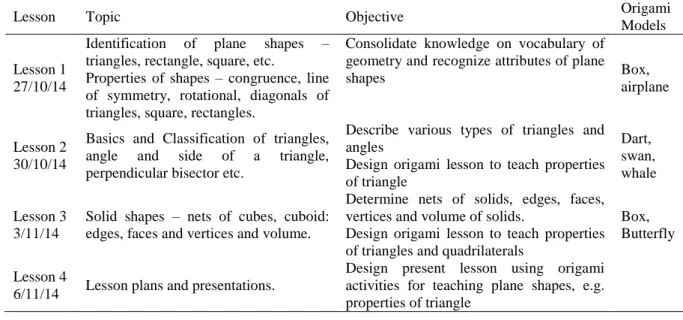
On the other hand, students in the experimental group were taught by the same teacher using origami lessons. The lessons followed procedures similar to those described by Boakes (2009) and Cakmak, Isiksal and Koc (2014). In each lesson, students were instructed to construct various origami models and discuss their geometrical properties. During the instructions, a set of folding steps were projected on the chalkboard for students to follow in creating their models. The students were encouraged to help each other to complete the models. After every folding and unfolding phase, the teacher discussed with the students the shapes formed and their properties. Upon completion, 30 minutes of each lesson was reserved for students to summarize the geometric vocabulary, concepts and properties of a given shape encountered in the origami models. These were subsequently presented on chalkboard as notes for students. In the final lesson, students were required to design and prepare a set of origami activities to teach different shape and their geometric properties as recommended in Primary school syllabus. Peer teaching practice were organized for preservice teachers to carry out these activities in peer teaching sessions in order to gain first hand teaching experiences with origami activities. In all, 6 origami models were used (Table 1). The post tests were administered in the following week. Some students’ shared their views about using origami activities in teaching shape and space on an audio tape but these are being analyzed for the subsequent phase of our research.
Table 1. Areas of instructions involving origami activities
Lesson Topic Objective Origami
Models
Lesson 1 27/10/14
Identification of plane shapes – triangles, rectangle, square, etc.
Properties of shapes – congruence, line of symmetry, rotational, diagonals of triangles, square, rectangles.
Consolidate knowledge on vocabulary of geometry and recognize attributes of plane
shapes Box,
airplane
Lesson 2 30/10/14
Basics and Classification of triangles, angle and side of a triangle, perpendicular bisector etc.
Describe various types of triangles and angles
Design origami lesson to teach properties of triangle
Dart, swan, whale
Lesson 3 3/11/14
Solid shapes – nets of cubes, cuboid: edges, faces and vertices and volume.
Determine nets of solids, edges, faces, vertices and volume of solids.
Design origami lesson to teach properties of triangles and quadrilaterals
Box, Butterfly
Lesson 4
6/11/14 Lesson plans and presentations.
Design present lesson using origami activities for teaching plane shapes, e.g. properties of triangle
Data Analysis
In order to investigate the effect of origami instruction on pre service teachers’ spatial ability and geometric knowledge for teaching, data were subjected to descriptive and inferential statistical analyses in SPSS 16.0. For descriptive analysis, mean and standard deviation of the pretests and posttests were calculated for both experimental and control groups. For inferential analysis (at ), a one-way between groups multivariate analysis of variance (MANOVA) was used to determine the effect of the independent variable at two levels (origami and conventional instructions) on the dependent variables (spatial visualization, spatial orientation and geometric knowledge). Univariate Analysis of Variance (ANOVA) was further conducted to investigate statistically significant difference in spatial ability and geometric knowledge between pre-test mean scores, between post-test mean scores and finally between pre-test and post-test mean scores of groups. To investigate statistically significant gains due to treatment conditions, the pretests were analyzed as covariates for the dependent variables. Eta squared values were calculated to determine the effect sizes.
Table 2: Shapiro Wilk’s Lambda test of normality of dependent variable
Dependent Variable Group N Shapiro-Wilk
Levene test for equality of variance
Df Statistic p F df p
Spatial Orientation Experimental 52 94 .93 .60 .01 1 .93
Control 42
Spatial Visualization Experimental 52 94 .96 .08 5.44 1 .02
Control 42
Geometric Knowledge for teaching (GKT)
Experimental 52
94 .98 .08 .69 1 .41
Control 42
Understanding Shape/ Space Experimental 52 94 .98 .11 - - -
Control 42
Furthermore, there were no serious violations for assumptions of linearity, homogeneity of variance-covariance matrices and multicollinearity. The Box’s M test ( showed equality of observed covariance matrices of the dependent variable across groups. Statistics of the Levene test for equality of variance also showed that except spatial visualization, error variance of spatial orientation and geometric knowledge for teaching were equal across groups (Table 2). In all tests, the results showed no serious violation for the assumptions needed to apply (M)ANOVA.
Results
Pairwise comparisons of the mean scores of experimental group and control group in pretests and posttests on spatial ability and GKT were computed. As shown in Table 3, the descriptive analysis of the differences between the mean scores of the pretests and the corresponding posttests showed general improvements in spatial ability and GKT in both experimental and control groups. The experimental group however had higher posttest mean score in spatial visualization than the control group. Also, the difference in mean score over the time interval of treatment for experimental group was relatively higher than that for the control group. On spatial orientation and GKT, the results indicate that the difference in mean scores for the experimental group were more than that for the control group over the treatment time interval. Also, the difference in posttest mean scores for spatial orientation and GKT were also higher favoring the experimental group.
Table 3. Group descriptive statistics of dependent variables
Dependent variable Group N Pretest Posttest Mean
Diff(MD) Max score
Mean SD Mean SD
Spatial Visualization Control 42 27.50 14.500 47.13 14.662
19.63
80 Experimental 52 31.29 13.150 52.29 11.211 21.00
Spatial Orientation Control 42 4.26 1.149 6.43 2.037 2.17 10
Experimental 52 3.77 2.114 7.73 1.848 3.96
GKT Control 42 30.52 6.929 61.42 13.616 31.84 100
Experimental 52 27.71 7.182 67.96 15.137 40.25
In terms of difference between groups prior to treatment, the MANOVA result based on pretest scores showed that there was no preexisting difference between groups regarding dependent variable. Furthermore, the univariate ANOVA results on pretest scores showed no preexisting differences between the two groups in terms of the subscales of spatial orientation
, spatial visualization and geometric
knowledge ). The results indicated that the two groups were comparable in the measures of their spatial ability and knowledge of shape and space before treatment conditions. As a result, any significant difference in posttest mean score of the dependent variable at group levels may be attributed mainly to the treatment effect.
multivariate partial eta squared using Wilk’s Lambda value of .83 on linearly independent pairwise comparisons showed that the magnitude of the difference in post-test mean scores between groups was moderate ( . This implies that some other independent variables accounted for the rest of the 83% unexplained multivariate variance in the study.
Regarding the bivariate ANOVA, the result revealed both statistical and practical significant differences ( between groups on spatial ability which composed of spatial visualization and spatial orientation skills. Univariate ANOVAs were also performed to test the impact of independent variable on spatial visualization, spatial orientation and geometric knowledge of pre service teachers. The analysis showed no statistical significant difference in posttest mean score between the experimental and control groups regarding spatial visualization . However, there were statistical significant differences in posttest mean scores between groups in spatial orientation
and GKT .
Furthermore, when the pretests were used as covariates in computing the univariate ANOVAs, the F ratio showed statistically significant gains for two subscales of the dependent variable: spatial orientation , and GKT but no statistical significant gains in the third subscale (spatial visualization) . Further analysis using the aggregate pretest mean score as covariate showed statistical significant difference in gains between groups on their aggregate posttest mean scores.
İn summary, both descriptive and inferential analyses revealed that origami instruction has influenced preservice teachers’ spatial visualization, spatial orientation and geometric knowledge for teaching more than the conventional instruction. Statistically, there was significant difference in linear combination of the measures of spatial visualization, spatial orientation and geometric knowledge between the conventional and origami instruction groups. The proportion of the variance in the dependent variable that could be explained by the independent variable was moderately high. However, the origami instruction group only differed significantly from the conventional instruction group in the measures of spatial orientation and geometric knowledge for teaching but not in that of spatial visualization.
Discussion
Whereas origami is said to have pedagogical benefits in geometry education, research is still inclusive or rather limited about its effect on the spatial ability and geometric knowledge for teaching among preservice teachers. The purpose of the study was to investigate the superiority of origami instruction over the traditional chalkboard instruction on Shape and Space among preservice teachers whose prior knowledge in geometry. In the study, the preservice teachers’ spatial orientation, spatial visualization and geometric knowledge for teaching were regarded as subscales of the dependent variable. Literature has pointed out that origami instruction could be used to address limited spatial experiences or underdeveloped geometric knowledge among primary and secondary school students. Could this be practical in the context of teacher education?
Descriptive analysis of the initial measures of spatial ability and geometric knowledge of both experimental and control groups indicated quite low geometric abilities of participants. Furthermore, the results of univariate analyses indicate that there were no statistically significant differences between the experimental and control groups in spatial orientation, spatial visualization and geometric knowledge prior to treatment conditions. The multivariate analysis also found no evidence of statistically significant difference between groups. The findings were important since any pre-existing variations in understanding shape and space may introduce possible threats from the study design rather than treatment conditions (Fraenkel & Wallen, 2006). The results however suggest that both groups were initially comparable in their understanding of shape and space. Using similar quasi-experimental design type, Awofa (2014) noted that determining variation or similarity in dependent variables between experimental and control groups, as done in the present study, was good starting point for understanding the context, pattern of result and the treatment effect. In this study, intact classes of pre service teachers were exposed to origami instruction (experimental group) and conventional instruction (control group). One unique attribute of the origami instruction observed in the study was that the origami activities created room for participants to construct their own shapes during which various abstractions and deductions were made about the shapes.
difference in post-test mean scores between groups indicated that the treatment accounted for 17% of the multivariate variance of the dependent variable. This implies other independent variables accounted for the rest of the unexplained multivariate variance in the study. Awofala (2014) claimed that aside teaching methods, independent variables such as attitudes, environmental and psychological variables could also account for variance in dependent variable like achievement scores. Nonetheless, according to Cohen (1988), an effect size greater than 10% is practically significant and hence supports the argument (Fenyvesi, Budinski & Lavicza, 2014; Arici & Aslan-Tutak, 2013; Golan, 2011; Golan, & Jackson, 2009) that origami instruction could be superior to the conventional instruction on shape and space.
Furthermore analysis using bivariate dependent variable of spatial ability again revealed statistical significant difference between groups. An effect size of about 15% was found which suggests a moderate practical significance of results. Following this finding, univariate ANOVAs was conducted and the results showed differing outcomes of the subscales of spatial visualization and spatial orientation. While no statistical significant difference in posttest mean scores on spatial visualization between groups were found, there existed both statistical and practical significant differences in posttest mean scores on spatial orientation between the groups. This result differ slightly from recent finding by Cakmak, Isiksal and Koc (2014) where 10% of the variance in the elementary students’ spatial visualization corresponding to moderate effect size was attributed to origami instruction. Perhaps, the wider difference in age of participants interacting with some contextual independent variables may have yielded the inconsistency of the finding. Nonetheless, like in their study, when the pretest was used as covariate for univariate analysis, the results revealed statistical significant gains on each posttest mean scores of spatial visualization and spatial orientation respectively. This confirms the claim (Golan, 2011; Golan, & Jackson, 2009; Boakes, 2009) that origami instruction improves students’ spatial skills in manipulating objects.
Finally, regarding GKT, the result showed substantial gains in posttest mean scores of the experimental group more than the control group when the effect of pretest was removed. The revelation that both statistical and practical significance were found in the mean scores between groups was predictable as a study by Arici and Aslan-Tutak (2013) relying on repeated measure ANOVA found similar result. Similar studies (Taylor and Tenbrink, 2013) have acknowledged that origami can promote visualization, construction and reasoning which are needed for effective geometric thinking. Notwithstanding this finding, there are previous studies (Boakes, 2009) which found that origami instruction was not significantly different from traditional instruction. Despite the difference in result, the finding in the present is regarded practically significant for the purposes of improving preservice teachers’ ability to teach shape and space. As observed in the study, an added instructional value of origami lessons was the opportunity created for preservice teachers to physically, artistically and mentally construct their own geometric models. Our further observations revealed that the origami activities also provoked inductive-deductive reasoning and created room for classroom conversations which the teacher did not anticipate.
The implication of the findings in the present study relates practically to ways of improving basic school teachers’ spatial experience and geometric knowledge for teaching Shape and Space. Indeed, the basic school teacher requires an integrated subject matter knowledge which is fundamental for teaching. As acknowledged (Ball, Thames, & Phelps, 2008), the development of teachers’ subject matter knowledge must be the basis for producing quality teachers who will in turn teach effectively upon graduation. If this is not done properly, then the quality of teachers coming out of the Colleges of Education could be threatened. This appears to be the threat facing Ghanaian teachers whose output value in geometry, from the perspective of students’ national and international achievement reports (Gunhan, 2014; Mullis, Martin & Foy, 2008; Institute of Education, 2006; 2007b) and local empirical studies (Fletcher & Anderson, 2012; Alebna, 2010; Gogoe, 2009) in recent times, has been in doubt. It can be observed that, materials for origami instructions are easy to obtain and the principles and steps guiding its use are readily available and adaptable from the internet. This means that even novice teachers could be able to employ origami approach in instructions and in the process become perfect in its use in classroom setting.
Conclusion
Recommendations
It is therefore recommended that as is done in Turkey and Isreal, colleges of education in Ghana and elsewhere should employ origami instructions to promote pre-service teachers’ spatial ability and geometric knowledge regarding shape and space. The limitations in this study relate to few validity threats noted in literature about the study design, like controlling extraneous variables and switching treatment conditions. We were also restricted to specific time slot for teaching the unit which we also thought could make the findings more suitable for classroom application. In terms of context, efforts were made to randomize and limit interaction between experimental and control groups as well as minimize Hawthorne effect by the teacher. The experimental group agreed not to discuss origami activity with the control group while the lead researcher regularly supervised the teacher’s teaching processes. We however assumed that if such interaction even occurred, it would have favored the control group which obviously did not affect the study predictions. Future study employing this study design may switch groups to treatment conditions and also extend treatment duration to help further clarify the impact of origami instruction on students’ understanding of shape and space.
References
Acquah, S. (2011). Pre-service teachers’ difficulties in learning Geometric transformations and perception of factors inhibiting the development of their Mathematical knowledge for teaching: A Case Study of Two Colleges of Education. (Unpublished master’s thesis). Department of Mathematics Education, UEW,
Ghana.
Alebna, V. (2010). Using hands-On investigations to help pre-service teachers of St. John Bosco’s College of Education discover properties of Geometrical shapes. Unpublished Thesis. Department of Mathematics Education, UEW, Ghana.
Arici, S. & Aslan-Tutak, F. (2013).The effect of origami-based instruction on spatial visualization, Geometric achievement and Geometric reasoning. International Journal of Science and Mathematics Education,13(1), 179-200.
Awofala, A. O. A. (2014). Examining personalization of instruction, attitudes toward and achievement in Mathematics word problems among Nigerian senior secondary school students. International Journal of Education in Mathematics, Science and Technology, 2(4), 273-288.
Ball, D. L., Thames, M. H. & Phelps, G. (2008). Content knowledge for teaching: What makes it Special?
Journal of Teacher Education, 59(5), 389-407.
Boakes, N. (2009). Origami Instruction in the Middle school Mathematics classroom: Its impact on spatial visualization and Geometry knowledge of students. Research in Middle Level Education Online, 32(7), 1-12.
Çakmak, S. (2009). An investigation of the effect of origami-based instruction on elementary students’ spatial ability in Mathematics (Master’s thesis). Middle East Technical University, Ankara, Turkey.
Cakmak, S., Isiksal, M. & Koc, Y. (2014). Investigating Effect of Origami-Based Instruction on Elementary Students’ Spatial skills and perceptions. The Journal of Educational Research, 107(1), 59-68.
Cohen, J. (1988). Statistical power analysis for the behavioral sciences. Hillsdale, NJ: Erlbaum.
Ekstrom, R. B., French, J. R., Harman, H. H. & Dermen, D. (1976). Manual for kit on factor-referenced cognitive tests. Princeton, NJ: Educational Testing Service.
Fenyvesi, K., Budinski, N. & Lavicza, Z. (2014). Two solutions to an unsolvable problem: Connecting origami and GeoGebra in a Serbian high school. Proceedings of Bridges 2014: Mathematics, Music, Art, Architecture, Culture, pp. 95-102.
Fletcher, J. A. & Anderson, S. (2012). Improving students’ performance in mensuration at the senior high school level using Geometer’ sketchpad. Journal of Science and Mathematics Education, 6(1), 63-79.
Fraenkel, J. R. & Wallen, N. E. (2006). How to design and evaluate research in education (5th ed.). New York: McGraw-Hill,Inc.
Georgeson, J. (2011). Fold in origami and unfold math. Mathematics Teaching in Middle School, 16(6), 354-361.
Gogoe, M. (2009). Ghanaian preservice teachers’ Geometric knowledge for teaching. (Unpublished master’s thesis). Department of Mathematics Education, UEW, Ghana.
Golan, M. & Jackson, J. (2009). Origametria: A program to teach Geometry and to develop learning skills using the art of Origami. In Origami 4: Fourth International Meeting of Origami Science, Mathematics, and Education, edited by Robert J. Lang, pp. 459–469. Wellesley, MA: A K Peters, Ltd.
Guven, B. & Kosa, T. (2008). The effect of dynamic Geometry software on student Mathematıcs teachers’ ppatial visualization Skılls. The Turkish Online Journal of Educational Technology. 7(4). 1303-6521. Gunhan, B. C. (2014). A Case Study on the investigation of reasoning skills in Geometry. South African Journal
of Education, 34(2)1-19.
Institute of Education (2005). Three- year diploma in basic education Mathematics syllabus. Cape Coast: University of Cape Coast.
Institute of Education (2006). Chief examiner’s report on the 2006 three- year post-secondary teacher training college diploma in basic education methods of teaching junior high school Mathematics examination. Cape Coast: University of Cape Coast.
Institute of Education (2007a). Chief examiner’s report on the 2007 three- year post-secondary teacher training college diploma in basic education Mathematics II (GEOMETRY & TRIGONOMETRY) Examination. Cape Coast: University of Cape Coast.
Institute of Education (2007b). Chief examiner’s report on the 2007 three- year post-secondary teacher training college diploma in basic education methods of teaching junior high school Mathematics examination. Cape Coast: University of Cape Coast.
Institute of Education (2009). Chief examiner’s report on the 2009 three- year post-secondary teacher training college diploma in basic education GEOMETRY Examination. Cape Coast: University of Cape Coast. Jones, K. (2002). Issues in the teaching and learning of Geometry In: Linda Haggarty (Ed), Aspects of Teaching
secondary mathematics: Perspectives on Practice. London: Routledg eFalmer. Pp121 - 139. ISBN: 0-415-2664-6.
Ministry of Education, Science and sports (MOESS) (2007). Mathematics Syllabus for Primary School. Accra: Ministry of Education, Science and Sports. GES: CRDD.
Mullis, I. V. S., Martin, M. O., & Foy, P. (2008). TIMSS 2007 International Mathematics Report: Findings from IEA’s International Trends in Mathematics and Science Study at Fourth and Eighth Grades. TIMSS & PIRLS International Study Center, Lynch School of Education, Boston College.
Pak, R., Rogers, W. A. & Fisk, A. D. (2006). Spatial ability sub factors and their influence on a computer-based information search task. Human Factors, 48, 154-165.
Salthouse, T. A., Babcock, R. L., Skovronek, E., Mitchell, D. R. D. & Palmon, R. (1990). Age and experience in visualization. Development psychology, 26(1), 128-136.
Sriraman, B., & English, L. D. (2005). On the teaching and learning of Dienes’ principles. International Reviews in Mathematics Education (ZDM), 37(3), 258-262.
Strutchens, M. E., Harris, K. A. & Martin, W. G. (2001). Assessing Geometric and measurement understanding using Manipulatives. Mathematics Teaching in the Middle School, 6(7),402-405.
Taylor, H. A. & Tenbrink, T. (2013). The spatial thinking of Origami: Evidence from think-aloud protocols.
Cognitive Process, 14, 189-191.
Vandergerg, S. G. & Kuse, A. R. (1978). Mental rotations, a group test for three dimensional spatial visualization. Perceptual and Motor Skills, 47, 599-604.
Author Information Peter Akayuure
Department of Mathematics Education University of Education, Winneba Box 25, Winneba, Ghana
Contact e-mail: [email protected]
S. K. Asiedu-Addo
Department of Mathematics Education University of Education, Winneba Box 25, Winneba, Ghana
Victor Alebna
Department of Mathematics,