AUSTRALIAN JOURNAL OF BASIC AND
APPLIED SCIENCES
ISSN:1991-8178 EISSN: 2309-8414 Journal home page: www.ajbasweb.com
Open Access Journal
Published BY AENSI Publication
© 2016 AENSI Publisher All rights reserved
This work is licensed under the Creative Commons Attribution International License (CC BY). http://creativecommons.org/licenses/by/4.0/
To Cite This Article: S. BrittoRaj, R. Srikkanthan and A. Sivanesh Kumar., Efficient Transmission From Node To Node with Mobile Sink in Clustering Using Sensor Node. Aust. J. Basic & Appl. Sci., 10(1): 280-286, 2016
Efficient Transmission From Node To Node with Mobile Sink in Clustering
Using Sensor Node
S. BrittoRaj, R. Srikkanthan and A. Sivanesh Kumar
Assistant Professor
Address For Correspondence: S. BrittoRaj, Assistant Professor. E-mail: [email protected]
A R T I C L E I N F O A B S T R A C T
Article history:
Received 10 December 2015 Accepted 28 January 2016 Available online 10 February 2016
Keywords:
Mobile Sinks, Tryst Nodes, Wireless Sensor Networks, Clustering, Sensor Node
An Efficient Data Transmission Protocol has influence on the energy performance on Wireless Sensor Network (WSN). A set of isolated remote areas covered by sensor nodes (SNs) monitoring environmental parameters. Mobile sinks (MSs) are fixed upon the public vehicles with fixed path tracker to collect the important data from nodes. Within the range the existing system involve either single-hop transfer of data from one node to another involving in variation of quality of service. These nodes run with possible consumption causing decreased network lifetime and loss of network connectivity. Our proposed protocol aims at minimizing the overall network overhead and energy expenditure associated with the multihop data retrieval process while also ensuring balanced energy consumption among SNs and prolonged network lifetime. This can be achieved through building cluster structures consisted of member nodes that route their measured data to their assigned cluster head (CH) and a mobile sink deployed in sensor area collects the sensory data from cluster heads through random path. CHs performs data filtering upon raw data exploiting potential spatial-temporal data redundancy and pass the filtered data to appropriate end nodes with sufficient residual energy, located in proximity to the MS’s trajectory. Simulation results confirm the effectiveness of our approach against as well as its performance gain over alternative methods.
INTRODUCTION
Recent advances in low-power wireless technologies have enabled wireless sensor networks (WSNs) in a variety of applications, such as environment detecting , coal mine monitoring, object tracing, and scientific observation. They enable people to gather data that were difficult, expensive, or even impossible to collect by using traditional approaches. Data collection is a fundamental but challenging task for WSNs, due to the constraints in communication bandwidth and energy budget. On one hand, many applications require persistent long-term data collection, since the gathered data make sense only if the data collection procedure lasts for months or even years without interruption. On the other hand, sensor nodes are often battery powered and deployed in harsh environments, hence data collection strategy must be carefully designed to reduce energy consumption on sensor nodes, so as to prolong the network lifetime as much as possible.
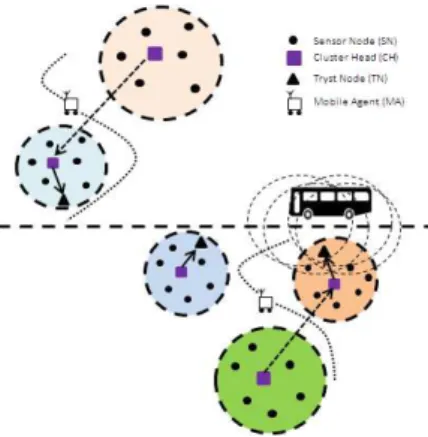
Fig. 1: Tryst sensor nodes, cluster structures, & data forwarding paths in EMC.
Large classes of monitoring applications involve a set of urban areas (e.g., urban parks or building blocks) that need to be monitored with respect to environmental parameters (e.g., temperature, moisture, pollution, light intensity), surveillance, fire detection, etc. In these environments, individual monitored areas are typically covered by isolated “sensor islands,” which makes the Mobile Agents (MAs) to traverse around and collects the data from SNs. In such cases, a number of representative nodes located in the periphery of the sensor field can be used as “Tryst” points wherein sensory data from neighbour nodes and MAs may be collected and finally delivered to an MS when the latter approaches within radio range. In this context, the specification of the appropriate number and locations of Tryst Nodes (TNs) is crucial. The number of TNs should be equivalent (neither small nor very large) to the deployment density of SNs.
Here, investigate the use of MSs for efficient data collection from “sensor islands” spread throughout urban environments. Here the ideal carriers of such MSs are public surface transportation vehicles (e.g., buses) that repeatedly follow a predefined trajectory with a periodic schedule that may pass along the perimeter of the isolated sensor fields.
Related work:
A number of approaches exploiting sink mobility for data collection in WSNs have been proposed in recent years (Nayak, A., 2010). The MS(s) may visit each SN and gather its data (single-hop communication) or may visit only some locations of the WSN and SNs send their data to MS through multihop communication. Apparently, since in the first solution only singlehop communication is required, energy consumption is minimized, however, at the expense of high data delivery delay. In the second solution, this delay is low but the energy consumption due to multihop communication is rather high. In addition, SNs should constantly be kept updated about the MS’s current location thereby creating considerable routing overhead.
A solution in between is to have SNs send first their data to a certain number of nodes (RNs) which buffer the received data and send them to MS when MS is within their transmission range or when they receive a query from MS asking for the buffered data. In the second approach, the MS does not necessarily pass near the RNs and the data stored at each RN are forwarded to MS by reversing the route of the received query packet.
Enhanced Mobile Cluster Protocol:
In this proposed methodology, a small number of mobile devices referred to as Mobile Agents (MAs) roam about sensing fields and collect data from CHs. As a result, significant network energy saving can be achieved by reducing or completely avoiding costly multi-hop wireless transmissions. On the other hand, the energy consumption of MAs is less constrained as they can replenish their energy supplies because of the mobility.
The MSs are mounted upon public buses circulating within urban environments on fixed trajectories and near-periodic schedule. Namely, sinks motion is not controllable and their routes do not adapt upon specific WSN deployments. Our only assumption is that sensors are deployed in urban areas in proximity to public transportation vehicle routes. Also, an adequate number of nodes are enrolled as TNs as a fair compromise between a small numbers which results in their rapid energy depletion and a large number which results in reduced data throughput.
Finally, SNs are grouped in separate clusters. Raw sensory data are filtered within individual clusters exploiting their inherent spatial-temporal redundancy. Thus, the overhead of multihop data relaying (inter clustering traffic) to the edge TNs is minimized. Given that the communication cost is several orders of magnitude higher than the computation cost, in-cluster data aggregation can achieve significant energy savings.
underlying assumption in this model is that nodes which are closer than a certain distance (transmission range R) can always communicate. However, in practice, a message sent by a node is received by the receiver with only certain probability even if the distance of the two nodes is smaller than the transmission range.
In the following sections, the five phases of EMC protocol are described. The first three phases comprise the setup phase while the last two comprise the steady phase. The setup phase completes in a single MS trip and during this trip, the MS periodically broadcasts BEACON messages which are used by SNs for determining a number of parameters important for the protocol operation. In the steady phase, data from SNs and MAs are routinely gathered to TNs and then sent to MS. During the steady phase, reselection of TNs and/or local re-clustering is performed in case of energy exhaustion of some critical nodes. Most importantly, these operations take place in the background without disrupting the protocol’s normal operation.
A. Clustering:
The large-scale deployment of WSNs and the need for data aggregation necessitate efficient organization of the network topology for the purpose of balancing the load and prolonging the network lifetime. Clustering has proven to be an effective approach for organizing the network in the above context. Besides achieving energy efficiency, clustering also reduces channel contention and packet collisions, resulting in improved network throughput under high load (Mamalis, B., 2009). Our clustering algorithm borrows ideas from the algorithm of Chen et al. [4]to build a cluster structure of unequal clusters. The clustering algorithm in (Li, C., 2005) constructs a multisized cluster structure, where the size of each cluster decreases as the distance of its cluster head from the base station increases. This paper slightly modifies the approach of (Stojmenovic, I., S. Olariu, 2006) to build clusters of two different sizes depending on the distance of the CHs from the MS’s trajectory. Specifically, SNs located near the MS trajectory are grouped in small sized clusters while SNs located farther away are grouped in clusters of larger size.
The CHs near the MS trajectory are usually burdened with heavy relay traffic coming from other parts of the network. By maintaining the clusters of these CHs small, CHs near the MS trajectory are relatively relieved from intracluster processing and communication tasks and thus they can afford to spend m ore energy for relaying intercluster traffic to TNs. Fig. 4.1 Rendezvous sensor nodes, cluster structures, and data forwarding paths in Enhanced Mobile Cluster (EMC). Unequal cluster formation in Enhanced Mobile Cluster (EMC). During an initialization phase, the MS moves along its fixed trajectory broadcasting periodically a BEACON signal to all SNs at a fixed power level.
All nodes near the MS trajectory receive the BEACON message and thus they know that the clusters in their region will be small sized. Then, these nodes flood the BEACON message to the rest of the network. A detailed description of the clustering algorithm which is executed right after the MS completes its first trip. The message complexity of this phase as well as of all other phases of Enhanced Mobile Cluster (EMC). As soon as the clustering phase finalizes, each CH proceeds to the selection of the appropriate cluster member(s) to serve as TN(s). As discussed in the following section, not every CH can find such a set of TNs.
B. TNs Selection:
TNs guarantee connectivity of sensor islands with MSs; hence, their selection largely determines network lifetime. TNs lie within the range of traveling sinks and their location depends on the position of the CH and the sensor field with respect to the sinks trajectory. Suitable TNs are those that remain within the MS’s range for relatively long time, in relatively short distance from the sink’s trajectory and have sufficient energy supplies. In practical deployments, the number of designated TNs introduces an interesting trade-off:
A large number of TNs implies that the latter will compete for the wireless channel contention as soon as the mobile robot appears in range, thereby resulting in low data throughput and frequent outages.
A small number of TNs implies that each TN is associated with a large group of sensors. Hence, TNs will be heavily used during data relays, their energy will be consumed fast and they will be likely to experience buffer overflows.
To regulate the number of TNs and prevent either their rapid energy depletion or potential data losses, in this it proposes a simple selection model whereby a set of cluster members (in vicinity to the MS’s trajectory) from each cluster is enrolled as TNs. TN’s role may be switched among cluster members when the energy level of a node currently serving as TN drops below a prespecified threshold. As mentioned earlier, MSs follow a fixed trajectory. We argue that the euclidean distance among SNs and the MS should not be used as the only factor for selecting TNs. In addition to lying in a short distance from MS trajectories, the best candidates TNs are the SNs with sufficient residual energy that receive a relatively high number of BEACON packets. To count
the number of received BEACON packets, when a SN v receives the ith BEACON, it increases a BEACON
counter nb by one, records the receipt time ti, the signal strength si and restarts a “Connection Dropped Timer”
set equal to 3 .Tbeacon (which allows up to two BEACON packets lost due to channel error). The SN v also keeps
expires the node assumes that the MS has moved away and the BEACON counter value is finalized. Assume that when the sink moves away it does not return within the node’s range during the same traversal.
C. CHs Attachment to TNs:
Note that not every CH u has a nonempty Ru set associated with it. CHs located far from the MS trajectories
do not have any TNs within transmission range. An important condition for building intercluster overlay graphs
is that CHs with no attached TNs, attach themselves to a CH u with nonempty Ru set so as to address their
clusters’ data to u. It is noted that our approach typically requires a single MS trip to collect (through the receipt of BEACON messages) the information needed to execute the setup phase. Clustering starts upon the completion of the first MS trip.
The TNs’ selection process commences immediately afterward (the information needed for the execution of this phase, i.e., the number of beacons, their receipt time, and signal strength is also collected during the first MS trip). CHs attachment to TNs follows next. All these phases complete in reasonably short period of time, typically within the time interval between two successive bus trips. As soon as the setup phase finalizes, sensory data collected at CHs from their attached cluster members are forwarded toward the TNs following an intercluster overlay graph (see Fig. 1). The selected transmission range among CHs may vary to ensure a certain degree of connectivity and to control interference.1
D. Data Aggregation and Forwarding to the TNs:
The steady phase of Enhanced Mobile Cluster (EMC) protocol starts with the periodic recording of
environmental data from sensor nodes with a Tr period. The data accumulated at individual source nodes are
sent to local CHs (intracluster communication) with a Tc period (typically, Tc is a multiple of Tr). CHs perform
data processing to remove spatial-temporal data redundancy, which is likely to exist since cluster members are located maximum two hops away. CHs then forward filtered data toward remote CH they are attached to. Alongside the intercluster path, a second-level of data filtering may apply. Upon reaching the end CH u, filtered data are forwarded to u’s local TNs in a pipeline fashion.
In the case that multiple TNs exist in that cluster, data are not equally distributed among them. Instead, the
CH favors the data delivery by the most suitable TNs, i.e., those with highest competence value (Compval). Data
distribution among TNs should ensure that each TN will be able to accommodate its assigned data, i.e., to deliver all its buffered data and not experience an outage. Hence, CH u sorts the TNs in its Ru set in Compval
decreasing order and delivers to each TN node vi 2 Ru the maximum amount of data Di it can accommodate,
minus an “outage prevention allowance” amount O.
The Di value is calculated taking into account the TN’s data rate ri and the length li of the time interval [vi.Tfirst, vi.Tlast] that vi remains within the MS’s range. The process is repeated for each vi ϵ Ru until all data available at u are distributed among its TNs. The algorithm executed by each CH u for distributing data to the TNs attached to it, follows (Algorithm DATA_ DISTRIBUTION):
E. Communication between TNs and Mobile Sinks:
The last phase of Enhanced Mobile Cluster (EMC) protocol involves the delivery of data buffered to TNs to MSs. Data delivery occurs along an intermittently available link; hence, a key requirement is to determine when the connectivity between an TN and the MS is available. Communication should start when the connection is available and stop when the connection no longer exists, so that the TN does not continue to transmit data when the MS is no longer receiving it. To address this issue, it uses an acknowledgment-based protocol between TNs and MSs.
The MS, in all subsequent path traversals after the setup phase, periodically broadcasts a POLL packet, announcing its presence and soliciting data as it proceeds along the path. The POLL is transmitted at fixed intervals Tpoll (typically equal to Tbeacon). This POLL packet is used by TNs to detect when the MS is within connectivity range. The TN receiving the POLL will start transmitting data packets to the MS. The MS acknowledges each received data packet to the TN so that the TN realizes that the connection is active and the data were reliably delivered.
needed, in order to distribute energy consumption among SNs by swapping the roles of the nodes (from CH to cluster member and vice versa).
This way the reclustering control overhead is localized, avoiding frequent global reclustering that causes the network to be in an unstable stat. On the other hand, applying only local reclustering may lead after a certain period of time which is application specific, to a nonoptimal—according to the criteria set by Enhanced Mobile Cluster (EMC)—clustered infrastructure and inter-clustered overlay graph. Then, the setup phase of Enhanced Mobile Cluster (EMC) is reexecuted to rebuild “optimal” cluster structures. Note that there is a trade-off in determining how often the setup phase will be executed, which is application dependent (e.g., object tracking or query-based applications).
Note that although our clustering algorithm borrows ideas from the algorithm of Chen et al. [4]to build a cluster structure, an entirely different approach than that of [4]is followed for intercluster routing and data transmission to the MS. In particular, new sophisticated methods are proposed for enrolling appropriate nodes as TNs, building adaptable intercluster overlay graphs, fairly distributing sensory data among TNs and delivering these data to the MS in nonintersecting time windows.
Simulation:
In this section, the performance of EMC is compared with distributed clustering algorithm, where CHs relay data to a sink node via multihop routing. It has an iterative CH selection mechanism in which the probability for each node to become a CH depends on its residual energy. When a CH candidate is not selected as a CH node in a round, it doubles its probability of selection so that it will have a better chance in the next round.
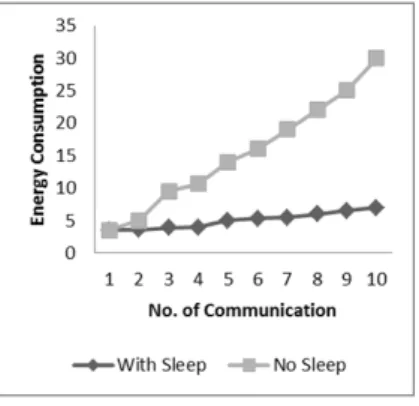
Fig. 2: Residual Energy Consumption.
We evaluate the performance of Mobile sink and Enhanced Mobile Clustering Algorithm using Network simulator with the 100-node network in a play field of size 100m x 100m. The base station is located at position (50,200) and the initial energy per node is the random number of [2J, 5J]. For simplicity, we assume the probability of signal collision and interference in the wireless channel is ignorable. We compare the performance of Enhanced Mobile Clustering Algorithm with three important clustering algorithms. Fig.2 shows the relationship between the number of node death and the network runtime (rounds). We see that, in addition to LEACH, the curve of the other three algorithms is gentle, which demonstrates their methods of cluster head selection enable the balanced energy dissipation among the sensor nodes. The other three algorithms, however, by using strategy of probabilistic based clustering, are prone to partition the adjacent nodes with similar sensed data into several clusters, thus increase the energy consumption of wasteful message transmission. Similarly, we have placed some Cluster head nodes with the help of election algorithm method .We have applied our algorithm to form k clusters in a mobility manner, such that the total square of the distances between sensors in a cluster and the corresponding cluster head node, over all clusters is minimized. The number of cluster head nodes depends on the capacity constraint of each of them. We can avoid the maximum redundant data transmission in the network through the high rate of data aggregation in clusters. The above process is a problem of complicate random search which is in general NP-hard. GA (genetic algorithm) is a good random search method normally used to solve NP-hard problems.
Last, MobiCluster achieves reduced average energy consumption (see Fig. 3). For the basic scenario, this is due to clustering and the higher aggregation ratio achieved.
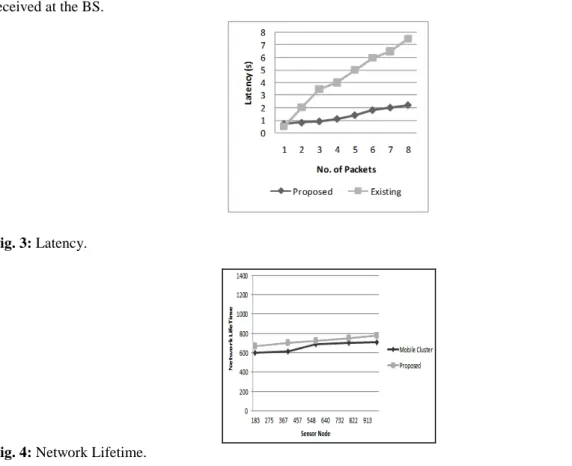
Clustering Algorithm with the other two algorithms. It is obvious to see that Mobile based Clustering algorithm has the highest rate of data aggregation, which ensures the maximum reduction of the total amount of data received at the BS.
Fig. 3: Latency.
Fig. 4: Network Lifetime.
Conclusion:
This paper introduced Enhanced Mobile Cluster, a algorithm that proposes the use of urban buses to carry MSs that retrieve information from isolated parts of WSNs. Enhanced Mobile Cluster mainly aims at maximizing connectivity, data throughput, and enabling reasonable energy expenditure among SNs. The connectivity idea is addressed by employing MSs to collect data from isolated urban sensor islands and also through prolonging the lifetime of selected peripheral TNs which lie within the range of ephemeral MSs and used to cache and deliver sensory data derived from remote source nodes. Increased data throughput is ensured by regulating the number of TNs for allowing sufficient time to deliver their buffered data and preventing data losses. Unlike further approaches, Enhanced Mobile Cluster moves the processing and data transmission burden away from the vital periphery nodes (TNs) and enables balanced energy consumption across the WSN through building cluster structures that exploit the high redundancy of data collected from neighbor nodes and minimize intercluster data in the clouds. The performance gain of Enhanced Mobile Cluster over different approaches has been validated by widespread simulation tests.
REFERENCES
Aristides Mpitziopoulos, Charalampos Konstantopoulos, Grammati Pantziou, Damianos Gavalas, and Basilis Mamalis, 2012. “A Rendezvous-Based Approach Enabling Energy-Efficient Sensory Data Collection with Mobile Sinks”, IEEE Transactions on parallel and distributed systems, 23-5.
Nayak, A., X. Li, I. Stojmenovic, 2010. “Sink Mobility in Wireless Sensor Networks,” Wireless Sensor and Actuator Networks, A. Nayak, I. Stojmenovic, eds., Wiley.
Mamalis, B., D. Gavalas, C. Konstantopoulos, and G. Pantziou, 2009. “Clustering in Wireless Sensor Networks,” RFID and Sensor Networks: Architectures, Protocols, Security and Integrations, Y. Zhang, L.T. Yang, J. Chen, eds., 324-353, CRC Press.
Li, C., G. Chen, M. Ye, J. Wu., 2007. “An Unequal Cluster-Based Routing Protocol in Wireless Sensor Networks,” Wireless Networks, 15: 193-207.
Stojmenovic, I., S. Olariu, 2006. “Design Guidelines for Maximizing Lifetime and Avoiding Energy Holes in Sensor Networks with Uniform Distribution and Uniform Reporting,” Proc. IEEE INFOCOM.
Di Francesco, M., S.K. Das and G. Anastasi, 2011. Data collection in wireless sensor networks with mobile elements: A survey. ACM Trans.Sen.Netw, 8(1), 7: 1-7:31.
Szymanski, M., T. Breitling, J. Seyfried and H. Wörn, 2006. "Distributed shortest-path finding by a micro-robot swarm," in Ant Colony Optimization and Swarm Intelligence, M. Dorigo, L. Gambardella, M. Birattari, A. Martinoli, R. Poli and T. Stützle, Eds. Berlin/ Heidelberg: Springer.
Ma, M. and Y. Yang, 2008. “Data gathering in wireless sensor networks with mobile collectors,” in Parallel